Quick Summary: Karatepe-Aslantaş is a fortified Neo-Hittite (Late Hittite) citadel overlooking the Ceyhan River valley in Osmaniye Province, built in the 8th century BC by King Azatiwada of the city-state of Adanawa (Hiyawa). The site is world-famous for its bilingual inscription — the longest parallel text in Phoenician and Luwian hieroglyphs ever found — which served as the key to deciphering Anatolian hieroglyphic script. Richly carved basalt reliefs of lions, sphinxes, banquet scenes, and mythological figures line the two monumental gates. Karatepe-Aslantaş has been an open-air museum since the 1960s, and its inscriptions were added to the UNESCO Memory of the World Register in 2025.
- Why Karatepe-Aslantaş Matters
- Geography and Setting
- Historical Background
- King Azatiwada and the Adanawa Kingdom
- The Bilingual Inscription
- The Monumental Gates
- Sculptural Reliefs
- The Fortification System
- Discovery and Excavation
- Halet Çambel and Helmuth Bossert
- Decipherment of Luwian Hieroglyphs
- UNESCO Recognition
- The Open-Air Museum
- Visitor Information
- Frequently Asked Questions
- Sources and Further Reading
Why Karatepe-Aslantaş Matters
Karatepe-Aslantaş occupies a singular place in the history of ancient Near Eastern studies. Its bilingual inscription — presenting the same royal text in both Phoenician alphabetic script and Luwian hieroglyphic script — provided the decisive key for the decipherment of Anatolian hieroglyphs, much as the Rosetta Stone unlocked Egyptian hieroglyphs. Before Karatepe, scholars could read only fragments of the hieroglyphic Luwian script used across Anatolia and northern Syria from the 2nd to 1st millennium BC. After the discovery, the entire corpus became accessible.
Beyond epigraphy, Karatepe is significant as one of the best-preserved Neo-Hittite fortified settlements in Turkey. The two monumental gates, with their basalt orthostats carved with lions, sphinxes, banquet scenes, and mythological narratives, survive largely in situ — a rare situation that allows visitors to experience a Late Iron Age entrance complex much as it was designed.
The inscriptions themselves document a critical moment in writing history: the transition from syllabic scripts (cuneiform and hieroglyphic) to alphabetic writing (Phoenician, then Greek). The Phoenician text at Karatepe represents one of the longest known Phoenician inscriptions and demonstrates the spread of alphabetic literacy into Anatolia.
In 2025, the inscriptions were inscribed on the UNESCO Memory of the World International Register, recognising their global significance for the history of writing.
Geography and Setting
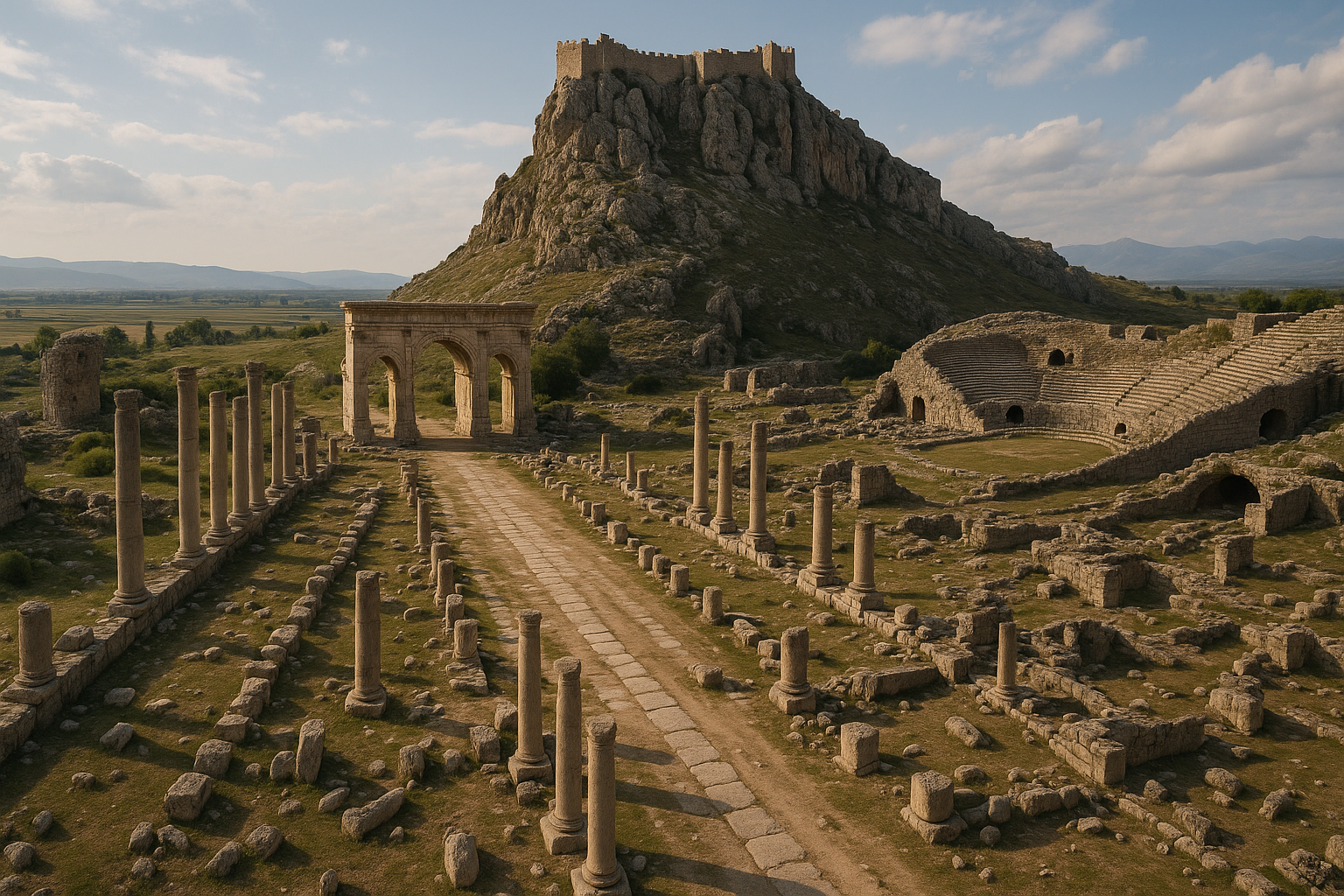
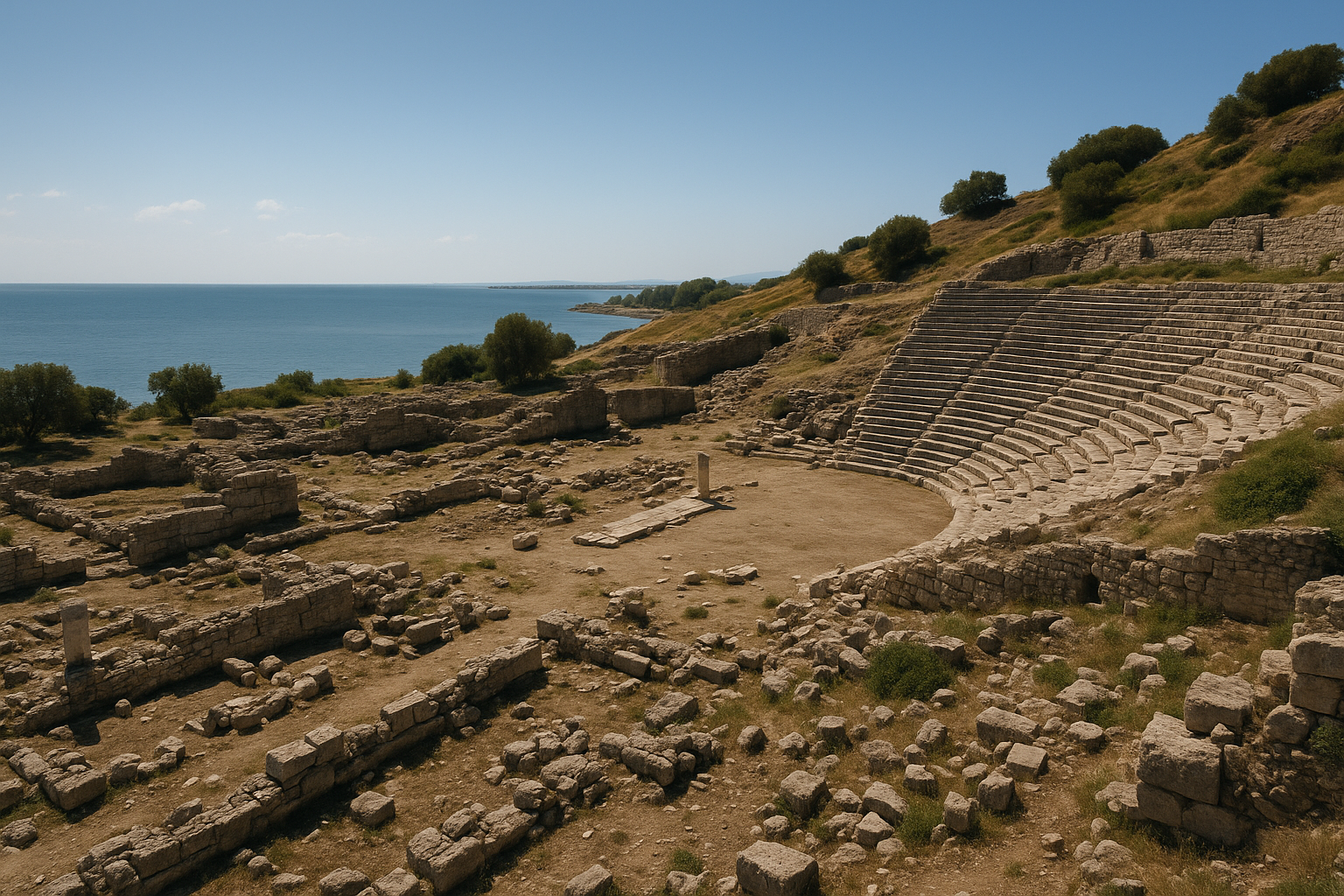
Karatepe sits on a forested hilltop overlooking the Ceyhan River (ancient Pyramus) at the point where it exits the Taurus Mountains through the narrow gorge of the Aslantaş Dam area, approximately 23 km north-east of Kadirli in Osmaniye Province.
The strategic position is immediately apparent: the citadel commands the river passage from the Cilician coastal plain into the interior highlands. Any traffic — military, commercial, or pastoral — moving between the Mediterranean lowlands and the Anatolian plateau had to pass this point. Azatiwada's inscription explicitly describes the fortress as protection "against raids from the north."
The surrounding landscape is a transition zone between the Mediterranean coastal region and the continental interior. The hills are covered in pine and maquis forest, and the Ceyhan River provides a fertile valley floor. The Aslantaş Dam (built in the 1980s) now floods part of the valley downstream, but the citadel hill remains well above the water level.
Historical Background
The Neo-Hittite Period
After the fall of the Hittite Empire around 1180 BC, the political landscape of southeastern Anatolia and northern Syria fragmented into a mosaic of small kingdoms often called Neo-Hittite (or Syro-Hittite) states. These kingdoms — including Carchemish, Sam'al (Zincirli), Gurgum, Que, and Adanawa — preserved elements of Hittite culture, language, and artistic tradition while absorbing Aramean, Phoenician, and Assyrian influences.
The region that became Karatepe's territory was part of the kingdom of Adanawa (also called Hiyawa), centred on the Cilician plain — roughly the area of modern Adana and the eastern Çukurova. Adanawa maintained independence or semi-independence until the Assyrian campaigns of the late 8th century BC.
Iron Age Cilicia
The Cilician plain was one of the most agriculturally productive regions of the ancient Near East. Control of the river valleys and mountain passes made the Neo-Hittite kingdoms of this area wealthy and strategically important. The competition between Assyria, Urartu, Phrygia, and the local states shaped the political history of the 8th and 7th centuries BC.
King Azatiwada
The citadel was built by Azatiwada (also rendered as Azatiwataš or Azatiwatas), who ruled as the "lord" of a fortress-city under the authority of Awariku, king of Adanawa. Azatiwada's inscription — one of the most detailed royal texts from the Neo-Hittite world — reveals a complex political self-presentation:
- He calls himself "blessed by Ba'al" and servant of the storm-god
- He describes himself as a loyal subordinate of King Awariku (Urikki in Assyrian sources)
- He credits himself with bringing peace, prosperity, and agricultural abundance to the Adanawa lands
- He claims to have extended the kingdom's borders and filled the granaries
- He built the fortress-city Azatiwataya (the city of Azatiwada) to protect the plain from northern raiders
- He invokes divine curses against anyone who would destroy his inscriptions or alter his name
The text is remarkable for its self-justifying rhetoric, which echoes the propaganda patterns of both Hittite royal inscriptions and Phoenician royal dedications. Azatiwada presents himself as a good shepherd, bringing blessing through strong rule.
Chronological Debate
The dating of Azatiwada's reign is debated. Most scholars place it in the late 8th century BC (approximately 740–710 BC), during the period when Assyrian pressure on the region was intensifying. Awariku (Urikki) is attested in Assyrian records as a vassal who submitted to Tiglath-Pileser III around 738 BC.
The Bilingual Inscription
The Karatepe bilingual is the longest known parallel text in Phoenician and Luwian hieroglyphs. The same royal proclamation appears in both scripts on the orthostats (upright stone slabs) lining the two monumental gates of the citadel.
The Phoenician Text
The Phoenician version is written in the standard Northwest Semitic alphabetic script — 22 consonantal letters written right to left. It is one of the longest Phoenician inscriptions known from the ancient world and demonstrates that Phoenician alphabetic writing was in active use in Cilicia, far from the Levantine coast.
The Luwian Hieroglyphic Text
The hieroglyphic version uses the indigenous Anatolian script system known as Luwian hieroglyphs (formerly called "Hittite hieroglyphs"). This pictographic/logographic script was used from the Late Bronze Age through the Iron Age across Anatolia and northern Syria for monumental royal inscriptions.
Why the Bilingual Was Decisive
Before Karatepe, the decipherment of Luwian hieroglyphs had progressed haltingly. Scholars could identify some logographic signs but could not confirm their readings phonetically. The Karatepe bilingual provided:
- Proper names appearing in both scripts, confirming phonetic values
- Parallel passages that established the meaning of previously unknown hieroglyphic signs
- Grammatical structures in Luwian that could be compared with the known Phoenician grammar
- Ideographic signs whose meaning could now be fixed through context
The impact was comparable to the Rosetta Stone's role in Egyptology: it transformed a partially understood script into a largely readable one. Within a few years of the publication of the Karatepe texts, the entire corpus of Luwian hieroglyphic inscriptions from across Anatolia and Syria became accessible to scholars.
The Monumental Gates
Karatepe has two monumental gates — the North Gate and the South Gate — each consisting of a passage flanked by orthostats (upright carved stone slabs) bearing inscriptions and relief sculptures.
North Gate
The North Gate is the more elaborate of the two. Its features include:
- Paired lion sculptures flanking the outer entrance — the lions are striding forward with mouths open, functioning as both guardians and symbols of royal power
- Orthostats with the Phoenician text along the left wall and Luwian hieroglyphic text along the right
- Relief panels depicting banquet scenes, musicians, animal combat, and mythological narratives
- A sphinx figure at the inner entrance
South Gate
The South Gate complements the North Gate with:
- Paired lion sculptures at the entrance (the "Aslantaş" — lion stones — that give the site its Turkish name)
- Additional relief orthostats with both inscriptions and figural scenes
- Guardian figures and decorative panels
Both gates are oriented to control access to the citadel from the river valley below. The pairing of two inscribed and sculpted gates is unusual in Neo-Hittite architecture and suggests that Azatiwada intended visitors approaching from either direction to encounter his royal proclamation.
Sculptural Reliefs
The basalt orthostats at Karatepe bear some of the most vivid Neo-Hittite relief sculpture in existence. The subject matter includes:
Banquet and Festival Scenes
- A king or nobleman seated at a banquet table with musicians playing lyre, double flute, and drums
- Servants bringing food and drink
- Dancers and acrobats performing
These scenes likely depict the religious festivals that Azatiwada claims to have instituted in his inscription, and they provide rare visual evidence of Iron Age music, food culture, and court life.
Animal Scenes
- Lions attacking bulls — a classic Near Eastern motif symbolising royal power overcoming chaos
- Deer hunts — the king or warriors pursuing game
- Goats and cattle — possibly representing the agricultural prosperity Azatiwada claims to have brought
Mythological and Religious Scenes
- Bes-like figures — dwarf-like protective deities derived from Egyptian iconography, showing the reach of international cultural exchange
- Storm god imagery — consistent with the inscription's emphasis on the storm god's protection
- A nursing mother figure — possibly a goddess or fertility symbol
- Winged solar disk — a Near Eastern symbol of divine kingship
Guardian Figures
- Sphinxes — human-headed winged lions, a motif shared with Assyrian, Hittite, and Levantine traditions
- Lions — positioned at gate entrances as supernatural protectors
The artistic style blends Hittite, Assyrian, Phoenician, and North Syrian elements, reflecting the cosmopolitan cultural environment of Iron Age Cilicia.
The Fortification System
The citadel occupies the entire summit of the hill, enclosed by a circuit wall with towers and the two monumental gates:
- Walls: Built of rough stone with an earth fill core, following the contours of the hilltop
- Towers: Rectangular projecting towers at intervals along the walls
- Gates: The two elaborate entrances (North and South) are the only points of access
- Interior: The enclosed area contained domestic structures, storage facilities, and possibly an administrative building or small palace
The fortress was designed as a border fortification protecting the Cilician plain from raids through the Taurus mountain passes. Its elevated position provides excellent visibility over the river valley and surrounding terrain.
Discovery and Excavation
First Report (1890)
The German scholar Felix von Luschan, working on the nearby Zincirli (Sam'al) excavations, received reports of carved stones at Karatepe and noted the site in his publications. However, the remote location and dense forest cover prevented immediate investigation.
Rediscovery (1946)
The decisive rediscovery came in 1946 when Turkish teacher Ekrem Kuşçu reported the carved stones to the archaeologist Helmuth Theodor Bossert (1889–1961), a German-born scholar working at Istanbul University. Bossert visited the site with his assistant Halet Çambel (1916–2014) and immediately recognised the importance of the bilingual inscription.
Excavations (1947–1957)
Systematic excavation was conducted from 1947 to 1957 under Bossert's direction, with Çambel as field director. The team:
- Uncovered both monumental gates with their orthostats in situ
- Documented the full extent of the bilingual inscription
- Excavated the fortification walls and interior structures
- Published preliminary reports that electrified the world of Near Eastern studies
The excavation was notable for its decision to leave the relief orthostats in their original positions rather than removing them to a museum — a pioneering approach to in-situ conservation that was ahead of its time.
Halet Çambel and Helmuth Bossert
The two scholars most associated with Karatepe are:
Helmuth Theodor Bossert (1889–1961)
A German art historian and Near Eastern specialist who fled Nazi Germany and settled in Turkey. Bossert held a chair at Istanbul University and was instrumental in developing Turkish archaeology. He immediately grasped the significance of the Karatepe bilingual and devoted his remaining years to its study and publication.
Halet Çambel (1916–2014)
One of Turkey's most distinguished archaeologists — and the first Turkish woman to compete at the Olympic Games (fencing, Berlin 1936). Çambel served as field director at Karatepe from 1947, led the excavations after Bossert's death in 1961, and continued working at the site for decades. She was instrumental in establishing the open-air museum and fought to preserve the site from damage caused by the Aslantaş Dam construction in the 1980s.
Çambel's commitment to Karatepe spanned over 60 years — one of the longest continuous associations between an archaeologist and a single site in the history of the discipline. She received numerous awards including the Prince Claus Award (2004) for her conservation work.
Decipherment of Luwian Hieroglyphs
The impact of the Karatepe bilingual on the decipherment of Luwian hieroglyphs cannot be overstated:
Before Karatepe
- Luwian hieroglyphs had been known since the 19th century from monuments across Anatolia and Syria
- Some logographic signs could be tentatively read, but phonetic values were uncertain
- Key breakthroughs by scholars like Ignace Gelb, Piero Meriggi, and Emmanuel Laroche had identified basic structural features
- But without a bilingual, full decipherment remained impossible
After Karatepe
- The Phoenician parallel provided the contextual framework to confirm and correct earlier readings
- Proper names like Azatiwada, Awariku, and geographical terms could be cross-checked between scripts
- Within 5–10 years, the decipherment progressed from partial to substantially complete
- The entire corpus of Luwian hieroglyphic inscriptions — from Hattusa to Carchemish, from Aleppo to Karaman — became readable
Significance for Writing History
The inscriptions also illuminate a crucial transition: from syllabic writing systems (cuneiform and hieroglyphic) to alphabetic writing (Phoenician, then Greek). Karatepe shows these two systems coexisting in a single monument, reflecting the moment when the Phoenician alphabet was spreading through the eastern Mediterranean and displacing older, more complex scripts.
UNESCO Recognition
In 2025, the Karatepe-Aslantaş inscriptions were inscribed on the UNESCO Memory of the World International Register, joining documents of global significance such as the Gutenberg Bible, the Bayeux Tapestry, and the archives of the French Revolution.
The UNESCO citation recognises the inscriptions as:
- Among the oldest known long texts in both Phoenician and Luwian
- The key to deciphering Anatolian hieroglyphic script
- Evidence of a critical moment in the transition from syllabic to alphabetic writing
- A monument to intercultural exchange in the ancient Eastern Mediterranean
Karatepe-Aslantaş is also on Turkey's UNESCO World Heritage Tentative List, nominated for its archaeological and art-historical significance.
The Open-Air Museum
Karatepe-Aslantaş has operated as an open-air museum since the 1960s, following the pioneering conservation philosophy of Halet Çambel. Key features:
- The relief orthostats remain in their original positions at both gates — visitors see them exactly where Azatiwada placed them 2,700 years ago
- Protective shelters cover the most vulnerable sculptures
- Walking paths connect the North Gate, South Gate, and fortification walls
- The hilltop setting within Karatepe-Aslantaş National Park provides a forested, atmospheric environment
- Information panels explain the inscriptions, reliefs, and historical context
The in-situ presentation makes Karatepe uniquely evocative among Neo-Hittite sites. Unlike museums where orthostats are displayed in galleries, here the sculptures remain embedded in the architectural context for which they were designed.
Visitor Information
Location: Karatepe-Aslantaş National Park, approximately 23 km north-east of Kadirli, Osmaniye Province.
Getting There: By car from Kadirli (30 minutes) or Osmaniye (45 minutes). The road through the national park is paved. There is no public transport directly to the site — a car or taxi is necessary.
Hours: Daily, typically 08:00–17:00 (winter) or 08:00–19:00 (summer). Closed on certain national holidays.
Admission: Entrance fee applies. Museum Pass is valid.
Duration: 1.5–2.5 hours for a thorough visit including both gates, the walls, and the hilltop viewpoints.
Facilities: Small visitor centre with information panels. Picnic areas within the national park. Limited food and drink facilities — bring supplies.
Combined Visits:
- Kadirli — local market town (30 min)
- Kastabala (Hierapolis) — Roman city with colonnaded street and castle (25 km south)
- Dülük (Doliche) — sanctuary of Jupiter Dolichenus (90 km east)
- Anavarza (Anazarbos) — spectacular Roman/medieval city (60 km south-west)
Tips:
- The site is in a national park — the forest setting is beautiful, especially in spring and autumn
- Wear comfortable walking shoes for the hillside paths
- The North Gate is the most impressive — spend extra time there
- Early morning or late afternoon light is best for photographing the reliefs
- Mosquitoes can be a problem near the river in summer — bring repellent
- The bilingual inscription can be difficult to read without preparation — study the text beforehand or use the information panels
Frequently Asked Questions
What does "Karatepe-Aslantaş" mean? "Karatepe" means "Black Hill" in Turkish. "Aslantaş" means "Lion Stone," referring to the lion sculptures at the gates.
Why is the bilingual inscription so important? It provided the key to deciphering Luwian hieroglyphs — the script used for monumental inscriptions across Anatolia and northern Syria for over a thousand years. It served the same function as the Rosetta Stone for Egyptian hieroglyphs.
Who was Azatiwada? A Neo-Hittite ruler who governed a fortress-city under the authority of King Awariku of Adanawa (Hiyawa). He built the Karatepe citadel in the late 8th century BC to protect the Cilician plain from northern raids.
Are the original reliefs still in place? Yes — this is one of the site's most remarkable features. The orthostats with their reliefs and inscriptions remain in their original positions at both gates, covered by protective shelters.
Is Karatepe-Aslantaş a UNESCO World Heritage Site? Its inscriptions were added to the UNESCO Memory of the World Register in 2025. The archaeological site is on Turkey's UNESCO World Heritage Tentative List.
How does it compare to other Neo-Hittite sites? Karatepe is unique for its bilingual inscription and in-situ preservation. For comparison: Zincirli (Sam'al) has larger-scale architecture, Carchemish has more elaborate sculpture, and Ain Dara has a better-preserved temple — but none has a comparable bilingual text.
Can I combine it with other ancient sites? Yes — Kastabala, Anavarza, and Dülük are all within day-trip range. The eastern Cilicia region has an exceptional concentration of ancient sites.
Fortification Measurements and Structural Data
The Karatepe-Aslantas citadel has been precisely surveyed, yielding detailed dimensional and structural data.
Citadel Plan
| Parameter | Measurement |
|---|---|
| Citadel footprint | 196 x 376 m (approximately 7.4 hectares) |
| Orientation | Northeast--southwest, aligned with the Ceyhan River course and the Akyol caravan route |
| Wall construction | Rough stone with earth-fill core, following the natural contours of the hilltop |
| Defensive towers (planned) | 34 rectangular bastions on the circuit wall |
| Defensive towers (identified) | 28 bastions confirmed through excavation |
| Tower spacing | Regular intervals of 18--20 m along the curtain wall |
| Gate complexes | 2 (North Gate and South Gate), the only points of access |
The regular spacing of bastions every 18--20 metres indicates systematic military-engineering planning. The six unlocated towers may have been destroyed by erosion or by later disturbance, or they may represent planned but unfinished construction.
Orthostat Programme
The interior faces of both gate passages are lined with basalt orthostats -- upright carved stone slabs supporting the lower courses of the mud-brick superstructure. Basalt was deliberately chosen over the locally available limestone for its durability, weather resistance, and darker visual impact, lending the inscriptions and reliefs a monumental gravitas.
| Gate | Inscription Script (Left Wall) | Inscription Script (Right Wall) | Number of Relief Panels | Guardian Figures |
|---|---|---|---|---|
| North Gate | Phoenician alphabetic | Luwian hieroglyphic | Multiple figural and narrative orthostats | Paired striding lions (outer entrance); sphinx (inner entrance) |
| South Gate | Phoenician / Luwian | Luwian / Phoenician | Additional figural and narrative orthostats | Paired lion sculptures ("Aslantas" -- lion stones) |
The North Gate's relief programme includes a galley scene with oarsmen -- a maritime motif unexpected at an inland mountain fortress, possibly reflecting Adanawa's access to Mediterranean trade via the Ceyhan River valley. Other panels depict warriors battling lions, a mother nursing a child beneath a tree, and the Hittite sun-god with a winged solar disk.
Inscription Analysis: Phoenician and Luwian Texts
The bilingual inscription is not merely a translation; it represents the earliest known bilingual narrative on an architectural monument in the Ancient Near East and the Mediterranean. Both scripts deliver the same royal proclamation by Azatiwada, but with subtle differences in emphasis and divine invocations that reflect the distinct cultural audiences of each language.
Phoenician Text Statistics
| Parameter | Detail |
|---|---|
| Script type | Northwest Semitic alphabetic (22 consonantal letters, right-to-left) |
| Status | The longest extant Phoenician inscription known from the ancient world |
| Language | Standard Phoenician with some Luwian loanwords |
| Cultural significance | Demonstrates active use of Phoenician alphabetic literacy far from the Levantine coast, deep into Anatolia |
Luwian Hieroglyphic Text Statistics
| Parameter | Detail |
|---|---|
| Script type | Anatolian hieroglyphic (pictographic-logographic-syllabic mixed system) |
| Status | The longest extant Luwian hieroglyphic inscription known from any site |
| Decipherment impact | Confirmed phonetic values for dozens of previously uncertain signs; enabled reading of the entire Luwian hieroglyphic corpus from Hattusa to Aleppo |
| Key names confirmed bilingually | Azatiwada, Awariku (Urikki), Ba'al, the storm-god, Adanawa geographical terms |
The transition visible at Karatepe -- syllabic scripts (cuneiform and hieroglyphic) coexisting with alphabetic writing (Phoenician) on a single monument -- documents the precise historical moment when alphabetic literacy was spreading through the eastern Mediterranean and beginning to displace older, more complex writing systems.
Excavation Chronology and Conservation History
| Year | Event | Key Individuals |
|---|---|---|
| 1890 | Felix von Luschan (working at nearby Zincirli / Sam'al) receives reports of carved stones at Karatepe; notes the site but does not excavate | Von Luschan |
| 1946 | Turkish teacher Ekrem Kuscu reports carved stones to Helmuth Bossert; Bossert and Halet Cambel visit the site and recognise the bilingual inscription | Bossert, Cambel, Kuscu |
| 1947--1957 | Systematic excavation under Bossert's direction with Cambel as field director; both gates uncovered with orthostats in situ; fortification walls and interior structures excavated | Bossert, Cambel |
| 1960s | Open-air museum established; orthostats left in original positions with protective shelters -- a pioneering in-situ conservation decision | Cambel |
| 1961 | Bossert dies; Cambel assumes full directorship | Cambel |
| 1980s | Aslantas Dam construction threatens the valley; Cambel campaigns to protect the site | Cambel |
| 2003 | Publication of Karatepe-Aslantas: Azatiwataya by Cambel and Asli Ozyar (Mainz) -- the definitive site monograph | Cambel, Ozyar |
| 2004 | Cambel receives the Prince Claus Award for cultural conservation | Cambel |
| 2014 | Halet Cambel dies, aged 97, after more than 60 years of continuous association with the site | -- |
| 2025 | Inscriptions added to the UNESCO Memory of the World International Register | -- |
Halet Cambel's 60+ year association with Karatepe represents one of the longest sustained relationships between an archaeologist and a single site in the history of the discipline. Her decision to preserve the orthostats in situ rather than removing them to a museum was controversial at the time but is now recognised as a model for open-air archaeological presentation.
Sources and Further Reading
- Helmuth Theodor Bossert, Karatepe: A Preliminary Report (Istanbul, 1950)
- Halet Çambel and Aslı Özyar, Karatepe-Aslantaş: Azatiwataya (Mainz, 2003)
- J. David Hawkins, Corpus of Hieroglyphic Luwian Inscriptions, vol. I–III (Berlin, 2000)
- UNESCO Memory of the World Register — Karatepe-Aslantaş Inscriptions (2025)
- UNESCO World Heritage Tentative List — Karatepe-Aslantaş Archaeological Site
- Wikipedia, "Karatepe" and "Karatepe bilingual" — overview and bibliography
- Koç University Library Digital Collections, "The Fortress Azatiwatas: Karatepe-Aslantaş"
- MuseoPics, "The Bilingual Citadel: The Sculpted Legacy of Karatepe-Aslantaş"