Selge

The Sky City of the Taurus Mountains

24 min read

Quick Summary: Selge was one of the most powerful and populous cities of ancient Pisidia, perched at approximately 1,250 meters above sea level in the heart of the Taurus Mountains. Now within Koprulu Canyon National Park near the village of Altinkaya (Zerk) in Manavgat, Antalya, the city is renowned for its remarkably well-preserved Roman theatre (10,000 capacity), the ancient Eurymedon Bridge (Oluk Kopru), temples of Zeus and Artemis, and a stadium. Despite its remote mountain location, Selge once fielded an army of 20,000 soldiers and grew wealthy from timber and storax resin exports. The site has never been systematically excavated, and many of the modern village houses are built with inscribed or decorated stones scavenged from the ancient ruins -- making Selge a living palimpsest where the ancient and modern coexist.

  1. Why Selge Matters
  2. Geography and Setting
  3. Historical Timeline
  4. Major Monuments and Structures
  5. Economy and Trade
  6. Coinage
  7. Archaeological Work
  8. Visitor Information
  9. Frequently Asked Questions
  10. Sources and Further Reading

Why Selge Matters

Selge occupies a unique position in the ancient world for several reasons:

  1. Mountain fortress city with remarkable prosperity. While most major ancient cities were built on coasts or fertile plains, Selge thrived at over 1,000 meters elevation in one of the most rugged terrains in Anatolia. The ancient geographer Strabo recorded that the city could muster 20,000 soldiers, making it one of the most powerful Pisidian settlements -- a remarkable military capacity for a city so far from the coast and major trade routes.

  2. One of the best-preserved Roman theatres in Turkey. The theatre of Selge, built in the 2nd century AD, retains its auditorium (cavea) in virtually intact condition. With an estimated seating capacity of around 10,000, it is among the finest surviving Roman theatres in the region. Unlike the nearby ancient cities of Perge and Side, Selge's theatre has never been reconstructed, offering visitors an authentic view of how ancient theatres appeared before modern interventions.

  3. The Eurymedon Bridge -- a marvel of Roman engineering. The ancient stone bridge spanning the Eurymedon River (modern Koprucay) near Selge is a striking example of Roman bridge construction in mountainous terrain. Known locally as Oluk Kopru (Gutter Bridge), this 2nd-century AD structure -- 14 meters long, 3.5 meters wide, with a single pointed arch spanning approximately 7 meters -- still stands and is still passable, making it one of the best-preserved Roman bridges in Turkey.

  4. Natural setting of extraordinary beauty. Located within Koprulu Canyon National Park, one of Turkey's most scenic protected areas, Selge combines archaeological significance with dramatic natural landscapes of deep gorges, pine forests, rushing rivers, and the strange conglomerate rock formations known as "Adam Kayalar" (Man Rocks).

  5. Diplomatic relationship with Alexander the Great. When Alexander passed through Pisidia in 333 BC, Selge was among the few cities that sent an embassy rather than resist, securing friendship and autonomy -- a testament to the city's political sophistication and pragmatic survival instinct.

  6. An unexcavated treasure. Selge has never been the subject of a comprehensive systematic excavation. Much of its urban fabric remains buried, and the modern village of Altinkaya sits directly on top of parts of the ancient city. Future excavation could reveal significant new information about Pisidian urbanism, trade networks, and mountain settlement strategies.

Geography and Setting

Selge sits on the southern slope of the Taurus Mountains at approximately 1,250 meters elevation, where the Eurymedon River (Koprucay) carves its way through dramatic canyon terrain toward the Mediterranean coast. The ancient city overlooks the spectacular Koprulu Canyon, one of the deepest river gorges in Turkey, with cliffs dropping over 400 meters to the river below.

The modern village of Altinkaya (formerly known as Zerk, preserving the ancient name through millennia of linguistic evolution) occupies part of the ancient site. Selge lies approximately 12 kilometers north of the Koprulu Canyon visitor center, accessed via a winding mountain road that itself provides breathtaking views of the canyon, the river, and the surrounding mountains.

The terrain around Selge is characterized by unusual conglomerate rock formations known locally as "Adam Kayalar" (Man Rocks) -- weathered pillars of cemented gravel that give the landscape a surreal, sculptural quality. These formations result from millions of years of erosion acting on ancient river deposits, creating natural columns and towers that ancient inhabitants may have regarded with superstitious awe.

The area is densely forested with Mediterranean pine (particularly Calabrian pine), cedar (including the native Taurus cedar), and maquis vegetation. The Eurymedon River, fed by mountain springs and snowmelt, provided Selge with both a natural defense -- the canyon was virtually impassable except at bridged crossing points -- and a transportation corridor for its timber exports downstream to the coast at Aspendos.

The climate at this elevation is markedly cooler than the coastal plain below: summers are warm but bearable (typically 25--30 C versus 35--40+ C on the coast), while winters bring snow and occasional road closures. The best visiting season is May through October, with June and September offering the ideal combination of comfortable temperatures and accessible roads.

Historical Timeline

Foundation and Legendary Origins

According to Strabo, Selge was founded by Spartans, though he adds the cryptic note that "previously it had been founded by Calchas," the legendary Greek seer from the Trojan War who died at Claros in Ionia. This dual foundation legend suggests both Greek colonial influence and earlier indigenous Anatolian settlement in the region. The Spartan connection, if historical, may explain Selge's exceptional military reputation and its fierce independence.

The city's name may derive from a local Anatolian language, predating Greek colonization. Archaeological evidence indicates habitation in the area from at least the 7th century BC, and the region was part of the broader Pisidian cultural zone -- a highland culture known for its warrior traditions, linguistic distinctiveness, and resistance to outside control.

Classical and Hellenistic Period (5th--1st centuries BC)

Selge developed into one of the most powerful cities in Pisidia, known for its fierce independence and strong military capability. Key events include:

  • 5th century BC: Selge begins minting its own silver and bronze coins -- an unusually early date for a Pisidian city, indicating significant economic development and political confidence. Coin types depict wrestling pairs (reflecting Greek athletic culture adopted by Pisidian elites), a triskeles (three-legged rotational symbol), and Gorgon heads.
  • 333 BC: When Alexander the Great campaigns through Pisidia on his march from Gordion to the Mediterranean coast, most cities resist fiercely. Selge takes the diplomatic route, sending an embassy with gifts and offers of alliance. Alexander accepts, and the city preserves its autonomy -- a pragmatic decision that spared it from the sieges and destruction visited upon cities like Termessos and Sagalassos.
  • 218 BC: Selge is besieged by Achaeus, a Seleucid rebel general who had established himself as an independent ruler in western Anatolia. The historian Polybius provides a remarkably detailed account of the siege in Book V of his Histories, noting that Selge's population at this time was approximately 20,000 and that the city fiercely defended itself before ultimately negotiating a settlement. Polybius describes the city's mountain defenses as nearly impregnable, requiring Achaeus to resort to treachery rather than frontal assault.
  • 2nd--1st centuries BC: Selge maintains its independence and continues minting coins as the surrounding region comes under increasing Roman influence. The city's mountain fortress position made it difficult for any external power to impose direct control.

Roman Period (1st century BC -- 4th century AD)

Under Roman rule, Selge retained a degree of autonomy greater than most Pisidian cities, reflected in its continued right to mint its own coinage until the 3rd century AD. The city experienced significant building activity during the Roman Imperial period:

  • 1st--2nd centuries AD: Construction of the great theatre (10,000 capacity), the stadium, and major temple complexes for Zeus and Artemis. These monumental buildings demonstrate that Selge had sufficient wealth and population to invest in large-scale public architecture even at 1,250 meters elevation.
  • 2nd century AD: The Eurymedon Bridge (Oluk Kopru) is built, improving road connections between the mountain city and the coastal plain of Pamphylia. The bridge's construction technique -- dressed stone blocks with a pointed arch -- and its sturdy stonework confirm a 2nd-century AD date, coinciding with the period of greatest prosperity.
  • Reign of Hadrian (117--138 AD): Numismatic evidence indicates Selge was still a flourishing urban center during the Hadrianic period, issuing coins with imperial portraits.
  • 3rd century AD: Like many Anatolian cities, Selge begins to decline amid broader economic instability, political crises, and increasing pressure from external threats.

Late Antique and Byzantine Period (4th--7th centuries AD)

A severe earthquake in the late 4th century AD destroyed the city's aqueducts, cutting off the water supply that sustained urban life at this elevation. The aqueducts were never repaired -- a decision (or failure) that sealed Selge's fate. Without a reliable water supply, the population could not sustain the level of urban organization that had characterized the city for centuries.

Despite this catastrophic event, the city retained some importance during the Byzantine period:

  • Remains of five churches have been identified, indicating that a Christian community persisted for several centuries after the earthquake, adapting to reduced circumstances
  • Selge served as a bishopric for some time during the Byzantine era, suggesting it retained enough population and administrative importance to warrant ecclesiastical recognition
  • At least one of the temples (possibly the Temple of Zeus) was converted into a church, a common practice throughout the Christianizing Roman Empire
  • The city was gradually abandoned over the following centuries as its population relocated to more accessible lowland settlements, eventually leaving only the village of Zerk (later Altinkaya) amid the ruins

Major Monuments and Structures

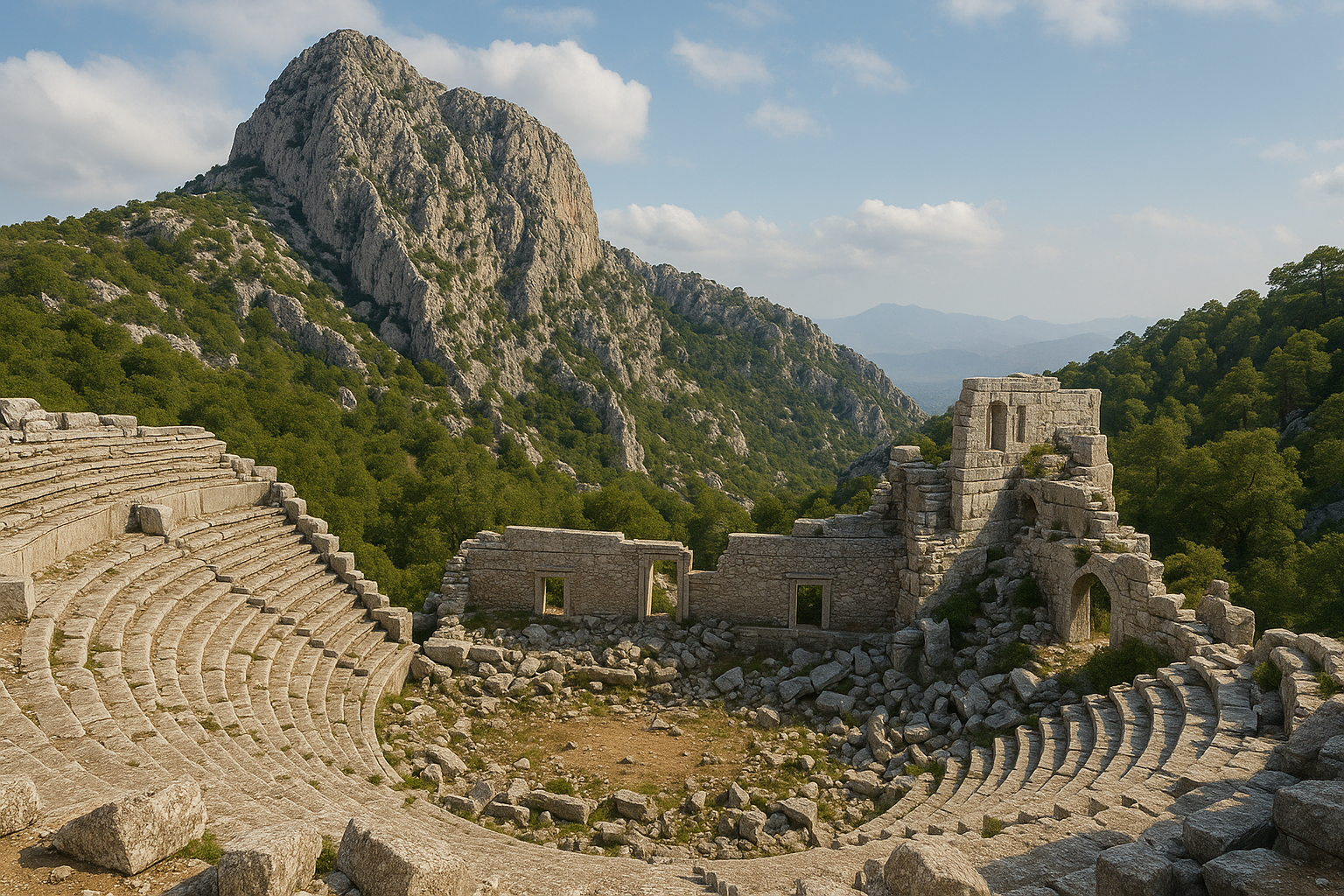
The Theatre

The theatre of Selge is the city's crowning monument and one of the best-preserved Roman theatres in southern Turkey. Key features:

  • Date: Built in the 2nd century AD on the Hellenistic-Roman plan
  • Capacity: Approximately 10,000 spectators -- a remarkable size for a mountain city, suggesting either a very large population or that the theatre served a regional function attracting audiences from surrounding settlements
  • Structure: The auditorium (cavea) is built into the natural hillside, taking advantage of the sloped terrain to reduce the need for artificial substructure. The seating rows remain largely intact, carved from and built upon the natural bedrock
  • Skene (stage building): The stage building has collapsed, but the foundation walls and scattered architectural fragments (column drums, entablature blocks, decorative moldings) are visible and allow the building's original form to be reconstructed in imagination
  • View: The theatre commands a spectacular panoramic view of the surrounding mountains, the Eurymedon gorge, and the Adam Kayalar rock formations -- one of the most dramatic theatre settings in the ancient world, rivaling theatres like Taormina in Sicily for scenic grandeur
  • Acoustics: The theatre's acoustics are still excellent; visitors can test this by speaking from the orchestra floor and hearing their voice clearly reflected from the upper tiers -- a testament to the precision of Roman acoustic engineering

The Stadium

Located below and to the south of the theatre, the stadium hosted athletic competitions and festivals. Its elongated U-shaped form is still traceable in the terrain, measuring approximately 230 meters in length, though less well preserved than the theatre. The stadium's presence underscores Selge's engagement with Greek athletic culture, also reflected in the wrestling pairs depicted on the city's early coins. Stadiums are relatively rare among Pisidian cities, making Selge's example significant.

Temple of Zeus

On the acropolis area, remains of a temple dedicated to Zeus have been identified. Zeus was the principal deity of Selge, as evidenced both by temple remains and by the prominence of Zeus imagery on the city's Roman-era coinage. The temple's elevated position on the acropolis reflects the typical association of Zeus with mountaintops and sky phenomena -- a connection that resonated powerfully in a city literally built among the clouds.

Temple of Artemis

A second major temple was dedicated to Artemis, the goddess of the hunt and wild nature -- an appropriate patroness for a mountain city surrounded by dense forests teeming with wildlife. The temple remains include column fragments, architectural blocks, and inscribed stones. Artemis worship was widespread in the Pisidian and Pamphylian hinterland, connecting Selge to the broader religious network of the region.

The Agora

The city's commercial and civic center, the agora occupies a relatively flat area near the acropolis. A paved road leads up to it, and traces of surrounding stoas (colonnaded walkways) and shops can be identified. This was where citizens gathered for commerce, political assembly, legal proceedings, and social interaction -- the beating heart of Selge's civic life.

The Odeon

Near the agora, an odeon (small covered theatre) served for musical performances, lectures, and smaller civic gatherings. It complemented the large theatre, which was used for major dramatic performances and public spectacles. The odeon's smaller, roofed space would have provided better acoustics for spoken-word events and shelter from mountain weather.

City Walls and Fortifications

Selge was protected by a circuit of fortification walls that took advantage of the natural terrain. Sections of these walls, built with large stone blocks, are visible along the perimeter of the ancient city. The natural canyon and cliff barriers on multiple sides meant that only limited stretches of constructed wall were needed to create a fully defensible perimeter -- a geographic advantage that the Pisidians exploited with characteristic efficiency.

The Eurymedon Bridge (Oluk Kopru)

Located about 3 kilometers south of the city center, this Roman-era bridge spans the Eurymedon River with a single pointed arch:

  • Dimensions: 14 meters long and 3.5 meters wide, with a roadway of 2.5 meters and a clear arch span of approximately 7 meters
  • Construction: Dressed stone blocks with a pointed arch design, demonstrating sophisticated Roman engineering adapted to the forces of a mountain river
  • Current name: Oluk Kopru (Gutter Bridge), referring to the water channel that ran along its top surface, possibly part of the city's water supply system
  • Status: Still standing and still passable on foot, making it one of the best-preserved Roman bridges in Turkey and a testament to the durability of Roman engineering -- nearly 1,900 years after construction
  • Function: The bridge facilitated travel between Selge and the coastal cities of Pamphylia (particularly Aspendos), connecting the mountain economy to Mediterranean trade networks

Aqueducts and Cisterns

The city's water supply depended on an aqueduct system that brought water from mountain springs, possibly supplemented by channeled snowmelt and rainwater. Ancient cisterns carved into the rock are visible at several points within the city, some quite large. The catastrophic earthquake of the late 4th century AD destroyed these aqueducts, and their failure to be repaired was the primary cause of the city's eventual abandonment -- a stark demonstration of how dependent mountain cities were on engineered water infrastructure.

Economy and Trade

Selge's prosperity, remarkable for such a remote mountain location, was built on several economic pillars:

Timber

The dense Mediterranean pine and Taurus cedar forests surrounding Selge provided abundant timber, which was the city's primary export commodity. Logs were floated down the Eurymedon River to Aspendos on the coastal plain, from where they were shipped throughout the eastern Mediterranean, including to Egypt where they were in high demand for shipbuilding (Egypt being notably timber-poor). This river-based timber trade connected the remote mountain city to international commerce and generated substantial revenue.

Storax Resin

The storax tree (Liquidambar orientalis), native to the moist valleys and river banks around Selge, produced a fragrant balsamic resin that was highly valued in the ancient world. Strabo specifically mentions this product as a major source of Selge's wealth. The resin was used as:

  • Perfume and incense in religious ceremonies and daily life
  • Medicine for treating wounds, respiratory ailments, and skin conditions
  • Flavoring in food and wine The storax trade connected Selge to luxury goods markets across the Mediterranean, from Rome to Alexandria to Antioch.

Wine and Olive Oil

Despite its elevation, the surrounding slopes and lower valleys supported viticulture and olive cultivation. Wine and olive oil supplemented the city's agricultural economy and were likely traded through the same downstream routes used for timber.

Livestock

The mountain pastures around Selge supported substantial herds of sheep and goats, providing wool, dairy products, and meat. Pastoral agriculture was a staple of Pisidian highland economies and likely contributed significantly to Selge's self-sufficiency.

Coinage

Selge minted its own coins from at least the 5th century BC through the 3rd century AD, an unusually long minting history for a Pisidian city and a clear indicator of sustained economic vitality and political autonomy. The coinage provides valuable evidence for the city's cultural orientation and economic life:

Early coins (5th--4th centuries BC) featured:

  • Wrestling pairs -- two nude wrestlers grappling, reflecting the adoption of Greek athletic culture by Pisidian elites and possibly connected to local festival competitions
  • Triskeles -- a three-legged rotational symbol, also found on coins of other Pisidian and Pamphylian cities
  • Gorgon heads -- an apotropaic (evil-averting) design common across the Greek world
  • Stag and boar -- animals associated with hunting in the Taurus forests

Later Roman-era coins (1st--3rd centuries AD) depicted:

  • Zeus seated or standing, confirming his status as the city's chief deity
  • Artemis with hunting attributes
  • Heracles (Hercules) performing his labors
  • Imperial portraits of reigning Roman emperors, demonstrating Selge's integration into the imperial system while retaining local minting rights

Archaeological Work

Selge has attracted scholarly attention since the 19th century, though it has never been the subject of a comprehensive systematic excavation -- making it one of the most significant unexcavated ancient cities in Turkey:

  • 1842: European travelers first document the ruins, noting the impressive theatre and the standing Eurymedon Bridge.
  • 1886: The Polish count, historian, and traveler Karol Lanckoronski visited Selge during his extensive survey of Pamphylia and Pisidia. He prepared the first detailed plan of the ancient city, identifying major structures and recording their condition. His monumental publication Stadte Pamphyliens und Pisidiens (Cities of Pamphylia and Pisidia, 1890--1892) remains a foundational reference work.
  • Late 19th--20th century: Various European scholars visited and described the ruins, contributing to the identification and documentation of major structures. These included archaeologists, architects, and numismatists who helped establish Selge's significance in scholarly literature.
  • Modern period: Turkish authorities have conducted conservation work, particularly on the theatre and the Eurymedon Bridge, stabilizing masonry and clearing vegetation. The site is protected within the boundaries of Koprulu Canyon National Park.
  • Village archaeology: Many houses in modern Altinkaya village are built with inscribed, carved, or decorated stones from the ancient city, creating an informal outdoor museum of architectural fragments. Column drums serve as garden walls, inscribed blocks as doorsteps, and decorative cornices as shelf supports -- a practical but archaeologically painful reuse of ancient materials.

The absence of systematic excavation means that much of Selge's urban fabric remains unexcavated beneath the surface and beneath the modern village. Future archaeological campaigns could yield significant new information about Pisidian urbanism, domestic architecture, water management, and the integration of highland communities into Mediterranean trade networks.

Visitor Information

Getting There

From Antalya (approximately 90 km): Take the D-400 highway east toward Manavgat/Side. Turn north at the Koprulu Canyon junction (near Belek/Serik). Follow the canyon road approximately 45 km to the Koprulu Canyon visitor area, crossing the ancient and modern bridges over the Eurymedon River, then continue north on a winding mountain road for about 12 km to reach Altinkaya (Zerk) village and the ancient city.

From Side/Manavgat (approximately 70 km): Take the road north toward Tasagil and then continue to Koprulu Canyon and Selge.

The final 12 km stretch from the canyon floor to Altinkaya is a narrow, winding mountain road. It is paved but requires careful driving, especially around blind curves and when encountering oncoming vehicles. The road offers spectacular views but demands attention. Allow at least 45 minutes for this section alone.

Best Time to Visit

  • May--June: Ideal weather, wildflowers covering the meadows, green landscapes, rivers running full after snowmelt. The contrast between snow-capped peaks and spring blooms is unforgettable.
  • September--October: Comfortable temperatures, golden autumn light that enhances the stone ruins, clear mountain air.
  • July--August: Warm but manageable at this elevation (25--30 C versus 35--40+ C on the coast); peak rafting season in the canyon below draws crowds to the lower canyon area but few reach Selge itself.
  • November--April: Snow possible from December through March; the mountain road may be impassable in winter. Check conditions with local sources before attempting the drive.

Duration

Plan 2 to 4 hours for the archaeological site itself, plus travel time. A combined visit with Koprulu Canyon and the Eurymedon Bridge makes for a rewarding full-day excursion that blends archaeology, nature, and adventure.

Facilities

Altinkaya village has several small family-run restaurants (lokantas) serving traditional Turkish mountain food -- grilled trout from the Eurymedon River, goat cheese, fresh bread, village salads, and strong tea. Basic accommodation (pansiyons) is available in the village for those wishing to stay overnight. There is no formal ticket booth, visitor center, or interpretive signage at the archaeological site. Sturdy walking shoes are essential, as the terrain is rocky and steep in places.

Combining with Koprulu Canyon

Selge is best visited as part of a broader Koprulu Canyon excursion. The canyon area offers:

  • White-water rafting on the Koprucay (Eurymedon River) -- one of Turkey's most popular rafting destinations, with rapids ranging from Grade II to Grade IV
  • The Oluk Kopru (Olban Bridge) -- the Roman Eurymedon Bridge, accessible on foot
  • Hiking trails through the national park, including segments of the long-distance St. Paul Trail
  • Swimming in the clear, cold mountain river
  • Canyoning in side gorges for the adventurous

Frequently Asked Questions

How difficult is it to reach Selge?

The paved mountain road is accessible to regular cars but requires confident driving on narrow, winding stretches with limited guardrails and occasional blind curves. Tour groups sometimes use minibuses. The journey from the canyon floor to Altinkaya takes about 45 minutes and is itself part of the experience, with stunning canyon and mountain views along the way. Do not attempt in poor weather or after dark.

Is Selge suitable for families with children?

Yes, but with serious precautions. The theatre area has steep, unrailed drops of several meters. The terrain is uneven, rocky, and studded with ancient wall foundations and cistern openings. Children should be supervised closely, especially near the theatre seating tiers, cliff edges, and unmarked cisterns. That said, children who enjoy hiking and outdoor adventure will find Selge fascinating.

What is the connection between Selge and Alexander the Great?

When Alexander the Great was campaigning through Pisidia in 333 BC, most cities resisted (Termessos defied him; Sagalassos fought and was taken by storm). Selge took the diplomatic route, sending an embassy with gifts and offers of alliance. Alexander accepted, and the city preserved its autonomy and avoided destruction -- a pragmatic decision that demonstrated political sophistication.

Can I visit Selge and the Koprulu Canyon in one day?

Yes, and this is the most popular approach. A typical day trip from Antalya or Side includes the Eurymedon Bridge (Oluk Kopru), a rafting excursion or canyon walk, lunch at a riverside restaurant with fresh trout, and then the drive up to Selge for the archaeological site in the afternoon. Start early (by 8:00 AM) to make the most of the day.

What happened to Selge? Why was it abandoned?

The critical turning point was a devastating earthquake in the late 4th century AD that destroyed the city's aqueducts. Without a reliable water supply at this elevation, the population could not sustain the urban infrastructure. The city declined over the following centuries, with residents gradually relocating to more accessible lowland settlements. The village of Zerk (now Altinkaya) persisted as a small rural community amid the ruins.

Are there guided tours available?

Some tour operators in Antalya, Side, and Manavgat offer day trips to Selge and the Koprulu Canyon area, typically combined with rafting. Independent visits are straightforward with a rental car and basic navigation (GPS recommended). There are no on-site guides, so research the site before visiting for maximum appreciation.

What is the St. Paul Trail?

The St. Paul Trail is a 500 km long-distance hiking trail from Perge (near Antalya) to Yalvac (Pisidian Antioch), following an approximation of the route taken by the Apostle Paul on his first missionary journey. The trail passes through Koprulu Canyon and near Selge, making the ancient city a natural stopover for long-distance hikers.

Architectural Measurements and Key Figures

FeatureMeasurement / Detail
Theatre cavea diameter104 m
Ima cavea (lower section)30 rows of seats, divided into 11 cunei
Summa cavea (upper section)15 rows of seats, divided into 22 cunei
Total seating rows45 (separated by a diazoma)
Estimated theatre capacity9,300--11,600 spectators
Cavea orientationSouth-south-east
Stadium lengthapproximately 230 m
Eurymedon Bridge length14 m
Eurymedon Bridge width3.5 m (roadway 2.5 m)
Eurymedon Bridge arch spanapproximately 7 m
Eurymedon Bridge voussoir thickness60 cm (set without mortar)
City elevationapproximately 1,250 m above sea level
Army capacity (Polybius, 218 BC)20,000 soldiers

Numismatic Evidence

Selge's coinage is among the most important in the Pisidian region, providing rare direct evidence of the Pisidian language through legends rendered as "Stlegiys" -- the local name for the city. The coins closely resembled the silver staters of neighboring Aspendos, reflecting shared cultural influence along the Eurymedon corridor.

Coin Denominations and Weights

DenominationPeriodWeightDiameterObverseReverse
Silver staterc. 400--325 BC10.87--10.88 g22--24 mmTwo wrestlers grapplingSlinger, triskeles
Silver staterc. 325--250 BC9.58--10.64 g21--23 mmTwo wrestlersSlinger right, Pisidian legend
Obol / Trihemiobol5th--4th c. BC0.65 g9 mmGorgoneion bustStag or head of Artemis
Hemiobol5th--4th c. BC0.27 g6 mmGorgoneionAstragalos or triskeles
Bronze (Roman era)2nd--3rd c. AD4--12 g15--28 mmImperial portraitZeus seated, Artemis, Heracles

The decline in stater weight from the earlier to the later series (approximately 10.88 g to 9.58 g) reflects broader monetary trends in the Hellenistic period, where Pisidian cities gradually adjusted their standards in response to changing trade networks and the influence of the Attic weight system.

Pisidian Language on Coins

Selge's coin inscriptions are among the very few surviving examples of the Pisidian language, a poorly attested Anatolian language that has largely vanished from the historical record. Numismatists have identified the legend "ESTFEDIIYS" and "STLEGIIS" on various issues, providing critical philological data for understanding Pisidian phonology and its relationship to other Anatolian languages such as Lycian and Sidetic.

Excavation and Survey Chronology

Despite its monumental remains, Selge has never undergone a full-scale scientific excavation. The site's archaeological record is built primarily from surface surveys, travel accounts, and architectural documentation.

YearExplorer / ScholarContribution
1842European travelers (unnamed)First modern documentation of ruins
1886Karol Lanckoronski (Polish)First detailed city plan; publication in Stadte Pamphyliens und Pisidiens (1890--1892)
Late 19th--early 20th c.Various European scholarsIdentification and photography of major structures
20th c.German and Austrian surveyorsRecording of fortification walls, cistern locations, church remains
Modern periodTurkish Ministry of CultureConservation of theatre masonry, bridge stabilization, vegetation clearing

The absence of excavation means that domestic architecture, ceramic sequences, industrial installations (such as storax resin processing facilities), and the full extent of the city's necropolis remain unknown. A systematic excavation program at Selge would likely yield significant new data about highland Pisidian economy, urbanism, and the storax trade that connected this remote mountain city to the luxury markets of the Mediterranean world.

Trade Route Reconstruction: From Mountain to Sea

The economic link between Selge and the coast followed a specific corridor that can be reconstructed from ancient sources and modern topography:

  1. Selge (1,250 m) -- Timber and storax resin collected from surrounding forests and lower valleys
  2. Eurymedon Bridge crossing -- Goods loaded onto pack animals or, for timber, floated downstream
  3. Koprulu Canyon passage -- The Eurymedon (Koprucay) provided a natural corridor through the Taurus barrier
  4. Aspendos (coastal plain) -- River port where timber was offloaded and prepared for maritime shipment
  5. Mediterranean sea routes -- Timber shipped to Egypt (for shipbuilding), storax resin distributed to perfume and medicine markets across the eastern Mediterranean

The voussoirs of the Eurymedon Bridge, set without mortar and measuring 60 cm in thickness, were engineered to withstand the powerful spring floods of the Koprucay -- a river fed by snowmelt from the Taurus peaks. The bridge's pointed arch design distributes lateral forces more effectively than a round arch, an engineering choice dictated by the extreme hydraulic conditions of this mountain river.

Sources and Further Reading

  • Wikipedia -- Selge
  • Turkish Archaeological News -- Selge
  • ArticHaeology -- Selge Ancient City
  • Pisidia Heritage Trail -- Selge
  • Ancient Theatre Archive -- Selge Theatre
  • Turkish Archaeological News -- Eurymedon Bridge (Selge)
  • Lonely Planet -- Selge
  • Lanckoronski, K. G. -- Stadte Pamphyliens und Pisidiens (1890--1892)
  • Strabo -- Geographica, Book XII
  • Polybius -- Histories, Book V (siege of Selge, 218 BC)
Share

Location Information

Latitude:37.227908
Longitude:31.130245
Open in Google Maps