Quick Summary: Adada is one of the best-preserved ancient cities of the Pisidia region, located near Sagrak Village in the Sutculer district of Isparta Province. Known for its remarkably intact Roman temples, stone-paved forum, and colonnaded main street, Adada offers a rare window into provincial religious and civic life during the Roman Imperial Period. The city lies along the route traditionally associated with Saint Paul's missionary journeys through southern Anatolia and has been an active survey site under Suleyman Demirel University since the early 2000s.
- Why Adada Matters
- Geography and Setting
- Historical Timeline
- Major Monuments and Structures
- Coinage and Economy
- Archaeological Work
- Visitor Information
- Frequently Asked Questions
- Sources and Further Reading
Why Adada Matters
Adada stands out among the dozens of Pisidian cities for several compelling reasons:
-
Exceptional preservation of Roman temples. Unlike most ancient cities where temples survive only as foundations, Adada retains two standing temple structures with walls reaching several meters in height. The Temple of Trajan and the Temple of the Emperors and Zeus Megistos-Serapis are among the best-preserved examples of imperial cult architecture in the entire Pisidia region. In total, four imperial temples from the 2nd and 3rd centuries AD are still well preserved at the site.
-
Intact urban street fabric. The main colonnaded street, paved with large polygonal stone blocks, preserves its original alignment and surface in long stretches. This is rare for inland Anatolian sites and gives visitors an immediate physical sense of Roman-era urban planning.
-
Connection to the Via Sebaste and Saint Paul. Adada sits on the network of roads that linked the major Pisidian cities, including segments associated with the Roman Via Sebaste. The Apostle Paul is believed to have traveled through this region during his first missionary journey (c. 46-48 AD), making the city relevant to both classical and early Christian studies.
-
A living archaeology laboratory. The site has been the subject of ongoing survey work by Suleyman Demirel University's archaeology department, producing new data on Pisidian urbanism, religious architecture, and regional trade networks. The first scientific excavations took place in 2004 under the Isparta Museum directorate with participation from Pamukkale University.
-
Unspoiled landscape context. Situated amid the forested hills of the western Taurus range, Adada is free from modern development. The setting provides an unusually immersive experience of what an ancient mountain city looked and felt like, with over 2,200 years of history quietly resting in a pine forest.
-
Diplomatic history documented in stone. An agreement discovered at Termessos documents a friendship pact between Adada and Termessos, formed to jointly confront their common enemy Selge -- evidence of the complex inter-city politics of the Pisidian highlands.
Geography and Setting
Adada occupies a plateau in the rugged terrain of the Lake District (Goller Bolgesi) of southwestern Turkey. The site sits at an elevation of approximately 1,200 meters above sea level, surrounded by pine and cedar forests characteristic of the western Taurus Mountains.
The city is located about 28 kilometers southeast of the Sutculer district center and approximately 35 kilometers south of Lake Egirdir. Access is via a secondary road branching from the Isparta-Antalya highway, passing through Sagrak Village before reaching the archaeological area, locally known as Karabavlu (also spelled Karabavullu).
Geographically, Adada held a transitional position between the highland Pisidian plateau to the north and the coastal Pamphylian plain to the south. This positioning made it a natural waypoint on trade and communication routes connecting the Mediterranean coast to the Anatolian interior. The Eurymedon River system (modern Koprucay), which eventually reaches the sea near Aspendos, has its headwaters in the mountains near Adada, further anchoring the city within regional geography.
The surrounding terrain is mountainous and heavily forested. The plateau on which the city was built provides a relatively flat area amid steep hillsides, offering both agricultural potential and natural defensive advantages. Water sources in the mountains sustained the city's population, and the nearby forests provided timber for construction.
The climate is continental Mediterranean, with cool, snowy winters and hot, dry summers. Temperatures can drop below freezing from November through March, and snowfall is common at this elevation. Spring (April-May) and autumn (September-October) offer the most comfortable conditions for visiting, with wildflowers carpeting the forest floor in spring and golden light enhancing the ruins in autumn.
Historical Timeline
Pre-Hellenistic Origins
The name "Adada" is almost certainly Pisidian in origin, predating Greek settlement. The indigenous Pisidian population was known for its fierce independence and warrior culture. While the exact date of the city's founding is unknown, the presence of a Pisidian name suggests the settlement existed before significant Hellenistic influence reached the region.
Hellenistic Period (3rd-1st centuries BC)
The earliest known literary reference to Adada comes from the geographer Artemidorus of Ephesus, as quoted by Strabo, who lists Adada among the cities of Pisidia. The geographer Ptolemy also confirms its existence.
A 2nd-century BC agreement document discovered at Termessos indicates that Adada was already an established polis with diplomatic relations among the Pisidian city-states. This treaty established a friendship between Adada and Termessos to jointly confront Selge, their common rival -- revealing the competitive landscape of highland Pisidia.
During the Late Hellenistic period, Adada began minting its own coinage, a sign of political autonomy and economic activity. The first coins are dated to the 1st century BC and feature designs such as the head of Heracles in a lion-skin.
Roman Period (1st-3rd centuries AD)
Under Roman rule, Adada experienced its greatest period of monumental construction. The city was incorporated into the Roman provincial system following Pompey's reorganization of the eastern provinces. The forum was laid out with stone paving, and the major temples were erected:
- c. 110-114 AD: The Temple of Trajan was built, dedicated to the deified Emperor Trajan. This is one of the finest surviving examples of imperial cult temples in Pisidia.
- c. 160 AD: The Temple of the Emperors and Zeus Megistos-Serapis was constructed, according to inscriptional evidence. This dual dedication reflects the syncretic religious culture of Roman Anatolia.
- 2nd-3rd centuries AD: Additional public buildings were erected, including a bouleuterion (council house), a monumental fountain (nymphaeum), an open-air assembly area, and the Temple of the Emperors and Aphrodite.
Imperial coinage from Adada began under Trajan (98-117 AD) and continued until the reign of Valerian and Gallienus (253-268 AD), covering roughly 170 years of mint activity. The variety of coin types -- featuring Zeus, Athena, Dionysos, Serapis, the Dioscuri, and a hexastyle temple facade -- indicates a prosperous and religiously diverse community.
Late Roman and Byzantine Period (4th-7th centuries AD)
As Christianity spread through Anatolia, Adada's pagan temples gradually fell out of active use. A basilica church was constructed, indicating the city's transition to a Christian community. Multiple church structures have been identified in different areas of Adada, with the largest located in the western part of the valley where the city is situated.
The site appears to have been gradually abandoned during the early Byzantine period, though the exact timeline and reasons remain unclear. Possible factors include economic decline, shifting trade routes, and the general insecurity of the period.
Post-Antique Period
Unlike many ancient cities that were built over by medieval or modern settlements, Adada was simply left behind. No later habitation disturbed the ancient remains. This neglect paradoxically ensured exceptional preservation of its Roman-era structures, leaving them to be slowly enveloped by the Taurus forests.
Major Monuments and Structures
The Temple of Trajan
The Temple of Trajan is Adada's most iconic structure and one of the best-preserved Roman temples in the Pisidia region. Built between approximately 110 and 114 AD, it was dedicated to the cult of the deified Emperor Trajan.
The temple follows a prostyle plan with columns at the front entrance. Its walls stand to a considerable height, with visible courses of carefully dressed ashlar masonry. The pronaos (entrance porch) and the cella (inner chamber) are clearly distinguishable. Architectural fragments, including Corinthian capitals and entablature pieces, lie scattered around the structure.
The temple's orientation and its placement within the forum complex suggest it served as a focal point for imperial cult ceremonies and public gatherings. The 2004 excavations under the Isparta Museum directorate revealed previously unknown sections of the temple precinct.
The Temple of the Emperors and Zeus Megistos-Serapis
Located near the forum, this temple was built around 160 AD according to dedicatory inscriptions. The double dedication to both the Roman emperors and the syncretic deity Zeus Megistos-Serapis reflects the blending of Greek, Egyptian, and Roman religious traditions that characterized 2nd-century Anatolia.
The cult of Serapis was widespread in the eastern Roman Empire, and its presence in a mountain city like Adada demonstrates how far these syncretic traditions penetrated into provincial life. The temple's architecture shows Corinthian influences and stands alongside the Temple of Trajan as evidence of the city's prosperity during the High Imperial period.
The Temple of the Emperors and Aphrodite
A third temple, dedicated to the Emperors and Aphrodite, has been identified to the east of a structure formerly interpreted as an administrative palace. Less well preserved than the other two temples, it nonetheless adds to the picture of Adada as a city with a rich and varied religious landscape.
The Fourth Imperial Temple
A fourth temple from the imperial period has been identified at the site, bringing the total number of well-preserved imperial temples to four -- an unusually high concentration for a city of Adada's size and further evidence of the importance of imperial cult worship in Pisidian cities.
The Forum and Agora
The heart of Adada's public life was its stone-paved forum and agora complex. Located west of the acropolis, the agora served as the city's commercial, administrative, and religious center during the Hellenistic and Early Roman Imperial periods.
During the city's initial construction in the 2nd century BC, the agora featured a multi-story, two-nave stoa to the north and a single-nave stoa to the south. The forum's paving stones, many still in situ, are large irregular polygonal blocks fitted closely together in a style typical of Roman provincial construction.
The Colonnaded Main Street
A broad, stone-paved road runs through the city, lined on both sides with column bases that once supported a covered colonnade. This street connects the major public buildings and gives the site its characteristic linear organization. Walking along it today, visitors can trace the same route that merchants, officials, and worshippers followed nearly two thousand years ago.
The Theatre
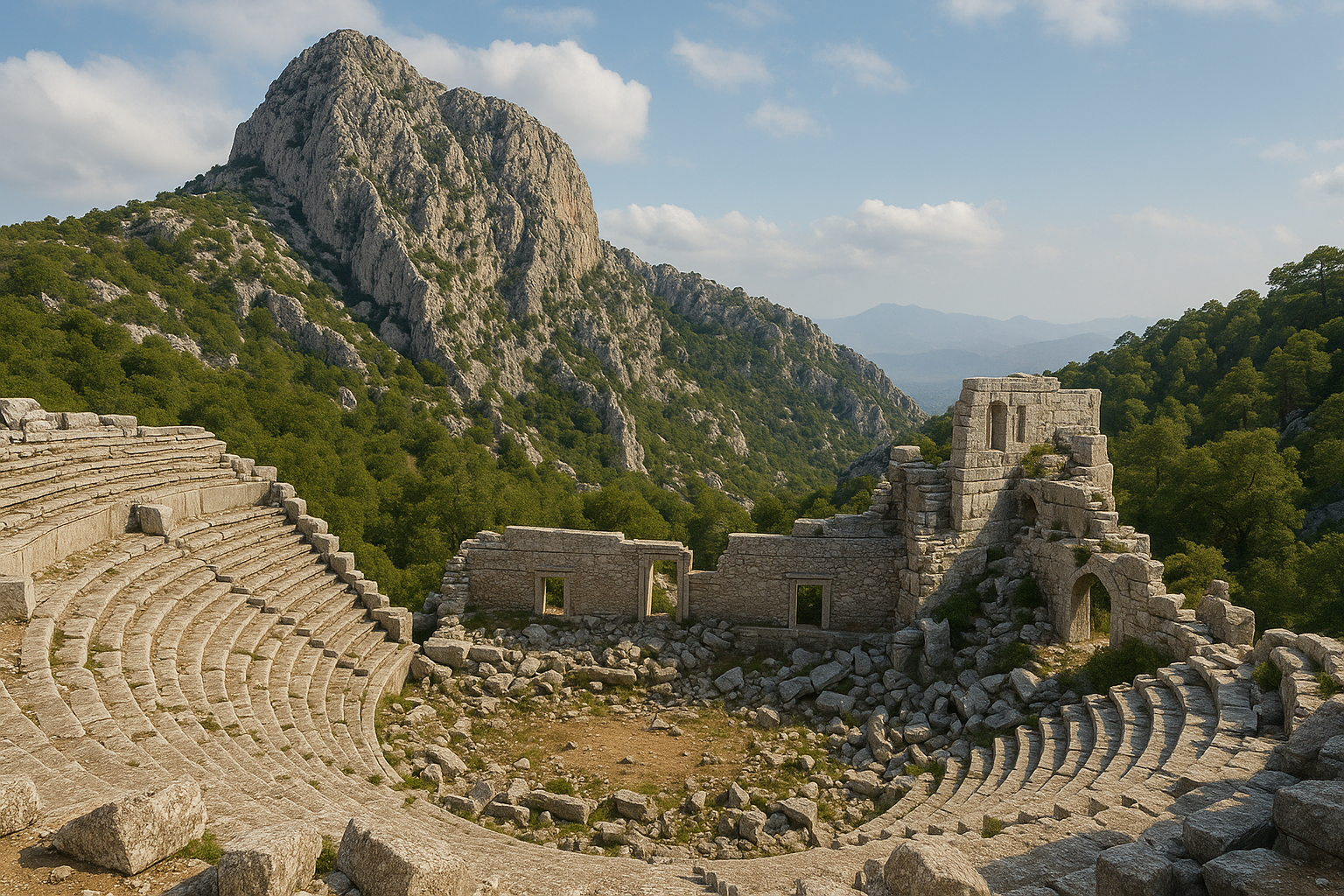
The theatre was built on the slope of the hill in the northwest of the plain on which Adada is located. The cavea (seating area) is still visible, carved into the natural hillside. Current estimates suggest a capacity of approximately 1,000 spectators -- relatively modest compared to major cities but appropriate for a mountain community. The theatre's position offers panoramic views of the surrounding forest and mountains, making it one of the most atmospherically situated ancient theatres in Turkey.
The Bouleuterion (Council House)
The council house, where the city's governing body met, is identifiable by its semi-circular seating arrangement carved into the bedrock. Although smaller than council buildings in major metropolitan centers, it testifies to Adada's status as a self-governing polis with formal democratic institutions.
The Monumental Fountain (Nymphaeum)
A nymphaeum structure provided the city with a public water supply. Decorated facades on monumental fountains were a standard feature of prosperous Roman cities. Fragments of the architectural decoration remain visible, including carved stone blocks with water channels.
Basilica and Churches
A Christian basilica, dating to the late Roman or early Byzantine period, stands as evidence of the city's religious transformation. Its construction likely repurposed materials from earlier pagan structures, a common practice throughout Anatolia. Additional church structures have been identified in different areas of the city, with the largest basilica situated in the western part of the valley.
The Necropolis
The city's cemetery areas contain a variety of tomb types, including rock-cut tombs and sarcophagi. Funerary inscriptions from the necropolis have provided valuable data on the names, occupations, and family structures of Adada's inhabitants. The inscriptions are primarily in Greek, reflecting the Hellenized culture of the urban elite.
The Acropolis
The highest point of the city served as its acropolis, accessed by a well-preserved stone stairway leading up from the agora area. The acropolis likely housed defensive structures and possibly a watchtower, providing a commanding view of the surrounding landscape and the approaches to the city through the mountain passes.
Open-Air Assembly Area
An open-air meeting place has been identified near the forum complex, serving as a space for public assemblies and community gatherings that supplemented the more formal bouleuterion.
Coinage and Economy
Adada's numismatic record provides important evidence for its economic and political status:
-
Late Hellenistic coinage (1st century BC): The city began minting its own bronze coins, featuring designs such as the head of Heracles in a lion-skin and bearded helmeted heads. The initiation of coinage indicates that Adada had achieved sufficient political autonomy and economic strength to warrant its own monetary system.
-
Imperial coinage (Trajan to Valerian/Gallienus, 98-268 AD): A rich series of coins was produced over approximately 170 years. Coin types include seated Zeus, bust of Athena, Dionysos seated on the ground, a cista (sacred basket) encircled by a serpent with the legend BACCHEIA, bust of Serapis, Serapis seated, the Dioscuri standing, and a hexastyle (six-columned) temple facade.
The variety of religious imagery on the coins mirrors the diversity of cult dedications found in the city's temples. The hexastyle temple depicted on certain coins likely represents one of the actual temples at the site, providing numismatic confirmation of the architectural evidence.
The city's economic base included agriculture (cereals and olives suited to the mountain climate), animal husbandry (especially goats and sheep in the highland pastures), forestry (the surrounding Taurus forests provided valuable timber), and trade along the regional road network. Its position on routes between the coast and the interior made it a natural exchange point for goods moving between Pamphylia and the Pisidian highlands.
The presence of Serapis imagery on both coins and temple dedications suggests connections to broader Mediterranean trade networks, as the Serapis cult was closely associated with commerce and seafaring in the Hellenistic and Roman periods.
Archaeological Work
Early Explorations
Adada was first visited by the European scholar A. Schonborn in 1842, making it one of the earlier Pisidian sites to be documented by Western travelers. The American explorer J. R. S. Sterrett rediscovered and described the ruins in 1884, publishing detailed accounts in his An Epigraphical Journey in Asia Minor (1888) that brought the site to wider scholarly attention.
In 1887, the German scholar Gustav Hirschfeld and the British historical geographer William M. Ramsay further confirmed the identification of the site as ancient Adada. Ramsay's extensive work on the historical geography of Asia Minor, particularly his landmark The Historical Geography of Asia Minor (1890), placed Adada firmly within the scholarly framework of Pisidian studies.
Modern Survey Work
In recent decades, the Archaeology Department of Suleyman Demirel University in Isparta has conducted systematic survey work at Adada, producing new documentation of the site's monuments, inscriptions, and urban layout. This ongoing project has contributed to a deeper understanding of urban planning, religious architecture, and material culture in the Pisidian region.
2004 Excavations
The first scientific excavations at Adada took place in 2004 under the directorate of the Isparta Museum, with participation from Pamukkale University's Archaeology Department. These excavations revealed previously unknown sections of the Theatre, Agora, and the Temple of Trajan precinct, significantly expanding the understanding of the city's layout and architectural history.
Current Status and Future Potential
No large-scale sustained excavation has been carried out at the site beyond the 2004 campaign, which means the visible remains are largely surface-level. This also means that significant archaeological deposits likely remain undisturbed beneath the surface, representing a major potential for future research.
The site's remote location has both protected it from development pressure and limited investment in infrastructure and conservation. Proposals for more systematic excavation and site management have been discussed in Turkish archaeological circles, but funding and logistical challenges in this mountainous terrain have slowed progress.
Visitor Information
Getting There
From Isparta city center, drive south toward Sutculer (approximately 80 km). From Sutculer, continue southeast for about 28 km via Sagrak Village. The final approach is on an unpaved forest road (about 5 km), passable by regular car in dry conditions but requiring caution after rain. A four-wheel-drive vehicle is recommended during wet months.
From Antalya, the drive is approximately 140 km north through the Taurus Mountains via Koprulu Canyon. From Egirdir, the distance is approximately 60 km south.
Best Time to Visit
- Spring (April-May): Wildflowers carpet the forest floor, comfortable temperatures (15-25 degrees C), clear views of the surrounding mountains.
- Autumn (September-October): Mild weather, golden light filtering through the pine trees, fewer visitors.
- Summer (June-August): Hot but manageable at this altitude (around 1,200 m); start early to avoid midday heat.
- Winter (November-March): Snow is common and can be heavy; access roads may be impassable. Not recommended unless you have winter driving experience and equipment.
Duration
A thorough visit takes 2 to 3 hours. Allow additional time for photography and the slow drive on the forest road. A more detailed exploration, including the necropolis, all four temples, and the surrounding terrain, can take half a day.
Facilities
The site is open-air and unenclosed. There are no ticket booths, restrooms, cafes, or shade structures at the ruins themselves. Visitors should bring their own water, snacks, sun protection, and sturdy walking shoes. The terrain is uneven with scattered stone blocks and overgrown areas.
The nearest services (restaurants, fuel stations, basic accommodation) are in Sutculer. More comfortable hotels can be found in Egirdir or Isparta.
Nearby Attractions
- Kovada Lake National Park (approximately 15 km) -- scenic lake surrounded by forests
- Egirdir Lake (approximately 60 km north) -- Turkey's fourth-largest lake, known for lavender and apple orchards
- Zindan Cave (near Sutculer) -- a significant karst cave system
- Yazili Canyon Nature Park -- a dramatic river canyon with walking trails
- Other Pisidian sites: Sagalassos (the best-excavated Pisidian city), Kremna, Antioch of Pisidia (Yalvac)
Frequently Asked Questions
What makes Adada different from other Pisidian ancient cities?
Adada is distinguished by the exceptional preservation of its Roman temples -- four imperial temples survive in remarkably good condition, particularly the Temple of Trajan and the Temple of Zeus Megistos-Serapis. While cities like Sagalassos and Antioch of Pisidia are larger and more extensively excavated, Adada offers an unmatched experience of walking through an intact Roman provincial urban landscape in a completely natural, undeveloped forest setting.
Is Adada connected to Saint Paul?
The city lies within the broader region traversed by the Apostle Paul during his first missionary journey through Pisidia (c. 46-48 AD). While the New Testament does not mention Adada by name, the city's location on the regional road network -- the Via Sebaste and connecting routes -- makes it plausible that Paul or his companions passed through or near the site.
Can I visit Adada without a guide?
Yes. The site is open and unguarded, with no formal entrance. However, there are no information panels on-site, so preparing in advance with a guidebook or downloaded materials is strongly recommended. A knowledgeable guide familiar with Pisidian archaeology would significantly enhance the experience, as many structures require explanation to fully appreciate.
How large is the ancient city?
Adada covers a significant area across the plateau, with the main urban core stretching several hundred meters along the colonnaded street. The surrounding necropolis, agricultural terraces, and outlying structures extend the archaeological zone further. A complete walking tour of all visible remains covers approximately 2-3 kilometers.
How long does a visit take?
Plan for at least 2 hours on site, plus travel time from Sutculer (approximately 45 minutes each way on the forest road). A more detailed exploration can take half a day.
Is there an entrance fee?
As of recent reports, there is no entrance fee. The site is unenclosed and accessible year-round, weather permitting.
What should I wear?
Sturdy closed-toe shoes are essential. The terrain includes loose stones, uneven paving, and overgrown areas with potential for thorny vegetation. In summer, bring sun protection and a hat; in shoulder seasons, bring layers for changing mountain weather. Long trousers are advisable to protect against thistles and insects.
Is the site safe?
The site itself is safe for visitors, but the remote location means there is no mobile phone coverage in some areas and no emergency services nearby. Inform someone of your plans before visiting. Watch for snakes in warm months, as the rocky terrain provides habitat for them.
Cultural and Religious Life
Adada's four imperial temples tell a remarkable story about religious diversity in a relatively small mountain city. The simultaneous presence of cults dedicated to the deified Emperor Trajan, the syncretic deity Zeus Megistos-Serapis, and Aphrodite demonstrates that Adada was no isolated backwater but a community fully engaged with the religious currents of the wider Roman world.
The Serapis cult is particularly significant. Originating in Ptolemaic Egypt as a deliberate fusion of Greek and Egyptian religious traditions, the worship of Serapis spread across the Mediterranean through trade networks. Its presence in a Pisidian mountain city like Adada indicates either direct trade connections with Egypt or, more likely, the cultural influence of larger Anatolian port cities where the cult was well established.
The Bacchic imagery on Adada's coins -- including the cista mystica (sacred basket) encircled by a serpent with the legend BACCHEIA -- suggests that Dionysiac mystery rites were also practiced in the city. Such mystery cults offered initiates the promise of spiritual transformation and afterlife blessings, and their popularity across the Roman Empire is well documented.
The transition to Christianity, evidenced by the construction of multiple churches, appears to have been gradual. The reuse of pagan architectural materials in Christian buildings -- a practice called "spolia" -- is visible at Adada and reflects both pragmatism and the symbolic appropriation of the old religious order by the new.
Municipal Administration
As a self-governing polis, Adada maintained the standard Greek civic institutions:
- A boule (city council) that met in the bouleuterion.
- A demos (citizen assembly) that gathered in the open-air meeting area.
- Elected magistrates who oversaw city administration, finances, and public works.
- A mint that produced the city's coinage under imperial authority.
The city's diplomatic engagement with neighboring poleis, documented in the Termessos agreement, shows that Adada participated in the complex system of inter-city relations that characterized the Hellenistic and Roman periods in Pisidia.
The Via Sebaste and Regional Road Network
The Via Sebaste was a major Roman road constructed in the late 1st century BC under the governor of Galatia, linking the colonial cities of southern Anatolia. While the main route passed through Antioch of Pisidia and the Pisidian Lakes region, secondary roads branched off to connect smaller cities like Adada to the network.
Adada's position on these secondary routes gave it access to regional markets and ensured the flow of goods, ideas, and people through the city. The stone-paved main street that survives today was almost certainly part of this road network, designed to the standards required for wheeled traffic and military movement.
The road network also facilitated the spread of Christianity through Pisidia. The Apostle Paul's missionary journeys followed Roman roads, and the gospel message reached the region's cities along these same arteries of communication.
The Coins of Adada -- A Visual Record of Civic Identity
Adada's bronze coinage provides a remarkably rich visual record of the city's religious life, cultural associations, and political allegiances during the Roman Imperial period. Numismatic evidence is crucial for understanding cities like Adada, where literary sources are scarce.
Imperial Portraits and Provincial Loyalty
The obverse (front) of Adada's coins typically bears the portrait of the reigning Roman emperor or empress, demonstrating the city's political loyalty. These portraits follow standard imperial iconography but are locally engraved, sometimes showing stylistic variations that distinguish Adadan coins from those of other mints.
Religious Imagery on Reverse Types
The reverse types reveal the city's religious landscape:
- Zeus enthroned -- confirming Zeus as the chief deity of the city.
- Demeter and Persephone -- reflecting the agricultural importance of grain production in the surrounding highlands.
- Serapis -- demonstrating connections to the broader Mediterranean religious world.
- Dionysos and Bacchic symbols -- including the cista mystica with the BACCHEIA legend, indicating the practice of mystery rites.
- River god or local deity figures -- linking civic identity to the natural landscape.
What Coins Tell Us
For a city like Adada, where few inscriptions have been found and no ancient literary work describes the city in detail, coins serve as primary historical documents. Each coin type was approved by the city council, making coin imagery an official statement of civic identity -- what the city's leaders wanted the world to know about their community.
The coins circulated beyond the city boundaries, serving as miniature ambassadors that announced Adada's wealth, piety, and cultural sophistication to the wider Roman world.
Architectural Measurements and Key Figures
The following table compiles the principal documented dimensions and statistics for the monuments at Adada, based on survey data from Suleyman Demirel University and published excavation reports.
| Feature | Measurement / Quantity |
|---|---|
| Forum / Agora dimensions | 32 x 45 m |
| Site elevation | c. 1,200 m above sea level |
| Distance from Sutculer | c. 28 km southeast |
| Distance from Lake Egirdir | c. 35 km south |
| Theatre estimated capacity | c. 1,000 spectators |
| Imperial temples preserved | 4 |
| Imperial coinage span | Trajan (98 AD) to Valerian/Gallienus (268 AD), c. 170 years |
| Walking tour of all visible remains | c. 2--3 km |
| Agora northern stoa | Multi-story, two-nave design |
| Agora southern stoa | Single-nave design |
Numismatic Evidence -- Detailed Catalogue
Adada's coinage provides the richest body of evidence for the city's political and religious identity. The following table, compiled from the WildWinds database and the SNG Von Aulock reference collection, catalogues the principal known coin types.
Pre-Imperial (Autonomous) Coinage -- 1st Century BC
| Obverse | Reverse | Reference |
|---|---|---|
| Laureate head of Zeus right | Nike standing left, holding palm, crowning trophy with wreath | SNG Von Aulock -- |
| Bearded head of Heracles right, wearing lion-skin headdress | Helmeted, draped bust of Ares right | SNG Von Aulock -- |
| Filleted bull's head facing, star above | Triskeles (three-legged symbol) | SNG Von Aulock 4895 |
Autonomous coins carry the inscription ADADEY or ADA, confirming the city's Hellenized Pisidian name.
Imperial Coinage -- Trajan to Valerian/Gallienus (98--268 AD)
| Emperor / Period | Obverse | Reverse Type | Inscription |
|---|---|---|---|
| Trajan (98--117) | Laureate bust of Trajan right | Zeus seated, holding sceptre | ADADEON |
| Hadrian (117--138) | Laureate bust of Hadrian right | Athena standing with spear and shield | ADADEON |
| Antoninus Pius (138--161) | Laureate bust right | Dionysos seated on ground | ADADEON |
| Marcus Aurelius (161--180) | Laureate bust right | Demeter standing, holding grain ears and torch | ADADEON |
| Various 2nd--3rd c. | Emperor bust right | Cista mystica (sacred basket) encircled by serpent, legend BACCHEIA | ADADEON |
| Various 2nd--3rd c. | Emperor bust right | Serapis seated, holding sceptre | ADADEON |
| Various 2nd--3rd c. | Emperor bust right | The Dioscuri (Castor and Pollux) standing | ADADEON |
| Various 2nd--3rd c. | Emperor bust right | Hexastyle (six-columned) temple facade | ADADEON |
| Valerian/Gallienus (253--268) | Laureate bust right | Various types | ADADEON |
The hexastyle temple depicted on certain coin reverses is of particular significance. This six-columned facade almost certainly represents one of the actual temples standing at Adada, providing numismatic confirmation of the architectural evidence visible on-site today. The presence of Bacchic imagery (the cista mystica with serpent and the BACCHEIA legend) is unique among Pisidian coinages and suggests an active Dionysiac mystery cult operating within the city.
Inscriptions and Diplomatic History
Adada's epigraphic record, while modest compared to larger Pisidian cities, provides essential evidence for the city's political life and inter-city relations.
The Termessos Alliance Inscription
The most important diplomatic document associated with Adada is an isopoliteia agreement discovered at Termessos, the powerful mountain city near modern Antalya. This inscription records a formal friendship pact between Adada and Termessos, established to jointly confront their common enemy Selge -- a rival Pisidian city controlling the upper Eurymedon valley.
The treaty reveals that Pisidian inter-city politics were characterized by shifting alliances and rivalries, with smaller cities like Adada forming coalitions to counterbalance more powerful neighbours. This alliance strategy mirrors the broader pattern of Hellenistic international relations, where smaller poleis sought security through bilateral treaties and mutual defence agreements.
Funerary Inscriptions
The necropolis has yielded inscriptions primarily in Greek, reflecting the Hellenized character of the urban elite. These texts provide evidence for:
- Personal names of both Greek and indigenous Pisidian origin
- Family structures and lineage patterns
- Occupational titles and civic offices
- The use of standard Greek funerary formulae alongside local customs
The coexistence of Greek and Pisidian naming conventions in the inscriptions demonstrates the cultural hybridity that characterized the Romanized Pisidian highlands -- a society where indigenous traditions and Greco-Roman culture coexisted across generations.
Early Exploration Timeline
| Year | Explorer / Scholar | Contribution |
|---|---|---|
| 1842 | A. Schonborn | First European visitor to document the ruins |
| 1884 | J. R. S. Sterrett (American) | Rediscovered and described the site; published in An Epigraphical Journey in Asia Minor (1888) |
| 1887 | Gustav Hirschfeld (German) and William M. Ramsay (British) | Confirmed identification as ancient Adada; Ramsay published in The Historical Geography of Asia Minor (1890) |
| 2000s | Suleyman Demirel University, Isparta | Systematic archaeological survey of monuments and inscriptions |
| 2004 | Isparta Museum / Pamukkale University | First scientific excavations at the Theatre, Agora, and Temple of Trajan precinct |
Sterrett's 1884 rediscovery was part of a broader epigraphic expedition across Asia Minor that documented dozens of previously unrecorded ancient sites and inscriptions. His publication remains a foundational source for the study of Pisidian epigraphy and historical geography.
Sources and Further Reading
- Adada (Pisidia) -- Wikipedia
- Suleyman Demirel University -- Adada Ancient City Survey
- Alaturka Info -- Adada: Basilicas and Imperial Temples in the Forgotten City
- WildWinds -- Pisidia, Adada Ancient Coins
- Ramsay, W. M. -- The Historical Geography of Asia Minor (1890)
- Sterrett, J. R. S. -- An Epigraphical Journey in Asia Minor (1888)
- Strabo, Geography, Book XII -- on the cities of Pisidia
- Ptolemy, Geography -- listing of Pisidian cities
- TripAdvisor -- Ancient City of Adada Reviews
- WowCappadocia -- Isparta Adada Ancient City