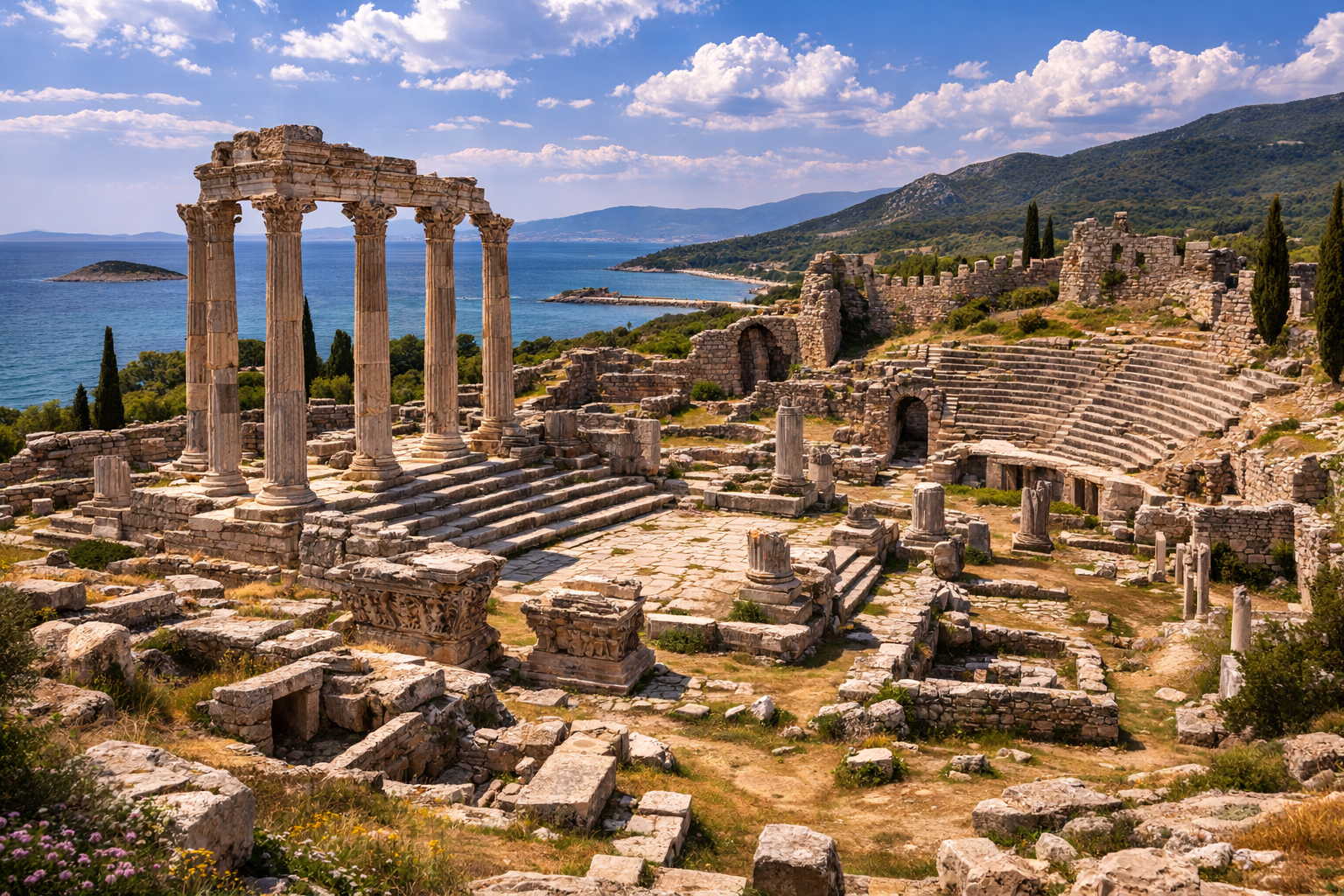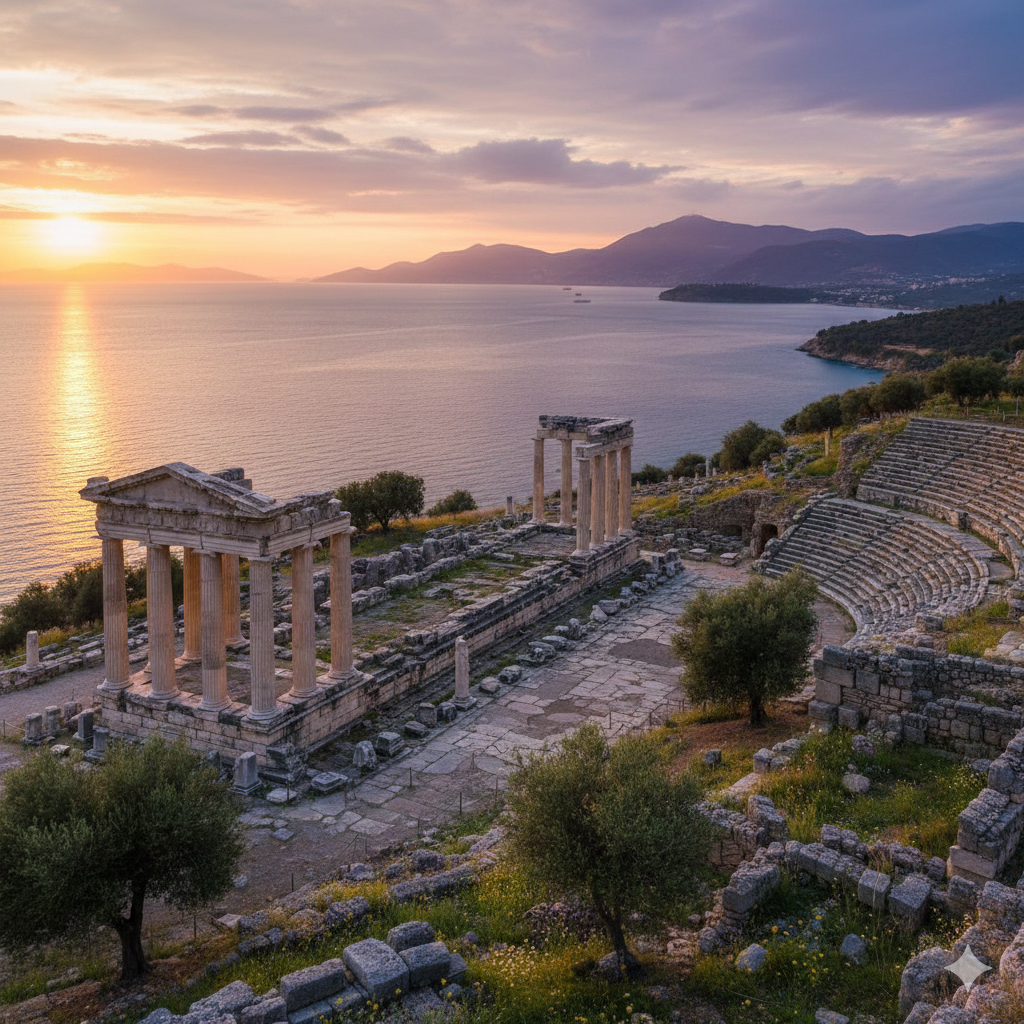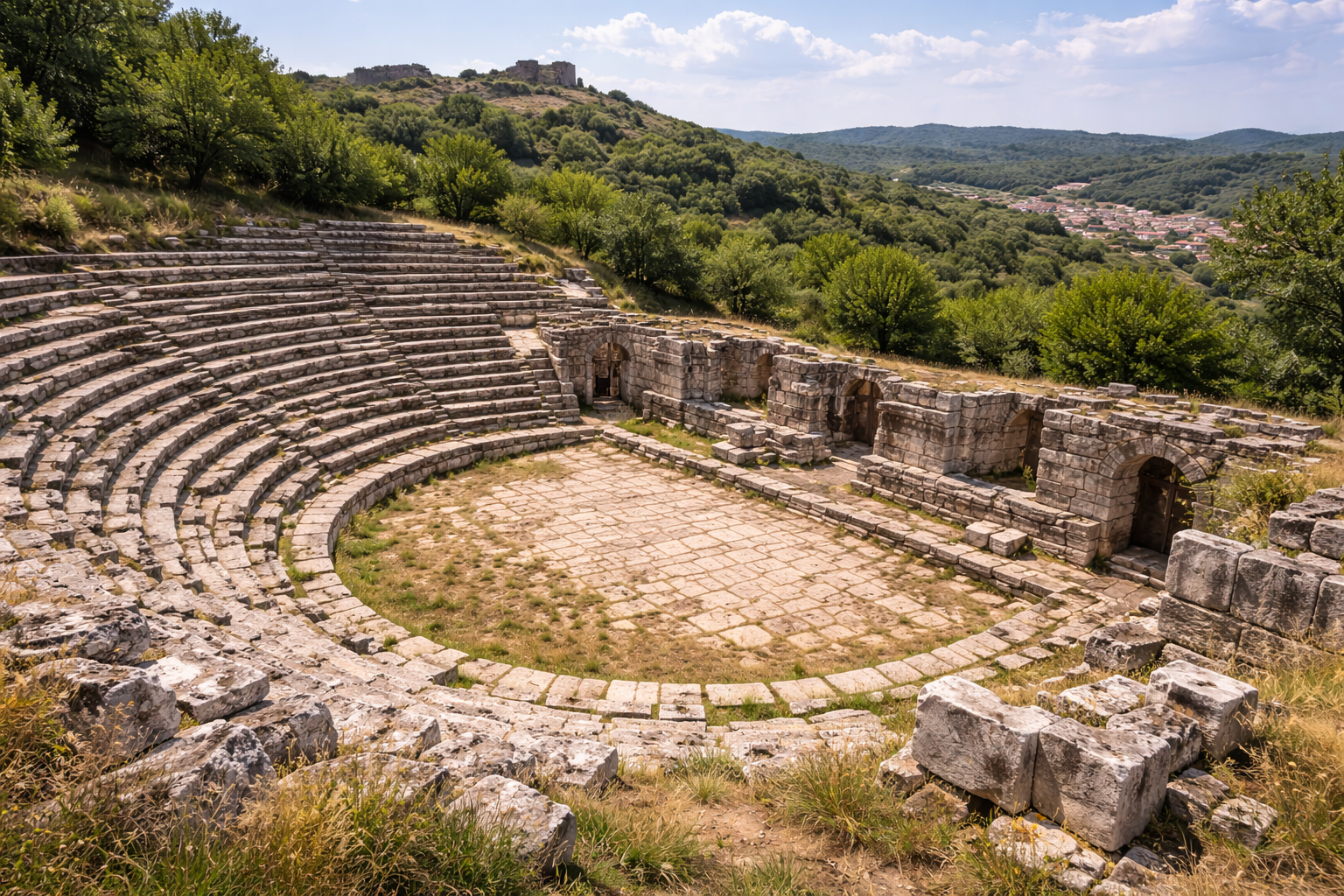
The Vize Ancient Theater is the only known Roman-period theater in the Thrace region of Turkey. Located in the town center of Vize (ancient Bizye) in Kirklareli Province, this 2nd-century AD structure was excavated beginning in 1998 and features all-marble seating rows with a capacity of approximately 4,000 spectators. But Vize is far more than its theater: the town preserves the layered heritage of a Thracian royal capital (seat of the Astai tribe), a prosperous Roman city under Trajan and Hadrian, a fortified Byzantine kastron, and a medieval settlement that produced one of Turkey's finest surviving Byzantine churches -- the 9th-century Hagia Sophia of Vize. Together, these make Vize one of the most underappreciated archaeological destinations in European Turkey.
- Why Vize Matters
- Geography and Setting
- Historical Timeline
- Major Monuments
- Archaeological Work
- Coins, Inscriptions, and Material Culture
- Vize in the Broader Thracian Context
- Visitor Information
- Frequently Asked Questions
- Sources and Further Reading
Why Vize Matters
-
The only Roman theater in Thrace. No other Roman-period theater has been identified in the entire Turkish Thrace region, making the Vize theater a unique monument for understanding Romanization and civic culture in this part of the ancient world. While other Thracian cities undoubtedly had public entertainment venues, only at Vize has one been archaeologically confirmed.
-
Thracian royal capital. Bizye was the seat of the Astai (or Astae), a powerful Thracian tribe whose kings, including the famous Cotys, ruled a territory stretching between the Sea of Marmara and the Black Sea from at least the 3rd century BC. The Thracian dynasty minted its own coinage and maintained diplomatic relations with both Hellenistic kingdoms and Rome.
-
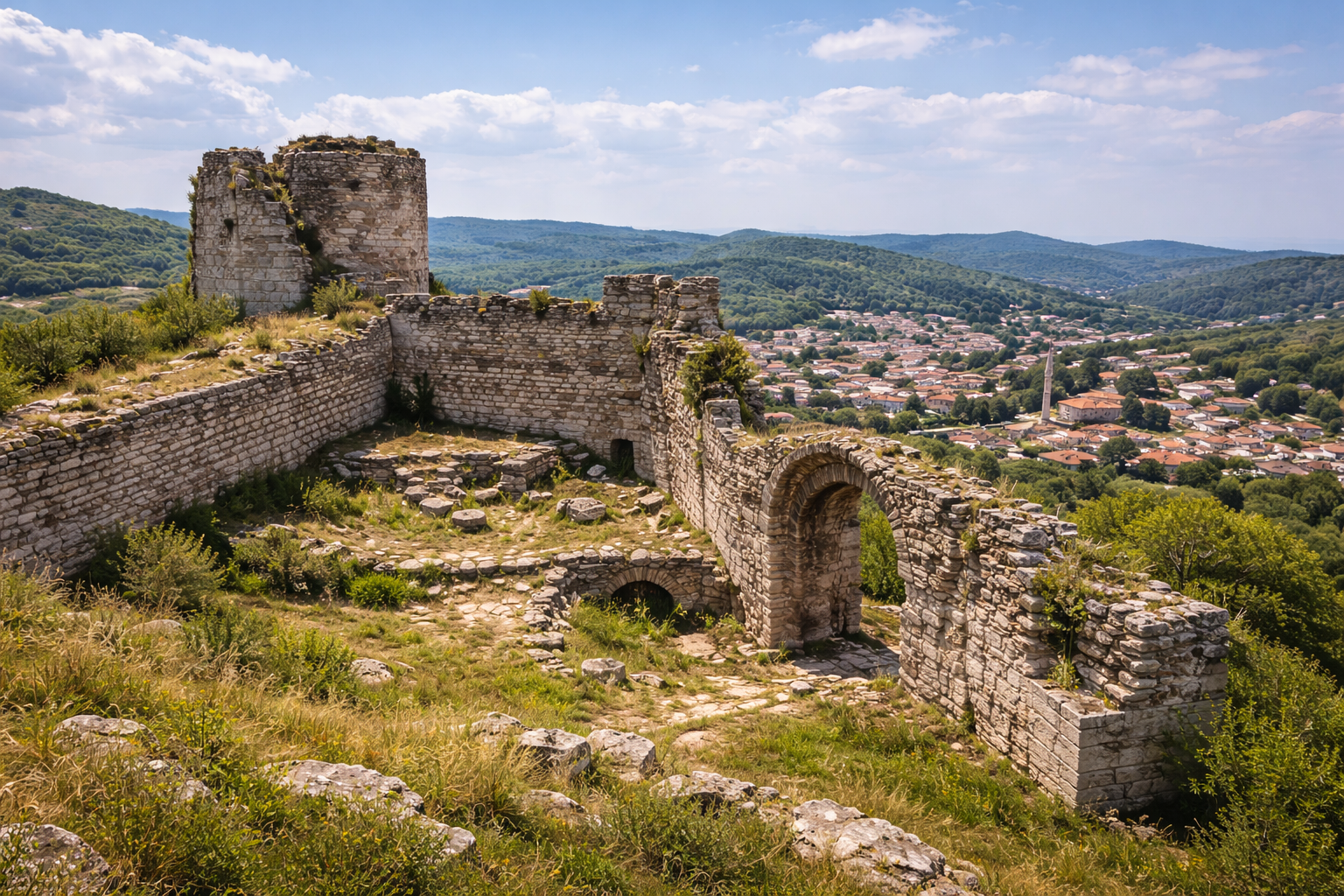
Multi-period fortifications. The city's defensive walls show construction phases from the Hellenistic period through the Byzantine era, with substantial remains still standing along the western and southern edges of the acropolis. These are among the best-preserved ancient fortifications in Turkish Thrace, demonstrating nearly two millennia of continuous defensive adaptation.
-
The Hagia Sophia of Vize. The 9th-century Byzantine church of Hagia Sophia, located in the town center, is one of the most important middle-Byzantine religious structures in Thrace. It demonstrates the city's continued importance as a fortified provincial center and ecclesiastical seat through the medieval centuries. The church was later converted to a mosque (Gazi Suleyman Pasa Camii) during the Ottoman period.
-
Gateway to Strandzha. Vize sits at the edge of the Istranca (Strandzha) Mountains, an area of exceptional natural beauty and biodiversity that straddles the Turkish-Bulgarian border. The combination of archaeological heritage and mountain landscape makes Vize a compelling destination for both cultural and nature tourism.
-
Tumulus treasures. One of the first archaeological digs undertaken after the founding of the Turkish Republic took place at Vize in the 1930s. Excavation of a local tumulus revealed a cache of Roman-era treasures that are now preserved in the Istanbul Archaeology Museum, attesting to the wealth of the ancient city's elite population.
Geography and Setting
Vize lies in the northeastern part of Turkish Thrace, approximately 60 km north of the Sea of Marmara and 90 km northwest of Istanbul (as the crow flies). The town occupies a hilltop position at the southern edge of the Istranca (Strandzha) Mountain range, where the rolling hills of the Thracian interior begin to rise toward the forested uplands.
The ancient settlement was centered on a naturally defensible acropolis hill, with the town spreading over the slopes below. The theater was built into the eastern slope of the hill known as Comlektepe, taking advantage of the natural gradient to support the cavea seating. The acropolis summit, where the fortification walls are best preserved, offers commanding views over the surrounding agricultural landscape and the Strandzha foothills.
Water sources from the Istranca foothills and several small streams provided the freshwater necessary for urban life. The fertile plains to the south supported agriculture, particularly grain cultivation, which was the economic backbone of the Thracian interior. The region also produced wine, livestock, and honey -- products that connected Vize to broader Mediterranean trade networks.
The town's location gave it strategic importance as a gateway between the Thracian lowlands and the mountainous Strandzha interior. Ancient roads connected Bizye to the major Thracian centers of Hadrianopolis (Edirne), Perinthos (Marmara Ereglisi), and the Black Sea coast.
Coordinates: Approximately 41.57 N, 27.77 E
Elevation: Town center approximately 250-300 meters above sea level; acropolis slightly higher.
Climate: Continental-transitional; cold winters with occasional snow, warm summers. Spring and autumn are mild and ideal for visiting. Annual rainfall averages around 600-700 mm, distributed primarily in winter and spring.
Surrounding Landscape: The Istranca Mountains to the north and east are covered with dense oak and beech forests, supporting populations of deer, wild boar, and numerous bird species. The plains to the south and west are agricultural, producing sunflowers, wheat, and other cereals.
Historical Timeline
Thracian Period (pre-3rd century BC -- 1st century AD)
Bizye was the royal seat of the Astai, one of the major Thracian tribal confederations. The Astai controlled a territory between the Propontis (Sea of Marmara) and the Euxine (Black Sea), with Bizye as their political and ceremonial capital.
The most famous Astai king was Cotys, who ruled in the 3rd century BC and was known for his diplomatic relationships with both Hellenistic kingdoms and the emerging Roman power. Thracian royal authority at Bizye is attested by literary sources and by the discovery of elite burial goods and administrative artifacts in the region.
The Thracian kings at Bizye minted their own bronze and silver coinage, featuring royal portraits on the obverse and tribal symbols on the reverse. These coins have been found across the broader Thracian territory, confirming Bizye's role as a center of political authority.
The earliest fortification walls on the acropolis may date to this period, though later construction has obscured much of the original Thracian-era architecture. Thracian religious practices, including the worship of the Thracian Rider deity, are attested through inscriptional and sculptural evidence from the region.
Roman Period (1st -- 4th century AD)
After the Roman annexation of Thrace as a province in AD 46, Bizye was incorporated into the Roman administrative system. The city prospered particularly under Emperors Trajan (r. 98-117) and Hadrian (r. 117-138), adopting the additional name Ulpia in honor of Trajan's family name (gens Ulpia).
The 2nd century AD was the golden age of Roman Bizye. During this period:
- The theater was constructed, with its all-marble seating and sophisticated stage building (scaenae frons)
- Public infrastructure was expanded, including baths, markets, and administrative buildings
- The fortification walls were strengthened and extended with new towers and gates
- The city minted its own provincial coinage bearing the name BIZYHNON
- Monumental sculpture and architectural decoration adorned public spaces
- A Roman-style urban grid was established in parts of the city
The city's wealth during this period is demonstrated by the quality of marble used in the theater and by luxury goods found in burials, including gold jewelry, glass vessels, and imported ceramics.
Roman Bizye was a prosperous provincial city that participated fully in the cultural life of the empire, as evidenced by the theater's capacity and the quality of its sculptural decoration. The city served as a local market center for the surrounding agricultural hinterland and as a waystation on the road network connecting Constantinople to the Danube frontier.
Late Roman and Early Byzantine Period (4th -- 7th century)
As the Roman Empire transitioned into the Byzantine state, Bizye remained strategically important. Its position near the frontier zone between Constantinople and the Danube made it a military staging point and garrison town. The proximity to the imperial capital -- only a few days' march away -- ensured continued imperial attention and investment.
The fortification walls were repaired and modified multiple times during this period, reflecting the ongoing threat from Gothic, Hunnic, Avar, and Slavic incursions into Thrace. Each wave of invasion prompted renewed fortification efforts, creating the complex multi-phase wall circuit visible today.
The theater, like many Roman entertainment venues, fell out of regular use during the Christian era and was gradually repurposed. Parts of the structure may have been incorporated into later defensive works or used as quarries for building stone.
Christianity reached Bizye relatively early, given its proximity to Constantinople. By the 5th century, the city had its own bishop, and Christian architecture began to replace or supplement pagan religious buildings. The early Byzantine fortifications transformed Bizye into a formidable kastron (fortified settlement).
Middle Byzantine Period (7th -- 13th century)
Bizye emerged as a significant fortified kastron (castle-town) in the Byzantine military and administrative system. The city served as a garrison for defending Thrace against Bulgarian incursions, particularly from the 9th century onward. Its position on the approaches to Constantinople made it a critical link in the chain of Thracian defenses.
The construction of the Hagia Sophia church in the 9th century demonstrates the city's ecclesiastical importance and its role as a regional center. This church, built in the cross-in-square plan typical of middle Byzantine architecture, remains one of the best examples of its period in Thrace. The cross-in-square plan features a central dome supported by four columns or piers, with barrel-vaulted arms extending to form a cross within a rectangular envelope.
Byzantine emperors occasionally visited Bizye during military campaigns in Thrace. The city appears in Byzantine military manuals and administrative lists as a significant fortified position. Its garrison played a role in several Byzantine-Bulgarian conflicts that shaped the medieval Balkans.
In the 13th century, Bizye was one of the larger fortified towns in Thrace and served as a base for multiple Byzantine military operations. The city's strategic value is confirmed by its frequent mention in Byzantine military chronicles. The Latin Empire period (1204-1261) brought further turmoil, with Bizye changing hands between Latin and Byzantine forces.
Late Byzantine and Ottoman Period (13th -- 15th century)
During the turbulent final centuries of the Byzantine Empire, Bizye changed hands between Byzantine, Bulgarian, and eventually Ottoman forces. The Ottomans captured the town in the 14th century (traditionally dated to 1368-1369 during the reign of Murad I), after which it became known as Vize. The existing fortifications were maintained and partially modified for Ottoman military purposes.
The transition to Ottoman rule was gradual, with the town's Christian population initially remaining alongside the new Muslim settlers. Ottoman-era mosques, baths, and administrative buildings were constructed alongside the existing Byzantine structures.
Ottoman and Modern Era (15th century -- present)
Under Ottoman rule, Vize served as a modest provincial center, the seat of a kaza (sub-province) within the Kirklareli sanjak. The town retained its character as a small hilltop settlement, preserving much of its ancient and medieval layout beneath the Ottoman-era buildings.
Several Ottoman monuments were constructed, including mosques, a hamam (bathhouse), and fountain structures. The Gazi Suleyman Pasa Camii -- the converted Hagia Sophia church -- became the town's principal mosque.
In the modern Republic of Turkey, Vize is the administrative center of a district within Kirklareli Province, with a population of several thousand. The discovery and excavation of the Roman theater beginning in 1998 brought renewed attention to the town's archaeological significance.
Major Monuments
The Roman Theater
The centerpiece of Vize's archaeological heritage is the 2nd-century AD Roman theater, located on the eastern slope of the town hill (Comlektepe). Key features:
- Construction date: 2nd century AD, during the reigns of Trajan and Hadrian
- Capacity: Approximately 4,000 spectators
- Seating material: The sitting rows and walking steps are entirely made of marble, a mark of civic pride and substantial investment that distinguishes Vize from many other provincial theaters that used limestone or local stone
- Stage building (scaenae frons): Excavations revealed marble stage reliefs and sculptures depicting mythological and theatrical themes, including masks, garlands, and figural scenes
- Orchestra: The semicircular orchestra area between the stage and the seating was paved and served as the performance area
- Cavea design: The seating area (cavea) was divided into sections (cunei) separated by radiating staircases, following standard Roman theater design
- Condition: The theater was damaged during the Byzantine period, likely through deliberate dismantling for building material and natural deterioration. Significant portions of the cavea and stage building have been recovered through excavation
- Significance: It is the only Roman-period theater yet identified in the Thrace region of Turkey, making it unique among hundreds of ancient theaters in the country
The theater's existence demonstrates that Vize, despite being an interior city far from the major coastal centers, possessed sufficient wealth, population, and cultural aspiration to construct a major entertainment venue. The all-marble construction indicates that the city's elite were willing to invest considerably in public display and civic amenities.
The Acropolis Fortifications
Substantial remains of defensive walls rise along the western and southern sides of the acropolis. The wall circuit shows multiple construction phases:
- Hellenistic period: The earliest identifiable masonry, likely associated with the Thracian royal period, using large polygonal or ashlar blocks
- Roman period: Strengthening and extension under imperial patronage, with more regular courses and the addition of towers
- Byzantine period: Extensive repairs and modifications, including towers and gate structures, using mixed masonry with brick courses (the characteristic Byzantine cloisonne technique)
- Possible Roman-era gate: A monumental gate structure on the acropolis has been tentatively dated to the Roman period, with Byzantine-era repairs visible in the upper courses
- Wall dimensions: In several places the walls stand 3-5 meters high, with thicknesses of approximately 2-3 meters
The fortifications at Vize are among the best-preserved in Turkish Thrace and provide a rare opportunity to study the evolution of defensive architecture across nearly two millennia. The multi-phase construction visible in the walls is a textbook illustration of how ancient cities continually adapted their defenses to new threats and technologies.
Hagia Sophia of Vize (9th century)
The Hagia Sophia church in the town center is a middle-Byzantine cross-in-square church dating to the 9th century. Although smaller than its famous namesake in Istanbul, it is architecturally significant as one of the best-preserved examples of this building type in Thrace.
Key features:
- Cross-in-square plan with a central dome supported by four columns
- Original 9th-century masonry with later repairs visible in the walls
- The central dome rises above the crossing on a drum with windows, flooding the interior with light
- Converted to a mosque during the Ottoman period (Gazi Suleyman Pasa Camii)
- Interior traces of Byzantine-period decoration, including possible fresco fragments under later plaster
- The narthex (entrance vestibule) extends along the western facade
- Exterior brickwork decoration typical of middle-Byzantine construction in Thrace
The church's construction in the 9th century, a period of relative recovery after the iconoclasm controversies, reflects the city's continued role as an important Byzantine provincial center and an episcopal seat within the ecclesiastical hierarchy of the Constantinople patriarchate.
Rock-Cut Tombs and Tumuli
The hills surrounding Vize contain numerous burial sites:
- Thracian and Roman-period rock-cut burial chambers have been identified in the surrounding hills, carved into the soft limestone bedrock
- Tumuli (burial mounds) dot the landscape around the ancient city, some of which have been excavated, yielding important finds
- The 1930s tumulus excavation produced a remarkable cache of Roman-era luxury objects -- gold, silver, bronze, and glass -- that are now housed in the Istanbul Archaeology Museum
- These burial sites reflect the continuity of elite mortuary practices from the Thracian period through the Roman era
Other Notable Features
- Ottoman-period buildings: Several Ottoman-era structures, including mosques, a hamam, and fountain structures, contribute to the town's layered historical character
- Inscriptions and architectural fragments: Reused ancient blocks and inscribed stones can be found incorporated into later buildings throughout the town, a common phenomenon known as spolia
- Ancient road traces: Parts of the Roman road network connecting Bizye to other Thracian centers are visible in the surrounding landscape
- Medieval cisterns: Underground water storage facilities dating to the Byzantine period served the garrison and civilian population
Coins, Inscriptions, and Material Culture
The material culture from Vize provides crucial evidence for the city's history:
Coinage
- Thracian royal coins minted at Bizye feature royal portraits and tribal symbols, confirming the city's status as a political capital
- Roman provincial coins bearing the legend BIZYHNON were minted during the 2nd-3rd centuries AD, depicting emperors on the obverse and local religious or civic images on the reverse
- Coin types include representations of local deities, the theater, and civic symbols, providing visual evidence of the city's cultural life
Inscriptions
- Greek and Latin inscriptions from the Roman period document civic institutions, religious dedications, and honorific decrees
- Byzantine-era inscriptions record church dedications, imperial visits, and garrison activities
- Funerary inscriptions provide information about the city's population, including names, occupations, and family relationships
Sculptural Finds
- Marble reliefs from the theater depict mythological scenes, theatrical masks, and decorative garlands
- Fragments of statuary, including possible imperial portraits, have been recovered from the excavations
- Thracian Rider votive reliefs, characteristic of Thracian religious art, have been found in the vicinity
Vize in the Broader Thracian Context
To appreciate Vize's significance fully, it must be understood within the broader landscape of ancient Thrace:
Thracian Civilization
The Thracians were one of the major peoples of the ancient Balkans, occupying territories from the Danube to the Aegean and from the Black Sea to the Adriatic. They were known for their warrior culture, metalworking skills, gold treasures, and distinctive religious practices centered on the Thracian Rider deity and Dionysiac-Orphic traditions.
Romanization of Thrace
After the Roman conquest in AD 46, Thrace was gradually Romanized, with cities adopting Roman political institutions, architectural forms, and cultural practices. The construction of theaters, baths, and temples in Roman Thrace followed patterns established throughout the empire. Vize's theater is the sole surviving physical evidence of this cultural transformation in the theater-building tradition.
Thrace as a Byzantine Frontier
During the Byzantine period, Thrace served as the critical buffer zone between Constantinople and the barbarian peoples to the north. Cities like Bizye functioned as fortified outposts in a defensive network that protected the approaches to the capital. The dense concentration of Byzantine fortifications in Thrace -- of which Vize is one of the best-preserved -- reflects the strategic importance of this region throughout the medieval period.
Archaeological Work
Discovery and Early Investigation
The identification of Vize with ancient Bizye was established through classical literary sources (Pliny, Ptolemy, Byzantine chronicles) and travelers' accounts from the 18th and 19th centuries. The visible fortification walls and scattered architectural fragments had long been noted, but systematic excavation did not begin until the late 20th century.
The 1930s tumulus excavation at Vize was one of the first archaeological digs of the young Turkish Republic, producing spectacular Roman-period finds now in the Istanbul Archaeology Museum.
Theater Excavation (1998 -- 2003+)
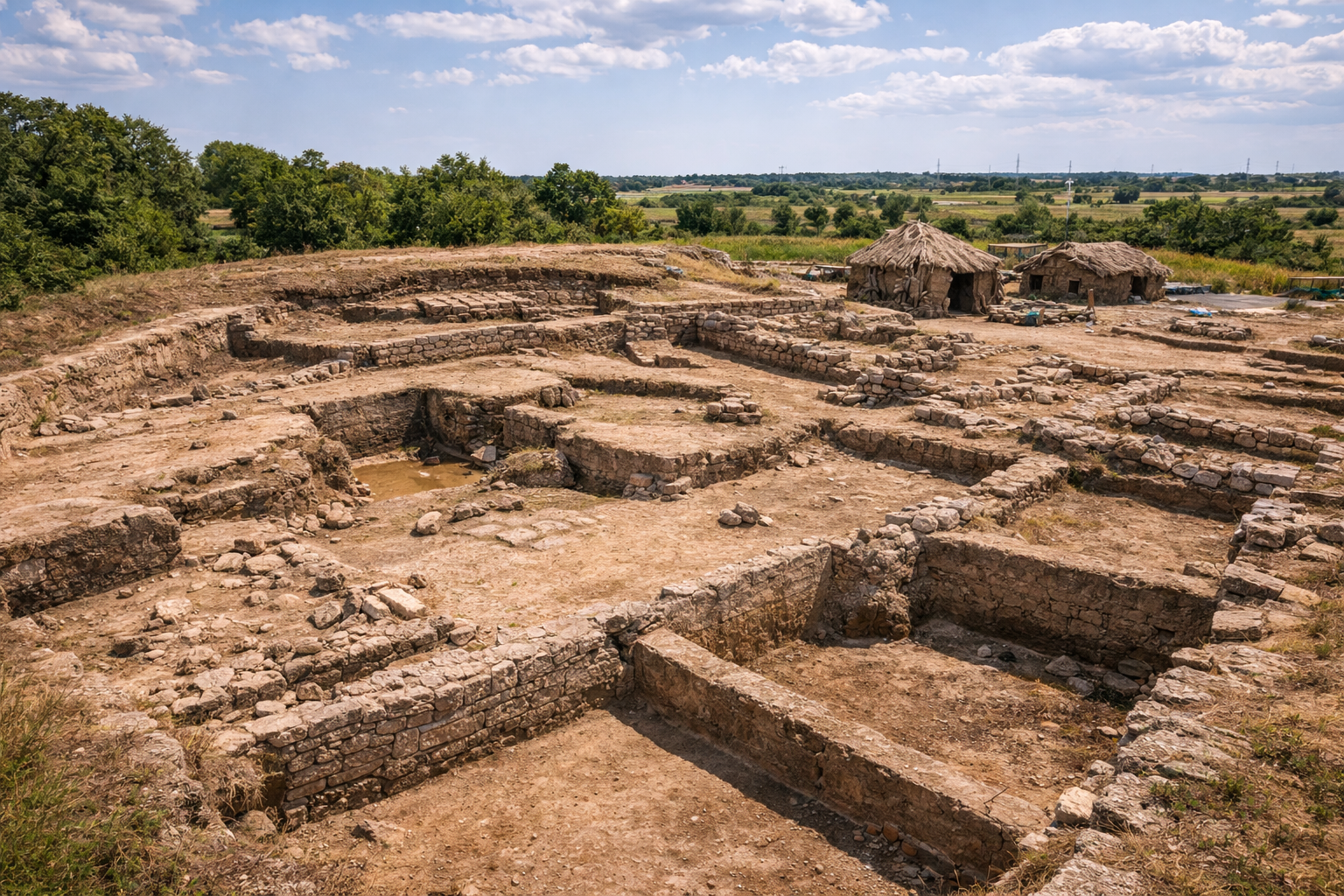
Remains of the Roman theater were first uncovered in 1998 during construction-related archaeological monitoring on the east side of the town. Systematic excavation in 2003 revealed the theater's seating rows and stage building, along with numerous finds:
- Marble seating blocks and walking steps in remarkably good condition
- Stage reliefs depicting mythological scenes and theatrical masks
- Sculptural fragments from the scaenae frons (stage facade)
- Ceramics, glass, and metal objects from Roman, Byzantine, and Ottoman contexts, reflecting the site's long use as a dumping and fill area after the theater fell out of use
- Coins providing dating evidence for the theater's construction and later disturbance phases
The excavation demonstrated that the theater had been deliberately quarried for building material during the Byzantine period, explaining the partial destruction of the upper seating rows. Despite this, the lower sections survived in excellent condition beneath centuries of accumulated debris.
Fortification Studies
Archaeological and architectural survey of the acropolis walls has documented construction phases from the Hellenistic through Byzantine periods. The work has been complemented by historical topographic studies, most notably the doctoral research by Beygo on "The historical topography of a provincial Byzantine city in Thrace: Vize (Bizye)," published through the University of Munich.
Current Status
The theater area is partially excavated and accessible to visitors. Conservation work has stabilized exposed marble elements against weathering and environmental damage. Ongoing research continues to clarify the relationship between the theater, the acropolis fortifications, and the broader urban layout of Roman and Byzantine Bizye.
Plans for site presentation and interpretation are in development, aimed at making Vize a more accessible and better-known archaeological destination within the broader Thracian heritage landscape.
Visitor Information
Getting There
- By car from Istanbul: Approximately 2 to 2.5 hours via the O-3 motorway to Kirklareli, then south on the D020 to Vize. Alternatively, take the E-80/TEM toward Edirne and exit at Vize.
- By car from Kirklareli: Approximately 45 minutes south on the D020.
- By car from Edirne: Approximately 1.5 hours east via the D020.
- By bus: Regular minibus services connect Vize to Kirklareli and other regional centers. Intercity buses from Istanbul serve Kirklareli, with onward connections to Vize.
What to See
A recommended walking route through Vize covers:
- The Roman theater on the eastern slope -- the primary archaeological attraction, where the marble seating and stage building are visible
- The acropolis fortifications along the western and southern hilltop -- walk along the wall circuit for views and architectural detail showing multiple construction phases
- Hagia Sophia of Vize / Gazi Suleyman Pasa Camii in the town center -- the 9th-century Byzantine church converted to mosque
- The town's historic core -- narrow streets with Ottoman-era houses and reused ancient stonework visible in building walls
- Panoramic viewpoints from the acropolis summit over the Thracian landscape and the Strandzha foothills
- Tumulus sites in the surrounding hills (if accessible) -- burial mounds of the Thracian and Roman periods
Best Time to Visit
- Spring (April -- June): Ideal weather, green landscape, wildflowers in the surrounding hills, comfortable temperatures for walking
- Autumn (September -- November): Pleasant temperatures, harvest season atmosphere, golden light ideal for photography
- Summer: Warm but less humid than coastal areas; mornings and evenings are comfortable
- Winter: Cold, potentially snowy; fewer visitors but atmospheric, especially when the Strandzha hills are dusted with snow
Estimated Visit Duration
Allow 2 to 4 hours for a thorough visit covering the theater, fortifications, church, and town exploration. For photography enthusiasts or researchers, a full day is warranted. Combining Vize with other sites in the Kirklareli area can fill a full weekend.
Combining with Other Sites
- Kirklareli city center: Provincial museum with archaeological collections, Hisar Kaplica (thermal baths)
- Asagi Pinar mound: Neolithic open-air museum, 3 km south of Kirklareli (approximately 45 min from Vize) -- one of the most important prehistoric sites in European Turkey
- Strandzha (Istranca) Mountains: Hiking, forest walks, and biodiversity observation in one of Turkey's most pristine natural areas
- Igneada floodplain forests: Unique longos (alluvial) forests on the Black Sea coast (approximately 1.5 hours northeast), a UNESCO-recognized natural area
- Edirne: The former Ottoman capital with the Selimiye Mosque (UNESCO World Heritage), approximately 1.5 hours west
- Kiyikoy: A charming Black Sea fishing village with a small Byzantine fortress, approximately 1 hour east
Practical Tips
- Wear comfortable shoes -- the town is hilly and some areas have uneven footing on ancient stone surfaces
- The theater site may have limited signage; a guidebook or pre-visit research enhances the experience significantly
- Local restaurants in Vize town center offer traditional Thracian cuisine, including local cheeses, meat dishes, and the region's famous sunflower honey
- There is no entrance fee for the outdoor archaeological areas (as of recent information; verify locally before visiting)
- A local guide from the Kirklareli Museum or the municipality can provide valuable context for the archaeological sites
- Photography is permitted at all outdoor sites
Frequently Asked Questions
Why is the Vize theater unique?
It is the only Roman-period theater identified in the Thrace region of Turkey. While Thrace had many Roman cities, this is the sole surviving example of a dedicated performance venue, making it essential for understanding the cultural life of Roman provincial cities in the region. The all-marble construction further distinguishes it from many provincial theaters that used cheaper materials.
How big is the theater compared to other ancient theaters?
With a capacity of approximately 4,000, the Vize theater is modest by Mediterranean standards (Ephesus held 25,000; Aspendos about 15,000; Pergamon about 10,000). However, its significance lies not in size but in its unique regional status and its all-marble construction. For a city in the Thracian interior, a 4,000-seat marble theater represents a major civic investment.
What happened to the theater after the Roman period?
During the Byzantine period, the theater was no longer used for performances (public entertainment venues were generally discontinued under Christian governance). The structure was progressively dismantled for building material -- the marble was prized for reuse in fortification walls, churches, and other structures. The lower rows survived because they were buried under accumulated debris, which protected them until modern excavation.
Can I see the stage sculptures?
Marble reliefs and sculptures recovered from the theater are being studied and conserved. Their eventual display location (local museum or regional institution) is to be determined. Some finds may be housed in the Kirklareli Museum. Check with the museum for current display arrangements.
What is the Hagia Sophia of Vize?
It is a 9th-century Byzantine cross-in-square church, not to be confused with the famous Hagia Sophia of Istanbul (which is a much larger and earlier structure). The Vize church was converted to a mosque during the Ottoman period and is known as Gazi Suleyman Pasa Camii. It is one of the best-preserved middle-Byzantine churches in Thrace and can be visited as a functioning mosque.
What are the tumulus finds from the 1930s?
One of the earliest post-Republic archaeological digs at Vize excavated a tumulus (burial mound) that yielded a cache of Roman-era luxury objects including gold jewelry, silver vessels, bronze implements, and glass artifacts. These are now displayed in the Istanbul Archaeology Museum.
Is Vize worth visiting if I only have one day in Thrace?
Yes. Vize offers a rare combination of Roman, Byzantine, and Ottoman layers in a compact, walkable town setting with beautiful natural surroundings. If time is limited, prioritize the theater, the fortification walls, and the Hagia Sophia church. The town can be combined with a visit to Kirklareli or the Strandzha Mountains for a full day trip.
Is there a museum in Vize?
There is no dedicated archaeological museum in Vize itself. The most relevant museum collections are at the Kirklareli Museum (provincial museum) and the Istanbul Archaeology Museum (where the tumulus finds are displayed). Plans for improved on-site interpretation at the theater and fortifications are in development.
Architectural Measurements and Structural Data
Theater Dimensional Analysis
The following table compiles the known architectural measurements of the Vize Roman theater, based on excavation reports from the 1998--2003 campaigns and subsequent conservation studies.
| Structural Element | Measurement | Notes |
|---|---|---|
| Cavea outer diameter | ~55 m (estimated) | Partially destroyed in upper rows |
| Orchestra diameter | ~12 m | Semicircular, paved surface |
| Seating capacity | ~4,000 spectators | Based on surviving row count and extrapolation |
| Seating material | White marble throughout | All sitting rows and walking steps |
| Preserved seating rows | 12--15 rows (lower cavea) | Upper rows quarried in Byzantine period |
| Scaenae frons width | ~25 m (estimated) | Stage building partially preserved |
| Stage depth | ~6 m (estimated) | Based on foundation walls |
| Construction date | 2nd century AD | Reign of Trajan or Hadrian |
The exclusive use of marble for all seating elements distinguishes the Vize theater from many provincial Roman theaters across Thrace and the broader Balkans, where limestone or local sandstone was typically employed. This material choice indicates that the civic elite of Bizye invested substantially in public display, importing or quarrying marble specifically for the theater construction.
Comparative Theater Data: Vize in Regional Context
| Theater | Location | Capacity | Seating Material | Period |
|---|---|---|---|---|
| Vize (Bizye) | Turkish Thrace | ~4,000 | Marble | 2nd c. AD |
| Philippopolis | Plovdiv, Bulgaria | ~3,500 | Marble and limestone | 2nd c. AD |
| Nicopolis ad Istrum | Veliko Tarnovo, Bulgaria | ~3,000 | Limestone | 2nd c. AD |
| Traianopolis | Near Alexandroupoli, Greece | Unknown | Limestone | 2nd c. AD |
| Augusta Traiana | Stara Zagora, Bulgaria | ~5,000 | Limestone | 2nd c. AD |
Vize remains the only excavated Roman theater in Turkish Thrace, making direct regional comparison impossible within Turkey's European territory. The nearest comparable theaters lie across the Bulgarian border, where Roman-period performance venues have been documented at Philippopolis (Plovdiv), Augusta Traiana (Stara Zagora), and Nicopolis ad Istrum.
Numismatic Evidence from Bizye
Roman provincial coins minted at Bizye bearing the legend BIZYHNON (Greek genitive plural: "of the Bizyenoi") provide important evidence for the city's civic identity and cultural life during the 2nd--3rd centuries AD.
| Emperor | Reign | Obverse | Notable Reverse Types |
|---|---|---|---|
| Trajan | 98--117 AD | Laureate bust right | City gate; Tyche standing |
| Hadrian | 117--138 AD | Laureate bust right | Temple facade; Demeter |
| Antoninus Pius | 138--161 AD | Laureate bust right | Zeus seated; Hygeia |
| Marcus Aurelius | 161--180 AD | Laureate bust right | Ares standing; Asklepios |
| Septimius Severus | 193--211 AD | Laureate bust right | Dionysos; Apollo |
| Caracalla | 211--217 AD | Laureate bust right | City gate with towers |
| Philip I | 244--249 AD | Radiate bust right | Homonoia standing |
The reverse types depicting a city gate with flanking towers (particularly under Caracalla) provide numismatic evidence for the monumental fortification architecture that the city wished to advertise. The frequent appearance of Dionysos on Bizye's coinage reflects the importance of the Dionysiac cult in Thracian religious tradition -- Thrace was regarded in antiquity as the homeland of Dionysiac worship.
Tumulus A Excavation: Inventory of Major Finds
The 1930s excavation of Tumulus A, located approximately 4 km south of Vize along a riverbank, uncovered an unrobbed barrel-vaulted chamber tomb attributed to a high-ranking individual, possibly a Thracian or Roman-period notable.
| Find Category | Description | Current Location |
|---|---|---|
| Gold jewelry | Necklaces, rings, earrings | Istanbul Archaeological Museum |
| Silver vessels | Drinking cups, libation bowls | Istanbul Archaeological Museum |
| Bronze vessels | Oinochoe, patera, lamp stands | Istanbul Archaeological Museum |
| Glass vessels | Blown glass unguentaria | Istanbul Archaeological Museum |
| Ceramics | Red-slip tableware; local coarse ware | Istanbul Archaeological Museum |
| Cremation remains | Ashes within stone sarcophagus | (Not displayed) |
The assemblage from Tumulus A represents one of the richest Roman-period burial deposits discovered in Turkish Thrace. The combination of gold personal ornaments, silver drinking vessels, and bronze lamp stands indicates a burial following Roman funerary conventions but with elements -- particularly the tumulus form itself -- that reflect the persistence of indigenous Thracian burial traditions well into the Imperial period.
Fortification Wall Chronology and Construction Phases
The acropolis walls at Vize display at least four distinct construction phases, identifiable through masonry technique and associated ceramic evidence.
| Phase | Date Range | Masonry Type | Distinctive Features |
|---|---|---|---|
| Phase I | 72--76 BC (inscription-dated) | Large ashlar blocks | Thracian-period acropolis wall |
| Phase II | 2nd century AD | Regular ashlar courses | Roman restoration recorded in inscription |
| Phase III | Mid-6th century AD | Coursed stone with brick bands | Justinian I restoration (Procopius, De Aedificiis) |
| Phase IV | 13th--15th century | Alternating stone/brick; decorative patterns | Palaeologan repairs with zigzag brickwork |
The 72--76 BC date for the original construction, established from a commemorative Latin inscription recording a 2nd-century AD restoration, makes Vize Castle one of the earliest securely dated fortifications in the entire Thracian region. The Justinianic phase, documented by Procopius in Book IV of De Aedificiis, added semicircular projecting towers and reinforced gateways as part of the emperor's systematic programme of frontier defence across the Balkans.
Sources and Further Reading
- The Princeton Encyclopedia of Classical Sites, "BIZYE (Vize) Thrace, Turkey." Link
- The Byzantine Legacy, "Bizye." Link
- ToposText, "Bizye (Thrace)." Link
- Beygo, "The historical topography of a provincial Byzantine city in Thrace: Vize (Bizye)." Link
- EBSCO Research Starters, "Bizye." Link
- Turkey from the Inside, "Vize." Link
- Archiqoo, "Vize." Link
- TripAdvisor, "Hayran Vize Ancient Theater." Link
- Turkiye Routes, "Vize Ancient Theater." Link
- Kultur Portali, "Vize Antik Tiyatrosu." Link
- Kirklareli Kultur ve Turizm Mudurlugu, "Vize Antik Kenti." Link
- Wikipedia, "Vize." Link
- GoTurkiye, "See Kirklareli." Link