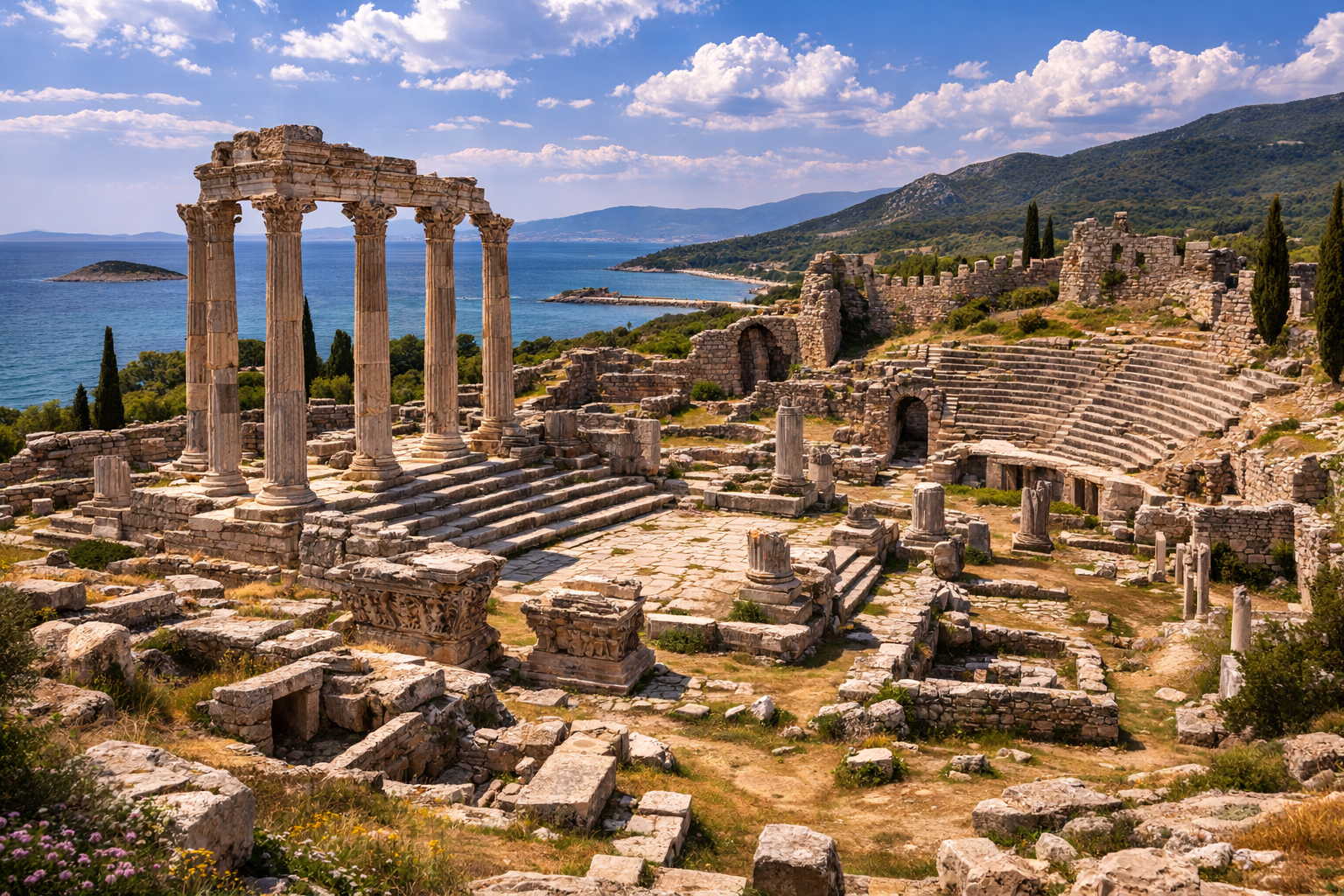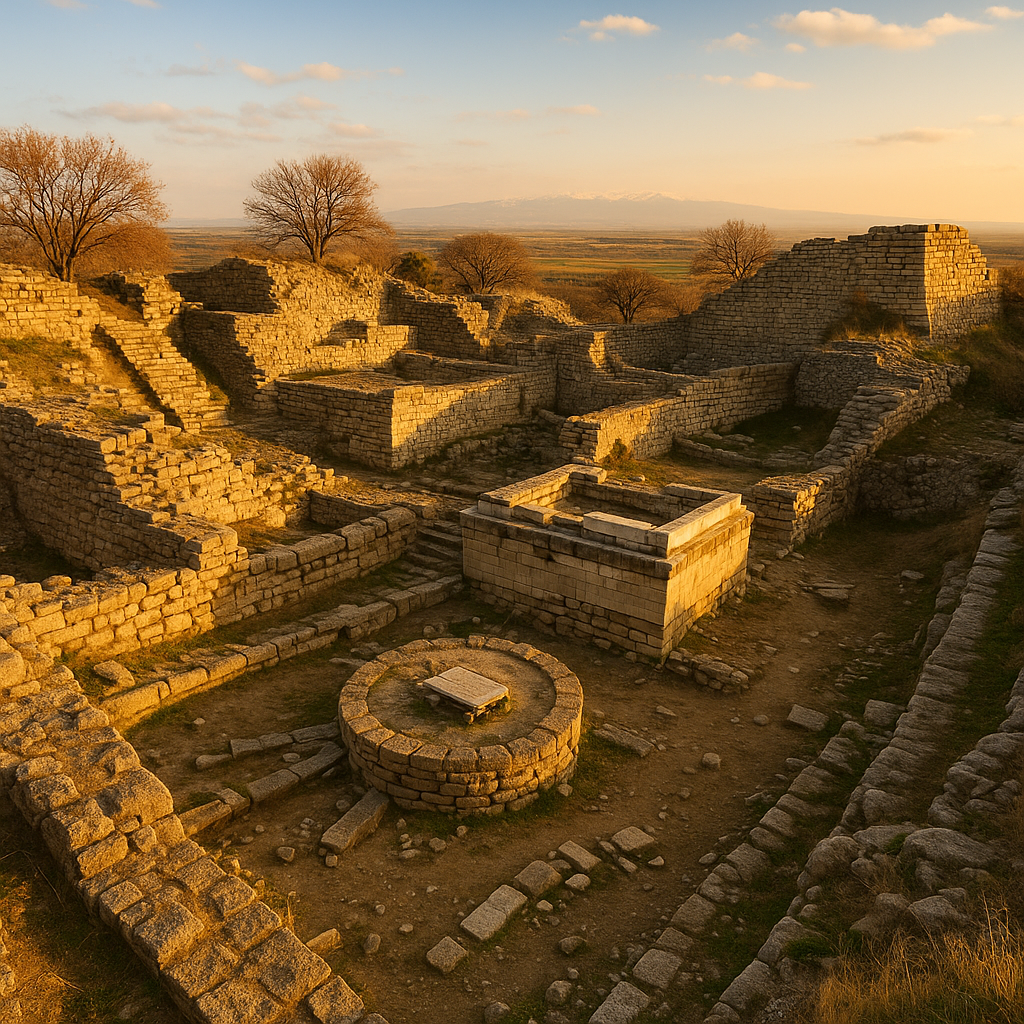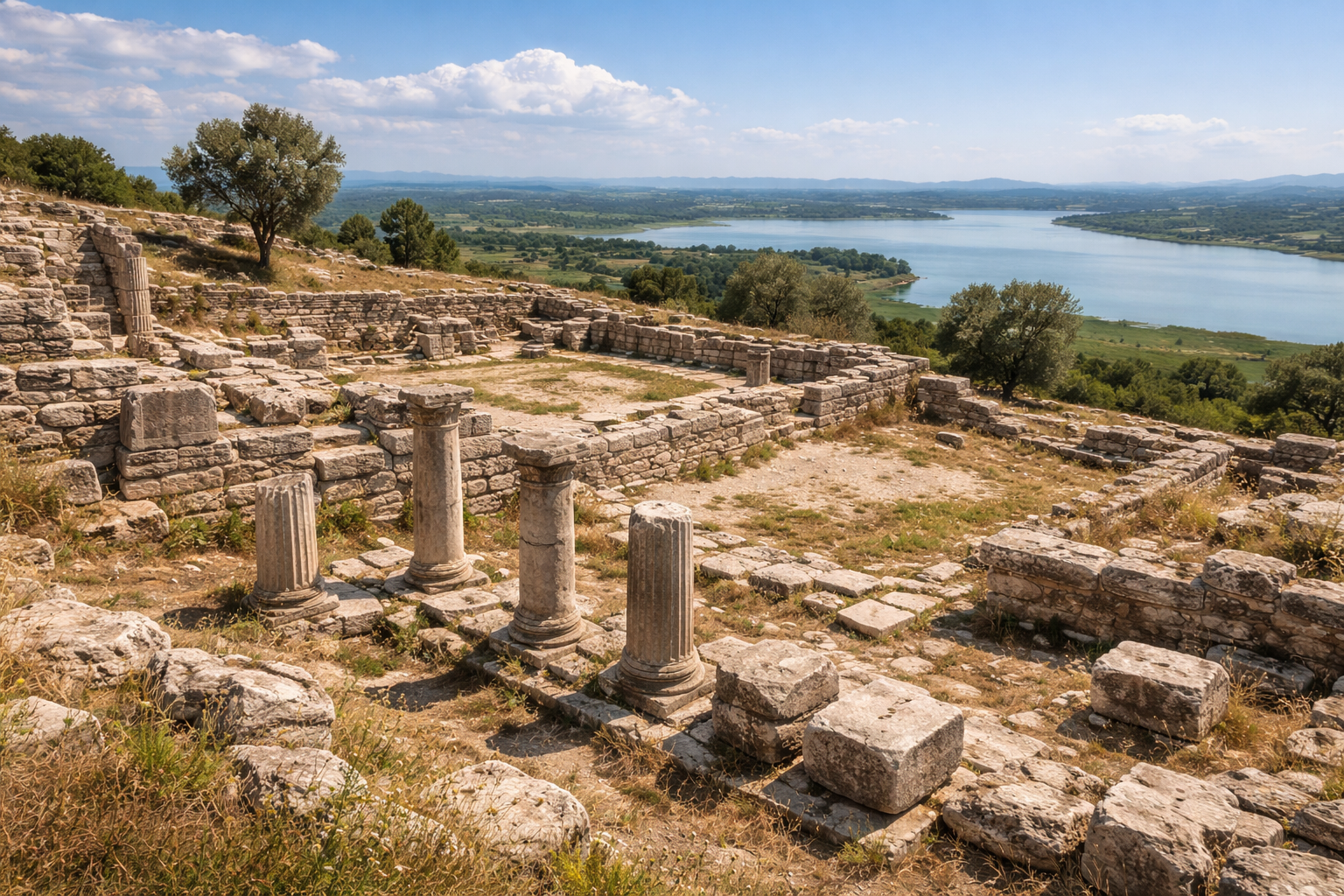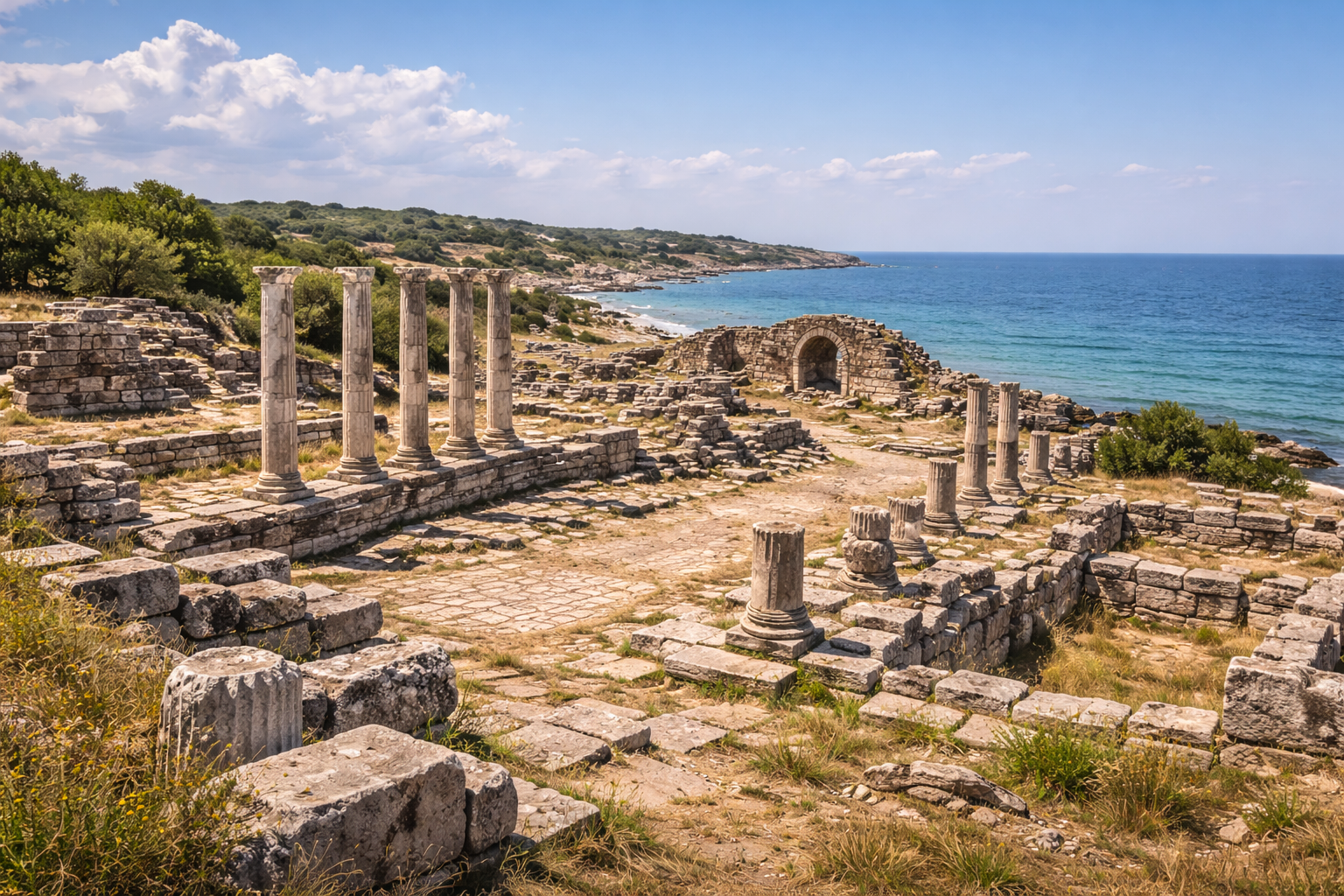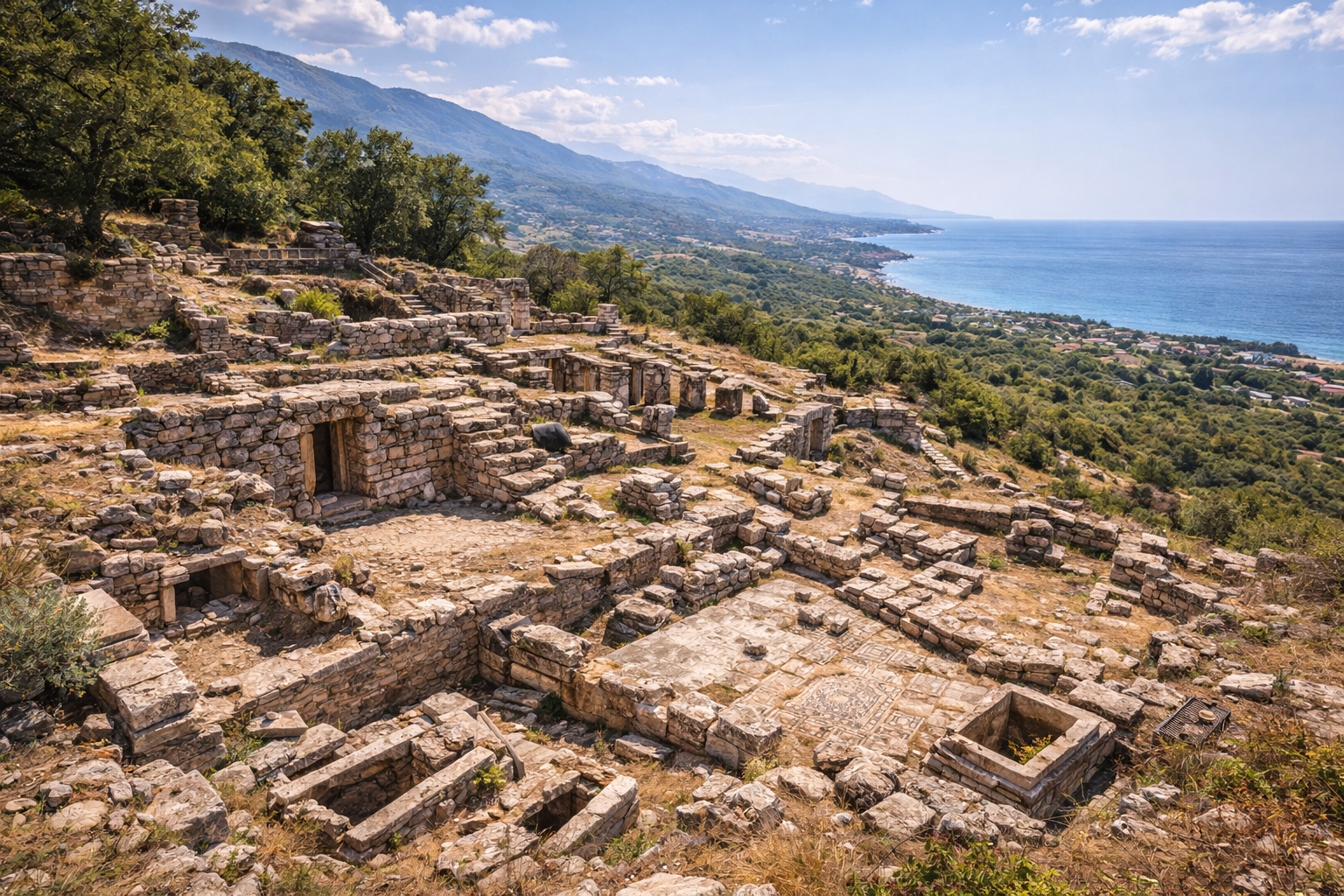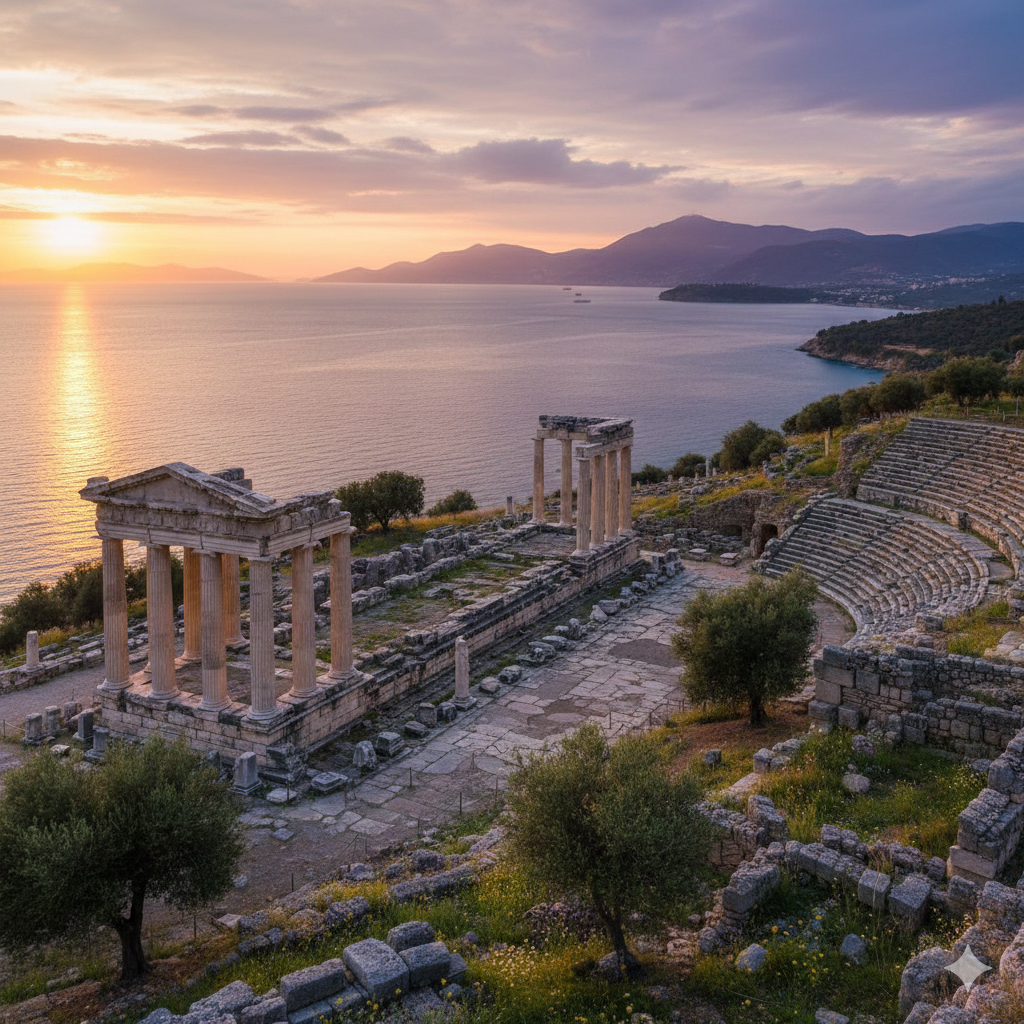
Parion (Parium) is an ancient Greek and Roman port city located near Kemer village in the Biga district of Canakkale Province, on the southern coast of the Sea of Marmara. Founded around 709 BC as a Greek colony, Parion grew into one of the largest and most prosperous harbor cities in northwestern Anatolia. The urban area covers approximately 4 km in diameter, making it one of the biggest archaeological sites in the region. Continuous excavations since 2005 have revealed a Roman bath complex, a theater seating 5,000--6,000, an odeon, a necropolis, city walls, and remarkably a second ancient harbor discovered through underwater research -- confirming Parion's role as a key maritime hub controlling trade between the Aegean, the Dardanelles, and the Black Sea.
- Why Parion Matters
- Geography and Setting
- Historical Timeline
- Major Monuments
- Coinage and Economy
- Archaeological Work
- Daily Life and Material Culture
- Visitor Information
- Frequently Asked Questions
- Sources and Further Reading
Why Parion Matters
-
Strategic harbor location: Parion sat on the Propontis (Sea of Marmara) at the intersection of major maritime routes linking the Aegean Sea, the Dardanelles (Hellespont), and the Black Sea (Pontus). Any ship traveling between Greece and the grain-rich Black Sea region had to pass through waters controlled by cities like Parion.
-
One of the largest ancient cities in the region: With an urban area spanning approximately 4 km in diameter and substantial remains of public buildings, Parion rivals nearby Cyzicus and Lampsakos in scale. Its harbor installations, recently confirmed by underwater archaeology, demonstrate its importance as a commercial gateway.
-
Rich numismatic heritage: Parion minted its own coins from the 5th century BC through the 3rd century AD, featuring distinctive iconography including the Gorgon head (Medusa) and the inscription "PARION." These coins are widely studied in ancient numismatics and appear in collections from London to New York.
-
Exceptional archaeological finds: Excavations have produced extraordinary artifacts including a 2,400-year-old bronze amphora decorated with Dionysiac scenes (satyrs and maenads), a golden crown with oak leaves, golden earrings with Eros figurines, and a coin depicting Paris of Troy -- linking Parion's identity to the broader Trojan mythological tradition.
-
Continuous habitation from archaic to Byzantine periods: Parion preserves evidence of Greek colonial foundations, Hellenistic civic development, Roman Imperial monumental architecture, and Byzantine ecclesiastical organization, providing a complete cross-section of ancient urban life across more than a millennium.
-
Dual harbor system confirmed by underwater archaeology: The 2024 discovery of a second port -- likely a military harbor -- makes Parion one of the few ancient cities in the Propontis region with archaeologically confirmed dual-harbor infrastructure, comparable to major naval bases of antiquity.
Geography and Setting
Parion occupies both sides of a small river valley where it meets the Sea of Marmara, forming a natural double harbor. The city is located near the modern village of Kemer, approximately 15 km north of Biga and about 100 km east of Canakkale city.
Key geographic features:
- Coastal position: The Marmara coastline provided sheltered anchorage and direct access to the Hellespont shipping lane. The city's two harbors -- confirmed by underwater surveys -- gave it capacity to handle significant maritime traffic. The southern harbor appears to have been the main commercial port, while the northern harbor may have served military or auxiliary purposes.
- River and valley: The small river bisecting the site provided fresh water and a natural axis for urban development. Settlement spread across both valley sides and along the coastal strip, creating a substantial urban footprint.
- Hinterland: The fertile Biga plain behind the city supported agriculture -- particularly grain, olives, and viticulture -- and connected Parion to inland settlements via road networks that reached deep into the Troad.
- Regional context: Parion lay between Lampsakos (modern Lapseki) to the west and Priapos to the east, with Skepsis and other Troad cities to the south. This dense network of cities created both competition and economic synergy, forming one of the most urbanized coastlines in the ancient Mediterranean world.
- Geological setting: The coastal geology features a mix of alluvial deposits from the river valley and harder bedrock along the coastline, which provided natural foundations for quay walls and harbor breakwaters.
- Marine environment: The Sea of Marmara's relatively calm waters, compared to the open Aegean, made harbor operations safer and more predictable. Tidal variation is minimal, simplifying the engineering requirements for port facilities. The prevailing northerly winds in summer assisted ships arriving from the Bosporus direction.
- Modern access: Reachable from Biga (approximately 15 km) or from Canakkale (approximately 100 km via the Canakkale-Biga highway). The village of Kemer serves as the nearest settlement with basic amenities.
Historical Timeline
Foundation Period (c. 709 BC)
Parion was founded as a Greek colony, traditionally dated to approximately 709 BC. The colonists came from several Greek cities, including Erythrai, Paros, and perhaps Miletus, making Parion an Aeolian-Ionian mixed foundation. The settlement's location at a natural harbor on the Propontis coast was chosen for its strategic and commercial advantages -- controlling the southern approach to the Hellespont passage.
Archaic Period (c. 700--480 BC)
During this period, Parion established itself as one of the significant Greek poleis on the Propontis coast. The city began minting silver and bronze coins featuring the distinctive Gorgon head (Medusa), a motif that would become Parion's trademark emblem for centuries. Archaeological evidence from this period includes early fortification walls and the foundations of the acropolis. The city developed trade links with other Greek colonies across the Propontis and into the Black Sea region, participating in the broader Greek colonization movement that transformed the shores of the ancient world.
Classical Period (480--330 BC)
Parion came under Persian control following the Ionian Revolt. After the Greek victories in the Persian Wars, the city became a member of the Delian League (Athenian alliance) and paid tribute to Athens, appearing in the Athenian tribute lists. Throughout the 5th and 4th centuries BC, it oscillated between Athenian, Spartan, and Persian spheres of influence, reflecting the turbulent politics of the era. The city's wealth during this period is evidenced by the quality and variety of its coinage, which circulated widely throughout the Aegean and Propontis commercial networks.
Hellenistic Period (330--133 BC)
After Alexander the Great's conquests, Parion passed through the hands of various Diadochi (successor kingdoms). The city eventually came under the control of the Kingdom of Pergamon. During this period, the urban infrastructure was significantly expanded with new public buildings, improved fortifications, and enlarged harbor facilities. Parion maintained its commercial importance as a transit point for goods moving between the Aegean and the Black Sea.
Roman Period (133 BC -- c. 400 AD)
When the Kingdom of Pergamon was bequeathed to Rome in 133 BC, Parion became part of the Roman province of Asia. Under Roman rule, the city experienced its greatest building boom:
- The Roman theater was constructed, with a three-story stage building and a capacity of 5,000--6,000 spectators, making it one of the larger theaters in the Propontis region
- A large Roman bath complex was built in the 2nd century AD, underwent multiple renovations, and remained in use until the 5th century
- An odeon (small covered theater for music and recitation) with a capacity of approximately 200 people -- described as one of the largest of its type in Anatolia
- A colonnaded agora or market street was developed, serving as the commercial heart of the city
- The harbor was expanded with new quay walls and breakwater installations
- Water supply infrastructure including aqueducts and cisterns were constructed to serve the growing urban population
Under Augustus, Parion received the status of a Roman colony (Colonia Pariana Iulia Augusta), a prestigious designation that granted its citizens Roman civic rights and exempted them from certain taxes. This status attracted Roman military veterans who settled in the city, further enriching its cultural diversity.
Byzantine Period (c. 400--1300 AD)
Parion continued as an important settlement in the Byzantine Empire. By the 5th century AD, it was recognized as a bishopric under the metropolitanate of Cyzicus, and by the 10th century, it had risen to the rank of archbishopric -- indicating its continued administrative and religious significance. Christian churches were built over or near older pagan structures. The city participated in several church councils. Settlement gradually contracted during the late medieval period as political instability, raids, and shifting trade routes diminished its strategic importance. By the 13th century, Parion was largely abandoned.
Major Monuments
Roman Theater
The most prominent visible structure at Parion. Features:
- Capacity: 5,000--6,000 spectators
- Stage building: Three-story scaenae frons (stage facade) with elaborate architectural decoration including columns, niches, and statuary placements
- Date: Primarily Roman Imperial period (1st--2nd century AD)
- Design: The cavea (seating area) was built partly into a natural hillside and partly on substructure vaulting, a technique common in Roman theater construction
- Archaeological note: In 2019, archaeologists solved the mystery of the theater's unusual 1,850-year-old stage configuration, revealing modifications to the orchestra area that adapted the building for different performance types, including gladiatorial combat and wild animal shows -- a practice known from other eastern Roman theaters
- Conservation: Ongoing restoration work aims to stabilize the seating sections and protect the remaining stage building elements from further deterioration
Roman Bath Complex
Located approximately 70 meters east of the theater and 150 meters from the beach:
- Construction: Estimated to the 2nd century AD, during the height of Roman imperial building activity in the province
- Usage: Remained in continuous use with repairs until the 5th century AD, spanning approximately three centuries of service
- Features: Includes the standard Roman bath sequence -- frigidarium (cold room), tepidarium (warm room), caldarium (hot room) -- plus hypocaust (underfloor heating) systems with well-preserved pilae (heating pillars) and tubuli (wall heating channels)
- Size: The complex covers a substantial area, indicating it served not just the immediate neighborhood but the wider urban population
- Water supply: Fed by a dedicated aqueduct that brought water from springs in the hinterland, with lead and ceramic pipes distributing water throughout the complex
- Excavation: First exposed in 2006, with ongoing conservation work. Mosaic floor fragments and marble revetment panels have been recovered from the bath complex
Odeon
A small covered theater for musical performances, recitations, and council meetings:
- Capacity: Approximately 200 people
- Significance: Described as one of the largest odeons discovered in Anatolia, suggesting Parion's civic ambitions and cultural life rivaled much larger cities
- Design: Semi-circular seating arrangement with a roofed structure providing acoustic enhancement for musical performances
- Discovery: An Artemis/Diana statue was found within the odeon during excavations, now an important artifact for understanding religious life in Roman Parion. The statue's placement within the odeon may indicate the building also served occasional religious functions
Necropolis Areas
Multiple burial zones have been excavated, with the Southern (Tavsandere) Necropolis providing the richest finds. In the 2023 excavation season, 18 graves representing five distinct burial types were uncovered:
- Cremation burials in urns, reflecting Greek and early Roman funerary customs
- Inhumation burials in tile graves (tegula graves), a widespread Roman practice
- Wooden coffin burials, evidenced by iron nails and wood traces
- Simple earth graves for more modest burials
- Pottery vessel graves, particularly for infant burials
- Rich grave goods including pottery, glass vessels, metal objects, figurines, and coins spanning from the Classical and Hellenistic periods through the 1st and 2nd centuries AD
- A 1,900-year-old tombstone that illuminated aspects of period-specific burial practices and family commemorative traditions
- 2,000-year-old mother-child graves unearthed in recent seasons, providing poignant evidence of family burial customs
Harbor Installations
Parion's harbors were its economic lifeblood:
- The primary (southern) harbor area includes quay walls, breakwater structures, and storage facilities for maritime goods
- In 2024, underwater archaeological research revealed a second ancient port to the north, which appears to have been smaller and may have served military purposes, given Parion's status as a Roman legion colony. This dual-port arrangement echoes the harbor configurations of major ancient naval cities.
- Harbor installations span from the Hellenistic through Roman periods, with evidence of periodic maintenance and expansion
- Underwater surveys identified submerged quay walls, stone anchors, and fragments of amphorae that once held wine, olive oil, and grain -- the staple commodities of Mediterranean trade
City Walls and Acropolis
Fortification walls approximately 1,800 years old have been uncovered, along with remains of the acropolis on the elevated area above the harbor:
- The walls demonstrate multiple phases of construction and repair, reflecting both evolving defensive needs and earthquake damage
- The acropolis served as the original civic and religious center of the colony
- Traces of earlier Greek-period walls have been identified beneath the Roman-era fortifications
- The acropolis offers panoramic views over both harbors, illustrating why this position was chosen as the settlement's nucleus
Agora and Warehouse Complex
The commercial center of the city has been partially excavated:
- Colonnaded streets with shop fronts opening onto the main thoroughfare
- Large warehouse structures near the harbor for storing goods in transit
- Evidence of commercial activity including weights, measures, and merchant seals
Coinage and Economy
Parion's coinage is one of its most distinctive contributions to ancient history:
- Period: Coins were minted from the 5th century BC to the late 3rd century AD, an extraordinarily long minting history that spans Greek, Hellenistic, and Roman periods
- Materials: Silver, bronze, and copper in various denominations
- Iconography: The most characteristic type features a Gorgon (Medusa) head -- a powerful apotropaic symbol believed to ward off evil. The Gorgon appears on coins across multiple centuries, making it one of the most enduring civic emblems in ancient numismatics. Other types include bulls, altars, sacrificial scenes, and portraits of Roman emperors.
- Inscription: Coins bear the legend "PARION", "C.G.I.H.P." (Colonia Gemella Iulia Hadriana Pariana), or Greek equivalents
- Paris coin: A remarkable coin depicting Paris of Troy (the mythological Trojan prince who abducted Helen) was discovered, approximately 1,800 years old. This links Parion's civic identity to the broader Trojan mythological tradition, suggesting the city may have claimed mythological ancestry from the Trojan royal house.
- Colonial coinage: After receiving Roman colony status, Parion issued coins with Latin legends and imperial portraits, reflecting its integration into the Roman administrative system
- Economic significance: The range and quantity of Parion's coinage demonstrates its role as a major commercial center with an active local economy and participation in regional trade networks. Parion coins have been found across the Aegean, in the Black Sea region, and along the eastern Mediterranean coast.
- Comparative numismatics: Parion's Gorgon coinage is compared by scholars with similar apotropaic emblems used by other Propontis cities, helping to reconstruct the religious and cultural networks that linked the Greek colonies of the southern Marmara coast.
Archaeological Work
Early Investigations (19th--20th century)
The site was known to travelers and scholars from the 19th century, but systematic investigation came later. Surface surveys documented the extent of the ancient city and noted the visible remains of the theater, walls, and harbor. European numismatists studied Parion's coins extensively, establishing its importance long before excavation began.
Cevat Basaran (1997, 1999, 2002)
Professor Cevat Basaran conducted initial archaeological campaigns that established the site's potential and identified key areas for excavation. These early surveys produced the first scientific maps of the site and catalogued surface finds.
Vedat Keles and Ondokuz Mayis University (2005--present)
Since 2005, continuous excavations have been led by Professor Vedat Keles from the Archaeology Department of Ondokuz Mayis University (OMU) in Samsun. This long-running project has:
- Excavated seven major areas: Odeon, Southern (Tavsandere) Necropolis, Slope Bath, Roman Bath, Agora/Warehouse complex, Theater, and Acropolis walls
- Uncovered the 2,400-year-old bronze amphora with Dionysiac decoration (satyrs and maenads) -- one of the most significant Bronze/Classical period artifacts found in the region
- Discovered 260+ ancient artifacts including the golden crown with oak leaves and golden earrings with Eros figurines
- Conducted underwater research revealing the second ancient port (2024), with remote sensing and diving surveys
- Implemented conservation and restoration programs for the theater and bath complex
- Published scholarly findings through the journal Anatolian Archaeology and other academic outlets
- Collaborated with international researchers in underwater archaeology, numismatics, and archaeobotany
- In the 2023 season, recovered 37 ceramics, 39 figurines, seven coins, five metal objects, five bone artifacts, and six glass objects, all donated to the Troy Museum
- Participated in the 3rd Troas Symposium, where necropolis findings were presented to the international scholarly community
Daily Life and Material Culture
Archaeological evidence provides a vivid picture of everyday life in ancient Parion:
Food and Agriculture
- Archaeobotanical analysis of samples from the excavation has identified remains of wheat, barley, grapes, olives, figs, and lentils, documenting the agricultural base of the city's economy
- Fish bones recovered from domestic contexts confirm that fishing in the Marmara was a significant food source
- Large storage amphorae in the warehouse district suggest organized trade in wine and olive oil, both for local consumption and export
Crafts and Industry
- Evidence of pottery production workshops has been found near the city's periphery, including kiln fragments and production wasters
- Metal-working debris -- including bronze casting waste, slag, and unfinished objects -- indicates local craft production serving both domestic and export markets
- Glass vessels found in graves and domestic contexts demonstrate the city's participation in the wider Roman glass trade network
Religious Life
- In addition to the Artemis/Diana statue from the odeon, excavations have produced terracotta figurines depicting various deities, including Aphrodite, Cybele, and Hermes
- Votive offerings found near the harbor suggest the existence of a harbor shrine where sailors and merchants made dedications for safe voyages
- The transition from pagan to Christian worship is documented by the conversion of temple sites to churches during the Byzantine period
Burial Customs
- The five distinct burial types in the necropolis demonstrate that Parion's population maintained diverse funerary traditions simultaneously, reflecting its multicultural character as a colony city
- Infant burials in pottery vessels follow a widespread Mediterranean practice that appears across many centuries
- Grave goods evolve over time from Greek-style painted pottery to Roman glass unguentaria and coin-in-mouth burials (for Charon's fee), tracing changing beliefs about the afterlife
Visitor Information
Getting There
- From Biga: Approximately 15 km north, about 20 minutes by car. Head toward Kemer village on the coastal road.
- From Canakkale: Approximately 100 km east, about 1.5 hours via the Canakkale-Biga highway
- From Istanbul: Approximately 280 km, about 3.5 hours via the Tekirdag-Biga route or via the 1915 Canakkale Bridge and Canakkale-Biga road
Hours and Admission
- The site is an active archaeological excavation zone. Check with local authorities or Biga tourism office for current access conditions.
- Some areas may have restricted access during active excavation seasons (typically June through September).
- Major finds from Parion are displayed at the Troy Museum in Canakkale and the Canakkale Archaeological Museum.
Time Required
- Minimum: 1--1.5 hours (main visible structures: theater, bath complex)
- Recommended: 2--3 hours (full site including harbor area and necropolis)
- Combined visit: Can be paired with Lampsakos (Lapseki) or a day trip from Canakkale incorporating other Troad sites
Best Seasons
- Spring (April--May): Ideal weather, green landscape, wildflowers along the coastal path
- Autumn (September--October): Comfortable temperatures, good visibility, harvest season in the surrounding farmland
- Summer: Hot; early morning visits recommended. The Marmara coast provides some breeze.
- Winter: Quiet but can be cold and windy on the coast. The site is still accessible.
Practical Tips
- Wear sturdy shoes; the terrain is varied with uneven ground near excavation areas.
- Bring water and sun protection, especially in summer.
- The site is extensive -- allow time for walking between areas, particularly between the theater and harbor zones.
- As an active excavation, some areas may be fenced. Respect restricted zones and follow any posted instructions.
- There is limited tourist infrastructure at the site; bring supplies from Biga.
- Photography is generally permitted but flash and tripods may be restricted in certain excavation areas.
- A visit to the Troy Museum in Canakkale before or after Parion provides excellent context for understanding the artifacts recovered from the site.
Frequently Asked Questions
Why is Parion not as well known as Troy or Ephesus?
Parion's excavation history is relatively recent (systematic work began in 2005), and the site has not yet been developed for mass tourism. However, its archaeological significance is enormous -- it was one of the largest and richest cities on the Propontis coast. As excavations continue and more structures are revealed, Parion's profile is steadily growing in both academic and popular awareness.
What is the Gorgon head on Parion coins?
The Gorgon (Medusa) was an apotropaic symbol -- a fearsome image believed to ward off evil. It was Parion's most distinctive civic emblem, appearing on coins from the Classical through Roman periods. The choice of the Gorgon may relate to Greek mythological traditions associated with the Troad region and the protective function the image was believed to provide for the city and its harbor.
Can I see the golden crown and bronze amphora?
Major finds from Parion are displayed at the Troy Museum in Canakkale and at the Canakkale Archaeological Museum. Some artifacts are also held at research facilities associated with Ondokuz Mayis University. Check museum hours before visiting.
Is Parion connected to the Trojan War mythology?
Yes, indirectly. The name "Parion" has been linked by some ancient sources to Paris (Alexandros), the Trojan prince. The discovery of a coin depicting Paris reinforces this mythological connection, and the city lies within the broader Troad cultural sphere. Ancient geographers consistently placed Parion within the territory of the Troad, connecting it to the wider Trojan narrative landscape.
How does Parion relate to nearby ancient cities?
Parion was part of a dense network of cities along the Propontis and Hellespont coasts, including Lampsakos (Lapseki), Priapos, Kyzikos (Cyzicus), and Abydos. These cities competed and cooperated commercially, and they shared political experiences under Persian, Hellenistic, and Roman rule. Parion's dual harbors made it particularly important as a waystation for ships transiting the straits.
What was the second port discovered in 2024?
Underwater archaeological research in 2024 revealed a previously unknown northern port in addition to the already known southern harbor. The northern port appears to be smaller and may have served military purposes, consistent with Parion's status as a Roman legion colony (Colonia). This dual-port arrangement is significant because it suggests a level of maritime infrastructure previously undocumented for Parion.
Is the site suitable for families?
Yes, though it requires more imagination than a fully restored site. The theater and bath complex are visually impressive, and the coastal setting is pleasant for walking. Bring comfortable shoes and water for children. The site lacks formal facilities such as restrooms or snack bars.
What artifacts were found in the 2023 excavation season?
The 2023 season produced 37 ceramics, 39 figurines, seven coins, five metal objects, five bone artifacts, and six glass objects. Eighteen graves of five distinct burial types were uncovered in the necropolis, spanning from Classical and Hellenistic periods to the first and second centuries AD. All finds were donated to the Troy Museum.
What was Parion's relationship with Rome?
Parion was one of the few cities in the region to receive the coveted status of a Roman colony (Colonia) under Augustus. This granted its citizens full Roman civic rights, exemptions from certain taxes, and the right to self-governance under Roman law. The city attracted Roman veterans and became a cultural bridge between Greek and Roman traditions in the eastern Mediterranean.
Architectural Measurements and Key Figures
The following table consolidates published and estimated dimensions for Parion's principal monuments, drawn from excavation reports by the Ondokuz Mayis University team and comparative architectural studies.
| Feature | Measurement / Detail |
|---|---|
| Urban area diameter | Approximately 4 km |
| Roman theater -- capacity | 5,000 -- 6,000 spectators |
| Roman theater -- scaenae frons | Three-story stage facade with columnar orders |
| Odeon -- capacity | Approximately 200 people (one of the largest in Anatolia) |
| Roman bath complex -- distance from theater | 70 m east of the theater, 150 m from the beach |
| Roman bath complex -- construction date | 2nd century AD |
| Roman bath complex -- operational lifespan | 2nd -- 5th century AD (approximately 300 years) |
| City walls -- estimated age | Approximately 1,800 years (Roman Imperial period) |
| Southern (Tavsandere) Necropolis -- 2023 graves | 18 graves representing 5 distinct burial types |
| Foundation date | ca. 709 BC |
| Coin minting period | 5th century BC -- late 3rd century AD (~700 years of minting) |
| Colony designation | Colonia Pariana Iulia Augusta (under Augustus) |
| Bishopric establishment | 5th century AD |
| Archbishopric elevation | 10th century AD |
| 2023 season artifact count | 37 ceramics, 39 figurines, 7 coins, 5 metal objects, 5 bone artifacts, 6 glass objects |
Numismatic Evidence -- Detailed Catalogue
Parion's coinage represents one of the most extensive and distinctive numismatic traditions of any city in the ancient Troad. The following table catalogues the principal coin types by period, metal, weight, and iconography.
Greek-Period Coinage
| Period | Metal | Denomination | Weight | Obverse | Reverse |
|---|---|---|---|---|---|
| 5th century BC (archaic) | Silver | Drachm (3/4 weight) | ca. 3.5 -- 4.0 g | Gorgoneion (Medusa head, tongue protruding, snakes encircling) | Irregular incuse pattern |
| 5th -- 4th century BC | Silver | Hemidrachm | ca. 2.3 -- 2.6 g | Gorgoneion facing | Bull standing left, head turned right |
| 4th century BC | Silver | Hemidrachm | 2.14 -- 2.44 g, 12 -- 14 mm diameter | Gorgoneion with coiled snakes | ΠA-PI, bull standing left, star or symbol below |
| 4th -- 3rd century BC | Bronze | Various | Variable | Gorgoneion | Bull, altar, or sacrificial scene |
The Gorgoneion type is Parion's most enduring civic emblem, appearing continuously across multiple centuries. David Sear, in Greek Coins and Their Values, classifies the silver issues into two weight groups: a heavier "3/4 drachm" at approximately 4 g and a lighter hemidrachm at approximately 2.6 g. The sub-bull symbols (stars, crescents, grain ears, dolphins) serve as magistrate or issue markers and are catalogued in the standard numismatic references.
Roman Colonial Coinage
| Period | Metal | Legend | Obverse | Reverse |
|---|---|---|---|---|
| Augustan era onward | Bronze | C.G.I.H.P. (Colonia Gemella Iulia Hadriana Pariana) | Imperial portrait (Augustus, later emperors) | Founder plowing with ox, colonial standards |
| ca. 2nd century AD | Bronze | PARION or C.G.I.H.P. | Imperial portrait | Altar with sacrificial scene |
| ca. 2nd -- 3rd century AD | Bronze | PARION | Paris of Troy (mythological prince) | Various types |
The Paris of Troy coin, approximately 1,800 years old, is of particular significance because it explicitly links Parion's civic identity to the Trojan mythological tradition. The name "Parion" itself was understood in antiquity as a derivation from the Trojan prince Paris (also called Alexandros), and this coin provides numismatic confirmation of that claimed heritage.
Theater Stage Configuration and Gladiatorial Adaptation
The 2019 excavation season resolved a longstanding archaeological puzzle about the theater's unusual 1,850-year-old stage configuration. Analysis of the orchestra area revealed structural modifications that adapted the building for multiple performance types:
- Standard theatrical performances: The original Hellenistic-Roman configuration with a raised stage (proskenion) and curved orchestra
- Gladiatorial combat adaptation: Barrier walls and modified drainage channels were identified in the orchestra, designed to contain animal and human blood during gladiatorial spectacles -- a practice documented at other eastern Roman theaters including those at Ephesus and Aphrodisias
- Wild animal shows (venationes): Reinforced parapet walls at the orchestra perimeter protected spectators from animals released into the arena
This multi-purpose adaptation reflects a broader trend in the Roman East, where purpose-built amphitheaters were rare and existing theaters were modified to accommodate the popular gladiatorial and animal combat events demanded by Roman audiences. The modifications at Parion date to approximately the mid-2nd century AD, coinciding with the peak of gladiatorial culture in the eastern provinces.
Trade Networks and Commercial Amphora Evidence
Amphora finds from the Slope Bath excavations (2008 -- 2019) provide direct evidence of Parion's far-reaching commercial connections. The commercial amphora assemblage includes:
| Amphora Type | Origin | Contents | Date Range |
|---|---|---|---|
| Dressel 2-4 | Aegean / Italian | Wine | 1st century BC -- 2nd century AD |
| Late Roman 1 | Cilicia / Cyprus | Wine, olive oil | 4th -- 7th century AD |
| Late Roman 2 | Aegean islands | Wine | 4th -- 7th century AD |
| Sinopean types | Black Sea (Sinope) | Fish sauce, wine | 4th -- 2nd century BC |
| Local Troad types | Parion region | Wine, olive oil | Hellenistic -- Roman |
The presence of Sinopean amphorae confirms Parion's role as a transit hub for Black Sea commodities moving through the Propontis toward Aegean and Mediterranean markets. The variety of amphora types spanning nearly a millennium underscores the city's commercial resilience across political transitions from Hellenistic kingdoms to the Roman Empire and early Byzantine period.
Excavation Season Highlights (2005 -- 2024)
| Year | Key Finding | Significance |
|---|---|---|
| 2005 | Excavations begin under Prof. Vedat Keles (OMU) | First systematic campaign at Parion |
| 2006 | Roman bath complex first exposed | Confirms 2nd-century AD monumental civic architecture |
| 2006 | Theater excavation commences | Reveals 5,000-6,000-seat capacity and three-story scaenae frons |
| ca. 2007 -- 2010 | 2,400-year-old bronze amphora (34 cm height) discovered | Dionysiac decoration (satyrs, maenads); one of the finest bronze vessels from the Troad |
| ca. 2010 -- 2015 | Golden crown with oak leaves; golden earrings with Eros figurines recovered | Elite burial goods demonstrating significant wealth |
| 2019 | 1,850-year-old stage mystery solved | Theater adapted for gladiatorial combat and wild animal shows |
| 2023 | 18 graves of 5 burial types in Southern Necropolis | 37 ceramics, 39 figurines, 7 coins, 5 metal, 5 bone, 6 glass objects |
| 2023 | 1,900-year-old tombstone recovered | Illuminates Roman-era burial customs |
| 2023 | Findings presented at 3rd Troas Symposium | International academic recognition |
| 2024 | Second ancient port discovered via underwater research | Dual-harbor system confirmed; military harbor hypothesis |
| All seasons | 260+ ancient artifacts catalogued | Donated to Troy Museum in Canakkale |
Sources and Further Reading
- Ondokuz Mayis University -- Parion Excavations https://ark-itbf.omu.edu.tr/en/ara%C5%9Ftirmalar/kazilar/parion-kazilari
- Turkish Archaeological News -- Parion (Kemer) https://turkisharchaeonews.net/site/parion-kemer
- Greek Reporter -- Unraveling the Secrets of Parion https://greekreporter.com/2025/08/12/parion-ancient-greek-city/
- Arkeonews -- 2,000-year-old mother-child graves at Parion https://arkeonews.net/in-parion-one-of-the-most-important-cities-of-the-troas-region-2000-year-old-mother-child-graves-were-unearthed/
- Turkiye Today -- 3rd Troas Symposium and Parion Necropolis https://www.turkiyetoday.com/culture/3rd-troas-symposium-canakkale-48144/
- ArticHaeology -- Parium Ancient City https://www.artichaeology.com/parium-ancient-city
- Daily Sabah -- 2,200-year-old Parion tablet https://www.dailysabah.com/life/2014/09/06/2200yearold-parion-tablet-gives-insight-into-roman-legacy-in-canakkale
- Daily Sabah -- Archaeologists solve mystery of 1,850-year-old stage https://www.dailysabah.com/history/2019/10/03/archaeologists-solve-mystery-of-1850-year-old-stage-in-western-turkey
- Wikipedia -- Parium https://en.wikipedia.org/wiki/Parium
- Wow Cappadocia -- Parion (Parium) Ancient City https://wowcappadocia.com/parion-parium-ancient-city.html
- VoyageTurkey -- Parion Ancient City https://voyageturkey.net/parion-ancient-city-son-of-trojan-king-priam/