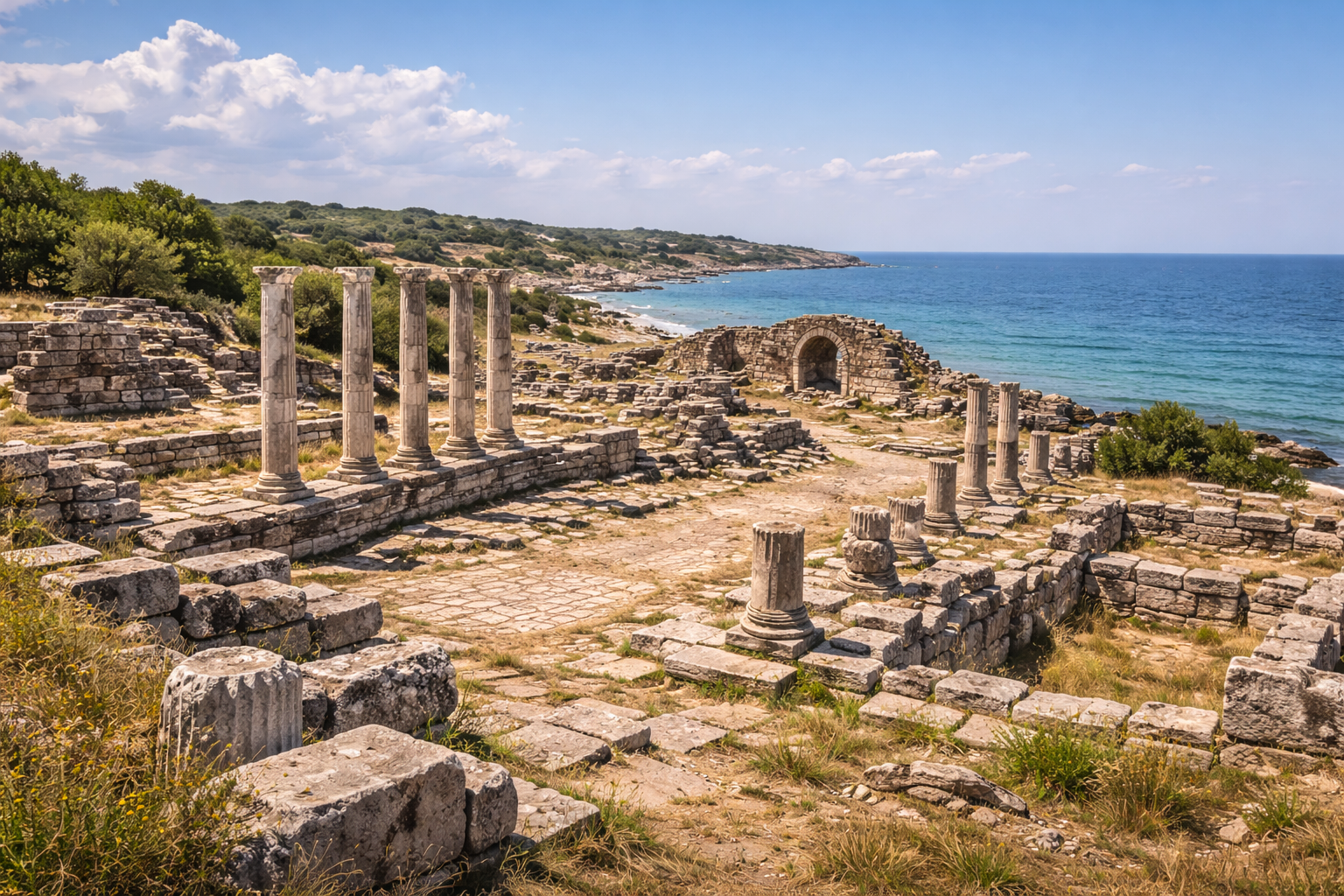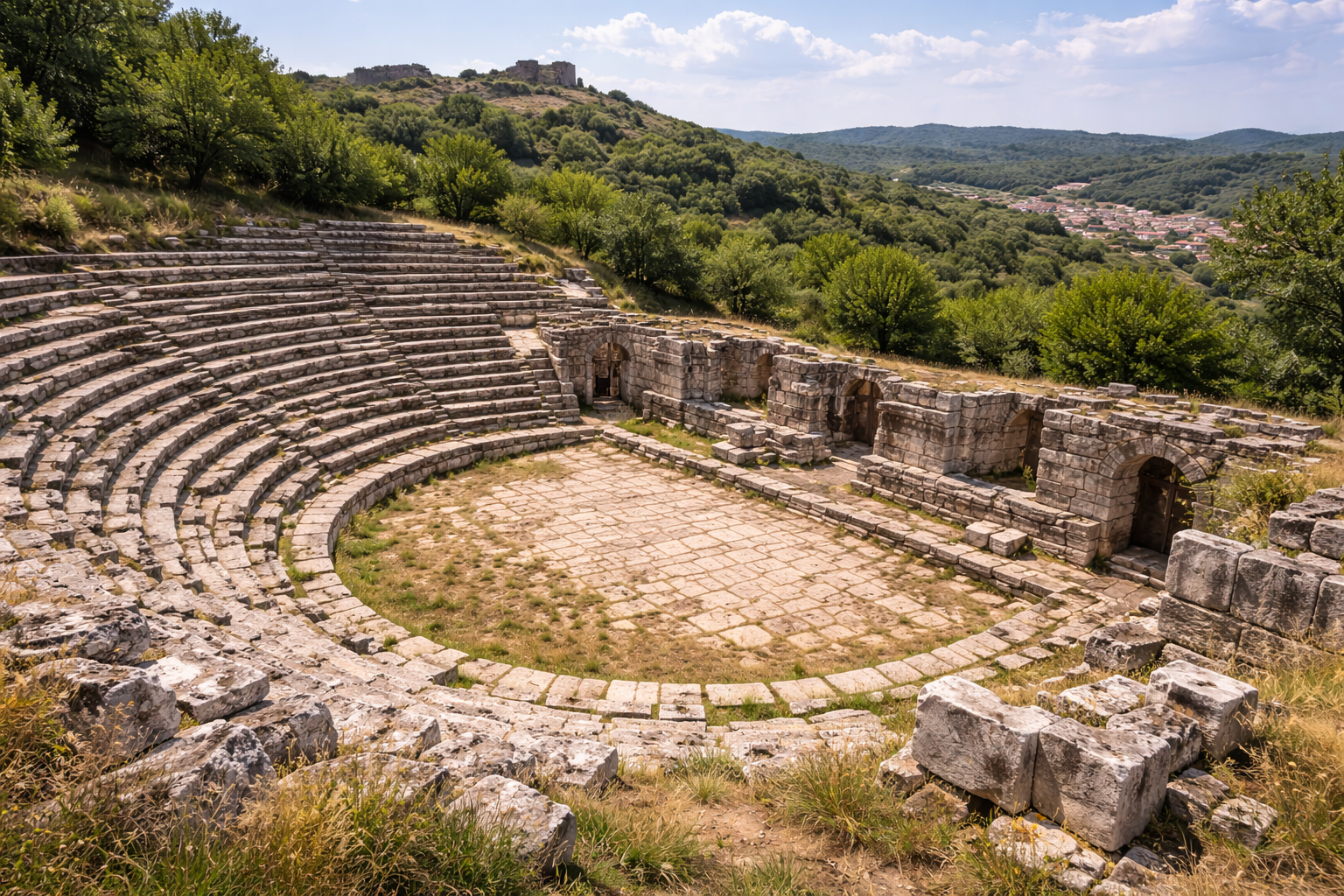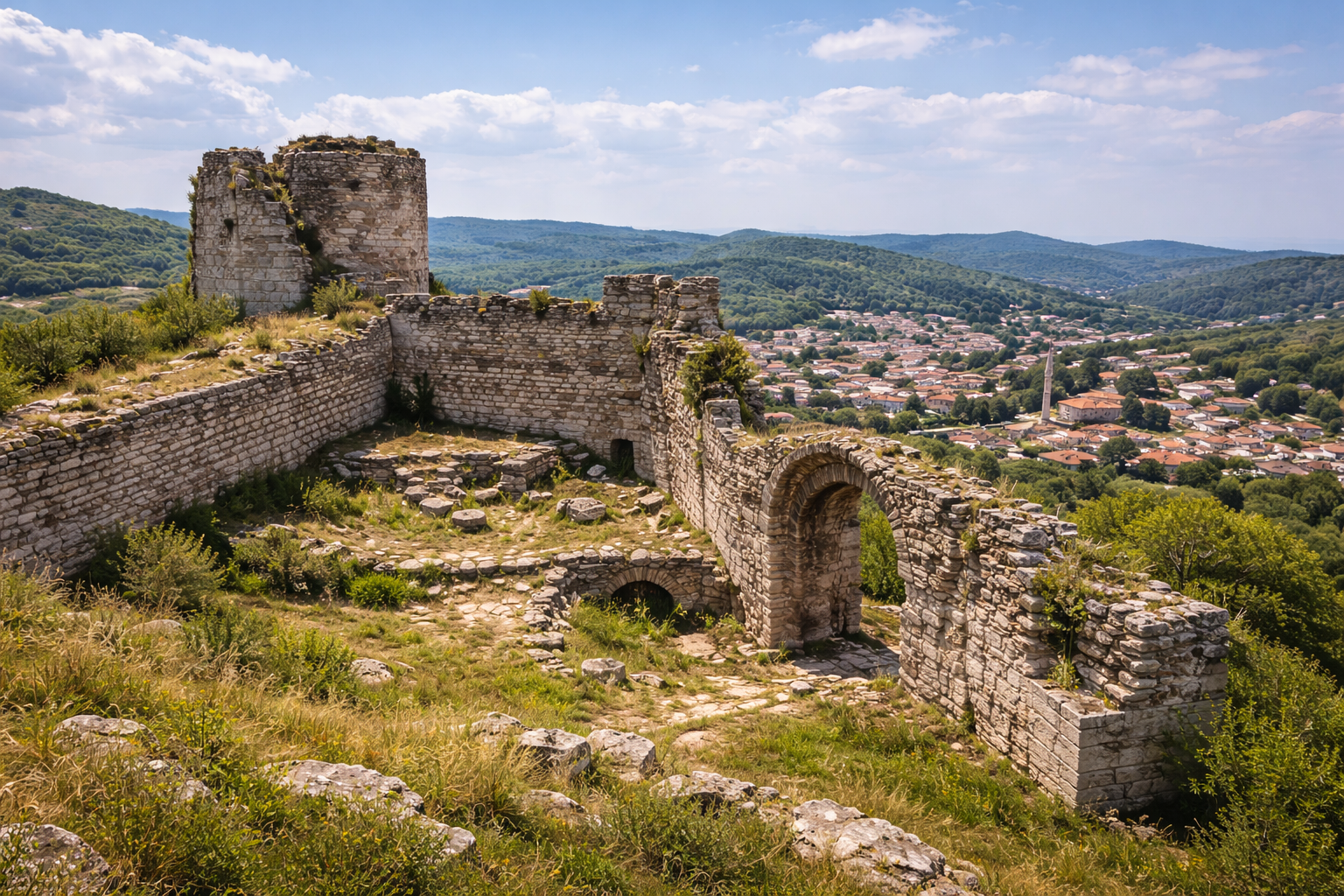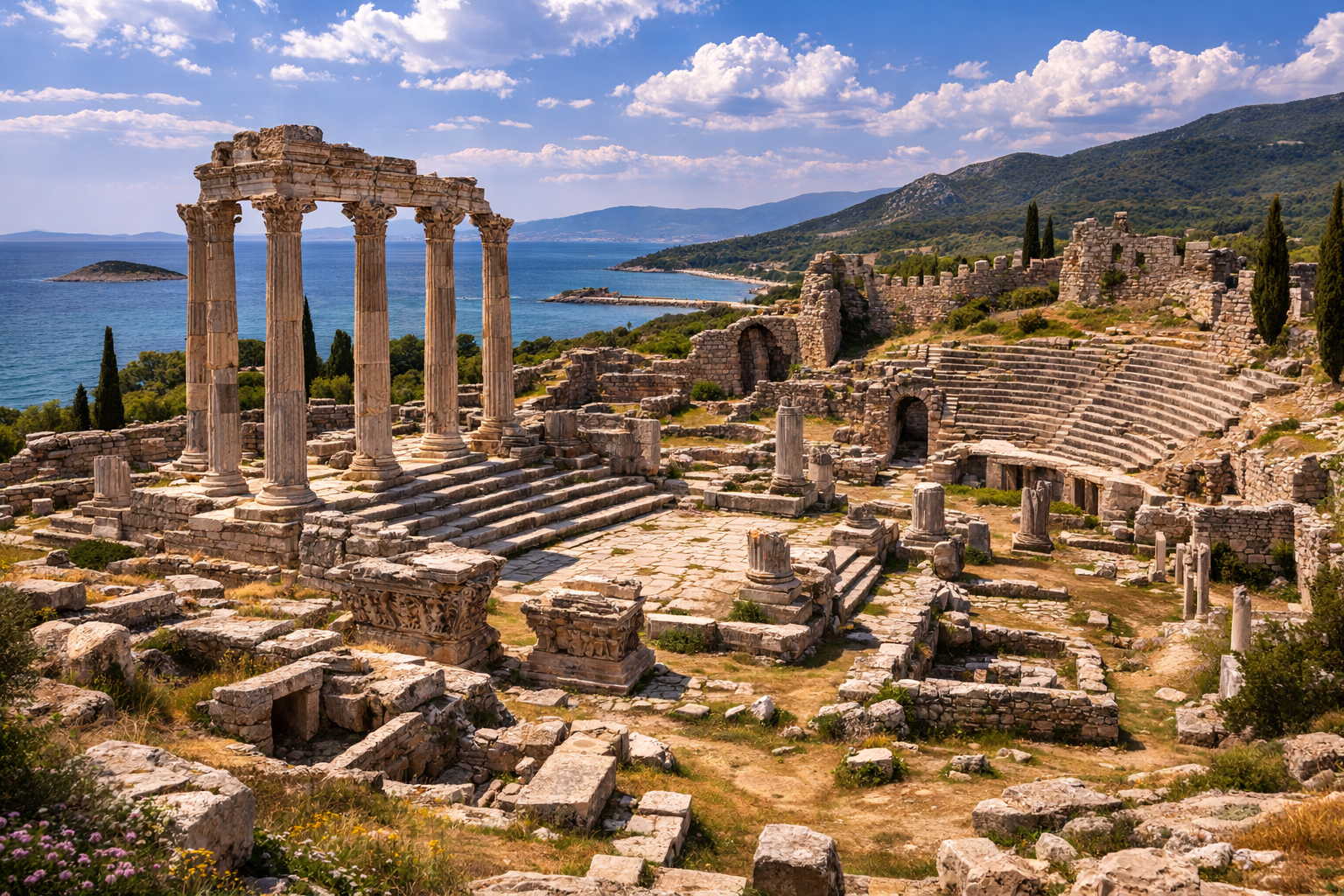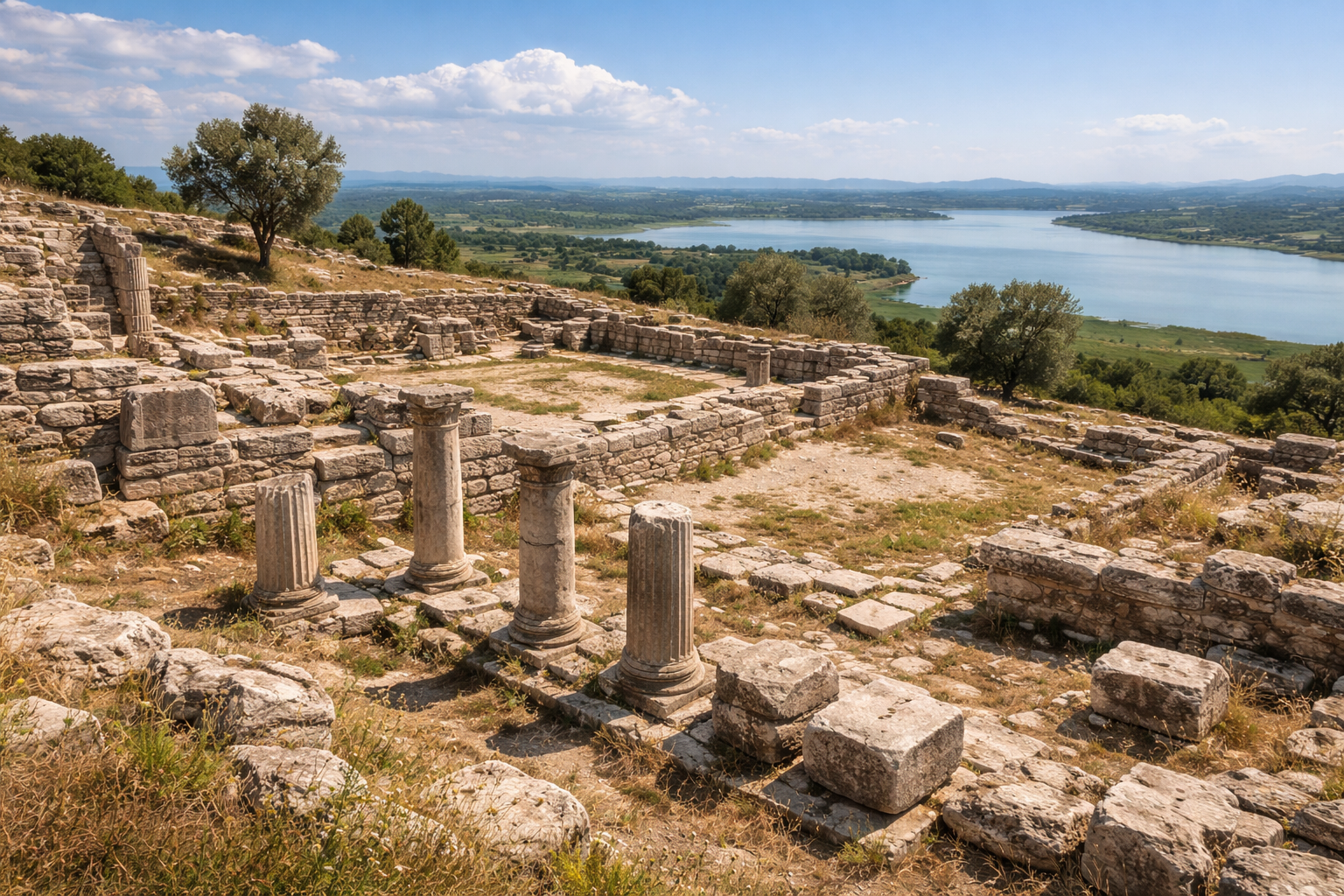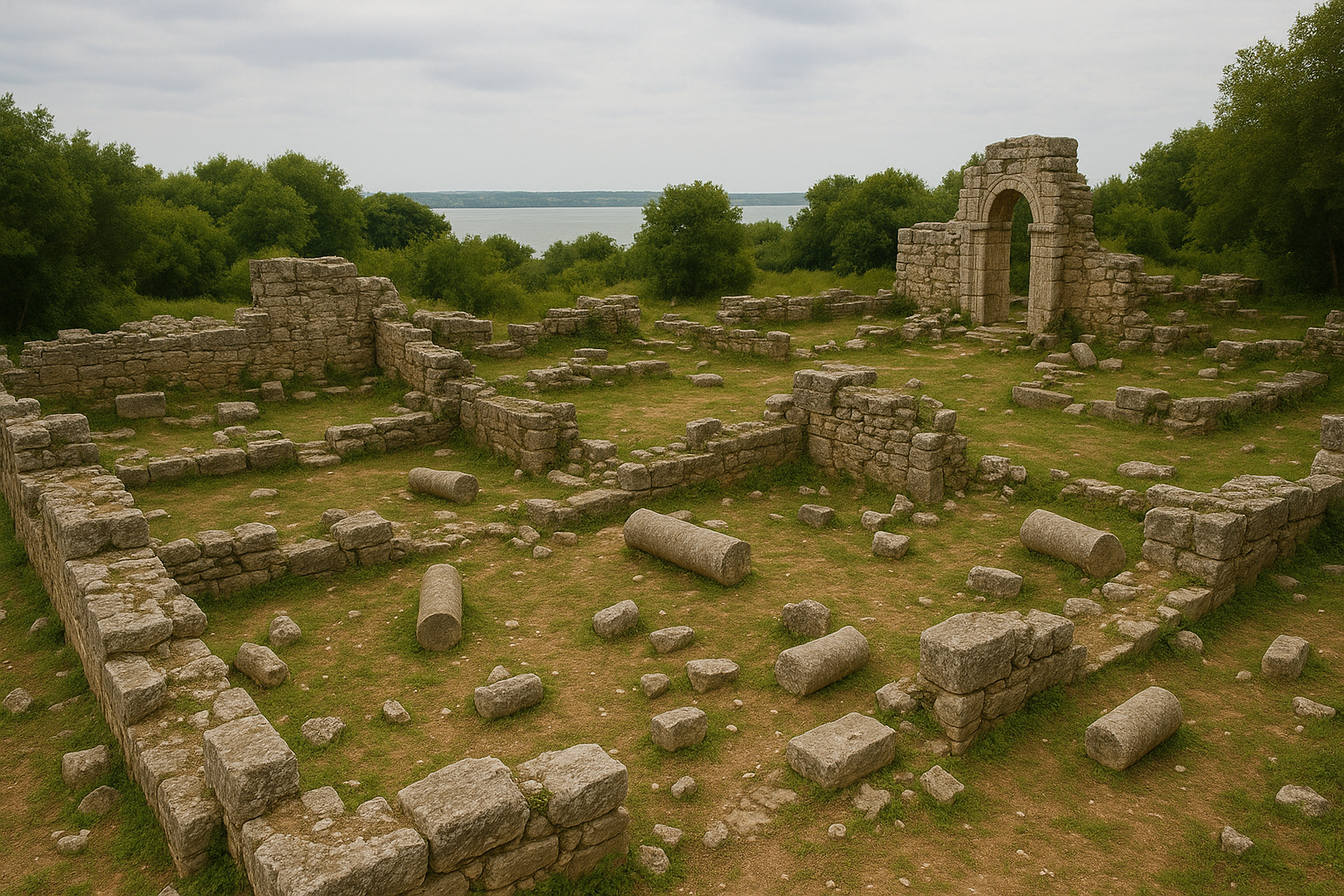
Bathonea is an ancient harbor settlement on the northwestern shore of Kucukcekmece Lake in the Avcilar district of Istanbul. Rediscovered in 2007 after a drought lowered the lake level, the site has yielded evidence of continuous occupation spanning roughly 4,000 years, from the Bronze Age through the Byzantine period. Directed by Prof. Sengul Aydingun of Kocaeli University, excavations since 2009 have uncovered two ancient harbors, a lighthouse, a palace complex with mosaics, a Constantinian cistern with a capacity of 7,000 cubic meters, wine and olive-oil workshops, and Viking-era trade artefacts, making Bathonea one of Istanbul's most significant ongoing archaeological projects.
- Why Bathonea Matters
- Geography and Setting
- Historical Timeline
- Major Monuments and Discoveries
- Archaeological Work
- Visitor Information
- Frequently Asked Questions
- Sources and Further Reading
Why Bathonea Matters
-
Gateway to Constantinople. Bathonea functioned as a safe harbor for vessels heading to the imperial capital from the 4th century AD onward, making it a critical link in the maritime supply chain that sustained the Byzantine Empire. Ships transiting from the Aegean to the Bosphorus could shelter here before completing the final approach to the Golden Horn.
-
Extraordinary time depth. The cultural deposits span from the Bronze Age (c. 2000 BC) through the 11th century AD, providing an uninterrupted narrative of settlement, trade, and urban transformation across multiple civilizations. Two figurines and ceramic fragments from the Early Hittite or Hurri period, dated to approximately 1800 BC and found in 2014, pushed the site's known history even further back.
-
Unique lighthouse discovery. The ancient lighthouse found submerged in the lake is only the second ancient lighthouse ever identified in Turkey, after the Patara lighthouse on the Mediterranean coast. It guided ships through the narrow channel connecting the Sea of Marmara to the sheltered lake waters.
-
Viking-age connections. Artefacts tied to the Varangian (Viking) trade networks demonstrate that Bathonea was connected to Northern European commercial routes, a rare find for the Istanbul region. These Scandinavian traders used river routes through Eastern Europe to reach Constantinople, and Bathonea was a natural waypoint.
-
Wine production heritage. The oldest known winery in Thrace was identified at Bathonea, featuring a marble basin, grape-crushing area, filtration pits, and amphora fragments dating to the 9th--11th centuries AD. This discovery rewrites the agricultural history of the region.
-
Giant imperial cistern. The open cistern attributed to Constantine the Great has a capacity of approximately 7,000 cubic meters, making it a monumental piece of late Roman hydraulic engineering designed to support both the harbor community and the imperial supply network.
Geography and Setting
Bathonea sits on the Firuzkoy Peninsula, which juts into Kucukcekmece Lake from the northwest. The lake itself is a shallow coastal lagoon connected to the Sea of Marmara by a narrow channel. This geography created a naturally sheltered anchorage ideal for servicing the maritime traffic between the Aegean, the Marmara, and the Bosphorus.
The surrounding terrain is gently rolling, with elevations rarely exceeding 50 meters. Fresh water from small streams feeding the lake, combined with fertile alluvial soils, supported agriculture -- particularly olive cultivation and viticulture -- from antiquity through the Byzantine centuries. The grape-crushing installations discovered at the site confirm that the peninsula's microclimate was well suited to winemaking.
Today the site lies within the rapidly expanding western suburbs of Istanbul, surrounded by modern development. Kucukcekmece Lake itself, once a thriving maritime environment, has faced environmental pressures from urbanization, making the archaeological work both an excavation project and an act of cultural rescue. The Istanbul Prehistoric Archaeological Field Survey Project, which identified the site, was conceived partly in response to the threat posed by construction encroaching on unrecorded heritage.
Coordinates: Approximately 41.00 N, 28.76 E
Elevation: Near sea level, approximately 5--15 meters above the current lake surface.
Climate: Mediterranean-influenced continental; hot, dry summers and cool, wet winters. The lake creates a moderating micro-effect on local temperatures. Best archaeological conditions exist in spring and autumn.
Geological context: The Kucukcekmece basin sits in a seismically active zone along the North Anatolian Fault's western extension. Earthquakes in the 6th and 11th centuries caused major destruction at Bathonea, and the same tectonic context shaped the coastline and lake morphology over millennia.
Historical Timeline
Bronze Age (c. 2000 -- 1200 BC)
The earliest occupation traces at Bathonea date to the Bronze Age. Ceramic sherds and settlement remains indicate that the lake shore was already attracting communities who relied on fishing, small-scale agriculture, and coastal exchange routes. Two figurines and tin remains found in 2014 and dated to approximately 1800 BC -- the Early Hittite or Hurri period -- represent some of the oldest objects recovered from the site and indicate long-distance trade connections even at this early date.
Iron Age and Archaic Period (c. 1200 -- 480 BC)
Evidence for this transitional period is fragmentary but present. The Kucukcekmece basin lay within the broader cultural zone influenced by Thracian tribes to the west and emerging Greek colonial activity along the Marmara and Bosphorus coasts. The foundation of Byzantium (c. 657 BC) would have increased traffic past the lake entrance, and the settlement may have served as a provisioning or shelter point for mariners navigating the treacherous Marmara currents.
Classical and Hellenistic Periods (480 -- 30 BC)
Harbour infrastructure begins to appear in the archaeological record. Two harbours -- designated "Large" and "Small" by the excavation team -- show Hellenistic-period construction phases. The harbour walls are built from large cut-stone blocks bonded with hydraulic mortar, indicating advanced maritime engineering. The settlement likely served as a waypoint and anchorage for ships navigating between the Propontis (Sea of Marmara) and the cities of the Thracian coast.
Roman Period (30 BC -- AD 330)
Under Roman provincial administration, the settlement consolidated its role as a secondary port. Ceramic assemblages and architectural fragments from this era indicate growing prosperity and integration into the broader Roman trade network of the eastern Mediterranean. The harbour facilities were maintained and potentially expanded to accommodate increased commercial shipping.
Early Byzantine Period (AD 330 -- 7th century)
The transformation of nearby Byzantium into Constantinople in AD 330 under Emperor Constantine the Great was the decisive turning point for Bathonea. The settlement became a vital outer harbor and provisioning station for the new imperial capital.
Key developments from this era include:
- A large open cistern of approximately 7,000 cubic meters capacity, believed to have been commissioned by Constantine himself around AD 330, designed to store fresh water for harbor operations and the local population.
- A palace complex with elaborate mosaic floors, suggesting elite or administrative presence. The mosaics feature geometric and figural designs of high artistic quality.
- Expansion and reinforcement of the harbor walls to accommodate increased shipping traffic.
- Construction of the lighthouse, which guided vessels into the lake's sheltered waters from the open Marmara.
- Development of an extensive network of underground water channels carrying fresh water from highland sources.
- Construction of ancient roads connecting the harbor to inland routes and to the approaches to Constantinople.
A devastating earthquake in the 6th century -- likely one of the seismic events documented in 557 or 558 AD -- caused significant destruction. Archaeological traces of this cataclysm include collapsed walls, fire-damaged layers, and rapid rebuilding efforts. The earthquake was powerful enough to damage Constantinople itself and would have struck Bathonea with comparable force.
Middle Byzantine Period (7th -- 11th centuries)
Bathonea continued to function as a harbor settlement through the middle Byzantine centuries, though at reduced scale. The wine and olive-oil production workshops date primarily to late antiquity and the early medieval transition. The winery features a marble basin, dedicated grape-crushing area, filtration pits, and numerous amphora fragments, and has been identified as the oldest known winery in Thrace. A major earthquake in the 11th century appears to have dealt the final blow, leveling much of the remaining infrastructure and leading to the site's gradual abandonment.
Post-Byzantine Silence and Rediscovery (11th century -- 2007)
After its abandonment, Bathonea was progressively buried under alluvial deposits and rising lake sediments. The site was partially investigated in the 1930s but was misidentified and not recognized for its true significance. In 2007, a severe drought lowered Kucukcekmece Lake's water level, exposing submerged architectural remains and prompting the Istanbul Prehistoric Archaeological Field Survey Project, which led to the formal identification of the site as Bathonea.
Major Monuments and Discoveries
The Twin Harbors
Bathonea possessed two distinct harbor basins, identified as the "Large Harbor" and the "Small Harbor." Both show Hellenistic-period origins with significant Roman and Byzantine expansions. The harbor walls are constructed of large cut-stone blocks with hydraulic mortar, designed to withstand wave action and tidal fluctuation. The Large Harbor could accommodate multiple commercial vessels simultaneously, while the Small Harbor may have served military or administrative craft. Together they represent one of Istanbul's oldest known port complexes.
The Ancient Lighthouse
Discovered submerged beneath the lake waters, the Bathonea lighthouse is the second ancient lighthouse identified in Turkey (after Patara). The structure was built to guide vessels through the narrow lake entrance from the Sea of Marmara. Its identification was made possible by underwater survey work combined with the 2007 drought exposure. The lighthouse's existence confirms Bathonea's importance as a navigational waypoint on the sea route to Constantinople.
The Constantinian Cistern
A large open-air cistern with a capacity of approximately 7,000 cubic meters, dated to approximately AD 330, is attributed to the reign of Emperor Constantine the Great. The cistern was designed to collect and store rainwater and stream runoff for the harbor community. Its construction coincides with the founding of Constantinople, suggesting it was part of a deliberate imperial infrastructure program to support the new capital's supply networks. The sheer scale of the cistern -- among the largest known outside Constantinople itself -- underscores the strategic importance the empire placed on Bathonea.
The Palace Complex
A multi-room structure with mosaic-covered floors has been interpreted as either a palatial residence or an administrative headquarters. The quality of the mosaics -- featuring geometric and figural designs -- indicates significant wealth and official patronage. The palace complex likely served the governor or harbor master responsible for managing Bathonea's shipping operations. One structure within the complex has been identified as a tomb built for a man declared a saint, featuring an elaborate plan and floor mosaics.
Wine and Olive-Oil Workshops
Excavations revealed a combined olive oil and wine production facility dating to late antiquity. The workshop contains pressing installations, collection basins, and storage areas. The wine production component has been identified as the oldest known winery in Thrace. A striking recent find was a stone spout decorated with a lion-head motif that channeled liquid into a fermentation pool. The facility includes a marble basin, grape-crushing area, filtration pits, and amphora fragments, providing critical evidence for the region's agricultural economy during the Byzantine period.
Underground Water Channels
An extensive network of subterranean channels carried fresh water from highland sources to the settlement and harbor facilities. These channels demonstrate sophisticated hydraulic engineering consistent with late Roman and early Byzantine imperial standards, and they worked in concert with the great cistern to ensure reliable water supply.
The Writing Set (4th century AD)
A remarkable find from the excavations is a 1,600-year-old writing set, including styluses and ink containers, suggesting the presence of literate administrative or scholarly activity at the site. This discovery has led to speculation about a possible library or archive connected to the Byzantine bureaucratic apparatus that managed the harbor.
Viking-Era Artefacts
Among the most unexpected finds are objects linked to Varangian (Viking) trade networks, likely dating to the 9th--10th centuries. These include metal objects and trade goods consistent with the well-documented Viking routes through the Black Sea and down to Constantinople. Their presence at Bathonea confirms the site's role in international trade networks extending far beyond the Mediterranean. The Varangians were known to serve in the imperial Varangian Guard at Constantinople, and Bathonea's position on the approach route makes it a logical point of contact.
Early Bronze Age Figurines
Two figurines discovered in 2014, along with tin remains and ceramic fragments from the Early Hittite or Hurri period (c. 1800 BC), represent the oldest datable objects from the site. These artefacts suggest that even in the early second millennium BC, the Kucukcekmece basin was connected to broader Anatolian exchange networks.
Ancient Road Network
Excavations have revealed sections of ancient roads that connected the harbor to inland routes and to the approaches to Constantinople. These roads facilitated the movement of goods, military supplies, and personnel between the outer harbor and the imperial capital. The road surfaces show evidence of heavy cart traffic consistent with commercial use.
Ceramic Assemblages
The excavations have yielded vast quantities of ceramic material spanning every occupation phase. These assemblages include:
- Bronze Age coarse wares from the earliest settlement layers
- Hellenistic fine wares associated with harbor construction phases
- Roman terra sigillata (fine red-slipped pottery) indicating trade connections across the Mediterranean
- Byzantine amphorae used for wine and oil storage and transport
- Glazed Byzantine ceramics from the later occupation phases
The ceramic sequence provides the backbone for dating the site's stratigraphic layers and understanding its commercial connections.
Archaeological Work
Initial Surveys and Misidentification (1930s)
The Kucukcekmece Lake basin was first investigated by archaeologists in the 1930s. However, the remains were not correctly identified as Bathonea, and the site received no further systematic attention for decades. The true significance of the ruins remained unknown.
The 2007 Drought and Rediscovery
A severe drought in 2007 dramatically lowered the water level of Kucukcekmece Lake, exposing previously submerged architectural remains along the shoreline and in shallow water. This event triggered the Istanbul Prehistoric Archaeological Field Survey Project, which conducted systematic surface survey of the entire lake basin. The survey identified the site as a major harbor settlement and proposed the identification with the historical Bathonea.
Formal Excavations (2009 -- present)
Full-scale excavations began in 2009 under the direction of Prof. Dr. Sengul Aydingun and Prof. Dr. Haldun Aydingun of Kocaeli University, with support from the Turkish Ministry of Culture and Tourism. The project has operated continuously, with annual excavation campaigns and ongoing conservation work. Since 2011--2012, major structures including the cistern, palace complex, underground water channels, and ancient roads have been progressively revealed.
Key methodological approaches include:
- Stratigraphic excavation across multiple sectors of the peninsula
- Underwater archaeological survey of submerged harbor structures and the lighthouse
- Archaeobotanical analysis of agricultural remains from the wine and oil workshops
- Ceramic typology spanning Bronze Age through Byzantine periods
- Geophysical prospection (ground-penetrating radar, magnetometry) to map unexcavated areas
- Architectural conservation of exposed mosaic floors and wall sections
- Heritage for the Future Project (Gelecege Miras Projesi), a joint initiative with the Ministry of Culture and Tourism
The excavation has been recognized among Turkey's most important archaeological discoveries -- ranked among the country's top ten -- and has attracted international scholarly attention.
Publication Record
Results have been published in Turkish archaeological journals, international conference proceedings, and a dedicated monograph: Excavations of Kucukcekmece Lake Basin (Bathonea) by Haldun Aydingun and Sengul Aydingun. Academic papers have appeared in journals including those indexed by DergiPark and presented at international Byzantine studies conferences. Media coverage by outlets including Daily Sabah, Hurriyet Daily News, and Arkeonews has brought the site to broader public attention.
Visitor Information
Current Access Status
Bathonea is an active excavation site. Public access may be restricted during excavation seasons (typically spring through autumn). Visitors should check with the Kocaeli University archaeology department or the local museum directorate for current access policies before planning a visit.
Getting There
- By public transport: The site is accessible from central Istanbul via metro and bus connections to the Avcilar district. From Avcilar, local transport or taxi to the Firuzkoy area near the lake.
- By car: Follow the E-5 highway (D100) toward Avcilar, then follow signs to Kucukcekmece Lake / Firuzkoy.
- Distance from central Istanbul: Approximately 25 km from Sultanahmet.
- From Istanbul Airport (IST): Approximately 15 km east.
Best Time to Visit
- Spring (April -- May) and Autumn (September -- October) offer comfortable temperatures and the best light for observing archaeological features.
- Summer can be very hot; bring sun protection and water.
- Winter visits are feasible but the area may be muddy after rain.
What to Bring
- Comfortable walking shoes suitable for uneven terrain
- Sun protection (hat, sunscreen)
- Water and snacks (no facilities on site)
- Camera with zoom capability for documenting distant features
- Binoculars for viewing submerged structures near the shoreline
- A printed or downloaded site plan if available
Combining with Other Sites
Bathonea can be combined with visits to other Istanbul-area archaeological sites:
- Yenikapi excavations (Byzantine harbor, now partially displayed in the Marmaray metro station area)
- Istanbul Archaeological Museums (Sultanahmet)
- Theodosian Walls (land walls of Constantinople)
- Kucukcekmece Lake nature walks for the surrounding landscape context
- Basilica Cistern in Sultanahmet, for comparison with Bathonea's Constantinian cistern
Estimated Visit Duration
Allow 1.5 to 3 hours for a thorough visit, depending on access conditions and whether guided tours are available.
Safety and Etiquette
- The site is an active excavation; do not enter fenced areas or remove any objects.
- The lake shore can be slippery; exercise caution near the water's edge.
- Photography is generally permitted but check current rules with site staff if present.
- Respect any signage marking restricted excavation zones.
Food and Accommodation
- Restaurants: Available in nearby Avcilar and Kucukcekmece town centres.
- Accommodation: A wide range of hotels is available throughout western Istanbul, from budget to luxury.
- The site itself has no food or drink services.
Frequently Asked Questions
What does the name "Bathonea" mean?
The name Bathonea appears in historical sources but its etymology is debated. It may derive from a Greek root related to depth (bathos), possibly referencing the deep harbor or the lake basin. The identification of the site with the historical name Bathonea was proposed by the excavation team based on literary and geographical analysis of ancient texts.
Was Bathonea part of Constantinople?
Not directly. Bathonea was a separate settlement in the hinterland of Constantinople, functioning as an outer harbor and supply station. It was connected to the capital through the Kucukcekmece Lake channel and land routes, serving as part of the infrastructure network that supported the imperial city. However, the Constantinian cistern and palace complex suggest direct imperial involvement in the site's development.
Why were Vikings at Bathonea?
The Varangians (Scandinavian traders and warriors) traveled through Eastern Europe via river routes -- particularly the Dnieper -- to reach Constantinople, where many served in the imperial Varangian Guard. Bathonea, as a harbor on the approach to the capital from the Sea of Marmara, would have been a natural stopping point. The artefacts found at the site confirm this connection and place Bathonea within a trade network stretching from Scandinavia to Byzantium.
How was the lighthouse discovered?
The lighthouse was identified through a combination of the 2007 drought exposure (which revealed submerged structures) and subsequent underwater archaeological surveys. It is only the second ancient lighthouse found in Turkey, after the well-known Patara lighthouse in Lycia. Its position would have guided ships from the open Marmara through the narrow lake channel.
Is there a museum for Bathonea finds?
Currently, there is no dedicated on-site museum. Finds from Bathonea are held by the Istanbul Archaeological Museums and the Kocaeli University collection. Some items have been displayed in temporary exhibitions. The excavation team has expressed hopes for a future site museum.
Can I visit the underwater remains?
The submerged harbor structures and lighthouse are not accessible to general visitors. Underwater remains have been documented by the excavation team's diving archaeologists and are available through published photographs and academic reports.
What is the "Heritage for the Future Project"?
The Gelecege Miras Projesi (Heritage for the Future Project) is a joint initiative between the Turkish Ministry of Culture and Tourism and Kocaeli University, under which recent excavation campaigns at Bathonea have been conducted. It reflects the institutional commitment to preserving the site amid Istanbul's rapid urban growth.
How large is the Constantinian cistern?
The cistern has an estimated capacity of approximately 7,000 cubic meters, making it one of the largest open cisterns known from the early Byzantine period outside of Constantinople itself. It was designed to collect rainwater and stream runoff to supply the harbor settlement.
What happened during the 6th-century earthquake?
A devastating earthquake struck the region in approximately AD 557 or 558 -- the same seismic events that damaged Constantinople. At Bathonea, the earthquake caused widespread destruction: walls collapsed, fire broke out in several areas (leaving charred layers in the archaeological record), and extensive rebuilding was required. The earthquake's effects are clearly visible in the stratigraphic sequence.
Why is the site called one of Turkey's top ten discoveries?
Bathonea has been repeatedly recognized in Turkish media and archaeological circles as one of the country's most important discoveries because it combines extraordinary time depth (4,000 years), multiple unique finds (Turkey's second lighthouse, Thrace's oldest winery, Viking-era artefacts), and direct connections to the founding of Constantinople -- all within the modern city limits of Istanbul.
Is there a connection to the Hittites?
The two figurines and ceramic fragments dated to approximately 1800 BC (Early Hittite or Hurri period) found in 2014 suggest indirect connections to the broader Anatolian cultural sphere of that era. While Bathonea was not a Hittite city, these objects indicate that the Kucukcekmece basin was part of long-distance exchange networks that linked the Marmara region to central Anatolian cultures.
Accessibility
- The site is mostly flat near the lake shore, though some excavation trenches may require careful navigation.
- There are no paved paths within the archaeological area.
- Wheelchair access is extremely limited due to the undeveloped nature of the site.
- Visitors with mobility limitations can still observe much of the site from the access road along the lake shore.
Photography Tips
- The best photography light occurs in the early morning and late afternoon, when the low sun illuminates the mosaic fragments and stone surfaces.
- A polarizing filter helps when photographing submerged structures visible near the shore.
- Drone photography may require special permits; check with the excavation team and Turkish Civil Aviation authorities.
- The lake itself provides excellent reflections during calm mornings, creating dramatic compositions with the ruins in the foreground.
Numismatic and Small Finds
Beyond the monumental structures, Bathonea has yielded a wealth of smaller artefacts that illuminate daily life across the centuries:
- Coins: Bronze and silver coins spanning from Hellenistic issues through late Byzantine folles. A concentration of 4th-century bronze nummi near the cistern suggests active commercial exchange during the Constantinian period.
- Glass fragments: Pieces of Roman and Byzantine glass vessels, including late antique lamp fragments and window glass from the palace complex.
- Metal objects: Iron nails and copper-alloy fittings from ship construction, confirming the harbor's role in vessel maintenance and repair.
- Bone and ivory: Carved bone pins and ivory fragments, likely associated with textile production or personal adornment.
- Stone tools: Grinding stones and mortars connected to the olive-oil and wine production workshops, demonstrating the integration of agricultural processing within the settlement.
These finds collectively demonstrate that Bathonea was not merely a transit point but a fully functioning settlement with its own productive economy, craft specialization, and social complexity.
Environmental and Conservation Challenges
The preservation of Bathonea faces several ongoing threats:
- Urbanization pressure: Istanbul's rapid westward expansion brings construction activity closer to the site each year. The excavation team has worked to establish protective buffer zones around the most sensitive archaeological areas.
- Lake pollution: Industrial and residential runoff into Kucukcekmece Lake affects the preservation of submerged structures and the overall ecological health of the site's setting.
- Rising water levels: Fluctuations in lake level -- both natural and artificial -- can re-submerge exposed structures or erode newly excavated features.
- Looting risk: The site's urban location and incomplete fencing make it vulnerable to unauthorized digging, particularly in areas not under active excavation.
- Climate factors: Increasingly intense rainfall events accelerate erosion on exposed architectural surfaces, and freeze-thaw cycles can damage fragile mosaic fragments.
The Gelecege Miras Projesi (Heritage for the Future Project) directly addresses many of these concerns through coordinated institutional action, but sustained funding and public awareness remain essential for the site's long-term survival.
Architectural Measurements and Key Figures
The following table consolidates published dimensions and data from the excavation campaigns conducted by Prof. Sengul Aydingun and Prof. Haldun Aydingun of Kocaeli University since 2009.
| Feature | Measurement / Detail |
|---|---|
| Constantinian cistern capacity | Approximately 7,000 cubic meters |
| Cistern attributed date | ca. AD 330 (reign of Constantine the Great) |
| Cistern type | Open-air, rainwater and stream runoff collection |
| Lake depth (modern) | 4 -- 20 m (13 -- 65 ft) |
| Earthquake damage (major events) | ca. AD 557 -- 558 (6th century); 11th century |
| Earliest datable artifacts | ca. 1800 BC (Early Hittite / Hurri figurines and tin remains) |
| Occupation span | ca. 2000 BC -- 11th century AD (approximately 3,000 years of documented settlement) |
| Peninsula | Firuzkoy Peninsula, northwestern shore of Kucukcekmece Lake |
| Excavation sectors | 3 main points: Great Harbor (peninsula tip), Small Harbor (middle), Inner Wall (north) |
| Distance from Sultanahmet (central Istanbul) | Approximately 25 km |
| Distance from Istanbul Airport (IST) | Approximately 15 km |
| Lighthouse status | Second ancient lighthouse identified in Turkey (after Patara) |
| Lighthouse discovery method | 2007 drought exposure + underwater survey; two square-shaped structures from two periods |
| Winery dating | 9th -- 11th centuries AD (oldest known winery in Thrace) |
| Writing set age | ca. 1,600 years old (4th century AD) |
| Corporate sponsor (from 2022) | Mercedes-Benz Turk |
Numismatic and Monetary Evidence
Bathonea's coin finds span from the Hellenistic period through the late Byzantine era, providing a monetary chronology that mirrors the site's settlement history.
| Period | Coin Types Found | Metal | Significance |
|---|---|---|---|
| Hellenistic (3rd -- 1st century BC) | Civic bronze issues from Marmara-region cities | Bronze | Confirms harbor trade with Propontis cities (Byzantium, Chalcedon, Cyzicus) |
| Roman Provincial (1st -- 3rd century AD) | Provincial bronzes, occasional imperial denarii | Bronze, silver | Integration into Roman imperial economy |
| Constantinian (4th century AD) | Concentration of bronze nummi near the cistern | Bronze | Active commercial exchange during founding of Constantinople; coins of Constantine I and his successors |
| Late Byzantine (9th -- 11th century AD) | Anonymous bronze folles (Class A -- C types) | Bronze | Final occupation phase; folles with Christ portrait (post-969 AD reform) |
The concentration of 4th-century bronze nummi in the cistern area is particularly significant. These small-denomination coins, used for everyday market transactions, indicate that the Constantinian cistern was located within or adjacent to an active commercial zone -- not merely a utilitarian water-storage facility but a hub of economic activity during Bathonea's early Byzantine heyday.
The Lion-Head Spout and Wine Production Complex
One of the most striking recent discoveries at Bathonea is a finely carved lion-head stone spout, unearthed during excavation of the Late Antique olive oil and wine workshop. The archaeological significance of this find extends beyond its artistic quality:
- Function: The spout channeled liquid (pressed wine or olive oil) through the lion's open jaws into a fermentation pool below, combining engineering precision with symbolic artistry
- Date: Late Antiquity (3rd -- 8th century AD), consistent with the broader workshop complex
- Artistic context: Lion-head water spouts are known from Roman and Byzantine architecture across the Mediterranean, but their use in production architecture (as opposed to fountains or baths) is rare, suggesting that this workshop held special status -- possibly an imperial or ecclesiastical estate
- Workshop components: Pressing platforms, collection basins, storage units, fragments of amphorae (some apparently inscribed with harvest years), drinking glasses (suggesting on-site tasting or ceremonial consumption)
The identification of this facility as the oldest known winery in Thrace rewrites the agricultural history of the Marmara region. Prior to this discovery, the earliest documented wine production in Thrace was dated several centuries later.
Earthquake Stratigraphy and Seismic History
Bathonea's archaeological stratigraphy provides an unusually clear record of seismic destruction, directly relevant to understanding Istanbul's earthquake risk.
| Event | Date | Archaeological Evidence | Historical Context |
|---|---|---|---|
| First major earthquake | ca. AD 557 -- 558 | Collapsed walls, fire-damaged layers, rapid rebuilding phases | Same events damaged Constantinople; documented by historian Agathias |
| Second major earthquake | 11th century AD | Wholesale leveling of remaining infrastructure; site abandonment follows | Possibly the 1063 or 1064 earthquake documented in Byzantine sources |
| Tectonic context | Ongoing | Site located on North Anatolian Fault's western extension | Istanbul's seismic vulnerability; Kucukcekmece basin morphology shaped by fault activity |
The 6th-century earthquake layer is visible as a distinct charred stratum in the excavation profiles, with collapsed masonry overlain by a rapid rebuilding phase characterized by reused spolia (recycled architectural elements from destroyed buildings). This rebuilding effort indicates that Bathonea was considered important enough to warrant immediate reconstruction after catastrophic damage -- consistent with its role as a strategic harbor serving Constantinople.
Excavation Timeline and Key Discoveries
| Year | Discovery / Event | Significance |
|---|---|---|
| 1930s | Initial archaeological investigation of Kucukcekmece basin | Site misidentified; not recognized as Bathonea |
| 2007 | Severe drought lowers lake level | Submerged architectural remains exposed; Istanbul Prehistoric Archaeological Field Survey Project launched |
| 2009 | Formal excavations begin under Sengul and Haldun Aydingun (Kocaeli University) | First systematic campaign |
| 2011 -- 2012 | Cistern, palace complex, underground water channels, and ancient roads progressively revealed | Major monumental architecture confirmed |
| 2014 | Two figurines and tin remains from Early Hittite / Hurri period (ca. 1800 BC) | Site chronology extended to early 2nd millennium BC |
| ca. 2014 -- 2016 | 1,600-year-old writing set (styluses, ink containers) unearthed | Evidence of literate administrative or scholarly activity; possible library |
| 2018 -- 2020 | Viking-era (Varangian) trade artifacts identified | Confirms Scandinavian trade network connections (9th -- 10th century) |
| 2022 | Mercedes-Benz Turk becomes excavation sponsor | Corporate patronage enables expanded campaigns |
| 2023 | Signing ceremony for Heritage for the Future Project continuation | Institutional commitment to long-term excavation |
| 2024 | Ancient lighthouse confirmed via underwater survey (two square structures, two periods) | Second ancient lighthouse in Turkey; dual-harbor navigation system established |
| 2024 -- 2025 | Lion-head stone spout and wine/olive oil workshop complex | Oldest known winery in Thrace; Late Antique production architecture |
Trade Networks: From the Aegean to Scandinavia
Bathonea's artifact assemblage documents trade connections spanning an extraordinary geographic range, from the eastern Mediterranean to Northern Europe.
| Trade Connection | Evidence | Period |
|---|---|---|
| Aegean and eastern Mediterranean | Roman terra sigillata (fine red-slipped pottery); commercial amphorae (Dressel types) | 1st -- 4th century AD |
| Black Sea region | Sinopean and Pontic amphorae types | Hellenistic -- Roman |
| Central Anatolia | Early Hittite / Hurri figurines, tin remains | ca. 1800 BC |
| Constantinople | Constantinian cistern, road network, harbor infrastructure | 4th century AD onward |
| Scandinavia (Varangian routes) | Metal objects and trade goods consistent with Viking-era material culture | 9th -- 10th century AD |
| Thracian hinterland | Agricultural products (wine, olive oil); amphora workshop debris | Late Antique -- early medieval |
The Varangian connection is particularly noteworthy. Scandinavian traders and warriors traveled through Eastern Europe via the Dnieper and Dniester river routes to reach Constantinople, where many served in the imperial Varangian Guard. Bathonea's position on the final maritime approach to the capital -- where ships transiting from the open Marmara entered the sheltered Kucukcekmece lagoon -- made it a natural waypoint for these Northern European traders. The artifacts found at the site are consistent with the well-documented "Route from the Varangians to the Greeks" described in the Russian Primary Chronicle.
Sources and Further Reading
- Aydingun, H. & Aydingun, S., Excavations of Kucukcekmece Lake Basin (Bathonea), Istanbul, Ege Yayinlari.
- Daily Sabah, "Lost ancient harbors, lighthouse found in Istanbul's Bathonea excavations." Link
- Turkiye Today, "Excavations uncover Viking traces at Bathonea in Istanbul." Link
- Turkiye Today, "Thrace's oldest known winery unearthed in Turkiye's Bathonea." Link
- Arkeonews, "Turkey's second ancient lighthouse found in the Bathonea." Link
- Arkeonews, "A 1600-year-old writing set was unearthed in the city of Bathonea." Link
- Arkeonews, "A 4000-year-old trading port was discovered in Istanbul." Link
- Scientific American, "Ruins of Forgotten Byzantine Port Yield Some Answers, Yet Mysteries Remain." Link
- TRT World, "From Hittites to Vikings: The hidden history of Turkey's Bathonea unearthed." Link
- The History Blog, "1,600-year-old writing set found in Istanbul." Link
- Hurriyet Daily News, "Bathonea excavations shed light on Istanbul's history." Link
- Anatolian Archaeology, "Bathonea excavations reveal olive oil and wine workshop." Link
- Ancient Pages, "Excavations in ancient city of Bathonea reveal traces of Viking settlement." Link
- Istanbul Tarihi, "The Contributions to Istanbul of the Prehistoric Archaeological Field Surveys and the Bathonea Excavations." Link
- Bathonea Project Official Website. Link