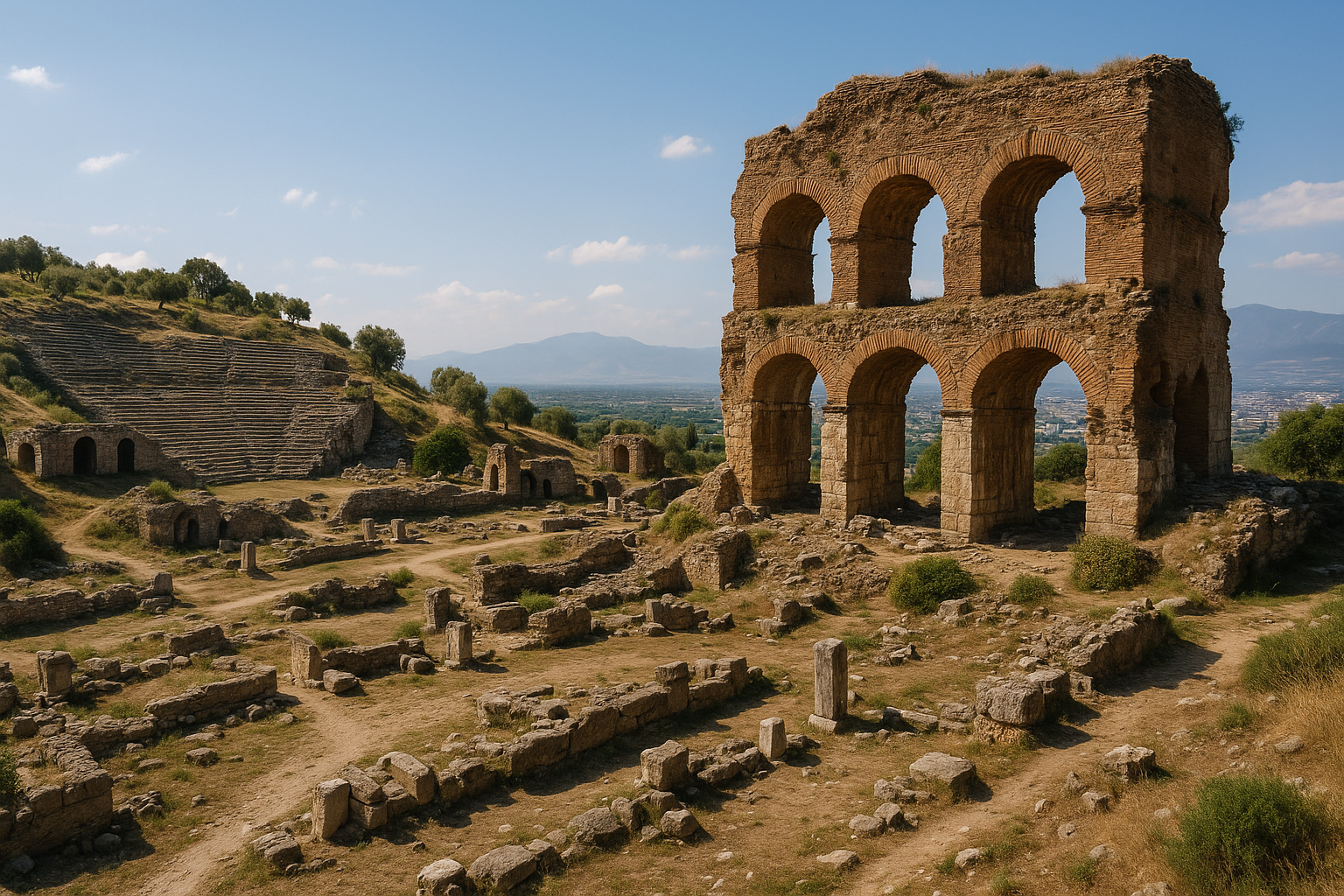
Tralles (also known as Tralleis) is a major ancient city perched on the Topyatagi plateau overlooking the fertile Buyuk Menderes (Maeander) valley in western Turkey. Founded nearly 3,000 years ago by Thracian and Argive settlers, it became one of the wealthiest cities in Asia Minor during the Hellenistic and Roman periods. Tralles is renowned for producing world-class sculptors, most notably Apollonius of Tralles, co-creator of the Farnese Bull -- the largest single sculpture recovered from antiquity. The city's iconic landmark is the "Three Eyes" (Uc Gozler), the surviving triple-arched facade of its monumental 2nd-century AD gymnasium.
- Why Tralles Matters
- Geography and Setting
- Historical Timeline
- Major Monuments
- Archaeological Work
- Visitor Information
- Frequently Asked Questions
- Sources and Further Reading
Why Tralles Matters
-
A powerhouse of ancient sculpture. Tralles produced some of the most celebrated sculptors of the Hellenistic world, including Apollonius and his brother Tauriscus, whose Farnese Bull now stands in the Naples Archaeological Museum as one of its greatest treasures.
-
Strategic hilltop location. The Topyatagi plateau gave Tralles command over the Maeander valley's trade routes while providing strong natural defences -- a combination that fuelled centuries of prosperity.
-
Earliest notated music. According to scholarly tradition, Tralles is believed to be one of the sites where the first notated music in history was created, linking the city to the origins of musical documentation.
-
The Three Eyes landmark. The surviving triple-arched structure of the gymnasium, visible from across the modern city of Aydin, is one of the most recognisable Roman-era ruins in western Turkey and the enduring symbol of Aydin Province.
-
Multi-period urban fabric. The site preserves layers spanning Thracian foundation, Hellenistic refinement, Roman grandeur, Byzantine adaptation, and Seljuk-era reuse -- making it a compact encyclopaedia of Anatolian history.
Geography and Setting
Tralles occupies the flat-topped Topyatagi hill directly north of the modern city centre of Aydin, in the Efeler district. The hill rises sharply above the Buyuk Menderes (ancient Maeander) river plain, one of the richest agricultural zones in Turkey.
| Feature | Detail |
|---|---|
| Coordinates | 37.86 N, 27.84 E |
| Elevation | ~170 m above sea level (plateau top) |
| Nearest city | Aydin (directly adjacent) |
| Nearest airport | Izmir Adnan Menderes (approx. 100 km northwest) |
| Region | Ancient Caria/Lydia border, modern Aydin Province |
| River | Buyuk Menderes (Maeander), approx. 3 km south |
The Aegean climate brings hot, dry summers and mild, rainy winters. The plateau's elevation offers cooling breezes and a commanding view across the valley -- advantages that made the location attractive for settlement since prehistoric times.
The Maeander valley was one of antiquity's most important east--west corridors, connecting the Aegean coast to the Anatolian interior. Tralles sat at the point where secondary routes from the south (via the Tabae road) met this main artery, making it a natural trade hub.
Historical Timeline
Foundation and Archaic Period (10th--6th century BC)
Ancient tradition credits the city's founding to a combined force of Thracians and Argives (Greeks from the Argolid). The Thracian element is reflected in the name itself: "Tralles" may derive from a Thracian word. This dual origin gave the city a mixed cultural character from the outset.
Early settlement traces on the Topyatagi hill date to at least the 10th century BC, though the city does not enter the historical record prominently until the Classical period.
Classical and Hellenistic Period (5th--1st century BC)
During the 5th and 4th centuries BC, Tralles came under successive Persian, Macedonian, and Seleucid control. After Alexander the Great's conquests, the city grew rapidly under Hellenistic influence, acquiring a theatre, agora, and public buildings befitting a major polis.
In the 3rd--2nd centuries BC, Tralles belonged to the Kingdom of Pergamon under the Attalid dynasty. This was a period of cultural flowering: the school of sculpture at Tralles gained Mediterranean-wide fame. Apollonius of Tralles and his brother Tauriscus created the Farnese Bull group, depicting the punishment of Dirce, around the late 2nd century BC. Pliny the Elder recorded this monumental work, which was later discovered in 1546 at the Baths of Caracalla in Rome.
Another celebrated sculptor from the city was the creator of the "Young Athlete" (Apoxyomenos-type statue), further cementing Tralles' reputation as a centre of artistic excellence.
Roman Period (1st century BC -- 3rd century AD)
After the Attalid kingdom was bequeathed to Rome in 133 BC, Tralles became part of the Roman province of Asia. Under the Pax Romana, the city reached its zenith of wealth and monumental construction:
- The gymnasium (including the famous "Three Eyes" arched facade) was built in the 2nd century AD as a centre for athletics, education, and culture.
- An extensive bath complex was added adjacent to the gymnasium.
- The theatre was expanded and its proscenium decorated with a sculpted frieze depicting a Dionysiac procession (thiasus), approximately 1 m in height.
- A marble-paved colonnaded avenue linked major public buildings.
- Temples, agora expansions, and civic buildings were constructed or renovated.
A devastating earthquake in 26 BC severely damaged the city. Emperor Augustus provided funds for reconstruction, and the Roman Senate sent Aeschines as a commissioner to oversee the rebuilding.
Late Roman and Byzantine Period (4th--12th century AD)
Tralles survived as an important urban centre into the Byzantine era. Several churches were built, and the city served as a bishopric. The site's strategic hilltop position kept it relevant through centuries of conflict between Byzantium and various eastern powers.
In 1071, following the Battle of Manzikert, Turkic groups began settling the Maeander valley. The city experienced periods of Seljuk and Byzantine alternation before eventually becoming part of the Beylik of Aydinogullari in the 14th century, which gave the modern province its name.
Ottoman Period and Modern Era
The ancient settlement was largely abandoned as the population shifted to the lower plain, forming the nucleus of modern Aydin. The ruins on Topyatagi became an archaeological site.
Major Monuments
The Gymnasium and the "Three Eyes" (Uc Gozler)
The most iconic structure at Tralles, the gymnasium was a 2nd-century AD complex serving as a centre for education, athletics, and social life. The surviving portion is its monumental triple-arched facade -- three tall arches that locals call "Uc Gozler" (Three Eyes). These arches, constructed of finely cut stone, are visible from the modern city of Aydin and serve as the symbol of the entire province.
The gymnasium originally included:
- Training halls and exercise courts
- Lecture rooms for philosophical and rhetorical education
- Changing rooms and storage
- Connected bathing facilities
The Theatre
Built against the natural slope of the hill, the theatre at Tralles was one of the first Hellenistic theatres with a decorated proscenium. German excavators in 1888 unearthed fragments of a sculpted frieze from the stage building depicting a Dionysiac procession approximately 1 m high, with figures of satyrs, maenads, and Dionysus himself.
The theatre's cavea (seating area) has been partially excavated, revealing the typical fan-shaped arrangement. Estimated capacity: 8,000--10,000 spectators.
The Bath Complex
Adjacent to the gymnasium, the Roman baths followed the standard sequence of frigidarium, tepidarium, and caldarium. Sections of the hypocaust (underfloor heating) system and water supply channels have been documented during excavations.
The Agora
The commercial heart of Tralles, the agora was a large open square surrounded by colonnaded porticos (stoas) where merchants displayed goods. The agora connected directly to the marble-paved avenue that served as the city's main ceremonial route.
The Marble-Paved Avenue
Sections of an original marble-paved colonnaded street have been exposed during excavations, revealing the high quality of Roman-period urban infrastructure. This avenue linked the agora, gymnasium, and temple zones.
Military Arsenal and Tunnels
An unusual feature of Tralles is the arsenal (cephanelik) -- a military ammunition depot and associated tunnel system carved into the hillside. These structures reflect the city's strategic defensive role in controlling the Maeander valley.
The Latrine (Public Toilet)
A well-preserved Roman public latrine has been excavated, demonstrating the sophisticated sanitation infrastructure of the ancient city. The structure follows the standard Roman design with a continuous bench over a running water channel.
Necropolises and Sarcophagi
Burial areas surround the settlement hill, with sarcophagi and tomb structures dating from the Hellenistic through Byzantine periods. Some sarcophagi carry sculptural decoration reflecting the high artistic traditions of the city.
Churches and Religious Structures
Several Byzantine-era churches have been identified on the site, marking the transformation from pagan to Christian worship. These include both basilica-plan and centrally-planned structures.
Archaeological Work
The first systematic excavations at Tralles were conducted in 1888 by German archaeologists Carl Humann and Wilhelm Dorpfeld, who documented the theatre and recovered the important Dionysiac frieze fragments. Their findings were published in the journal Archaologische Mitteilungen (AM 18, 1893) under the title "Ausgrabungen in Tralles".
Subsequent Turkish excavation campaigns have expanded knowledge of the site significantly:
- Theatre clearance and documentation, revealing the Hellenistic stage building and Roman modifications.
- Gymnasium and "Three Eyes" conservation, including structural stabilisation of the iconic arches.
- Discovery of the marble-paved avenue, confirming the high quality of Roman urban planning.
- Mapping of the arsenal and tunnel complex, a feature rare among civilian ancient cities.
- Recovery of sculptural fragments from multiple periods, now housed in regional museums.
As of the 2025 excavation season, preparations have been underway to open the site more fully to tourism after decades of research. The excavations are being conducted under the auspices of the Aydin Provincial Directorate of Culture and Tourism in collaboration with Turkish university teams.
The most famous objects associated with Tralles are housed in international museums:
- Farnese Bull -- Museo Archeologico Nazionale, Naples, Italy
- Young Athlete of Tralles -- Istanbul Archaeological Museums
- Dionysiac frieze fragments -- Various collections
Visitor Information
Getting There
- By car: From Izmir, take the Izmir--Aydin motorway (O-31) south for approximately 100 km. The site is on Topyatagi hill in the centre of Aydin, well signposted from the city.
- By train: Aydin has a railway station on the Izmir--Denizli line, with regular services.
- By bus: Frequent intercity buses connect Aydin's otogar with Izmir, Denizli, Mugla, and other Aegean cities.
On Site
| Practical Detail | Information |
|---|---|
| Entrance fee | Check current status; some areas are open-access |
| Opening hours | Daylight hours; check locally as site is being developed for tourism |
| Estimated visit duration | 1--2 hours |
| Terrain | Relatively flat plateau top; some uneven surfaces |
| Shade | Limited; bring hat and water in summer |
| Facilities | Aydin city centre is immediately adjacent for all services |
Recommended Route
- Begin at the Three Eyes (gymnasium) -- the landmark visible from the city below.
- Walk to the theatre area and examine the hillside seating.
- Follow the marble avenue toward the agora zone.
- Explore the bath complex remains near the gymnasium.
- Visit the arsenal/tunnel area for a unique military-engineering perspective.
- End with a panoramic view across the Maeander valley from the plateau edge.
Best Time to Visit
- Spring (March--May): Comfortable temperatures, green valley landscape.
- Autumn (September--November): Pleasant warmth, excellent visibility.
- Summer: Extremely hot on the exposed plateau; visit early morning or evening.
- Winter: Mild but rainy; fewer visitors.
Combined Visits
Tralles can easily be combined with other major archaeological sites in the region:
- Nysa on the Maeander (approx. 30 km east): Impressive library, theatre, and tunnel-stadium.
- Aphrodisias (approx. 100 km southeast): UNESCO World Heritage Site; world-renowned sculpture school.
- Priene, Miletus, and Didyma (approx. 60--80 km southwest): Classic trio of Ionian sites.
- Ephesus (approx. 60 km northwest): One of the most visited ancient cities in the world.
- Aydin Museum: Houses local finds and provides essential context for the site.
Frequently Asked Questions
What are the "Three Eyes" of Tralles?
The "Uc Gozler" (Three Eyes) is the local name for the surviving triple-arched facade of the Roman gymnasium, dating to the 2nd century AD. The three arches, visible from across modern Aydin, are the symbol of the city and the province.
What is the connection between Tralles and the Farnese Bull?
The Farnese Bull -- the largest single sculpture recovered from antiquity -- was created by Apollonius of Tralles and his brother Tauriscus in the late 2nd century BC. The marble group, depicting the punishment of Dirce, was discovered in 1546 at the Baths of Caracalla in Rome. It is now in the Naples Archaeological Museum.
Who excavated Tralles?
The first formal excavations were conducted in 1888 by Carl Humann and Wilhelm Dorpfeld (the same Humann who excavated the Pergamon Altar). Turkish teams have continued excavations for decades since. The site is being prepared for broader public access as of the mid-2020s.
Is the site fully open to visitors?
As of recent years, the site has been undergoing preparation for full public opening. Parts of the site -- particularly the Three Eyes and surrounding areas -- are accessible. Check with the Aydin Provincial Directorate of Culture and Tourism for the latest access information.
How did the city get its name?
The name "Tralles" is believed to derive from a Thracian word, reflecting the city's legendary foundation by Thracian settlers alongside Argive Greeks.
What happened to the sculptures from Tralles?
Major works are dispersed across international museums: the Farnese Bull is in Naples, the Young Athlete is in Istanbul, and various smaller finds are in the Aydin Museum and other Turkish collections.
Excavation Chronology and Archaeological Campaigns
The following table documents the history of archaeological work at Tralles from the first systematic investigations to the present day:
| Year(s) | Director / Institution | Activities and Key Findings |
|---|---|---|
| 1888 | Carl Humann & Wilhelm Dorpfeld (German Archaeological Institute) | First systematic excavation; theatre documentation; recovery of the Dionysiac procession frieze (~1 m high) from the proscenium |
| 1893 | Humann & Dorpfeld | Publication of findings in Archaologische Mitteilungen (AM 18): "Ausgrabungen in Tralles" |
| 1996 | Turkish campaign begins | First season of modern Turkish excavations; initial site opening to the public |
| 1996-2020s | Aydin Provincial Directorate / Turkish university teams | Gradual exposure of marble-paved avenue, bath complex, agora, arsenal, and tunnel system |
| 2025 | Current campaign | Main focus on uncovering additional architectural elements of the bath-gymnasium complex; preparations for full public opening |
The 1888 Humann-Dorpfeld expedition was conducted by the same Carl Humann who excavated the Pergamon Altar (now in Berlin). His work at Tralles, though smaller in scale, produced one of the most important sculptural finds in the region: the Dionysiac frieze from the theatre proscenium, depicting a thiasus (ritual procession) with figures of satyrs, maenads, and Dionysus in approximately 1-metre-high relief panels.
The Farnese Bull: Detailed Material and Dimensional Analysis
The Farnese Bull, created by sculptors Apollonius and Tauriscus of Tralles, has been subjected to detailed modern analysis. The following table compiles the verified measurements:
| Attribute | Measurement / Detail |
|---|---|
| Original marble block | 3.66 m x 2.75 m (12.0 ft x 9.0 ft) |
| Current perimeter (after restorations) | ~3.3 m on each side |
| Current height | More than 4.0 m (13 ft 1 in) |
| Weight | 21.8 tonnes (24 short tons) |
| Material | White marble |
| Original creation | Late 2nd century BC, attributed to sculptors from Tralles working on Rhodes |
| Discovery | 1546, excavated in fragments from the gymnasium of the Baths of Caracalla, Rome |
| Commissioner of excavation | Pope Paul III, seeking sculptures for the Palazzo Farnese |
| Current location | Museo Archeologico Nazionale, Naples (since 1826) |
| Literary source | Pliny the Elder, Naturalis Historia 36.33-34 |
The sculpture depicts the punishment of Dirce: the mythological queen Dirce is being tied to the horns of a wild bull by her stepsons Zethus and Amphion, avenging the mistreatment of their mother Antiope. The work is the largest single sculptural group recovered from antiquity -- a designation it has held since its discovery in 1546. The dramatic composition, with its intertwined figures, rearing animal, and swirling drapery, represents the peak of the Hellenistic Baroque sculptural tradition.
Architectural Measurements of Key Monuments
| Monument | Dimensions / Specifications |
|---|---|
| Theatre cavea (seating) | Estimated capacity: 8,000-10,000 spectators; built into the natural hillside slope |
| Gymnasium "Three Eyes" arches | Three tall arches of finely cut stone; visible from the modern city of Aydin below |
| Bath complex | Standard Roman sequence: frigidarium, tepidarium, caldarium; hypocaust underfloor heating documented |
| Marble-paved avenue | Width sufficient for ceremonial processions; connects agora, gymnasium, and temple zones |
| Dionysiac proscenium frieze | ~1 m in height; depicting satyrs, maenads, and Dionysus in high relief |
| Topyatagi plateau | ~170 m above sea level; flat-topped hill directly above modern Aydin |
The arsenal and tunnel system carved into the hillside represents a feature rare among civilian ancient cities. Military ammunition depots of this type are more commonly associated with frontier garrison towns, suggesting that Tralles's strategic position controlling the Maeander valley required dedicated defensive infrastructure even during periods of general peace.
Sources and Further Reading
- Wikipedia -- Tralles
- Wikipedia -- Farnese Bull
- Britannica -- Apollonius of Tralles
- Anadolu Agency -- Ancient city of Tralleis to welcome visitors after decades of excavations
- Anatolian Archaeology -- 2025 Excavation Season Begins at Tralleis
- Anatolian Archaeology -- Tralleis Ancient City to Open for Visitors
- The Ancient Theatre Archive -- Tralleis Theatre
- Perseus Digital Library -- Princeton Encyclopedia entry on Tralles
- Humann, C. & Dorpfeld, W. -- "Ausgrabungen in Tralles," Archaologische Mitteilungen 18 (1893)
- Pliny the Elder -- Naturalis Historia, Book 36 (on the Farnese Bull)
- Destinations.com.tr -- The Ancient City of Tralles in Aydin
The Tralles School of Sculpture
Tralles was not merely a city that produced individual talented artists -- it fostered a genuine school of sculpture whose influence extended across the Mediterranean:
Apollonius of Tralles and Tauriscus
The most famous products of this school, brothers Apollonius and Tauriscus, were active in the late 2nd century BC. Their masterwork, the Farnese Bull, depicts the mythological punishment of Dirce by her stepsons Zethus and Amphion, who tied her to the horns of a wild bull. Key facts about this sculpture:
- Dimensions: Approximately 3.7 metres high -- the largest single sculptural group surviving from antiquity.
- Material: Marble, likely carved from a single block for the main group.
- Original location: Probably displayed in a public space in Rhodes or Tralles itself.
- Discovery: Excavated in 1546 from the Baths of Caracalla in Rome, where it had been installed as decoration.
- Current location: Museo Archeologico Nazionale, Naples, Italy.
- Literary source: Pliny the Elder, Naturalis Historia 36.33--34, describes the work and attributes it to the Trallian sculptors.
The sculpture's dramatic composition, dynamic movement, and emotional intensity exemplify the Hellenistic Baroque style at its peak.
The Young Athlete (Apoxyomenos Type)
Another celebrated work attributed to a sculptor from Tralles, the Young Athlete depicts a male figure in the act of scraping oil and dust from his skin with a strigil -- a common post-exercise ritual in Greek gymnasia. The statue is now in the Istanbul Archaeological Museums and represents the refined naturalism of Hellenistic body representation.
Artistic Legacy
The Tralles school's emphasis on dramatic narrative, dynamic poses, and emotional expression placed it within the broader tradition of late Hellenistic sculpture that also includes the famous Laocoon Group and the Winged Victory of Samothrace. The school's influence testifies to the cultural richness of inland Asian cities, which are sometimes overshadowed by coastal centres like Ephesus and Miletus.
The Maeander Valley Trade Network
Tralles' prosperity was inseparable from its position within the Maeander valley trade network, one of antiquity's most important commercial corridors:
East--West Route
The Buyuk Menderes river valley formed a natural highway connecting the Aegean coast (via Miletus and Ephesus) with the Anatolian interior (via Laodicea and Apamea). Goods flowing along this route included:
- Textiles from inland weaving centres
- Wine and olive oil from valley vineyards and olive groves
- Precious metals from Phrygian and Lydian mines
- Grain from the fertile valley floor
- Spices and luxury goods arriving from eastern trade networks
North--South Route
A secondary route branched south from Tralles through the Tabae corridor toward the coast at Caunus and the Lycian cities. This route carried timber, livestock, and agricultural products between the highland interior and the sea.
Market Function
Tralles' hilltop agora served as a regional market hub where producers from the surrounding countryside met long-distance merchants. The city's wealth from this commercial role funded the monumental construction programme visible in the ruins today.
Earthquakes and Resilience
Tralles' history is marked by a recurring pattern of seismic destruction and rebuilding that reveals both the city's vulnerability and its remarkable resilience:
- 26 BC earthquake: Severely damaged the city. Emperor Augustus personally provided reconstruction funds, and the Roman Senate appointed Aeschines as a commissioner to supervise rebuilding. The restored city was temporarily renamed Caesarea in gratitude to Augustus.
- Multiple later earthquakes during the Roman and Byzantine periods damaged structures that were repeatedly repaired and rebuilt.
- The gymnasium's "Three Eyes" survival through centuries of seismic activity testifies to the quality of Roman engineering and construction.
This pattern of destruction and renewal is typical of Aegean Anatolian cities and provides a useful framework for understanding the layered archaeological record visible at the site.
Cultural Life in Roman Tralles
During the Roman imperial period (1st--3rd century AD), Tralles was a vibrant cultural centre:
- Rhetorical education: The gymnasium served as a school for rhetoric and philosophy, disciplines highly valued in Roman provincial culture.
- Musical tradition: The city's association with early musical notation suggests a long tradition of performance culture, possibly supported by the theatre and odeon.
- Athletic competitions: The gymnasium hosted local athletic contests and training for regional festivals.
- Bathing culture: The extensive bath complex adjacent to the gymnasium served as a social gathering place where citizens conducted business, socialised, and maintained health.
- Religious life: Temples to various Greek and Roman deities dotted the city, alongside later Christian churches.
The marble-paved colonnaded avenue that connected these facilities created a ceremonial axis that expressed the city's civic pride and cultural ambition.
Glossary of Key Terms
| Term | Definition |
|---|---|
| Gymnasium | A complex for athletic training, education, and social gathering in Greek/Roman cities |
| Proscenium | The stage building and its architectural facade in an ancient theatre |
| Thiasus | A ritual procession honouring the god Dionysus |
| Agora | The central public and commercial square of a Greek/Roman city |
| Stoa | A covered colonnade or portico |
| Hypocaust | An underfloor heating system used in Roman baths |
| Cavea | The semicircular seating area of a theatre |
| Necropolis | A cemetery; literally "city of the dead" |
| Apoxyomenos | A sculptural type showing an athlete scraping oil from skin |
| Farnese Bull | The largest single ancient sculptural group, created by Apollonius of Tralles |