Overview: Magnesia on the Maeander (Magnesia ad Maeandrum) was one of the great cities of ancient Ionia, set at the foot of Mount Thorax in the fertile Maeander (Büyük Menderes) River plain, near modern Ortaklar in Aydın Province. The city is celebrated above all for its Temple of Artemis Leukophryene, the masterpiece of Hermogenes — antiquity's most influential architect of temple design — and one of the largest temples in the ancient world. Magnesia was also famed for its monumental Agora (the largest known Ionian agora), its impressive theater, the Amazonomachy frieze (now in the Louvre and Berlin museums), and its role in Hellenistic history. Though less visited than its famous neighbors Ephesus and Priene, Magnesia's architectural legacy profoundly shaped temple design across the Roman world.
- Why Magnesia Matters
- Geography and Setting
- Historical Timeline
- Founding Legends
- The Temple of Artemis Leukophryene
- Hermogenes: The Master Architect
- The Amazonomachy Frieze
- The Agora
- The Theater
- The Temple of Zeus Sosipolis
- The Prytaneion
- The Artemis Festival and Asylia
- The Battle of Magnesia (190 BC)
- Economy and Daily Life
- Religion and Cults
- Decline and Later History
- Archaeological History
- How to Visit Magnesia
- FAQ
- Sources
Why Magnesia Matters
Magnesia is exceptional for several reasons:
- Hermogenes' masterpiece: The Temple of Artemis was designed by Hermogenes (c. 200–130 BC), whose pseudodipteral plan became the standard for Roman temple architecture — making him arguably the most influential temple architect in history
- Fourth-largest Hellenistic temple: The Temple of Artemis measured 67 × 40 meters — one of the biggest temples in Asia Minor
- The Amazonomachy frieze: A spectacular 175-meter-long frieze depicting the battle between Greeks and Amazons — one of the finest Hellenistic sculptural achievements
- Largest Ionian agora: The civic square at Magnesia was the biggest known agora in the Ionian world
- Asylia: The city was granted sacred inviolability (asylia) following a divine epiphany of Artemis — a major honor in the Hellenistic world
- Battle of Magnesia (190 BC): One of the most decisive battles in ancient history — Rome's defeat of the Seleucid king Antiochus III, which established Roman supremacy in Asia Minor
- Carl Humann's excavations: The same archaeologist who discovered the Pergamon Altar also excavated Magnesia
Geography and Setting
Magnesia occupies a strategic position in the Maeander (Büyük Menderes) River plain.
Location:
- Near Ortaklar (Germencik district), Aydın Province
- Approximately 100 km south of İzmir
- At the foot of Mount Thorax (Gümüş Dağı)
- In the triangle between Ephesus (30 km west), Priene (40 km south), and Tralles/Aydın (20 km east)
Landscape:
- The wide, fertile Maeander plain — one of the most productive agricultural regions in western Türkiye
- Mount Thorax rises dramatically behind the city site
- The Maeander River's famously winding course (from which we get the English word "meander") passes nearby
- The Lethaios River, a tributary, flowed through the city
- Mediterranean climate with hot summers and mild winters
Historical Timeline
| Period | Date | Key Events |
|---|---|---|
| Foundation | c. 7th century BC | Founded by Aeolian/Ionian settlers from Thessaly |
| Persian period | 546–334 BC | Under Persian rule; Themistocles exiled here |
| Alexander | 334 BC | Liberated by Alexander the Great |
| Hellenistic | 3rd–2nd century BC | Growth under Seleucid patronage |
| Temple built | c. 200–130 BC | Hermogenes designs the Temple of Artemis |
| Artemis epiphany | c. 220 BC | Divine appearance leads to asylia recognition |
| Battle of Magnesia | 190 BC | Rome defeats Antiochus III nearby |
| Roman Republic | 133 BC | Province of Asia established |
| Roman Imperial | 1st century BC–4th century AD | Continued prosperity |
| Byzantine | 5th–13th century | Reduced settlement |
| Ottoman | 14th century onward | Site largely abandoned |
| Excavation | 1891–1893 | Carl Humann excavates for Berlin |
| Modern excavation | 1984–present | Orhan Bingöl resumes Turkish excavations |
Founding Legends
Magnesia's origins are connected to Greek migration legends:
- The city was reportedly founded by Magnetians from Thessaly (northern Greece) — a people after whom the word "magnet" is supposedly named (magnesian stone)
- Some traditions associate the founding with the wanderings after the Trojan War
- The city distinguished itself as "Magnesia on the Maeander" (ad Maeandrum) to differentiate from the other Magnesia — Magnesia ad Sipylum (modern Manisa), located further north
- The Thessalian origins explain the city's Aeolian connections despite its later classification among Ionian cities
The Temple of Artemis Leukophryene
The Temple of Artemis Leukophryene ("Artemis of the White Brow") is Magnesia's crown jewel and one of the most architecturally significant temples of antiquity.
Architecture:
- Designed by Hermogenes, the most famous architect of the Hellenistic period
- Pseudodipteral Ionic plan — an outer colonnade spaced as if for a double row of columns, but with the inner row eliminated, creating a wide walkway around the cella
- Dimensions: approximately 67 × 40 meters (including the colonnade) — the fourth-largest temple in the Hellenistic world
- 8 × 15 columns in the peristyle
- The cella (inner chamber) housed the cult statue of Artemis
- A monumental altar stood before the temple
Significance:
- Hermogenes' pseudodipteral design was revolutionary — it saved material and construction effort while creating spacious, well-proportioned interiors
- The Roman architect Vitruvius extensively discussed Hermogenes' work in De Architectura, making his principles the basis for Roman temple design
- The Temple of Artemis at Magnesia directly influenced countless later temples across the Roman Empire
Current state:
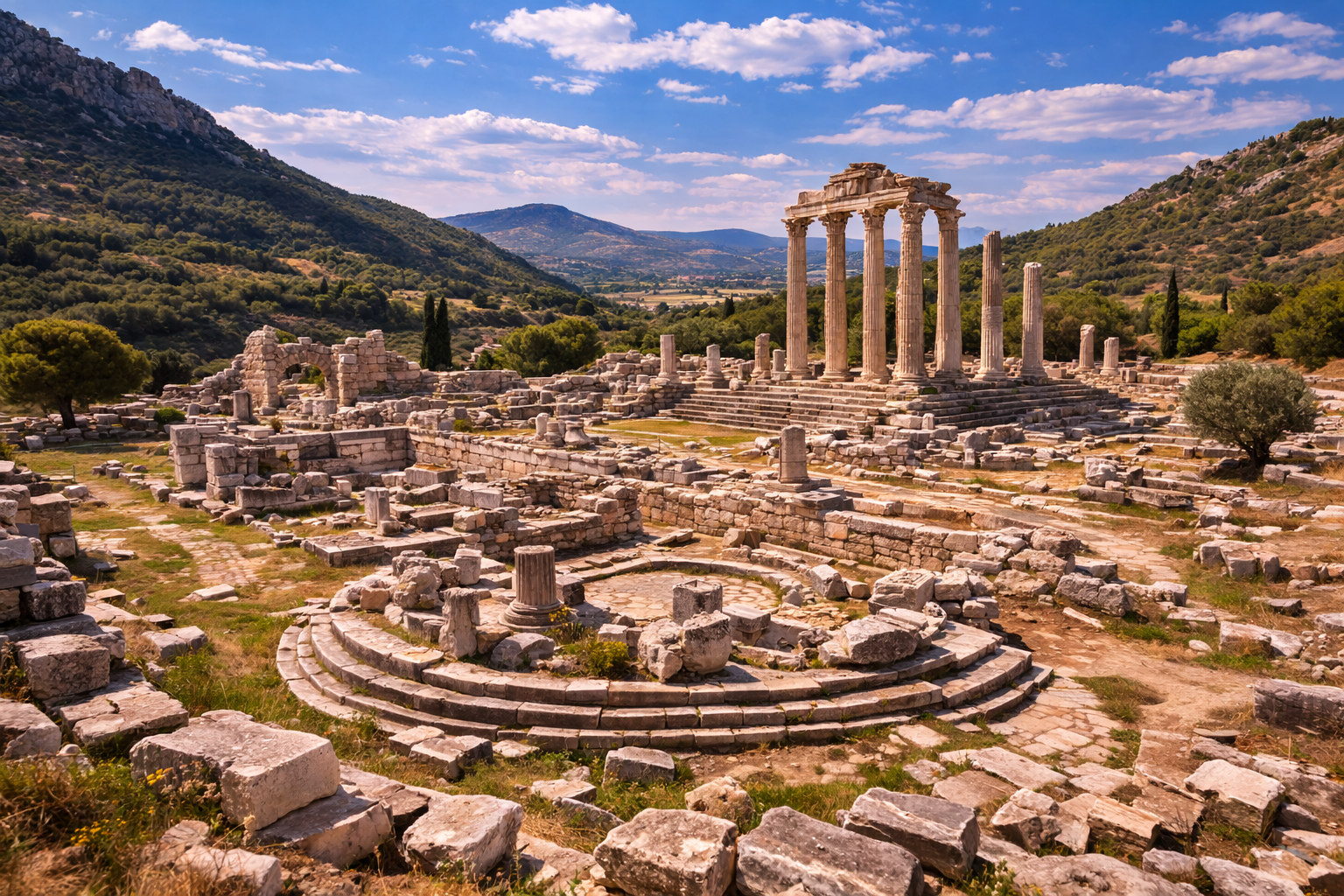
- The temple foundations, column bases, and some architectural elements are visible at the site
- Major sculptural elements (the Amazonomachy frieze) are in Paris and Berlin
Hermogenes: The Master Architect
Hermogenes of Priene (active c. 200–130 BC) is one of the most important architects in all of ancient history.
Innovations:
- Developed the pseudodipteral plan — his signature contribution, which eliminated the inner ring of columns in dipteral temples
- This created a wide, shaded walkway (pteron) around the cella — more spacious, less expensive, and more aesthetically pleasing
- Also credited with establishing the eustyle intercolumniation (ideal column spacing)
- Wrote theoretical treatises on architecture that influenced generations of architects
Legacy:
- Vitruvius devoted extensive discussion to Hermogenes' principles
- The pseudodipteral plan became the dominant temple form in the Roman Imperial period
- Hermogenes' influence is visible in temples from Rome to North Africa to the eastern Mediterranean
- He is considered perhaps the single most influential temple architect in Western architectural history
The Amazonomachy Frieze
The Amazonomachy frieze from the Temple of Artemis is one of the masterpieces of Hellenistic sculpture.
Description:
- A continuous sculptured frieze approximately 175 meters long that decorated the temple's exterior
- Depicts the Amazonomachy — the mythological battle between Greek warriors and the Amazons (female warriors)
- Dynamic, dramatic compositions with interlocking figures, flowing drapery, and intense expressions
- The style shows the influence of Pergamene sculptural traditions (the Pergamon Altar was roughly contemporary)
Current location:
- 43 panels of the frieze are in the Louvre Museum in Paris
- Additional fragments are in the Pergamon Museum in Berlin
- Some pieces remain in Türkiye (Istanbul Archaeological Museums)
- The division of the frieze among multiple museums reflects the 19th-century excavation practices
The Agora
The Agora of Magnesia is the largest known agora in the Ionian world.
Features:
- An enormous colonnaded public square
- Surrounded by stoas (covered walkways) with shops and public buildings
- The Temple of Zeus Sosipolis was integrated into the agora complex
- Used for commerce, civic assemblies, and public life
- The scale of the agora indicates the city's considerable wealth and population
The Theater
The Theater of Magnesia was a substantial performance venue:
Features:
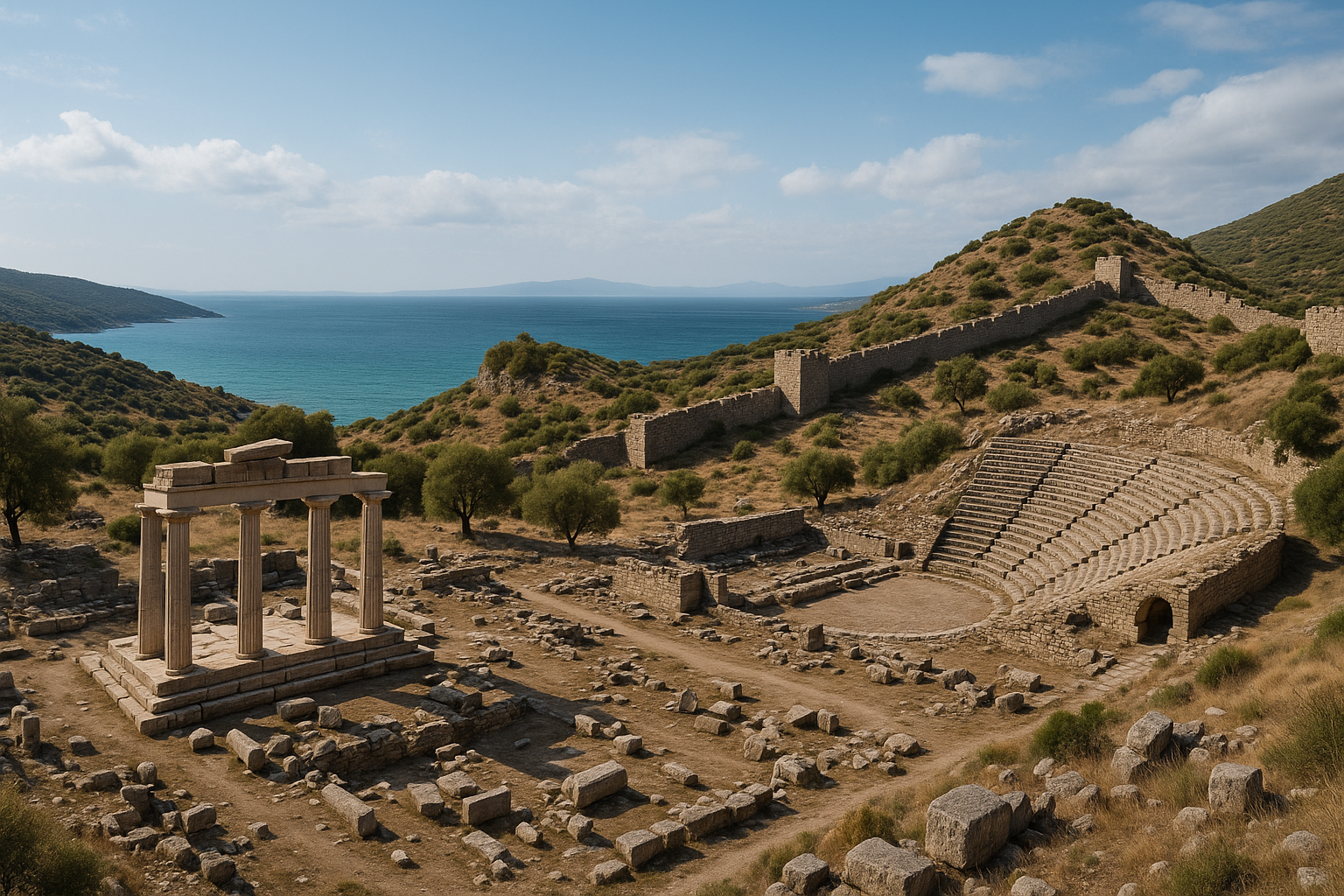
- Built into the slope of the hill
- Capacity estimated at approximately 5,000–8,000 spectators
- Typical Hellenistic/Roman design with cavea, orchestra, and stage building
- Partially excavated and visible at the site
- Views from the upper seats extend across the Maeander plain
The Temple of Zeus Sosipolis
The Temple of Zeus Sosipolis ("Zeus Savior of the City") stood in the agora:
Features:
- A smaller but significant temple within the civic center
- Demonstrated the importance of Zeus worship alongside the primary Artemis cult
- Integrated into the agora's architectural design
- Hermogenes may have had a role in its design
The Prytaneion
The Prytaneion was the civic hearth of Magnesia — the building where the sacred fire of the city burned perpetually:
Features:
- Housed the eternal flame of the city
- Officials (prytaneis) dined here at public expense
- Foreign ambassadors were hosted
- Represented the political and sacred heart of the community
The Artemis Festival and Asylia
Magnesia's greatest source of prestige was its connection to the goddess Artemis Leukophryene.
The epiphany:
- In approximately 220 BC, the citizens of Magnesia reported a theophany (divine appearance) of Artemis
- The goddess supposedly appeared in or near the city, confirming her special protection
Asylia:
- Following the epiphany, Magnesia sent ambassadors throughout the Greek world requesting recognition of the city's asylia (sacred inviolability)
- This meant that Magnesia and its sanctuary would be recognized as an inviolable asylum — no one within its sacred boundaries could be harmed
- Over 150 Greek cities and kingdoms recognized Magnesia's asylia — their response decrees have been found inscribed on the walls of the agora
- These inscriptions are among the most important documents for understanding Hellenistic diplomatic relations
The Leukophryena festival:
- A major festival and athletic/musical competition was held in honor of Artemis Leukophryene
- The games were elevated to isopythian status — equivalent in prestige to the Panhellenic Pythian Games at Delphi
- Athletes and performers from across the Greek world competed
The Battle of Magnesia (190 BC)
The Battle of Magnesia was one of the most decisive battles in ancient history.
Background:
- The Seleucid Empire under King Antiochus III "the Great" controlled most of the Near East and was expanding into Greece and the Aegean
- Rome, allied with Pergamon and other Greek states, opposed Seleucid expansion
The battle:
- Fought in 190 BC near Magnesia (the exact battlefield location is debated — it may have been closer to Magnesia ad Sipylum/Manisa)
- The Roman army, commanded by Lucius Cornelius Scipio (with his brother Scipio Africanus advising), decisively defeated Antiochus III's larger army
- Roman and Pergamene cavalry played a crucial role
Consequences:
- The Treaty of Apamea (188 BC) forced the Seleucids to withdraw from Anatolia west of the Taurus Mountains
- Pergamon and Rhodes gained vast territories as Roman allies
- Rome became the dominant power in the eastern Mediterranean — the beginning of Roman supremacy in Asia
- The battle fundamentally changed the political map of the ancient world
Economy and Daily Life
Magnesia's prosperity was based on several factors:
Agriculture:
- The fertile Maeander plain produced grain, olives, wine, and figs
- Irrigation from the Maeander and Lethaios rivers supported intensive farming
Commerce:
- Strategic location between Ephesus, Tralles, and Priene made Magnesia a trade hub
- The large agora testifies to active commercial life
- Connected to major overland routes across western Anatolia
Population:
- At its peak, Magnesia likely had 15,000–25,000 inhabitants
- A prosperous, well-connected Hellenistic and Roman city
Religion and Cults
Religion at Magnesia centered on Artemis Leukophryene:
- The primary cult of Artemis gave the city its religious identity
- The epiphany and asylia raised Magnesia's religious prestige throughout the Greek world
- Zeus Sosipolis was worshipped as the city's protector
- Other cults included Dionysus, Apollo, and the imperial cult in Roman times
- The prytaneion housed the sacred fire of the community
Decline and Later History
Magnesia's decline was gradual:
- Under Roman rule, the city prospered but was overshadowed by nearby Ephesus
- Earthquakes (particularly the devastating earthquake of 17 AD that struck many cities in western Anatolia) caused damage
- The Maeander River's silting may have affected the surrounding landscape
- During the Byzantine period, the city contracted significantly
- By the Ottoman period, the site was largely abandoned as the population shifted to nearby towns
Archaeological History
Carl Humann (1891–1893):
- The German architect and archaeologist Carl Humann — famous for discovering the Pergamon Altar — conducted the first major excavations at Magnesia
- Over 21 months, he partially revealed the Temple of Artemis, theater, agora, Zeus temple, and prytaneion
- Major sculptural finds (the Amazonomachy frieze) were transported to Berlin and Paris
- Humann's publication documented the site but the excavation remained incomplete
Orhan Bingöl (1984–present):
- After nearly a century's pause, Professor Orhan Bingöl of Ankara University resumed systematic excavations in 1984 under the Turkish Ministry of Culture
- Bingöl's team has focused on conservation, documentation, and further revelation of the city's monuments
- Ongoing work continues to expand understanding of the site
Finds in museums:
- Louvre Museum, Paris: 43 panels of the Amazonomachy frieze
- Pergamon Museum, Berlin: Architectural elements and additional frieze fragments
- Istanbul Archaeological Museums: Some finds
- Aydın Museum: Local finds from Turkish excavations
How to Visit Magnesia
Getting there:
- From Aydın: 25 km (about 30 minutes)
- From İzmir: 100 km (about 1.5 hours)
- From Kuşadası/Selçuk (Ephesus): 50 km (about 45 minutes)
- The site is near Ortaklar (Tekin village), Germencik district
- Accessible by car; signposted from the main road
The site:
- Allow 1.5–2 hours
- Key stops: Temple of Artemis foundations and column remains, Theater, Agora, Zeus temple, Prytaneion
- The site is partially excavated — some areas are overgrown
- Fewer visitors than nearby Ephesus — often very quiet
Best time to visit:
- Spring (March–May) and autumn (October–November) are ideal
- Summer is very hot in the Maeander plain
- Winter is mild but can be rainy
Practical tips:
- Wear comfortable shoes — some terrain is uneven
- Bring water and sun protection
- Combine with visits to Ephesus (30 km), Priene (40 km), Miletus, and Didyma
- The Aydın Museum has finds from the excavation
FAQ
Q: Who was Hermogenes? A: Hermogenes of Priene (active c. 200–130 BC) was the most influential temple architect in antiquity. His pseudodipteral plan, perfected at the Temple of Artemis at Magnesia, became the standard for Roman temple design. The Roman architect Vitruvius extensively discussed his principles.
Q: Where is the Amazonomachy frieze? A: The 175-meter frieze was divided after excavation: 43 panels are in the Louvre Museum (Paris), with additional fragments in the Pergamon Museum (Berlin) and Istanbul. None remains at the site.
Q: What was the Battle of Magnesia? A: A decisive battle in 190 BC where Rome defeated the Seleucid king Antiochus III, establishing Roman dominance over Asia Minor. The exact battlefield may have been near Magnesia ad Sipylum (Manisa) rather than Magnesia ad Maeandrum.
Q: Is the site well-preserved? A: The temple foundations and some architectural elements are visible, as are the theater, agora, and other structures. The site is partially excavated and less developed for tourism than Ephesus, but offers a quieter, more atmospheric experience.
Q: How does it compare to Ephesus? A: Magnesia is architecturally significant — Hermogenes' temple design influenced all of Roman architecture. But it receives far fewer visitors than Ephesus and is less extensively excavated. It appeals especially to those interested in architectural history.
Q: Is Magnesia on the UNESCO list? A: Magnesia is not currently on the UNESCO World Heritage List or Tentative List, though its architectural significance would merit consideration.
Detailed Architectural Measurements
Carl Humann's 1891–1893 excavation and subsequent surveys by Orhan Bingol's team have produced precise dimensional data for Magnesia's principal monuments.
| Monument | Dimensions / Key Measurement | Date |
|---|---|---|
| Temple of Artemis — overall plan | 67 x 41 m (including colonnade) | c. 200–130 BC |
| Temple of Artemis — colonnade | 8 columns (short sides) x 15 columns (long sides) — pseudodipteral octastyle | c. 200–130 BC |
| Amazonomachy frieze — total length | Approx. 175 m | c. 200–130 BC |
| Amazonomachy frieze — panels in Louvre | 43 panels | Excavated 1891–1893 |
| Temple of Zeus Sosipolis — podium | 7.38 x 15.82 m | Hellenistic |
| Agora — overall area | Largest known Ionian agora (exact dimensions unpublished in round figures) | Hellenistic |
| Theater — capacity | Approx. 5,000–8,000 spectators | Hellenistic / Roman |
| Monumental altar (before Temple of Artemis) | Substantial platform, proportional to temple scale | Hellenistic |
Hermogenes' pseudodipteral plan for the Temple of Artemis eliminated the inner ring of columns found in standard dipteral temples, producing a wide shaded ambulatory (pteron) around the cella without the expense and visual congestion of a double colonnade. The spacing created by this design was calculated so precisely that Vitruvius later codified it as the "eustyle" intercolumniation — the ideal distance between columns for both structural soundness and aesthetic harmony (De Architectura III.3.6–9). This standardization at Magnesia became the template for Roman temple construction across the empire.
The Amazonomachy Frieze: Distribution and Technical Data
The 175-meter frieze from the Temple of Artemis was divided among multiple institutions following Humann's excavation. The following table documents its current distribution and key technical details.
| Collection | Number of Pieces | Material | Notable Features |
|---|---|---|---|
| Louvre Museum, Paris | 43 panels | Marble | Largest collection; dynamic battle compositions |
| Pergamon Museum, Berlin | Approx. 60 architectural fragments (plus frieze portions) | Marble | Includes pronaos elements (two-thirds of transported material from pronaos) |
| Istanbul Archaeological Museums | Some pieces | Marble | Retained in Turkey |
| Aydin Museum | Local finds from Turkish excavations | Marble and other materials | From Bingol's campaigns |
| At the site | None | — | No frieze panels remain in situ |
Approximately 200 architectural pieces from the Temple of Artemis were transported to Berlin following Humann's excavation, where they were integrated into the Antikensammlung (Collection of Classical Antiquities). Two-thirds of this transported material originated from the pronaos. The division of the frieze among Paris, Berlin, and Istanbul reflects the 19th-century excavation conventions under which host governments and excavating institutions shared finds — a practice that has generated ongoing repatriation discussions.
The Asylia Dossier: Epigraphic Evidence
The recognition of Magnesia's asylia (sacred inviolability) produced one of the most remarkable epigraphic dossiers of the Hellenistic world.
| Aspect | Detail |
|---|---|
| Date of Artemis epiphany | c. 220 BC |
| Number of response decrees | Over 150 from Greek cities and kingdoms |
| Location of inscriptions | Carved on the agora walls |
| Key document | I.Magnesia 16 — narrative inscription explaining the history of the asylia request |
| Festival status | Leukophryena games elevated to isopythian rank (equivalent to Pythian Games at Delphi) |
The asylia dossier carved on the agora walls constitutes one of the largest collections of Hellenistic diplomatic documents from a single site. Over 150 cities and kingdoms — from mainland Greece and the Aegean islands to the Seleucid Empire and Ptolemaic Egypt — formally recognized Magnesia's sacred status and the inviolability of its sanctuary. These inscriptions provide invaluable evidence for understanding the diplomatic networks, political hierarchies, and religious prestige systems of the Hellenistic world.
Excavation Chronology and Recent Discoveries
| Year(s) | Director / Institution | Key Activities and Discoveries |
|---|---|---|
| 1891–1893 | Carl Humann / Berlin Museums | 21-month campaign: Temple of Artemis, theater, agora, Zeus temple, prytaneion partially revealed |
| 1891–1893 | Humann | Amazonomachy frieze transported to Berlin and Paris |
| 1893–1983 | — | Nearly a century without systematic excavation |
| 1984 | Orhan Bingol / Ankara University | Turkish excavations resume under Ministry of Culture authority |
| 1984–2010s | Bingol team | Conservation, documentation, and continued exposure of monuments |
| July 2018 | Bingol team | Six Greek statues discovered in Temple of Artemis ruins: 4 female, 1 male, 1 unidentified gender |
| Post-2018 | Bingol team | Temple of Zeus gate re-erected; a further 80 statues and various artifacts unearthed |
| Ongoing | Ankara University | Continued excavation of residential quarters and civic buildings |
The 2018 discovery of six statues within the Temple of Artemis was particularly significant because the figures were found in close association with the temple foundations, suggesting they were deliberately deposited — possibly during the temple's conversion or destruction in late antiquity — rather than randomly displaced by natural collapse. The subsequent recovery of approximately 80 additional statues and artifacts from the Zeus temple area confirms that Magnesia's sculptural program was far more extensive than previously understood from Humann's 19th-century work alone.
Sources
- Vitruvius, De Architectura (On Architecture), Books III and VII
- Humann, Carl, et al. Magnesia am Maeander. Berlin, 1904.
- Bingöl, Orhan. Excavation reports, Ankara University.
- Wikipedia, "Magnesia on the Maeander"
- Turkish Archaeological News, "Magnesia on the Meander"
- Turkish Museums, "Aydın Magnesia Archaeological Site"
- Louvre Museum, "Amazonomachy Frieze from Magnesia"
- Republic of Türkiye Ministry of Culture and Tourism