Ephesus is the most completely excavated classical city in the eastern Mediterranean and, for many travellers, the single most evocative ancient site in Türkiye. Founded in the archaic age on the alluvial plain of the Cayster River and refounded again and again as harbours silted and politics shifted, the city grew from an Ionian colony beside the sanctuary of an indigenous mother-goddess into the administrative and commercial capital of the Roman province of Asia. Its temple of Artemis — the Artemision — was counted among the Seven Wonders of the Ancient World, drawing pilgrims and bankers from across the Mediterranean for more than a millennium. Its theatre, hollowed from the western flank of Mount Pion, held some twenty-five thousand spectators and witnessed the riot of the silversmiths described in the Acts of the Apostles. Its Library of Celsus, raised in the early second century as a senator's tomb-monument, still presents one of the most photographed facades in the ancient world. Paul of Tarsus lived and taught here for the better part of three years; tradition places the tomb of the Evangelist John on the neighbouring hill of Ayasoluk and the final dwelling of the Virgin Mary on Bülbül Dağı above the city. Excavated almost without interruption by the Austrian Archaeological Institute since 1895 and inscribed on the UNESCO World Heritage List in 2015, Ephesus today is at once a textbook of Greco-Roman urbanism, an open-air gallery of imperial-era sculpture and architecture, and a sanctuary still alive with religious memory.
- Why Ephesus Matters
- Geography and Setting
- Historical Timeline
- Major Monuments and Structures
- Archaeological Work
- Religion and Culture
- Numbers and Measurements
- Visitor Information
- Frequently Asked Questions
- Sources and Further Reading
Why Ephesus Matters
Few ancient cities concentrate so many of the defining stories of the classical and early Christian worlds within a single walkable site. Ephesus is not simply a beautiful ruin; it is a place where Greek, Anatolian, Roman, Jewish and Christian histories meet and overlap, and where the physical fabric of the city still allows visitors to follow those overlaps street by street. The points below outline the principal reasons the site has shaped European and Near Eastern memory for two and a half thousand years.
1. A Wonder of the World on Anatolian soil.
The temple of Artemis at Ephesus, in the form rebuilt after the arson of 356 BC, was the largest marble temple ever raised in Greek antiquity, measuring roughly 137 by 69 metres and surrounded by 127 Ionic columns about eighteen metres tall.
Apollonios of Byzantium and Antipater of Sidon both placed it among the Seven Wonders; Antipater wrote that even Olympus could not match it. Although only a single re-erected column now stands above the marshy ground, the building shaped Mediterranean religion, banking and architectural ambition for almost a thousand years.
2. Capital of the richest Roman province in the East.
When Augustus reorganised the eastern Mediterranean after Actium, he made Ephesus the seat of the Roman governor of Asia, displacing Pergamon. From the late first century BC to the third century AD the city served as the political, commercial and judicial centre of a province that included Lydia, Caria, Mysia and Phrygia.
The monumental architecture of the lower town — the harbour street, the Tetragonos Agora, the Vedius Gymnasium, the Temple of Hadrian — is the architectural expression of that provincial primacy. The province of Asia was, with Egypt, the wealthiest in the Roman empire, and Ephesus its showcase.
3. A cradle of early Christianity.
Paul of Tarsus made Ephesus his base for two to three years (roughly AD 52-55), preaching at the synagogue and in the lecture hall of Tyrannus and dispatching letters across the Aegean. The Acts of the Apostles describes the silversmiths' riot in the Great Theatre.
Christian tradition places the death and burial of the Evangelist John on the neighbouring hill of Ayasoluk, the final years of the Virgin Mary on Bülbül Dağı, and the Third Ecumenical Council — at which Mary was proclaimed Theotokos — in the church of Mary at Ephesus in AD 431. Few cities outside the Holy Land have so many associations with the foundational generation of Christianity.
4. The world's most legible Greco-Roman streetscape.
Because the Byzantine harbour silted up and the population gradually withdrew to Ayasoluk Hill from the seventh century onward, the heart of the Roman city was never built over by a later town. Long stretches of the original marble pavement, sewer system, shopfronts, fountains, and public latrines survive in situ.
The Curetes Street, Marble Street and Arcadiane allow visitors to walk genuine Roman streets for over a kilometre — a continuity of urban texture matched at very few other sites. Pompeii preserves better individual buildings; Rome preserves more spectacular monuments; but for the experience of walking a complete Roman urban axis, Ephesus has no real rival.
5. A masterpiece of architectural restoration.
The anastylosis of the Celsus Library facade between 1970 and 1978, directed by Volker Michael Strocka and Friedmund Hueber for the Austrian Archaeological Institute, has become a textbook example of how scattered marble fragments can be reassembled into a legible monument without compromising scientific scruple.
The reconstructed facade has reshaped how Roman library architecture is understood, and it remains one of the most photographed structures in Türkiye. The methodology has influenced conservation practice across the Mediterranean.
6. A continuous archaeological laboratory since 1895.
Few sites in the Mediterranean enjoy such an unbroken record of scientific excavation. The Austrian Archaeological Institute, founded the same year its Ephesus mission began under Otto Benndorf, has now worked at the site for more than 130 years.
Its publications fill shelves, its catalogues of pottery, sculpture and inscriptions remain reference works, and recent discoveries — most spectacularly the early Byzantine commercial quarter unearthed near the harbour in 2024 — show that the site is still capable of substantially rewriting received history.
7. A pilgrimage destination that has never closed.
From the priestesses of Artemis, to the Christian pilgrims who bought small flasks at the basilica of Saint John, to the Catholic and Muslim visitors who today climb to the chapel on Bülbül Dağı, Ephesus has functioned as a place of religious memory for almost three millennia.
Few archaeological sites are simultaneously a living shrine and a textbook of urban history; Ephesus is one. Its sanctity is woven into the landscape itself — into the hills, the springs, the harbour, the streets — in ways that no museum display can fully capture.
Geography and Setting
The Cayster Valley
Ephesus sits in the lower valley of the Küçük Menderes — the ancient Cayster — about three kilometres inland from the present coastline of the Aegean and roughly seventy-five kilometres south of İzmir. The site occupies the gap between two long, low limestone ridges: Mount Pion (Panayır Dağı) to the north and Mount Coressus (Bülbül Dağı) to the south.
Between these two hills runs the natural east-west corridor along which the Roman city laid out its main civic axis, the Curetes Street. The corridor is itself a small tectonic graben, dropped relative to the surrounding limestone, and it has been the natural path of human movement between the Aegean and the interior for at least four thousand years.
In antiquity, ships entering the Gulf of Ephesus could sail directly into a sheltered basin tucked against the western flank of Pion. The harbour was already in operation in the Bronze Age and remained the heart of the city's economy until late antiquity. Today that same basin is a reed-filled marsh several kilometres from any open water, drained by a small canal and grazed by water buffalo.
A Silting Harbour
The valley's geology is unusual and consequential. The Cayster River, like its larger neighbour the Büyük Menderes (the ancient Maeander), drains a tectonically active basin whose mountains shed exceptional quantities of fine sediment.
Every winter, swollen by rains and melting snow, the river carried suspended silt down to the coast, where it precipitated on contact with seawater. The Gulf of Ephesus, deep and broad in the archaic and classical periods, narrowed and shallowed century by century. Strabo, writing under Augustus, already remarks that the harbour mouth was treacherous and that the engineer Attalus II had unintentionally worsened the problem by building a mole that disturbed natural tidal scouring.
Roman engineers spent extraordinary sums on dredging and on regulating the river's mouth; Tacitus and Pliny both mention the problem. They lost the battle. By the late Byzantine period the city had been cut off from the sea, and the seaport function passed first to Phygela and Anaea, then ultimately to Kuşadası, fifteen kilometres south. The retreat of the coastline since antiquity is among the most striking examples of human-scale geomorphic change anywhere in the Mediterranean.
Geology, Resources and the Hinterland
The territory of Ephesus extended well beyond the urban perimeter to include rich agricultural land. The Cayster plain produced grain, fruit, olives and the wine that Ephesian merchants exported across the Mediterranean. The surrounding limestone hills yielded marble of variable quality; the finest building stone, however, was brought from the quarries of Bel Evi a few kilometres east, where the white-grey marble used in the Celsus Library, the Hadrian Temple and most of the imperial-era public buildings was extracted.
Higher slopes carried pine and oak woodland; the marshes along the river attracted waterfowl and, less happily, malarial mosquitoes that contributed to the gradual depopulation of the lower town in late antiquity. The combination of fertile alluvium, dependable water, accessible building stone and a sheltered harbour gave Ephesus an unusually balanced resource base, and helps explain its survival as a major centre across more than two thousand years of shifting political circumstances.
A Nodal Position
The site lies astride one of the great natural corridors of western Anatolia. The Cayster valley funnels travel from the Aegean coast east into the Lydian plain, while a network of secondary routes connected Ephesus south to Priene and Miletus and north to Smyrna (modern İzmir).
In the Roman period, the city stood at the western end of the Via Sebaste and at the head of the main road that ran up to Sardis and ultimately to the Royal Road of the Persians. This nodal position made Ephesus a natural capital — for the Ionian League, for the Roman governor of Asia, and for the early Christian missions that fanned out from it into Galatia and beyond.
Selçuk and Kuşadası Today
Modern Selçuk, a town of around forty thousand inhabitants, sits on the lower flank of Ayasoluk Hill, immediately north-east of the archaeological park. The Roman ruins and the Byzantine acropolis are within easy walking distance of one another, and the Selçuk railway station — on the İzmir-Denizli line — is a short walk from the museum.
Kuşadası, fifteen kilometres south on the coast, is the cruise-ship port from which most international visitors arrive; in summer, several thousand passengers a day can pass through the lower gate of Ephesus. The proximity of these two settlements — one a modest historic town, the other a major resort — shapes the rhythms of any modern visit.
Climate and Best Season
The climate is typical Mediterranean: mild, wet winters and hot, dry summers. January temperatures average around 9°C; July highs frequently exceed 35°C and the unshaded marble of the site can become punishing in the afternoon. Rainfall concentrates between November and March, with December and January often bringing heavy bursts of precipitation that flood the lower drainage channels.
The best visiting seasons are unambiguously April-May and late September-October, when wildflowers cover the hillsides, the marble is warm rather than blistering, and tour-bus pressure is lighter than at the peak of summer. Winter visits — December through February — have their own quiet appeal: the site is nearly empty, the surrounding hills are green, and the low winter sun rakes dramatically across the carved marble.
Historical Timeline
Earliest Settlement: Carians, Leleges and the Mycenaean Horizon
Archaeology, philology and Hittite diplomatic correspondence converge on the conclusion that the gap between Pion and Coressus was inhabited long before the Ionian Greeks arrived. The Hittite archives of the fourteenth and thirteenth centuries BC mention a polity called Apasa, capital of the kingdom of Arzawa, that almost all scholars now identify with later Ephesus.
The pre-Greek population is described by classical authors as a mixture of Carians and Leleges, indigenous Anatolian peoples whose languages and cults the Greeks regarded as ancient and venerable. Their settlements clustered around the springs and the small natural harbour beneath Ayasoluk Hill, and their burial practices — extended inhumation with ceramic offerings — have been documented in test trenches on the citadel.
The mother-goddess later worshipped as Artemis Ephesia almost certainly originated in this pre-Greek substrate; her polymastic image and her wild-animal attendants belong to a religious vocabulary deeply rooted in Anatolian tradition, with parallels in the Phrygian Cybele cult and in the goddesses of Çatalhöyük two and a half millennia earlier.
Mycenaean material — pottery, weapons, beads — has been recovered from the Ayasoluk citadel and from a small cemetery on its eastern slope, suggesting either a Mycenaean trading presence or a hybrid local culture in contact with the Aegean koine of the Late Bronze Age. The end of the Bronze Age, around 1200 BC, brought general dislocation across the eastern Mediterranean; whatever continuity Apasa enjoyed was disturbed, but the site was not abandoned.
Ionian Colonisation and the Androclus Legend (10th century BC)
According to the foundation legend most fully preserved by Strabo and Pausanias, the Ionian Greek presence at Ephesus began with Androclus, son of King Codrus of Athens. Consulting the Delphic oracle on where to settle, he was told to found his city where a fish and a wild boar would show him the way.
The story, in its various versions, has Androclus joining a fishing crew on the coast, watching a flame leap from a frying pan and ignite a thicket, from which a startled boar fled and led him to the site beside the sanctuary of the mother-goddess. He killed the boar, founded the city, and was venerated as the city's hero-founder for centuries afterwards; his reliefs appear on the inner frieze of the Temple of Hadrian a thousand years later.
What the legend dresses up is the historical fact of Greek-speaking colonists settling on a coast that already possessed a thriving Carian-Lelegian sanctuary. The Greeks adopted the local goddess, identified her with their own Artemis, and built their houses and shrines around her temenos. This double inheritance — Anatolian goddess in Greek dress — would define the religious life of Ephesus for the next millennium.
The Ionian Ephesus joined the Panionion, the federal sanctuary of the Ionian League at Mt Mycale, and by the eighth century its citizens were already participating in the larger Greek currents of colonisation, alphabet diffusion and aristocratic exchange.
Archaic Period and the First Artemision (7th-6th c. BC)
By the seventh century BC Ephesus had emerged as one of the leading cities of the Ionian League. The earliest substantial temple of Artemis on the site is conventionally dated to the second half of the seventh century. It was a relatively modest stone building, but already monumental by Greek standards and already attracting dedicants from across the Aegean.
The temple suffered repeated damage from floods of the Cayster — a problem that would plague every subsequent building on the spot — and the level of the sanctuary had to be repeatedly raised. Successive archaic structures, identified in the foundations by Anton Bammer's excavations of the 1960s and 1970s, document at least four building phases between roughly 700 and 560 BC.
Late in the seventh century the city suffered a brief but spectacular Cimmerian raid, part of the wider movement of horse-borne peoples from north of the Black Sea into Anatolia. The temple was burned. Recovery was rapid, and by the early sixth century BC Ephesus was again prosperous enough to undertake a far more ambitious reconstruction.
During this archaic period Ephesus also became one of the first cities in history to mint coinage: small electrum staters bearing a bee on the obverse and a stag on the reverse circulated from the late seventh century onward. The bee was the city's emblem and a title of the priestesses of Artemis; the stag was the goddess's sacred animal. These early electrums are among the foundational documents in the history of money.
Croesus and the Great Archaic Temple (mid-6th c. BC)
The Lydian king Croesus (reigned c. 560-546 BC), already overlord of much of western Asia Minor, sponsored a complete rebuilding of the Artemision on a colossal scale. The new temple — designed, according to ancient sources, by Chersiphron of Cnossos and his son Metagenes, with later contributions by Theodorus of Samos — was the first Greek temple built entirely of marble.
It measured roughly 115 by 55 metres, dwarfing every previous Greek temple, and inaugurated the giant dipteral plan that would define East Greek temple architecture. The technical challenges of moving the immense marble column drums across the marshy ground were addressed, according to Pliny, by an ingenious system of timber rollers and rope harnesses devised by Chersiphron himself; Pliny tells the story as one of the engineering wonders of the ancient world.
Croesus's personal contribution is documented archaeologically: column drums recovered from the site by John Turtle Wood in 1869 and 1871, now in the British Museum, carry inscriptions in archaic Greek recording that the columns were dedicated by the king. These drums are among the most precisely datable monumental marble sculptures of the Greek world, and they confirm Herodotus's testimony that Croesus financed much of the building.
The Lydian phase ended abruptly in 547-546 BC, when Croesus was defeated by Cyrus the Great. Ephesus, like the rest of Ionia, passed under Persian control. The temple, however, continued to grow in prestige and wealth under the new regime.
Persian and Hellenistic Eras (546-133 BC)
For more than two centuries Ephesus remained a Persian-administered Greek city, paying tribute, occasionally rebelling (as during the Ionian Revolt of 499-494 BC) and continuing to develop its cults, its commerce and its philosophy. Heraclitus lived and wrote here around 500 BC. Aristagoras of Miletus passed through with the Ionian fleet, and Persian governors levied troops for the campaigns of Darius and Xerxes.
Through the fifth and early fourth centuries the city oscillated between Persian and Athenian influence, depending on the fortunes of the Peloponnesian War and its aftermath. The Artemision continued to be a major Mediterranean pilgrimage destination, growing only in wealth.
In 356 BC the temple was destroyed by arson, the perpetrator — a man named Herostratus — confessing under torture that he had set the fire to immortalise his own name. Ancient tradition, with some symmetry, placed the event on the night Alexander the Great was born. To deny Herostratus his prize, the Ephesians issued a decree forbidding his name to be spoken — a decree we know about precisely because the historian Theopompus broke it.
Alexander himself entered Ephesus in 334 BC after his victory at the Granicus and offered to finance the rebuilding of the temple. The Ephesians politely declined, observing that "it was not fitting for one god to dedicate offerings to another." The new temple, slightly larger than its predecessor and the version remembered as one of the Seven Wonders, was completed over the following decades using local and pan-Hellenic funds.
Its sculptural programme included carved column drums of the type recovered by Wood and now in London, decorated with high-relief life-size figures of Hermes leading souls to the underworld and of Persephone with her mother Demeter. Apelles, the most celebrated painter of antiquity, contributed a panel of Alexander wielding a thunderbolt — one of the most reproduced images of the ancient world.
After Alexander's death in 323 BC, Ephesus passed to his successors. The decisive intervention came from Lysimachus, one of Alexander's generals and ultimately ruler of Thrace and western Anatolia, who in 287 BC forcibly relocated the city from its old position around the temple — now an unhealthy, mosquito-ridden flood plain — to the new site between Pion and Coressus that is the Ephesus visitors see today.
He built a circuit of fortification walls almost ten kilometres long, much of which still survives on the upper slopes, and renamed the new foundation Arsinoea in honour of his wife. The name did not stick. The Ephesians, attached to their old population centre near the temple, are said to have resisted the relocation; Lysimachus reportedly blocked the sewers during a rainstorm to drive them out of their old houses.
The new city was laid out on a regular grid plan, an early example of Hellenistic urbanism, with the Tetragonos Agora at its commercial heart and the State Agora higher up on the natural terrace beneath the Bouleuterion.
Roman Period: Capital of Asia (133 BC - 4th c. AD)
The last king of Pergamon, Attalus III, bequeathed his kingdom — including Ephesus — to Rome in 133 BC. After the initial turbulence of the Mithridatic Wars, during which Ephesus joined the massacre of Roman citizens in 88 BC (the "Asian Vespers") and was severely punished by Sulla, the city settled into a long imperial twilight that was in many respects its golden age.
Augustus, after Actium in 31 BC, made Ephesus the seat of the Roman governor of Asia in place of Pergamon. The city's population grew to perhaps 200,000-250,000 at its peak in the first and second centuries AD, making it one of the largest cities in the Mediterranean after Rome and Alexandria.
Almost every monument visible today belongs to the Roman period or to its Hellenistic foundations elaborated under Rome. The Temple of Domitian (the first Asian provincial temple to a living emperor, late first century), the Temple of Hadrian (early second century), the Library of Celsus (c. AD 110-135), the Vedius Gymnasium (mid-second century), the rebuilt Great Theatre and the elaborated Tetragonos Agora all date to this era.
The city served as a major banking centre — the treasury of Artemis functioned, in effect, as a Mediterranean reserve bank — and as a node in the imperial postal and military networks. Roman governors lived in palaces along Curetes Street; senatorial families like the Vedii and the Polemones built gymnasia, fountains and tombs that proclaimed their wealth in monumental marble.
A devastating earthquake in AD 17 brought down many archaic and Hellenistic structures, and the emperor Tiberius funded a large-scale rebuilding programme. A second major quake in the 260s, together with the Gothic sack of 262, marked the beginning of the city's slow contraction. The third-century crisis affected Ephesus as it did the rest of the empire, but the city remained important enough that Diocletian visited and Constantine confirmed its status as metropolis of Asia.
Early Christianity (1st - 5th c. AD)
The first generation of Christian missionaries arrived in Ephesus within twenty years of the crucifixion. Paul of Tarsus, according to the Acts of the Apostles, made the city his base from roughly AD 52 to 55, lecturing daily in the schoolroom of Tyrannus and writing what may have been the earliest version of his correspondence with the Corinthians from here.
The riot of the silversmiths, led by Demetrius and staged in the Great Theatre, is described in Acts 19; it captures the threat the new religion posed to the lucrative trade in Artemis souvenirs. Paul left the city shortly afterwards, but the community he founded continued to grow under leaders including Aquila and Priscilla, Apollos, and eventually Timothy, whom tradition names as the first bishop of Ephesus.
Christian tradition further associates Ephesus with the Evangelist John, who is said to have lived in the city until extreme old age and to have been buried on the hill of Ayasoluk; and with the Virgin Mary, whom John brought with him and who reputedly spent her last years in a small house on Bülbül Dağı. The Gospel of John is, on internal grounds, often thought to have been composed in or near Ephesus around the end of the first century, and the same milieu may have produced the three Johannine epistles and the Apocalypse.
By the second century the Ephesian church was prominent enough to attract the letters of Ignatius of Antioch, who praised its bishop Onesimus and warned against heretical teachings circulating in the city. Christian persecution under Decius in the mid-third century left its mark in the legend of the Seven Sleepers, and the city's first significant church buildings appeared in the late third and early fourth centuries.
In AD 431 the city hosted the Third Ecumenical Council, summoned by the emperor Theodosius II in the church of Mary near the harbour. The council, presided over by the patriarch of Alexandria, Cyril, condemned Nestorius of Constantinople and proclaimed Mary Theotokos — Mother of God — a definition that has shaped Christian theology ever since. The choice of Ephesus as venue was no accident: the city's deep association with both Mary and John made it ideologically charged ground for any council concerned with the nature of Christ and his mother.
Byzantine Period and the Harbour's Decline (5th - 11th c.)
Christian Ephesus remained important throughout late antiquity. Justinian rebuilt the small shrine over John's tomb on Ayasoluk Hill as a vast six-domed cruciform basilica in the 530s, one of the largest churches of the empire and a flagship project of the same building campaign that produced Hagia Sophia in Constantinople.
The city was the metropolitan see of Asia, hosting major synods, training clergy, and remaining a destination for pilgrims drawn by the tombs of John and (in the later tradition) of the Virgin. The procession of the manna — the holy dust from John's tomb — was famous across the Christian world.
Defensive walls were thrown up around the contracted lower city in the seventh century in response to Arab raids; the population migrated progressively up to the better-defended citadel of Ayasoluk. Successive emperors — Heraclius, Constans II, Constantine IV — visited or based military operations at Ephesus during the long contest with the Sasanians and the early Arab caliphates.
The harbour, however, was losing its battle with the Cayster. Successive emperors attempted dredging projects, but by the eighth century the lower town was effectively cut off from the sea and from its commercial lifeline. Population, prestige and ecclesiastical importance all shifted to the upper city.
The Byzantine quarter excavated near the harbour in 2024, sealed by a catastrophic fire in the seventh century (probably around AD 614-616 during the Sasanian invasion), provides an exceptional snapshot of that final phase of urban life. The preserved goods — Mediterranean amphorae, locally-made coarseware, pilgrim flasks, jars of salted fish — show a city still trading actively until the moment of its destruction.
By the late eleventh century, when the Seljuk Turks first appeared in western Anatolia, the lower city was effectively abandoned and Christian Ephesus had withdrawn entirely to Ayasoluk Hill.
Seljuk and Ottoman: Ayasoluk Hill (12th - 19th c.)
The Seljuk presence in western Anatolia became permanent after the battle of Manzikert in 1071, but Ayasoluk passed through various hands — Byzantine, Crusader, Nicaean — for the next two centuries before falling firmly under Turkish control.
In 1304 the Beylik of Aydın captured Ayasoluk and transformed it into a small but flourishing emirate capital. The Aydınid emirs maintained a fleet that raided across the Aegean and traded actively with Genoa, Venice and the eastern Mediterranean.
The İsa Bey Mosque, built in 1374-75 at the foot of the basilica of St John, is a masterpiece of Aydınid-Seljuk architecture. Its double-domed prayer hall, finely carved marble facade and extensive reuse of Roman spolia (including columns brought up from the harbour district and capitals taken from the ruined Artemision) make it one of the most architecturally ambitious mosques of pre-Ottoman Anatolia.
The Ottomans absorbed the Aydınid lands in 1390 under Bayezid I, lost them briefly to Timur after the battle of Ankara in 1402, and recovered them under Mehmed I. Ottoman absorption reduced the town's strategic importance — administrative power shifted to İzmir and Aydın — and by the nineteenth century Ayasoluk had shrunk to a malarial village of a few hundred inhabitants.
The settlement was renamed Selçuk in 1914 — in honour of the Seljuk dynasty whose mosque dominates the skyline — and modern municipal development began in the early Republic. Systematic Austrian excavation of the lower town from 1895 onward gradually revealed the ancient city now visited by millions each year, and the eradication of malaria in the mid-twentieth century transformed Selçuk from a sickly backwater into the prosperous tourist town it is today.
Major Monuments and Structures
Temple of Artemis (Artemision)
The Artemision lies on the plain just below the western flank of Ayasoluk Hill, roughly 1.5 kilometres from the main archaeological park. What survives today is a single re-erected Ionic column, perhaps fifteen metres tall, standing alone among reeds and waterfowl — a melancholy contrast with the temple's ancient fame.
The site was identified after a long, frustrating search by the British engineer John Turtle Wood in 1869, after six seasons of trial trenching across the floodplain. Major sculptural fragments were excavated by Wood and by his successor David George Hogarth in the 1900s, then by Anton Bammer for the Austrian Institute from 1965 onwards. Most of the recovered sculpture is now in the British Museum, with selected pieces in Vienna, Istanbul and Selçuk.
In its final form — the post-356 BC reconstruction that classical authors counted among the Seven Wonders — the temple measured approximately 137 by 69 metres at the stylobate, with 127 Ionic columns approximately 18 metres tall arranged in a double colonnade around the cella. The architectural ambition can hardly be exaggerated: at completion it was the largest marble building in the Greek world and remained so for two centuries.
Among its most distinctive features were the columnae caelatae — column drums whose lower portions were carved with life-size relief figures — a peculiarity unique to East Greek temple architecture. One such drum, now in the British Museum, includes figures of Hermes, Hades and Persephone in beautifully preserved high relief. The pediment carried a sculptural group of Amazons, the legendary founders of the sanctuary; their cult statues, by Phidias, Polyclitus, Cresilas and Phradmon, were the subject of a celebrated artistic competition recorded by Pliny.
The temple functioned simultaneously as a sanctuary, a major Mediterranean bank, a refuge for fugitives, and a workshop for the priestesses of Artemis. Wealthy individuals and even reigning kings deposited their bullion in the temple treasury; Xenophon left funds there during his Anabasis; Caesar's officers used it for payroll reserves.
Coins minted in Ephesus celebrated the temple facade well into the third century AD. The building was sacked by Gothic raiders in AD 262 and effectively closed by the time Christianity became the state religion in the late fourth century; its marble was progressively quarried for limeburning and for new churches, including, ultimately, Justinian's basilica of St John on the hill above. By the time medieval pilgrims arrived looking for relics, almost nothing remained above ground.
Celsus Library
Of all the monuments of Ephesus, the Library of Celsus has become the visual emblem of the city. Built between approximately AD 110 and 135 by Tiberius Julius Aquila, suffect consul of AD 110, as a combined library and funerary monument for his father, the Roman senator Tiberius Julius Celsus Polemaeanus — proconsul of Asia in 105-107 — it occupies a prominent position at the foot of Curetes Street where the road bends into the Tetragonos Agora.
The dedication is more than a private memorial. Celsus was one of the first senators of Greek descent from the eastern provinces to reach the highest reaches of the Roman cursus honorum. By burying him beneath a public library at the very heart of his home city, his son made a political statement about provincial loyalty and Roman cosmopolitanism that would have been read clearly by every passer-by.
The reconstructed two-storey facade is twenty-one metres wide and sixteen metres tall, organised by four pairs of columns flanking three doorways and supporting alternating triangular and segmental pediments. The lower order is Corinthian, the upper Composite; the two are stitched together by a richly carved entablature whose dentils, modillions and palmettes repay close inspection with binoculars.
The four niches between the columns hold copies of the statues of Sophia (Wisdom), Episteme (Knowledge), Ennoia (Intelligence) and Arete (Virtue) — virtues of the deceased senator. The originals were taken to Vienna in the early twentieth century and are displayed in the Ephesus Museum at the Kunsthistorisches Museum.
A subtle optical refinement, comparable to those used at the Parthenon, gives the central inter-columniation slightly greater width and the central pediments slightly more prominence, making the facade appear more imposing than its actual dimensions would predict. The columns also lean very slightly inwards, an architectural illusion meant to correct for the diverging perspective lines as one looks up.
Behind the facade, a rectangular reading hall measured about 10.9 by 16.7 metres. Its walls were lined with niches for some 12,000 scrolls; an inner double-wall system separated by an air gap protected the parchment from rising damp. The ceiling was probably coffered and gilded, and a great apsidal niche in the back wall once held a statue of the deceased senator — or, in some reconstructions, of Athena, patroness of learning.
Beneath the floor, a marble-lined burial chamber held Celsus's sarcophagus — an unusually intimate combination of memorial and public service. The sarcophagus, of Asiatic type with garlanded sides and eros figures at the corners, was still in place when discovered and remains beneath the modern visitors' platform.
The hall was destroyed by fire in the third century, perhaps during the Gothic raid of 262, and the facade collapsed in a later earthquake — possibly the great quake of AD 365 that affected the entire eastern Mediterranean. For centuries the marble fragments lay scattered on the plaza in front of the building, sometimes reused as bench seats, sometimes broken up for lime.
The structure remained a heap of rubble until the anastylosis project conducted between 1970 and 1978 by the Austrian Archaeological Institute under Volker Michael Strocka and Friedmund Hueber. Strocka's team identified, catalogued and re-fitted thousands of fragments, supplementing them with carefully marked modern blocks of slightly different colour so that ancient and reconstructed material remain visually distinguishable.
The result is generally regarded as one of the finest examples of restoration in Mediterranean archaeology and has reset visitor expectations for what a Roman library could look like. A new conservation campaign, addressing fifty years of weathering, opened in October 2024 and is scheduled to run through 2027.
Great Theatre
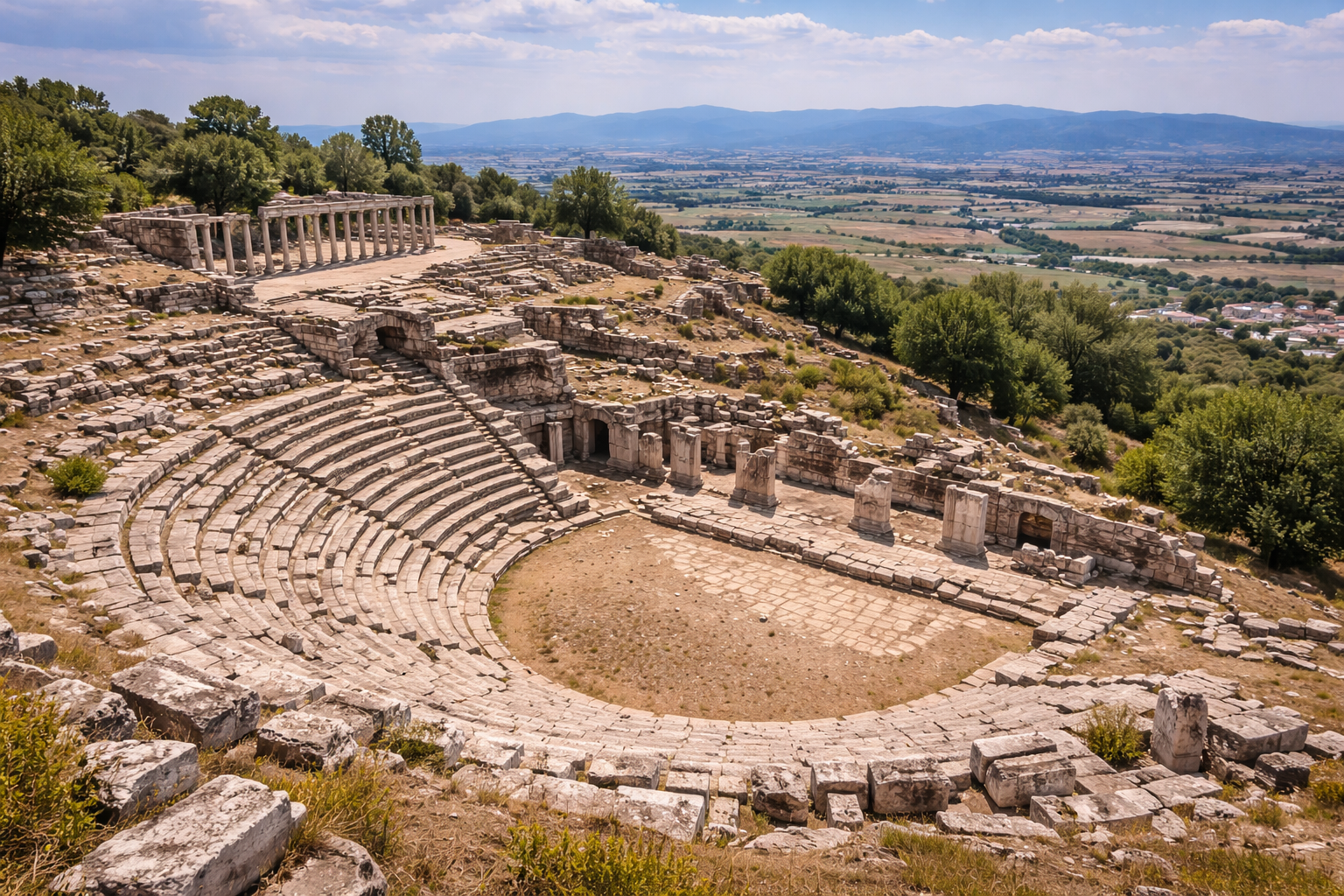
The Great Theatre is hollowed from the western slope of Mount Pion at the point where Marble Street meets the Arcadiane and is by some distance the largest theatre surviving from the Greco-Roman world in Asia Minor. Its cavea, faced in marble, has a diameter of about 145 metres and embraces an arc somewhat wider than the standard Greek semicircle.
Seating is arranged in three horizontal bands (ima, media and summa cavea) separated by broad walkways (diazomata). Vertical staircases (klimakes) divide the rows into wedge-shaped sections (cunei) for orderly entry and exit; calculations suggest that the entire 25,000-strong audience could clear the theatre within roughly ten minutes.
Capacity is estimated at approximately 25,000 spectators. A Hellenistic theatre on the site, dating to the third century BC under Lysimachus, was progressively rebuilt in the Roman period: the second tier was added under Nero, the third under Trajan, and the stage building (scaenae frons) eventually rose to three storeys some thirty-eight metres tall.
The acoustic properties remain remarkable; an unamplified voice on the orchestra carries crisply to the upper rim, a phenomenon studied repeatedly by modern acousticians. The slight forward inclination of the seating, the careful relationship between the diameter of the orchestra and the height of the scaena, and the slope of the hillside itself all contribute to the effect.
The theatre served the full range of Roman public uses — drama, mime and pantomime, musical contests, civic assemblies and, in the imperial period, gladiatorial combats and beast hunts. In late antiquity the orchestra was waterproofed and used for staged naval battles. Christian sources also record the use of the theatre for episcopal elections in the fifth and sixth centuries.
It is also the setting of one of the most famous episodes in the early history of Christianity: the riot described in Acts 19:23-41, in which the silversmith Demetrius rallied artisans whose livelihoods depended on souvenir shrines of Artemis, dragged Paul's companions Gaius and Aristarchus into the theatre, and led the crowd in two hours of shouted refrain — "Great is Artemis of the Ephesians!" — before the town clerk dispersed the assembly with a careful appeal to civic order and the rule of Roman law.
Today the lower seating is accessible to visitors when conservation work permits; the upper cavea has been closed for restoration since 2025. Even from the lowest rows, the view across the now-marshy harbour plain toward the distant Aegean is among the most evocative sights at Ephesus.
Temple of Hadrian
Half-way up Curetes Street, between the Scholastikia Baths and the Trajan fountain, stands the elegant little Temple of Hadrian. It is among the most photographed minor monuments at Ephesus, and rightly so.
The design combines an exquisite Corinthian facade with a Syrian arch springing between the two central columns, in the tympanum of which a relief bust of Tyche — the city's protective fortune — emerges from a wreath of acanthus. The Syrian arch, a curved pediment springing from straight architraves on either side, became an influential motif in late antique and Byzantine architecture; the Ephesus example is one of the earliest dated examples.
Inside the porch, a second relief in the tympanum of the inner doorway shows a snake-bodied female figure — usually interpreted as Medusa — flanked by acanthus and floral ornament of unusually high quality.
The temple was dedicated around AD 117-138 to Hadrian, to Artemis Ephesia and to the people of Ephesus, by a private citizen named P. Quintilius. The dedicatory inscription survives intact on the architrave and is one of the best-preserved short Greek inscriptions in the city.
The inner porch carries a frieze in four panels, removed to the Selçuk museum and replaced on site by casts. The first panel depicts the foundation myth of Ephesus, with Androclus chasing the boar; the second a procession of Olympian gods led by Athena; the third the legendary battle between Amazons and Greeks (the Amazons claimed Ephesus as a foundation); and a fourth, added under Theodosius I in the late fourth century, showing the imperial family alongside Athena, Artemis and a personification of the city.
The combination of pagan myth and Christian-era imperial portraiture on the same monument captures the long, complex transition of late antique Ephesus from one religious world to another.
Strictly speaking, the building was not a true temple but a naiskos — a small ornamental aedicula erected over a niche containing the imperial statue. It is a perfect specimen of Antonine architectural taste: refined, miniaturised, and freighted with allusion to both local myth and Roman political theology.
Terrace Houses
The Terrace Houses (Yamaç Evler), arranged on three artificial terraces cut into the slope of Mount Coressus immediately above Curetes Street, are the single most spectacular survival of upper-class Roman domestic architecture anywhere in the Mediterranean. The complex consists of two insulae containing seven distinct residences (the so-called Houses 1-7), occupied with continuous reconstruction from roughly the first century BC to the seventh century AD.
The wealth of their inhabitants is evident in every detail. These were the homes of senators, equestrians and leading priests of the imperial cult — the families who staffed the city's magistracies, sat on the boule, and built the public monuments along Curetes Street directly below their front doors.
Each house is organised around a peristyle courtyard with surrounding rooms whose walls are painted with frescoes — mythological panels, garden scenes, theatrical masks, portraits — and whose floors are paved with intricate mosaics in black-and-white and polychrome marble.
Some rooms preserve marble wall revetment with veneers from quarries across the empire: green from Karystos, purple from Phrygia, yellow from Numidia. Others retain hypocaust systems for underfloor heating, glass window panes (a luxury rare even in Rome), and traces of indoor latrines fed by piped water with hot and cold runs.
The figural programmes are art-historically important. House 2 contains a series of panels depicting Socrates, the muses, and theatrical scenes; House 6 (the so-called "Residence Unit 6") was the home of a wealthy senatorial family and contains a marble hall with elaborate opus sectile floors and frescoes in the Pompeian Third and Fourth Styles.
The graffiti are as evocative as the formal art: gladiator names, gaming boards scratched into floors, household accounts in charcoal on walls, magical curses scribbled in plaster. Together they bring the inhabitants vividly to life across two thousand years.
The houses are protected today under a vast modern shelter inaugurated in 2000, and access requires a separate ticket. A network of elevated walkways allows visitors to circulate without descending into the still-active excavation. Conservation work continues year-round in the lower levels, with frescoes being painstakingly cleaned and stabilised.
Allow at least forty-five minutes; for anyone with a serious interest in Roman art, an hour and a half is not too much. The Terrace Houses are, with the Library of Celsus and the Theatre, the single most important reason to add a third hour to a quick Ephesus visit.
Curetes Street
The Curetes Street is the great processional axis of Roman Ephesus. It runs roughly south-east to north-west, descending from the Hercules Gate at the head of the upper plateau down to the small plaza in front of the Celsus Library, a distance of about 210 metres.
The pavement is original marble, deeply rutted by wheeled traffic over five centuries of Roman use. Beneath the slabs runs a sophisticated drainage system that carried storm water and sewage down to the harbour; the manhole covers, neatly cut from the same marble as the road surface, are still visible at regular intervals.
The colonnades along both sides supported continuous porticoes whose tile roofs sheltered shoppers from sun and rain. The columns are of mixed orders and origins — many reused from earlier monuments, some carrying inscriptions still legible after two millennia — and they were originally painted in red and gilded at the capitals.
The street takes its name from the Curetes — a college of priests originally attached to the temple of Artemis whose later headquarters stood in the Prytaneion. Their lists of magistrates, inscribed on column bases along the street, provide one of the most important prosopographical sources for the Roman city, listing dozens of priests and benefactors by name and giving researchers a window into the social organisation of imperial-era Ephesus.
Between the Hercules Gate and the Library facade, visitors pass — in order — the Memmius Monument (a 1st-century BC funerary tower honouring the grandson of the dictator Sulla); the Fountain of Pollio; the Domitian Square with its temple terrace; the elegant Temple of Hadrian; the Scholastikia Baths (a Christian-era refurbishment of an earlier complex, named for the wealthy lady whose statue presided over the entrance); the famously well-preserved public latrines with their marble seats over running water; the Fountain of Trajan; the small Octagon (the alleged tomb of Arsinoe IV, sister of Cleopatra, murdered here in 41 BC on Mark Antony's orders); and finally the magnificent Celsus facade itself.
Few hundred-metre stretches in the ancient world are so densely furnished with monuments. Walking the street slowly — pausing at the inscriptions, looking up at the friezes, glancing into the shopfronts that lined the lower portico — remains one of the great pedagogical experiences in classical archaeology.
Marble Street
From the Library plaza, Marble Street runs northwards along the eastern flank of the Tetragonos Agora to the Great Theatre, a distance of about 400 metres. Its pavement, also of marble, was laid down in the time of Nero and reused massively in later periods; many of the slabs carry the deeply worn track marks of two-wheeled carts.
The street carried the heaviest traffic of the lower city — wagons from the agora to the harbour, processions between the theatre and the civic centre, daily foot traffic from the residential quarters. On either side, monumental colonnades shaded passers-by; behind the eastern colonnade ran a raised pedestrian walkway protected from the wheeled traffic below.
It is here that visitors are shown the famous carved advertisement: a footprint, a heart, a woman's head and a coin pouch incised in the marble. Long popular guidebook lore reads this as a sign-post to the city's brothel, allegedly located in the adjacent building; sober epigraphy is less certain, and the inscription may well be no more than an idle graffito. Either way, it remains one of the most photographed paving stones in classical antiquity.
At the northern end of the street, where it joins the Arcadiane in front of the theatre, stood a four-way arch in honour of the Flavian emperors, of which only the foundations now remain.
Temple of Domitian and Pollio Fountain
On the southern side of the State Agora, a great vaulted terrace supports the platform on which once stood the Temple of Domitian (or, more accurately, the Temple of the Sebastoi — the Augusti — initially dedicated to the Flavian dynasty in AD 89-90). It was the first Asian provincial temple to a living emperor and gave Ephesus the coveted title of neokoros (temple-warden) of the imperial cult.
This title became a matter of intense civic pride and inter-city rivalry; Ephesus would eventually claim to be tris neokoros — three times temple-warden — by adding shrines under Hadrian and Caracalla. The honour brought tangible benefits: tax breaks, the right to host imperial games, and a privileged position in the provincial assembly.
After Domitian's damnatio memoriae in AD 96, the dedication was rededicated to his deified father Vespasian; the colossal cult statue, of which a fragmentary head and forearm survive in the Ephesus Museum at Selçuk, is one of the largest known imperial portraits, reconstructable at a height of about seven metres.
The vaulted substructure of the terrace is largely intact and visitable from Curetes Street. Its vaults today house a small lapidary collection of inscribed altars and statue bases. The temple platform above is reduced to foundations, but the scale of the original cella is still clearly readable.
Adjacent to the temple, the Pollio Fountain, dedicated by the family of C. Sextilius Pollio in the late first century BC, marks the western entrance to the State Agora; its arched facade once sheltered a sculptural group of Odysseus and the blinding of Polyphemus, now in the Selçuk Museum. The group, a strikingly violent Hellenistic composition, is one of the masterpieces of Asian provincial sculpture.
State and Commercial Agorae
Roman Ephesus possessed two great civic squares, distributing its political and economic functions between an upper and a lower forum.
The State Agora (or Upper Agora), at the eastern end of the urban axis, measured roughly 160 by 58 metres and served as the political and administrative heart of the city. It was bordered by the Prytaneion, the Bouleuterion (Odeon), the Basilike Stoa and the Temple of Roma and Caesar at its centre. Here the city's elected magistrates conducted public business, made sacrifices, and read out imperial edicts.
The Basilike Stoa, built under Augustus and rebuilt under Nero, was a long three-aisled covered hall that functioned as a court of law and a venue for the city's commercial banking. The colossal statues of Augustus and Livia found at its eastern end (now in the Selçuk Museum) signal the political ideology of the building: justice administered under the watchful eyes of the imperial family.
The Commercial Agora or Tetragonos Agora, by contrast, lay in the lower city beside the harbour and was the economic engine of Ephesus. Built in the early imperial period on Hellenistic foundations, it was a perfectly square colonnaded plaza measuring approximately 110 by 110 metres, surrounded by double-storey stoas whose ground floor sheltered some 230 shops.
Through it passed the imports and exports that made Ephesus rich: marble from Proconnesus, grain from Egypt, spices from the East, wool and parchment from the Anatolian interior, slaves from the Pontic coast. Excavations in the 2010s and 2020s have recovered substantial deposits of imported amphorae from across the Mediterranean, documenting the agora's role as a clearing house for goods moving in both directions.
A monumental gateway built in the late first century BC, the Gate of Mazaeus and Mithridates, gave entrance to the agora from the Library plaza. Two freedmen of Augustus, named on the inscribed architrave, dedicated the arch in gratitude to their imperial patron; the gate still stands largely intact and is one of the most photographed structures of the lower city after the Library itself.
Harbour Street (Arcadiane)
From the western parodos of the Great Theatre, the magnificent Arcadiane — sometimes called the Harbour Street — drives straight as a ruler 530 metres west to the gate of the now-vanished harbour. Eleven metres wide between its kerbs, lined with marble-paved porticoes and shop fronts, this was the showpiece avenue of late Roman Ephesus.
Its name records the rebuilding of an older avenue by the emperor Arcadius around AD 400, but the line of the street is much older, having been laid out under Lysimachus and elaborated through the imperial period. Arcadius's contribution included the resurfacing of the central roadway, the addition of the great columned porticoes on either side, and — most remarkably — the installation of streetlamps at regular intervals. Ephesus was, with Antioch and Rome, one of only three ancient cities documented to have had street lighting at night.
Half-way along the street stood a tall column carrying statues of the four evangelists, a Christian monument that survived into the medieval period. Today the central roadway is mostly grassed over and the porticoes survive only as truncated column drums, but the long sight-line from theatre to harbour remains one of the most evocative views in the lower city.
Prytaneion
The Prytaneion, on the north side of the State Agora, was the symbolic centre of the city's religious and civic life. It housed the eternal flame of Hestia Boulaia — the goddess of the city hearth — tended continuously by the prytaneis and the Curetes, and ritually re-lit at certain festivals from a flame brought from the sanctuary of Artemis.
The building's offices held the city's official records, hosted state dinners for foreign envoys, and accommodated honoured guests at public expense. The list of prytaneis through the centuries, partially preserved in inscriptions, reads as a who's-who of Ephesian aristocracy.
The Prytaneion also served as the home of the Curetes, the college of priests who had inherited the cult of the indigenous mother-goddess that long predated the Greek city. Two of the most famous archaic statues of Artemis Ephesia — the so-called Great Artemis and Beautiful Artemis, now the proudest exhibits of the Selçuk Ephesus Museum — were discovered buried inside the building in 1956, where they had been carefully concealed by sympathetic Christian officials when the cult of Artemis was finally suppressed in the late fourth century.
The act of hiding rather than destroying the cult images speaks to the complex texture of religious change in late antique Ephesus: even as one religion gave way to another, individual believers preserved what they could of the old.
Vedius Gymnasium
In the upper city, near the modern stadium, stands the Vedius Gymnasium, built in the mid-second century AD by M. Claudius P. Vedius Antoninus Phaedrus Sabinianus, a leading Ephesian senator and benefactor whose family appears in dozens of inscriptions across the city.
The complex combines a colonnaded palaestra (open exercise yard), a bath block with the standard sequence of cold, warm and hot rooms, a great vaulted hall (the so-called kaisersaal or imperial hall), and a small temple to Artemis. The marble revetment of the imperial hall was particularly rich, with imported coloured stones from across the Mediterranean.
Its sculptural programme, now largely in Selçuk and Vienna, included a beautiful Resting Satyr type from the Lysippan tradition, a series of athlete statues, and portraits of the donor and his wife Flavia Papiane. The gymnasium was both a sports facility and a finishing school for the elite youth of Roman Asia; the ephebes — young men in their late teens — trained here in athletics, rhetoric, music and Homeric literature.
The Vedius Gymnasium is one of three known major bath-gymnasium complexes at Ephesus, alongside the Harbour Gymnasium (the largest, near the western end of the Arcadiane) and the East Gymnasium near the Magnesia Gate.
Other Notable Monuments
Several smaller monuments deserve mention even in a compressed survey.
The Memmius Monument, on the upper end of Curetes Street, was erected around 30 BC by Memmius, grandson of the dictator Sulla, in honour of his Roman ancestry; its four-faced design with reliefs of armed warriors stood prominently on the corner of the State Agora and is partially restored.
The Hercules Gate, marking the upper end of Curetes Street, takes its name from the two relief panels of Hercules wearing the Nemean lion's skin that survive on either side of the road; the structure originally framed a much larger triumphal arch.
The Scholastikia Baths, mid-way along Curetes Street, occupy a Roman bath complex extensively rebuilt in the late fourth or early fifth century by a wealthy Christian patron named Scholastikia, whose seated statue (now headless) sits at the entrance.
The public latrines beside the Scholastikia Baths preserve their marble bench with twelve seats over running water, a small central pool, and a covered colonnade — providing one of the clearest views of Roman daily plumbing anywhere in the empire.
The Fountain of Trajan (Nymphaeum Traiani), built around AD 102-104, was a two-storey ornamental fountain whose facade carried statues of Trajan, Nerva and the imperial family; a colossal seated statue of Trajan stood at the centre, of which the foot and surrounding marble globe survive.
The Bouleuterion or Odeon, on the north side of the State Agora, was the council chamber of the city's boule, built in the mid-second century by P. Vedius Antoninus and his wife. It seated about 1,500 and could also be used for musical performances and lectures.
The Library Square in front of the Celsus facade was paved with marble and bordered by a small fountain, a sundial, and several honorific monuments; recent excavations have recovered much of its original sculpture, now in the Selçuk Museum.
The Magnesia Gate, at the south-east end of the city, was the principal land entrance, marking the start of the road to Magnesia on the Maeander; substantial portions of the gate's masonry and the adjacent stretch of Hellenistic wall survive.
Basilica of St John (Ayasoluk Hill)
On the summit of Ayasoluk Hill, immediately above the modern town of Selçuk, the emperor Justinian I between roughly AD 536 and 565 raised a vast cruciform basilica over the modest fourth-century shrine that already marked the supposed tomb of the Evangelist John.
The plan was a Latin cross some 130 by 56 metres, divided by piers into a nave and four side aisles, and crowned by six domes — one over each arm of the cross, one over the crossing, and one over the central western bay. The disposition of the domes makes the building a key intermediate stage between the early Christian basilica plan and the developed Byzantine domed cross, anticipating the more famous solution at the church of the Holy Apostles in Constantinople.
Pilgrim accounts of the seventh and eighth centuries describe its marble revetment, its mosaics, and the sacred dust (manna) that supposedly bubbled up from the tomb beneath the central dome. The dust was collected by pilgrims in small flasks (some of which have been recovered in the 2024 excavations) and carried home as relics; it was credited with healing and protective powers across the Byzantine world.
The basilica was converted into a mosque in the fourteenth century by the Aydınid emirs and then severely damaged by earthquake in 1365-70. Today its plan is clearly legible, with four piers of the central crossing partially re-erected during the restoration carried out by Greek and Turkish archaeologists in the 1920s and again in the 1970s under George Sotiriou and Hormoz Khalil Ramazan.
The view from the citadel ramparts above the basilica takes in the entire ancient harbour plain, the lone column of the Artemision, the İsa Bey Mosque immediately below, the medieval aqueduct (its arches now home to a colony of storks) crossing the southern part of Selçuk town, and, on a clear day, the distant blue of the Aegean. Few archaeological viewpoints in western Anatolia offer such a complete reading of urban history at a glance.
İsa Bey Mosque
At the foot of Ayasoluk Hill, the İsa Bey Mosque was built in 1374-75 by the architect Ali ibn Mushaimish al-Dimashqi ("Ali son of Mushaimish of Damascus") for İsa Bey, ruler of the Aydınid emirate. It is among the most important pre-Ottoman mosques surviving in Anatolia.
A rectangular courtyard with a marble fountain leads into a prayer hall divided by reused antique granite columns into two aisles, each crowned by a dome. The columns themselves are spolia from the harbour baths of Roman Ephesus, hauled up the hill by the fourteenth-century builders.
The west facade, of finely cut marble with two superimposed registers of niches and a richly framed central portal, is unique in Anatolian Turkish architecture and reflects the cosmopolitan culture of an emirate that traded with Mamluk Egypt, Genoese Galata and Venetian Crete.
The building demonstrates the cultural sophistication of the small emirates that flourished briefly between the collapse of the Seljuks and the rise of the Ottomans. The minaret on the north-west corner is later — its predecessor was destroyed in an earthquake. The mosque is open to visitors outside prayer times; modest dress is required and shoes are removed at the entrance to the prayer hall.
Archaeological Work
From Wood to Benndorf
Systematic archaeology at Ephesus is now in its second century. The first major intervention came not from a continental academic institute but from the British Museum, which in 1863 dispatched the railway engineer John Turtle Wood to locate the long-lost Temple of Artemis.
After six gruelling years of trial trenches across the Cayster floodplain, often standing waist-deep in malarial water and fending off bouts of fever, Wood struck the temple platform on the last day of 1869. His method — extending a trial trench outward from a single inscribed Hellenistic block — was painstaking but brilliantly successful.
His subsequent excavation seasons through 1874 recovered the great Croesus column drum and many of the sculpted column fragments now in London. His memoir, Discoveries at Ephesus (1877), is still essential reading and ranks among the great narrative documents of nineteenth-century archaeology.
The Austrian Era
In 1895 the newly founded Austrian Archaeological Institute under Otto Benndorf took over the lower city and began the work that, with intermittent interruptions for the two world wars, has continued without serious break ever since. The Institute's foundation and its Ephesus mission were almost simultaneous, and the city has remained the flagship project of Austrian classical archaeology ever since.
The early Austrian campaigns concentrated on the Tetragonos Agora, the Great Theatre and the civic monuments of the State Agora. Wilhelm Wilberg and Josef Keil dominated excavation between the wars, producing the foundational volumes of the Forschungen in Ephesos series that remains the field's standard reference.
Franz Miltner, Hermann Vetters and Anton Bammer directed the campaigns after 1945. Bammer's prolonged investigation of the Artemision in the 1960s and 1970s revealed the archaic foundations and rebuilt the chronology of the early sanctuary; the Terrace Houses were explored under Vetters and then under Friedrich Krinzinger from the 1980s onward.
The Celsus Anastylosis
The defining restoration project — and the one that has done most to shape the modern visitor's experience — was the anastylosis of the Library of Celsus facade between 1970 and 1978, conducted by Volker Michael Strocka and Friedmund Hueber.
The team identified, catalogued and reassembled an estimated three-quarters of the original blocks, using clearly marked travertine fills for the missing portions and stainless steel armatures for stability. The methodology was carefully documented in a series of publications that remain influential models for similar projects elsewhere in the Mediterranean.
The Celsus restoration set a methodological standard for the discipline. It has been followed, with adaptations, by the partial anastylosis of the Hadrian Temple, the Pollio Fountain and several stretches of the Curetes Street colonnade, by the partial restoration of the Memmius Monument, and by the rebuilding of one of the Artemision columns on its original foundation.
Recent Directors and Discoveries
Excavation directors in recent decades — Stefan Karwiese, Friedrich Krinzinger, Sabine Ladstätter (since 2009) — have increasingly emphasised conservation, archaeometry, and the late-antique and Byzantine phases. The shift reflects a broader trend in classical archaeology away from monumental display and toward urban, economic and environmental history.
A research focus on the late antique commercial quarters culminated in October 2023 and 2024 with the discovery, near the Tetragonos Agora, of an early Byzantine neighbourhood of shops and houses sealed by a catastrophic fire of the early seventh century.
The Pompeii-like preservation has been spectacular: ceramic vessels still packed with mussel and oyster shells, jars of salted mackerel, bronze and gold coins lying in shop drawers, pilgrim flasks waiting to be sold to visitors. Ladstätter has described it as the most important Ephesus discovery in half a century. The find is rewriting the history of the city's final commercial flourishing before the Persian and Arab disruptions of the seventh century.
Conservation in the 21st Century
Conservation has become a permanent concern. Marine humidity, microbial growth, salt crystallisation, root action and earthquakes are unrelenting. The Celsus facade itself, restored half a century ago, now requires intensive intervention to repair fifty years of weathering and biological attack.
A new conservation campaign on the Celsus facade, launched in October 2024 and planned to run through 2027, is addressing fifty years of weathering since the original restoration. The Great Theatre is undergoing parallel work that began in spring 2025; the Terrace Houses, the Hadrian Temple and the Vedius Gymnasium are all subject to continuous monitoring and intervention.
Modern techniques — laser-scanning, photogrammetry, structural monitoring, micro-borehole sampling, GIS-based site management, drone-mounted multi-spectral imaging — are now fully integrated into the Austrian Institute's annual programme. Beneath the visitor traffic of millions, in other words, Ephesus remains an active scientific laboratory of unusual richness, with publications appearing at a rate of several books and dozens of articles each year.
Numismatics
A specialist programme in Ephesian coin studies has run continuously since 2000 under the Austrian Academy of Sciences. Coins are recovered routinely from every season's excavation: archaic electrum staters with the city's bee-and-stag emblems, Hellenistic bronzes with Artemis and her sacred animals, Roman provincials with imperial portraits and temple facades, late antique and Byzantine bronzes documenting the city's gradual contraction.
The bee was the city's most enduring civic symbol, appearing on coinage for more than five centuries. The Greek word for bee, melissa, also designated the priestesses of Artemis, linking the city's commercial currency directly to its religious identity. Ephesian coins have been recovered across the Mediterranean and as far as Crimea, the Indus valley and the African Red Sea coast, documenting the extraordinary reach of the city's commerce.
Inscriptions
Few cities in the Roman world have yielded such a corpus of inscriptions as Ephesus. The published edition, Die Inschriften von Ephesos (8 volumes, 1979-1984), runs to several thousand texts: civic decrees, honorific dedications, funerary stelae, sacred laws, building accounts, private letters and graffiti.
Particularly important are the inscriptions of the Salutaris foundation (AD 104), a series of long texts recording the bequest by which C. Vibius Salutaris endowed a series of processions of silver statues of Artemis and the city's heroes through the streets on festival days. Together they document not only the religious life of imperial Ephesus but also the precise topography of the procession route through the lower city.
Religion and Culture
Artemis Ephesia: The Polymastic Goddess
The Artemis worshipped at Ephesus was not the slim, virgin huntress of Athenian iconography. She was a hieratic, frontally posed image whose torso was covered with rows of pendulous protuberances — interpreted variously as breasts, eggs, bull testicles, or amber gourds — and whose pillar-like lower body was carved with registers of lions, bulls, sphinxes, griffins and bees.
The protuberances, sometimes called mastoi in the ancient sources, have provoked centuries of scholarly debate. The recent consensus, advanced by Guy MacLean Rogers among others, is that they represent neither breasts nor eggs but the testicles of sacrificed bulls hung on the goddess's body as a fertility offering. Whichever interpretation is correct, the image is unmistakably one of generative power.
Two of the finest surviving cult statues, the Great Artemis (about 2.92 metres tall) and the Beautiful Artemis (about 1.74 metres), both from the second century AD and both excavated from the Prytaneion in 1956, dominate the central hall of the Selçuk Museum. A third, smaller image, the so-called Little Artemis, is also displayed there, providing an unrivalled overview of how the cult image was elaborated across the imperial period.
The goddess's pre-Greek roots are unambiguous. Her sanctuary at Ephesus was a sacred place long before Androclus's Ionians arrived, and the image preserves the visual vocabulary of an Anatolian mother-goddess closely related to the Phrygian Cybele and ultimately, perhaps, to the seated goddesses of Neolithic Çatalhöyük.
The Greeks identified her with their own Artemis, but the Ephesian cult retained its distinctive ritual: a college of megabyzoi (eunuch priests of probable Persian origin), bands of melissai ("bees" — virgin priestesses), and a year-long festival cycle culminating in a great annual procession (the Ephesia) along a sacred road from the city to the temple.
The procession route, lined with statues and dedications, has been partially traced by surface survey. It began at the Magnesia Gate, descended along Curetes Street, passed through the Tetragonos Agora, exited the city through the harbour district, and wound around the base of Ayasoluk Hill to the temple — a ceremonial circumambulation of the entire civic space.
The temple itself functioned as a Mediterranean reserve bank. Greek and Roman cities, individual aristocrats, and even reigning kings deposited bullion in its treasury, secure in the inviolability of the sanctuary. Xenophon left funds there during the Anabasis, Caesar's officers used it for payroll reserves, and the historian Dio Chrysostom describes the practice in detail.
The temple's commercial importance helped sustain the city's prosperity for almost a millennium, and the silver trade in souvenir shrines — the trade defended so vigorously by Demetrius in Acts 19 — gives a measure of how lucrative the pilgrim economy could be. Small bronze and silver replicas of the cult image have been found across the Roman world, from Britain to the Black Sea.
Paul and the Early Christian Community
Paul's Ephesian mission, recounted in Acts 18-20 and reflected in his correspondence (1 Corinthians, written from Ephesus; Romans, written shortly afterward), was perhaps the most successful chapter of his career.
He preached first in the synagogue and then, when expelled, in the lecture hall of a man named Tyrannus, "so that all the Jews and Greeks who lived in the province of Asia heard the word of the Lord." Acts records spectacular miracles attributed to Paul — handkerchiefs touched to his body and applied to the sick, exorcisms gone wrong when imitators tried to invoke "the Jesus whom Paul preaches" — the public burning of magical books worth fifty thousand drachmas, and the demographic shift of devotees away from Artemis that triggered the riot of the silversmiths.
The letter to the Ephesians, whether composed by Paul himself or by a close disciple shortly after his death, articulates one of the most cosmic visions in early Christianity: a single church gathering Jew and Gentile under one head, mirroring on earth the unity of the heavens. Whether or not it was originally addressed to this particular congregation — many manuscripts lack the words "in Ephesus" — its association with the city has been theologically formative for two thousand years.
The Christian community Paul founded outlived him. The book of Revelation, addressed in part to the "angel of the church in Ephesus," already in the 90s critiques the community for having lost its first love. Ignatius of Antioch's letter to the Ephesians, written under guard on his way to martyrdom around AD 108, speaks of a vibrant, well-organised congregation under their bishop Onesimus.
The community produced its own martyrs in the second and third centuries; their names — Bishop Polycrates, the deacon Hermolaus, the trio of Audactus, Taracus and Probus — survive in liturgical calendars. By the third century Ephesus was a major metropolitan see; by 431 it was the venue of the most consequential Christological council of the patristic age.
The physical traces of early Christianity at Ephesus are widely scattered. They include the Cave of the Seven Sleepers, the basilica of St John on Ayasoluk Hill, the Council Church beside the harbour, an early Christian cemetery on the eastern slope of Pion, several house-church conversions in the lower city, and the dozens of Christian inscriptions and graffiti recorded across the site.
The House of the Virgin Mary
On the northern flank of Bülbül Dağı, some seven kilometres south of the ancient city, a small stone chapel marks the spot identified in the nineteenth century as the final dwelling of the Virgin Mary.
The identification rests on the visions of the German Augustinian mystic Anne Catherine Emmerich (1774-1824), whose detailed descriptions of the house — recorded by her amanuensis the poet Clemens Brentano and published posthumously — guided a Lazarist mission led by Father Eugène Poulin to the site in 1891. They found the ruins of a small Byzantine chapel built on first-century foundations, oriented as Emmerich had described.
The match between Emmerich's visionary description (a small stone house in a wooded fold of the hills, with a particular spring nearby and a view toward the sea) and the physical site is striking enough that even sceptical observers have found it hard to dismiss as coincidence. Whether one reads the find as evidence of authentic mystical insight or as a happy accident of topographical match, it triggered a revival of Christian devotion to the spot.
The Catholic Church has never formally pronounced on the historicity of the site but has consistently permitted devotion. Paul VI visited in 1967; John Paul II in 1979; Benedict XVI in 2006; Francis has prayed there during his pontificate. The visits have raised the international profile of the site, and it now receives close to a million visitors a year.
Muslim tradition also holds Mary (Hazret-i Meryem) in high honour — she is the only woman named in the Qur'an, and an entire sura bears her name — and the chapel attracts pilgrims of both faiths in roughly equal numbers. A spring beside the house is believed to have healing properties, and the wall of wish-papers beside the path has become a small folk shrine in its own right.
The site is reached by a winding road through pine woods and is open daily; modest dress is requested, and an entrance fee is charged. Whether the building is genuinely first-century or, more probably, a later Christian commemoration of an oral tradition, it remains one of the most quietly atmospheric sacred places in the Aegean.
The Seven Sleepers
On the eastern slope of Mount Pion, a short walk from the upper gate of Ephesus, lies the so-called Grotto of the Seven Sleepers. The legend, attested from the fifth century in both Christian and (later) Islamic sources, tells of seven young Christians who took refuge from the persecution of the emperor Decius in a cave on Mount Pion in AD 250.
The seven — Maximilian, Iamblicus, Martin, John, Dionysius, Antonius and Constantine in the most common Christian versions — were sealed in the cave by the persecutors and fell miraculously asleep. They awoke 180 (in some versions, almost 200) years later to find a Christian emperor on the throne and the city full of churches. One of them ventured into the city to buy bread with an obsolete coin, was arrested as a thief, and the truth of the miracle was revealed.
The story appears in the Qur'an (Sura 18, Al-Kahf, "The Cave"), where the sleepers are called the Companions of the Cave (Aṣḥāb al-Kahf). The Qur'anic version, slightly different in its details, is one of several points at which Christian Anatolian legend has entered Islamic tradition; the Cave of the Seven Sleepers is consequently sacred in both faiths.
The archaeological site, excavated by the Austrian Institute in 1927-28 under Franz Miltner, is a late-antique cemetery complex of vaulted tombs cut into the slope, with a small basilica added in the Byzantine period. Whatever the historicity of the legend, the site was clearly a major Christian pilgrimage destination from the fifth century onwards, with hundreds of burials clustered around the supposed tombs of the sleepers themselves.
The site is open to visitors and is signposted from the Ephesus upper gate; the walk takes about ten minutes through olive groves.
Heraclitus
The philosopher Heraclitus of Ephesus (c. 535-475 BC), one of the most enigmatic of the pre-Socratic thinkers, was born into the aristocratic priestly family that controlled the cult of Artemis but renounced his hereditary office (so the tradition holds) in favour of solitary speculation.
His one book, On Nature (Peri Physeos), survives only in some 130 short fragments preserved by later authors. The fragments are notoriously cryptic; Heraclitus was called ho Skoteinos, "the Obscure," already in antiquity. But the central ideas come through clearly: that all things are in flux (panta rhei, "everything flows"); that the Logos orders the world through a tension of opposites; that fire is the primal element from which all other things are condensed; that "the path up and the path down are one and the same."
These ideas have shaped Western philosophy from Plato (who quotes Heraclitus throughout the Cratylus) through the Stoics, through Hegel (whose Logic is unintelligible without Heraclitus), to Heidegger and beyond. Heraclitus is said to have deposited his book in the temple of Artemis, where for all we know it remained until the great fire of 356 BC.
His death, according to a probably legendary tradition recorded by Diogenes Laertius, came from dropsy contracted while he was burying himself in cow-dung in an attempt to dry out his swollen body — a wonderfully Heraclitean death, if true, marrying earth, fire and the failed tension of opposites.
Daily Life and Economy
The Ephesus visitors see today is the spectacle of public Ephesus — temples, fountains, civic squares, monumental tombs. But the city was also a place where some quarter of a million people ate, slept, worked, married, made things, bought and sold them, fell ill and were buried. The archaeological evidence for this everyday life is unusually rich and growing every year.
Trade was the city's economic engine. The Tetragonos Agora alone housed some 230 shops; the streets connecting it to the harbour were lined with secondary commercial premises, and excavated pottery deposits document a clearing trade in wine, oil, fish sauce (garum), grain, marble, slaves and finished metal goods.
Imports came from across the Mediterranean and beyond. African red-slip pottery from modern Tunisia, fine glass from Syria, spices from India and Arabia, amber from the Baltic, papyrus from Egypt, ivory from sub-Saharan Africa — all have been recovered from Ephesian deposits. The Roman trade with India is documented in the Periplus Maris Erythraei, which mentions Ephesus among its principal western nodes.
Banking was concentrated around the temple of Artemis and the Basilike Stoa in the State Agora. Inscriptions document large-scale moneylending and the management of dedicated funds for civic purposes.
One particularly important second-century inscription records the bequest of C. Vibius Salutaris, an Italian-descended Roman knight resident in Ephesus, who in AD 104 set up a substantial endowment to fund processions of silver statues through the city on certain festival days. The text, inscribed in multiple copies on the walls of the Great Theatre, runs to several hundred lines and is one of the most detailed accounts of civic religion to survive from any Roman city.
Manufacturing at Ephesus included textiles (especially wool, fulled and dyed locally), leather, marble sculpture, fine pottery, glassware, and the celebrated silver-shrines of Artemis whose makers protested Paul's preaching. A neighbourhood of workshops west of the State Agora has produced clear evidence of bronze-working and small-scale metallurgy.
A particular Ephesian specialty was the manufacture of magical amulets and inscribed gemstones; the city's reputation for sorcery in the Greco-Roman world is reflected in the Ephesia grammata — a set of six magical words traditionally inscribed on protective charms — and in the references in Acts to magical books burned by Paul's converts.
Food was produced both in the city's hinterland (grain, olives, fruit, vegetables) and imported from further afield (Egyptian grain, North African olive oil, Pontic salt fish). The 2024 Byzantine quarter excavations included spectacular finds of dried mussel and oyster shells in storage jars, salted mackerel in amphorae, and miscellaneous foodstuffs in ceramic crocks — a snapshot of the seventh-century Ephesian table.
Baking, brewing, and small-scale food processing occupied countless workshops across the lower city. The poet Hipponax's iambics, fragmentary as they are, mention bread sellers, tavern keepers, and the everyday street life of the archaic city in surprisingly recognisable terms.
Housing ranged from the marble luxury of the Terrace Houses down through middle-class tenements, modest courtyard houses, and the temporary shelters of the urban poor. Inscriptions document slaves, freedmen, day labourers, ferrymen, fishmongers and prostitutes alongside the senators and equestrians whose mansions and monuments survive most prominently.
The population in the imperial period was extraordinarily diverse: Greeks from across the Aegean, Italians from the Roman west, Jews (with a substantial community attested from at least the second century BC), Egyptians, Syrians, Phrygians, Lydians and traders from the Black Sea coast. Bilingual and multilingual inscriptions are common; the city's epigraphic record is essentially Greek but Latin, Aramaic and Hebrew are also represented.
Water, Drainage and Roman Engineering
Few aspects of Ephesus more clearly demonstrate Roman civic capacity than the city's water supply. At its imperial peak, Ephesus was served by at least four aqueducts bringing water from springs in the hills east and north of the city: the Şirince aqueduct, the Değirmendere aqueduct, the Marnas aqueduct and the Pollio aqueduct.
The Marnas line, the most studied, ran more than forty kilometres through a combination of underground channels, surface conduits and elevated arcades to deliver an estimated 5,000 cubic metres of water per day to the upper city. The Pollio aqueduct, named for its second-century sponsor, brought water from springs near Şirince village; surviving piers of its arcade still cross the modern road south of Selçuk.
Within the city, water was distributed to public fountains (more than a dozen substantial nymphaea are documented), to bath complexes, to the imperial cult terrace at the Temple of Domitian, and to private elite residences including the Terrace Houses. Cisterns and water-tanks fed the overflow back into a marble-lined sewer system that ran beneath every major street and emptied into the harbour.
The sewer beneath Curetes Street is still partially navigable; manhole covers at regular intervals show the same hexagonal pattern used in modern infrastructure. The public latrines, fed by overflow water from the Scholastikia Baths, provided continuously flushed seating for twenty-four users at a time.
The Festivals of Artemis
The religious calendar of Roman Ephesus was dominated by the festivals of Artemis. The annual Artemisia, held in the month named for the goddess, included athletic and musical competitions, a great procession from the city to the temple along the sacred road, and the public sacrifice of dozens of animals.
The Mysteries of Artemis, conducted at night and restricted to initiates, were celebrated in special precincts north of the city; their content remains largely unknown, but inscriptions mention an agon of sacred dances, the carrying of secret objects in covered baskets, and the participation of the kouretes and melissai — the male and female religious orders associated with the goddess.
The Ephesian games, established by the city in the imperial period, were among the most prestigious athletic festivals in the eastern Mediterranean. Successful athletes received not only crowns and money prizes but also the privilege of entering the city through a special "victors' gate" and lifetime tax exemptions.
The cult of the emperors added a parallel sequence of festivals — the Caesarea in honour of the deified imperial family — that interlocked with the older religious calendar. Asiarchs and archiereis, the high priests of the provincial imperial cult, sponsored games and processions whose costs ran into millions of sesterces.
Other Famous Ephesians
Heraclitus is the best known of the city's intellectual sons, but he was not alone. The list of distinguished Ephesians extends across antiquity and includes figures who shaped medicine, painting, sculpture, philology and law.
Hipponax (fl. mid-6th c. BC), a poet of bitter satirical iambics, was exiled from Ephesus after offending the tyrant Athenagoras; his poems, surviving in fragments, are among the earliest examples of personal lyric invective.
Parrhasius (fl. late 5th c. BC), one of the most celebrated painters of antiquity, was born in Ephesus and worked in Athens; he is the painter who, according to Pliny, won a famous contest with Zeuxis by painting a curtain so convincing that his rival demanded he draw it back to reveal the picture.
Soranus of Ephesus (fl. early 2nd c. AD) was a physician of the Methodist school who practised in Alexandria and Rome; his treatise On the Diseases of Women remained a standard gynaecological text for fifteen centuries.
Rufus of Ephesus (fl. late 1st c. AD), another Methodist physician, wrote on melancholy, on the kidneys and on naming the parts of the body; his works were translated into Arabic and influenced Galen.
Artemidorus Daldianus (2nd c. AD), often called "Artemidorus of Ephesus" although he was born at Daldis in Lydia, composed the Oneirocritica, a five-book treatise on dream interpretation that remains the principal ancient handbook on the subject.
Polycrates of Ephesus (late 2nd c. AD), bishop of Ephesus, played a leading role in the Quartodeciman controversy over the date of Easter, arguing for the Asian tradition against the position of Rome.
John of Ephesus (c. 507-588 AD), a Monophysite bishop and church historian, wrote in Syriac an Ecclesiastical History and a Lives of the Eastern Saints that are crucial sources for the religious culture of sixth-century Anatolia.
Numbers and Measurements
The Austrian Archaeological Institute's century-and-a-third of work at Ephesus has produced precise measurements for almost every significant monument on the site. The table below summarises the principal dimensions referenced in this guide.
These figures reflect the published consensus of the Forschungen in Ephesos monograph series and subsequent peer-reviewed updates. Where reconstructions are uncertain or contested in the scholarly literature, the most widely cited values have been retained, and notes specify the relevant qualifications.
| Structure | Dimension | Date | Notes |
|---|---|---|---|
| Temple of Artemis (final form) | 137 × 69 m; 127 Ionic columns ~18 m tall | rebuilt after 356 BC | one of the Seven Wonders; sculpted columnae caelatae |
| Croesus's temple (earlier phase) | c. 115 × 55 m | c. 560-550 BC | first Greek temple entirely of marble |
| Celsus Library facade | 21 m wide × 16 m tall (two storeys) | c. AD 110-135 | anastylosis 1970-78 |
| Celsus Library reading hall | 10.9 × 16.7 m (~180 m²) | c. AD 110-135 | double-wall scroll storage; ~12,000 scrolls |
| Great Theatre cavea diameter | 145 m | Hellenistic, expanded under Nero/Trajan | three horizontal bands |
| Great Theatre stage building height | 38 m, three storeys | mid-2nd c. AD | three-storey scaenae frons |
| Great Theatre capacity | ~25,000 spectators | Roman period | largest in Asia Minor |
| Temple of Hadrian frontage | c. 7.5 m wide × 6 m tall | c. AD 117-138 | Syrian arch with Tyche relief |
| Tetragonos (Commercial) Agora | 110 × 110 m | Augustan on Hellenistic foundations | ~230 shops in surrounding stoas |
| State Agora | c. 160 × 58 m | Augustan | Prytaneion, Basilike Stoa, Temple of Roma |
| Curetes Street (main stretch) | 210 m long, c. 9 m wide | Hellenistic-Roman | original marble pavement |
| Marble Street | c. 400 m long | refurbished under Nero | linked agora to theatre |
| Harbour Street (Arcadiane) | 530 m long × 11 m wide | rebuilt under Arcadius, c. AD 400 | colonnaded, lit by streetlamps |
| Odeon (Bouleuterion) | ~1,500 seats | mid-2nd c. AD | civic council chamber and small theatre |
| Vedius Gymnasium | c. 130 × 70 m overall | mid-2nd c. AD | palaestra, baths, imperial cult hall |
| Terrace Houses (insula 2) | seven residences on three terraces | 1st c. BC - 7th c. AD | hypocausts, frescoes, marble revetment |
| Basilica of St John | 130 × 56 m, six domes | AD 536-565 | over the supposed tomb of the Evangelist |
| Theodosian/Byzantine city wall | c. 3 km circuit | 7th c. AD | contracted late-antique perimeter |
| Lysimachus's Hellenistic wall | c. 9 km circuit | 287 BC | ascends to summit of Bülbül Dağı |
| İsa Bey Mosque (prayer hall) | c. 51 × 16 m | AD 1374-75 | reused antique columns |
| Peak population | est. 200,000-250,000 | 1st-2nd c. AD | among the largest in the Roman East |
| Site UNESCO inscription | World Heritage Site | 2015 | criteria iii, iv and vi |
Visitor Information
Getting There
Ephesus is one of the most accessible major archaeological sites in Türkiye. The nearest international gateway is İzmir Adnan Menderes Airport (ADB), about 60 kilometres north of Selçuk and connected by both motorway (the O-31 toll road) and direct suburban trains (the İZBAN system, hourly during the day, journey time about 75 minutes).
Domestic flights link İzmir to Istanbul (50 minutes), Ankara, Antalya and most other major Turkish cities; international connections operate seasonally to numerous European hubs including London, Frankfurt, Vienna, Amsterdam and Copenhagen.
By car, the drive from İzmir city centre to Selçuk takes about an hour on the motorway; from Kuşadası, fifteen kilometres south on the coast, allow twenty minutes; from Bodrum (with its own airport), about two hours via the coastal road; from Pamukkale, about three hours east via Aydın. Cruise passengers landing at the port of Kuşadası are almost invariably bundled into pre-booked excursion coaches.
By public transport, the cleanest route is rail: trains on the İzmir-Selçuk-Denizli line stop in central Selçuk roughly every two hours and connect onward to Aydın and Pamukkale. Intercity buses run frequently between Selçuk and İzmir, Aydın, Kuşadası and Söke from the otogar at the edge of town.
From Selçuk town centre to the lower gate of Ephesus is a three-kilometre walk or a short taxi ride; minibuses (dolmuş) also run regularly along the route in the high season. The upper gate is slightly further from town and is normally accessed by car or pre-booked transfer.
Hours, Tickets and the Museum Pass
The archaeological park is open daily, including most public holidays. Summer hours (April through October) run roughly 08:00 to 19:00; winter hours (November through March) run roughly 08:30 to 17:00. Last entry is normally an hour before closing.
Hours are subject to change, especially during conservation campaigns or for special events; the official source is the Ministry of Culture and Tourism's muze.gov.tr website, which is updated promptly and is also the most reliable source for current ticket prices.
Tickets are available at the upper and lower gates and online via muze.gov.tr. Buying online avoids the modest but tedious queue at the ticket booths, especially in peak season. The Terrace Houses carry a separate entry fee and require a separate ticket; this is one of the few supplementary charges worth paying without hesitation.
The Müzekart+ Annual Museum Pass offers Turkish citizens and residents unlimited entry to most state museums and sites for one calendar year, including Ephesus. International visitors can purchase the Türkiye Museum Pass (valid for 15 days), which covers Ephesus, the Terrace Houses, the Selçuk Ephesus Museum, the Basilica of St John, and a long list of other sites. At peak season the Türkiye Museum Pass pays for itself within a single day of energetic sightseeing.
Children under a certain age (usually 8) enter free; reductions are normally available for students and seniors; foreign-passport holders pay the standard adult rate. Cash is no longer accepted at the gates — all payments are by card or contactless device.
Time Required
A quick visit focused only on the headline monuments — the Great Theatre, Marble Street, the Celsus Library, the Temple of Hadrian and Curetes Street — can be done in about two hours, walking downhill from the upper gate. This is the minimum that does justice to the site and is what most cruise-ship excursions allow.
A standard visit including the Terrace Houses, the State Agora, the Domitian terrace, the Prytaneion and the upper-city baths needs four to five hours. This is the recommended duration for independent travellers and is sufficient for a thoughtful first encounter.
A comprehensive day adding the Selçuk Ephesus Museum, the Artemision, the Basilica of St John, the İsa Bey Mosque and the House of the Virgin Mary requires a full day and benefits from a hired car or a dedicated guide.
For repeat or specialist visitors, two full days at the site and museum together are not excessive: the Terrace Houses alone reward a second hour, and the museum's small-finds collection benefits from unhurried examination.
What to Bring
The site is largely unshaded, and the marble pavements reflect heat fiercely in summer. Comfortable shoes with grip are essential; the polished marble can be slippery underfoot, especially after light rain, and the gradient of Curetes Street is steeper than it appears in photographs.
Carry at least a litre of water per person; bottled water is sold at both gates and at the Terrace Houses entrance but at premium prices. A sun hat, sunscreen and sunglasses are not optional between May and September. A light raincoat or fold-up umbrella is wise from November to March.
A small daypack with a snack, a phone with offline maps, a power bank, and any medication you may need is sensible; there are no rest facilities between the two gates other than the latrines and shaded benches near the Library.
If you plan to walk the full site one-way and not retrace your steps, the conventional strategy is to enter at the upper (Magnesia) gate at the south-east end, descend through the State Agora and down the Curetes Street to the Library, then exit at the lower (harbour) gate beside the Tetragonos Agora. Taxis or pre-arranged transfers can shuttle drivers and luggage between the two gates; some tour operators provide this service automatically.
If you must enter from the lower gate (as cruise passengers usually do) and walk uphill, take the climb slowly and plan rest stops at the Library, the Hadrian temple, and the Trajan fountain.
Best Season
Mid-April through early June and mid-September through late October are the optimal visiting windows. Temperatures are comfortable (highs of 22-28°C), wildflowers are abundant in spring (especially red anemones in April and the Judas trees in late March), and the cruise-ship crowds, though present, are tolerable.
July and August can be brutally hot, with afternoon temperatures regularly above 35°C and unbroken sun on exposed marble. If you must visit in summer, start at the upper gate at opening time and aim to be at the Library before 11:00; consider returning to your hotel for lunch and a siesta, then visiting the Selçuk Museum or the Basilica of St John in the late afternoon.
Winter (December-February) offers dramatic skies, near-empty paths and the best photography light, but rain and the occasional cold snap can disrupt plans. Late January and February sometimes see a remarkable phenomenon: snow on the higher hills behind Selçuk, framing the Roman city in white. Winter visitors should pack a warm layer, a waterproof, and be prepared for shorter daylight hours.
Public holidays — especially the Turkish national holidays of April 23, May 19, August 30 and October 29, plus the two religious festivals of Ramazan Bayramı and Kurban Bayramı whose dates shift each year — see substantially heavier domestic crowds. Plan accordingly.
Nearby Sites
The Ephesus archaeological park is the centrepiece of a constellation of sites that can occupy from a single day to a full week, depending on appetite and pace. The most rewarding combinations are listed below.
-
House of the Virgin Mary (Meryemana Evi), 7 km south of Ephesus on Bülbül Dağı: a small chapel built over first-century foundations, identified in 1891 and visited by four modern popes. The setting in pine woods is restful, the chapel atmosphere genuinely devotional. Allow 1 hour including the drive.
-
Basilica of St John (Selçuk, Ayasoluk Hill): the sixth-century cruciform church of Justinian over the supposed tomb of the Evangelist. The summit also carries the medieval citadel and offers superb views over the plain toward the lone column of the Artemision. Allow 1.5 hours.
-
Ephesus Archaeological Museum (Selçuk): the indispensable companion to the site, displaying the Great Artemis and Beautiful Artemis statues, the Polyphemus group from the Pollio Fountain, the colossal head and arm of Domitian/Titus, the Terrace House frescoes and an exquisite small-finds collection of jewellery, ivory, glass and Roman bronze. Allow 1.5-2 hours.
-
İsa Bey Mosque (Selçuk): the 1374-75 Aydınid masterpiece beside the basilica. Open to non-Muslim visitors outside prayer times; modest dress and removal of shoes required. Allow 30 minutes.
-
Şirince village, 8 km east of Selçuk: a hillside village of Ottoman Greek houses now famous for fruit wines, restored old schools and weekend tourism. A perfect lunch stop after Ephesus. The drive up through olive groves and small vineyards is itself part of the appeal.
-
Pamucak Beach, 6 km west of Selçuk: a long sandy beach on the Aegean, much less crowded than Kuşadası; useful for an end-of-day swim in summer. The beach lies at the mouth of the Cayster — the same river whose silt buried the Ephesus harbour.
-
Cave of the Seven Sleepers, on the eastern slope of Mount Pion: an atmospheric late-antique cemetery with associated Christian and Islamic legend. Free to visit; allow 30 minutes.
-
Priene, Miletus and Didyma, roughly 50-80 km south of Selçuk: three of the great cities of southern Ionia, easily combined into a single long day from a Selçuk or Kuşadası base. Priene offers a perfectly preserved Hellenistic grid plan; Miletus the largest theatre in Asia Minor after Ephesus; Didyma the unfinished giant temple of Apollo.
-
Pergamon, about 200 km north of Selçuk, accessible as a long day-trip but better split over two: the spectacular Hellenistic acropolis, the Asclepieion, the Red Hall, and the modern museum.
-
Aphrodisias, 150 km east of Selçuk, less visited than Ephesus and all the more rewarding for it: a beautifully preserved provincial city in a remote upland setting, with one of the finest sculpture museums in Türkiye.
-
Sardis, the old Lydian capital, about 100 km north-east of Selçuk: the spectacular reconstructed gymnasium-synagogue complex, the temple of Artemis, the remains of the royal acropolis on a steep hillside.
-
Hierapolis-Pamukkale, 200 km east: travertine terraces, vast Roman necropolis, theatre, and an excellent on-site museum.
Ephesus Archaeological Museum (Selçuk)
The Ephesus Archaeological Museum in Selçuk is the indispensable companion to the site. Founded in 1929 in a small house near the basilica, it was relocated to its present purpose-built premises in 1976 and has been progressively expanded and modernised ever since; a major renovation completed in 2014 dramatically improved the lighting, the labelling and the climate control.
The collection is organised thematically. The Hall of the Terrace Houses displays frescoes, mosaics, marble revetment fragments and small finds from the elite residences. The Hall of Fountains presents sculpture from the Pollio, Trajan and Polyphemus fountains, including the magnificent Hellenistic group of Odysseus blinding the Cyclops.
The Hall of Cult Statues is the museum's centrepiece, dominated by the two great cult statues of Artemis Ephesia — the Great Artemis and the Beautiful Artemis — both excavated from the Prytaneion in 1956. The hall also displays a smaller Artemis (the Little Artemis) and a series of altars and votive offerings.
The Hall of Emperors displays the colossal head and forearm of Domitian/Titus from the Temple of the Sebastoi, several imperial portraits, and the Roman statues of Augustus and Livia from the Basilike Stoa.
A separate room treats the Christian and Byzantine material: relief crosses, marble screens, pilgrim flasks, manuscript fragments. The garden displays inscribed sarcophagi, altars, and a small reconstructed tomb monument.
Allow at least an hour and a half; two hours for an unhurried visit. The museum is normally open daily except certain public holidays; current hours and ticket prices are available at muze.gov.tr. The Türkiye Museum Pass covers entry.
Accessibility
Ephesus is partially accessible to wheelchair users and visitors with limited mobility, but the terrain is challenging. The main upper-to-lower walk is downhill on largely paved (if rough) surfaces; the marble paving on the Curetes and Marble streets is uneven and rutted; the State Agora and Domitian terrace involve some steps.
The Terrace Houses are organised around steel walkways with steps and ramps that are not fully wheelchair-accessible. The Basilica of St John involves an unavoidable climb up Ayasoluk Hill and uneven paving on the summit. The House of the Virgin Mary is partly accessible from the upper car park.
Both Ephesus gates have accessible parking and toilets; mobility scooters can sometimes be rented from local agencies in Selçuk and Kuşadası, though availability cannot be guaranteed in high season. The Ministry of Culture and Tourism has, in recent years, installed additional ramps and information panels in braille at key viewpoints.
Visitors with serious mobility needs are advised to enter at the upper gate, focus on the Curetes/Library/Marble Street axis, and arrange transport back to the upper gate at the end of the visit. A guide familiar with accessibility considerations can substantially improve the experience; several Selçuk-based agencies specialise in such tours.
Eating and Drinking
Selçuk and Şirince offer the best food options for visitors to Ephesus. In Selçuk itself, several family-run restaurants near the Aydınoğlu Mehmet Bey statue serve good Aegean cooking — wild-herb pancakes, grilled fish from the nearby coast, slow-cooked lamb and the rich tomato-and-pepper stews characteristic of the region. The restaurants along Cengiz Topel Caddesi are reliable; reserve in summer.
Şirince has a higher concentration of restaurants per capita than perhaps anywhere else in Türkiye, ranging from simple village kitchens to ambitious tasting menus. The village's signature product is fruit wine — pomegranate, mulberry, peach, raspberry — sold in every shop and produced by several local cooperatives.
At Ephesus itself, the cafes at both gates sell drinks, ice cream and basic snacks; for a proper meal, return to Selçuk or drive up to Şirince. Picnicking inside the archaeological park is discouraged.
In Kuşadası, the restaurants along the harbour serve the cruise-ship clientele and tend to be more expensive and less authentic. For a memorable seafood meal in the area, try the small fishing villages of Güzelçamlı or Pamucak, both within easy driving distance.
Souvenirs and Shopping
Selçuk has the usual run of Turkish carpet shops, ceramics, jewellery and leather goods, with some genuinely good craft outlets among the more touristic operations. The town's weekly Saturday market (in the centre, near the bus station) is a colourful local affair selling fresh produce, cheeses, olives, honey and household goods.
Şirince specialises in handmade soaps, olive oil products, and the aforementioned fruit wines, all of which travel well. Several small ateliers in the village also sell hand-loomed textiles and embroidered linens.
For serious collectors, the licensed antiquities dealers of İstanbul and İzmir offer Ottoman and Islamic objects; export of pre-1923 material requires formal documentation from the Ministry of Culture and Tourism.
Safety and Etiquette
Ephesus is among the safest archaeological sites in the world. Petty theft is rare, violent crime almost unheard of, and the site is well staffed and patrolled.
The principal hazards are physical: heat, sunstroke, slippery marble, uneven steps. Twisted ankles are the most common visitor injury. Move carefully, especially on the Curetes Street and around the Terrace House walkways.
Respect the monuments: do not climb on walls, do not touch the frescoes, do not pick up or carry away any stone, however small. Removal of any antiquity, however worthless-looking, is a criminal offence under Turkish law.
Dress codes are relaxed at Ephesus itself but should be more modest at the Basilica of St John, the İsa Bey Mosque and the House of the Virgin Mary. Carry a light scarf for shoulders and (for women) head covering at the mosque.
Suggested Itineraries
Half-day from a cruise ship (4 hours)
Enter at the upper gate, walk slowly down the State Agora, descend Curetes Street pausing at the Hadrian Temple and Trajan fountain, spend 20 minutes at the Terrace Houses, photograph the Library, walk Marble Street to the Theatre, and exit at the lower gate. Skip the Artemision.
Full day from Selçuk (8 hours)
08:00-12:00 at the main site including the Terrace Houses; lunch in Selçuk; 13:30-15:00 at the Selçuk Museum; 15:30-17:00 at the Basilica of St John and the İsa Bey Mosque; sunset drive past the Artemision back to Selçuk.
Two days (16 hours)
Day 1: Main archaeological park (5-6 hours) including the Terrace Houses; Selçuk Museum in the afternoon. Day 2: Morning at the House of the Virgin Mary; lunch and walking in Şirince; afternoon at the Basilica of St John, İsa Bey Mosque, Artemision and Seven Sleepers' Cave.
Three days or more (with a car)
Add a day-trip to Priene-Miletus-Didyma to the south, or to Pergamon to the north. For Christian-history visitors, a separate day for the Seven Churches of Revelation (Smyrna, Pergamon, Thyatira, Sardis, Philadelphia, Laodicea) can be organised from a Selçuk base.
A Walk Through the Site
For visitors who like to plan in advance, the following walking route — entering at the upper Magnesia Gate and exiting at the lower harbour gate — is the most natural way to read the city in its proper sequence.
0 minutes — Magnesia Gate. Show your ticket and enter the archaeological park. To the right are the remains of the East Gymnasium; ahead, the road opens onto the upper plateau.
5 minutes — State Agora. Walk west across the open square. To the north, the Bouleuterion (Odeon) and the Prytaneion; to the south, the substructures of the Temple of Domitian; in the centre, foundations of the Temple of Roma and Caesar.
15 minutes — Memmius Monument and Hercules Gate. The road narrows as it begins the descent of Curetes Street. The Memmius Monument is on the left; the Hercules Gate marks the top of the street proper.
25 minutes — Fountain of Pollio and Domitian Square. The vaulted substructure of the Domitian terrace rises on the left; the small Pollio Fountain is on the right at the corner.
35 minutes — Temple of Hadrian. The elegant Antonine naiskos on the left. Pause to read the Tyche relief and the inner-porch frieze.
40 minutes — Scholastikia Baths and public latrines. On the left, the bath complex and the famous communal toilet. The path winds slightly inside the complex.
45 minutes — Fountain of Trajan. The two-storey nymphaeum on the right, with the surviving foot of the colossal Trajan statue.
55 minutes — Octagon and small monuments. Several smaller honorific tombs and bases line the final descent to the Library plaza.
65 minutes — Celsus Library and Tetragonos Agora. The great facade unfolds at the bottom of the slope. The Gate of Mazaeus and Mithridates leads west into the Commercial Agora. Pause for photographs; explore the agora's shop foundations.
90 minutes — Detour: Terrace Houses. Return up Curetes Street about 50 metres and turn left into the Terrace Houses complex (separate ticket required). Plan 45-60 minutes here.
150 minutes — Marble Street. Returning to the Library plaza, walk north along Marble Street toward the Theatre, pausing to spot the carved advertisement.
170 minutes — Great Theatre. Climb (as access permits) into the cavea to enjoy the view across the harbour plain.
185 minutes — Arcadiane. Descend the parodos to the great Harbour Street and walk west toward the lower gate, passing the remains of the harbour gymnasium on the right.
210 minutes — Lower gate. Exit, perhaps stopping for cold water at the cafe. A taxi or pre-booked driver can return you to your car at the upper gate, or to your hotel in Selçuk or Kuşadası.
This route covers roughly three and a half hours at a comfortable pace, including 45 minutes in the Terrace Houses and several pauses for photographs and rest. Energetic walkers can compress it into two and a half hours; reflective ones will easily stretch it to five.
Frequently Asked Questions
How long should I plan for a visit to Ephesus?
A focused two hours will cover the headline monuments, but most visitors benefit from four to five hours including the Terrace Houses and a coffee break.
A full day, adding the Artemision, the Basilica of St John, the Selçuk Museum and the House of the Virgin Mary, is realistic only with a private vehicle or a guided tour. Repeat visits — and many people make them — reveal details (graffiti, inscriptions, masonry techniques) invisible on a first pass.
Is the Temple of Artemis worth the detour?
For most visitors the physical remains — a single re-erected column standing among reeds — are anticlimactic. But for anyone with a serious interest in classical religion, in the Seven Wonders, or in the cultural archaeology of Anatolia, the site is essential.
Read about the temple's history first; without that context, the column is just a column. With it, the column becomes one of the most poignant ruins in the Mediterranean.
Are the Terrace Houses worth the extra ticket?
Unequivocally yes. The frescoes, mosaics and architectural detail are among the finest surviving examples of Roman domestic luxury anywhere; the protected micro-environment under the modern shelter ensures excellent visibility year-round; and the secondary crowd is much thinner than on Curetes Street.
Budget at least forty-five minutes inside; an hour is better. The Terrace Houses are, for many visitors, the most memorable part of an Ephesus day.
Did Saint Paul really preach in the Great Theatre?
The Acts of the Apostles places the silversmiths' riot in the theatre and describes Paul's companions being dragged inside, but Paul himself, according to the text, was prevented by his disciples and by friendly Asiarchs from entering. He preached in the synagogue and in the schoolroom of Tyrannus, but the theatre was the venue of the riot, not of his sermons.
That said, the theatre is unquestionably the place where the most dramatic moment of his Ephesian ministry played out, and it remains a major Christian pilgrimage stop for that reason.
What is the connection between Ephesus and Christianity?
Multiple and deep. Paul's mission (AD 52-55), the death and burial of John the Evangelist, the tradition of the Virgin Mary's final years, the inclusion of Ephesus in the Seven Churches of Revelation, the Third Ecumenical Council (AD 431) and the Justinianic basilica of St John together make Ephesus one of the most theologically charged sites in the Christian world, second only to Jerusalem and Rome.
For Catholic and Orthodox Christians especially, a visit to Ephesus combines archaeology with pilgrimage in a way few other places can match.
Can I climb to the top of the Great Theatre?
At present, partial access to the lower seating is permitted, but the upper cavea is closed during the conservation campaign that resumed in spring 2025. The connecting route between the theatre and the Library is also affected at times.
Check the current status on muze.gov.tr or with site staff on arrival.
How crowded does Ephesus get?
Very. On peak cruise-ship days (typically Tuesdays to Thursdays in summer), several thousand passengers can arrive between 10:00 and 14:00 in coach convoys from Kuşadası.
The conventional advice is to arrive at the upper gate at opening time, walk against the flow, and be at the Library well before 11:00. Late afternoon (after 16:00) is often equally quiet, with the bonus of dramatic raking light on the marble.
Is there shade on the site?
Almost none on the main axes. The Terrace Houses are shaded by their modern roof; the Celsus Library throws a useful shadow in early morning; the Tetragonos Agora has a few trees along its eastern edge.
Otherwise, plan for direct sun. The pine groves near the Magnesia Gate and the lower car park offer the only natural shade for picnicking.
What is the best way to combine Ephesus with other sites?
For a two-day plan: spend day one on Ephesus, the Terrace Houses and the Selçuk Museum; day two on the Basilica of St John, the Artemision, the Virgin Mary's House and either Şirince village or Priene-Miletus-Didyma to the south.
For a three-day plan, add a separate day for Pergamon or for Aphrodisias (both about 2.5 hours by road). For a week, the entire Aegean classical itinerary — Troy, Assos, Pergamon, Sardis, Ephesus, Priene, Miletus, Didyma, Aphrodisias, Hierapolis — becomes feasible.
Is photography allowed?
Yes, throughout the site. Tripods are not permitted without a professional permit. Flash is forbidden inside the Terrace Houses to protect the frescoes.
The best photography conditions are within an hour of sunrise or sunset, especially on the Celsus facade and the upper rows of the Great Theatre. Drones require a separate permit from the Ministry of Culture and Tourism and are normally refused for tourist use.
Where can I see the original statues from the Celsus Library?
The originals of Sophia, Episteme, Ennoia and Arete are in the Ephesus Museum at the Kunsthistorisches Museum, Vienna. The figures now standing in the niches of the reconstructed facade at Ephesus are casts.
The original frieze from the Temple of Hadrian and the two great cult statues of Artemis Ephesia are in the Ephesus Archaeological Museum in Selçuk. The two collections together — Vienna and Selçuk — constitute the most important holdings of Ephesian material outside Britain.
Is Ephesus suitable for children? Yes, with caveats. The walkable streets, the dramatic theatre and the visual richness of the Library and Terrace Houses can engage children well. The lack of shade, the heat in summer, and the four-kilometre downhill walk between gates can defeat younger ones. A short focused visit (Library, theatre, public latrines, Hadrian temple) of ninety minutes is often more successful than an exhaustive three-hour march.
Should I hire a guide? For a first visit, almost certainly yes. The site is vast, the labels are sparse, and a knowledgeable guide can transform a sequence of marble piles into a coherent story. Licensed guides can be booked through reputable Selçuk and Kuşadası agencies; rates are regulated and reasonable. Audio guides and good guidebooks (Scherrer's Ephesus: The New Guide is the standard) are decent alternatives for independent travellers.
Where should I stay? Selçuk offers a range of family-run pensions and small hotels, plus a few mid-range options, all within walking distance of the museum and the basilica of St John. Kuşadası, fifteen kilometres south, has the bulk of the international resort accommodation but is less atmospheric. Şirince village offers boutique stays in restored stone houses and is an excellent base for a quieter visit. For luxury travellers, the boutique hotels of Alaçatı and Çeşme, an hour to the north, are also within day-trip range.
What does the name "Ephesus" mean?
The Greek name Ephesos is of pre-Greek (probably Anatolian) origin and its meaning is uncertain. Some ancient authors connected it to a local Amazon queen named Ephesia; modern philologists are more cautious. The Turkish name Efes is the same word in a different orthography.
Are there guided night tours of Ephesus?
Occasionally, in summer, the Ministry organises evening openings of the site for special events, sometimes with musical performances in the Great Theatre. These are not routine and are normally announced only a few weeks in advance through the Selçuk Municipality and the Ministry of Culture.
For most visitors, the practical alternative to a night tour is an early-morning visit timed to catch the long shadows and golden light just after opening.
Can I visit Ephesus from a cruise ship?
Yes; this is in fact the way the majority of international visitors arrive. Cruise lines docking at Kuşadası offer organised excursions ranging from a half-day at Ephesus alone to a full day combining the site with the basilica of St John and the Virgin Mary's house. Independent transfers (taxi or pre-booked car) from Kuşadası are also straightforward and often cheaper than ship-organised excursions.
Allow a full hour each way for the drive plus port-side formalities, and budget your time at the site accordingly.
Is there a connection to the famous Ephesus beer?
Efes Pilsen, Türkiye's most widely distributed beer brand, takes its name from the ancient city. The brewery, founded in 1969, has no historical connection to the site beyond the name and an iconic image of the Celsus Library on some of its older marketing.
Sources and Further Reading
Official and Institutional Sources
- UNESCO World Heritage Centre, "Ephesus" — official inscription documentation: https://whc.unesco.org/en/list/1018
- Republic of Türkiye Ministry of Culture and Tourism, official site portal: https://www.kultur.gov.tr
- Türkiye Museums and Ticketing Portal: https://muze.gov.tr
- Austrian Archaeological Institute (ÖAI / OeAW), Ephesus research project: https://www.oeaw.ac.at/oeai/forschung/historische-archaeologie/ephesos
- Turkish Museums Portal, Ephesus and Selçuk Ephesus Museum: https://www.turkishmuseums.com
- Turkish Archaeological News, ongoing reporting on Ephesus excavations: https://turkisharchaeonews.net
- Selçuk Municipality tourism portal: https://www.selcuk.bel.tr
- İzmir Provincial Directorate of Culture and Tourism: https://izmir.ktb.gov.tr
Museum Collections
- British Museum, Ephesus collection (Wood and Hogarth excavations, including Croesus column drum): https://www.britishmuseum.org
- Kunsthistorisches Museum, Vienna, Ephesus Museum: https://www.khm.at/en/visit/collections/ephesos-museum/
- Ephesus Archaeological Museum, Selçuk: official listing on muze.gov.tr.
General Reference
- Wikipedia (English), "Ephesus": https://en.wikipedia.org/wiki/Ephesus
- Encyclopaedia Britannica, "Ephesus": https://www.britannica.com/place/Ephesus
- World History Encyclopedia, "Library of Celsus" and "Ephesus": https://www.worldhistory.org
Selected Scholarly Books
- Scherrer, Peter (ed.), Ephesus: The New Guide. Ege Yayınları, İstanbul, 2000. The standard site guide in English.
- Ladstätter, Sabine, Ephesos: Die antike Metropole im Spannungsfeld von Religion und Bildung. Phoibos Verlag, Vienna, 2019.
- Strocka, Volker Michael, Die Bibliothek des Celsus: eine kaiserzeitliche Bauinschrift aus Ephesos. Wiener Forschungen zur Archäologie, 1981. The reference work on the Library and its restoration.
- Foss, Clive, Ephesus after Antiquity: A Late Antique, Byzantine and Turkish City. Cambridge University Press, 1979.
- Rogers, Guy MacLean, The Mysteries of Artemis of Ephesos: Cult, Polis, and Change in the Graeco-Roman World. Yale University Press, 2012.
- Trebilco, Paul, The Early Christians in Ephesus from Paul to Ignatius. Eerdmans, 2007.
- Wood, John Turtle, Discoveries at Ephesus, including the site and remains of the great Temple of Diana. Longmans, Green & Co., London, 1877. The classic excavator's memoir.
- Knibbe, Dieter, Ephesos: Geschichte einer bedeutenden antiken Stadt und Portrait einer modernen Großgrabung. Peter Lang, 1998.
- Bammer, Anton, Das Heiligtum der Artemis von Ephesos. Akademische Druck- und Verlagsanstalt, 1984.
Primary Sources
- Acts of the Apostles, especially chapters 18-20 (Paul's mission and the silversmiths' riot).
- Revelation 2:1-7 (letter to the church in Ephesus).
- Letter to the Ephesians (Pauline corpus).
- Strabo, Geography, Book 14.
- Pausanias, Description of Greece, Book 7 (on the foundation legend).
- Pliny the Elder, Natural History, Books 5, 16 and 36 (on the temple of Artemis and its construction).
- Tacitus, Annals, Books 3 and 16.
- Ignatius of Antioch, Letter to the Ephesians (c. AD 108).
Last substantive revision: 2026. Hours, ticket arrangements and ongoing conservation closures are subject to change; always confirm with muze.gov.tr before travel.