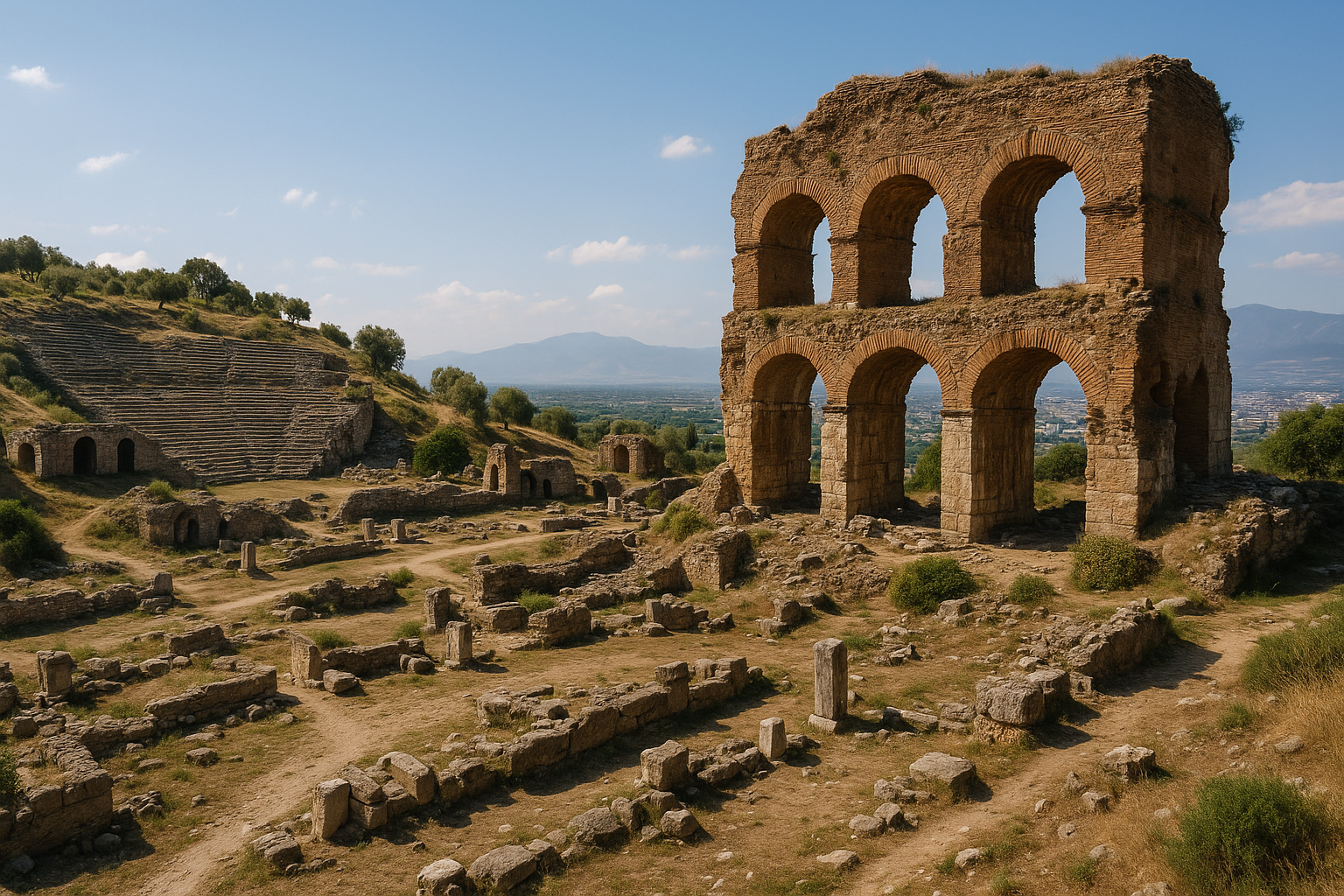
Expanded Overview: Nysa on the Maeander was a prosperous Greco-Roman city renowned across the ancient world as a centre of higher education and literary culture. Its ruins lie near Sultanhisar in Aydin Province, about 30 km east of Aydin and 3 km north-west of Sultanhisar town centre, on the south-facing slopes of the Messogis Mountains (modern Aydin Mountains). The city's most distinctive feature is its dramatic topography: a deep gorge carved by a mountain stream splits the site in two, and the Romans bridged this ravine with a massive vaulted tunnel-substructure that still stands. The great geographer Strabo studied here as a young man, and he praised Nysa's teachers of Homeric epic and rhetoric as among the finest in Asia Minor. Today, Nysa preserves one of Turkey's second-best-preserved ancient libraries (after the Celsus Library at Ephesus), a theatre famous for its Dionysus friezes, and a stadium that once held 30,000 spectators.
- Why Nysa Matters
- Geography and Setting
- Historical Timeline
- Major Monuments
- Cultural and Intellectual Life
- Coinage and Economy
- Archaeological Work
- Water Systems and Hydraulic Engineering
- Inscriptions and Epigraphy
- Population and Social Structure
- Trade Connections and Commercial Networks
- How to Read the Site
- Visitor Information
- Frequently Asked Questions
- Sources and Further Reading
Why Nysa Matters
- A renowned intellectual centre. Strabo (64/63 BC -- c. 24 AD), one of antiquity's greatest geographers, received his early education at Nysa. He described the city's schools as producing distinguished rhetoricians and philosophers, making Nysa effectively an ancient university town specialising in Homeric literature and epic interpretation.
Among his teachers was the rhetorician Aristodemus, a disciple of Panaetius and grandson of the Stoic philosopher Posidonius.
- Turkey's second-best-preserved ancient library. The library of Nysa, dating from the 2nd century AD, is considered the best-preserved ancient library structure in Anatolia after the Celsus Library at Ephesus.
Its multi-storey facade, reading niches, and an ingenious wall-cavity system designed to protect scrolls from moisture survive to a remarkable degree.
The recent discovery of a 1,800-year-old stone staircase linking the main street to the library entrance has further illuminated how central this institution was to the city's daily life.
- An extraordinary gorge-bridging city. Nysa was built on both sides of a dramatic natural ravine carved by the Tekkecik stream. The Romans constructed a 46-metre-long vaulted tunnel over the stream to unify the two halves of the city -- an engineering feat that remains one of the most impressive ancient infrastructure works in western Turkey.
This tunnel allowed the main east-west street to cross uninterrupted from one hillside to the other.
- A theatre with narrative sculpture. The theatre of Nysa is celebrated for its elaborate stage-building friezes depicting scenes from the life of Dionysus -- his birth, upbringing, and triumphal procession.
These are among the finest examples of narrative architectural sculpture surviving from the Roman East, comparable in ambition to the great sculptural programmes at Aphrodisias and Perge.
- A Dionysian city par excellence. The very name "Nysa" was associated in Greek mythology with the place where the god Dionysus was raised by nymphs.
This mythological connection permeated the city's monuments, coinage (which frequently depicted Dionysus and vine motifs), festivals, and cultural identity throughout its history.
Geography and Setting
Nysa occupies the southern slopes of Mount Messogis (Aydin Mountains), overlooking the broad alluvial plain of the Maeander River (Buyuk Menderes).
The city sits at an elevation of approximately 150--300 metres above sea level, on terrain that drops steeply into a gorge formed by the Tekkecik stream (identified in antiquity as a tributary of the Maeander).
The site lies on the ancient border between Caria and Lydia, along the main route connecting Tralles (modern Aydin) to the west with Antioch on the Maeander and interior Anatolia to the east.
This strategic position on a major east-west route contributed to Nysa's commercial and cultural importance. Ancient travellers moving between the Aegean coast and the Phrygian interior would have passed directly through or near the city.
The gorge that bisects the city runs roughly north-south, dividing the urban area into eastern and western halves. Strabo described Nysa as a "double city" because of this topographic feature, noting that the two sides were linked by bridges and a tunnel.
The ravine is steep-sided and densely vegetated, creating a surprisingly lush microenvironment within the archaeological zone.
The climate is Mediterranean with continental influences: summers are hot (35+ degrees C) and dry; winters are mild and wet. The gorge and the mountain slope create microclimatic conditions that keep the site slightly cooler than the valley floor in summer.
Spring wildflowers carpet the ruins between March and May, making it one of the most photogenic seasons to visit.
Sultanhisar, the modern town 3 km to the south-east, provides basic services including restaurants, small hotels, and fuel stations. Aydin city centre is 30 km to the west, and Denizli is approximately 120 km to the east.
The ancient healing sanctuary of Akharaka (Acharaca), associated with Pluto and Persephone, lies nearby and was administratively connected to Nysa.
Historical Timeline
Prehistoric and Early Settlement
The Nysa area shows evidence of habitation predating the Hellenistic foundation. The earlier settlement of Athymbra, on or near the same site, is mentioned by several ancient authors.
The fertile Maeander valley supported farming communities from at least the Bronze Age, and the defensible slopes of Mount Messogis attracted settlement long before the Seleucid refoundation.
Hellenistic Foundation (3rd century BC)
According to ancient sources including Strabo and Stephanos of Byzantium, Nysa was founded in the early 3rd century BC, probably by Antiochus I Soter (r. 281--261 BC) of the Seleucid dynasty, on the site of the earlier settlement of Athymbra.
The city was created through a synoikismos (forced union) of three pre-existing communities: Athymbra, Athymbrados, and Hydrela.
The name "Nysa" likely honoured a female member of the Seleucid royal family, though its mythological associations with Dionysus -- the god was said to have been raised at a place called Nysa -- were cultivated from the very start.
This dual resonance, dynastic and divine, gave the city a distinctive cultural identity.
Late Hellenistic Period (2nd--1st centuries BC)
Following the Treaty of Apamea in 188 BC, the region passed from Seleucid to Pergamene control. Nysa benefited from Pergamene patronage of the arts and learning.
When the Kingdom of Pergamon was bequeathed to Rome in 133 BC, Nysa became part of the Roman province of Asia.
During this transitional period, the city began to develop its reputation as an educational centre, attracting students from across Anatolia and beyond.
Roman Imperial Golden Age (1st--3rd centuries AD)
Under Roman rule, Nysa flourished as one of the wealthiest and most cultured cities in the Maeander valley.
Strabo, writing in the early 1st century AD, described the city's intellectual life in detail, noting that he had studied under the rhetorician Aristodemus during his youth.
The major monuments visible today -- the theatre, library, stadium, bouleuterion/gerontikon, baths, gymnasium, and the great tunnel -- date primarily from this era.
The city minted its own coins, many featuring images of Dionysus, grapevines, and the river god Maeander.
Nysa was granted various honorific titles by Roman emperors and participated in the pan-Hellenic festival circuit.
The Intellectual Legacy
Nysa's schools specialised in Homeric epic, rhetoric, and grammar -- the core curriculum of Hellenistic higher education.
Students came to study the works of Homer under distinguished grammarians and rhetoricians.
Besides Strabo, alumni and teachers associated with Nysa include Aristodemus (Strabo's teacher, who ran one of the most respected rhetorical schools in Asia Minor), Sostratus (a grammarian), and Menecrates (a student of Aristarchus of Samothrace).
The city's intellectual output contributed to the broader tradition of Alexandrian textual scholarship.
Late Roman and Byzantine Periods (4th--12th centuries AD)
Nysa became an episcopal see during the early Christian period, evidence of its continuing importance as a regional centre.
The city continued to function, though on a reduced scale, through the Byzantine era.
Several structures were adapted for Christian worship, and a bishop of Nysa is attested at several church councils.
The gorge, however, presented ongoing engineering challenges, and periodic flooding likely damaged lower-lying structures.
Seljuk, Beylik, and Ottoman Periods (12th--15th centuries)
The city gradually declined as regional power shifted to new centres.
The fertile Maeander plain attracted Turkish settlement, but the hilltop city itself became less viable.
Nysa was finally abandoned after being sacked by Tamerlane (Timur) in 1402 during his devastating campaign across Anatolia.
The nearby settlement that eventually became Sultanhisar grew in its place, and the ancient ruins were gradually buried under soil and vegetation.
Major Monuments
The Theatre
One of the best-preserved theatres in western Anatolia, the theatre of Nysa was built during the Roman Imperial period (primarily 2nd century AD) and could seat approximately 12,000 spectators.
It is carved into the northern slope of the hill on the western side of the gorge, taking advantage of the natural gradient.
The theatre is renowned for the elaborate relief friezes on the stage building (scaenae frons), which depict scenes from the mythology of Dionysus -- his birth from Zeus's thigh, his upbringing by the nymphs, his discovery of wine, and his triumphal procession through Asia accompanied by satyrs, maenads, and exotic animals.
These friezes are among the finest examples of narrative architectural sculpture surviving from the Roman East.
The cavea (seating area) is divided into two main sections by a diazoma (horizontal walkway), and the orchestra area is well preserved.
A vaulted passageway (vomitorium) provides access to the lower seating tiers.
The Library
Dating from the 2nd century AD, Nysa's library is considered Turkey's second-best-preserved ancient library after the Celsus Library at Ephesus.
The building features a main reading hall with wall niches designed to hold wooden bookcases (armaria), a multi-storey facade with decorative columns and pediments, and an internal arrangement that protected scrolls from humidity by creating air gaps between the inner and outer walls.
This sophisticated moisture-protection technique is also found at the Celsus Library and the Library of Pergamon.
During the 2002--2006 seasons, archaeologists from the University of Freiburg under Volker Michael Strocka excavated and documented the library in detail.
More recently, excavations uncovered an approximately 1,800-year-old stone staircase that once provided direct access from the city's main street to the library entrance, resolving the long-standing question of how visitors negotiated the roughly 2-metre height difference between the street and the library threshold.
The Gerontikon (Council of Elders)
Strabo specifically mentioned the gerontikon at Nysa -- the council house where the city elders deliberated.
Originally built in the Hellenistic period, this structure was adapted in the 2nd century AD as an odeon (small covered theatre for musical and rhetorical performances).
It had 12 rows of seats and could accommodate 600--700 people.
The building's dual identity -- political chamber and performance venue -- reflects the close connection between civic governance and cultural life in Nysa.
Though Strabo counted it among the buildings on the eastern side of the city, the current structure visible on the western side dates from its Roman reconstruction.
The Vaulted Tunnel (Stream Substructure)
Perhaps Nysa's most impressive engineering achievement: a massive vaulted tunnel approximately 46 metres long and 10 metres high was constructed over the gorge stream to create a flat surface connecting the two halves of the city.
This structure also served as a bridge carrying the city's main east-west street.
The barrel-vaulted construction, built of finely cut stone blocks with precise mortar joints, has survived nearly two millennia and remains one of the most remarkable pieces of Roman civic engineering in Turkey.
The tunnel channelled the stream safely beneath the roadway while providing a broad, level crossing that carts and pedestrians could use with ease.
The Stadium
Nysa's stadium, located in the eastern part of the site, had a reported capacity of up to 30,000 spectators, making it one of the largest in the region.
Though partially damaged by the same stream floods that cut through the gorge, the stadium's outline, starting gates (carceres), and terraced seating banks are still discernible.
It was used for athletic competitions, festivals associated with the cult of Dionysus, and public gatherings.
The stadium's long axis follows the natural contour of the slope, with one open end offering views over the Maeander plain.
The Gymnasium and Baths
A large gymnasium complex served the educational and athletic needs of the city -- fitting for a place devoted to learning.
Young men underwent both physical and intellectual training here, in keeping with the Greek paideia tradition.
Adjacent Roman-era baths with hypocaust heating systems have been partially excavated, revealing the typical sequence of frigidarium (cold room), tepidarium (warm room), and caldarium (hot room).
Marble revetment fragments suggest that the baths were lavishly decorated.
The Agora
The city's commercial and civic centre, the agora was surrounded by colonnaded stoas and contained shops, workshops, and administrative offices.
Its location along the main east-west street placed it at the heart of daily urban life.
Archaeological investigation has revealed column bases, paving stones, and drainage channels.
The Amphitheatre
Strabo mentioned an "amphitheatre" at Nysa equipped with a hidden underground passage -- an unusual feature for cities in this region and more commonly associated with major gladiatorial centres in Italy.
While the precise identification of this structure remains debated among scholars, it appears to have been used for gladiatorial contests and animal hunts (venationes) during the Roman period.
If confirmed, it would be one of the easternmost amphitheatres of the Roman world.
The Akharaka Sanctuary
Located in the vicinity of Nysa, the healing sanctuary of Akharaka (ancient Acharaca) was dedicated to Pluto (Hades) and Persephone (Kore).
Strabo described it as a place where the sick came to receive healing through incubation -- sleeping in the sacred precinct to receive divine revelations in dreams.
The sanctuary included a cave entrance believed to lead to the underworld (a Plutonion or Charonion), from which noxious gases emerged.
The site's connection to chthonic deities and healing rituals adds a unique dimension to Nysa's cultural landscape.
Cultural and Intellectual Life
Nysa was not merely a regional town with a good school; it was one of the genuine intellectual centres of the Greco-Roman East.
The city's educational reputation rested on the grammatical and rhetorical tradition -- the systematic study of Homeric epic, literary criticism, composition, and public speaking.
This was the core of upper-class Greek education (paideia), and Nysa's schools attracted students from across Anatolia and beyond.
The presence of figures like Aristodemus, who combined philosophical training with rhetorical expertise, gave the city's schools a distinctive character.
Unlike purely philosophical academies, Nysa's institutions emphasised practical skills: oratory, textual analysis, and civic argumentation.
Graduates of Nysa's schools went on to serve as orators, administrators, and educators throughout the Roman East.
The city's cultural life was enriched by its association with Dionysus. The god of wine, theatre, and ecstatic experience was not merely a mythological figure in Nysa -- he was the city's patron and defining symbol.
The Dionysian connection manifested in:
- The theatrical friezes depicting the god's life story
- Coin types featuring Dionysus, vine tendrils, and related imagery
- Festival celebrations associated with the theatre and stadium
- The very name of the city itself
This combination of intellectual rigour and religious-cultural vitality made Nysa a distinctive city in the ancient landscape.
Coinage and Economy
Nysa minted its own bronze coins during the Roman Imperial period. The coin types provide valuable evidence about the city's self-image and cultural priorities.
Common reverse types include:
- Dionysus standing or seated, often with a thyrsus and kantharos
- Vine and grape motifs, reflecting the region's viticulture
- The river god Maeander, depicted as a reclining male figure
- Pluto and Kore (Persephone), reflecting the cult at Akharaka
- Athena and other Olympian deities
The obverse typically displayed the bust of the reigning Roman emperor, connecting local identity with imperial authority.
The Maeander valley was agriculturally rich, producing wine, olives, grain, and figs. Nysa's position on the east-west trade route allowed it to benefit from both local production and through-traffic commerce.
The city's educational institutions also generated economic activity, as students from distant cities brought spending power and cultural exchange.
Archaeological Work
1760s -- Richard Chandler. The English antiquarian Richard Chandler was among the first Europeans to identify and describe the ruins of Nysa during his travels through Asia Minor, published in his Travels in Asia Minor (1775).
1830s -- William John Hamilton. The Scottish geologist and traveller William John Hamilton refined earlier identifications and provided more detailed descriptions of the visible remains during his extensive Anatolian surveys.
1907--1909 -- Early German investigations. German scholars conducted initial surveys and limited excavations, producing early plans of the theatre and other visible monuments.
1990--2010 -- Ankara University excavations. Systematic large-scale excavations were initiated by Prof. Vedat Idil of Ankara University, who uncovered and documented the theatre, library, gerontikon, tunnel, and gymnasium complex.
These campaigns established the modern understanding of Nysa's urban layout and confirmed its identification as the city described by Strabo.
2002--2006 -- University of Freiburg library excavation. A specialist team under Volker Michael Strocka from the University of Freiburg focused on the library building, producing detailed architectural documentation and analysis of the scroll-protection wall systems.
2012--2016 -- Aydin Museum. The Aydin Museum continued excavation work during this period, maintaining the site and exploring previously unexcavated sectors.
2017--present -- Serdar Hakan Oztaner. Associate Professor Serdar Hakan Oztaner of Ankara University's Faculty of Language, History and Geography has directed continuing excavation and restoration work.
The project has been supported by the national "Heritage for the Future" initiative.
Recent highlights include the discovery of the stone staircase connecting the main street to the library, further conservation of the theatre's Dionysus friezes, extensive excavation along the western main street running from the central bridge toward Akharaka, and investigation of the city's water management systems.
Current research focus. Teams are working on the comprehensive conservation of the library facade, study of Nysa's role in Roman provincial education networks, environmental archaeology to understand the relationship between the stream gorge and urban development, and the mapping of the full extent of the stadium and amphitheatre areas.
Water Systems and Hydraulic Engineering
Nysa's hydraulic infrastructure was remarkably sophisticated for a city built on such challenging terrain. The gorge that split the city was both a problem and an opportunity -- while it necessitated the famous tunnel, it also provided a natural water channel that the Romans exploited for urban water management.
The Tekkecik Stream Management System. The stream running through the gorge was not merely bridged but actively managed. Archaeological surveys have identified a series of stone-lined channels and settling basins upstream of the tunnel, designed to reduce sedimentation within the vaulted passage. Without these pre-filtration measures, the tunnel would have silted up within decades. The total system extends approximately 200 metres upstream from the tunnel entrance.
Terracotta Pipeline Network. Excavations along the western main street revealed a terracotta pipe system running beneath the paved road surface, distributing water from mountain springs to public fountains, the baths, and the gymnasium. Individual pipe sections are approximately 50--55 cm long with socket-and-spigot joints sealed with lime mortar. The pipes maintain a consistent internal diameter of approximately 15 cm, indicating careful standardisation of manufacture. Over 120 metres of intact pipeline have been documented along the main street corridor.
The Nymphaeum. A monumental fountain house stood at the intersection of the main east-west street and the road leading south toward the Maeander plain. Fragments of its marble revetment, including carved acanthus-leaf brackets and lion-head water spouts, were recovered during excavations in the early 2000s. The nymphaeum served both practical and symbolic purposes -- providing potable water to travellers arriving from the valley while announcing the city's prosperity and cultural refinement. Based on architectural fragments, the structure was approximately 8 metres wide with a two-storey columnar facade.
Cisterns on the Upper Terraces. The residential areas on the higher slopes, above the reach of the gravity-fed pipe system, relied on rock-cut cisterns carved into the bedrock. At least six cisterns have been identified on the eastern hill, with capacities ranging from approximately 8 to 25 cubic metres. Their interiors were coated with hydraulic cement (opus signinum) -- a waterproof plaster made from crushed terracotta mixed with lime -- to prevent seepage through the porous limestone bedrock.
Flood Management Engineering. The gorge was prone to flash flooding during winter storms, and the tunnel had to accommodate sudden surges in water volume. The tunnel's 10-metre height was not merely structural ambition but practical necessity: it provided sufficient capacity for extreme flood events while keeping the road surface safely above water level. Erosion marks visible on the tunnel's interior walls indicate that water levels occasionally rose 3--4 metres above the normal stream bed during exceptional storms.
The Bath Water Supply. The Roman baths required enormous quantities of water -- estimated at several hundred cubic metres per day for a facility of this size. A dedicated supply line from a spring on the upper slopes of Mount Messogis, separate from the general domestic water system, fed the bath complex through lead and terracotta pipes. Sections of this supply line have been traced uphill for approximately 400 metres above the bath site.
Inscriptions and Epigraphy
The epigraphic corpus from Nysa provides unique insights into the city's institutional life, cultural values, and social structure. Over 200 inscriptions have been recorded from the site and its immediate surroundings.
The Gymnasium Dedication. A dedicatory inscription found near the gymnasium complex records the donation of funds for the construction of a wrestling ground (palaestra) by a wealthy citizen named Demetrios son of Apollonios during the reign of Hadrian (117--138 AD). The inscription specifies that the donation included not only the building cost but also an endowment for annual maintenance and the provision of olive oil for athletes -- a common form of civic benefaction in the Greek East known as an aleiphis endowment.
Ephebic Lists. Fragmentary lists of ephebes (young men undergoing civic and military training) inscribed on marble stelae have been found near the gymnasium. These lists, dating from the 1st--2nd centuries AD, record the names of graduates along with their fathers' names and demes (civic subdivisions), providing evidence that Nysa maintained the traditional Greek system of youth education well into the Roman Imperial period. The presence of both Greek and Romanised names in these lists illustrates the city's bicultural character under Rome.
Honorific Decrees for Teachers. Several inscriptions honour the city's grammatikoi (teachers of literature) and rhetores (teachers of rhetoric) with public praise, reserved seating in the theatre (prohedria), and exemption from municipal liturgies (compulsory public service). One fragmentary inscription preserves a decree honouring a teacher for "training the youth in the words of Homer and instilling virtue through the study of the ancients" -- a vivid encapsulation of Nysa's educational values and self-image.
The Neokoros Question. An inscription from the Imperial period records Nysa's claim to the title neokoros (temple warden) -- a prestigious designation indicating that the city hosted a provincial temple dedicated to the emperor. While the rank of neokoros was more commonly associated with larger cities like Ephesus, Smyrna, and Pergamon, several smaller cities in the province of Asia sought this honour as a mark of distinction. The evidence at Nysa suggests that the city competed for imperial patronage through active participation in the imperial cult.
Funerary Epigrams. The necropolis areas have yielded numerous funerary epigrams in verse -- short poems commemorating the dead. Several of these display literary polish that reflects the city's reputation for grammatical and rhetorical excellence. One epitaph, composed in elegiac couplets, laments a young student who died before completing his education, asking that "the Muses weep for one who loved their song." Another commemorates a retired teacher who "illuminated the dark paths of Homer for generations of the young."
Theatre Building Inscriptions. Inscriptions on the theatre's seating blocks record the names of the civic and religious groups who funded particular sections of the construction, including the gerousia (council of elders), the neoi (young men's association), and individual benefactors. These "seat ownership" inscriptions mirror similar practices documented at theatres across the Roman East.
The Strabo Connection in Epigraphy. While no inscription directly naming Strabo has been found at Nysa, an inscription honouring the family of Aristodemus -- Strabo's teacher -- was identified among the site's epigraphic corpus. This inscription confirms the historical existence of the teacher mentioned in Strabo's Geographica and establishes the prominence of his family within Nysa's civic elite.
Population and Social Structure
Population Estimates. Based on the theatre capacity (12,000), stadium capacity (30,000 for periodic regional festivals drawing visitors), residential area surveys, and comparison with similar-sized cities in the Roman province of Asia, scholars estimate Nysa's peak population at approximately 15,000--20,000 inhabitants during the 2nd century AD. An additional rural population of perhaps 5,000--10,000 inhabited the city's chora (agricultural territory) in the surrounding countryside, cultivating the fertile Maeander valley slopes.
Civic Organisation. Like most Greek cities under Rome, Nysa was governed by a boule (council) and demos (citizen assembly), with executive magistrates including strategoi (generals, serving as chief executives), grammateus (secretary), and stephanephoros (crown-bearer, the chief religious official who gave his name to the year). The gerousia (council of elders) had particular prestige at Nysa, as evidenced by the gerontikon building and the frequency of gerousia inscriptions.
Social Stratification. The epigraphic and archaeological evidence reveals a three-tier social structure:
- A wealthy elite class of landowners, many holding Roman citizenship, who funded public buildings, festivals, and educational institutions through euergetism (benefaction)
- A substantial middle class of traders, artisans, and professionals who benefited from the city's position on the east-west trade route
- A lower class including freedmen, slaves, and seasonal agricultural workers, whose presence is attested primarily through simple burials in the necropolis and through manumission inscriptions
Women in Public Life. Several inscriptions attest to women holding public religious offices at Nysa, including priestesses of Demeter, Artemis, and the Imperial cult. One inscription honours a woman named Tatia who served as stephanephoros -- an unusually prominent civic role for a woman in the Greek East, suggesting that Nysa's elite women had greater public visibility than in many contemporary cities. The phenomenon of female stephanephoroi is attested at only a handful of cities in Asia Minor.
The Jewish Community. A fragmentary inscription mentioning a synagoge (assembly) has been tentatively identified among the city's epigraphic corpus. If confirmed, this would add Nysa to the growing list of Maeander valley cities -- including Sardis, Hierapolis, Laodicea, and Miletus -- with attested Jewish communities during the Roman period. The Maeander corridor was a major route for Jewish settlement in Asia Minor following the Seleucid-era transplantation policies.
Trade Connections and Commercial Networks
Nysa's position on the main east-west route through the Maeander valley placed it at the intersection of several major trade networks that connected the Aegean coast with the Anatolian interior.
Wine Production and Export. The Maeander valley was one of the most productive wine-growing regions in Roman Asia. Nysa's territory produced substantial quantities of wine, reflected in the Dionysian imagery on the city's coins and the prominence of the wine god's cult. Amphora stamps found in the agora area indicate trade connections with consumers across the eastern Mediterranean. The Maeander wines were mentioned by ancient authors including Pliny the Elder, who noted the region's reputation for productive vineyards.
Olive Oil Trade. Alongside wine, olive oil was a primary agricultural export. Stone olive press beds have been identified in the city's hinterland, and residues of olive processing have been found in commercial areas near the agora. The oil produced in the Maeander valley was used for cooking, lighting, bathing, and religious rituals, and was exported both locally and regionally.
Textile Production. Literary and epigraphic evidence suggests that Nysa participated in the Maeander valley's renowned textile industry. The wider region -- particularly the cities of Laodicea, Colossae, and Hierapolis further up the valley -- was famous for production of fine woollen fabrics dyed with local colorants. Loom weights, spindle whorls, and dye vats found in residential areas confirm domestic-scale textile production at Nysa, likely supplementing the larger industrial operations at neighbouring cities.
The Fig Trade. The Maeander valley, particularly the area around Nysa and its neighbours, was famous in antiquity for high-quality dried figs. The Roman agricultural writer Columella (1st century AD) mentions figs from the Carian region (adjacent to Nysa's territory) among the finest available. Dried figs were a high-value, easily transportable commodity that could survive long-distance shipping, and they likely constituted a significant export product for the city's agricultural hinterland.
Transit Commerce and Hospitality. Perhaps more important than any single export was Nysa's role as a transit point on the route connecting the Aegean ports (Ephesus, Miletus, Priene) with the interior cities of Phrygia (Laodicea, Hierapolis, Colossae, Apamea). Merchants, diplomats, students, and pilgrims passing through the city required accommodation, food, animal fodder, and vehicle repairs -- all generating revenue. The city's educational institutions added a special dimension to this transit economy, as students arriving from distant cities brought tuition payments, spending power, and cultural exchange.
Connection to Akharaka's Pilgrimage Economy. The healing sanctuary at Akharaka attracted pilgrims from across the region seeking cures through incubation. These visitors would typically pass through Nysa, contributing to the local economy through purchases of food, accommodation, and votive offerings. The pilgrimage trade created a secondary economic circuit that complemented the educational and agricultural economies.
How to Read the Site
Nysa rewards visitors who approach it as a layered landscape rather than a collection of isolated monuments.
1. Start with the gorge.
Before examining individual buildings, look at the ravine that splits the city. This single natural feature explains almost everything about Nysa's urban planning, engineering challenges, and the tunnel that made the city function as a unified whole.
2. Follow the main street.
The east-west axis, crossing the tunnel, connected the major public buildings and gave the city its spatial logic. Walking this route reveals how theatre, library, agora, and baths were arranged in sequence.
3. Consider the educational function.
Unlike most ancient cities where military or commercial logic dominates, Nysa was organised around learning. The library, gerontikon, theatre, and gymnasium formed an interconnected educational precinct.
4. Notice the Dionysian theme.
From the theatre friezes to the coin types to the very name of the city, the cult of Dionysus provided a unifying cultural thread. This was not incidental decoration -- it was civic identity.
5. Look for infrastructure.
Water channels, retaining walls, drainage systems, and the tunnel itself reveal the unglamorous but essential engineering that made the city liveable on its steep, gorge-divided terrain.
Visitor Information
Getting there. Nysa is located 3 km north-west of Sultanhisar town centre, which sits directly on the Aydin--Denizli highway (D-320). From Aydin, Sultanhisar is about 30 km east (30 minutes by car).
Dolmus (minibus) services run regularly between Aydin and Sultanhisar.
From the town, the archaeological site is reached via a signposted road heading uphill to the north.
The nearest airports are Aydin-Cildir (limited service) and Izmir Adnan Menderes (160 km). For those driving from Izmir, the journey takes approximately 2 hours via the O-31 motorway and D-320.
Opening hours. The site is generally open daily. Summer hours are typically 08:30--19:00 (April--October); winter hours are 08:30--17:30 (November--March).
Verify current hours with the Aydin Museum or the Turkish Ministry of Culture and Tourism website before visiting.
Admission. An entrance fee applies; the Museum Pass (Muzekart) is accepted. Ticket prices are updated annually by the Ministry.
Duration. A thorough visit requires 1.5 to 2.5 hours. The terrain involves uphill walking and some uneven surfaces.
Those with a particular interest in the library, theatre friezes, or tunnel engineering may wish to allow more time.
What to bring. Sturdy footwear is essential for the sloped and rocky terrain. Sun protection (hat, sunscreen) and water are necessary in summer, especially as shade is limited in the open areas.
The gorge area can be slippery after rain. A small flashlight is useful for examining the tunnel interior.
Recommended route. Most visitors begin at the theatre (the most prominent structure), then walk eastward to the tunnel, library, and gerontikon. The stadium is further east and requires additional walking. The agora and baths lie along the main street corridor.
Accessibility. The theatre and tunnel are reached via moderate uphill paths. The library and gerontikon require further walking on uneven ground.
The site is not fully wheelchair-accessible, though the lower portions near the main street are easier to navigate.
Nearby sites. Nysa can be combined with visits to Aphrodisias (90 km east, one of Turkey's most spectacular archaeological sites), Miletus (100 km south-west), Priene (80 km south-west), Tralles (modern Aydin, 30 km west), or Ephesus (50 km west via Aydin) for a multi-day Maeander Valley itinerary.
The nearby Akharaka healing sanctuary is also worth a visit.
Accommodation. Sultanhisar has limited accommodation options. Most visitors base themselves in Aydin (wider hotel selection) or in the popular tourist centres of Kusadasi or Denizli/Pamukkale and visit Nysa as a day trip.
Best seasons. March--May (spring wildflowers, moderate temperatures) and September--November (pleasant weather, fewer visitors).
The gorge vegetation is most lush in spring.
July and August can be uncomfortably hot, with temperatures above 40 degrees C on the exposed hillside.
Frequently Asked Questions
What was Nysa famous for in antiquity?
Nysa was most famous as a centre of higher education, specialising in rhetoric, philosophy, grammar, and Homeric literary studies. The geographer Strabo, who studied there as a young man, praised it as one of the finest schools in Asia Minor.
The city was also celebrated for its connection to the mythology of Dionysus -- the god's mythical birthplace was said to have been a location called "Nysa."
Who was Strabo and what is his connection to Nysa?
Strabo (64/63 BC -- c. 24 AD) was one of the most important geographers and historians of the ancient world. Born in Amasya (ancient Amaseia, in Pontus), he studied rhetoric at Nysa under the teacher Aristodemus before continuing his education in Rome and Alexandria.
His monumental work Geographica (17 volumes) contains a detailed description of Nysa in Book 14.1.43--48 that remains our primary literary source for the city's layout, institutions, and cultural achievements.
How does Nysa's library compare to the Celsus Library at Ephesus?
While the Celsus Library at Ephesus is more famous and has been more extensively restored (its iconic facade was reconstructed in the 1970s), Nysa's library is considered the second-best-preserved ancient library structure in Turkey.
Its wall niches, reading spaces, scroll-protection air cavities, and multi-storey facade survive in largely original condition.
For scholars of ancient library architecture, Nysa is arguably more informative than Ephesus because less restoration means more original fabric is visible.
What is the tunnel/vaulted substructure?
The Romans built a massive barrel-vaulted tunnel (approximately 46 m long, 10 m high) over the stream that runs through the gorge dividing the city.
This engineering achievement created a flat surface for the main street to cross from one half of the city to the other, effectively bridging the ravine while channelling the stream safely below.
What is the Akharaka sanctuary?
Akharaka (Acharaca) was a healing sanctuary near Nysa dedicated to Pluto and Persephone.
The sick came to sleep in the sacred precinct (a practice called incubation) and receive healing through divine dreams.
Strabo described a cave there from which noxious gases emerged, associated with the entrance to the underworld.
Can I visit Nysa and Aphrodisias in the same day?
Yes, though it requires early departure and efficient timing. Nysa is about 90 km west of Aphrodisias (roughly 1.5 hours by car).
A combined visit is feasible but demanding; allowing a full morning at one site and an afternoon at the other works best.
Both sites are exceptional and deserve unhurried exploration.
Is there a museum at the site?
There is no dedicated museum at Nysa itself. Finds from the excavations are housed primarily in the Aydin Archaeological Museum (30 km west in Aydin city centre) and at Ankara University research facilities.
The Aydin Museum is well worth a visit for its collection of Nysa sculpture and inscriptions.
How does the "Heritage for the Future" project affect visitors?
The national "Heritage for the Future" (Gelecege Miras) initiative has provided additional funding for excavation and conservation at Nysa, particularly along the main street corridor.
Visitors may encounter active excavation areas during the digging season (typically June--October), which can be an exciting opportunity to see archaeologists at work.
Why is Nysa less well known than Ephesus or Aphrodisias?
Nysa lacks the monumental scale of Ephesus and the sculptural fame of Aphrodisias, but it offers something neither of those sites can match: the tangible atmosphere of an ancient educational centre.
Its library, theatre, and gerontikon form a coherent precinct dedicated to learning and cultural performance.
Visitors who appreciate intellectual history and quieter archaeological experiences will find Nysa deeply rewarding.
Sources and Further Reading
- Strabo, Geographica, Book 14.1.43--48 (the primary ancient source on Nysa).
- Idil, V. Nysa ve Akharaka. Ankara, 1999.
- Strocka, V.M. "The Library of Nysa on the Maeander." In Ancient Libraries, ed. J. Koenig, 2013.
- Humann, C., Kohte, J. and Watzinger, C. Magnesia am Maeander (relevant comparative material for Maeander valley cities).
- Kadıoglu, M. "Nysa ad Maeandrum: Recent Research Results." In Anadolu/Anatolia 42, 2016.
- Wikipedia -- "Nysa on the Maeander": https://en.wikipedia.org/wiki/Nysa_on_the_Maeander
- Turkish Archaeological News -- "Nysa on the Maeander": https://turkisharchaeonews.net/site/nysa-maeander
- Turkish Museums -- Nysa Archaeological Site: https://www.turkishmuseums.com/museum/detail/1987-aydin-nysa-archeological-site/1987/4
- Nysa Excavation Project (Ankara University): https://nysa.ankara.edu.tr/
- Ancient Theatre Archive -- Nysa: https://ancienttheatrearchive.com/theatre/nysa-modern-sultanhisar-turkey/
- Turkiye Today -- "Ancient staircase linking Nysa main street to library": https://www.turkiyetoday.com/culture/ancient-staircase-linking-nysa-main-street-to-library-unearthed-in-western-turkiye-3211717
- Akdoruk -- Nysa Ancient City Excavation Sponsor: https://www.akdoruk.com.tr/en/news.asp?akd=48
- Visit Aydin -- Nysa Ancient City: https://visitaydin.com/en/nysa-ancient-city/
- Slow Travel Guide -- Nysa: https://slowtravelguide.net/nysa-en/