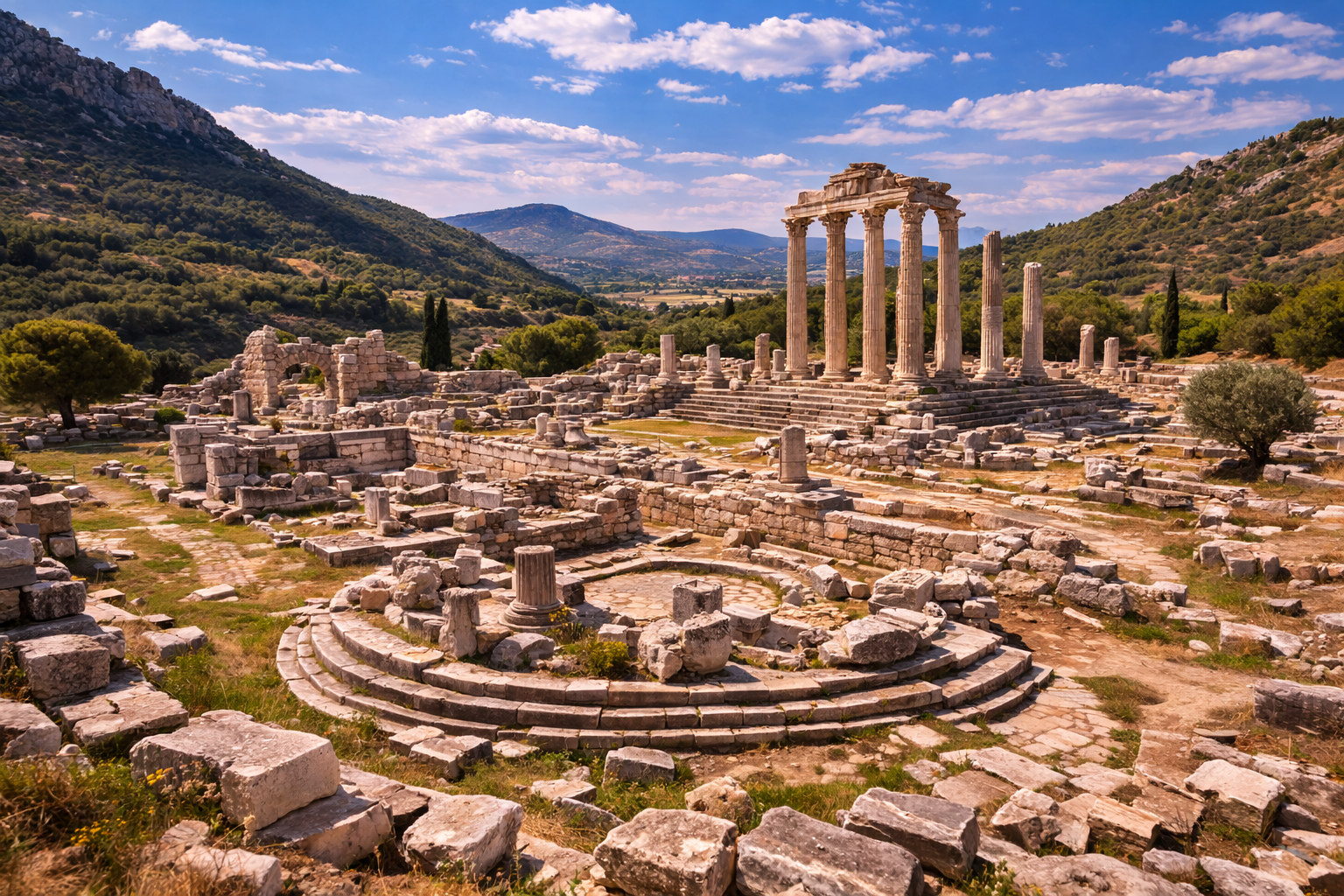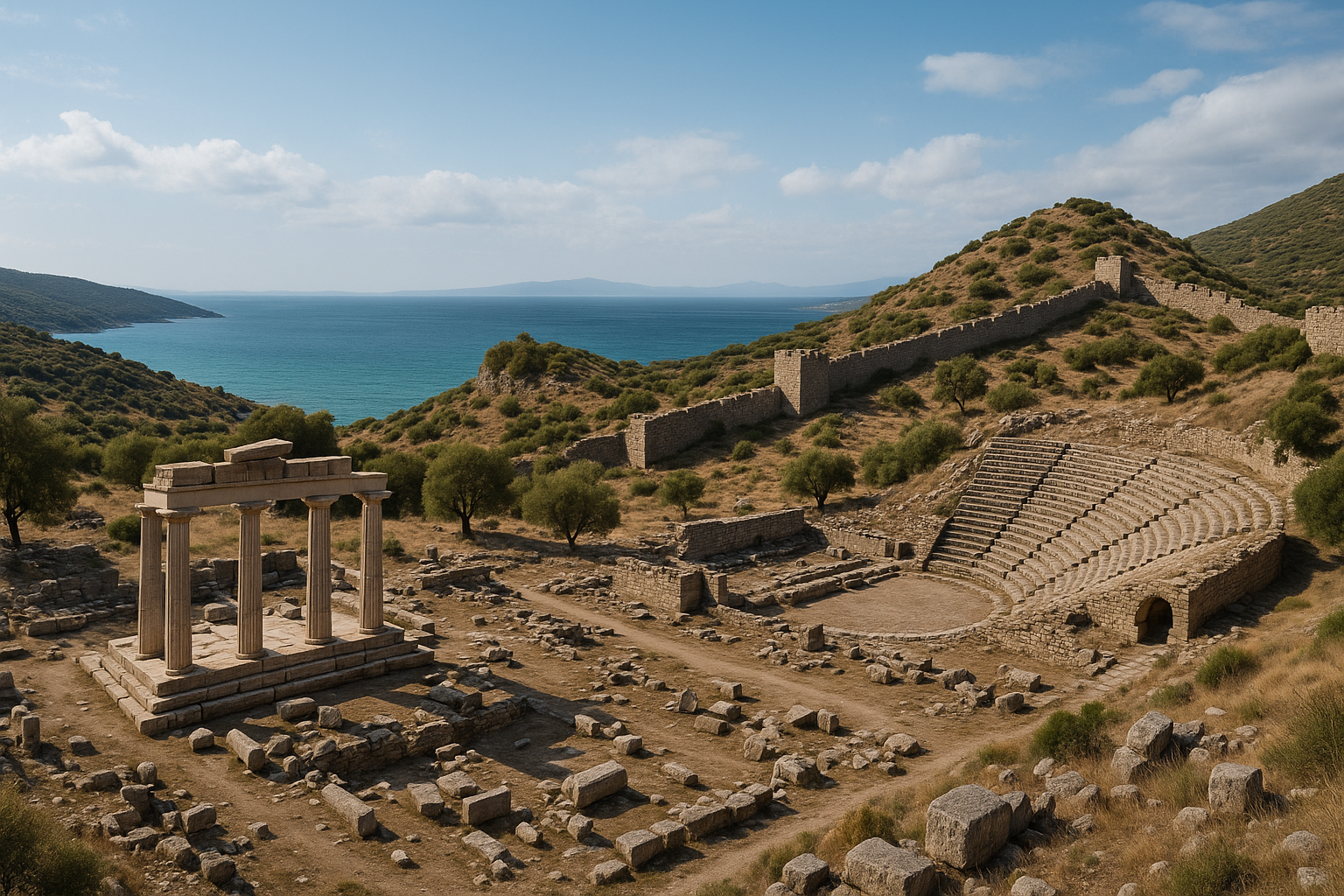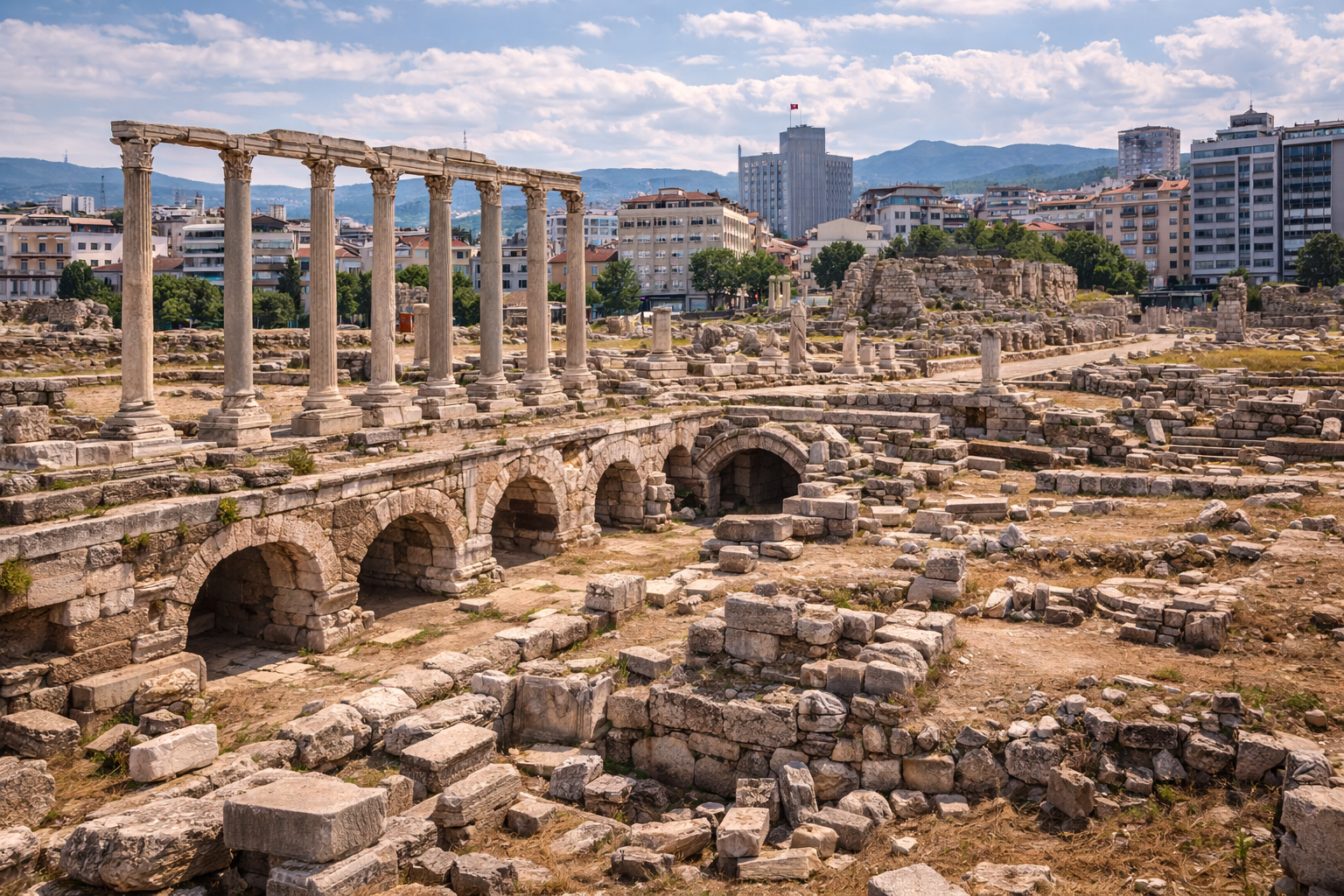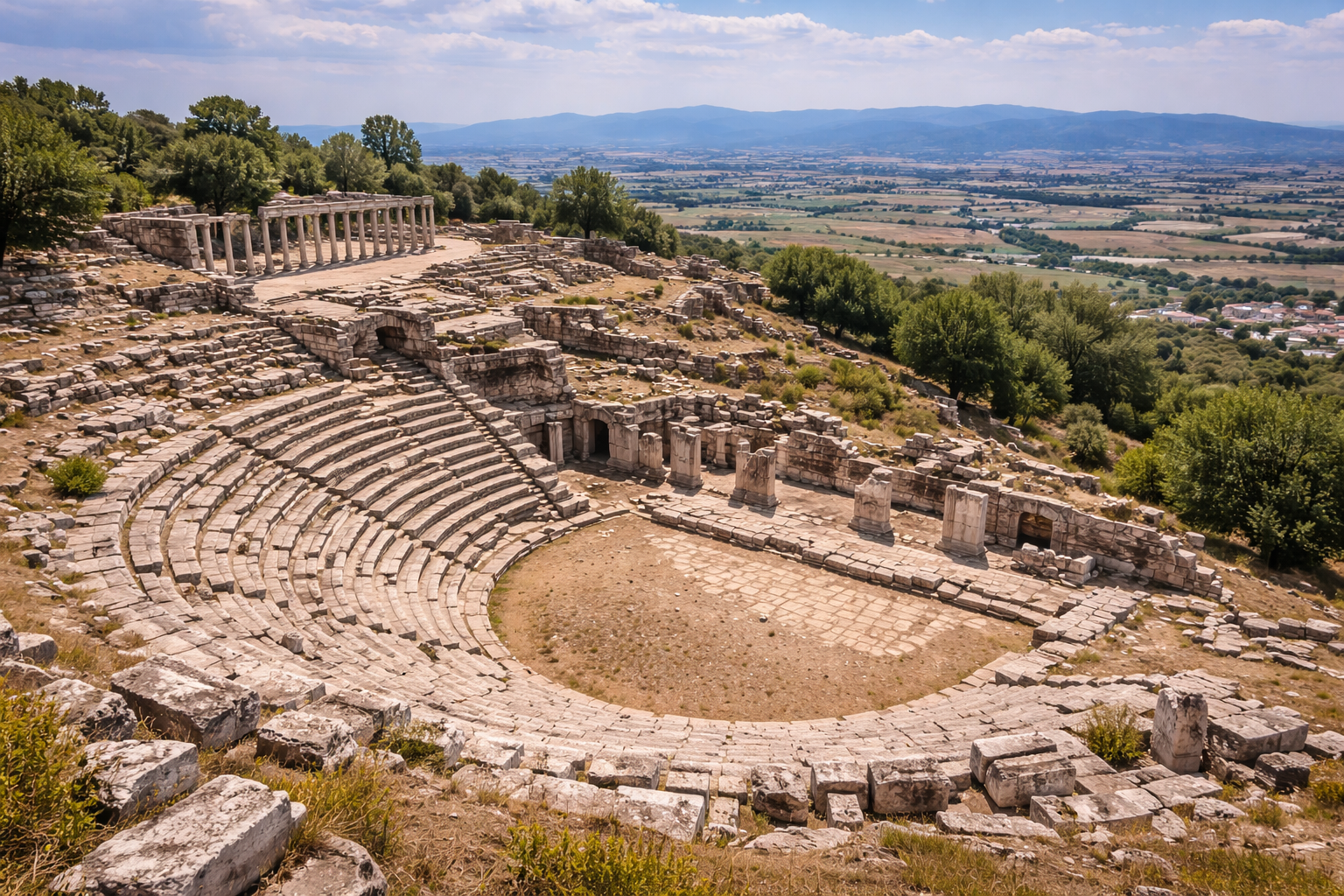
Metropolis, whose name literally means "City of the Mother Goddess" (from Greek meter = mother, polis = city), is an ancient Ionian settlement perched on a 140-metre-high hill between the villages of Yenikoy and Ozbey in the Torbali district of Izmir, roughly 40-45 km southeast of Izmir and about 30 km northeast of Ephesus. Overlooking the fertile Kaystros (Kucuk Menderes) River plain, the city commanded the strategic trade routes connecting the Aegean coast with the interior valleys of western Anatolia. Continuously inhabited from the Neolithic period through the Byzantine era, Metropolis is one of the most comprehensively excavated inland Ionian cities in Turkey. Remarkable recent finds include a Hellenistic marble sculpture head, nearly 2,000 bronze statue fragments from a Late Antique "junkyard," and the progressive unearthing of an 1,800-year-old Roman agora -- offering visitors an unbroken narrative of urban life spanning more than four millennia.
- Why Metropolis Matters
- Geography and Setting
- Historical Timeline
- Major Monuments and Structures
- The Mother Goddess Cult and Religious Life
- Coinage and Numismatic Evidence
- Daily Life and Material Culture
- Archaeological Work
- Visitor Information
- Frequently Asked Questions
- Sources and Further Reading
Why Metropolis Matters
-
Name and Cult Origin: The name Metropolis derives from the cult of Meter Gallesia (the Mother Goddess) worshipped on nearby Mount Gallesion (modern Alaman Dagi). A rock-cut cult cave at Uyuzdere has yielded hundreds of terracotta figurines and votive offerings dedicated to the Mother Goddess, making the site one of the best-documented Anatolian goddess sanctuaries outside of Pessinus and Ephesus. The cult linked the city to a deep Anatolian religious tradition stretching back thousands of years before Greek colonisation.
-
Strategic Position on the Izmir-Ephesus Corridor: Positioned midway between Izmir (ancient Smyrna) and Ephesus, Metropolis controlled the overland trade route through the Kucuk Menderes valley. This gave the city commercial importance far exceeding its modest size, linking the Aegean maritime economy with the agricultural hinterland and providing a waystation for travellers and merchants moving between two of Ionia's greatest cities.
-
Hellenistic Urban Planning Intact: Unlike many Aegean sites where Roman rebuilding dominates, Metropolis preserves an exceptionally well-planned Hellenistic terraced city from the 3rd-2nd centuries BC, including a theatre, bouleuterion, and stoa that still reflect their original Hellenistic design principles. The terraced layout, following the natural contours of the hill, is a textbook example of Hellenistic urban design.
-
Roman Daily-Life Architecture: The excavation of the Peristyle House, workshops, shops, a public toilet, and bath-palaestra complexes provides a rare, detailed window into the everyday domestic and commercial life of a provincial Roman city in the 2nd-3rd centuries AD -- the kind of ordinary urban experience that mega-sites like Ephesus, with their monumental focus, often obscure.
-
Uninterrupted Excavation Since 1989: Continuous archaeological work for over three decades, supported by the Sabanci Foundation and the Turkish Ministry of Culture and Tourism, has produced a remarkably complete picture of urban evolution from prehistoric settlement through Late Antiquity.
-
2025 Breakthrough Finds: In 2025, archaeologists unearthed nearly 2,000 bronze statue fragments in an area interpreted as an ancient recycling depot or "junkyard," along with a Hellenistic-period marble sculpture head. These discoveries are reshaping understanding of cultural and religious transformations in the region during Late Antiquity and the transition from paganism to Christianity.
Geography and Setting
Metropolis occupies a north-south oriented hillside that slopes gently toward the Torbali plain. The acropolis sits at approximately 140 metres above sea level, providing panoramic views over the Kucuk Menderes (Kaystros) River plain to the south and west. The surrounding landscape is characterized by fertile alluvial soils ideal for agriculture, particularly olive cultivation and viticulture, which sustained the city's economy throughout antiquity. Even today, the Torbali district is one of Izmir's most productive agricultural zones.
The site benefits from a Mediterranean microclimate with hot, dry summers (regularly exceeding 35 degrees C) and mild, rainy winters. The hill's orientation creates natural terraces that the Hellenistic city planners exploited to create a series of stepped public and residential zones, each connected by paved streets and stairways. This terracing system is one of the best-preserved examples of Hellenistic urban topographic adaptation in western Turkey.
To the northeast, Mount Gallesion (modern Alaman Dagi) rises steeply, and on its slopes the sacred cave sanctuary at Uyuzdere served as the religious heart of the Mother Goddess cult for centuries. The cave, cut into the mountainside, contained votive deposits spanning from the Archaic through the Hellenistic period, documenting the evolution of Anatolian goddess worship over more than half a millennium.
The nearby prehistoric mound of Bademgedigi Tepe preserves Neolithic and Bronze Age layers, suggesting that the wider Torbali basin has been a focal point for human settlement since at least the 6th millennium BC. In Hittite sources, the area may correspond to the place known as Puranda, a fortified settlement mentioned in royal correspondence -- though this identification remains debated among scholars.
The position of Metropolis on the road between Smyrna and Ephesus was crucial. Ancient travellers heading from Izmir to Ephesus overland would have passed directly through or near the city, making it a natural stopping point. This "corridor city" role shaped its economy and cultural connections throughout antiquity.
Historical Timeline
Prehistoric Period (6000-1000 BC)
The earliest traces of human activity in the Metropolis area come from Bademgedigi Tepe, where Neolithic and Early Bronze Age pottery, tools, obsidian blades, and structural remains have been found. Ceramic fragments from the Early and Middle Bronze Ages have also been recovered from the acropolis hill itself, proving that the hilltop attracted settlers long before the arrival of Greek colonists. The region lay within the sphere of influence of major Bronze Age powers, and Hittite-era references to Puranda may indicate that an organised settlement existed in the area during the Late Bronze Age.
Archaic and Early Classical Period (9th-5th centuries BC)
The first recognisably Greek settlement on the acropolis dates to the Late Geometric period (roughly 9th-8th centuries BC), as indicated by pottery sherds and architectural fragments. The city's identity crystallised around the cult of the Mother Goddess Meter Gallesia, whose sanctuary at the Uyuzdere cave drew worshippers from across the region. Hundreds of terracotta figurines depicting the seated goddess, along with votive plaques and ritual vessels, have been recovered from the cave. During this era, Metropolis remained a modest hilltop settlement, overshadowed by its larger Ionian neighbours Ephesus, Miletus, and Smyrna, but connected to the wider Ionian cultural world through shared religious traditions and trade.
Hellenistic Period (3rd-1st centuries BC)
The city underwent a dramatic transformation in the 3rd century BC when it was replanned as a formal Hellenistic polis with terraced streets, public buildings, and monumental architecture. Under the patronage of the Kingdom of Pergamon in the 2nd century BC, Metropolis experienced its first golden age. The theatre, bouleuterion, and a grand Doric-columned stoa were constructed during this period. The bouleuterion, with its horseshoe-shaped seating arrangement for approximately 360 councillors, became the political heart of the city. The Hellenistic planning is notable for its sensitivity to the terrain -- rather than imposing a rigid grid, the planners adapted the street layout to the hill's natural contours, creating an organic yet ordered urban fabric.
Roman Period (1st century BC - 4th century AD)
Following the incorporation of western Anatolia into the Roman Empire, Metropolis flourished as a station on the busy Izmir-Ephesus road. The Roman period saw extensive new construction:
- Two large bathhouses with hypocaust underfloor heating
- A bath-palaestra (gymnasium) complex for athletic training and social gathering
- The luxurious Peristyle House with its marble-paved courtyard and surrounding colonnades
- A mosaic hall featuring polychrome floor mosaics depicting Dionysus and Ariadne
- Rows of commercial shops lining the main streets
- A sophisticated public toilet (latrina) with multi-seat benches and flowing water channels
- Paved streets equipped with stone drainage systems
- Cisterns for water storage on the hilltop
The city reached its demographic and architectural peak in the 2nd-3rd centuries AD, when provincial cities across the Roman East competed to display their prosperity through monumental building programmes.
Late Roman and Byzantine Period (4th-7th centuries AD)
As the Roman Empire Christianised, the pagan sanctuaries of Metropolis gradually fell out of use. The Mother Goddess cult cave at Uyuzdere was abandoned, and the votive tradition that had sustained the sanctuary for centuries came to an end. Evidence suggests that bronze statues from pagan temples may have been systematically collected for recycling -- the nearly 2,000 bronze fragments found in 2025 may represent the remains of such a process. The city contracted in size during Late Antiquity but was not entirely deserted; limited Byzantine-era remains suggest continued, if diminished, habitation into the early medieval period.
Major Monuments and Structures
The Hellenistic Theatre
Cut into the natural slope of the hill, the Hellenistic theatre of Metropolis dates to the 2nd century BC and was one of the city's most prominent public buildings. The cavea (seating area) exploits the hillside gradient, offering spectators sweeping views over the Kucuk Menderes plain -- a dramatic natural backdrop. In 1995, archaeologists discovered a remarkable marble seat of honour (prohedria) decorated with carved griffins, a prestige seat reserved for distinguished citizens or visiting dignitaries. The griffin was a symbol of divine guardianship, and the quality of the carving indicates high artistic standards. The theatre likely served both civic assembly functions and cultural performances including dramatic festivals.
The Bouleuterion (Council House)
Adjacent to the theatre, the bouleuterion is a compact, square-plan building with a horseshoe-shaped seating arrangement accommodating roughly 360 people. Built in the Hellenistic period, it functioned as the meeting hall of the city council (boule). Its relatively modest capacity -- compared to bouleuteria at Ephesus or Miletus -- reflects the mid-tier administrative status of Metropolis among Ionian cities, but also ensures intimate acoustics ideal for political debate.
The Hellenistic Stoa
The stoa, dating to the 2nd century BC, was supported by two rows of Doric columns and served as a covered promenade along one edge of the civic centre. It functioned simultaneously as a commercial arcade (with shops opening onto the colonnade), a social gathering place where citizens discussed politics and philosophy, and an architectural boundary defining the public agora space. Portions of the column drums and stylobate (foundation course) remain visible.
Roman Baths and Palaestra Complex
Two separate Roman bathhouses and an adjoining palaestra (exercise ground) have been excavated at Metropolis. These structures, dating primarily to the 2nd century AD, follow the standard Roman bathing sequence of frigidarium (cold room), tepidarium (warm room), and caldarium (hot room), with underfloor heating (hypocaust) systems still partially visible beneath raised floor tiles. The palaestra served as an athletic and social space where young men trained and citizens socialised. The sheer size of the bathing complex relative to the city's modest population underscores the importance of bathing culture in Roman provincial life.
The Peristyle House
One of the most significant residential discoveries at Metropolis is the Peristyle House, a wealthy family's residence from the 2nd-3rd centuries AD. The central courtyard is paved with marble slabs and surrounded on all four sides by colonnaded porticoes. Archaeological investigation between 2007-2010 and 2018 revealed evidence of multiple renovation phases, including changes in room function, decorative updates, and structural repairs. The house provides valuable insights into the domestic architecture, decorative tastes (including painted plaster walls and marble floors), and daily routines of the Roman provincial elite.
The Mosaic Hall
A separate public or semi-public building features floor mosaics depicting Dionysus and Ariadne, restored in recent years. The polychrome mosaic work, using tesserae of stone, glass, and terracotta, demonstrates the artistic ambitions of Metropolis even as a mid-sized city, connecting it to the broader tradition of Greco-Roman mosaic art found across western Anatolia from Zeugma to Antioch.
The Roman Agora
Recent excavation seasons have focused on uncovering the Roman-era agora, the main marketplace and civic square of the city. An 1,800-year-old Roman agora has been progressively unearthed, revealing the commercial infrastructure -- shops, stalls, colonnades, and open gathering spaces -- that sustained urban life. Experts suggest it may be the largest trade centre ever identified at Metropolis.
Public Toilet (Latrina) and Streets
A well-preserved Roman public toilet with a multi-seat bench arrangement and flowing water channel demonstrates the sophisticated sanitary engineering of the city. The water channel ran continuously beneath the seats, flushing waste away. The paved streets and drainage channels connecting the major buildings reflect the careful urban planning that characterised Metropolis throughout its history.
Cisterns and Water Infrastructure
In 2021, archaeologists unearthed cisterns that shed light on how the ancient residents managed their water supply. These underground storage chambers, cut into the rock of the hilltop, were critical for sustaining a hilltop city without direct access to a major river. Rainwater was collected from rooftops and public surfaces and channelled into these cisterns through clay pipe systems.
The Mother Goddess Cult and Religious Life
The religious landscape of Metropolis was dominated by the cult of the Mother Goddess, but it was by no means the only religious tradition practised in the city. The archaeological and epigraphic evidence reveals a rich, layered religious life spanning more than a millennium.
Meter Gallesia: Origins and Character. The Mother Goddess worshipped at Metropolis was specifically identified as Meter Gallesia -- the "Mother of Mount Gallesion" -- distinguishing her from other manifestations of the Anatolian mother goddess (such as Cybele of Pessinus or Artemis of Ephesus). The epithet "Gallesia" ties the goddess directly to the local mountain landscape, suggesting an indigenous Anatolian cult that predated Greek colonisation and was subsequently absorbed into the Greek religious framework. In Greek interpretative tradition, she was often assimilated to Rhea (mother of the Olympian gods) or to Demeter (goddess of grain and fertility).
The Uyuzdere Cave Sanctuary: Ritual Practices. The cave sanctuary at Uyuzdere was not merely a place of casual worship but a formal cult site with organised ritual practices. Evidence suggests:
- Seasonal festivals: Concentration of votive deposits in particular layers suggests annual or periodic festivals during which large numbers of offerings were dedicated simultaneously
- Animal sacrifice: Bone deposits within the cave include the remains of small animals (sheep, goats, birds), indicating sacrificial rituals
- Musical worship: Terracotta figurines of musicians (pipe-players and tympanon-beaters) among the votives suggest that ecstatic music was part of the cult, consistent with the broader Anatolian Mother Goddess tradition documented at other sites
- Healing function: Some votive terracottas depict individual body parts (eyes, limbs, breasts), a common practice at healing sanctuaries where worshippers offered representations of afflicted body parts seeking divine cure
Figurine Typology. The terracotta figurines from Uyuzdere follow a consistent iconographic programme across several centuries: the goddess is typically depicted seated on a throne, wearing a tall cylindrical crown (polos), flanked by lions or holding a tympanon (frame drum). This iconography is shared with Cybele sanctuaries across Anatolia, confirming the shared cultural substrate. The figurines range in size from approximately 8 to 25 cm in height and were produced in local workshops using moulds -- fragments of the moulds themselves have been recovered.
Other Cults at Metropolis. Beyond the Mother Goddess, inscriptions and archaeological finds attest to the worship of:
- Ares (god of war) -- an unusual prominence for this deity in an Ionian city, possibly reflecting the militaristic aspect of the Mother Goddess cult
- Dionysus -- as evidenced by the mosaic depicting Dionysus and Ariadne
- Zeus -- standard in any Greek polis
- The Imperial Cult -- worship of the Roman emperor, a political-religious obligation for provincial cities
- Isis and Serapis -- Egyptian deities whose worship spread widely through the Hellenistic and Roman East, attested at Metropolis through small bronze statuettes
The Transition to Christianity. The archaeological evidence for the Christianisation of Metropolis is particularly vivid. The 2025 discovery of nearly 2,000 bronze fragments may represent the systematic destruction of pagan cult statues during the 4th-5th centuries AD, when imperial edicts increasingly restricted pagan worship. This "recycling depot" suggests an organised, official programme of de-consecration rather than random destruction, with the bronze being collected for melting and reuse -- a pragmatic approach to religious transformation that is documented in literary sources but rarely demonstrated so dramatically in the archaeological record.
Coinage and Numismatic Evidence
Metropolis minted its own bronze coins during the Hellenistic and Roman Imperial periods. The city's coinage provides important evidence about its civic identity, religious life, and political relationships.
Hellenistic Issues. The earliest coins of Metropolis, dating to the 2nd-1st centuries BC, typically bear the image of Ares (helmeted head) on the obverse -- an unusual choice that distinguishes Metropolis from most Ionian cities, which typically chose Athena, Apollo, or their principal deity. The reasons for this martial iconography remain debated; it may reflect the city's strategic position on a contested route, or it may relate to an otherwise unattested cult tradition. Reverse types include a bee (a common Ionian symbol also used at Ephesus), a lyre, and representations of the Mother Goddess.
Roman Imperial Coinage. During the Roman period (1st-3rd centuries AD), Metropolis issued bronze coins with the portrait of the reigning emperor on the obverse. Reverse types expand to include:
- Ares standing in military dress with spear and shield -- maintaining the city's distinctive martial identity
- The Mother Goddess seated with lions -- the fundamental civic deity
- Tyche (civic fortune) wearing a mural crown -- representing the city's personified destiny
- Zeus enthroned
- Artemis the huntress
The Ares Connection. The prominence of Ares on Metropolis coinage is one of the most unusual features of the city's numismatic programme. While Ares was widely worshipped across the Greek world, he was rarely chosen as a primary civic deity or featured on civic coinage. At Metropolis, his repeated appearance suggests a specific local cult tradition that distinguished the city from its Ionian neighbours. Some scholars have proposed a syncretic identification between Ares and a local Anatolian war deity that was incorporated into the Greek pantheon under the name of Ares.
Coin Weights and Standards. The Hellenistic bronze coins follow the standard weight system used across the cities of the Pergamene kingdom, with denominations typically ranging from 2 to 8 grams. The Roman-period issues follow the general provincial bronze standard, with larger denominations (medallions or homonoia issues celebrating alliances with other cities) reaching up to 15-20 grams.
Daily Life and Material Culture
The comprehensive excavation of residential, commercial, and public spaces at Metropolis provides an unusually detailed picture of daily life in a mid-sized provincial Roman city.
Diet and Food Production. Archaeobotanical analysis of seeds and residues from excavated contexts has identified the cultivation of: wheat, barley, lentils, chickpeas, grapes (for wine production), olives (for oil and table consumption), figs, pomegranates, and walnuts. Animal bone assemblages indicate the consumption of sheep/goat, pig, cattle, and various domestic fowl. Fish bones from marine species confirm continued trade connections with the coast despite the city's inland position. Numerous amphora fragments from Rhodian, Cnidian, and Coan workshops demonstrate the importation of wine and oil from other Aegean production centres.
Ceramic Production. Large quantities of locally-produced pottery have been identified, including cooking vessels, storage jars, tableware, and oil lamps. The presence of kiln wasters (misfired pottery discarded during production) in certain areas of the site suggests local ceramic workshops operating from at least the Hellenistic period through the Roman era. Imported fine wares include Eastern Sigillata A (from the Levant), Pergamene Sigillata, and later African Red Slip ware -- all standard luxury tableware of their respective periods.
Domestic Decoration. The Peristyle House and other residential structures preserve evidence of decorative programmes that reveal the aesthetic preferences of provincial elites:
- Wall painting: Fragments of painted plaster in the "architectural style" (depicting columns, cornices, and perspective effects in paint to simulate elaborate architectural interiors) have been recovered from multiple contexts
- Marble revetment: Thin slabs of coloured marble (mainly white, grey, and pink varieties quarried from regional sources) were applied to walls in reception rooms
- Stucco moulding: Decorative plaster cornices and ceiling rosettes complement the painted and marble surfaces
Commerce and Craft. The excavated shops along the main streets include evidence for specific trades: metal-working (bronze slag and crucible fragments), oil-pressing (stone press beds), bread-baking (large domed ovens), and leather-working (bone awls and bronze rivets). The variety of crafts attested suggests a diversified local economy serving both the city's own population and passing travellers on the Smyrna-Ephesus road.
The Latrina as Social Space. The public toilet at Metropolis was not merely a sanitary facility but a social space. Roman-era latrinae were typically multi-seat affairs where citizens sat side by side without privacy barriers, conversing and conducting business. The flowing water beneath the seats provided continuous flushing, while a separate channel in front of the seats carried water for personal cleaning with sponge-sticks. The Metropolis example accommodated approximately 12-15 users simultaneously, based on the bench length preserved.
Archaeological Work
Early Investigations and the Uyuzdere Sanctuary (1989-2005)
Systematic excavation at Metropolis began in 1989 under Prof. Recep Meric of Dokuz Eylul University, in cooperation with the Ephesus Museum. The initial focus was the Mother Goddess cave sanctuary at Uyuzdere, where hundreds of terracotta figurines, votive plaques, and ritual objects were recovered, documenting the Anatolian cult tradition that gave the city its name. This early work established Metropolis as an important site for understanding Anatolian religious continuity from the pre-Greek period through the Hellenistic era.
Expansion Under Serdar Aybek (2006-Present)
Since 2006, the excavation has been directed by Prof. Serdar Aybek, also of Dokuz Eylul University, with Dr. Burak Arslan of Ege University serving as deputy director. Under Aybek's leadership, the project expanded from the sanctuary to encompass the entire urban area, systematically uncovering the theatre, bouleuterion, stoa, bathhouses, peristyle house, mosaic hall, shops, streets, cisterns, and the Roman agora. The excavation has become one of the most consistently productive archaeological projects in the Izmir region.
Institutional Support
The excavations have been continuously supported by the Turkish Ministry of Culture and Tourism, the General Directorate of Cultural Heritage and Museums, the Izmir Metropolitan Municipality, the Torbali Municipality, and the Sabanci Foundation, whose long-term partnership has enabled year-round conservation, site management, and public accessibility infrastructure.
Key Finds
Notable discoveries include: the griffin-decorated prohedria seat (1995); the Peristyle House and its marble courtyard (2007-2010, 2018); the Dionysus-Ariadne mosaic (restored in recent years); a headless 1,800-year-old marble statue of a woman found in 2021; the Roman-era cisterns (2021); the 1,800-year-old Roman agora (ongoing); a Hellenistic marble sculpture head (2025); and nearly 2,000 bronze statue fragments from a Late Antique recycling depot (2025). Over 11 categories of artefacts -- ceramics, glass, architectural elements, figurines, statues, bone and ivory objects, metalwork, coins, inscriptions, terracotta lamps, and mosaics -- have been documented.
Official Opening
In 2014, Metropolis was officially opened to visitors as an archaeological park, with walking paths, information panels, protective shelters over sensitive areas, and a visitor circuit that guides guests through the major monuments in chronological order.
Visitor Information
Getting There
Metropolis is located between the villages of Yenikoy and Ozbey in the Torbali district, about 40 km southeast of Izmir city centre. From Izmir, take the Izmir-Aydin highway (O-31) and exit at Torbali; the site is signposted from the town centre. The drive from Izmir takes approximately 40-50 minutes. The site is also accessible from Ephesus (Selcuk), about 30 km to the southwest. Dolmus (minibus) services connect Torbali to Izmir regularly.
Best Time to Visit
Spring (April-May) and autumn (September-October) offer the most comfortable conditions. Summers can be extremely hot on the exposed hillside, with temperatures exceeding 35 degrees C and little shade. Winter visits are possible but may be affected by rain, which can make the stone paths slippery.
Duration
A thorough visit to Metropolis requires 1.5 to 3 hours. The terraced layout means moderate uphill walking with several flights of ancient stairs. Visitors interested in archaeology, photography, or architecture should allow closer to 3 hours to appreciate the details of the Hellenistic planning and Roman domestic structures.
What to Bring
Sturdy walking shoes are essential for the uneven terrain and stone-paved ancient streets. Sun protection (hat, sunscreen, water) is critical from May through September. There are no food or drink vendors within the site, so bring at least one litre of water per person.
Combining with Other Sites
Metropolis pairs exceptionally well with a visit to Ephesus (30 km, approximately 30 minutes by car). A practical day itinerary is: visit Metropolis in the morning (when the hilltop is cooler and the light is softer) and Ephesus in the afternoon. Together, the two sites provide a compelling contrast between a modest inland city and a grand coastal metropolis, illustrating the range of urban experience in the Roman East. Claros (the Oracle of Apollo, near Menderes) is another excellent nearby combination.
Accessibility
The site involves uphill walking on ancient stone surfaces with some steep sections. It is not wheelchair accessible in its current state. Visitors with mobility limitations should be aware of uneven ground, stepped pathways, and the lack of handrails in most areas.
Frequently Asked Questions
What does the name Metropolis mean?
The name comes from the Greek words "meter" (mother) and "polis" (city), meaning "City of the Mother Goddess". It refers to the cult of Meter Gallesia, the Anatolian mother goddess worshipped at the nearby Uyuzdere cave sanctuary on Mount Gallesion. This is not the modern use of "metropolis" to mean a large city -- the ancient name was purely religious in origin.
How is Metropolis different from Ephesus?
While Ephesus was one of the largest cities in the Roman Empire with a population of over 200,000, Metropolis was a smaller, mid-tier Ionian city with perhaps a few thousand inhabitants. This actually makes Metropolis more representative of typical ancient urban life. Its well-preserved Hellenistic planning and Roman residential architecture offer insights into how ordinary provincial cities -- rather than mega-capitals -- functioned. Visitors who have seen Ephesus will appreciate the contrast.
What was found in the Mother Goddess cave?
The Uyuzdere cave sanctuary yielded hundreds of terracotta figurines depicting the seated Mother Goddess, along with votive offerings, ritual vessels, small dedicatory plaques, and animal figurines. These objects span from the Archaic through the Hellenistic period (roughly 7th-1st centuries BC) and represent one of the most extensive collections of Anatolian goddess cult materials in the Izmir region.
What are the 2,000 bronze fragments found in 2025?
In 2025, archaeologists uncovered nearly 2,000 bronze statue fragments in an area interpreted as an ancient "junkyard" or recycling depot. Scholars believe these fragments represent the remains of pagan bronze statues that were systematically collected and broken down during the Christianisation of the city in Late Antiquity (4th-5th centuries AD). This find provides rare physical evidence of the religious transformation from paganism to Christianity.
Can I visit Metropolis and Ephesus in the same day?
Yes. The two sites are approximately 30 km apart (about 30 minutes by car). A practical itinerary is to visit Metropolis in the morning (when the hilltop is cooler) and then drive to Ephesus for an afternoon visit. Together, the two sites provide a compelling contrast between a modest inland city and a grand coastal metropolis.
Is there an entrance fee?
Metropolis has been an open archaeological park since 2014. Check current entrance conditions with the Torbali municipality or the Izmir Provincial Directorate of Culture and Tourism before your visit, as policies may change seasonally.
What happened to the artefacts found at Metropolis?
Most artefacts from Metropolis are housed at the Ephesus Museum in Selcuk and the Izmir Archaeological Museum. Some smaller finds are kept in storage at Dokuz Eylul University for ongoing research. The griffin prohedria seat is a particularly notable display item.
What is the griffin seat?
The prohedria (seat of honour) is a marble chair decorated with carved griffin figures, discovered in the theatre in 1995. Griffins -- mythological creatures combining the body of a lion with the head and wings of an eagle -- symbolised divine protection and royal authority. The seat was reserved for the city's most distinguished citizens or honoured guests at theatrical and civic events.
Sources and Further Reading
- Turkish Museums -- Izmir Metropolis Archaeological Site
- Metropolis Excavations Official Website
- Dokuz Eylul University -- Metropolis Excavations
- Wikipedia -- Metropolis (Anatolia)
- Visit Izmir -- Metropolis Ancient Settlement
- Anatolian Archaeology -- 1,800-Year-Old Roman Agora Unearthed
- Daily Sabah -- Cisterns at Izmir's Ancient Metropolis
- Daily Sabah -- 2025 Packs Stellar Archaeological Discoveries for Turkiye
- Daily Sabah -- Mosaics of Dionysus and Ariadne Restored
- Sabanci Foundation -- Metropolis Archaeological Research
- Izmir Provincial Directorate of Culture and Tourism -- Metropolis
- Caspianpost -- Turkiye's Major Archaeological Discoveries of 2025
- Antik Rota -- Metropolis Ancient City
- Meric, R. Metropolis: City of the Mother Goddess. Izmir, 2004.
- Aybek, S. "Metropolis Excavation Reports." Kazi Sonuclari Toplantisi, 2006-present.