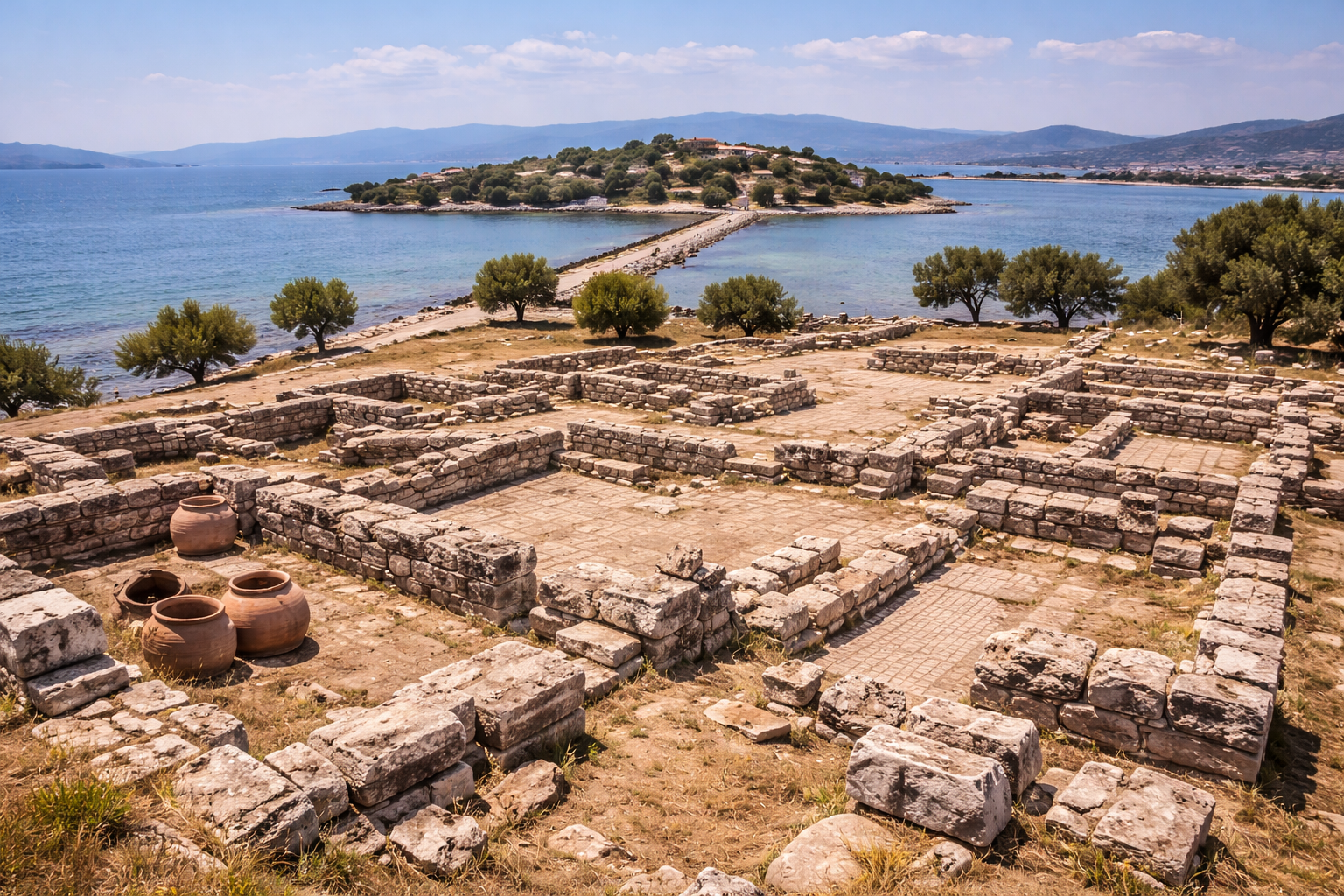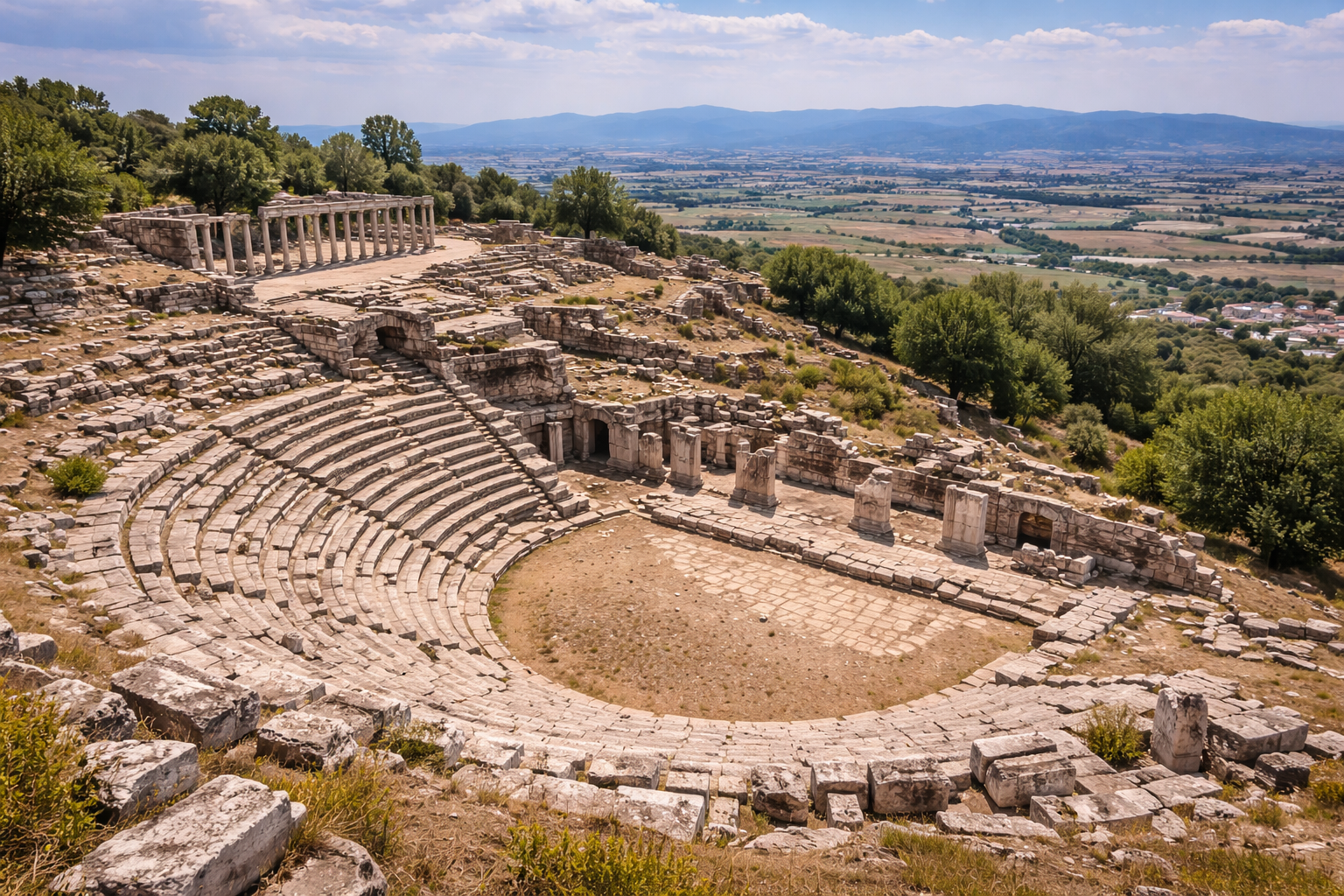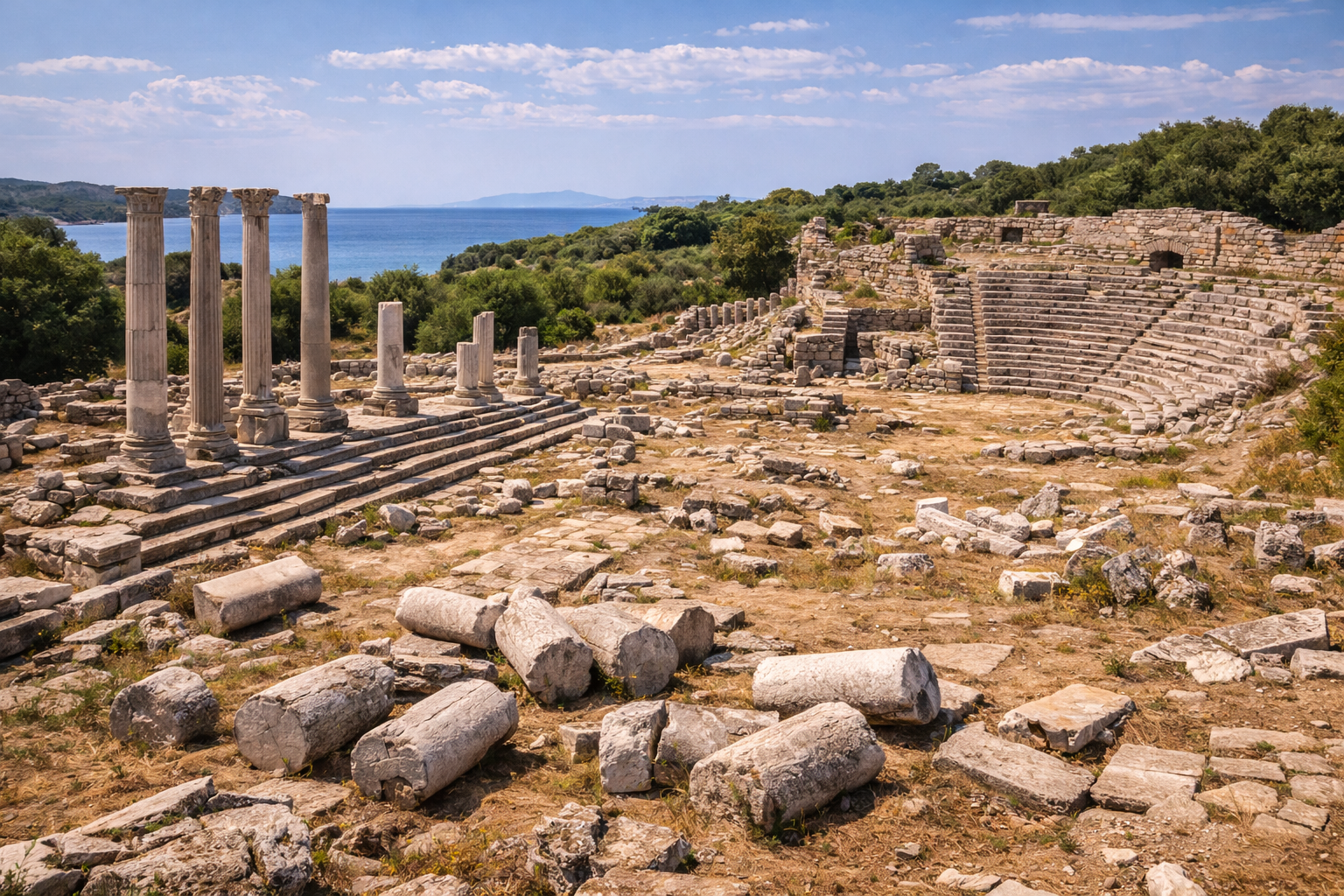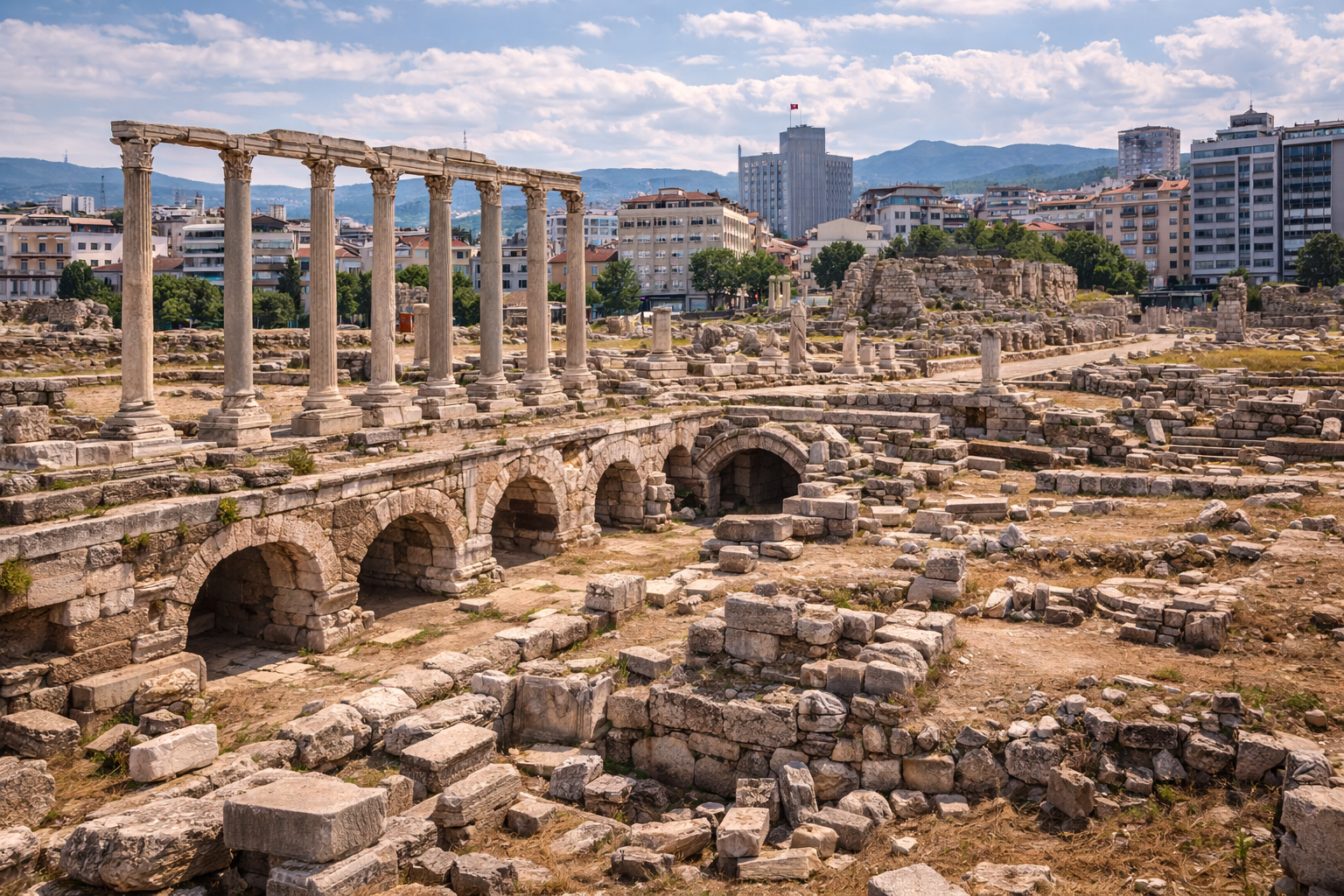
The Agora of Smyrna, widely known as the Izmir Agora, is the excavated remains of the ancient state agora of Smyrna, located in the heart of modern Izmir's Konak district, on the northern slope of Mount Pagos (Kadifekale). First built in the late 4th century BC after the refoundation of Smyrna by the successors of Alexander the Great, the agora was devastated by a catastrophic earthquake in AD 178 and magnificently rebuilt with funding from Emperor Marcus Aurelius. Measuring 161.4 x 29.3 meters, the basilica alone ranks among the largest ever built in Roman Asia Minor. The site preserves one of the richest collections of ancient graffiti from the Roman period -- including 21 ship drawings, gladiator sketches, and what has been called the world's first crossword puzzle. Since 2020, the site has been part of the UNESCO Tentative List as a component of "The Historical Port City of Izmir."
- Why the Agora of Smyrna Matters
- Geography and Setting
- Historical Timeline
- Major Monuments and Finds
- Archaeological Work
- Visitor Information
- Frequently Asked Questions
- Sources and Further Reading
Why the Agora of Smyrna Matters
-
Living archaeology in a living city. The Izmir Agora is one of the rare ancient civic centers that can be experienced within the fabric of a thriving modern metropolis. Surrounded by Izmir's historic Kemeraltl bazaar district and overlooked by the Kadifekale fortress, the agora sits at the intersection of 2,400 years of continuous urban life. You can walk from a 2,000-year-old Roman marketplace directly into a 400-year-old Ottoman bazaar within minutes.
-
Rebuilt by Marcus Aurelius. After the devastating earthquake of AD 178, Emperor Marcus Aurelius -- the philosopher-emperor -- personally sponsored the reconstruction of the agora. The visible ruins largely represent this Roman rebuilding, making the site a monument to imperial patronage and the resilience of ancient Smyrna. The Smyrnians honored his wife by naming the entrance the Faustina Gate.
-
Extraordinary ancient graffiti collection. The plaster walls of the basilica's underground corridors preserve hundreds of Greek graffiti including names, love declarations, 21 detailed ship drawings depicting Mediterranean commercial vessels, gladiator sketches showing named fighters in combat, game boards, riddles, and what excavators have described as the world's first crossword puzzle. This constitutes one of the largest and most diverse collections of informal Roman-period writing known anywhere, comparable to the graffiti of Pompeii but with a distinctly Eastern Mediterranean character.
-
UNESCO Tentative List. Since 2020, the Agora has formed part of the UNESCO Tentative List entry for "The Historical Port City of Izmir," recognizing its role as a key component of Izmir's layered urban heritage stretching from antiquity through Ottoman and modern periods.
-
Monumental basilica architecture. The north stoa (basilica), measuring approximately 161.4 x 29.3 meters, was one of the largest basilicas built in the Roman world. Its structure features a cryptoportico basement with 4 galleries and 3 naves on the ground level, demonstrating sophisticated Roman engineering and urban planning.
-
Earliest Republican-era excavation. Work at the Izmir Agora began in 1932--1933, making it one of the very first archaeological excavations of the Turkish Republic -- a site that helped define the new nation's relationship with its ancient heritage.
Geography and Setting
The Agora of Smyrna lies on the northern slope of Mount Pagos (modern Kadifekale, 186 meters elevation), in the Namazgah quarter of the Konak district, precisely between the hilltop fortress of Kadifekale to the south and the historic Kemeraltl bazaar to the north. The site occupies a gently sloping rectangular area in the dense urban core of Izmir, Turkey's third-largest city.
The location reflects the deliberate urban design of Hellenistic Smyrna. When the city was refounded on Mount Pagos in the late 4th century BC (the earlier settlement at Bayrakli/Old Smyrna having been destroyed), the new Hippodamian grid plan placed the agora at the city's functional center -- below the acropolis (where the military garrison and temples stood) and above the harbor (where commercial activity concentrated). This positioning gave the agora its role as the civic, judicial, and administrative hub connecting the upper and lower city.
Today, the agora is surrounded by residential and commercial buildings, with excavation areas opened amid the modern street grid. The proximity of the Kemeraltl bazaar -- one of the largest and oldest covered markets in Turkey, dating to the 17th century -- creates a remarkable continuity of commercial tradition spanning over two millennia.
Mount Pagos (Kadifekale) rises directly behind the agora to the south, crowned by the Hellenistic-Ottoman fortress. From the fortress, visitors can see the entire agora layout spread below them, making Kadifekale an excellent starting point for understanding the site's topographic context.
Coordinates: Approximately 38.42 N, 27.14 E
Elevation: Approximately 30--50 meters above sea level, on the slope of Mount Pagos.
Climate: Mediterranean; hot dry summers frequently exceeding 35 C in July--August, mild wet winters. Morning visits are recommended in summer.
Historical Timeline
Hellenistic Foundation (late 4th century BC)
After the earlier city of Smyrna (at Bayrakli, about 3 km northeast) was destroyed, a new city was founded on Mount Pagos in the late 4th century BC, traditionally attributed to Lysimachus, one of Alexander the Great's generals. The new city was laid out on a Hippodamian grid plan, and the agora was built as a large rectangular open space surrounded by colonnaded stoas (covered walkways with shops and offices). This Hellenistic agora served as the political, judicial, and commercial center of the refounded Smyrna.
Roman Smyrna: A Great City of Asia
Smyrna thrived under Roman rule as one of the most important cities of the Roman province of Asia. It competed with Ephesus and Pergamon for the title of "First City of Asia." The agora continued to serve its civic functions, hosting law courts, government offices, and public commerce. The city was known for its beauty, wealth, and intellectual life -- it was a major center of the Second Sophistic movement.
The Earthquake of AD 178 and Imperial Reconstruction
In AD 178 (some sources say 177), a devastating earthquake struck western Anatolia, causing severe damage to Smyrna and its agora. The young orator Aelius Aristides, one of the most famous speakers of the Second Sophistic and a resident of Smyrna, reportedly wrote an emotional appeal to Emperor Marcus Aurelius and Empress Faustina describing the destruction. Ancient sources record that Marcus Aurelius wept upon reading the letter.
Moved by the plea, Marcus Aurelius ordered and financed the comprehensive reconstruction of the agora and other public buildings. The Smyrnians expressed their gratitude by erecting the Faustina Gate at the agora entrance, featuring a portrait relief of Empress Faustina.
Most of the visible archaeological remains date to this post-178 AD reconstruction. The rebuilt agora was even grander than the original, featuring the massive north stoa (basilica) with its cryptoportico, the west stoa, and an open courtyard covering thousands of square meters.
Life in the Rebuilt Agora (2nd--4th centuries AD)
The reconstructed agora bustled with daily life. The basilica served both judicial and commercial functions. It was in these years that the graffiti were scratched and painted onto the basement walls -- sailors drawing their ships, fans sketching gladiators, lovers writing names, idlers carving game boards, and intellectuals composing riddles and wordplay in Greek.
Late Roman and Byzantine Periods (3rd--15th centuries)
The agora continued in use through the Late Roman period, though its functions evolved. Some areas were repurposed for industrial and commercial activities. During the Byzantine period, structures including an Ottoman-era building and cemetery were constructed within the courtyard, reflecting the ongoing transformation of the space across cultures and centuries.
Ottoman Period
The agora area became part of the Ottoman urban fabric, with residential buildings gradually encroaching on the ancient site. The ruins were partially buried under fill and construction, paradoxically preserving the underground structures while hiding them from view for centuries.
Modern Excavation and Opening (1932--present)
Excavations began in 1932--1933, making the Izmir Agora one of the first archaeological excavations of the Turkish Republic era. The site has been progressively excavated, restored, and opened to the public, becoming one of Izmir's most important cultural attractions.
Major Monuments and Finds
The North Stoa (Civil Basilica)
The basilica is the most imposing structure at the agora. This rectangular building, measuring approximately 161.4 x 29.3 meters, was built after the AD 178 earthquake and functioned as a civil basilica -- with both judicial and commercial features, used for courts, business transactions, and public gatherings.
The basilica's structure consists of:
- A cryptoportico basement with 4 galleries used to level the sloping ground
- 3 naves on the ground level, with the main hall larger than the side naves
- Above-ground colonnaded hall with marble columns and arched openings
- A mezzanine level between ground and basement
This makes it one of the largest basilicas in all of Asia Minor.
The Ancient Graffiti Collection
It is in the basement corridors that the famous ancient graffiti were discovered, scratched and painted onto the plastered walls and arch supports. A comprehensive documentation project beginning in 2003 by a team including Roger Bagnall of NYU's Institute for the Study of the Ancient World produced the monograph Graffiti from the Basilica in the Agora of Smyrna.
The graffiti include:
- Names and declarations -- lovers, friends, visitors recording their presence
- 21 ship drawings -- some remarkably detailed, depicting commercial vessels that sailed the Mediterranean in the 2nd--4th centuries AD. Some are made with paint and others with scraping lines. These drawings provide invaluable evidence about ancient vessel types and confirm Smyrna's importance as a port city.
- Gladiator sketches -- depicting named fighters in combat scenes, reflecting the popularity of gladiatorial games
- Game boards -- scratch-carved on walls and floors for ancient board games
- Riddles and wordplay -- intellectual amusements in Greek, including what excavators have described as the world's first crossword puzzle
- Obscene imagery and sexual references -- frank depictions of everyday life
- Bird and animal drawings -- casual artistic expressions
- Political references -- commentary on local affairs
This collection constitutes one of the richest archives of informal Roman-period writing and imagery known to scholarship, comparable to the graffiti of Pompeii but with a distinctly Eastern Mediterranean and Greek-language character.
The West Stoa and Cryptoportico
The west stoa (western portico) runs along the western side of the agora courtyard. Its most notable feature is the cryptoportico -- an underground vaulted passage with three arched galleries that supported the above-ground colonnade. The cryptoportico compensated for the sloping terrain and provided additional covered commercial or storage space. Walking through these corridors today gives visitors a powerful sense of the scale and engineering sophistication of Roman urban architecture.
The Bouleuterion (Council House)
Located to the west of the main agora courtyard, the bouleuterion was where the elected city council of Smyrna met to debate and pass legislation. Excavations have shown that the bouleuterion was relocated northward during the post-178 reconstruction, reflecting deliberate replanning of the civic space after the earthquake.
The Mosaic Hall
Adjacent to the bouleuterion, a mosaic-floored hall has been excavated, featuring geometric polychrome mosaics that demonstrate the decorative quality of the agora's public spaces. The mosaics reflect the wealth and aesthetic standards of Roman Smyrna.
The Faustina Gate
The agora's ceremonial entrance was the Faustina Gate, named after Faustina the Younger, wife of Marcus Aurelius. The gate featured a portrait relief of Faustina at the center of the northern arch, honoring her role alongside her husband in financing the agora's reconstruction. While the gate is heavily damaged, its archaeological remains and historical significance make it a key interpretive point.
The Roman Bath
Remains of a Roman bath complex have been identified within the agora precinct, including hypocaust floors (underfloor heating system) and water channels, reflecting the integration of bathing facilities into the civic center.
Ottoman-Period Structures
Within the agora courtyard, the remains of an Ottoman building and an associated cemetery have been excavated, illustrating the continuous cultural layering of the site from antiquity through the Islamic period. These structures demonstrate how the site was repurposed across centuries.
Statuary and Sculpture
Excavations have yielded fragments of marble statuary, including portrait busts and dedicatory inscriptions that illuminate the civic life and patronage networks of Roman Smyrna. These finds are displayed at the Izmir Archaeological Museum.
Archaeological Work
The Izmir Agora is one of the earliest archaeological excavations of the modern Turkish Republic. Initial work began in 1932--1933 under the direction of Selahattin Kantar, Director of the Izmir and Ephesus Museums, working alongside German archaeologist Rudolf Naumann. Their campaigns, which continued until 1941, uncovered the basilica, west stoa, and major portions of the underground cryptoportico.
After a long hiatus, excavations resumed in the 1990s and gained significant momentum in 2007 when Assoc. Prof. Akin Ersoy of Izmir Katip Celebi University and his team began systematic new campaigns that have continued to the present.
Recent campaigns have focused on:
- Expansion of the excavation area to expose previously buried portions of the agora courtyard
- Restoration and conservation of the cryptoportico arches and basilica walls
- Documentation of the graffiti using digital photography, 3D scanning, and epigraphic analysis, culminating in the ISAW Monographs publication
- Discovery of the bouleuterion and mosaic hall, adding new dimensions to understanding the agora's civic functions
- Integration with urban planning -- the Izmir Metropolitan Municipality has worked to balance excavation with the surrounding modern city, creating an open-air archaeological park accessible to both tourists and local residents
- Discovery of 21 ship graffiti depicting Mediterranean commercial vessels, shedding new light on Smyrna's maritime history
In 2020, the Agora of Smyrna was inscribed on the UNESCO Tentative List as part of "The Historical Port City of Izmir," recognizing its significance within the broader context of Izmir's multi-layered urban heritage.
Finds from the agora are exhibited at the Izmir Archaeological Museum and at the on-site display areas within the agora itself. The landmark publication Graffiti from the Basilica in the Agora of Smyrna (ISAW Monographs, NYU, 2016) by Roger S. Bagnall, Roberta Casagrande-Kim, Akin Ersoy, Cumhur Tanriver, and Burak Yolacan provides comprehensive scholarly documentation of the graffiti.
Visitor Information
Getting There
The Izmir Agora is located in the Namazgah quarter of Konak, Izmir's central district. It is accessible on foot from multiple points:
- From Konak Square: approximately 15-minute walk uphill through the Kemeraltl bazaar
- From Kadifekale: approximately 10-minute walk downhill
- By Izmir Metro: Cankaya station (then 10-minute walk)
- By bus/tram: numerous city bus and tram lines serve Konak
- Taxi: easily accessible from anywhere in central Izmir
Best Time to Visit
The agora is open year-round. Spring (March--May) and autumn (September--November) offer the most pleasant weather. Summer visits are possible but can be very hot (Izmir regularly exceeds 35 C in July--August). Morning visits are recommended in summer for comfortable temperatures and good photography light.
Duration
Plan 1--2 hours for a thorough visit to the agora site. If combining with Kadifekale (directly above) and the Kemeraltl bazaar (directly below), plan a half-day excursion covering all three sites in sequence -- one of Izmir's finest walking routes.
What to Bring
- Comfortable walking shoes (stone paths and some uneven surfaces)
- Water (especially in summer)
- Camera (the underground corridors offer dramatic photography opportunities)
- A flashlight or phone light (helpful for viewing graffiti details in darker corridor sections)
- Guidebook or downloaded information about the graffiti (helps identify specific drawings)
Recommended Visit Route
- Start at Kadifekale for the panoramic overview of the agora and city below
- Descend to the agora and enter through the upper (southern) entrance
- Walk through the basilica basement corridors -- look carefully for graffiti on the walls, including ship drawings and gladiator sketches
- Explore the west stoa cryptoportico galleries -- note the 4-gallery structure and vaulted ceilings
- Visit the open courtyard and bouleuterion area
- Examine the mosaic hall adjacent to the bouleuterion
- Look for the Faustina Gate remains at the northern entrance
- Exit northward and continue into the Kemeraltl bazaar for a seamless transition from ancient to Ottoman commercial space
Nearby Attractions
- Kadifekale (Pagos) -- Hellenistic-Ottoman fortress, panoramic views (directly above)
- Kemeraltl bazaar -- historic Ottoman market dating to the 17th century, food, shopping (directly below)
- Izmir Archaeological Museum -- agora finds and broader regional collections
- Konak Square and Clock Tower -- Izmir's iconic waterfront landmark
- Kordon (waterfront promenade) -- seaside walking and dining
- Agora of Old Smyrna (Bayrakli) -- the earlier Archaic-period settlement, 3 km northeast
- Ephesus (Selcuk) -- Turkey's most visited ancient site, 80 km south
Entrance and Fees
The agora charges a museum entrance fee (check current prices at the Turkish Museums website or on-site). A Museum Pass Turkey or Izmir Museum Pass may cover entry. Open daily; hours vary by season (typically 8:30--17:30 in winter, extended to 19:00 in summer).
Accessibility Notes
The upper agora areas are relatively flat and accessible. The underground cryptoportico corridors involve stairs and may be challenging for visitors with mobility limitations. Some areas have been adapted for improved access, and the open courtyard is generally accessible.
Frequently Asked Questions
What is an agora?
An agora was the central public gathering space in a Greek or Roman city -- equivalent to a Roman forum. It served as a marketplace, political assembly area, law court, and general civic center. The Agora of Smyrna was the state agora (as opposed to a commercial agora), meaning it was primarily used for judicial, administrative, and political functions, though commercial activities also took place.
Why did Marcus Aurelius rebuild the agora?
After the devastating earthquake of AD 178, the famous orator Aelius Aristides, who lived in Smyrna, reportedly sent an emotional appeal to Emperor Marcus Aurelius describing the city's destruction. Ancient sources say Marcus Aurelius wept upon reading the letter. Known as the philosopher-emperor and a patron of Smyrna (which he had visited), he authorized and financed a comprehensive reconstruction. The Smyrnians honored this generosity by naming the main gate after his wife, Faustina.
What makes the graffiti special?
The graffiti scratched and painted on the basement walls of the basilica constitute one of the largest collections of informal Roman-period writing and drawing found outside of Pompeii. Unlike formal inscriptions, these graffiti reveal the unfiltered voices of ordinary people: their names, love interests, humor, games, ship designs, gladiatorial heroes, and sexual preoccupations. They include 21 detailed ship drawings that confirm Smyrna's role as a major port, and what excavators have called the world's first crossword puzzle. They are written in Greek and provide an unparalleled window into daily life in a major Roman-period city.
How do the ship graffiti help historians?
The 21 ship drawings found in the basilica basement are made with paint or scratched into the walls. They depict commercial vessels assumed to have been sailing the Mediterranean during the 2nd--4th centuries AD. These drawings provide rare visual evidence of ancient ship construction and rigging, complementing the literary and numismatic evidence for ancient maritime trade, and they confirm that Izmir was a significant port city in the ancient world.
How does the agora connect to the Kemeraltl bazaar?
The spatial relationship is remarkable. The ancient agora lies on the hillside directly above the Kemeraltl bazaar, Izmir's historic Ottoman-era covered market dating to the 17th century. Walking from the agora downhill into Kemeraltl, you traverse a continuous history of commercial activity spanning over 2,000 years -- from a Hellenistic-Roman marketplace to an Ottoman bazaar to a modern shopping district.
Is the site on the UNESCO World Heritage List?
The Agora of Smyrna has been on the UNESCO Tentative List since 2020, as part of "The Historical Port City of Izmir." A full nomination for World Heritage status is under preparation.
Can I visit the underground corridors?
Yes, the cryptoportico corridors of the west stoa and parts of the basilica basement are open to visitors. These are among the most atmospheric spaces at the site, with barrel-vaulted ceilings and (in places) visible graffiti on the walls. Lighting is provided but bringing a flashlight helps for viewing details.
Who was Aelius Aristides?
Aelius Aristides (AD 117--181) was one of the most famous orators of the Roman Empire, a leading figure of the Second Sophistic literary movement. He lived in Smyrna and was devoted to the city. His impassioned letter to Marcus Aurelius after the AD 178 earthquake is credited with securing the imperial funding for the agora's reconstruction.
What happened to the agora after the Roman period?
After the decline of the Roman Empire, the agora's civic functions gradually ceased. During the Byzantine period, some areas were repurposed for industrial activity and residential use. Under Ottoman rule, the district became part of the city's residential fabric, with houses built over the ancient ruins. Ironically, this burial under later construction helped preserve the underground cryptoportico corridors and their graffiti for centuries, protecting them from weathering and vandalism until modern excavation revealed them.
Are there toilets and refreshments at the site?
The agora site has basic visitor facilities near the entrance. However, the adjacent Kemeraltl bazaar offers an enormous range of restaurants, cafes, and Turkish tea houses within a short walk. This is one of the advantages of visiting an archaeological site embedded in a living city -- every amenity is nearby.
What is the cryptoportico?
A cryptoportico is an underground vaulted corridor or gallery used in Roman architecture to create a level building platform on sloping terrain, while simultaneously providing covered commercial or storage space below. At the Agora of Smyrna, the cryptoportico beneath the basilica has four galleries and was used to level the natural slope of Mount Pagos. The cryptoportico's walls became the canvas for the famous ancient graffiti collection.
How does the Izmir Agora compare to the Athens Agora?
Both are state agoras of major ancient cities, but they differ significantly. The Athens Agora is much larger and was the political heart of the world's first democracy. The Izmir Agora, rebuilt after the AD 178 earthquake, represents a later Roman-period civic center with a massive basilica and elaborate cryptoportico system. The Izmir Agora's graffiti collection is unique -- Athens has nothing comparable. Both sites are embedded within their modern cities, creating similar contrasts between ancient and contemporary urban life.
Architectural Details
Construction Techniques
The agora's construction demonstrates several advanced Roman engineering methods:
- Hydraulic concrete (opus caementicium): The barrel vaults of the cryptoportico used Roman concrete -- a mixture of lime mortar, volcanic ash (pozzolana), and aggregate -- that has survived nearly two millennia. This material allowed the Romans to span large interior spaces without timber supports.
- Cut-stone masonry: The basilica's visible facade employed precisely cut limestone and marble blocks, many with drafted margins -- a technique inherited from Hellenistic building traditions.
- Terracing: The entire agora complex was built on an artificial terrace that compensated for Mount Pagos's slope, requiring massive retaining walls on the downhill side. This engineering feat demonstrates why the cryptoportico was essential -- it simultaneously leveled the ground and created usable space.
- Column construction: The basilica columns were built from stacked marble drums, each individually carved and precisely fitted. Surviving column bases show Attic-Ionic profiles consistent with 2nd-century AD architectural conventions.
Water Management
The agora incorporated a sophisticated water management system:
- Drainage channels ran beneath the courtyard pavement, directing rainwater away from the foundations.
- Lead pipes supplied water to fountains and basins within the civic space.
- The Roman bath's hypocaust system required a reliable water supply, delivered through the city's aqueduct network.
The Second Sophistic and Smyrna's Intellectual Life
The Agora of Smyrna was not merely a marketplace or law court -- it was the stage for one of the most vibrant intellectual cultures of the Roman world. Smyrna was a major center of the Second Sophistic (c. AD 60--230), a literary and rhetorical movement that celebrated Greek cultural identity within the Roman Empire.
Key aspects of Smyrna's intellectual life connected to the agora:
- Public oratory: The basilica served as a venue for public speeches by leading sophists. Orators competed for fame, students, and imperial patronage, drawing crowds that filled the galleries.
- Philosophical schools: Smyrna hosted schools of philosophy where students studied rhetoric, ethics, and natural philosophy in the tradition of Plato and Aristotle.
- Literary festivals: The city hosted agonistic festivals (competitions) in rhetoric and poetry, with victors receiving public honors.
- Aelius Aristides' legacy: Aristides' surviving works, including his famous Sacred Tales describing his mystical experiences with the god Asclepius, remain important sources for understanding 2nd-century intellectual life and religious experience.
The graffiti in the basilica basement may partly reflect this intellectual atmosphere -- the word puzzles, riddles, and literary allusions scratched on the walls suggest that at least some of the graffiti artists were educated individuals familiar with Greek literary traditions.
Architectural Measurements and Key Figures
The following table summarizes the principal documented dimensions and statistics for the Agora of Smyrna, drawn from excavation reports, the ISAW Monographs publication, and the official Smyrna Agora archaeological site documentation.
| Feature | Measurement / Quantity |
|---|---|
| Basilica (north stoa) length | 161.4 m |
| Basilica (north stoa) width | 29.3 m |
| Basilica floor count | 3 (ground + mezzanine + upper), plus basement |
| Basilica basement galleries | 4 |
| Basilica ground-level naves | 3 |
| West portico excavated length | 83 m |
| West portico cryptoportico galleries | 3 (originally 2 in Hellenistic period) |
| Nemeses inscription length (west portico architrave) | 35 m |
| Total agora area (current excavated) | 16,590 m² |
| Ship graffiti drawings documented | 21 |
| UNESCO Tentative List inscription | 2020, as part of "The Historical Port City of Izmir" |
Numismatic Evidence and Smyrna's Civic Coinage
Smyrna was one of the most prolific minting cities in Roman Asia, producing a rich and varied coinage that expressed the city's competitive civic identity, religious diversity, and political alliances.
Civic Competition on Coinage
Smyrna's coins frequently bore the title "First of Asia" (PROTE ASIAS), reflecting the city's centuries-long rivalry with Ephesus and Pergamon for this honorary distinction. The claim to primacy was tied to temple-warden (neokoros) status -- the right to host a provincial temple of the imperial cult. Smyrna held neokoros status multiple times, and each award was celebrated on the coinage.
Religious Imagery on Coins
| Deity / Image | Significance |
|---|---|
| Two Nemeses (symbolized by griffins) | Patron deities of Smyrna; unique double-Nemesis cult |
| Tyche (Fortune) with turreted crown | Standard city personification |
| Temple of Tiberius, Hadrian, and Roma | Provincial imperial cult temple |
| Homer (seated, holding scroll) | Smyrna claimed to be Homer's birthplace |
| Amazons | Legendary founders of the city |
| River god Meles | Local river personification |
| Asclepius and Hygeia | Healing cult, associated with Aelius Aristides |
Alliance Coins (Homonoia)
A distinctive category of Smyrna's coinage is the homonoia (alliance/concord) issue, which celebrated formal agreements of friendship between Smyrna and other cities. These coins depict paired patron deities of the two allied cities. Known homonoia partners include Ephesus, Pergamon, Laodicea, Sardis, and Alexandria -- confirming Smyrna's extensive diplomatic network across the eastern Mediterranean.
The 35-Metre Nemeses Inscription
One of the most significant epigraphic features of the agora is the monumental inscription carved on the architrave of the first storey of the western portico. Extending for approximately 35 metres, this dedicatory text was addressed to the two Nemeses and to other gods -- a reflection of the unique double-Nemesis cult that was central to Smyrna's religious identity.
The cult of the two Nemeses was one of Smyrna's most distinctive religious features. Unlike most Greek cities, which venerated a single Nemesis (the goddess of retribution and divine balance), Smyrna worshipped a pair of Nemeses, often represented in art and coinage as twin griffins or as two standing female figures. Their sanctuary was one of the city's most important sacred sites, and the 35-metre inscription on the agora portico demonstrates that their cult was physically integrated into the civic centre rather than confined to a peripheral temple.
Excavation Chronology
| Year(s) | Event | Lead Excavator(s) |
|---|---|---|
| 1932--1933 | First excavations of the Turkish Republic era at the agora | Selahattin Kantar (Dir., Izmir and Ephesus Museums), Rudolf Naumann (German archaeologist) |
| 1933--1941 | Continued campaigns; basilica, west stoa, and cryptoportico uncovered | Kantar and Naumann |
| 1943 | Publication of Die Agora von Smyrna (Berlin) | Naumann and Kantar |
| 1990s | Excavations resume after long hiatus | Various teams |
| 2003 | Graffiti documentation project begins | ISAW (NYU) team including Roger Bagnall |
| 2007--present | Systematic new campaigns with year-round excavation | Assoc. Prof. Akin Ersoy, Izmir Katip Celebi University |
| 2016 | Publication of Graffiti from the Basilica in the Agora of Smyrna (ISAW Monographs) | Bagnall, Casagrande-Kim, Ersoy, Tanriver, Yolacan |
| 2020 | Agora inscribed on UNESCO Tentative List as part of "The Historical Port City of Izmir" | Izmir Metropolitan Municipality |
The Graffiti as a Social Archive
The graffiti collection at the Smyrna Agora constitutes one of the most important archives of everyday life in the Roman East. Unlike formal inscriptions, which record the actions and dedications of elites, graffiti preserve the unfiltered voices of ordinary people -- sailors, soldiers, merchants, lovers, idlers, and intellectuals who passed through the basilica's basement corridors.
Categories of Graffiti Content
| Category | Examples | Count / Notes |
|---|---|---|
| Ship drawings | Detailed depictions of Mediterranean commercial vessels with masts, rigging, and hulls | 21 documented, some painted, some scratched |
| Gladiator sketches | Named fighters shown in combat poses with weapons and armour | Multiple examples, comparable to Pompeii graffiti |
| Names and love declarations | Personal names, declarations of affection, visitors recording their presence | Hundreds of examples in Greek |
| Game boards | Scratch-carved playing surfaces for ancient board games | Multiple, carved on walls and floors |
| Riddles and wordplay | Intellectual puzzles in Greek, including what excavators describe as the world's first crossword puzzle | Several examples |
| Obscene imagery | Frank sexual depictions and references | Multiple |
| Bird and animal drawings | Casual artistic sketches of wildlife | Various |
| Political references | Commentary on local affairs and civic life | Several |
The ship drawings are of particular scholarly importance because they provide visual evidence of ancient vessel types that sailed the Mediterranean during the 2nd through 4th centuries AD. Some ships are drawn with detailed rigging, including masts, yards, sails, and hull construction -- information that complements the textual and numismatic evidence for ancient maritime technology. The technique varies: some drawings were made with a paint mixture of iron and oak-root extract, while others were scratched directly into the plaster with a sharp point.
Sources and Further Reading
- Bagnall, R.S., Casagrande-Kim, R., Ersoy, A., Tanriver, C., Yolacan, B. Graffiti from the Basilica in the Agora of Smyrna (ISAW Monographs, NYU, 2016). Link
- Ersoy, A. et al. "Smyrna/Izmir Agora Excavation Reports." Izmir Metropolitan Municipality / Ministry of Culture and Tourism.
- Naumann, R. & Kantar, S. "Die Agora von Smyrna." Kleinasien und Byzanz, Berlin, 1943.
- Wikipedia -- Agora of Smyrna
- Ancient Smyrna -- smyrnaagorasi.com
- Visit Izmir -- Agora of Smyrna
- Turkish Archaeological News -- Agora of Smyrna
- Arkeonews -- 2500-year-old ship graffiti at Izmir
- Daily Sabah -- Smyrna Agora a historical and architectural treasure
- GoExploreTurkey -- Agora of Smyrna
- Turkish Museums -- Izmir Agora Archaeological Site
- Izmir Provincial Directorate of Culture and Tourism -- Izmir Agora
- Hurriyet Daily News -- Ship graffiti reveals Izmir was a significant port city
- World Archaeology -- Smyrna