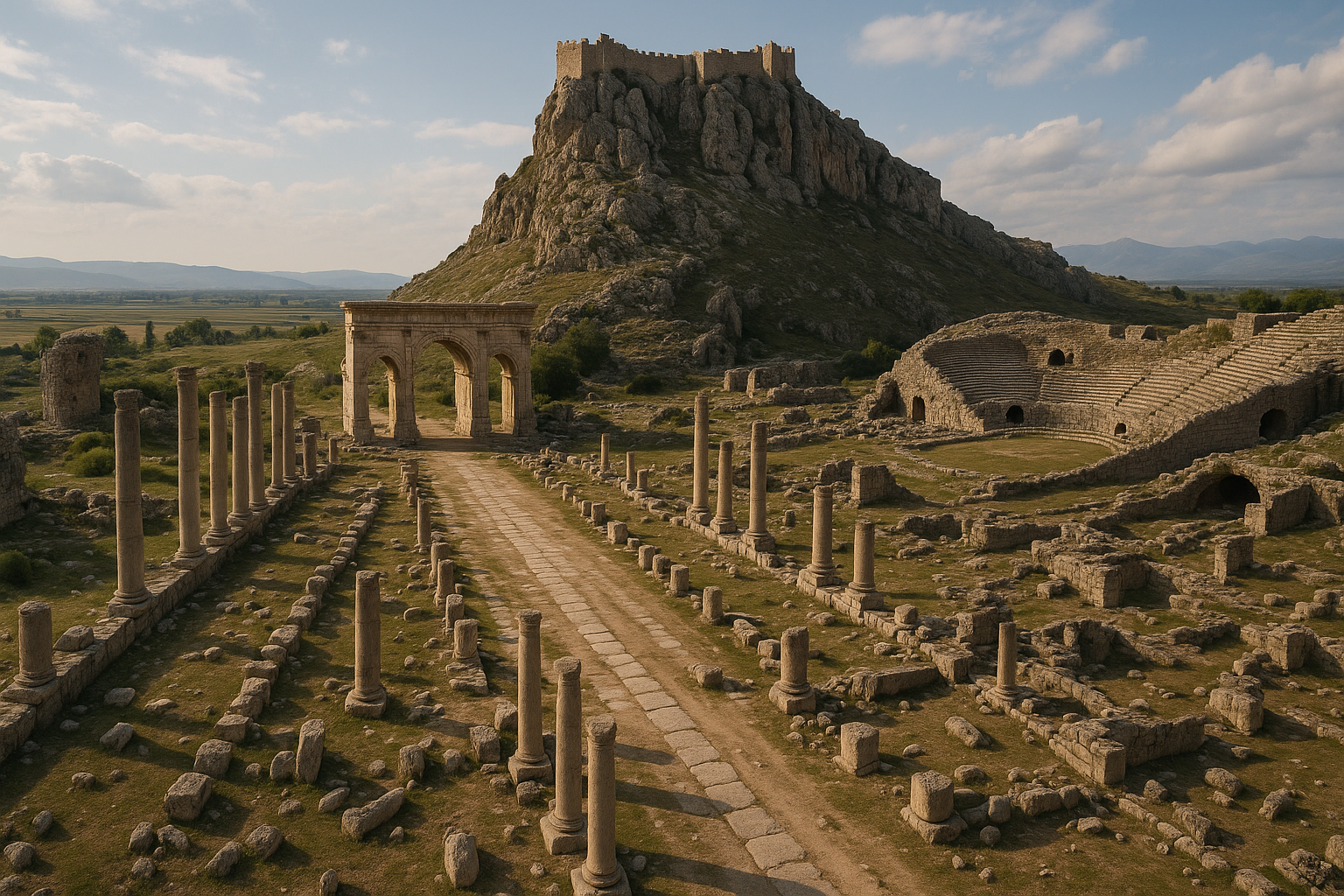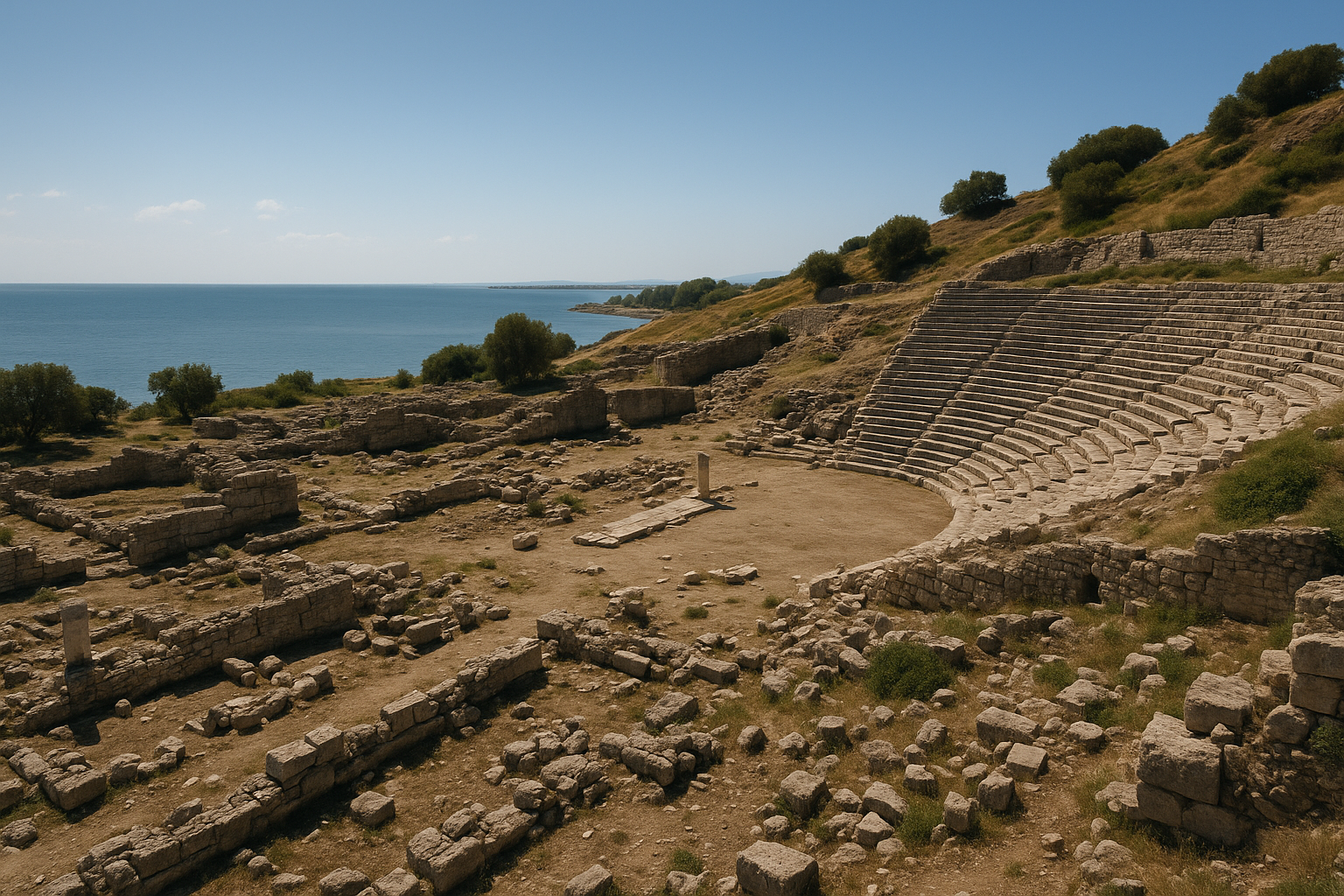
Vue d'ensemble : Magarsus était la cité portuaire et l'enceinte sacrée de l'antique Mallos, l'une des cités les plus importantes de la Cilicie Pédiade (Cilicie Plate), située sur un promontoire côtier spectaculaire dans le district de Karataş, dans la province d'Adana. Positionnée à l'embouchure du fleuve Pyramos (l'actuel Ceyhan Nehri) là où il se jette dans la Méditerranée, Magarsus servit à la fois de port majeur et de centre religieux renommé abritant le célèbre temple d'Athéna Magarsia — l'un des principaux centres de prophétie (manteia) de la Méditerranée orientale. Alexandre le Grand visita célèbrement Magarsus en 333 av. J.-C. pour sacrifier au temple avant sa campagne contre les Perses. Le site préserve un théâtre à vue sur la mer unique (le seul de ce type dans l'Antiquité), un château médiéval, des murailles, des citernes et les vestiges non fouillés du temple d'Athéna, ce qui en fait l'un des sites archéologiques les plus prometteurs mais les moins explorés de Cilicie.
Table des matières
- Pourquoi Magarsus compte
- Géographie et contexte
- Chronologie historique
- Magarsus et Mallos
- Le temple d'Athéna Magarsia
- Alexandre le Grand à Magarsus
- Le centre de prophétie
- Le théâtre à vue sur la mer
- Le port
- Le château et les fortifications
- Période classique et hellénistique
- Magarsus romaine
- Monnaies et économie
- Sources antiques
- Fouilles archéologiques
- Le delta du fleuve Pyramos
- Comment visiter Magarsus
- FAQ
- Sources
Pourquoi Magarsus compte
Magarsus est significative pour plusieurs raisons convaincantes :
- La visite d'Alexandre le Grand : Alexandre sacrifia au temple d'Athéna Magarsia en 333 av. J.-C. avant la bataille d'Issos — l'une des batailles les plus déterminantes de l'histoire
- Centre de prophétie majeur : Le temple d'Athéna Magarsia était l'un des principaux sites oraculaires (manteia) de la Méditerranée orientale — comparable dans sa fonction à Delphes, Didymes et Claros
- Seul théâtre à vue sur la mer : Le théâtre de Magarsus est considéré comme le seul théâtre antique avec une vue directe sur la mer — les spectateurs regardaient la Méditerranée pendant les représentations
- Potentiel non fouillé : Malgré son importance historique, Magarsus est largement non fouillée — un trésor de potentiel archéologique
- Port à l'embouchure du fleuve : La position stratégique à l'embouchure du fleuve Pyramos (Ceyhan) faisait de Magarsus un port crucial pour le commerce maritime et fluvial
- Connexions mythologiques : Les traditions antiques liaient la fondation de Mallos/Magarsus aux héros de la guerre de Troie — Amphilochos et Mopsos, deux célèbres devins
Géographie et contexte
Magarsus occupe un promontoire côtier bas à la jonction du fleuve Ceyhan et de la Méditerranée.
Emplacement :
- Localité de Dört Direk, district de Karataş, province d'Adana
- Sur un promontoire s'étendant dans la Méditerranée
- À l'embouchure du fleuve Ceyhan (l'antique Pyramos)
- À environ 50 km au sud du centre-ville d'Adana
- Près de la moderne ville de pêcheurs de Karataş
Paysage :
- Un promontoire côtier plat à légèrement surélevé
- La Méditerranée sur trois côtés — offrant les célèbres vues sur la mer
- Le delta du fleuve Ceyhan crée d'importantes zones humides à proximité
- Plages de sable et dunes côtières
- Les plaines agricoles plates (la Çukurova / plaine cilicienne) s'étendent à l'intérieur des terres
- Le site est exposé aux vents méditerranéens et aux embruns marins
Climat :
- Climat méditerranéen chaud
- Étés très chauds (35°C+) et hivers doux
- Les brises marines modèrent les températures côtières
- Sec en été avec des pluies occasionnelles en hiver
Chronologie historique
| Période | Date | Événements clés |
|---|---|---|
| Fondation mythologique | Époque de la guerre de Troie | Fondée par les devins Amphilochos et Mopsos (tradition mythologique) |
| Archaïque | VIIe–VIe siècle av. J.-C. | Établissement fondé ; temple d'Athéna Magarsia fondé |
| Classique | Ve–IVe siècle av. J.-C. | Mallos/Magarsus se développe ; Alexandre visite (333 av. J.-C.) |
| Hellénistique | IIIe–Ier siècle av. J.-C. | Sous influence séleucide, puis romaine ; théâtre construit |
| Romaine | Ier siècle av. J.-C.–IVe siècle apr. J.-C. | Prospérité continue ; port actif |
| Byzantine | Ve–VIIe siècle | Conversion chrétienne ; château construit/renforcé |
| Médiévale | VIIIe–XIVe siècle | Château entretenu ; établissement réduit |
| Ottomane | À partir du XVe siècle | Abandon progressif |
| Fouilles modernes | Années 2000–présent | Équipes archéologiques turques |
Magarsus et Mallos
Magarsus fonctionnait comme le port et l'enceinte sacrée de la plus grande cité intérieure de Mallos.
Mallos :
- L'une des plus anciennes et des plus importantes cités grecques de la Cilicie Pédiade (Cilicie Plate)
- Située à quelques kilomètres à l'intérieur des terres depuis la côte
- Fondée, selon la légende, par Amphilochos et Mopsos — deux devins mythologiques associés à la guerre de Troie
- Mallos était un centre agricole et commercial prospère contrôlant la riche plaine cilicienne
La relation Mallos-Magarsus :
- Magarsus servait à Mallos de port et de centre religieux
- Les navires accostaient à Magarsus ; les marchandises étaient transportées vers l'intérieur jusqu'à Mallos
- Le temple d'Athéna Magarsia dans le port était le sanctuaire religieux principal de Mallos
- La relation est similaire à celle d'Athènes-Le Pirée ou Corinthe-Léchaion — une cité avec son port distinct
Le temple d'Athéna Magarsia
Le temple d'Athéna Magarsia était le monument le plus important de Magarsus — un sanctuaire et un oracle renommés.
Le temple :
- Dédié à Athéna Magarsia — une forme locale de la déesse Athéna avec de fortes associations prophétiques
- Le temple était l'un des principaux centres de prophétie (manteia) de la Méditerranée orientale
- Pèlerins et souverains venaient consulter l'oracle et recevoir des conseils divins
- La renommée du temple se répandit dans le monde antique — les auteurs anciens, dont Strabon, Arrien et Pausanias, le mentionnent
Architecture :
- Le plan et les dimensions exacts du temple ne sont pas encore entièrement connus — le temple n'a pas été systématiquement fouillé
- Les vestiges de surface suggèrent un substantiel temple en pierre de proportions classiques
- Le temple était probablement entouré d'un témenos (enceinte sacrée) avec des autels, des offrandes votives et des bâtiments sacerdotaux
- Les monnaies de Mallos/Magarsus représentent Athéna, suggérant l'importance du temple dans l'identité de la cité
Fonction oraculaire :
- L'oracle de Magarsus était consulté sur des questions de guerre, de gouvernance, de commerce et de décisions personnelles
- La tradition prophétique de Magarsus peut être liée aux devins mythologiques Amphilochos et Mopsos, réputés pour leurs capacités oraculaires
- L'oracle attirait des clients de toute la région — Alexandre le Grand fut le plus célèbre
Alexandre le Grand à Magarsus
Alexandre le Grand visita Magarsus en 333 av. J.-C. — l'un des événements les plus célèbres de l'histoire de la cité.
La visite :
- En 333 av. J.-C., Alexandre marchait vers l'est à travers la Cilicie en direction de sa confrontation avec le roi perse Darius III
- Avant de poursuivre vers la bataille d'Issos (l'une des batailles les plus déterminantes de l'histoire), Alexandre s'arrêta à Magarsus
- Il sacrifia au temple d'Athéna Magarsia — recherchant la faveur divine pour la campagne
- L'historien antique Arrien (Anabase, II.5.9) rapporte cette visite
Signification :
- La visite d'Alexandre démontre le prestige du temple — le conquérant du monde connu rechercha sa bénédiction
- Le sacrifice à Magarsus s'inscrivait dans le schéma d'Alexandre consistant à honorer les traditions religieuses locales en traversant les territoires conquis
- La bataille d'Issos (333 av. J.-C.), livrée peu après la visite de Magarsus, aboutit à une victoire grecque décisive qui ouvrit la voie vers l'Égypte et la Perse
- Alexandre visita également la voisine Mallos et remit à la cité son tribut à Darius, revendiquant une parenté avec la cité à travers sa légende fondatrice argienne
Le centre de prophétie
Le temple d'Athéna de Magarsus fonctionnait comme l'un des grands manteia (centres de prophétie) du monde antique.
La tradition oraculaire :
- La prophétie était centrale dans la fonction du temple — les visiteurs venaient spécifiquement pour recevoir des conseils divins
- La méthode prophétique de Magarsus n'est pas entièrement documentée, mais elle pouvait impliquer des prêtres ou prêtresses inspirés délivrant des oracles
- La tradition pourrait dériver des légendaires devins Amphilochos et Mopsos, dont les capacités oraculaires étaient célèbres dans l'Antiquité
Amphilochos et Mopsos :
- Tous deux étaient des figures mythologiques associées à la prophétie et à la période post-guerre de Troie
- Amphilochos, fils du devin Amphiaraos, était l'un des Épigones (fils qui vengèrent la défaite de leurs pères à Thèbes)
- Mopsos était un devin légendaire qui erra à travers la Cilicie en fondant des cités et des oracles après la guerre de Troie
- La tradition antique affirmait qu'ils se livrèrent à un duel à Mallos et s'entre-tuèrent, mais que leurs esprits continuèrent à donner des oracles sur le site
Comparaison avec d'autres sites oraculaires :
- L'oracle de Magarsus faisait partie d'un réseau de grands centres de prophétie du monde antique :
- Delphes (Apollon) — l'oracle grec le plus célèbre
- Didymes (Apollon) — oracle ionien majeur près de Milet
- Claros (Apollon) — près de Colophon
- Siwa (Zeus-Ammon) — en Égypte, visité par Alexandre
Le théâtre à vue sur la mer
Le théâtre de Magarsus est l'un des monuments les plus distinctifs du site — considéré comme le seul théâtre antique avec une vue directe sur la mer.
Description :
- Cavea semi-circulaire (bassin de gradins) faisant face à la Méditerranée
- Capacité estimée : environ 3 000 spectateurs
- Environ 30 mètres de large et 150 mètres de long (incluant la zone de scène)
- La zone de scène donnait sur la mer — ce qui signifie que les spectateurs regardaient directement la Méditerranée pendant les représentations
- Cette orientation est unique dans le monde antique — la plupart des théâtres font face à l'intérieur des terres
État archéologique :
- Le théâtre est la structure la plus largement fouillée de Magarsus
- Il fut mis au jour lors des travaux archéologiques turcs débutés dans les années 2000
- Le théâtre vieux de 2 500 ans est considéré comme l'une des découvertes archéologiques les plus importantes de Cilicie
Signification :
- L'orientation vers la mer rend le théâtre de Magarsus unique dans l'architecture antique
- Le design suggère que la connexion visuelle entre la représentation et la mer était délibérément voulue
- Le théâtre a pu accueillir à la fois des représentations dramatiques et des cérémonies religieuses liées au culte d'Athéna
Le port
Le port de Magarsus était son artère économique — l'installation portuaire desservant la cité de Mallos et la plus large plaine cilicienne.
Caractéristiques :
- Situé dans la zone abritée près de l'embouchure du fleuve
- Le fleuve Pyramos/Ceyhan fournissait à la fois la protection portuaire et l'accès à l'intérieur
- Les navires commerçaient à travers la Méditerranée — Égypte, Levant, Chypre et mer Égée
- Le port traitait les exportations agricoles de la plaine cilicienne phénoménalement fertile — céréales, coton, lin et vin
Déclin :
- Au fil des siècles, le delta du fleuve Ceyhan a avancé, ensablant l'antique port
- La côte actuelle est significativement différente de celle de l'Antiquité
- L'ensablement du port contribua au déclin de Magarsus dans les périodes ultérieures
Le château et les fortifications
Un château médiéval couronne le point le plus élevé du promontoire.
Caractéristiques :
- Murs de pierre et tours commandant des vues sur la mer et le delta
- Construction incorporant des spolia (blocs antiques réutilisés)
- Le château date probablement de la période byzantine et/ou croisée/arménienne
- Des murailles d'une date antérieure (hellénistique/romaine) encerclaient la zone d'établissement
- Les fortifications reflètent l'importance stratégique continue de Magarsus en tant que position côtière
Période classique et hellénistique
Magarsus prospéra durant les périodes classique et hellénistique.
Période classique (Ve–IVe siècle av. J.-C.) :
- Le temple d'Athéna Magarsia était déjà renommé
- Mallos/Magarsus faisait partie de la satrapie cilicienne de l'Empire perse
- La visite d'Alexandre (333 av. J.-C.) marqua la transition vers la domination hellénistique
- La cité frappait des monnaies représentant Athéna — reflétant la centralité du temple
Période hellénistique (IIIe–Ier siècle av. J.-C.) :
- Sous contrôle séleucide après la mort d'Alexandre
- Les Séleucides promouvaient l'urbanisation et la culture grecque en Cilicie
- Magarsus continua à fonctionner comme un port majeur et un centre religieux
- Le théâtre a pu être construit ou agrandi durant cette période
Magarsus romaine
Sous la domination romaine, Magarsus conserva son importance en tant que port et sanctuaire.
Période romaine :
- La Cilicie devint une province romaine au Ier siècle av. J.-C.
- La campagne de Pompée contre les pirates ciliciens (67 av. J.-C.) apporta la stabilité à la région
- Le port bénéficia de la Pax Romana — commerce maritime accru
- Construction et rénovation d'époque romaine des bâtiments publics
- Le temple d'Athéna Magarsia continua à fonctionner sous le patronage romain
- Les monnaies continuèrent à être frappées à Mallos/Magarsus jusque tard dans la période impériale
Monnaies et économie
Le monnayage de Mallos/Magarsus fournit des informations précieuses sur l'identité et l'économie de la cité.
Monnaies :
- Mallos/Magarsus frappa son propre monnayage à partir de la période classique
- L'imagerie commune inclut Athéna (reflétant le temple), Amphilochos et Mopsos (les fondateurs légendaires), et des symboles maritimes
- Les monnaies de différentes périodes montrent les styles artistiques changeants et les affiliations politiques de la cité
- La frappe continue de monnaies indique une activité économique soutenue et une fierté civique
Économie :
- Commerce maritime à travers le port
- Exportations agricoles de la plaine cilicienne — l'une des régions les plus fertiles du monde antique
- Revenus du temple provenant des pèlerins et des consultations oraculaires
- Le fleuve Pyramos facilitait le commerce avec l'intérieur
Sources antiques
Plusieurs auteurs antiques mentionnent Magarsus, fournissant un contexte historique.
Arrien (Anabase d'Alexandre, II.5.9) :
- Rapporte la visite d'Alexandre à Magarsus et son sacrifice au temple d'Athéna Magarsia
- La source principale pour la présence d'Alexandre sur le site
Strabon (Géographie, XIV.5.16) :
- Décrit Mallos et son port à Magarsus
- Note la fondation légendaire par Amphilochos et Mopsos
Pausanias :
- Mentionne l'oracle d'Amphilochos associé à la région
Méla (De Chorographia) :
- Fait référence à Magarsus dans son étude géographique
Fouilles archéologiques
Les travaux archéologiques à Magarsus sont en cours mais ont déjà produit des résultats significatifs.
Fouilles modernes :
- Les équipes archéologiques turques ont commencé un travail systématique dans les années 2000
- Le théâtre fut le principal centre d'intérêt des fouilles initiales
- La découverte du théâtre à vue sur la mer généra une attention médiatique significative
- Les travaux en cours explorent les murailles, les citernes et la zone potentielle du temple
Découvertes clés :
- Le théâtre vieux de 2 500 ans avec son orientation unique tournée vers la mer
- Sections de muraille et structures défensives
- Citernes et infrastructure de gestion de l'eau
- Découvertes céramiques et numismatiques établissant le cadre chronologique
Potentiel :
- Magarsus a un énorme potentiel non fouillé
- Le temple d'Athéna Magarsia — le monument historiquement le plus important du site — n'a pas encore été entièrement fouillé
- Les installations portuaires peuvent se trouver sous le delta ensablé
- Le site pourrait livrer des informations importantes sur le commerce maritime cilicien, la religion oraculaire et les campagnes d'Alexandre
Le delta du fleuve Pyramos
Le delta du fleuve Ceyhan/Pyramos entourant Magarsus est à la fois un paysage historique et écologique.
Signification historique :
- Le Pyramos était l'un des grands fleuves de Cilicie — fournissant l'eau pour l'agriculture, le transport et la protection portuaire
- Les géographes antiques décrivaient la fertile plaine cilicienne arrosée par le Pyramos et ses fleuves jumeaux
- Le delta a avancé significativement depuis l'Antiquité — la côte antique était plus proche des ruines actuelles
Environnement naturel :
- Le delta est un habitat de zones humides important
- Des routes de migration d'oiseaux passent par la région
- La combinaison des zones humides du delta, des plages de sable et des ruines historiques crée un paysage unique
Comment visiter Magarsus
Pour s'y rendre :
- Depuis Adana : environ 50 km au sud (environ 1 heure via la route de Karataş)
- Depuis Karataş : environ 5 km (environ 10 minutes)
- Près de la localité de Dört Direk — signalisée depuis la zone de Karataş
- Pas de transport public régulier vers le site ; location de voiture ou taxi depuis Karataş
Le site :
- Prévoir 1 à 1,5 heure
- Étapes clés : le théâtre à vue sur la mer (le principal monument fouillé), les ruines du château, les traces de muraille, les vues depuis le promontoire sur la Méditerranée et le delta
- Le site est partiellement fouillé — certaines zones sont des zones de fouilles actives
- Pas d'installations formelles pour visiteurs — apportez de l'eau et une protection solaire
- L'emplacement côtier offre des brises marines mais peu d'ombre
Meilleur moment pour visiter :
- Le printemps (mars–mai) est idéal — températures agréables, fleurs sauvages
- L'automne (octobre–novembre) est également excellent
- L'été est très chaud — visiter tôt le matin
- L'hiver est doux mais peut être venteux
Conseils pratiques :
- Portez des chaussures solides — terrain irrégulier autour des ruines
- Apportez de l'eau, de la crème solaire et un chapeau — pas d'ombre ni d'installations
- La photographie y est excellente — le théâtre avec la Méditerranée en arrière-plan est spectaculaire
- Combinez avec une visite à Karataş (ville balnéaire avec restaurants de poisson frais)
- Le musée archéologique d'Adana possède des trouvailles de la région
- Yumurtalık (l'antique Aigéai) est à proximité et mérite la visite
FAQ
Q : Alexandre le Grand a-t-il vraiment visité Magarsus ? R : Oui. L'historien antique Arrien rapporte qu'Alexandre sacrifia au temple d'Athéna Magarsia en 333 av. J.-C., avant la bataille d'Issos.
Q : Qu'est-ce que le théâtre à vue sur la mer ? R : Le théâtre de Magarsus est orienté vers la mer — les spectateurs regardaient directement la Méditerranée pendant les représentations. Cette orientation est unique parmi les théâtres antiques.
Q : Le temple d'Athéna a-t-il été trouvé ? R : L'emplacement du temple est connu d'après les vestiges de surface et les sources historiques, mais il n'a pas encore été entièrement fouillé. Cela reste l'une des perspectives les plus passionnantes pour la future archéologie sur le site.
Q : Quelle est la relation entre Magarsus et Mallos ? R : Magarsus était le port et le centre religieux de Mallos — la plus grande cité intérieure. Similaire à la relation Athènes-Le Pirée, elles fonctionnaient en paire.
Q : Le site est-il facile à visiter ? R : Le site est accessible en voiture depuis Karataş (environ 5 km). Il n'y a pas d'installations formelles pour visiteurs — venez préparés avec de l'eau et une protection solaire.
Q : Pourquoi l'oracle de Magarsus était-il célèbre ? R : Le temple d'Athéna Magarsia était l'un des principaux centres de prophétie de la Méditerranée orientale. Sa tradition oraculaire était associée aux légendaires devins Amphilochos et Mopsos. La visite d'Alexandre confirma sa prestigieuse réputation.
Mesures architecturales et données structurelles
Les fouilles récentes ont produit des mesures précises pour les principaux monuments de Magarsus.
| Monument | Dimensions / Mesures | Période | Notes |
|---|---|---|---|
| Théâtre à vue sur la mer | 150 m de longueur x 30 m de largeur | Hellénistique (Ve–IIIe siècle av. J.-C.) | Orientation maritime unique ; capacité ~3 000–4 000 |
| Cavea du théâtre | ~26 rangées de gradins | Hellénistique | Semi-circulaire ; construite dans la pente naturelle |
| Murailles | ~1,2 km de circuit traçable | Hellénistique–Byzantine | Pierre taillée avec spolia dans les assises supérieures |
| Château (médiéval) | ~40 x 25 m d'emprise | Byzantin–Croisé/Arménien | Position dominante au sommet du promontoire |
| Élévation du promontoire | ~15 m au-dessus du niveau de la mer | — | Faible élévation côtière ; exposé aux embruns marins |
Détails structurels du théâtre :
- L'orientation maritime du théâtre signifie que le bâtiment de scène (skènè) était positionné entre les interprètes et la Méditerranée ouverte — les spectateurs regardaient au-delà des interprètes directement vers la mer
- La fouille a révélé des blocs de gradins en pierre avec des divisions individuelles de sièges sculptées dans la surface
- L'orchestra (zone de représentation circulaire) mesure environ 12 m de diamètre
- Aucun proskènion (scène surélevée) permanent en pierre n'a été identifié — les représentations ont pu être menées au niveau de l'orchestra
- L'âge de 2 500 ans du théâtre en fait l'une des plus anciennes structures théâtrales de Cilicie
Évidence numismatique de Mallos et Magarsus
Le monnayage de Mallos/Magarsus fournit une évidence exceptionnelle sur l'identité religieuse, les affiliations politiques et la vie économique de la cité.
Types de monnaies et leur signification :
| Période | Métal | Avers | Revers | Signification |
|---|---|---|---|---|
| Ve siècle av. J.-C. | Statère d'argent | Figure masculine ailée (Mopsos ?) | Cygne dans carré creux | Monnayage le plus ancien ; influence artistique grecque |
| IVe siècle av. J.-C. | Statère d'argent | Athéna casquée | Amphilochos tenant une branche, sanglier à ses pieds | Référence directe au héros oraculaire fondateur |
| Ère séleucide (IIIe siècle av. J.-C.) | Tétradrachme d'argent | Athéna Magarsia (debout, armée) | Niké couronnant un trophée | Atelier séleucide de Mallos ; figure cultuelle d'Athéna |
| Impériale romaine | Bronze | Portrait impérial | Tyché assise avec deux dieux-fleuves à ses pieds | Les dieux-fleuves représentent les affluents Pyramos et Ceyhan |
La figure cultuelle d'Athéna Magarsia sur les monnaies :
- Les tétradrachmes d'ère séleucide de Mallos représentent Athéna Magarsia comme une déesse debout armée, nettement différente des représentations standard athéniennes d'Athéna
- La figure cultuelle porte un polos haut (coiffe cylindrique) plutôt que le casque corinthien typique de l'Athéna attique
- Elle tient une lance et un bouclier mais porte aussi des attributs oraculaires — renforçant la double nature militaire et prophétique du culte Magarsia
- Ces types monétaires circulèrent largement à travers la Cilicie et le Levant, étendant la réputation du culte par les canaux commerciaux
Chronologie des fouilles
| Année(s) | Directeur / Institution | Activités et découvertes clés |
|---|---|---|
| Avant 2013 | Prospections du musée d'Adana | Prospection de surface ; identification du théâtre, des murailles et des vestiges du château |
| 2013 | Musée d'Adana / Université de Çukurova | Début des fouilles systématiques avec le soutien de la Direction générale du patrimoine culturel |
| 2013–2015 | Équipe conjointe | Cavea du théâtre dégagée ; rangées de gradins exposées ; orientation vers la mer confirmée |
| 2016 | Équipe conjointe | Sections de muraille documentées ; systèmes de citernes cartographiés |
| 2017–2018 | Équipe conjointe | Attention médiatique pour la découverte du « théâtre à vue sur la mer » ; les découvertes céramiques établissent la chronologie depuis le Ve siècle av. J.-C. |
| 2018–présent | En cours | Planification de la restauration du théâtre ; exploration de la zone potentielle du temple ; analyse des monnaies et de la poterie |
La perspective du temple d'Athéna :
- Le temple d'Athéna Magarsia — le monument historiquement le plus significatif du site — n'a pas encore été entièrement fouillé
- Les vestiges de surface (blocs architecturaux dispersés, fragments de tambours de colonnes) suggèrent un substantiel temple en pierre de proportions classiques
- La prospection géomagnétique a identifié une grande anomalie rectangulaire dans la zone historiquement associée à l'enceinte du temple
- La fouille complète du temple représenterait l'une des plus importantes découvertes archéologiques de Cilicie, révélant potentiellement les mécanismes oraculaires, les dépôts votifs et les installations cultuelles de ce célèbre centre prophétique
Les devins fondateurs : Corrélations archéologiques
Les sources littéraires antiques attestent que les tombes des deux fondateurs légendaires — Amphilochos et Mopsos — se trouvaient à Magarsus. Strabon affirme explicitement que leurs tertres funéraires étaient visibles sur le site.
Implications archéologiques :
- Aucune structure positivement identifiée comme les tombes des héros n'a été fouillée, mais deux éléments de tertre sur le promontoire ont été notés dans les rapports de prospection
- Le culte héroïque d'Amphilochos et Mopsos impliquait probablement des rituels annuels à leurs tombes, intégrant la tradition oraculaire à la vénération des ancêtres
- Les monnaies représentant Amphilochos avec une branche et un sceptre, avec un sanglier à ses pieds, suggèrent que le culte héroïque maintenait des conventions iconographiques spécifiques transmises à travers les siècles
- La double légende fondatrice — deux devins qui s'entre-tuèrent en duel mais continuèrent à prophétiser après la mort — est unique dans la mythologie grecque et suggère une tradition rituelle complexe impliquant une consultation oraculaire appariée
Sources
- Arrien, Anabase d'Alexandre, Livre II.5.9
- Strabon, Géographie, Livre XIV.5.16
- Pausanias, Description de la Grèce
- Hürriyet Daily News, "Excavations continue in ancient Magarsus" (2018)
- Hürriyet Daily News, "Ancient theater of Magarsus ready to open curtains" (2015)
- Archaeology Magazine, "Excavation of Magarsus Continues in Turkey" (2016)
- Travelertopia, "The Prophecy Center of the Eastern Mediterranean: The Mysteries of the Ancient City of Magarsus"
- Wikipedia, "Magarsus" / "Mallus (Cilicia)"
- République de Türkiye Ministère de la Culture et du Tourisme — patrimoine culturel d'Adana
- WildWinds.com, "Cilicia, Mallos — Ancient Greek Coins"
- Academia.edu, "The Seleucid Mint of Mallus and the Cult Figure of Athena Magarsia"