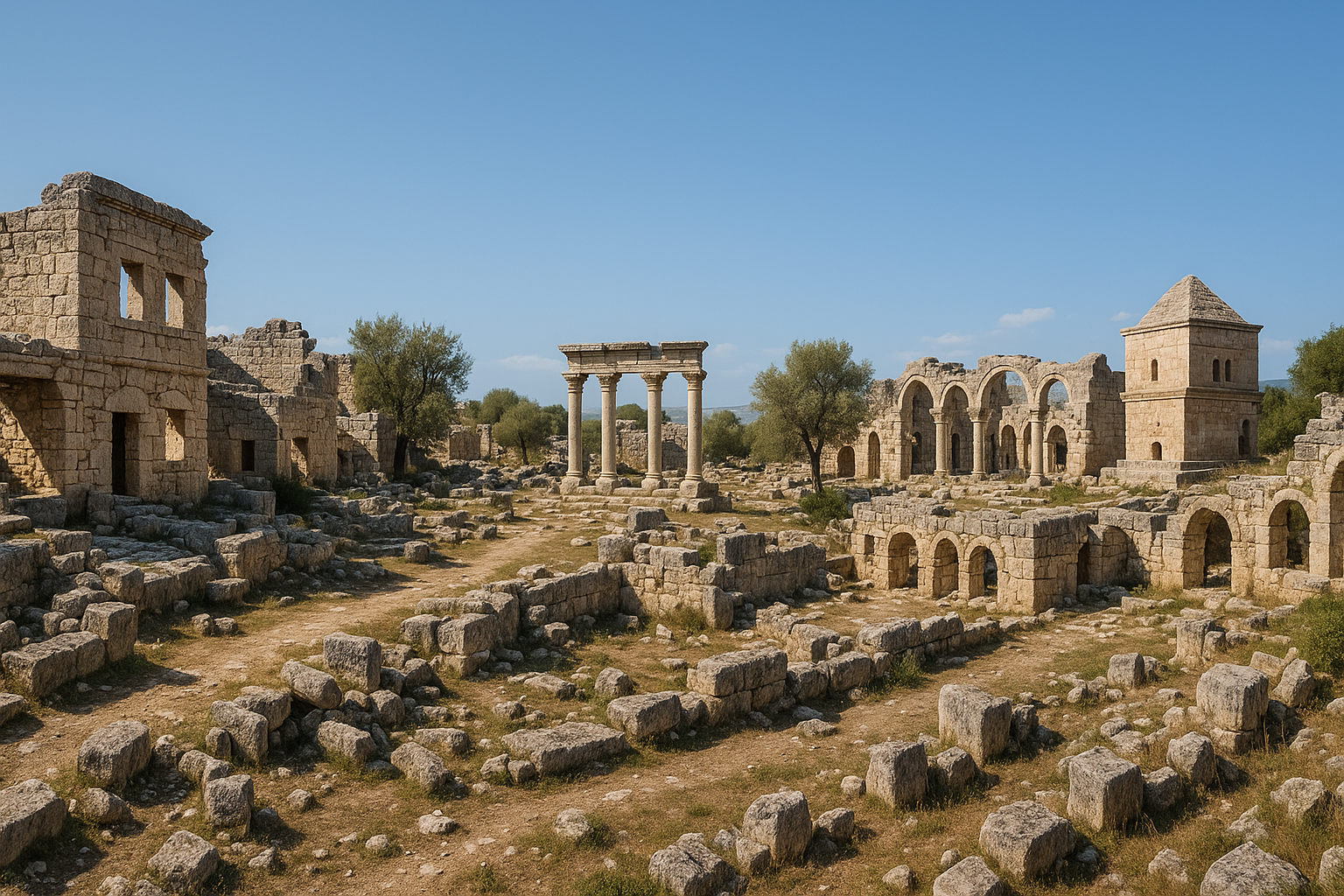
Karakabaklı est un établissement rural remarquablement bien préservé des périodes romaine et protobyzantine, niché dans le paysage karstique accidenté de la Cilicie Trachée (Cilicie Rude). Connu pour ses deux tétrapyles, ses églises basilicales, ses ateliers d'huile d'olive et ses maisons en pierre à deux étages, ce village agricole isolé offre un regard sans filtre sur la manière dont les gens ordinaires vivaient, travaillaient et priaient en Anatolie antique entre les IIe et VIIe siècles apr. J.-C.
Table des matières
- Pourquoi Karakabaklı compte
- Géographie et cadre
- Chronologie historique
- Principaux monuments
- Travaux archéologiques
- Informations pour les visiteurs
- Foire aux questions
- Sources et lectures complémentaires
Pourquoi Karakabaklı compte
La plupart des sites antiques qui attirent les visiteurs sont de grands centres urbains — des cités dotées de théâtres, d'agoras et de colonnades de marbre. Karakabaklı est fondamentalement différent. C'est un établissement rural, un village où agriculteurs, producteurs d'huile d'olive et bergers ont façonné leur monde à partir de blocs de calcaire grossiers. Voici pourquoi cela importe :
-
Une archéologie rurale authentique. Tandis que des cités comme Éphèse ou Pergé mettent en valeur l'architecture d'élite, Karakabaklı révèle comment la grande majorité des habitants de l'Empire romain vivaient réellement. Les fermes, les installations de stockage et les modestes églises racontent l'histoire de communautés ordinaires qui sont généralement invisibles dans les sources historiques.
-
Une préservation exceptionnelle. En raison de son emplacement isolé dans les monts Taurus, Karakabaklı n'a jamais été systématiquement pillé ni recouvert de constructions ultérieures. Les murs s'élèvent encore jusqu'à leurs deuxièmes étages, les arcs restent intacts, et l'on peut encore parcourir la route romaine qui reliait le village au monde extérieur.
-
Les tétrapyles comme monuments ruraux. La présence de deux tétrapyles (portes monumentales à quatre piliers) dans un village aussi petit est extraordinaire. On les trouve habituellement dans les grandes cités. Leur existence ici suggère que même les petits établissements de la Cilicie Rude participaient aux traditions architecturales romaines plus larges.
-
L'économie de l'huile d'olive. La région de la Cilicie Rude était une zone majeure de production d'huile d'olive durant l'Antiquité tardive. Karakabaklı conserve des pressoirs taillés dans la roche, des systèmes à levier et contrepoids, ainsi que des aires de stockage qui documentent cette industrie agricole avec un détail remarquable.
-
Le lien avec Işıkkale. Karakabaklı était relié par une route antique à l'établissement fortifié voisin d'Işıkkale, formant un réseau de communautés rurales qui fonctionnaient ensemble sur les plans économique et défensif.
Géographie et cadre
Karakabaklı se trouve dans l'arrière-pays montagneux de Silifke (l'antique Séleucie du Calycadnos), dans la province de Mersin, au sud-est de la Turquie. Le site est situé à environ 7 kilomètres au nord-ouest de Susanoğlu (l'antique Corasium) et à proximité du village moderne de Karadedeli (aujourd'hui un quartier d'Atakent).
| Caractéristique | Détail |
|---|---|
| Région | Cilicie Trachée (Cilicie Rude) / Isaurie sud-orientale |
| Terrain | Karst calcaire des monts Taurus centraux |
| Altitude | Environ 400--600 m au-dessus du niveau de la mer |
| Ville importante la plus proche | Silifke (~25 km au nord-ouest) |
| Côte la plus proche | Susanoğlu / Corasium (~7 km au sud-est) |
| Ressources en eau | Cours d'eau saisonniers, citernes taillées dans la roche |
Le paysage est typique de la Cilicie Rude : un terrain rocheux et ondulant couvert de maquis bas, ponctué de petites vallées fertiles où l'on pouvait cultiver céréales, oliviers et vignes. L'établissement est positionné le long d'une route antique qui reliait la zone côtière aux hauts plateaux intérieurs, ce qui lui conférait une importance stratégique comme étape pour le commerce et la communication.
Malgré le terrain difficile, les habitants exploitaient chaque poche de sol disponible. Une agriculture en terrasses était pratiquée sur les versants, et des citernes creusées dans la roche calcaire recueillaient les eaux de pluie pour l'usage domestique et l'irrigation.
Chronologie historique
Période hellénistique (IIIe--Ier siècles av. J.-C.)
Les traces les plus anciennes à Karakabaklı remontent à la période hellénistique, bien qu'aucune structure substantielle de cette époque ne subsiste. La région de la Cilicie Rude était sous le contrôle lâche de l'Empire séleucide et tomba ensuite dans une période d'instabilité marquée par la piraterie et les chefs de guerre locaux. De petites fermes existaient probablement dans la région, mais un établissement à grande échelle ne s'y était pas encore développé.
Période romaine ancienne (Ier--IIIe siècles apr. J.-C.)
Après la conquête romaine de la Cilicie et la répression de la piraterie par Pompée en 67 av. J.-C., la région se stabilisa progressivement. Sous l'Empire romain, la production agricole s'étendit considérablement. Karakabaklı débuta probablement comme une ferme isolée durant cette période, croissant lentement à mesure que la production d'huile d'olive devenait de plus en plus rentable.
Période romaine tardive (IVe--Ve siècles apr. J.-C.)
Ce fut l'âge d'or de Karakabaklı. Au IVe siècle, l'établissement fut substantiellement reconstruit et fortifié avec un mur défensif, des portes monumentales (les tétrapyles) et des tours. La population s'accrut, et de nouvelles structures furent ajoutées : des églises basilicales pour la communauté désormais chrétienne, un tombeau monumental et des installations agrandies de production d'huile d'olive. La qualité de la maçonnerie durant cette période est remarquablement élevée, ce qui suggère que des bâtisseurs qualifiés étaient disponibles même dans ce lieu reculé.
Période protobyzantine (Ve--VIIe siècles apr. J.-C.)
L'occupation se poursuivit et même s'étendit au cours des Ve et VIe siècles. Les églises étaient probablement des centres actifs de la vie communautaire, et la production d'huile d'olive restait économiquement importante. L'établissement atteignit peut-être sa population maximale durant cette période.
Abandon (VIIe--VIIIe siècles apr. J.-C.)
Karakabaklı fut presque certainement abandonné durant les guerres arabo-byzantines des VIIe et VIIIe siècles. Les raids arabes en Cilicie rendaient les établissements ruraux vulnérables, et les populations se retiraient dans des cités fortifiées ou des bastions côtiers. Le village ne fut jamais réoccupé, ce qui, paradoxalement, garantit sa préservation extraordinaire.
Principaux monuments
Le tétrapyle nord
Le tétrapyle nord est la structure la mieux préservée de Karakabaklı et l'un des plus beaux exemples de porte monumentale rurale de toute la Cilicie Rude. Il se dresse à l'entrée nord de l'établissement, chevauchant l'ancienne route.
- Forme : Une porte à quatre piliers sur un plan presque carré
- Préservation : Un arc complet subsiste, encore soutenu par ses piliers d'origine ornés de chapiteaux de style corinthien
- Hauteur : Environ 4--5 mètres jusqu'au sommet de l'arc subsistant
- Date : Probablement IVe siècle apr. J.-C., d'après le style de maçonnerie et les parallèles architecturaux
- Fonction : Servait à la fois d'entrée monumentale et de marqueur symbolique de l'identité de l'établissement
Le tétrapyle nord est remarquable car les structures de ce type sont généralement associées aux grandes cités romaines (comme le tétrapyle d'Aphrodisias ou d'Anjar). Sa présence dans un village rural suggère que la communauté avait à la fois les ressources et l'ambition d'imiter les formes architecturales urbaines.
Le tétrapyle sud
Un second tétrapyle se dresse à l'approche sud de l'établissement. Il est moins bien préservé que la porte nord mais conserve suffisamment d'éléments structurels pour confirmer sa forme d'origine. Ensemble, les deux tétrapyles définissaient l'axe principal de l'établissement et encadraient la route romaine qui traversait le village.
Les églises basilicales
Karakabaklı contient les vestiges de deux églises de plan basilical, toutes deux datées du Ve ou VIe siècle apr. J.-C. Ce sont des structures à trois nefs dotées d'absides semi-circulaires orientées à l'est.
- Église 1 (basilique principale) : Située près du centre de l'établissement. Les murs préservés s'élèvent à une hauteur d'environ 2--3 mètres. Des bases de colonnes et des fragments de décoration architecturale subsistent in situ.
- Église 2 (basilique plus petite) : Située sur le bord oriental de l'établissement. Cette église a pu remplir une fonction communautaire spécifique, telle qu'une chapelle funéraire ou une annexe baptismale.
Les deux églises sont dotées de baptistères (kolymbia), confirmant que la communauté pratiquait le baptême et que les églises fonctionnaient comme de véritables centres paroissiaux plutôt que comme de simples chapelles.
Villa à deux étages
L'une des structures résidentielles les plus impressionnantes de Karakabaklı est une grande villa à deux étages qui conserve ses murs pratiquement à leur hauteur d'origine. Le rez-de-chaussée servait probablement au stockage et à l'abri des animaux, tandis que l'étage supérieur servait de quartiers d'habitation principaux — un plan typique des maisons rurales à travers la Méditerranée orientale.
- Construction : Blocs de calcaire grossièrement taillés avec mortier
- Caractéristiques : Cour, pièces de stockage et indices d'un escalier interne
- Date : Romain tardif / Protobyzantin (IVe--VIe siècle apr. J.-C.)
Bâtiments de production d'huile d'olive
Plusieurs structures à Karakabaklı sont identifiables comme des ateliers d'huile d'olive d'après la présence :
- De lits de pressoir taillés dans la roche directement creusés dans le substrat rocheux
- De systèmes de pression à levier et contrepoids (contrepoids en pierre munis de trous de fixation)
- De cuves de collecte pour séparer l'huile de l'eau
- D'aires de stockage avec de grands vases en céramique (pithoi)
Ces installations confirment que Karakabaklı était un participant actif à l'économie de l'huile d'olive qui rendit la Cilicie Rude prospère durant l'Antiquité tardive. L'huile d'olive était une marchandise d'exportation majeure, utilisée pour la cuisine, l'éclairage, la production de savon et les rituels religieux.
Tombeau monumental
Un tombeau monumental d'époque romaine se dresse près de l'établissement, appartenant probablement à une famille locale éminente. Le tombeau présente des blocs de pierre taillés et des moulures architecturales qui indiquent une date au IIe ou IIIe siècle apr. J.-C. — antérieure à la plupart des autres structures du site. Cela suggère que la zone était habitée avant que l'établissement principal ne soit officiellement établi.
Murs et tours de défense
Au IVe siècle apr. J.-C., l'établissement fut entouré d'un mur défensif ponctué de tours de guet. Cette fortification était probablement une réponse à l'insécurité générale de la fin de la période romaine, lorsque les communautés rurales à travers l'Anatolie investissaient dans l'autodéfense contre le brigandage et les menaces militaires.
Travaux archéologiques
L'étude systématique de Karakabaklı a commencé relativement récemment. Le site fut documenté pour la première fois lors des prospections régionales de la Cilicie Rude menées à la fin du XXe siècle.
- Günder Varinlioğlu (Université des Beaux-Arts Mimar Sinan) a mené des recherches détaillées à Karakabaklı à partir de 2003. Ses travaux ont porté sur la documentation des vestiges architecturaux et la compréhension du rôle de l'établissement au sein du réseau plus large de communautés rurales en Cilicie et en Isaurie.
- Les tétrapyles ont fait l'objet d'une étude académique spécifique, avec une publication dédiée analysant leur forme architecturale et leurs parallèles régionaux.
- Karakabaklı a également été étudié dans le contexte de la production d'huile d'olive en Cilicie Rude, contribuant à notre compréhension de l'économie agricole qui soutenait ces communautés montagnardes.
Aucune fouille à grande échelle n'a été menée à Karakabaklı. Les vestiges visibles sont entièrement des éléments de surface — murs, églises, tétrapyles et installations de production qui ont survécu hors-sol pendant plus de 1 400 ans. Cela signifie que d'importants dépôts archéologiques restent probablement enfouis sous la surface, en attente d'investigations futures.
Informations pour les visiteurs
S'y rendre
- Depuis Silifke : Conduisez vers le sud-est en direction de Susanoğlu/Atakent. Le site est accessible par des routes non goudronnées depuis le village de Karadedeli. Un véhicule avec une garde au sol raisonnable est recommandé.
- Depuis Mersin : Empruntez la route côtière (D-400) vers l'ouest jusqu'à Silifke, puis suivez les indications ci-dessus. Distance totale d'environ 90 km.
- Coordonnées GPS : Environ 36.33N, 33.95E (à vérifier avec des cartes locales)
À quoi s'attendre
- Pas de droit d'entrée (site en plein air, non clôturé)
- Aucun équipement sur place (pas de toilettes, pas d'eau, pas de structures d'ombrage)
- Terrain : Sol rocheux et inégal avec végétation de maquis. Des chaussures de marche solides sont essentielles.
- Signalisation : Minimale ou absente. Apportez des documents de recherche ou un guide.
Durée de visite recommandée
- Aperçu rapide : 1--1,5 heure
- Exploration détaillée : 2--3 heures
- Visite photographique/de recherche : Une demi-journée
Meilleure période pour visiter
- Printemps (mars--mai) : Fleurs sauvages, températures agréables, meilleure lumière pour la photographie
- Automne (septembre--novembre) : Temps doux, humidité plus faible
- Été : Très chaud ; visitez tôt le matin ou en fin d'après-midi
- Hiver : Accessible mais peut être froid et boueux sur les routes non goudronnées
Visites combinées
Karakabaklı se combine bien avec des visites à :
- Işıkkale — l'établissement fortifié voisin relié par l'ancienne route
- Corasium (Susanoğlu) — cité côtière antique avec des vestiges portuaires
- Uzuncaburç (Olba/Diocésarée) — site majeur d'époque romaine avec une rue à colonnades et un temple de Zeus Olbios
- Le château de Silifke et le Musée archéologique de Silifke
Conseils
- Apportez suffisamment d'eau et une protection solaire
- Téléchargez des cartes hors ligne avant la visite, car le signal mobile peut être faible
- Respectez les vestiges archéologiques : ne grimpez pas sur les murs et n'enlevez pas de pierres
- Les visites matinales offrent la meilleure combinaison de lumière et de température
Foire aux questions
Comment Karakabaklı s'appelait-il dans l'Antiquité ?
Le nom antique de l'établissement est inconnu. « Karakabaklı » est le nom turc moderne de la zone. Malgré la présence d'une architecture monumentale, aucune inscription n'a encore été trouvée qui révélerait le nom d'origine de l'établissement.
Pourquoi y a-t-il des tétrapyles dans un si petit village ?
C'est l'une des questions les plus intéressantes à propos de Karakabaklı. Les tétrapyles sont généralement associés aux grandes cités romaines. Leur présence ici pourrait indiquer que l'établissement avait une importance économique plus grande que sa petite taille ne le suggère — peut-être comme nœud dans le commerce de l'huile d'olive — ou que les communautés rurales de la Cilicie Rude adoptaient les formes architecturales urbaines plus volontiers qu'on ne le pensait auparavant.
Karakabaklı convient-il aux familles avec enfants ?
Le site est accessible aux familles, mais le terrain est accidenté et il n'y a pas d'équipements. Les enfants doivent être surveillés autour des murs en ruine. Il convient le mieux aux visiteurs ayant une certaine expérience de la marche sur sol irrégulier.
Comment Karakabaklı se compare-t-il aux autres sites antiques de la région ?
Contrairement aux grandes cités comme Uzuncaburç ou Silifke, Karakabaklı offre une perspective rurale sur la vie antique. Il est beaucoup plus petit et manque des bâtiments publics monumentaux d'un centre urbain, mais il offre une vue plus intime et authentique de la vie quotidienne dans la campagne romaine.
Y a-t-il des fouilles en cours ?
Selon les derniers rapports, aucune fouille officielle n'est menée. Le site a été documenté à travers des prospections de surface et des études architecturales. De futures fouilles pourraient révéler des informations importantes sur la vie domestique, l'alimentation et les pratiques agricoles.
Quel est le lien entre Karakabaklı et Işıkkale ?
Les deux établissements étaient reliés par une ancienne route encore partiellement visible. Işıkkale était un établissement plus grand et plus fortifié qui a pu servir de centre administratif ou défensif régional, tandis que Karakabaklı fonctionnait comme une communauté satellite agricole.
Mesures architecturales et inventaire structurel
Les prospections architecturales détaillées menées par Varinlioğlu et les chercheurs ultérieurs ont produit l'inventaire suivant de l'environnement bâti de Karakabaklı :
| Structure | Dimensions / Spécifications | Date | État de préservation |
|---|---|---|---|
| Tétrapyle nord | ~5 m de hauteur (jusqu'au sommet de l'arc) ; plan presque carré ; 4 piliers à chapiteaux de style corinthien | IVe siècle apr. J.-C. | Un arc complet subsiste sur les piliers d'origine |
| Tétrapyle sud | Plan similaire à la porte nord ; éléments structurels partiels subsistants | IVe siècle apr. J.-C. | Moins bien préservé ; base et piliers partiels visibles |
| Basilique 1 (église principale) | Plan à trois nefs avec abside est semi-circulaire ; murs jusqu'à ~2-3 m de hauteur | Ve-VIe siècle apr. J.-C. | Bases de colonnes et décoration architecturale in situ |
| Basilique 2 (petite église) | Plan à trois nefs avec pièces latérales ; possible chapelle funéraire ou annexe baptismale | Ve-VIe siècle apr. J.-C. | Murs et abside partiels visibles |
| Villa à deux étages | Rez-de-chaussée (stockage/abri des animaux) + étage supérieur (quartiers d'habitation) ; cour, escalier interne | IVe-VIe siècle apr. J.-C. | Murs presque à leur hauteur d'origine |
| Tombeau monumental | Blocs de pierre taillés avec moulures architecturales | IIe-IIIe siècle apr. J.-C. | Structure debout près du bord de l'établissement |
| Circuit du mur défensif | Mur d'enceinte avec tours de guet à intervalles | IVe siècle apr. J.-C. | Traçable autour du périmètre de l'établissement |
| Ateliers d'huile d'olive | Lits de pressoir taillés dans la roche, contrepoids à levier, cuves de collecte | IIe-VIe siècle apr. J.-C. | Lits de pressoir préservés dans le substrat rocheux |
Les deux basiliques contiennent des baptistères (kolymbia) — des fonts baptismaux par immersion complète — confirmant que ces églises fonctionnaient comme des centres paroissiaux complets avec l'autorité d'administrer le baptême, et non comme de simples chapelles dépendantes visitées par un clergé itinérant. La présence de baptistères dans un établissement aussi petit indique à quel point l'organisation ecclésiastique avait pénétré la Cilicie rurale dès le Ve siècle.
Technologie de production d'huile d'olive : analyse technique
Les installations de pressage d'huile d'olive à Karakabaklı représentent le type de pressoir à levier et contrepoids, la technologie de pressage dominante en Cilicie Rude durant l'Antiquité tardive. Le tableau suivant détaille les composants et leurs signatures archéologiques :
| Composant | Description | Preuves archéologiques à Karakabaklı |
|---|---|---|
| Bassin d'écrasement | Bassin en pierre où les olives étaient écrasées avant pressage | Bassins circulaires taillés dans la roche dans les zones d'atelier |
| Lit de pressoir | Surface plane à canaux où la pâte d'olive écrasée était placée sous la poutre de pressage | Lits de pressoir taillés directement dans le substrat calcaire |
| Cavité de poutre à levier | Fente taillée dans un mur ou la roche pour ancrer l'extrémité fixe de la poutre de pressage en bois | Fentes rectangulaires visibles dans les murs des ateliers |
| Pierre de contrepoids | Pierre lourde (généralement 200-500 kg) suspendue à l'extrémité libre de la poutre à levier | Blocs de pierre percés avec trous de fixation trouvés sur place |
| Canal de collecte | Rainure sculptée dirigeant l'huile pressée vers une cuve de séparation | Canaux taillés dans la roche sous les lits de pressoir |
| Cuve de séparation | Bassin où l'huile et l'eau pouvaient se séparer par gravité | Cuves taillées dans la roche adjacentes aux lits de pressoir |
| Aire de stockage | Espace pour de grands vases en céramique (pithoi) contenant l'huile finie | Pièces de stockage avec empreintes de bases de pithoi |
Cette technologie à levier et contrepoids était efficace et économique pour les communautés rurales. Contrairement au pressoir à vis plus élaboré utilisé dans les grands centres urbains (qui nécessitait des composants métalliques usinés avec précision), le pressoir à levier pouvait être construit presque entièrement à partir de matériaux disponibles localement : substrat calcaire pour le lit de pressoir, bois local pour la poutre, et une seule grosse pierre pour le contrepoids. Les seuls éléments importés étaient probablement les ferrures métalliques qui fixaient le contrepoids à la poutre.
La production des ateliers de Karakabaklı aurait été transportée le long de l'ancienne route jusqu'à la côte — probablement vers Corasium (l'actuelle Susanoğlu), à environ 7 km au sud-est — où elle entrait dans le réseau commercial méditerranéen plus large de l'huile d'olive.
Phases de développement de l'établissement
L'analyse archéologique des techniques de construction et des parallèles architecturaux permet de reconstituer le développement de Karakabaklı à travers des phases distinctes :
| Phase | Période | Caractéristiques | Preuves |
|---|---|---|---|
| Phase 1 : Ferme initiale | Ier-IIe siècle apr. J.-C. | Ferme isolée unique ; début de l'oléiculture | Tombeau monumental (IIe-IIIe s.) antérieur à la plupart des autres structures |
| Phase 2 : Expansion agricole | IIIe siècle apr. J.-C. | Bâtiments agricoles supplémentaires ; début de la production d'huile d'olive | Installations de pressage ; premières structures d'atelier |
| Phase 3 : Formation du village | IVe siècle apr. J.-C. | Murs défensifs, tétrapyles, tours de guet ; plan d'établissement formel | Circuit de murs, portes monumentales, construction de tours |
| Phase 4 : Christianisation | Ve-VIe siècle apr. J.-C. | Deux églises basilicales avec baptistères ; population maximale | Construction des églises, décoration architecturale religieuse |
| Phase 5 : Abandon | VIIe-VIIIe siècle apr. J.-C. | Établissement déserté durant les guerres arabo-byzantines | Aucune construction datable après le VIIe siècle ; aucun matériel de période islamique |
La transition de la phase 1 à la phase 3 — de la ferme isolée au village fortifié — reflète un schéma plus large à travers la Cilicie Rude aux IIIe-IVe siècles, lorsque les communautés rurales à travers l'Anatolie investissaient dans la défense collective alors que l'autorité romaine centrale s'affaiblissait. Le tombeau monumental de la phase 1 (IIe-IIIe siècle apr. J.-C.) suggère que la famille agricole d'origine était suffisamment prospère pour commander une architecture funéraire en pierre taillée, indiquant que la production d'huile d'olive générait déjà une richesse significative avant l'urbanisation formelle de l'établissement.
Sources et lectures complémentaires
- Varinlioğlu, G. « A Rural Settlement in the Rough Cilicia-Isaura Region: Karakabakli. » Academia.edu, 2003.
- « The Tetrapylons of Karakabakli in the Region of Southeastern Isauria. » Academia.edu.
- Karakabaklı — Wikipédia
- Karakabaklı — Turkish Archaeological News
- Karakabaklı — Archiqoo
- Elton, H. et al. « Olive Oil Production in Rough Cilicia: Production Installations, Settlement Patterns, Dating. » Academia.edu.
- Rough Cilicia Archaeological Survey Project (RCSP) — Université Purdue
- Direction provinciale de la Culture et du Tourisme de Mersin
Comprendre les schémas d'établissement rural en Cilicie Rude
Karakabaklı n'existe pas isolément. Il fait partie d'un schéma plus large d'établissement rural qui définissait le paysage de la Cilicie Rude durant l'Antiquité tardive. Comprendre ce schéma aide les visiteurs à apprécier pourquoi des sites comme Karakabaklı se sont développés là où ils l'ont fait et ce qu'ils signifiaient pour les gens qui les ont construits.
Le réseau agricole
Aux périodes romaine et byzantine, la Cilicie Rude était couverte d'un réseau de petits établissements agricoles reliés par des routes, des sentiers et des relations économiques partagées. Chaque établissement se spécialisait dans des produits particuliers — huile d'olive, vin, céréales ou bétail — et commerçait avec les autres par le biais d'un système de marchés locaux et de ports côtiers.
L'accent de Karakabaklı était clairement mis sur la production d'huile d'olive, comme le démontrent les pressoirs taillés dans la roche et les installations de stockage trouvées dans tout le site. L'huile produite ici aurait été transportée le long de l'ancienne route jusqu'à la côte (probablement vers Corasium/Susanoğlu), où elle entrait dans le réseau commercial méditerranéen plus large.
Architecture défensive en milieu rural
Les murs et les tours de défense à Karakabaklı reflètent une tendance plus large dans l'Anatolie romaine tardive. À mesure que l'autorité centrale s'affaiblissait aux IIIe et IVe siècles, les communautés rurales investissaient de plus en plus dans leur propre défense. Les murs de Karakabaklı n'étaient pas conçus pour résister à un siège majeur mais plutôt pour dissuader le brigandage occasionnel — banditisme, incursions militaires à petite échelle et attaques opportunistes.
Les deux tétrapyles, bien que servant principalement de portes monumentales, fonctionnaient également comme partie du périmètre défensif. Ils contrôlaient l'accès à l'établissement et fournissaient des positions élevées d'où les gardes pouvaient surveiller les visiteurs s'approchant.
Le christianisme dans la campagne
Les deux églises basilicales de Karakabaklı démontrent que le christianisme atteignit même les communautés rurales les plus reculées de la Cilicie Rude dès le Ve siècle. La présence de baptistères confirme qu'il s'agissait d'églises paroissiales pleinement fonctionnelles, et non de simples chapelles visitées par un clergé itinérant.
Les églises auraient servi de centre social et spirituel de la communauté — des lieux où les villageois se rassemblaient non seulement pour le culte mais aussi pour des réunions communautaires, la résolution de conflits, et la célébration des événements de la vie (naissances, mariages, décès).
Contexte comparatif : Karakabaklı et autres sites ruraux
Les visiteurs intéressés par l'exploration de l'archéologie rurale de la Cilicie Rude peuvent comparer Karakabaklı avec plusieurs autres sites de la région :
| Site | Distance de Karakabaklı | Caractéristiques clés |
|---|---|---|
| Işıkkale | ~3 km (reliés par une route antique) | Établissement fortifié avec églises et citernes |
| Çambazlı | ~15 km au nord-ouest | Village romain tardif bien préservé avec église |
| Cennet-Cehennem | ~20 km au nord-ouest | Dolines spectaculaires avec église byzantine |
| Uzuncaburç (Olba) | ~30 km au nord-ouest | Grand centre urbain avec temple de Zeus et rue à colonnades |
| Corasium (Susanoğlu) | ~7 km au sud-est | Cité côtière avec port |
Chacun de ces sites offre une perspective différente sur la vie dans la Cilicie Rude antique, depuis l'architecture urbaine grandiose d'Uzuncaburç jusqu'à la domesticité rurale intime de Karakabaklı.
L'économie de l'huile d'olive de la Cilicie de l'Antiquité tardive
L'huile d'olive était le moteur économique qui propulsait la prospérité d'établissements comme Karakabaklı. Dans la Méditerranée antique, l'huile d'olive n'était pas simplement un produit alimentaire ; c'était une marchandise fondamentale aux multiples usages :
- Cuisine et préparation des aliments — la principale matière grasse culinaire
- Éclairage — les lampes à huile étaient la forme standard d'éclairage artificiel
- Hygiène personnelle — l'huile d'olive était utilisée comme nettoyant corporel (appliquée puis raclée avec un strigile)
- Rituels religieux — l'onction à l'huile était centrale tant dans la pratique païenne que chrétienne
- Médecine — utilisée comme base pour les préparations pharmaceutiques
- Production de savon — une industrie majeure de l'Antiquité tardive
Les installations de pressoirs taillés dans la roche à Karakabaklı représentent un type spécifique de pressoir à olives commun en Cilicie Rude : le pressoir à levier et contrepoids. Dans ce système, une longue poutre en bois était insérée dans une fente taillée dans la roche, et un lourd contrepoids en pierre était suspendu à l'extrémité opposée de la poutre. Les olives écrasées étaient placées sous la poutre, et le poids du contrepoids pressait l'huile, qui s'écoulait dans des canaux de collecte sculptés dans la roche en dessous.
Cette technologie était efficace et relativement peu coûteuse, nécessitant un minimum de composants métalliques. Elle convenait bien aux communautés rurales qui ne pouvaient se permettre la technologie plus élaborée du pressoir à vis utilisée dans les grands centres urbains.
Lire le paysage : un guide d'interprétation sur place
Lorsque vous arrivez à Karakabaklı, utilisez le cadre suivant pour organiser vos observations :
-
Identifiez d'abord la route. L'ancienne route qui traverse l'établissement est la colonne vertébrale organisatrice du site. Trouvez-la, et tout le reste se mettra en place par rapport à elle.
-
Repérez les deux tétrapyles. Ils marquent les limites nord et sud de l'établissement le long de la route. Ce sont vos points d'orientation principaux.
-
Distinguez les espaces résidentiels des espaces productifs. Les maisons ont tendance à avoir de plus petites pièces, des cours et des étages supérieurs. Les ateliers d'huile d'olive sont reconnaissables à leurs lits de pressoir taillés dans la roche et à leurs contrepoids en pierre.
-
Trouvez les églises. Ce sont les plus grands bâtiments non défensifs de l'établissement et elles sont orientées est-ouest, avec des absides semi-circulaires à l'extrémité orientale.
-
Cherchez l'infrastructure hydraulique. Citernes, canaux et bassins taillés dans la roche révèlent comment la communauté gérait sa ressource la plus précieuse.
-
Tracez le mur défensif. Suivez le circuit du mur pour comprendre les limites de l'établissement et les points où il était le plus vulnérable.
-
Observez la qualité de la construction. Remarquez comment la qualité de la maçonnerie varie entre les bâtiments et les périodes. Les tétrapyles et les églises présentent la plus belle maçonnerie ; les bâtiments domestiques sont plus grossiers.
-
Terminez à un point de vue. Reculez par rapport aux ruines et regardez l'établissement en relation avec le paysage environnant. Considérez pourquoi cet emplacement particulier a été choisi et comment le terrain a façonné le développement de la communauté.
Réflexions finales
Karakabaklı nous rappelle que le monde antique n'était pas composé uniquement de grandes cités et de monuments célèbres. Pour chaque Éphèse ou Athènes, il y avait des milliers de petites communautés comme celle-ci — des lieux où les agriculteurs cultivaient des versants rocheux, où les familles construisaient des maisons en pierre solides qui allaient tenir debout pendant seize siècles, et où un modeste village pouvait produire une architecture suffisamment ambitieuse pour inclure des portes monumentales à quatre piliers.
Les gens qui ont construit Karakabaklı sont inconnus de l'histoire. Aucun général ou empereur célèbre n'a parcouru ses rues. Aucune grande œuvre littéraire ne décrit ses marchés. Mais les pierres parlent assez clairement : c'était une communauté qui était fière de son travail, qui investissait dans son avenir, et qui a créé quelque chose d'assez durable pour survivre à l'empire qui la gouvernait autrefois.