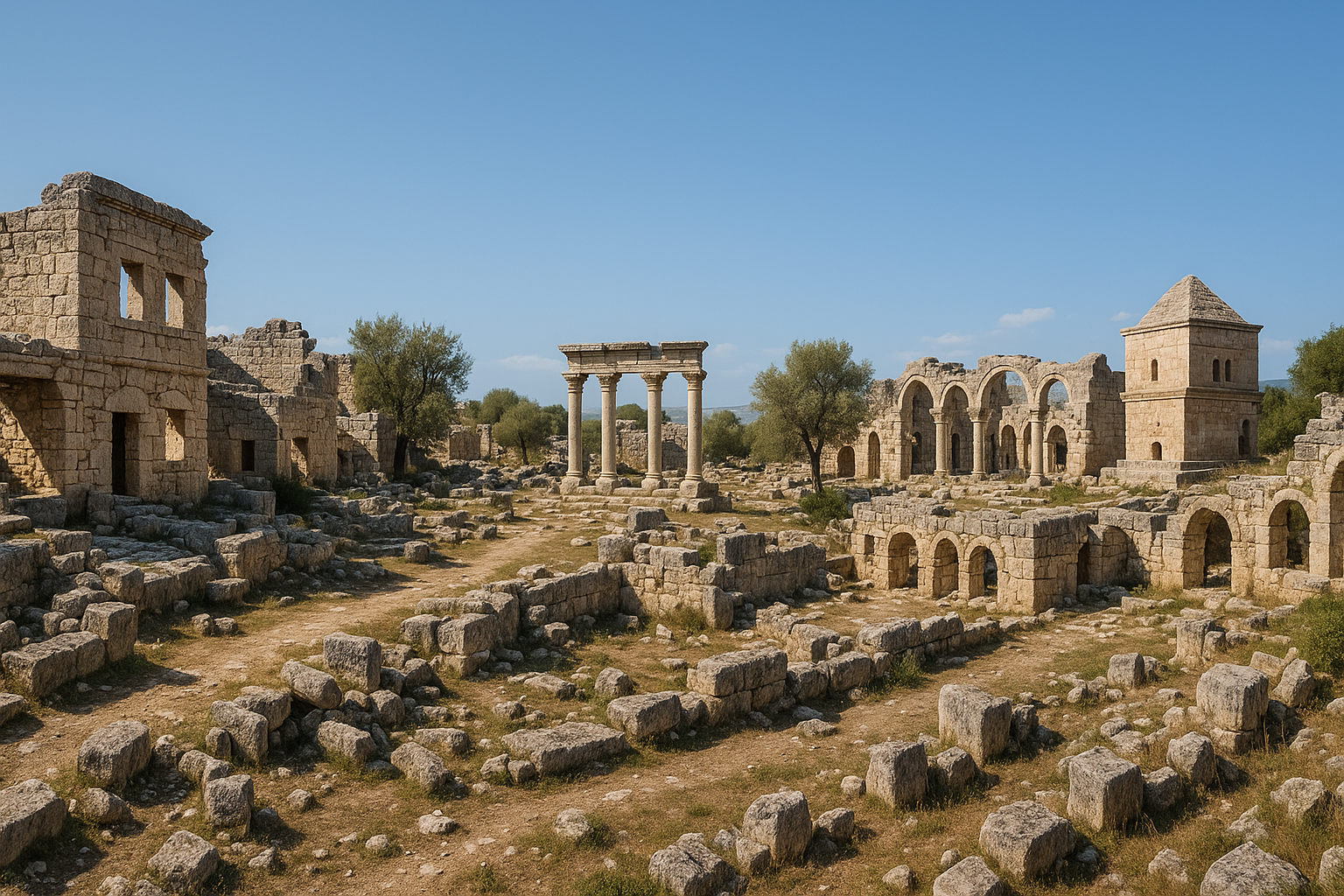
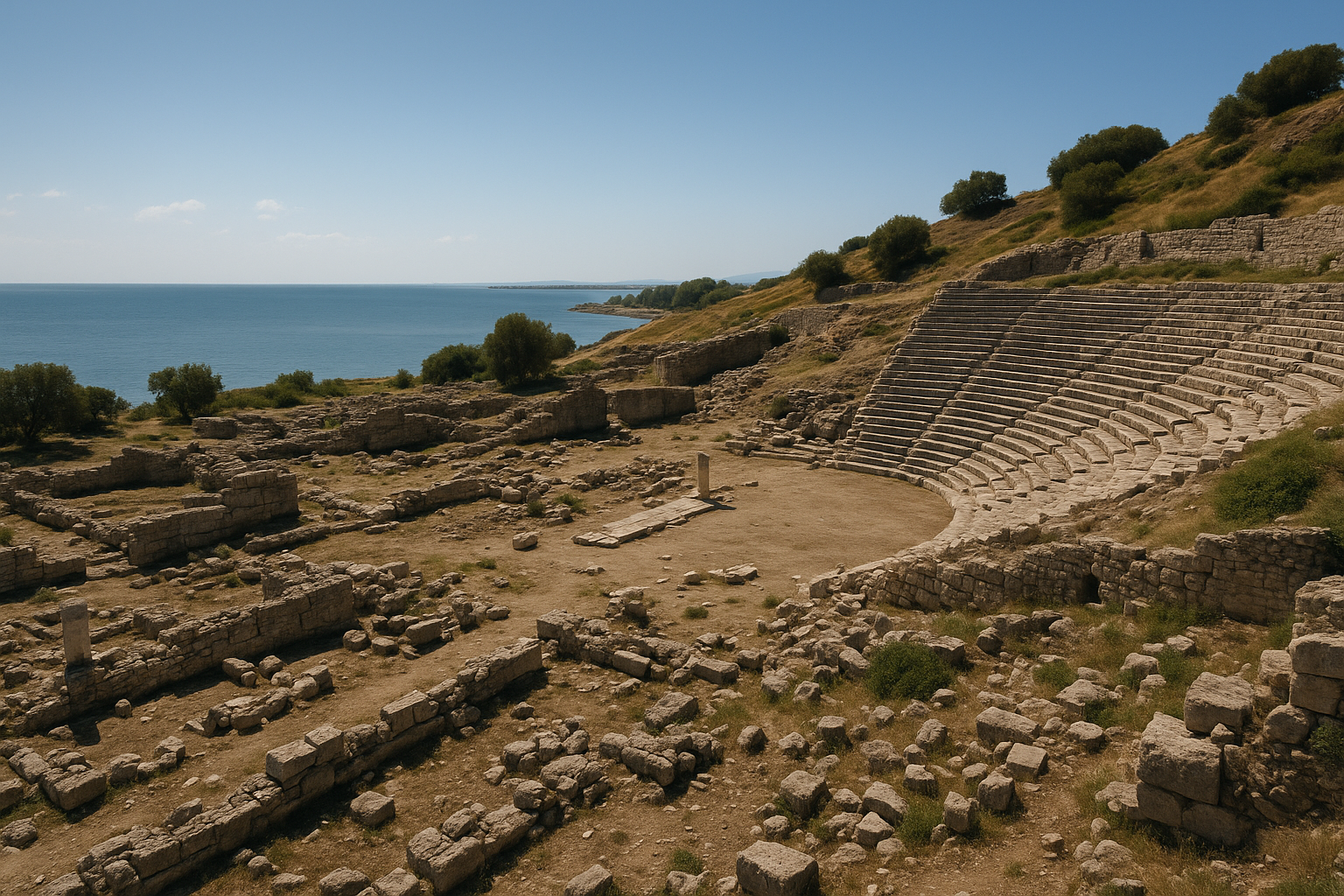
Soli-Pompeipolis is one of the most important ancient harbour cities on Turkey's eastern Mediterranean coast, located in the Mezitli district of modern Mersin. Founded by Rhodian colonists around 700 BC, the city flourished as a commercial and cultural centre for over a millennium. After being devastated by pirates, it was rebuilt by the Roman general Pompey the Great in 67 BC and renamed Pompeipolis ("City of Pompey"). Its iconic colonnaded street -- 450 metres long with Corinthian columns bearing carved busts of emperors and gods -- remains the defining monument of the site. Soli also gave the English language the word "solecism", reflecting the distinctive Greek dialect spoken by its inhabitants.
- Why Soli-Pompeipolis Matters
- Geography and Setting
- Historical Timeline
- Major Monuments
- The Colonnaded Street in Detail
- Archaeological Work
- Visitor Information
- Frequently Asked Questions
- Sources and Further Reading
Why Soli-Pompeipolis Matters
Soli-Pompeipolis deserves a prominent place on any ancient Turkey itinerary for these reasons:
-
Birthplace of a word. The English term "solecism" (a grammatical mistake or breach of etiquette) derives from the Greek soloikismos, referring to the "incorrect" Greek spoken by Soli's colonists, who blended their Rhodian dialect with local Cilician influences. This etymological connection makes Soli unique among ancient cities.
-
Home of Aratos. The renowned Hellenistic poet and astronomer Aratos of Soli (c. 315--240 BC) authored Phainomena, a didactic poem on celestial phenomena that was one of the most widely read works in the ancient world, translated into Latin by Cicero and Germanicus and studied in schools for centuries.
-
Pompey's showcase city. After clearing the Mediterranean of pirates in 67 BC, Pompey resettled captured pirates and local refugees in Soli, investing in major infrastructure to create a model Roman city. The renaming to Pompeipolis symbolized Rome's new order in eastern Cilicia.
-
One of the largest ancient harbours in the Eastern Mediterranean. The harbour, with a western breakwater of 160 metres and a total harbour length of 320 metres, used hydraulic concrete technology -- a hallmark of advanced Roman engineering.
-
A living archaeological site within a modern city. Unlike remote ruins, Soli-Pompeipolis sits within the urban fabric of Mersin, making it one of Turkey's most accessible ancient sites and an ongoing open-air museum project.
Geography and Setting
Soli-Pompeipolis occupies a flat coastal plain in the Viransehir neighbourhood of Mezitli, directly on the Mediterranean shore. The city's ancient harbour faced south towards the open sea, while the colonnaded street extended inland on a north-south axis.
The modern city of Mersin (population over 1.8 million) has grown around and over much of the ancient city, meaning excavation has been a delicate process of urban archaeology. The surviving ruins are concentrated in a defined archaeological zone near the coastline.
| Feature | Detail |
|---|---|
| Location | Viransehir, Mezitli, Mersin |
| Coastline | Direct Mediterranean frontage |
| Ancient region | Cilicia Pedias (Flat Cilicia) |
| Nearest airport | Mersin-Adana (Sakirpasa) Airport, ~70 km |
| Climate | Hot Mediterranean; mild winters |
| Elevation | Sea level |
The Cilician coastal plain (Cukurova) is one of Turkey's most fertile agricultural regions, and in antiquity it supported a dense network of cities connected by sea trade. Soli's position gave it control over both coastal shipping routes and inland trade via river valleys leading to the Taurus Mountains.
Historical Timeline
Foundation and Archaic Period (c. 700--500 BC)
Greek settlers from the island of Rhodes and, according to some sources, from Lindos, founded Soli around 700 BC. The colony quickly grew into a significant port, taking advantage of the natural harbour and the fertile Cilician plain. By the 6th century BC, Soli was prosperous enough to mint its own silver coins, which often featured images of grapes, Athena, and the Amazon warrior figure.
Persian Period (c. 500--333 BC)
Under Achaemenid Persian rule, Soli became the capital of a sub-province in Cilicia. The city maintained considerable autonomy, continuing to mint coins and conduct maritime trade. Soli contributed ships to the Persian fleet during the Greco-Persian Wars. When Alexander the Great passed through Cilicia in 333 BC, he imposed a heavy fine on Soli for its earlier support of the Persians.
Hellenistic Period (333--67 BC)
After Alexander, Soli passed through the hands of the Seleucid Empire and later the Ptolemaic Kingdom as the great successor states vied for control of Cilicia. This was the era when Aratos of Soli (c. 315--240 BC) lived and wrote his famous Phainomena. The philosopher Chrysippus (c. 279--206 BC), the third head of the Stoic school, was also from Soli. By the 1st century BC, rampant piracy in the eastern Mediterranean devastated the city, and Soli fell into ruin.
Roman Refoundation: Pompeipolis (67 BC onward)
In 67 BC, the Roman general Gnaeus Pompeius Magnus (Pompey the Great) was granted extraordinary powers to eradicate piracy from the Mediterranean. After a swift campaign, he resettled captured pirates and displaced populations in several Cilician cities, including Soli. The city was extensively rebuilt and renamed Pompeipolis. New public buildings, the harbour, and the iconic colonnaded street were constructed or begun during this era.
Imperial Prosperity (1st--3rd century AD)
Under the Roman Empire, Pompeipolis thrived as a major commercial port. Emperor Hadrian visited the city in AD 130 and provided financial support for harbour construction. The colonnaded street was adorned with columns bearing busts of emperors and deities. The city reached its architectural peak in the 2nd and 3rd centuries AD.
Late Antiquity and Decline (4th--7th century)
Pompeipolis became an important early Christian centre and episcopal see. However, repeated earthquakes and the silting of the harbour gradually reduced the city's importance. By the Arab raids of the 7th century, the city had largely been abandoned.
Major Monuments
The Colonnaded Street
The defining monument of Soli-Pompeipolis is its magnificent colonnaded street, which extended 450 metres from the harbour inland toward the centre of the city. The street was 14.5 metres wide and was originally lined with an estimated 200 Corinthian columns. As of recent excavations, 47 columns have been re-erected. The column capitals and consoles bear carved busts of Roman emperors (including Balbinus) and deities such as Asclepius, Hygieia, Zeus, Nemesis, Demeter, and Dionysus.
The Ancient Harbour
The harbour of Soli-Pompeipolis was one of the largest in the eastern Mediterranean, with:
- Western breakwater: 160 metres long
- Total harbour length: 320 metres
- Entrance width between breakwaters: 180 metres
- Construction material: Hydraulic concrete (opus caementicium), indicating advanced Roman engineering
Underwater archaeological surveys have revealed the harbour's structure in detail. Emperor Hadrian is credited with financing major harbour improvements during his visit in AD 130.
Residential Quarter and Mosaics
Excavations have uncovered sections of a residential quarter with mosaic floors featuring geometric patterns and mythological scenes. These mosaics date primarily to the 2nd--4th centuries AD and demonstrate the wealth of Pompeipolis's urban elite.
Necropolis
A significant necropolis (cemetery) has been identified on the outskirts of the ancient city, with rock-cut tombs, sarcophagi, and burial chambers spanning multiple periods from the Hellenistic through the Byzantine era.
City Walls
Remnants of the city fortification walls have been traced in various locations, though much has been destroyed by modern urban development. The walls appear to date primarily to the Hellenistic and Roman periods.
Bath Structures
Fragments of at least one Roman bath complex have been identified near the colonnaded street, with typical features including hypocaust floors and marble revetment.
The Colonnaded Street in Detail
The colonnaded street merits special attention because it is the most visible and impressive feature of the site:
- Orientation: North-south, connecting the harbour to the city interior
- Total length: 450 metres
- Width: 14.5 metres (including sidewalks and porticoes)
- Original column count: Estimated 200
- Surviving/re-erected columns: 47
- Column order: Corinthian, with elaborately carved capitals
- Unique feature: Console brackets bearing carved portrait busts
The busts on the consoles are remarkable because they include both imperial portraits (providing dating evidence) and divine figures (revealing the city's religious life). Notable identified figures include:
| Figure | Type | Significance |
|---|---|---|
| Balbinus | Roman Emperor (AD 238) | Provides terminus post quem for dating |
| Asclepius | God of healing | Indicates medical cult presence |
| Hygieia | Goddess of health | Companion of Asclepius |
| Zeus | King of gods | Chief deity |
| Nemesis | Goddess of retribution | Common in harbour cities |
| Demeter | Goddess of harvest | Reflects agricultural economy |
| Dionysus | God of wine | Wine trade connection |
Walking down this street, visitors can imagine the bustling commercial life that once filled the porticoes: merchants selling goods from across the Mediterranean, travellers arriving from ships in the harbour, and citizens gathering for civic and religious festivals.
Archaeological Work
Early Discoveries (1960s--1980s)
Rescue excavations initiated by the Mersin Museum Directorate in the 1960s and 1980s concentrated on documenting the colonnaded street as modern development threatened the site.
Systematic Excavations (1999--present)
The first systematic scientific excavations began in 1999, led by Prof. Dr. Remzi Yagci of Dokuz Eylul University, in collaboration with the Ministry of Culture and Tourism. Key achievements include:
- Uncovering and re-erecting 47 columns of the colonnaded street
- Documenting the bust-bearing consoles in detail
- Excavating sections of the residential quarter with mosaic floors
- Conducting underwater surveys of the harbour structure
Harbour Excavations
Underwater archaeological research on the harbour has been published in the International Journal of Nautical Archaeology, revealing the use of hydraulic concrete and the massive scale of Roman harbour engineering at Soli.
Archaeopark Project
An ongoing initiative aims to transform Soli-Pompeipolis into an open-air museum or archaeopark, integrating the archaeological site with the modern urban environment. Prof. Yagci has stated: "Our aim is to establish the connection between the areas we are excavating and turn this place into an archaeopark."
Search for Aratos's Tomb
In recent years, archaeologists have actively searched for the tomb of Aratos, the famous poet and astronomer, within the necropolis area. While the tomb has not yet been definitively identified, the search has yielded significant new finds.
Visitor Information
Getting There
- Within Mersin: Soli-Pompeipolis is located in the Viransehir neighbourhood of Mezitli district, easily reachable by city bus, taxi, or private car from central Mersin (approximately 10 km west).
- From Adana: Take the O-51 motorway west (approximately 70 km, 1 hour).
- From Antalya: Follow the coastal D-400 highway east (approximately 550 km, 7 hours) or fly to Adana and drive.
On Site
- Entrance: The archaeological zone has defined boundaries. Check locally for current access conditions and any admission fees.
- Terrain: Mostly flat and easy to walk; suitable for all fitness levels.
- Duration: Allow 1.5 to 3 hours for a complete visit, including the colonnaded street, harbour area, and any open excavation zones.
Best Time to Visit
- Spring (March--May) and Autumn (October--November) are ideal for comfortable weather.
- Summer is hot and humid on the coast; morning visits are recommended.
- Winter is mild in Mersin, making it a viable year-round destination.
Combined Visits
- Mersin Museum: Houses artefacts from Soli-Pompeipolis, including coins, pottery, and sculptural fragments.
- Tarsus (30 km east): Birthplace of Saint Paul, with its own rich archaeological heritage.
- Kizkalesi (Corycus) (60 km southwest): Dramatic sea castle and ancient city.
- Uzuncaburc (Diocaesarea) (80 km west): Hellenistic temple and Roman colonnaded street in the mountains.
Tips
- The site is within a modern urban area, so restaurants, cafes, and shops are nearby.
- Photography is excellent in late afternoon light, when the columns cast long shadows.
- Combine your visit with a walk along the Mersin waterfront promenade.
- Look for the carved busts on the column consoles -- they are the site's most distinctive feature.
Frequently Asked Questions
What is the connection between Soli and the word "solecism"?
The word solecism (meaning a grammatical error or social blunder) comes from the Greek soloikismos, which refers to the way the inhabitants of Soli spoke Greek. Their dialect was considered "incorrect" by Athenian standards because it blended Rhodian Greek with local Cilician linguistic influences. The term has survived for over 2,000 years as a testament to Soli's cultural distinctiveness.
Who was Aratos of Soli?
Aratos (c. 315--240 BC) was a Hellenistic poet and astronomer born in Soli. His major work, Phainomena, is a didactic poem describing the constellations and weather signs. It became one of the most widely read texts in the ancient world, translated into Latin by Cicero and Germanicus, and quoted by Saint Paul in the Acts of the Apostles (17:28): "For we are also his offspring."
How many columns of the colonnaded street are still standing?
As of the most recent excavations, 47 of an estimated 200 original columns have been re-erected. Excavation and restoration work continues, with the goal of revealing more of the street.
Can I see the ancient harbour?
The harbour area is partially visible, and underwater archaeological surveys have documented its structure. Some harbour features can be observed from the shore, though the most detailed remains are underwater and not always accessible to casual visitors.
Is Soli-Pompeipolis being turned into a museum?
Yes. There is an active archaeopark project to transform the site into an integrated open-air museum that will connect the various excavated areas and provide visitor facilities, interpretive signage, and walking routes.
How does Soli compare to other colonnaded streets in Turkey?
Turkey has several famous colonnaded streets (Ephesus, Perge, Side, Apamea). Soli-Pompeipolis is distinctive for the carved portrait busts on its column consoles, which are rare in the Roman world. Its direct connection to the harbour also creates a unique visual axis.
Numismatic Evidence: The Coinage of Soli-Pompeipolis
Soli's numismatic record is one of the longest in Cilicia, spanning from the 6th century BC into the Roman imperial period. The coins document the city's changing political allegiances, economic activities, and religious cults with remarkable detail.
Coin Types by Period
| Period | Metal | Obverse | Reverse | Weight / Size | Significance |
|---|---|---|---|---|---|
| 6th--5th century BC | Silver (stater) | Head of Athena in crested helmet (some with griffin ornament on bowl) | Amazon figure; or grape cluster | ~10.5--10.9 g (Persian standard) | Among the earliest Cilician silver; confirms Rhodian colonial identity |
| c. 350--330 BC | Silver (stater) | Athena in crested helmet with leaping griffin on bowl | Grape cluster; SOLEON legend | ~10.5 g | High-quality Archaic-Classical style; collected by British Museum, ANS |
| Hellenistic period | Silver and bronze | Various Seleucid/Ptolemaic royal portraits | City symbols; local deities | Varied | Reflects shifting Seleucid and Ptolemaic control over Cilicia |
| Roman colonial | Bronze | Imperial portrait (e.g., Antoninus Pius) | Harbour of Pompeipolis; ship prow; Latin legends | Varied | Harbour depicted on Antoninus Pius coins (AD 138--161); unique architectural numismatic evidence |
| 3rd century AD | Bronze | Imperial bust (e.g., Balbinus, AD 238) | Colonnaded street; temple facades | Varied | Corroborates colonnaded street construction chronology |
The Antoninus Pius bronze is especially significant: its reverse depicts the harbour of Pompeipolis, providing the only known ancient visual representation of the harbour's layout. This numismatic evidence, combined with underwater archaeological surveys, has been used to reconstruct the harbour's original configuration.
Harbour Engineering: Detailed Measurements
Underwater archaeological research conducted in 2017 by the team publishing in the International Journal of Nautical Archaeology refined previously published descriptions of the harbour structure.
| Parameter | Measurement |
|---|---|
| Western breakwater length | 160 m |
| Total harbour length (N-S) | 320 m |
| Entrance width between breakwaters | 180 m |
| Construction material | Hydraulic concrete (opus caementicium) with volcanic ash (pozzolana) |
| Depth of harbour basin | Variable, 2--6 m in antiquity |
| Imperial patron | Emperor Hadrian, who visited and financed improvements in AD 130 |
The 2017 underwater survey challenged several previously published reconstructions of the harbour's plan, particularly regarding the eastern breakwater configuration. The use of hydraulic concrete -- made by mixing volcanic ash with lime and seawater -- demonstrates that Roman engineers at Soli had access to the same advanced construction technology deployed at major Italian ports like Puteoli and Caesarea Maritima. Modern materials research has shown that Roman marine concrete actually strengthens over centuries as seawater promotes the growth of aluminium tobermorite crystals within its matrix.
Excavation Chronology and Recent Discoveries
| Year / Period | Activity | Director / Institution | Key Results |
|---|---|---|---|
| 1960s--1980s | Rescue excavations | Mersin Museum Directorate | Colonnaded street documented; ceramics, coins, statue heads recovered for Mersin Museum |
| 1999 | Systematic excavation begins | Prof. Dr. Remzi Yagci, Dokuz Eylul University | Bronze Age--Hittite and Early Iron Age settlement layers identified beneath Hellenistic/Roman levels |
| 1999--2010s | Colonnaded street restoration | Yagci team | 47 of ~200 columns re-erected; 33 retain original capitals; bust-bearing consoles documented |
| 2016--2017 | Harbour underwater survey | Underwater archaeology team | Hydraulic concrete breakwaters mapped; previously published harbour descriptions revised |
| 2020s | Necropolis and residential quarter | Yagci team / rescue archaeology | Search for Aratos's tomb; mosaic floors in residential quarter; geomorphological harbour study |
| 2024 | Renewed rescue excavations | Mersin regional team | 8 Roman tombs, Roman water channel, and architectural remains uncovered on a villa plot within the ancient city boundaries |
The 2024 rescue excavations were triggered by modern construction on a private villa plot inside the ancient city's footprint. The discovery of eight Roman tombs, a Roman water channel, and substantial architectural remains demonstrated that significant archaeological deposits survive beneath the modern urban fabric of Mezitli, reinforcing the urgency of the archaeopark project.
Colonnaded Street: Column Capital and Bust Analysis
Of the 47 re-erected columns, 33 retain their original Corinthian capitals. The southern row of columns preserves console brackets that originally supported portrait busts -- a decorative feature that is exceptionally rare in the Roman world.
| Bust / Figure | Type | Identification Method | Dating Implication |
|---|---|---|---|
| Balbinus | Roman Emperor | Portrait comparison with known imperial coinage of AD 238 | Provides terminus post quem: busts installed no earlier than AD 238 |
| Asclepius | Healing deity | Serpent-staff attribute | Indicates medical cult or Asclepieion presence in the city |
| Hygieia | Health goddess | Paired with Asclepius; snake-feeding attribute | Confirms healing-cult complex |
| Zeus | Chief deity | Thunderbolt; enthroned pose | Standard civic patron deity |
| Nemesis | Retribution goddess | Scale and wheel attributes | Common in harbour cities as protectress against maritime injustice |
| Demeter | Harvest goddess | Grain sheaf; torch | Reflects the Cilician plain's agricultural wealth |
| Dionysus | Wine deity | Ivy crown; thyrsus | Confirms viticulture economy; wine trade through the harbour |
The bust of Emperor Balbinus (who reigned for only three months in AD 238 before being assassinated) is a particularly valuable chronological marker. His portrait's presence on the colonnaded street confirms that the bust programme was still being updated in the mid-3rd century AD, indicating continued civic investment and imperial patronage even during the Crisis of the Third Century.
Sources and Further Reading
- Wikipedia: Soli, Cilicia
- Turkish Archaeological News: Soli (Pompeiopolis)
- Hurriyet Daily News: Excavations Start at Soli Pompeiopolis
- Anadolu Agency: Soli-Pompeiopolis to Be Turned into Archaeopark
- Daily Sabah: Turkey's Soli Pompeiopolis to Serve as Open-Air Museum
- GoTurkiye: Excavations at 1,800-Year-Old Port
- Essiz Mersin: Ancient City of Soli Pompeipolis
- Following Hadrian Photography: Soli/Pompeiopolis
Famous Inhabitants of Soli
Soli produced several figures of major importance in the ancient intellectual world:
Aratos of Soli (c. 315--240 BC)
The most famous native of Soli, Aratos wrote Phainomena, a didactic poem of approximately 1,150 lines describing the constellations and weather signs. The poem was based on the astronomical work of Eudoxus of Cnidus and became enormously popular. It was translated into Latin by Cicero (as a young student), Germanicus Caesar, and the late Roman poet Avienus. Saint Paul quoted Aratos in his speech at Athens: "For we are also his offspring" (Acts 17:28). Aratos spent much of his career at the court of Antigonus II Gonatas in Macedonia.
Chrysippus of Soli (c. 279--206 BC)
Chrysippus was the third head of the Stoic school of philosophy, succeeding Cleanthes. Born in Soli, he moved to Athens and became one of the most prolific writers in antiquity, reportedly producing over 700 works (none of which survive intact). He systematized Stoic logic and physics and was considered so important that the ancients said, "If there had been no Chrysippus, there would have been no Stoa."
Philemon of Soli (c. 362--262 BC)
The comic poet Philemon was born in Soli (though he later became an Athenian citizen) and was a leading figure of New Comedy, rivalling Menander. His plays were later adapted by the Roman playwright Plautus.
Soli and Cilician Piracy
The destruction of Soli by pirates in the 1st century BC was part of a much larger crisis:
-
Background: By the early 1st century BC, piracy had reached epidemic proportions in the eastern Mediterranean. Operating from bases along the rugged Cilician coast (Cilicia Tracheia), pirate fleets disrupted trade, raided coastal cities, and even interfered with Rome's vital grain supply.
-
Impact on Soli: As a prosperous but exposed coastal city, Soli was a prime target. Pirates attacked and sacked the city, carrying off inhabitants as slaves and destroying much of its infrastructure.
-
Pompey's campaign: In 67 BC, the Lex Gabinia granted Pompey unprecedented command over the entire Mediterranean to suppress piracy. Pompey divided the sea into thirteen zones and systematically swept the pirates from west to east. The campaign was completed in just three months -- one of the most efficient military operations in Roman history.
-
Resettlement: Rather than executing the captured pirates, Pompey adopted a policy of resettlement, relocating them to underpopulated inland areas and depopulated cities like Soli. This humane approach was considered innovative for its time and effectively ended the piracy crisis.
-
Legacy: The resettlement transformed Soli-Pompeipolis into a multicultural community, blending Greek, Cilician, and diverse Mediterranean populations.
The Sun God Connection
The name "Soli" is linguistically connected to the Greek word for the sun (helios/sol), and solar imagery is prominent in the city's iconography:
- Coin evidence: Many Soli coins feature the head of the Sun God (Helios/Sol) wearing a radiate crown
- Cultural significance: The solar association may reflect an early cult of a sun deity at the site, possibly predating Greek colonization
- Name debate: Scholars debate whether the city was named for the sun or whether the connection is coincidental. The Rhodian colonists came from an island famous for its Colossus -- a giant statue of the Sun God Helios
Harbour Engineering: Roman Hydraulic Concrete
The harbour at Soli-Pompeipolis showcases one of the Romans' most remarkable engineering innovations -- hydraulic concrete (opus caementicium):
- Composition: Roman hydraulic concrete was made by mixing volcanic ash (pozzolana) with lime and seawater, creating a material that could set and harden underwater
- Durability: Modern research has shown that Roman hydraulic concrete actually strengthens over time when immersed in seawater, as mineral crystals grow within the matrix
- Application at Soli: The harbour breakwaters were constructed using this technology, allowing the Romans to build massive underwater foundations in open-sea conditions
- Scientific significance: The Soli-Pompeipolis harbour is an important case study for researchers investigating ancient concrete technology and its potential modern applications
Glossary of Key Terms
- Colonnaded street (cardo): A monumental avenue flanked by columns, typically the main north-south street of a Roman city
- Corinthian order: The most ornate of the Greek architectural orders, featuring capitals decorated with acanthus leaves
- Hydraulic concrete: A Roman building material that could set underwater, made with volcanic ash
- Necropolis: A cemetery, literally "city of the dead"
- Archaeopark: A modern concept combining an archaeological site with museum infrastructure and visitor facilities
- Console: A projecting bracket on a column that supports a bust or decorative element
- Terminus post quem: A dating term meaning "the earliest possible date," determined by an object found in context
- Solecism: A grammatical error or breach of etiquette, derived from the speech patterns of Soli's inhabitants
- Breakwater: A structure protecting a harbour from waves and currents
- Pozzolana: Volcanic ash used as a key ingredient in Roman hydraulic concrete
Soli-Pompeipolis Coinage
Soli minted coins from as early as the 6th century BC, making its numismatic record one of the longest in Cilicia:
- Archaic period: Silver staters and obols featuring grapes, Athena, and Amazon figures
- Classical period: Issues under Persian suzerainty, often depicting local deities
- Hellenistic period: Bronze and silver issues reflecting Seleucid and Ptolemaic influence
- Roman colonial period: Bronze issues bearing imperial portraits and Latin legends, marking the city's new identity as Pompeipolis
The grape motif on early coins reflects the importance of viticulture in the Cilician coastal economy. The Amazon figure may connect to a foundation myth linking Soli to legendary warrior women, a motif shared with several other eastern Mediterranean colonial cities.
Coins from Soli are held in major numismatic collections worldwide, including the British Museum, the American Numismatic Society, and the Istanbul Archaeological Museums.
Timeline Summary
| Date | Event |
|---|---|
| c. 700 BC | Foundation by Rhodian colonists |
| 6th century BC | First silver coinage minted |
| 500--333 BC | Persian period; Soli serves as sub-provincial capital |
| 333 BC | Alexander the Great imposes fine on Soli |
| c. 315--240 BC | Lifetime of Aratos of Soli |
| c. 279--206 BC | Lifetime of Chrysippus of Soli |
| 1st century BC | City devastated by Cilician pirates |
| 67 BC | Pompey rebuilds the city; renamed Pompeipolis |
| AD 130 | Emperor Hadrian visits; finances harbour improvements |
| AD 238 | Bust of Emperor Balbinus placed on colonnaded street |
| 4th--7th century | Pompeipolis as early Christian bishopric |
| 7th century | City largely abandoned after Arab raids |
| 1999 | Systematic excavations begin under Prof. Dr. Remzi Yagci |
| Ongoing | Archaeopark project to transform site into open-air museum |