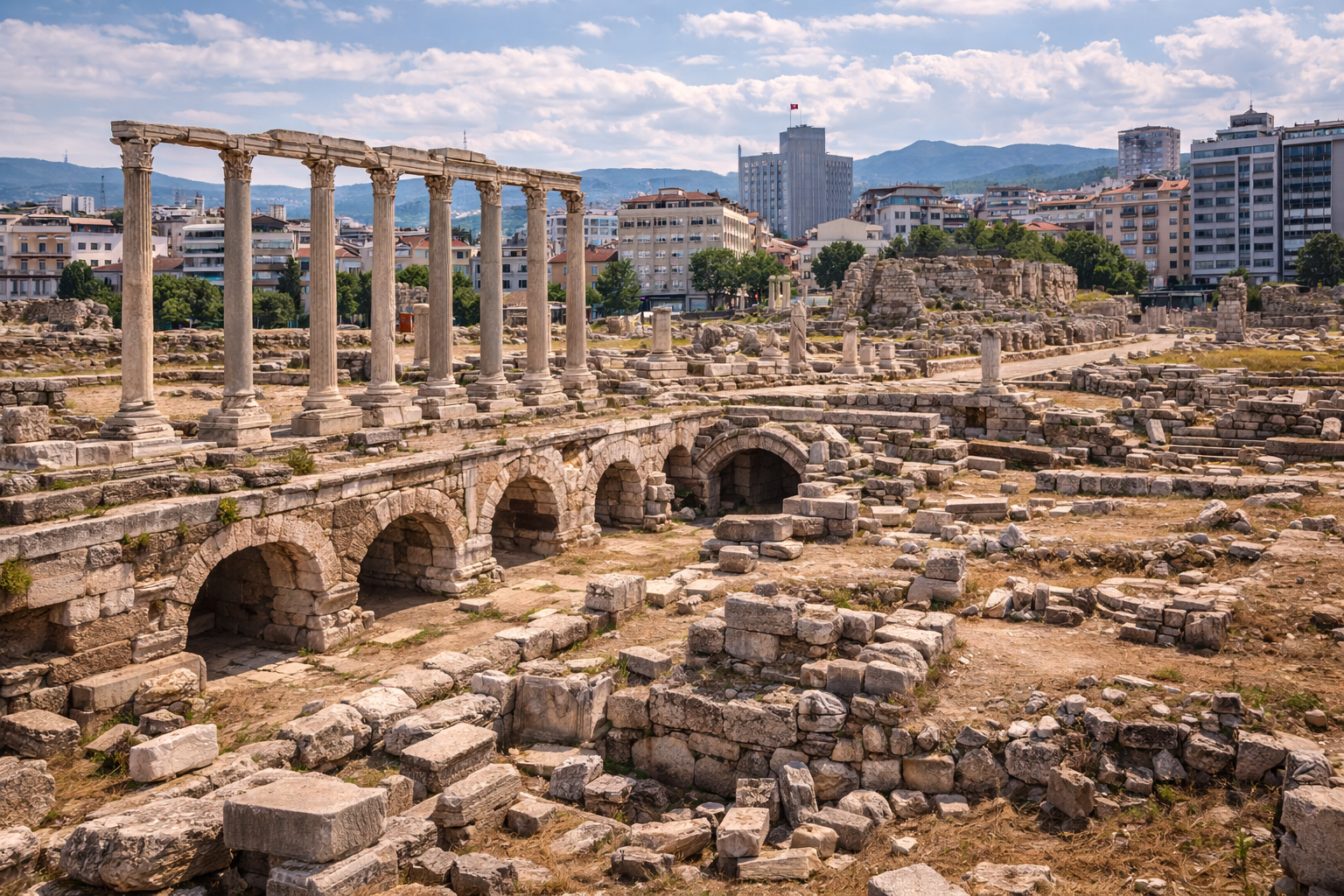
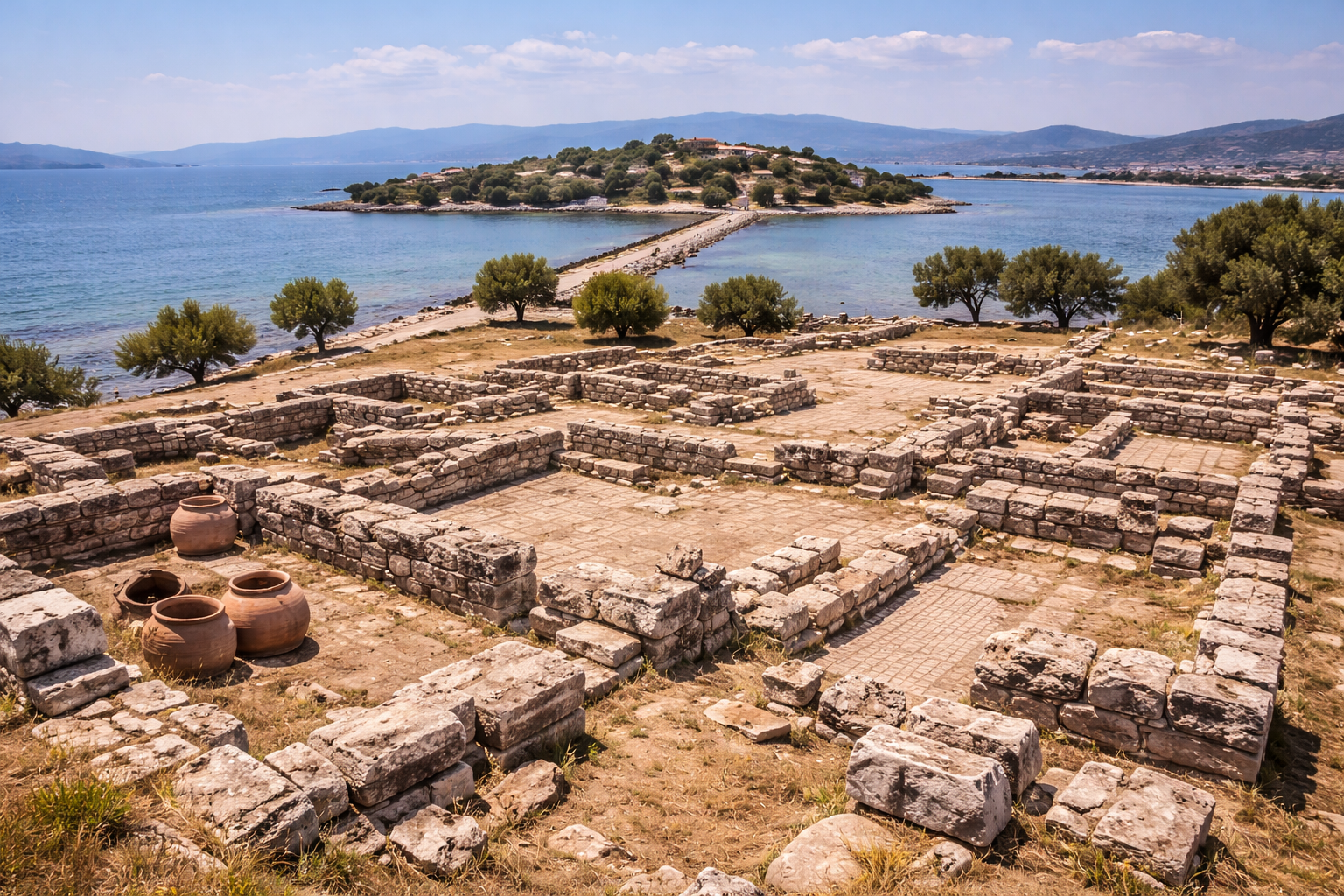
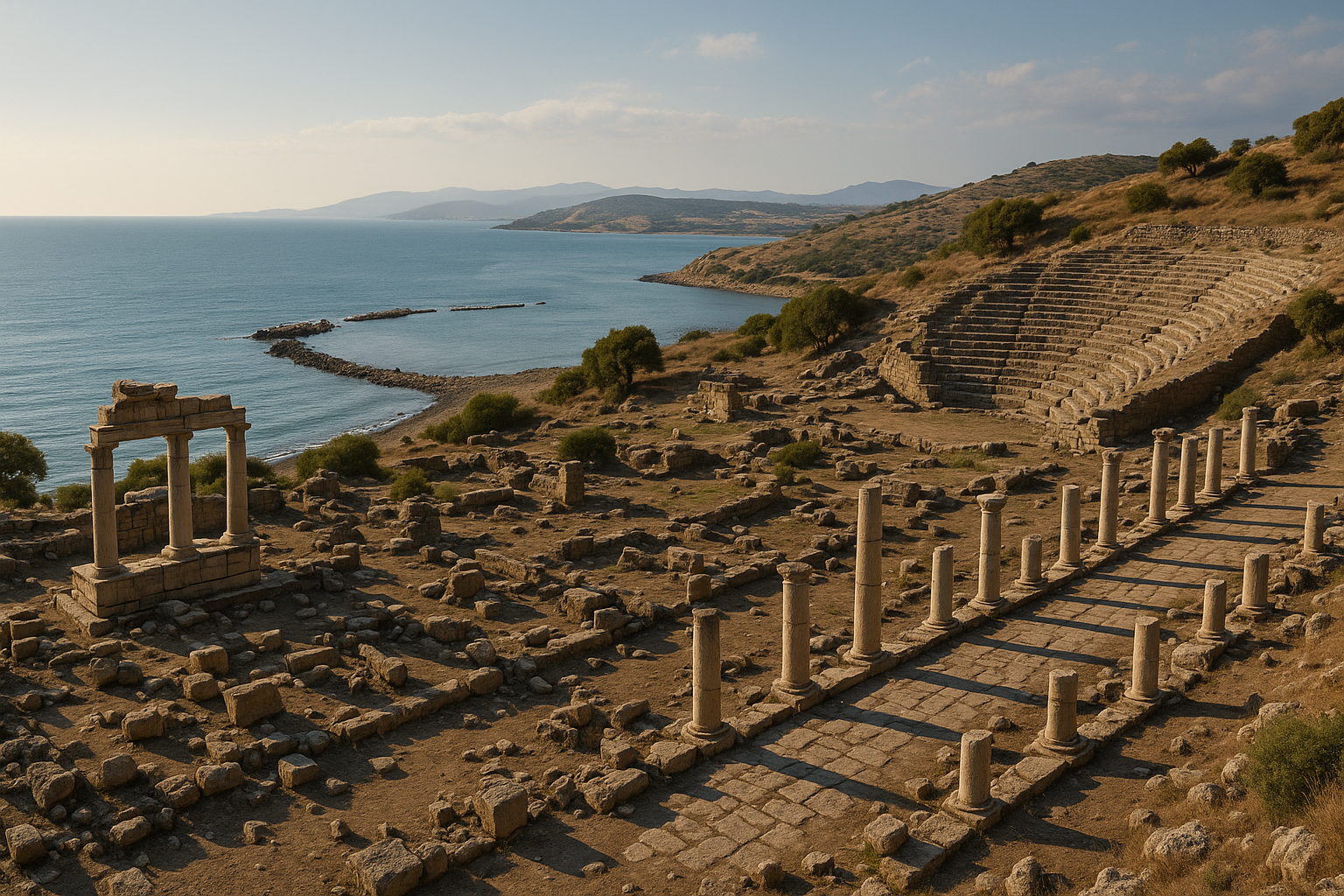
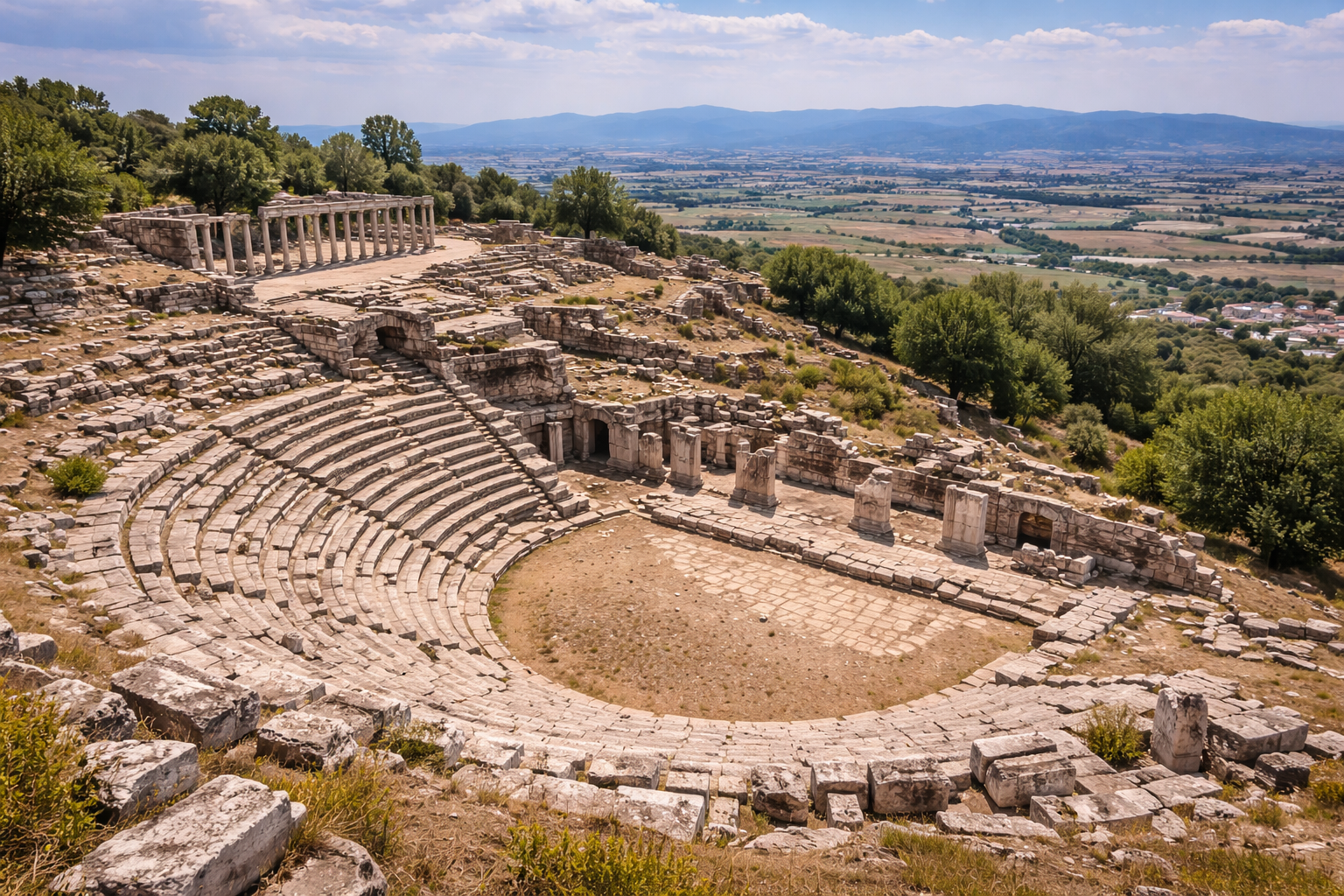
Bayrakli Mound, also known as Tepekule or Old Smyrna, is the original settlement site of ancient Smyrna -- one of the oldest continuously inhabited cities in the Mediterranean world. With occupation layers stretching back to the 3rd millennium BC, this modest urban mound in Izmir's Bayrakli district yielded some of the most revolutionary discoveries in Aegean archaeology: the earliest known Greek temple of Athena (c. 725--700 BC), one of the first grid-planned city layouts in the ancient world, formidable mud-brick fortification walls, and megaron-type houses that illuminate how ordinary Greeks lived during Homer's lifetime. Ancient tradition names Old Smyrna as the birthplace of Homer himself, making this unassuming hillock one of the most culturally significant archaeological sites in Turkey.
- Why Old Smyrna Matters
- Geography and Setting
- Historical Timeline
- Major Monuments
- Archaeological Work
- Visitor Information
- Frequently Asked Questions
- Sources and Further Reading
Why Old Smyrna Matters
Old Smyrna holds a uniquely important position in Mediterranean archaeology for these reasons:
- Birthplace of Homer tradition: Multiple ancient sources -- including Strabo, Herodotus, and Pausanias -- identify Smyrna as the most likely birthplace of Homer, the poet behind the Iliad and Odyssey. If this tradition is correct, the streets of Old Smyrna are where the greatest poet of Western civilization walked.
- Earliest Greek stone temple: The Temple of Athena discovered at Bayrakli, dating to approximately 725--700 BC, is the oldest known Greek temple built in stone in the eastern Aegean. It revolutionized scholarly understanding of when Greeks began constructing monumental religious architecture.
- Pioneer of urban planning: Old Smyrna is one of the earliest sites to show evidence of grid-planned street layout, predating the traditionally credited "Hippodamian plan" by over a century. The organized blocks of houses demonstrate sophisticated urban thinking in the Archaic period.
- 5,000 years of continuous occupation: The mound contains settlement layers from the Early Bronze Age (c. 3000 BC) through the Classical period (5th century BC), making it an unbroken record of Anatolian-Aegean cultural interaction.
- Dramatic destruction narratives: The city was violently destroyed by the Lydian king Alyattes around 600 BC and later devastated by Persian forces in 545 BC, providing archaeologically datable destruction layers that help calibrate chronology across the ancient Aegean.
Geography and Setting
Bayrakli Mound sits in the Bayrakli district of modern Izmir, approximately 700 meters inland from the present coastline, in the neighborhood called Tepekule. In antiquity, the mound was a small peninsula or island projecting into the Gulf of Smyrna (today's Izmir Bay), giving it natural harbor access and defensive advantages.
| Feature | Detail |
|---|---|
| Coordinates | 38.46 N, 27.17 E |
| Mound dimensions | Approximately 130 m x 100 m |
| Elevation | Roughly 10--15 m above surrounding plain |
| Modern district | Bayrakli, Izmir metropolitan area |
| Nearest landmark | Bayrakli train station (1 km) |
| Ancient coastline | The mound was originally waterfront; alluvial deposits have since pushed the coast northward |
The geological and topographic context is critical for understanding Old Smyrna. The mound sits on a natural bedrock rise that formed a defensible promontory when sea levels and sedimentation patterns differed from today. Rivers draining the Bornova plain deposited alluvium that gradually filled the ancient harbor, explaining why the site now appears landlocked.
The local climate is Mediterranean with hot, dry summers (35+ degrees C in July-August) and mild, rainy winters. The mound today is surrounded by modern apartment blocks and urban infrastructure, in stark contrast to its ancient setting.
Historical Timeline
Early Bronze Age (c. 3000--2000 BC)
The earliest occupation of Bayrakli Mound dates to the 3rd millennium BC, contemporary with the great Bronze Age civilizations of Troy, the Cyclades, and Minoan Crete. These earliest settlers were likely indigenous Anatolian peoples engaged in fishing, farming, and coastal trade. Ceramic evidence from these layers shows connections with both inland Anatolian and Aegean island traditions.
Middle and Late Bronze Age (c. 2000--1200 BC)
Occupation continued through the 2nd millennium BC. Some scholars have explored possible connections to the Aeolian Greek migrations traditionally dated to the end of the Bronze Age. The site shows signs of cultural transition during this period.
Protogeometric and Geometric Periods (c. 1050--700 BC)
After the Bronze Age collapse, Smyrna re-emerged as a settlement with strong Aeolian Greek character. The Protogeometric (c. 1050--900 BC) and Geometric (c. 900--700 BC) layers are among the richest on the site:
- Megaron-type houses with central hearths were built in organized rows.
- The first Temple of Athena was constructed around 725--700 BC -- a small stone structure that is the earliest known Greek temple in the eastern Aegean.
- Population is estimated at 500--600 houses supporting roughly 3,000 inhabitants in the city's prime.
- Pottery finds include fine Geometric ware with painted decoration.
The ancient tradition of Homer's birth at Smyrna places it in this period (Homer is usually dated to the 8th century BC). If Homer truly composed the Iliad and Odyssey here, the megaron houses of Old Smyrna provide the domestic context for some of the greatest literature ever written.
Archaic Period (c. 700--546 BC)
The 7th century BC was the golden age of Old Smyrna. The city:
- Expanded its Temple of Athena with a more elaborate stone building (c. 640--580 BC), one of the oldest monumental temples in the Greek world.
- Constructed formidable fortification walls of mud-brick on stone foundations, with tower bastions and a monumental gate.
- Developed a grid-planned street layout with standardized housing blocks.
- Built a monumental fountain to supply fresh water to the urban population.
- Engaged in long-distance trade, as evidenced by imported pottery from Corinth, East Greece, and the Levant.
This prosperity ended in catastrophe. Around 610--600 BC, the Lydian king Alyattes (father of the legendary Croesus) besieged and destroyed Old Smyrna. The archaeological evidence for this destruction is vivid: collapsed walls, fire debris, and arrowheads embedded in fortification towers. The geographer Strabo records that after Alyattes's assault, the population was scattered into villages for approximately 400 years.
Persian Destruction (545 BC)
Any recovery from the Lydian attack was cut short by the Persian conquest of Lydia in 546 BC. Old Smyrna was again devastated, this time by the forces of Cyrus the Great. The site never recovered its former urban character.
Hellenistic Refoundation -- New Smyrna (c. 300 BC)
According to legend, Alexander the Great dreamed of refounding Smyrna at a new location. His successors, particularly Antigonus and then Lysimachus, carried out this vision around 300 BC, establishing New Smyrna at modern Izmir's Kadifekale (Mount Pagos), approximately 5 km to the south. The old mound at Bayrakli was largely abandoned as an urban center, though some modest occupation may have continued.
Major Monuments
Temple of Athena
The Temple of Athena at Bayrakli is the single most important archaeological discovery on the mound. Two main phases have been identified:
- Phase I (c. 725--700 BC): A small stone temple -- the earliest known Greek temple in the eastern Aegean. This discovery by Ekrem Akurgal in the 1960s pushed back the timeline of Greek monumental architecture by decades.
- Phase II (c. 640--580 BC): A larger, more elaborate rebuilding with refined stone masonry. This version featured a pronaos (entrance porch) and cella (inner chamber) and is among the earliest examples of the developing Greek temple plan.
The temple confirms that goddess Athena was the patron deity of Old Smyrna, consistent with the city's identity as a center of Greek learning and culture.
Fortification Walls and City Gate
Old Smyrna possessed a remarkable defensive system consisting of:
- Mud-brick walls on stone foundations, with an estimated height of 5--6 meters.
- Tower bastions at regular intervals along the circuit.
- A monumental city gate providing the main entrance.
- An exterior glacis (sloping defensive surface) to prevent siege engines from reaching the walls.
These fortifications date primarily to the 7th century BC and are among the best-documented Archaic Greek defensive systems. The Lydian siege left dramatic archaeological evidence: arrowheads lodged in wall surfaces, fire-reddened mud-brick, and collapsed tower sections.
Megaron Houses
The residential architecture of Old Smyrna consists primarily of megaron-type houses -- rectangular structures with a central hearth, an entrance porch, and a main living hall. These houses were:
- Built in organized rows along planned streets.
- Constructed from mud-brick on stone foundations.
- Sized at approximately 4 x 8 meters internally.
- Heated by central fire hearths.
The megaron plan is the same architectural tradition that influenced the design of Greek temples themselves, providing a rare window into the domestic life of 8th--7th century BC Greeks.
Monumental Fountain
A public fountain structure was built to supply fresh water to the city's residents. Fed by a channel from a spring source, this structure demonstrates the civic infrastructure of Archaic Smyrna and its capacity for organized public works.
Residential Street Grid
The organized street layout of Old Smyrna, with houses arranged in roughly parallel rows separated by lanes, is one of the earliest examples of proto-grid planning in the Greek world. While not as rigid as the later Hippodamian grid, it demonstrates that urban planning concepts were already developing in the eastern Aegean well before the 5th century BC.
Archaeological Work
The archaeological exploration of Bayrakli Mound has a distinguished history:
- 1930--1931: The first excavations were conducted by the Austrian archaeologist Franz Miltner, who identified the site as ancient Smyrna.
- 1948--1951: A major British-Turkish joint excavation was directed by John Manuel Cook (British School at Athens) and Ekrem Akurgal (Ankara University). This campaign established the site's chronological framework and uncovered the fortification system.
- 1966--1992: Ekrem Akurgal continued excavations focusing on the Geometric and Archaic period occupation. He discovered the Temple of Athena and the organized residential quarters, transforming understanding of early Greek urbanism. His monograph Alt-Smyrna I: Wohnschichten und Athenatempel (1983) remains the definitive publication.
- 2007--present: Renewed excavations, now under the Turkish Ministry of Culture and Tourism's "Heritage for the Future" project, have concentrated on the area around the Temple of Athena, investigating both the northern and southern sections. These campaigns continue to refine the site's stratigraphy and chronology.
Key scholarly contributions include:
| Scholar | Period | Contribution |
|---|---|---|
| Franz Miltner | 1930--1931 | First identification and excavation |
| John M. Cook | 1948--1951 | Stratigraphic framework, fortification analysis |
| Ekrem Akurgal | 1948--1992 | Temple of Athena, megaron houses, major publication |
| Current Turkish teams | 2007--present | Ongoing refinement around Athena temple precinct |
Visitor Information
Location and Access
| Detail | Information |
|---|---|
| Location | Tepekule neighborhood, Bayrakli district, Izmir |
| Distance from Izmir center (Konak) | Approximately 8 km north |
| Nearest transit | Bayrakli IZBAN commuter rail station (1 km walk) |
| By car | Accessible from the Izmir ring road (Otoyol); signs to Bayrakli/Tepekule |
| Parking | Limited street parking near the mound |
Transport Options
- By IZBAN (commuter rail): Take the IZBAN line to Bayrakli station, then walk approximately 1 km east to the Tepekule neighborhood. This is the most convenient public transport option.
- By metro/bus: Izmir metro and bus routes connect to the Bayrakli area; ask locally for the Tepekule direction.
- By car/taxi: From central Izmir (Konak), drive north along the bay road toward Bayrakli. The mound is located in the Tepekule residential area.
- By walking: If staying in the Bayrakli or Bornova districts, the site is walkable.
Visit Duration
- Quick visit: 30--45 minutes to walk around the mound and view the main excavation areas
- Standard visit: 1--1.5 hours with careful examination of the temple area, walls, and interpretive signs
- Combined with Izmir museums: Add 2--3 hours for the Izmir Archaeology Museum (Konak) and Agora Open Air Museum
Best Time to Visit
- Spring (March--May): Mild temperatures, pleasant for outdoor walking
- Autumn (September--November): Comfortable weather, less humidity
- Summer: Can be very hot; visit early morning or late afternoon
- Winter: Mild but rainy; still accessible
Combined Visits
- Izmir Archaeology Museum (Konak): Houses many artifacts from Old Smyrna excavations, including pottery and architectural fragments. Essential complement to the site visit.
- Agora of Smyrna (Konak): The Roman-era agora of "New Smyrna" at Kadifekale, approximately 8 km south, provides the later chapter of Smyrna's story.
- Kadifekale (Mount Pagos): The Hellenistic-Roman citadel where New Smyrna was refounded by Lysimachus.
- Ephesus: 80 km south, the most famous ancient city in western Turkey, for comparison of scale and preservation.
Practical Tips
- The site is located within a residential neighborhood; be respectful of local residents.
- Wear comfortable walking shoes; the mound has uneven surfaces.
- Bring water and sun protection in summer.
- Check locally for current access hours, as the site may have limited visiting times during active excavation seasons.
- Photography is generally permitted.
- There is no on-site cafe or gift shop; amenities are available in the surrounding Bayrakli neighborhood.
- The site is relatively compact and suitable for visitors of most fitness levels.
- Consider visiting the Izmir Archaeology Museum before the site, as the museum provides context that enhances on-site interpretation.
Frequently Asked Questions
Was Homer really born at Old Smyrna?
Seven cities in the ancient world claimed to be Homer's birthplace, but Smyrna had one of the strongest traditions. Ancient authors including Strabo and a text called the Pseudo-Herodotean Life of Homer locate his birth here. While absolute proof is impossible, the archaeological evidence shows that Old Smyrna was a thriving, culturally sophisticated Greek city in the 8th century BC -- exactly the period when Homer is thought to have composed his epics. The megaron houses, temple, and active port trade revealed by excavation provide a plausible context for a poet of Homer's stature.
What makes the Temple of Athena so important?
The Phase I temple (c. 725--700 BC) at Bayrakli is the oldest known Greek stone temple in the eastern Aegean. Before this discovery, scholars believed monumental Greek temple architecture began later, primarily in mainland Greece. The Bayrakli temple pushed the timeline back and proved that eastern Greek cities were architectural innovators. The Phase II temple (c. 640--580 BC) further demonstrates the rapid evolution of Greek sacred architecture during the Archaic period.
Why did the Lydians destroy Smyrna?
The Lydian king Alyattes (r. c. 610--560 BC), father of the famous Croesus, pursued an expansionist policy along the Aegean coast. Old Smyrna, as a wealthy and independent Greek city, was a target. The siege and destruction around 600 BC scattered the population and ended the city's urban existence. Strabo records that the inhabitants lived in villages for approximately 400 years until Alexander the Great's successors refounded the city at a new location.
Where did New Smyrna go?
Around 300 BC, the successors of Alexander the Great -- particularly Antigonus and Lysimachus -- refounded Smyrna at Mount Pagos (Kadifekale), approximately 5 km south of the old mound. This "New Smyrna" grew into one of the largest and most prosperous cities of the Roman East, with a population of over 100,000. Its ruins, including the Roman Agora, are visible in central Izmir today.
Is the site well-preserved?
The mound has suffered from urban encroachment, as modern Bayrakli grew around and over parts of the ancient site. However, the excavated areas are protected and maintained. The temple foundations, wall traces, and stratigraphic sections are visible. The full extent of the ancient city lies beneath modern buildings, and only a portion has been excavated.
Can I see artifacts from Old Smyrna?
Yes. The Izmir Archaeology Museum in the Konak district houses pottery, figurines, architectural fragments, and other finds from the Bayrakli excavations. Visiting the museum before or after the site greatly enriches the experience.
Ceramic Assemblage and Stratigraphic Phases
The ceramic record at Bayrakli Mound provides one of the most complete pottery sequences in the Aegean, spanning from the Early Bronze Age through the Classical period. Recent excavations led by Dr. Aylin Umit Erdem of Ege University have revealed significant new data from the deeper strata.
Bronze Age Pottery Typology
| Ceramic Type | Period | Parallels | Significance |
|---|---|---|---|
| Beak-spouted jugs | 3rd millennium BC (EBA) | Troy I--II | Earliest occupation evidence; Anatolian trade links |
| Ribbed bowls | 3rd millennium BC (EBA) | Cycladic tradition | Aegean maritime connections |
| Red Ware vessels | 2nd millennium BC (MBA--LBA) | Larisa (Hermos valley) | Inland Anatolian cultural sphere |
| Gray Ware vessels | 2nd millennium BC (MBA--LBA) | Northwestern Anatolian types | Troadic influence zone |
| Storage jars (pithoi) | 3rd--2nd millennium BC | Regional Anatolian forms | Agricultural surplus and storage economy |
| Mycenaean-influenced pottery | Late Bronze Age (c. 1400--1200 BC) | Mycenaean IIIA--B | Evidence of Aegean palatial trade contacts |
During the 2007--present excavation campaigns, five distinct architectural layers from the Middle and Late Bronze Ages were identified. Among the finds were workshops, a ceramic cooking oven, remains of multiple bread ovens, and a collection of bronze vessels -- indicating a settlement with diversified craft production and food processing capabilities.
Protogeometric and Geometric Ceramic Sequence
The transition from Bronze Age to Iron Age at Bayrakli is documented through a continuous pottery sequence:
- Protogeometric phase (c. 1050--900 BC): Hand-made and early wheel-made vessels with simple linear decoration. These ceramics show strong Aeolian Greek characteristics, consistent with the settlement of Aeolian colonists.
- Early Geometric (c. 900--800 BC): Introduction of more complex decorative motifs including concentric circles, crosshatching, and meander patterns.
- Late Geometric (c. 800--700 BC): Fine painted ware with figural scenes. The pottery from this phase is contemporary with the earliest Temple of Athena and provides the material context for the Homeric period.
Fortification Wall Engineering Data
Recent research published in the journal Hoyuk (2023, Issue 11) has refined understanding of Old Smyrna's defensive walls. The fortification system represents the earliest known city wall in the Greek world, dating to approximately 850 BC.
| Wall Feature | Measurement / Detail |
|---|---|
| Construction technique | Mud-brick superstructure on stone socle foundation |
| Stone socle facing | Dressed stone exterior, rubble core |
| Estimated wall height | 5--6 m (including mud-brick superstructure) |
| Circuit extent | Approximately 400 m perimeter around the mound |
| Tower bastions | Semi-circular projections at intervals of c. 15--20 m |
| Glacis slope | Packed earth ramp at base, angle c. 35--45 degrees |
| Siege ramp (Alyattes) | Earthen siege mound built against eastern wall section |
The fortification represents a multi-phase construction history. The earliest wall circuit (c. 850 BC) was expanded and strengthened during the 7th century BC as Lydian aggression increased. The final phase corresponds to the period immediately before the destruction by Alyattes (c. 600 BC).
Temple of Athena: Architectural Reconstruction Data
The publication by Cook and Nicholls (Old Smyrna Excavations: The Temples of Athena, 1998) provides the most detailed architectural analysis:
| Feature | Phase I (c. 725--700 BC) | Phase II (c. 640--580 BC) |
|---|---|---|
| Foundation material | Andesite stone blocks | Dressed limestone |
| Cella wall fragment | 5.5 m long preserved stretch | Larger footprint, pronaos + cella |
| Column order | Aeolic (earliest Aeolic capitals known) | Transitional Aeolic-to-Ionic |
| Column arrangement | Debated; possibly 6 x 11 peristyle | Reconstructed as peripteral temple |
| Access ramp | c. 3 m wide ramp to altar area | Formal approach path |
| Altar | Stone altar east of temple | Rebuilt altar with ash deposits |
The Phase I temple's Aeolic column capitals -- with their distinctive double-volute design -- are among the oldest examples of monumental column decoration in the Greek world. These capitals link Old Smyrna's architectural tradition to the broader Aeolian cultural zone of northwestern Anatolia and Lesbos.
Excavation Chronology: Detailed Record
| Year(s) | Director / Institution | Key Activities and Discoveries |
|---|---|---|
| 1930--1931 | Franz Miltner (Austrian Archaeological Institute) | First identification of the site as ancient Smyrna; surface survey and trial trenches |
| 1948--1951 | J.M. Cook (British School at Athens) + E. Akurgal (Ankara University) | Established stratigraphic framework; uncovered fortification system; identified Bronze Age through Archaic occupation layers |
| 1966--1992 | Ekrem Akurgal (Ankara University) | Discovery of Temple of Athena (Phase I and II); excavation of megaron houses and residential grid; published Alt-Smyrna I (1983) |
| 2007--2012 | Turkish Ministry of Culture | Renewed focus on Temple of Athena precinct; conservation of exposed architectural remains |
| 2013--present | Turkish Ministry / Ege University collaboration | Investigation of Bronze Age and Iron Age layers; discovery of 5,000-year-old ceramics revealing early trade links; geophysical surveys of unexcavated areas |
The most recent campaigns (2013--present) have shifted focus to the pre-Greek Bronze Age layers, revealing that the site's role as a trade node connecting Anatolian interior networks with Aegean maritime routes extends much further back in time than previously understood. The 5,000-year-old ceramic assemblage shows direct parallels with Troy I and Troy II period forms, suggesting that Bayrakli was part of the same cultural and commercial sphere as northwestern Anatolian settlements during the 3rd millennium BC.
Sources and Further Reading
- Akurgal, E. Alt-Smyrna I: Wohnschichten und Athenatempel. Ankara: Turk Tarih Kurumu, 1983.
- Cook, J.M. "Old Smyrna, 1948--1951." Annual of the British School at Athens 53/54, 1958--59.
- Cook, J.M. and Nicholls, R.V. "Old Smyrna Excavations: The Temples of Athena." Annual of the British School at Athens, Supplement, 1998.
- Akurgal, E. Ancient Civilizations and Ruins of Turkey. Istanbul: Haset, 1985.
- Wikipedia -- Old Smyrna
- Wikipedia -- Smyrna
- Turkiye Today -- Archaeological excavations at 5,000-year-old Smyrna Mound
- Visit Izmir -- Old Smyrna - Bayrakli Hoyuk
- Luwian Studies -- Bayrakli/Alt-Smyrna
Homer and Smyrna: The Literary Tradition
The question of Homer's birthplace was debated throughout antiquity. A famous ancient epigram lists seven claimant cities:
Seven cities warred for Homer being dead: Smyrna, Chios, Colophon, Ithaca, Pylos, Argos, and Athens.
Of these, Smyrna and Chios had the strongest traditions. The so-called Pseudo-Herodotean Life of Homer -- a biographical text probably written in the Hellenistic period -- provides the most detailed account, placing Homer's birth in Smyrna and describing his early life along the banks of the Meles River (a stream flowing through the area near Bayrakli and ancient Smyrna).
Why the Smyrna Tradition Is Plausible
The archaeological evidence from Bayrakli supports the plausibility of the Homer-Smyrna tradition:
- Chronological match: Old Smyrna was a thriving, culturally active Greek city in the 8th century BC, precisely when Homer is believed to have lived and composed the Iliad and Odyssey.
- Cultural sophistication: The megaron houses, organized street grid, Temple of Athena, and imported pottery demonstrate a wealthy, internationally connected community -- the kind of environment that could produce a poet of Homer's ambition and literary range.
- Aeolian-Ionian cultural mix: Old Smyrna was originally an Aeolian settlement that came under Ionian influence. Homer's language famously blends Aeolian and Ionian Greek dialects, consistent with a poet raised in this cultural intersection.
- Maritime knowledge: Homer's detailed knowledge of seamanship, harbors, and coastal geography -- evident throughout the Odyssey -- fits a childhood in a port city like Smyrna.
While absolute proof of Homer's birthplace is unattainable, Old Smyrna remains the strongest archaeological candidate.
The Destruction by Alyattes: Archaeological Evidence
The Lydian destruction of Old Smyrna around 600 BC is one of the best-documented military events in Archaic Greek archaeology. The evidence includes:
- Fire layer: A thick deposit of charred debris covering large areas of the mound, indicating widespread conflagration.
- Arrowheads in walls: Bronze arrowheads have been found embedded in the mud-brick fortification walls, physical evidence of the siege assault.
- Collapsed fortifications: Sections of the city wall and tower bastions show violent collapse consistent with siege warfare.
- Siege mound traces: Evidence of an earthen ramp constructed against the walls, a standard Lydian and Near Eastern siege technique.
The Lydian king Alyattes (r. c. 610--560 BC) was one of the most aggressive military leaders of the 7th--6th century BC Aegean. He expanded Lydian territory westward to the coast, subjugating Greek cities. His son Croesus would later become legendary for his wealth before being defeated by the Persian king Cyrus the Great in 546 BC.
Strabo records the aftermath: the inhabitants of Smyrna "lived in villages" for approximately 400 years before the city was refounded. This statement is broadly confirmed by archaeology -- the mound shows minimal urban occupation between the 6th century BC destruction and later periods.
From Old Smyrna to New Smyrna: The Alexander Legend
The refounding of Smyrna at a new location is one of the most dramatic stories in the city's history. According to the ancient tradition preserved by Pausanias:
- Alexander the Great, while hunting on Mount Pagos (Kadifekale), fell asleep under a plane tree near a sanctuary of the Nemeseis (goddesses of retribution).
- In his dream, the Nemeseis appeared and told him to refound the city of Smyrna on the slopes of Mount Pagos.
- Alexander gave the order, but the actual construction was carried out by his successors Antigonus and Lysimachus around 300 BC.
New Smyrna grew into one of the most important cities of the Roman East, with a population exceeding 100,000 at its peak. It was renowned for its beauty, its schools of rhetoric, and its claim to be a "First City of Asia" alongside Ephesus and Pergamon.
The ruins of New Smyrna are visible in central Izmir today, including the Roman Agora (reconstructed after a 178 AD earthquake under Marcus Aurelius) and the fortress walls of Kadifekale.
The Significance of the Grid Plan
The proto-grid street layout at Old Smyrna has important implications for the history of urban planning:
- Before Hippodamos: The traditional narrative credits Hippodamos of Miletus (5th century BC) as the "father of urban planning" who invented the grid street system. However, Old Smyrna demonstrates that organized street layouts existed in the eastern Aegean at least two centuries earlier.
- Anatolian precedents: Organized town planning had even deeper roots in Anatolia, with Bronze Age sites like Hattusa (the Hittite capital) showing planned quarters. Old Smyrna may represent a convergence of Anatolian planning traditions with Greek urbanization.
- Social implications: A grid plan implies centralized authority capable of allocating land systematically, standardized property sizes reflecting social equality or regulation, and collective civic investment in public infrastructure.
The Old Smyrna grid, while not as rigid as later Hippodamian plans, demonstrates that the concept of an organized, planned city was embedded in eastern Greek culture from a very early date.