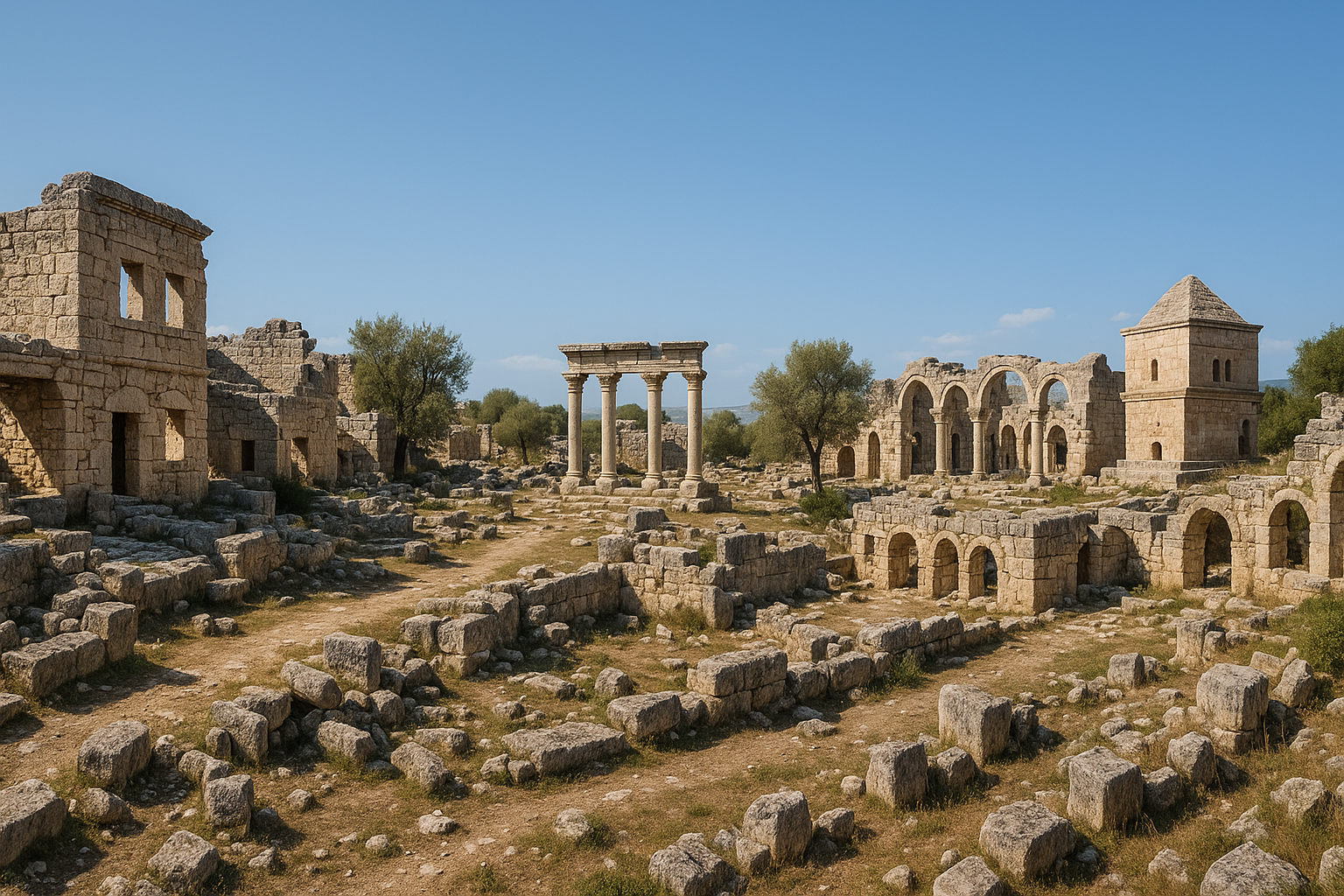
Anemurium, whose name derives from the Greek word Anemourion meaning "Windy Cape," stands at Cape Anamur -- the southernmost point of the entire Asian landmass of Turkey, only 64 km from Cyprus across the Mediterranean. This major port and commercial city of Rough Cilicia flourished from the 4th century BC through the 7th century AD, reaching its zenith during the Roman Imperial period (2nd-3rd centuries AD). Today Anemurium is renowned for its extraordinarily well-preserved necropolis of approximately 350 tombs, its mosaic-floored bathhouses, its sea-facing theatre and odeon, and its Early Christian basilicas -- all set against a dramatic coastal backdrop where the Taurus Mountains plunge into the Mediterranean.
- Why Anemurium Matters
- Geography and Setting
- Historical Timeline
- Major Monuments
- Archaeological Work
- Visitor Information
- Frequently Asked Questions
- Sources and Further Reading
Why Anemurium Matters
-
The best-preserved Roman necropolis in Anatolia. Anemurium's cemetery of approximately 350 vaulted tomb structures -- many surviving to roof level, some two stories high, with interior frescoes and mosaics -- is without parallel in Turkey and ranks among the finest Roman-period burial grounds in the eastern Mediterranean.
-
A complete Roman provincial city. Unlike many ancient sites where only a few monumental buildings survive, Anemurium preserves a full urban fabric: theatre, odeon, multiple bath complexes, churches, city walls, aqueducts, a harbour area, and residential quarters. This completeness makes it an invaluable case study of how a medium-sized Roman city functioned.
-
Mosaic heritage. The bath complexes and churches contain geometric and figural mosaic floors that represent the artistic traditions of Cilician craftsmen. Several mosaics include donor inscriptions in Greek, providing insights into the civic life and patronage culture of the community.
-
Strategic location on the Cyprus corridor. At only 64 km from the coast of Cyprus, Anemurium occupied a critical position for maritime trade and military communication between the Anatolian mainland and the island. Ancient sources confirm regular maritime traffic on this shortest of crossings.
-
UNESCO Tentative List candidate. Anemurium has been proposed for inclusion on the UNESCO World Heritage Tentative List, reflecting its international significance.
Geography and Setting
Location
Anemurium is situated approximately 6 km southwest of the modern town of Anamur in Mersin Province, on a high promontory that forms Cape Anamur (Anamur Burnu), the southernmost point of the Anatolian peninsula.
Landscape
The site occupies a dramatic coastal setting where the western Taurus Mountains descend sharply to the Mediterranean Sea. The ancient city is divided into:
- Upper City (Acropolis): Built on a steep, rocky promontory at the southern extremity, with Hellenistic and medieval fortification walls
- Lower City: Spread along the coastal plain to the north, containing the main public buildings and residential areas
- Necropolis: Extending along the hillslopes north of the Lower City, covering approximately 101,000 square metres
Climate
The Anamur coast enjoys a Mediterranean climate with hot, humid summers and mild, rainy winters. The cape is consistently windy -- justifying the ancient Greek name -- which moderates summer heat but can make winter visits blustery.
Maritime Significance
The shortest sea crossing between Anatolia and Cyprus is from Cape Anamur to Cape Kormakiti on the northern coast of the island -- approximately 64 km. This proximity made Anemurium a natural relay point for:
- Grain and commodity trade between Cilicia and Cyprus
- Military and administrative communication
- Cultural and religious exchange across the eastern Mediterranean
Historical Timeline
| Period | Approximate Dates | Key Developments |
|---|---|---|
| Hellenistic | 4th -- 1st century BC | City established; earliest fortification walls on acropolis; coinage begins |
| Roman Republic | 1st century BC | Cilicia brought under Roman control; city integrated into provincial administration |
| Early Imperial | 1st -- 2nd century AD | Harbour development; construction of theatre, odeon, and first bath complexes |
| Peak Period | 2nd -- 3rd century AD | City reaches maximum extent; necropolis expands rapidly; mosaic workshops flourish; all five bath complexes operational |
| Late Roman / Early Byzantine | 4th -- 6th century AD | Four Christian basilicas built; some bath complexes converted to industrial use; city walls reinforced |
| Sasanian Raid | AD 260 | Sasanian Persian forces under Shapur I raid Cilicia; Anemurium likely affected |
| Arab Raids and Earthquakes | 7th century AD | Repeated Arab naval raids and seismic events lead to gradual abandonment |
| Medieval | 8th -- 14th century | Reduced settlement; nearby Mamure Castle (Anamur Castle) assumes defensive role |
The Sasanian Crisis
In AD 260, the Sasanian Emperor Shapur I launched devastating raids across Cilicia after capturing the Roman Emperor Valerian at the Battle of Edessa. While Anemurium's specific experience during this crisis is not fully documented, the broader regional disruption likely affected the city and may account for evidence of destruction and rebuilding observed in the archaeological record of the late 3rd century.
The Final Decline
Anemurium's abandonment in the 7th century was caused by the convergence of two forces: Arab naval raids that threatened coastal cities across the eastern Mediterranean, and seismic activity in the region. The combination made the exposed coastal position untenable, and the population shifted to more defensible inland locations or to the nearby Mamure Castle.
Major Monuments
The Necropolis
The Anemurium Necropolis is the site's signature feature and one of the most remarkable funerary landscapes in the ancient world.
- Area: Approximately 101,000 square metres
- Tomb count: Approximately 350 sepulchral structures
- Date range: 1st century AD to early 4th century AD
- Types: Vaulted barrel-roofed tombs, two-story mausoleums, simple chamber tombs
- Construction: Local limestone with mortar; many feature tiled or vaulted roofs that have survived intact
- Interior decoration: Frescoes depicting garlands, birds, geometric patterns, and mythological scenes; mosaic floors in some larger tombs
- Significance: The preservation is extraordinary because many tombs survive to full roof height, offering a three-dimensional understanding of Roman funerary architecture that most other sites can only suggest from foundations
Theatre
The theatre is positioned on the western edge of the Lower City, facing the sea.
- Type: Greco-Roman cavea (seating area) with stage building
- Capacity: Estimated 3,000-4,000 spectators
- Features: Semicircular orchestra; stage building (scaenae frons) partially preserved; seating rows carved into natural hillside supplemented with built masonry
- Views: Spectacular panoramic views of the Mediterranean from the upper seats
Odeon (Bouleuterion)
The odeon served as a covered concert hall and likely also as a council chamber.
- Capacity: Approximately 900 seats
- Condition: One of the best-preserved structures at the site; seating rows largely intact
- Features: Rectangular exterior with semicircular interior cavea; traces of the roof structure
- Function: Musical performances, public speeches, and possibly city council meetings
Bath Complexes
Anemurium contains five bath complexes -- an unusually high number for a city of its size, reflecting the importance of bathing culture in Roman Cilician society.
- Large Bath (Thermae I): The principal public bath; features rooms with mosaic floors including geometric designs; frigidarium, tepidarium, and caldarium sequence preserved
- Small Bath (Thermae II): More intimate facility; also decorated with mosaics
- Baths III-V: Smaller neighbourhood baths serving different quarters of the city
- Late antique conversion: In the 5th-6th centuries, at least one bath complex was converted for industrial use (olive pressing or textile production), a common adaptation in late antique cities
Early Christian Basilicas
Four basilica churches have been identified at Anemurium, dating to the 4th-6th centuries AD:
- Basilica I: Three-aisled plan with mosaic floor; the most significant mosaic depicts a leopard and capricorn flanking a palm tree, interpreted as a symbol of the "Kingdom of Peace" -- this mosaic is now displayed in the Anamur Museum
- Basilica II: Located near the city walls; simpler plan with apse
- Basilica III and IV: Smaller structures in residential quarters
- Donor inscriptions: Several mosaics include Greek inscriptions naming the individuals who funded their creation, providing valuable prosopographical data
City Walls and Fortifications
The fortification system consists of:
- Hellenistic acropolis walls: The oldest defensive circuit, on the rocky promontory of the upper city
- Roman-period lower city walls: Enclosing the expanded urban area along the coast
- Late Roman reinforcements: Thickened walls and additional towers added in response to 3rd-century threats
- Medieval repairs: Associated with the Byzantine presence before the shift to Mamure Castle
Aqueducts
Remains of the water supply system include:
- Sections of elevated aqueduct bringing water from springs in the Taurus foothills
- Distribution channels within the city directing water to baths, fountains, and residential areas
- Underground cisterns for water storage
Harbour Area
The ancient harbour is now partially submerged, but its outline can be identified:
- Located on the sheltered eastern side of the cape
- Quay walls partially visible at low tide
- Warehouse foundations along the harbourfront
Archaeological Work
Canadian Excavations (1965-1991)
The systematic excavation of Anemurium was a Canadian enterprise, making it one of the few major ancient Cilician cities excavated by North American teams.
- 1965-1970: Initial excavations directed by Elizabeth Alfoldi-Rosenbaum of the University of Toronto, focusing on the necropolis and its painted tombs
- 1971-1991: Excavations continued under James Russell of the University of British Columbia, with significant contributions from Hector Williams and his wife Caroline Williams. Russell's work expanded to cover the bath complexes, churches, and residential areas
- Publication: The first comprehensive volume of the Canadian excavation results was published in 2021 under James Russell's name, representing decades of research and analysis
Key Discoveries
- Documentation and conservation of the necropolis frescoes, establishing a typology of tomb painting in Roman Cilicia
- Excavation of the bath mosaics, including the identification of a Cilician mosaic workshop tradition
- Recovery of the leopard-capricorn mosaic from Basilica I, now a centrepiece of the Anamur Museum
- Mapping of the complete urban plan, revealing the relationship between public, residential, commercial, and funerary zones
- Analysis of ceramic and coin sequences establishing a detailed chronology of occupation and abandonment
Current Status
Following the Canadian excavation campaigns, the site has been under the supervision of the Turkish Ministry of Culture and Tourism. Conservation work focuses on protecting exposed mosaics and stabilising structural remains. Anemurium has been proposed for inclusion on the UNESCO Tentative List, which would bring additional international attention and conservation resources.
Visitor Information
Location and Access
| Detail | Information |
|---|---|
| Province | Mersin |
| District | Anamur |
| Distance from Anamur centre | Approximately 6 km southwest |
| Distance from Mersin city | Approximately 230 km (4-5 hours driving along the coast road) |
| Distance from Antalya | Approximately 250 km (5-6 hours via coastal D400) |
| GPS Coordinates | Approximately 36.03N, 32.80E |
How to Get There
- By car: From Anamur town centre, follow signs to Anemurium/Eski Anamur heading southwest on the coastal road. The site is well signposted.
- By bus: Long-distance buses connect Anamur to Mersin, Antalya, and other major cities. From Anamur, taxis or local minibuses reach the site.
- Coastal road note: The D400 coastal road from either Mersin or Antalya to Anamur is spectacularly scenic but winding and time-consuming. Allow extra driving time.
Visit Duration
- Quick overview of key structures: 1-1.5 hours
- Standard visit including necropolis, theatre, baths, and churches: 2-3 hours
- Thorough exploration of the entire site including acropolis and harbour area: 4-5 hours
Best Time to Visit
- Spring (March-May): Ideal temperatures, wildflowers, clear sea views
- Autumn (September-November): Warm but comfortable, excellent light for photography
- Summer (June-August): Very hot and humid; visit early morning or late afternoon
- Winter (December-February): Mild compared to inland Turkey; occasional rain; fewer visitors
Practical Tips
- Footwear: Sturdy walking shoes essential. The site covers a large area with uneven terrain.
- Sun protection: Limited shade across much of the site; bring hat, sunscreen, and water.
- Time allocation: Do not underestimate the site's size. The necropolis alone can absorb an hour of exploration.
- Anamur Museum: Visit the museum in Anamur town to see the leopard-capricorn mosaic and other finds from the site.
- Admission: Entrance fee applies; verify current pricing before visiting. Museum card (Muzekart) may be accepted.
- Photography: Excellent photographic opportunities throughout; the theatre-with-sea backdrop is particularly striking.
Combined Visits
A full day around Anamur can include:
- Mamure Castle (Mamure Kalesi): A spectacularly preserved medieval castle directly on the coast, approximately 7 km east of Anemurium -- one of the finest castles in Mediterranean Turkey
- Anamur Museum: Houses finds from Anemurium including mosaics, sarcophagi, and coins
- Anamur beaches: The long sandy beaches near Anamur are among the best on the Cilician coast
- Softa Castle: A Byzantine-Crusader castle in the hills above Anamur
Frequently Asked Questions
How does Anemurium compare to better-known sites like Ephesus or Perge?
Anemurium is smaller and less reconstructed than Ephesus or Perge, but it offers something those sites cannot: an almost complete Roman-period necropolis with tombs preserved to full height. The combination of necropolis, baths, theatre, churches, and city walls in a compact coastal setting provides a uniquely comprehensive picture of a Roman provincial city. The relative lack of crowds also allows a more contemplative visit.
Are the mosaics still visible on site?
Some mosaic floors remain in situ within the bath complexes and churches, though they are partially covered for protection. The finest mosaic -- the leopard-capricorn panel -- has been removed to the Anamur Museum for preservation. The geometric mosaics in the baths are still visible during visits.
Can I enter the tombs in the necropolis?
Many tombs are open and accessible. Visitors can enter several of the larger vaulted structures and see interior frescoes and architectural details. However, some tombs may be closed or restricted for conservation reasons. Never touch fresco surfaces.
Is there a connection to Cyprus visible from the site?
On clear days, the mountains of northern Cyprus are visible from the upper parts of the site and from the acropolis, dramatically illustrating the proximity (64 km) that made this crossing so strategically important in antiquity.
How remote is Anamur?
Anamur is one of the more remote towns on Turkey's Mediterranean coast, requiring a long drive from either Mersin (4-5 hours) or Antalya (5-6 hours) along winding coastal roads. However, this remoteness is part of its charm -- the coast around Anamur remains relatively undeveloped compared to the Antalya or Alanya resort areas.
Is Anemurium suitable for children?
Yes, with supervision. Children often enjoy exploring the necropolis tombs (which feel like "caves") and scrambling around the theatre. The coastal setting with sea views adds interest. However, the terrain requires careful footing, and there are no railings or barriers.
Anemurium in the Context of Cilician Coastal Cities
Anemurium belongs to a chain of ancient coastal cities along the Rough Cilicia (Cilicia Tracheia) coast. Understanding this regional context helps visitors appreciate its significance:
- Selinus (Gazipasa): A coastal city approximately 70 km west, where Emperor Trajan died in AD 117
- Antiochia ad Cragum: A city with impressive mosaics approximately 40 km west
- Syedra: A hilltop fortress-city between Alanya and Gazipasa
- Coracesium (Alanya): The famous fortress city approximately 130 km west
- Elaiussa Sebaste (Ayas): A major coastal city approximately 150 km east, with a well-preserved theatre and necropolis
Within this chain, Anemurium is distinguished by its unmatched necropolis preservation, its position at the southernmost geographic extremity, and the completeness of its urban fabric including all major building types expected in a Roman provincial city.
Glossary of Key Terms
- Necropolis: A large ancient cemetery, literally "city of the dead" in Greek
- Odeon: A small covered theatre used for musical performances and council meetings
- Frigidarium: The cold room in a Roman bath complex
- Tepidarium: The warm room in a Roman bath complex
- Caldarium: The hot room in a Roman bath complex
- Basilica: An early Christian church building with a rectangular plan and aisles
- Rough Cilicia (Cilicia Tracheia): The mountainous western section of ancient Cilicia, characterised by a rugged coastline
- Eski Anamur: The Turkish name for the ruins of Anemurium, meaning "Old Anamur"
Sources and Further Reading
- Wikipedia -- Anemurium
- Turkish Museums -- Mersin Anemurium Archaeological Site
- Artichaeology -- Anemurium Ancient City
- Turkish Archaeological News -- Anemurium
- Livius -- Anemurium (Anamur)
- Lonely Planet -- Anemurium Ancient City
- Hurriyet Daily News -- Mersin's Anemurium Ancient City Aims for UNESCO Recognition
- Art of Wayfaring -- Mamure Castle and Anemurium Ancient City
- Republic of Turkey Ministry of Culture and Tourism -- Official site documentation