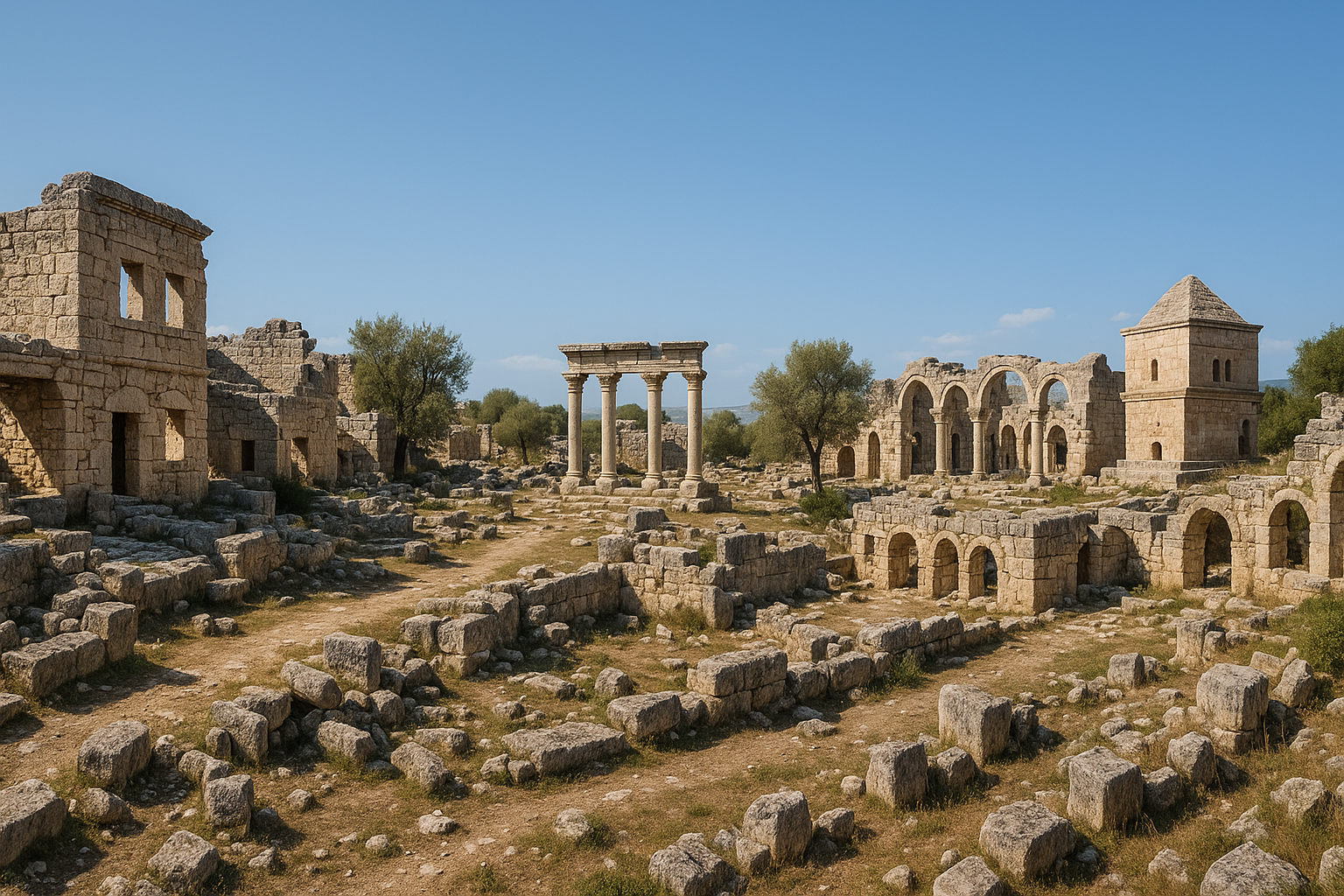
Aya Thecla

Meriamlik, Silifke (Mersin)

20 min read

Overview: The Pilgrimage Complex of St. Thecla (Aya Tekla / Meryemlik) near Silifke in Mersin Province is one of the most important early Christian pilgrimage sites in the eastern Mediterranean. Located on a hilltop about 4 km south of Silifke, the complex centers on a sacred cave where Saint Thecla — traditionally considered the first female martyr and the most prominent female saint of early Christianity — is believed to have lived, preached, and performed miracles. The site preserves the remains of a monumental domed basilica commissioned by Emperor Zeno the Isaurian (r. 474–491 AD), a cave church carved into the limestone grotto, extensive monastery buildings, cisterns, and baths. For centuries, pilgrims traveled from across the Christian world to venerate Thecla at this remote Cilician hilltop, making it one of the great cult centers of late antiquity alongside Jerusalem, Rome, and Ephesus.

  1. Why Aya Thecla Matters
  2. Geography and Setting
  3. Historical Timeline
  4. Who Was Saint Thecla?
  5. The Acts of Paul and Thecla
  6. The Cave Church
  7. Emperor Zeno's Basilica
  8. The Monastery Complex
  9. Pilgrimage and Cult
  10. The Miracles of Thecla
  11. Egeria and Ancient Pilgrims
  12. Architecture and Art
  13. The Cisterns and Infrastructure
  14. Thecla in Early Christianity
  15. Byzantine Silifke and Seleucia
  16. Decline and Abandonment
  17. Archaeological Research
  18. How to Visit Aya Thecla
  19. FAQ
  20. Sources

Why Aya Thecla Matters

The Thecla pilgrimage complex is significant for several reasons:

  • One of the greatest early Christian pilgrimage sites: Ranked alongside Jerusalem, Rome, and Ephesus as a major destination for late antique Christian pilgrims
  • First female martyr tradition: Saint Thecla was venerated as the first female martyr and the protomartyr among women — a foundational figure in Christian hagiography
  • Imperial patronage: Emperor Zeno the Isaurian built a monumental domed basilica here — one of the most important 5th-century churches in Asia Minor
  • Cave church: The cave where Thecla reportedly lived is one of the earliest documented Christian cult sites in Anatolia
  • Pilgrimage infrastructure: The site preserves extensive pilgrimage infrastructure — basilica, cave church, monastery, baths, cisterns — providing rare evidence for how ancient pilgrimage functioned
  • The Acts of Paul and Thecla: One of the most popular texts in early Christianity, the Acts profoundly influenced the development of female monasticism and asceticism
  • Isaurian heritage: The site connects to the Isaurian cultural tradition of Rough Cilicia — Emperor Zeno himself was Isaurian

Geography and Setting

Aya Thecla occupies a hilltop overlooking the ancient city of Seleucia ad Calycadnum (modern Silifke).

Location:

  • Meriamlik (Meryemlik) village, about 4 km south of Silifke, Mersin Province
  • On a limestone hilltop overlooking the Göksu (Calycadnus) river valley
  • Approximately 80 km west of Mersin city center
  • Near the coast of ancient Rough Cilicia (Cilicia Tracheia)
  • Altitude: approximately 250 meters above sea level

Landscape:

  • Rocky limestone hilltop with Mediterranean vegetation
  • Views over the Göksu valley and the mountains of Rough Cilicia
  • The coastal plain and Mediterranean Sea visible in the distance
  • Pine trees and scrub cover the hillside
  • The site is peaceful and relatively isolated — appropriate for its monastic character

Historical Timeline

PeriodDateKey Events
1st century ADc. 50–70Traditional date of Thecla's life and association with St. Paul
2nd centuryc. 150–180Acts of Paul and Thecla composed
3rd–4th century200s–300sCult of Thecla develops; cave becomes pilgrimage site
4th centuryc. 312 onwardChurch built over/in the cave; pilgrimage grows
Late 4th centuryc. 380sEgeria (pilgrim) visits and describes the site
5th century460s–470sEmperor Zeno builds monumental basilica
5th centuryc. 470–480Life and Miracles of Thecla composed
6th–7th century500–650Continued pilgrimage; monastery active
Arab raids7th–8th centuryDecline due to Arab-Byzantine frontier warfare
Medieval9th–14th centuryReduced habitation; Armenian Cilicia
Modern19th–20th centuryArchaeological documentation

Who Was Saint Thecla?

Saint Thecla (Thekla/Tekla) is one of the most important female saints in early Christianity.

Traditional biography:

  • According to the Acts of Paul and Thecla (a 2nd-century text), Thecla was a young woman from Iconium (modern Konya) who heard Saint Paul preach
  • She was so moved by his message of chastity and resurrection that she broke off her engagement and devoted herself to following Paul
  • Her fiancé and family denounced her; she was condemned to death by fire and then by wild beasts, but was miraculously saved both times
  • She traveled to Antioch and then to Seleucia (Silifke), where she lived as a hermit in a cave and performed healings and miracles
  • She was venerated as the first female martyr (protomartyr among women) — though technically she survived her ordeals
  • Her feast day is celebrated on September 24 (Western) or September 24/October 7 (Eastern)

Historical assessment:

  • Modern scholars debate whether Thecla was a historical person or a literary creation
  • The Acts of Paul and Thecla is considered by scholars to be a fictional narrative, though it may preserve memories of an actual early Christian woman
  • Regardless of historicity, the cult of Thecla was enormously influential in shaping early Christian attitudes toward women, virginity, and asceticism

The Acts of Paul and Thecla

The Acts of Paul and Thecla is one of the most popular and influential texts in early Christianity.

The text:

  • Written in the 2nd century AD (c. 150–180), probably in Asia Minor
  • Part of a larger text called the Acts of Paul
  • Tells the story of Thecla's conversion, her trials (condemnation to fire and wild beasts), her miracles, and her life as a hermit in Seleucia
  • Written in vivid, novelistic style — one of the earliest Christian "novels"

Influence:

  • The Acts were enormously popular — translated into Latin, Syriac, Coptic, Armenian, and other languages
  • Thecla became a model for female asceticism — her story inspired generations of Christian women to embrace virginity and religious life
  • The text was controversial — some church authorities questioned its authenticity and its implications for women's authority in the church
  • Tertullian (c. 200 AD) attacked the Acts, arguing they were forged and should not be used to justify women baptizing or teaching

Significance for the pilgrimage site:

  • The Acts established Seleucia (Silifke) as the place of Thecla's final retirement
  • The cave at Meriamlik was identified as Thecla's hermitage
  • The popularity of the Acts drove pilgrimage to the site for centuries

The Cave Church

The cave church is the spiritual heart of the Thecla complex — the grotto where Thecla is believed to have lived and died.

Description:

  • A natural limestone cave on the hilltop, adapted for use as a church
  • The cave was expanded and shaped to create a liturgical space
  • An apse was carved at the eastern end
  • Walls were plastered and probably painted with frescoes
  • The cave church predates the hilltop basilica — worship in the cave may have begun as early as the 3rd century

The tradition:

  • According to legend, Thecla lived in this cave during her final years in Seleucia
  • She reportedly performed healings and miracles from the cave
  • After her death (or miraculous disappearance — accounts vary), the cave became a shrine
  • Before Constantine legalized Christianity (312 AD), the cave was likely a secret place of worship

Archaeological evidence:

  • The cave shows signs of extensive modification for worship
  • Votive inscriptions and graffiti from pilgrims have been found
  • The cave church continued in use even after the hilltop basilica was built — it was the most sacred space on the site

Emperor Zeno's Basilica

The monumental basilica on the hilltop was built by Emperor Zeno the Isaurian (r. 474–491 AD) — one of the most important 5th-century churches in Anatolia.

The emperor:

  • Zeno was born in Isauria (Rough Cilicia) — the region where Meriamlik is located
  • He was the first emperor from this region, and his patronage of local churches reflected his Isaurian identity and pride
  • Building the Thecla basilica was both a religious act and a political statement connecting imperial authority with local religious tradition

The basilica:

  • A large domed basilica — one of the earliest centrally-planned domed churches in Anatolia
  • Architectural plan: a central dome supported by arches and piers, with aisles and an apse
  • Built of local limestone with fine architectural detailing
  • Mosaic floors and marble decoration
  • The basilica could accommodate hundreds of pilgrims

Current state:

  • Substantial ruins survive — walls, piers, apse, and architectural fragments
  • The dome has collapsed, but the plan is clearly legible
  • The basilica is the most visually impressive monument at the site

The Monastery Complex

The Thecla pilgrimage site included an extensive monastery and pilgrimage infrastructure.

Features:

  • Monastery buildings surrounding the basilica and cave church
  • Cells for monks or nuns
  • A pilgrims' hostel (xenodocheion) for visitors
  • Baths for ritual purification and practical hygiene
  • Cisterns for water storage (essential on the dry hilltop)
  • A refectory (dining hall) for the monastic community and pilgrims
  • Gardens and agricultural areas to support the community

Significance:

  • The monastery infrastructure shows how a major pilgrimage site was organized and managed
  • The combination of cave church (sacred space), basilica (public worship), and monastery (religious community) is typical of great late antique pilgrimage sites
  • The scale of the complex indicates that significant numbers of pilgrims visited regularly

Pilgrimage and Cult

The cult of Thecla at Meriamlik was one of the most important pilgrimage traditions in late antique Christianity.

The pilgrimage:

  • Pilgrims came from across the eastern Mediterranean — Asia Minor, Syria, Egypt, Constantinople, and beyond
  • The journey to the hilltop involved climbing from Seleucia along a processional path
  • At the summit, pilgrims visited the cave church (the most sacred space), prayed at the basilica, and sought healing
  • Festival days attracted large crowds — the feast of St. Thecla (September 24) was the main celebration

Healing cult:

  • Thecla was particularly venerated as a healer
  • Pilgrims came seeking cures for illness, infertility, and other afflictions
  • The Life and Miracles of Thecla (c. 470–480 AD) records numerous healing miracles attributed to the saint
  • Votive offerings were left at the cave in gratitude for cures

Comparison:

  • The Thecla pilgrimage is comparable to other great late antique cult centers:
    • Holy Sepulchre, Jerusalem — the supreme Christian pilgrimage
    • St. Peter's, Rome — the apostolic shrine
    • St. John, Ephesus — another major Anatolian pilgrimage
    • Abu Mena, Egypt — healing cult of St. Menas
  • Thecla's site was among the most visited pilgrimage destinations in Asia Minor

The Miracles of Thecla

The Life and Miracles of Thecla (composed c. 470–480 AD, probably at Meriamlik) records miracles attributed to Thecla at the shrine.

The text:

  • Written by an anonymous author closely associated with the shrine
  • Records dozens of miracle stories — healings, rescues, and divine interventions
  • The miracles involve people from all social classes — soldiers, merchants, mothers, monks
  • The text provides a vivid picture of daily life at the pilgrimage site

Examples:

  • Healing of a woman with a chronic illness after sleeping in the cave (incubation)
  • Rescue of sailors from shipwreck after praying to Thecla
  • Thecla appearing in dreams to guide and comfort the sick
  • Protection of the city of Seleucia from military attack

Egeria and Ancient Pilgrims

The site is mentioned by Egeria — one of the earliest known Christian pilgrims to leave a written account.

Egeria (c. 380s AD):

  • A woman (possibly a nun) from western Europe (Spain or Gaul) who traveled extensively in the Holy Land and Asia Minor
  • Her travel diary (Itinerarium Egeriae) is one of the most important documents for understanding early Christian pilgrimage
  • Egeria visited the Thecla shrine at Meriamlik and described it in her diary
  • She recorded the presence of a church at the cave, a monastery, and a community of monks and virgins (ascetic women)
  • Her account confirms that the site was already a major pilgrimage destination by the late 4th century

Architecture and Art

The Thecla complex features several noteworthy architectural and artistic elements.

Zeno's basilica:

  • One of the earliest centrally-planned domed churches in Anatolia
  • Influenced the development of Byzantine church architecture
  • Architectural parallels to churches in Constantinople, Ephesus, and Syria

The cave church:

  • A unique adaptation of a natural grotto for Christian worship
  • The combination of natural cave and constructed liturgical space is found at other early Christian sites (e.g., the Holy Sepulchre in Jerusalem, the Grotto of the Nativity in Bethlehem)

Mosaics and decoration:

  • Mosaic floor fragments survive
  • The basilica and cave church were probably richly decorated with frescoes, marble, and liturgical furnishings
  • Carved architectural elements — column capitals, cornices, and door frames — show high-quality workmanship

The Cisterns and Infrastructure

The pilgrimage complex required substantial infrastructure to support visitors and the monastic community.

Cisterns:

  • Multiple rock-cut cisterns for water storage
  • Essential on the dry limestone hilltop with no natural spring
  • The cisterns collected rainwater for drinking, cooking, bathing, and ritual use
  • Some cisterns are impressively large — testimony to the expected numbers of visitors

Baths:

  • Bath buildings for pilgrims — ritual purification and practical hygiene
  • The presence of baths indicates the sophistication of the pilgrimage infrastructure

Roads and paths:

  • A processional path connected the hilltop complex with the city of Seleucia below
  • Pilgrims walked uphill along this path as part of their devotional journey

Thecla in Early Christianity

Saint Thecla was one of the most important figures in early Christian tradition.

Significance:

  • Venerated as the protomartyr among women — the female equivalent of Stephen (the first male martyr)
  • Her story was used to argue both for and against women's roles in the church
  • She became a patron of female monasticism — convents and churches were dedicated to her across the Christian world
  • Thecla's cult was particularly strong in Egypt, Syria, Asia Minor, and the West
  • She is venerated in both the Eastern Orthodox and Catholic traditions

Churches dedicated to Thecla:

  • Churches named for Thecla exist across the Mediterranean, from Milan to Egypt
  • The Cathedral of Milan has an ancient chapel of St. Thecla
  • Multiple churches in Syria, Palestine, and Egypt bear her name
  • Her widespread cult testifies to the popularity and influence of the Acts of Paul and Thecla

Byzantine Silifke and Seleucia

The Thecla complex is closely connected to the ancient city of Seleucia ad Calycadnum (Seleucia on the Göksu), modern Silifke.

Seleucia:

  • Founded by Seleucus I Nicator (one of Alexander the Great's successors) in the 3rd century BC
  • Named after the Calycadnus river (modern Göksu Nehri)
  • An important city of Rough Cilicia throughout the Roman and Byzantine periods
  • Emperor Frederick Barbarossa drowned in the Göksu river near Silifke during the Third Crusade (1190) — a major event in Crusade history

Relationship to Meriamlik:

  • Seleucia/Silifke was the urban center; Meriamlik/Aya Thecla was its sacred hilltop
  • Pilgrims arrived in Seleucia and then ascended to the Thecla shrine
  • The two sites functioned as a pair — city and sanctuary

Decline and Abandonment

The Thecla complex declined during the Arab-Byzantine wars.

Decline:

  • The 7th-century Arab raids devastated the Cilician coast
  • Pilgrimage traffic decreased as the region became a war zone
  • The monastery was eventually abandoned
  • During the Armenian Kingdom of Cilicia (11th–14th centuries), some activity may have continued
  • By the Ottoman period, the site was fully abandoned

Legacy:

  • Despite the site's abandonment, the cult of Thecla continued elsewhere
  • Thecla remains one of the most venerated saints in Eastern Christianity
  • The site is gradually being recognized for its archaeological and religious-historical importance

Archaeological Research

Archaeological investigation has documented the complex's remarkable remains.

Key research:

  • 19th-century travelers documented the ruins
  • Ernest Herzfeld and Samuel Guyer published architectural studies in the early 20th century
  • More recent Turkish and international teams have continued documentation
  • Conservation work has stabilized key structures

Publications:

  • Dagron, Gilbert. Vie et Miracles de Sainte Thècle — critical edition and study of the miracle text
  • Herzfeld, Ernst and Guyer, Samuel. Meriamlik und Korykos — fundamental architectural documentation

How to Visit Aya Thecla

Getting there:

  • From Silifke: 4 km south (about 10 minutes)
  • From Mersin: 80 km west (about 1.5 hours)
  • From Kızkalesi: 25 km west (about 30 minutes)
  • Signposted as "Aya Tekla" or "Meriamlik/Meryemlik" from Silifke
  • Accessible by car or taxi from Silifke

The site:

  • Allow 1–1.5 hours
  • Key stops: Zeno's basilica ruins, cave church (the most atmospheric space), monastery remains, cisterns
  • The cave church is the spiritual highlight — atmospheric and evocative
  • Modest dress recommended out of respect for the religious character of the site
  • Limited signage; a guidebook or prior reading enhances the visit

Best time to visit:

  • Spring (March–May) and autumn (October–November) are ideal
  • Summer is hot — visit early morning
  • Winter is mild but can be rainy

Practical tips:

  • Comfortable walking shoes — uneven terrain
  • A flashlight is useful for the cave church
  • Photography is good — the basilica ruins against the sky are dramatic
  • Combine with visits to Silifke Castle, the Temple of Jupiter in Silifke, and nearby Cilician sites (Kızkalesi, Uzuncaburç, Kanlıdivane)
  • Silifke has hotels and restaurants

FAQ

Q: Who was Saint Thecla? A: According to the 2nd-century Acts of Paul and Thecla, she was a young woman from Iconium (Konya) who was converted by Saint Paul, survived execution by fire and wild beasts, and retired to a cave near Seleucia (Silifke) to live as a hermit.

Q: Is the cave still accessible? A: Yes. The cave church can be visited — it is the most atmospheric part of the complex. Bring a flashlight.

Q: Who built the basilica? A: Emperor Zeno the Isaurian (r. 474–491 AD) built the monumental domed basilica. Zeno was born in the region and wanted to honor the local saint.

Q: Was Thecla a real person? A: Modern scholars debate this. The Acts of Paul and Thecla is generally considered a fictional narrative, but it may preserve memories of an actual early Christian woman. The cult of Thecla was undeniably real and enormously influential.

Q: Why was this site important? A: The Thecla shrine was one of the most important Christian pilgrimage sites in the eastern Mediterranean, ranked alongside Jerusalem, Rome, and Ephesus. Pilgrims came from across the Christian world to seek healing and venerate the saint.

Q: Who visited the site in antiquity? A: Among the famous visitors was Egeria (c. 380s AD), a Western pilgrim whose travel diary describes the shrine and its monastic community.

Architectural Measurements and Structural Data

Detailed surveys by Herzfeld, Guyer, and later Turkish archaeological teams have documented the precise dimensions of the principal structures at the Thecla pilgrimage complex.

StructureDimensionsPeriodKey Features
Hilltop Basilica (Zeno's)55 m long x 37 m wide460–470 ADThree-aisled; 15 columns per aisle; Doric order
Underground Cave Church18 m x 12 m (rectangular plan)3rd–5th century ADNave and two aisles; Doric columns reused from earlier structures
Main Cistern12.6 m x 14.1 m5th–6th century AD1.7 m thick walls; ashlar exterior, brick interior with double plaster coat
Cistern vault systemThree barrel vaults5th–6th century ADSupported on walls and internal columns
Processional path~1.5 km from Seleucia to hilltopRoman–ByzantineStone-paved in sections; gradual ascent from river valley

Basilica architectural details:

  • The nave is separated from side aisles by two rows of 15 Doric columns each (30 columns total)
  • The apse at the eastern end has an internal radius of approximately 8 m
  • Wall thickness averages 1.8 m — a structural necessity for supporting the large central dome
  • The dome's estimated original span was 18–20 m, making it one of the largest pre-Justinianic domes in Anatolia
  • Architectural fragments of the dome pendentives and supporting arches survive in the collapsed rubble field

Cistern Engineering

The water infrastructure at Meriamlik represents a sophisticated solution to the challenge of sustaining a hilltop pilgrimage community without a natural spring.

Main cistern construction:

  • Outer walls built in ashlar masonry (cut stone blocks), providing structural stability against hillside pressure
  • Inner walls constructed from fired brick overlaid with two layers of hydraulic plaster (opus signinum), ensuring waterproofing
  • The three barrel vaults spanning the cistern are supported by internal columns, distributing the roof load evenly
  • Total estimated water capacity: approximately 2,100 cubic meters — sufficient to supply several hundred residents and pilgrims for extended dry periods

Additional cisterns:

  • At least four additional rock-cut cisterns have been documented across the site
  • Smaller cisterns near the cave church served the immediate liturgical needs (baptismal water, ritual washing)
  • A fragmentary aqueduct section indicates that water was also brought from a distant mountain source, supplementing rainwater collection

Mosaic and Decorative Fragments

Although much of the basilica's interior decoration has been lost, surviving fragments provide evidence of the original artistic program.

Fragment TypeLocation FoundDescription
Polychrome floor mosaicBasilica nave (northwest)Geometric patterns in red, white, black, and gold tesserae
Ceiling mosaic fragmentsCave church cornersSmall colored tesserae suggesting vault decoration
Carved column capitalsBasilica and cave churchDoric order with slight Corinthian influence — wind-blown acanthus leaves
Door frame carvingsCave church entranceCross motifs flanked by vine scrolls; 5th-century style
Marble revetment fragmentsBasilica apseThin marble slabs (opus sectile) in red and white

Excavation Chronology

Year(s)Investigator(s)Key Activities
1907Initial excavationsPreliminary clearance of basilica; many questions left unresolved
1907–1908Ernst Herzfeld & Samuel GuyerComprehensive architectural survey; published in Meriamlik und Korykos (MAMA II)
1925–1930sVarious European scholarsDocumentation of inscriptions and pilgrimage graffiti in the cave
1960s–1970sTurkish Directorate of MuseumsConservation of basilica walls; stabilization of cave entrance
1990s–2000sTurkish archaeological teamsSurvey of cistern systems; mosaic fragment recovery
2010s–presentOngoing conservationSite management plan; protective roofing over mosaic fragments; visitor pathway construction

Unexcavated areas:

  • A significant portion of the monastic complex — particularly the pilgrims' hostel (xenodocheion) and the refectory — has never been systematically excavated
  • Geophysical survey has suggested buried structures to the north and east of the basilica, potentially including additional residential buildings or workshops
  • The relationship between the cave church and the basilica — specifically how pilgrims moved between the two structures — remains incompletely understood

Pilgrim Graffiti and Votive Inscriptions

The cave church walls preserve a rich record of pilgrim graffiti and votive inscriptions carved or scratched by visitors over several centuries.

  • Over 200 individual graffiti marks have been documented, in Greek, Syriac, and Latin
  • Common formulas include "Lord, help your servant [name]" and "Saint Thecla, remember [name]"
  • Some graffiti include dates according to the Seleucid era, providing chronological anchors for patterns of pilgrimage activity
  • The graffiti density increases markedly in the 5th century, correlating with Emperor Zeno's construction of the basilica and the composition of the Life and Miracles of Thecla
  • Several graffiti record the occupations of pilgrims — soldiers, merchants, sailors — confirming the diverse social composition of the pilgrim community

Sources

  • Dagron, Gilbert. Vie et Miracles de Sainte Thècle (Subsidia Hagiographica 62)
  • Herzfeld, Ernst and Guyer, Samuel. Meriamlik und Korykos (MAMA II)
  • Egeria, Itinerarium Egeriae (Travels of Egeria)
  • Acts of Paul and Thecla (New Testament Apocrypha)
  • Turkish Archaeological News, "Saint Thecla Church and Cave in Silifke"
  • Wikipedia, "Aya Tekla Church"
  • Republic of Türkiye Ministry of Culture and Tourism — Mersin cultural heritage
  • Kristensen, Troels Myrup. "Landscape, Space, and Presence in the Cult of Thekla at Meriamlik," JECS 24.2 (2016)
  • ARCHAEOTRAVEL.eu, "In the Underground Cave Church of Aya Tekla in Silifke"
  • Archiqoo.com, "Aya Tekla Church" — architectural data
Share

Location Information

Latitude:36.362762
Longitude:33.931264
Open in Google Maps