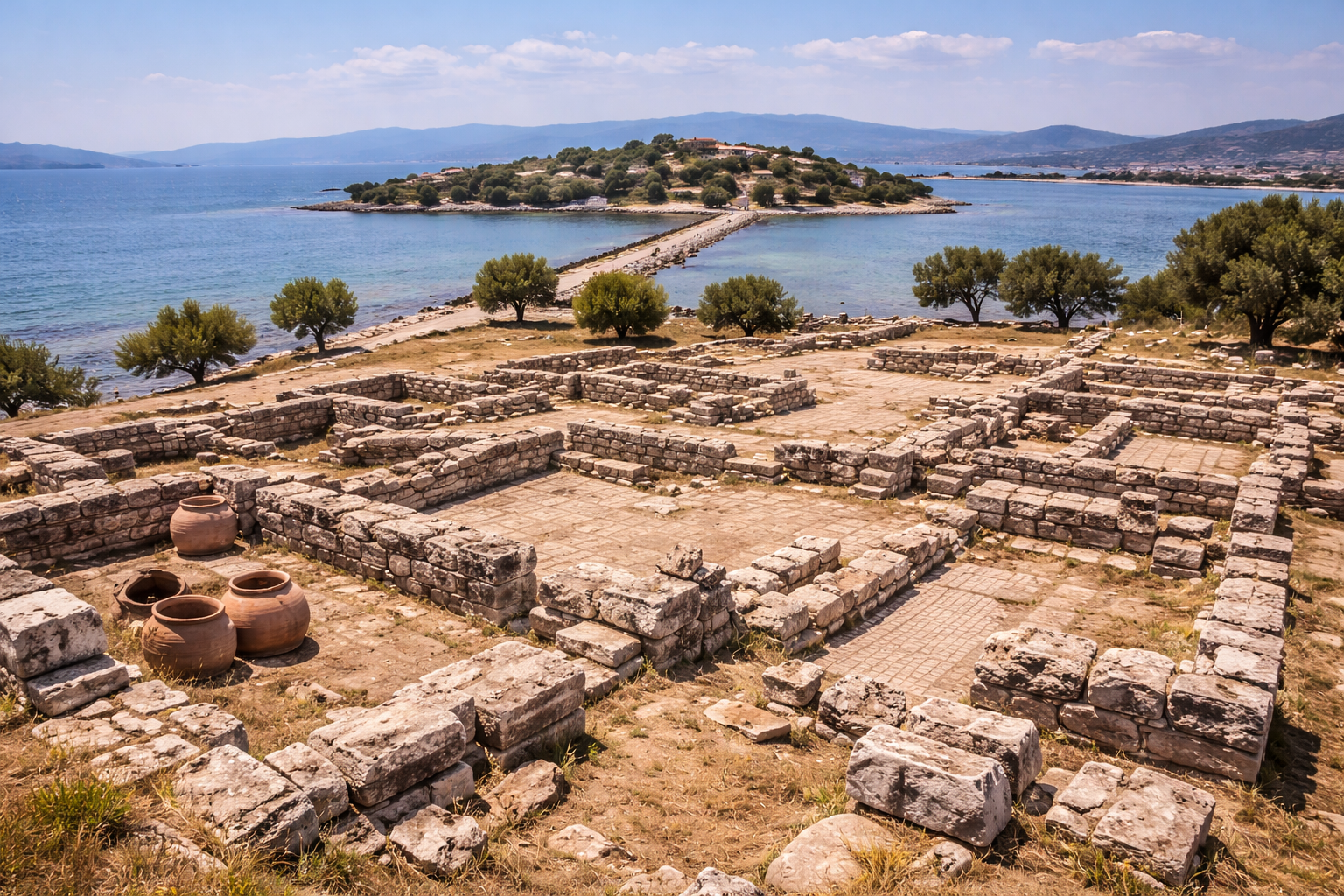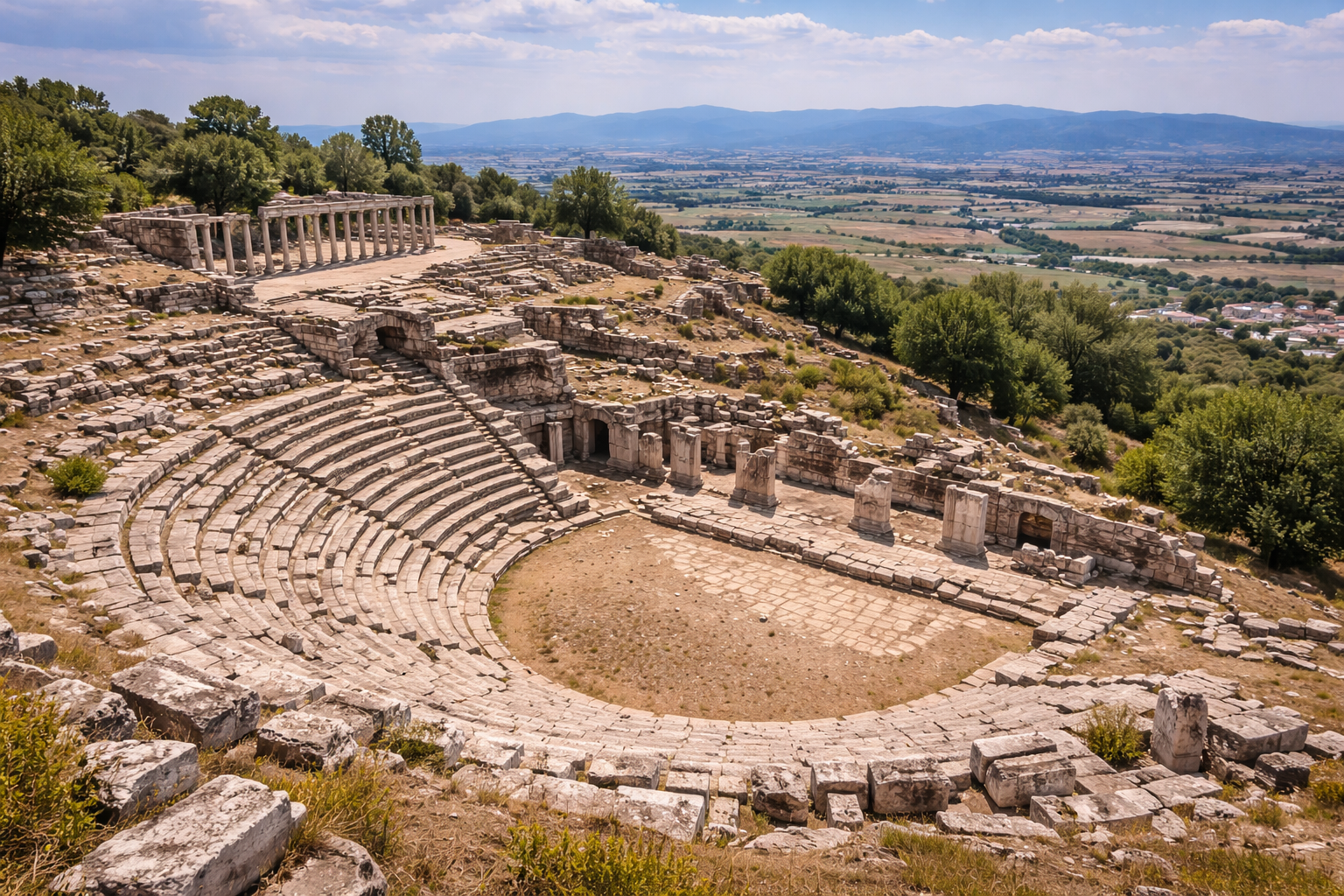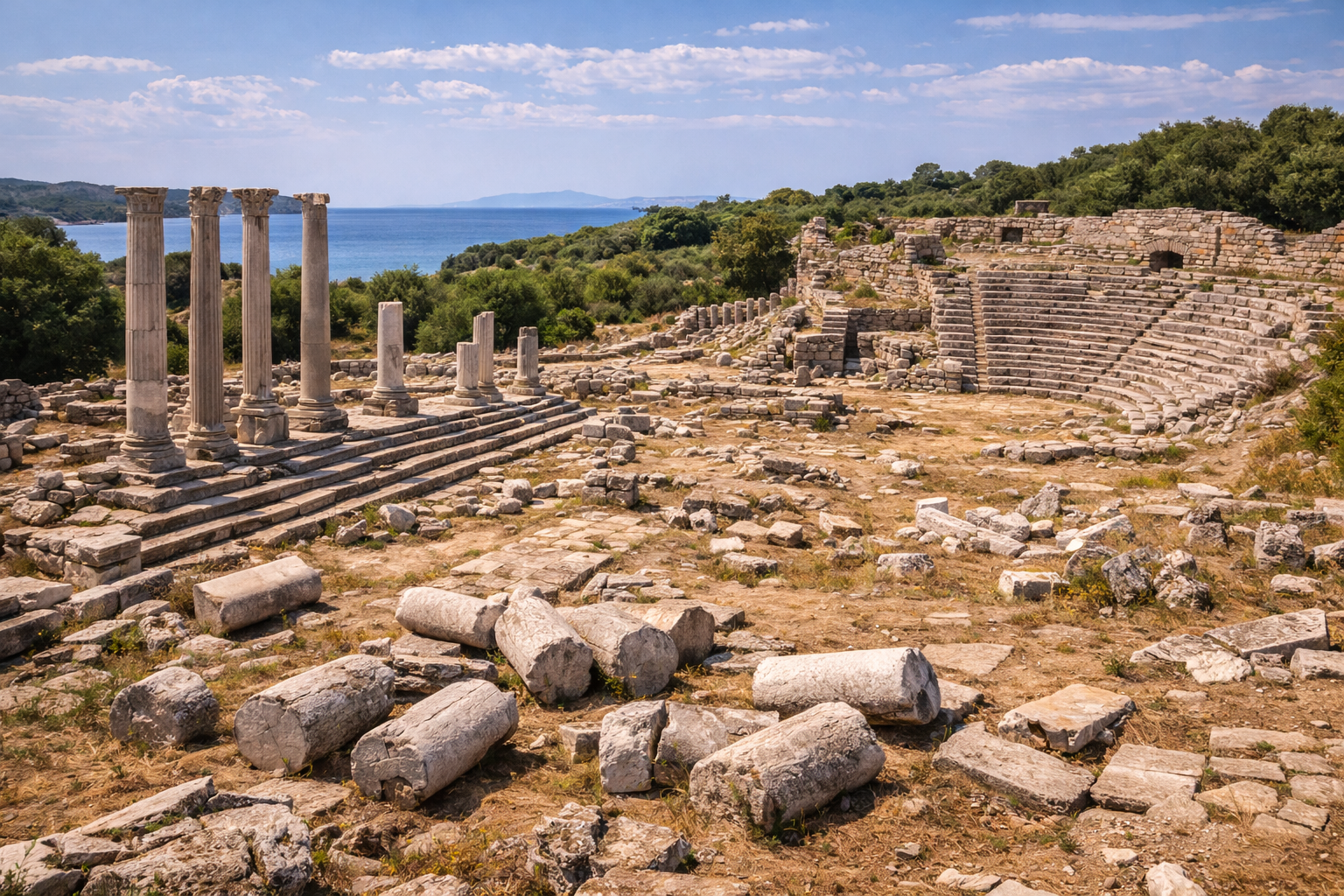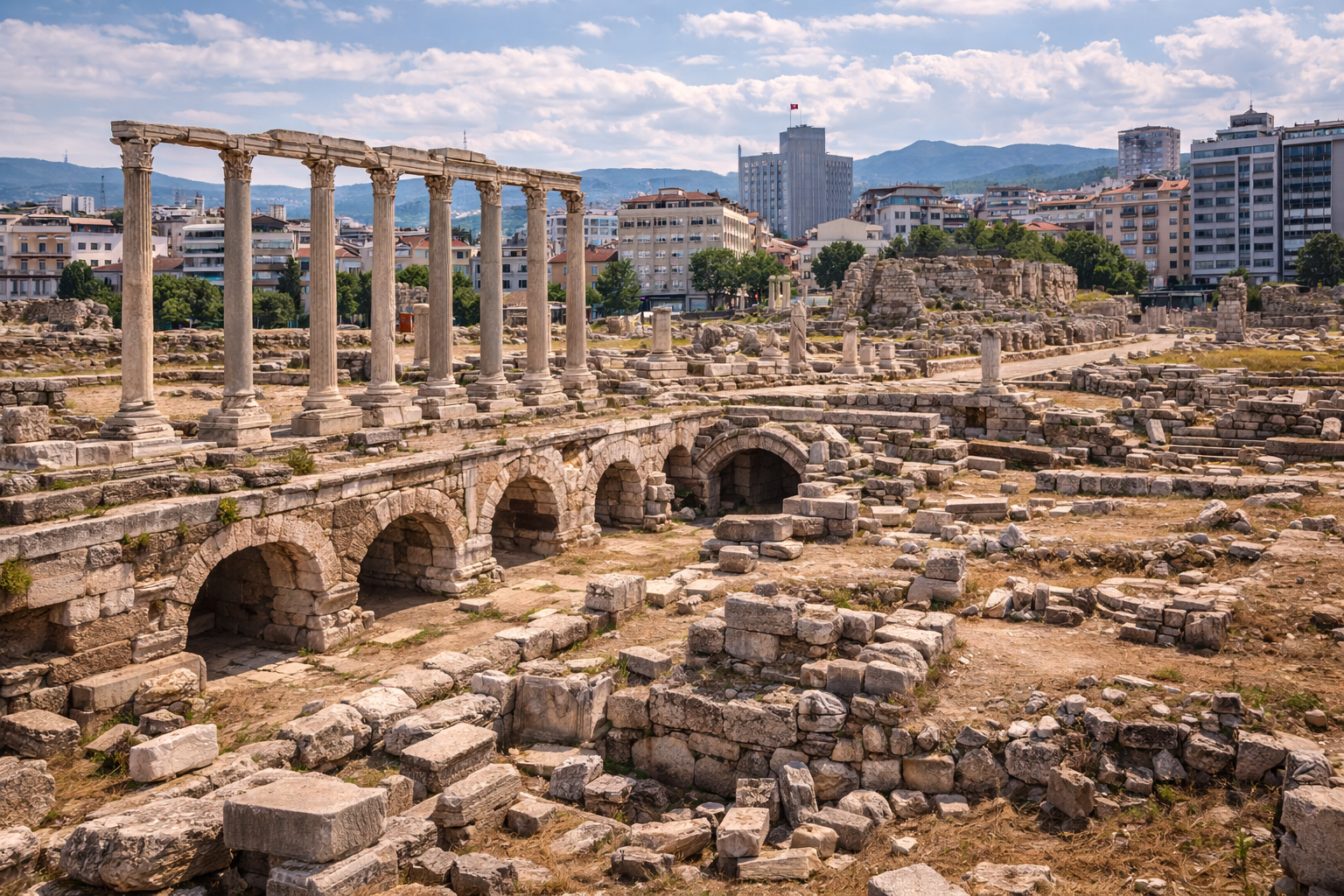
Visión ampliada: El Ágora de Esmirna, conocida ampliamente como el Ágora de İzmir, son los restos excavados del antiguo ágora estatal de Esmirna, situada en el corazón del moderno distrito de Konak de İzmir, en la ladera norte del monte Pagos (Kadifekale). Construida por primera vez a finales del siglo IV a. C. tras la refundación de Esmirna por los sucesores de Alejandro Magno, el ágora fue devastada por un catastrófico terremoto en el 178 d. C. y reconstruida magníficamente con financiación del emperador Marco Aurelio. Con unas medidas de 161,4 x 29,3 metros, la basílica por sí sola se cuenta entre las mayores jamás construidas en el Asia Menor romana. El yacimiento conserva una de las colecciones más ricas de grafitis antiguos del periodo romano —incluidos 21 dibujos de naves, bocetos de gladiadores y lo que se ha llamado el primer crucigrama del mundo—. Desde 2020, el yacimiento forma parte de la Lista Indicativa de la UNESCO como componente de «La ciudad portuaria histórica de İzmir».
Tabla de contenidos
- Por qué importa el Ágora de Esmirna
- Geografía y entorno
- Cronología histórica
- Principales monumentos y hallazgos
- Trabajos arqueológicos
- Información para el visitante
- Preguntas frecuentes
- Fuentes y lecturas adicionales
Por qué importa el Ágora de Esmirna
-
Arqueología viva en una ciudad viva. El Ágora de İzmir es uno de los raros centros cívicos antiguos que pueden experimentarse dentro del tejido de una próspera metrópoli moderna. Rodeada por el histórico distrito del bazar de Kemeraltı de İzmir y dominada por la fortaleza de Kadifekale, el ágora se sitúa en la intersección de 2.400 años de vida urbana continua. Es posible pasar de un mercado romano de 2.000 años de antigüedad directamente a un bazar otomano de 400 años en cuestión de minutos.
-
Reconstruida por Marco Aurelio. Tras el devastador terremoto del 178 d. C., el emperador Marco Aurelio —el emperador filósofo— patrocinó personalmente la reconstrucción del ágora. Las ruinas visibles representan en gran medida esta reconstrucción romana, lo que convierte al yacimiento en un monumento al mecenazgo imperial y a la resiliencia de la antigua Esmirna. Los esmirnios honraron a su esposa nombrando la entrada como Puerta de Faustina.
-
Extraordinaria colección de grafitis antiguos. Las paredes de yeso de los corredores subterráneos de la basílica conservan cientos de grafitis en griego, entre ellos nombres, declaraciones de amor, 21 dibujos detallados de naves que representan embarcaciones comerciales mediterráneas, bocetos de gladiadores que muestran a luchadores nombrados en combate, tableros de juego, acertijos y lo que los excavadores han descrito como el primer crucigrama del mundo. Constituye una de las colecciones más amplias y diversas de escritura informal de época romana que se conoce en cualquier lugar, comparable a los grafitis de Pompeya pero con un carácter distintivamente mediterráneo oriental.
-
Lista Indicativa de la UNESCO. Desde 2020, el Ágora forma parte de la entrada en la Lista Indicativa de la UNESCO «La ciudad portuaria histórica de İzmir», reconociendo su papel como componente clave del estratificado patrimonio urbano de İzmir, que se extiende desde la Antigüedad hasta los periodos otomano y moderno.
-
Arquitectura basilical monumental. La estoa norte (basílica), que mide aproximadamente 161,4 x 29,3 metros, fue una de las mayores basílicas construidas en el mundo romano. Su estructura cuenta con un sótano criptopórtico con 4 galerías y 3 naves en el nivel del suelo, lo que demuestra la sofisticada ingeniería romana y la planificación urbanística.
-
Una de las excavaciones más tempranas de la era republicana. Los trabajos en el Ágora de İzmir comenzaron en 1932-1933, lo que la convierte en una de las primerísimas excavaciones arqueológicas de la República turca: un yacimiento que ayudó a definir la relación de la nueva nación con su patrimonio antiguo.
Geografía y entorno
El Ágora de Esmirna se halla en la ladera norte del monte Pagos (actual Kadifekale, 186 metros de altitud), en el barrio de Namazgâh del distrito de Konak, precisamente entre la fortaleza en la cima de Kadifekale al sur y el histórico bazar de Kemeraltı al norte. El yacimiento ocupa un área rectangular de suave pendiente en el denso núcleo urbano de İzmir, la tercera ciudad más grande de Turquía.
La ubicación refleja el diseño urbano deliberado de la Esmirna helenística. Cuando la ciudad fue refundada en el monte Pagos a finales del siglo IV a. C. (tras haber sido destruido el asentamiento anterior en Bayraklı/Antigua Esmirna), el nuevo plano hipodámico situó el ágora en el centro funcional de la ciudad: por debajo de la acrópolis (donde se encontraban la guarnición militar y los templos) y por encima del puerto (donde se concentraba la actividad comercial). Esta posición dio al ágora su papel de centro cívico, judicial y administrativo que conectaba la ciudad alta y la baja.
Hoy, el ágora está rodeada de edificios residenciales y comerciales, con áreas de excavación abiertas en medio de la cuadrícula viaria moderna. La proximidad del bazar de Kemeraltı —uno de los mercados cubiertos más grandes y antiguos de Turquía, que se remonta al siglo XVII— crea una notable continuidad de tradición comercial que abarca más de dos milenios.
El monte Pagos (Kadifekale) se eleva directamente detrás del ágora hacia el sur, coronado por la fortaleza helenístico-otomana. Desde la fortaleza, los visitantes pueden ver desplegado a sus pies todo el trazado del ágora, lo que hace de Kadifekale un excelente punto de partida para entender el contexto topográfico del lugar.
Coordenadas: aproximadamente 38,42 N, 27,14 E
Altitud: aproximadamente entre 30 y 50 metros sobre el nivel del mar, en la ladera del monte Pagos.
Clima: mediterráneo; veranos calurosos y secos que con frecuencia superan los 35 °C en julio-agosto, inviernos suaves y húmedos. Se recomiendan las visitas matinales en verano.
Cronología histórica
Fundación helenística (finales del siglo IV a. C.)
Tras la destrucción de la primera ciudad de Esmirna (en Bayraklı, unos 3 km al noreste), se fundó una nueva ciudad en el monte Pagos a finales del siglo IV a. C., atribuida tradicionalmente a Lisímaco, uno de los generales de Alejandro Magno. La nueva ciudad se trazó según un plano hipodámico y el ágora se construyó como un gran espacio rectangular abierto rodeado de estoas porticadas (paseos cubiertos con tiendas y oficinas). Esta ágora helenística sirvió como centro político, judicial y comercial de la Esmirna refundada.
La Esmirna romana: una gran ciudad de Asia
Esmirna prosperó bajo el dominio romano como una de las ciudades más importantes de la provincia romana de Asia. Competía con Éfeso y Pérgamo por el título de «Primera ciudad de Asia». El ágora siguió cumpliendo sus funciones cívicas, albergando tribunales, oficinas gubernamentales y el comercio público. La ciudad era conocida por su belleza, su riqueza y su vida intelectual: era un gran centro del movimiento de la Segunda Sofística.
El terremoto del 178 d. C. y la reconstrucción imperial
En el 178 d. C. (algunas fuentes dicen 177), un devastador terremoto sacudió Anatolia occidental, causando graves daños a Esmirna y a su ágora. Se dice que el joven orador Elio Arístides, uno de los oradores más famosos de la Segunda Sofística y residente en Esmirna, escribió una emotiva súplica al emperador Marco Aurelio y a la emperatriz Faustina describiendo la destrucción. Las fuentes antiguas relatan que Marco Aurelio lloró al leer la carta.
Conmovido por la súplica, Marco Aurelio ordenó y financió la reconstrucción integral del ágora y de otros edificios públicos. Los esmirnios expresaron su gratitud erigiendo la Puerta de Faustina en la entrada del ágora, con un retrato en relieve de la emperatriz Faustina.
La mayor parte de los restos arqueológicos visibles datan de esta reconstrucción posterior al 178 d. C. El ágora reconstruida fue aún más grandiosa que la original, con la enorme estoa norte (basílica) y su criptopórtico, la estoa oeste y un patio abierto que cubría miles de metros cuadrados.
Vida en el ágora reconstruida (siglos II-IV d. C.)
El ágora reconstruida bullía con la vida cotidiana. La basílica cumplía funciones tanto judiciales como comerciales. Fue en estos años cuando se grabaron y pintaron los grafitis en las paredes del sótano: marineros que dibujaban sus barcos, aficionados que esbozaban gladiadores, enamorados que escribían nombres, ociosos que tallaban tableros de juego e intelectuales que componían acertijos y juegos de palabras en griego.
Periodos romano tardío y bizantino (siglos III-XV)
El ágora siguió en uso a lo largo del periodo romano tardío, aunque sus funciones evolucionaron. Algunas áreas se reutilizaron para actividades industriales y comerciales. Durante el periodo bizantino se construyeron estructuras, incluido un edificio y un cementerio de época otomana, dentro del patio, reflejando la transformación continua del espacio a lo largo de culturas y siglos.
Periodo otomano
La zona del ágora pasó a formar parte del tejido urbano otomano, con edificios residenciales que invadieron gradualmente el sitio antiguo. Las ruinas quedaron parcialmente enterradas bajo rellenos y construcciones, lo que paradójicamente preservó las estructuras subterráneas, aunque las ocultó a la vista durante siglos.
Excavación y apertura modernas (1932-presente)
Las excavaciones comenzaron en 1932-1933, lo que hace del Ágora de İzmir una de las primeras excavaciones arqueológicas de la era de la República Turca. El yacimiento ha sido progresivamente excavado, restaurado y abierto al público, convirtiéndose en una de las atracciones culturales más importantes de İzmir.
Principales monumentos y hallazgos
La estoa norte (basílica civil)
La basílica es la estructura más imponente del ágora. Este edificio rectangular, de aproximadamente 161,4 x 29,3 metros, se construyó tras el terremoto del 178 d. C. y funcionó como basílica civil, con elementos tanto judiciales como comerciales, utilizada para tribunales, transacciones comerciales y reuniones públicas.
La estructura de la basílica consta de:
- Un sótano criptopórtico con 4 galerías utilizadas para nivelar el terreno en pendiente
- 3 naves en el nivel del suelo, con la sala principal mayor que las naves laterales
- Una sala porticada sobre el nivel del suelo con columnas de mármol y vanos con arcos
- Un entresuelo entre la planta baja y el sótano
Esto la convierte en una de las mayores basílicas de todo el Asia Menor.
La colección de grafitis antiguos
Es en los corredores del sótano donde se descubrieron los famosos grafitis antiguos, grabados y pintados sobre las paredes enlucidas y los soportes de los arcos. Un exhaustivo proyecto de documentación iniciado en 2003 por un equipo en el que participó Roger Bagnall del Instituto para el Estudio del Mundo Antiguo (ISAW) de la NYU produjo la monografía Graffiti from the Basilica in the Agora of Smyrna.
Los grafitis incluyen:
- Nombres y declaraciones — enamorados, amigos, visitantes que dejan constancia de su presencia
- 21 dibujos de barcos — algunos notablemente detallados, que representan embarcaciones comerciales que surcaban el Mediterráneo en los siglos II-IV d. C. Algunos están hechos con pintura y otros mediante incisión. Estos dibujos proporcionan evidencia inestimable sobre los tipos de naves antiguas y confirman la importancia de Esmirna como ciudad portuaria.
- Bocetos de gladiadores — que representan a luchadores nombrados en escenas de combate, lo que refleja la popularidad de los juegos gladiatorios
- Tableros de juego — tallados con incisiones en muros y suelos para juegos de mesa antiguos
- Acertijos y juegos de palabras — distracciones intelectuales en griego, incluido lo que los excavadores han descrito como el primer crucigrama del mundo
- Imágenes obscenas y referencias sexuales — representaciones francas de la vida cotidiana
- Dibujos de aves y animales — expresiones artísticas informales
- Referencias políticas — comentarios sobre los asuntos locales
Esta colección constituye uno de los archivos más ricos de escritura e imágenes informales de época romana conocidos por la erudición, comparable a los grafitis de Pompeya pero con un carácter distintivamente del Mediterráneo oriental y en griego.
La estoa oeste y el criptopórtico
La estoa oeste (pórtico occidental) recorre el lado oeste del patio del ágora. Su rasgo más notable es el criptopórtico, un pasaje abovedado subterráneo con tres galerías arqueadas que sostenían la columnata superior. El criptopórtico compensaba el terreno en pendiente y proporcionaba espacio adicional cubierto para uso comercial o de almacén. Caminar por estos corredores hoy ofrece al visitante una poderosa sensación de la escala y la sofisticación ingenieril de la arquitectura urbana romana.
El bouleuterion (sala del consejo)
Situado al oeste del patio principal del ágora, el bouleuterion era el lugar donde el consejo electo de la ciudad de Esmirna se reunía para debatir y aprobar leyes. Las excavaciones han demostrado que el bouleuterion fue reubicado hacia el norte durante la reconstrucción posterior al 178, reflejando una replanificación deliberada del espacio cívico tras el terremoto.
La sala del mosaico
Adyacente al bouleuterion se ha excavado una sala con suelo de mosaico, que presenta mosaicos geométricos policromos que demuestran la calidad decorativa de los espacios públicos del ágora. Los mosaicos reflejan la riqueza y los estándares estéticos de la Esmirna romana.
La Puerta de Faustina
La entrada ceremonial del ágora era la Puerta de Faustina, llamada así por Faustina la Joven, esposa de Marco Aurelio. La puerta contaba con un retrato en relieve de Faustina en el centro del arco norte, en honor a su papel junto a su esposo en la financiación de la reconstrucción del ágora. Aunque la puerta está muy dañada, sus restos arqueológicos y su importancia histórica la convierten en un punto interpretativo clave.
La terma romana
Se han identificado restos de un complejo termal romano dentro del recinto del ágora, incluidos suelos de hipocausto (sistema de calefacción bajo el suelo) y canales de agua, lo que refleja la integración de las instalaciones de baño en el centro cívico.
Estructuras del periodo otomano
Dentro del patio del ágora se han excavado restos de un edificio otomano y de un cementerio asociado, lo que ilustra la continua estratificación cultural del lugar desde la Antigüedad hasta el periodo islámico. Estas estructuras demuestran cómo se reutilizó el yacimiento a lo largo de los siglos.
Estatuaria y escultura
Las excavaciones han proporcionado fragmentos de estatuaria de mármol, incluidos bustos de retrato e inscripciones dedicatorias que iluminan la vida cívica y las redes de mecenazgo de la Esmirna romana. Estos hallazgos se exhiben en el Museo Arqueológico de İzmir.
Trabajos arqueológicos
El Ágora de İzmir es una de las primeras excavaciones arqueológicas de la moderna República Turca. Los trabajos iniciales comenzaron en 1932-1933 bajo la dirección de Selahattin Kantar, director de los Museos de İzmir y Éfeso, en colaboración con el arqueólogo alemán Rudolf Naumann. Sus campañas, que continuaron hasta 1941, sacaron a la luz la basílica, la estoa oeste y partes importantes del criptopórtico subterráneo.
Tras un largo paréntesis, las excavaciones se reanudaron en la década de 1990 y ganaron un impulso significativo en 2007, cuando el profesor asociado Akın Ersoy de la Universidad İzmir Katip Çelebi y su equipo iniciaron nuevas campañas sistemáticas que han continuado hasta la actualidad.
Las campañas recientes se han centrado en:
- Ampliación del área de excavación para exponer partes del patio del ágora previamente enterradas
- Restauración y conservación de los arcos del criptopórtico y de los muros de la basílica
- Documentación de los grafitis mediante fotografía digital, escaneo 3D y análisis epigráfico, que culminó en la publicación de las Monografías ISAW
- Descubrimiento del bouleuterion y de la sala del mosaico, añadiendo nuevas dimensiones a la comprensión de las funciones cívicas del ágora
- Integración con la planificación urbana: el Ayuntamiento Metropolitano de İzmir ha trabajado para equilibrar la excavación con la ciudad moderna circundante, creando un parque arqueológico al aire libre accesible tanto para turistas como para residentes locales
- Descubrimiento de 21 grafitis de naves que representan embarcaciones comerciales mediterráneas, arrojando nueva luz sobre la historia marítima de Esmirna
En 2020, el Ágora de Esmirna fue inscrita en la Lista Indicativa de la UNESCO como parte de «La ciudad portuaria histórica de İzmir», reconociendo su importancia dentro del contexto más amplio del patrimonio urbano multiestratificado de İzmir.
Los hallazgos del ágora se exhiben en el Museo Arqueológico de İzmir y en las áreas de exposición in situ dentro de la propia ágora. La publicación de referencia Graffiti from the Basilica in the Agora of Smyrna (ISAW Monographs, NYU, 2016) de Roger S. Bagnall, Roberta Casagrande-Kim, Akın Ersoy, Cumhur Tanrıver y Burak Yolaçan proporciona una documentación académica exhaustiva de los grafitis.
Información para el visitante
Cómo llegar
El Ágora de İzmir se sitúa en el barrio de Namazgâh de Konak, el distrito central de İzmir. Es accesible a pie desde múltiples puntos:
- Desde la Plaza de Konak: aproximadamente 15 minutos a pie cuesta arriba a través del bazar de Kemeraltı
- Desde Kadifekale: aproximadamente 10 minutos a pie cuesta abajo
- En metro de İzmir: estación de Çankaya (luego 10 minutos a pie)
- En autobús/tranvía: numerosas líneas de autobuses urbanos y tranvías sirven Konak
- Taxi: fácilmente accesible desde cualquier punto del centro de İzmir
Mejor época para visitar
El ágora está abierta todo el año. La primavera (marzo-mayo) y el otoño (septiembre-noviembre) ofrecen el tiempo más agradable. Las visitas en verano son posibles, pero pueden ser muy calurosas (İzmir supera con frecuencia los 35 °C en julio-agosto). Se recomiendan las visitas matinales en verano para temperaturas confortables y buena luz fotográfica.
Duración
Calcule de 1 a 2 horas para una visita exhaustiva al yacimiento del ágora. Si se combina con Kadifekale (directamente encima) y el bazar de Kemeraltı (directamente debajo), planifique una excursión de media jornada que cubra los tres lugares en secuencia: una de las mejores rutas a pie de İzmir.
Qué llevar
- Calzado cómodo para caminar (caminos de piedra y algunas superficies irregulares)
- Agua (especialmente en verano)
- Cámara (los corredores subterráneos ofrecen oportunidades fotográficas espectaculares)
- Una linterna o la luz del móvil (útil para ver detalles de los grafitis en los tramos más oscuros del corredor)
- Guía o información descargada sobre los grafitis (ayuda a identificar dibujos concretos)
Recorrido recomendado
- Comience en Kadifekale para la vista panorámica del ágora y de la ciudad al pie
- Descienda hacia el ágora y entre por la entrada superior (sur)
- Recorra los corredores del sótano de la basílica: busque cuidadosamente los grafitis en las paredes, incluidos dibujos de barcos y bocetos de gladiadores
- Explore las galerías del criptopórtico de la estoa oeste: fíjese en la estructura de 4 galerías y en los techos abovedados
- Visite el patio abierto y la zona del bouleuterion
- Examine la sala del mosaico adyacente al bouleuterion
- Busque los restos de la Puerta de Faustina en la entrada norte
- Salga hacia el norte y continúe hacia el bazar de Kemeraltı para una transición sin solución de continuidad del espacio comercial antiguo al otomano
Atracciones cercanas
- Kadifekale (Pagos) — fortaleza helenístico-otomana, vistas panorámicas (directamente arriba)
- Bazar de Kemeraltı — mercado histórico otomano que se remonta al siglo XVII, comida, compras (directamente debajo)
- Museo Arqueológico de İzmir — hallazgos del ágora y colecciones regionales más amplias
- Plaza de Konak y Torre del Reloj — icónico hito frente al mar de İzmir
- Kordon (paseo marítimo) — paseo y cocina junto al mar
- Ágora de la Antigua Esmirna (Bayraklı) — el asentamiento anterior del periodo arcaico, a 3 km al noreste
- Éfeso (Selçuk) — el yacimiento antiguo más visitado de Turquía, a 80 km al sur
Entrada y tarifas
El ágora cobra una tarifa de entrada de museo (compruebe los precios actuales en el sitio web de Museos de Turquía o en el yacimiento). Un Museum Pass Turkey o un Pase de Museos de İzmir pueden cubrir la entrada. Abierta a diario; el horario varía según la estación (típicamente 8:30-17:30 en invierno, ampliado a 19:00 en verano).
Notas de accesibilidad
Las áreas superiores del ágora son relativamente planas y accesibles. Los corredores subterráneos del criptopórtico implican escaleras y pueden resultar difíciles para los visitantes con movilidad reducida. Algunas zonas se han adaptado para un mejor acceso, y el patio abierto es en general accesible.
Preguntas frecuentes
¿Qué es un ágora?
Un ágora era el espacio público central de reunión en una ciudad griega o romana, equivalente a un foro romano. Servía como mercado, área de asamblea política, tribunal y centro cívico general. El Ágora de Esmirna era el ágora estatal (a diferencia de un ágora comercial), lo que significa que se utilizaba principalmente para funciones judiciales, administrativas y políticas, aunque también se desarrollaban actividades comerciales.
¿Por qué reconstruyó Marco Aurelio el ágora?
Tras el devastador terremoto del 178 d. C., se dice que el famoso orador Elio Arístides, que vivía en Esmirna, envió una emotiva súplica al emperador Marco Aurelio describiendo la destrucción de la ciudad. Las fuentes antiguas relatan que Marco Aurelio lloró al leer la carta. Conocido como el emperador filósofo y patrón de Esmirna (que había visitado), autorizó y financió una reconstrucción integral. Los esmirnios honraron esta generosidad nombrando la puerta principal en honor a su esposa, Faustina.
¿Qué hace especiales a los grafitis?
Los grafitis grabados y pintados sobre las paredes del sótano de la basílica constituyen una de las mayores colecciones de escritura y dibujo informales de época romana halladas fuera de Pompeya. A diferencia de las inscripciones formales, estos grafitis revelan las voces sin filtrar de la gente común: sus nombres, intereses amorosos, humor, juegos, diseños de barcos, héroes gladiadores y preocupaciones sexuales. Incluyen 21 dibujos detallados de naves que confirman el papel de Esmirna como gran puerto y lo que los excavadores han llamado el primer crucigrama del mundo. Están escritos en griego y proporcionan una ventana inigualable a la vida cotidiana en una gran ciudad de época romana.
¿Cómo ayudan los grafitis de barcos a los historiadores?
Los 21 dibujos de barcos hallados en el sótano de la basílica están hechos con pintura o grabados en las paredes. Representan embarcaciones comerciales que se supone surcaban el Mediterráneo durante los siglos II-IV d. C. Estos dibujos proporcionan una rara evidencia visual de la construcción y aparejo de las naves antiguas, complementando las pruebas literarias y numismáticas sobre el comercio marítimo antiguo, y confirman que İzmir fue una importante ciudad portuaria en el mundo antiguo.
¿Cómo se conecta el ágora con el bazar de Kemeraltı?
La relación espacial es notable. El ágora antigua se encuentra en la ladera, directamente sobre el bazar de Kemeraltı, el histórico mercado cubierto de época otomana de İzmir, que data del siglo XVII. Al bajar del ágora hacia Kemeraltı, se atraviesa una historia continua de actividad comercial que se extiende por más de 2.000 años: de un mercado helenístico-romano a un bazar otomano y a un distrito comercial moderno.
¿Está el yacimiento en la Lista del Patrimonio Mundial de la UNESCO?
El Ágora de Esmirna se halla en la Lista Indicativa de la UNESCO desde 2020, como parte de «La ciudad portuaria histórica de İzmir». Una candidatura completa para el estatus de Patrimonio Mundial está en preparación.
¿Puedo visitar los corredores subterráneos?
Sí, los corredores del criptopórtico de la estoa oeste y partes del sótano de la basílica están abiertos a los visitantes. Son algunos de los espacios más atmosféricos del lugar, con techos abovedados en cañón y (en algunos puntos) grafitis visibles en las paredes. Hay iluminación, pero llevar una linterna ayuda a ver detalles.
¿Quién fue Elio Arístides?
Elio Arístides (117-181 d. C.) fue uno de los oradores más famosos del Imperio romano, figura destacada del movimiento literario de la Segunda Sofística. Vivió en Esmirna y se dedicó a la ciudad. Su apasionada carta a Marco Aurelio tras el terremoto del 178 d. C. se considera responsable de asegurar la financiación imperial para la reconstrucción del ágora.
¿Qué ocurrió con el ágora tras el periodo romano?
Tras la decadencia del Imperio romano, las funciones cívicas del ágora cesaron gradualmente. Durante el periodo bizantino, algunas áreas se reutilizaron para actividades industriales y residenciales. Bajo el dominio otomano, el distrito se convirtió en parte del tejido residencial de la ciudad, con casas construidas sobre las ruinas antiguas. Irónicamente, este enterramiento bajo construcciones posteriores ayudó a preservar los corredores subterráneos del criptopórtico y sus grafitis durante siglos, protegiéndolos de la intemperie y el vandalismo hasta que la excavación moderna los reveló.
¿Hay aseos y refrigerios en el yacimiento?
El yacimiento del ágora cuenta con servicios básicos para visitantes cerca de la entrada. Sin embargo, el adyacente bazar de Kemeraltı ofrece una enorme gama de restaurantes, cafés y casas de té turcas a escasa distancia a pie. Esta es una de las ventajas de visitar un yacimiento arqueológico inserto en una ciudad viva: cada comodidad está cerca.
¿Qué es el criptopórtico?
Un criptopórtico es un corredor o galería abovedada subterránea utilizada en la arquitectura romana para crear una plataforma de edificio nivelada en terrenos en pendiente, proporcionando al mismo tiempo espacio cubierto comercial o de almacén abajo. En el Ágora de Esmirna, el criptopórtico bajo la basílica tiene cuatro galerías y se utilizaba para nivelar la pendiente natural del monte Pagos. Las paredes del criptopórtico se convirtieron en el lienzo de la famosa colección de grafitis antiguos.
¿Cómo se compara el Ágora de İzmir con el de Atenas?
Ambas son ágoras estatales de grandes ciudades antiguas, pero difieren significativamente. El Ágora de Atenas es mucho mayor y fue el corazón político de la primera democracia del mundo. El Ágora de İzmir, reconstruida tras el terremoto del 178 d. C., representa un centro cívico de época romana posterior, con una basílica masiva y un elaborado sistema de criptopórtico. La colección de grafitis del Ágora de İzmir es única: Atenas no tiene nada comparable. Ambos yacimientos están inmersos en sus ciudades modernas, creando contrastes similares entre la vida urbana antigua y la contemporánea.
Detalles arquitectónicos
Técnicas de construcción
La construcción del ágora demuestra varios métodos avanzados de ingeniería romana:
- Hormigón hidráulico (opus caementicium): las bóvedas en cañón del criptopórtico utilizaron hormigón romano —una mezcla de mortero de cal, ceniza volcánica (pozzolana) y árido— que ha sobrevivido casi dos milenios. Este material permitió a los romanos cubrir grandes espacios interiores sin soportes de madera.
- Mampostería de piedra tallada: la fachada visible de la basílica empleaba bloques de caliza y mármol cortados con precisión, muchos con bordes biselados, una técnica heredada de las tradiciones constructivas helenísticas.
- Aterrazado: todo el complejo del ágora se construyó sobre una terraza artificial que compensaba la pendiente del monte Pagos, requiriendo enormes muros de contención en el lado descendente. Esta hazaña ingenieril demuestra por qué el criptopórtico era esencial: simultáneamente nivelaba el terreno y creaba espacio utilizable.
- Construcción de columnas: las columnas de la basílica se hicieron con tambores de mármol apilados, cada uno individualmente labrado y ajustado con precisión. Las bases de columna supervivientes muestran perfiles ático-jónicos coherentes con las convenciones arquitectónicas del siglo II d. C.
Gestión del agua
El ágora incorporaba un sofisticado sistema de gestión del agua:
- Canales de drenaje discurrían bajo el pavimento del patio, alejando el agua de lluvia de los cimientos.
- Tuberías de plomo suministraban agua a fuentes y pilas dentro del espacio cívico.
- El sistema de hipocausto de la terma romana requería un suministro fiable de agua, entregado a través de la red de acueductos de la ciudad.
La Segunda Sofística y la vida intelectual de Esmirna
El Ágora de Esmirna no era meramente un mercado o tribunal: era el escenario de una de las culturas intelectuales más vibrantes del mundo romano. Esmirna fue un centro importante de la Segunda Sofística (h. 60-230 d. C.), un movimiento literario y retórico que celebraba la identidad cultural griega dentro del Imperio romano.
Aspectos clave de la vida intelectual de Esmirna conectados con el ágora:
- Oratoria pública: la basílica servía como escenario de discursos públicos de los principales sofistas. Los oradores competían por la fama, los estudiantes y el mecenazgo imperial, atrayendo multitudes que llenaban las galerías.
- Escuelas filosóficas: Esmirna albergaba escuelas de filosofía donde los estudiantes estudiaban retórica, ética y filosofía natural en la tradición de Platón y Aristóteles.
- Festivales literarios: la ciudad acogía festivales agonísticos (competiciones) de retórica y poesía, en los que los vencedores recibían honores públicos.
- Legado de Elio Arístides: las obras supervivientes de Arístides, incluidos sus famosos Discursos sagrados que describen sus experiencias místicas con el dios Asclepio, siguen siendo fuentes importantes para entender la vida intelectual y la experiencia religiosa del siglo II.
Los grafitis en el sótano de la basílica pueden reflejar en parte esta atmósfera intelectual: los juegos de palabras, los acertijos y las alusiones literarias grabadas en las paredes sugieren que al menos algunos de los autores de los grafitis eran individuos educados familiarizados con las tradiciones literarias griegas.
Medidas arquitectónicas y cifras clave
La siguiente tabla resume las principales dimensiones y estadísticas documentadas del Ágora de Esmirna, extraídas de los informes de excavación, la publicación de las Monografías ISAW y la documentación oficial del yacimiento arqueológico del Ágora de Esmirna.
| Elemento | Medida / Cantidad |
|---|---|
| Longitud de la basílica (estoa norte) | 161,4 m |
| Anchura de la basílica (estoa norte) | 29,3 m |
| Número de plantas de la basílica | 3 (suelo + entresuelo + superior), más sótano |
| Galerías del sótano de la basílica | 4 |
| Naves en el nivel del suelo de la basílica | 3 |
| Longitud excavada del pórtico oeste | 83 m |
| Galerías del criptopórtico del pórtico oeste | 3 (originalmente 2 en el periodo helenístico) |
| Longitud de la inscripción de las Némesis (arquitrabe del pórtico oeste) | 35 m |
| Superficie total del ágora (excavada actualmente) | 16.590 m² |
| Grafitis de barcos documentados | 21 |
| Inscripción en la Lista Indicativa de la UNESCO | 2020, como parte de «La ciudad portuaria histórica de İzmir» |
Evidencias numismáticas y la moneda cívica de Esmirna
Esmirna fue una de las ciudades acuñadoras más prolíficas del Asia romana, produciendo una rica y variada moneda que expresaba la competitiva identidad cívica de la ciudad, su diversidad religiosa y sus alianzas políticas.
Competencia cívica en la moneda
Las monedas de Esmirna llevaban con frecuencia el título de «Primera de Asia» (PROTE ASIAS), reflejando la rivalidad secular de la ciudad con Éfeso y Pérgamo por esta distinción honorífica. La pretensión de primacía estaba ligada al estatus de guardiana del templo (neokoros), el derecho a albergar un templo provincial del culto imperial. Esmirna ostentó el estatus de neokoros varias veces, y cada concesión se celebraba en la moneda.
Imágenes religiosas en las monedas
| Deidad / Imagen | Significado |
|---|---|
| Las dos Némesis (simbolizadas por grifos) | Deidades patronas de Esmirna; culto único a la doble Némesis |
| Tique (Fortuna) con corona torreada | Personificación estándar de la ciudad |
| Templo de Tiberio, Adriano y Roma | Templo provincial del culto imperial |
| Homero (sentado, sosteniendo un rollo) | Esmirna reivindicaba ser la cuna de Homero |
| Amazonas | Fundadoras legendarias de la ciudad |
| Dios fluvial Meles | Personificación del río local |
| Asclepio e Higía | Culto sanador, asociado a Elio Arístides |
Monedas de alianza (homónoia)
Una categoría distintiva de la moneda de Esmirna es la emisión de homónoia (alianza/concordia), que celebraba acuerdos formales de amistad entre Esmirna y otras ciudades. Estas monedas representan emparejadas a las deidades patronas de las dos ciudades aliadas. Entre los socios conocidos de homónoia figuran Éfeso, Pérgamo, Laodicea, Sardes y Alejandría, lo que confirma la extensa red diplomática de Esmirna en todo el Mediterráneo oriental.
La inscripción de las Némesis de 35 metros
Uno de los rasgos epigráficos más significativos del ágora es la inscripción monumental tallada en el arquitrabe del primer piso del pórtico occidental. Extendiéndose unos 35 metros, este texto dedicatorio estaba dirigido a las dos Némesis y a otros dioses, reflejo del culto único a la doble Némesis que era central en la identidad religiosa de Esmirna.
El culto a las dos Némesis era uno de los rasgos religiosos más distintivos de Esmirna. A diferencia de la mayoría de las ciudades griegas, que veneraban a una sola Némesis (la diosa de la retribución y el equilibrio divino), Esmirna adoraba a un par de Némesis, a menudo representadas en el arte y la moneda como grifos gemelos o como dos figuras femeninas de pie. Su santuario era uno de los lugares sagrados más importantes de la ciudad, y la inscripción de 35 metros en el pórtico del ágora demuestra que su culto estaba físicamente integrado en el centro cívico, en vez de confinado a un templo periférico.
Cronología de las excavaciones
| Año(s) | Acontecimiento | Excavador(es) principal(es) |
|---|---|---|
| 1932-1933 | Primeras excavaciones de la era de la República turca en el ágora | Selahattin Kantar (dir., Museos de İzmir y Éfeso), Rudolf Naumann (arqueólogo alemán) |
| 1933-1941 | Campañas continuadas; basílica, estoa oeste y criptopórtico al descubierto | Kantar y Naumann |
| 1943 | Publicación de Die Agora von Smyrna (Berlín) | Naumann y Kantar |
| Años 90 | Las excavaciones se reanudan tras un largo paréntesis | Diversos equipos |
| 2003 | Comienza el proyecto de documentación de grafitis | Equipo del ISAW (NYU), incluido Roger Bagnall |
| 2007-presente | Nuevas campañas sistemáticas con excavación durante todo el año | Prof. asoc. Akın Ersoy, Universidad İzmir Katip Çelebi |
| 2016 | Publicación de Graffiti from the Basilica in the Agora of Smyrna (Monografías ISAW) | Bagnall, Casagrande-Kim, Ersoy, Tanrıver, Yolaçan |
| 2020 | Ágora inscrita en la Lista Indicativa de la UNESCO como parte de «La ciudad portuaria histórica de İzmir» | Ayuntamiento Metropolitano de İzmir |
Los grafitis como archivo social
La colección de grafitis del Ágora de Esmirna constituye uno de los archivos más importantes de la vida cotidiana en el Oriente romano. A diferencia de las inscripciones formales, que registran las acciones y dedicaciones de las élites, los grafitis preservan las voces sin filtrar de la gente común: marineros, soldados, mercaderes, enamorados, ociosos e intelectuales que pasaron por los corredores del sótano de la basílica.
Categorías de contenido de los grafitis
| Categoría | Ejemplos | Recuento / Notas |
|---|---|---|
| Dibujos de barcos | Representaciones detalladas de embarcaciones comerciales mediterráneas con mástiles, aparejos y cascos | 21 documentados, algunos pintados, otros incisos |
| Bocetos de gladiadores | Luchadores nombrados mostrados en poses de combate con armas y armaduras | Múltiples ejemplos, comparables a los grafitis de Pompeya |
| Nombres y declaraciones de amor | Nombres personales, declaraciones de afecto, visitantes que registran su presencia | Cientos de ejemplos en griego |
| Tableros de juego | Superficies de juego talladas con incisiones para juegos de mesa antiguos | Múltiples, tallados en muros y suelos |
| Acertijos y juegos de palabras | Acertijos intelectuales en griego, incluido lo que los excavadores describen como el primer crucigrama del mundo | Varios ejemplos |
| Imágenes obscenas | Francas representaciones y referencias sexuales | Múltiples |
| Dibujos de aves y animales | Bocetos artísticos informales de fauna silvestre | Diversos |
| Referencias políticas | Comentarios sobre los asuntos locales y la vida cívica | Varios |
Los dibujos de barcos son de particular importancia académica porque proporcionan evidencia visual de los tipos de embarcaciones antiguas que surcaban el Mediterráneo durante los siglos II al IV d. C. Algunos barcos están dibujados con aparejos detallados, incluidos mástiles, vergas, velas y construcción del casco: información que complementa las pruebas textuales y numismáticas sobre la tecnología marítima antigua. La técnica varía: algunos dibujos se hicieron con una mezcla de pintura de hierro y extracto de raíz de roble, mientras que otros fueron grabados directamente en el yeso con una punta afilada.
Fuentes y lecturas adicionales
- Bagnall, R. S., Casagrande-Kim, R., Ersoy, A., Tanrıver, C., Yolaçan, B. Graffiti from the Basilica in the Agora of Smyrna (ISAW Monographs, NYU, 2016). Enlace
- Ersoy, A. et al. «Smyrna/İzmir Agora Excavation Reports». Ayuntamiento Metropolitano de İzmir / Ministerio de Cultura y Turismo.
- Naumann, R. y Kantar, S. «Die Agora von Smyrna». Kleinasien und Byzanz, Berlín, 1943.
- Wikipedia — Ágora de Esmirna
- Esmirna Antigua — smyrnaagorasi.com
- Visit Izmir — Ágora de Esmirna
- Turkish Archaeological News — Ágora de Esmirna
- Arkeonews — Grafitis de barcos de 2.500 años en İzmir
- Daily Sabah — El Ágora de Esmirna, un tesoro histórico y arquitectónico
- GoExploreTurkey — Ágora de Esmirna
- Turkish Museums — Yacimiento Arqueológico del Ágora de İzmir
- Dirección Provincial de Cultura y Turismo de İzmir — Ágora de İzmir
- Hurriyet Daily News — Los grafitis de barcos revelan que İzmir fue una importante ciudad portuaria
- World Archaeology — Esmirna