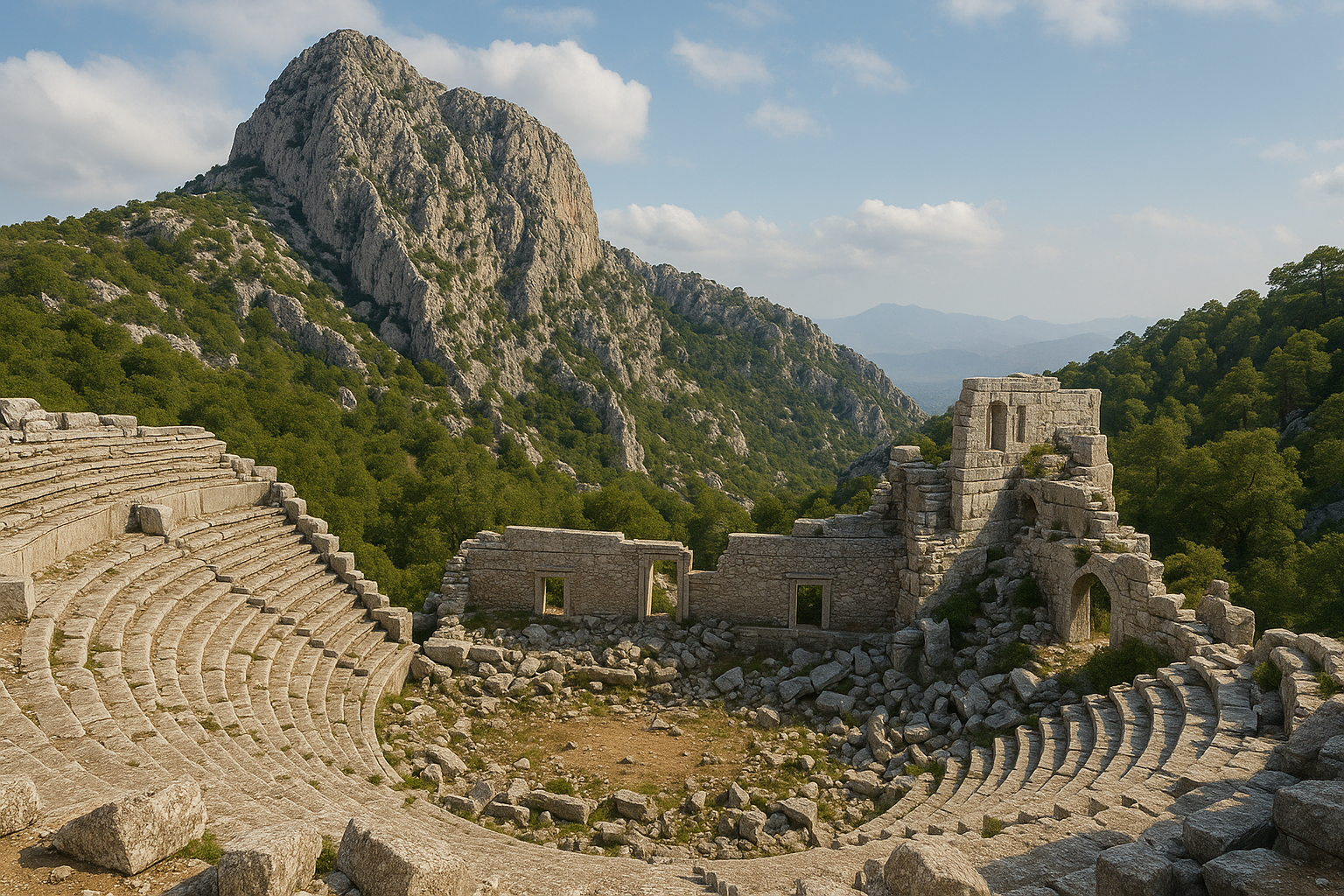
Quick Summary: Side (meaning "pomegranate" in the ancient local language) was the largest and most important port city of Pamphylia, built on a small peninsula jutting into the Mediterranean Sea. Famous for its Temple of Apollo on the waterfront, a 15,000-17,000-seat Roman theatre built on arched substructures rather than a hillside, and its unique identity as a living town where modern life and ancient ruins intertwine, Side has been under continuous archaeological excavation since 1947. It served as a major centre of trade, culture, and -- infamously -- piracy and the slave trade in the 1st century BC. Recent restoration of the Temple of Athena (completed 2023) has added a dramatic new dimension to the waterfront sacred precinct.
- Why Side Matters
- Geography and Setting
- Historical Timeline
- Major Monuments
- The Temple of Apollo
- The Theatre
- The Side Museum
- Archaeological Work
- Visitor Information
- Frequently Asked Questions
- Sources and Further Reading
Why Side Matters
Side holds a distinctive place among Anatolia's ancient cities for several important reasons.
-
A city built on the sea. Side's peninsula location gives it a dramatic relationship with the Mediterranean that most inland ancient cities lack. The temples, harbour walls, colonnaded streets, and fortifications were all designed in direct conversation with the sea, creating a visual impact that remains powerful today.
-
The largest theatre in Pamphylia. With a capacity of approximately 15,000-17,000, Side's theatre is the biggest in the region. Uniquely for Anatolia, it was built on a flat surface using an elaborate system of arched vaults rather than being set into a hillside -- a Roman engineering achievement of the first order.
-
A living archaeological site. Unlike most ancient cities in Turkey, Side is not an uninhabited ruin field. The modern town of Side sits directly on top of and around the ancient city. Walking through Side means passing ancient columns, inscriptions, and fortification walls alongside modern shops, restaurants, and hotels. This extraordinary coexistence makes Side a uniquely atmospheric destination.
-
A dark chapter: piracy and slavery. In the 1st century BC, Side became a notorious centre of the Mediterranean slave trade and piracy. The city's large commercial agora is traditionally associated with this activity. This history makes Side important not only for its architecture but also for understanding the complexities of ancient Mediterranean society.
-
Continuous excavation since 1947. Side has been under systematic archaeological investigation for nearly eight decades, making it one of the longest-running excavation projects in Turkey and providing an exceptionally deep understanding of the city's development over time.
-
The Sacred Harbor Area. Recent research has shown that the peninsula tip is not just the site of the Apollo and Athena temples but encompasses a large sacred area with additional cultural structures, now referred to as the Temple Zone or Sacred Harbor Area, expanding our understanding of Side's religious landscape.
Geography and Setting
Side occupies a small peninsula extending into the Mediterranean Sea on the coast of the ancient Pamphylia region, within the modern Manavgat district of Antalya Province. The peninsula is approximately 1 km long and 400 metres wide at its broadest point.
This geography was decisive for the city's character:
- The peninsula provided natural harbour protection on both its eastern and western flanks, creating two separate harbour basins
- The narrow connection to the mainland made the city highly defensible -- a single fortification wall across the neck of the peninsula could secure the entire settlement
- The waterfront position of the temples at the peninsula's tip created one of the most visually dramatic sacred landscapes in the ancient Mediterranean
- The relatively flat terrain of the peninsula necessitated the construction of the theatre on arched substructures rather than a natural hillside
The surrounding Pamphylian coast is flat and sandy, backed by the fertile Manavgat plain with the Taurus Mountains rising to the north. The Manavgat River (ancient Melas) flows into the sea a short distance east of the city, providing fresh water and agricultural potential that supported the city's population.
The coastal location also made Side vulnerable to maritime threats, which partly explains both the city's involvement in piracy and its extensive fortification systems. The peninsula position was both an asset and a liability -- excellent for defense and commerce, but exposed to naval attack.
Historical Timeline
Pre-Greek Settlement (before 7th century BC)
Side's name itself provides evidence of pre-Greek habitation. The word "Side" means "pomegranate" in an indigenous Anatolian language, not in Greek. Ancient sources record that the earliest settlers developed their own local language and script, known as Sidetic, which was distinct from Greek and remained in use into the Hellenistic period. This linguistic independence is remarkable and distinguishes Side from most other cities in the region. Sidetic inscriptions have been found on coins and stone monuments, and the language is still only partially deciphered.
Greek Colonization and Archaic Period (7th-5th century BC)
According to ancient tradition, Greek colonists from Aeolian Cyme (western Anatolia) settled in Side, probably in the 7th century BC. The story goes that the colonists "forgot" their Greek and adopted the local language -- a striking detail that suggests the indigenous population absorbed the newcomers rather than the reverse. This unusual cultural dynamic makes Side an important case study in ancient colonization processes.
Classical Period (5th-4th century BC)
Side came under Persian control and later entered the orbit of Athenian naval power during the 5th century BC. The city participated in the complex geopolitical struggles of the eastern Mediterranean. When Alexander the Great passed through Pamphylia in 333 BC, Side opened its gates without resistance, accepting Macedonian control peacefully -- a pragmatic decision that spared the city the destruction suffered by resistant communities.
Hellenistic Period (3rd-1st century BC)
Side prospered under successive Hellenistic kingdoms -- the Ptolemies, the Seleucids, and the Attalids of Pergamon. Its harbour became one of the busiest in the eastern Mediterranean, and the city's wealth attracted the attention of both legitimate traders and less lawful elements. The first major phase of monumental construction began during this period.
The Piracy Era (2nd-1st century BC)
In the 2nd and 1st centuries BC, Side became deeply entangled with Cilician pirates who operated across the eastern Mediterranean. The city functioned as a major centre of the slave trade, with captives from raids sold in its agora. Ancient sources, particularly Strabo, describe Side during this period as a place where piracy and slave-dealing were conducted openly, with the complicity of the city's inhabitants.
The ancient geographer wrote that Side had "dockyards" where pirates built and stored their ships, and that the slave market operated in broad daylight. This dark chapter is an integral part of Side's history and provides important evidence for understanding the scale and organization of piracy and slavery in the ancient Mediterranean.
This era ended when Pompey the Great conducted his famous campaign against Mediterranean piracy in 67 BC, suppressing the pirate networks and restoring Roman-controlled order to the region.
Roman Imperial Period (1st century BC -- 4th century AD)
The Pax Romana brought Side its greatest period of prosperity. The 2nd and 3rd centuries AD saw the construction or embellishment of most of the monuments visible today: the theatre, the temples of Apollo and Athena, the great nymphaeum, the monumental gate, the colonnaded street, the agora, and the massive bath complexes.
Side received the title of neokoros (temple warden), an honour granted to cities that hosted imperial cult temples, and competed vigorously with Perge and Aspendos for regional prestige. The rivalry between these Pamphylian cities is documented in inscriptions where Side proclaims its superiority.
Byzantine Period (5th-10th century AD)
Christianity transformed Side. A major basilica was constructed near the harbour, temples were converted or replaced, and the city became an important bishopric and later an archbishopric. The great Roman baths near the agora were converted into a church and administrative complex.
The city contracted significantly during the 7th century due to Arab raids and the general insecurity of the Mediterranean coastline. A reduced settlement survived behind a newly constructed inner wall that enclosed only part of the original city, reflecting the dramatic population decline.
Abandonment and Modern Resettlement
Side was largely abandoned by the 10th century. In the late 19th century, Turkish immigrants from Crete resettled the ruins, building their village directly among and on top of the ancient structures. This is the origin of the modern town of Side, which has grown dramatically with tourism since the 1960s, creating the unique archaeology-meets-daily-life character that defines the site today.
Major Monuments
The Great Gate and City Walls
The monumental main gate on the landward (northern) side of the peninsula was the formal entrance to the city. It consisted of a three-arched gateway flanked by towers and preceded by a courtyard. Nearby stands the Monument of Vespasian, a decorative fountain arch honouring the Roman emperor.
The city walls extending from the gate across the peninsula neck are among the most visible ancient features. They were reinforced multiple times, with the Byzantine-era inner wall representing the city's contraction during the insecure 7th century.
Great Nymphaeum
A monumental three-storey fountain structure built just outside the main gate. It was approximately 5 metres high with an ornamental facade of niches, columns, and a large water basin. Water was fed from the city's aqueduct system. The nymphaeum served both as a practical water distribution point and as a grand architectural statement greeting visitors to the city.
Colonnaded Street
A major colonnaded avenue led from the main gate through the city centre toward the harbour and temple district. Lined with shops and public buildings, it functioned as the city's main commercial and ceremonial spine. The street's column bases and paving stones are visible throughout the modern town, creating the distinctive atmosphere where ancient infrastructure and modern life overlap.
Commercial Agora
A large, nearly square agora (approximately 100 x 100 metres) surrounded by porticos with shops. This was the main marketplace, and ancient sources associate it with the notorious slave trade of the 1st century BC. The agora's scale reflects Side's commercial importance as a major eastern Mediterranean port.
State Agora
A second agora served administrative and civic functions, distinguishing Side's commercial and governmental spaces. This agora was surrounded by colonnades and hosted official activities.
The Temple of Apollo
The Temple of Apollo stands at the very tip of the Side peninsula, facing the sea. Built around 150 AD during the height of the Pax Romana, it is a peripteral Corinthian temple -- meaning it was surrounded by a colonnade of Corinthian-order columns on all sides.
Key details:
- Six columns on the short sides, eleven on the long sides
- Column height approximately 9 metres
- The temple stood on a raised platform (podium) approximately 1.5 metres above ground level
- Five columns were restored between 1984 and 1990 and are now the iconic symbol of Side and Antalya
- The white marble columns catch the Mediterranean light in ways that change throughout the day
Adjacent to the Temple of Apollo stands the Temple of Athena, dedicated to the city's chief goddess. Athena was the principal deity of Side, and her temple was the more important of the two in civic terms. The two temples together formed a sacred precinct at the harbour entrance, visible to ships approaching from the sea.
Recent restoration work on the Temple of Athena, completed in November 2023, has brought 20 historical columns back to standing position, dramatically enhancing the visual impact of the temple precinct. Research has also revealed that this area is not just limited to the two temples but encompasses a larger sacred zone with additional cultural structures, now referred to as the Temple Zone or Sacred Harbor Area.
The sunset view through the restored Apollo temple columns, with the Mediterranean stretching beyond, is one of the most photographed scenes in all of Turkey and one of the most iconic images of the Turkish Mediterranean coast.
The Theatre
Side's theatre is the largest in the Pamphylia region and one of the most architecturally distinctive ancient theatres in Anatolia.
Construction Method
Unlike most ancient theatres, which were built into natural hillsides (as at Aspendos or Perge), Side's theatre was constructed on flat ground using an elaborate system of barrel-vaulted arches and radial walls to support the seating structure. This Roman engineering technique allowed the theatre to be placed wherever urban planning required it, not just where geography permitted. The engineering challenge was significant, as the entire weight of the seating had to be carried by the artificial substructure.
Dimensions and Capacity
- Seating capacity: approximately 15,000 to 17,000 spectators
- The cavea is supported by a massive system of arched galleries and corridors that also served as circulation space for spectators
- The stage building featured a richly decorated facade with columns, niches, and statuary
- The diameter of the orchestra is approximately 22 metres
Multiple Uses
The theatre was used not only for traditional dramatic performances but also for gladiatorial combat and possibly water spectacles (naumachiae). Modifications to the orchestra area -- including the addition of a protective wall around the orchestra floor and a drainage system -- suggest adaptation for these violent entertainments during the later Roman period.
Current Condition
The theatre has been substantially restored and is used for modern cultural events and concerts, bringing the ancient structure back to active performance use. The gallery arcades and corridors beneath the seating provide impressive architectural spaces that can be explored by visitors.
The Side Museum
One of Turkey's most distinctive small museums, the Side Museum is housed in the restored 5th-century AD Roman baths (agora baths) adjacent to the state agora. The building itself is a museum piece -- visitors experience the ancient bath architecture, including vaulted ceilings and original floor plans, while viewing the archaeological collection.
The collection includes:
- Sarcophagi with elaborate relief decoration depicting mythological scenes
- Statuary including portraits, mythological figures, and imperial representations
- Architectural fragments from the temples and public buildings
- Small finds including coins, jewellery, ceramics, and glass
- The famous Side inscription in the Sidetic language, one of the key documents for studying this partially deciphered script
- A sculpture garden displaying larger architectural pieces, column capitals, and sarcophagi in an open-air setting among the bath ruins
The museum provides essential context for understanding the ancient city and is an integral part of any visit to Side.
Archaeological Work
Side has been under continuous archaeological excavation since 1947, making it one of the longest-running excavation projects in Turkey.
The first systematic excavations were initiated by Prof. Arif Mufid Mansel of Istanbul University in 1947, with work continuing under successive Turkish archaeologists for nearly eight decades. Major campaigns have focused on:
- The theatre and its restoration for modern use
- The temple precinct at the peninsula tip, including the recent Athena temple restoration
- The agora complexes and their relationship to the slave trade
- The city walls and monumental gate
- The bath buildings and their conversion to the museum
- Residential quarters and water infrastructure
- The nymphaeum and aqueduct system
- The Sacred Harbor Area research program
The ongoing excavation program continues to reveal new information about the city's layout, chronology, and daily life. The discovery that the temple area encompasses a larger sacred zone has expanded understanding of Side's religious architecture. Recent restoration projects have focused on making the archaeological site more accessible and visually coherent for visitors while maintaining archaeological integrity.
Side's archaeological significance was recognized through its inclusion in the UNESCO World Heritage Tentative List as part of the "Ancient Greek Theatres" nomination. The combination of continuous excavation history, the unique peninsula setting, and the living-town character makes Side one of the most important archaeological sites on the Turkish Mediterranean coast.
Visitor Information
Getting There
Side is located 75 km east of Antalya, within the Manavgat district. It is accessible by:
- Regular public buses from Antalya and Manavgat
- Dolmus (minibus) services from Manavgat town centre
- Private car via the D400 highway; parking is available at the edge of the old town (the peninsula centre is pedestrian-only)
- Organized tours from Antalya and surrounding resort areas
The ancient site is integrated into the modern town, so visitors arrive directly among the ruins.
Time Required
- Quick highlights (temple, theatre): 1.5 to 2 hours
- Standard visit (temple, theatre, museum, agora, gate): 3 to 4 hours
- Comprehensive visit with harbour walk, full perimeter, and beach time: half a day
- Sunset at the Apollo Temple plus dinner: allow a full evening
Best Seasons
- Spring (March-May): Pleasant temperatures, clear sea views, manageable crowds
- Autumn (September-November): Warm but comfortable, golden light ideal for photography
- Summer (June-August): Hot but the sea breeze helps; sunset visits to the Apollo temple are especially popular and crowded
- Winter (December-February): Mild; the town is very quiet and the archaeological sites are nearly empty, offering a contemplative experience
Practical Tips
- The Apollo Temple at sunset is Side's signature experience; plan to arrive at least 30 minutes before sunset to secure a good position
- The Side Museum is small but excellent and housed in a fascinating building; do not skip it
- Walking shoes are sufficient for most of the site since many paths are paved or well-maintained
- The town has abundant restaurants, cafes, and accommodation options among the ruins
- The old town peninsula is largely pedestrian-only; leave your car at the parking area
- Combine a Side visit with a trip to the Manavgat Waterfalls (4 km) or a boat trip up the Manavgat River
- The eastern harbour beach allows swimming right next to ancient ruins -- bring swimwear
Nearby Sites
Side is well positioned for day trips to:
- Aspendos (30 km west) -- the best-preserved Roman theatre in the world
- Perge (60 km west) -- Pamphylia's best-preserved Hellenistic-Roman city
- Selge and Koprulu Canyon (50 km north) -- mountain city and rafting
- Alanya (65 km east) -- Seljuk fortress and castle
- Green Canyon (Oymapinar Dam) (30 km north) -- boat tours on an emerald lake
Frequently Asked Questions
What does "Side" mean?
"Side" means "pomegranate" in the ancient local Anatolian language (not Greek). This pre-Greek name indicates that the site was settled before Greek colonization and retained its indigenous identity even after the arrival of Greek colonists. The pomegranate was a symbol of fertility and abundance in the ancient world.
Is Side a modern town or an archaeological site?
Both. Side is unique among major Turkish archaeological sites because the modern town and the ancient ruins occupy the same space. Visitors walk ancient streets past Roman columns to reach modern restaurants and hotels. This coexistence is both the charm and the challenge of the site.
What is the connection between Side and piracy?
In the 2nd and 1st centuries BC, Side was a major base for Cilician pirates and a notorious centre of the Mediterranean slave trade. The ancient geographer Strabo described the open complicity of Side's residents in these activities, noting that the city had dockyards for pirate ships and an open slave market. Pompey's campaign against piracy in 67 BC ended this era.
Why is the theatre built on flat ground?
Side's theatre is built on a flat peninsula with no hillside to cut into. Roman engineers solved this by constructing an elaborate system of arched vaults and radial walls to support the seating from below -- a technique that demonstrates Roman structural engineering at a high level. This also meant the theatre could be placed at the most convenient location within the urban plan.
When is the best time to see the Temple of Apollo?
Sunset. The temple's five restored columns silhouetted against the setting sun over the Mediterranean is Side's iconic image and one of the most photographed views in Turkey. Arrive at least 30 minutes before sunset to find a good vantage point.
What happened to the Temple of Athena?
The Temple of Athena, next to the Apollo Temple, underwent major restoration work completed in November 2023. Twenty historical columns were restored to standing position, dramatically enhancing the temple precinct. Research has also revealed that the area encompasses a larger sacred zone, now called the Sacred Harbor Area.
How does Side compare to other Pamphylian cities?
Side offers the most dramatic coastal setting and the unique experience of ancient ruins integrated into a living town. Aspendos has a better-preserved theatre, Perge has superior sculpture and urban planning, but Side's combination of seaside temples, harbour atmosphere, and town-ruin coexistence is unmatched. Each site offers something the others cannot.
What is the Sidetic language?
Sidetic was the indigenous language of Side, distinct from Greek. It was written in its own script and survives in inscriptions on coins and stone monuments. The language has been only partially deciphered. Its existence demonstrates that Side maintained a strong local identity even during periods of Greek cultural influence.
Is there a museum at Side?
Yes. The Side Museum is housed in the restored Roman bath complex near the agora. It contains an excellent collection of sculptures, sarcophagi, reliefs, and architectural fragments found during excavations, including the famous Nike (Victory) statue and numerous portrait busts. The museum provides essential context for understanding the ruins outside. It is one of the best small archaeological museums in Turkey.
How large was the slave market at Side?
Ancient sources, particularly the geographer Strabo, describe Side's slave market as one of the largest in the eastern Mediterranean. The market could reportedly process tens of thousands of slaves per day at its peak during the 2nd-1st centuries BC, when Cilician pirates used Side as a major distribution point. The exact location of the slave market within the city has not been conclusively identified, though the large commercial agora is a strong candidate.
What happened to Side during the Arab raids?
Beginning in the 7th century AD, Arab naval raids devastated Side and other cities along the southern coast of Anatolia. The city suffered repeated attacks, leading to significant population decline. By the 10th century, most of the population had relocated inland. Side was largely abandoned until the late 19th century, when Cretan Turkish refugees resettled the peninsula, founding the modern village among the ancient ruins.
Architectural Measurements and Structural Data
The following tables compile verified dimensional data from published excavation reports and survey documentation spanning nearly eight decades of archaeological work at Side.
Theatre -- Detailed Dimensions
| Element | Measurement | Notes |
|---|---|---|
| Seating capacity | 15,000--17,000 spectators | Largest theatre in Pamphylia |
| Construction date | Last quarter of the 2nd century AD | Built on site of earlier Hellenistic theatre |
| Orchestra diameter | ~22 m | Modified for gladiatorial and water spectacles |
| Construction method | Barrel-vaulted arches and radial walls | Built on flat ground, not a hillside |
| Location | Narrowest point of the peninsula | Centrally positioned in the urban plan |
| Stage building facade | Multi-storey with columns, niches, and statuary | Richly decorated architectural program |
| Later modifications | Protective wall around orchestra; drainage system | For gladiatorial combat and possible naumachiae |
The theatre's construction on flat terrain using arched substructures is a Roman engineering achievement that distinguishes Side from virtually every other ancient theatre in Anatolia. The galleries and corridors beneath the seating served a dual function: structural support and spectator circulation, allowing thousands of people to enter and exit efficiently.
Temple of Apollo -- Dimensions
| Element | Measurement | Notes |
|---|---|---|
| Type | Peripteral Corinthian | Surrounded by colonnade on all sides |
| Column count | 6 x 11 | Short sides x long sides |
| Column height | ~9 m | White marble |
| Podium height | ~1.5 m above ground | Raised platform |
| Construction date | ~150 AD | Height of the Pax Romana |
| Restored columns | 5 (restored 1984--1990) | Iconic symbol of Side and Antalya |
Temple of Athena -- Restoration Data
| Element | Detail |
|---|---|
| Restoration completed | November 2023 |
| Columns restored | 20 historical columns re-erected |
| Sacred zone | Expanded understanding as "Temple Zone / Sacred Harbor Area" |
| Research finding | Area encompasses additional cultural structures beyond the two temples |
Nymphaeum and Aqueduct
| Feature | Measurement / Detail |
|---|---|
| Nymphaeum location | Opposite the main city gate |
| Nymphaeum height | ~5 m (three storeys in original form) |
| Nymphaeum facade | Three niches on the lowest floor; richly decorated upper storeys |
| Aqueduct length | 30 km |
| Aqueduct construction | More than half laid through mountain tunnels |
| Aqueduct date | 2nd half of the 2nd century AD |
| Water distribution | Fed the nymphaeum, baths, fountains, and residential areas |
Numismatic Evidence
Side's coinage is among the most extensively studied in the ancient Mediterranean, with a minting history spanning over six centuries. The pomegranate -- the city's namesake symbol -- appears consistently across all periods.
| Period | Denomination | Obverse | Reverse | Weight Standard |
|---|---|---|---|---|
| ~470 BC | Stater | Pomegranate in dotted circle | Head of Athena in incuse square | Persic (10.7 g) |
| Early 4th c. BC | Stater | Athena standing holding Nike (later owl) | Apollo standing with phiale, sacrificing over altar | Persic |
| Late 3rd--2nd c. BC | Tetradrachm | Athena in Corinthian helmet | Nike advancing left holding wreath; pomegranate at left | 16.9 g |
| Late 3rd--2nd c. BC | Drachm | Athena in Corinthian helmet | Nike advancing left holding wreath; pomegranate at left | 3.9 g |
| 2nd c. BC onward | Bronze fractions | Various local types | Pomegranate, Athena, Nike | Variable |
| Roman Imperial | Provincial bronze | Emperor's portrait | City symbols, pomegranate | Variable |
The minting of silver coinage began at Side at approximately the same time as at Aspendos, around 470 BC. Side's tetradrachms from the late 3rd through 2nd centuries BC circulated widely across the eastern Mediterranean. A study published in The Numismatic Chronicle (vol. 177) documented Side's bronze coins appearing in the southern Levant, connected to Seleucid military activities following the conquest of 198 BC rather than straightforward commercial trade.
A comprehensive assessment of coin finds from Side covering the period 1947--2015 has been published, providing a preliminary catalog of numismatic evidence recovered during nearly seven decades of excavation. This corpus is essential for understanding the city's economic life, trade connections, and political relationships across successive periods.
Excavation Chronology
| Year | Event | Director / Institution |
|---|---|---|
| 1947 | First systematic excavations begin | Prof. Dr. Arif Mufid Mansel, Istanbul University |
| 1947--1966 | Major campaigns documenting core urban area | Mansel team |
| 1982--2008 | Theatre excavation and restoration | Dr. Ulku Izmirligil, Ministry of Culture and Tourism |
| 2009--present | Ongoing excavations | Huseyin Sabri Alanyali and Feristah Soykal Alanyali, Anadolu University |
| 2023 | Temple of Athena restoration completed (20 columns re-erected) | Turkish Ministry of Culture restoration team |
| Ongoing | Sacred Harbor Area research program | Expanding understanding of the temple zone |
Side's unbroken excavation history since 1947 makes it one of the longest-running archaeological projects in Turkey. The transition from Mansel's foundational work through Izmirligil's theatre restoration to the current Anadolu University program demonstrates institutional continuity spanning nearly eight decades.
Comparative Data: Side Among Pamphylian Cities
| City | Theatre Capacity | Key Monument | Distinctive Feature |
|---|---|---|---|
| Side | 15,000--17,000 | Temple of Apollo on the waterfront | Coastal peninsula; living town among ruins |
| Aspendos | ~12,000 | Best-preserved Roman theatre globally | Theatre's stage building nearly intact |
| Perge | ~12,000 | Hellenistic-Roman gateway and colonnaded street | Superior sculptural program |
| Sillyum | unknown | Acropolis fortifications | Dramatic hilltop position |
| Attaleia (Antalya) | unknown | Hadrian's Gate | Modern city overlying ancient core |
Side's theatre surpasses all other Pamphylian theatres in capacity. While Aspendos preserves a more intact stage building, Side's arched substructure construction is the more remarkable engineering achievement, and its coastal setting creates a fundamentally different relationship between architecture and landscape.
Sources and Further Reading
- Temple of Apollo (Side) -- Wikipedia
- Side -- Wikipedia
- Side -- All About Turkey
- Side Ancient City -- Turkey Tour Organizer
- Restored Athena Temple Opens to Visitors -- Daily Sabah
- Athena Temple Restoration -- Anatolian Archaeology
- Temple Zone Research -- Anatolian Archaeology
- Mansel, A.M. Die Ruinen von Side. Berlin, 1963.
- Nolle, J. Side im Altertum. Bonn, 1993-2001.
- Bean, G.E. Turkey's Southern Shore. London, 1968.