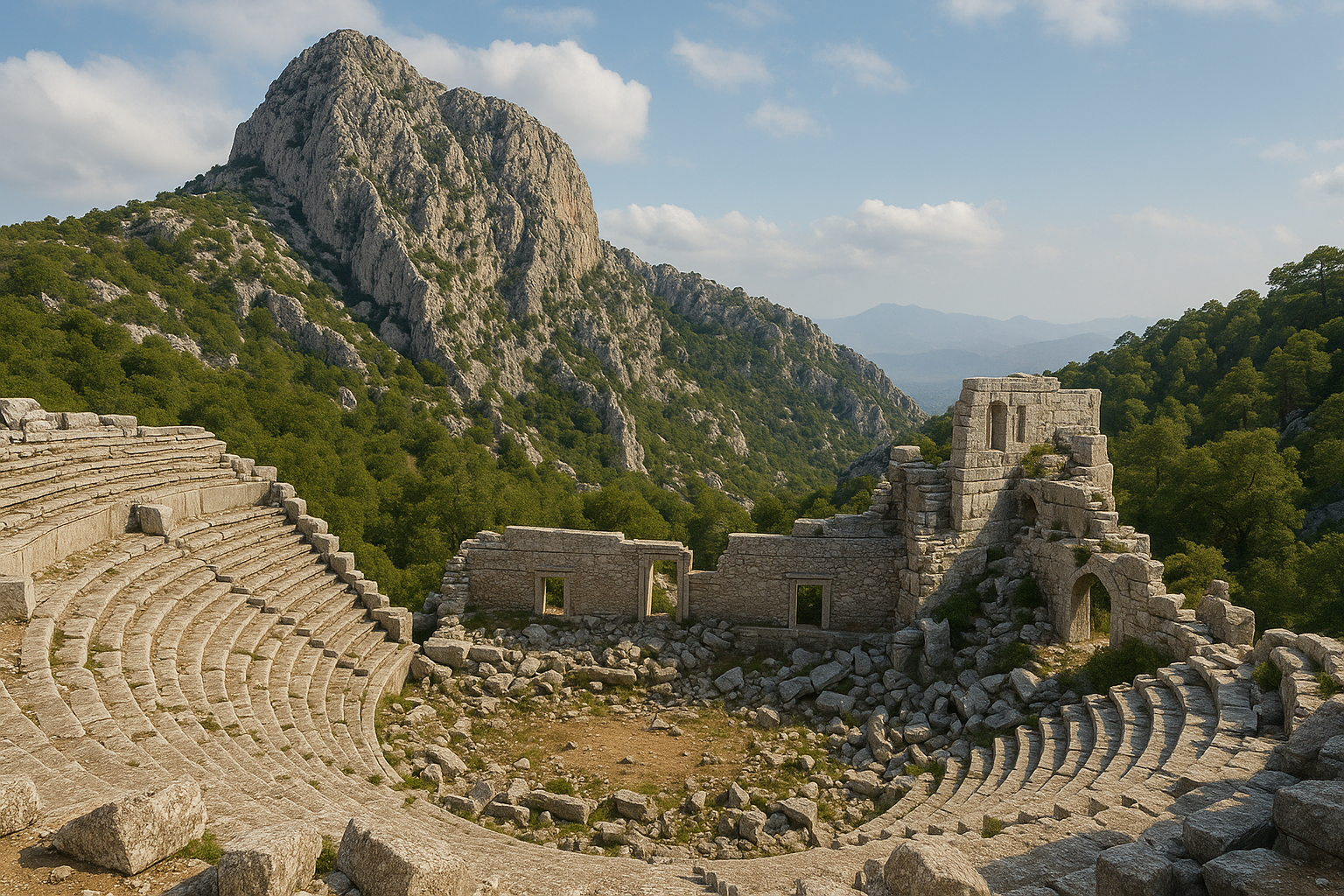
Aspendos sits on a low limestone hill above the Eurymedon River — today the Köprüçay — in the village of Belkıs, in the Serik district of Antalya Province, roughly 47 kilometres east of the modern city. It was one of the four great cities of ancient Pamphylia, a coastal plain hemmed in by the Taurus Mountains and laced with rivers that once carried Greek, Persian, Macedonian, and Roman ships into its quiet inland harbours. Its name reaches us through Hittite records, through the half-mythical wanderings of the seer Mopsus, through the silver staters that made Aspendos one of the wealthiest mints in Anatolia, and through one extraordinary act of survival: the Roman Theatre, completed under Marcus Aurelius between AD 161 and 180, is still standing — cavea, vaulted galleries, scaenae frons, doorways, niches, and almost all of its original height — as the best-preserved Roman theatre anywhere in the world. Its architect, Zeno son of Theodorus, was a local man, and the building remains a masterclass in acoustic geometry: every summer, since 1994, the Aspendos International Opera and Ballet Festival fills the cavea with sound that travels exactly as Zeno intended. A few kilometres away, the city's other engineering marvel — a 19-kilometre aqueduct with three inverted siphons, pressure towers, and pressurised pipes climbing over deep valleys — is one of only two such systems known from the ancient world. Add Alexander the Great's siege of 333 BC, the Battle of the Eurymedon in 467 BC, a Byzantine palace, a Seljuk caravanserai, and an Atatürk-era restoration, and Aspendos becomes one of the densest, strangest, and most moving sites in the entire Mediterranean.
- Why Aspendos Matters
- Geography and Setting
- Historical Timeline
- Major Monuments
- The Theatre's Architecture
- Zeno the Architect
- The Aqueduct's Engineering
- Aspendos Opera and Ballet Festival
- Archaeological Work
- Coinage and the Aspendos Mint
- Daily Life and Society
- Numbers and Measurements
- Visitor Information
- Frequently Asked Questions
- Sources and Further Reading
Why Aspendos Matters
Aspendos is one of those rare ancient cities that does not require imagination to appreciate. The single building most visitors come to see — the Roman theatre — survives with such completeness that it can be walked, climbed, and listened to almost exactly as a second-century spectator would have experienced it. But behind that one extraordinary structure stands a city with several other, less famous but equally significant claims on world heritage.
-
It preserves the most complete Roman theatre in existence. No other Roman theatre survives with cavea, vomitoria, vaulted galleries, two-storey scaenae frons, and full external façade so nearly intact. Theatres at Orange (France), Bosra (Syria), Sabratha (Libya), and Mérida (Spain) all preserve portions of comparable quality, but none combines every element at original height the way Aspendos does. It is, quite simply, the reference Roman theatre.
-
Its acoustics still work. The geometry of the cavea, the reflective limestone of the scaenae frons, and the enclosing portico above the upper seats produce a sound field that modern engineers have repeatedly measured and confirmed. A whisper from the orchestra still reaches the topmost row. Opera companies still perform there. There is no other ancient theatre in the world where the original acoustic design is still under active, professional use.
-
The aqueduct is an engineering marvel of a different order. The 19-kilometre line from springs in the Taurus foothills to the city's pressure towers includes three inverted siphons — closed, pressurised pipes that descend into a valley and rise on the other side. This is rare technology in antiquity. Only Pergamon's Madradağ line is comparably famous. Aspendos preserves the towers, the pipes, and the venter bridges in better condition than almost anywhere else.
-
The Eurymedon Valley was a strategic gateway. The river was navigable in antiquity from the Mediterranean to a harbour just below the city; the Battle of the Eurymedon (467 BC), where Cimon's Athenians shattered the Persian fleet, was fought near its mouth; Alexander the Great besieged the city in 333 BC; and Roman, Byzantine, and Seljuk powers all valued the crossing point for the same reason — geography. Aspendos is a single point through which many empires passed.
-
It is a layered monument, not a single-period site. The theatre was built as a Roman entertainment venue, lived as a Byzantine fortified palace, served as a Seljuk caravanserai with red-and-zigzag brick decoration on its upper façade, fell silent during the Ottoman centuries, was visited by Atatürk in 1930, and has hosted international opera since 1994. Few buildings in the world have been continuously, visibly significant across so many centuries.
-
Aspendos was a major mint. Its silver staters — wrestlers on the obverse, a slinger and triskeles on the reverse — circulated across the Greek and Persian worlds. Later Roman bronzes from the city depict the Eurymedon Bridge, giving us an ancient image of an ancient bridge. Few cities marked their own infrastructure on their own coinage; Aspendos did.
-
The site continues to teach. Restoration philosophy at Aspendos — what Atatürk's 1930s team did, what the modern conservators have done since, and what the opera festival now demands — has become a case study debated in international heritage circles. The site is not a closed chapter. It is an ongoing argument about how to balance preservation and life.
Geography and Setting
Aspendos lies on the eastern edge of the Pamphylian plain, a coastal lowland in the south of Anatolia bounded on the north by the Taurus Mountains and on the south by the Mediterranean. The plain is one of the most fertile zones in Türkiye — a wide apron of alluvium laid down by the Aksu (ancient Cestrus), Köprüçay (Eurymedon), Manavgat (Melas), and several smaller rivers as they tumble out of the Taurus and slow across the flat coastal strip. This combination of rich soils, abundant fresh water, gentle gradients, and a long growing season made Pamphylia an attractive prize for every power that controlled it, from the Hittites to the late Ottomans.
The Eurymedon — Köprüçay today, a name that simply means "Bridge River" — rises in the limestone uplands of the western Taurus, threads through the spectacular Köprülü Canyon, and emerges onto the Pamphylian plain about ten kilometres north of Aspendos. From there it meanders south to the Mediterranean. In antiquity the river was significantly larger and more channelised than it is today; the lower 15 to 20 kilometres were navigable by small seagoing vessels, and Aspendos appears to have had a working river port on the right bank below the acropolis. This is the city's secret. From the air, Aspendos looks landlocked — it sits on a flat-topped hill eight kilometres from the coast. But the river gave it everything a coastal city had: imports, exports, commercial reach, and the wealth that comes with them. The same river also kept enemy fleets at a manageable distance.
The acropolis itself is a low limestone outcrop, roughly 40 metres above the plain, with a flat top that lent itself to the orderly Roman grid of agora, basilica, nymphaeum, and bouleuterion. The southern flank of this hill, where the natural slope drops sharply, is where Zeno set his theatre, exploiting the slope to support the cavea — the standard Greek-and-Roman trick for cheap seating. Standing on the upper gallery of the theatre and looking south, you can see the entire Pamphylian plain stretching to the sea, the snow-capped Taurus closing the horizon to the north, and the silver glint of the Köprüçay winding through the fields.
The plain is built on Taurus runoff alluvium — clays, silts, and gravels carried out of the mountains and deposited by the rivers over hundreds of thousands of years. This sediment is what makes the area so agriculturally productive, but it also explains the disappearance of Aspendos's harbour. Over two thousand years of continuous sedimentation, the river's mouth has shifted, its channel has narrowed, and the inland port that once carried Aspendian olive oil and grain to Rhodes and Alexandria has silted away beyond recognition.
The climate is classic Mediterranean: hot dry summers, mild wet winters, no real autumn or spring to speak of. Summer days routinely exceed 35°C, and the theatre's stone can become uncomfortably hot in direct sun. The festival programs accordingly — performances begin after sunset. The best season to visit is from late March to late May, or from mid-September to early November. Winter is mild but variable; rain is more likely between December and February, and the long views over the plain often disappear into haze.
Pamphylia in Brief
Ancient Pamphylia — the "land of all tribes" — covered roughly the coastal strip from modern Antalya in the west to Alanya in the east. Its four great cities were Perge, Sillyon, Aspendos, and Side. Each occupied a distinct ecological niche: Perge controlled the Cestrus and the western entrance to the plain; Sillyon perched on an isolated mesa midway across; Aspendos guarded the Eurymedon and the river port; Side commanded the eastern coastal harbour and the road to Cilicia. Together they formed a kind of urban quartet, sometimes allied, sometimes rivalrous, always aware of one another. To understand any one of them, it helps to understand the others.
The Pamphylian dialect of Greek, which the cities shared, was distinctive enough that ancient writers regularly commented on its peculiarities. It preserved archaic features (the digamma, certain vowel patterns) that had disappeared from mainstream Greek by the classical period, and it incorporated Anatolian loanwords and grammatical influences. The dialect is best attested through inscriptions and coin legends from the four cities, and it gives modern linguists a precious window into the early Iron Age Greek of southern Anatolia.
Pamphylian Religious Traditions
The religious life of Pamphylia retained a marked indigenous character even after centuries of Greek and Roman influence. Aphrodite Kastnietis, the goddess of Mount Kastnion, was a distinctively Pamphylian deity worshipped at a sanctuary in Aspendian territory. Artemis Pergaia, the goddess of Perge, had her own iconography (a stylised non-figural cult image) that differs sharply from the standard Greek Artemis. Side worshipped Athena in a form that may preserve pre-Greek elements. These local cults, alongside the standard Greco-Roman pantheon, gave Pamphylia a religious texture distinct from neighbouring regions. The persistence of indigenous cult forms is one of the markers that allow modern scholars to trace the depth of pre-Greek Anatolian culture in the area.
The Pamphylian Plain in Antiquity
Ancient writers describe the Pamphylian plain as one of the most fertile and productive regions of the eastern Mediterranean. Strabo, in his Geography (Book XIV), mentions the abundance of grain, the quality of the olive oil, the fine horses bred on the plain, and the strategic value of the rivers. The plain was a battleground precisely because it was worth fighting for. Through the Persian, Athenian, Macedonian, Ptolemaic, Seleucid, Pergamene, Roman, Byzantine, Seljuk, and Ottoman periods, it changed hands more than a dozen times. Aspendos sat near the geographical centre of this contested zone and was repeatedly affected by the consequences.
River Navigation in Antiquity
The Eurymedon's navigability is a recurring theme in ancient sources. Strabo notes specifically that the river was navigable up to Aspendos; Pomponius Mela makes a similar observation. The pattern is consistent with other Anatolian rivers of the period — the Maeander (modern Büyük Menderes), the Cestrus (Aksu), the Calycadnus (Göksu) — all of which were navigable in their lower reaches in classical antiquity and have since silted up. The mechanism is well understood: deforestation in the upland catchments, intensification of agriculture, increased sediment loads, and the slow westward progradation of river deltas. The Eurymedon today is shallow, fast in places, slow in others, and not navigable by anything larger than a small boat. In Roman times, when the catchment was less disturbed and the channel was deeper and more stable, ships of moderate size could probably reach the city.
The Loss of the Harbour
The disappearance of Aspendos's harbour is one of the most quietly significant facts in the city's archaeological record. A harbour represents the connection between local production and Mediterranean commerce; without it, the city's economic logic changes fundamentally. The shift from sea-connected commercial centre to inland agricultural community probably accelerated in the late Roman and Byzantine periods, as sedimentation increased and river maintenance declined. By the medieval period, the harbour was effectively gone, and Aspendos's economic future was as a smaller, locally focused community. The city's monumental architecture survived the change; its commercial vitality did not.
Why the Theatre Survived Here
Geography also explains why Aspendos's theatre — uniquely — survived. It is too far inland to have been picked apart for ballast by passing ships, as so many coastal buildings were. It is too close to the river to have served as a convenient quarry for outlying farms. Its limestone is too hard to be easily recycled. And — crucially — when the Seljuks arrived in the thirteenth century, they did not pull it down. They moved in.
The Belkıs Village Today
The modern village of Belkıs sits a short walk south of the archaeological site. Its name is a Turkish folk etymology — Belkıs is the Arabic-Turkish name of the Queen of Sheba — applied to the ruins probably in the late medieval or early Ottoman period, when popular tradition often associated impressive ancient ruins with the great kings and queens of biblical and Quranic story. The village is small, with a few hundred inhabitants, several small restaurants and cafés along the road to the site, and a handful of guesthouses. Most local families still farm the surrounding land, which produces cotton, citrus, vegetables, and (increasingly) greenhouse-grown produce for the Antalya market. Belkıs is also one of the access points for tourists heading north to the Köprülü Canyon, and during the festival season the village swells noticeably with visitors.
Hinterland and Agriculture
The agricultural hinterland around Aspendos has been continuously farmed for at least three thousand years. The dominant crops have shifted with technology and trade — barley and wheat in antiquity; olives, grapes, and figs in the Roman and Byzantine periods; cotton, sesame, and rice under the Ottomans; greenhouse vegetables, citrus, and exotic fruits today — but the underlying logic has not. The Pamphylian plain is rich, well watered, and warm; agriculture has always been profitable. Roman Aspendos drew much of its wealth from the surrounding farms, and the city's surviving olive presses, grain mills, and storage facilities (some of which remain under field cover, awaiting future excavation) testify to a large-scale agricultural economy. Modern surveys have located several villa rustica sites — Roman country estates — within a few kilometres of the city, each presumably owned by a wealthy citizen of Aspendos and farmed by a workforce of slaves, tenants, and free labourers.
Historical Timeline
Earliest Settlement — Pamphylia in Hittite Records
The plain around Aspendos has been continuously inhabited since at least the Late Bronze Age. Hittite texts of the second millennium BC mention a region in southern Anatolia called Tarḫuntašša, whose southern extent appears to overlap with the later territory of Pamphylia. The name "Aspendos" itself is generally regarded as pre-Greek, drawn from the Luwian or related Anatolian linguistic stratum, and it preserves an indigenous element that the later Greek colonists adopted rather than invented. Whatever city existed here in the Bronze Age has not yet been excavated, but pottery scatters and surface finds make clear that the hill was occupied long before any Greek arrived.
c. 1000 BC — The Mopsus Legend
According to a tradition repeated by several ancient writers, Aspendos was founded by Greeks from Argos under the leadership of Mopsus, a seer who led a wave of post-Trojan-War migration into southern Anatolia. Mopsus is also credited with founding Mallos in Cilicia and Perge in Pamphylia. The legend is impossible to verify, but it is consistent with the archaeological evidence of a real Greek presence in southern Anatolia in the early Iron Age. The Pamphylian dialect of Greek that emerges by the seventh century BC is unusually archaic, retaining features that suggest its speakers had been isolated from mainland Greek for centuries — exactly what one would expect of an early colonial offshoot.
7th–5th Centuries BC — Lydian and Persian Periods
By the seventh century BC, Aspendos was clearly a significant city. Its silver coinage — among the earliest in Anatolia — appears in the sixth century, bearing the local legend ESTFEDIIUS or EΣTFEΔIIYΣ, the Pamphylian-dialect rendering of "Aspendos." When Cyrus the Great absorbed Lydia in 546 BC, Pamphylia passed into the Persian Empire and remained nominally Persian for the next two centuries. The cities of Pamphylia were unusually wealthy under Persian rule and seem to have enjoyed considerable internal autonomy.
467 BC — The Battle of the Eurymedon
In or around 467 BC, the Athenian general Cimon, son of Miltiades, led the combined fleet of the Delian League to the mouth of the Eurymedon River. There he fought one of the most extraordinary engagements of the entire Greco-Persian Wars. According to Thucydides and Plutarch, Cimon defeated a Persian fleet in the river mouth, then disembarked his hoplites and defeated the Persian land army on the same day. A second naval action against a Phoenician relief force followed shortly afterwards. The Battle of the Eurymedon effectively ended Persian naval power in the eastern Mediterranean for a generation. The battle was fought at Aspendos's doorstep, and the city — although on the Persian side — was apparently spared. For decades afterwards Aspendos paid tribute to Athens through the Delian League, though it never sat easily under Athenian influence.
The exact date of the battle is debated; ancient sources are vague and modern reconstructions range from 469 to 466 BC. Plutarch's Life of Cimon provides the most detailed narrative. According to Plutarch, Cimon brought a fleet of about 200 trireme galleys to the Pamphylian coast, encountered a much larger Persian fleet (Phoenician, Cilician, and Cypriot contingents) drawn up at the mouth of the Eurymedon, and forced an immediate naval engagement. The Persian fleet broke and was driven onto the shore; the surviving sailors and marines disembarked and joined the Persian land army drawn up to defend them. Cimon then landed his hoplites and engaged the Persians on land, defeating them in a sharp battle. The same day or the following day, a fresh Phoenician fleet sailing south to reinforce the Persians was intercepted further out at sea and destroyed in a third action.
The battle is one of the great examples of combined-arms operations in classical warfare and a defining moment in the establishment of Athenian thalassocracy in the eastern Mediterranean. For Aspendos, the immediate consequence was political: the city joined the Delian League, paid tribute to Athens (initially around 15 talents per year, a substantial figure), and shifted nominally from the Persian to the Athenian sphere. The longer-term consequence was geographical and cultural: the city remained a major node in the maritime networks of the Aegean and eastern Mediterranean for the rest of antiquity.
333 BC — Alexander's Siege
When Alexander the Great swept through Anatolia in 334–333 BC, Pamphylia fell rapidly. Aspendos initially negotiated, offering tribute and horses (the city was famous for its horse breeding) in exchange for being spared a garrison. Alexander accepted and moved on toward Side. While he was away, Aspendos reconsidered, closed its gates, and prepared to resist. Alexander returned, set up siege lines around the city, and forced its surrender. The new terms were harsh: a much larger indemnity, hostages, the surrender of all horses, and an annual tribute to the Macedonian crown. The episode is preserved by Arrian and remains one of the best-documented incidents of Alexander's Anatolian campaign. It tells us two things: that Aspendos was rich enough to be worth fining, and proud enough to risk a second negotiation.
Arrian's account, in the Anabasis of Alexander (Book I, chapters 26–27), gives a vivid description of the episode. The Aspendians, he says, had initially welcomed Alexander's envoys and agreed to pay fifty talents and to surrender the horses that the city had reserved for the Persian king. When Alexander returned to collect, he found the city barricaded; the wealthier citizens had withdrawn to a fortified upper area while the poorer inhabitants had fled into the surrounding countryside. Alexander encircled the upper area, made it clear that resistance would lead to a sack, and the city — perhaps recalling what had recently happened to other cities that had resisted — capitulated. The revised terms required the surrender of all horses, the payment of 100 talents (double the original sum), the provision of high-ranking hostages, an annual tribute, and acceptance of a Macedonian-appointed governor. The episode is one of the few in Arrian's narrative where Alexander shows clear irritation with a city's diplomatic manoeuvring, and the punishment reflects it.
Hellenistic Period — Ptolemies, Seleucids, Pergamenes
After Alexander's death in 323 BC, Aspendos changed hands repeatedly. It passed to the Seleucids, then to the Ptolemies of Egypt in the third century, back to the Seleucids in the second century, and finally to the Kingdom of Pergamon after the Treaty of Apamea in 188 BC. Throughout these transitions the city retained its civic institutions, its coinage, and its commercial prosperity. The Hellenistic centuries left fewer monumental buildings than the Roman centuries that followed, but the foundations of the city's later wealth — its trade networks, its agricultural hinterland, its banking and minting capacity — were laid in this period.
The Hellenistic Mediterranean was, broadly, a world of competing Greek-speaking kingdoms — the successors of Alexander and their descendants — fighting for control of the rich coastlines and trade routes of the eastern Mediterranean. Pamphylia, as a wealthy and strategically positioned coastal region, was repeatedly contested. The Aspendians appear to have learned to weather these changes with a combination of pragmatism and discretion: pay tribute promptly, host the visiting officials politely, mint your own coinage as a sign of civic autonomy, and avoid being noticed when armies pass through. The city's continued minting through the Hellenistic period is itself evidence of this strategy; mints required royal permission, and Aspendos's appears to have been one of the few that operated continuously through every regime change.
Roman Period — Province of Pamphylia (25 BC onward)
When Attalus III of Pergamon willed his kingdom to Rome in 133 BC, Aspendos was briefly drawn into the Province of Asia. The Roman administrative geography of southern Anatolia was reorganised several times. Under Augustus, in 25 BC, the province of Galatia was created and absorbed parts of Pamphylia; under later emperors, Pamphylia was joined with Lycia in a combined province (Lycia et Pamphylia) from AD 43. By the second century, the Pamphylian cities had entered their golden age. Roman peace, stable taxation, secure sea lanes, and imperial subsidies funded a wave of monumental construction unmatched anywhere in southern Anatolia.
Antonine Golden Age — Theatre Dedicated under Marcus Aurelius
The construction of the great theatre falls squarely in the reign of Marcus Aurelius (AD 161–180). The dedicatory inscriptions, still partly legible above the entrances, record that the building was the gift of two brothers, Aulus Curtius Crispinus Arruntianus and Aulus Curtius Auspicatus Titinianus, who paid for it as a benefaction to their city and dedicated it to the gods of their homeland and the Imperial House. The architect named in the inscription is Zeno, son of Theodorus, a Pamphylian. The Antonine decades also saw the construction or major refurbishment of the aqueduct (under or shortly after Marcus Aurelius), the nymphaeum, the basilica, the agora's porticoes, and several smaller structures. Aspendos in the late second century was, by any reasonable measure, at the height of its wealth and self-confidence.
The Antonine age is well known to historians as a period of prosperity across the Roman East. The eastern Mediterranean was politically stable, sea lanes were patrolled, trade was secure, and wealthy provincials competed to outdo each other in benefactions to their cities. Aspendos's wave of construction is mirrored at every other Pamphylian and Lycian city: Perge built its monumental gates and colonnaded street, Side built its temples and theatre, Patara built its lighthouse and granary, Xanthos built its Nereid Monument. The theatres of Side and Perge, although smaller and less well preserved than Aspendos's, belong to the same architectural tradition and were probably built by the same kind of locally trained masters as Zeno. Together these buildings constitute one of the densest concentrations of monumental Roman architecture anywhere in the empire.
Late Roman and Byzantine Periods — Christianity and Basilicas
Aspendos continued as a Roman provincial city through the third century, weathering the chaos of the mid-third-century crisis better than many cities in the region. In the fourth and fifth centuries it became a Christian bishopric. The Roman commercial basilica on the acropolis appears to have been partially adapted for Christian worship, and other church buildings — modest by the standards of the great Roman buildings — were added. Aspendos sent bishops to several of the early ecumenical councils, including Nicaea in 325 and Chalcedon in 451. The city contracted during the Arab raids of the seventh and eighth centuries; like much of coastal Anatolia, it became a defended hilltop rather than an open commercial centre. The theatre's exterior galleries appear to have been fortified in this period.
The Byzantine reorganisation of Pamphylia was part of a broader rationalisation of the eastern provinces. After the Arab raids, the imperial government grouped Pamphylia into the Theme of Cibyrrhaeot, a maritime military district responsible for the coastal defence of southern Anatolia. Aspendos was a fortified node in this defensive system. By the late Byzantine period — the eleventh and twelfth centuries — the city had shrunk to a small fortified settlement on and around the theatre, with the broader urban fabric abandoned and ploughed over. When the Seljuks arrived in the early thirteenth century, they encountered a much-reduced settlement and a massive standing monument.
Seljuk Era — Caravanserai and the Eurymedon Bridge
In the early thirteenth century, the Seljuk Sultanate of Rûm under Alaeddin Keykubat I (r. 1220–1237) consolidated control over southern Anatolia. The Seljuks were great builders of roads and caravanserais — fortified inns spaced a day's journey apart along the trade routes between Anatolia and Syria. The theatre at Aspendos, with its enclosed bowl, its solid stage building, and its commanding position on the road between Antalya and Alanya, was an obvious candidate for conversion. The Seljuks roofed parts of the cavea, installed a residential quarter inside the stage building, and decorated the upper façade with their characteristic red-tile brickwork in zigzag patterns, which is still visible today. The nearby Eurymedon Bridge — originally Roman, partially collapsed — was rebuilt in this period in a distinctive zigzag plan that survives essentially intact and is still in use for pedestrians and light traffic. The bridge is now the most photographed Seljuk bridge in Türkiye.
Alaeddin Keykubat I was, by any standard, one of the most ambitious builders in medieval Islamic history. His reign saw the construction of city walls at Konya, Sivas, and Antalya, the great citadel at Alanya, the harbour and shipyards at Alanya, dozens of caravanserais across Anatolia, and major mosques in several cities. The Aspendos conversion fits into this broader programme of state-led infrastructure. The Seljuk presence at the site continued under his successors and through the fragmentation of the sultanate in the late thirteenth century. By the early fourteenth century, however, the trade routes had shifted and the caravanserai had fallen into disuse.
Post-Ottoman Abandonment
After the Mongol invasions of the mid-thirteenth century, the Seljuk Sultanate fragmented and the caravanserai network decayed. The Ottomans, who absorbed the region in the fifteenth century, never invested in Aspendos. The village of Belkıs ("Queen of Sheba" — a Turkish folk etymology for the ruins) grew up beside the ancient site but did not reuse it intensively. By the eighteenth and nineteenth centuries the theatre was a famous ruin, visited by European travellers and increasingly drawn into the scholarly literature.
The Ottoman neglect was, paradoxically, a form of preservation. The empire's bureaucratic gaze was elsewhere; the local population had no interest in dismantling the theatre for building stone (their houses were mud-brick and timber, materials cheaper and more practical for local use than cut limestone); and the absence of any major urban centre nearby meant there was no industrial-scale quarrying operation. The theatre stood. By the time it became a subject of European antiquarian interest in the nineteenth century, it had survived essentially intact for more than a millennium since its construction.
Eighteenth-century European travellers — botanists, geographers, military officers, scholars — began to filter through southern Anatolia in increasing numbers from the 1730s onward. Most were on their way to or from somewhere else (Antioch, Aleppo, Jerusalem, Cairo); a few stopped at Aspendos. Their descriptions, scattered through letters, travel narratives, and consular reports, are mostly brief but increasingly detailed. By the 1820s and 1830s, the theatre had begun to feature in scholarly discussion as one of the major surviving Roman buildings of the eastern Mediterranean.
Modern Era — Atatürk and the Festival
Mustafa Kemal Atatürk visited Aspendos in 1930, two years before the foundation of the Turkish Historical Society. His visit catalysed early Republican conservation work: parts of the theatre's stage doorways were rebuilt, the cavea was cleared, and the site was opened formally to visitors. According to tradition, when Atatürk saw the theatre he ordered its preservation as a working performance venue rather than a static monument — an instruction that, decades later, would help legitimise the modern opera festival. Since 1994 the Aspendos International Opera and Ballet Festival has used the theatre for an annual summer programme of operas, ballets, and orchestral concerts. The site was placed on Türkiye's UNESCO Tentative List in 2015 under the title "The Theatre and Aqueducts of the Ancient City of Aspendos," and the city's archaeological agenda — protection, study, and live use — continues to evolve through the early decades of the twenty-first century.
Chronological Summary Table
| Date | Event |
|---|---|
| Late Bronze Age | Pre-Greek settlement on the hill; Hittite-era regional record |
| c. 1000 BC | Legendary foundation by Mopsus and Argive Greeks |
| 6th c BC | First silver staters minted in local script |
| 546 BC | Persian conquest of Anatolia under Cyrus the Great |
| 467 BC | Battle of the Eurymedon: Cimon defeats Persians |
| 5th–4th c BC | Member of Delian League; periodic Persian re-control |
| 333 BC | Alexander the Great's siege and settlement |
| 323–188 BC | Successive Hellenistic kingdoms (Ptolemy, Seleucid) |
| 188 BC | Pergamene control after Treaty of Apamea |
| 133 BC | Bequest of Pergamon to Rome |
| 25 BC | Reorganisation under Province of Galatia |
| AD 43 | Province of Lycia et Pamphylia created |
| c. AD 161–180 | Theatre built under Marcus Aurelius; architect Zeno |
| 2nd–3rd c AD | Aqueduct, nymphaeum, basilica, agora constructed |
| 4th–6th c AD | Christianisation; bishopric; basilicas |
| 7th–8th c AD | Arab raids; fortification of theatre |
| 13th c | Seljuk caravanserai conversion; Eurymedon Bridge rebuilt |
| 14th–15th c | Decline after Mongol pressure; Ottoman absorption |
| 18th–19th c | European travellers document the site |
| 1885 | Lanckoroński's systematic survey |
| 1930 | Atatürk visits; early Republican conservation |
| 1940s | Turkish Historical Society campaigns |
| 1994 | Aspendos International Opera and Ballet Festival inaugurated |
| 2015 | Placed on UNESCO Tentative List |
Major Monuments
The Roman Theatre
The theatre is the reason most visitors come to Aspendos, and it deserves the attention. It is the most complete Roman theatre surviving anywhere in the world.
The cavea — the curved auditorium — is semi-circular, set against the natural slope of the hill, with 40 rows of seats divided into a lower and an upper section by a horizontal walkway (diazoma). Vomitoria — vaulted entrance passages — open at the diazoma level, allowing audiences to fill or empty the building rapidly. Above the highest row runs a colonnaded portico, intact for almost the entire arc of the cavea, with 59 arched openings facing outward. It is this portico, and the velarium awning whose support holes are still visible at the top of the stage building, that gives Aspendos its distinctive crowned silhouette.
The scaenae frons — the two-storey stage façade — is the building's miracle. It rises to nearly its original height of about 25 metres, with two tiers of columns, niches that once held statues, pediments, a decorative cornice, and three monumental doorways through which actors entered. Most Roman scaenae frontes survived only in their lower courses; Aspendos's is essentially complete. The orchestra and stage platform survive in plan, although the marble flooring and statuary are gone. Stage capacity estimates range from 7,000 to 12,000 spectators depending on assumptions about row spacing.
The building is constructed of local conglomerate limestone, cut in large rectangular blocks fitted together with extraordinary precision. The external face of the cavea — a long, gently curving wall punctuated by entrance arches and the gallery above — is one of the most photographed surfaces in ancient architecture. Approaching the building from the south, a visitor sees first the soaring outer wall, then the dark mouths of the entrances, then, through the doorways, glimpses of the cavea curving away inside. The transition from exterior to interior is one of the most carefully composed architectural sequences anywhere in the Roman world.
Aspendos Aqueduct
Roughly two kilometres north of the city, the aqueduct's surviving elements stretch across the plain and into the hills. The line begins at springs in the Taurus foothills, descends through a graded open channel, and then — three times — drops dramatically into a pressurised inverted siphon that crosses a deep valley and rises on the other side. The two surviving pressure towers (header tanks) stand approximately 30 metres tall, framing the moment where gravity flow gives way to pressurised flow. The venter bridges that support the lowest stretch of the siphon pipes still carry their arches across the plain. The pipes themselves, carved from limestone blocks and sealed with lime-and-oil mortar, withstood pressures of up to 4 bar. The system delivered an estimated 5,000–6,000 cubic metres of water per day to the city's nymphaeum and public fountains. It is among the most sophisticated water supply systems of the Roman world.
The aqueduct's surviving sections are best appreciated on foot. Walking the line from the southern pressure tower northward, a visitor crosses a sequence of arched venter bridges, follows the pipes up the gradient of the valley, reaches the second pressure tower, and continues into the foothills along the trace of the open channel. The walk takes several hours and rewards the effort: the aqueduct is, in many ways, more spectacular than the theatre, but it is also far less visited.
Stadium
To the north of the acropolis, partly buried under field and scrub, lies the stadium — a long, narrow racing and athletic facility roughly 215 metres long. Its seating banks are eroded but legible; the starting line and finish line can be traced. The stadium is a reminder that Aspendos hosted athletic festivals on a serious scale; its wrestlers were famous enough to be commemorated on the city's silver coinage.
Basilica
On the acropolis, the Roman basilica is one of the largest civic buildings of Pamphylia. It functioned as a covered commercial and judicial hall — a Roman institution rather than a religious one, although in Late Antiquity part of it appears to have been adapted for Christian worship. The basilica's walls stand to a height of several metres, and the apsidal end (added or modified in the Byzantine period) is clearly visible.
Agora and Nymphaeum
The agora — a Greek term Romans used loosely — was the city's central public square, surrounded by colonnaded porticoes and lined with shops and offices. At its northern end stood the nymphaeum, a monumental fountain building whose two-storey façade once carried statues in niches and through which the aqueduct delivered water to the city's public taps. The nymphaeum survives to a substantial height and remains one of the most photogenic ruins of the acropolis.
Eurymedon Roman Bridge
The Romans built a bridge across the Eurymedon a short distance below the city; it is depicted on bronze coinage of Aspendos under the Severan emperors. The bridge collapsed at some point in late antiquity. In the thirteenth century the Seljuks rebuilt it in their characteristic zigzag plan, reusing some of the Roman piers and abutments. The Seljuk bridge — still in use — is one of the most beautiful medieval bridges in Türkiye and an essential stop on any visit to Aspendos.
The zigzag plan is not decorative; it is structural. The original Roman piers were spaced for a straight bridge, but by the time the Seljuks came to rebuild, some piers had been washed downstream while others had survived in their original positions. Rather than demolish the surviving piers and start over, the Seljuk engineers connected them with arches angled to suit their displaced positions — producing a bridge whose deck runs in a Z-shape across the river. The pragmatic solution produced an unexpectedly beautiful structure, and the zigzag pattern has become an icon of Seljuk engineering. The bridge carries a single lane of light traffic to this day and is signposted from the road as Köprüpazar Köprüsü ("Bridge-Market Bridge") — a name that recalls a small medieval market that grew up around its crossing.
Bouleuterion
The bouleuterion — the meeting hall of the city council — sits near the agora. It is a relatively small, roofed building with curved rows of seats facing a central speaker's platform. It is the architectural expression of Aspendos's civic autonomy: even under Roman rule, the local council retained substantial powers over the day-to-day administration of the city.
Acropolis Remains
The acropolis preserves a dense scatter of further ruins: stretches of city wall in multiple periods, gates, cisterns, shops lining the agora porticoes, an exedra (an apsidal monumental seat used for civic display), and the foundations of several temples and smaller buildings whose identifications remain debated.
Traces of the Seljuk Caravanserai
Inside the theatre, the Seljuk caravanserai is most visible in the upper part of the stage building. Red brickwork in zigzag patterns decorates the façade above the second storey. Doors and windows were cut into the stage walls to make residential and administrative quarters. The original Roman openings were partly filled and partly enlarged. Plaster traces of Seljuk wall paintings have been recorded in earlier surveys. The site is one of the most legible examples anywhere of medieval Islamic adaptive reuse of a classical building.
The Seljuk caravanserai network across Anatolia was one of the great infrastructural projects of medieval Islam — a chain of fortified inns spaced approximately a day's camel travel apart, offering free lodging for up to three days to any merchant on the road. The Aspendos theatre's position on the Antalya–Alanya route, its size, and its inherent defensibility made it a natural conversion candidate. Comparable caravanserai conversions of classical buildings are known from elsewhere in Anatolia, but Aspendos's is by far the most architecturally legible and the most fully documented.
Smaller Structures and Field Remains
Beyond the headline monuments, Aspendos's site preserves dozens of smaller features that repay careful attention: stretches of drainage channel under the agora paving; the foundations of shops along the south portico; a small odeon or covered concert hall (identified tentatively); several cisterns cut into the bedrock of the acropolis; segments of an early Byzantine wall built into and around the Roman fabric; and the traces of an olive press at the southern foot of the acropolis. None of these is individually spectacular; together they fill in the texture of an ordinary working city behind the great monumental façades.
The City Walls and Gates
Stretches of city wall survive on the southern, western, and northern edges of the acropolis, with at least two identifiable gates. The earliest walls are Hellenistic, in characteristic isodomic masonry; Roman repairs and additions are visible in places; Byzantine fortifications — heavier, more makeshift — represent the late-antique transformation of the city into a defensive enclave. The gates were probably modest by the standards of the great Pamphylian gateways at Perge or Side, but they functioned as ceremonial as well as practical entrances to the city. Inscriptions found near the gates record the names of magistrates and the dates of repairs.
The Exedra
A semi-circular exedra — an apsidal monumental seat used for civic display and possibly for public oratory — stands near the agora. Exedrae were standard features of Hellenistic and Roman civic spaces, used by the urban elite as places to be seen, to receive petitioners, or to deliver speeches. Statues of benefactors were sometimes placed inside or in front of them. The Aspendos exedra, modest in scale but well preserved, gives a tangible sense of the everyday performance of civic life.
The Temple of Aphrodite Kastnietis
Although the principal sanctuary of Aphrodite Kastnietis lay on Mount Kastnion, somewhere in the Aspendian territory but not yet securely located, the city itself certainly had a temple to the goddess on or near the acropolis. The foundations of a substantial temple structure have been identified, although the dedication has not been confirmed. The cult of Aphrodite Kastnietis was one of the most distinctive religious institutions of Pamphylia and an important regional cult; identifying and excavating the temple would be a major contribution to the understanding of Pamphylian religion.
Walking the Acropolis — A Suggested Route
A short walking route up onto the acropolis can be completed in about an hour and rewards the time spent. Beginning at the theatre, climb the path north-westward up the side of the hill. Pass through a gap in the city wall — original Roman with Byzantine repairs — and emerge onto the flat top. The first major structure visible is the basilica, with its preserved end walls standing several metres high. Continue west across the open ground (paths are informal but generally clear) to the agora, marked by the foundations of its surrounding porticoes. At the north end of the agora stands the nymphaeum, its two-storey façade still substantially preserved. South of the agora is the bouleuterion, smaller and more modest. From the western edge of the acropolis there are excellent views over the Pamphylian plain toward the Mediterranean; from the northern edge, the silver thread of the Köprüçay is visible against the green of the fields. Return to the theatre by retracing your steps or by descending the eastern slope along an alternate path.
Stadium Details
The stadium, north of the acropolis, is one of the city's most under-appreciated monuments. Although heavily eroded, its long, narrow plan is clearly legible on the ground. The seating banks were carved into the natural slope on the west side, with a simpler bank of seats on the east; the starting line at the northern end and the finishing line at the southern end can be traced through subtle surface features. Stadium dimensions place it within the standard range for Greek and Roman athletic venues — about 215 metres long by 30 metres wide, capable of seating perhaps 5,000 spectators. The structure has not been systematically excavated, and substantial additional information is likely buried beneath the surface.
The Theatre's Architecture
The theatre at Aspendos is a textbook for Roman theatrical design. Studying it in detail reveals how thoroughly Zeno understood the geometry, materials, and acoustics of the type.
Plan
The plan is a perfect semi-circle — Roman theatres differ from Greek ones in this; a Greek theatre cavea is typically a half-circle plus extensions. The semi-circular cavea is set into the natural slope on the southern flank of the acropolis hill, with the open end facing south. The diameter from the outer wall of the cavea to the front of the stage is approximately 96 metres.
The Cavea
The auditorium has 40 rows of seats in total, divided by the diazoma into a lower section (about 20 rows) and an upper section (about 21 rows). Stairs running radially from the orchestra to the gallery divide the cavea into wedge-shaped cunei. The seats are carved from local limestone, and the front rows — closest to the orchestra — were the seats of honour, reserved for magistrates, priests, and benefactors. Standard occupancy estimates vary because Roman audiences sat closer together than modern theatregoers; the canonical figures range from 7,000 to 12,000.
Vomitoria and Galleries
Beneath the cavea, a system of vaulted vomitoria and corridors allowed efficient circulation. Spectators entered the building through external doorways, climbed staircases to the diazoma, and emerged onto the cavea through the vomitoria openings. Above the highest row, the colonnaded upper gallery runs the full arc of the auditorium. This portico is one of Aspendos's most unusual features: most Roman theatres lost their upper galleries to time, weather, or quarrying, but Aspendos retains its almost completely. The 59 arched openings on the outer face of the gallery dominate the building's external silhouette.
Scaenae Frons
The scaenae frons — the two-storey stage façade — is the building's signal achievement. It rises to almost its full original height of about 25 metres and retains the bulk of its architectural ornament. Two tiers of columns (the lower Ionic, the upper Corinthian) frame niches that once held statues, and three monumental doorways open into the stage proper: the central porta regia ("royal door"), through which the principal actors entered, and the flanking portae hospitales for secondary characters. Above the columns runs a decorative cornice, and above the cornice are the rectangular sockets that anchored the velarium — the awning that shaded the audience from the worst of the summer sun.
Acoustic Design and Horizontal Scan Studies
Aspendos's acoustics have been studied for decades. The building is famous for its ability to project a quiet voice from the orchestra to the top of the cavea, and modern research has decomposed this effect into three contributing factors: the cavity geometry of the cavea, which focuses reflected sound back into the audience; the scaenae frons, which acts as a hard reflective screen behind the performers; and the upper portico, which prevents sound from escaping upward into the open air. Studies using horizontal acoustic scans — measurements taken at multiple positions around the cavea — have shown that the sound field is unusually uniform across the seats, with negligible dead zones. This is unusual; most ancient theatres show measurable acoustic shadows behind columns or in corners. Aspendos does not.
Modern acoustic researchers have also analysed the building using computer simulation. Three-dimensional models of the theatre, traced from photogrammetric and laser scans of the surviving fabric, have been used to model sound propagation under various conditions: empty house, full house, with the velarium deployed, with the velarium retracted, with the stage building's wooden roof in place (it has not survived), and with it removed. The simulations confirm what listeners report: the building is acoustically near-optimal for unamplified speech and song from the stage. The cavity geometry produces a controlled reflection pattern that delivers clear, intelligible sound to every seat without echo or distortion. The scaenae frons, with its columns and niches, scatters sound enough to avoid harsh focal reflections while still projecting power. The portico above the topmost row contains the sound field within the building rather than letting it escape into the open sky. The result is a sound stage that any modern acoustic engineer would be proud to design.
Construction Materials and Techniques
The theatre is built primarily from local conglomerate limestone, quarried from outcrops a short distance from the site. The blocks are large — typically several cubic metres each — and cut with great precision. The joints between blocks are tight enough that no mortar was required in the structural courses; the masonry holds itself together through friction and gravity, exactly as a Greek temple does. Decorative elements — column capitals, cornices, statue bases — are carved from finer-grained limestone selected for its workability. The cores of vaulted substructures are built of opus caementicium — Roman concrete — faced with rubble or brick. Where stone reuse occurred (in Byzantine fortifications and Seljuk modifications), the reused blocks are typically of a slightly different colour from the original limestone, making the period of intervention identifiable.
The construction techniques used at Aspendos reflect a careful adaptation of Roman imperial practice to Pamphylian conditions. The use of large interlocking limestone blocks, with minimal mortar in load-bearing positions, draws on the local Hellenistic tradition and is exceptionally durable in seismic conditions. The vaulted substructures, on the other hand, are pure Roman concrete engineering — fast to build, structurally efficient, and well suited to the curved geometry of the cavea. The combination is one of the marks of Zeno's design: Roman engineering principles, applied with regional craft excellence.
Restoration Debate — Atatürk's 1930s Intervention
When the Republican Turkish authorities first turned serious attention to Aspendos in the early 1930s, the theatre was already remarkably preserved but suffering from centuries of accumulated debris, plant growth, and minor structural damage. Atatürk's 1930 visit prompted a campaign of clearance and stabilisation that left modern conservators with a complicated inheritance. Some of the stage building's doorways were repaired with new stone; the cavea seats were cleaned and locally reset; modern concrete was used in a few places to stabilise vaulting. By later standards the interventions were heavy-handed, but they prevented further collapse, opened the building to the public, and made the subsequent festival use possible. The debate continues — how much restoration is too much, where the line between conservation and reconstruction should fall, and how to balance use with preservation are questions that Aspendos sharpens better than almost any other ancient site.
The 1930s intervention is best understood in the context of early Republican Turkish nationalism. The new Turkish Republic, founded in 1923, was actively constructing a narrative of Anatolian heritage that linked the modern nation to the deep past — Hittite, Greek, Roman, Byzantine, Seljuk, and Ottoman alike. Major ancient sites were brought under state protection, opened to the public, and presented as part of the national heritage. Aspendos was an early and high-profile example of this policy. Atatürk's personal interest in the site gave it political prominence, and the resulting clearance and stabilisation work was relatively well funded for its period. The interventions reflect the conservation philosophy of the early twentieth century — repair, present, and re-use rather than the more passive approach favoured by later generations.
Modern conservation practice has shifted significantly since the 1930s. Today, interventions are minimised, original fabric is prioritised, and replacement stone is clearly distinguished from ancient stone (often by leaving a slight setback or using slightly different colour). The Atatürk-era repairs are themselves now historic in their own right and are increasingly preserved as part of the site's evolving story rather than removed or hidden. The result is a layered monument in every sense: Roman, Byzantine, Seljuk, early Republican, and contemporary, all visible in one building.
Modern Festival Use
Since 1994 the theatre has hosted the Aspendos International Opera and Ballet Festival each summer. Modern lighting rigs, sound reinforcement (used selectively), and removable seating are installed and removed annually. Conservation specialists monitor the building during the festival to assess stress, vibration, and wear. The festival is one of the most visible signs that ancient buildings can still be alive, but it is also one of the most discussed test cases in heritage management.
Comparative Architecture — Aspendos Among Roman Theatres
A short comparison with other major Roman theatres illustrates Aspendos's singular preservation:
- Orange (France): outstanding scaenae frons, full original height, but cavea heavily restored; upper galleries lost.
- Bosra (Syria): unusually complete, enclosed in a medieval citadel; restoration heavy in places; political situation has limited modern access.
- Mérida (Spain): beautiful, restored, used for performances; original scaenae frons largely reconstructed.
- Sabratha (Libya): preserved scaenae frons, but cavea mostly gone; security situation limits access.
- Leptis Magna (Libya): Severan-era spectacular, but again, security challenges.
- Aspendos (Türkiye): cavea, vomitoria, galleries, scaenae frons all preserved to nearly original height; in active performance use; readily accessible.
By the test of "what survives, in what condition, and is it usable today," Aspendos stands alone.
Inscriptions and Dedications
Two dedicatory inscriptions on the parodos walls of the theatre name the patrons and the architect. The Greek inscription reads, in translation: "To the gods of the homeland and the Imperial House, Aulus Curtius Crispinus Arruntianus and Aulus Curtius Auspicatus Titinianus, sons of Aulus, dedicated this theatre — the work of the architect Zeno, son of Theodorus, of Aspendos." The Latin version is broadly parallel. The two inscriptions together establish the date (Marcus Aurelius reign), the donor family (the Curtii), and the architect's name and origin — and they are the foundation on which all modern scholarship on the theatre rests.
The Curtii Family
The Curtii — Aulus Curtius Crispinus Arruntianus and Aulus Curtius Auspicatus Titinianus — were members of the wealthy Roman-citizen elite of Aspendos. Their Roman citizenship and triple names (Latin tria nomina) indicate that the family had received Roman civic rights, probably through grant or purchase several generations earlier. They were, in effect, the local aristocracy: rich, Romanised, politically connected, and culturally bilingual. The brothers' decision to pay for the theatre was an act of euergetism — public benefaction — a standard practice of the Roman provincial elite by which wealthy individuals funded public buildings in exchange for civic prestige, statues in their honour, and (in some cases) political advancement. The Aspendos theatre is one of the largest and most ambitious euergetic projects of the entire Antonine Mediterranean.
The Curtii family's wealth probably derived from a combination of agricultural estates in the Pamphylian plain, commercial enterprises connected with the river port, and possibly imperial favour (the family may have received imperial appointments at some point). The cost of building the theatre would have been substantial — the comparable aqueduct cost two million denarii, and the theatre was a structurally and architecturally even more ambitious project. The brothers' fortune must have been very large indeed for them to undertake the work as a private benefaction. In return, they received the immortality that came with having their names on the building — an immortality that has, in fact, been delivered: nearly two thousand years later, anyone reading about Aspendos still encounters the Curtii brothers' names.
Local Elites and Imperial Networks
The Curtii were typical of a class of provincial elites in the second-century Roman East. They were locally rooted (originally from Aspendos), Romanised (Latin names, Roman citizenship), and connected to imperial networks (the dedication includes the imperial house). They competed with parallel families in neighbouring cities — the equivalent benefactors at Perge, Side, Patara, Xanthos — to outdo each other in the scale and ambition of their projects. The result was the wave of monumental construction that defined the Antonine East. Behind every major building of the period there was a wealthy donor family, a celebrated architect, a local civic government coordinating the project, and an imperial framework that gave it political meaning. The Curtii brothers and their theatre are the most visible local example.
The Imperial Cult Dimension
The dedication "to the gods of the homeland and the Imperial House" places the theatre within the framework of the imperial cult — the religious veneration of the Roman emperors and their household. The imperial cult was the standard mechanism by which the Roman Empire integrated its diverse provincial populations into a single religious-political system. Cities competed to build the grandest temples to the imperial cult, to host the imperial games, and to receive the prestigious title of neokoros (temple-warden) from the emperor in recognition of cult buildings. Aspendos's theatre, dedicated jointly to the local gods and the imperial house, served as a religious as well as an entertainment building — performances would have included ritual elements, and the building itself stood as a permanent monument to the cult.
Zeno the Architect
The dedicatory inscriptions of the theatre, set on the parodos walls, record the name of the architect in clear Greek: Zenon Theodorou Aspendios — "Zeno, son of Theodorus, of Aspendos." He is one of the very few Roman-period architects whose name we know, whose work survives, and whose city of origin is recorded.
A Local Pamphylian
Zeno was a local — a Pamphylian, not an imperial architect brought from Rome. This matters. The Aspendos theatre fits squarely within the Roman tradition (semi-circular cavea, two-storey scaenae frons, full Roman vocabulary of arches and orders), but it is built by a man trained in the regional tradition, using local limestone, local masons, and local craft conventions. The result is a building that is unmistakably Roman in plan but unmistakably Pamphylian in execution.
His Father Theodorus
The patronymic — "son of Theodorus" — links Zeno to a probable architectural family. Theodorus was a common Greek name and we cannot identify his father with any other known figure, but it is reasonable to assume that the family worked in construction and that Zeno inherited a workshop. The Theodorus inscription — a fragmentary Pamphylian-script inscription found near the theatre in the nineteenth century — has occasionally been associated with the family, but the connection cannot be proven.
Roman Technique, Local Skill
Zeno's achievement is the marriage of Roman engineering — concrete cores, vaulted substructures, modular planning — with Pamphylian stone-working tradition. The limestone joints of the cavea and scaenae frons are extraordinarily tight; the masonry shows no use of metal cramps because the stones interlock with such precision that none was required. This is a kind of work that imperial Roman architects, accustomed to brick-faced concrete, did not always master. Zeno's name and his building stand as a reminder that the great monuments of the Roman provinces were often the work of provincial architects, drawing on a deep local tradition, working in the imperial idiom.
The Legend of the Two Architects
Local tradition, recorded by several modern Turkish sources, tells of a rivalry between Zeno and another architect — sometimes named, sometimes not — who built the aqueduct. According to the story, the ruler of Aspendos promised his daughter in marriage to the architect who built the greatest work. When both were finished, the ruler was unable to decide between them and proposed to cut his daughter in two — at which point the aqueduct's architect conceded, and the theatre was judged the winner. Zeno married the princess; the rival is remembered for his magnanimity. The story is, of course, a folktale rather than history (the theatre and aqueduct are not even precisely contemporary), but it captures something of the popular memory of the two great structures and the architects who built them. Versions of the legend appear in local guidebooks and in Turkish heritage publications.
Zeno's Place in Roman Architectural History
Roman architects whose names are known are rare; Roman architects whose names are known and whose principal works survive are rarer still. The handful that survive in inscriptions — Vitruvius (author of De Architectura), Apollodorus of Damascus (Trajan's Forum, Trajan's Column, the Danube bridge), Severus and Celer (the Domus Aurea), Rabirius (the Flavian palace) — were mostly imperial architects working in Rome. Zeno belongs to a much smaller category of provincial architects identified by inscription, working in their own city, building a structure that still stands. As such, he is one of the most precisely identifiable individual creators of Roman architecture, and his name deserves to be better known.
Other Architects in the Region
Other Pamphylian and Lycian buildings of the Antonine period must have had architects of comparable skill, though most of their names are lost. The theatre at Perge — smaller than Aspendos's but architecturally sophisticated — and the colonnaded street with its hydraulic central channel were the work of unknown but evidently first-class designers. The lighthouse at Patara (recently restored), the granary of Hadrian at the same site, and the theatre at Side all imply similar levels of architectural and engineering expertise in the region. Zeno was the most famous of a class of provincial masters whose work made Pamphylia one of the densest and richest architectural landscapes of the Roman East.
Reconstructing Zeno's Working Methods
We have no documents from Zeno himself. We do not know his birth or death dates, his family beyond his father's name, his other projects, or his training. What we can reconstruct comes from the building. Zeno worked at a large scale (the theatre is one of the biggest buildings in Pamphylia); with great precision (the joints in the masonry are exceptionally tight); with a thorough understanding of Roman engineering (the vaulted substructures are textbook examples); with an acute sense of acoustics (the sound field is unusually controlled); and with an instinct for visual drama (the approach to the theatre is one of the most carefully composed architectural sequences in the region). He had, at minimum, a substantial team of stonemasons, surveyors, concrete workers, and supervisors. He worked closely with his patrons, the Curtii brothers, who would have approved the design and authorised the expenditure. He likely supervised construction in person over several years. The result is the building we know — and beyond the name and the patronymic, the building itself is the only document of his existence.
The Aqueduct's Engineering
If the theatre is Zeno's monument, the aqueduct is Aspendos's other great Roman achievement — and from an engineering standpoint, it is arguably the more remarkable. The aqueduct carried fresh water roughly 19 kilometres from springs in the Taurus foothills to the city's nymphaeum and public fountains. Most of its length is conventional Roman aqueduct construction: a graded open channel running along the contour of the hillside, sometimes carried on low arches, sometimes cut into the rock. What makes the Aspendos line unusual is what happened where the contour ran out.
Inverted Siphon Theory
In several places the line had to cross deep valleys. The usual Roman solution — a tall arched bridge carrying the channel across the valley — was impractical at Aspendos because the valleys were too deep and too wide for an arcade. The engineers instead chose a fundamentally different approach: an inverted siphon. Water enters a closed pipe at the upper edge of the valley, descends to the valley floor under gravity, builds pressure, and rises up the other side under that pressure — exactly as a U-tube manometer behaves. The physics is straightforward; the engineering is not. The pipes must withstand high internal pressures; the joints must be perfectly sealed; and trapped air must be vented or the system will airlock.
Pressure Towers
To manage the transition between the open gravity channel and the pressurised siphon pipe, Roman engineers built pressure towers — tall stone structures at the upper edge of each valley with a header tank at the top. The open channel discharged into the header tank; the siphon pipe took the water from the bottom of the tank. The tower regulated pressure, allowed trapped air to escape, and absorbed surges from the pulsating flow. Two of Aspendos's pressure towers still stand, roughly 30 metres tall, and are among the most visible engineering relics of the ancient world. The towers are also extraordinarily beautiful structures — slender, vertical, square in plan, built of carefully fitted limestone.
One of Only Two Examples — The Pergamon Comparison
The inverted-siphon technique is rare in antiquity. The most famous parallel is the Madradağ aqueduct at Pergamon, on the Aegean coast of Anatolia, which used a pressurised lead pipe to cross a 200-metre-deep valley. Aspendos is the second great surviving example. The two sites together constitute almost the entire surviving evidence for Roman large-scale siphon engineering, and they are routinely paired in modern textbooks of hydraulic history.
Pipes and Mortar
The Aspendos siphon pipes were carved from blocks of local limestone, each block bored along its long axis and shaped to fit precisely against the next. Joints were sealed with a mortar based on lime and olive oil — a mixture that produces a slightly elastic, water-resistant seal that becomes tighter under wetting. Maintenance access points along the line allowed crews to clear sediment and replace damaged blocks.
Performance and Capacity
Modern estimates suggest the line delivered roughly 5,000 to 6,000 cubic metres of water per day at peak operation. Maximum internal pressures reached about 4 bar (400 kPa) at the deepest point of the central siphon. This is enough to supply a city of perhaps 15,000 to 20,000 people at Roman urban water-use rates — a generous allowance that left water for baths, fountains, and the nymphaeum's hydraulic theatre as well as for drinking and cooking.
Hydraulic Theory and the Roman Knowledge of Siphons
The fact that Roman engineers could design and build pressurised inverted siphons at all is a significant statement about the depth of their hydraulic knowledge. The underlying physics — that water in a closed system seeks its own level, that pressure increases linearly with depth, that head loss through a long pipe must be accounted for in the design — was understood, at least empirically, by the engineers of the period. Vitruvius, writing in the late first century BC, describes pressurised siphons in his treatise De Architectura (Book VIII), and discusses the materials and pressures involved. The Aspendos engineers worked within this tradition, but they pushed it further than most: their siphon is longer, deeper, and more pressurised than any of the comparable systems Vitruvius describes. The design implies a working knowledge of pressure that would not be formally codified for another fifteen hundred years.
Maintenance and Operation
A pressurised siphon is not a maintenance-free system. Sediment accumulation, joint failure, biological growth, and occasional structural damage all required periodic intervention. The Aspendos system included a series of manhole shafts along the route, allowing maintenance crews to descend, clear deposits, replace damaged pipe sections, and inspect joints. Inscriptions and incidental literary references suggest that Roman cities employed dedicated water-system staff — a chief engineer, supervisors, slave or freedman workmen — funded from a combination of public revenues and user fees. Aspendos's water system probably operated under a similar arrangement, with daily maintenance, periodic shutdowns for major repairs, and an institutional memory passed down through generations of municipal staff.
Aqueduct in the Modern Landscape
The aqueduct's surviving elements are now scattered across a working agricultural landscape. The pressure towers stand in cultivated fields; the venter bridges cross modern irrigation ditches; the open channel runs alongside dirt tracks and through olive groves. The integration is at once beautiful (the structures soften into the landscape) and precarious (modern land use creates ongoing pressures on the monument). Conservation efforts have focused on establishing buffer zones around the most significant surviving elements and on coordinating with local landowners to prevent damage. Walking the line, a visitor can experience the aqueduct as it was — as a piece of infrastructure cutting across a productive countryside, serving the city in the distance.
Engineering Measurements Table
| Component | Measurement |
|---|---|
| Total aqueduct length | ~19 km |
| Open channel dimensions | ~0.60 m wide × ~0.90 m high (interior) |
| Total inverted siphon length | ~1,670 m across valleys |
| Northern venter bridge | ~592 m |
| Central venter bridge | ~924 m |
| Southern venter bridge | ~154 m |
| Maximum siphon depth | ~40 m below header towers |
| Pressure tower height (surviving) | ~30 m (two towers) |
| Arch height at deepest valley point | ~15 m |
| Arch spacing | ~5.5 m between piers |
| Siphon pipe inclination | up to ~55° |
| Maximum water pressure | ~400 kPa (4 bar) |
| Estimated daily delivery | ~5,000–6,000 m³ (~65 L/s) |
| Sealant | lime-and-olive-oil mortar |
| Pipe material | bored limestone blocks |
| Patron (per inscription) | Tiberius Claudius Italicus |
| Recorded cost | ~2,000,000 Denarii |
Why It Matters
The Aspendos aqueduct matters for at least three reasons. First, it is a working example of a rare ancient technology, preserved well enough to be studied in detail. Second, its inverted-siphon design solved a hydraulic problem (deep valley crossings) that other Roman engineers usually circumvented with longer routes or shorter aqueducts. Third, it demonstrates the depth of Aspendian wealth: a project of this scale and sophistication required not just engineering talent but also the political will and financial resources to build and maintain it for centuries. The aqueduct is, in its way, as much a monument to the city's civic life as the theatre is.
Aspendos Opera and Ballet Festival
Origins and Growth
The Aspendos International Opera and Ballet Festival was launched in 1994 by the Turkish State Opera and Ballet (Devlet Opera ve Balesi) as a way to make the country's ancient theatres relevant to contemporary cultural life. The festival has grown steadily since. Each summer — typically from mid-June through early September — the theatre hosts a programme of operas, ballets, orchestral concerts, and occasional dance and choral events.
World-Class Performers
The festival has hosted leading opera houses, orchestras, and ballet companies from Türkiye, Russia, Italy, Germany, Spain, Japan, and many other countries. Performances of Aida, Carmen, La Traviata, Swan Lake, Don Quixote, and the standard operatic and balletic repertory have all been staged in the ancient cavea, often with thousands of spectators per performance.
How the Building Performs
Performers and acoustic engineers consistently report that the theatre's acoustic design is fully effective for unamplified or lightly amplified performance. Singers report needing significantly less vocal projection than at modern outdoor venues of comparable size. Orchestras find that the scaenae frons reflects sound cleanly across the cavea. Some discreet sound reinforcement is used for clarity at the upper rows, but the building's natural acoustics carry the bulk of the program.
Conservation Debate
The festival is not without controversy. Heritage conservators have raised concerns about the long-term effects of festival use: foot traffic on ancient seating, vibration from large temporary structures, lighting attached to historic surfaces, and the noise and stress of large modern audiences. Defenders point out that the building was designed for exactly this purpose and that active, monitored use is often a better long-term preservation strategy than passive enclosure. The debate has produced an evolving compromise: the festival continues, but with progressively stricter conservation protocols, the construction of supplementary off-site facilities, and an increasing emphasis on monitoring and reporting.
The compromise has included the construction of a modern open-air venue — the Aspendos Arena — a short distance from the ancient theatre, for use as an alternative for some performances. Larger productions, those requiring heavy scenery or substantial pyrotechnic effects, are increasingly directed to the arena, leaving the ancient theatre for performances whose scale and design are compatible with its fabric. The transition has been gradual and continues to evolve.
A Visitor's Festival Experience
Attending an opera or ballet at Aspendos is one of the great cultural experiences of the eastern Mediterranean. Audiences typically arrive in the late afternoon, picnic in the open area near the entrance, and enter the theatre about an hour before curtain. Performances begin at sunset, often as the last light leaves the limestone façade. As the lights come up on the scaenae frons, the building seems to come alive: voices carry effortlessly to the upper rows, the chorus of Aida fills the cavea, ballet dancers move against the backdrop of two-thousand-year-old architecture. The evening typically ends around midnight, after which the audience flows out into the warm Mediterranean night.
The festival's classic productions are operas with strong vocal projection requirements and large choruses — Aida, Nabucco, Carmen, Tosca, La Traviata — and ballets with strong narrative content and full orchestral scores — Swan Lake, Don Quixote, Spartacus, Romeo and Juliet. The combination of pre-twentieth-century operatic and balletic repertory with the second-century building produces a kind of temporal collapse: for the duration of the performance, the ancient and the modern coexist in a single space, each lending depth to the other.
Festival Highlights Over the Years
Since 1994, the festival has hosted hundreds of performances. Notable highlights have included Turkish premieres of major productions, guest appearances by international opera companies, and concert performances by some of the world's leading conductors and soloists. Several productions have been recorded for television and DVD, with the theatre itself becoming a character in the visual presentation. The festival's archive — held by the Turkish State Opera and Ballet — is a significant cultural resource that documents Türkiye's evolving operatic and balletic life over three decades.
Particular highlights have included visits by the Bolshoi Ballet, productions by the Vienna State Opera in collaboration with Turkish companies, and concerts conducted by some of the world's most distinguished maestros. Solo recitals — particularly of operatic arias — have been a recurrent feature, with the building's acoustic qualities being especially flattering to unaccompanied or lightly accompanied vocal performance. Theatre audiences have included Turkish and international heads of state, cultural ministers, and the patrons of major international opera houses, and the festival has become one of Türkiye's flagship cultural events.
The Festival in Television
The festival has been televised by Turkish state broadcasting since its early years, and several productions have been released on commercial DVD. The visual presentation of the building itself has become one of the festival's signatures: aerial shots of the cavea, slow pans across the scaenae frons, close-ups of the ancient stone framing modern performers — the camerawork has produced some of the most striking images of any ancient theatre anywhere. The festival's broadcasts reach a substantial audience across Türkiye and the Turkish-speaking world.
Side Programming and Workshops
Beyond the main performances, the festival hosts workshops, masterclasses, and outreach events. Younger performers from Turkish conservatories travel to Aspendos for intensive coaching with the visiting professionals; local schoolchildren are bussed in for matinee performances; community engagement programmes connect the festival to the surrounding villages and towns. The festival's broader cultural impact in the Antalya region — the number of people who have first encountered opera or ballet at Aspendos — is substantial and lasting.
Festival Logistics
The festival is administered by the Turkish State Opera and Ballet (Devlet Opera ve Balesi) and includes guest performances from Turkish state opera companies (Ankara, Istanbul, Izmir, Mersin, Antalya, Samsun) and international guests. Tickets are sold online and through partner agencies; popular nights sell out weeks or months in advance. The festival programme is announced each spring. Performance dates, times, and casts are subject to change; visitors planning to attend should book early and confirm details near the date.
Practical Tips for Festival Attendance
- Book in advance. Popular productions, particularly opening night and visiting international companies, often sell out weeks ahead.
- Arrive early. Gates typically open 90 minutes before curtain. Use the time to walk around the theatre and to find your seat before darkness falls.
- Bring a cushion. The ancient limestone seats are hard. The festival usually provides simple cushions, but bringing your own (or a folded sweater) is sensible.
- Layer clothing. Pamphylian summer evenings can be warm at the start and cool at the end; a light jacket or wrap is useful.
- Plan transport. Many festival-goers come from Antalya or Belek; traffic before the performance is heavy and the road can be slow. After the performance, the access road takes time to clear.
- Respect the building. Do not touch the stones unnecessarily, do not climb on the surfaces, and follow the staff's instructions regarding where to walk.
- Bring binoculars. From the upper rows, some details of the staging are hard to see with the naked eye.
The Building Under Performance Lights
When the performance lights come up on the scaenae frons, the ancient limestone takes on extraordinary qualities. The honey colour of the stone reflects the warm theatrical lighting; the niches catch dramatic shadows; the columns frame the action; the upper galleries glow against the dark sky. From the upper rows, looking down on the orchestra and stage, the visual effect is hypnotic: the modern performers move against a backdrop of stone so old that it predates almost every other still-standing performance space in the world. From the lower rows, looking up, the scale of the building becomes overwhelming — the scaenae frons rises into the air, the cavea curves away on both sides, and the audience becomes part of the architecture in exactly the way the original designers intended.
Archaeological Work
Charles Texier (19th Century)
The French architect and traveller Charles Texier visited Aspendos in the 1830s as part of his great survey of Asia Minor. He produced careful drawings of the theatre's plan, elevations, and decorative details — the first scientifically accurate documentation of the building. Texier's plates remain useful reference works.
Lanckoroński (1880s)
The Polish-Austrian archaeologist Karl Graf Lanckoroński led a major expedition through Pamphylia and Pisidia in the 1880s, accompanied by the architects George Niemann and Eugen Petersen. The team produced the first systematic architectural survey of Aspendos, with measured drawings of the theatre, the acropolis buildings, the aqueduct, and the city walls. Their 1890 publication, Städte Pamphyliens und Pisidiens, remains a foundational reference and is still cited today.
The Lanckoroński expedition was a milestone in the documentation of southern Anatolia. The team spent weeks at Aspendos, measuring the theatre stone by stone, drawing the scaenae frons in elevation, plotting the aqueduct in cross-section, and recording the inscriptions. The published volumes include some of the finest architectural drawings of the nineteenth century. Niemann's plates of the theatre, in particular, are works of graphic art as well as scholarship, and they have served as the baseline for every subsequent study. The volumes are now in the public domain and available through several major library digitisation projects.
Turkish Historical Society Work — 1940s
After the foundation of the Turkish Historical Society (Türk Tarih Kurumu) in 1931 and the launch of Republican-era heritage initiatives, the first sustained Turkish archaeological campaigns at Aspendos began in the 1940s. These early campaigns focused on clearance, stabilisation, and documentation rather than excavation; their results made the site accessible to a wider public and laid the groundwork for later research.
Modern Era — Köse and Demirer
Modern systematic excavation at Aspendos has been led by Turkish scholars. Veli Köse of Hacettepe University in Ankara has directed campaigns focused on the upper city, the basilica, and the agora, combining architectural recording with stratigraphic excavation. Ünal Demirer of the Antalya Museum has overseen significant conservation and survey work, and Katja Lembke (Lower Saxony State Museum, Hannover) has contributed comparative European expertise on the theatre and its sculptural programme.
Akdeniz University Collaboration
Researchers from Akdeniz University, the regional university of Antalya, have collaborated extensively on geophysical survey, palaeoenvironmental reconstruction (including efforts to model the ancient course of the Eurymedon), and conservation science. The combination of regional and national universities — together with international partners — has produced a steady stream of publications, doctoral theses, and conservation reports over the last two decades.
Akdeniz University's involvement in Pamphylian archaeology extends well beyond Aspendos. The university has active research programmes at Perge, Side, Patara, Phaselis, and several smaller sites. Its students and faculty have contributed to almost every recent excavation in the region. This regional concentration of expertise means that scholars working at Aspendos benefit from comparative knowledge — the basilica at Aspendos is studied in light of basilicas at Perge and Side; the aqueduct is compared with those of other Pamphylian cities; the theatre's architectural details are read against the parallel evidence from neighbouring sites.
International Collaboration
International scholars have contributed substantially to the modern understanding of Aspendos. Paul Kessener (Netherlands) and his collaborators conducted the definitive engineering analysis of the aqueduct's siphon system in the 1990s and 2000s. Frank Sear (Australia) included Aspendos in his standard reference work Roman Theatres (Oxford, 2006). German, Italian, French, and Austrian researchers have all contributed to specific aspects of the site's interpretation. The current pattern of work, in which Turkish institutions lead and international partners participate, reflects the broader evolution of Mediterranean archaeology over the last several decades.
Recent Findings
Modern excavation has refined the chronology of the acropolis buildings, confirmed several previously hypothetical structures (including additional shops along the agora portico), documented the Seljuk-period interventions in the theatre with much greater precision than was previously possible, and contributed to the conservation programme that supports the opera festival's continued use of the building.
Sculpture and Decorative Programme
Although most of the statuary that once filled the theatre's niches and the nymphaeum's façade has been lost, fragments and surviving examples in the Antalya Museum allow a partial reconstruction. The scaenae frons originally held statues of emperors and members of the imperial family (a standard programme for imperial-cult-affiliated buildings), interspersed with depictions of deities and possibly allegorical figures (Pamphylia, the river Eurymedon, Victory, Tyche). The nymphaeum probably held statues of water deities (Naiads, river gods), along with figures associated with the patron family. Fragments of marble drapery, body parts, and stylistic features in the surviving pieces allow art historians to date the original programme to the Antonine period and to identify connections with the major sculptural workshops of the eastern Mediterranean — particularly the workshops of Aphrodisias, whose products were widely exported and which influenced sculptural style across the region.
Open Research Questions
Several major questions about Aspendos remain unresolved:
- The pre-Greek phase. Was there a substantial Bronze Age or early Iron Age settlement on the acropolis? Surface finds suggest yes, but no stratigraphic excavation has yet reached pre-Greek levels in any quantity.
- The exact location of the river port. The lower Eurymedon has shifted course substantially since antiquity; the original harbour has not been securely located on the ground. Geophysical and sedimentological survey could in principle identify it.
- The full extent of the necropolis. Tomb concentrations have been observed but not mapped systematically; the city's burial population is largely undocumented.
- The lifespan of the aqueduct. When did it cease to function? Inscriptions and pottery from the maintenance shafts could provide dating evidence, but the relevant deposits have not yet been investigated.
- The Byzantine and Seljuk urban fabric. What did the city look like in the centuries between Roman prosperity and Ottoman abandonment? Excavation in the lower city could clarify this.
- The festival's long-term impact on the theatre fabric. Annual monitoring is producing data; long-term trends will become clearer over the next several decades.
Each of these questions is the subject of active research, and the answers — when they come — will further enrich our understanding of one of the most important ancient cities of the Mediterranean.
Excavation Chronology Table
| Date | Investigator / Institution | Focus |
|---|---|---|
| 1830s | Charles Texier | First detailed drawings of the theatre and inscriptions |
| 1880s | Karl Graf Lanckoroński, with Niemann and Petersen | First systematic architectural survey of city |
| 1890 | Lanckoroński | Publication of Städte Pamphyliens und Pisidiens |
| 1930 | Atatürk's visit | Catalyses Republican-era clearance |
| 1940s–60s | Turkish Historical Society / Antalya Museum | Clearance, stabilisation, early documentation |
| Late 20th c | International collaborations | Aqueduct studies; theatre acoustic studies |
| Late 1990s | P. Kessener and team | Hydraulic engineering analysis of the siphons |
| 2000s onward | Veli Köse (Hacettepe University) | Excavation of the upper city and basilica |
| 2010s onward | Ünal Demirer (Antalya Museum) | Conservation, survey, and registration |
| 2010s onward | Akdeniz University collaboration | Geophysical survey, palaeoenvironmental work |
| 2015 | UNESCO Tentative List nomination | International recognition of theatre and aqueducts |
| 2020s | Multi-institutional team | Ongoing excavation, environmental reconstruction |
Coinage and the Aspendos Mint
Aspendos was one of the great mints of ancient Anatolia. Its silver coinage circulated far beyond Pamphylia and survives today in major numismatic collections worldwide. The coins are themselves a primary historical source for the city — its language, its economy, its self-image, and even its infrastructure.
The Silver Stater
The classic Aspendos coin is the silver stater of roughly 10.3 grams, struck on the Persian weight standard. From the late fifth century BC onward, the standard type is unmistakable: on the obverse, two nude wrestlers grappling, sometimes in varied poses, more often in a fixed canonical stance; on the reverse, a slinger taking aim, with the triskeles (three-legged sun symbol) in the field and the city name inscribed in the local Pamphylian script. The wrestlers may commemorate a famous athletic festival or, as some scholars argue, a specific bronze statue group set up in the agora; the slinger advertises Aspendian military prowess, since Aspendian slingers were prized as mercenaries throughout the Greek and Persian worlds.
The ESTFEDIIUS Legend
The city's name appears on early coinage as EΣTFEΔIIYΣ or ESTFEDIIUS — the Aspendos name written in the local Greco-Pamphylian alphabet. This is one of the most important written records of the Pamphylian dialect, a divergent form of Greek with significant influence from the pre-Greek Anatolian substrate. The dialect retained archaic features (such as the digamma F, lost in mainstream Greek), used distinctive verb endings, and incorporated loanwords from Luwian and other indigenous languages. Pamphylian Greek is one of the four classical Greek dialect groups (alongside Attic-Ionic, Doric, and Aeolic) and Aspendos's coins are among its most important monuments.
Hellenistic Tetradrachms
After Alexander, Aspendos minted Alexander-type tetradrachms on the Attic weight standard — coins bearing the standard Alexander imagery (Herakles obverse, Zeus enthroned reverse) but identifiable as Aspendos issues by their mint marks. These coins continued in production for at least a century after Alexander's death and circulated widely in the Hellenistic eastern Mediterranean.
Roman Bronzes and the Eurymedon Bridge
Under Roman rule, Aspendos minted bronze civic coinage in the standard provincial pattern: an imperial portrait on the obverse, local imagery on the reverse. The reverse types are particularly interesting because they include depictions of the city's own monuments. Coins of the Severan period (late 2nd – early 3rd century AD) depict the Eurymedon Bridge — giving us an ancient image of an ancient bridge, valuable for understanding what was rebuilt by the Seljuks a thousand years later. Other reverse types show the city's tutelary deities, temple façades, and personifications of the river.
Numismatic Summary
| Period | Type | Standard | Obverse | Reverse |
|---|---|---|---|---|
| 6th–5th c BC | Silver stater | Persian | Warrior / horse | Triskeles |
| Late 5th c BC | Silver stater | Persian, ~10.3 g | Two wrestlers (varied) | Slinger, ESTFEDIIUS |
| 4th c BC | Silver stater | Persian, ~10.3 g | Two wrestlers (canonical) | Slinger, mint marks |
| Late 4th–3rd c BC | Tetradrachm | Attic | Head of Herakles | Zeus enthroned |
| 1st–3rd c AD | Bronze civic | Various | Imperial portrait | Bridge, temples, deities |
What Coins Tell Us
The coinage tells us that Aspendos was rich enough to mint silver in significant volume for several centuries; that its identity was bound up with athletic and military prestige; that it was sufficiently Hellenised by Alexander's era to mint Alexander-type tetradrachms; and that by the Roman imperial period its civic pride extended to monumentalising its own infrastructure on its currency. Few ancient cities express themselves so directly through their coinage, and few coinages survive in such quantity and quality.
Where to See Aspendian Coins
Major museum collections worldwide include Aspendian coins. The Antalya Museum has a substantial local collection. The Istanbul Archaeology Museum has more. The British Museum, the American Numismatic Society in New York, the Bibliothèque nationale de France in Paris, the Berlin State Museums, and the Vienna Münzkabinett all hold significant Aspendian holdings. Coins occasionally appear at auction; the wrestler staters in particular have been valued by collectors for centuries and command substantial prices in good condition. For visitors interested in numismatics, the Antalya Museum is the obvious starting point.
Hoards and Find Contexts
Aspendian coins have been found in hoards across the ancient Mediterranean. Major published hoards include finds from Cilicia (where Aspendian staters mixed with eastern coinages), from Italy (where they appear in Hellenistic-period hoards alongside coins of other Greek cities), and from Egypt (where Ptolemaic-era hoards include Aspendian issues). The hoard evidence allows numismatists to track the chronology of the city's coinage with substantial precision and to map its commercial reach. Some of the most important hoards have been published in the international numismatic literature and are accessible to researchers through standard reference works.
The Symbolism of the Wrestlers
The two wrestlers on the obverse of the Aspendian stater have prompted considerable scholarly speculation. The standard interpretation is that they commemorate Aspendos's athletic reputation, but the consistently identical poses on the later coins (after about 370 BC) suggest a specific reference. One leading theory holds that a bronze statue group of wrestlers was erected at Aspendos — possibly to commemorate a famous victory at a Panhellenic games, possibly as a votive dedication, possibly simply as civic art — and that the coins reproduce this statue. The theory is plausible but unproven; no remains of such a statue have been recovered. Whatever the exact reference, the wrestler stater is one of the most distinctive and recognisable coin types of the ancient Greek world.
Daily Life and Society
Behind the great monuments — theatre, aqueduct, basilica, nymphaeum — stood an ordinary Roman provincial city with a working population, a political elite, a slave underclass, and a daily rhythm of trade, worship, eating, bathing, and entertainment.
Population
Estimating ancient populations is notoriously difficult, but the size of the theatre (7,000–12,000 seats), the scale of the aqueduct (delivering enough water for 15,000–20,000 residents at Roman urban rates), and the size of the agora suggest a city in the range of 15,000 to 25,000 inhabitants at its second-century peak, with a wider hinterland population that might have doubled that figure on festival days. Aspendos was not as large as Ephesus or Antioch, but it was a substantial city by Roman provincial standards.
Civic Government
Like most Greek-speaking cities of the Roman East, Aspendos was governed by a council (boule) of perhaps several hundred members drawn from the wealthier families, meeting in the bouleuterion, and by an assembly (ekklesia) of the broader male citizen body, meeting in the theatre or the agora. Day-to-day administration was handled by elected magistrates — chief among them the demiourgos, the city's principal official, whose name often appears on inscriptions. The Curtii brothers who paid for the theatre were precisely the kind of wealthy benefactors whose private fortunes funded public works; their commemoration in the dedicatory inscription was as important to them as the building itself.
Religion
The city's principal deity was a local form of Aphrodite Kastnietis — a Pamphylian Aphrodite worshipped at a sanctuary on Mount Kastnion in the territory of Aspendos. Other gods worshipped at the city included Apollo, Artemis, Athena, and the standard Greco-Roman pantheon. Temples to these deities once stood on the acropolis, though only foundations now survive. The imperial cult — worship of the deified Roman emperors — was added in the first century AD; the theatre, dedicated to the gods of the homeland and the imperial house, is partly a monument to this cult. Christianity arrived by the third century at the latest and became dominant in the fourth.
Athletic Culture
The wrestlers on the city's coins are not arbitrary. Aspendos appears to have had a strong athletic tradition, with regular games and a stadium large enough to host them. Wrestlers, slingers, and horsemen all feature in the city's iconographic vocabulary. The stadium north of the acropolis was the venue for foot races, possibly chariot races, and likely also for occasional gladiatorial spectacles in the Roman period (although Greek-speaking cities generally preferred athletic to gladiatorial entertainment).
Economic Life
Aspendos's economy rested on three pillars: agriculture (cereals, olives, wine, livestock), river trade (imports of luxury goods, exports of agricultural produce), and manufactured goods (textiles, leatherwork, pottery, and ironwork). The river port below the city was the city's commercial nerve centre. Inscriptions mention guilds of various trades — purple-dyers, wool-workers, fishermen, and bakers among them. Aspendian wine and olive oil are mentioned occasionally in Roman commercial literature.
Slavery
Like every Roman city, Aspendos depended on slave labour. Slaves worked on the great agricultural estates, in domestic service, in the workshops of the artisans, and in some cases in the public administration. The city's monumental construction projects — the theatre, the aqueduct, the nymphaeum — would have employed both free and enslaved labour, in proportions that are now impossible to reconstruct.
Language
The dominant language of the city was Greek, in its local Pamphylian dialect, supplemented in the Roman period by Latin in formal administrative contexts. Indigenous Anatolian languages probably persisted in the countryside well into the Roman era. By Late Antiquity, Greek had become essentially universal, and the Pamphylian dialect had been smoothed by centuries of contact with mainstream koine Greek.
Education and Culture
Wealthier Aspendian families educated their sons (and, less commonly, their daughters) in literature, rhetoric, geometry, and music. The local gymnasium — known from inscriptions but not yet confidently located on the ground — provided the standard Hellenistic curriculum: physical training, basic literacy, music, mathematics, and rhetoric. Promising students from the city travelled to Athens, Alexandria, Antioch, or Rhodes for higher studies. The city seems to have produced philosophers, doctors, and athletes in modest numbers; a handful are mentioned in passing in surviving Greek and Roman literature. The most famous Aspendian by name in ancient sources is the philosopher Diodorus of Aspendos, a Pythagorean of the fourth century BC who was apparently known for his austere lifestyle and his shaggy beard.
Diodorus is a small but interesting figure. Athenaeus mentions him in passing as one of the more eccentric Pythagoreans of his generation, given to long silences and unkempt clothing. The Pythagorean tradition that he represented — vegetarianism, asceticism, mathematical interest, an emphasis on harmony in music and the cosmos — was widely diffused in the eastern Mediterranean in the fourth century BC, and Diodorus's home city of Aspendos was clearly within its reach. We have no surviving writings by him; he is known only through reference. But his existence is a reminder that even a city as remote-sounding as Aspendos participated in the major intellectual currents of the classical Mediterranean.
The City's Voice
What did Aspendos sound like? Greek, in its local Pamphylian dialect, would have been heard everywhere — in the agora, in the streets, in the home, in the theatre. Latin would have been audible from the second century BC onward in administrative settings and from Roman officials passing through. Indigenous Anatolian languages probably persisted longer in the countryside than in the city itself. The sound of the city would have included the calls of vendors, the noise of horses and carts, the music of itinerant performers, the chants of religious processions, the orations of magistrates in the agora and the bouleuterion, and — on festival days — the sustained roar of a theatre full of spectators reacting to a tragedy, a comedy, or a public ceremony. The same building that hosts opera tonight hosted everything from political assemblies to religious dramas, from gladiator displays (sometimes) to mime performances, in the centuries of its Roman use.
Festivals and the Calendar
Like most Greek-speaking cities, Aspendos celebrated an annual cycle of religious festivals. The most important were probably the festivals of Aphrodite Kastnietis (a major regional cult) and of Artemis (associated with hunting and the wild margins of the territory). Roman-period inscriptions mention games — including athletic and possibly gladiatorial contests — that drew competitors and spectators from across Pamphylia. The theatre would have been used for dramatic performances during these festivals; the stadium hosted the athletic events.
Death and Burial
A scatter of tombs and sarcophagi has been recorded around the periphery of the ancient city, on the slopes leading down from the acropolis and along the approach roads. Many are Roman; some are Hellenistic; a few may be earlier. The sarcophagi are mostly local limestone, occasionally imported Proconnesian marble, with the standard repertoire of decorative motifs — garlands, erotes, mythological scenes. Tomb inscriptions in Greek (occasionally in Pamphylian-dialect Greek) name the deceased, their parents, and sometimes their occupation. The cemeteries have been only partly explored.
Women in Aspendos
The visibility of women in the surviving evidence from Aspendos is limited but real. Tomb inscriptions occasionally commemorate wives, daughters, mothers, and freed women slaves. A handful of inscriptions name women as benefactors of public buildings or as priestesses of major cults — Aphrodite Kastnietis in particular had a female priesthood. Wealthy Aspendian families maintained their daughters in the standard pattern of the eastern Roman elite: educated to a level appropriate to their station, married to men of equal or higher standing, occasionally widowed and surviving with property of their own. The structures within which their lives unfolded — household, religious community, occasional civic ceremony — are mostly invisible to us, but the surviving inscriptions allow at least a partial reconstruction.
Trade Networks
Aspendos's commercial reach was substantial. The city's silver coinage circulated as far west as Sicily and Italy, as far east as Mesopotamia, and as far south as Egypt — coin hoards from all these regions include Aspendian staters. In the Roman period, the city's bronze coinage circulated within Pamphylia and the neighbouring regions; for international commerce, Aspendians used the standard imperial gold and silver. The city's exports included olive oil, wine, grain, textiles, leatherwork, and probably timber from the Taurus hinterland; its imports included luxury goods (marble, fine pottery, glass, perfumes), staple goods that the local hinterland could not supply (certain grains, salt fish), and the kind of speciality commodities that have always moved through commercial port cities (spices, dyes, semiprecious stones). The river port below the acropolis was the funnel through which all of this passed.
Slingers and Mercenary Tradition
The slinger on the reverse of the Aspendian stater is not just iconographic ornament; it advertises a real military speciality. Aspendian slingers were valued mercenaries throughout the Greek and Persian worlds. Xenophon's Anabasis mentions slingers from Rhodes (a related skill), and ancient sources frequently describe slingers from southern Anatolia as among the most accurate in the Greek world. The sling, used skilfully, was a devastating ranged weapon — projectiles of lead or carefully shaped stone could disable a heavily armoured opponent at considerable distance. Aspendian boys grew up with the sling as a hunting tool and a sport, and the best of them were recruited into the mercenary armies of the eastern Mediterranean. The city's military prestige rested in part on this human export, and the coinage advertised it.
Horses and Horsemanship
The horses Alexander demanded from Aspendos in 333 BC were not ordinary livestock; they were the famed Pamphylian breed, raised on the plain for centuries before Alexander and famed throughout the eastern Mediterranean. Pamphylian horses are mentioned in classical literature as among the best in the world, comparable to the Nesaean horses of Media or the Thessalian horses of northern Greece. The plain's climate, grass, and water produced animals strong enough for cavalry, fast enough for chariots, and beautiful enough for the courts of the Persian Great King. Aspendos's horse breeding tradition was one of its principal sources of prestige and wealth, and the city's loss of its horse herds to Alexander was a significant economic blow as well as a symbolic humiliation.
A City of Athletes and Soldiers
The combination of wrestlers, slingers, and horses on the city's coinage and in its surviving traditions paints a clear picture: Aspendos saw itself as a city of athletic and military excellence. The cultural ideal of the kalokagathia — the well-rounded citizen who combined physical prowess with civic virtue — was central to Greek (and later Greco-Roman) urban life, and Aspendos embraced it. The stadium, the gymnasium (lost), the theatre's frequent use for athletic and ceremonial events, and the city's pride in its mercenary slingers all reinforce the same message. This was not just a wealthy commercial city; it was a city that took its martial and athletic identity seriously.
Music and Performance
Beyond the obvious use of the theatre for dramatic performances, music was central to the cultural life of the city. Aulos players (double-pipe musicians), lyre players, citharodes (singers accompanied by the cithara), and choral groups all performed at festivals, in private symposia, and at religious ceremonies. A passing reference in a late antique source mentions an Aspendian aulos player named in connection with a major eastern Mediterranean musical competition; the detail is small but evocative of a city that took its music seriously enough to send virtuosos to the great festivals of the period.
Numbers and Measurements
| Element | Measurement |
|---|---|
| Location | Belkıs village, Serik district, Antalya Province |
| Distance from Antalya city | ~47 km east |
| Distance from Serik town | ~8 km |
| Distance from Mediterranean coast | ~8 km |
| Acropolis elevation | ~40 m above plain, ~60 m above sea level |
| Theatre construction date | c. AD 161–180 (Marcus Aurelius) |
| Theatre architect | Zeno son of Theodorus, of Aspendos |
| Theatre patrons | A. Curtius Crispinus Arruntianus and A. Curtius Auspicatus Titinianus |
| Theatre diameter | ~96 m |
| Cavea rows | ~40 (lower + upper sections) |
| Cavea height | ~24 m |
| Scaenae frons height | ~25 m (nearly original) |
| Stage building width | ~61 m |
| Capacity (estimates) | 7,000–12,000 spectators |
| Upper gallery openings | 59 arches |
| Aqueduct total length | ~19 km |
| Aqueduct siphon count | 3 inverted siphons |
| Pressure tower height (surviving) | ~30 m |
| Maximum siphon depth | ~40 m |
| Maximum water pressure | ~400 kPa (4 bar) |
| Daily water delivery | ~5,000–6,000 m³ |
| Stadium length | ~215 m |
| Seljuk reuse period | early 13th c (Alaeddin Keykubat I) |
| Atatürk's visit | 1930 |
| Opera festival inaugurated | 1994 |
| UNESCO Tentative List | 2015 |
| Modern village | Belkıs (Serik district) |
Visitor Information
Getting There
Aspendos lies about 47 kilometres east of Antalya along the D-400 coastal highway. The site itself is a few kilometres north of the highway, signposted as you approach the village of Belkıs.
- From Antalya city centre: approximately 45 minutes by car. Drive east on the D-400 toward Serik; turn north at the Aspendos signposted junction shortly before Serik.
- From Antalya Airport (AYT): approximately 35 km, 30–40 minutes.
- From Serik town centre: approximately 8 km, 10–15 minutes.
- From Side: approximately 35 km west on the D-400, about 35 minutes.
- From Perge: approximately 40 km east, about 40 minutes — the two sites can comfortably be combined in a single day.
- From Belek: approximately 15 km east, about 20 minutes.
- From Alanya: approximately 90 km west, about 90 minutes.
- By public transport: regular minibuses (dolmuş) run from Antalya's bus terminal to Serik, and from Serik to the village of Belkıs. The last kilometre or so may need to be walked or taken by taxi.
- By tour: Aspendos is a standard stop on Antalya's classical antiquities tours; many travellers combine it with Perge and Side.
- By rental car: the most flexible option, with the advantage of allowing visits to less-touristed nearby sites (Sillyon, the Eurymedon Bridge, the aqueduct).
Parking and Site Entry
A large free car park serves the site, with space for cars and tour buses. From the car park, a short walk leads past souvenir vendors and a small café to the ticket booth. Beyond the ticket booth, the path leads directly to the southern entrance of the theatre. The acropolis is accessed by a steeper path leading up to the west of the theatre. Site staff at the entrance can provide a simple plan and basic directions; for serious visitors, a downloaded site map or a hired guide is much more useful.
Hours, Tickets, and Museum Pass
The site is open year-round, with seasonal hours (typically 08:30 to 19:00 in summer, 08:30 to 17:00 in winter). Admission is charged at a single gate near the theatre. The Müzekart+ (Turkish Museum Pass) is accepted at Aspendos and provides free entry. For festival nights, the site operates on a separate ticketing system through the State Opera and Ballet; festival tickets do not include daytime site access and vice versa.
Specific opening times and current ticket prices are subject to change. Check the Ministry of Culture and Tourism website (muze.gov.tr) or the relevant museum directorate for the most up-to-date information. The Müzekart+ is widely available to residents of Türkiye and provides excellent value for any visitor planning to see multiple state-managed sites and museums; foreign visitors may purchase a comparable MüzeKart for Foreigners valid for a defined period and at most state museums and ancient sites. Both options pay for themselves quickly if you plan even a modest itinerary of cultural visits.
Etiquette and Respect
Aspendos is both a working monument and a sacred site to many of those who encounter it — sacred not in a religious sense but in the sense of profound cultural significance. Visitors should treat the building accordingly. Do not climb on the stones beyond marked routes. Do not write or scratch on any surface. Do not pocket fragments of stone, mortar, or tile, no matter how small. Do not bring food or drink (other than water) into the theatre. Photograph respectfully and quietly. Listen to the building. Read about it. Sit in it. Walk slowly through it. The best visits are the unhurried ones, and the best memories are made by paying attention.
Time Required
- Theatre only: 45 minutes to an hour.
- Theatre plus acropolis (basilica, agora, nymphaeum, bouleuterion): 2–3 hours.
- Full visit including aqueduct pressure towers and the Eurymedon Bridge: half a day.
- Festival evening: budget for pre-performance access (usually opens 90 minutes before curtain), the performance itself (2–3 hours), and the slow exit.
- Comprehensive scholarly visit: a full day with morning and afternoon sessions, ideally with a knowledgeable guide.
- Casual tourist visit: two hours is enough for a first impression, but visitors who allow only this much will miss the acropolis and the aqueduct.
Combining Aspendos with Antalya City
Many visitors base themselves in Antalya for a Pamphylian holiday, using the city as a hub for day trips. A typical four- or five-day itinerary might include Aspendos and Perge on one day, Side and Manavgat on another, Termessos and the Antalya Museum on a third, the Köprülü Canyon on a fourth, and a relaxed day in Antalya's old town and on the beach. The city itself rewards a leisurely visit — the old quarter (Kaleiçi), the harbour, the museum, the restaurants, and the markets. Travel between Antalya and Aspendos is straightforward, and the road follows the line of an ancient route used by traders, soldiers, and pilgrims for thousands of years.
Best Season
- Spring (late March–May): the ideal season — comfortable temperatures, green countryside, wildflowers, excellent light for photography.
- Autumn (mid-September–early November): also excellent, with milder weather than midsummer and fewer crowds than spring.
- Summer (June–early September): very hot; arrive at opening or visit in late afternoon. This is the festival season; evenings in the theatre are exceptional.
- Winter (December–February): quiet and atmospheric; opening hours are reduced and rain is more likely, but the light can be spectacular.
Seasonal Crowds and Visitor Patterns
Aspendos receives several hundred thousand visitors per year. The peak season runs from late April through early October, with peaks around the festival weeks in summer. Mornings are quieter than afternoons; weekdays are quieter than weekends; outside of peak season the site can be remarkably empty. For visitors who want the experience of the theatre to themselves, an early-morning visit on a weekday in late autumn or early spring is ideal. For visitors who want the energy of a busy cultural site, a summer afternoon during the festival season delivers a different (and equally valid) experience.
Combining with Other Heritage Sites
The Antalya region is one of the densest concentrations of ancient sites in the Mediterranean. Beyond the immediate Pamphylian quartet (Aspendos, Perge, Side, Sillyon), a longer stay allows visits to Termessos (Pisidian mountain city), Selge (the gateway to the Köprülü Canyon), Phaselis (Lycian coastal city with three harbours), Olympos and the Chimaera (Lycian ruins and a natural gas flame), Myra (Lycian rock tombs and the church of St Nicholas), Patara (Lycian capital with a famous lighthouse), and Xanthos (Lycian inscriptions and tombs). A two-week itinerary through the region can cover the major sites with time for relaxation, swimming, and the inevitable rakı evenings on coastal terraces.
Nearby Sites
- Perge (~40 km west): the finest Hellenistic-Roman city of Pamphylia, with outstanding sculpture, a colonnaded main street, and a vast Roman bath complex.
- Side (~35 km east): coastal Pamphylian city with the spectacular Temple of Apollo at the harbour, a fine theatre, and an excellent local museum housed in a Roman bath building.
- Manavgat Waterfall (~50 km east): a popular natural attraction near Side, ideal for a midday break.
- Köprülü Canyon (~40 km north): a stunning Taurus river canyon with rafting, walking, and the Selge ruins at its head.
- Antalya Museum (Antalya Müzesi): one of the great archaeological museums of Türkiye, with major collections of sculpture and inscriptions from Aspendos, Perge, and the wider Pamphylian region. A visit is essential to understanding what was once inside the city's now-empty buildings.
- Seljuk Eurymedon Bridge: signposted just below the site; well worth a stop.
- Sillyon (~30 km west): the third great Pamphylian city, less visited than Aspendos or Perge, perched on a dramatic isolated mesa.
- Belek beaches: Mediterranean coastline a short drive south for swimming and seafront dining.
- Antalya old town (Kaleiçi): the medieval and Ottoman heart of Antalya, with hotels, restaurants, and the city's museum within easy reach.
Accessibility
The site presents the usual challenges of an ancient ruin. The walk from the entrance to the theatre is short and on level ground; access to the theatre's orchestra is achievable for wheelchair users with assistance, though uneven thresholds may need to be negotiated. The cavea seats and the upper gallery require climbing and are not wheelchair-accessible. The acropolis, reached by a path up the side of the hill, has uneven footing and is best attempted in sturdy shoes. Restrooms and a small café are available near the entrance. Bring water, sun protection, and a hat in summer; the cavea offers little shade.
Suggested Itineraries
- Half-day visit (3–4 hours): Theatre interior and exterior; quick walk up to the acropolis to see the basilica, agora, and nymphaeum; brief stop at the Eurymedon Bridge.
- Full-day visit: All of the above, plus a walk to the aqueduct pressure towers, lunch in Belkıs village, and an afternoon at the Antalya Museum.
- Two-day combined visit: Aspendos and Perge on day one; Side and Manavgat Waterfall on day two. Sleep in Side or Belek.
- Three-day Pamphylia tour: Aspendos and Perge day one; Side and Manavgat day two; Köprülü Canyon and Selge day three. Sleep in Antalya or Side.
- Festival evening: Daytime visit to a nearby site (Perge or Side), late-afternoon arrival at Aspendos, evening performance, return to base.
- Photographer's itinerary: Sunrise at the theatre exterior (low golden light on the eastern wall); midday at the aqueduct (full sun on the towers); sunset on the Eurymedon Bridge (Köprüçay glowing in the western light).
- Family with children: Theatre and acoustic demonstration (have a child speak from the orchestra while another listens from the top row); short visit to the acropolis; lunch and swim afterwards at a Belek or Side beach.
- Solo cultural traveller: Slow morning at the theatre with a guidebook; an hour or two at the aqueduct; lunch in Belkıs village; afternoon at the Antalya Museum; festival evening if available.
Photography Tips
The theatre's exterior façade catches the morning light particularly well; arrive at opening for the best photographs of the great curving outer wall. Inside the cavea, midday brings strong contrast between the sunlit scaenae frons and the shaded seats; late afternoon flattens the light and is better for evenly lit images. The pressure towers of the aqueduct photograph best in direct sun against a deep blue sky. The Seljuk Eurymedon Bridge, with its distinctive zigzag plan and warm limestone tones, is most photogenic in the soft light of late afternoon.
For interior shots of the cavea, a wide-angle lens is essential; the standard "tourist photo" attempting to capture the full bowl in a single frame requires at least a 16mm equivalent on full-frame, and a panoramic stitch is often necessary for the complete sweep. For details — column capitals, niches, inscription fragments — a moderate telephoto (around 50–100mm) gives better isolation. Avoid harsh midday shadows on the scaenae frons; the dynamic range of the building under direct sun is challenging for any camera. Tripods are permitted but bulky; a compact travel tripod is the practical choice. Festival photography is restricted; check the festival's published rules each year.
A Photographer's Map
- Theatre exterior, north face: best in morning light, full sun on the curving wall.
- Theatre interior from the upper gallery: dramatic late-afternoon images with shadows raking across the cavea.
- Scaenae frons close-ups: detail shots best in the soft light of the hour after dawn or before dusk.
- Aqueduct pressure tower south: photographs well from the west in morning light.
- Aqueduct venter bridges: best photographed from below, looking up against the sky.
- Eurymedon Bridge from upstream: the classic shot, late afternoon, with the river reflecting the warm limestone.
- Acropolis nymphaeum: softer light in the late afternoon flatters the eroded surfaces.
- Plain and Taurus from the upper gallery: at sunset, the silhouette of the mountains across the plain is one of the great views of Pamphylia.
What to Bring
- Water — substantial quantities in summer; less is available on site than you might expect.
- Sun protection — wide-brimmed hat, sunscreen, sunglasses.
- Sturdy footwear — closed shoes for the acropolis paths.
- Layers — cool mornings can be deceptive; afternoons are hot.
- A small torch — useful in the vomitoria, where light levels can be low.
- A field guide or downloaded site map; signage on the acropolis is limited.
- Cash — for the small café, parking attendants, and souvenir vendors. ATMs are not on site.
- Binoculars — for distant details in the scaenae frons and for the aqueduct from a distance.
- A notebook — for serious visitors, the site rewards sketches and notes more than photographs alone.
Local Food and Lodging
Belkıs village has several small restaurants serving Turkish home cooking — grilled meats, mezze, fresh bread, salads from the surrounding fields. Larger restaurants line the D-400 highway. For lodging, the nearest options are in Belek (a Mediterranean resort town 15 km west, famous for golf), Side (35 km east), or Antalya city (47 km west). Festival nights see a brief shortage of nearby accommodation; book well in advance.
Belek is the closest major resort cluster; it offers a wide range of accommodation from mid-range pensions to luxury beachfront resorts. Side is a more atmospheric base — a small medieval and modern town built around the ancient ruins, with hotels of varying styles, restaurants on the harbour, and excellent swimming beaches. Antalya offers the widest range of options, the best urban dining, and access to a major museum, an old town (Kaleiçi), and a busy airport. For festival evenings, many visitors stay in Belek (closest, most convenient) or Side (more interesting, longer drive). For a less touristed experience, smaller pensions in or near Belkıs village offer a more local atmosphere; advance booking is essential.
Typical Local Cuisine
The food of the Pamphylian plain is characteristic eastern Mediterranean cooking with a Turkish accent. Grilled meats — lamb, chicken, occasionally beef — are central. Vegetables from the surrounding fields are eaten in season and in great variety: stuffed peppers, aubergine in many preparations, cucumber-tomato salads, white beans, lentils. Olive oil from the local groves is good and used liberally. Bread is fresh and ubiquitous. Cheese is mostly white and soft, locally produced. The standard sweet finish is künefe (a hot cheese pastry soaked in syrup) or fresh seasonal fruit. Beer and wine are available; Turkish wine has improved significantly in recent decades and the local producers are worth trying. The standard alcoholic drink, however, remains rakı — an anise-flavoured spirit drunk with water and ice as an accompaniment to mezze and grilled fish.
Frequently Asked Questions
Is Aspendos really the best-preserved Roman theatre in the world?
By the standard measure — preservation of all three principal elements (cavea, vomitoria-and-galleries, scaenae frons) at nearly original height — yes. Other theatres preserve individual elements as well or better (the scaenae frons at Orange, for instance, is also extraordinary), but no other theatre preserves the entire ensemble as completely as Aspendos. It is the building that scholars, architects, and conservators routinely cite as the reference example.
Who designed the theatre?
Zeno son of Theodorus, a local Pamphylian architect, named in the dedicatory inscriptions of the building. The theatre was paid for by two brothers, the Curtii Crispinus Arruntianus and Auspicatus Titinianus, as a benefaction to their city.
When was the theatre built?
Under the emperor Marcus Aurelius, between AD 161 and 180. The building belongs to the Antonine golden age of Roman provincial architecture.
Why are there so many different capacity figures (7,000? 12,000? 15,000?)?
Ancient theatre capacity is calculated, not measured. Different assumptions about seat width, row spacing, and standing-room conventions produce different figures. Conservative modern estimates give about 7,000; generous estimates exceeding 12,000 are also reasonable. The truth is probably somewhere in the middle. The building was, in any case, designed for a very large audience.
Is the theatre still acoustically perfect?
Effectively yes. Modern measurements show the geometry-driven sound field is intact. Some details have changed — wooden stage decking, fabric awnings, and the velarium are gone — but the essential acoustics work as designed. Opera performances are testimony.
Can I visit during the Opera and Ballet Festival?
Yes. The festival runs from June to early September with multiple performances per week. Tickets are sold by the Turkish State Opera and Ballet through their official site and partner agencies. Book in advance — popular nights sell out — and arrive early for the best seats. The experience of an opera in a 1,800-year-old theatre is one of the most moving cultural events Türkiye offers.
What was the Battle of the Eurymedon?
In about 467 BC, the Athenian general Cimon led the Delian League fleet to the mouth of the Eurymedon River near Aspendos, where he won a decisive double victory over the Persian fleet and army on the same day, followed by a second naval victory over a Phoenician relief force. It effectively ended Persian naval power in the eastern Mediterranean for a generation.
Did Alexander the Great really besiege Aspendos?
Yes. In 333 BC the city negotiated an initial settlement with Alexander, then reneged and closed its gates; Alexander returned, besieged the city, and forced its surrender on much harsher terms (cash indemnity, hostages, an annual tribute, and the surrender of the city's horses). The episode is described by Arrian.
What is the Aspendos aqueduct?
A 19-kilometre Roman water supply line that delivered fresh water from springs in the Taurus foothills to the city. Its distinctive feature is the use of three inverted siphons — pressurised closed pipes that cross deep valleys. With Pergamon, Aspendos is one of only two great surviving examples of this technique. Two pressure towers about 30 metres tall still stand.
Why did the Seljuks use the theatre as a caravanserai?
In the early thirteenth century the Seljuk Sultanate of Rûm was building a network of fortified inns along its trade routes. The theatre at Aspendos was an obvious candidate — already enclosed, already roofable, already located on the road. Sultan Alaeddin Keykubat I ordered its conversion. The Seljuk decorations on the upper façade (red brick in zigzag patterns) are still visible.
What did Atatürk do at Aspendos?
He visited in 1930, just before the founding of the Turkish Historical Society, and his visit catalysed the Republican-era programme of clearance and stabilisation that opened the theatre to the modern public. Some of the visible restoration in the stage building doorways dates from this early Republican intervention.
Where can I see objects from Aspendos?
The Antalya Museum holds the principal sculptural and inscriptional finds from the site. Some items are also held in the Istanbul Archaeology Museum. The site museum at Aspendos itself is small; most of the moveable finds have long since been transferred to the regional collections.
Is there a guide service at the site?
Licensed Turkish tourist guides operate at Aspendos and at the other major Pamphylian sites; they can be hired in advance through agencies in Antalya, Side, or Belek, or sometimes engaged at the entrance gate. A good guide adds enormously to the experience — there is much to see that is not signposted. Audioguides are also available in several languages.
How do I combine Aspendos with the Köprülü Canyon?
The Köprüçay (ancient Eurymedon) flows from the canyon, so the two are naturally linked. The canyon is about 40 km north of Aspendos; the road follows the river upstream through orchards and pine forests. A typical day combines a morning at Aspendos with an afternoon of rafting in the canyon, or vice versa. Several rafting operators include the Aspendos ruins as part of their day-tour package.
Are there shops or vendors at the site?
Yes — a small café, a souvenir shop, and a handful of vendors selling cold drinks and snacks operate near the entrance. Selection is limited; for serious lunch or shopping, head to Belkıs village or Belek.
What language is spoken locally?
Turkish is the only widely spoken language in the village and at the site. Site staff and guides often speak English, German, or Russian; some speak French or Italian as well. Festival staff are typically multilingual. For independent travellers, a basic Turkish phrasebook is useful but not essential.
Is the site safe for children?
Yes, with sensible supervision. The theatre's upper galleries have low parapets and steep drops; younger children should be held or kept close. The acropolis has uneven ground and occasional unmarked drops; supervised exploration is fine. Sun and heat are the main hazards in summer; bring water, hats, and sunscreen.
Can I bring a drone?
Drone use at Turkish archaeological sites is generally restricted and requires advance permission. Casual drone flying is not permitted. Researchers and professional photographers can apply through the Ministry of Culture and Tourism for specific permits.
Conservation Today
The Site's Management
Aspendos is managed by the Republic of Türkiye Ministry of Culture and Tourism, through its General Directorate of Cultural Heritage and Museums. Day-to-day operations are coordinated through the Antalya Provincial Directorate, with on-site staff handling ticketing, security, basic maintenance, and visitor information. The conservation and excavation programmes are coordinated with the academic institutions involved (Hacettepe University, Akdeniz University, and international partners) and with the Antalya Museum. Funding comes from a combination of ministry budgets, ticket revenues, festival income, and grant support from various Turkish and international sources.
Major Conservation Challenges
The principal conservation challenges at Aspendos are well known but persistent. Stone weathering — the slow loss of surface material to wind, rain, freeze-thaw cycles, and biological growth — affects every exposed surface. Vegetation establishes itself in cracks and crevices and can cause structural damage as roots expand. Seismic activity is a constant background risk in southern Anatolia; the building has survived numerous earthquakes since construction, but each one has the potential to dislodge masonry or destabilise vaults. Visitor pressure — wear from footsteps, oils transferred from hands, accidental damage — accumulates slowly but inexorably. Festival use adds vibration, lighting attachments, temporary structures, and the wear of many thousands of additional visitors per performance. Climate change brings new pressures: more intense rainfall, longer heat waves, shifting humidity regimes, and increased fungal and microbial growth.
Conservation Strategies
Modern conservation at Aspendos combines several strategies. Monitoring — regular photographic and laser scans of the structure to detect small changes over time — provides the data on which interventions are planned. Preventive conservation — keeping the site clean, removing vegetation, ensuring drainage works — prevents minor problems from becoming major ones. Stabilisation — careful structural interventions, often using compatible materials chosen to match the original limestone — addresses specific risks. Reversible interventions — additions that can be removed without damage to the original fabric — are preferred when possible. Documentation — comprehensive records of every intervention — ensures that future conservators understand what has been done and why.
The Future
Aspendos faces the future as one of the world's most actively studied and most visited ancient sites. UNESCO Tentative List status is likely to convert into full World Heritage inscription at some point in the next several years, which would bring additional international support and additional management obligations. The festival is likely to continue, with progressively stricter conservation protocols. New excavation will progressively fill in the gaps in our understanding of the city's chronology and urban fabric. New conservation techniques — particularly those involving digital documentation, structural monitoring, and reversible interventions — will be applied. The combination of academic research, public engagement, cultural performance, and conservation makes Aspendos one of the most dynamic ancient sites in the world. Its next century will be at least as eventful as its last.
Afterword: Why Visit Aspendos
There are sites in Türkiye that overwhelm the visitor with scale — Ephesus, Pergamon, Hierapolis. There are sites that move the visitor with romance — Ani, Termessos, Olympos. There are sites that reward the patient observer with the slow density of accumulated history — Sardis, Aphrodisias, Magnesia. Aspendos belongs to a fourth category: sites where a single building changes the visitor's sense of what survives from antiquity. To stand in the orchestra of the Aspendos theatre — to look up at the cavea curving away on three sides, the vaulted gallery crowning it, the great stage façade behind, the columns and pediments and niches still in place — is to be granted, briefly, the experience of seeing a Roman building as a Roman audience saw it. The theatre is not a ruin. It is, almost uniquely, an intact monument. Add the aqueduct, the bridge, the acropolis, and the festival, and Aspendos becomes one of the indispensable destinations of any serious traveller in the Mediterranean.
The site is not large. A full day will cover it comprehensively. Combined with Perge in the morning and an evening at Side, it makes one of the great days of antiquity travel anywhere in the world. For visitors who can attend a festival performance, the experience is unforgettable: opera at sunset in a building two millennia old, with the sound carrying exactly as the architect intended, with the limestone glowing in the last light, with the Pamphylian plain stretching away into the Mediterranean dusk. Few cultural experiences anywhere are equivalent.
Go in spring or autumn if you can. Go early in the morning to have the theatre to yourself. Walk to the aqueduct if the heat allows. Cross the Seljuk bridge on foot. Spend an hour in the Antalya Museum afterwards, looking at the statues and inscriptions that once stood in the buildings you have just walked through. And, if your travels permit, return at festival time and listen to the building doing what Zeno built it to do. Aspendos rewards every kind of visitor, but it rewards the patient and the curious most of all.
A Final Reflection
The Aspendos theatre is now nearly 1,850 years old. It was built within the lifetime of a single emperor, by a local architect named in its own inscriptions, with the donations of two brothers whose family had grown rich on Pamphylian trade. It has been a Roman entertainment venue, a Byzantine fortified palace, a Seljuk caravanserai with painted plaster and zigzag brickwork, an Ottoman ruin admired by passing travellers, an early Republican monument repaired under Atatürk's direction, and a modern opera venue hosting some of the world's leading companies. In each of these phases it has been the same building — and in each it has been remade by the people who used it. To stand inside it today is to feel all of those phases at once: the polish of Roman ambition, the careful pragmatism of Byzantine survival, the colourful confidence of Seljuk reuse, the studied antiquarianism of the early Republic, and the bright modern light of the opera festival. Few buildings in the world hold so many centuries so legibly in their stones. Aspendos is a place to think slowly, to listen carefully, and to imagine — for an evening, perhaps, while the chorus of Aida fills the cavea — what it must have been like to sit here in AD 175, the velarium snapping in the evening breeze, the actors entering through the porta regia, the slingers and wrestlers of the city's coinage gathered in the front rows, and the architect Zeno somewhere in the audience, listening to his own building do exactly what he had built it to do.
Sources and Further Reading
- Aspendos — Wikipedia
- Roman Theatre of Aspendos — Wikipedia
- Aspendos Aqueduct — Wikipedia
- Republic of Türkiye Ministry of Culture and Tourism — Aspendos (muze.gov.tr)
- Aspendos International Opera and Ballet Festival — Turkish State Opera and Ballet (Official)
- Antalya Museum — Official Website
- Akdeniz University — Faculty of Letters, Department of Archaeology
- Hacettepe University — Department of Archaeology (Veli Köse)
- UNESCO World Heritage Tentative List — Aspendos
- Turkish Archaeological News — Aspendos
- Kessener, P. and Piras, S. "The Pressure Line of the Aspendos Aqueduct." Adalya II (1997–98).
- Lanckoroński, K., Niemann, G., and Petersen, E. Städte Pamphyliens und Pisidiens. Vienna, 1890.
- Sear, F. Roman Theatres: An Architectural Study. Oxford University Press, 2006.
- Ward-Perkins, J.B. Roman Imperial Architecture. Yale University Press, 1981.
- Mitchell, S. Anatolia: Land, Men, and Gods in Asia Minor. Oxford, 1993.
- Bean, G.E. Turkey's Southern Shore: An Archaeological Guide. London, 1968 (later editions).
- Bean, G.E. Lycian Turkey: An Archaeological Guide. London, 1978.
- Akurgal, E. Ancient Civilizations and Ruins of Turkey. Istanbul, 1973 (multiple later editions).
- Arrian, Anabasis of Alexander, Book I (for the 333 BC siege).
- Thucydides, History of the Peloponnesian War, Book I (for the Battle of the Eurymedon background).
- Plutarch, Life of Cimon (for the Battle of the Eurymedon narrative).
- Strabo, Geography, Book XIV (for the Pamphylian context and the Eurymedon).
- Pomponius Mela, De Chorographia (for a brief late-Republican description).
- Pliny the Elder, Natural History, Book V (for general Pamphylian geography).
- Cassius Dio, Roman History (occasional references to Pamphylian provincial affairs).
- Levick, B. Roman Colonies in Southern Asia Minor. Oxford University Press, 1967.
- Magie, D. Roman Rule in Asia Minor. Princeton, 1950.
- Kessener, P. "The Aqueduct at Aspendos and its Inverted Siphon," in BABesch (Annual Papers on Mediterranean Archaeology), various issues.
- Pace, B. "Ricerche nella regione di Aspendos." Various Italian archaeological publications.
- İzmirligil, Ü. The Aspendos Aqueduct: Surveys and Reconstructions. Ankara, 2000s.
- Online image archives: the Library of Congress, the Getty Research Institute, and the Deutsche Archäologische Institut hold significant early photographic records.