Quick Summary: The magnificent Walls of Nicaea, which still encircle the modern town of İznik, are a layered monument to the city's immense historical importance. First constructed in the Hellenistic and Roman periods, and heavily fortified throughout the Byzantine and Ottoman eras, these walls protected one of the most significant cities in Christendom.
- Overview
- Historical Background
- Archaeology and Urban Layout
- Visitor Experience
- A Short Story from the Past
- Practical Travel Notes
- FAQ
- Sources
Overview
The magnificent Walls of Nicaea, which still encircle the modern town of İznik, are a layered monument to the city's immense historical importance. First constructed in the Hellenistic and Roman periods, and heavily fortified throughout the Byzantine and Ottoman eras, these walls protected one of the most significant cities in Christendom.
This page is designed for real visitors: not only what this place is, but why it matters and how to experience it meaningfully.
Historical Background
The magnificent Walls of Nicaea, which still encircle the modern town of İznik, are a layered monument to the city's immense historical importance. First constructed in the Hellenistic and Roman periods, and heavily fortified throughout the Byzantine and Ottoman eras, these walls protected one of the most significant cities in Christendom. Nicaea was the host of the First (325 CE) and Seventh (787 CE) Ecumenical Councils, meetings that shaped the future of the Christian faith.
The first major defensive walls were built in the Roman era, but after they were damaged by earthquakes and a Gothic invasion in 258 CE, they were substantially rebuilt and strengthened. Their most crucial role came during the Byzantine period. When Constantinople fell to the Fourth Crusade in 1204, Nicaea became the capital of the Byzantine government-in-exile, known as the Empire of Nicaea. During this time, a second, outer wall was constructed, creating a formidable double-layered defense system that made the city one of the most secure fortresses in the empire.
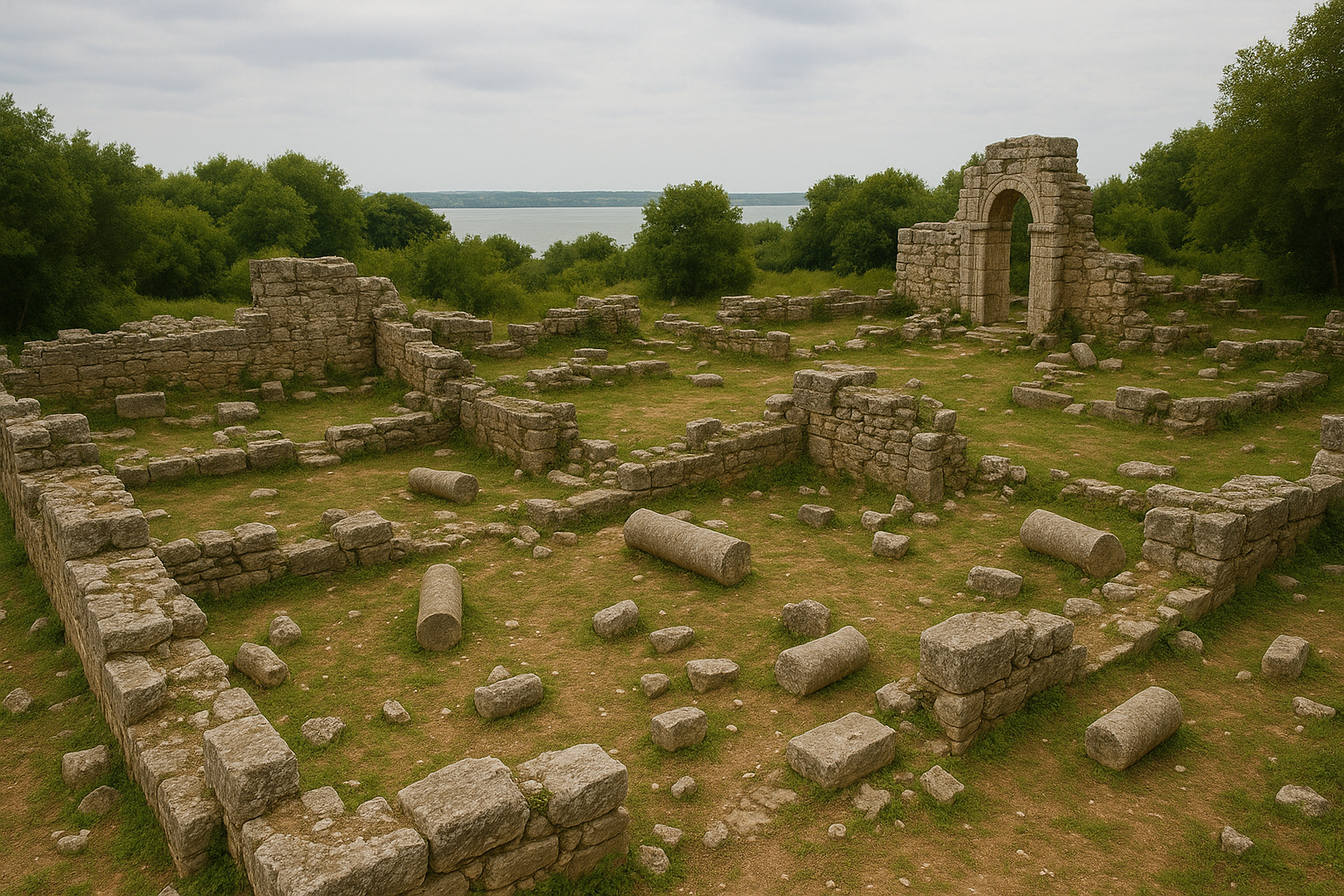
The walls of İznik stretch for nearly 5 kilometers, forming a pentagonal circuit around the city. They stand as a textbook example of Roman and Byzantine military architecture.
- Layered Construction: The walls clearly show different phases of construction. The original Roman core, made of rubble and mortar, is faced with well-cut stone blocks. Later Byzantine repairs and additions are easily identified by the characteristic use of "brick-band" courses, which provided both structural flexibility and a decorative touch.
- Monumental Gates: The city was accessed through four main gates, each a complex and heavily fortified structure. The Istanbul Gate in the north and the Lefke Gate in the east are the best-preserved. They are adorned with triumphal arches, reliefs, and inscriptions, and incorporate a large amount of spolia—reused stones from older buildings, including columns and sarcophagi.
- Towers and Defenses: Over 100 towers, both square and semi-circular, punctuate the walls, providing strategic points for defense. The double-wall system was further protected by a wide moat, creating a truly daunting obstacle for any attacker.
The walls of Nicaea did not just protect a city; they protected a cornerstone of Christian history. It was within these fortifications that two of the most important gatherings in the history of the church took place:
- The First Council of Nicaea (325 CE): Convened by Emperor Constantine the Great, this council brought bishops from acros...
Beyond the visible ruins, the historical value of this site comes from continuity: changing powers, changing urban functions, and changing ways people used public space over centuries.
Archaeology and Urban Layout
When reading this site on location, focus on three layers:
- Circulation layer: streets, gates, terraces, harbor or slope connections
- Public layer: theaters, agoras, baths, temples, administrative spaces
- Infrastructure layer: water systems, walls, storage zones, service architecture
This method helps visitors and researchers understand the city as a living system rather than isolated monuments.
Visitor Experience
A high-quality visit usually includes:
- A first orientation point (viewpoint, acropolis edge, or central axis)
- A pass through the site’s signature structure
- A slower walk through daily-life spaces
- A final stop connecting ruins with landscape
This sequence creates a stronger historical narrative than quick “photo-only” movement.
A Short Story from the Past
Imagine arriving here in antiquity at sunrise: workers preparing the day, travelers entering through roads or harbor routes, merchants opening storage spaces, and public architecture already shaping movement and ritual. The stones you see today are not silent objects; they are fragments of those repeated daily rhythms.
Practical Travel Notes
- Prefer spring and autumn for comfort.
- In summer, avoid midday peak heat when possible.
- Wear stable walking shoes for uneven terrain.
- Keep enough time (at least 1.5–3 hours) for a meaningful route.
- Check current access and ticket conditions before departure.
FAQ
Why is İznik Castle (Walls of Nicaea) – İznik, Bursa important?
Because it preserves multiple historical layers and helps explain regional cultural continuity in Türkiye.
How long should I spend here?
Most visitors spend 1.5–3 hours; in-depth visits may take half a day.
Is this suitable for first-time archaeology travelers?
Yes. With basic planning, this site is suitable for both first-time and experienced visitors.
Wall Dimensions and Engineering Specifications
| Parameter | Measurement |
|---|---|
| Total circuit length | ~4,970 m (inner wall); ~3,100 m circumference (some sources vary by measurement method) |
| Wall thickness (base) | 5--7 m |
| Wall height | 10--13 m |
| Number of towers | 114 defensive towers (documented) |
| Tower spacing | ~40--50 m intervals |
| Tower maximum height | Up to 15 m |
| Number of major gates | 4 (Istanbul, Lefke, Yenisehir, Gol) |
| Number of minor gates | 12 smaller postern gates |
| Plan shape | Pentagonal |
| Moat | Wide external ditch (partially silted) |
| Construction materials | Limestone blocks, Roman brick courses, lime mortar, reused spolia |
Construction Phases and Chronology
| Phase | Date | Event / Works | Authority |
|---|---|---|---|
| Phase I | Late 1st c. AD | Initial pentagonal wall circuit constructed | Flavian dynasty (Vespasian / Titus) |
| Phase II | 123 AD | Earthquake damage; reconstruction funded by Emperor Hadrian; Lefke Gate rededicated | Emperor Hadrian |
| Phase III | 268 AD | Goths capture and destroy the city; walls rebuilt on the same course | Emperor Claudius II |
| Phase IV | 6th c. AD | Major restoration programme | Emperor Justinian I |
| Phase V | 1204--1261 | Nicaea becomes capital of the Byzantine Empire-in-exile; outer wall (proteichisma) added, creating a double-wall system | Empire of Nicaea (Laskaris dynasty) |
| Phase VI | 13th c. | Outer gates constructed with spolia columns and flanking semi-cylindrical bastions | Theodore I / II Laskaris |
| Phase VII | Ottoman period | Selective repairs; some towers adapted for gunpowder-era defences | Ottoman sultans |
The Four Monumental Gates
| Gate | Orientation | Key Features |
|---|---|---|
| Istanbul Kapisi (Istanbul Gate) | North | Triple-arched Roman gate; triumphal arch with relief panels; extensively reused spolia including sarcophagi and column shafts |
| Lefke Kapisi (Lefke Gate) | East | Best-preserved gate; dedicatory inscription to Emperor Hadrian (post-123 AD reconstruction); triple-gate form added in Byzantine period; flanking towers |
| Yenisehir Kapisi (Yenisehir Gate) | South | Roman-era core; less well preserved than north and east gates; partially obscured by modern road |
| Gol Kapisi (Lake Gate) | West | Opens toward Lake Iznik; strategic waterfront access; the most vulnerable approach, defended by additional tower clusters |
The walls exhibit a distinctive banded construction technique: alternating courses of cut limestone blocks and Roman brick (3--5 brick courses per band). This technique, characteristic of late Roman and Byzantine military architecture, provided both structural flexibility during earthquakes and a visually striking polychrome appearance.
Spolia: Reused Architectural Elements
The Nicaea walls are among the richest examples of spolia reuse in Anatolian fortification architecture. Elements incorporated into the walls and gates include:
- Marble columns from demolished Roman-era temples and public buildings
- Inscribed stone blocks with Greek and Latin texts, placed face-inward to hide their original function
- Sarcophagus panels built into gate foundations
- Corinthian and Ionic capitals embedded in tower masonry
- Honorific statue bases recycled as structural fill
This reuse accelerated after the Gothic destruction of 268 AD and again during the 13th-century double-wall construction, when Byzantine engineers systematically quarried earlier Roman structures for building material.
The Ecumenical Councils and Their Archaeological Context
The two great ecumenical councils held at Nicaea left no surviving purpose-built structures, but their historical significance defines the site:
| Council | Date | Convened By | Key Outcome | Approximate Attendance |
|---|---|---|---|---|
| First Council of Nicaea | 325 AD | Emperor Constantine I | Nicene Creed established; Arianism condemned; Easter date standardized | ~318 bishops |
| Seventh Ecumenical Council | 787 AD | Empress Irene | Restoration of icon veneration; Iconoclasm condemned | ~350 bishops |
The First Council met in a hall within the imperial palace complex, believed to have been located near the modern centre of Iznik. No architectural remains of this hall have been conclusively identified, though Byzantine-era church foundations and floor mosaics have been excavated within the walled area.
Sources
- https://en.wikipedia.org/wiki/Walls_of_Nicaea
- https://www.thebyzantinelegacy.com/iznik
- https://www.travelatelier.com/iznik-nicea/
- https://www.toldinstone.com/iznik-nicea-city-walls/
- https://commons.wikimedia.org/w/index.php?search=İznik+Castle+–+İznik,+Bursa&title=Special:MediaSearch&type=image
- https://en.wikipedia.org/wiki/İznik_Castle_–_İznik,_Bursa
Advanced Historical Analysis
Political Layering
İznik Castle (Walls of Nicaea) – İznik, Bursa should be interpreted through shifts in political authority, because each regime changed administrative priorities, urban investment, and symbolic architecture. This means visible remains are not neutral stones: they reflect historical decisions about control, legitimacy, and long-term territorial strategy.
Urban Adaptation
Cities evolved according to topography, resources, and mobility constraints. At sites like İznik Castle (Walls of Nicaea) – İznik, Bursa, adaptation can be traced in circulation routes, wall systems, water management, and the redistribution of public spaces over time.
Material Continuity and Reuse
A core archaeological reality is reuse: blocks, inscriptions, and architectural elements often migrated across periods. Reuse is not merely practical—it is also cultural messaging, where later communities selectively preserved, transformed, or reinterpreted earlier prestige.
Ritual and Public Memory
Sacred and civic spaces often overlap in long-lived cities. Ritual landscapes can persist even when political systems change, making them critical for studying continuity in collective memory.
Long-Form Visitor Interpretation Framework
Use this 8-step framework on site:
- Establish orientation with topography and route context.
- Identify the best-preserved structural system (walls, harbor, theatre, temple, etc.).
- Distinguish primary phase from later interventions.
- Compare monumental and everyday-life sectors.
- Read water and logistics infrastructure as survival systems.
- Evaluate symbolic/ritual axis and visibility politics.
- Track reuse and repair evidence.
- Conclude with city-landscape relationship at a final viewpoint.
This method improves interpretation quality for both general visitors and advanced readers.
Practical Planning for Researchers and Travelers
- Allocate at least one full interpretation cycle (2–4 hours).
- If available, pair site visit with local museum context.
- Record notes by phase, not by random observation order.
- Separate what is directly visible from what is inferred.
- Use maps and elevation to validate movement assumptions.
Expanded Visitor Q&A
Is this site only for archaeology specialists?
No. Structured route planning and basic historical framing make the site understandable to non-specialists.
Why do different periods overlap in one place?
Because cities are living systems. They are rebuilt, repurposed, and politically reframed rather than created once.
What is the most reliable way to avoid shallow interpretation?
Follow chronology, compare layers, and include infrastructure and landscape in your reading.
Should winter visits be avoided?
Not necessarily. Winter can offer lower crowd density and better interpretive pacing if weather conditions are manageable.
What makes this site distinct from other ancient cities?
Its specific combination of geography, political history, architecture, and continuity across multiple historical transitions.
Advanced Historical Analysis
Political Layering
İznik Castle (Walls of Nicaea) – İznik, Bursa should be interpreted through shifts in political authority, because each regime changed administrative priorities, urban investment, and symbolic architecture. This means visible remains are not neutral stones: they reflect historical decisions about control, legitimacy, and long-term territorial strategy.
Urban Adaptation
Cities evolved according to topography, resources, and mobility constraints. At sites like İznik Castle (Walls of Nicaea) – İznik, Bursa, adaptation can be traced in circulation routes, wall systems, water management, and the redistribution of public spaces over time.
Material Continuity and Reuse
A core archaeological reality is reuse: blocks, inscriptions, and architectural elements often migrated across periods. Reuse is not merely practical—it is also cultural messaging, where later communities selectively preserved, transformed, or reinterpreted earlier prestige.
Ritual and Public Memory
Sacred and civic spaces often overlap in long-lived cities. Ritual landscapes can persist even when political systems change, making them critical for studying continuity in collective memory.
Long-Form Visitor Interpretation Framework
Use this 8-step framework on site:
- Establish orientation with topography and route context.
- Identify the best-preserved structural system (walls, harbor, theatre, temple, etc.).
- Distinguish primary phase from later interventions.
- Compare monumental and everyday-life sectors.
- Read water and logistics infrastructure as survival systems.
- Evaluate symbolic/ritual axis and visibility politics.
- Track reuse and repair evidence.
- Conclude with city-landscape relationship at a final viewpoint.
This method improves interpretation quality for both general visitors and advanced readers.
Practical Planning for Researchers and Travelers
- Allocate at least one full interpretation cycle (2–4 hours).
- If available, pair site visit with local museum context.
- Record notes by phase, not by random observation order.
- Separate what is directly visible from what is inferred.
- Use maps and elevation to validate movement assumptions.
Expanded Visitor Q&A
Is this site only for archaeology specialists?
No. Structured route planning and basic historical framing make the site understandable to non-specialists.
Why do different periods overlap in one place?
Because cities are living systems. They are rebuilt, repurposed, and politically reframed rather than created once.
What is the most reliable way to avoid shallow interpretation?
Follow chronology, compare layers, and include infrastructure and landscape in your reading.
Should winter visits be avoided?
Not necessarily. Winter can offer lower crowd density and better interpretive pacing if weather conditions are manageable.
What makes this site distinct from other ancient cities?
Its specific combination of geography, political history, architecture, and continuity across multiple historical transitions.
Advanced Historical Analysis
Political Layering
İznik Castle (Walls of Nicaea) – İznik, Bursa should be interpreted through shifts in political authority, because each regime changed administrative priorities, urban investment, and symbolic architecture. This means visible remains are not neutral stones: they reflect historical decisions about control, legitimacy, and long-term territorial strategy.
Urban Adaptation
Cities evolved according to topography, resources, and mobility constraints. At sites like İznik Castle (Walls of Nicaea) – İznik, Bursa, adaptation can be traced in circulation routes, wall systems, water management, and the redistribution of public spaces over time.
Material Continuity and Reuse
A core archaeological reality is reuse: blocks, inscriptions, and architectural elements often migrated across periods. Reuse is not merely practical—it is also cultural messaging, where later communities selectively preserved, transformed, or reinterpreted earlier prestige.
Ritual and Public Memory
Sacred and civic spaces often overlap in long-lived cities. Ritual landscapes can persist even when political systems change, making them critical for studying continuity in collective memory.
Long-Form Visitor Interpretation Framework
Use this 8-step framework on site:
- Establish orientation with topography and route context.
- Identify the best-preserved structural system (walls, harbor, theatre, temple, etc.).
- Distinguish primary phase from later interventions.
- Compare monumental and everyday-life sectors.
- Read water and logistics infrastructure as survival systems.
- Evaluate symbolic/ritual axis and visibility politics.
- Track reuse and repair evidence.
- Conclude with city-landscape relationship at a final viewpoint.
This method improves interpretation quality for both general visitors and advanced readers.
Practical Planning for Researchers and Travelers
- Allocate at least one full interpretation cycle (2–4 hours).
- If available, pair site visit with local museum context.
- Record notes by phase, not by random observation order.
- Separate what is directly visible from what is inferred.
- Use maps and elevation to validate movement assumptions.
Expanded Visitor Q&A
Is this site only for archaeology specialists?
No. Structured route planning and basic historical framing make the site understandable to non-specialists.
Why do different periods overlap in one place?
Because cities are living systems. They are rebuilt, repurposed, and politically reframed rather than created once.
What is the most reliable way to avoid shallow interpretation?
Follow chronology, compare layers, and include infrastructure and landscape in your reading.
Should winter visits be avoided?
Not necessarily. Winter can offer lower crowd density and better interpretive pacing if weather conditions are manageable.
What makes this site distinct from other ancient cities?
Its specific combination of geography, political history, architecture, and continuity across multiple historical transitions.
Advanced Historical Analysis
Political Layering
İznik Castle (Walls of Nicaea) – İznik, Bursa should be interpreted through shifts in political authority, because each regime changed administrative priorities, urban investment, and symbolic architecture. This means visible remains are not neutral stones: they reflect historical decisions about control, legitimacy, and long-term territorial strategy.
Urban Adaptation
Cities evolved according to topography, resources, and mobility constraints. At sites like İznik Castle (Walls of Nicaea) – İznik, Bursa, adaptation can be traced in circulation routes, wall systems, water management, and the redistribution of public spaces over time.
Material Continuity and Reuse
A core archaeological reality is reuse: blocks, inscriptions, and architectural elements often migrated across periods. Reuse is not merely practical—it is also cultural messaging, where later communities selectively preserved, transformed, or reinterpreted earlier prestige.
Ritual and Public Memory
Sacred and civic spaces often overlap in long-lived cities. Ritual landscapes can persist even when political systems change, making them critical for studying continuity in collective memory.
Long-Form Visitor Interpretation Framework
Use this 8-step framework on site:
- Establish orientation with topography and route context.
- Identify the best-preserved structural system (walls, harbor, theatre, temple, etc.).
- Distinguish primary phase from later interventions.
- Compare monumental and everyday-life sectors.
- Read water and logistics infrastructure as survival systems.
- Evaluate symbolic/ritual axis and visibility politics.
- Track reuse and repair evidence.
- Conclude with city-landscape relationship at a final viewpoint.
This method improves interpretation quality for both general visitors and advanced readers.
Practical Planning for Researchers and Travelers
- Allocate at least one full interpretation cycle (2–4 hours).
- If available, pair site visit with local museum context.
- Record notes by phase, not by random observation order.
- Separate what is directly visible from what is inferred.
- Use maps and elevation to validate movement assumptions.
Expanded Visitor Q&A
Is this site only for archaeology specialists?
No. Structured route planning and basic historical framing make the site understandable to non-specialists.
Why do different periods overlap in one place?
Because cities are living systems. They are rebuilt, repurposed, and politically reframed rather than created once.
What is the most reliable way to avoid shallow interpretation?
Follow chronology, compare layers, and include infrastructure and landscape in your reading.
Should winter visits be avoided?
Not necessarily. Winter can offer lower crowd density and better interpretive pacing if weather conditions are manageable.
What makes this site distinct from other ancient cities?
Its specific combination of geography, political history, architecture, and continuity across multiple historical transitions.