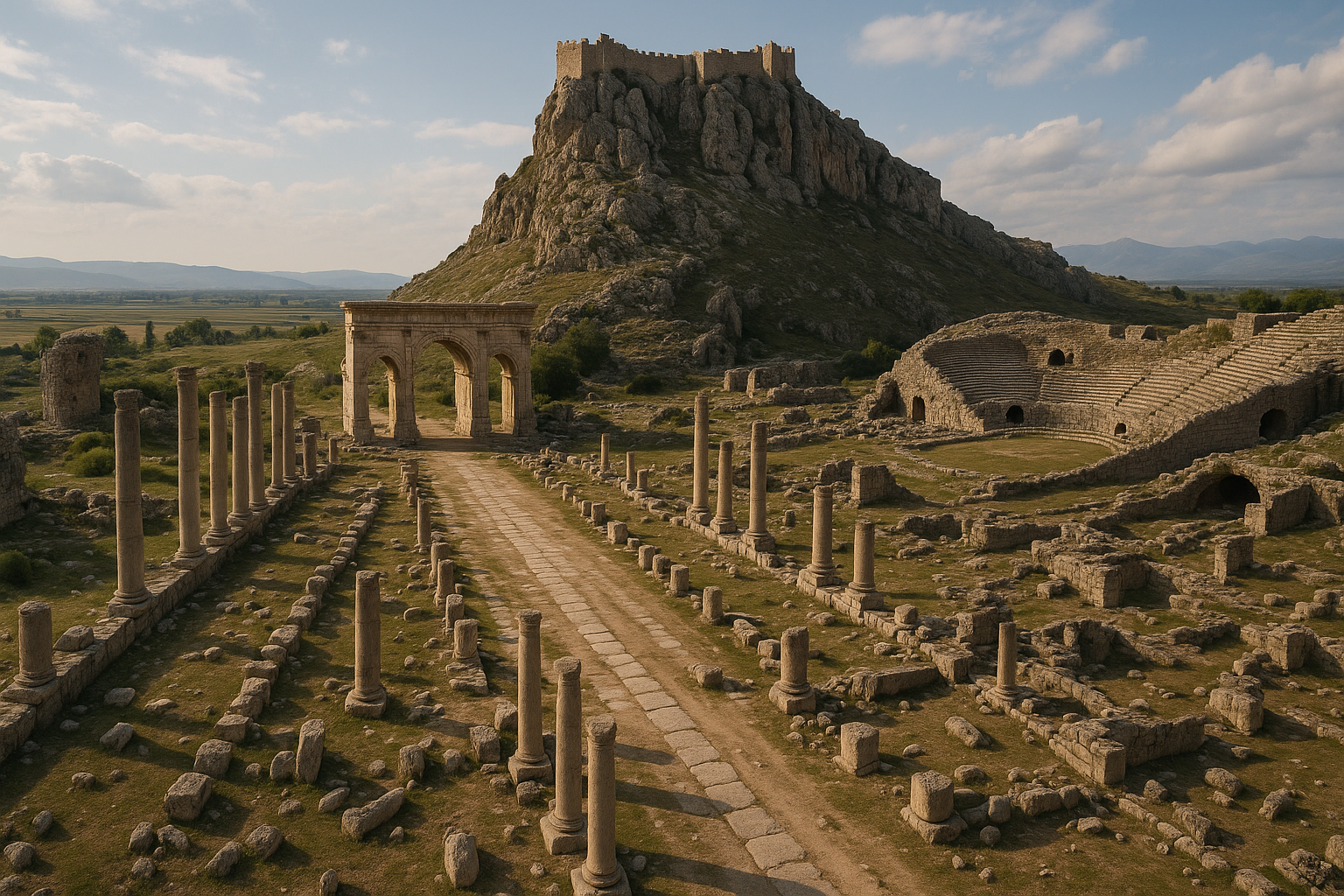
Quick Summary: Anavarza (ancient Anazarbus, later Caesarea ad Anazarbum) is one of the largest and most impressive ancient cities in southern Turkey, spread across the Çukurova (Cilician) Plain at the foot of a dramatic 200-metre-high rock massif near Kozan, Adana. Founded in antiquity and elevated to prominence under the Roman Empire, Anavarza rivalled Tarsus for the title of capital of Cilicia, eventually winning the designation of metropolis and neokoros (temple-warden) under Emperor Septimius Severus in the early 3rd century AD. The site boasts a monumental three-arched triumphal arch (Alakapı — the only Roman triumphal arch in Cilicia), one of the widest colonnaded streets in the ancient world (34 metres), a massive stadium, theatre, baths, aqueducts, a spectacular hilltop castle, and extensive Byzantine mosaics. Hometown of the renowned physician Dioscorides — the "father of pharmacology" — Anavarza is on Turkey's UNESCO World Heritage Tentative List and has been under systematic excavation since 2012.
- Why Anavarza Matters
- Geography and Setting
- Historical Timeline
- The Triumphal Arch (Alakapı)
- The Colonnaded Street
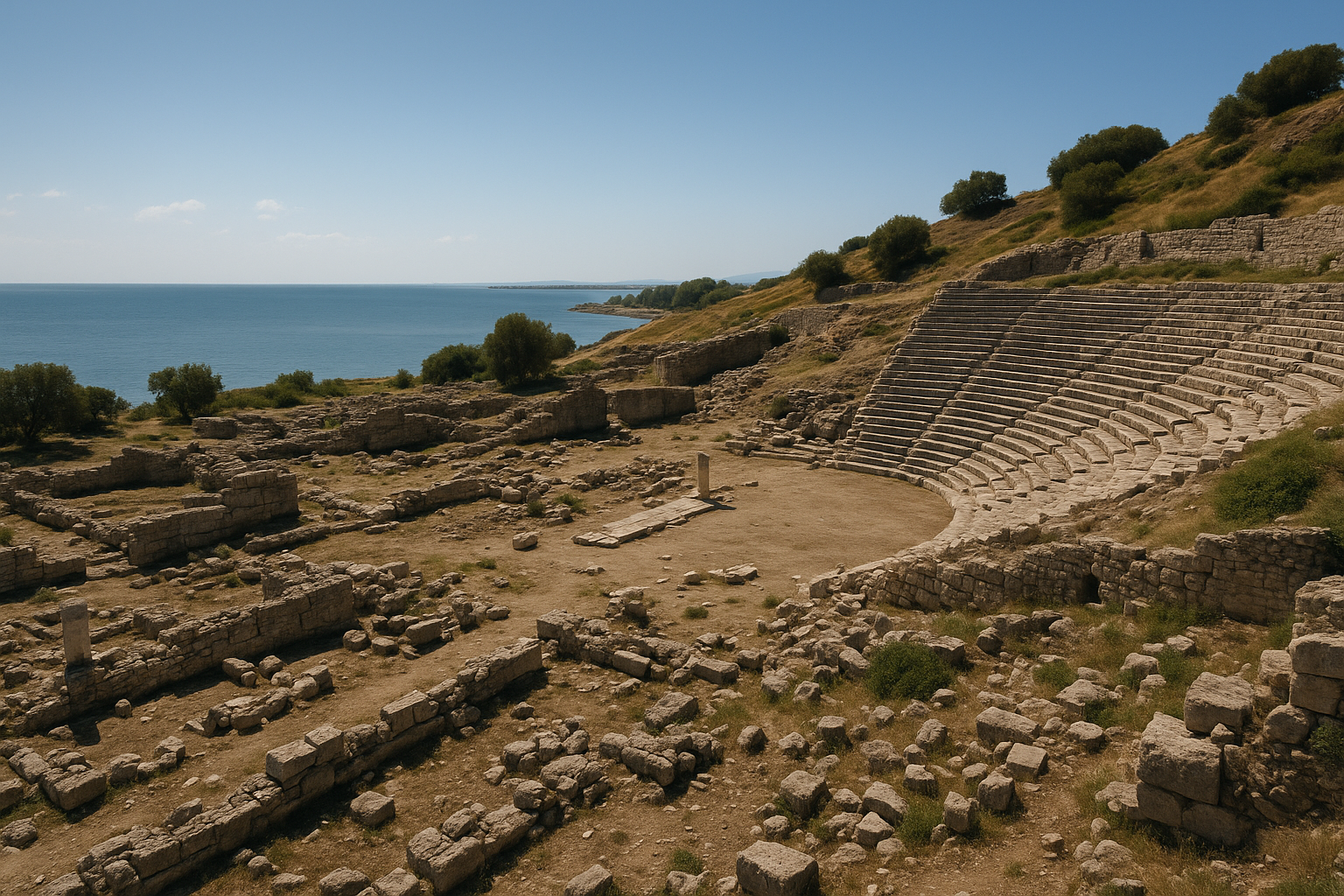
- Stadium and Theatre
- Anavarza Castle
- Baths, Aqueducts, and Infrastructure
- Mosaics and Churches
- Dioscorides and Intellectual Life
- The Rivalry with Tarsus
- Archaeological Excavations
- Visitor Information
- Frequently Asked Questions
- Sources and Further Reading
Why Anavarza Matters
Anavarza is significant for multiple reasons:
Scale and preservation: The site covers an enormous area — the lower city extends over 1 km along the colonnaded street, while the castle above occupies the entire summit of the rock massif. The combination of Roman, Byzantine, Armenian, and Crusader-era remains creates an exceptionally layered archaeological landscape.
The Triumphal Arch: The Alakapı (three-arched triumphal gate) is the only surviving Roman triumphal arch in Cilicia and one of the finest in all of Anatolia. Its monumental scale (nearly 8 metres high) and elaborate decoration make it an architectural landmark.
Medical history: Anavarza was the birthplace of Pedanius Dioscorides (c. 40–90 AD), whose five-volume work De Materia Medica remained the standard pharmacological reference in both the Islamic and European worlds for over 1,500 years.
Urban rivalry: The competition between Anavarza and Tarsus for the title of capital of Cilicia provides a fascinating case study in ancient civic rivalry — expressed through coin legends, honorary titles, and monumental construction.
Continuity: The site's occupation spans from the Chalcolithic period (c. 5000 BC) through the Armenian Kingdom of Cilicia (12th–14th centuries), encompassing over 7,000 years of human presence.
Geography and Setting
Anavarza is located approximately 30 km south of Kozan (ancient Sis) in Adana Province, on the eastern edge of the Çukurova Plain — the vast, fertile lowland of ancient Cilicia Pedias (Flat Cilicia).
The site's defining feature is the Anavarza Rock — a sheer limestone massif rising approximately 200 metres above the surrounding plain, roughly 1.5 km long and 800 metres wide. This natural fortress provided both a dramatic backdrop and an impregnable defensive position.
Landscape Features
- The Rock Massif: The castle-topped crag dominates the landscape for kilometres in every direction
- The Çukurova Plain: One of the most fertile agricultural regions in the Mediterranean — ancient grain production, modern cotton and citrus cultivation
- The Sumbas River: A tributary of the Ceyhan (ancient Pyramus) River flows near the site, providing water for the ancient city
- Route Network: Anavarza sat at the junction of routes connecting Tarsus and Adana to the Euphrates frontier and northern Mesopotamia — a strategic position for both trade and military logistics
The climate is hot Mediterranean — summers are intensely hot (40°C+), making spring and autumn the preferred visiting seasons.
Historical Timeline
Chalcolithic and Bronze Age (c. 5000–1200 BC)
Archaeological evidence indicates human presence at Anavarza from the Chalcolithic period (c. 5000 BC). The site's natural defensive position would have attracted early settlers. During the Bronze Age, the region was part of the Hittite sphere of influence as the land of Kizzuwatna.
Hellenistic Foundation (c. 2nd century BC)
The formal city of Anazarbus was likely founded or refounded during the Seleucid period. The name may derive from a local Anatolian toponym. Under the Seleucids, the city began to develop its urban infrastructure.
Roman Period (1st century BC – 4th century AD)
Anavarza flourished under Roman rule:
- 1st century BC: Incorporated into the Roman province of Cilicia
- 19 AD: Renamed Caesarea ad Anazarbum by the Emperor Germanicus
- Flavian period (69–96 AD): Significant construction activity
- 198 AD: Granted the title of neokoros (temple-warden) by Septimius Severus — the right to host an imperial cult temple
- 204 AD: Elevated to metropolis — the administrative capital of Cilicia Secunda (Second Cilicia), wresting this honour from Tarsus
- 2nd–3rd centuries AD: Period of maximum prosperity — the triumphal arch, colonnaded street, stadium, and major public buildings date to this era
Byzantine Period (4th–11th centuries)
Anavarza became an important Byzantine frontier city:
- Seat of an archbishop in the ecclesiastical hierarchy
- Multiple churches and basilicas constructed, decorated with elaborate mosaic floors
- Frequent Arab raids from the 7th century onward damaged the city repeatedly
- 525 AD and 561 AD: Devastating earthquakes destroyed much of the city; rebuilt by Emperor Justinian I
- The city served as a forward base during the Byzantine-Arab border conflicts
Armenian Kingdom of Cilicia (11th–14th centuries)
After the arrival of Armenian populations in Cilicia following the Seljuk conquest of their homeland:
- Anavarza became a key stronghold of the Armenian Kingdom of Cilicia (Cilician Armenia)
- The castle was extensively rebuilt and expanded with Armenian fortification walls
- The city served briefly as an Armenian capital in the early 12th century
- Armenian churches and structures were added to the existing urban fabric
Mamluk Conquest and Abandonment
The Mamluk invasion of 1375 ended the Armenian Kingdom of Cilicia. Anavarza was sacked and largely abandoned. The site was never reoccupied as a major settlement, preserving its ancient and medieval remains.
The Triumphal Arch (Alakapı)
The Alakapı ("Ornate Gate") is Anavarza's most iconic monument:
- Three-arched triumphal gate — a large central archway flanked by two smaller side arches
- The only surviving Roman triumphal arch in Cilicia
- Estimated height: approximately 8 metres
- Built of precisely cut limestone ashlar
- Dated to the 2nd–3rd century AD, probably commemorating Anavarza's elevation to metropolis
- The arch served as the monumental entrance to the colonnaded street from the south
- Richly decorated with Corinthian pilasters, entablature mouldings, and relief panels
- Some scholars identify relief scenes depicting military victories or imperial ceremonies
- The local name "Alakapı" (colourful/ornate gate) may reflect original polychromy — traces of colour have been noted
Comparisons with other Anatolian triumphal arches (such as the Hadrianic gate at Antalya or the triple arch at Patara) show that Anavarza's arch is among the most ambitious in the region.
The Colonnaded Street
The colonnaded main street (cardo maximus) is one of the widest in the ancient world:
- Total width: approximately 34 metres — wider than the colonnaded streets at Ephesus, Perge, or Apamea
- Length: over 1 km running north-south through the lower city
- Lined with Corinthian columns supporting covered porticos on both sides
- Shops and workshops opened onto the covered walkways — the ancient equivalent of a covered shopping mall
- The street was paved with large limestone slabs
- Drainage channels ran beneath the pavement
- Connected the triumphal arch (south) to the northern gate and beyond to the castle approach
Stadium and Theatre
The Stadium
Anavarza's stadium is one of the largest in Anatolia:
- Dimensions: approximately 400 × 60 metres
- Partially carved into the rock at the base of the massif
- Capacity estimated at 20,000–30,000 spectators
- Used for athletic competitions, chariot racing, and possibly gladiatorial events
- The gladiatorial tradition at Anavarza is documented by a 2nd-century AD relief discovered during excavations showing gladiatorial combat scenes
The Theatre
- Built against the lower slopes of the rock massif
- Estimated seating capacity: 8,000–10,000
- Cavea (seating area) partially rock-cut, partially built
- The stage building (scaenae frons) has collapsed but fragments of its elaborate decoration survive
- Roman-period construction with later modifications
Anavarza Castle
The castle occupies the entire summit of the 200-metre rock massif:
- One of the largest castle complexes in southern Turkey
- Multi-period construction: Roman, Byzantine, Armenian, and possibly Crusader phases
- The Armenian fortification walls are the most visible, with distinctive rubble-core construction and semicircular towers
- A rock-cut stairway connects the lower city to the castle summit
- Inside the castle: remains of a palace, chapel, cisterns, and storage rooms
- Panoramic 360-degree views over the Çukurova Plain from the summit
- The castle was the last refuge during sieges — its sheer cliffs made it virtually impregnable from assault
Baths, Aqueducts, and Infrastructure
Roman Baths
Multiple bath complexes (thermae) have been identified:
- The large bath complex near the colonnaded street includes frigidarium (cold room), tepidarium (warm room), and caldarium (hot room) sections
- Hypocaust heating system with brick pilae (support pillars) still visible
- Marble wall revetments and mosaic floors in some sections
Aqueducts
A multi-section aqueduct brought water to the city from mountain sources:
- Stone-built sections survive along the approach to the city
- Water distribution system with terracotta pipes and stone channels
- The water system supported both public fountains (nymphaea) and the bath complexes
Necropolis
Extensive cemetery areas surround the city:
- Rock-cut tombs in the cliff face
- Sarcophagi of various periods
- Some tomb facades with relief decoration
Mosaics and Churches
Anavarza's Byzantine churches contain some of the finest mosaic floors in Cilicia:
Church Mosaics
- Excavations since 2012 have uncovered extensive mosaic pavements in multiple church buildings
- Motifs include geometric patterns, vine scrolls, birds, animals, and inscriptions
- A particularly fine 5th–6th century mosaic panel features hunting scenes with detailed animal figures
- The mosaics demonstrate the wealth and artistic sophistication of Byzantine Anavarza
Church Architecture
- Several basilica-plan churches have been identified in the lower city
- One large basilica features a three-aisled plan with a semicircular apse
- Architectural sculpture includes Corinthian capitals, carved cornices, and decorative window frames
Dioscorides and Intellectual Life
Anavarza's most famous son is Pedanius Dioscorides (c. 40–90 AD):
- Born in Anazarbus, served as a military physician in the Roman army
- Authored De Materia Medica — a five-volume encyclopaedia of pharmacology describing approximately 600 plants, 35 animal products, and 90 minerals with their medicinal uses
- The work was the standard reference on pharmacology for over 1,500 years in both the Islamic world (translated into Arabic by Hunayn ibn Ishaq) and medieval Europe
- Dioscorides' systematic approach to documenting medicines — describing each substance's preparation, dosage, and effects — anticipates modern pharmacological methodology
- The city's coins sometimes feature medical imagery (serpent of Asklepios) possibly in honour of its famous physician
- Dioscorides represents the broader intellectual culture of Roman Cilicia, which also produced the Stoic philosopher Chrysippus (from nearby Soli)
The Rivalry with Tarsus
One of the most fascinating aspects of Anavarza's history is its civic rivalry with Tarsus:
- Tarsus was the traditional capital of Cilicia — the birthplace of St. Paul and a major cultural centre
- Anavarza challenged this supremacy through aggressive monumental construction, seeking honorary titles from Rome
- In 198 AD, Anavarza won the coveted neokoros title from Septimius Severus
- In 204 AD, Anavarza was elevated to metropolis of Cilicia Secunda — effectively splitting Cilicia and making Anavarza capital of the eastern portion
- This rivalry is documented on coin legends: Anavarza's coins proudly proclaim its titles (ΜΗΤΡΟΠΟΛΙΣ, ΝΕΩΚΟΡΟΣ) as assertions of civic prestige
- The competition drove both cities to invest heavily in public architecture — benefiting posterity with magnificent ruins
Archaeological Excavations
Early Investigations
- 19th-century European travellers described the ruins
- Victor Langlois (1852) published early descriptions
- Various survey expeditions documented individual monuments
Modern Excavations (2012–present)
Systematic excavations have been conducted since 2012 under the direction of Çukurova University:
- Excavation of the colonnaded street and adjacent buildings
- Discovery of gladiatorial reliefs confirming arena combat at the stadium
- Uncovering of extensive Byzantine mosaic pavements in church buildings
- Documentation of the multi-period castle complex
- Conservation work on the triumphal arch
- The excavations have revealed that the city's occupation extends back to the Chalcolithic period (c. 5000 BC)
UNESCO Tentative List
Anavarza was added to Turkey's UNESCO World Heritage Tentative List in 2014, recognising its outstanding universal value as a multi-period archaeological landscape.
Visitor Information
Location: Approximately 30 km south of Kozan, Adana Province. The ancient site is near the village of Dilekkaya.
Getting There: By car from Adana (approximately 1.5 hours east via the Adana-Kozan road, then south). From Kozan, follow signposts toward Dilekkaya/Anavarza. No regular public transport directly to the site.
Hours: Open daily during daylight hours.
Admission: A nominal fee may be charged during active excavation seasons.
Duration: 2–4 hours minimum. The site is very large — allow a full half-day for thorough exploration including the castle climb.
Castle Climb: The ascent to the castle summit is steep and strenuous — allow 30–45 minutes each way. The path is rough and exposed. Not recommended in summer heat or for those with mobility limitations. The views from the top are spectacular.
Combined Visits:
- Kozan — the Kozan Castle (Armenian-period fortress), old town
- Kadirli — Karatepe-Aslantaş National Park (Neo-Hittite fortress with bilingual inscriptions)
- Adana — Taşköprü (Roman stone bridge), Adana Archaeological Museum
- Misis (Mopsuestia) — Roman bridge and Noah's Ark mosaic
Tips:
- Start early in the morning, especially in warm weather
- Bring plenty of water — there is limited shade on site
- The triumphal arch and colonnaded street are the must-see highlights
- The castle climb rewards the effort with extraordinary panoramic views
- Wear sturdy shoes for the castle ascent
- The site is still actively excavated — some areas may be restricted
- Combine with Karatepe for a full day of Cilician archaeology
Frequently Asked Questions
What is Anavarza? One of the largest ancient cities in Cilicia (southern Turkey), located at the foot of a 200-metre rock massif. It served as the capital of Cilicia Secunda under Rome and contains a triumphal arch, stadium, colonnaded street, castle, and Byzantine mosaics.
Who was Dioscorides? Pedanius Dioscorides (c. 40–90 AD) was born in Anavarza and wrote De Materia Medica, the most influential pharmacological text in history, used for over 1,500 years.
Is it a UNESCO site? Anavarza is on Turkey's UNESCO World Heritage Tentative List (since 2014) but has not yet been formally inscribed.
How does it compare to other ancient cities in Turkey? In terms of scale, Anavarza rivals Ephesus and Perge. Its colonnaded street is wider than Ephesus's (34 metres vs. 11 metres). The castle adds a dramatic vertical dimension not found at most coastal sites.
Can I climb the castle? Yes, though the ascent is steep and requires 30–45 minutes. The views from the top are among the best in southern Turkey.
Architectural Measurements and Structural Survey Data
Systematic excavation since 2012 under Cukurova University has produced detailed measurements for Anavarza's major monuments, confirming its status as one of the largest and most ambitious urban projects in Roman Cilicia.
Colonnaded Street: Engineering Specifications
| Feature | Measurement / Detail |
|---|---|
| Total width | 34 metres (among the widest in the ancient world) |
| Total documented length | 2,700 metres |
| Lane configuration | Double-lane divided road -- the first known example of its kind in antiquity |
| Column order | Corinthian, with covered porticos on both sides |
| Pavement | Large limestone slabs |
| Drainage | Subterranean channels beneath pavement |
| Shops | Commercial premises opening onto covered walkways along both sides |
| Discovery date | 2013 excavation season |
For comparison, the colonnaded street at Ephesus measures approximately 11 metres wide, at Perge 20 metres, and at Apamea (Syria) 37 metres. Anavarza's 34-metre width places it among the top three widest colonnaded streets in the entire Roman world. The 2,700-metre documented length makes it one of the longest as well.
Amphitheatre / Arena: Structural Data
| Feature | Measurement / Detail |
|---|---|
| Shape | Oval (true amphitheatre form) |
| Dimensions | 62 x 83 metres (203 x 272 feet) |
| Substructure | Arched chambers and corridors beneath seating |
| Animal holding cells | Underground chambers for lions, tigers, and other wild animals |
| Watchtowers | Tall granite observation towers for referees overseeing combat |
| Gladiator burials | Burial ground discovered adjacent to amphitheatre -- only the 2nd such find in Turkey |
| Relief evidence | 2nd-century AD carved relief depicting gladiatorial combat scenes |
The discovery of gladiator tombs near the amphitheatre is of exceptional rarity. Skeletal analysis of the burials has provided data on the physical characteristics, injuries, and dietary patterns of professional gladiators in the Roman East.
Triumphal Arch (Alakapi): Measured Dimensions
| Feature | Measurement / Detail |
|---|---|
| Arch configuration | Triple arch: large central arch flanked by two smaller pedestrian arches |
| Height | c. 8 metres |
| Construction material | Precisely cut limestone ashlar blocks |
| Architectural decoration | Corinthian pilasters, entablature mouldings, relief panels |
| Central arch function | Vehicular passage |
| Side arch function | Pedestrian passage |
| Probable date | Late 2nd--early 3rd century AD (commemorating metropolis elevation) |
| Polychromy | Traces of original colour noted on carved surfaces |
Numismatic Evidence: Civic Rivalry Documented in Coinage
The coinage of Anavarza provides the clearest evidence for the chronology of its rivalry with Tarsus for the title of capital of Cilicia.
| Title | Date Granted | Emperor | Coin Legend | Significance |
|---|---|---|---|---|
| Neokoros (first) | 198 AD | Septimius Severus | ΝΕΩΚΟΡΟΣ (NEOKOROS) | Right to maintain an imperial cult temple; elevated status within Cilicia |
| Neokoros (second) | 203 AD | Septimius Severus | Β ΝΕΩΚΟΡΟΣ (second neokoros) | Double temple-warden status; extremely rare honour |
| Metropolis | 204 AD | Septimius Severus | ΜΗΤΡΟΠΟΛΙΣ (MHTRO) | Administrative capital of Cilicia Secunda -- supreme civic achievement |
| First, Greatest, Most Beautiful | 3rd century AD | Various Severan-era | Honorary epithets in coin legends | Competitive titulature directly challenging Tarsus's claims |
Coins from the reign of Julia Paula (AD 219--222) and Severus Alexander confirm the continued use of the MHTPO (metropolis) inscription, demonstrating that the title was maintained for decades after its initial grant. The reverse types on Anavarza's coins include representations of the imperial cult temple, city goddess Tyche, agonistic wreaths (documenting athletic festivals), and medical symbols (serpent of Asklepios) -- the latter possibly honouring Dioscorides.
Mosaic Catalogue: Byzantine Church Pavements
The Byzantine mosaics uncovered since 2012 constitute one of the most important mosaic collections in Cilicia.
| Mosaic Subject | Date | Location | Condition |
|---|---|---|---|
| Sea goddess Thetis | 3rd century AD | Agricultural field near lower city | Well-preserved polychrome panel |
| Hunting scenes | 5th--6th century AD | Basilica nave | Detailed animal figures including deer, boar, and dogs |
| Vine scroll borders | 5th--6th century AD | Multiple church buildings | Geometric and vegetal interlace patterns |
| Bird panels | 5th--6th century AD | Church apse area | Peacocks, doves, and waterfowl |
| Greek inscriptions | 5th--6th century AD | Church narthex and nave | Donor names and dedicatory formulas |
| Geometric carpet patterns | 5th--6th century AD | Baptistery floor | Interlocking circles and diamonds |
The Thetis mosaic, discovered in a farmer's field, depicts the sea goddess surrounded by marine creatures in a composition that parallels mosaic programmes found at Antioch on the Orontes and other major centres of the eastern Mediterranean mosaic tradition.
Excavation Chronology: Detailed Record
| Period | Director / Institution | Key Discoveries and Activities |
|---|---|---|
| 1852 | Victor Langlois | Published first systematic descriptions of the ruins |
| 19th century | Various European travellers | Documentation of visible triumphal arch, theatre, and castle |
| 2012--present | Cukurova University (scientific supervision) + Adana Archaeology Museum | Systematic excavation programme; discovery of colonnaded double-lane street (2013); gladiatorial reliefs and tombs; Byzantine mosaic pavements; church excavation; castle documentation; conservation of triumphal arch |
| 2014 | UNESCO Tentative List nomination | Anavarza added to Turkey's UNESCO World Heritage Tentative List |
Sources and Further Reading
- Dioscorides, De Materia Medica — the foundational pharmacological text by Anavarza's most famous citizen
- Michael Gough, Anazarbus — early archaeological documentation
- Fatih Gözlük et al., "Recent Excavations at Anavarza" (Çukurova University, 2012–)
- UNESCO World Heritage Tentative List — Ancient City of Anazarbos
- Strabo, Geography XIV.5.18 — description of Cilician cities
- Pliny the Elder, Natural History V.22 — reference to Anazarbus
- BMC Lycaonia, Cilicia — catalogue of Anavarza's coinage documenting civic titles