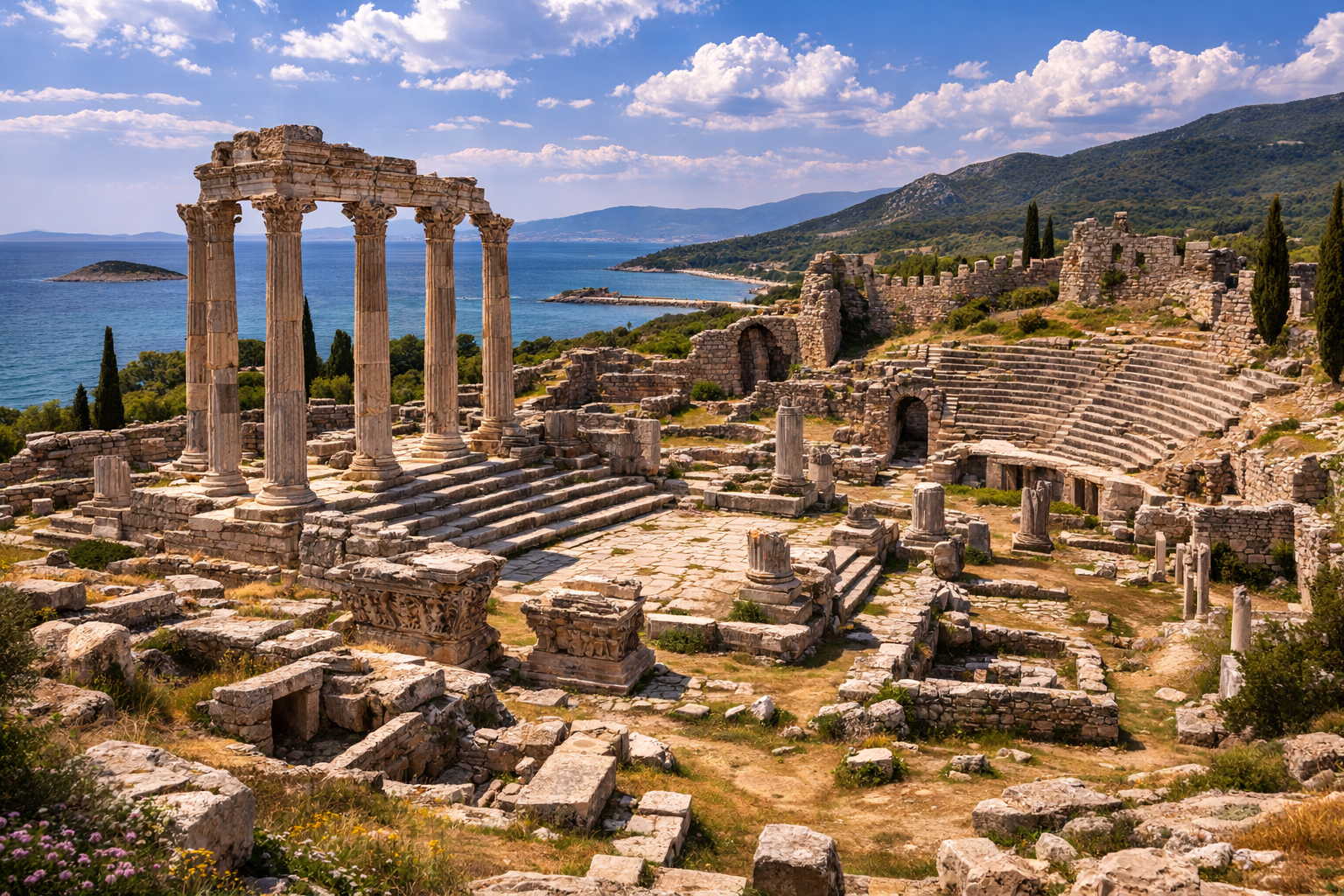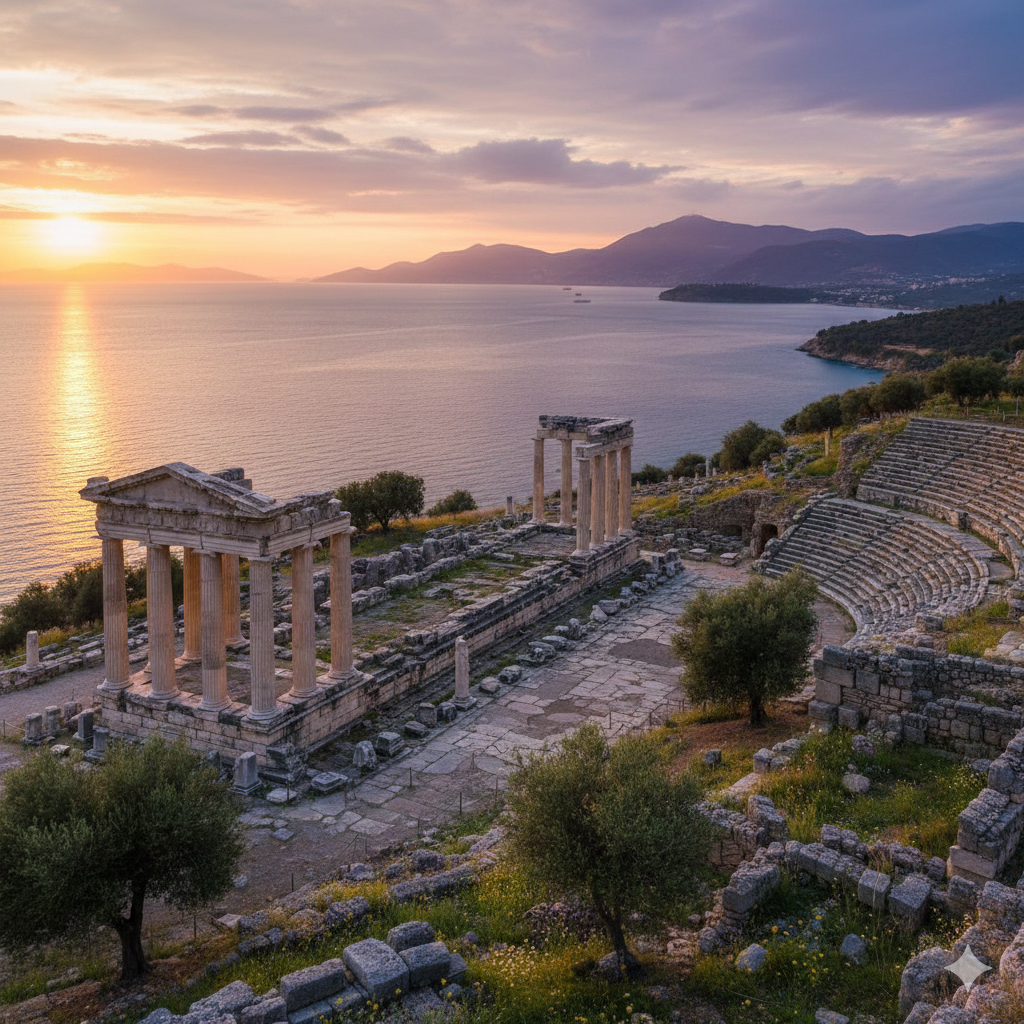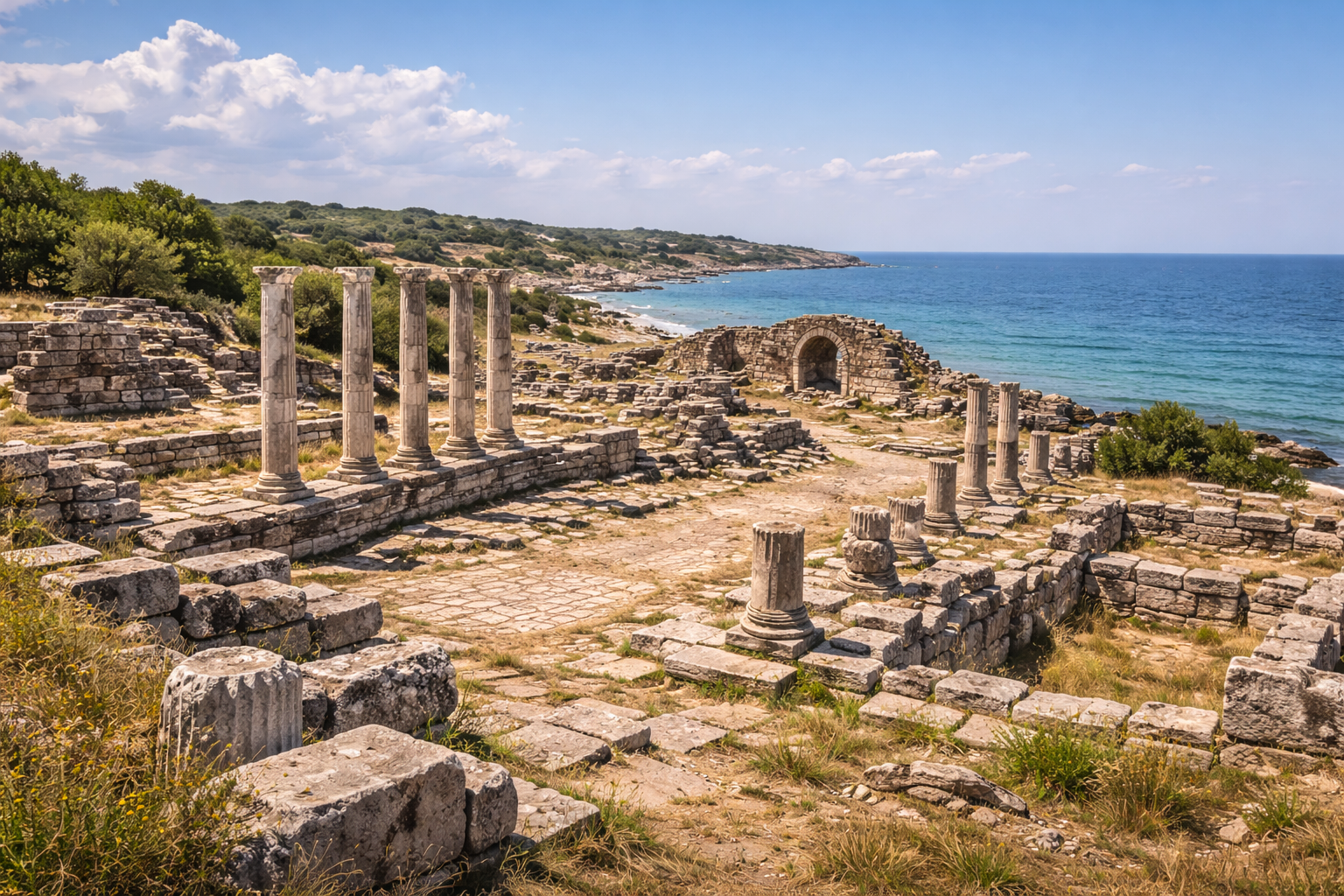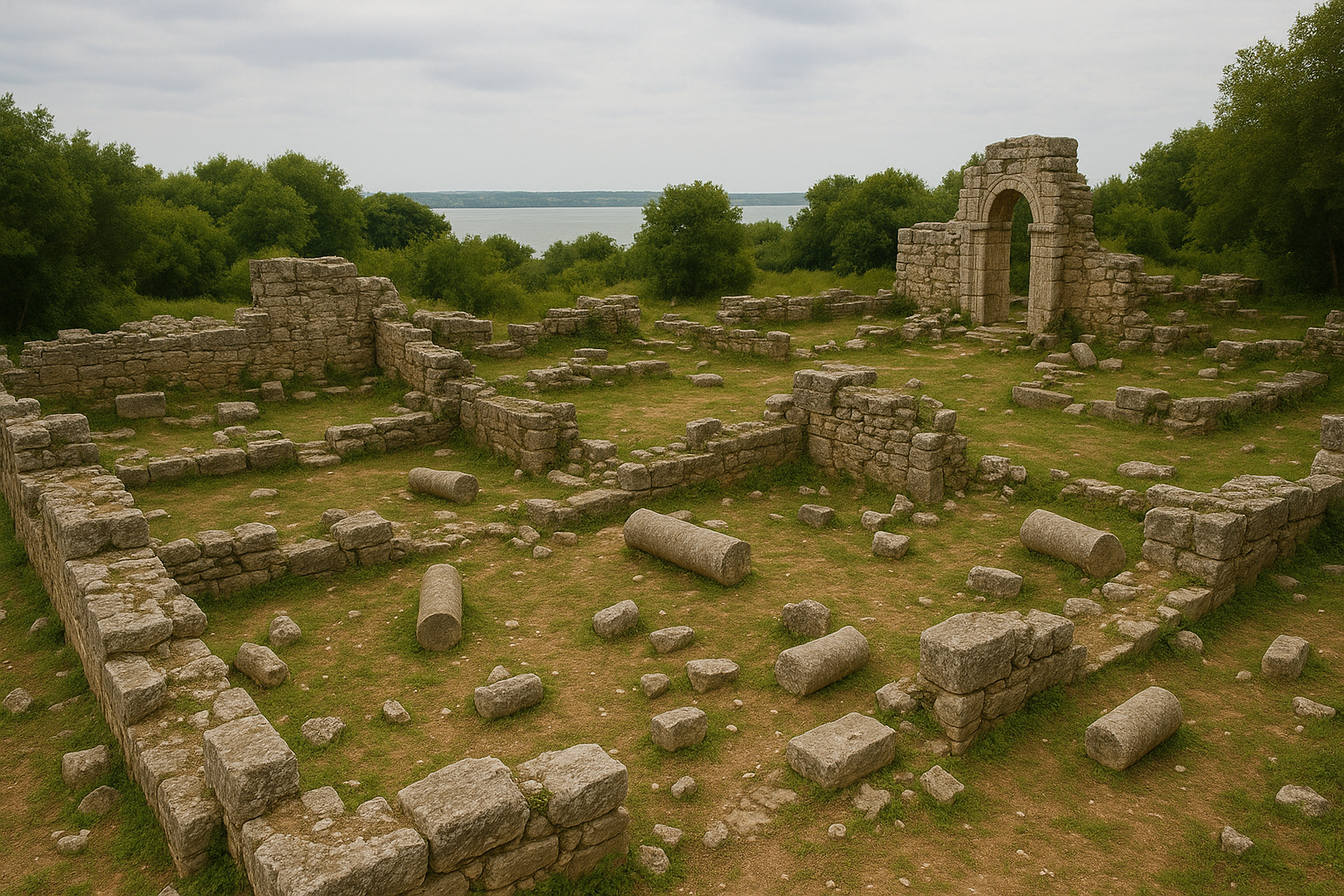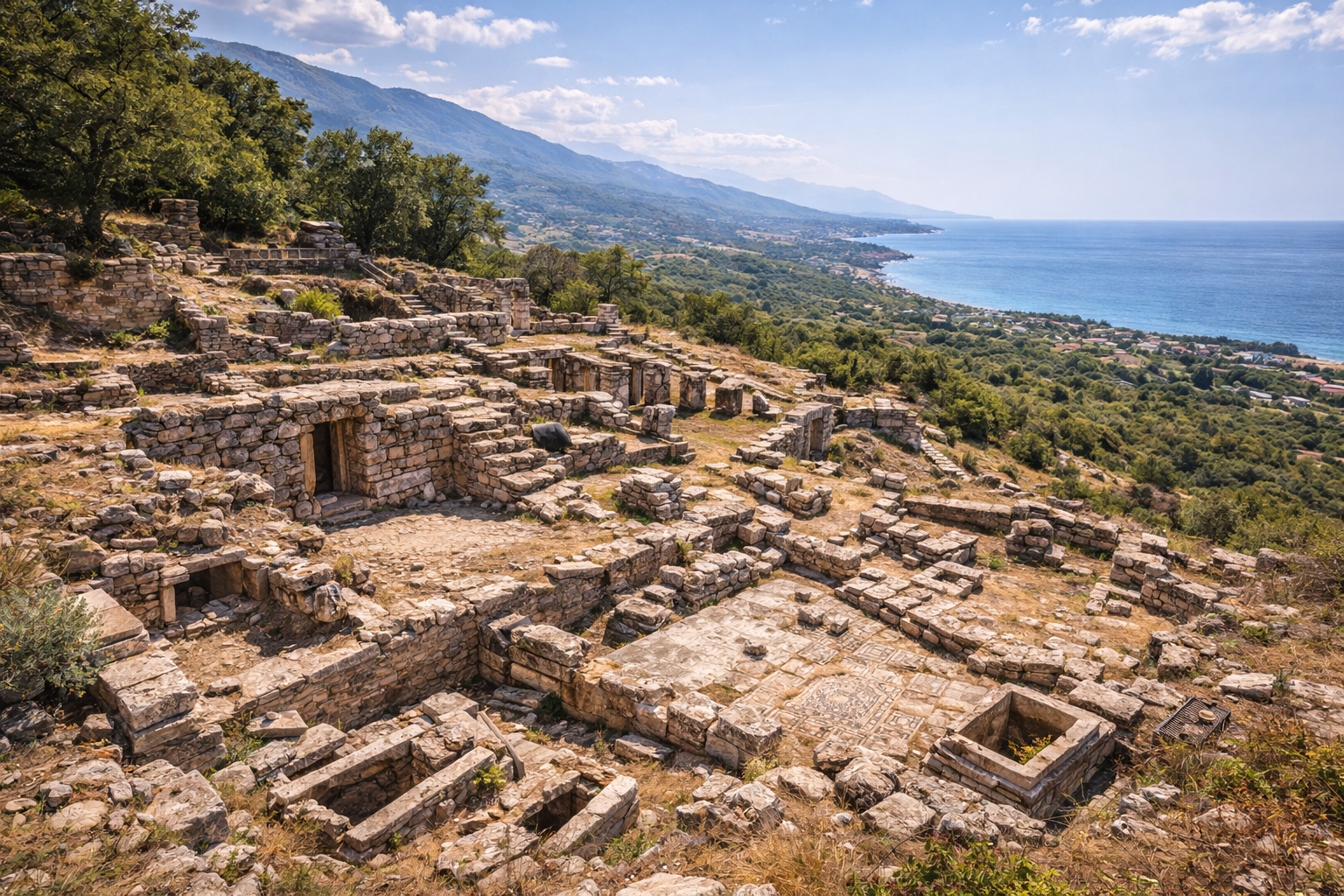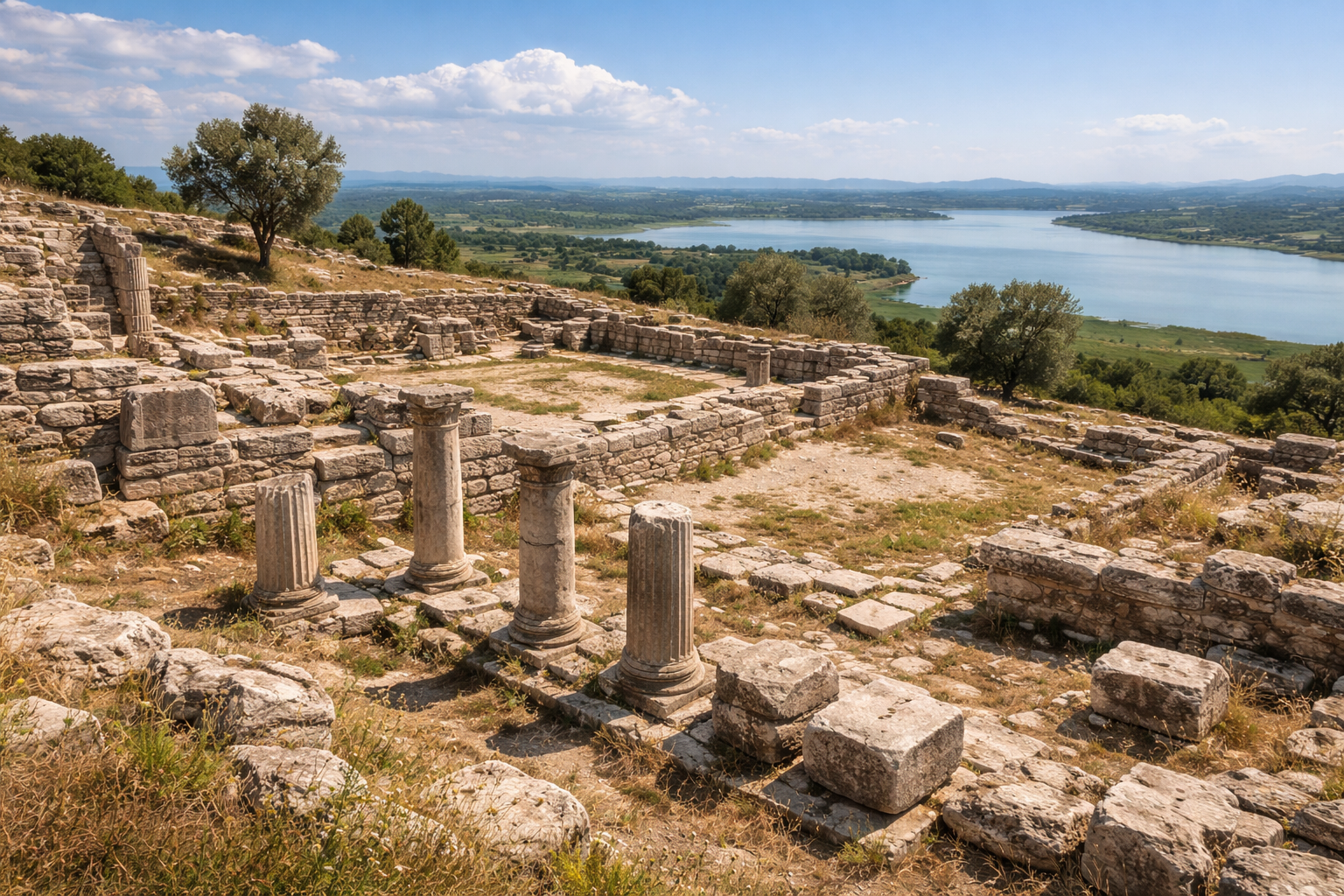
Vue d'ensemble approfondie : Miletus était la reine de la Ligue ionienne et, pour de nombreux auteurs anciens, tout simplement la perle de l'Ionie — une cité dont les réalisations intellectuelles, les ambitions politiques et la portée commerciale ont défini ce que signifiait être Grec en Asie. Aujourd'hui dressées au milieu de la plaine plate, bordée de roseaux, du bas Büyük Menderes (Méandre), près du village de Balat à Didim, dans la province d'Aydın, les ruines se trouvent à environ huit kilomètres du littoral moderne, échouées par le fleuve même dont les limons enrichirent jadis puis finirent par étouffer les quatre célèbres ports de la cité. Pourtant, au VIe siècle av. J.-C., c'était le lieu le plus cosmopolite de l'Égée : les navires s'amarraient au port aux Lions à côté des filets de pêcheurs, les marchands pesaient le grain de la mer Noire contre le lin d'Égypte, et trois hommes — Thalès, Anaximandre et Anaximène — inventaient discrètement l'habitude d'expliquer le monde sans dieux. Leur École milésienne est la graine d'où la philosophie naturelle et, à terme, la science moderne ont germé. Miletus donna également à la Grèce son premier urbaniste, Hippodamos, dont le plan en damier fut imposé à la cité reconstruite après la catastrophe de 494 av. J.-C., et de là gagna le Pirée, Rhodes et au-delà. De la Voie sacrée vers Didymes, où le grand oracle d'Apollon répondait aux questions des rois, au théâtre romain qui accueille encore 15 000 fantômes et au Bouleutérion où les citoyens délibéraient, Miletus offre l'une des concentrations les plus denses d'antiquité monumentale en Turquie — une cité d'idées autant que de pierres.
Table des matières
- Pourquoi Miletus compte
- Géographie et cadre
- Chronologie historique
- Monuments majeurs
- L'École milésienne et la philosophie
- Hippodamos et le plan en damier
- Le mouvement de colonisation
- Le lien avec l'Apollon de Didymes
- Les adieux de saint Paul
- Travaux archéologiques
- Chiffres et mesures
- Informations pratiques
- Questions fréquemment posées
- Sources et lectures complémentaires
Pourquoi Miletus compte
-
Berceau de la philosophie naturelle. Entre environ 600 et 525 av. J.-C., trois penseurs milésiens — Thalès, Anaximandre et Anaximène — soutinrent tour à tour que le cosmos était fait d'eau, d'une matière indéterminée qu'ils appelaient l'apeiron, et d'air, le tout transformé par des processus naturels intelligibles. Ce fut la première tentative soutenue, dans n'importe quelle culture lettrée, de remplacer la causalité mythologique par l'explication rationnelle, et c'est la raison pour laquelle philosophes et scientifiques font remonter leur propre généalogie à cette unique petite cité aux confins du Méandre.
-
Le premier urbaniste. Hippodamos de Milet codifia le plan orthogonal de la cité lors de la reconstruction qui suivit la destruction perse de 494 av. J.-C. Son damier — des rues droites se croisant à angle droit, des quartiers distincts pour la vie sacrée, civique et résidentielle — devint la forme urbaine grecque par défaut, fut transporté au Pirée et à Rhodes, et sous-tend en définitive la logique de planification des coloniae romaines et des cités modernes en damier.
-
La plus grande métropole coloniale du monde grec. Les écrivains anciens créditèrent Miletus de la fondation de plus de quatre-vingt-dix colonies autour de l'Égée, de la Propontide et surtout de la mer Noire — Sinope, Trapezus, Olbia, Tomis, Istros — ainsi qu'à Naucratis en Égypte. Aucune autre cité grecque ne projeta sa langue, sa religion et son commerce sur un arc aussi immense.
-
Un laboratoire d'architecture monumentale. Du Bouleutérion hellénistique, l'une des salles de conseil antiques les mieux conservées au monde, au théâtre romain, en passant par les Thermes de Faustine et la célèbre Porte du Marché (aujourd'hui remontée dans le Pergamonmuseum de Berlin), Miletus offre un catalogue presque complet des types de bâtiments publics grecs et romains.
-
Une scène politique décisive. Miletus mena la Révolte ionienne contre la Perse (499–494 av. J.-C.), subit un sac catastrophique après la bataille navale de Ladé, et fut plus tard libérée par Alexandre en 334 av. J.-C. Le destin de la cité fit à plusieurs reprises tourner la roue de l'histoire égéenne.
-
Là où la géographie défit une grande cité. Peu de sites enseignent avec une telle vivacité que les paysages ne sont pas permanents. Les sédiments incessants du Méandre transformèrent le golfe Latmique ouvert en terres agricoles, étouffèrent les ports et réduisirent l'un des ports les plus actifs de l'Antiquité à une ruine continentale dans une plaine marécageuse — un cas d'étude saisissant pour qui s'intéresse à l'histoire environnementale.
-
Un paysage spirituel. Reliée par la Voie sacrée à l'oracle de Didymes, mentionnée dans les Actes des Apôtres comme le lieu où saint Paul fit ses adieux aux anciens d'Éphèse, et couronnée au début du XVe siècle par la mosquée d'İlyas Bey, Miletus porte une mémoire religieuse continue à travers près de trois millénaires.
-
Une bibliothèque épigraphique de pierre. Avec plus de 1 500 inscriptions publiées — décrets civiques, traités, réponses oraculaires, affranchissements d'esclaves, attributions de sièges au théâtre — Miletus est l'une des cités les mieux documentées du monde grec antique. La fameuse inscription « place des Juifs » sur un siège du théâtre n'est qu'une des traces à échelle humaine de la vie quotidienne qui émergent de ces pierres.
-
Une longue postérité. Contrairement à de nombreuses cités antiques qui s'éteignirent avec l'effondrement romain ou byzantin, Miletus continua — à travers les siècles seldjoukides, menteshides et ottomans — comme la petite ville portuaire de Palatia / Balat. Les visiteurs parcourent donc une biographie urbaine continue, depuis les niveaux de l'âge du bronze d'influence minoenne jusqu'à une mosquée du XVe siècle, sur la même colline.
-
Un atelier pour la science moderne. Le lien qui va de la prédiction d'éclipse de Thalès aux lois de Newton, de l'apeiron d'Anaximandre à la théorie moderne des champs, et de l'air d'Anaximène à la théorie cinétique des gaz, n'est pas une métaphore mais une filiation historique. Miletus appartient autant à l'histoire des sciences qu'à celle de l'art et de l'architecture.
-
Un site magnifiquement vide. Contrairement à Éphèse ou à Pergame, Miletus est rarement bondé. Les visiteurs peuvent flâner au Bouleutérion, aux Thermes de Faustine et au grand théâtre dans une quasi-solitude — une expérience qui décuple la puissance imaginative des ruines.
Géographie et cadre
Le delta du Méandre
Miletus se trouve au bord méridional de ce qui fut autrefois le golfe Latmique, un profond bras de mer qui, à l'âge du bronze, s'enfonçait à plus de trente kilomètres à l'est du littoral actuel. Dans ce golfe, le fleuve Büyük Menderes (Méandre) déversait son énorme charge sédimentaire, arrachée à l'intérieur tendre et rapidement érodé de l'Anatolie occidentale. Au cours de trois millénaires, ces sédiments ont comblé le golfe, fait avancer la côte vers l'ouest, rattaché d'anciennes îles au continent et laissé Miletus échouée à environ huit kilomètres dans les terres. Le mot français méandre, utilisé pour toute courbe sinueuse d'un cours d'eau, vient directement du tracé en boucles de ce fleuve, tel que le décrivirent les observateurs anciens.
Quatre ports antiques
À son apogée, Miletus s'élevait sur une crête péninsulaire presque entièrement entourée d'eaux abritées. Géographes anciens et archéologie moderne identifient ensemble quatre bassins portuaires naturels :
- Le port aux Lions (Löwenhafen), principal port militaire et cérémoniel au nord, dont l'entrée était flanquée de deux lions de marbre qui ont donné son nom au bassin et qui subsistent, érodés, en bordure du marais actuel.
- Le port du Théâtre au nord-ouest, immédiatement sous le grand théâtre.
- Une baie orientale utilisée comme port commercial secondaire.
- Une baie méridionale, la plus calme et la mieux protégée, utilisée en partie pour la construction navale.
Cette abondance inhabituelle de mouillages — combinée à la proximité immédiate de l'eau douce du Méandre — explique comment Miletus put combiner puissance navale, commerce à longue distance et construction navale plus efficacement qu'aucune cité ionienne rivale.
Croissance du delta et lac Bafa
L'étouffement progressif du golfe peut être reconstitué à partir de carottages, de tessons et de la position de jetées immergées. À l'époque archaïque, les ports étaient pleinement ouverts sur la mer ; à l'époque romaine, brise-lames et dragages étaient déjà nécessaires ; au cours des siècles byzantins tardifs, la cité n'avait plus de port utilisable. Plus à l'est, ce qui avait été le fond du golfe Latmique se trouva isolé sous forme d'un lac — l'actuel et magnifique lac Bafa (Bafa Gölü), encore légèrement saumâtre, bordé des ruines antiques d'Héracleia du Latmos et désormais parc naturel.
Le village de Balat et la plaine de Söke
Le hameau moderne de Balat se dresse en lisière des ruines. Son nom conserve le byzantin Palatia (« les palais »), désignant les bâtiments antiques en ruine encore debout lorsque les colons hellénophones donnèrent au lieu son nom médiéval. Autour du village s'étend la plaine de Söke, vaste paysage de coton, de maïs et de céréales qui est l'un des districts agricoles les plus productifs de Turquie — sa fertilité est l'héritage direct du fleuve qui détruisit les ports.
Climat
Le climat est typiquement méditerranéen oriental : étés chauds et secs avec des températures diurnes dépassant souvent 35 °C, et hivers doux et humides autour de 10–15 °C. Le printemps (avril–mai) apporte les fleurs sauvages à travers la plaine et constitue la plus belle saison. L'automne (septembre–octobre) est tout aussi agréable. Les après-midi d'été peuvent être éprouvants sur les ruines exposées, et le marais environnant produit des moustiques de fin juin à septembre.
Faune et avifaune
Les zones humides autour de Miletus et du lac Bafa forment un corridor biologique continu d'importance européenne. Des cigognes nichent sur des poteaux électriques désaffectés dans le village de Balat ; au printemps et à l'automne, la plaine est traversée par des rapaces migrateurs, notamment busards des roseaux, faucons crécerellettes et circaètes Jean-le-Blanc. Le lac Bafa lui-même accueille des pélicans, des cormorans pygmées et d'importantes populations hivernales de sauvagine. Le delta du Méandre, à l'ouest du site, a été désigné comme réserve naturelle et zone humide inscrite à la convention de Ramsar, et cette proximité confère à Miletus une ambiance sonore — grenouilles, rousserolles, martins-pêcheurs lointains — bien différente de celle de sites classiques plus secs.
Sols, agriculture et économie moderne
Les sols alluviaux profonds de la plaine de Söke, irrigués par le Méandre et ses affluents, soutiennent l'un des districts les plus productifs de Turquie en matière de coton, de maïs et d'agrumes. Le village de Balat et ses voisins vivent principalement de cette agriculture, complétée par les oliveraies des collines environnantes et par le tourisme autour de Didymes et d'Altınkum.
Chronologie historique
Âge du bronze — Minoens, Mycéniens et Millawanda
Les fouilles sur la colline du temple ont livré des peintures murales, de la poterie et une architecture de style minoen datant du début du IIe millénaire av. J.-C. — preuves extraordinaires que l'influence crétoise atteignait la côte anatolienne.
À l'âge du bronze récent, ces témoignages furent suivis par du matériel clairement mycénien :
- De la poterie mycénienne importée en grandes quantités.
- Une muraille de fortification de style mycénien entourant l'établissement.
- Des tombes à chambre de forme mycénienne.
- Une production locale de céramique imitant les formes mycéniennes — preuve d'une communauté hellénophone installée, et non simplement de marchands de passage.
La correspondance royale hittite mentionne à plusieurs reprises une cité côtière appelée Millawanda (ou Milawata), presque certainement Miletus, comme un port tantôt vassal, tantôt rebelle, pris entre les rois hittites d'Anatolie centrale et les Ahhiyawa — généralement identifiés au monde grec mycénien.
Miletus était donc déjà une cité internationale avant la guerre de Troie — un territoire frontalier disputé où les civilisations anatolienne et égéenne se rencontraient, commerçaient et parfois s'affrontaient.
Peuplement carien et colonisation ionienne
Après l'effondrement des systèmes palatiaux de l'âge du bronze, le site semble avoir été occupé par des populations indigènes cariennes. La tradition grecque attribue ensuite la colonisation ionienne de Miletus à environ 1100 av. J.-C., sous un chef légendaire nommé Nélée, fils du roi athénien Codros. Les nouveaux colons ioniens absorbèrent les Cariens locaux et s'unirent à eux par mariage — Hérodote remarque fameusement que les hommes milésiens de son époque avaient des grands-mères cariennes — produisant une population hybride qui allait bientôt devenir l'un des groupes ethniques dominants d'Asie Mineure.
Ce caractère hybride aide à expliquer l'ouverture culturelle ultérieure de la cité. Miletus était simultanément grecque et anatolienne, regardant vers l'est en direction de la Carie et de la Lydie, et vers l'ouest, à travers l'Égée, en direction d'Athènes, d'Égine et de Corinthe. L'aristocratie carienne apporta noms, dieux et traditions artisanales à la nouvelle communauté politique, et il en résulta une culture suffisamment confiante pour aborder les étrangers selon ses propres termes — une condition préalable tant au mouvement colonial qu'à la révolution philosophique qui suivit.
Âge d'or archaïque (VIIe–VIe s. av. J.-C.)
Au VIIe siècle, Miletus était la cité directrice de la Ligue ionienne et une puissance maritime sans égale en mer Égée orientale. Ses navires dominaient le commerce du grain en mer Noire et ses marchands négociaient des conditions favorables avec les rois d'Égypte.
Le catalogue des fondations milésiennes — conservé en partie chez Pline l'Ancien et en partie dans des inscriptions éparses — comprend plus de quatre-vingt-dix colonies s'étendant sur :
- Sinope et Trapezus sur la côte sud de la mer Noire.
- Olbia sur l'estuaire du Boug, le grand port céréalier de la steppe.
- Istros et Tomis sur la côte ouest pontique.
- Apollonia du Pont (l'actuelle Sozopol) et Odessos sur la côte bulgare.
- Le comptoir commercial conjoint de Naucratis dans le delta du Nil en Égypte.
- Des dizaines d'établissements secondaires autour de la Propontide (mer de Marmara).
Chaque nouvelle fondation étendait le dialecte milésien, ses cultes — en particulier ceux d'Apollon Delphinios et de l'Apollon de Didymes — et sa portée commerciale. Au début du VIe siècle av. J.-C., Miletus était devenue non seulement une cité, mais le centre d'un empire commercial informel couvrant la Méditerranée et la mer Noire.
L'École milésienne
C'est dans ce même âge d'or que se déploie la révolution intellectuelle de la cité. Thalès (env. 624–546 av. J.-C.), compté plus tard par les Grecs parmi les Sept Sages, soutenait que la réalité ultime du cosmos est l'eau — peut-être parce que tous les êtres vivants connus en ont besoin, peut-être parce que la terre semble flotter sur l'eau, prédit (ou se vit attribuer la prédiction) l'éclipse solaire du 28 mai 585 av. J.-C., et utilisa le raisonnement géométrique pour mesurer hauteurs et distances — y compris, selon la légende, la hauteur des pyramides égyptiennes à partir de la longueur de leur ombre. Son élève Anaximandre (env. 610–546 av. J.-C.) proposa plutôt que la source de toutes choses était un apeiron indéfini et éternel (« l'illimité »), dessina ce que les auteurs ultérieurs décrivent comme la première carte grecque du monde, conçut la Terre comme un cylindre flottant librement, et imagina même que les êtres humains s'étaient développés à partir d'ancêtres semblables à des poissons — une intuition proto-évolutionniste extraordinaire. Anaximène (env. 586–526 av. J.-C.) revint à une substance tangible, l'air, qui par condensation devenait nuage, eau et terre, et par raréfaction devenait feu. Ensemble, ces trois penseurs inventèrent ce que nous appelons aujourd'hui la philosophie naturelle.
À leurs côtés œuvraient d'autres Milésiens qui ont façonné le monde intellectuel grec : Hécatée (env. 550–476 av. J.-C.), historien-géographe dont la Périégèse et les Généalogies préparèrent le terrain pour Hérodote, et Hippodamos, dont le plan en damier allait bientôt redessiner la cité elle-même.
Domination lydienne et perse (milieu du VIe siècle av. J.-C.)
Miletus négocia des traités avec les rois lydiens et jouit d'une relation privilégiée avec Crésus. Lorsque le Perse Cyrus le Grand conquit la Lydie en 546 av. J.-C., Miletus fut la seule parmi les cités ioniennes à être autorisée à conserver les conditions favorables qu'elle avait obtenues sous les Lydiens. La domination perse fut d'abord légère.
La cité continua à frapper de l'argent, à envoyer des offrandes à Didymes, et à dépêcher des navires de commerce vers ses colonies pontiques. Mais sous Darius Ier, à la fin du VIe siècle, l'administration perse se durcit. Des tyrans locaux — hommes forts pro-perses — remplacèrent un gouvernement plus responsable, le tribut augmenta, et les cités d'Ionie commencèrent à s'irriter de ce qui ressemblait davantage à un joug impérial qu'à une suzeraineté lointaine.
La Révolte ionienne (499–494 av. J.-C.)
À la fin du VIe siècle, cependant, les tyrans soutenus par les Perses et la hausse du tribut provoquèrent la rébellion. En 499 av. J.-C., le tyran milésien Aristagoras rallia les cités ioniennes et persuada Athènes et Érétrie d'envoyer des navires.
Les forces grecques combinées marchèrent à l'intérieur des terres et incendièrent Sardes, la capitale satrapique, en 498 av. J.-C. — un acte qui servirait plus tard à justifier les invasions perses de la Grèce. La révolte se délita ensuite.
En 494 av. J.-C., une vaste flotte perse battit les Ioniens à la bataille de Ladé, livrée dans les eaux du golfe Latmique au large même de Miletus.
Les conséquences pour la cité furent catastrophiques :
- La ville fut prise d'assaut et ses murailles percées.
- La majeure partie de la population masculine fut tuée ou réduite en esclavage.
- Femmes et enfants furent déportés au plus profond de l'intérieur perse, près de Suse.
- Le grand sanctuaire de Didymes fut pillé, incendié, et son sacerdoce — les Branchides — emmené en Bactriane.
Le choc fut tel que, lorsque le dramaturge athénien Phrynichos mit en scène sa tragédie La Prise de Milet à Athènes peu après, le public pleura de manière incontrôlable et la cité infligea une lourde amende au dramaturge pour leur avoir rappelé le malheur de leurs proches. La pièce n'a pas survécu, mais l'anecdote (transmise par Hérodote) nous dit à quel point Athènes s'identifiait au sort de ses parents ioniens.
Repeuplement et reconstruction hippodamienne
Le site ne fut pas longtemps abandonné. Dès les années 470, une nouvelle population s'y était installée, et après les défaites perses de Salamine (480 av. J.-C.) et de Mycale (479 av. J.-C.), Miletus fut effectivement libérée et rejoignit la Ligue de Délos sous la direction athénienne.
La reconstruction de la cité, traditionnellement placée autour de 466 av. J.-C., donna à Hippodamos l'occasion d'appliquer son schéma urbain rationnel sur un site vierge. Le résultat fut l'exemple canonique de la planification grecque que les visiteurs parcourent encore aujourd'hui — et le modèle de centaines de fondations ultérieures à travers les mondes hellénistique et romain.
Durant la majeure partie du Ve siècle av. J.-C., Miletus fut un allié athénien — parfois inconfortable, se révoltant brièvement au début des années 440 — et contribua à la force financière et militaire de la Ligue de Délos. Ses philosophes, géographes et architectes continuèrent à circuler à travers Athènes et au-delà.
Période hellénistique
Alexandre le Grand assiégea et prit Miletus en 334 av. J.-C., mettant fin au contrôle perse. Le siège fut inhabituel : la flotte perse mouillait juste au large mais, faute d'eau et d'un port ami, ne put secourir la cité. Après une brève défense, les citoyens se rendirent, et Alexandre — qui admirait la culture grecque — épargna les habitants et rétablit le gouvernement démocratique.
Sous ses successeurs séleucides et lagides, la cité prospéra commercialement et culturellement :
- L'exquis Bouleutérion fut offert à la cité vers 175–164 av. J.-C. par le roi séleucide Antiochos IV Épiphane.
- Le sanctuaire d'Apollon à Didymes fut reconstruit à une échelle colossale.
- Une nouvelle génération de stoas, de gymnases et d'aménagements portuaires étendit le tissu urbain.
- Miletus frappa une abondante monnaie d'argent et signa des alliances avec les principales puissances hellénistiques, équilibrant ses fidélités entre Séleucides, Lagides et la puissance montante de Pergame.
Période romaine
À partir du legs du royaume de Pergame (133 av. J.-C.), Miletus fit partie de la province romaine d'Asie. La paix romaine donna à la cité son second grand âge architectural :
- Sous Auguste, les infrastructures civiques furent rénovées et les installations portuaires modernisées.
- Sous Trajan (98–117 apr. J.-C.), la Voie sacrée vers Didymes fut repavée et une porte monumentale cérémonielle érigée.
- Les Thermes de Capito furent construits au milieu du Ier siècle apr. J.-C. par le procurateur Cnaeus Vergilius Capito.
- Le théâtre fut agrandi en phases antoniniennes successives pour atteindre sa capacité colossale actuelle d'environ 15 000.
- Les Thermes de Faustine furent dédiés à l'épouse de Marc Aurèle dans les années 160 apr. J.-C.
- La Porte du Marché fut ajoutée vers 120–130 apr. J.-C. comme entrée d'apparat de l'Agora Nord.
Au haut Empire, la cité comptait une population de l'ordre de 50 000 à 100 000 habitants, soutenue par un aqueduc, quatre complexes thermaux, un stade, un théâtre de style amphithéâtre et deux énormes agoras.
Christianisme primitif et saint Paul
Selon Actes 20, 17–38, l'apôtre Paul, en route vers Jérusalem à la fin de son troisième voyage missionnaire (env. 57 apr. J.-C.), s'arrêta au port de Miletus et fit venir les anciens de l'Église d'Éphèse pour le rencontrer là.
Son discours d'adieu émouvant — culminant dans la parole « Il y a plus de bonheur à donner qu'à recevoir » — est l'un des passages les plus personnels du Nouveau Testament.
L'événement fit de Miletus un lieu permanent de mémoire chrétienne. Une communauté chrétienne y prospéra rapidement, et dès le IVe siècle la cité avait son propre évêque, participant aux grands conciles œcuméniques — y compris Éphèse (431) et Chalcédoine (451) — jusqu'au début de la période byzantine.
Évêché byzantin et déclin du port
Miletus devint un évêché, puis un archevêché, avec l'église Saint-Jean construite au milieu des ruines de l'agora hellénistique. La cavea du grand théâtre fut couronnée d'un château byzantin fortifié.
Mais l'avancée régulière du delta du Méandre étrangla les ports :
- Aux IVe et Ve siècles apr. J.-C., le port aux Lions nécessitait un approfondissement et un endiguement.
- Aux VIIe et VIIIe siècles, il était devenu une lagune saumâtre.
- Au haut Moyen Âge, aucun grand navire ne pouvait atteindre la cité.
- La population diminua, les bâtiments publics tombèrent en désuétude et beaucoup furent démantelés pour leur marbre.
Le rôle de la cité comme centre régional fut hérité par le port médiéval plus modeste de Palatia — et finalement, beaucoup plus tard, par les établissements côtiers ottomans de Kuşadası et Söke.
Seldjoukides, Menteshides et la mosquée d'İlyas Bey
Après que les principautés turques seldjoukides puis Menteshides eurent pris le contrôle de la région à la fin du XIIIe siècle, la cité diminuée — désormais le plus souvent appelée Palatia / Balat — devint un modeste port local et un emporium au service des marchands vénitiens et génois. En 1404, le souverain Menteshide İlyas Bey fit bâtir sa magnifique mosquée en bordure des ruines antiques, recyclant du marbre antique pour son portail finement sculpté. Avec la conquête ottomane et l'ensablement final du port, l'établissement se réduisit progressivement au petit village qui subsiste aujourd'hui.
Ensablement du port et abandon
Le processus lent qui condamna Miletus en tant que port fut presque géologique dans son ampleur. Au IIe siècle apr. J.-C., le port aux Lions était déjà suffisamment peu profond pour que les ingénieurs romains aient dû l'approfondir et l'endiguer ; aux IVe et Ve siècles, les baies orientales étaient marécageuses. Les sources byzantines tardives décrivent une chaîne de lagunes plutôt qu'une mer ouverte. Lorsque les autorités menteshides et ottomanes prirent le relais, Balat / Palatia était un petit port intérieur accessible seulement par des embarcations à faible tirant d'eau se faufilant dans les chenaux du bas Méandre. Quand ces chenaux mêmes se fermèrent, vers les XVIIe et XVIIIe siècles, le rôle de port régional passa de manière décisive à la côte ouverte de Kuşadası et à l'établissement en développement de Söke, et Miletus abandonna enfin son identité bimillénaire de cité maritime.
Monuments majeurs
Le théâtre romain
La survivance la plus spectaculaire à Miletus est le théâtre romain, construit à l'origine au IVe siècle av. J.-C. et agrandi successivement aux époques hellénistique et romaine jusqu'à atteindre, sous les Antonins, une capacité d'environ 15 000 spectateurs. Son diamètre est d'environ 140 m.
Éléments clés à remarquer lors d'une visite :
- La cavea est divisée en trois gradins horizontaux par deux passages (diazomata).
- Les premiers rangs conservent un siège en marbre réservé aux dignitaires civiques.
- Un banc à l'inscription célèbre porte « place des Juifs » (topos Ioudaion), l'un des témoignages les plus cités de la présence de communautés juives en Asie Mineure romaine.
- Deux grands tunnels d'accès voûtés — vomitoria — permettent encore aux visiteurs d'entrer dans les gradins par le dessous, comme le faisait le public antique.
- L'orchestre et les gradins inférieurs furent modifiés à l'Antiquité tardive, lorsqu'une loge impériale (pulvinar) et une barrière de protection furent ajoutées pour que des spectacles de gladiateurs et d'animaux sauvages puissent y être donnés.
- Après la christianisation, la partie supérieure de la cavea fut remodelée en l'imposant château byzantin dont les tours carrées couronnent encore la colline et servent de repère visible à travers la plaine.
La vue depuis les rangs supérieurs, embrassant la plaine ensablée où les navires amarraient jadis, est l'une des plus mémorables de l'archéologie égéenne.
Le Bouleutérion
Construit entre environ 175 et 164 av. J.-C. comme don à Miletus du roi séleucide Antiochos IV Épiphane, le Bouleutérion est l'un des bâtiments de conseil antiques les mieux conservés du monde grec.
Le complexe se compose de trois parties disposées selon une stricte séquence axiale :
- Un propylée corinthien monumental faisant face à la rue civique principale.
- Une cour à colonnades avec un autel central dédié à Apollon, Hestia et au Démos de Miletus.
- La salle du conseil elle-même, un auditorium couvert avec des gradins en demi-cercle pour environ 1 500 conseillers.
Des études acoustiques et de lignes de vue ont montré que la courbure des gradins était soigneusement calculée pour que chaque membre puisse entendre l'orateur depuis la tribune centrale. La combinaison d'une entrée axiale, d'une cour cérémonielle et d'une salle acoustiquement réfléchie devint un modèle copié dans tout l'Orient hellénistique — et est parfois invoquée comme un lointain ancêtre de la chambre parlementaire moderne.
Les Thermes de Faustine
Dédiés au milieu du IIe siècle apr. J.-C. en l'honneur de Faustine la Jeune, épouse de l'empereur Marc Aurèle, cet immense complexe thermal impérial occupe environ 5 000 mètres carrés à l'extrémité sud-ouest de la cité. Son plan se décale délibérément du quadrillage hippodamien — signe qu'il fut inséré comme une libéralité impériale autonome.
Les principales salles conservées au sol comprennent :
- L'apodyterium (vestiaire), avec des niches pour les vêtements.
- Le frigidarium, avec son grand bassin d'eau froide.
- Le tepidarium, espace tiède de transition.
- Le caldarium, le bain chaud, avec ses canaux de chauffage par le sol (hypocauste) encore visibles.
- La palaestra, cour d'exercice entourée de colonnades.
La sculpture la plus célèbre découverte ici est une personnification de marbre allongée du dieu fleuve Méandre, aujourd'hui exposée au musée de Miletus à Didim, aux côtés de petites statues d'un lion et d'une Muse qui décoraient le bassin froid. Ensemble, elles suggèrent quelque chose de la splendeur de l'intérieur original, qui aurait combiné marbres colorés polis, stucs dorés et eau au doux écho.
La Porte du Marché (aujourd'hui à Berlin)
La Porte du Marché de Miletus (Markttor von Milet) à deux étages, d'environ 29 m de large et 17 m de haut, fut construite vers 120–130 apr. J.-C. comme entrée monumentale depuis la Voie sacrée vers l'Agora Nord romaine.
Sa conception combinait :
- Une élaborée colonnade corinthienne à l'ordre inférieur.
- Des colonnes composites à l'ordre supérieur.
- Trois ouvertures cintrées, la centrale plus haute et plus large que celles qui la flanquent.
- Un entablement richement sculpté avec reliefs figurés.
La porte fut fouillée par l'équipe de Theodor Wiegand en 1903, démontée et expédiée à Berlin, où elle fut minutieusement remontée dans le Pergamonmuseum — et où elle demeure l'une des pièces emblématiques du musée.
Aujourd'hui, seules les fondations de la porte subsistent sur le site, signalées par des panneaux d'interprétation pour les visiteurs souhaitant comprendre ce qui s'y dressait jadis.
Le Delphinion d'Apollon
Le Delphinion, dédié à Apollon Delphinios (« des dauphins »), était le centre cultuel fondateur de Miletus et le principal sanctuaire civique de la cité.
Situé près du port aux Lions, il consistait en une cour à colonnades ouverte avec un autel central plutôt qu'un temple au sens strict. La combinaison d'un emplacement portuaire, de l'iconographie du dauphin et de la centralité civique reflétait l'identité maritime profonde de la cité — Apollon Delphinios était le protecteur des marins, le patron des colonies et le parrain de la procession annuelle vers Didymes.
Le Delphinion était également les archives publiques de la cité. Des centaines de décrets, traités, affranchissements et honneurs y étaient inscrits sur des stèles et y étaient dressés, ce qui en fait l'un des sites épigraphiques les plus riches du monde grec. À partir de ces textes, les historiens modernes ont reconstitué avec un degré inhabituel de détail les institutions politiques, les relations étrangères et le calendrier religieux de la cité.
Le port aux Lions
Le port militaire et cérémoniel du nord était gardé à son étroite embouchure par deux lions de marbre surdimensionnés, posés sur des socles afin que les navires passent entre leurs regards vigilants. Les deux statues subsistent — battues, à demi enfouies dans le marais — et sont devenues un symbole durable de la cité.
D'ici partirent :
- Les expéditions colonisatrices de l'âge archaïque — vers la mer Noire, la Propontide et l'Égypte.
- Le contingent milésien pour la désastreuse bataille de Ladé en 494 av. J.-C.
- Selon la tradition, le navire de saint Paul en route vers Jérusalem (env. 57 apr. J.-C.).
Le bassin lui-même est aujourd'hui un marais bordé de roseaux, mais sa forme peut encore être lue sur le terrain et, depuis les sièges supérieurs du théâtre, son contour est sans équivoque.
Temple d'Athéna
Au sud-ouest du théâtre se dressait un Temple d'Athéna, dont la forme la plus ancienne remonte à la fin du VIe siècle av. J.-C. et qui fut reconstruit après la destruction perse.
Bien que seuls sa plate-forme et des blocs architecturaux dispersés restent visibles, la structure était :
- Le principal sanctuaire d'une divinité féminine de la cité.
- Construite dans l'ordre ionique.
- Étroitement associée à l'un des ports originels.
- Un point focal pour les rites civiques impliquant les jeunes femmes et la protection de la cité.
Ses marbres épars sont identifiables le long du versant sud, et les fouilles de Wiegand ont livré suffisamment de fragments pour permettre une reconstitution provisoire de l'élévation.
Hérôon
Un hérôon circulaire — un monument funéraire cultuel honorant un fondateur ou un bienfaiteur de la cité — subsiste dans l'aire urbaine centrale, avec une cour à péristyle enserrant une chambre funéraire à coupole.
Les hérôa commémoraient typiquement :
- Le fondateur mythique ou historique de la cité.
- Un riche bienfaiteur qui avait doté des bâtiments publics majeurs.
- Un souverain divinisé à l'époque hellénistique.
De tels bâtiments combinaient commémoration privée et rituel civique, et étaient une caractéristique de l'urbanisme hellénistique. L'intégration soignée de l'hérôon milésien dans le quadrillage orthogonal montre à quel point la cité avait pleinement absorbé le sens hippodamien de l'ordre.
Le Stade
Le Stade de Miletus, situé entre l'Agora Sud et les Thermes de Faustine, mesure environ 190 m de long et accueillait environ 15 000 spectateurs sur de longs gradins.
Il accueillait :
- Des festivals athlétiques locaux.
- Des jeux liés au culte d'Apollon et à la procession de la Voie sacrée.
- Des jeux provinciaux de la période romaine, dont des festivals du culte impérial.
La ligne de départ, avec ses rainures taillées pour les pieds des coureurs, est conservée à l'extrémité orientale.
Les Thermes de Capito
Un second grand thermes romain, les Thermes de Capito (également appelés Thermes de Cnaeus Vergilius Capito), fut construit au milieu du Ier siècle apr. J.-C. par un riche procurateur du même nom.
Ses voûtes survivantes en parement de briques révèlent la séquence thermale romaine standard — apodyterium, frigidarium, tepidarium, caldarium — et complètent le complexe beaucoup plus vaste de Faustine. Les Thermes de Capito furent construits comme un don privé par un unique donateur nommé, et furent donc inscrits avec son nom en grandes lettres sur la façade — un rappel public de qui avait payé l'eau chaude dont on profitait à l'intérieur.
Agoras romaines — Nord et Sud
Miletus possédait deux énormes places de marché de l'époque romaine.
- L'Agora Nord, la plus ancienne et la plus petite, se trouvait près du Bouleutérion et était le foyer des processions civiques et religieuses.
- L'Agora Sud, d'environ 164 × 196 m et l'une des plus vastes connues dans le monde hellénophone, était entourée de stoas doriques sur les quatre côtés, abritant boutiques, bureaux et entrepôts.
L'Agora Sud était le cœur commercial de la cité romaine — le lieu où le grain égyptien, le poisson pontique et les textiles asiatiques changeaient de mains. Tambours de colonnes et blocs de seuil survivants tracent encore son colossal périmètre au sol.
Château byzantin
La couronne de la colline du théâtre est le château byzantin, construit lorsque la cavea fut réaffectée en forteresse. Des tours carrées et des pans de courtines, bâtis largement avec des blocs antiques remployés, subsistent encore sur plusieurs mètres de hauteur.
Depuis ses murs, on pouvait surveiller la navigation égéenne et, à la période Menteshide, il servit de siège à l'administration locale avant que le complexe-mosquée d'İlyas Bey n'assume ce rôle.
Le château est l'un des éléments les plus photogéniques de Miletus — le fait même qu'une forteresse médiévale se dresse au sommet d'un théâtre romain dit en un instant au visiteur combien de vies cette cité a vécues.
Mosquée d'İlyas Bey (1404)
Située en bordure sud des ruines, la mosquée d'İlyas Bey est l'un des chefs-d'œuvre de la période des beyliks de l'architecture anatolienne.
Ses caractéristiques distinctives comprennent :
- Une grande coupole unique couvrant une salle de prière carrée — un emploi précoce et élégant de la forme.
- Un portail d'entrée finement sculpté en marbre, considéré comme l'un des plus beaux d'Anatolie.
- Un mihrab exceptionnel en marbre sculpté, avec des entrelacs géométriques et floraux.
- Un parvis attenant bordé d'arcades.
La mosquée fait partie d'un complexe (külliye) qui comprenait à l'origine une medrese (école théologique), un imaret (cuisine populaire) et un hammam, dont des fragments subsistent.
Sa restauration soigneuse en 2010–2012 lui valut le Prix Aga Khan d'architecture en 2013. Elle reste une mosquée en activité et un point focal pour les visiteurs — une conclusion appropriée pour un site qui débuta avec des murs peints minoens de l'âge du bronze.
Didymes — le Temple d'Apollon (17 km au sud)
Bien qu'administrativement distinct, le Temple d'Apollon à Didymes appartenait à Miletus et était le grand sanctuaire oraculaire de la cité. Relié par la Voie sacrée, il est traité ci-dessous dans sa propre section et devrait être vu conjointement à Miletus dans tout itinéraire sérieux.
Église Saint-Jean et quartier byzantin
Une petite mais substantielle église Saint-Jean fut érigée au début de la période byzantine sur une partie de l'ancienne agora hellénistique, avec des colonnes remployées de l'architecture civique environnante. Son plan — une basilique à trois nefs avec parvis — illustre comment la cité christianisée recolonisa discrètement le cœur urbain païen, réaffectant plutôt que démolissant. L'église servit l'évêché jusqu'à l'effondrement progressif de la vie urbaine au haut Moyen Âge.
Remparts ouest et nord de la cité
Les remparts visibles de Miletus sont en grande partie une construction hellénistique et du début de l'époque romaine, réparée à plusieurs reprises à l'Antiquité tardive et à l'époque byzantine. Ils enserrent une zone à peu près trapézoïdale sur la péninsule, avec des portes monumentales percées au sud (vers la Voie sacrée de Didymes) et à l'est. Plusieurs tours-portes subsistent sur une hauteur de plusieurs assises, et des sections de maçonnerie en pierre de taille bien équarrie préservent la construction hellénistique originale.
Nymphée
Un nymphée monumental (fontaine publique), construit au début du IIe siècle apr. J.-C. et rénové sous des empereurs successifs, terminait la conduite principale de l'aqueduc de la cité près du Bouleutérion. Sa façade en marbre à plusieurs étages — colonnes, niches pour statues, canaux d'eau en cascade — aurait été l'une des pièces maîtresses de la Miletus romaine. Aujourd'hui, seuls le podium inférieur et des fragments de marbre épars subsistent in situ, mais son plan peut encore être lu au sol.
Gymnase hellénistique
Au sud-ouest du Bouleutérion se dressait un gymnase hellénistique, complet avec palestre, salles d'eau et une série de longues colonnades utilisées pour l'enseignement et l'entraînement athlétique. Comme dans la plupart des cités grecques, le gymnase était autant une institution culturelle et civique qu'une installation athlétique, accueillant conférences, festivals et le programme de formation des éphèbes de la cité.
L'École milésienne et la philosophie
La chose la plus influente que Miletus ait jamais produite n'était pas un bâtiment, un port ou une colonie, mais une habitude de l'esprit — la détermination d'expliquer le monde naturel par référence uniquement à d'autres parties du monde naturel. Les trois figures principales de cette révolution sont conventionnellement appelées l'École milésienne, bien qu'elles n'aient constitué une école formelle en aucun sens institutionnel.
Thalès
Thalès de Milet (env. 624–546 av. J.-C.) est la figure sur laquelle Aristote drapa plus tard le titre de « premier philosophe ». Il soutenait que la réalité sous-jacente du cosmos est l'eau — peut-être parce que tous les êtres vivants connus en ont besoin, peut-être parce que la terre semble flotter sur l'eau.
La position elle-même importe moins que la méthode : au lieu de dire que le monde fut créé par les dieux, Thalès chercha une substance unique et un ensemble de transformations naturelles pour l'expliquer.
On lui attribue également :
- La prédiction de l'éclipse solaire du 28 mai 585 av. J.-C., qui interrompit une bataille entre Lydiens et Mèdes sur l'Halys.
- Le calcul de la hauteur des pyramides égyptiennes en mesurant la longueur de leurs ombres quand sa propre ombre égalait sa taille.
- L'estimation de la distance des navires en mer par un raisonnement trigonométrique simple.
- La formulation de premiers théorèmes géométriques — y compris ce que l'on appelle encore le théorème de Thalès, selon lequel tout triangle inscrit dans un demi-cercle dont le diamètre est l'un des côtés est un triangle rectangle.
Diogène Laërce et d'autres biographes tardifs racontent à son sujet des anecdotes divertissantes : qu'il tomba dans un puits en observant les étoiles ; qu'il prouva que les philosophes pouvaient être riches en s'accaparant le marché des pressoirs à olives une année prospère ; qu'il était l'un des Sept Sages de Grèce. Sous les anecdotes, l'accomplissement historique est réel et décisif — le remplacement délibéré du mythe par l'explication rationnelle.
Anaximandre
Anaximandre (env. 610–546 av. J.-C.), associé plus jeune de Thalès, trouva l'eau trop spécifique pour être l'origine de toutes choses. Il soutint au contraire que le premier principe est l'apeiron, substance indéfinie, éternelle et inengendrée dont émergent les contraires — chaud et froid, humide et sec.
Ses doctrines, préservées principalement dans des fragments cités par des auteurs ultérieurs, comprennent des intuitions remarquablement modernes :
- La Terre est un cylindre flottant librement, maintenu en place par une pression égale de tous les côtés — la première tentative de se passer de supports mythologiques pour la Terre.
- Les étoiles sont des roues de feu vues à travers des ouvertures dans des brumes cosmiques.
- Les êtres humains se sont développés à partir de créatures antérieures, semblables à des poissons, écloses dans l'humidité — un tableau frappant proto-évolutionniste plus de deux millénaires avant Darwin.
- L'univers subit de longs cycles de génération et de destruction, gouvernés par une légalité impersonnelle qu'il décrit en termes quasi judiciaires.
Les sources anciennes lui attribuent également d'avoir dessiné la première carte du monde habité, avec mers et continents disposés autour de la Méditerranée. La carte elle-même est perdue, mais l'ambition qui la sous-tendait — rendre la terre entière visible comme un unique objet d'inspection rationnelle — est préservée dans tout ce que la cartographie est depuis devenue.
Anaximène
Anaximène (env. 586–526 av. J.-C.), élève d'Anaximandre, chercha à rendre la substance sous-jacente à la fois assez indéfinie pour expliquer la pluralité et assez concrète pour être intelligible. Il choisit l'air.
Son schéma est élégant et mécaniste :
- Par condensation, l'air devient vent, puis nuage, puis eau, puis terre et pierre.
- Par raréfaction, il devient feu.
- Toute substance observable n'est donc que de l'air à un certain degré de compression.
De manière cruciale, cela lui donna un mécanisme pour la transformation — un processus physique — et non simplement une substance.
L'idée d'expliquer le changement qualitatif par la variation quantitative (plus ou moins d'une seule matière sous-jacente) préfigure à la fois l'atomisme grec et la théorie physique moderne. En particulier, le passage de « les choses diffèrent parce qu'elles sont faites de matières différentes » à « les choses diffèrent parce que la même matière est disposée différemment » est l'une des transitions conceptuelles les plus importantes de l'histoire des sciences, et elle fut faite pour la première fois à Miletus.
Ce que signifie vraiment « premiers philosophes »
Appeler les Milésiens « premiers philosophes » relève en partie de la convention. Les penseurs égyptiens, babyloniens et anatoliens avaient déjà cartographié les étoiles, calculé des calendriers et codifié la médecine.
Ce qui est nouveau à Miletus est la séparation délibérée de l'explication d'avec le récit divin :
- Le refus de dire « c'est Zeus qui l'a fait » et l'insistance sur une chaîne de causes qu'un être humain peut présenter à un autre.
- La disposition à argumenter, critiquer et réviser — Anaximandre critiquant Thalès, Anaximène critiquant Anaximandre.
- L'exigence implicite que l'univers soit intelligible par la raison humaine ordinaire, sans accès privilégié aux secrets divins.
De cette méthode sortirent, à terme, la médecine hippocratique de Cos, la géométrie d'Euclide, l'astronomie d'Hipparque, l'histoire naturelle d'Aristote et finalement les sciences expérimentales.
Quoi qu'ils aient fait d'autre, les trois hommes de Miletus inventèrent la critique — et ouvrirent ainsi une porte qui n'a depuis jamais été refermée.
Hécatée
Un quasi-contemporain, Hécatée (env. 550–476 av. J.-C.), appliqua une sensibilité critique similaire à l'histoire et à la géographie. Sa Périégèse recensait les terres et les peuples du monde connu ; ses Généalogies s'ouvrent fameusement par : « Hécatée le Milésien parle ainsi : j'écris ce qui me semble vrai ; car les récits des Grecs sont nombreux et, à mon avis, absurdes. » C'est la première déclaration explicite de méthode historique dans la littérature européenne.
Aspasie et la voix milésienne à Athènes
Bien qu'elle appartienne à l'histoire intellectuelle athénienne plutôt qu'à la philosophie milésienne proprement dite, la célèbre Aspasie (env. 470–400 av. J.-C.) — compagne de Périclès, amie de Socrate, maîtresse de rhétorique — est née à Miletus. Le Ménexène de Platon lui attribue la composition d'une oraison funèbre, et les sources anciennes la décrivent comme l'une des femmes les plus cultivées de son temps. Son origine milésienne reflète à quel point la cité s'était entièrement identifiée, à l'époque classique, à la culture intellectuelle.
Leucippe et la voie vers l'atomisme
Certaines sources anciennes attribuent l'origine de la théorie atomique — la doctrine selon laquelle toutes choses sont constituées de particules indivisibles (atoma) se déplaçant dans le vide — à Leucippe de Milet (Ve siècle av. J.-C.), dont l'élève Démocrite d'Abdère élabora ensuite le système dans sa forme classique. Si l'attribution est correcte, le courant intellectuel milésien apporta non seulement la première philosophie naturelle et la première géométrie, mais aussi la graine de l'atomisme, l'idée la plus durable de l'histoire des sciences physiques.
Isidore et Sainte-Sophie
Mille ans après Thalès, au VIe siècle apr. J.-C., le mathématicien et architecte milésien Isidore de Milet, aux côtés d'Anthémios de Tralles, conçut Sainte-Sophie de Constantinople pour l'empereur Justinien (532–537). La maîtrise de la géométrie par Isidore — la discipline que la tradition milésienne avait contribué à inventer — produisit le système de coupole sur pendentifs qui soutient la vaste coupole centrale du bâtiment. La très longue arche qui va de Thalès à Isidore démontre comment la réputation de la cité pour la pensée mathématique survécut même à l'ensablement de ses ports.
Hippodamos et le plan en damier
Si les philosophes milésiens donnèrent à la Grèce sa première image rationnelle du cosmos, Hippodamos de Milet lui donna la première image rationnelle de la cité.
Père de l'urbanisme
Aristote, dans sa Politique, décrit Hippodamos comme le premier homme qui, « sans être homme d'État, tenta de parler de la meilleure constitution » — un théoricien qui traitait la polis comme un objet conçu.
Il soutenait qu'une cité bien ordonnée devait avoir :
- Trois classes de citoyens — artisans, agriculteurs et soldats.
- Trois catégories de terres — sacrées, publiques et privées.
- Trois catégories de lois — couvrant l'insulte, la blessure et l'homicide.
Si schématiques que puissent paraître ces triades, la tentative de planifier la vie civique par des catégories délibérées était sans précédent. Aristote critique certaines des propositions d'Hippodamos, mais le fait même que ces propositions aient existé — que quelqu'un ait tenté d'écrire une théorie complète de la cité — était en soi un jalon intellectuel.
Le damier
La contribution la plus durable d'Hippodamos, cependant, était spatiale. Il systématisa le damier orthogonal : de longues rues droites se croisant à angle droit, avec des insulae (îlots) régulières et des quartiers dédiés à des fonctions sacrées, civiques et commerciales. Le plan n'était pas inconnu avant lui — les colonies grecques antérieures employaient parfois des dispositions rectangulaires — mais Hippodamos en fit une philosophie de conception cohérente.
Miletus reconstruite, vers 466 av. J.-C.
La reconstruction de Miletus dans le second quart du Ve siècle av. J.-C., après la destruction perse, fournit le laboratoire parfait. La nouvelle cité fut tracée sur deux quadrillages imbriqués, l'un pour la crête péninsulaire nord et l'autre pour la sud, avec une grande zone civique ouverte — le futur emplacement des agoras, du bouleutérion et des stoas — dans le détroit entre les deux. Les ports, le Delphinion et le théâtre furent soigneusement intégrés au schéma géométrique.
Pirée, Rhodes et au-delà
Selon Aristote, Hippodamos fut plus tard commissionné par Périclès pour tracer le nouveau port militaire d'Athènes au Pirée au milieu du Ve siècle av. J.-C.
La tradition lui attribue également des rôles dans :
- La fondation de Thourioi en Italie du Sud (444 av. J.-C.).
- La planification de la grande cité de Rhodes lors de son synœcisme en 408 av. J.-C.
Le damier hippodamien devint alors la forme urbaine par défaut des fondations hellénistiques — Priène, Alexandrie, Antioche, Séleucie du Tigre — et fut absorbé dans la pratique urbaine romaine sous la forme du cardo et du decumanus. La portée de l'idée de l'urbaniste milésien fut, en ce sens, aussi grande que celle des colonies milésiennes elles-mêmes.
Héritage moderne
Des coloniae romaines et des bastides médiévales jusqu'à Manhattan, à l'Eixample de Barcelone et aux quadrillages planifiés d'innombrables cités modernes, la ressemblance familiale est sans équivoque. Quand les New-Yorkais descendent une avenue numérotée, ils marchent, en un sens, dans une rue d'abord imaginée à Miletus au Ve siècle av. J.-C.
Comment lire le damier sur le terrain
Bien que les monuments encore debout à Miletus attirent l'œil, le plan hippodamien lui-même se savoure mieux en marchant. Du Bouleutérion vers le nord, le visiteur suit la ligne d'une rue antique qui court parfaitement droit jusqu'au bord du port ; des rues perpendiculaires de largeur égale se ramifient à intervalles réguliers. Une fois que l'on a remarqué le motif, il devient impossible de ne pas le voir : la cité est un damier, même là où ne subsistent que les fondations. C'est l'expression physique originelle d'une idée maintenant si omniprésente que nous ne réalisons plus qu'elle fut un jour une innovation saisissante.
Le mouvement de colonisation
L'autre grand produit d'exportation milésien de l'âge archaïque fut la cité elle-même, multipliée à travers les mers sous forme de colonies (apoikiai) et de comptoirs commerciaux (emporia).
Plus de quatre-vingt-dix fondations
Les sources anciennes — Pline l'Ancien le plus célèbrement — créditent Miletus d'avoir fondé plus de quatre-vingt-dix colonies. Le chiffre ne doit pas être pris trop littéralement ; certaines fondations « milésiennes » étaient des efforts conjoints, et certaines revendications étaient probablement des inventions plus tardives. Cela étant, aucune autre cité grecque n'en approche.
Le réseau de la mer Noire
La spécialité de Miletus était la mer Noire (Pont-Euxin). À partir de la fin du VIIe siècle av. J.-C., ses colons fondèrent :
- Sinope (l'actuelle Sinop), grand emporium pontique sur la côte sud.
- Trapezus (l'actuelle Trabzon), porte d'entrée des ressources métallurgiques du Caucase.
- Olbia à l'embouchure du Boug et du Dniepr, ouvrant le commerce du grain de la steppe.
- Tomis (l'actuelle Constanța) et Istros sur la côte ouest pontique.
- Pantikapaion (l'actuelle Kertch), commandant l'entrée de la mer d'Azov.
- Apollonia du Pont (l'actuelle Sozopol) et Odessos (l'actuelle Varna) sur la côte bulgare.
À travers ce réseau, Miletus contrôla, ou du moins taxa, la majeure partie du commerce de grain, poisson salé, peaux, bois et esclaves qui s'écoulait des steppes de la Russie et de l'Ukraine méridionales vers l'Égée.
Beaucoup de ces fondations conservèrent leur dialecte et leurs cultes milésiens pendant des siècles ; certaines — Sinope, Olbia, Pantikapaion — devinrent à leur tour de riches cités, avec leurs propres colonies. L'Apollon milésien, sa lyre et son laurier, fut emporté avec les colons, et Didymes resta un point de référence spirituel pour les citoyens de ces fondations lointaines, même quand leurs liens directs avec la métropole s'étaient estompés.
Naucratis en Égypte
À la fin du VIIe siècle av. J.-C., les pharaons saïtes d'Égypte accordèrent aux marchands grecs une enclave commerciale spéciale dans le delta du Nil — Naucratis. Miletus était la dominante des douze cités grecques impliquées.
Naucratis exportait grain, lin, papyrus, faïence et natron d'Égypte en échange du vin, de l'huile d'olive et de l'argent grecs, et fut le principal point d'entrée par lequel l'art et les idées égyptiens atteignirent l'Égée.
Ce n'est pas par hasard si l'on dit que Thalès se rendit en Égypte et y étudia avec les prêtres égyptiens : la colonie milésienne de Naucratis rendait un tel échange intellectuel routinier. La connexion égyptienne aide à expliquer l'intérêt grec précoce pour l'astronomie, la géométrie et l'architecture à grande échelle — toutes des domaines dans lesquels la pratique égyptienne pouvait être observée et adaptée.
Marchands milésiens
À travers ces réseaux, le marchand milésien devint un type reconnaissable : un homme capable de peser l'étain et de compter les amphores en trois langues, de naviguer en haute mer jusqu'en Crimée, de consacrer une offrande votive à Didymes à son retour, et de financer une stoa ou une fontaine dans sa vieillesse. La richesse qui bâtit la cité du VIe siècle — et la curiosité cosmopolite qui nourrit ses philosophes — refluait par ces artères maritimes.
Laine milésienne et autres exportations
Les auteurs romains — Pline l'Ancien, Virgile, Athénée — louent à plusieurs reprises la laine milésienne comme parmi les plus fines du monde antique, utilisée pour des manteaux de luxe, teinte de couleurs profondes caractéristiques, et exportée jusqu'en Italie. La cité produisait également des céramiques très appréciées, en particulier la poterie peinte du style des chèvres sauvages à la fin du VIIe et au VIe siècle av. J.-C., dont des tessons ont été retrouvés du sud de la France à l'est de la mer Noire. Un petit mais lucratif commerce de pourpre de murex, exploitant les mollusques de la côte égéenne, complétait le panel des exportations de luxe qui complétaient le trafic en vrac de grain pontique et de lin égyptien.
Monnayage milésien
Miletus fut l'une des premières cités à frapper monnaie. Dès la fin du VIIe siècle av. J.-C., son atelier produisit des statères d'électrum ornés d'une tête de lion — suivis bientôt par des émissions d'argent dans lesquelles un lion regardant en arrière et un motif solaire en étoile devinrent canoniques. Ces monnaies circulèrent largement à travers l'Égée et la mer Noire et contribuèrent à fixer l'étalon de poids milésien comme l'un des étalons du commerce international à l'époque archaïque.
Infrastructures hydrauliques et ingénierie
La cité romaine était alimentée par un aqueduc captant des sources dans les collines à plusieurs kilomètres au sud-est, près du village moderne de Doğanbey. Des sections du canal sont encore traçables dans le paysage, et un réseau de tuyaux en terre cuite et en plomb distribuait l'eau à travers la grille urbaine.
Le débit quotidien total est estimé à environ 10 000–15 000 mètres cubes, assez pour fournir une population de plusieurs dizaines de milliers de personnes en plus des demandes substantielles de :
- Les Thermes de Faustine (5 000 m²) avec leurs multiples bassins chauffés.
- Les Thermes de Capito et autres établissements de bains plus petits.
- Le nymphée monumental près du Bouleutérion.
- Des dizaines de fontaines de rue secondaires.
- Les résidences privées de l'élite urbaine.
Le quadrillage hippodamien servait également de système de drainage : des caniveaux bordés de pierre le long des rues, avec des égouts couverts courant sous les artères principales, évacuaient les eaux pluviales et les déchets vers les bassins portuaires. Les ingénieurs exploitèrent le doux gradient naturel de la péninsule pour s'assurer que la cité se drainait efficacement après les pluies d'hiver. Plusieurs de ces drains, construits il y a près de deux mille ans, fonctionnent encore aujourd'hui.
Ingénierie portuaire
Les quatre ports nécessitaient un entretien constant contre les sédiments et les tempêtes. Les prospections archéologiques sous-marines ont identifié un brise-lames à l'entrée du port aux Lions, s'étendant sur quelque 200 m depuis le rivage nord et construit en grands blocs de calcaire. Des murs de quai en pierre de taille bordaient les bassins intérieurs, et des hangars à navires — longues galeries parallèles utilisées pour abriter les navires de guerre hors de l'eau — ont été identifiés le long du port du Théâtre.
Inscriptions et vie civique
Peu de cités antiques ont laissé un registre épigraphique aussi riche que Miletus. Plus de 1 500 inscriptions ont été cataloguées dans la série multi-volumes Inschriften von Milet éditée par Peter Herrmann et Wolfgang Günther. Parmi les plus remarquables :
- Le décret des Molpoi, long calendrier religieux du Ve siècle av. J.-C. régissant la procession annuelle de Miletus à Didymes, énumérant les points d'arrêt, les hymnes et les officiants.
- Des documents de traités enregistrant des alliances avec des cités de Crète, de la mer Noire et d'Italie du Sud.
- Des centaines d'inscriptions d'affranchissement enregistrant la libération formelle de personnes asservies.
- Les inscriptions des sièges du théâtre assignant des blocs de places à des guildes professionnelles et à des associations religieuses — y compris le fameux topos Ioudaion (« place des Juifs »).
- Des réponses oraculaires de Didymes, préservées sur les murs du temple, dans lesquelles des questions sur les mariages, les entreprises commerciales et la politique impériale sont consignées avec les réponses en vers d'Apollon.
Ensemble, ces textes donnent une idée du tissu social de la cité — ses guildes commerciales, ses quartiers ethniques, son calendrier religieux et ses habitudes juridiques — bien plus riche que ce que les monuments seuls peuvent transmettre.
Le lien avec l'Apollon de Didymes
La Voie sacrée
Depuis le port aux Lions et le Delphinion à Miletus, une avenue processionnelle pavée courait vers le sud sur environ 17 kilomètres à travers la plaine jusqu'au grand sanctuaire d'Apollon à Didymes.
C'était la Voie sacrée (Hiera Hodos) :
- Large et bien pavée, atteignant par endroits près de 30 m de largeur dans sa section urbaine.
- Bordée de statues — beaucoup d'entre elles des figures archaïques assises du sacerdoce des Branchides, dont plusieurs se trouvent maintenant au British Museum.
- Marquée à intervalles par des autels, des fontaines et de petits sanctuaires où la procession s'arrêtait pour des rituels.
- Réparée et partiellement reconstruite sous Trajan au début du IIe siècle apr. J.-C., quand une porte monumentale fut ajoutée à l'extrémité Miletus.
La procession annuelle qui la parcourait portait la statue cultuelle d'Apollon et était l'événement religieux le plus important du calendrier de la cité.
L'oracle des Branchides
Le temple de Didymes fut administré avant les guerres médiques par une famille sacerdotale héréditaire appelée les Branchides, qui prétendait descendre d'un jeune homme aimé d'Apollon. L'oracle qu'ils délivraient était célèbre à travers le monde grec et fut consulté, entre autres, par Crésus de Lydie. Les statues de marbre assises des Branchides, dont plusieurs se trouvent maintenant au British Museum, sont des chefs-d'œuvre de la sculpture archaïque.
Destruction perse (494 av. J.-C.)
Au lendemain de la bataille de Ladé en 494 av. J.-C., les Perses saccagèrent Didymes. Le temple fut incendié, la statue cultuelle de bronze d'Apollon fut emportée (les sources anciennes disent à Ecbatane), et les Branchides eux-mêmes disparurent du registre historique. L'oracle se tut pendant près de deux siècles.
Reconstruction hellénistique
Après les victoires d'Alexandre, l'oracle reprit vie. À partir de la fin du IVe siècle av. J.-C., un colossal nouveau temple hellénistique fut commencé, conçu par les architectes Paionios d'Éphèse et Daphnis de Milet.
Bien que jamais entièrement achevé, il était, une fois complet, l'un des plus grands temples du monde grec :
- Plus de 109 mètres de long et 51 mètres de large.
- Une double rangée de 124 colonnes ioniques colossales, chacune de près de 20 mètres de haut.
- Un escalier monumental descendant du porche avant vers une cour intérieure à ciel ouvert (adyton).
- L'adyton abritait un laurier sacré et une source qui nourrissait l'oracle.
- Deux longs tunnels étroits (chresmographeion) reliaient le porche à la cour intérieure — utilisés par les prêtres lors du rituel de consultation.
Les pèlerins descendaient l'escalier monumental depuis un parvis, et les consultations oraculaires avaient lieu dans une chambre souterraine dont l'acoustique amplifiait la voix de la prophétesse.
Les deux colonnes survivantes de la façade orientale s'élèvent encore à leur pleine hauteur et figurent parmi les images les plus photographiées de l'Anatolie antique.
Pourquoi visiter ensemble
Parce que Didymes était, en termes religieux et administratifs, une extension de Miletus, les deux sites sont inséparables. Un visiteur qui n'en voit qu'un n'a effectivement vu que la moitié du même monument.
Comment fonctionnait l'oracle
La mécanique de la consultation à Didymes peut être reconstituée à partir des inscriptions et de l'architecture du temple lui-même. Les pèlerins arrivaient par la Voie sacrée, payaient une taxe, présentaient leur question aux prêtres et attendaient dans la grande cour. La prophétesse descendait dans la chambre souterraine, où elle se purifiait avec l'eau de la source sacrée et inhalait l'air frais qui s'élevait de l'adyton. Sa réponse oraculaire — typiquement délivrée en vers hexamètres — était ensuite interprétée, consignée sur pierre et remise au pèlerin. Plusieurs centaines de telles réponses enregistrées subsistent parmi les inscriptions du temple, allant de questions sur le mariage et l'héritage à des consultations d'empereurs sur leurs règnes.
Les adieux de saint Paul
Au printemps d'environ 57 apr. J.-C., à la fin de son troisième voyage missionnaire, l'apôtre Paul navigua le long de la côte égéenne à bord d'un navire caboteur de Troas vers Jérusalem.
Il évita délibérément Éphèse pour ne pas tarder, et le navire fit escale au port de Miletus.
De là, Paul envoya chercher les anciens de l'Église d'Éphèse pour qu'ils viennent à lui.
La rencontre, racontée dans Actes 20, 17–38, est l'un des passages les plus personnels du Nouveau Testament :
- Paul rappelle aux anciens son ministère parmi eux en Asie.
- Il les met en garde contre des « loups cruels » qui viendront parmi le troupeau après son départ.
- Il les exhorte à veiller sur le peuple qui leur a été confié.
- Il les recommande « à Dieu et à la parole de sa grâce ».
- Il conclut par la parole qui a façonné la pensée caritative chrétienne depuis :
« Souvenez-vous des paroles du Seigneur Jésus, qui a dit lui-même : Il y a plus de bonheur à donner qu'à recevoir. »
Quand il eut fini de parler, nous dit le texte, il s'agenouilla avec eux tous et pria, et ils pleurèrent et l'embrassèrent, « affligés surtout des paroles qu'il avait dites, qu'ils ne verraient plus son visage. » Ils l'accompagnèrent jusqu'au navire.
Le port exact où se déroula cette scène est impossible à identifier avec certitude, mais dans les traditions pèlerines et dévotionnelles, il a longtemps été associé au port aux Lions — le bassin même dont les deux lions de marbre contemplent encore le marais aujourd'hui.
Miletus dans le christianisme primitif
La brève rencontre décrite dans les Actes n'est pas la seule mention de la cité dans le Nouveau Testament. 2 Timothée 4, 20 note que Paul laissa son compagnon Trophime malade à Miletus lors d'un voyage ultérieur, et l'église qui s'y trouvait apparaît dans des sources chrétiennes plus tardives comme l'une des congrégations asiatiques établies aux côtés d'Éphèse, Smyrne et Pergame. Au IVe siècle, Miletus avait son propre évêque, et les évêques de Miletus signèrent les actes des grands conciles œcuméniques jusqu'au début de la période byzantine — y compris Éphèse (431) et Chalcédoine (451) — confirmant le poids continu de la cité comme centre ecclésiastique régional.
Travaux archéologiques
Premiers explorateurs et Olivier Rayet
Les voyageurs européens avaient visité et décrit les ruines depuis la fin du XVIIe siècle, mais les premiers travaux archéologiques soutenus furent menés par l'architecte français Olivier Rayet en 1872–1873. Ses dessins soigneux et sa publication Milet et le golfe Latmique (avec Albert Thomas) introduisirent le site à l'Europe savante.
Theodor Wiegand et la campagne allemande (1899–1938)
Les fouilles systématiques commencèrent en 1899, lorsque Theodor Wiegand, agissant d'abord pour les Musées royaux de Berlin, puis pour l'Institut archéologique allemand (DAI), ouvrit un grand chantier qui se poursuivrait, avec des interruptions, jusqu'en 1938.
Sous Wiegand furent dégagés, relevés et publiés :
- Le théâtre romain et le château byzantin au-dessus.
- Le Bouleutérion avec son propylée et son autel.
- Les Agoras Nord et Sud et leurs stoas environnantes.
- Le sanctuaire et les archives du Delphinion.
- Les Thermes de Faustine avec leur décoration sculpturale.
- Les bassins portuaires et les monuments du port aux Lions.
- Rues, égouts et maisons privées sur de grandes parties du quadrillage urbain.
Les résultats parurent dans la série monumentale Milet : Ergebnisse der Ausgrabungen und Untersuchungen seit dem Jahre 1899, encore aujourd'hui le fondement de toute recherche moderne sur la cité. C'est durant cette campagne que la Porte du Marché fut démontée et expédiée à Berlin.
La Porte du Marché à Berlin
Remontée à l'intérieur du Pergamonmuseum sur l'île aux Musées de Berlin, la Porte du Marché de Miletus est l'une des expositions emblématiques du musée depuis 1929. Elle subit de sérieux dommages lors des bombardements alliés en 1944 mais fut minutieusement restaurée dans les décennies d'après-guerre. Aujourd'hui, elle se dresse au cœur de l'aile grecque et romaine du musée, à quelques pas de l'autel de Pergame. La présence continue d'un monument anatolien aussi vaste et célèbre à Berlin reste un foyer de débat sur les biens culturels.
Carl Weickert
Après la Seconde Guerre mondiale, les fouilles du DAI reprirent sous Carl Weickert, qui dirigea à partir de 1955 de nouveaux travaux sur le quadrillage urbain et sur le Temple d'Athéna. Ses campagnes rétablirent la continuité institutionnelle qui avait été interrompue par la guerre.
Wolfgang Müller-Wiener (1968–1987)
Entre 1968 et 1987, le projet fut dirigé par Wolfgang Müller-Wiener, dont les intérêts allaient du Miletus byzantin et médiéval à la géomorphologie du golfe ensablé.
Ses investigations comprirent :
- Le château byzantin sur le théâtre et ses phases de réutilisation.
- L'église Saint-Jean et autres bâtiments chrétiens.
- Le complexe d'İlyas Bey et son contexte architectural médiéval.
- La géomorphologie du golfe Latmique ensablé, en collaboration avec des géographes allemands et turcs.
- L'étude systématique du village médiéval et post-médiéval de Palatia / Balat.
Sous Müller-Wiener, les phases tardives et post-antiques du site reçurent pour la première fois une attention scientifique sérieuse, transformant Miletus d'un site « classique » en une biographie urbaine pleinement diachronique s'étendant de l'âge du bronze à la période ottomane.
Volkmar von Graeve et Peter Herrmann
À partir de 1989, la direction passa à Volkmar von Graeve, dont le long mandat a privilégié la publication des fouilles plus anciennes, l'étude de la céramique archaïque et classique, et la conservation des monuments encore debout. En parallèle, le philologue Peter Herrmann (avec W. Günther et d'autres) édita le multi-volume Inschriften von Milet, désormais indispensable pour le registre épigraphique de la cité — plus de 1 500 inscriptions cataloguées et publiées avec commentaire.
Christof Berns et l'ère moderne
Plus récemment, le projet du DAI est dirigé par Christof Berns (Ruhr-Universität Bochum et Université de Hambourg), poursuivant les travaux de terrain, la conservation et la publication du matériel hérité en collaboration avec le ministère turc de la Culture et du Tourisme et le musée de Miletus à Didim, ouvert en 1973, qui détient les principales trouvailles transportables.
Géoarchéologie et le golfe ensablé
Un volet particulièrement important de la recherche récente, mené en collaboration avec des géographes allemands et turcs, a reconstitué la paléogéographie du delta du Méandre par carottages de sédiments et analyse de microfossiles. Les résultats ont permis de cartographier, décennie par décennie, comment les quatre ports se sont comblés, quand chacun a cessé de fonctionner pour les navires de mer, et comment le littoral a reculé. Ces travaux transforment Miletus d'un cas curieux de cité échouée à l'intérieur des terres en l'un des exemples les mieux documentés au monde d'interaction humain-environnement à long terme.
Conservation et accès au public
En parallèle des fouilles, des projets de conservation continus ont stabilisé les substructions voûtées du théâtre, redressé des colonnes tombées dans la cour du Bouleutérion, et consolidé le marbre des monuments du port aux Lions. De nouvelles infrastructures d'accueil — panneaux d'interprétation, sentiers, parkings et cheminements accessibles — ont été progressivement installées, et les villages environnants de Balat, Akköy et Yeni Akköy font de plus en plus partie de l'expérience du visiteur.
Publications et ressources numériques
Le DAI tient à jour un site web complet Milet Project avec des rapports annuels, des plans archéologiques et des bibliographies téléchargeables ; le corpus Inschriften von Milet est partiellement numérisé ; et le Pergamonmuseum a produit une documentation en ligne détaillée sur l'histoire et le remontage de la Porte du Marché. Ensemble, ces ressources font de Miletus l'un des sites archéologiques les mieux documentés de la Méditerranée orientale.
Le musée de Miletus à Didim
La collection sur place est conservée au musée de Miletus à Didim, ouvert en 1973. Ses galeries exposent :
- Le dieu fleuve Méandre allongé, provenant des Thermes de Faustine.
- De petites statues de marbre représentant un lion, une Muse et divers portraits romains.
- Une grande collection de poterie archaïque et classique illustrant les styles d'exportation milésiens.
- Une sélection représentative d'inscriptions provenant du Delphinion et d'autres sanctuaires.
- Une maquette architecturale utile de la cité antique montrant les quatre ports dans leur configuration originale.
Le musée est petit mais extrêmement bien aménagé, et constitue le complément naturel de la visite du site.
Chiffres et mesures
| Élément | Valeur |
|---|---|
| Distance du littoral moderne | env. 8 km (ensablée) |
| Distance de Didymes (Voie sacrée) | env. 17 km |
| Ports antiques | 4 (Lions, Théâtre, Est, Sud) |
| Capacité du théâtre romain | env. 15 000 |
| Diamètre du théâtre romain | env. 140 m |
| Places du Bouleutérion | env. 1 500 |
| Date du Bouleutérion | env. 175–164 av. J.-C. |
| Surface des Thermes de Faustine | env. 5 000 m² |
| Dimensions de la Porte du Marché | env. 29 × 17 m |
| Agora Sud | env. 164 × 196 m |
| Longueur du Stade | env. 190 m |
| Emprise du temple de Didymes | env. 109 × 51 m |
| Colonnes de Didymes | 124, env. 19,7 m de haut |
| Colonies milésiennes (décompte antique) | 90+ |
| Bataille de Ladé | 494 av. J.-C. |
| Replanification hippodamienne | env. 466 av. J.-C. |
| Prise par Alexandre | 334 av. J.-C. |
| Saint Paul à Miletus | env. 57 apr. J.-C. |
| Mosquée d'İlyas Bey | 1404 apr. J.-C. |
| Début des fouilles du DAI | 1899 (Wiegand) |
| Inscriptions publiées | 1 500+ |
Informations pratiques
S'y rendre
Miletus se trouve dans la partie occidentale de la province d'Aydın, dans le district moderne de Didim, à l'extrémité nord du village de Balat.
En voiture :
- Depuis Aydın : environ 100 km à l'ouest, environ 1 h 30 min via la D525 et la D515.
- Depuis Söke : environ 35 km au sud, environ 40 minutes.
- Depuis Kuşadası : environ 65 km au sud, environ 1 heure.
- Depuis Bodrum : environ 100 km au nord, environ 1 h 45 min via Milas.
- Depuis Didim : environ 20 km au nord, environ 25 minutes.
En transports en commun :
Des minibus (dolmuş) fréquents relient Söke et Didim à Balat, en passant par l'entrée du site. Le service est régulier en été mais plus rare en hiver — vérifiez localement avant de vous y fier pour une excursion d'une journée.
En avion :
- L'aéroport le plus proche est Milas–Bodrum (BJV), à environ 80 km.
- İzmir Adnan Menderes (ADB) est à environ 150 km au nord.
Une excursion d'une journée combinée commode depuis Kuşadası, Selçuk, Söke, Didim ou Bodrum comprend Priène, Miletus et Didymes — un itinéraire long mais gratifiant, souvent commercialisé sous le nom de « tour des trois cités » du sud de l'Ionie.
Horaires et entrée
Le site est généralement ouvert tous les jours :
- Été (avril–octobre) : environ 8 h 30–19 h 00.
- Hiver (novembre–mars) : environ 8 h 30–17 h 30.
Les horaires changent selon les saisons et peuvent être réduits les jours fériés — vérifiez toujours sur le site web du ministère de la Culture et du Tourisme avant de voyager.
Un droit d'entrée standard s'applique, et le Müzekart (Pass Musées Türkiye) est accepté.
Le musée de Miletus à Didim, qui expose des sculptures (dont le dieu fleuve Méandre) et une maquette utile du site, a un billet séparé mais mérite bien d'être combiné à la visite.
Temps à prévoir
- Site archéologique de Miletus : 2–3 heures.
- Didymes (Temple d'Apollon) : 1–1,5 heure.
- Priène (optionnel) : 1,5 heure.
Une journée « trois cités » couvre confortablement Priène + Miletus + Didymes en environ huit heures, voyage compris.
Saison
Les périodes les plus agréables pour visiter sont :
- Avril–mai — Températures douces (18–25 °C), fleurs sauvages à travers la plaine, jours longs.
- Fin septembre–octobre — Températures confortables, moins de foule, belle lumière dorée, idéal pour la photographie.
L'été (juin–début septembre) est chaud et humide ; des températures de 35–38 °C l'après-midi sont courantes, et le marais environnant fait éclore des moustiques, surtout autour des ruines du port.
Si vous devez venir en été :
- Commencez à l'heure d'ouverture et finissez avant midi.
- Apportez au moins un litre et demi d'eau par personne.
- Portez un chapeau à large bord et utilisez une crème solaire à forte protection.
- Emportez du répulsif anti-insectes, surtout si vous prévoyez de vous attarder près du port aux Lions.
- Prévoyez un repos dans des locaux climatisés à Didim ou Söke ensuite.
Les visites d'hiver (décembre–février) sont calmes et atmosphériques ; la pluie est possible mais rarement abondante, et la plaine verte est très différente de son aspect estival desséché.
Attractions à proximité
Une courte liste de sites qui font d'excellents compagnons à Miletus :
- Didymes (Temple d'Apollon, 17 km au sud) — Essentiel. Administrativement part de l'antique Miletus et l'un des plus grands temples grecs jamais construits.
- Priène (35 km au nord) — Une cité hellénistique magnifiquement préservée sur les pentes du mont Mycale, avec un plan en damier quasi intact et l'élégant Temple d'Athéna Polias conçu par Pythéos.
- Parc naturel du lac Bafa (Bafa Gölü, 20 km au sud-est) — Paysage et avifaune saisissants ; les vestiges de l'antique golfe Latmique, désormais un lac d'eau douce.
- Héracleia du Latmos — Cité antique sur la rive est du lac Bafa, avec un paysage de montagne spectaculaire et des ruines monastiques byzantines sur les hauteurs environnantes.
- Plages d'Altınkum et Akbük — Stations balnéaires près de Didim, parfaites pour conclure la journée en douceur.
- Musée de Miletus (Balat / Didim) — Sculptures, inscriptions, céramiques et la maquette des ports antiques ; complément essentiel du site lui-même.
- Söke — Ville de marché animée avec ses bazars hebdomadaires et le musée régional.
- Selçuk et Éphèse (90 km au nord) — Facilement combinables en un itinéraire de deux jours d'archéologie égéenne.
Accessibilité
Le Bouleutérion, le parvis du théâtre et la zone des Thermes de Faustine sont accessibles par un terrain relativement plat et tassé. Le théâtre lui-même, le château byzantin supérieur et certaines parties de la zone portuaire impliquent des marches de pierre irrégulières et un sol accidenté ; les visiteurs à mobilité réduite peuvent les trouver difficiles. Il y a un parking près de l'entrée, une petite billetterie, et des installations basiques de café et de souvenirs à la lisière du village.
Itinéraire de marche suggéré
Une visite pratique peut suivre cette séquence :
- Depuis le parking, dirigez-vous d'abord vers le théâtre — le monument le plus frappant et le point d'orientation naturel.
- Montez jusqu'à la cavea supérieure pour le panorama sur la plaine et une vue sur les murs du château byzantin.
- Descendez et marchez au nord-est vers le port aux Lions pour voir les lions de marbre et les vestiges du Delphinion.
- Continuez vers le sud à travers le cœur urbain, en passant par l'Agora Nord et les boutiques romaines jusqu'au Bouleutérion — faites une pause ici pour admirer les colonnes survivantes.
- Traversez la zone civique ouverte vers les Thermes de Capito et l'Agora Sud.
- Terminez aux Thermes de Faustine, avec leurs évocatrices chambres à hypocauste.
- Sur le chemin du retour, faites un détour par la mosquée d'İlyas Bey à l'extrémité sud du site — une conclusion belle et discrètement émouvante.
Comptez environ trois heures à un rythme tranquille, ou deux heures à allure soutenue.
Où manger et dormir
Le village de Balat propose des cafés simples et des maisons de gözleme (crêpes) ; Didim et Altınkum, à quinze minutes en voiture vers le sud, offrent la plus large gamme de restaurants, hôtels et hébergements de plage. La ville de Söke au nord a des options plus locales et moins touristiques. De nombreux visiteurs se basent à Kuşadası et traitent Miletus, Didymes et Priène comme une longue journée d'excursion.
Questions fréquemment posées
Pourquoi Miletus est-elle si éloignée de la mer aujourd'hui ?
Parce que le fleuve Méandre (Büyük Menderes) a passé trois mille ans à combler de limons l'autrefois profond golfe Latmique. La ligne de côte antique courait le long de ce qui est maintenant la lisière des ruines ; le rivage égéen moderne se trouve à environ huit kilomètres à l'ouest.
Qui a fondé Miletus ?
La tradition grecque attribue la fondation ionienne à un chef appelé Nélée, fils du roi athénien Codros, vers 1100 av. J.-C.. Mais il y avait déjà sur le site un peuplement carien — et avant cela influencé par les Mycéniens et les Minoens — remontant au début de l'âge du bronze.
Qui étaient les trois « philosophes milésiens » ?
Thalès, Anaximandre et Anaximène, actifs au VIe siècle av. J.-C. Ensemble, ils fondèrent la philosophie naturelle, la tentative d'expliquer le cosmos par des causes naturelles plutôt que mythologiques.
Pour quoi Thalès est-il célèbre ?
Pour avoir prédit l'éclipse solaire de 585 av. J.-C., soutenu que l'eau est la substance fondamentale de l'univers, et prouvé des théorèmes géométriques précoces — y compris le théorème de Thalès, selon lequel un triangle inscrit dans un demi-cercle sur son diamètre est toujours rectangle.
Qui était Hippodamos ?
Hippodamos de Milet, un architecte-philosophe du Ve siècle av. J.-C. qui systématisa le plan en damier de l'aménagement urbain. Après la destruction perse de 494 av. J.-C., Miletus elle-même fut reconstruite sur son plan ; il travailla plus tard au Pirée et est associé à la fondation de Rhodes.
Que s'est-il passé à la bataille de Ladé ?
En 494 av. J.-C., une flotte perse battit la marine ionienne combinée au large de l'île de Ladé — alors dans le golfe Latmique ouvert, aujourd'hui une basse colline en terre agricole. Miletus fut alors mise à sac, ses hommes tués, et ses femmes et enfants déportés vers Suse, mettant fin à la Révolte ionienne.
Quel est le lien entre Miletus et Didymes ?
Les deux sites sont inséparables. Miletus contrôlait le grand sanctuaire d'Apollon à Didymes, à 17 km au sud, et les deux étaient reliés par la Voie sacrée, parcourue chaque année par une procession religieuse. Les visiteurs modernes devraient les traiter comme une expérience unique.
Pourquoi la Porte du Marché est-elle à Berlin ?
Elle fut fouillée par l'équipe allemande de Theodor Wiegand en 1903, démontée, expédiée à Berlin et remontée au Pergamonmuseum en 1929, où elle demeure aujourd'hui. Seules les fondations subsistent sur le site.
Saint Paul est-il vraiment venu à Miletus ?
Selon Actes 20, 17–38, oui — en route vers Jérusalem à la fin de son troisième voyage missionnaire (env. 57 apr. J.-C.), Paul fit escale au port milésien et convoqua les anciens d'Éphèse pour les rencontrer là pour son célèbre discours d'adieu.
Qu'est-ce que la mosquée d'İlyas Bey ?
Une mosquée petite mais exquise de la période des beyliks construite en 1404 par le souverain Menteshide İlyas Bey, utilisant du marbre antique remployé. Sa restauration remporta le Prix Aga Khan d'architecture en 2013, et c'est l'un des plus beaux exemples d'architecture religieuse turque pré-ottomane en Anatolie.
Peut-on voir Priène, Miletus et Didymes en une journée ?
Oui — c'est le classique « tour des trois cités ». Avec un départ matinal, les trois sites peuvent être visités confortablement en une seule journée, avec environ 1,5 heure chacun à Priène et Didymes et 2,5–3 heures à Miletus.
Le site est-il adapté aux enfants ?
Pour les enfants plus âgés intéressés, oui — le théâtre est spectaculaire, le port aux Lions évocateur, et la plaine ouverte facile à parcourir. Les enfants plus jeunes peuvent trouver fatigantes les longues marches entre les monuments, surtout en été.
Y a-t-il des commodités sur le site ?
Des commodités basiques existent : une billetterie, un parking, des toilettes, et un petit café et kiosque de souvenirs près de l'entrée. Il n'y a pas de restaurants sur le site archéologique lui-même, mais le village de Balat et la route vers Didim ont plusieurs petits établissements servant de la cuisine familiale égéenne.
Quelle est la meilleure photographie à Miletus ?
La plupart des photographes vont droit à la vue panoramique depuis la cavea supérieure du théâtre romain, avec le château byzantin derrière et la plaine du Méandre s'étendant devant. Une seconde préférée est le lion érodé du port aux Lions allongé parmi les roseaux — peut-être l'image unique la plus évocatrice du site, surtout dans la lumière dorée de l'après-midi.
Comment Miletus se compare-t-elle à Éphèse ?
Éphèse est plus reconstruite, plus visitée, et a une théâtralité d'époque romaine plus forte (la Bibliothèque de Celsus, les maisons en terrasses). Miletus est plus calme, plus contemplative, et sans doute plus importante en termes d'histoire intellectuelle — le lieu où la philosophie et l'urbanisme furent inventés. Beaucoup de voyageurs trouvent Miletus plus enrichissante précisément à cause de son vide.
Où puis-je voir des objets milésiens en dehors de la Turquie ?
Le Pergamonmuseum à Berlin abrite la Porte du Marché. Le Louvre à Paris possède des statues archaïques des Branchides provenant de la Voie sacrée. Le British Museum détient d'autres sculptures des Branchides. Le musée de Miletus à Didim conserve la principale collection nationale, y compris la statue du dieu fleuve Méandre provenant des Thermes de Faustine.
Peut-on conduire entre Miletus et Didymes le long de l'ancienne Voie sacrée ?
Les routes modernes suivent à peu près l'alignement antique, mais la Voie sacrée pavée proprement dite n'est conservée que par segments épars. La conduite entre les deux sites prend environ 25 minutes en voiture. Parcourir l'itinéraire complet à pied est théoriquement possible mais non recommandé sous la chaleur estivale.
Y a-t-il un lien entre Miletus et le nom du fleuve Menderes ?
Oui — directement. Le fleuve qui a détruit la cité est le Büyük Menderes en turc, le Méandre des anciens Grecs, dont le nom est devenu un mot ordinaire en français pour toute ligne sinueuse. La personnification du fleuve était une figure majeure dans l'imaginaire religieux de Miletus — une statue du dieu fleuve fut trouvée dans les Thermes de Faustine et est aujourd'hui exposée au musée.
À quel point Miletus est-elle sûre à visiter ?
Très sûre. Le site se trouve dans un district rural tranquille sans préoccupations sécuritaires significatives. Les précautions standard de plein air — protection solaire, chaussures robustes, attention à son pas sur la pierre brisée — s'appliquent.
Y a-t-il des visites guidées ?
Des guides locaux opèrent depuis Didim, Kuşadası et Selçuk et peuvent être réservés à l'avance via une agence de voyage ou un hôtel. La signalétique sur place en turc et en anglais est adéquate pour une visite indépendante, mais un guide ajoute une profondeur considérable — surtout pour les dimensions philosophique et épigraphique, qui ne sont pas toujours évidentes à partir de l'architecture seule.
Quel est le meilleur moment pour la photographie ?
La fin d'après-midi, en particulier l'heure avant le coucher du soleil, est exceptionnelle : le théâtre et le château byzantin rougeoient chaleureusement, les marais autour du port aux Lions captent le soleil bas, et l'air est souvent plus calme. Tôt le matin arrive en seconde position.
Les chiens et autres animaux de compagnie sont-ils admis ?
Des chiens locaux amicaux errent parfois sur le site, mais on n'attend pas des visiteurs qu'ils amènent leurs animaux. Les animaux d'assistance sont généralement acceptés, mais demandez à la billetterie.
Y a-t-il de l'ombre ?
Pas beaucoup. Le Bouleutérion et certaines parties des Thermes de Faustine offrent un peu d'abri sous leurs murs survivants, et les arbres près de l'entrée fournissent un bref répit. Sinon, le site est ouvert et exposé — un chapeau à large bord et des lunettes de soleil sont essentiels en été.
Et les drones ?
La photographie par drone est restreinte sur la plupart des sites archéologiques turcs et nécessite généralement une autorisation préalable du ministère de la Culture et du Tourisme. Ne volez pas sans autorisation explicite.
Pourquoi Miletus est-elle parfois appelée l'« ornement de l'Ionie » ?
L'expression dérive d'Homère (Iliade II) et d'auteurs anciens ultérieurs. Même à l'époque romaine, quand d'autres cités grecques l'avaient éclipsée commercialement, Miletus conservait un prestige culturel sans égal — berceau de la philosophie, mère des colonies, foyer d'Hippodamos. Le qualificatif « ornement » saisit cette distinction culturelle durable.
Sources et lectures complémentaires
- Wikipédia — Miletus : https://en.wikipedia.org/wiki/Miletus
- Wikipédia — Thalès de Milet : https://en.wikipedia.org/wiki/Thales_of_Miletus
- Wikipédia — Hippodamos de Milet : https://en.wikipedia.org/wiki/Hippodamus_of_Miletus
- République de Türkiye, ministère de la Culture et du Tourisme — Miletos cité antique : https://www.kulturportali.gov.tr/turkiye/aydin/gezilecekyer/mletos-antk-kent
- Deutsches Archäologisches Institut (DAI) — Projet Milet : https://www.dainst.org/en/projekt/-/project-display/25920
- Pergamonmuseum, Staatliche Museen zu Berlin — Porte du Marché de Miletus : https://www.smb.museum/en/museums-institutions/antikensammlung/collection-research/architecture/the-market-gate-of-miletus/
- Turkish Archaeological News — Miletus : https://turkisharchaeonews.net/site/miletus
- Turkish Museums — Site archéologique de Miletus : https://www.turkishmuseums.com/museum/detail/1986-aydin-miletus-archeological-site/1986/4
- Parc naturel du lac Bafa — Direction générale de la Conservation de la nature et des Parcs nationaux : https://www.tarimorman.gov.tr/DKMP
- Aga Khan Trust for Culture — Restauration du complexe d'İlyas Bey : https://www.akdn.org/architecture/project/restoration-ilyas-bey-complex
- Stanford Encyclopedia of Philosophy — Philosophie présocratique : https://plato.stanford.edu/entries/presocratics/
- Greaves, A. M. Miletos: A History. Routledge, 2002.
- Gorman, V. B. Miletos, the Ornament of Ionia: A History of the City to 400 BCE. University of Michigan Press, 2001.
- Wiegand, T. et al. Milet: Ergebnisse der Ausgrabungen und Untersuchungen seit dem Jahre 1899. Berlin, multiples volumes (1906– ).
- Herrmann, P., Günther, W., et al. Inschriften von Milet. Berlin (série multi-volumes en cours).
- Kirk, G. S., Raven, J. E., et Schofield, M. The Presocratic Philosophers. 2e éd. Cambridge University Press, 1983.
- Cook, J. M. The Greeks in Ionia and the East. Thames & Hudson, 1962.
- Boardman, J. The Greeks Overseas: Their Early Colonies and Trade. 4e éd. Thames & Hudson, 1999.
- Tuplin, C. (éd.). Pontus and the Outside World: Studies in Black Sea History, Historiography and Archaeology. Brill, 2004.
- Niemeier, W.-D. « The Mycenaeans in Western Anatolia and the Problem of the Origins of the Sea Peoples. » Dans Mediterranean Peoples in Transition, Israel Exploration Society, 1998.
- Brückner, H. et al. Geoarchaeology of the Lower Maeander Plain. Divers articles de revues, années 2000–2020.
- Şahin, N. Miletus and the Maeander Valley: An Archaeological Guide. Istanbul, 2010.
Ressources en ligne
- Actes des Apôtres 20, 17–38 — récit biblique des adieux de Paul à Miletus.
- Collection du British Museum (statues des Branchides de la Voie sacrée) : https://www.britishmuseum.org/
- Louvre — Antiquités grecques (sculpture des Branchides) : https://www.louvre.fr/
- Perseus Digital Library — Miletus : https://www.perseus.tufts.edu/hopper/artifact?name=Miletus
- Ministère de la Culture et du Tourisme — Müzekart Türkiye : https://muze.gov.tr/
- Aegean Archaeological Research Project (AART) : https://aegeanresearch.org/
- Liste indicative de l'UNESCO — Site archéologique de Miletus : https://whc.unesco.org/en/tentativelists/
Ressources pratiques de voyage
- Miletus sur Google Maps : chercher « Miletus Antik Kenti » ou « Balat, Didim ».
- Chemins de fer de l'État turc (TCDD) : https://www.tcdd.gov.tr/ (pour les voyages à Söke ou Selçuk).
- Office de tourisme provincial d'Aydın : pour les informations locales sur Söke, Didim et le tour des trois cités.
- Kültür Varlıkları ve Müzeler Genel Müdürlüğü : pour les tarifs d'entrée actuels et les nouvelles des fouilles.
- Archives du Prix Aga Khan d'architecture : pour la documentation du projet de restauration de la mosquée d'İlyas Bey (2010–2013).
- Informations visiteur du parc naturel du lac Bafa : pour des itinéraires écologiques et archéologiques combinés.