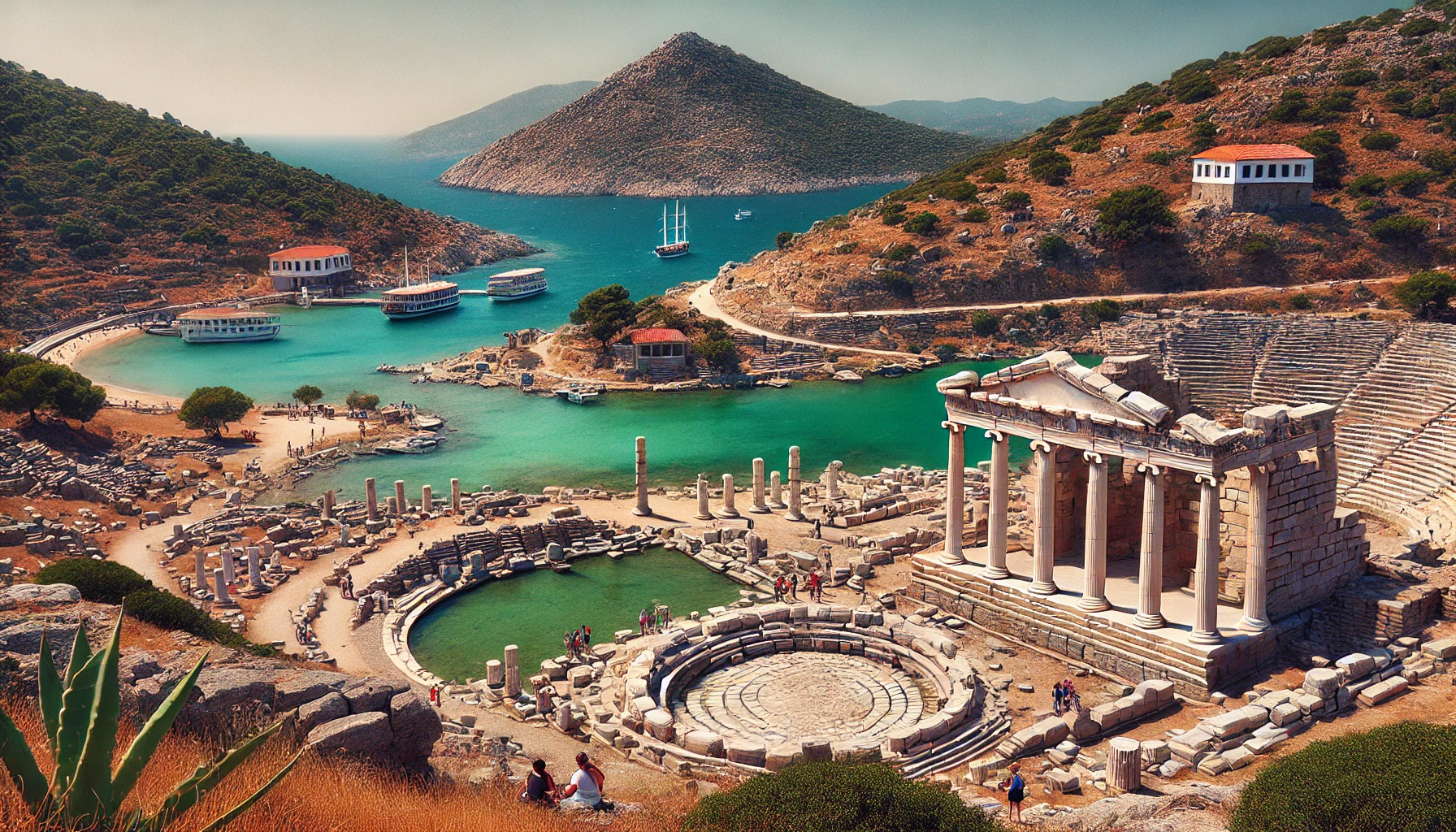
Pedasa is the most important surviving city of the Lelegians, an ancient pre-Greek people of southwestern Anatolia, situated on the hilltops and ridges above Konacik (Gokceler) on the Bodrum Peninsula in Mugla Province, Turkey. Mentioned by Homer in the Iliad and described by Herodotus for its fierce resistance against the Persians, Pedasa preserves remarkable dry-stone defensive walls built without mortar, the Temple of Athena (confirmed by Herodotus's account and terracotta figurine finds), approximately 70 stone tumuli (domed burial structures), defensive towers, and the remains of an acropolis with palace structures. Archaeological evidence indicates the city was inhabited from approximately 2000 BC to 1300 AD, spanning from the Bronze Age through the Byzantine period. Excavated since 2007 under the direction of Prof. Adnan Diler from Mugla University (following surveys from 1999--2006), Pedasa is a unique window into a largely vanished pre-Greek Anatolian civilization.
- Why Pedasa Matters
- Geography and Setting
- Historical Timeline
- Major Monuments
- Archaeological Work
- Visitor Information
- Frequently Asked Questions
- Sources and Further Reading
Why Pedasa Matters
Pedasa holds a singular position in the archaeology of ancient Anatolia:
-
Premier Lelegian city. The Lelegians were an indigenous pre-Greek population who inhabited the Bodrum Peninsula (ancient Halicarnassus Peninsula) and surrounding regions. While their identity has been debated by scholars since antiquity, Pedasa is the most extensively excavated settlement attributed to this people, providing the primary archaeological evidence for Lelegian material culture, architecture, burial customs, and daily life.
-
Homeric reference. Pedasa is mentioned in Homer's Iliad: "Altes is the king of warlike Lelegians; he kept Pedasos in his possession on Satnioeis shores." This literary reference places Pedasa among the earliest named settlements in Western Anatolia and connects it to the epic traditions of the Bronze Age and Archaic period. Few archaeological sites in Turkey can claim such an ancient literary pedigree.
-
Herodotus and Persian resistance. The Greek historian Herodotus recorded that the priestess of Athena at Pedasa grew a beard whenever disaster threatened the city -- a story that captured the imagination of ancient readers. More importantly, Herodotus documented Pedasa's resistance against Persian invasions, making it one of the few Lelegian cities whose political history is preserved in a major ancient text. The beard story, while fantastical, confirms the existence of an Athena oracle cult at the site.
-
Masterful dry-stone construction. The Lelegians were renowned throughout antiquity for building without mortar or lime. The defensive walls, towers, and residential structures at Pedasa are constructed by precisely fitting stone blocks together without any binding material -- a technique requiring extraordinary craftsmanship that has allowed the walls to survive for over 2,500 years. The Greeks themselves called this technique "Lelegian walls," attributing its invention to this people.
-
Exceptional tumuli tradition. Approximately 70 stone tumuli have been identified in the Pedasa area. These domed burial structures, dating primarily to the Geometric and Archaic periods (8th--6th century BC), represent a distinctive funerary tradition that differs from both Greek and mainstream Carian burial practices, offering a window into the Lelegians' unique cultural identity.
-
Longest continuous habitation on the peninsula. With archaeological evidence spanning from approximately 2000 BC to 1300 AD -- over three millennia -- Pedasa demonstrates the longest known occupation history of any site on the Bodrum Peninsula, predating even the famous Halicarnassus.
Geography and Setting
Peninsula Hilltop Position
Pedasa is spread across a series of hilltops and ridges above the modern settlement of Konacik (also referred to as Gokceler), on the northeastern part of the Bodrum Peninsula. The site commands panoramic views over the Bodrum plain to the south, the Gulf of Gulluk to the north, and the Aegean Sea to the west. On clear days, the Greek islands of Kos and Kalymnos are visible on the horizon.
The city covers a remarkably large area -- the walls, towers, tumuli, agricultural terraces, and outlying farm buildings extend across several hills and valleys, spanning an estimated 2-3 square kilometers. This dispersed settlement pattern distinguishes Pedasa from the more compact urban plans of Greek cities and reflects the Lelegians' adaptation to the peninsula's rugged terrain, utilizing every defensible hilltop and cultivable valley.
Defensive Landscape
The hilltop position was chosen for its natural defensive advantages. The steep slopes on multiple sides created natural barriers, while the ridgeline offered control over major land routes crossing the peninsula from the interior to the coast. The Lelegians enhanced these natural defenses with their characteristic dry-stone walls and watchtowers, creating an interconnected defense system that could monitor and control movement across a wide area.
The position also provided visual communication with other Lelegian settlements on the peninsula, including sites at Telmessos, Theangela, and Side. Signal fires from the watchtowers could alert the entire network of Lelegian communities to approaching danger.
Vegetation and Terrain
The site is covered with typical Aegean maquis vegetation -- low scrub, wild herbs (oregano, thyme, sage), and scattered pine trees. The aromatic herbs growing among the ruins create a sensory experience unique to Aegean archaeology. Walking through the ruins involves navigating rocky paths through this Mediterranean landscape. The terrain is moderately challenging, with elevation changes of 200--300 meters across the site.
Water Resources
Despite the hilltop position, the area has access to seasonal springs and collected rainwater. Ancient cisterns and water management features have been identified during excavations, demonstrating the Lelegians' engineering skills in managing scarce water resources in a semi-arid hilltop environment. The water supply was always more limited than at lowland settlements, which may have been one factor constraining the city's population growth.
Historical Timeline
Lelegian Origins and Bronze Age (Before 8th Century BC)
The origins of the Lelegian people are debated. Ancient Greek writers used the term "Lelegians" to describe a pre-Greek population of southwestern Anatolia, sometimes distinguishing them from the Carians and sometimes conflating the two groups. Modern scholars generally treat them as a distinct but related Anatolian people with their own material culture and burial traditions.
Archaeological evidence at Pedasa suggests settlement activity dating back to at least approximately 2000 BC (Middle Bronze Age), making it one of the oldest continuously occupied sites on the Bodrum Peninsula. This early occupation predates the Greek colonization of the Aegean coast by many centuries.
The Lelegians are credited in ancient sources with several innovations, including the invention of the crest for military helmets and were particularly renowned for their stonemasonry skills -- building without mortar in a technique the Greeks called "Lelegian walls." This masonry tradition, visible in its most impressive form at Pedasa, demonstrates a sophisticated understanding of stone geometry, weight distribution, and structural engineering.
Geometric and Archaic Periods (8th--6th Century BC)
The most intensive period of Lelegian activity at Pedasa appears to have been the Geometric and Archaic periods (c. 800--500 BC). During this era:
- The main settlement on the acropolis was established and fortified with the characteristic dry-stone walls
- The distinctive tumuli tradition reached its peak, with approximately 70 burial mounds constructed across the surrounding landscape
- The Temple of Athena (or an earlier predecessor sanctuary) was established on the acropolis, serving both religious and oracular functions
- Defensive walls and watchtowers were built to control the peninsula's land routes and provide early warning of approaching threats
- Agricultural terracing of the hillsides indicates systematic farming of olives, grapes, grain, and other Mediterranean crops
- The community developed a distinctive material culture combining indigenous Lelegian elements with influences from neighboring Greek and Carian traditions
Persian Period and Herodotus (6th--5th Century BC)
The most historically documented phase of Pedasa's history comes from Herodotus (c. 484--425 BC), who wrote about the city in his Histories:
- He described the priestess of Athena at Pedasa who grew a beard whenever great calamity was about to befall the people of the area -- an event said to have occurred three times. While fantastical, this account confirms the existence of an oracle sanctuary at Pedasa and the importance of the Athena cult.
- He recorded Pedasa's resistance against Persian forces, specifically during the campaigns of the Persian general Harpagos. This makes Pedasa one of the few Lelegian cities to leave a trace in the major historical narratives of the ancient world.
- His account confirms the existence of the Athena sanctuary at Pedasa, providing a rare and valuable correlation between literary and archaeological evidence for a Lelegian settlement.
Pedasa's resistance to Persia is notable because most Carian and Lelegian cities submitted to Persian authority. Pedasa's defiance suggests a strong tradition of independence and military capability, consistent with the formidable defensive architecture visible at the site.
Classical and Hellenistic Periods (5th--1st Century BC)
During the Classical period, the Bodrum Peninsula came increasingly under the influence of Halicarnassus (modern Bodrum), the major Greek/Carian city at the peninsula's southern tip. The Hekatomnid dynasty, particularly Maussollos (377--353 BC), pursued a policy of synoikism -- the forced or encouraged consolidation of smaller settlements into larger cities. Many Lelegian communities on the peninsula were absorbed into Halicarnassus during this process, which aimed to concentrate population, tax revenue, and military manpower.
Pedasa's fate during synoikism is debated among scholars. The city may have been partially depopulated as residents were relocated to Halicarnassus, though some habitation likely continued. The remoteness and altitude of the site may have allowed some degree of resistance to the centralization policy. The Hellenistic period saw reduced activity at the site, but the tumuli and walls continued to stand as monuments to the Lelegian past.
Roman and Byzantine Periods
Evidence for Roman-period occupation at Pedasa is limited compared to the earlier phases, suggesting that the city's importance had declined significantly by this time. However, archaeological evidence indicates continued use of the site, possibly as a rural settlement or seasonal pastoral station.
More surprising is the evidence for Byzantine-period activity, extending the site's occupation to approximately 1300 AD. This means Pedasa was used in some capacity for over three millennia, an extraordinary span of human activity on a single hilltop. The Byzantine presence may have been related to watchtower or signal station functions, exploiting the site's commanding views.
Major Monuments
Lelegian Dry-Stone Walls
The most distinctive feature of Pedasa is its dry-stone defensive walls. Constructed without mortar, lime, or any binding material, these walls demonstrate the Lelegians' legendary mastery of stonemasonry.
The walls are built by carefully selecting and fitting irregularly shaped stone blocks so that they interlock precisely. Each stone is individually shaped to match its neighbors, creating a three-dimensional puzzle of interlocking pieces. The technique relies entirely on the weight and friction of the stones and the skill of the mason in achieving tight joins. Despite lacking any adhesive, these walls have survived for approximately 2,500 years, a testament to the quality of Lelegian craftsmanship and the inherent stability of well-fitted dry-stone construction.
The defensive circuit encloses the acropolis and extends along ridgelines to protect approach routes. Wall sections vary in thickness from approximately 1.5 to 3 meters, with the thicker sections at vulnerable points and gateway approaches. Different phases of construction and repair are visible in the varying quality and technique of different wall segments.
Temple of Athena
The Temple of Athena is located on the acropolis area of the settlement. Its identification is supported by Herodotus's literary reference to the sanctuary of Athena at Pedasa and by archaeological evidence including terracotta figurine fragments of the goddess Athena found during excavation by Prof. Diler's team.
The temple dates primarily to the late Archaic and early Classical periods (6th--5th century BC), with possible earlier phases. It is a square-plan structure with columns on the front side. While modest in scale compared to the great Greek temples, it represents one of the few archaeologically confirmed Lelegian religious structures and provides crucial evidence for understanding Lelegian-Greek religious interaction. The discovery of Athena figurine fragments confirmed that Herodotus's account was based on real knowledge of the site, not literary invention.
Stone Tumuli
Approximately 70 stone tumuli have been identified in the Pedasa area, making this one of the densest concentrations of tumulus burials on the Bodrum Peninsula. These burial structures are:
- Dome-shaped mounds constructed from carefully stacked stone, using the same dry-stone technique as the city walls
- Dating primarily to the Geometric and Archaic periods (8th--6th century BC)
- Varying in size from modest individual burials (2-3 meters diameter) to larger structures (up to 8-10 meters) suggesting elite or collective burials
- Reflecting a funerary tradition distinct from mainstream Greek or Carian burial practices, reinforcing the Lelegians' cultural individuality
A 2021 academic study published on the tumuli examined the terminology and origins of these structures, noting their unique characteristics within the broader context of Anatolian burial practices and debating whether the Lelegian tumulus tradition developed independently or was influenced by other Anatolian cultures.
Acropolis and Upper Castle
The acropolis occupies the highest point of the settlement and served as both the administrative center and last line of defense. Remains of what may be palace or elite residential structures have been identified on the acropolis, along with the Temple of Athena. These structures suggest that Pedasa was governed by a local ruler or chief, consistent with the Homeric reference to "Altes, king of the Lelegians."
An Upper Castle (Ust Kale) area crowns the acropolis, with the most substantial wall construction and the best defensive position. From here, the defenders of Pedasa could survey the entire peninsula and the surrounding sea.
Watchtowers and Defensive Towers
Multiple towers are positioned along the defensive circuit and at strategic points on the ridgelines. These include:
- Watchtowers providing visual communication between different sectors of the settlement and with other Lelegian sites on the peninsula
- Defensive towers reinforcing vulnerable points in the wall circuit
- Towers controlling views of the surrounding landscape, including approach routes from the coast and the peninsula interior
Sacred Road
A sacred road has been identified leading to the sanctuary area, similar in concept (though smaller in scale) to the sacred roads found at other Anatolian sanctuaries such as Labraunda and Didyma. This road would have been the processional route for religious ceremonies at the Athena temple.
Agricultural Terraces and Farm Buildings
The hillsides around Pedasa show extensive evidence of agricultural terracing -- stone-walled platforms creating level planting surfaces on the steep slopes. These terraces, built using the same dry-stone technique as the city walls, demonstrate the Lelegians' systematic approach to agriculture in challenging terrain. Scattered across the outlying areas are remains of farm buildings, indicating that the Pedasa community was engaged in intensive agriculture alongside its urban and military functions.
Archaeological Work
Survey Phase (1999--2006)
The modern archaeological study of Pedasa began with a comprehensive survey program running from 1999 to 2006, directed by Prof. Adnan Diler from Mugla University (now Mugla Sitki Kocman University). This multi-year survey documented the extent of the settlement, mapped the defensive walls and towers, catalogued the tumuli, and identified key structural remains.
The survey established that Pedasa was far larger and more complex than previously assumed, with the settlement area extending across multiple hilltops and valleys. The identification of approximately 70 tumuli, extensive wall circuits, and numerous farm buildings revealed a community of considerable size and organizational sophistication.
Excavation Phase (2007--Present)
Formal excavation began in 2007, also under the direction of Prof. Adnan Diler. The excavation program has targeted several key areas:
Temple of Athena: Excavation of the sanctuary area confirmed the identification of the Temple of Athena through the discovery of terracotta statuette fragments of the goddess Athena, dating to the late Archaic and early Classical periods. This discovery provided the archaeological confirmation of Herodotus's literary reference -- a rare case of ancient literary testimony being directly verified by modern excavation.
Acropolis area: Work on the acropolis has revealed the layout of the upper settlement, including defensive walls, domestic structures, and possible elite buildings that may correspond to the "palace" of the Lelegian ruler mentioned in the Iliad.
Tumuli: Systematic investigation of selected tumuli has provided information about Lelegian burial practices, tomb construction techniques, and grave goods. The finds reveal a culture that combined local Anatolian traditions with elements borrowed from neighboring Greek and Carian communities.
Defensive walls and towers: Detailed recording of the wall circuit has documented the construction techniques and phases of the defensive system, confirming the sophistication of Lelegian dry-stone engineering.
Key Findings
The excavation has produced several significant results:
- Confirmation of the Temple of Athena through terracotta figurine evidence, validating Herodotus
- Documentation of approximately 70 tumuli across the landscape, establishing the largest Lelegian burial ground known
- Evidence for settlement activity spanning from approximately 2000 BC through 1300 AD -- over three millennia
- Detailed recording of Lelegian dry-stone construction techniques providing the definitive study of this ancient masonry tradition
- Identification of agricultural terracing and farm structures indicating a settled, farming community with sophisticated land management
- Evidence for cultural interaction between Lelegians and their Greek and Carian neighbors, challenging the notion of isolated, "primitive" pre-Greek peoples
The International Pedasa Festival
An International Pedasa Festival has been organized to raise awareness about the site and celebrate its cultural heritage. This event brings together archaeologists, historians, local communities, and visitors, combining academic presentations with cultural activities and guided visits to the ruins.
Visitor Information
Location and Access
Pedasa is located above the town of Konacik, approximately 5 km northeast of Bodrum center. The site can be reached on foot from Konacik via marked hiking trails.
From Bodrum: Drive or take a dolmus to Konacik (approximately 5 km northeast of Bodrum center). From Konacik, follow signs for "Pedasa Antik Kenti" or the Pedasa hiking trail. The walk from the trailhead to the main ruins takes approximately 30--45 minutes uphill through pine-scented maquis.
From Bodrum-Milas Airport: The airport is approximately 35 km from Konacik (30 minutes by car).
Visit Duration
The hike up to the main ruins and a thorough exploration of the acropolis, Temple of Athena, walls, and nearby tumuli takes approximately 2.5--4 hours (including the walk up and down). Those wishing to explore the more distant tumuli and farm structures should plan for a full day.
Best Time to Visit
- Spring (March--May): The ideal season. Wildflowers cover the hillsides in spectacular displays, temperatures are perfect for hiking (15-25 C), and the Aegean landscape is at its most beautiful. Orchids, anemones, and other Mediterranean flora bloom among the ancient walls.
- Autumn (September--November): Excellent hiking weather, softer light, fewer crowds. The herb-scented maquis fills the air with thyme and oregano.
- Winter (December--February): Mild but potentially rainy. The trails may be muddy. However, the site is beautifully atmospheric in winter light.
- Summer (June--August): Very hot for the uphill hike (temperatures can exceed 40 C). If visiting in summer, start very early in the morning (before 8 AM) or in the late afternoon (after 5 PM). Bring ample water.
Combined Visits
Pedasa pairs naturally with the rich historical landscape of the Bodrum Peninsula:
- Bodrum Castle (Castle of St. Peter): The iconic Crusader castle housing the Bodrum Museum of Underwater Archaeology, approximately 5 km southwest.
- Mausoleum of Halicarnassus: The site of one of the Seven Wonders of the Ancient World, in Bodrum center.
- Bodrum Ancient Theater: The Hellenistic-Roman theater with views over Bodrum harbor.
- Myndos Gate: The only surviving gate of the ancient city walls of Halicarnassus.
- Labraunda: The sanctuary of Zeus Labraundos in the mountains above Milas (approximately 60 km northeast) -- combining Pedasa and Labraunda visits creates a comprehensive picture of pre-Greek and Carian religious and urban life.
- Other Lelegian sites: Several smaller Lelegian settlements on the Bodrum Peninsula (including Telmessos, Theangela, Side) can be combined for a "Lelegian Peninsula" tour revealing the extent of Lelegian civilization.
Practical Tips
- This is primarily a hiking site. Sturdy walking shoes with good ankle support are essential. The rocky terrain can be treacherous in smooth-soled shoes.
- Bring at least 2 liters of water per person, especially in warm weather. There is no water available on the trail or at the ruins.
- Sun protection (hat, sunscreen, sunglasses) is critical as there is limited tree cover on the upper slopes.
- Start early in the morning to avoid midday heat, especially May--September.
- The trail is marked but not always clearly. Consider downloading GPS tracks beforehand or using offline maps.
- Inform someone of your hiking plan and expected return time.
- Snacks or a light picnic are recommended for longer explorations. The views from the acropolis make an excellent picnic spot.
- Binoculars are useful for spotting tumuli and wall sections across the landscape.
- The Bodrum Municipality has installed some trail signage and information boards at the trailhead, but a guidebook or advance research significantly enhances the experience.
- Watch for snakes in warm weather, especially among the ruins and in tall grass.
Frequently Asked Questions
Who were the Lelegians?
The Lelegians were an indigenous pre-Greek people of southwestern Anatolia mentioned by Homer, Herodotus, and other ancient writers. They inhabited the Bodrum Peninsula (Halicarnassus Peninsula) and surrounding coastal regions before and during the Greek colonization period. They are distinguished from the Carians (their neighbors and cultural relatives) in some ancient sources, while others treat the two groups as closely related. The Lelegians are particularly associated with expert dry-stone masonry, a building technique so distinctive that the Greeks named it after them.
Why is the story of the bearded priestess famous?
Herodotus recorded that the priestess of Athena at Pedasa would miraculously grow a long beard whenever great disaster was about to befall the region. This phenomenon was said to have occurred three times. The story captured the Greek imagination because it inverted normal gender expectations and was seen as a sign of divine warning -- the goddess Athena communicating through her priestess's body. For historians, the account is valuable because it confirms the existence of an Athena oracle cult at Pedasa and provides a literary anchor for the archaeological evidence. The 2007+ excavations finding Athena figurine fragments confirmed this literary testimony.
Can I visit the tumuli?
Some tumuli are accessible along the main hiking trails and side paths. However, the approximately 70 tumuli are spread across a wide area of several square kilometers, and reaching the more distant ones requires extended hiking through trackless terrain. The tumuli visible near the main acropolis area can be visited within a standard visit.
Is there an entrance fee?
As of recent information, Pedasa is an open archaeological and hiking area without formal entrance gates or ticket offices. However, this may change as the site gains recognition; check with the Bodrum Municipality or local tourism offices for current information.
How does Pedasa compare to other Bodrum Peninsula sites?
While Bodrum's castle and the Mausoleum site focus on later historical periods (Crusader and Classical Greek/Carian), Pedasa takes visitors back to an earlier era -- the pre-Greek Lelegian civilization. It offers a completely different experience: a wilderness hike through ancient ruins rather than an urban museum visit. The combination of natural landscape, archaeological mystery, physical challenge, and aromatic Mediterranean vegetation makes Pedasa unique on the peninsula.
Is the site suitable for families with children?
The hike is moderately strenuous and involves steep, rocky terrain. Older children (age 10+) with hiking experience will likely enjoy it, but the site is not suitable for young children or strollers. There are no facilities, shade structures, or guardrails. Teenagers with an interest in history or hiking will find it a memorable experience.
What happened to the Lelegians?
The Lelegians were gradually absorbed into the Carian and Greek populations of the region during the Classical period. The synoikism policies of Maussollos in the 4th century BC accelerated this process by relocating populations from small Lelegian settlements into the larger city of Halicarnassus. By the Hellenistic period, the Lelegians had largely disappeared as a distinct ethnic group, though their architectural legacy -- the distinctive dry-stone walls -- continued to mark the landscape.
Architectural Measurements and Key Figures
| Feature | Measurement / Detail |
|---|---|
| Settlement occupation span | c. 2000 BC -- 1300 CE (~3,300 years) |
| Total site area | estimated 2--3 km2 |
| Number of tumuli identified | approximately 70 |
| Tumuli diameter range | 2--3 m (modest) to 8--10 m (elite/collective) |
| Defensive wall thickness | 1.5--3 m (varying by position) |
| Acropolis length | approximately 200 m |
| Acropolis exterior walls | 2 exterior walls supported by towers |
| Acropolis interior walls | interior compartmentalization walls |
| Elevation above Bodrum plain | 200--300 m elevation change across site |
| Distance from Bodrum centre | approximately 5 km northeast |
| Distance from Bodrum-Milas Airport | approximately 35 km |
| Megaron (palace) date | 7th century BC |
| Excavation survey phase | 1999--2006 |
| Excavation phase | 2007--present |
Pottery and Trade Networks
Recent ceramic studies from Pedasa have significantly expanded knowledge of the Lelegian pottery tradition and the trade connections that linked this hilltop settlement to the broader Aegean and eastern Mediterranean world.
Early Iron Age Pottery
A landmark 2014 study by H. Bulut -- published as "Early Iron Age Pottery from Halicarnassus Peninsula: Two New Amphora Fragments from Pedasa" in OLBA 22 (pp. 63--79) -- documented two significant amphora fragments that illuminate the transition from Bronze Age to Iron Age ceramic traditions on the peninsula.
| Pottery Type | Period | Characteristics |
|---|---|---|
| Shoulder-handled amphora | Late Protogeometric | Blend of local Carian and Attic Protogeometric features |
| Neck-handled amphora (Sivriçam Tepe tumulus) | Middle--Late Geometric | Local production with Attic and Dodecanesian influences |
| Orientalizing imports | 7th century BC | Ionian (south Ionian / Milesian) trade amphorae |
| Local bowls | Geometric--Archaic | Distinctive Carian coastal production |
The Sivriçam Tepe tumulus near Pedasa yielded pottery spanning from the Late Protogeometric to the Late Geometric period, providing one of the longest continuous ceramic sequences on the Bodrum Peninsula. A neck-handled amphora from this tumulus can be compared stylistically to one found at Dirmil, another Carian site, though the Pedasa specimen preserves distinctive local characteristics that distinguish it from pure Attic or Dodecanesian traditions.
Trade Amphora Evidence
The quantitative superiority of south Ionian (specifically Milesian-type) trade amphorae found at Pedasa and along coastal Caria demonstrates that the Lelegian communities were integrated into the broader Aegean exchange networks during the Archaic period. Miletus, the dominant Ionian trading power roughly 100 km to the north, was clearly the primary external trading partner, supplying goods (likely wine and olive oil) in standardized transport vessels.
Orientalizing-style pottery imported from Ionia has also been documented at Pedasa, further confirming that despite the settlement's hilltop defensive posture, it was not culturally isolated but actively participated in the flow of goods and artistic ideas across the southeastern Aegean.
Tumuli: Construction Techniques and Burial Practices
The approximately 70 stone tumuli at Pedasa constitute the largest concentration of Lelegian burial monuments in the region. Detailed archaeological study has revealed several distinctive features that set these tumuli apart from other Anatolian burial traditions.
Structural Distinctions
| Feature | Lelegian (Pedasa) | Lydian / Phrygian |
|---|---|---|
| Dromos (entrance passage) | Visible -- intended to remain accessible | Hidden -- concealed after burial |
| Construction material | Dry-stone (no mortar) | Earth mound over stone/timber chamber |
| Intended use | Collective / family graves with repeated access | Typically single-use sealed chambers |
| Typical placement | Hilltop positions with high visibility | Valley or plain locations |
The visible dromos is a particularly significant distinction. Unlike Lydian or Phrygian tumuli, where the entrance was hidden after burial to deter grave robbers, Lelegian tumuli at Pedasa were designed for repeated access. This indicates a funerary tradition of collective or family burials, where successive generations were interred in the same structure over time. Reused tumuli with evidence of multiple interment phases confirm familial connections across generations.
Burial Practices
Excavations of selected tumuli have revealed a transition in burial practice:
- Geometric period: Burials in terracotta coffins (a practice paralleling contemporary Greek traditions)
- Later phases: Collective internments with cremation ashes, suggesting a shift toward cremation rites
- Combined practices: Evidence for both cremation and inhumation within the same tumulus, possibly reflecting different treatment for individuals of different status
Grave Goods
Assemblages recovered from tumuli in the West Acropolis area include:
- Iron knife -- suggesting both practical use and symbolic significance in funerary context
- Bronze bracelets -- personal adornment items indicating trade connections for metal goods
- Bronze fibulae (clothing pins) -- stylistically comparable to types found across the broader Carian and Greek cultural zones
- Ceramic vessels -- local production with the distinctive Carian coastal style
The socio-economic disparities visible in the grave goods -- ranging from modest single burials with few offerings to larger tumuli with more elaborate assemblages -- indicate a stratified Lelegian society with distinguishable elite and common classes.
The Megaron and the Question of Lelegian Kingship
A large building in the centre of the acropolis has been identified as a megaron -- a rectangular hall with a central hearth, a building type associated with elite residences and palatial architecture across the Bronze and Iron Age Aegean. Dated to the 7th century BC, this structure may have served as the residence of a local ruler, consistent with Homer's reference to "Altes, king of the Lelegians."
The megaron's position at the heart of the fortified acropolis, combined with its relatively large size compared to surrounding domestic structures, supports the interpretation that Pedasa was governed by a chief or king rather than a democratic assembly. This monarchical or chieftain-based political structure would have differed from the polis model that characterized contemporary Greek cities, reflecting the Lelegians' distinct political traditions.
Sources and Further Reading
- Wikipedia -- Pedasa
- Bodrum Municipality -- Pedasa Ancient City
- The Bodrum Guide -- Pedasa
- Cekiste -- Pedasa: Travel, History, Excavations
- Property Turkey -- "Uncover One of the Region's Best Kept Secrets at Pedasa." Link
- Academia.edu -- "Stone Tumuli in Pedasa on the Lelegian Peninsula: Problems of Terminology and Origin" (2021). Link
- TripAdvisor -- Pedasa Antique City Reviews
- Herodotus, Histories (references to Pedasa and the priestess of Athena)
- Homer, Iliad (reference to Pedasos and the Lelegians)
- Wikipedia Turkish -- Pedasa