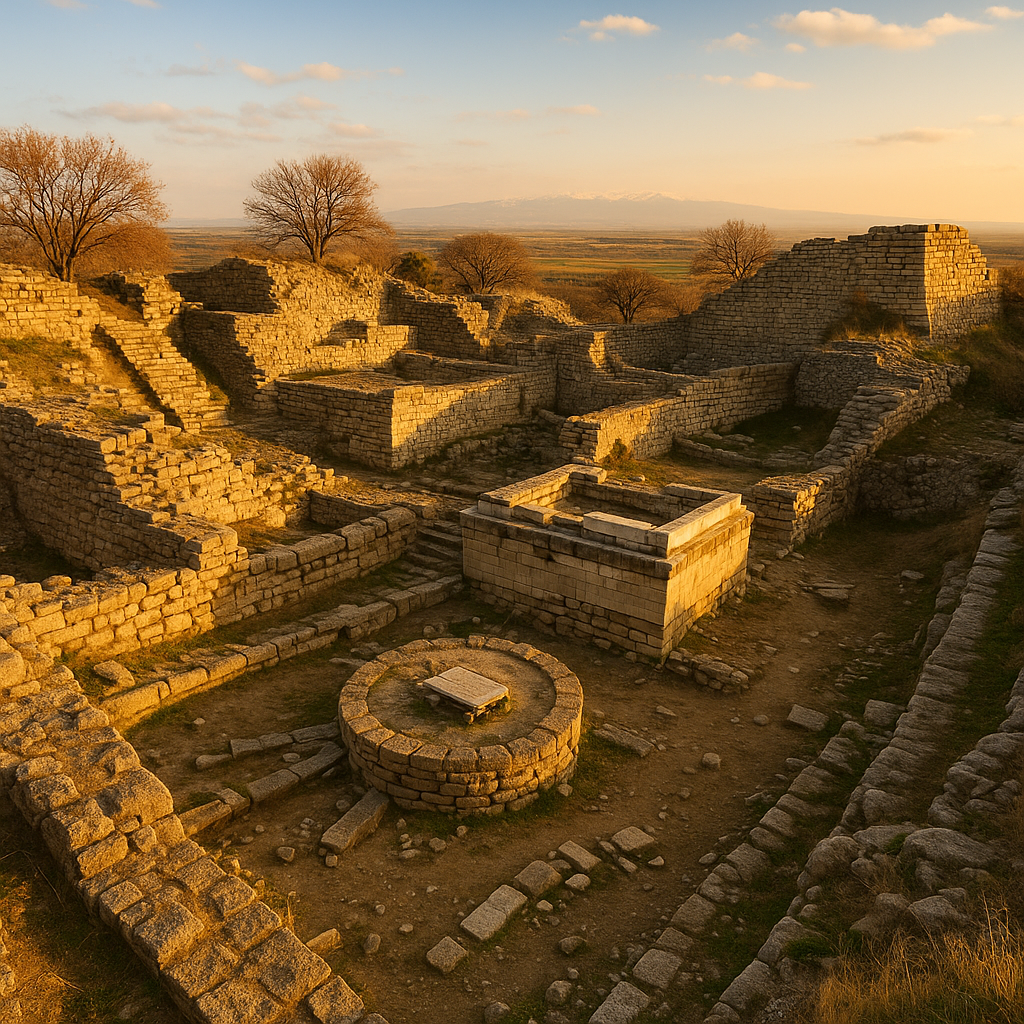
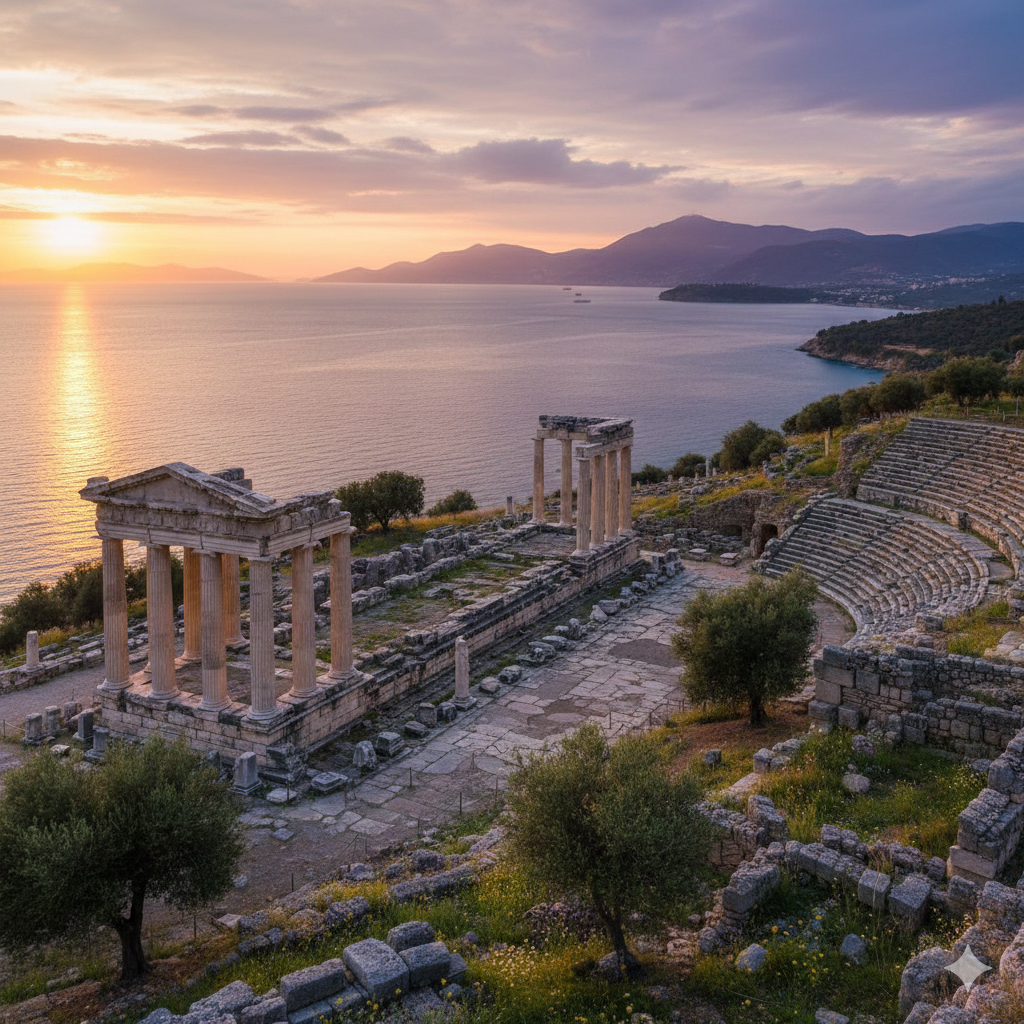
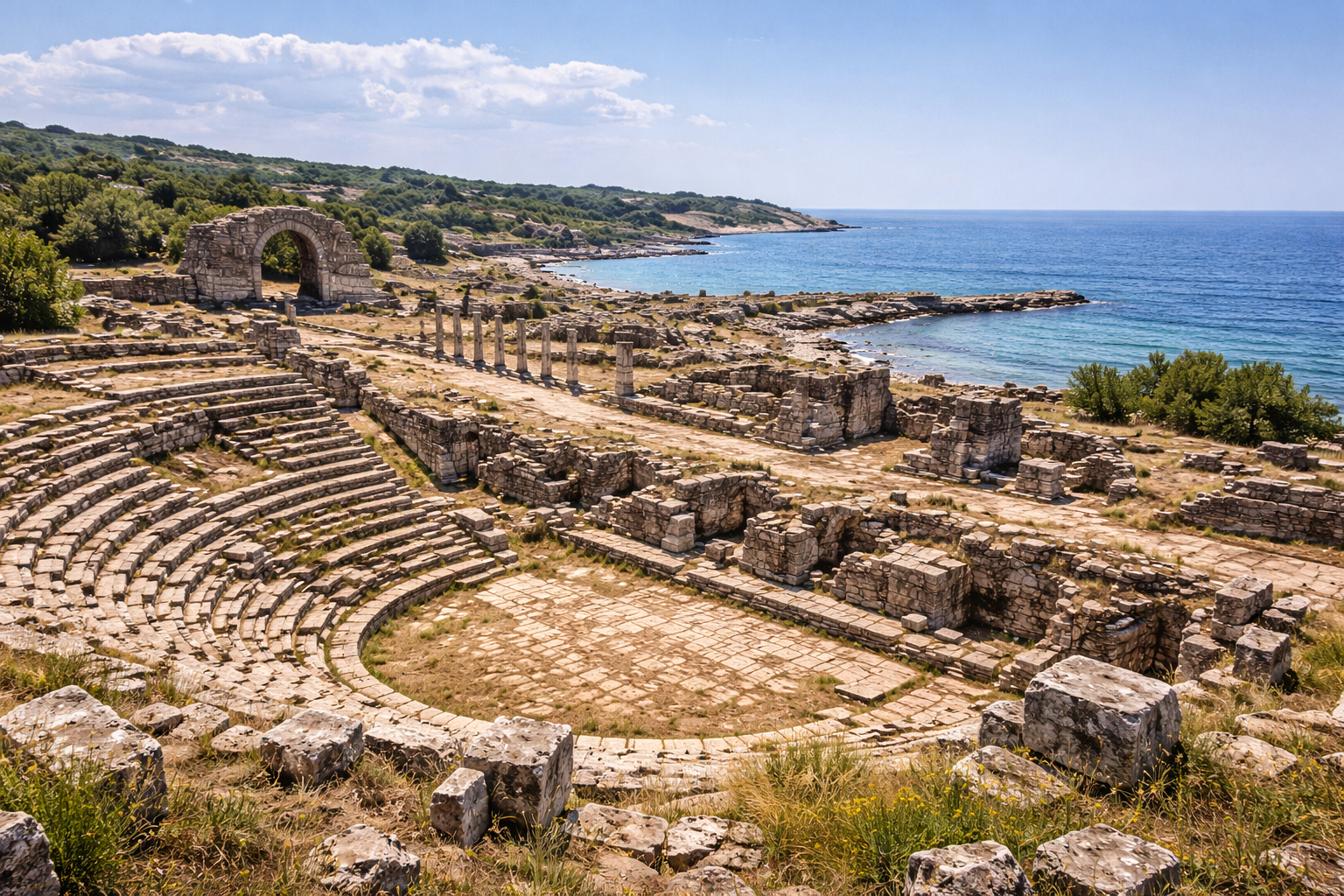
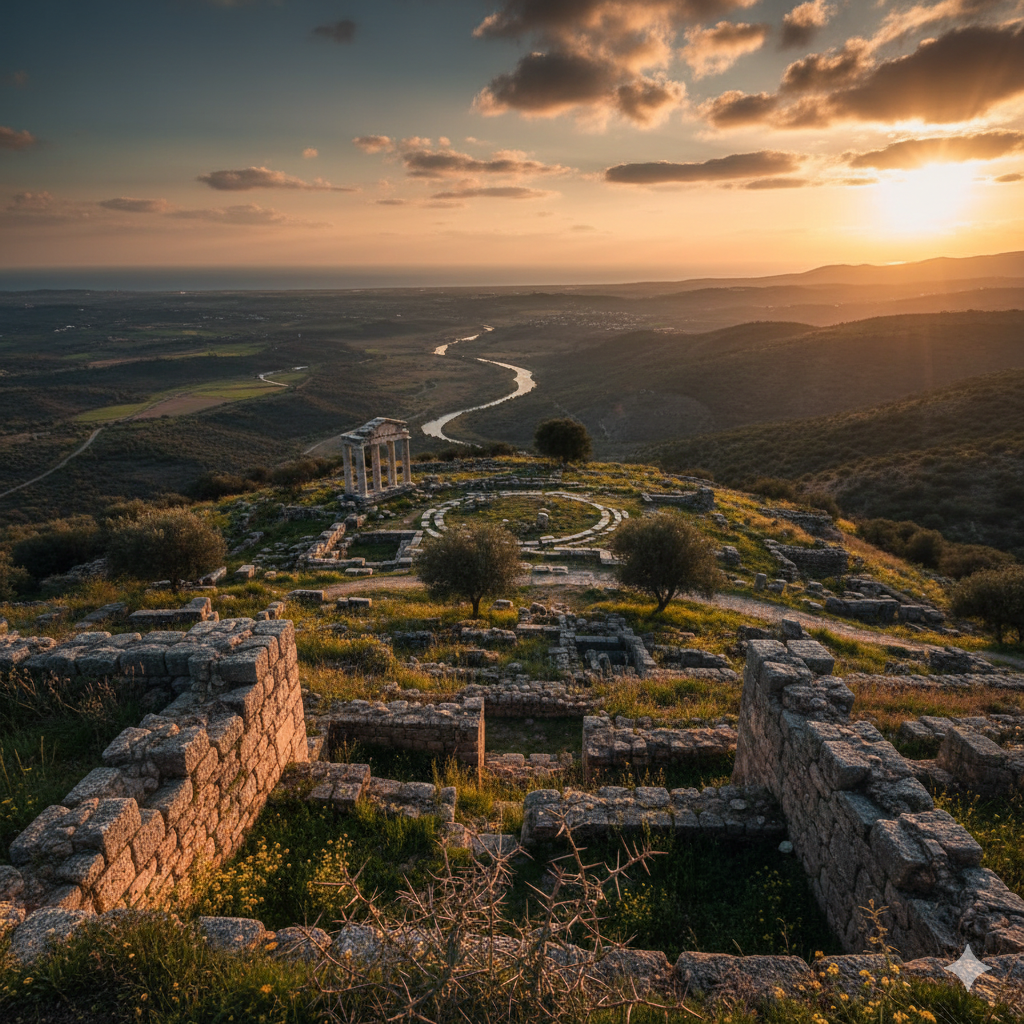
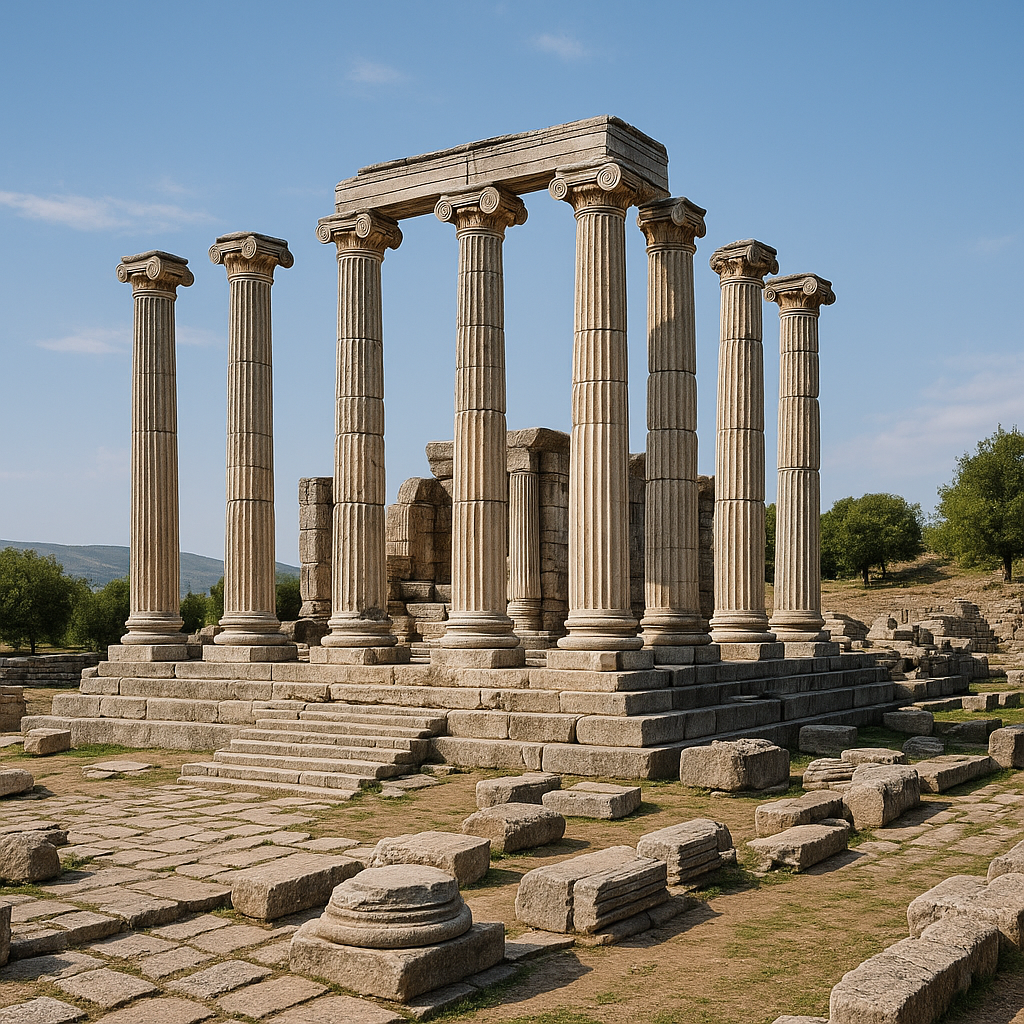
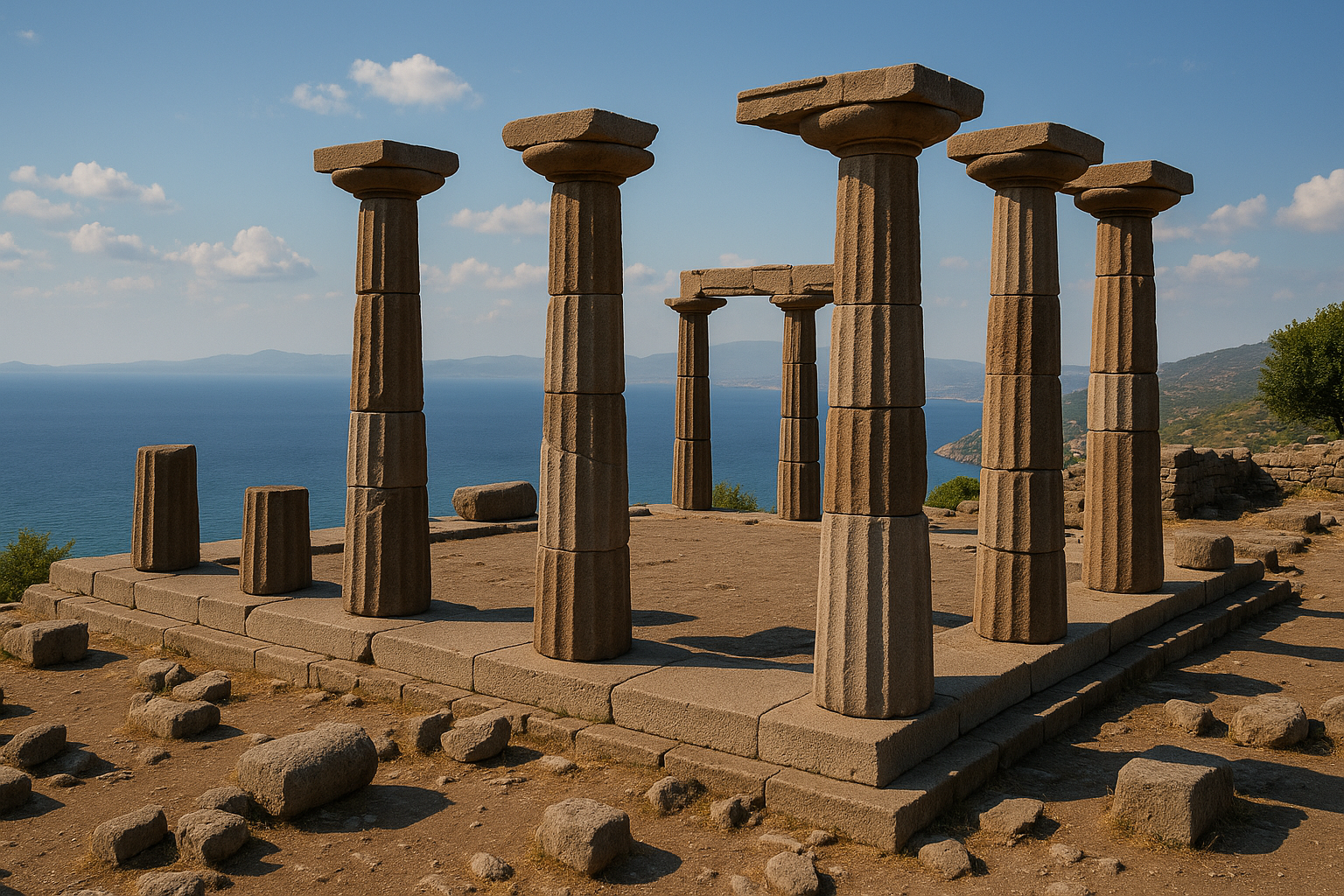
Overview: Ainos, modern Enez, is one of the most historically layered towns in Turkish Thrace — an ancient city situated at the mouth of the Hebros River (Meriç / Evros) where it flows into the Aegean Sea. Located in Edirne Province near the Greek border, Ainos was a prosperous trading port from the Chalcolithic period (4th–3rd millennium BC) through the Ottoman era. The city preserves remarkable remains including Hellenistic and Roman fortification walls, a powerful Byzantine castle reinforced by Emperor Justinian I, early Christian basilicas, an Ottoman mosque, and traces of what was once one of the most important harbors on the northern Aegean coast. As the capital of the late Roman province of Rhodope and an important early Christian bishopric, Ainos played a significant role in the religious and political history of the Byzantine Empire.
- Why Ainos Matters
- Geography and Setting
- Historical Timeline
- Chalcolithic and Bronze Age Origins
- Greek Colonization
- Classical and Hellenistic Ainos
- Roman Ainos
- The Fortification Walls
- The Byzantine Castle
- Justinian's Fortifications
- Capital of Rhodope Province
- The Bishopric and Early Christianity
- The Harbor and Maritime Trade
- The Via Egnatia Connection
- Ainos in the Crusades and Latin Period
- Ottoman Enez
- The Fatih Mosque and Ottoman Monuments
- The Meriç River Delta
- Archaeological Research
- How to Visit Enez
- FAQ
- Sources
Why Ainos Matters
Ainos/Enez is significant for several reasons:
- 6,000+ years of habitation: From Chalcolithic settlements (4th millennium BC) through the Ottoman period — one of the longest continuously inhabited sites in Thrace
- River-mouth harbor: The strategic position at the mouth of the Hebros — one of the great rivers of the Balkans — made Ainos a crucial trading hub between the Aegean world and the Thracian interior
- Justinian's castle: Emperor Justinian I (r. 527–565) reinforced the fortifications, making Ainos one of the key Byzantine defensive positions on the northern Aegean
- Capital of Rhodope: In the late Roman administrative reorganization, Ainos became the capital of the province of Rhodope — a significant political role
- Early Christian bishopric: An important center of early Christianity in Thrace, with multiple basilicas and a bishopric attested from the 4th century
- Meriç Delta wetlands: The Meriç/Evros river delta surrounding Enez is one of Türkiye's most important wetland ecosystems and a major bird habitat
- Border town atmosphere: As one of Türkiye's most remote towns, near the Greek border, Enez has a unique atmosphere of isolation and historical depth
Geography and Setting
Ainos occupies a commanding position at the junction of river and sea.
Location:
- Enez town, Edirne Province, Turkish Thrace
- At the mouth of the Meriç River (ancient Hebros / Greek Evros)
- On the northeastern Aegean coast
- Approximately 60 km south of Edirne
- Close to the Turkish-Greek border (the Meriç/Evros river forms the border)
- At the western tip of the Saros Gulf
Landscape:
- A low, rocky promontory overlooking the river mouth and the Aegean Sea
- The Meriç River delta — vast wetlands, lagoons, and sand dunes — extends around the town
- The delta is one of the most significant wetland ecosystems in southeastern Europe
- Flat agricultural plains stretch inland toward Edirne
- The Greek island of Samothrace is visible on clear days from the Enez coast
- Sparsely populated — Enez has a remote, frontier-town character
Climate:
- Mediterranean-influenced with continental elements
- Hot, dry summers and cool, sometimes snowy winters
- Strong winds from the Aegean, especially in summer (etesian winds)
- The delta wetlands create a unique microclimate
Historical Timeline
| Period | Date | Key Events |
|---|---|---|
| Chalcolithic | c. 4000–3000 BC | Early settlement; evidence of copper-age habitation |
| Bronze Age | c. 3000–1200 BC | Thracian settlement; trade connections |
| Greek colonization | 7th century BC | Aeolian Greek colony founded (traditionally by settlers from Lesbos/Cyme) |
| Classical | 5th–4th century BC | Delian League member; minted own coins |
| Hellenistic | 3rd–1st century BC | Under Macedonian, then Ptolemaic, then Attalid influence |
| Roman Republic | 2nd–1st century BC | Incorporated into Roman province of Macedonia/Thrace |
| Roman Empire | 1st–4th century AD | Prosperous port; capital of Rhodope province |
| Justinian I | 527–565 AD | Fortifications reinforced |
| Byzantine | 6th–14th century | Important fortress and bishopric |
| Fourth Crusade | 1204 | Captured by Latin Crusaders |
| Genoese | 13th–14th century | Genoese trading colony |
| Ottoman | 1456 | Conquered by Mehmed II (the Conqueror) |
| Ottoman period | 15th–20th century | Enez — Ottoman garrison and trading town |
| Turkish Republic | 1923–present | Border town in Edirne Province |
Chalcolithic and Bronze Age Origins
Ainos's origins stretch back to the prehistoric period.
Chalcolithic period (c. 4000–3000 BC):
- Archaeological surveys and limited excavations have revealed Chalcolithic pottery and settlement remains near Enez
- The location at the river mouth was already attractive for settlement — fresh water, fish, fertile delta soil, and access to maritime routes
- Copper-age communities in Thrace were connected to wider Aegean and Balkan exchange networks
Bronze Age (c. 3000–1200 BC):
- The site continued to be occupied during the Bronze Age
- Thracian populations inhabited the region
- The Hebros river system provided access deep into the Thracian hinterland
- Trade goods from the Aegean islands (including obsidian) reached the site via maritime routes
- The harbor's strategic position at the river mouth was recognized from the earliest periods
Greek Colonization
Greek colonists established Ainos as a formal city in the 7th century BC.
Foundation:
- Traditionally founded by Aeolian Greek colonists from Lesbos and/or Cyme (in Aeolis, western Anatolia)
- The mythological founder was said to be Ainos (or Aeneas in some traditions), connecting the city to the Trojan cycle
- The colonists were attracted by the harbor's strategic position and the rich agricultural potential of the river delta
Early development:
- The Greek city developed around the natural harbor at the river mouth
- Greek institutions — assembly, magistrates, temples — were established
- The city minted its own coinage from an early date — Ainean coins feature the head of Hermes (the god of trade) on the obverse, reflecting the city's commercial character
- A temple of Hermes was among the city's principal sanctuaries
Classical and Hellenistic Ainos
In the Classical and Hellenistic periods, Ainos was a significant northern Aegean port.
Classical period (5th–4th century BC):
- Member of the Delian League — paying tribute to Athens
- Active in the grain trade between the Black Sea region and the Aegean
- The city prospered from its control of the Hebros river mouth — goods from the Thracian interior (grain, metals, timber, slaves) passed through Ainos
- Thucydides mentions Ainos in the context of the Peloponnesian War
- The city maintained a degree of independence despite pressure from Thracian kingdoms, Athens, and Macedon
Hellenistic period (3rd–1st century BC):
- After Alexander the Great, Ainos came under the influence of the Macedonian kingdom
- The city was briefly under Ptolemaic control (Ptolemy II held parts of the Thracian coast)
- Later, the Attalid kingdom of Pergamon exercised influence
- The city's walls were strengthened during this period of shifting powers
- Hellenistic Ainos continued to prosper as a trading port
Roman Ainos
Under Roman rule, Ainos reached a new level of prosperity and political importance.
Incorporation:
- Ainos became part of the Roman province of Thrace (formally organized as a province in 46 AD)
- Later, in the Diocletianic reorganization (late 3rd–early 4th century), Ainos became the capital of the newly created province of Rhodope
Roman-era development:
- The harbor was improved and expanded
- Roman roads connected Ainos to the Via Egnatia — the great east-west highway across the Balkans
- Public buildings, baths, and temples were constructed in Roman style
- The city's population grew as its commercial importance increased
- Latin inscriptions appear alongside Greek
Economy:
- Grain trade from the Thracian interior
- Fish from the river and delta (the Meriç delta is still rich in fish today)
- Wine production in the region
- Timber from the Thracian forests
- Transit trade between the Aegean and the Balkans
The Fortification Walls
Ainos was protected by substantial fortification walls that were built and rebuilt over many centuries.
Features:
- Walls encircling the rocky promontory on the landward side
- The sea and river provided natural defense on other sides
- Multiple construction phases visible in the masonry — from Hellenistic through Byzantine periods
- Hellenistic walls: Cut stone blocks in regular courses, with towers at intervals
- Roman repairs: Rubble-and-mortar additions strengthening the Hellenistic circuit
- Byzantine reconstructions: Including Justinian's major rebuilding program (6th century)
- Impressive sections of the walls are still standing, particularly on the western and northern sides
Significance:
- The fortification walls represent one of the most complete multi-period defensive systems in Thrace
- They illustrate the continuous strategic importance of the site over nearly two millennia
- The quality of construction, especially in the Hellenistic and Justinianic phases, indicates the resources invested in defending this crucial harbor
The Byzantine Castle
The Byzantine castle of Enez is the most prominent monument in the town.
Features:
- A large fortified enclosure crowning the rocky promontory
- Massive walls with towers at strategic points
- An inner citadel (keep) for last-resort defense
- The castle commands views over the river mouth, the Aegean coast, and the delta
- Gates with bent entrances for defensive purposes
- Cisterns for water storage during sieges
Construction history:
- The castle incorporates earlier Hellenistic and Roman masonry
- Major reinforcement under Justinian I (6th century) — see below
- Further modifications during the Crusades, Genoese, and Ottoman periods
- The castle remained a functioning military installation through the Ottoman era
Justinian's Fortifications
Emperor Justinian I (r. 527–565 AD) invested heavily in fortifying Ainos as part of his vast building program across the Byzantine Empire.
The program:
- Justinian recognized Ainos's strategic importance — it guarded the Hebros river mouth and the northern Aegean coast
- He ordered the reconstruction and strengthening of the city walls and castle
- Procopius, in his Buildings (De Aedificiis), records Justinian's fortification work in Thrace, though the specific description of Ainos is debated
- The Justinianic fortifications used characteristic techniques: thick walls of rubble core with brick and stone facing, round and square towers, and massive gateways
Significance:
- Justinian's fortification program aimed to protect the empire against barbarian incursions (Avars, Slavs, Bulgars) that threatened the Balkans
- Ainos, as a harbor and river-crossing point, was crucial for controlling access between the Balkans and the Aegean
- The Justinianic walls are among the best-preserved examples of 6th-century Byzantine military architecture in Thrace
Capital of Rhodope Province
In the late Roman administrative reorganization, Ainos was elevated to the position of provincial capital.
The province of Rhodope:
- Created during the Diocletianic reforms (late 3rd–early 4th century) when the larger provinces of the early Empire were subdivided
- The province covered the southern part of Thrace — from the Hebros delta to the Rhodope Mountains
- Named after the Rhodope Mountains that formed its northern boundary
- Ainos (as the principal port and largest city) became the capital (metropolis)
What this meant:
- Ainos hosted the provincial governor and his administration
- Tax collection for the province was coordinated from Ainos
- The city's infrastructure was enhanced to serve its capital function — government buildings, courts, official residences
- Provincial capital status brought increased prestige, population, and economic activity
The Bishopric and Early Christianity
Ainos was an important center of early Christianity in Thrace.
The bishopric:
- A bishopric is attested at Ainos from at least the 4th century
- The bishop of Ainos attended major church councils, including the Council of Ephesus (431) and the Council of Chalcedon (451)
- The bishopric was suffagan to the Metropolitan of Trajanopolis (later elevated)
- The Christian community at Ainos was significant — the city's status as provincial capital enhanced its religious importance
Basilicas:
- Multiple early Christian basilicas have been identified at Enez
- These include large three-aisled basilicas with mosaic floors
- The basilicas date to the 5th–6th centuries — the golden age of Christian building in the Byzantine Empire
- Some basilica remains are visible in the town center
Significance:
- Ainos's bishopric demonstrates the early and thorough Christianization of Thrace
- The presence of bishops at major ecumenical councils shows Ainos's integration into the wider church hierarchy
- The basilica remains are among the most important early Christian monuments in Turkish Thrace
The Harbor and Maritime Trade
The harbor of Ainos was the foundation of its prosperity.
The harbor:
- Located in the sheltered area where the Hebros river met the Aegean Sea
- The river mouth provided natural protection from Aegean storms
- Ships could travel upriver (to a limited extent) to reach the Thracian interior
- The harbor served both sea-going vessels and river craft
Trade routes:
- Upriver: Access to the Thracian hinterland via the Hebros — grain, metals, timber, livestock
- Aegean Sea: Connection to the Greek islands, western Anatolia, Constantinople, and the eastern Mediterranean
- Black Sea: Via the Hellespont (Dardanelles) and Propontis (Sea of Marmara)
- Overland: Connection to the Via Egnatia
Trade goods:
- Grain from the fertile Thracian plains
- Fish from the river and delta
- Wine from local vineyards
- Timber and metals from the Rhodope Mountains
- Slaves (Thrace was a major source of enslaved people in antiquity)
- Luxury goods transiting between East and West
The Via Egnatia Connection
Ainos was connected to the Via Egnatia — the great Roman highway across the Balkans.
The Via Egnatia:
- Built in the 2nd century BC, the Via Egnatia ran from Dyrrachium (Durrës, Albania) on the Adriatic to Byzantium (Constantinople/Istanbul) on the Bosphorus
- It was the most important east-west highway in the Roman Balkans
- A branch road connected Ainos to the main highway
Significance:
- The Via Egnatia connection integrated Ainos into the Roman road network
- Overland trade complemented maritime commerce
- Military forces could reach Ainos from major centers in the Balkans
- The road system enhanced Ainos's role as a transshipment point between sea, river, and land routes
Ainos in the Crusades and Latin Period
The Crusades brought dramatic changes to Ainos.
Fourth Crusade (1204):
- When the Fourth Crusade sacked Constantinople and established the Latin Empire, Ainos was captured by the Crusaders
- The city was assigned to various Latin lords in the partition of the Byzantine Empire
- The harbor's strategic importance made it a valued prize
Genoese period:
- The Republic of Genoa established a trading colony at Ainos
- Genoese merchants used the harbor for their Black Sea and Aegean trade networks
- Genoese towers and commercial buildings were constructed
- The Genoese presence lasted until the Ottoman conquest
Byzantine recovery:
- Ainos was recovered by the Byzantine Empire in the 14th century
- However, the city was in decline — the harbor was silting up and the population had decreased
- The Black Death (1347–1351) devastated Thracian cities including Ainos
Ottoman Enez
The Ottoman Empire conquered Enez in 1456 during the campaigns of Sultan Mehmed II (the Conqueror).
The conquest:
- Mehmed II, fresh from conquering Constantinople (1453), systematically absorbed the remaining Byzantine and Genoese possessions in Thrace
- Enez surrendered without a major siege
- The castle was garrisoned by Ottoman forces
Ottoman period:
- Enez became an Ottoman garrison and small trading town
- The population shifted from predominantly Greek-Christian to mixed Muslim-Christian
- Mosques, baths, and a market were constructed
- The harbor gradually declined as the river delta silted up, reducing Enez's commercial importance
- However, the town retained military significance as a border post near the Greek frontier
The Fatih Mosque and Ottoman Monuments
The most prominent Ottoman monument in Enez is the Fatih Mosque (Fatih Camii).
The Fatih Mosque:
- Built in the late 15th century, likely by or in honor of Sultan Mehmed II (Fatih — "the Conqueror")
- A modest but well-proportioned mosque typical of early Ottoman provincial architecture
- Single dome, stone construction, a minaret
- The mosque may incorporate elements of an earlier Byzantine church (a common Ottoman practice in newly conquered towns)
Other Ottoman monuments:
- An Ottoman hamam (bathhouse) — partially ruined
- Ottoman-era houses and commercial buildings in the town center
- A restored fountain (çeşme)
- The castle was maintained and modified during the Ottoman period
The Meriç River Delta
The Meriç/Evros Delta surrounding Enez is one of Türkiye's most important natural areas.
The delta:
- Formed by the Meriç (Hebros/Evros) river as it flows into the Aegean
- A vast wetland complex of lagoons, marshes, sand dunes, salt pans, and grasslands
- Shared between Türkiye and Greece (the river forms the border)
- Designated as a wetland of international importance under the Ramsar Convention
Biodiversity:
- One of the most important bird habitats in Europe — over 300 bird species recorded
- Key species include flamingos, pelicans, white storks, eagles, and numerous waterfowl
- Important for migratory birds on the East African–West Asian flyway
- The delta also supports diverse fish, amphibian, and plant communities
For visitors:
- Birdwatching is a major attraction — spring and autumn migration seasons are especially rewarding
- Boat tours of the delta are sometimes available from Enez
- The combination of ancient ruins and natural beauty makes Enez a unique dual destination
Archaeological Research
Archaeological investigation at Enez has revealed the site's long history.
Key research:
- Surface surveys have documented remains from the Chalcolithic through Ottoman periods
- Limited excavation within the castle and town center has exposed Byzantine and earlier layers
- The fortification walls have been studied and documented by multiple research teams
- Underwater surveys have investigated the ancient harbor area
- Early Christian basilicas have been partially excavated
Challenges:
- The modern town of Enez overlaps with much of the ancient site
- The military border zone restricts access to some areas
- Limited funding has constrained the scale of excavation
- However, the remoteness of Enez has protected it from large-scale modern development
Potential:
- Enez has significant archaeological potential — the harbor area, in particular, could yield important information about ancient maritime trade
- The multi-period fortifications deserve more detailed architectural study
- The Chalcolithic and Bronze Age levels remain largely unexplored
How to Visit Enez
Getting there:
- From Edirne: approximately 60 km south (about 1 hour)
- From Istanbul: approximately 300 km (about 3.5–4 hours via motorway to Keşan, then local roads)
- From Keşan: 45 km (about 40 minutes)
- From İpsala (border crossing): 40 km (about 35 minutes)
- No train service; limited bus service from Keşan and Edirne
- Rental car recommended for flexibility
The site:
- Allow 2–3 hours for the town and ruins
- Key stops: Byzantine castle, Hellenistic/Roman walls, Fatih Mosque, basilica remains, views from the castle over the delta
- The castle is the main monument — some climbing required
- Walk through the old town to see Ottoman-era buildings
- Continue to the coast and delta for birdwatching and beach access
Best time to visit:
- Spring (April–May) is ideal — wildflowers, migrating birds, pleasant temperatures
- Autumn (September–October) is also excellent for birdwatching
- Summer is hot with strong Aegean winds
- Winter can be cold with occasional snow
Practical tips:
- Enez is a small, quiet town — limited accommodation (a few pensions and simple hotels)
- Simple restaurants serving fresh fish and local dishes
- Bring binoculars for birdwatching in the delta
- The beaches near Enez are mostly undeveloped — bring supplies
- Be aware of the border zone — some areas near the Greek border may have restrictions
- Combine with visits to Edirne (Selimiye Mosque) and the Gallipoli peninsula
FAQ
Q: What is Ainos's connection to Aeneas? A: Some ancient traditions linked the city's name to Aeneas, the Trojan hero. While this connection is likely mythological rather than historical, it placed Ainos within the rich legendary geography of the Trojan War cycle.
Q: Can you visit the castle? A: Yes. The Byzantine castle is accessible and offers excellent views over the Meriç delta and the Aegean coast. Some climbing is required.
Q: Is there birdwatching in the delta? A: Absolutely. The Meriç/Evros Delta is one of Europe's premier birdwatching sites, with over 300 species recorded. Spring and autumn migrations are spectacular.
Q: Why did Ainos decline? A: The harbor gradually silted up as the Meriç river deposited sediment in the delta. This reduced Ainos's commercial importance. The Black Death, wars, and political instability also contributed.
Q: Is Enez near the Greek border? A: Yes. The Meriç/Evros river forms the Turkish-Greek border, and Enez is very close. Some areas near the border may have access restrictions.
Q: What was the Rhodope province? A: A late Roman province covering the southern part of Thrace (roughly the area between the Hebros river delta and the Rhodope Mountains). Ainos served as its capital.
Q: Can you swim at Enez? A: Yes. There are undeveloped beaches near Enez along the Aegean coast. The water is clean but facilities are minimal.
Numismatic Evidence: The Coinage of Ainos
Ainos minted one of the most distinctive and artistically accomplished coinages in the ancient Greek world. The numismatic record provides a detailed chronology of civic identity, trade, and political change spanning nearly four centuries.
| Period | Denomination | Obverse | Reverse | Legend |
|---|---|---|---|---|
| c. 474-449 BC | Silver tetradrachm, drachm, diobol | Profile head of Hermes | Caduceus, later goat | AINI |
| c. 449-400 BC | Silver tetradrachm | Profile head of Hermes (refined style) | Goat standing | AINI |
| First half 4th century BC | Silver tetradrachm | Frontal (facing) head of Hermes | Goat | AINION |
| Second half 4th century BC | Silver tetradrachm | Frontal Hermes | Bearded Herm-figure of Hermes Perperaios on throne | AINION |
| 3rd-1st century BC | Bronze denominations | Hermes head | Various (caduceus, goat, amphora) | AINION |
Coinage began at Ainos in the second quarter of the 5th century BC. The essential silver units of the early period are tetradrachms, drachms, and diobols. The obverse consistently features the head of Hermes, the patron deity of commerce and travel, reflecting the city's identity as a trading port. The shift from profile to frontal (facing) portraiture in the first half of the 4th century BC makes Ainean coins among the earliest examples of this technically demanding numismatic format, predating the famous facing-head coins of Syracuse.
The reverse type changed over time: initially a caduceus (Hermes' staff), then a goat (possibly connected to local herding economy or a cult animal), and in the late 4th century a remarkable depiction of Hermes Perperaios — a bearded, enthroned herm-figure representing a local Thracian manifestation of Hermes.
Excavation Chronology and Archaeological Findings
Annual Turkish archaeological excavations have been conducted at Enez since 1973, supplemented by international geoarchaeological research campaigns from 2011-2012 onward.
| Period | Team / Institution | Key Contributions |
|---|---|---|
| 1973-present | Turkish archaeological teams | Systematic excavation within castle and town; documentation of multi-period layers |
| 1988 | Coin analysis publication | Byzantine gold coin hoard publication in Belleten |
| 2011-2012 onward | International geoarchaeological teams | Geophysical survey of harbor; discovery of buried Hellenistic city walls |
| Recent campaigns | Underwater survey teams | Investigation of ancient harbor area and submerged structures |
Stratigraphic Depth: Archaeological work has established that the bedrock upon which successive layers of civilization accumulated lies 7.5 meters below the present ground level, indicating an extraordinarily deep archaeological deposit spanning from the Chalcolithic period through the Ottoman era.
Geophysical Discovery: For the first time, the existence of buried Hellenistic city walls surrounding the triangular peninsula of Ainos was proved by geophysical means during the 2011-2012 campaigns. These walls, which once enclosed the peninsula before coastal changes submerged or buried portions, were detected through resistivity and magnetometry surveys, revealing the original extent of the Classical-Hellenistic urban perimeter.
Byzantine Gold Coin Hoard
One of the most significant numismatic discoveries at Enez is a hoard of Byzantine gold coins found during excavations and published in the journal Belleten in 1988.
| Emperor | Reign | Number of Coins | Weight Range |
|---|---|---|---|
| Alexius I Comnenus | 1081-1118 | 1 | 4.30-4.50 g |
| John II Comnenus | 1118-1143 | 9 | 4.30-4.50 g |
| Isaac II Angelus | 1185-1195 | 1 | 4.30-4.50 g |
The coins were discovered 1.20 meters below the current ground surface, maintaining a standard fineness of 22 carats with weights between 4.30 and 4.50 grams. The total number of excavation coins recovered from Ainos across all campaigns is 1,120, excluding an additional 1,500 small bronze coins found in a separate deposit in 2000. This large aggregate coin assemblage makes Ainos one of the most numismatically productive archaeological sites in Turkish Thrace.
The concentration of 12th-century Comnenian gold coins suggests the hoard was assembled during the period of Byzantine-Genoese commercial activity at the port, and may have been buried during a period of military threat such as the disruptions surrounding the Fourth Crusade (1204).
The Hagia Sophia Basilica and Byzantine Monuments
Within the fortress precinct, remains of the Basilica of God's Wisdom (Hagia Sophia), dating to the 6th century AD, include a high semicircular apse and a preserved narthex with colonnade and arches. A chapel dedicated to Saint Gregory, also built in the 6th century, is decorated with rich floor mosaics featuring geometric and vegetal patterns characteristic of Justinianic-era ecclesiastical art.
| Monument | Date | Features |
|---|---|---|
| Hagia Sophia Basilica | 6th century AD | Semicircular apse; narthex with colonnade and arches |
| Chapel of Saint Gregory | 6th century AD | Floor mosaics; geometric and vegetal patterns |
| Fortification walls (Justinianic phase) | 527-565 AD | Rubble core with brick and stone facing; round and square towers |
| Lagoon-side fortifications | Multiple phases | Construction phases documented; defensive adaptations to coastal change |
Procopius records in De Aedificiis that Justinian I transformed the city's low walls into an impregnable fortification, reflecting the strategic priority of defending the Hebros river mouth against Avar, Slavic, and Bulgar incursions threatening the Balkans in the 6th century.
Sources
- Procopius, Buildings (De Aedificiis)
- Thucydides, History of the Peloponnesian War
- Barrington Atlas of the Greek and Roman World
- Türkiye Diyanet Vakfı İslam Ansiklopedisi, "Enez" maddesi
- Wikipedia, "Ainos (Thrace)"
- Ramsar Convention — Meriç Delta Wetland Information
- Republic of Türkiye Ministry of Culture and Tourism — Edirne cultural heritage
- Crow, James. "Fortifications and Urbanism in Late Antiquity: Thrace"
- Asdracha, Catherine. La région des Rhodopes aux XIIIe et XIVe siècles