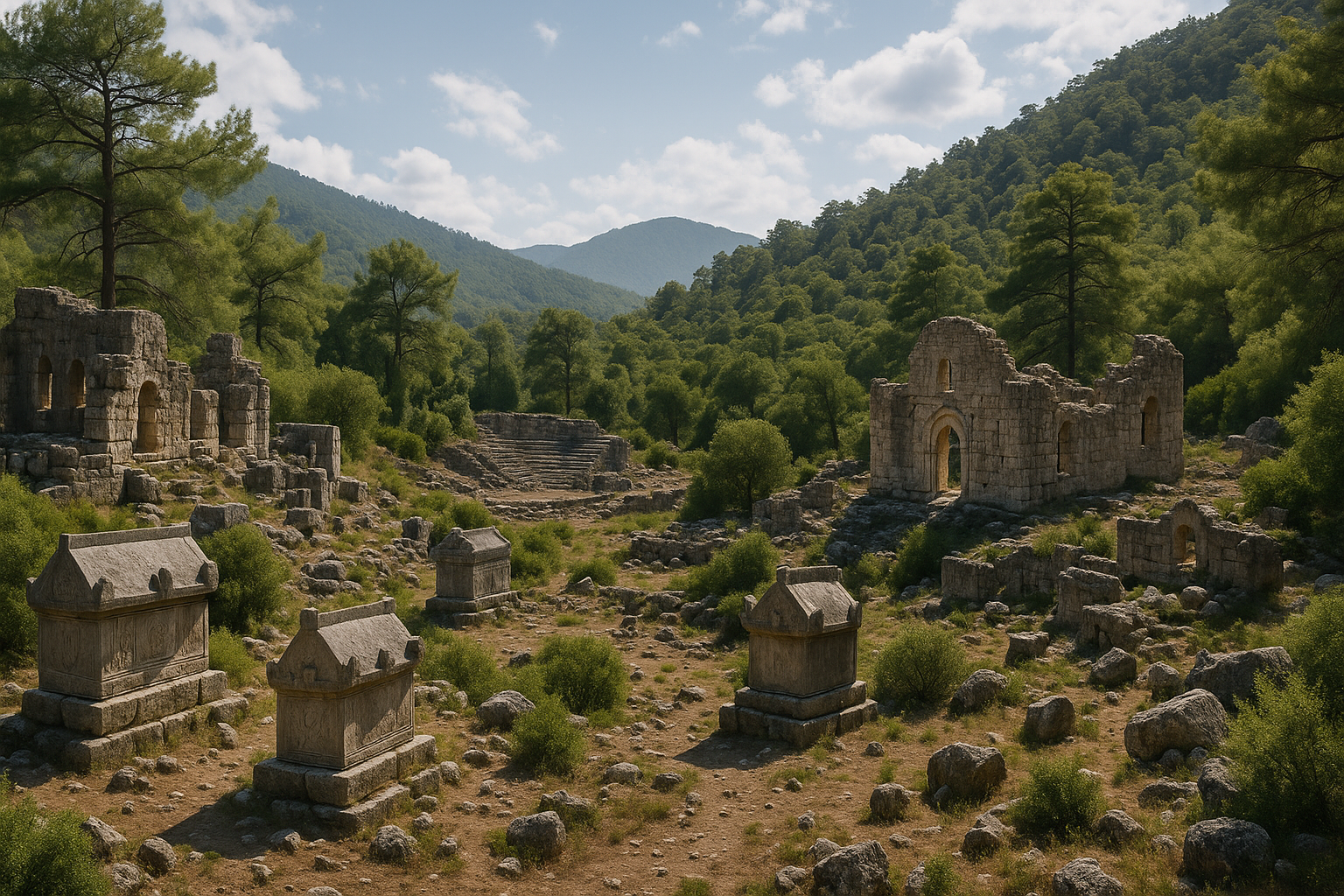
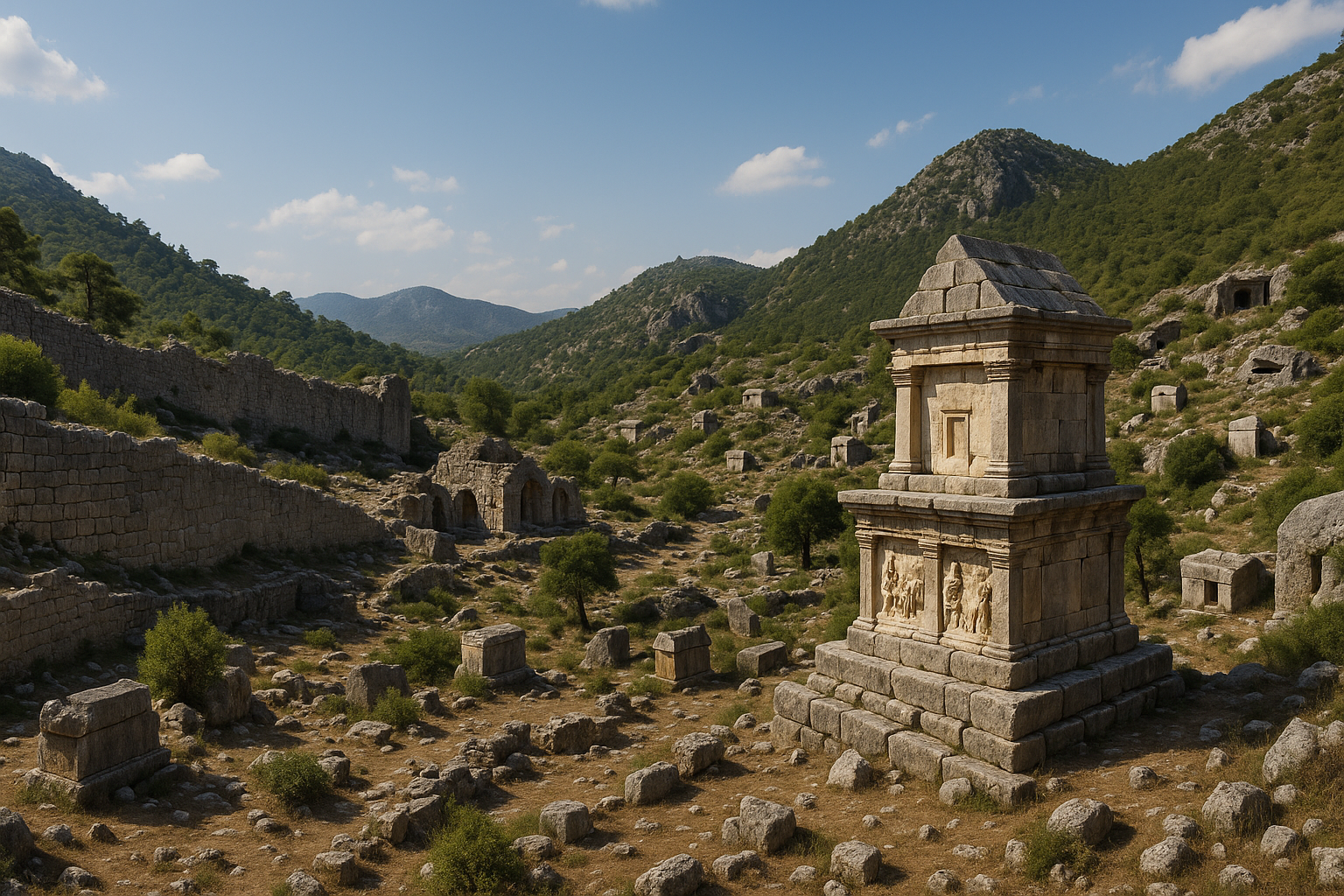
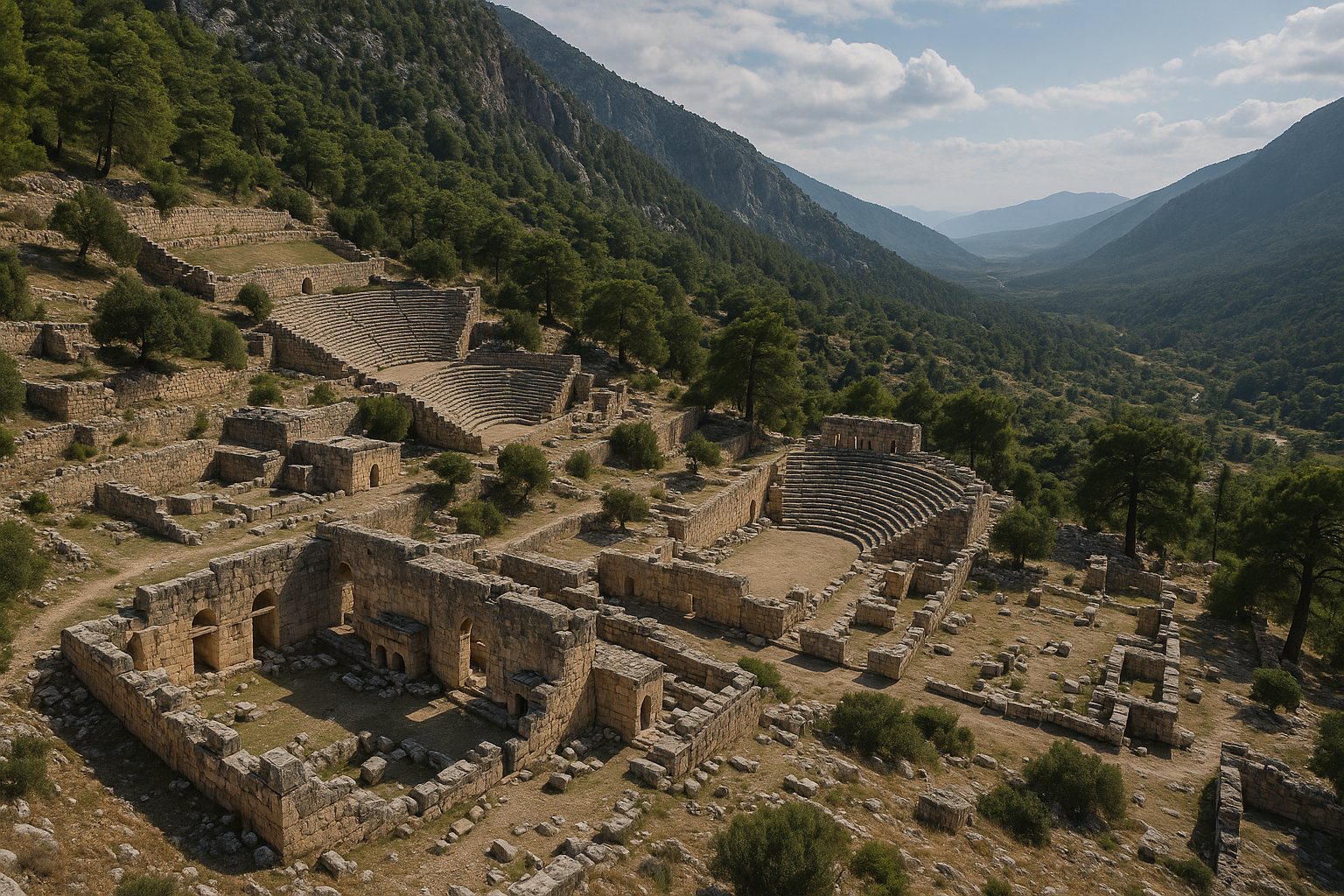
Olympos was one of the most powerful cities of the Lycian League, holding three votes in the federal assembly. Nestled in a lush river valley that opens to the Mediterranean Sea, this ancient port city is famous for the pirate lord Zenicetes, the Sarcophagus of Captain Eudemos, a Roman temple dedicated to Marcus Aurelius, and the legendary Chimaera eternal flames (Yanartas) that have burned on a nearby hillside for millennia. Today the ruins stretch along both banks of Akcay Stream, shaded by laurel, oleander, and plane trees, making Olympos one of the most atmospheric archaeological sites in all of Turkey.
- Why Olympos Matters
- Geography and Setting
- Historical Timeline
- Major Monuments
- Archaeological Work
- Visitor Information
- Frequently Asked Questions
- Sources and Further Reading
Why Olympos Matters
Olympos deserves attention for several compelling reasons:
- Lycian League powerhouse: As one of only six cities granted three votes in the Lycian federal assembly, Olympos was an economic and political heavyweight. The Lycian League itself is considered one of the earliest examples of representative democracy and directly influenced the framers of the United States Constitution.
- Pirate stronghold of Zenicetes: In the 1st century BC, the Cilician pirate Zenicetes seized Olympos as his base of operations, disrupting Mediterranean shipping until the Roman general Publius Servilius Vatia besieged the city in 78 BC. Rather than surrender, Zenicetes set fire to his own fortress and perished with his family.
- Chimaera and Hephaestus worship: The naturally burning gas vents on nearby Yanartas hill gave rise to the myth of the fire-breathing Chimaera monster. A Temple of Hephaestus, god of fire and the forge, stood near the flames and drew pilgrims from across the ancient world.
- Unique river-valley urban plan: Unlike most Lycian cities perched on hilltops, Olympos was built along a stream valley, giving it a distinctive linear layout split into north and south quarters by the Akcay.
- Remarkable state of preservation within nature: The dense Mediterranean vegetation that overtook the site after its abandonment paradoxically preserved many structures from stone robbing, resulting in walls, tombs, and mosaics still standing amid the forest canopy.
Geography and Setting
Olympos lies on the southern coast of Lycia, approximately 73 km southwest of Antalya and within the boundaries of the Kumluca district. The site occupies a narrow, fertile valley formed by Akcay Stream (ancient name unknown) as it descends from the flanks of Mount Olympos (Tahtali Dagi, 2,366 m) to the sea.
| Feature | Detail |
|---|---|
| Coordinates | 36.40 N, 30.47 E |
| Elevation | Sea level to approximately 50 m |
| Nearest modern settlement | Cirali village, 2 km northwest |
| National park | Olympos-Beydaglari Coastal National Park |
| Climate | Mediterranean; hot dry summers, mild rainy winters |
The valley runs roughly east--west. The city is bisected by the stream: the south bank houses the main civic and religious structures, while the north bank contains residential areas, a necropolis, and later Byzantine constructions. A sandy beach at the river mouth once served as the ancient harbor. The mountains rising sharply on both sides created a naturally defended corridor, which explains why the city could resist both pirate rivals and Roman siege forces for extended periods.
The surrounding landscape is dense maquis and Mediterranean pine forest, part of one of the most biodiverse coastal strips in Turkey. The rare Lycian salamander (Lyciasalamandra) is found in the vicinity.
Historical Timeline
Hellenistic Foundation (3rd--2nd century BC)
The earliest definite references to Olympos date to the 2nd century BC, when the city appears on Lycian League coinage and in regional inscriptions. The city was likely founded in the 3rd century BC during the period of Ptolemaic and then Seleucid influence over Lycia. It quickly grew wealthy through maritime trade and the exploitation of timber from the Tahtali mountain slopes.
Lycian League Membership
Olympos held three votes in the Lycian League assembly -- the maximum allotment, shared with only five other major cities: Xanthos, Patara, Pinara, Tlos, and Myra. This status reflects the city's wealth, population, and strategic importance as a port. Member cities contributed financially to the league in proportion to their voting weight.
The Pirate Era (early 1st century BC)
The political instability of the late Hellenistic period allowed Cilician pirates to dominate the eastern Mediterranean. Zenicetes, the most powerful of these pirate lords, established his headquarters at Olympos and also controlled neighboring Phaselis and Corycus. The pirates disrupted Roman shipping lanes, kidnapped travelers, and ransomed or enslaved captives.
In 78 BC, the Roman proconsul of Cilicia, Publius Servilius Vatia (later given the honorific cognomen "Isauricus"), launched a campaign against the pirates. He besieged Olympos, and Zenicetes, seeing no escape, set fire to his stronghold and died in the flames along with his family. The young Julius Caesar reportedly accompanied Servilius Vatia during this campaign.
After the pirate defeat, Olympos was separated (or expelled) from the Lycian League due to its association with piracy. The city would not regain full membership.
Roman Imperial Period (1st century BC -- 3rd century AD)
Following the Roman annexation of Lycia as a province in 43 AD under Emperor Claudius, Olympos entered a new era of prosperity. The most significant surviving monument from this period is the temple gateway dedicated to Emperor Marcus Aurelius in 172--173 AD, reflecting the Corinthian architectural order. A Roman bath complex, warehouses, and quay walls were constructed along the harbor.
Olympos also became an important center of the cult of Hephaestus (Roman Vulcan), directly linked to the natural flames of the Chimaera. A paved Roman road connected the city to the Yanartas sanctuary.
Byzantine Period (4th--7th century AD)
Olympos continued as a bishopric seat under the Byzantine Empire. Several basilica churches were constructed, their floors adorned with fine opus tessellatum mosaics. A 5th--6th century Byzantine bathhouse associated with a bishop was uncovered during excavations in 2025. The city gradually contracted as Arab naval raids along the Lycian coast increased during the 7th century.
Venetian and Genoese Contacts (12th--15th century)
Medieval sources mention Olympos in connection with Venetian and Genoese trading activities along the Anatolian coast. A medieval fortress was constructed on the hilltop south of the valley, likely by Crusader-era European traders or local Armenian lords. The city was eventually abandoned as trade routes shifted.
Major Monuments
Sarcophagus of Captain Eudemos
Located near the ancient harbor entrance on the south bank, this late 2nd century AD marble sarcophagus is one of the most iconic artifacts at Olympos. The front panel features a detailed relief of a merchant vessel -- an invaluable document for understanding ancient shipbuilding and rigging. An accompanying Greek inscription includes a poem honoring the captain's life at sea. The sarcophagus demonstrates Olympos's deep connection to maritime commerce.
Temple Gate (Marcus Aurelius Temple)
The monumental gateway on the south bank is the best-preserved standing structure at Olympos. Erected in 172--173 AD and dedicated to Emperor Marcus Aurelius, the gate features Corinthian capitals, fluted columns, and an ornate entablature. This structure likely served as the entrance to a larger temple precinct. The inscription on the architrave records the dedication by the citizens of Olympos.
Roman Bath Complex
A large bathhouse stands near the temple gate on the south bank. The structure includes the typical Roman sequence of frigidarium (cold room), tepidarium (warm room), and caldarium (hot room), with visible hypocaust heating channels beneath the floor. Wall niches once held statues. The bath served as a social gathering place as much as a hygiene facility.
Basilica Churches and Mosaics
At least three early Christian basilicas have been identified in the city. Their floors contain polychrome opus tessellatum mosaics with geometric and vegetal designs. The largest basilica, near the stream, had a three-aisled nave and a semicircular apse. These churches document Olympos's transition to Christianity during the Byzantine period.
Byzantine Bathhouse (Bishop's Bath)
Excavations in 2025 revealed a 5th--6th century Byzantine bathhouse linked to the local bishopric. The complex includes heated rooms and water channels, demonstrating that bathing culture continued in Olympos well into the Christian period.
Necropolis and Rock Tombs
The north bank features an extensive necropolis with a mix of Lycian rock-cut tombs, freestanding sarcophagi, and simple pit graves spanning several centuries. Some tombs bear Greek inscriptions recording the names and professions of the deceased, including sailors, merchants, and soldiers.
Mosaic Building
On the south bank, a structure sometimes called the "Mosaic Building" preserves elaborate floor mosaics with figurative and geometric motifs. The exact function of this building -- whether a wealthy private residence or a public hall -- remains debated.
Harbor and Quay Walls
The ancient harbor at the mouth of Akcay Stream is now silted up, but portions of ashlar quay walls remain visible, indicating a once-functional port capable of handling seagoing vessels. Warehouses and loading docks lined the stream banks closer to the sea.
Medieval Fortress
A hilltop fortress south of the valley dates primarily to the 12th--13th century and was likely used by Venetian or Genoese traders and possibly local Armenian lords. The walls are built partly from reused ancient blocks. The fortress commands views of the valley, beach, and sea approaches.
Chimaera (Yanartas)
Though technically outside the city proper, the Yanartas natural gas vents are inseparable from the identity of Olympos. Located about 3.5 km to the southwest on a hillside at roughly 250 m elevation, dozens of small flames emerge from fractures in ophiolite rock where methane and hydrogen seep from deep geological sources. These flames have burned continuously for at least 2,500 years and are visible from the sea at night. In antiquity, a Temple of Hephaestus stood here, and the phenomenon inspired the myth of the Chimaera -- a fire-breathing monster with a lion's head, goat's body, and serpent's tail, slain by the hero Bellerophon riding the winged horse Pegasus.
Archaeological Work
Systematic archaeological study of Olympos has been relatively limited compared to other major Lycian sites:
- 1910s: Austrian scholars produced early topographical sketches of the site.
- 1950s--1970s: Survey work by the Turkish Ministry of Culture and international scholars mapped the principal monuments.
- 2000s--2010s: Turkish universities conducted cleaning, conservation, and limited excavation campaigns, focusing on the temple gate, baths, and basilicas.
- 2025: Excavations led by Turkish archaeologists uncovered a 5th--6th century Byzantine bathhouse associated with the bishopric, significantly expanding knowledge of the city's late antique phase.
Much of Olympos remains unexcavated beneath dense vegetation and river sediment. The site's inclusion within the Olympos-Beydaglari Coastal National Park provides environmental protection but also constrains large-scale excavation.
Visitor Information
Location and Access
| Detail | Information |
|---|---|
| Distance from Antalya | 73 km southwest (approx. 1.5 hours by car) |
| Distance from Kumluca | 25 km south |
| Access road | Paved road from the D-400 highway, turning at Yanartas junction |
| Parking | Available at the site entrance |
| Public transport | Minibuses from Antalya and Kumluca to Cirali/Olympos |
Transport Options
- By car: Take the D-400 coastal highway from Antalya toward Kumluca; turn south at the Olympos/Cirali signpost. The final 11 km descend through pine forest to the valley.
- By minibus: Regular dolmus services operate from Antalya bus station (Otogar) to Olympos village and Cirali, especially in summer.
- By tour: Day trips from Antalya, Kemer, and surrounding resorts are widely available and usually combine Olympos with Yanartas.
Visit Duration
- Quick visit: 1.5--2 hours for the main south-bank monuments and beach
- Standard visit: 3--4 hours to explore both banks, necropolis, and harbor area
- Combined visit with Yanartas: Add 1.5--2 hours for the Chimaera hike (best done at dusk or after dark)
Best Time to Visit
- Spring (April--May): Wildflowers in bloom, comfortable temperatures, moderate crowds
- Autumn (September--October): Pleasant weather, fewer visitors
- Summer: Very hot during midday; visit early morning or late afternoon
- Yanartas: Most impressive after dark when the flames are clearly visible
Combined Visits
- Yanartas (Chimaera): 3.5 km southwest, accessible by a 20-minute uphill trail from Cirali
- Phaselis: 25 km northeast along the coast, another Lycian League city with well-preserved Roman streets and harbors
- Adrasan Bay: A scenic beach cove 10 km south
- Tahtalı Mountain (Olympos Teleferik): Cable car to the 2,366 m summit for panoramic views
Practical Tips
- Wear sturdy walking shoes; the terrain includes rocky paths, stream crossings, and uneven ground.
- Bring water and sun protection; there is limited shade in some areas.
- The path to the beach passes through the ruins, so you will encounter the archaeology naturally.
- Swimming is possible at the sandy beach at the river mouth.
- Mosquito repellent is useful in the valley, especially in summer evenings.
- There is an entrance fee to the archaeological site.
- Cirali village offers guesthouses, restaurants, and camping.
Frequently Asked Questions
What is the connection between Olympos and the Chimaera?
The Yanartas natural gas vents, located 3.5 km southwest of Olympos, produce permanently burning flames from underground methane seepage. Ancient Greeks attributed these flames to the Chimaera, a fire-breathing monster of Lycian mythology. A Temple of Hephaestus (god of fire) was built at the site, and Olympos prospered partly as a pilgrimage center for worshippers visiting the sanctuary. The myth says the hero Bellerophon, riding the winged horse Pegasus, slew the Chimaera near this spot.
Who was Zenicetes and what happened to him?
Zenicetes was a powerful Cilician pirate lord who seized Olympos and nearby Phaselis in the early 1st century BC, using them as bases for raids on Mediterranean shipping. In 78 BC, the Roman proconsul Publius Servilius Vatia attacked the pirate strongholds. When defeat was certain, Zenicetes set fire to his fortress and died in the blaze along with his family rather than face Roman capture. The young Julius Caesar reportedly participated in this campaign.
Can I swim at Olympos beach?
Yes. The archaeological site path leads directly to a beautiful sandy beach at the mouth of Akcay Stream. Swimming is permitted. The beach is also accessible from Cirali village. It is a designated Caretta caretta (loggerhead sea turtle) nesting site, so certain areas may be roped off during nesting season (May--August).
How does Olympos compare to other Lycian sites like Patara or Myra?
Olympos offers a distinctly different experience from Patara (open sand dunes, parliament building) or Myra (rock tombs, theater). Olympos is characterized by its forest-covered valley setting, the dramatic river running through the ruins, and the nearby Chimaera flames. While less formally excavated than Patara, Olympos has a raw, atmospheric quality that many visitors find more immersive.
Is there an entrance fee?
Yes. The archaeological site charges an entrance fee. Check current prices at the Turkish Ministry of Culture and Tourism website or at the ticket booth. The Museum Pass Turkey is accepted.
Is Olympos suitable for families with children?
Yes, with caveats. The terrain is uneven and some areas require careful footing. However, the combination of ancient ruins, river, beach, and the Chimaera flames makes it an exciting and educational experience for children. The beach is a highlight for families.
Architectural Measurements and Structural Data
The excavated monuments at Olympos provide precise dimensional evidence for the city's Roman and Byzantine phases.
Temple Gate of Marcus Aurelius (AD 172--173)
| Parameter | Detail |
|---|---|
| Height | 4.88 m (preserved standing height) |
| Architectural order | Ionic with Corinthian-influenced capitals |
| Lintel decoration | Acanthus-leaf ornament with an unfinished bead-and-reel moulding |
| Location | 150 m west of the river mouth, south bank |
| Inscription | Dedicatory text recording construction by the citizens of Olympos in honour of Emperor Marcus Aurelius |
The gate is the tallest standing structure at the site and originally served as the entrance to a temple precinct. The unfinished bead-and-reel motif on the lintel may indicate that construction was interrupted -- possibly by the economic or military pressures of the late Antonine period.
Sarcophagus of Captain Eudemos
The northern sarcophagus in the harbour-side mausoleum belongs to Captain Eudemos, uncle of the tomb's other occupant, Marcus Aurelius Zosimas. The front panel bears a carved relief of a merchant vessel depicted without sails, mast, or oars, with an image of Aphrodite on the prow. A Greek verse inscription records that Eudemos sailed as far as the Sea of Marmara and the Black Sea, documenting Olympos's long-distance trade connections. The adjacent eastern sarcophagus of Zosimas carries complementary funerary texts.
Roman Bath Complex (South Bank)
The south-bank bathhouse preserves the standard Roman bathing sequence:
| Room | Function | Visible Features |
|---|---|---|
| Frigidarium | Cold room | Plunge pool basin |
| Tepidarium | Warm transition room | Brick pilae supports |
| Caldarium | Hot room | Hypocaust channels beneath floor; wall niches for statues |
Heated air circulated under the raised floor via the hypocaust system. The caldarium's walls retain traces of tubuli (hollow clay pipes) that vented heat upward through the wall fabric.
Numismatic Evidence
Olympos appears on Lycian League coinage minted from 167--168 BC onward. As a three-vote city, Olympos's mint-mark confirms its status at the apex of the federal hierarchy.
| Period | Coin Type | Obverse | Reverse | Notes |
|---|---|---|---|---|
| 167--100 BC | AR drachm (Lycian League) | Apollo laureate | Lyre; legend "OLYMPOS" | Federal issue; Attic weight standard |
| 1st century BC | Reduced league coinage | Apollo head | Lyre with city monogram | Declining weight reflects economic disruption during pirate era |
| Roman Imperial | Bronze provincial | Portrait of emperor | Hephaestus standing with tongs | Reflects the city's cult of the fire-god linked to the Chimaera flames |
The presence of Hephaestus (Vulcan) on Roman-period bronzes is distinctive to Olympos and directly references the Yanartas eternal flames. No other Lycian city employed this deity as a civic emblem with such consistency.
Excavation Chronology and Epigraphic Corpus
| Year / Period | Team / Activity | Key Results |
|---|---|---|
| 1910s | Austrian scholars | First topographical sketches and site plan |
| 1950s--1970s | Turkish Ministry of Culture; international scholars | Principal monument survey and mapping |
| 1998--present | Turkish university-led systematic excavations | Ongoing campaigns in necropolis, churches, baths, harbour zone |
| 2024 | Excavation team | Four new funerary inscriptions recorded in necropolis: Tomb of Epiktesis, Tomb of Midas, Tomb of Zosimos, and one undeciphered owner |
| 2025 | Turkish archaeologists | 5th--6th century Byzantine bathhouse (Bishop's Bath) uncovered; church mosaics with inscription "Only those on the right path may enter here" |
Since 1998, excavations have recovered more than 50 Greek and Latin inscriptions, significantly expanding the epigraphic corpus for Roman Lycia. Material finds include ceramics attesting to long-distance trade networks until the 7th century and a substantial assemblage of Roman and Early Byzantine glass (2nd--7th centuries), both conforming to the stratigraphic dating of their respective layers.
The mosaic inscription discovered at Church No. 1 -- "Only those on the right path may enter here" -- was placed directly before the main entrance, functioning as a spiritual threshold marker for 5th-century Christian worshippers. Additional mosaics in the nave and side aisles feature geometric and botanical motifs alongside inscriptions naming the patrons who financed the church's construction.
Sources and Further Reading
- Adak, M. and Atvur, O. "Das Grabmal des C. Licinius Flavianus Iulianus in Olympos." Epigraphica Anatolica, 2006.
- Bean, G. E. Lycian Turkey: An Archaeological Guide. London: Ernest Benn, 1978.
- Bryce, T. The Lycians in Literary and Epigraphic Sources. Copenhagen, 1986.
- Turkish Ministry of Culture and Tourism -- Antalya Olympos Archaeological Site
- Turkish Archaeological News -- Olympos
- Wikipedia -- Olympus (Lycia)
- Vikipedi -- Olimpos, Kumluca
The Lycian League: Context for Olympos
The Lycian League (Lycian Federal Union) was a federation of independent Lycian cities that operated from roughly the 2nd century BC to 43 AD, when the Roman emperor Claudius dissolved it and incorporated Lycia as a Roman province. The league is considered one of the earliest examples of representative federalism and attracted the attention of Montesquieu and Alexander Hamilton.
How the League Worked
- Member cities were assigned one, two, or three votes based on their size, wealth, and strategic importance.
- Cities with three votes (including Olympos) had the greatest political and financial obligations, contributing proportionally to the league's military and treasury.
- The league assembled at a common meeting place, elected a Lyciarch (federal president), and maintained a shared judicial system.
- Coinage was minted in the league's name, creating a unified monetary system.
Olympos's Role
As a three-vote city, Olympos stood alongside Xanthos, Patara, Pinara, Tlos, and Myra at the apex of the Lycian political hierarchy. Its port location made it essential for the league's maritime trade and naval defense. The pirate crisis of the 1st century BC, when Zenicetes turned Olympos into a pirate base, directly threatened the league's stability and may have led to Olympos being expelled from the federation.
The Mythology of the Chimaera
The Chimaera (Greek: Khimaira) is one of the most vivid monsters of Greek mythology. Ancient sources describe it as:
- A creature with a lion's head, a goat's body, and a serpent's tail
- Capable of breathing fire from its mouth
- Native to Lycia, where it terrorized the countryside
According to Homer's Iliad (Book VI), the Lycian king Iobates sent the hero Bellerophon to slay the Chimaera, expecting him to perish. Instead, Bellerophon mounted the winged horse Pegasus and attacked the monster from the air, driving a lead-tipped lance into its mouth. The lead melted from the Chimaera's fire breath and suffocated it.
The connection between this myth and the Yanartas gas vents is clear: the permanently burning flames on the Lycian hillside provided a tangible, visible origin for the legend of a fire-breathing creature. Ancient sailors approaching the coast at night would have seen the flames flickering on the mountainside -- a powerful and mysterious sight.
Scientific Explanation
Modern geological analysis has identified the Yanartas flames as the result of abiogenic methane and hydrogen seeping through fractures in ophiolite rock (serpentinized peridotite). The gas originates from deep geological processes rather than organic decomposition, which is why it has burned for millennia without exhaustion. The Yanartas vents are studied by geologists as a natural laboratory for understanding hydrogen production in the Earth's mantle.
Olympos in the Context of the Lycian Way
The Lycian Way (Likya Yolu) is a long-distance hiking trail stretching approximately 540 km from Fethiye to Antalya along the ancient Lycian coast. Marked and developed by British-Turkish hiker Kate Clow beginning in 1999, it is considered one of the world's great long-distance trails.
Olympos and Yanartas are key waypoints on the Lycian Way:
- The trail passes directly through the Olympos valley and the archaeological site.
- The Yanartas (Chimaera) detour is a highlight of the eastern section.
- Hikers can walk from Adrasan to Olympos and onward to Cirali and Tekirova in multi-day segments.
For long-distance hikers, Olympos offers both a cultural landmark and practical amenities (accommodation, food, beach access) that make it a natural rest stop on the trail.
Conservation and Environmental Context
Olympos lies within the Olympos-Beydaglari Coastal National Park, one of Turkey's most important protected coastal areas. The park encompasses:
- Dense Mediterranean forests of Turkish pine (Pinus brutia), cedar, and mixed maquis
- Critical habitat for the endangered Caretta caretta (loggerhead sea turtle), which nests on Cirali beach
- The rare Lycian salamander (Lyciasalamandra fazilae)
- One of the last undeveloped stretches of Turkey's Mediterranean coast
The intersection of archaeological heritage and natural conservation at Olympos creates both opportunities and challenges. The forest that preserved the ruins from stone robbing also complicates excavation. The turtle nesting site requires beach management that balances tourism with wildlife protection.
Recent Discoveries (2024--2025)
Olympos has experienced a period of intensified excavation activity in recent years, with significant new findings:
Church Mosaics and Inscriptions
Archaeologists working at Olympos uncovered beautifully preserved mosaics and an inscription at the entrance of a fifth-century church. The most sensational find was a mosaic inscription reading "Only those on the right path may enter here", placed just in front of the main entrance of Church No. 1. This inscription was designed to guide early Christian worshippers entering the sanctuary. Additional mosaics found in the main and side sections of the church feature elaborate geometric and botanical motifs alongside inscriptions naming the patrons who financed the construction.
New Epigraphic Finds
During the 2024 season, four new inscriptions were recorded in the necropolis area:
- The Tomb of Epiktesis and his Family
- The Tomb of Midas and his Family
- The Tomb of Zosimos and his Family
- A tomb whose owner's name remains undeciphered
These inscriptions provide new data on family structures, naming conventions, and social status in Roman and Late Antique Olympos.
Ongoing Excavation Plans
The broader excavation project includes current work in the western necropolis, the Bishop's Palace, Church No. 3, and a newly identified temple area. The team aims to complete work in the northern sector of the city over the coming years before shifting focus to Olympos's southern region.
Timeline Summary
| Date | Event |
|---|---|
| 3rd century BC | Probable founding of the city |
| 2nd century BC | Olympos appears in Lycian League coinage |
| Early 1st century BC | Zenicetes seizes Olympos as pirate base |
| 78 BC | Roman siege; Zenicetes dies in fire |
| 43 AD | Lycia becomes a Roman province |
| 172--173 AD | Temple gateway dedicated to Marcus Aurelius |
| 4th--7th century | Olympos as Byzantine bishopric |
| 5th--6th century | Church mosaics and Bishop's Bathhouse constructed |
| 12th--13th century | Medieval fortress built on hilltop |
| 2024--2025 | Major mosaic and inscription discoveries |