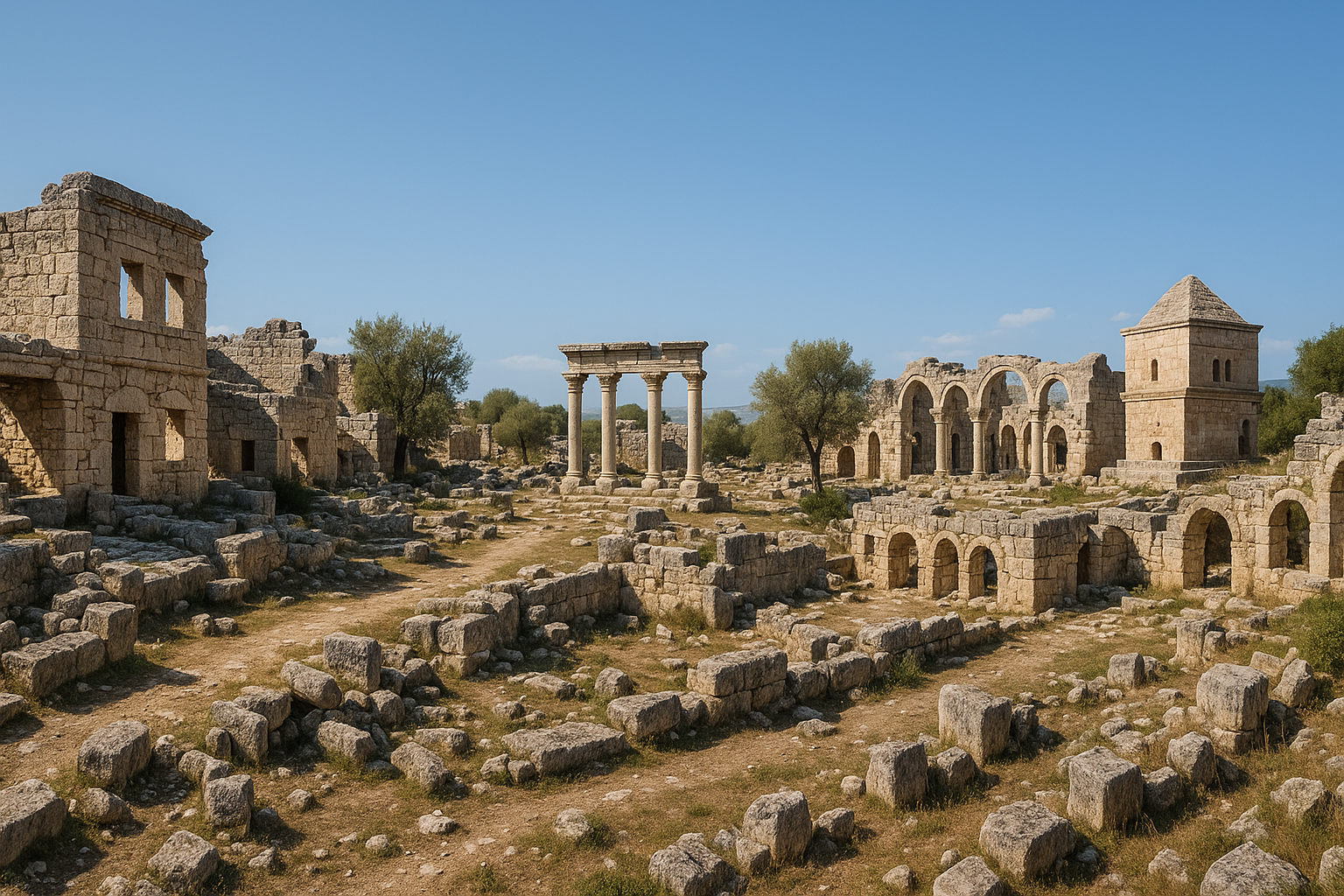
Quick Summary: Alahan Monastery (also known as Alahan Manastırı or Koja Kalesi) is one of the most remarkable early Byzantine architectural complexes in the Mediterranean, perched dramatically on a steep mountain slope at 1,300 metres elevation overlooking the Göksu Valley near Mut in Mersin Province. Built primarily during the 5th century AD under Emperors Leo I and Zeno, the complex includes two magnificent churches — the West Church (Church of the Evangelists) and the East Church (Domed Church) — connected by a colonnaded walkway, along with a baptistery, living quarters, and rock-cut chambers. Renowned for its exceptional Isaurian stone-carving tradition, elaborate sculptural decoration, and stunning natural setting, Alahan is considered one of the most important surviving examples of pre-Justinianic architecture. The site is on Turkey's UNESCO World Heritage Tentative List.
- Why Alahan Matters
- Geography and Setting
- Historical Background
- The West Church (Church of the Evangelists)
- The East Church (Domed Church)
- The Baptistery
- Other Structures
- The Isaurian Stone-Carving Tradition
- Sculptural Programme
- Pilgrimage and Monastic Life
- Archaeological Investigations
- Visitor Information
- Frequently Asked Questions
- Sources and Further Reading
Why Alahan Matters
Alahan is significant for several reasons:
Pre-Justinianic architecture: The complex dates to the 5th century — before the great building campaigns of Justinian I (527–565). This makes it one of the most important surviving examples of early Byzantine architecture, preserving forms and techniques that were later superseded by the Justinianic style.
The Domed Church: The East Church at Alahan is one of the earliest known examples of a domed basilica — a building type that would later culminate in Hagia Sophia. Its architectural innovations influenced the development of Byzantine church design.
Isaurian craftsmanship: The quality of the stone carving at Alahan is exceptional. The Isaurian tradition of architectural sculpture — characterised by deeply carved, naturalistic vine scrolls, animal figures, and geometric patterns — reached its peak here. The carved door frames, window surrounds, and cornices are masterpieces of late antique decorative art.
Natural setting: The site's dramatic position on a steep mountainside overlooking the Göksu Valley creates one of the most spectacular archaeological settings in Turkey. The combination of ruined stone architecture, mountain cliffs, and panoramic views is unforgettable.
Pilgrimage: Recent scholarship suggests Alahan functioned primarily as a pilgrimage shrine rather than a traditional monastery, attracting Christian travellers to a sacred site in the Isaurian mountains.
Geography and Setting
Alahan is located on the northern slopes of the Taurus Mountains, approximately 20 km north of Mut in Mersin Province, at an elevation of about 1,300 metres. The complex is built on a narrow terrace cut into a steep cliff face, with dramatic drops below and rocky crags above.
The site overlooks the Göksu Valley (the ancient Calycadnus River valley), which was a major route connecting the Cilician coast with the interior of Anatolia. The ancient road from Silifke (Seleucia on the Calycadnus) to Karaman (Laranda) passed through this valley, making the location accessible to pilgrims and travellers.
The region of Isauria — the rugged mountainous interior of Cilicia — had a distinctive cultural identity in late antiquity. The Isaurians were known as fierce mountain warriors who alternately served and resisted Roman and Byzantine authority. Several emperors (Leo I's wife Verina was Isaurian; Zeno was fully Isaurian) had connections to the region, which may explain the imperial patronage of Alahan.
The surrounding landscape is characterised by pine and cedar forests, rocky limestone outcrops, and deep valleys — a wild and beautiful terrain that enhanced the site's spiritual atmosphere.
Historical Background
Foundation (Mid-5th Century)
The first phase of construction occurred in the mid-5th century, probably under Emperor Leo I (r. 457–474). The West Church and associated residential structures were built during this period. Imperial patronage is suggested by the scale and quality of the construction.
Second Phase (Late 5th Century)
The East Church (Domed Church) was built in the last quarter of the 5th century, most likely under Emperor Zeno (r. 474–491), who was himself of Isaurian origin. Zeno's connection to the region would explain the extraordinary investment in a site located in his ancestral homeland.
Pilgrimage and Monastic Use
The complex functioned as both a pilgrimage shrine and a monastic community from the 5th through 7th centuries. The scale of the buildings and the presence of a baptistery suggest it attracted significant numbers of visitors.
Decline
The site appears to have been abandoned by the 7th century, probably due to the disruption of the Arab-Byzantine frontier wars and the decline of pilgrimage traffic. Its remote mountain location preserved the ruins from later stone-robbing.
The West Church (Church of the Evangelists)
The West Church is the larger of the two churches:
- Three-aisled basilica plan with a central nave and two side aisles
- Dimensions: approximately 36 × 16 metres — a substantial church
- The nave was separated from the aisles by two rows of columns supporting an upper clerestory
- Apse at the east end with a semicircular plan
- Named "Church of the Evangelists" because of carved evangelist symbols (the four winged creatures: man, lion, ox, eagle) on its decoration
- The western entrance is framed by an elaborate carved portal with vine-scroll decoration
- Much of the north wall survives to a significant height, preserving the original window openings
- The quality of the ashlar masonry is exceptional — tightly fitted limestone blocks with minimal mortar
The East Church (Domed Church)
The East Church is the architecturally more innovative structure:
- Domed basilica plan — combining the longitudinal basilica form with a central dome
- This makes it one of the earliest known domed basilicas in Christian architecture
- The dome was supported on squinches (arched structures spanning the corners of a square base to support a circular dome) — a technique that would become fundamental to Byzantine architecture
- Richly decorated with sculptural reliefs on the exterior, including elaborate cornices, window frames, and door surrounds
- The south façade features an extraordinary carved relief panel with vine scrolls, animals, and geometric patterns
- Built of precisely cut limestone ashlar in the Isaurian tradition
- The dome has collapsed, but the walls survive to considerable height, allowing reconstruction of the original design
The Baptistery
A twin-apsed baptistery lies between the two churches:
- Two aisles oriented east-west
- A cruciform baptismal pool confirming its function as a baptistery — candidates for baptism would descend into the cross-shaped pool
- The presence of a baptistery indicates that Alahan was a site where converts were baptised, supporting its identification as a pilgrimage centre rather than a purely monastic community
- The baptistery's position between the two churches suggests a liturgical procession from baptism to communion
Other Structures
The Colonnade
A colonnaded walkway connects the West Church to the East Church, running along the edge of the cliff terrace:
- Columns of varying types (some with Corinthian capitals)
- The walkway created a sheltered processional route between the two churches
- Views from the colonnade over the Göksu Valley are spectacular
Rock-Cut Chambers
Several rock-cut chambers are carved into the cliff face behind the built structures:
- Some served as monks' cells (individual living quarters)
- Others may have been storage rooms or burial chambers
- A large rock-cut chamber (sometimes called the "cave church") may have been an earlier place of worship predating the built churches
Living Quarters
Remains of residential buildings on the lower terrace served the monastic community:
- Communal spaces for dining and assembly
- Individual cells for monks
- Service buildings for storage and food preparation
Forecourt
A forecourt at the western end of the complex served as the main entrance area for visitors arriving from the valley below.
The Isaurian Stone-Carving Tradition
Alahan is the finest surviving example of the Isaurian school of architectural stone carving:
Characteristics
- Deeply carved reliefs with strong three-dimensional modelling
- Vine-scroll motifs — continuously spiralling grapevine tendrils with leaves, clusters, and animals nestled among the scrolls
- Naturalistic animal figures — birds, rabbits, deer, and lions
- Geometric interlace patterns — complex knotwork designs
- Christian symbols integrated into decorative schemes — crosses, chi-rho monograms, and evangelist symbols
- High-quality limestone from local quarries, well-suited to detailed carving
Significance
The Isaurian stone-carving tradition represents one of the peak achievements of late antique decorative art. The Alahan carvings influenced later Byzantine decoration and have parallels with contemporary Coptic and Syrian artistic traditions, suggesting cultural connections across the eastern Mediterranean.
Sculptural Programme
Alahan's sculptural decoration includes:
Evangelist Symbols
The four evangelist symbols — the angel (Matthew), lion (Mark), bull (Luke), and eagle (John) — appear on the West Church, giving it the name "Church of the Evangelists."
Vine Scrolls
Inhabited vine scrolls (vine tendrils containing animals and birds) are the dominant decorative motif, covering door frames, window surrounds, and cornices. The vine is a powerful Christian symbol representing Christ ("I am the vine, you are the branches" — John 15:5).
Animal Figures
Carved animals include eagles, lions, deer, rabbits, and various birds. These may represent both decorative naturalism and symbolic Christian meanings (the eagle = resurrection; the deer = the soul thirsting for God; the lion = Christ).
Archangel Gabriel
A carved relief of the Archangel Gabriel appears on the East Church — one of the finest examples of figural sculpture from the early Byzantine period in Anatolia.
Pilgrimage and Monastic Life
Recent scholarship has refined the understanding of Alahan's function:
Pilgrimage Shrine
The scale of the complex, the presence of a baptistery, and the elaborate decoration suggest that Alahan was primarily a pilgrimage shrine — a sacred place that attracted Christian visitors rather than a purely enclosed monastic community.
The specific focus of pilgrimage is uncertain — it may have been associated with a local saint's cult (possibly the tomb of a holy man in the rock-cut chambers) or with the dramatic natural setting itself, which was understood as a manifestation of divine power.
Monastic Community
A permanent monastic community maintained the site and served pilgrims. The monks would have conducted daily liturgical services in the churches, administered baptisms, and provided hospitality to visitors.
Regional Context
Alahan was part of a network of Christian pilgrimage sites in the Isaurian mountains. The nearby site of Dag Pazarı contains another significant early Byzantine church, and the broader region of Cilicia included the pilgrimage centre of St. Thecla at Seleucia (Silifke).
Archaeological Investigations
Early Discovery
- The site was first described by European travellers in the 19th century
- William Ramsay and Gertrude Bell both visited and described the ruins
Michael Gough Excavations
- Michael Gough (University of Toronto) conducted the most important excavations in the 1950s–1970s
- He published the first comprehensive study of the complex
- His work established Alahan's significance in the history of Byzantine architecture
Recent Work
- Turkish conservation teams have undertaken stabilisation and documentation work
- The site was added to Turkey's UNESCO World Heritage Tentative List in 2000
- Ongoing scholarly debate continues about the complex's function (monastery vs. pilgrimage shrine) and its relationship to imperial patronage
Visitor Information
Location: Approximately 20 km north of Mut, on the road from Mut to Karaman, Mersin Province.
Getting There: By car from Mut (30 minutes north on the Mut-Karaman road). The site is signposted from the highway. No regular public transport directly to the site. Mut is accessible by bus from Mersin (2.5 hours) and Silifke (1 hour).
Hours: The site is open daily; no formal ticket office. Access is free but may be restricted during conservation work.
Admission: Free at the time of writing.
Duration: 1–2 hours for the site.
Combined Visits:
- Mut — the Karamanid-era Lal Paşa Mosque and local museum
- Alanya or Silifke — as a day trip from the coast
- Uzuncaburç (Diocaesarea) — Roman temple city (50 km south via Silifke)
- Aya Tekla (St. Thecla) — Byzantine pilgrimage church near Silifke
Tips:
- The site's mountain setting is stunning — bring a camera
- Wear sturdy shoes for uneven rocky terrain
- The drive from Mut through the Göksu Valley is scenic
- Visit in spring or autumn for the best weather and wildflowers
- The East Church's carved decoration is the highlight — examine the door frames closely
- The colonnade offers the best views of the valley
- The site is remote — bring water and snacks
Frequently Asked Questions
What is Alahan Monastery? A 5th-century Byzantine complex on a mountainside above the Göksu Valley, featuring two churches (one of the earliest domed basilicas), a baptistery, and monastic quarters. It is one of the finest examples of early Byzantine architecture in Turkey.
Was it really a monastery? Recent scholarship suggests it functioned primarily as a pilgrimage shrine with an associated monastic community, rather than a traditional enclosed monastery.
Why is it important architecturally? The East Church is one of the earliest known domed basilicas — a building type that led to Hagia Sophia. The Isaurian stone carving represents the peak of late antique decorative art.
Is it a UNESCO site? Alahan is on Turkey's UNESCO World Heritage Tentative List (since 2000) but has not yet been formally inscribed.
Is it easy to reach? The site requires a car and is approximately 30 minutes from Mut. There is no regular public transport.
Alahan in the Byzantine World
Alahan's significance extends far beyond its mountain setting. The complex represents a critical link in the chain of architectural development that connects the early Christian basilicas of the 4th century to the great domed churches of the 6th century, culminating in Justinian's Hagia Sophia (532–537).
Architectural Innovation Chain: The East Church at Alahan demonstrates that Byzantine architects were already experimenting with dome-over-basilica solutions a full generation before Justinian's master builders Anthemius of Tralles and Isidorus of Miletus achieved the same goal at a vastly larger scale. The use of squinches at Alahan — rather than the pendentives that would later be perfected at Hagia Sophia — represents an alternative structural approach that was ultimately superseded but was clearly viable.
Imperial Isaurian Connection: The patronage of Emperors Leo I and Zeno places Alahan within a broader pattern of Isaurian imperial investment. Zeno, born Tarasicodissa in the Isaurian village of Rusumblada (modern Zenopolis), maintained strong ties to his homeland throughout his reign. The quality of Alahan's construction suggests it was not merely a provincial project but an imperially funded showcase of Isaurian culture and craftsmanship.
Comparison with Contemporary Sites: Alahan can be productively compared with several contemporary Byzantine complexes:
- Qal'at Sim'an (Syria) — the pilgrimage church of St. Simeon Stylites (c. 475–490), built during roughly the same period, demonstrates similar ambitions in creating monumental pilgrimage architecture
- Dağ Pazarı — another Isaurian mountain church nearby, sharing the same stone-carving tradition but on a smaller scale
- Meriamlik (Aya Tekla) — the pilgrimage centre of St. Thecla near Silifke, which formed part of the same regional pilgrimage network
The Question of Holy Man Veneration: One unresolved question is whether Alahan was built to honour a specific holy figure. The presence of rock-cut chambers that predate the built churches raises the possibility that an ascetic hermit — a "holy man" in the tradition studied by Peter Brown — originally occupied the mountain ledge, and his cult attracted first pilgrims and then imperial patronage for monumental construction.
Isaurian Paradox: The Isaurians are often described in Roman and Byzantine sources as "barbarians" or "bandits," yet sites like Alahan demonstrate an extraordinarily refined artistic and architectural tradition. This contradiction stems from the centralising perspective of ancient authors; the Isaurians were in fact mountain communities with deep cultural roots who maintained their distinct identity through centuries of imperial pressure.
Architectural Measurements and Structural Analysis
Detailed survey and excavation work has produced precise measurements of Alahan's buildings, revealing the ambition and technical sophistication of the 5th-century builders.
| Structure | Dimensions | Notes |
|---|---|---|
| West Church (Church of the Evangelists) | 36 x 16 m (118 x 52.5 ft) | Largest church at the complex |
| East Church (Domed Church) | 23 x 15 m (75.5 x 49 ft) | Architecturally the more innovative building |
| Cave Church | 7.5 x 7.7 m (24.5 x 25 ft) | Rock-cut chamber, possibly the earliest worship space |
| Natural Cave (western end) | ~10 m (32.8 ft) high | May have housed an ascetic hermit before the built churches |
| Site terrace (total length) | ~250 m long, ~30 m wide | Artificial ledge cut into the mountainside |
| Colonnaded walkway | ~130 m long | Built atop a heavy stone retaining wall |
| Baptismal pool | Cruciform plan | Cross-shaped immersion basin between the two churches |
The site terrace itself represents a major engineering feat: a shelf approximately 250 metres long and 30 metres wide was carved and built into the steep mountain slope, supported by a massive stone retaining wall. The creation of this level platform -- requiring the excavation and removal of thousands of tonnes of rock -- was a prerequisite for all subsequent construction and demonstrates the scale of resources available to the project's patrons.
Structural Engineering of the East Church Dome
The East Church's dome is the feature that places Alahan at the forefront of Byzantine architectural history. The dome rested on a square tower superimposed over the eastern section of the nave, a configuration that required solving the fundamental geometric problem of transitioning from a square base to a circular dome.
At Alahan, the builders employed squinches -- arched structures spanning each corner of the square -- rather than the pendentives that would later be perfected at Hagia Sophia. The squinches at Alahan are distinctive: they rest on slender columns held up by corbels carved with floral motifs and ram's heads, combining structural function with decorative artistry.
| Dome Feature | Detail |
|---|---|
| Transition element | Squinches (not pendentives) |
| Squinch support | Slender columns on carved corbels |
| Corbel decoration | Flowers and ram's heads |
| Dome material | Likely timber-framed (no stone dome fragments found in rubble) |
| Tower position | Superimposed over eastern nave bay |
Michael Gough's excavation found virtually no stone fragments that could be attributed to a fallen masonry dome among the rubble. This absence led him to conclude that the dome was probably constructed of light timber and tiles rather than solid stone -- a significant finding because it suggests the Alahan builders were experimenting with the visual form of a dome over a basilica without yet commanding the masonry techniques needed for a full stone dome. The stone dome over a basilica would not be achieved on a grand scale until Justinian's architects built Hagia Sophia in 532-537 AD, approximately half a century later.
Excavation Chronology and Key Finds
| Period | Researcher | Activities and Findings |
|---|---|---|
| 19th century | William Ramsay, Gertrude Bell | First European descriptions of the ruins; Bell photographed the site |
| 1955-1961 | Michael Gough (University of Toronto) | First systematic excavation; clearance of West Church; discovery of evangelist carvings |
| 1961-1967 | Michael Gough | Excavation of East Church; identification of squinch-dome system; baptistery clearance |
| 1967-1972 | Michael Gough | Cave church investigation; colonnade documentation; residential quarters excavated |
| 1972 | Gough dies before completing final report | Mary Gough continues publication efforts |
| 1985 | Publication | Alahan: An Early Christian Monastery in Southern Turkey published posthumously |
| 2000 | UNESCO | Site placed on Turkey's World Heritage Tentative List |
| 2000s-present | Turkish conservation teams | Stabilization, documentation, and visitor infrastructure work |
Gough's excavations revealed that the West Church had originally been decorated with sculpted masonry and rich floor mosaics, indicating wealthy patronage during the construction phase. The discovery of mosaics in a mountain monastery context is noteworthy because it implies that skilled mosaic artisans traveled to this remote highland site -- or that the project's budget was sufficient to attract them.
Among the sculptural finds, the carved relief of the Archangel Gabriel on the East Church exterior is considered one of the finest surviving examples of figural sculpture from the early Byzantine period in all of Anatolia. The companion figure of the Archangel Michael originally flanked the opposite side of the same doorway, though it is less well preserved.
Sculptural Inventory of Alahan
The carved decoration at Alahan constitutes a comprehensive programme of Christian iconography executed in the Isaurian stone-carving tradition. A systematic inventory includes:
| Motif Category | Specific Examples | Location |
|---|---|---|
| Evangelist symbols | Angel (Matthew), Lion (Mark), Ox (Luke), Eagle (John) | West Church facade |
| Archangels | Gabriel, Michael | East Church door frame |
| Vine scrolls | Continuously spiralling grapevine with leaves and grape clusters | Door frames, window surrounds, cornices on both churches |
| Animals in vine scrolls | Birds, rabbits, deer, lions | Integrated into vine-scroll decoration |
| Geometric interlace | Complex knotwork and braided patterns | Cornices, window frames |
| Christian symbols | Crosses, Chi-Rho monograms | Various locations across both churches |
| Naturalistic elements | Fish, acanthus leaves, pomegranates | Column capitals, cornice blocks |
| Ram's heads | Carved in three dimensions | Corbels supporting squinch columns in East Church |
The vine-scroll motif is the most pervasive decorative element, appearing on virtually every carved surface. In Christian iconography, the vine references Christ's statement "I am the vine, you are the branches" (John 15:5), while the animals inhabiting the scrolls represent souls in paradise. The depth of the carving at Alahan -- with figures projecting several centimetres from the background, creating strong shadows in the mountain light -- distinguishes the Isaurian tradition from the flatter relief work found at contemporary sites in Constantinople or the Aegean coast.
The quality of the Alahan carvings can be compared with the sculptural programmes at Qal'at Sim'an (the Church of St. Simeon Stylites in Syria, c. 475-490 AD) and at Meriamlik (the pilgrimage church of St. Thecla near Silifke). All three sites were produced during the same quarter-century and share a similar combination of monumental architecture with elaborate stone decoration, suggesting an interconnected network of skilled craftsmen working across the eastern Mediterranean in the late 5th century.
Sources and Further Reading
- Michael Gough, Alahan: An Early Christian Monastery in Southern Turkey (Toronto, 1985)
- Mary Gough, "Alahan Monastery: A Masterpiece of Early Christian Architecture," Anatolian Studies 17 (1967)
- Hugh Elton, "Alahan and its Landscape," in Landscapes of Change (2004)
- The Byzantine Legacy, "Alahan Monastery" — architectural analysis
- UNESCO World Heritage Tentative List — Alahan Monastery
- Turkish Museums Directorate — Alahan Monastery
- Archiqoo, "Alahan Monastery" — architectural documentation
- Slow Travel Guide, "Alahan Monastery" — visitor guide