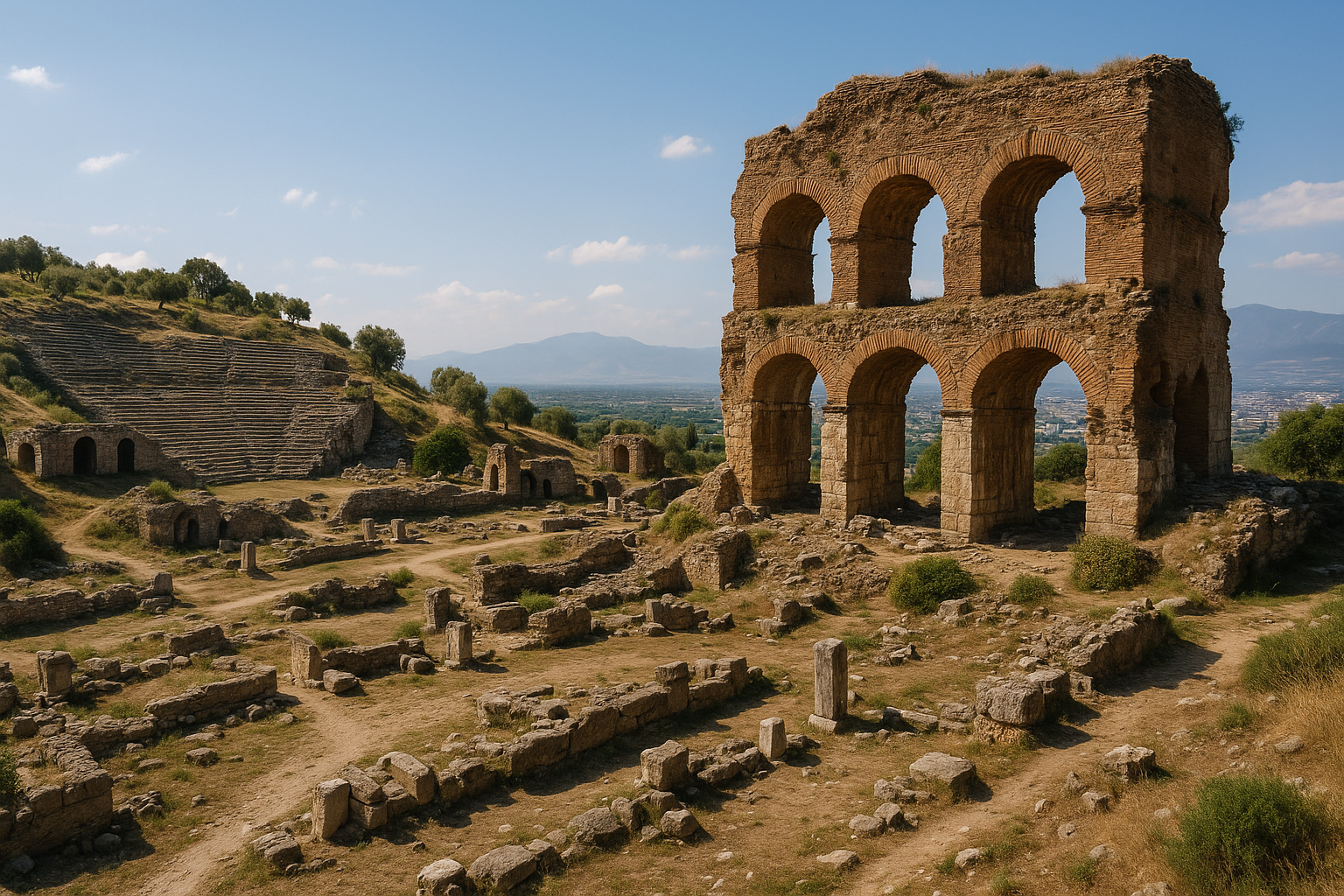
Tralles (znane również jako Tralleis) to znaczące starożytne miasto położone na płaskowyżu Topyatagi, skąd roztacza się widok na urodzajną dolinę Büyük Menderes (Meander) w zachodniej Turcji. Założone niemal 3000 lat temu przez osadników trackich i argiwskich, stało się jednym z najbogatszych miast Azji Mniejszej w okresach hellenistycznym i rzymskim. Tralles słynie z wydania na świat wybitnych rzeźbiarzy, w szczególności Apolloniosa z Tralles, współtwórcy Byka Farnezyjskiego -- największej zachowanej pojedynczej rzeźby ze starożytności. Ikonicznym zabytkiem miasta są „Trzy Oczy" (Üç Gözler) -- ocalała potrójnie-łukowa fasada monumentalnego gimnasium z II wieku n.e..
Spis Treści
- Dlaczego Tralles jest ważne
- Położenie geograficzne
- Chronologia historyczna
- Główne zabytki
- Prace archeologiczne
- Informacje dla zwiedzających
- Często zadawane pytania
- Źródła i literatura
Dlaczego Tralles jest ważne
-
Potęga starożytnej rzeźby. Tralles wydało na świat jednych z najbardziej cenionych rzeźbiarzy świata hellenistycznego, w tym Apolloniosa i jego brata Tauriskosa, których Byk Farnezyjski zdobi dziś Narodowe Muzeum Archeologiczne w Neapolu jako jeden z jego największych skarbów.
-
Strategiczne położenie na wzgórzu. Płaskowyż Topyatagi zapewniał Tralles kontrolę nad szlakami handlowymi doliny Meandra, a zarazem stanowił silną naturalną obronę -- połączenie, które przez wieki napędzało dobrobyt miasta.
-
Najstarsza notacja muzyczna. Zgodnie z tradycją naukową Tralles uważane jest za jedno z miejsc, gdzie powstała pierwsza notacja muzyczna w dziejach, łącząc miasto z początkami dokumentacji muzycznej.
-
Zabytek Trzech Oczu. Zachowana potrójnie-łukowa struktura gimnasium, widoczna z całego nowoczesnego Aydın, jest jedną z najbardziej rozpoznawalnych ruin epoki rzymskiej w zachodniej Turcji i trwałym symbolem prowincji Aydın.
-
Wielowarstwowa tkanka miejska. Stanowisko zachowuje warstwy sięgające od trackiego założenia, przez hellenistyczny rozkwit, rzymski przepych, bizantyjskie adaptacje, po seldżuckie ponowne wykorzystanie -- czyniąc zeń zwięzłą encyklopedię historii Anatolii.
Położenie geograficzne
Tralles zajmuje płaskogłowe wzgórze Topyatagi bezpośrednio na północ od centrum nowoczesnego miasta Aydın, w dzielnicy Efeler. Wzgórze wznosi się stromo nad równiną rzeki Büyük Menderes (starożytny Meander), jednego z najbogatszych obszarów rolniczych Turcji.
| Cecha | Szczegóły |
|---|---|
| Współrzędne | 37,86°N, 27,84°E |
| Wysokość n.p.m. | ~170 m (szczyt płaskowyżu) |
| Najbliższe miasto | Aydın (bezpośrednio sąsiadujące) |
| Najbliższe lotnisko | Izmir Adnan Menderes (ok. 100 km na północny zachód) |
| Region | Pogranicze starożytnej Karii i Lidii, nowoczesna prowincja Aydın |
| Rzeka | Büyük Menderes (Meander), ok. 3 km na południe |
Klimat egejski przynosi gorące, suche lata i łagodne, deszczowe zimy. Wysokość płaskowyżu zapewnia chłodzące bryzy i rozległy widok na dolinę -- zalety, które sprawiały, że lokalizacja była atrakcyjna dla osadnictwa od czasów prehistorycznych.
Dolina Meandra była jednym z najważniejszych korytarzy komunikacyjnych wschód-zachód w starożytności, łącząc wybrzeże Egejskie z anatolijskim interiorem. Tralles leżało w miejscu, gdzie drugorzędne szlaki z południa (przez korytarz tabejski) łączyły się z tą główną arterią, czyniąc je naturalnym centrum handlowym.
Chronologia historyczna
Założenie i okres archaiczny (X--VI w. p.n.e.)
Starożytna tradycja przypisuje założenie miasta połączonym siłom Traków i Argiwczyków (Greków z Argolidy). Element tracki odbija się w samej nazwie: „Tralles" może wywodzić się od trackiego słowa. To podwójne pochodzenie nadało miastu mieszany charakter kulturowy od samego początku.
Ślady wczesnego osadnictwa na wzgórzu Topyatagi sięgają co najmniej X wieku p.n.e., choć miasto pojawia się wyraźniej w źródłach historycznych dopiero w okresie klasycznym.
Okres klasyczny i hellenistyczny (V--I w. p.n.e.)
W V i IV wieku p.n.e. Tralles znalazło się pod kolejnymi rządami perskimi, macedońskimi i seleucydzkimi. Po podbojach Aleksandra Wielkiego miasto gwałtownie rozrosło się pod wpływem hellenistycznym, zyskując teatr, agorę i gmachy publiczne godne znaczącej polis.
W III--II wieku p.n.e. Tralles należało do Królestwa Pergamonu pod dynastią Attalidów. Był to okres rozkwitu kulturalnego: szkoła rzeźby w Tralles zyskała sławę w całym basenie Morza Śródziemnego. Apollonios z Tralles i jego brat Tauriskos stworzyli grupę Byka Farnezyjskiego, ukazującą karę Dirke, około końca II wieku p.n.e. Pliniusz Starszy opisał to monumentalne dzieło, które odkryto w 1546 roku w Termach Karakalli w Rzymie.
Innym sławnym rzeźbiarzem z tego miasta był twórca „Młodego Atlety" (typ Apoxyomenosa), co utrwaliło reputację Tralles jako centrum doskonałości artystycznej.
Okres rzymski (I w. p.n.e. -- III w. n.e.)
Po tym, jak królestwo Attalidów zostało zapisane Rzymowi w 133 p.n.e., Tralles stało się częścią rzymskiej prowincji Azji. W epoce Pax Romana miasto osiągnęło szczyt bogactwa i monumentalnej zabudowy:
- Gimnasium (w tym słynna fasada „Trzech Oczu") zostało wzniesione w II wieku n.e. jako centrum atletyki, edukacji i kultury.
- Obok gimnasium dodano rozległy kompleks łaźni.
- Teatr powiększono, a jego proskeniom ozdobiono rzeźbionym fryzem przedstawiającym procesję dionizyjską (thiasos), o wysokości około 1 m.
- Marmurowa kolumnada łączyła główne budynki publiczne.
- Świątynie, rozbudowa agory i budynki obywatelskie były wznoszone lub przebudowywane.
Niszczycielskie trzęsienie ziemi w 26 p.n.e. poważnie uszkodziło miasto. Cesarz August zapewnił środki na odbudowę, a senat rzymski wysłał Ajschinejsa jako komisarza nadzorującego prace.
Późny okres rzymski i bizantyjski (IV--XII w. n.e.)
Tralles przetrwało jako ważne centrum miejskie w epoce bizantyjskiej. Wzniesiono kilka kościołów, a miasto pełniło funkcję biskupstwa. Strategiczne położenie na wzgórzu zachowywało jego znaczenie przez wieki konfliktów między Bizancjum a różnymi wschodnimi potęgami.
W 1071 roku, po bitwie pod Manzikertem, grupy tureckie zaczęły osiedlać się w dolinie Meandra. Miasto przechodziło przez naprzemienne okresy panowania seldżuckiego i bizantyjskiego, by ostatecznie stać się częścią emiratu Aydınoğulları w XIV wieku, który nadał współczesnej prowincji jej nazwę.
Okres osmański i czasy nowożytne
Starożytna osada została w dużej mierze opuszczona, gdy ludność przeniosła się na niżej położoną równinę, tworząc zaczyn nowoczesnego Aydın. Ruiny na Topyatagi stały się stanowiskiem archeologicznym.
Główne zabytki
Gimnasium i „Trzy Oczy" (Üç Gözler)
Najbardziej ikoniczna budowla w Tralles, gimnasium to kompleks z II wieku n.e., służący jako centrum edukacji, atletyki i życia społecznego. Zachowaną część stanowi jego monumentalna potrójnie-łukowa fasada -- trzy wysokie łuki, które miejscowi zwą „Üç Gözler" (Trzy Oczy). Łuki te, zbudowane z starannie ciosanego kamienia, widoczne są z nowoczesnego Aydın i służą jako symbol całej prowincji.
Gimnasium pierwotnie obejmowało:
- Sale ćwiczeń i boiska
- Sale wykładowe do nauki filozofii i retoryki
- Szatnie i składy
- Połączone urządzenia kąpielowe
Teatr
Wybudowany na naturalnym zboczu wzgórza teatr w Tralles był jednym z pierwszych teatrów hellenistycznych z ozdobionym proskeniom. Niemieccy odkrywcy w 1888 roku odkopali fragmenty rzeźbionego fryzu z budynku scenicznego, przedstawiającego procesję dionizyjską o wysokości około 1 m, z postaciami satyrów, menad i samego Dionizosa.
Kawea (widownia) teatru jest częściowo wykopana, ukazując typowy wachlarzowy układ. Szacowana pojemność: 8000--10 000 widzów.
Kompleks łaźni
Sąsiadując z gimnasium, rzymskie łaźnie zachowywały standardową sekwencję frigidarium, tepidarium i caldarium. Podczas wykopalisk udokumentowano fragmenty systemu hypokaustu (ogrzewania podpodłogowego) oraz kanałów doprowadzających wodę.
Agora
Handlowe serce Tralles, agora była rozległym otwartym placem otoczonym kolumnowymi portykami (stoami), gdzie kupcy wystawiali towary. Agora łączyła się bezpośrednio z marmurową kolumnadą, stanowiącą główny szlak ceremonialny miasta.
Marmurowa kolumnada
Fragmenty oryginalnej marmurowej ulicy kolumnadowej zostały odsłonięte podczas wykopalisk, ukazując wysoką jakość infrastruktury miejskiej okresu rzymskiego. Aleja ta łączyła agorę, gimnasium i strefy świątynne.
Arsenał wojskowy i tunele
Niezwykłą cechą Tralles jest arsenał (cephanelik) -- wojskowy magazyn amunicji i towarzyszący mu system tuneli wydrążonych w zboczu wzgórza. Budowle te odzwierciedlają strategiczną rolę obronną miasta w kontrolowaniu doliny Meandra.
Latryna (toaleta publiczna)
Dobrze zachowana rzymska publiczna latryna została wykopana, demonstrując zaawansowaną infrastrukturę sanitarną starożytnego miasta. Budowla utrzymana jest w standardowym projekcie rzymskim z ciągłą ławą nad kanałem z bieżącą wodą.
Nekropole i sarkofagi
Obszary pogrzebowe otaczają wzgórze osadnicze; sarkofagi i budowle grobowe datowane są od okresu hellenistycznego po bizantyjski. Niektóre sarkofagi noszą zdobienia rzeźbiarskie odzwierciedlające wysokie tradycje artystyczne miasta.
Kościoły i budowle sakralne
Na stanowisku zidentyfikowano kilka kościołów z epoki bizantyjskiej, dokumentując przemianę od pogańskiego do chrześcijańskiego kultu. Obejmują one zarówno budowle na planie bazylikowym, jak i budowle centralne.
Prace archeologiczne
Pierwsze systematyczne wykopaliska w Tralles przeprowadzili w 1888 roku niemieccy archeolodzy Carl Humann i Wilhelm Dörpfeld, którzy udokumentowali teatr i odzyskali ważne fragmenty fryzu dionizyjskiego. Wyniki ich badań opublikowano w piśmie Archäologische Mitteilungen (AM 18, 1893) pod tytułem „Ausgrabungen in Tralles".
Kolejne tureckie kampanie wykopaliskowe znacznie poszerzyły wiedzę o stanowisku:
- Oczyszczenie i dokumentacja teatru, odsłaniając hellenistyczny budynek sceniczny i jego modyfikacje rzymskie.
- Konserwacja gimnasium i „Trzech Oczu", w tym wzmocnienie konstrukcyjne ikonicznych łuków.
- Odkrycie marmurowej kolumnady, potwierdzające wysoką jakość rzymskiego planowania urbanistycznego.
- Kartowanie arsenału i kompleksu tuneli, rzadkiej cechy wśród cywilnych miast starożytnych.
- Odzyskanie fragmentów rzeźbiarskich z wielu okresów, przechowywanych obecnie w regionalnych muzeach.
W sezonie wykopaliskowym 2025 roku trwają przygotowania do pełniejszego otwarcia stanowiska dla turystów po dziesięcioleciach badań. Wykopaliska prowadzone są pod auspicjami Prowincjonalnej Dyrekcji Kultury i Turystyki w Aydın we współpracy z tureckimi zespołami uniwersyteckimi.
Najsławniejsze obiekty związane z Tralles przechowywane są w międzynarodowych muzeach:
- Byk Farnezyjski -- Narodowe Muzeum Archeologiczne, Neapol, Włochy
- Młody Atleta z Tralles -- Stambulskie Muzea Archeologiczne
- Fragmenty fryzu dionizyjskiego -- różne kolekcje
Informacje dla zwiedzających
Jak dotrzeć
- Samochodem: Z Izmiru autostradą Izmir--Aydın (O-31) na południe przez około 100 km. Stanowisko znajduje się na wzgórzu Topyatagi w centrum Aydın i jest dobrze oznakowane.
- Pociągiem: Aydın posiada stację kolejową na linii Izmir--Denizli z regularnymi połączeniami.
- Autobusem: Częste autobusy międzymiastowe łączą otogar Aydın z Izmirem, Denizli, Muğlą i innymi miastami Egejskimi.
Na miejscu
| Informacja praktyczna | Szczegóły |
|---|---|
| Opłata wstępu | Sprawdź aktualny status; część obszarów jest ogólnodostępna |
| Godziny otwarcia | W godzinach dziennych; sprawdź lokalnie -- stanowisko jest przygotowywane do ruchu turystycznego |
| Szacowany czas zwiedzania | 1--2 godziny |
| Teren | Stosunkowo płaski szczyt płaskowyżu; miejscami nierówne powierzchnie |
| Cień | Ograniczony; latem warto zabrać nakrycie głowy i wodę |
| Udogodnienia | Centrum Aydın znajduje się bezpośrednio obok i oferuje wszelkie usługi |
Proponowana trasa
- Zacznij od Trzech Oczu (gimnasium) -- zabytku widocznego z miasta u podnóża wzgórza.
- Idź do teatru i obejrzyj zboczową widownię.
- Podążaj marmurową aleją w stronę agory.
- Zbadaj pozostałości kompleksu łaźni przy gimnasium.
- Odwiedź arsenał i tunel dla unikalnej perspektywy inżynierii wojskowej.
- Zakończ panoramicznym widokiem na dolinę Meandra z krawędzi płaskowyżu.
Najlepszy czas na wizytę
- Wiosna (marzec--maj): Komfortowe temperatury, zielony krajobraz doliny.
- Jesień (wrzesień--listopad): Przyjemne ciepło, doskonała widoczność.
- Lato: Bardzo gorąco na otwartym płaskowyżu; zwiedzaj wczesnym rankiem lub wieczorem.
- Zima: Łagodna, lecz deszczowa; mniej odwiedzających.
Zwiedzanie łączone
Tralles można łatwo połączyć z innymi ważnymi stanowiskami archeologicznymi regionu:
- Nysa nad Meanderem (ok. 30 km na wschód): imponująca biblioteka, teatr i tunel-stadion.
- Afrodyzjas (ok. 100 km na południowy wschód): Obiekt Światowego Dziedzictwa UNESCO; światowej sławy szkoła rzeźby.
- Priene, Milet i Didyma (ok. 60--80 km na południowy zachód): klasyczne trio stanowisk jońskich.
- Efez (ok. 60 km na północny zachód): jedno z najczęściej odwiedzanych miast starożytnych na świecie.
- Muzeum w Aydın: Prezentuje lokalne znaleziska i stanowi doskonałe wprowadzenie do stanowiska.
Często zadawane pytania
Czym są „Trzy Oczy" Tralles?
„Üç Gözler" (Trzy Oczy) to lokalna nazwa ocalałej potrójnie-łukowej fasady rzymskiego gimnasium z II wieku n.e. Trzy łuki, widoczne z całego nowoczesnego Aydın, są symbolem miasta i prowincji.
Jaki jest związek Tralles z Bykiem Farnezyjskim?
Byk Farnezyjski -- największa pojedyncza rzeźba odzyskana ze starożytności -- został stworzony przez Apolloniosa z Tralles i jego brata Tauriskosa pod koniec II wieku p.n.e. Marmurowa grupa, ukazująca karę Dirke, odkryta została w 1546 roku w Termach Karakalli w Rzymie. Dziś znajduje się w Narodowym Muzeum Archeologicznym w Neapolu.
Kto prowadził wykopaliska w Tralles?
Pierwsze formalne wykopaliska przeprowadzili w 1888 roku Carl Humann i Wilhelm Dörpfeld (ten sam Humann, który odkopał Ołtarz Pergameński). Tureckie zespoły kontynuują wykopaliska od dziesięcioleci. Stanowisko jest przygotowywane do szerszego dostępu publicznego od połowy lat dwudziestych XXI wieku.
Czy stanowisko jest w pełni otwarte dla zwiedzających?
W ostatnich latach stanowisko jest przygotowywane do pełnego otwarcia publicznego. Część stanowiska -- w szczególności Trzy Oczy i okoliczne obszary -- jest dostępna. Sprawdź najnowsze informacje o dostępie w Prowincjonalnej Dyrekcji Kultury i Turystyki w Aydın.
Skąd pochodzi nazwa miasta?
Uważa się, że nazwa „Tralles" wywodzi się od trackiego słowa, odzwierciedlając legendarną fundację miasta przez osadników trackich wraz z Grekami argiwskimi.
Co stało się z rzeźbami z Tralles?
Główne dzieła są rozrzucone po międzynarodowych muzeach: Byk Farnezyjski jest w Neapolu, Młody Atleta w Stambule, zaś różne mniejsze znaleziska trafiły do Muzeum w Aydın i innych tureckich kolekcji.
Chronologia wykopalisk i kampanie archeologiczne
Poniższa tabela dokumentuje historię prac archeologicznych w Tralles, od pierwszych systematycznych badań do dnia dzisiejszego:
| Rok(i) | Kierownik / Instytucja | Działania i kluczowe odkrycia |
|---|---|---|
| 1888 | Carl Humann i Wilhelm Dörpfeld (Niemiecki Instytut Archeologiczny) | Pierwsze systematyczne wykopaliska; dokumentacja teatru; odzyskanie fryzu procesji dionizyjskiej (~1 m wysokości) z proskenionu |
| 1893 | Humann i Dörpfeld | Publikacja wyników w Archäologische Mitteilungen (AM 18): „Ausgrabungen in Tralles" |
| 1996 | Kampania turecka | Pierwszy sezon współczesnych tureckich wykopalisk; wstępne udostępnienie stanowiska publiczności |
| 1996--2020-te | Prowincjonalna Dyrekcja Aydın / tureckie zespoły uniwersyteckie | Stopniowe odsłanianie marmurowej kolumnady, kompleksu łaźni, agory, arsenału i systemu tuneli |
| 2025 | Aktualna kampania | Główny nacisk na odkrywanie dodatkowych elementów architektonicznych kompleksu łaźni i gimnasium; przygotowania do pełnego otwarcia publicznego |
Ekspedycja Humanna i Dörpfelda z 1888 roku była prowadzona przez tego samego Carla Humanna, który odkopał Ołtarz Pergameński (obecnie w Berlinie). Jego prace w Tralles, choć skromniejsze w skali, przyniosły jedno z najważniejszych znalezisk rzeźbiarskich regionu: fryz dionizyjski z proskenionu teatru, ukazujący thiasos (procesję rytualną) z postaciami satyrów, menad i Dionizosa w płaskorzeźbie o wysokości około 1 metra.
Byk Farnezyjski: szczegółowa analiza materiałowa i wymiarowa
Byk Farnezyjski, stworzony przez rzeźbiarzy Apolloniosa i Tauriskosa z Tralles, został poddany szczegółowej analizie współczesnej. Poniższa tabela zestawia zweryfikowane pomiary:
| Atrybut | Pomiar / Szczegół |
|---|---|
| Oryginalny blok marmurowy | 3,66 m x 2,75 m (12,0 ft x 9,0 ft) |
| Aktualny obwód (po restauracjach) | ~3,3 m z każdej strony |
| Aktualna wysokość | Ponad 4,0 m (13 ft 1 in) |
| Masa | 21,8 ton (24 tony krótkie) |
| Materiał | Biały marmur |
| Pierwotne powstanie | Koniec II wieku p.n.e.; przypisywane rzeźbiarzom z Tralles pracującym na Rodos |
| Odkrycie | 1546, wykopalisko we fragmentach z gimnasium Term Karakalli, Rzym |
| Zleceniodawca wykopalisk | Papież Paweł III, poszukujący rzeźb dla Palazzo Farnese |
| Obecna lokalizacja | Narodowe Muzeum Archeologiczne, Neapol (od 1826 roku) |
| Źródło literackie | Pliniusz Starszy, Naturalis Historia 36.33--34 |
Rzeźba przedstawia karę Dirke: mitologiczna królowa Dirke jest przywiązywana do rogów dzikiego byka przez swych pasierbów Zetosa i Amfiona, mszczących się za złe traktowanie ich matki Antiopy. Dzieło jest największą pojedynczą grupą rzeźbiarską odzyskaną ze starożytności -- tytuł ten nosi od chwili odkrycia w 1546 roku. Dramatyczna kompozycja z przeplatającymi się postaciami, stającym dęba zwierzęciem i wirującymi draperiami stanowi szczyt hellenistycznego baroku w rzeźbie.
Pomiary architektoniczne kluczowych zabytków
| Zabytek | Wymiary / Dane techniczne |
|---|---|
| Kawea teatru (widownia) | Szacowana pojemność: 8000--10 000 widzów; wbudowana w naturalne zbocze wzgórza |
| Łuki „Trzech Oczu" gimnasium | Trzy wysokie łuki z starannie ciosanego kamienia; widoczne z nowoczesnego Aydın poniżej |
| Kompleks łaźni | Standardowa sekwencja rzymska: frigidarium, tepidarium, caldarium; udokumentowany hypokaust |
| Marmurowa kolumnada | Szerokość wystarczająca do ceremonialnych procesji; łączy agorę, gimnasium i strefy świątynne |
| Dionizyjski fryz proskenionu | ~1 m wysokości; ukazujący satyrów, menady i Dionizosa w wysokim reliefie |
| Płaskowyż Topyatagi | ~170 m n.p.m.; płaskogłowe wzgórze bezpośrednio nad nowoczesnym Aydın |
Arsenał i system tuneli wydrążony w zboczu wzgórza stanowi cechę rzadką wśród cywilnych miast starożytnych. Wojskowe magazyny amunicji tego rodzaju częściej kojarzone są z granicznymi miastami garnizonowymi, co sugeruje, że strategiczna pozycja Tralles w kontrolowaniu doliny Meandra wymagała wyspecjalizowanej infrastruktury obronnej nawet w okresach ogólnego pokoju.
Źródła i literatura
- Wikipedia -- Tralles
- Wikipedia -- Byk Farnezyjski
- Britannica -- Apollonios z Tralles
- Anadolu Agency -- Ancient city of Tralleis to welcome visitors after decades of excavations
- Anatolian Archaeology -- 2025 Excavation Season Begins at Tralleis
- Anatolian Archaeology -- Tralleis Ancient City to Open for Visitors
- The Ancient Theatre Archive -- Tralleis Theatre
- Perseus Digital Library -- Princeton Encyclopedia entry on Tralles
- Humann, C. & Dörpfeld, W. -- "Ausgrabungen in Tralles," Archäologische Mitteilungen 18 (1893)
- Pliniusz Starszy -- Naturalis Historia, Księga 36 (o Byku Farnezyjskim)
- Destinations.com.tr -- The Ancient City of Tralles in Aydin
Szkoła rzeźby w Tralles
Tralles nie było jedynie miastem, które wydało na świat pojedynczych utalentowanych artystów -- ukształtowało prawdziwą szkołę rzeźby, której wpływ rozciągał się na cały basen Morza Śródziemnego:
Apollonios z Tralles i Tauriskos
Najsławniejszymi wychowankami tej szkoły, bracia Apollonios i Tauriskos, byli aktywni w końcu II wieku p.n.e. Ich arcydzieło, Byk Farnezyjski, przedstawia mitologiczną karę Dirke przez jej pasierbów Zetosa i Amfiona, którzy przywiązali ją do rogów dzikiego byka. Kluczowe fakty o tej rzeźbie:
- Wymiary: Około 3,7 metra wysokości -- największa pojedyncza grupa rzeźbiarska zachowana ze starożytności.
- Materiał: Marmur, prawdopodobnie wykuty z jednego bloku dla głównej grupy.
- Pierwotna lokalizacja: Prawdopodobnie wystawiony w przestrzeni publicznej na Rodos lub w samym Tralles.
- Odkrycie: Wykopany w 1546 roku z Term Karakalli w Rzymie, gdzie był zainstalowany jako dekoracja.
- Obecna lokalizacja: Narodowe Muzeum Archeologiczne, Neapol, Włochy.
- Źródło literackie: Pliniusz Starszy, Naturalis Historia 36.33--34, opisuje dzieło i przypisuje je rzeźbiarzom z Tralles.
Dramatyczna kompozycja rzeźby, dynamiczny ruch i emocjonalna intensywność uosabiają styl hellenistycznego baroku u szczytu jego możliwości.
Młody Atleta (typ Apoxyomenosa)
Inne sławne dzieło przypisywane rzeźbiarzowi z Tralles, Młody Atleta, przedstawia męską postać zeskrobującą olej i pył ze skóry strigil -- powszechny rytuał po ćwiczeniach w greckich gymnasiach. Posąg znajduje się obecnie w Stambulskich Muzeach Archeologicznych i reprezentuje wyrafinowany naturalizm hellenistycznego ujęcia ciała.
Dziedzictwo artystyczne
Nacisk szkoły z Tralles na dramatyczną narrację, dynamiczne pozy i ekspresję emocjonalną wpisywał ją w szerszą tradycję późnohellenistycznej rzeźby, do której należą również słynna Grupa Laokoona i Nike z Samotraki. Wpływ tej szkoły świadczy o bogactwie kulturalnym śródlądowych miast azjatyckich, które niekiedy pozostają w cieniu nadmorskich ośrodków, takich jak Efez i Milet.
Sieć handlowa doliny Meandra
Dobrobyt Tralles był nierozerwalnie związany z jego położeniem w sieci handlowej doliny Meandra, jednym z najważniejszych korytarzy handlowych starożytności:
Szlak wschód--zachód
Dolina rzeki Büyük Menderes tworzyła naturalny trakt łączący wybrzeże Egejskie (przez Milet i Efez) z anatolijskim interiorem (przez Laodycję i Apameę). Towary przepływające tym szlakiem obejmowały:
- Tkaniny z wewnętrznych centrów tkackich
- Wino i oliwę z oliwek z winnic i gajów oliwnych doliny
- Metale szlachetne z kopalń frygijskich i lidyjskich
- Zboże z urodzajnego dna doliny
- Przyprawy i towary luksusowe napływające ze wschodnich sieci handlowych
Szlak północ--południe
Szlak drugorzędny odgałęział się na południe od Tralles przez korytarz tabejski w kierunku wybrzeża w Kaunos i miast licyjskich. Szlakiem tym przewożono drewno, żywy inwentarz i produkty rolne między wyżynnym interiorem a morzem.
Funkcja targowa
Agora na wzgórzu Tralles służyła jako regionalny węzeł targowy, gdzie producenci z okolicznej wsi spotykali się z kupcami dalekowędrownymi. Bogactwo miasta z tej roli handlowej finansowało monumentalny program budowlany widoczny dziś w ruinach.
Trzęsienia ziemi i odporność
Historia Tralles naznaczona jest powtarzającym się wzorcem zniszczeń sejsmicznych i odbudowy, który ukazuje zarówno wrażliwość miasta, jak i jego niezwykłą odporność:
- Trzęsienie ziemi 26 p.n.e.: Poważnie uszkodziło miasto. Cesarz August osobiście zapewnił fundusze na odbudowę, a senat rzymski mianował Ajschinejsa komisarzem nadzorującym prace. Odbudowane miasto zostało chwilowo przemianowane na Cezareę z wdzięczności wobec Augusta.
- Liczne późniejsze trzęsienia ziemi w okresach rzymskim i bizantyjskim niszczyły budowle, które były wielokrotnie naprawiane i odbudowywane.
- Przetrwanie „Trzech Oczu" gimnasium przez wieki aktywności sejsmicznej świadczy o jakości rzymskiej inżynierii i budownictwa.
Ten wzorzec zniszczenia i odnowy jest typowy dla egejskich miast anatolijskich i stanowi użyteczną ramę interpretacyjną dla warstwowego zapisu archeologicznego widocznego na stanowisku.
Życie kulturalne w rzymskim Tralles
W okresie cesarstwa rzymskiego (I--III w. n.e.) Tralles było żywym centrum kulturalnym:
- Edukacja retoryczna: Gimnasium służyło jako szkoła retoryki i filozofii, dyscyplin wysoko cenionych w kulturze prowincji rzymskich.
- Tradycja muzyczna: Związek miasta z wczesną notacją muzyczną sugeruje długą tradycję kultury performatywnej, prawdopodobnie wspieranej przez teatr i odeion.
- Zawody atletyczne: Gimnasium gościło lokalne zawody atletyczne i treningi do regionalnych festiwali.
- Kultura kąpielowa: Rozległy kompleks łaźni sąsiadujący z gimnasium służył jako miejsce spotkań towarzyskich, gdzie obywatele prowadzili interesy, nawiązywali kontakty i dbali o zdrowie.
- Życie religijne: Po mieście wznosiły się świątynie różnych bóstw greckich i rzymskich, obok których wyrastały późniejsze kościoły chrześcijańskie.
Marmurowa kolumnada łącząca te obiekty tworzyła oś ceremonialną, wyrażającą dumę obywatelską i ambicje kulturalne miasta.
Słownik kluczowych pojęć
| Termin | Definicja |
|---|---|
| Gimnasium | Kompleks do treningu atletycznego, edukacji i spotkań towarzyskich w miastach greckich i rzymskich |
| Proskeniom | Budynek sceniczny i jego architektoniczna fasada w starożytnym teatrze |
| Thiasos | Rytualny pochód ku czci boga Dionizosa |
| Agora | Centralny plac publiczny i handlowy miasta greckiego lub rzymskiego |
| Stoa | Kryty portyk lub kolumnada |
| Hypokaust | System ogrzewania podpodłogowego stosowany w łaźniach rzymskich |
| Kawea | Półkolista widownia teatru |
| Nekropola | Cmentarz; dosłownie „miasto umarłych" |
| Apoxyomenos | Typ rzeźbiarski ukazujący atletę zeskrobującego olej ze skóry |
| Byk Farnezyjski | Największa pojedyncza starożytna grupa rzeźbiarska, stworzona przez Apolloniosa z Tralles |