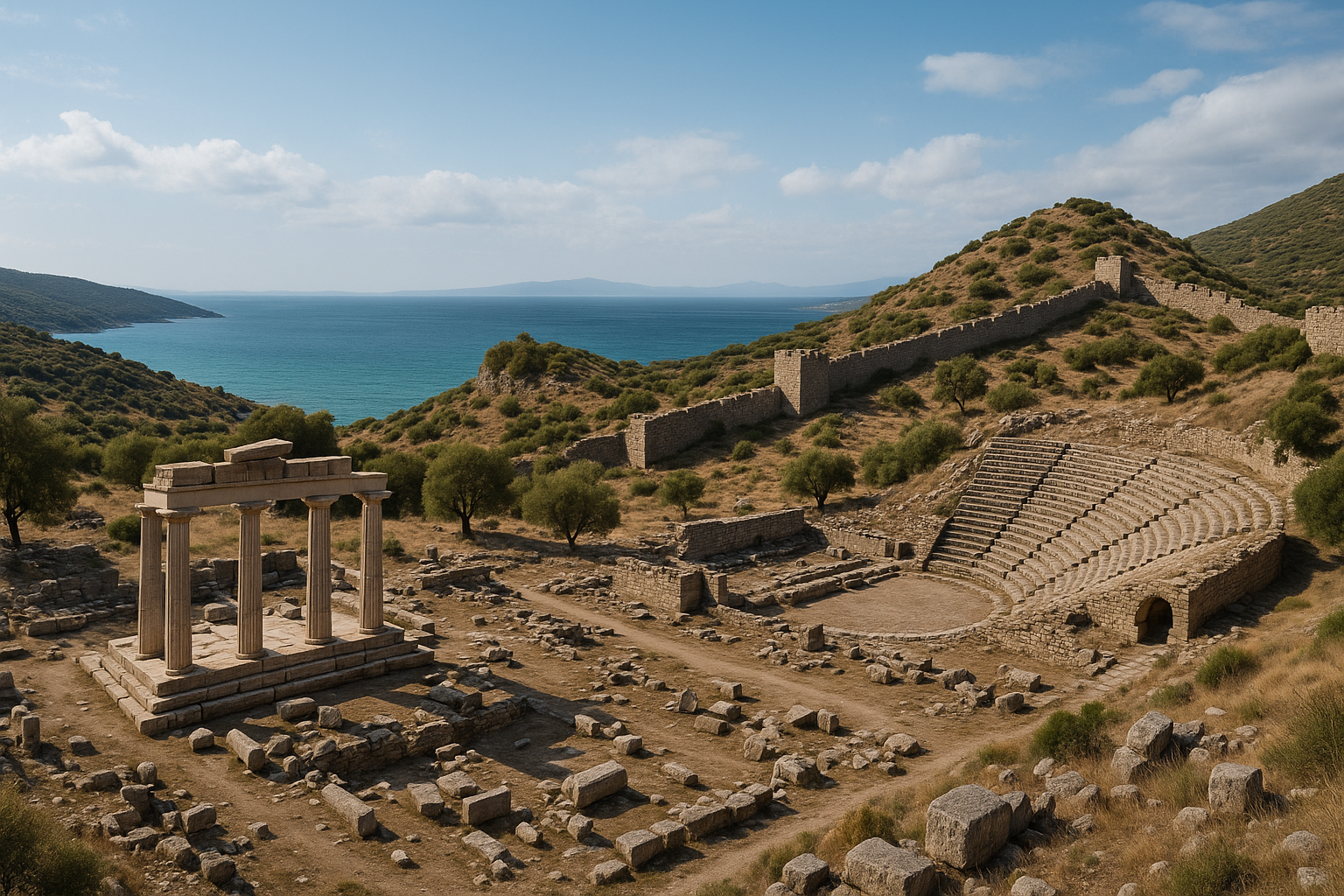
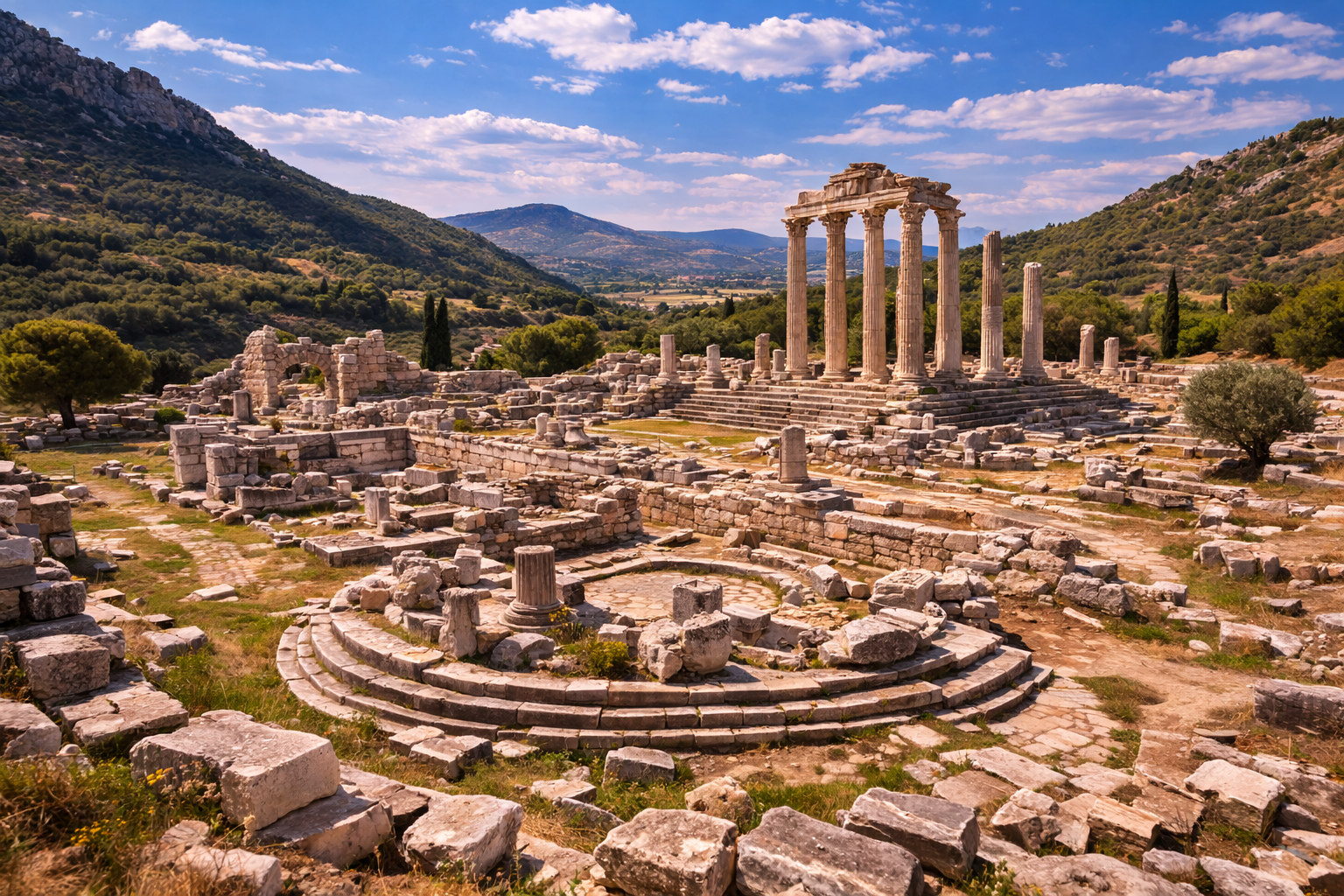
Le Panionium n'était pas une cité, mais quelque chose de plus rare : le sanctuaire fédéral et lieu d'assemblée politique de la Ligue ionienne, l'une des plus anciennes expériences de gouvernance collective du monde antique. Dédié à Poséidon Héliconien, ce site sacré situé sur les pentes nord du mont Mycale (Samsun Dağı) réunissait les délégués des douze cités ioniennes -- dont Milet, Éphèse, Priène et Samos -- pour des fêtes religieuses, des jeux athlétiques et des délibérations politiques. Les Ioniens y sacrifiaient des taureaux à Poséidon sur l'autel central, croyant que le dieu était satisfait si l'animal mugissait au moment de sa mort. Un jeune homme de Priène servait toujours de grand prêtre sous le titre de roi. Situé près de Güzelçamlı, dans la province d'Aydın, à l'intérieur de la zone tampon du Parc national de la péninsule de Dilek et du delta du Grand Méandre, le Panionium combine une profonde histoire politique avec l'un des cadres naturels les plus spectaculaires de tous les sites archéologiques de Turquie.
Table des matières
- Pourquoi le Panionium compte
- Géographie et contexte
- Chronologie historique
- Principaux monuments et caractéristiques
- Travaux archéologiques
- Informations pour les visiteurs
- Foire aux questions
- Sources et lectures complémentaires
Pourquoi le Panionium compte
-
Berceau de la politique fédérale. La Ligue ionienne, qui se réunissait au Panionium, représente l'un des plus anciens exemples connus d'organisation politique fédérale de la civilisation occidentale. Douze cités-États indépendantes se rassemblaient volontairement pour discuter de défense commune, de politique étrangère et d'identité culturelle -- des siècles avant le concept moderne de fédéralisme. Ce modèle de gouvernance collective a influencé la pensée politique de l'Antiquité jusqu'aux débats constitutionnels américains.
-
Un sanctuaire, pas une cité. Le Panionium était un temenos (enceinte sacrée) et un lieu d'assemblée, et non un établissement urbain permanent. Cela en fait un exemple rare de paysage purement politique-religieux dans les archives archéologiques -- un lieu défini par des événements et des rassemblements plutôt que par des murs et des maisons.
-
La fête des Panionia. Le site accueillait les Panionia annuelles -- une grande fête religieuse comportant des sacrifices à Poséidon (en particulier de taureaux), des compétitions athlétiques, des représentations musicales et des assemblées politiques. Hérodote, Thucydide et Diodore de Sicile font tous référence aux Panionia comme à une institution déterminante de l'identité ionienne.
-
Rituel de sacrifice du taureau. Les sources anciennes décrivent une pratique rituelle unique : les Ioniens sacrifiaient un taureau à Poséidon Héliconien sur l'autel central, et ils considéraient comme un présage favorable si le taureau mugissait au moment de sa mise à mort. Un jeune homme de Priène était toujours désigné comme grand prêtre, sous le titre de roi, pour conduire ces sacrifices.
-
Emplacement stratégique sur le mont Mycale. Le sanctuaire occupait un site à profonde résonance historique : le mont Mycale fut le théâtre de la bataille de Mycale en 479 av. J.-C., où une flotte grecque combinée détruisit la marine perse, mettant effectivement fin à la menace perse contre les cités ioniennes.
-
Racines pré-grecques. Les fouilles ont révélé que le sanctuaire fut construit sur les ruines de Mélia, un établissement carien détruit vers 700 av. J.-C., ce qui indique que le lieu pouvait être sacré avant même l'arrivée des Grecs. L'Iliade d'Homère mentionne le culte carien d'une divinité connue sous le nom de Poséidon Héliconien.
-
Lien avec le Parc national de la péninsule de Dilek. Le site se trouve dans l'une des aires naturelles protégées les plus importantes de Turquie, où forêts méditerranéennes, espèces endémiques et ruines antiques créent un paysage patrimonial intégré.
Géographie et contexte
Le Panionium est situé sur les pentes nord du mont Mycale (actuel Samsun Dağı), près du village de Güzelçamlı, dans le district de Kuşadası de la province d'Aydın.
Le mont Mycale forme la péninsule de Dilek, qui s'avance dans la mer Égée, créant l'étroit détroit entre le continent et l'île de Samos -- visible de l'autre côté de l'eau par temps clair. Cette géographie était centrale dans la signification du sanctuaire : les douze cités ioniennes étaient réparties des deux côtés de l'Égée, et la position du Panionium sur une montagne côtière proéminente le rendait accessible à la fois par terre et par mer.
Le site occupe un versant en terrasses connu sous le nom d'Otomatik Tepe (où les fouilles de 1958 furent menées) et une colline voisine étudiée par Hans Lohmann à partir de 2004-2005, située à environ 5 km au nord-est de Güzelçamlı, à une altitude d'environ 750 mètres sur le versant nord du mont Mycale. Le terrain est couvert de forêt de pins méditerranéens et de maquis, offrant une ombre et une atmosphère que peu de sites archéologiques peuvent égaler.
Au sud, le Parc national de la péninsule de Dilek et du delta du Grand Méandre protège l'un des derniers écosystèmes côtiers vierges de l'Égée orientale, avec plusieurs plages propres, des sentiers de randonnée et une riche biodiversité, y compris le phoque moine de Méditerranée, en danger critique d'extinction.
Coordonnées : Environ 37,70 N, 27,18 E
Altitude : Le site d'Otomatik Tepe se trouve à une altitude modérée ; le site de Lohmann se trouve à environ 750 mètres.
Climat : Méditerranéen -- étés chauds et secs (30--38 C) et hivers doux et humides (8--15 C). La meilleure période pour visiter est mars -- juin et septembre -- novembre.
Chronologie historique
Établissement ancien et Mélia carienne (avant le VIIe siècle av. J.-C.)
Les preuves archéologiques sur le site de Lohmann ont révélé les fondations d'un établissement identifié comme Mélia, une communauté carienne qui occupait la région avant l'arrivée des Grecs ioniens. L'Iliade d'Homère mentionne le culte carien d'une divinité connue sous le nom de Poséidon Héliconien, suggérant que le culte pourrait avoir des racines pré-grecques. Mélia fut détruite vers 700 av. J.-C. alors que les cités ioniennes consolidaient leur contrôle sur la péninsule de Mycale, et le nouveau sanctuaire fut construit directement sur ses ruines.
Fondation de la Ligue ionienne (vers le VIIe-VIe siècle av. J.-C.)
La Ligue ionienne fut formellement constituée en amphictyonie religieuse et politique (ligue sacrée) de douze cités : Milet, Myonte, Priène, Éphèse, Colophon, Lébédos, Téos, Clazomènes, Phocée, Samos, Chios et Érythrées. La Ligue établit son centre sur un site qui pouvait déjà être sacré pour la petite cité carienne de Mélia. La cité de Priène détenait la responsabilité particulière d'entretenir le sanctuaire et d'organiser la fête des Panionia, et un jeune homme de Priène était toujours désigné grand prêtre sous le titre de roi.
Construction du temple ionique (vers 540 av. J.-C.)
Un premier temple ionique fut construit sur les ruines de l'établissement carien de Mélia vers 540 av. J.-C., comme l'ont révélé les fouilles commencées en 2005 sous Hans Lohmann. Des tessons de céramique du VIIIe au VIe siècle av. J.-C. trouvés sur le site indiquent une activité bien avant la construction du temple. Ce temple représente la première phase monumentale du sanctuaire.
VIe siècle av. J.-C. -- Autel de Poséidon
Une structure rectangulaire en pierre mesurant 17,5 x 4,25 mètres fut érigée dans la zone centrale, datée de la fin du VIe siècle av. J.-C.. Elle est identifiée comme l'autel de Poséidon Héliconien, divinité patronne de la Ligue ionienne. C'est sur cet autel que les Ioniens accomplissaient leur rituel distinctif de sacrifice du taureau.
Guerres médiques (VIe-Ve siècle av. J.-C.)
Sous la domination perse (à partir de 546 av. J.-C.), les activités au Panionium furent réduites. L'historien Thucydide rapporte que les Ioniens déplacèrent les célébrations de leur fête à Éphèse durant les périodes de pression perse. Le temple ionique fut apparemment détruit vers 500 av. J.-C., peut-être durant la révolte ionienne contre la Perse (499-493 av. J.-C.).
Cependant, après la victoire grecque à la bataille de Mycale en 479 av. J.-C. -- livrée sur les pentes mêmes du mont Mycale, où une flotte grecque combinée sous commandement spartiate détruisit les restes de la marine perse -- les Ioniens furent libérés et le Panionium retrouva sa signification de symbole de la liberté ionienne.
Périodes classique et hellénistique (Ve-Ier siècle av. J.-C.)
Les Panionia continuèrent comme grande fête, bien que l'importance politique de la ligue ait diminué à mesure que les cités individuelles devenaient plus puissantes et que des puissances plus grandes (Athènes, puis les royaumes hellénistiques) dominaient la région. Diodore de Sicile rapporte qu'à un moment donné les Ioniens furent contraints de déplacer les Panionia du Panionium à Éphèse en raison de la guerre dans les environs.
Sous Alexandre le Grand, les jeux et la fête furent de nouveau organisés au Panionium, et il en fut de même sous la domination romaine.
Un petit théâtre ou bouleutérion (salle du conseil) fut taillé dans la roche au pied de la colline, mesurant environ 32 mètres de diamètre avec 11 rangées de sièges en pierre disposées selon un plan légèrement plus que semi-circulaire. Cette structure servait de chambre délibérative où les représentants des douze cités débattaient et votaient.
Période romaine (Ier siècle av. J.-C. -- IVe siècle apr. J.-C.)
Sous la domination romaine, la Ligue ionienne perdit sa fonction politique mais les traditions religieuses et culturelles des Panionia persistèrent sous une forme atténuée. La zone du sanctuaire fut occasionnellement entretenue mais aucune nouvelle construction majeure n'eut lieu.
Périodes byzantine et postérieures
Une inscription découverte en 1673 par les voyageurs britanniques John Pickering et Jerome Salter à l'intérieur d'une église byzantine près de Güzelçamlı fournit l'un des premiers indices sur l'emplacement du Panionium, bien que l'identification définitive ne soit intervenue qu'au XXe siècle.
Principaux monuments et caractéristiques
Autel de Poséidon Héliconien
L'élément central du sanctuaire est une plateforme rectangulaire en pierre mesurant 17,5 x 4,25 mètres, identifiée comme l'autel de Poséidon Héliconien. Daté de la fin du VIe siècle av. J.-C., l'autel constituait le point focal des rituels sacrificiels durant la fête des Panionia.
Selon les sources anciennes, les Ioniens sacrifiaient un taureau à Poséidon sur cet autel. Si le taureau mugissait pendant le sacrifice, cela était considéré comme un présage de faveur divine. L'épithète « Héliconien » pourrait se référer au mont Hélicon en Béotie, suggérant que le culte fut apporté par les colons ioniens de Grèce continentale. L'Iliade d'Homère mentionne également le culte carien de Poséidon Héliconien, indiquant que le culte pourrait avoir des origines encore plus anciennes, pré-grecques, en Anatolie.
Temenos (enceinte sacrée)
Le sanctuaire était entouré d'un mur de temenos, dont une à trois assises de pierre sont encore visibles. Le mur définissait la limite sacrée de l'enceinte, avec une entrée à l'ouest. La zone enclose n'était pas une cité mais un paysage sacré réservé aux rassemblements religieux et politiques -- un espace qui s'animait durant les fêtes et retombait dans un calme relatif ensuite.
Théâtre / Bouleutérion (salle du conseil)
Au pied de la colline, à environ 50 mètres au sud-ouest de l'autel, un petit théâtre ou salle d'assemblée fut taillé directement dans la roche :
- Diamètre : Environ 32 mètres
- Plan : Légèrement plus que semi-circulaire
- Sièges : 11 rangées de sièges taillées dans la roche solide
- Capacité : Plusieurs centaines de délégués estimés
- Fonction : Servait de salle de conseil (bouleutérion) où les représentants des douze cités ioniennes se réunissaient pour délibérer des affaires de la ligue
C'est l'une des plus anciennes structures d'assemblée politique connues spécialement construites dans le monde grec, antérieure à de nombreux bouleutéria mieux connus de la Grèce classique. Sa taille modeste reflète le caractère intime et délibératif des séances de la ligue -- il ne s'agissait pas d'un théâtre pour le spectacle public mais d'une chambre pour le débat politique entre pairs.
Fondations du temple ionique (vers 540 av. J.-C.)
Les fouilles de Hans Lohmann commencées en 2004-2005 ont révélé les fondations d'un temple ionique construit sur les ruines de l'établissement carien antérieur de Mélia. Ce temple, daté d'environ 540 av. J.-C., représente la première phase monumentale du sanctuaire. Des tessons de céramique du VIIIe au VIe siècle av. J.-C. ont été trouvés sur le site, indiquant une activité bien avant la construction du temple. Le temple fut apparemment détruit vers 500 av. J.-C. -- peut-être durant la révolte ionienne contre la Perse.
Ruines de la Mélia carienne
Sous le temple ionique, les fouilles de Lohmann ont mis au jour les fondations de l'établissement carien de Mélia, détruit vers 700 av. J.-C. par les Ioniens en progression. Cette découverte a démontré que le site avait une histoire sacrée pré-grecque et que les Ioniens ont pu délibérément construire leur sanctuaire fédéral au-dessus d'un site sacré existant, une pratique courante dans le monde antique.
Vestiges de l'église byzantine
Des fragments d'une église d'époque byzantine près du site contiennent l'inscription de 1673 trouvée par Pickering et Salter, qui a aidé les chercheurs à commencer à localiser le Panionium. La construction de l'église utilisant des matériaux du sanctuaire antique illustre la continuité de l'usage sacré du site à travers les siècles.
Travaux archéologiques
Premières tentatives d'identification
- 1673 : Les voyageurs britanniques John Pickering et Jerome Salter découvrirent une inscription à l'intérieur d'une église byzantine près de Güzelçamlı, fournissant le premier indice historique sur l'emplacement du Panionium.
- Fin du XIXe siècle : L'archéologue allemand Theodor Wiegand identifia des ruines près de Güzelçamlı comme le probable Panionium, identification largement acceptée.
Fouilles de 1958 (Otomatik Tepe)
En 1958, une équipe allemande dirigée par Gerhard Kleiner, Peter Hommel et Wolfgang Müller-Wiener mena des fouilles sur Otomatik Tepe. Ils mirent au jour la plateforme de l'autel, des fragments du mur de temenos et le théâtre/bouleutérion taillé dans la roche. Ces fouilles établirent le plan de base du site qui reste la référence standard et furent publiées dans la monographie phare Panionion und Melie (1967).
2004-2005 et au-delà (fouilles de Lohmann)
À partir de 2004, Hans Lohmann identifia un site de haute montagne situé à environ 5 km au nord-est de Güzelçamlı, à une altitude d'environ 750 mètres sur le versant nord du mont Mycale. Son équipe commença de nouvelles fouilles révélant :
- Des fondations du milieu du VIe siècle av. J.-C. d'un temple ionique construit sur l'établissement carien de Mélia
- Des tessons de céramique du VIIIe au VIe siècle av. J.-C., repoussant les preuves d'activité sur le site
- Des preuves que la phase monumentale du sanctuaire commença vers 540 av. J.-C.
- Le temple fut détruit vers 500 av. J.-C., probablement durant les troubles de la révolte ionienne
- Des preuves de la communauté carienne antérieure de Mélia, détruite vers 700 av. J.-C. par les Ioniens
- Un temple archaïque possiblement dédié à Poséidon Héliconien
Ces découvertes ont considérablement repoussé la chronologie connue du sanctuaire et démontré que le site avait une histoire pré-grecque enracinée dans les traditions religieuses cariennes.
État de conservation
Le site se trouve dans la zone tampon du Parc national de la péninsule de Dilek. Il n'est pas formellement aménagé en tant qu'attraction pour visiteurs, et une grande partie de la zone archéologique est couverte de végétation naturelle. La combinaison d'un environnement naturel protégé et d'un potentiel archéologique non fouillé fait du Panionium un site patrimonial particulièrement sensible nécessitant une gestion attentive.
Informations pour les visiteurs
S'y rendre
- En voiture : Depuis Kuşadası, roulez vers le sud en direction de Güzelçamlı (environ 25 km, environ 30 minutes). Le site du Panionium se trouve dans les collines au-dessus de Güzelçamlı, près de l'entrée du Parc national de la péninsule de Dilek.
- Depuis Selçuk/Éphèse : Environ 35 km au sud-ouest.
- Depuis Aydın : Environ 70 km à l'ouest.
- Depuis İzmir : Environ 120 km au sud par l'autoroute.
- Transports en commun : Des minibus (dolmuş) circulent régulièrement de Kuşadası à Güzelçamlı. De là, une marche de 1-2 km en montée est nécessaire pour atteindre le site.
Conditions du site
Le Panionium est un site archéologique non aménagé au sein d'un paysage naturel. Il n'y a :
- Pas de billetterie ni d'entrée formelle
- Pas de signalisation ni de panneaux d'information aux ruines
- Pas d'installations sur place (toilettes, boutiques, eau)
- Une végétation méditerranéenne naturelle couvre une grande partie de la zone
- Le terrain est inégal avec des sentiers rocailleux à travers la forêt de pins et le maquis
Les visiteurs doivent considérer cela comme une combinaison de promenade nature et d'exploration archéologique. Un guide local ou des recherches préalables sont fortement recommandés. Télécharger les coordonnées GPS avant la visite est essentiel.
Temps nécessaire
- Visite rapide : 1 à 1,5 heure pour trouver les principales ruines (zone de l'autel, bouleutérion) et revenir.
- Exploration étendue : 2 à 3 heures pour explorer la zone plus large du sanctuaire et profiter du cadre naturel.
- Combinée avec le Parc national de la péninsule de Dilek : Une journée entière, comprenant plages, randonnée et observation de la faune.
Que prendre
- Chaussures de randonnée robustes (le terrain est inégal, avec des sentiers rocailleux à travers le maquis)
- Protection solaire, eau (minimum 1,5 litre par personne) et collations (aucune installation)
- GPS ou une carte téléchargée avec coordonnées (les ruines ne sont pas bien signalisées)
- Jumelles (excellentes pour l'observation des oiseaux dans le parc national et pour voir Samos de l'autre côté du détroit)
- Répulsif contre les insectes au printemps et en été
- Appareil photo avec objectif grand angle pour la photographie de paysage
Combiner avec d'autres sites
Le Panionium se combine idéalement avec :
- Parc national de la péninsule de Dilek et du delta du Grand Méandre : Randonnée, plages préservées (İçmeler, Kavaklıburun, Karasu), faune comprenant le phoque moine de Méditerranée.
- Priène : La cité responsable de l'entretien du Panionium (30 km au nord) -- ancienne cité spectaculairement située avec un temple d'Athéna bien préservé.
- Milet : Grande cité de la Ligue ionienne avec un magnifique théâtre de 15 000 places (40 km au sud).
- Didymes : Temple d'Apollon, l'un des plus grands oracles du monde antique (50 km au sud).
- Éphèse/Selçuk : La plus célèbre cité antique de Turquie (35 km au nord-est).
- Samos (Grèce) : Visible de l'autre côté du détroit ; liaisons en ferry depuis Kuşadası.
Meilleure saison
- Printemps (mars -- mai) : Fleurs sauvages méditerranéennes, températures agréables, oiseaux migrateurs dans le parc national. La plus belle saison.
- Automne (septembre -- novembre) : Lumière chaude et dorée, plus calme que l'été.
- Été (juin -- août) : Très chaud ; visiter uniquement tôt le matin. Les plages voisines de la péninsule de Dilek offrent des options rafraîchissantes par la suite.
- Hiver (décembre -- février) : Frais et potentiellement pluvieux, mais atmosphérique et sans foule.
Foire aux questions
Qu'est-ce que la Ligue ionienne ?
La Ligue ionienne (également appelée Ligue panionique) était une confédération religieuse et politique de douze cités-États grecques le long de la côte de l'Anatolie occidentale et des îles voisines. Les cités membres étaient : Milet, Myonte, Priène, Éphèse, Colophon, Lébédos, Téos, Clazomènes, Phocée, Samos, Chios et Érythrées. Elles partageaient le dialecte grec ionien, les traditions culturelles et le culte de Poséidon Héliconien.
Qu'était la fête des Panionia ?
Les Panionia étaient la fête religieuse annuelle tenue au Panionium, comportant des sacrifices de taureaux à Poséidon (le dieu était censé être satisfait si le taureau mugissait au moment de la mort), des compétitions athlétiques, des représentations musicales et des assemblées politiques des délégués de la ligue. Un jeune homme de Priène était toujours désigné grand prêtre sous le titre de roi. C'était l'un des événements culturels déterminants de l'identité grecque ionienne.
Pourquoi le sacrifice du taureau était-il spécial ?
Les Ioniens croyaient que Poséidon était particulièrement satisfait si le taureau sacrificiel mugissait au moment où il était tué. Cela était interprété comme un présage de faveur divine. Le rituel reflète le lien profond entre la fête des Panionia et des traditions plus anciennes, peut-être cariennes, de sacrifice du taureau en Anatolie.
S'agit-il d'une cité ou d'un sanctuaire ?
Le Panionium était un sanctuaire et un lieu d'assemblée, et non une cité. Il n'avait pas de population résidentielle permanente. Il fonctionnait comme un lieu de rassemblement qui s'animait durant les fêtes et les réunions politiques, puis retombait dans un calme relatif -- plus analogue à un centre de congrès moderne dans un cadre naturel qu'à un établissement permanent.
Qu'est-ce que Mélia ?
Mélia était un établissement carien qui occupait le site avant l'arrivée des Grecs ioniens. Il fut détruit vers 700 av. J.-C. lorsque les Ioniens consolidèrent leur contrôle de la péninsule de Mycale. Les Ioniens construisirent ensuite leur sanctuaire fédéral directement sur les ruines de Mélia. L'Iliade d'Homère mentionne le culte carien de Poséidon Héliconien, suggérant que le culte et le site avaient une signification sacrée même avant les Grecs.
Puis-je voir des ruines réelles ?
Oui, bien qu'elles soient modestes comparées aux grands sites urbains. La plateforme de l'autel (17,5 x 4,25 mètres), les traces du mur de temenos et le bouleutérion taillé dans la roche avec ses 11 rangées de sièges en pierre sont tous visibles. Les ruines nécessitent une certaine conscience archéologique pour être pleinement appréciées, car elles sont partiellement couvertes par la végétation et non signalisées.
Quel est le lien avec la bataille de Mycale ?
La bataille de Mycale (479 av. J.-C.) fut livrée sur les pentes du mont Mycale, la même montagne où se trouve le Panionium. Lors de cette bataille, une flotte grecque sous commandement spartiate détruisit les restes de la marine perse, libérant les cités ioniennes de la domination perse. Cette victoire donna au Panionium une signification renouvelée comme symbole de la liberté et de l'indépendance ioniennes.
Pourquoi Priène était-elle responsable du sanctuaire ?
Selon la tradition antique, Priène se vit attribuer l'honneur et la responsabilité particuliers d'entretenir le sanctuaire du Panionium et d'organiser la fête des Panionia. Le grand prêtre de Priène -- toujours un jeune homme portant le titre de roi -- conduisait les sacrifices. Ce rôle conférait à Priène une position prestigieuse au sein de la Ligue ionienne malgré le fait qu'elle fût une cité relativement modeste.
Le site est-il accessible aux visiteurs occasionnels ?
Le Panionium nécessite une condition physique modérée (marche en montée sur terrain inégal) et un certain bagage archéologique pour être pleinement apprécié. Ce n'est pas un site touristique aménagé. Cependant, la beauté naturelle du cadre et l'importance historique en font une expérience enrichissante pour les visiteurs motivés. La combinaison avec le parc national rend l'excursion intéressante pour quiconque.
Dans quelle langue les délibérations des Panionia se déroulaient-elles ?
Les délibérations se déroulaient en grec ionien, le dialecte partagé par les douze cités membres. Cette langue commune était l'un des liens qui unissaient la Ligue ionienne, aux côtés des pratiques religieuses et des traditions culturelles partagées. Le dialecte ionien devint plus tard la base de la langue littéraire grecque utilisée par Hérodote et Hippocrate.
Les femmes étaient-elles autorisées à participer aux Panionia ?
Les sources anciennes ne donnent pas une image claire. Dans la plupart des sanctuaires grecs, les femmes pouvaient assister aux fêtes religieuses et aux sacrifices, mais étaient généralement exclues des délibérations politiques. Les femmes peuvent avoir participé aux aspects religieux des Panionia -- les processions, les sacrifices et les représentations musicales -- tandis que les assemblées politiques dans le bouleutérion étaient probablement réservées aux délégués citoyens masculins.
Comment la Ligue ionienne a-t-elle influencé les traditions démocratiques ultérieures ?
La Ligue ionienne est considérée comme un précurseur de la gouvernance fédéraliste. Douze cités-États indépendantes mirent volontairement en commun leur souveraineté pour la défense commune et l'observance religieuse tout en conservant leur autonomie interne. Ce modèle fut plus tard étudié par des théoriciens politiques dont Montesquieu, et les Pères fondateurs américains firent référence aux ligues grecques antiques -- y compris au modèle ionien -- lorsqu'ils conçurent la structure fédérale de la Constitution des États-Unis.
Quels animaux vivaient dans la région dans l'Antiquité ?
Le mont Mycale dans l'Antiquité abritait un riche écosystème méditerranéen : cerfs, sangliers, renards, lièvres, perdrix et divers oiseaux de proie. Les denses forêts de pins et de maquis fournissaient un habitat à ces espèces. Aujourd'hui, le Parc national de la péninsule de Dilek préserve une grande partie de cette biodiversité, y compris le phoque moine de Méditerranée en danger critique d'extinction (Monachus monachus) dans les grottes côtières sous le site du sanctuaire.
Sécurité et considérations pratiques
- Pas de couverture mobile au site supérieur de Lohmann ; une couverture basique peut être disponible près de Güzelçamlı mais devient peu fiable à mesure que l'on monte.
- Serpents : La région abrite des espèces de serpents inoffensives et venimeuses (y compris la vipère ottomane). Faites attention où vous mettez les pieds, en particulier près des zones rocheuses et sous les troncs tombés.
- Tiques : Présentes au printemps et en été dans le maquis. Portez des pantalons longs et vérifiez votre corps après la visite.
- Risque d'incendie de forêt : Extrêmement élevé de juin à septembre. N'allumez pas de feux et ne jetez pas de cigarettes. Les autorités du parc national peuvent restreindre l'accès lors des journées à haut risque d'incendie.
- Pas de structures d'ombre : Le terrain ouvert dans la zone du sanctuaire elle-même a une ombre limitée ; l'approche forestière offre une certaine couverture.
- Accès d'urgence : Les installations médicales les plus proches se trouvent à Kuşadası (environ 25 km). Emportez une trousse de premiers secours lors d'explorations prolongées.
Les douze cités ioniennes : Un bref guide
Comprendre le Panionium nécessite de connaître ses cités membres. Voici un bref aperçu des douze :
| Cité | Emplacement moderne | Caractéristique notable |
|---|---|---|
| Milet | Près de Balat, Aydın | Berceau de la philosophie grecque (Thalès, Anaximandre) |
| Éphèse | Selçuk, İzmir | Temple d'Artémis (l'une des Sept Merveilles) |
| Priène | Güllübahçe, Aydın | Temple d'Athéna par Pythéos ; entretenait le Panionium |
| Myonte | Près d'Avşar, Aydın | Plus petit membre ; absorbée plus tard par Milet |
| Samos | Île de Samos, Grèce | Temple d'Héra ; berceau de Pythagore |
| Chios | Île de Chios, Grèce | Célèbre pour la résine de mastic et le vin |
| Colophon | Près de Değirmendere, İzmir | Cavalerie célèbre ; berceau de Mimnerme |
| Lébédos | Près d'Ürkmez, İzmir | Plus petit membre continental ; accueillait les artistes dionysiaques |
| Téos | Sığacık, İzmir | Berceau d'Anacréon ; temple de Dionysos |
| Érythrées | Ildırı, İzmir | Célèbre sibylle (prophétesse) |
| Clazomènes | Urla, İzmir | Berceau d'Anaxagore ; sarcophages peints |
| Phocée | Foça, İzmir | Fonda Massalia (Marseille) ; navigateurs habiles |
Chacune de ces cités envoyait des délégués au Panionium, faisant du sanctuaire un point focal pour l'une des civilisations les plus culturellement productives de l'histoire humaine. Les cités ioniennes produisirent collectivement les fondations de la philosophie, de la science, de l'histoire et de la littérature occidentales.
Flore et faune de la région du Panionium
La position du Panionium au sein du Parc national de la péninsule de Dilek signifie que les visiteurs peuvent profiter d'une riche biodiversité aux côtés de l'archéologie :
Arbres et plantes :
- Pin de Calabre (Pinus brutia) -- l'espèce d'arbre dominante
- Pin parasol (Pinus pinea) -- dispersé sur les pentes inférieures
- Maquis arbustif : myrte, arbousier, lentisque et olivier sauvage
- Fleurs sauvages méditerranéennes (printemps) : anémones, orchidées, cistes, cyclamens
- Anciens oliviers -- certains peut-être centenaires
Oiseaux :
- Buse féroce et circaète Jean-le-Blanc (nicheurs)
- Faucon d'Éléonore (fin d'été, migrateur)
- Guêpiers et rolliers (printemps et été)
- Fauvette mélanocéphale et fauvette passerinette (toute l'année)
Mammifères :
- Sanglier (traces souvent visibles)
- Renard roux
- Chacal (entendu au crépuscule)
- Phoque moine de Méditerranée (Monachus monachus) -- dans les grottes côtières en contrebas
La combinaison d'exploration archéologique et d'observation de la nature fait du Panionium une destination particulièrement enrichissante pour les visiteurs aux intérêts variés.
Mesures architecturales et chiffres clés
Le tableau suivant consolide les dimensions et données publiées des fouilles Kleiner-Hommel-Müller-Wiener de 1958 et des campagnes Lohmann de 2004-2005.
| Caractéristique | Mesure / Détail |
|---|---|
| Autel de Poséidon Héliconien | 17,5 x 4,25 m (plateforme rectangulaire en pierre) |
| Date de l'autel | Fin du VIe siècle av. J.-C. |
| Diamètre du bouleutérion / théâtre | 32 m (105 pieds) |
| Plan du bouleutérion | Légèrement plus que semi-circulaire |
| Sièges du bouleutérion | 11 rangées de sièges, taillées dans la roche solide |
| Capacité estimée du bouleutérion | Plusieurs centaines de délégués |
| Position du bouleutérion par rapport à l'autel | 50 m (160 pieds) au sud-ouest |
| Date du bouleutérion | IVe siècle av. J.-C. |
| Date du temple ionique | vers 540 av. J.-C. (construit sur les ruines de Mélia) |
| Date de destruction du temple | vers 500 av. J.-C. (possiblement durant la révolte ionienne) |
| Date de destruction de Mélia | vers 700 av. J.-C. |
| Altitude du site de Lohmann | Environ 750 m au-dessus du niveau de la mer |
| Distance depuis Güzelçamlı | Environ 5 km au nord-est |
| Nombre de membres de la Ligue ionienne | 12 cités (plus tard 13 avec Smyrne) |
| Plage chronologique des céramiques | Tessons du VIIIe -- VIe siècle av. J.-C. sur le site de Lohmann |
| Découverte de l'inscription de 1673 | Par John Pickering et Jerome Salter (voyageurs britanniques) |
Preuves numismatiques de la Ligue ionienne
La Ligue ionienne ne frappa pas de monnayage fédéral durant ses premiers siècles, mais les cités membres produisirent certains des monnayages les plus importants du monde grec antique. Plus tard, sous la domination romaine, un monnayage explicite de la Ligue apparut.
Monnayages des cités membres aux périodes archaïque et classique
| Cité | Plus ancien monnayage | Types caractéristiques | Étalon pondéral |
|---|---|---|---|
| Milet | vers 600 -- 550 av. J.-C. | Lion ou tête de lion (statères en électrum) | Lydien-milésien |
| Éphèse | vers 600 av. J.-C. | Abeille (argent) ; cerf (électrum) | Phénicien |
| Phocée | vers 600 av. J.-C. | Phoque (phoké) ; tête de griffon (hectae en électrum) | Phocaïque |
| Samos | vers 550 av. J.-C. | Scalp de lion ; proue de samaina (navire de guerre) | Samien |
| Chios | vers 550 av. J.-C. | Sphinx assis ; amphore | Chien |
| Téos | vers 540 av. J.-C. | Griffon assis | Éginétique |
| Clazomènes | vers 500 av. J.-C. | Sanglier ailé (avant-train) | Divers |
| Érythrées | vers 480 av. J.-C. | Tête d'Hercule (Héraklès) | Attique |
| Priène | vers 350 av. J.-C. | Tête d'Athéna ; trident | Rhodien |
| Colophon | vers 400 av. J.-C. | Apollon lauré | Divers |
Ces monnayages civiques individuels circulaient au Panionium durant les fêtes et les assemblées politiques, reflétant la diversité économique des membres de la Ligue.
Monnayage de la Ligue à l'époque romaine
Sous l'Empire romain, la Ligue ionienne (Koinon ton Ionon) émit des monnaies fédérales en bronze explicites célébrant l'unité de la Ligue. Les types clés incluent :
- Avers : ΤΟ ΚΟΙΝΟΝ ΤΩΝ ΙΩΝΩΝ (« Le bien commun des Ioniens »)
- Revers : Les treize cités de la Ligue ionienne représentées debout en demi-cercle devant le temple d'Apollon Clarios à Colophon
- Période : Monnaies frappées sous le règne d'Antonin le Pieux (r. 138 -- 161 apr. J.-C.) commémorant les jeux des Panionia Pythia
- Métal : Bronze ; utilisé pour la circulation locale et la distribution cérémonielle durant les fêtes
Ces monnaies de la Ligue d'époque romaine comptent parmi les preuves numismatiques les plus explicites de l'importance cérémonielle et culturelle continue de la fête des Panionia jusqu'à la période impériale, des siècles après que la Ligue eut perdu son indépendance politique.
Chronologie des fouilles et débat scientifique
L'identification et l'étude du Panionium s'étendent sur près de quatre siècles, des premiers voyageurs modernes aux campagnes archéologiques allemandes du XXIe siècle.
| Date | Chercheur / Événement | Contribution |
|---|---|---|
| 1673 | John Pickering et Jerome Salter | Découvrirent une inscription à l'intérieur d'une église byzantine près de Güzelçamlı ; premier indice historique sur l'emplacement du Panionium |
| Fin du XIXe siècle | Theodor Wiegand | Identifia des ruines près de Güzelçamlı comme le probable Panionium ; identification largement acceptée |
| 1958 | Gerhard Kleiner, Peter Hommel, Wolfgang Müller-Wiener | Fouillèrent Otomatik Tepe ; mirent au jour la plateforme de l'autel (17,5 x 4,25 m), le mur de temenos et le bouleutérion taillé dans la roche (32 m de diamètre, 11 rangées) |
| 1967 | Kleiner, Hommel, Müller-Wiener | Publièrent Panionion und Melie (Berlin), monographie phare établissant le plan de site standard |
| 2004 | Hans Lohmann | Identifia un site de haute montagne à 750 m d'altitude sur le versant nord du mont Mycale ; proposa qu'il s'agisse de l'emplacement original du Panionium |
| 2005 et au-delà | Lohmann (avec le musée d'Aydın) | Fouilla les fondations d'un temple ionique du milieu du VIe siècle av. J.-C. sur les ruines de la Mélia carienne ; récupéra des céramiques du VIIIe -- VIe siècle av. J.-C. ; identifia la destruction du temple vers 500 av. J.-C. |
Le débat des deux sites
Une question scientifique importante demeure : le site d'Otomatik Tepe (fouillé en 1958) et le site de haute montagne de Lohmann (fouillé à partir de 2004) faisaient-ils tous deux partie du même complexe sanctuaire, ou représentent-ils différentes phases du Panionium à différents emplacements ? Lohmann a soutenu que son site à 750 mètres d'altitude représente le Panionium original et les ruines de Mélia, tandis que le site inférieur d'Otomatik Tepe avec son bouleutérion du IVe siècle av. J.-C. pourrait représenter une relocalisation ultérieure de l'assemblée après la destruction du temple archaïque durant la révolte ionienne. Ce débat reste actif dans la littérature scientifique.
La fête des Panionia -- Séquence rituelle et procédure politique
Les sources littéraires anciennes, principalement Hérodote (Histoires I.141 -- 148), Thucydide (Histoire I.12) et Diodore de Sicile (Bibliothèque XV.49), permettent une reconstitution partielle du rituel de la fête et des procédures politiques :
-
Procession (pompe) : Les délégués des douze cités arrivaient par terre et par mer, défilant en procession sur les pentes du mont Mycale jusqu'au sanctuaire. La délégation de chaque cité comprenait prêtres, athlètes, musiciens et représentants politiques.
-
Sacrifice du taureau à Poséidon Héliconien : L'acte religieux central. Un taureau était mené au grand autel (17,5 x 4,25 m). Le grand prêtre -- toujours un jeune homme de Priène portant le titre de basileus (roi) -- exécutait le sacrifice. Les Ioniens considéraient comme un présage favorable (kalon semeion) si le taureau mugissait au moment de la mort.
-
Compétitions athlétiques et musicales (agones) : Sur le modèle des jeux panhelléniques, bien qu'à une échelle régionale plus modeste. Les épreuves incluaient probablement courses à pied, lutte et concours musicaux à la lyre et à la flûte.
-
Assemblée politique (synodos) : Les représentants se rassemblaient dans le bouleutérion (32 m de diamètre, 11 rangées de sièges) pour délibérer sur des questions d'intérêt commun : défense contre les menaces extérieures, relations diplomatiques, résolution de différends entre cités et coordination des fêtes religieuses.
-
Festin et distribution de la viande sacrificielle : Après le sacrifice, la viande du taureau était divisée entre les délégations participantes selon des protocoles établis, renforçant les liens de commensalité qui unissaient la Ligue.
Inscription et registre épigraphique
Bien que le Panionium lui-même ait livré peu de matériel inscriptionnel, l'institution de la Ligue ionienne et la fête des Panionia sont richement documentées dans le registre épigraphique des cités membres :
| Type d'inscription | Lieu | Contenu | Date |
|---|---|---|---|
| Inscription d'église byzantine | Région de Güzelçamlı | Texte faisant référence au Panionium ; trouvée par Pickering et Salter | Découverte en 1673 ; date originale incertaine |
| ΤΟ ΚΟΙΝΟΝ ΤΩΝ ΙΩΝΩΝ (légende du monnayage de la Ligue) | Diverses cités membres | « Le bien commun des Ioniens » | Période impériale romaine |
| Décret de Priène | Priène | Références au rôle de Priène dans l'entretien du Panionium et la fourniture du grand prêtre | Période hellénistique |
| Décret de Milet | Milet | Références aux délibérations de la Ligue et à la fête des Panionia | Classique -- Hellénistique |
| Inscription d'admission de Smyrne | Smyrne | Enregistre l'acceptation de Smyrne comme 13e membre de la Ligue ionienne | vers le IIe siècle av. J.-C. |
Sources et lectures complémentaires
- Panionium - Wikipedia
- Panionium - Turkish Archaeological News
- Ionian League - Wikipedia
- Panionion - Pleiades Gazetteer
- Panionium - Perseus Digital Library
- Panionium - Ancient Theatre Archive
- Panionium - Archaeolist
- Panionia - Smith's Dictionary of Greek and Roman Antiquities
- Panionia - Greek Travel Pages
- Gerhard Kleiner, Peter Hommel, Wolfgang Müller-Wiener, Panionion und Melie (Berlin, 1967)
- Hans Lohmann, Rapports de fouilles à partir de 2004-2005
- Hérodote, Histoires, Livre I (références aux Panionia et à la Ligue ionienne)
- Thucydide, Histoire de la guerre du Péloponnèse (références à la relocalisation des Panionia)