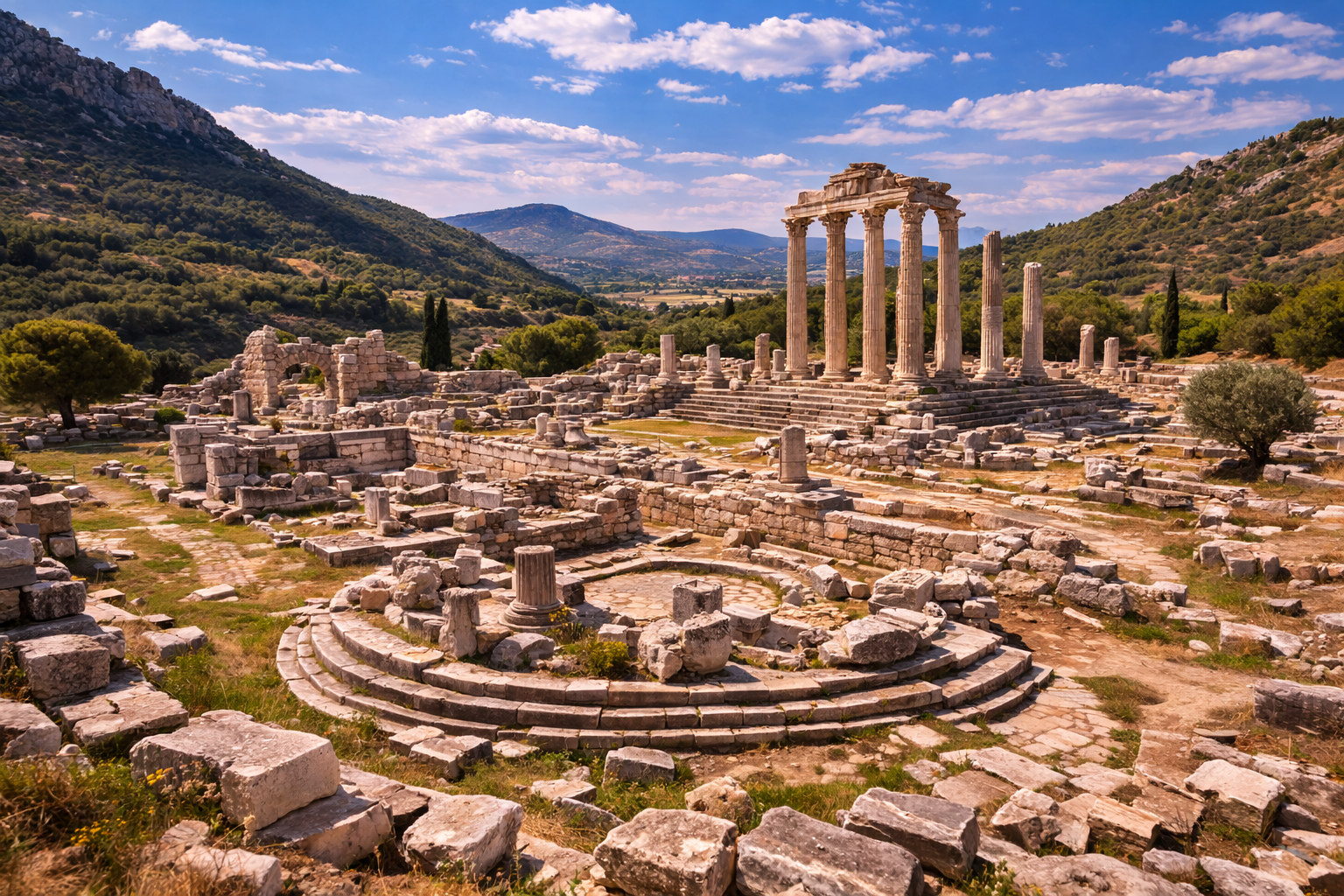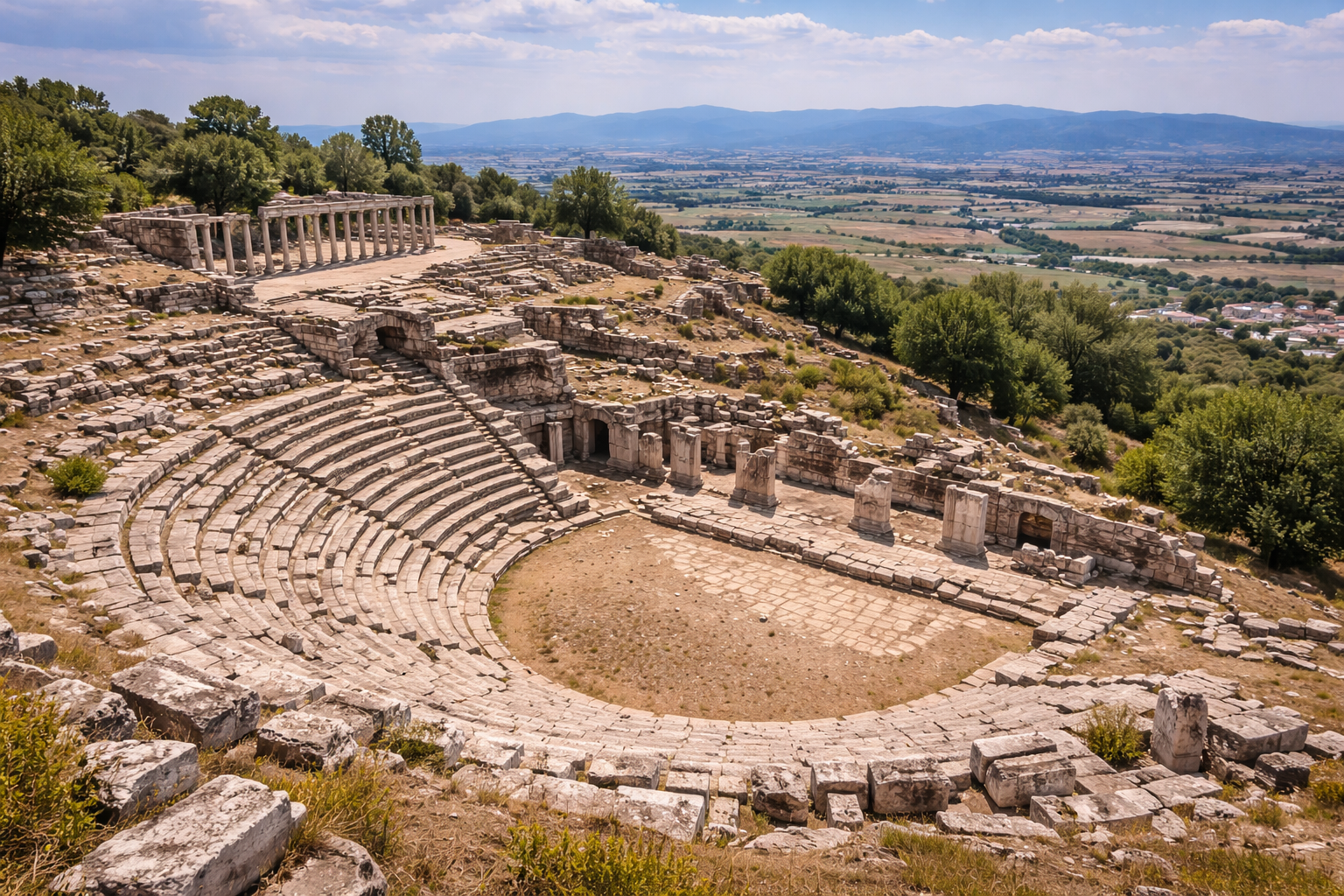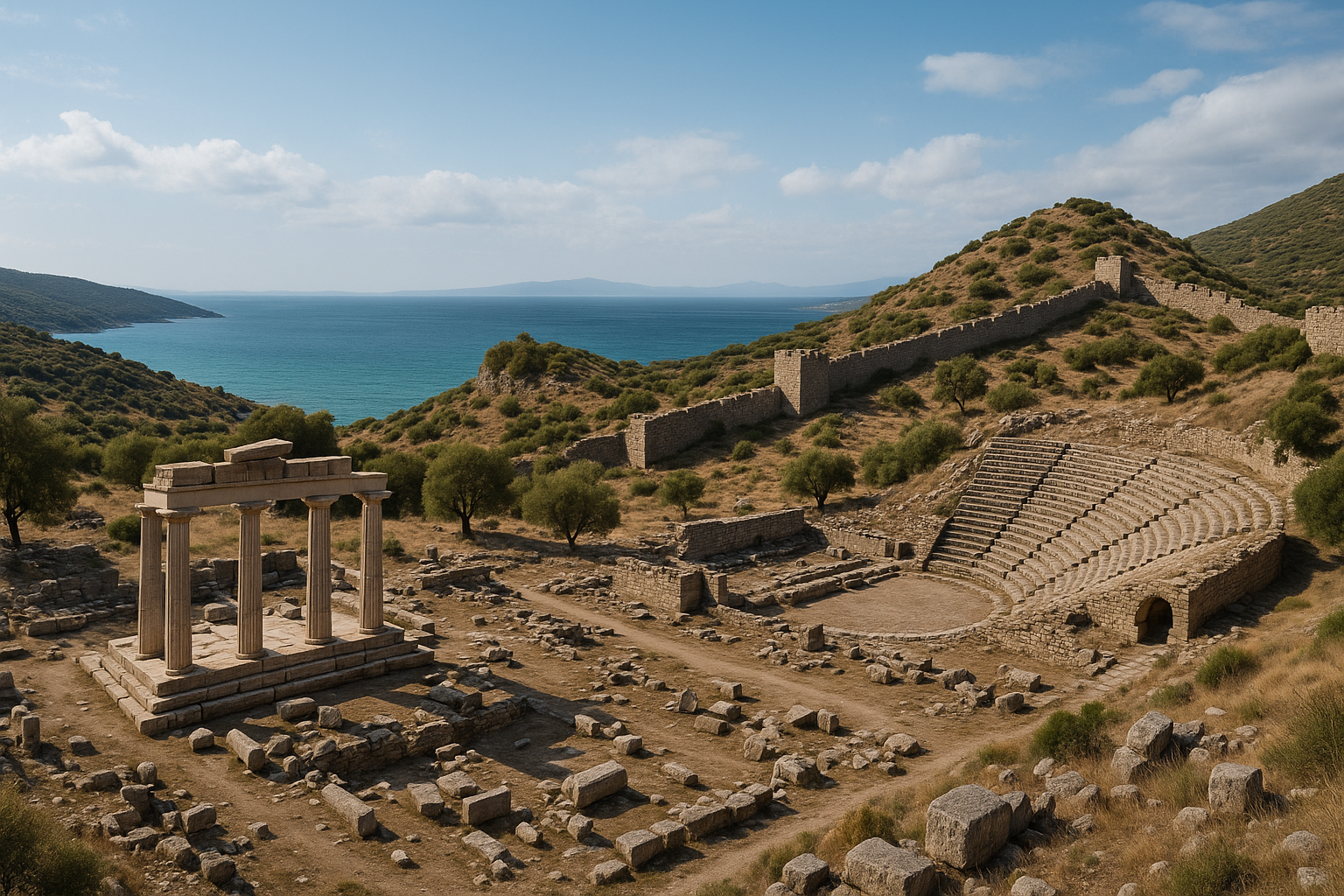
Notion (également connue sous le nom de Notium, signifiant « méridional » en grec ancien) était la cité portuaire de Colophon et une porte d'accès essentielle à l'Oracle d'Apollon à Claros. Située sur une colline surplombant la mer Égée, près de l'actuelle Ahmetbeyli dans le district de Menderes à Izmir, cette cité de 35 hectares planifiée en damier est entourée de murailles de fortification hellénistiques remarquablement bien conservées. Notion est le théâtre de la bataille de Notium (406 av. J.-C.), un engagement naval décisif de la guerre du Péloponnèse qui mit fin à la carrière militaire d'Alcibiade. Depuis 2022, l'Université du Michigan, en collaboration avec des universités turques, mène des fouilles qui ont déjà livré des découvertes spectaculaires, dont un trésor de 68 dariques d'or perses mis au jour en 2023.
Table des matières
- Pourquoi Notion compte
- Géographie et cadre
- Chronologie historique
- La bataille de Notium (406 av. J.-C.)
- Monuments majeurs
- Le lien avec Claros
- Travaux archéologiques
- Le trésor de dariques d'or
- Informations pour les visiteurs
- Foire aux questions
- Sources et lectures complémentaires
Pourquoi Notion compte
-
Port stratégique de Colophon : Notion servait de débouché maritime vital à l'une des cités ioniennes les plus puissantes. Tandis que Colophon contrôlait le territoire intérieur, Notion commandait la mer, faisant de leur relation symbiotique un modèle pour comprendre la dynamique antique entre cité et port.
-
Site d'une bataille qui changea la guerre : La bataille de Notium en 406 av. J.-C. provoqua directement la chute politique d'Alcibiade, l'une des figures les plus brillantes et controversées de l'histoire athénienne, et contribua à la défaite finale d'Athènes dans la guerre du Péloponnèse.
-
Porte d'accès à l'Oracle de Claros : Des milliers de pèlerins se rendant consulter l'Oracle d'Apollon à Claros passaient par le port de Notion, en faisant un carrefour de religion, de commerce et de voyages internationaux dans le monde antique.
-
Préservation urbaine exceptionnelle : La cité de 35 hectares planifiée en damier, avec ses murailles de fortification, son agora, son bouleutérion, son théâtre, son temple et ses quartiers résidentiels, offre l'un des exemples les plus complets d'urbanisme hellénistique de l'ouest de la Turquie.
-
Fouilles actives aux découvertes spectaculaires : Le permis de fouille de l'Université du Michigan accordé en 2022 a inauguré une nouvelle ère de recherche, et la découverte en 2023 de 68 dariques d'or réécrit déjà la compréhension de l'importance économique du site.
Géographie et cadre
Notion occupe une position de colline dominante surplombant la côte de la mer Égée, à l'est de la ville actuelle d'Ahmetbeyli dans le district de Menderes, province d'Izmir. La cité se trouve à environ 40 km au sud du centre d'Izmir, le long de la route côtière qui suit l'itinéraire antique reliant les grandes cités ioniennes.
La topographie du site était idéale pour une cité portuaire antique :
- Deux collines proéminentes formaient le cœur de l'établissement, fournissant des positions défensives naturelles et des plates-formes de construction surélevées
- Un port abrité au pied des collines accueillait le trafic maritime
- Un accès direct à la mer Égée permettait des connexions avec l'ensemble du monde méditerranéen
- La proximité de Colophon (environ 15 km à l'intérieur des terres) maintenait le partenariat économique et politique entre les deux cités
- L'accès immédiat au sanctuaire de Claros (environ 2 km au sud) faisait de Notion le principal point d'arrivée pour les pèlerins
Le cadre côtier signifiait que le port de Notion était exposé aux vents dominants d'ouest de l'Égée, mais le terrain en pente fournissait des brise-vent naturels et la baie offrait un abri raisonnable aux vaisseaux antiques.
Aujourd'hui, le site conserve son cadre côtier spectaculaire, avec des vues qui s'étendent sur l'Égée. Les environs sont peu développés, avec des oliveraies et des terres agricoles qui préservent une grande partie du caractère paysager antique.
Chronologie historique
Premier établissement (période préclassique)
Les origines de Notion sont obscures, mais le site fut probablement occupé au moins à partir de l'époque archaïque (VIIe–VIe siècle av. J.-C.). Sa fondation est traditionnellement liée à Colophon, l'une des douze cités de la Ligue ionienne, qui établit Notion comme son port.
Le nom « Notium » dérive du mot grec signifiant « méridional » (notios), indiquant sa position au sud de Colophon.
Période classique (Ve siècle av. J.-C.)
Durant la période classique, Notion/Notium acquit une importance historique grâce à son implication dans la guerre du Péloponnèse (431–404 av. J.-C.). À cette époque, Notion était reconnue comme le port de Colophon, et la relation entre les deux cités était cruciale pour l'une comme pour l'autre.
L'événement décisif fut la bataille de Notium en 406 av. J.-C., qui modifia le cours de la guerre (détaillée ci-dessous).
Période hellénistique (IVe–Ier siècle av. J.-C.)
La période hellénistique représente l'âge d'or du développement urbain de Notion. La cité fut tracée selon un plan en damier couvrant environ 35 hectares (80 acres) et fut entourée de murailles de fortification substantielles. La plupart des ruines visibles datent de cette période :
- Le temple d'Athéna Polias fut construit sur la colline occidentale
- Le bouleutérion (maison du conseil) fut bâti à l'est de l'agora
- L'agora fut aménagée comme centre civique
- Le théâtre fut construit à flanc de colline
- Des quartiers résidentiels furent organisés le long des rues en damier
- Les murailles de fortification avec leurs tours furent érigées autour du périmètre
La qualité et l'ambition de ce programme de construction suggèrent que Notion connut une prospérité significative durant la période hellénistique, bénéficiant peut-être de l'augmentation du trafic vers l'Oracle de Claros.
Période romaine (Ier siècle av. J.-C. – IVe siècle apr. J.-C.)
Sous la domination romaine, Notion continua de fonctionner comme port et porte d'accès des pèlerins à Claros. Le théâtre fut rénové durant la période romaine, et divers bâtiments reçurent des modifications. Cependant, à mesure que la cité intérieure de Colophon déclinait, le rôle de Notion changea progressivement.
Des inscriptions de la période romaine trouvées sur le site attestent de la poursuite des fonctions administratives de la cité et de ses relations avec d'autres cités de la région.
Antiquité tardive et déclin
Notion déclina durant l'Antiquité tardive à mesure que l'Oracle de Claros perdait son importance dans un Empire romain de plus en plus christianisé. L'envasement du port et les déplacements des routes commerciales régionales contribuèrent davantage au déclin de la cité. À l'époque byzantine, le site était largement abandonné.
La bataille de Notium (406 av. J.-C.)
La bataille de Notium (parfois appelée bataille d'Éphèse) est l'un des engagements navals les plus lourds de conséquences de la guerre du Péloponnèse et mérite une attention particulière pour comprendre l'importance historique de Notion.
Contexte
En 407 av. J.-C., le général athénien Alcibiade avait été rappelé d'exil et commandait la flotte athénienne dans l'Égée orientale. Il amena sa flotte à Notium pour surveiller de près la flotte spartiate stationnée à proximité, à Éphèse, sous le commandement de Lysandre, l'un des amiraux les plus capables de Sparte.
La décision fatale
Lorsqu'Alcibiade dut s'absenter brièvement pour assister des forces alliées à Phocée, il laissa sa flotte à Notium sous le commandement de son timonier, Antiochos. Alcibiade donna à Antiochos un ordre unique et clair : « N'attaque pas les navires de Lysandre. »
La bataille
Antiochos désobéit. Il conçut un plan pour attirer Lysandre dans la bataille, naviguant de manière provocante près de la flotte spartiate avec un petit escadron. Le stratagème se retourna catastrophiquement. Lysandre reconnut le piège, lança une contre-attaque coordonnée et mit en déroute les navires athéniens. Les Athéniens perdirent environ 15 trières dans l'engagement.
Conséquences
Bien que la défaite ait été militairement modeste, ses conséquences politiques furent énormes :
- Alcibiade fut déchu de son commandement par l'Assemblée athénienne, qui le tint pour responsable du désastre bien qu'il n'ait pas été présent à la bataille
- Alcibiade partit en exil permanent, sans jamais reprendre de commandement militaire pour Athènes
- La réputation de Lysandre monta en flèche, l'établissant comme le commandant capable de vaincre Athènes en mer
- La bataille contribua à la chaîne d'événements menant à la défaite finale d'Athènes à Aegos Potamos (405 av. J.-C.) et à la fin de la guerre du Péloponnèse
La bataille de Notium se dresse ainsi comme un tournant dans l'un des conflits les plus significatifs de l'Antiquité, faisant de cette petite cité portuaire un lieu d'une importance historique majeure.
Monuments majeurs
Temple d'Athéna Polias
Le temple d'Athéna Polias (« Athéna de la Cité ») occupe une position éminente sur la colline occidentale de l'acropole, surplombant la mer. En tant que principale structure religieuse de la cité, il servait à la fois de lieu de culte et de symbole d'identité civique.
Caractéristiques principales :
- Position élevée offrant des vues imprenables sur le port et le littoral
- Plan de temple classique avec cella (chambre intérieure) et colonnes périphériques
- Dédié à Athéna dans son rôle de gardienne de la cité (Polias)
- Les fondations et les assises inférieures des murs sont conservées
La position du temple tourné vers la mer signifiait qu'il aurait été le premier grand bâtiment visible pour les navires qui approchaient, servant à la fois de repère et d'affirmation de l'identité religieuse de la cité.
Bouleutérion (maison du conseil)
Le bouleutérion était la salle de réunion du conseil dirigeant de la cité (boulè). Situé sur le côté est de l'agora, c'est l'une des structures les mieux conservées du site.
Ses caractéristiques incluent :
- Un plan rectangulaire avec des gradins étagés sur trois côtés
- Une capacité permettant aux membres du conseil de la cité de débattre et de voter
- Une construction d'époque hellénistique avec des modifications ultérieures
- Un accès direct depuis l'agora, reflétant l'intégration de la vie politique et commerciale
Le bouleutérion est actuellement l'une des zones de concentration des fouilles de l'Université du Michigan, avec de nouvelles découvertes faites régulièrement.
Agora
L'agora servait de cœur civique, commercial et social de Notion. Cette vaste place ouverte était entourée de :
- Stoas offrant un espace couvert pour le commerce et les rassemblements
- Le bouleutérion sur le côté est
- Des bâtiments administratifs sur le pourtour
- Un hérôon (sanctuaire de héros) pour le culte civique
- Des bâtiments résidentiels et commerciaux dans les rues environnantes
L'agora était le théâtre de la vie quotidienne à Notion — le lieu où les citoyens se rassemblaient pour l'assemblée politique, les transactions commerciales, les pratiques religieuses et les interactions sociales.
Théâtre
Le théâtre fut construit sur une pente naturelle de colline, suivant la pratique grecque standard d'utiliser le terrain pour soutenir les gradins. Ses caractéristiques incluent :
- Une cavea semi-circulaire (zone des sièges) avec des sièges en pierre
- Une zone de bâtiment de scène
- Des preuves de rénovations d'époque romaine qui modernisèrent l'installation
- Des vues sur le paysage environnant depuis les sièges supérieurs
Murailles de fortification
Les murailles de la cité comptent parmi les caractéristiques les plus impressionnantes de Notion. Encerclant l'ensemble de l'établissement de 35 hectares, elles représentent un investissement majeur dans la défense urbaine :
- Construction d'époque hellénistique avec des blocs de pierre bien taillés
- Tours à intervalles réguliers pour le tir de flanquement
- Portes contrôlant l'entrée dans la cité depuis les approches terrestres et portuaires
- Excellent état de conservation sur des tronçons importants
- Longueur combinée de plusieurs kilomètres
Les murailles démontrent que Notion était considérée comme assez importante pour justifier un investissement défensif massif, reflétant à la fois sa valeur stratégique et sa prospérité.
Quartiers résidentiels
Les quartiers résidentiels planifiés en damier remplissent une grande partie de l'espace à l'intérieur des murs. Les rues se croisent à angle droit, créant des îlots réguliers (insulae) contenant des maisons privées. Les fouilles de ces maisons ont révélé :
- Des plans domestiques centrés sur une cour
- Des installations de stockage (dont la maison où furent trouvés les dariques d'or)
- Des preuves d'industrie domestique et de production artisanale
- Une culture matérielle reflétant la vie quotidienne des habitants de Notion
Le lien avec Claros
Comprendre Notion exige de comprendre sa relation avec l'Oracle d'Apollon à Claros, l'un des sanctuaires oraculaires les plus importants du monde antique.
L'Oracle
L'Oracle de Claros, situé à environ 2 km au sud de Notion, fut un centre majeur de consultation prophétique depuis l'époque archaïque jusqu'à l'Antiquité tardive. Des pèlerins venaient de toute la Méditerranée pour recevoir les oracles (énoncés prophétiques) du dieu Apollon, transmis par un prophète qui descendait dans une chambre souterraine.
Notion, porte d'accès des pèlerins
Pour la plupart des visiteurs, le voyage vers Claros commençait au port de Notion. La cité servait de :
- Principal point d'arrivée pour les pèlerins venus par mer de tout le monde grec
- Lieu d'hébergement et de préparation avant la visite à l'oracle
- Centre commercial profitant du flux constant de visiteurs
- Carrefour religieux où divers cultes et traditions se mêlaient
Ce rôle de porte d'accès des pèlerins était économiquement vital pour Notion. Les redevances du temple, les offrandes, les frais d'hébergement et le commerce engendrés par le trafic oraculaire constituaient une part importante des revenus de la cité.
Preuves archéologiques
La proximité de Notion et de Claros a conduit à un examen archéologique conjoint des deux sites. Inscriptions, monnaies et vestiges architecturaux aident à retracer le flux de pèlerins et de marchandises entre la cité portuaire et le sanctuaire.
Travaux archéologiques
Premières explorations
Le site a attiré l'attention savante depuis au moins le XIXe siècle, lorsque les voyageurs et archéologues européens commencèrent à documenter les ruines visibles, en particulier les impressionnantes murailles de fortification et le temple au sommet de la colline.
Fouilles françaises à Claros
Des équipes archéologiques françaises menèrent d'importantes fouilles à proximité, à Claros, à partir du milieu du XXe siècle, ce qui fournit un contexte important pour comprendre le rôle de Notion en tant que port de l'oracle.
Le Projet archéologique de Notion (2022–présent)
En 2022, l'Université du Michigan reçut du ministère de la Culture de la République de Turquie un permis pour commencer des fouilles systématiques à Notion, en collaboration avec des archéologues de l'Université de Sinop et de l'Université Adnan Menderes.
Les objectifs du projet incluent :
- Comprendre le développement urbain de la cité à travers toutes les périodes
- Étudier la relation entre Notion et le sanctuaire de Claros
- Documenter l'architecture résidentielle et la vie quotidienne
- Étudier le port et l'infrastructure maritime
- Conserver et protéger le site pour les générations futures
Zones de concentration des fouilles (2022–2023) :
- Une grande maison à cour sur le côté ouest de l'agora
- Le bouleutérion sur le côté est de l'agora
- Prospection systématique de surface et prospection géophysique
Le projet est dirigé par des professeurs du Kelsey Museum of Archaeology de l'Université du Michigan, l'une des principales institutions de recherche archéologique aux États-Unis.
Le trésor de dariques d'or
La découverte unique la plus spectaculaire des fouilles récentes est un trésor de 68 dariques d'or perses trouvé en juillet 2023, enterré sous les murs d'une maison privée près de l'agora.
Qu'est-ce qu'un darique ?
Les dariques étaient des pièces d'or frappées par l'Empire perse (achéménide), nommées d'après le roi Darius Ier. Elles comptaient parmi les pièces les plus prestigieuses et les plus largement reconnues du monde antique, équivalant à une monnaie de forte valeur utilisée pour les grandes transactions, les paiements militaires et le commerce international.
Importance du trésor
La découverte de 68 dariques à Notion est significative pour plusieurs raisons :
- Preuve économique : elle démontre que Notion manipulait des quantités importantes d'or perse, ce qui correspond à son rôle de port majeur dans une région où les sphères économiques perse et grecque se chevauchaient
- Contexte de la thésaurisation : les pièces furent délibérément cachées sous un mur, suggérant un moment de crise où le propriétaire eut besoin de dissimuler sa richesse — peut-être lors d'une menace militaire ou d'un bouleversement politique
- Marqueur chronologique : les dariques aident à dater les phases de construction de la maison et de la zone environnante
- Preuve des réseaux commerciaux : la présence de dariques perses dans une cité portuaire grecque ionienne illustre l'intégration économique profonde entre l'Empire perse et les cités grecques d'Anatolie occidentale
- Échelle : un trésor de 68 pièces d'or représente une fortune substantielle en termes antiques, indiquant qu'au moins certains habitants de Notion étaient très riches
Le trésor est actuellement étudié par l'équipe de fouille, et une publication détaillée est attendue dans les futures revues universitaires.
Informations pour les visiteurs
Emplacement : à l'est d'Ahmetbeyli, district de Menderes, province d'Izmir. Le site est sur la côte à environ 40 km au sud du centre d'Izmir.
S'y rendre :
- En voiture depuis Izmir : prendre l'autoroute D550 vers le sud en direction de Kusadasi/Selçuk, sortie pour Ahmetbeyli/Claros (environ 45–60 minutes)
- En voiture depuis Selçuk/Éphèse : remonter le long de la route côtière vers le nord (environ 30 minutes)
- Transports publics : bus depuis Izmir ou Selçuk jusqu'à Ahmetbeyli ; le site est à une courte marche du village
- Coordonnées GPS : environ 37,99 N, 27,19 E
Meilleur moment pour visiter :
- Printemps (mars–mai) : fleurs sauvages, températures agréables, excellente visibilité
- Automne (septembre–novembre) : temps doux, lumière dorée, mers calmes
- Été : chaud mais gérable avec des visites tôt le matin ; la brise marine aide
- Hiver : doux mais parfois pluvieux ; moins de visiteurs
Durée :
- Visite rapide (murs, temple, vue d'ensemble de l'agora) : 1–1,5 heure
- Visite standard (circuit complet des monuments) : 2–3 heures
- Visite détaillée avec le sanctuaire de Claros : 4–5 heures (combiner les deux sites)
Ce qu'il faut voir (liste de priorités) :
- Murailles de fortification — marcher le long des sections les mieux préservées
- Temple d'Athéna Polias sur la colline occidentale
- Zone de l'agora et du bouleutérion (zone de fouille active)
- Théâtre
- Quartiers résidentiels avec rues en damier
- Combiner avec une visite du sanctuaire de Claros (2 km au sud)
Conseils pour les visiteurs :
- Combiner Notion avec une visite à l'Oracle de Claros — ensemble ils racontent une histoire complète
- Le site est partiellement ouvert ; vérifier auprès des autorités locales l'accès actuel
- Apporter de l'eau, une protection solaire et des chaussures de marche confortables
- Le cadre côtier offre de belles opportunités photographiques, surtout au coucher du soleil
- Les zones de fouille active peuvent être restreintes durant la saison de fouille estivale
- L'infrastructure sur le site est limitée ; utiliser Ahmetbeyli pour les repas et les fournitures
Sites à proximité :
- Oracle d'Apollon de Claros (environ 2 km au sud)
- Colophon (environ 15 km au nord-est)
- Éphèse (environ 35 km au sud-est)
- Selçuk et le Musée d'Éphèse (environ 30 km au sud-est)
- Priène, Milet et Didymes (plus au sud le long de la côte)
Foire aux questions
Quelle est la différence entre Notion et Colophon ?
Colophon était une grande cité intérieure et l'un des douze membres de la Ligue ionienne. Notion était le port de Colophon sur la côte, parfois appelé « Colophon sur la mer ». Elles fonctionnaient comme des parties complémentaires d'un même système politique et économique, Colophon contrôlant le territoire et Notion gérant le commerce maritime.
Puis-je visiter Notion et Claros lors du même voyage ?
Oui, et c'est fortement recommandé. Les deux sites ne sont distants que d'environ 2 km, et la compréhension de l'un améliore grandement l'appréciation de l'autre. Prévoir 4–5 heures pour une visite combinée.
Le trésor de dariques d'or est-il exposé ?
Selon les dernières informations, le trésor est en cours d'étude par l'équipe de fouille. Son exposition finale aura probablement lieu dans un musée turc. Consulter le Musée archéologique d'Izmir ou le site web du Projet de Notion de l'Université du Michigan pour des mises à jour.
Quelle fut réellement l'importance de la bataille de Notium ?
En termes militaires, ce fut un engagement modeste (environ 15 navires perdus). Mais ses conséquences politiques furent énormes : elle mit fin à la carrière d'Alcibiade, fit monter la réputation de Lysandre et contribua à la chaîne d'événements menant à la défaite d'Athènes dans la guerre du Péloponnèse. En ce sens, ce fut l'une des batailles mineures les plus lourdes de conséquences de l'histoire antique.
Le site est-il sûr à visiter ?
Oui. Le site se trouve dans une zone côtière rurale paisible. Les précautions standard s'appliquent : faire attention à ses pas sur les pierres antiques, apporter une protection solaire et emporter de l'eau. Pendant la saison de fouille active, certaines zones peuvent être bouclées.
Pourquoi Notion n'est-elle pas aussi célèbre qu'Éphèse ?
Notion fut toujours une cité secondaire — importante, mais pas dans la même catégorie qu'Éphèse, qui était la plus grande cité de l'Asie romaine. L'importance de Notion réside dans son intégralité (le plan en damier, les murailles et de multiples monuments sont bien préservés), dans son rôle historique (la bataille de Notium, le lien avec Claros) et dans la promesse de fouilles en cours.
Mesures architecturales et données structurelles
Les mesures détaillées du Projet archéologique de Notion fournissent une image précise de l'infrastructure monumentale de la cité :
| Structure | Dimensions clés | Période |
|---|---|---|
| Superficie de la cité (à l'intérieur des murs) | 35 hectares (80 acres) | Hellénistique |
| Murailles de fortification | env. 4 km de circuit total | Hellénistique, réparées à l'époque romaine |
| Bouleutérion | 30,5 m x 24,3 m | Fin du IIIe siècle av. J.-C. (terminus post quem) |
| Temple d'Athéna Polias | Au sommet de la colline occidentale ; fondations et assises inférieures conservées | Classique–Hellénistique |
| Théâtre | Cavea semi-circulaire sur pente naturelle | Hellénistique, rénové à l'époque romaine |
| Agora | Place civique centrale flanquée de stoas | Hellénistique |
Le bouleutérion, mesurant 30,5 sur 24,3 mètres, est l'une des plus grandes maisons du conseil hellénistiques connues. Les fouilles durant la saison 2023 ont impliqué le retrait d'environ 100 blocs effondrés à l'aide d'une grue pour exposer les murs extérieurs, révélant la conception transparente et le système de construction du bâtiment. Les couches de fondation dans la zone du corridor ont livré des fragments de bols moulés, établissant que le bâtiment ne fut pas construit avant la fin du IIIe siècle av. J.-C.
Les murailles de fortification — construites principalement en calcaire blanc et gris-bleu, avec un usage occasionnel de marbre et d'une brèche caractéristique et facilement érodable — sont la caractéristique la plus visuellement frappante de la cité. Elles enferment l'ensemble des 35 hectares de l'établissement avec des tours à intervalles réguliers pour le tir de flanquement et des portes contrôlées pour les approches terrestres comme portuaires.
Le trésor de dariques d'or : analyse numismatique
Le trésor de 68 dariques d'or perses découvert en juillet 2023 est l'une des découvertes numismatiques les plus importantes de l'archéologie égéenne récente.
| Paramètre | Détail |
|---|---|
| Nombre de pièces | 68 dariques d'or |
| Type de pièce | Darique d'or perse (achéménide) |
| Motif standard | Archer agenouillé (le « Grand Roi » en posture de tir) |
| Atelier probable | Sardes, à environ 60 miles (96 km) au nord-est de Notion |
| Date du trésor | Ve siècle av. J.-C. |
| Lieu de découverte | Sous les murs d'une maison privée à cour près de l'agora |
| Contenant | Petit pot en céramique |
| Dépôt actuel | Musée archéologique d'Éphèse (en cours d'étude) |
Chaque darique perse pesait environ 8,4 grammes d'or de haute pureté, faisant du trésor de 68 pièces l'équivalent d'environ 571 grammes d'or — une fortune substantielle en termes antiques, suffisante pour payer un régiment de mercenaires pendant des semaines. Les pièces présentent le motif caractéristique d'un archer agenouillé ou courant, généralement interprété comme le « Grand Roi » en posture de combat, un motif introduit sous Darius Ier (r. 522–486 av. J.-C.).
La dissimulation délibérée du trésor sous le mur d'une maison privée suggère un moment de crise aiguë — peut-être une menace militaire, un bouleversement politique ou l'approche d'une force ennemie — lorsque le propriétaire jugea plus sûr de cacher sa richesse plutôt que de fuir avec elle. Les pièces ne furent jamais récupérées, ce qui implique que le propriétaire mourut, fut déplacé ou fut incapable de revenir.
Comme l'a déclaré Christopher Ratte, directeur du projet et professeur d'art et d'archéologie de la Méditerranée antique à l'Université du Michigan : « La découverte d'une trouvaille aussi précieuse lors d'une fouille archéologique contrôlée est très rare. »
Chronologie des fouilles et découvertes clés
| Année(s) | Équipe / Directeur | Travaux ou découvertes majeurs |
|---|---|---|
| XIXe siècle | Voyageurs européens | Première documentation des murs et du temple visibles |
| Milieu du XXe siècle | Équipes françaises (à Claros) | Les fouilles de l'oracle de Claros fournissent un contexte pour Notion |
| 2017–2018 | Christopher Ratte, Felipe Rojas (prospection) | Prospection archéologique de Notion ; documentation de surface |
| 2022 | Université du Michigan (permis accordé) | Première saison de fouilles systématiques ; identification de la maison à cour et du bouleutérion |
| 2023 (juillet) | Équipe de l'Université du Michigan | Découverte de 68 dariques d'or perses sous la maison à cour |
| 2023 | Équipe de l'Université du Michigan | Nettoyage du bouleutérion : env. 100 blocs retirés par grue ; tuiles d'avant-toit décorées trouvées |
| 2024 | Équipe de l'Université du Michigan | Fouille d'une seconde maison dans le quartier oriental ; étude de la stratification sociale |
La double concentration du projet sur le bouleutérion et la maison à cour résidentielle à l'ouest de l'agora reflète une stratégie délibérée visant à étudier simultanément la gouvernance publique et la vie domestique privée. Dans la maison à cour, la cour à péristyle et les pièces environnantes contenaient des preuves d'activités diverses — cuisine, stockage et consommation de vin importé — peignant un tableau détaillé de la vie quotidienne dans une cité portuaire ionienne.
En 2024, des fouilles ont commencé sur une seconde maison dans le quartier résidentiel oriental, avec l'objectif explicite de comparer la vie domestique entre différents quartiers et d'évaluer la stratification sociale au sein de la cité. Cette approche comparative est rare en archéologie égéenne et promet de produire des aperçus inhabituellement détaillés sur les inégalités urbaines antiques.
Notion et l'Oracle de Claros : infrastructure des pèlerins
La relation économique entre Notion et l'Oracle d'Apollon à Claros peut être quantifiée à travers les preuves archéologiques :
| Type de preuve | Constat |
|---|---|
| Capacité du port | Baie abritée au pied des collines ; adéquate pour les vaisseaux marchands et de pèlerins antiques |
| Distance jusqu'à Claros | env. 2 km au sud le long d'une route définie |
| Trafic de pèlerins | International : les inscriptions de Claros enregistrent des délégations de toute la Méditerranée |
| Impact économique | Hébergement, nourriture, offrandes, frais portuaires générés par les visiteurs de l'oracle |
| Circulation monétaire | Pièces de plusieurs ateliers grecs et non grecs trouvées à la fois à Notion et à Claros |
L'oracle de Claros recevait des délégations venues d'aussi loin que la côte de la mer Noire, de l'Afrique du Nord et de la Méditerranée occidentale. Chaque délégation arrivait par bateau, débarquait au port de Notion et voyageait par voie terrestre jusqu'au sanctuaire. La cité fonctionnait donc comme un centre d'accueil et d'approvisionnement — fournissant logement, nourriture, fournitures rituelles et transport pour des milliers de visiteurs annuels.
Le plan en damier de la Notion hellénistique, émergeant directement après les bouleversements consécutifs aux conquêtes d'Alexandre le Grand, suggère que la cité fut replanifiée spécifiquement pour accueillir et gérer efficacement ce trafic de pèlerins, avec de larges rues droites facilitant le mouvement entre le port et la route de Claros.
Sources et lectures complémentaires
- Wikipédia — Notion (cité antique)
- Projet archéologique de Notion — Université du Michigan
- Projet archéologique de Notion — Histoire
- Projet archéologique de Notion — Bouleutérion
- U-M Kelsey Museum of Archaeology — Notion, Turquie
- Turkish Archaeological News — Notion
- Archiqoo — Notion
- Alaturka.Info — L'ancienne Colophon et sa cité portuaire de Notion
- Wikipédia — Bataille de Notium
- History of War — Battle of Notium, 407 BC
- Britannica — Colophon
- University of Michigan News, « Persian gold coins likely used to pay mercenaries found at site of ancient Greek city in western Turkey » (2024)
- Michigan Today, « Archaeologist finds legit pot of gold » (2024)