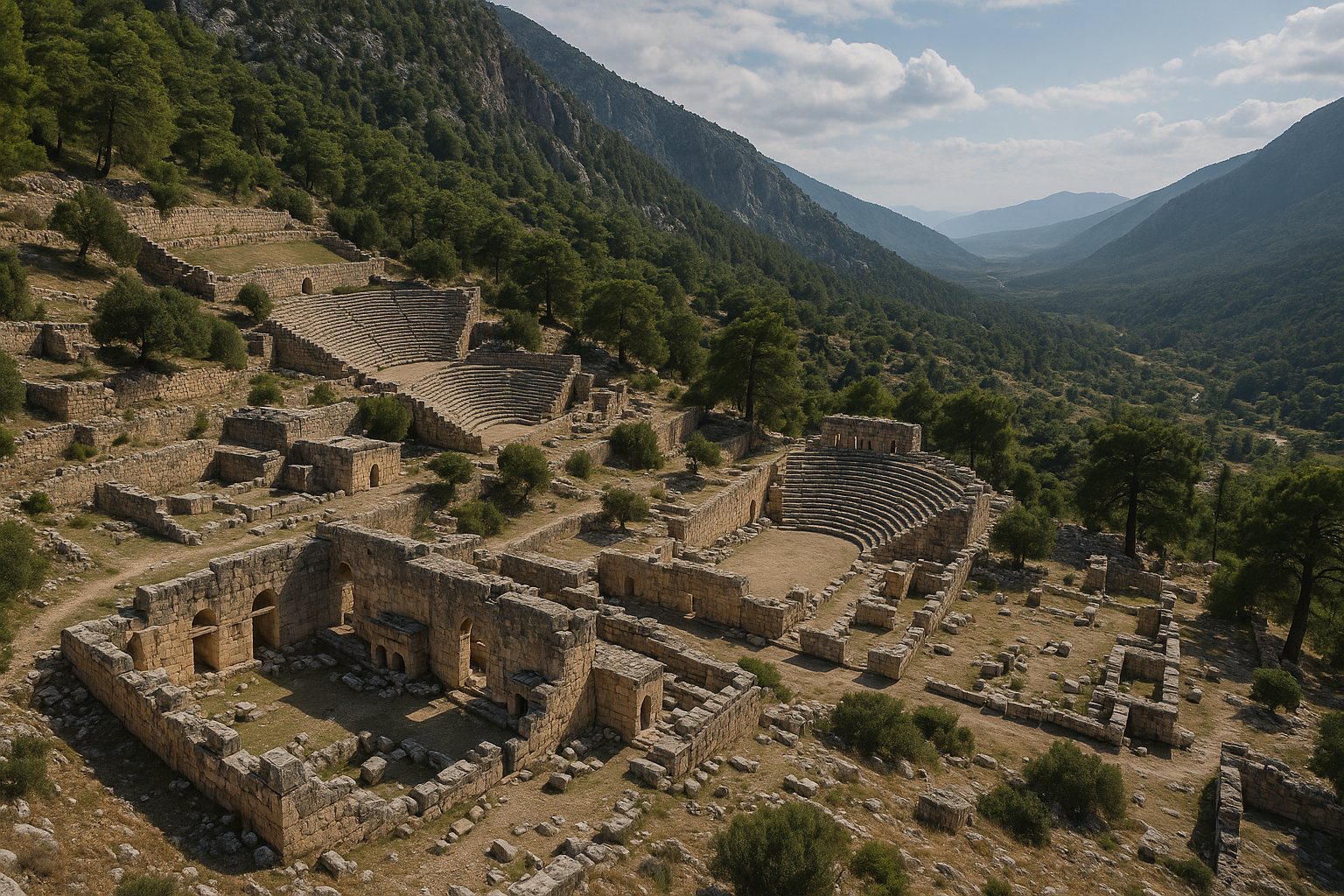
Myra était l'une des six plus grandes cités de la Ligue lycienne, disposant de trois voix à l'assemblée fédérale -- le maximum accordé à un membre. Taillées dans des falaises abruptes, ses spectaculaires tombes rupestres imitent dans la pierre les façades de maisons en bois, préservant une approche uniquement lycienne de l'au-delà. Des siècles plus tard, la cité acquit une renommée mondiale en tant que siège épiscopal de saint Nicolas (vers 270--343 apr. J.-C.), figure historique à l'origine de la légende du Père Noël. Aujourd'hui, les ruines de Myra se dressent dans la ville de Demre, sur la côte méditerranéenne de la province d'Antalya, tandis que son ancien port d'Andriake -- jadis appelé « la Pompéi d'Anatolie » -- abrite le Musée des civilisations lyciennes restauré à l'intérieur du colossal grenier de l'empereur Hadrien. Ensemble, Myra et Andriake forment l'un des complexes archéologiques les plus complets et les plus diversifiés de la côte méditerranéenne turque, combinant l'art funéraire lycien, l'architecture impériale romaine, l'héritage du pèlerinage chrétien primitif et un programme archéologique actif qui continue de révéler de nouvelles découvertes.
Table des matières
- Pourquoi Myra compte
- Géographie et cadre
- Chronologie historique
- Principaux monuments
- Travaux archéologiques
- Informations pratiques pour les visiteurs
- Foire aux questions
- Sources et lectures complémentaires
Pourquoi Myra compte
-
Cité lycienne de premier rang. En tant que l'une des seules six cités de la Ligue lycienne disposant du maximum de trois voix, Myra était une puissance politique, culturelle et économique du monde lycien -- une civilisation qui fut pionnière de la démocratie fédérale des siècles avant les expériences modernes. Le système de représentation proportionnelle de la Ligue lycienne, loué par Montesquieu et étudié par les Pères fondateurs américains, en fait l'une des expériences politiques les plus importantes de l'Antiquité.
-
Tombes rupestres emblématiques. Les deux nécropoles de Myra -- la nécropole du Fleuve et la nécropole de l'Océan (de la Mer) -- comportent des dizaines de tombes taillées dans des falaises verticales. Ces tombes « de type maison » reproduisent dans la pierre l'architecture en bois, avec des portes sculptées, des poutres et même du mobilier intérieur, offrant un aperçu sans égal de l'architecture domestique lycienne et des croyances funéraires que l'on ne trouve nulle part ailleurs dans le monde antique.
-
Saint Nicolas -- le véritable Père Noël. Saint Nicolas de Myre, évêque au début du IVe siècle apr. J.-C., devint l'un des saints les plus vénérés de la chrétienté. Sa générosité légendaire -- jetant des pièces d'or par une fenêtre pour sauver trois sœurs de la misère -- a inspiré la tradition mondiale du Père Noël. L'église Saint-Nicolas de Demre demeure un site de pèlerinage majeur, attirant des centaines de milliers de visiteurs chaque année.
-
Le plus grand théâtre de Lycie. Le théâtre romain de Myra, bâti au-dessus d'un prédécesseur hellénistique, accueillait environ 11 000 spectateurs, ce qui en faisait le plus grand de toute la région lycienne. Son bâtiment de scène présente des masques théâtraux sculptés et des reliefs mythologiques d'une qualité artistique exceptionnelle.
-
Andriake -- un port romain préservé sous des dépôts alluviaux. La cité portuaire d'Andriake, ensevelie sous 10 mètres de sédiments fluviaux, livre des structures remarquablement intactes à chaque saison de fouilles, ce qui lui vaut le surnom de « la Pompéi d'Anatolie ». Le grenier d'Hadrien, désormais restauré en Musée des civilisations lyciennes, est l'un des trois seuls entrepôts à grains romains survivants à cette échelle monumentale.
-
Lien biblique. L'apôtre Paul fit escale à Myra en 60 apr. J.-C. lors de son voyage vers Rome, changeant de navire au port d'Andriake -- un événement consigné dans Actes 27:5-6 qui relie Myra aux premiers jours de la diffusion du christianisme à travers le monde romain.
Géographie et cadre
Myra se situe sur la plaine alluviale du fleuve Demre (l'ancien Myros ou Andrakos), à environ 2 km à l'intérieur des terres depuis la côte méditerranéenne. Les falaises spectaculaires du mont Alaca s'élèvent immédiatement derrière le site, offrant la toile naturelle pour les tombes rupestres. Les falaises calcaires, dont la hauteur varie de 50 à 100 mètres, offrirent aux tailleurs de tombes lyciens à la fois la surface verticale et la stabilité géologique nécessaires à leur remarquable architecture funéraire.
La cité contrôlait l'accès à la fertile plaine de Demre -- l'une des zones agricoles les plus productives de la côte lycienne -- et à la route maritime stratégique le long de la Méditerranée orientale. Son port d'Andriake, situé à l'embouchure du fleuve Demre à environ 5 km au sud-ouest, servait de plaque tournante cruciale pour l'expédition de céréales reliant l'Égypte à Rome. Le rôle du port dans le système d'approvisionnement romain en grains (l'annona) explique l'investissement impérial dans le complexe massif du grenier d'Hadrien.
Le paysage environnant combine la garrigue méditerranéenne (maquis), les vergers d'agrumes -- Demre est célèbre dans toute la Turquie pour ses tomates et ses oranges, toutes deux cultivées dans de vastes complexes de serres -- et les eaux turquoise de la baie. La région de Kekova avec sa cité lycienne engloutie se trouve juste à l'est, ce qui fait de Myra une partie de l'un des littoraux archéologiques les plus concentrés de Turquie, où les ruines antiques et les paysages méditerranéens créent une expérience visiteur extraordinaire.
Les dépôts alluviaux du fleuve Demre ont été à la fois un préservateur et un dissimulateur de l'ancienne Myra. Au fil des siècles, le fleuve a déposé plusieurs mètres de sédiments sur les parties inférieures de la cité, ensevelissant des structures qui sont désormais révélées par les fouilles. Ce processus d'enfouissement progressif explique la préservation exceptionnelle des bâtiments portuaires d'Andriake, qui ont été scellés sous les sédiments avant qu'un pillage de pierres significatif n'ait pu se produire.
Climat : Les hivers sont doux et pluvieux (10--15 °C) ; les étés sont chauds et humides (30--38 °C) avec presque aucune précipitation. Les meilleurs mois de visite sont mars--mai et septembre--novembre, lorsque les températures sont agréables et que la lumière est idéale pour la photographie.
Chronologie historique
Période archaïque (vers Ve siècle av. J.-C. et avant)
La première mention de Myra apparaît dans des inscriptions lyciennes utilisant l'écriture lycienne indigène. Le nom pourrait dériver du mot lycien myrrh (signifiant « lieu de la Déesse-Mère »), reliant la cité aux traditions religieuses anatoliennes antérieures à l'influence grecque. Les tombes rupestres de la nécropole dynastique datent de cette période, indiquant que Myra était déjà un établissement significatif avec une élite dirigeante capable de commander une architecture funéraire monumentale.
La langue lycienne, écrite dans un alphabet unique dérivé du grec mais avec des caractéristiques nettement anatoliennes, est attestée dans des inscriptions à Myra. Les inscriptions bilingues et trilingues trouvées à travers la Lycie ont été essentielles pour déchiffrer cette langue, bien que de nombreux aspects restent mal compris.
Période classique (Ve--IVe siècle av. J.-C.)
Myra frappait sa propre monnaie et participait à la politique régionale en tant que cité lycienne importante. Les tombes rupestres lyciennes furent élaborées avec des façades peintes -- la fameuse « Tombe peinte » (également appelée « Tombe du Lion ») dans la nécropole du Fleuve portait à l'origine des pigments vifs rouges, jaunes et bleus dépeignant des scènes de banquet, des guerriers et des processions funéraires. Lorsque le voyageur britannique Charles Fellows documenta cette tombe en 1840, des traces de la décoration polychrome originale étaient encore visibles, bien qu'elles se soient depuis largement estompées.
Durant la période perse (546-334 av. J.-C.), la Lycie maintint un certain degré d'autonomie sous la suzeraineté perse, et les souverains dynastiques de Myra continuèrent de commander des tombes élaborées et des monuments civiques. La relation de la région avec la Perse était complexe -- en partie coopérative, en partie résistante -- comme en témoignent les alignements politiques variables des cités lyciennes durant les guerres médiques.
Période hellénistique (IIIe--Ier siècle av. J.-C.)
Myra devint membre de la Ligue lycienne (formalisée à partir de 168 av. J.-C. après que Rome eut libéré la Lycie du contrôle rhodien), l'une des six cités détenant trois voix chacune. Le géographe Strabon la décrivit comme l'une des plus grandes villes de l'alliance. Un théâtre hellénistique fut construit, établissant la tradition de représentation que le théâtre romain ultérieur poursuivrait.
Le système de représentation proportionnelle de la Ligue lycienne -- où les cités détenaient une, deux ou trois voix selon leur taille et leur importance -- était remarquablement sophistiqué pour le monde antique. Les juges et fonctionnaires fédéraux étaient élus par l'assemblée, et les taxes fédérales étaient évaluées proportionnellement. Ce système a été étudié comme précurseur de la démocratie fédérale moderne.
Période romaine (Ier siècle av. J.-C. -- IVe siècle apr. J.-C.)
Rome accorda à la Ligue lycienne une autonomie significative, la reconnaissant comme un modèle de gouvernance efficace. Un théâtre romain massif fut construit au-dessus de celui de l'époque hellénistique, avec une capacité de 11 000 spectateurs et un diamètre d'environ 110 mètres, ce qui en faisait le plus grand de toute la Lycie. Le bâtiment de scène (skene) était richement décoré de masques théâtraux sculptés, de reliefs mythologiques et d'ornements architecturaux.
Au port d'Andriake, l'empereur Hadrien (r. 117--138 apr. J.-C.) fit construire un grenier (horrea) monumental en 129--130 apr. J.-C. lors de sa tournée des provinces orientales. Cette structure colossale, mesurant environ 65 x 32 mètres avec huit chambres internes, est l'un des trois seuls entrepôts à grains romains survivants de cette échelle, aux côtés du grenier de Patara et de celui de Leptis Magna en Libye. La façade porte une inscription et des bustes en relief d'Hadrien et de l'impératrice Sabine, documentant le mécène impérial. Adjacente au grenier, une vaste montagne de coquilles d'escargots Murex témoigne qu'Andriake exploitait une industrie significative de production de pourpre de Tyr.
En 60 apr. J.-C., l'apôtre Paul fit escale à Myra lors de son voyage vers Rome pour y être jugé, changeant de navire au port d'Andriake (Actes 27:5--6). Ce lien biblique fit connaître Myra au monde chrétien primitif et contribua à son importance ultérieure en tant que centre chrétien.
Période paléochrétienne (IVe--VIIe siècle apr. J.-C.)
Saint Nicolas servit comme évêque de Myre au début du IVe siècle, sous le règne de Dioclétien (284-305 apr. J.-C.) et au-delà. Selon la tradition, il fut emprisonné durant la persécution des chrétiens par Dioclétien et libéré après l'accession au pouvoir de Constantin. On dit qu'il assista au concile de Nicée en 325 apr. J.-C., bien que son nom n'apparaisse pas dans toutes les traditions manuscrites des listes de présence du concile.
La réputation de saint Nicolas pour ses dons secrets -- la plus célèbre étant la légende de jeter des sacs d'or par une fenêtre pour fournir des dots à trois sœurs démunies -- et sa protection des marins, des enfants et des plus vulnérables finiraient par inspirer la figure du Père Noël (du néerlandais Sinterklaas). Il mourut le 6 décembre 343 apr. J.-C., et cette date devint sa fête, célébrée dans le monde entier.
La première église Saint-Nicolas fut construite à l'époque byzantine au VIe siècle, sur le lieu où Nicolas avait servi. L'église fut reconstruite plus tard au VIIIe siècle après des dommages causés par un tremblement de terre et une inondation, avec l'ajout d'un monastère orthodoxe à la fin du XIe siècle. Saint Nicolas fut enterré dans un sarcophage de marbre à l'intérieur de l'église.
En 1087, des marchands italiens de Bari pillèrent la tombe et emportèrent la plupart de ses reliques, les transportant vers la basilique Saint-Nicolas de Bari, en Italie, où elles demeurent aujourd'hui. Cet événement, connu sous le nom de « Translation des reliques », est commémoré chaque année à Bari le 9 mai. Quelques fragments d'os pourraient encore subsister à l'église de Demre ; les investigations archéologiques en cours continuent d'examiner cette question.
Périodes seldjoukide et ottomane (XIe--XXe siècle)
Les dépôts alluviaux du fleuve Demre ensevelirent progressivement une grande partie de la cité antique sous plusieurs mètres de sédiments. La région passa sous contrôle turc et un petit établissement nommé Kale se développa. En 2005, la ville fut officiellement rebaptisée Demre. L'église Saint-Nicolas fit l'objet d'une attention intermittente de la part des voyageurs, des érudits et des autorités ecclésiastiques, conduisant à diverses campagnes de réparation au cours des siècles.
Principaux monuments
Tombes rupestres lyciennes
Nécropole du Fleuve
Située à 1,5 km en amont le long du fleuve Demre depuis le théâtre, cet ensemble comprend la tombe la plus célèbre de Myra : la « Tombe peinte » (Tombe du Lion). Lorsque Charles Fellows la documenta en 1840, la façade conservait encore une décoration polychrome vive dépeignant des scènes de banquet, des processions de guerriers et des personnages en habit lycien. Les tombes sont taillées dans une falaise calcaire abrupte et présentent le style lycien distinctif « de type maison », avec des poutres en bois imitées (complètes avec des détails sculptés d'extrémités de poutres), des portes à charnières avec des mécanismes de verrouillage sculptés, et des bancs intérieurs destinés à recevoir le défunt.
La conception des tombes de type maison reflète la croyance lycienne selon laquelle les morts avaient besoin d'une demeure qui reproduisait l'architecture des vivants. La reproduction soignée des détails de construction en bois dans la pierre -- y compris l'assemblage, les liaisons chevillées et les pannes faîtières -- fournit des informations inestimables sur l'architecture domestique en bois lycienne qui a autrement entièrement disparu.
Nécropole de l'Océan (de la Mer)
Directement au-dessus du théâtre romain, cette nécropole est plus accessible et tout aussi spectaculaire. Les tombes cascadent en grappes denses le long de la falaise, beaucoup présentant des reliefs sculptés de figures humaines, de guerriers, de scènes de banquet funéraire et de créatures mythologiques. Certaines tombes portent des inscriptions en écriture lycienne, l'un des rares alphabets anatoliens indigènes, fournissant des preuves linguistiques importantes. La proximité de la nécropole avec le théâtre crée une juxtaposition visuellement frappante de l'architecture vivante et funéraire qui constitue l'une des scènes archéologiques les plus photographiées de Turquie.
Théâtre romain
Construit au-dessus d'un prédécesseur hellénistique, le théâtre a un diamètre d'environ 110 mètres et accueillait environ 11 000 spectateurs, ce qui en faisait le plus grand de la région lycienne et l'un des plus grands théâtres provinciaux de l'Orient romain. La cavea (zone de sièges) est bien préservée, avec les rangées inférieures taillées dans la roche et les sections supérieures soutenues par des substructures voûtées. Le bâtiment de scène (skene) présente des masques théâtraux sculptés et des reliefs mythologiques d'un mérite artistique considérable. Deux vomitoria (tunnels d'entrée) assuraient une circulation efficace de la foule. La position du théâtre à la base de la falaise couverte de tombes crée l'un des cadres archéologiques les plus spectaculaires de Turquie.
Église Saint-Nicolas (Noel Baba Müzesi)
Située au centre du Demre moderne, à environ 1 km du site de la cité antique, cette église fut construite au VIe siècle apr. J.-C. sur le lieu où Nicolas servit comme évêque, considérablement modifiée au VIIIe siècle et plus tard. Les éléments clés comprennent :
- Des mosaïques de sol avec des motifs géométriques en technique opus sectile
- Des fresques murales dépeignant des saints chrétiens, des scènes bibliques et des figures ecclésiastiques à travers plusieurs phases de peinture
- Un sarcophage de marbre que l'on croit avoir contenu les restes de saint Nicolas avant le vol des reliques en 1087
- Un ajout monastique orthodoxe du XIe siècle avec son propre caractère architectural
- De multiples phases de construction visibles dans les murs, documentant des siècles de construction, de réparation et d'expansion
L'église a fait l'objet d'un grand projet de restauration pluriannuel comprenant la construction d'une structure de toit protectrice conçue pour protéger le bâtiment des dommages météorologiques supplémentaires tout en permettant l'accès des visiteurs. Cette restauration a été l'un des projets de conservation du patrimoine les plus significatifs de Turquie.
Port d'Andriake et grenier d'Hadrien
Situé à 5 km au sud-ouest du centre de la cité antique, Andriake fut le port de Myra pendant plus d'un millénaire. Le port reliait Myra au réseau commercial de la Méditerranée orientale et jouait un rôle critique dans le système d'approvisionnement romain en grains, les navires transportant le grain égyptien vers Rome y faisant escale pour l'avitaillement et le transfert de navires.
La structure survivante la plus significative est le grenier d'Hadrien (Granarium), construit en 129--130 apr. J.-C. durant la tournée orientale de l'empereur. Ce magasin monumental mesure environ 65 x 32 mètres et comporte huit chambres conçues pour le stockage en vrac du grain, avec des systèmes de ventilation pour éviter la détérioration. La façade porte une inscription et des bustes en relief d'Hadrien et de l'impératrice Sabine.
Le grenier a été restauré et rouvert en 2016 en tant que Musée des civilisations lyciennes, exposant 1 476 artefacts dans huit salles d'exposition qui retracent toute l'étendue de l'histoire lycienne depuis l'âge du bronze jusqu'à la période byzantine. Le musée comprend des trouvailles provenant de toute la région lycienne, et pas seulement de Myra, fournissant un contexte global pour comprendre la civilisation lycienne.
Adjacente au grenier, une vaste montagne de coquilles d'escargots Murex -- estimée à des milliers de mètres cubes -- témoigne de manière saisissante qu'Andriake exploitait l'un des centres de production de pourpre de Tyr les plus significatifs de la Méditerranée antique. La pourpre, extraite des escargots de mer Murex par un processus élaboré et nauséabond, était le pigment le plus cher du monde antique et était réservée aux vêtements impériaux et aristocratiques.
D'autres structures à Andriake comprennent une synagogue (indiquant une communauté juive au port), des bâtiments thermaux, des installations portuaires et des structures commerciales, toutes progressivement fouillées et documentées.
Travaux archéologiques
Premières explorations
- 1840 : Le voyageur britannique Charles Fellows visita et documenta les tombes rupestres peintes, produisant des dessins et descriptions détaillés qui portèrent Myra à l'attention savante européenne pour la première fois. Ses illustrations de la décoration polychrome de la Tombe peinte restent le principal témoignage des couleurs aujourd'hui largement estompées.
- 1862--1863 : L'expédition autrichienne sous Julius August Schoenborn mena les premières prospections systématiques du théâtre et des zones de tombes.
Fouilles modernes
- 2005 -- présent : Les fouilles systématiques à Andriake, initialement dirigées par Helmut Borchhardt de l'Institut archéologique autrichien et poursuivies par les équipes ultérieures comprenant des archéologues turcs, ont révélé le complexe portuaire, le grenier et les structures environnantes dans un état de préservation que l'équipe de fouille compare à Pompéi. L'enfouissement alluvial qui a dissimulé Andriake l'a également protégée du pillage des pierres, donnant des murs encore debout, des portes intactes et des surfaces de sol préservées.
- Le ministère turc de la Culture et du Tourisme a dirigé d'importantes campagnes de restauration à l'église Saint-Nicolas (construction en cours d'un toit protecteur), au théâtre romain (nettoyage et stabilisation) et au Musée des civilisations lyciennes (réutilisation adaptative du grenier d'Hadrien).
Découvertes clés
- Les fouilles d'Andriake ont révélé des structures préservées sous jusqu'à 10 mètres de dépôts alluviaux, dans un état de préservation remarquable.
- Des dépôts de coquilles de Murex documentant une production de pourpre à grande échelle au port.
- Une synagogue à Andriake, indiquant une diversité religieuse au port.
- Des découvertes continues de nouvelles chambres funéraires dans les deux nécropoles à mesure que les falaises s'érodent et révèlent des cavités auparavant cachées.
- Une investigation en cours pour déterminer si les fragments d'os restants de saint Nicolas sont toujours présents à l'église de Demre.
- Les saisons récentes se sont concentrées sur l'infrastructure portuaire, les bâtiments commerciaux et le plan urbain d'Andriake, révélant la complexité surprenante de la cité portuaire.
Informations pratiques pour les visiteurs
Comment s'y rendre
- En voiture : Demre se trouve à environ 150 km au sud-ouest d'Antalya via la route côtière D400 (environ 2,5 heures). La route est bien entretenue et pittoresque, traversant les villes côtières de Kemer, Olympos et Finike.
- En bus : Des bus interurbains réguliers relient la gare routière d'Antalya (otogar) à Demre, avec des arrêts le long de la côte. La durée du trajet est d'environ 3 heures.
- En bateau : Demre est accessible depuis les excursions en bateau de Kekova, qui partent d'Üçağız et accostent parfois à Andriake.
Sites à visiter à Demre
- Tombes rupestres et théâtre de Myra -- le site de la cité antique, situé à l'extrémité nord de Demre (entrée payante).
- Église Saint-Nicolas -- au centre de la ville, à environ 1 km au sud de la cité antique (billet séparé).
- Port d'Andriake et Musée des civilisations lyciennes -- 5 km au sud-ouest du centre de Demre (billet séparé).
Temps nécessaire
- Tombes rupestres + théâtre de Myra : 1--1,5 heure. La nécropole de la Mer au-dessus du théâtre est la plus immédiatement impressionnante ; la nécropole du Fleuve nécessite une courte marche.
- Église Saint-Nicolas : 30--45 minutes. Notez que les travaux de restauration peuvent affecter l'accès à certaines sections.
- Andriake + musée : 1--2 heures. Le musée est excellent et mérite une attention non précipitée.
- Les trois sites combinés : 3--5 heures pour une visite complète. Une journée entière permet un rythme détendu avec un déjeuner à Demre.
Que prendre
- Des chaussures de marche confortables (la zone des tombes rupestres implique de marcher sur un terrain accidenté et quelques sentiers en pente).
- Une protection solaire et de l'eau, surtout en été -- la zone du théâtre a peu d'ombre.
- Un appareil photo avec une bonne capacité de zoom pour photographier les détails des tombes de la falaise depuis le sol.
- Des jumelles sont utiles pour examiner en détail les façades supérieures des tombes.
Combinaisons avec d'autres sites
- Les excursions en bateau de la cité engloutie de Kekova partent d'Üçağız ou du port de Demre tout proches. C'est l'une des combinaisons d'excursions d'une journée les plus populaires de la côte turque.
- Patara ancienne cité et plage (50 km à l'ouest) -- une autre grande cité de la Ligue lycienne avec la plus longue plage de sable de Turquie.
- Les flammes éternelles d'Olympos et de la Chimère (80 km à l'est vers Antalya) -- les évents de gaz naturel qui brûlent continuellement depuis l'Antiquité.
- L'ancienne cité de Limyra (30 km à l'est) -- une autre cité lycienne importante avec des tombes rupestres et un héroon.
- L'ancienne cité d'Arycanda (50 km au nord-est) -- une cité lycienne-romaine magnifiquement située dans un cadre montagneux.
Meilleure saison
- Printemps (mars--mai) : Températures douces, fleurs sauvages sur les collines, confortable pour la marche. Les vergers d'agrumes sont en fleurs, ajoutant un parfum au paysage.
- Automne (septembre--novembre) : Chaud, moins de monde qu'en été, excellente lumière photographique. La récolte des tomates de serre est en cours.
- Été (juin--août) : Très chaud et humide ; visitez tôt le matin pour éviter la chaleur de midi. La mer est chaude pour la baignade sur les plages voisines.
- Hiver (décembre--février) : Doux selon les standards méditerranéens (rarement en dessous de 5 °C) ; les célébrations de la Saint-Nicolas début décembre (vers le 6 décembre, jour de sa fête) attirent des visiteurs internationaux et comprennent des cérémonies spéciales à l'église.
Foire aux questions
Saint Nicolas est-il vraiment enterré ici ?
Saint Nicolas fut à l'origine enterré dans l'église Saint-Nicolas de Demre. Cependant, en 1087, des marchands italiens de Bari emportèrent la plupart de ses os et les apportèrent en Italie, où ils sont aujourd'hui conservés dans la basilique Saint-Nicolas de Bari. Certains fragments d'os pourraient encore rester à Demre ; les investigations archéologiques ont examiné le sarcophage et les zones environnantes, et la question reste ouverte. La Turquie a périodiquement soulevé la question du rapatriement des reliques.
Puis-je entrer dans les tombes rupestres ?
Non. Les tombes sont taillées dans des falaises abruptes à des hauteurs significatives (certaines à 30-50 mètres au-dessus du niveau du sol) et ne sont pas accessibles pour l'entrée. Elles sont mieux observées et photographiées depuis le sol, la zone du théâtre, ou avec des jumelles et des objectifs zoom. L'escalade des falaises est interdite pour des raisons de sécurité et de conservation.
Quel est le lien entre Myra et le Père Noël ?
Saint Nicolas (vers 270--343 apr. J.-C.), évêque de Myre, était célèbre pour sa générosité secrète -- la légende dit qu'il fit tomber des pièces d'or par une fenêtre pour aider un père pauvre à fournir des dots à ses trois filles, les sauvant de la misère ou pire. Au fil des siècles, cette histoire et d'autres sur ses interventions miraculeuses ont évolué vers la tradition mondiale du Père Noël (néerlandais Sinterklaas, anglais Father Christmas, allemand Weihnachtsmann). La transformation d'un évêque méditerranéen du IVe siècle en une figure vêtue de rouge au pôle Nord est l'une des transformations culturelles les plus remarquables de l'histoire.
Quelle est la taille du théâtre ?
Le théâtre romain de Myra accueillait environ 11 000 spectateurs, ce qui en faisait le plus grand de toute la région lycienne. Son diamètre est d'environ 110 mètres. Le théâtre est bien préservé, avec des rangées de sièges intactes, des tunnels d'entrée (vomitoria) et des vestiges substantiels du bâtiment de scène décoré.
Qu'est-ce que le Musée des civilisations lyciennes ?
Le musée est installé à l'intérieur du grenier d'Hadrien restauré à Andriake, l'ancien port de Myra. Ouvert en 2016, il expose 1 476 artefacts couvrant toute l'étendue de la civilisation lycienne depuis l'âge du bronze jusqu'à la période byzantine, organisés à travers huit salles d'exposition thématiques au sein des chambres d'origine du grenier. C'est l'un des plus beaux musées archéologiques de la côte méditerranéenne turque.
Qu'était l'industrie du pourpre de Murex ?
La vaste montagne de coquilles d'escargots Murex à Andriake démontre que le port exploitait une importante installation de production de pourpre. La pourpre de Tyr (également appelée pourpre royale) était extraite de la glande hypobranchiale des escargots de mer Murex par un processus impliquant écrasement, salage et chauffage lent. Le colorant résultant était le colorant le plus cher du monde antique -- valant plus que son poids en or -- et était utilisé pour colorer les vêtements des empereurs, des sénateurs et de l'élite fortunée.
Demre vaut-elle la visite au-delà des ruines ?
Oui. Demre est entourée de vergers d'agrumes et d'agriculture sous serre, produisant certaines des meilleures tomates et oranges de Turquie. La région voisine de Kekova offre des excursions en bateau vers une cité lycienne engloutie et de la baignade dans des eaux cristallines. La ville possède une forte tradition culinaire mettant en vedette des fruits de mer frais, des produits cultivés localement et une cuisine méditerranéenne traditionnelle. La commémoration annuelle de la Saint-Nicolas début décembre ajoute une dimension culturelle festive.
Mesures architecturales et chiffres clés
| Structure | Mesure | Notes |
|---|---|---|
| Diamètre du théâtre romain | 111 m | Dépasse un demi-cercle ; plus grand théâtre de Lycie |
| Capacité du théâtre | environ 12 000 spectateurs | Estimations antérieures de 11 000 ; relevé détaillé a augmenté le chiffre |
| Ima cavea (sièges inférieurs) | 27 rangées, 13 cunei | Divisée par 14 escaliers |
| Praecinctio (allée) | 2,66 m de large | Adossée à un mur de podium de 2,48 m de haut séparant la cavea supérieure et inférieure |
| Grenier d'Hadrien (Andriake) | environ 65 x 32 m (2 307 m²) | 8 chambres internes ; construit 129--130 apr. J.-C. |
| Citerne d'Andriake | 24 x 12 m, profondeur 6 m | Réservoir d'eau aménagé |
| Dépôt de coquilles de Murex (Andriake) | environ 300 m³ | Datant principalement du VIe siècle apr. J.-C. |
| Musée des civilisations lyciennes | 1 476 artefacts dans 8 salles | Ouvert en 2016 à l'intérieur du grenier restauré |
| Hauteur de la falaise des tombes rupestres | 50--100 m | Falaises calcaires du mont Alaca |
| Inscriptions des tombes | 23 au total (13 lyciennes, 10 grecques) | Trouvées sur les façades des tombes rupestres dans les nécropoles |
Évidence numismatique
Le monnayage de Myra s'étend des émissions dynastiques lyciennes du Ve siècle av. J.-C. jusqu'aux drachmes fédérales de la Ligue lycienne et à la période impériale romaine, fournissant un récit continu de l'évolution politique et religieuse de la cité.
Émissions dynastiques (Ve--IVe siècle av. J.-C.) : Les premières pièces attribuées à Myra datent de la période dynastique lycienne, lorsque les souverains locaux frappèrent de petites fractions d'argent portant le nom de la cité ou de ses dynastes en écriture lycienne. Ces pièces comportent typiquement une tête de lion ou un avant-train sur l'avers et un motif géométrique en creux sur le revers, suivant les conventions partagées à travers les centres de frappe lyciens.
Drachmes fédérales de la Ligue lycienne (167--100 av. J.-C.) : Après que Rome eut libéré la Lycie du contrôle rhodien en 168 av. J.-C., la Ligue lycienne nouvellement constituée commença à émettre un monnayage fédéral standardisé. Myra servit comme l'un des centres de frappe de la Ligue, produisant des drachmes d'argent pesant environ 2,7 g avec un diamètre d'environ 15,5 mm. L'avers montre la tête d'Apollon portant une couronne de laurier, tandis que le revers porte une lyre (cithare) et la marque d'atelier identifiant Myra. Le standard de poids cohérent et l'iconographie partagée à travers les ateliers de la Ligue (y compris Patara, Xanthos et Tlos) démontrent la coordination monétaire remarquable atteinte par ce système fédéral antique.
Artémis Éleuthéra sur le monnayage : La divinité dominante sur les pièces de l'époque impériale de Myra était Artémis Éleuthéra (Artémis la Libératrice), une forme distinctive de l'ancienne déesse-mère anatolienne Cybèle que les Grecs identifiaient à Artémis. Les pièces la représentent assise sur un trône ou debout dans son temple, rendue dans un style qui mélange l'iconographie de l'Artémis grecque avec l'ancienne tradition anatolienne de Cybèle. Les sources antiques rapportent que le temple d'Artémis Éleuthéra de Myra était le bâtiment le plus grand et le plus splendide de Lycie, bien que son emplacement précis n'ait pas été identifié archéologiquement.
| Période | Dénomination | Types clés |
|---|---|---|
| Ve--IVe siècle av. J.-C. | Fractions d'argent | Tête de lion, noms dynastiques en écriture lycienne |
| 167--100 av. J.-C. | Drachme d'argent fédérale (2,7 g) | Tête d'Apollon / lyre avec marque d'atelier de Myra |
| Ier--IIIe siècle apr. J.-C. | Bronze impérial | Artémis Éleuthéra, façade de temple, portraits d'empereurs |
La Tombe peinte : Analyse pigmentaire et iconographique
La Tombe peinte (également connue sous le nom de « Tombe du Lion ») dans la nécropole du Fleuve est le plus célèbre des monuments rupestres de Myra et l'un des exemples les plus importants de l'art funéraire lycien. Datée d'environ 360--340 av. J.-C., la tombe fut taillée durant les dernières décennies du règne dynastique lycien avant la conquête d'Alexandre le Grand.
Lorsque le voyageur britannique Charles Fellows visita Myra en 1840, il était accompagné de l'artiste George Scharf, qui réalisa de soigneux dessins en couleurs de la façade de la tombe. Les aquarelles de Scharf, aujourd'hui conservées dans les archives du British Museum, témoignent que les reliefs sculptés étaient à l'origine peints avec des pigments vifs rouges, jaunes et bleus. Les scènes représentées comprennent :
- Des scènes de banquet montrant des figures d'élite allongées sur des lits, servies par des serviteurs -- un motif partagé avec l'art funéraire grec et perse contemporain
- Des processions de guerriers avec des hommes armés en habit lycien, représentant possiblement le cortège funèbre ou les honneurs militaires du défunt
- Des offrandes funéraires et des scènes rituelles associées au culte des morts
Ces pigments se sont presque entièrement estompés depuis la documentation de Scharf, faisant de ses dessins le seul témoignage fiable de l'apparence polychrome originale. Les scientifiques de la conservation moderne ont utilisé l'imagerie multispectrale et l'analyse par fluorescence X (XRF) sur les traces restantes pour confirmer les pigments minéraux utilisés : ocre rouge (oxyde de fer) pour les rouges, bleu égyptien (silicate de calcium et de cuivre) pour les bleus, et ocre jaune (limonite) pour les jaunes.
Le trésor de sculptures en terre cuite (Découverte de 2021)
En février 2021, une équipe de l'Université Akdeniz dirigée par le professeur Nevzat Çevik annonça la découverte de dizaines de sculptures en terre cuite vieilles de 2 200 ans lors de fouilles sous le théâtre romain. Ces figurines, datant de la période hellénistique (IIIe--IIe siècle av. J.-C.), avaient été scellées sous la construction romaine ultérieure et préservées dans un état remarquable.
Le trésor comprend :
- Des figures d'hommes et de femmes en habit grec et lycien
- Des cavaliers à cheval, représentant possiblement des contextes militaires ou cérémoniels
- Des animaux comprenant des chevaux, des taureaux et des oiseaux
- Des représentations de divinités grecques, incluant des figures identifiables d'Aphrodite et de Dionysos
- Des fragments portant les noms des artistes qui les ont fabriquées, inscrits en grec
Certaines figurines conservent de la peinture partiellement préservée, indiquant qu'elles étaient à l'origine polychromes -- une survivance rare pour la terre cuite hellénistique. Les matériaux trouvés aux côtés des terres cuites comprennent des objets en céramique, bronze, plomb et argent, suggérant que le dépôt pourrait représenter soit des offrandes votives d'un sanctuaire d'époque hellénistique sous le théâtre, soit le contenu d'un atelier qui fut enseveli lors de la reconstruction romaine. Ces figurines étendent significativement l'histoire documentée de la production artistique de Myra et fournissent de nouvelles preuves pour la pratique religieuse hellénistique sur le site.
L'industrie du pourpre et la synagogue d'Andriake
Le vaste dépôt de coquilles de Murex à Andriake, identifié pour la première fois en 2003 et prospecté systématiquement en 2004, contient environ 300 mètres cubes de coquilles fortement fragmentées des espèces Bolinus brandaris et Hexaplex trunculus. Le dépôt entoure trois côtés d'une citerne souterraine et recouvre les vestiges d'un bâtiment en forme de U, les preuves de datation plaçant la période principale de production de pourpre au VIe siècle apr. J.-C. -- la période byzantine précoce.
L'échelle de ce dépôt fait d'Andriake l'un des plus grands centres documentés de production de pourpre de la Méditerranée antique, comparable aux installations majeures de Sidon et de Tyr. Un seul gramme de pourpre de Tyr nécessitait le traitement d'environ 10 000 escargots Murex, ce qui signifie que le dépôt d'Andriake représente le traitement de milliards de coquilles individuelles au cours de la vie opérationnelle de l'installation.
La synagogue : Les fouilles à Andriake ont également révélé une synagogue du Ve siècle apr. J.-C., fournissant la première preuve archéologique de la vie communautaire juive dans la Lycie chrétienne. La présence de la synagogue au port plutôt que dans la cité principale de Myra suggère que la communauté juive était liée aux activités commerciales maritimes d'Andriake. Cette découverte ajoute une dimension importante à la diversité religieuse de la côte lycienne, démontrant que les communautés juive, chrétienne et païenne résiduelle coexistaient dans la ville portuaire durant l'Antiquité tardive.
Sources et lectures complémentaires
- Myra - Wikipedia
- Myra (Demre) - Turkish Archaeological News
- Antalya Myra Archaeological Site - Turkish Museums
- Myra - Lycian Monuments
- Andriake and Hadrian's Granary - Demre.net
- The Ancient City of Myra - Kekova Travel
- Myra Ancient City - Sail n Stay
- Myra - Cultural Journeys GoTurkiye
- Fellows, C. A Journal Written During an Excursion in Asia Minor. Londres, 1839.
- Bean, G.E. Lycian Turkey. Londres : Ernest Benn, 1978.
- T.C. Kültür ve Turizm Bakanlığı