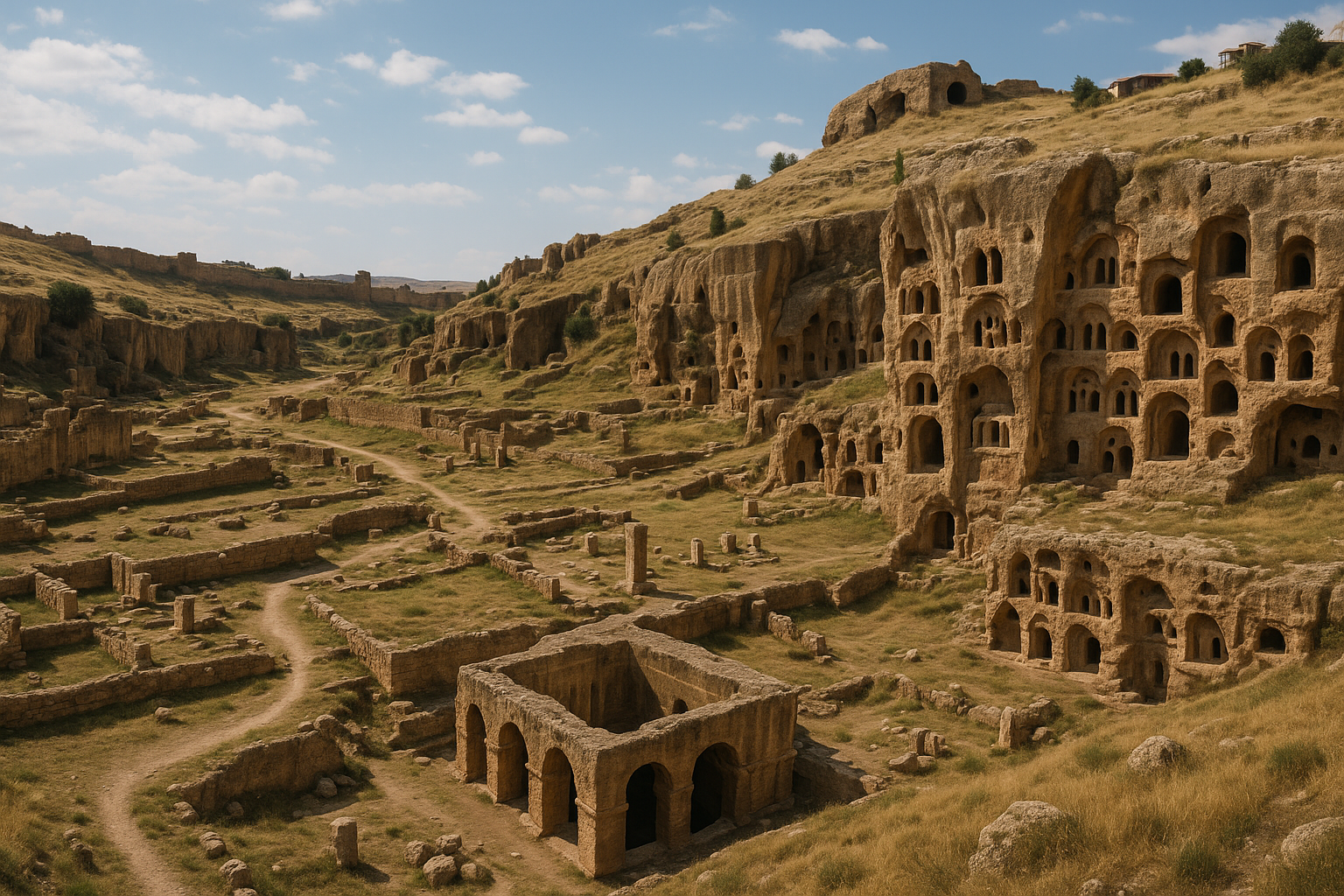
Göbekli Tepe est le plus ancien complexe rituel monumental connu sur Terre. Sur une crête calcaire battue par les vents des monts Germuş, à environ vingt-deux kilomètres au nord-est de Şanlıurfa, les chasseurs-cueilleurs du Néolithique précéramique ont érigé des cercles de mégalithes sculptés en forme de T entre environ 9600 et 8000 av. J.-C. — environ sept mille ans avant que les premières pierres ne soient traînées sur la plaine de Salisbury à Stonehenge, et sept mille cinq cents ans avant que le parement de la Grande Pyramide de Gizeh ne soit poli. Les piliers mesurent de cinq à sept mètres de haut, pèsent jusqu'à dix tonnes chacun et sont sculptés de renards, de léopards, de scorpions, de serpents, de sangliers, de vautours, de grues et de taureaux. Ils sont disposés en grandes enceintes circulaires autour de deux piliers centraux élancés, et l'ensemble du dispositif a été construit par des gens qui, autant que nous puissions le dire, n'avaient pas encore domestiqué une seule plante ou un seul animal. Ce simple fait explique pourquoi Göbekli Tepe est désormais appelé le « point zéro de l'histoire » : il a forcé l'archéologie à inverser l'ordre de son propre grand récit, dans lequel la religion et le monument étaient censés être les produits de l'agriculture, et non leurs précurseurs. Le site a été identifié lors d'une prospection en 1963 mais n'a été reconnu pour ce qu'il était qu'en 1994, par l'archéologue allemand Klaus Schmidt, dont les fouilles à partir de 1995 ont transformé une colline négligée de Şanlıurfa en l'un des lieux les plus discutés de la préhistoire mondiale. L'UNESCO a inscrit Göbekli Tepe sur la Liste du patrimoine mondial en 2018, et en 2019 la République de Türkiye a proclamé une « Année de Göbekli Tepe » officielle. Aujourd'hui, le site se trouve au centre du programme de recherche plus large Taş Tepeler (« Collines de pierre »), une constellation d'établissements néolithiques contemporains — Karahantepe, Sayburç, Sefertepe, Harbetsuvan, Kurttepesi et d'autres — qui réécrivent ensemble l'histoire de la manière dont les êtres humains ont choisi pour la première fois de vivre ensemble.
Table des matières
- Pourquoi Göbekli Tepe compte
- Géographie et cadre
- Chronologie historique
- Principales structures et découvertes
- La thèse de Schmidt et la critique moderne
- Le projet Taş Tepeler
- Karahantepe — Le frère de l'autre colline
- Chiffres et mesures
- Informations pour les visiteurs
- Foire aux questions
- Sources et lectures complémentaires
Pourquoi Göbekli Tepe compte
Appeler Göbekli Tepe le « point zéro de l'histoire » est un slogan, mais il pointe vers quelque chose de véritablement important sur la manière dont la discipline de l'archéologie a dû se réécrire elle-même depuis la fin des années 1990. L'expression est un raccourci pour au moins six arguments imbriqués, chacun d'eux suffisant à lui seul à rendre le site significatif.
-
Il fait s'effondrer l'ancienne séquence de la « civilisation ». Pendant la majeure partie du XXe siècle, les manuels enseignaient que l'histoire humaine se déroulait dans un ordre bien rangé : les gens ont inventé l'agriculture, l'agriculture a produit des surplus, les surplus ont permis les villages, les villages ont permis les chefs et les prêtres, et seulement alors — tardivement — les communautés ont eu la richesse, le temps et l'organisation pour ériger des temples. Göbekli Tepe inverse cet ordre. Ici, l'architecture monumentale précède manifestement les plantes domestiques, la poterie, la métallurgie et même les premiers villages réellement sédentaires. Le premier temple, autrement dit, est venu avant la première ferme.
-
Il réécrit ce que les chasseurs-cueilleurs étaient « autorisés » à faire. Des générations de chercheurs ont projeté sur les peuples préagricoles une vie tranquille de petites bandes se déplaçant au gré des saisons. Göbekli Tepe les montre extrayant des monolithes calcaires de dix tonnes, les habillant de sculptures en haut-relief de renards et de scorpions, les érigeant en cercles soigneusement planifiés et revenant entretenir le site sur plusieurs siècles. Rien de cela n'est incompatible avec une économie de chasseurs-cueilleurs, mais cela démantèle l'hypothèse selon laquelle l'ambition monumentale et la complexité rituelle exigeaient l'agriculture.
-
Il est véritablement le plus ancien de son genre. Les datations au radiocarbone calibrées à partir du charbon noyé dans les niveaux de construction placent les premières enceintes vers 9600 av. J.-C., tout au début du Néolithique précéramique A. Les phases de construction les plus récentes se terminent avant 8000 av. J.-C. Cela représente environ sept mille ans avant Stonehenge et sept mille cinq cents ans avant les pyramides égyptiennes. L'écart chronologique n'est pas une différence marginale ; c'est l'essentiel du temps humain enregistré.
-
Il ancre une région, pas un site unique. Une fois Göbekli Tepe compris, les archéologues ont commencé à examiner les tertres voisins d'un œil neuf. Karahantepe, Sayburç, Sefertepe, Kurttepesi, Harbetsuvan, Çakmaktepe et d'autres se sont révélés appartenir au même horizon, avec leurs propres piliers en T, leurs reliefs animaliers et leurs installations rituelles. Les « Collines de pierre » de Haute Mésopotamie formaient un réseau — peut-être le plus ancien paysage cultuel régional de l'histoire humaine.
-
Il relie le monument au blé. Les études génétiques de l'engrain pointent vers un événement de domestication sur les pentes basaltiques du Karaca Dağ, le volcan visible à l'est de Şanlıurfa, à seulement une trentaine de kilomètres de Göbekli Tepe. Les gens qui ont hissé les T calcaires puisaient dans un paysage qui, à quelques générations de leurs propres descendants, produirait le premier grain domestiqué sur Terre. Ce n'est pas une coïncidence ; c'est une co-évolution.
-
C'est un site de mémoire sociale. Les enceintes n'ont pas seulement été construites ; elles ont été entretenues, réparées, partiellement démantelées et finalement enterrées avec un soin extraordinaire. Les piliers portent des marques — H, croissants, paires de serpents — qui ressemblent à des emblèmes ou à des signes. Qu'ils représentent des groupes de parenté, des ancêtres ou des récits rituels, c'est ainsi qu'une société stockait du sens avant l'écriture. Göbekli Tepe montre que l'impulsion à créer un lieu symbolique permanent précède presque tous les autres « premiers » du registre humain.
-
Il est récupérable. Crucialement, le site survit. L'enfouissement délibéré des enceintes vers 8000 av. J.-C. a protégé les sculptures sous un remblai stérile pendant cent siècles. Nous pouvons encore marcher parmi les choses que nos ancêtres voulaient que nous nous souvenions, et nous pouvons encore débattre de ce qu'elles signifiaient.
Ce que « point zéro de l'histoire » signifie et ne signifie pas
L'expression « point zéro de l'histoire » — en turc, tarihin sıfır noktası — a été forgée à des fins de marketing autour de l'inscription à l'UNESCO de 2018, et comme tous les slogans de ce type, elle comporte un léger risque de survente. Il est utile de dire clairement ce qu'elle signifie, et ne signifie pas, dans la recherche.
Cela ne signifie pas que Göbekli Tepe est le plus ancien site humain au monde. Les humains anatomiquement modernes faisaient de l'art rupestre à Chauvet et à El Castillo plus de trente mille ans plus tôt ; des figurines sculptées comme l'Homme-Lion de Hohlenstein-Stadel sont encore plus anciennes. La culture natoufienne du Levant avait déjà produit des villages semi-sédentaires, des maisons en pierre et des sépultures élaborées au moment où les premières pierres de Göbekli Tepe ont été soulevées. Le site ne se tient pas au début de la créativité humaine, ni même de la pensée monumentale.
Ce que cela signifie, c'est que Göbekli Tepe est le plus ancien site connu où l'architecture monumentale est exprimée sans ambiguïté en pierre, à grande échelle, par une société qui n'avait pas encore adopté l'agriculture. C'est le plus ancien « lieu » au sens archéologique moderne — un environnement bâti dont le plan, les matériaux et la décoration déclarent une intention collective à long terme de marquer un point précis à la surface de la Terre. Tout ce qui vient après au Proche-Orient — Çatalhöyük, Uruk, Babylone, les temples et ziggourats de Mésopotamie — se situe, en un sens réel, en aval de ce qui a été commencé ici.
Cela signifie aussi, de manière plus provocatrice, que la superstructure idéologique d'une société — sa religion, son art, son sens de l'identité communautaire — pouvait déjà, à cette date, conduire à l'investissement d'un travail énorme dans un effort non productif. En termes économiques, Göbekli Tepe est « gaspilleur ». Il ne produit ni nourriture, ni abri, ni biens d'échange. Il produit du sens. Le site est, en ce sens, le point zéro non pas de l'existence humaine, mais de l'histoire en tant qu'investissement structuré du travail humain dans un sens partagé.
Géographie et cadre
Göbekli Tepe est un tell — un tertre artificiel — perché sur le bord méridional du massif des Germuş, un faible massif calcaire qui s'élève au nord du bassin de Şanlıurfa. Le tertre lui-même se situe à environ 760 mètres au-dessus du niveau de la mer, sur une colline appelée par les villageois locaux de langue kurde Girê Mirazan, « la colline des vœux », et en turc Göbekli Tepe, « la colline ventrue », d'après sa silhouette arrondie. Administrativement, le site se trouve sur les terres du village d'Örencik, dans le district de Haliliye, dans la province de Şanlıurfa, au sud-est de la République de Türkiye.
La vue depuis le sommet explique une grande partie de l'histoire du site. Au sud, la plaine de Şanlıurfa s'ouvre sur les sources du Balikh, et au-delà la plaine de Harran, parcourue de sources et d'oueds saisonniers — l'arc septentrional du Croissant fertile. À l'est, le cône du Karaca Dağ domine l'horizon. Au nord, les collines calcaires des Germuş roulent en direction de l'Anti-Taurus. À portée de vue, par temps clair, se trouvent les futures collines de Karahantepe, Sefertepe, Yenimahalle et Ayanlar Höyük — la constellation aujourd'hui appelée Taş Tepeler.
La géologie est décisive. Le sommet de la colline est une masse unique de calcaire éocène de haute qualité, facile à travailler avec des outils en silex et en basalte, et se fendant naturellement en dalles et en barres.
Les piliers n'ont pas été importés ; ils ont été extraits directement du substrat rocheux autour des enceintes, parfois à quelques mètres de l'endroit où ils se sont finalement dressés. Des piliers inachevés gisent encore dans leur lit dans les carrières méridionales, à moitié détachés de la matrice — y compris un colosse qui, s'il avait été libéré, aurait mesuré environ sept mètres de haut et pesé dans les cinquante tonnes.
L'agencement de la carrière et de l'enceinte fait lui-même partie du dessein du site. Il n'y a pas de « zone de production » distincte cachée loin de la zone rituelle ; les piliers s'élèvent là où le substrat le permettait, et les enceintes se forment autour d'eux. Cette intégration de l'architecture et de la géologie — construire avec la colline, plutôt que sur elle — est l'une des choses qui rendent Göbekli Tepe, encore aujourd'hui, organique et inéluctable.
Le climat aujourd'hui est rudement continental : des étés au-dessus de 40 °C avec des vents brûlants venant de la plaine, des hivers assez froids pour que le calcaire se fissure sous l'effet du gel.
Il y a douze mille ans, à la fin du Dryas récent et au début de l'Holocène, le climat régional était plus humide et un peu plus frais. Les carottes polliniques de lacs voisins enregistrent une forêt ouverte de chênes-pistachiers dans les contreforts, une forêt-galerie le long des cours d'eau et de larges prairies steppiques à travers la plaine.
Des troupeaux de gazelles, d'ânes sauvages (onagres), de sangliers, d'aurochs et de cerfs élaphes auraient été visibles depuis le sommet. L'engrain sauvage, l'amidonnier sauvage et l'orge sauvage poussaient dans les vallées mieux arrosées. Les amandiers et les pistachiers produisaient des récoltes d'automne fiables. Les sources et les oueds saisonniers au pied des collines Germuş fournissaient de l'eau ; le plateau supérieur, alors comme maintenant, était sec.
Il n'y a pas de source au sommet. Chaque goutte d'eau utilisée pendant la construction, les festins ou les rituels était portée en haut de la pente. Ce simple inconvénient nous dit quelque chose d'important : l'emplacement a été choisi pour sa visibilité et son sens, non pour sa commodité.
La connexion Karaca Dağ
La silhouette noire du Karaca Dağ, un volcan-bouclier éteint depuis longtemps dont le sommet s'élève à un peu plus de deux mille mètres, est le repère le plus important sur l'horizon oriental de Göbekli Tepe. Ses pentes portent les ancêtres sauvages de l'engrain (Triticum monococcum boeoticum), et les études génétiques de Manfred Heun et de ses collègues dans les années 1990 ont retracé l'engrain cultivé jusqu'à des populations poussant sur le Karaca Dağ même. La même région plus large a produit les premières formes domestiquées d'amidonnier, de pois chiche, de lentille, de vesce amère et possiblement de seigle. Depuis le sommet de Göbekli Tepe, cette montagne n'est pas une abstraction lointaine : c'est l'élément visible vers lequel les grands piliers centraux du Bâtiment D semblent, dans certaines interprétations, délibérément faire face.
La relation entre Göbekli Tepe et le Karaca Dağ est l'un des faits les plus évocateurs de l'archéologie néolithique. Des gens qui n'avaient pas encore « inventé » l'agriculture récoltaient néanmoins des céréales sauvages sur les pentes de cette même montagne, transportant la récolte vers un sanctuaire de pierre sur la crête calcaire d'en face, la traitant dans des mortiers creusés dans le substrat et la fermentant peut-être dans des cuves de pierre. À quelques générations de leurs descendants, ces mêmes céréales — récoltées sur ces mêmes pentes — deviendraient les premières cultures durablement domestiquées de la planète.
Notes géologiques
Le calcaire éocène des collines Germuş est, géologiquement parlant, presque idéal pour la sculpture monumentale. Il est suffisamment fin pour prendre une sculpture en relief nette, suffisamment tendre pour être travaillé avec des pics de silex et de basalte, mais suffisamment dur pour tenir des millénaires une fois érigé. Les piliers eux-mêmes ont été extraits sous forme de barres ou de dalles suivant les plans de stratification naturels de la roche — une stratégie qui réduisait le travail d'un ordre de grandeur. Le pilier inachevé qui gît encore dans la carrière méridionale montre clairement la technique : des canaux étaient découpés autour du périmètre du monolithe planifié à l'aide de pics, le dessous était entaillé le long du plan de stratification et le bloc était finalement libéré au levier.
Chronologie historique
L'histoire de Göbekli Tepe se déroule sur au moins quatre registres chronologiques : les phases néolithiques profondes pendant lesquelles il a été construit et utilisé, le moment de son enfouissement délibéré, les visites ultérieures possibles et l'histoire moderne de sa récupération.
Néolithique précéramique A (vers 9600 – 8800 av. J.-C.) — Couche III : les grandes enceintes
La phase de construction la plus ancienne et la plus spectaculaire se situe dans le Néolithique précéramique A (PPNA). C'est le niveau le plus profond, le plus ancien du tertre, conventionnellement appelé Couche III.
À cette période appartiennent les grandes enceintes circulaires étiquetées A, B, C et D, ainsi que les plus grands piliers en T connus et les reliefs animaliers les plus élaborés. La prospection géophysique suggère que jusqu'à vingt enceintes supplémentaires, encore non fouillées, se trouvent à l'intérieur du tertre.
La Couche III est la phase qui a étonné le monde : des chasseurs-cueilleurs, avant la domestication de toute plante alimentaire, construisant des cercles de pierre dont les piliers centraux mesurent cinq mètres et demi de haut. Le cadre radiocarbone de cette phase est ancré dans des échantillons de charbon provenant de l'intérieur des remplissages de construction, recalibrés à mesure que de nouvelles données dendrochronologiques sont devenues disponibles. Les datations sûres les plus anciennes remontent à environ 9600 av. J.-C. ; l'essentiel de l'activité se situe entre 9500 et 9000 av. J.-C.
Néolithique précéramique B (vers 8800 – 8000 av. J.-C.) — Couche II : petits bâtiments rectangulaires
Au Néolithique précéramique B (PPNB), le langage architectural du site change. Les grands cercles ne sont plus construits. À la place, de plus petites pièces rectangulaires sont insérées dans et au-dessus des enceintes plus anciennes, avec des piliers en T plus courts (souvent pas plus de 1,5 à 2 mètres) ou sans pilier du tout. C'est la Couche II.
Le changement n'est pas seulement architectural — il suit une transition néolithique régionale plus large vers un rituel à plus petite échelle, à l'échelle du foyer, et possiblement une résidence plus permanente sur ou près de la colline. Le célèbre Bâtiment au pilier au lion, avec sa paire de léopards ou de lions sculptés en haut-relief, appartient à cette phase.
La Couche II montre également les premiers signes d'un traitement plus intensif des plantes sur le site, avec des installations de broyage et des mortiers creusés dans le substrat apparaissant en plus grande densité. Cela est cohérent avec la trajectoire néolithique plus large : à mesure que le millénaire progressait, les communautés à travers la région ont commencé à dépendre davantage des céréales, et l'architecture de leur vie quotidienne s'est ajustée pour accommoder la nouvelle base économique.
Enfouissement délibéré / remblayage intentionnel (vers 8000 av. J.-C.)
Quelque part autour de 8000 av. J.-C., les enceintes de la Couche III ont été systématiquement et délibérément comblées. Le remplissage n'est pas une sédimentation naturelle lente ; c'est un dépôt compact d'os brisés, de silex, de cendres et de gravats calcaires, transportés et déversés dans les anneaux à la main.
Certaines enceintes ont été enterrées en un seul événement soutenu ; d'autres ont été fermées par étapes. Quel que soit le motif — déclassement rituel, « tuer » le bâtiment, sceller les ancêtres à l'intérieur — l'enfouissement est lui-même un acte rituel majeur. Cela explique également pourquoi le site a survécu dans un état aussi extraordinaire.
Les estimations du travail requis pour enterrer le Bâtiment D seul se comptent en milliers de paniers de terre et de gravats. Ce n'est pas le travail d'un petit groupe ; cela implique une communauté capable de s'organiser, de se nourrir et de se motiver pour un effort collectif soutenu. La fermeture était, en effet, le dernier grand projet de construction sur le site — un acte final de construction, exécuté en retirant le bâtiment du monde.
Possibles re-visites préhistoriques tardives
Après l'enfouissement, Göbekli Tepe semble avoir été plus ou moins abandonné, mais il n'a pas été entièrement oublié. Des trouvailles néolithiques tardives, chalcolithiques et même de l'âge du fer dispersées à travers le tertre suggèrent des visites occasionnelles, des dépôts rituels ou la connaissance du lieu comme point marqué dans le paysage. Rien de cela n'approche l'ampleur de l'activité PPNA-PPNB, mais cela indique que la colline a conservé une aura résiduelle longtemps après la fin de sa vie monumentale.
Redécouverte moderne (prospection de 1963 – reconnaissance de 1994 – fouilles de 1995)
En 1963, une prospection conjointe de l'Université d'Istanbul et de l'Université de Chicago — partie d'un projet plus large sur le Néolithique du sud-est de l'Anatolie — a enregistré le tertre et noté des fragments de calcaire façonnés à la surface. L'équipe les a interprétés comme un cimetière médiéval. Le site a été classé.
Trois décennies plus tard, en 1994, l'archéologue allemand Klaus Schmidt, alors de l'Institut archéologique allemand (DAI), travaillait dans le sud-est de la Türkiye et a réexaminé les archives de 1963. Visitant lui-même la colline, il a immédiatement reconnu les fragments de calcaire comme des piliers néolithiques brisés.
Il a écrit, devenu célèbre, qu'au moment où il a posé le pied sur la colline, il avait deux options : repartir et faire semblant de n'avoir pas vu ce qu'il avait vu, ou consacrer le reste de sa vie à cela. Il a choisi la seconde.
Les fouilles sous la direction conjointe de la Branche d'Istanbul du DAI et du Musée de Şanlıurfa ont commencé en 1995 et se sont poursuivies, saison après saison, jusqu'à sa mort subite d'une crise cardiaque en 2014. Schmidt avait 60 ans. Au moment de sa mort, son nom était devenu indissociable du site, et le site était devenu l'une des découvertes archéologiques les plus influentes de la fin du XXe siècle.
Après la mort de Schmidt, la direction du projet est passée à Lee Clare du DAI côté allemand et au Professeur Necmi Karul de l'Université d'Istanbul côté turc. Karul est également devenu coordinateur du projet « Taş Tepeler » (Collines de pierre) du Ministère turc de la Culture et du Tourisme, intégrant Göbekli Tepe à la fouille du paysage néolithique environnant. L'ouverture d'un abri de protection moderne au-dessus de la fouille principale en 2018, la même année que l'inscription à l'UNESCO, a marqué la transition du site d'un chantier de recherche à une destination patrimoniale pleinement développée.
Une chronologie condensée
| Date | Événement |
|---|---|
| vers 9600 av. J.-C. | Construction la plus ancienne ; début des enceintes PPNA (Couche III) |
| vers 9500–9000 av. J.-C. | Phase principale des Bâtiments A, B, C, D |
| vers 9000–8800 av. J.-C. | Phase de transition ; premiers éléments rectangulaires |
| vers 8800–8200 av. J.-C. | Couche II PPNB — petites pièces rectangulaires avec piliers en T réduits |
| vers 8000 av. J.-C. | Enfouissement délibéré / remblayage des enceintes restantes ; fin effective de l'usage monumental |
| vers 6000 av. J.-C. et après | Visites tardives sporadiques et trouvailles de surface dispersées |
| 1963 | Site enregistré lors de la prospection conjointe Université d'Istanbul / Université de Chicago ; mal identifié comme cimetière médiéval |
| 1994 | Klaus Schmidt ré-identifie les fragments de surface comme des piliers néolithiques |
| 1995 | Première saison de fouille sous le DAI et le Musée de Şanlıurfa |
| 2014 | Mort de Klaus Schmidt ; transition de la direction du projet |
| 2018 | Ouverture de l'abri de protection moderne ; inscription sur la Liste du patrimoine mondial de l'UNESCO |
| 2019 | La République de Türkiye proclame « l'Année de Göbekli Tepe » |
| 2021 | Lancement du programme plus large Taş Tepeler sous Necmi Karul |
| 2023 | Découverte de la statue peinte en calcaire d'un sanglier sauvage |
| 2024–2025 | Fouilles en cours sous Lee Clare et Necmi Karul ; nouvelles statues humaines, restauration du Bâtiment C |
Principales structures et découvertes
Le cœur fouillé de Göbekli Tepe est, pour l'instant, une parcelle relativement petite sur le versant sud-est du tertre — peut-être cinq pour cent de la superficie totale indiquée par la géophysique. Dans cette parcelle, quatre grandes enceintes PPNA (A, B, C et D), un complexe PPNB (le dit Bâtiment H) et une série de plus petites structures rectangulaires de la Couche II définissent ce que visiteurs et lecteurs rencontrent.
Bâtiment D — le plus grand et le mieux conservé (Couche III)
Le Bâtiment D est l'image canonique de Göbekli Tepe : une enceinte à peu près circulaire d'environ vingt mètres de diamètre, entourée de douze piliers en T sculptés posés sur un banc de pierre bas, avec deux énormes piliers centraux (P18 et P31) se tenant dos à dos au milieu. Les piliers centraux mesurent environ 5,5 mètres de haut et sont estimés peser entre huit et dix tonnes chacun. Ce ne sont pas de simples supports architecturaux ; ils sont anthropomorphes. Chacun a des bras sculptés courant le long de ses côtés, des mains aux longs doigts se rejoignant devant l'abdomen, et une ceinture sculptée d'où semble pendre un pagne en peau de renard. Ils sont, en un sens réel, les plus anciennes figures humaines monumentales connues sur Terre.
Le Bâtiment D est également la concentration la plus dense de sculptures en relief. Des renards bondissent le long des bords intérieurs des piliers. Des serpents s'enroulent le long de leurs flancs. Des taureaux et des aurochs font face vers l'intérieur. Le Pilier 43, encastré dans le mur du côté nord-ouest, porte la célèbre « Pierre du Vautour » : un panneau montrant des vautours aux ailes déployées, un scorpion, un sanglier et ce qui peut être une figure humaine sans tête sous un arc de petits disques. C'est l'une des images néolithiques les plus discutées au monde.
Bâtiment C — le grand cercle partiellement détruit
Le Bâtiment C est l'une des plus grandes enceintes par diamètre extérieur — son anneau extérieur s'étend sur près de vingt-cinq mètres — mais il a été délibérément endommagé dans l'Antiquité. Ses piliers centraux ont été abattus et brisés, et les têtes de plusieurs piliers périphériques ont été cassées. Les dégâts sont eux-mêmes archéologiquement significatifs : ils suggèrent que les habitants ne se contentaient pas de fermer leurs monuments silencieusement, mais que, dans certains cas, ils les « tuaient » rituellement avant l'enfouissement. Le Bâtiment C contient certaines des datations radiocarbones sûres les plus anciennes du site.
Bâtiment B — le pilier au renard
Le Bâtiment B est plus petit, ovale plutôt que parfaitement rond, et dominé par une seule image emblématique. Le pilier central oriental porte une sculpture en haut-relief d'un renard courant le long de sa face intérieure, patte tendue, queue coulant le long du calcaire. Le « pilier au renard » est l'une des images les plus photographiées de Göbekli Tepe et l'une des plus informatives : elle montre à quel point la technique de sculpture était propre, contrôlée et délibérée.
Bâtiment A — l'enceinte des serpents
Le Bâtiment A se trouve sur le bord nord-est du groupe fouillé. Il fait partie des structures fouillées les plus anciennes et contient l'imagerie de serpents la plus concentrée du site — des piliers couverts de filets de serpents, souvent disposés par groupes de trois, parfois s'entrelaçant avec d'autres reptiles ou avec des signes H abstraits. Des taureaux, des béliers et d'autres figures apparaissent également. Le Bâtiment A est un peu moins monumental en taille que le D, mais son iconographie est parmi les plus denses.
Bâtiment H et les fouilles récentes
Dans les années 2010 et 2020, les travaux se sont étendus aux terrasses nord du tertre, où de nouvelles structures — y compris le Bâtiment H — ont été mises au jour. Le Bâtiment H contient des piliers sculptés de léopards en postures actives et fournit de nouvelles données sur la manière dont l'architecture PPNA s'est transformée en pièces de la Couche II à plus petite échelle. Les fouilles sous Karul et Clare ont également récupéré la statue peinte en calcaire d'un sanglier sauvage (2023), la première preuve sans ambiguïté que les sculptures de Göbekli Tepe étaient autrefois polychromes — peintes en rouge, noir et blanc — et une série de nouvelles figurines humaines des saisons 2024–2025.
Le sens des piliers en T
La forme en T n'est pas simplement un raccourci architectural pour un pilier avec un chapiteau. Dès l'instant où les bras, les mains et les ceintures sculptés ont été reconnus sur les piliers centraux du Bâtiment D, il est devenu clair que chaque T à Göbekli Tepe est, en un sens, un corps stylisé.
Le « sommet » horizontal est une tête — abstraite, sans visage, sans yeux — placée au-dessus d'un tronc grand et mince. Les bras sculptés s'enroulent vers l'avant ; les mains sculptées se joignent au nombril ; la ceinture entoure la taille. Certains piliers portent des colliers, certains des pagnes, certains des vêtements en peau d'animal.
Ils font face vers l'intérieur vers le centre, en cercle, et les deux piliers centraux — plus grands, plus élaborément habillés, mis à part — sont largement interprétés comme des figures ancestrales ou supra-humaines présidant à une assemblée de figures similaires mais moindres. Qu'ils soient des dieux, des ancêtres, des êtres mythiques ou des membres d'un conseil, ils ne sont catégoriquement pas des colonnes anonymes.
La qualité sans visage des têtes est elle-même significative. À travers le Néolithique anatolien, l'anonymat est souvent un marqueur de l'ancestral ou du sacré. L'Homme d'Urfa, malgré ses yeux d'obsidienne et son corps naturaliste, manque d'un visage clairement individualisé. La figure assise à Karahantepe est tout aussi générique. Les piliers en T participent à la même convention : le corps est humain, mais l'identité est collective.
Les reliefs animaliers
Le bestiaire sculpté de Göbekli Tepe est remarquablement cohérent. Les créatures les plus fréquemment représentées comprennent :
- Renards — l'animal le plus fréquent, souvent en course, souvent sur les piliers centraux.
- Serpents — généralement en groupes, parfois convergeant vers un seul point.
- Sangliers — à la fois en reliefs et comme la grande statue libre de 2023.
- Aurochs et taureaux — têtes et corps entiers.
- Grues, canards et outardes — oiseaux échassiers et debout.
- Vautours — ailes déployées, en particulier sur le Pilier 43.
- Léopards et lions — prédateurs aux dents découvertes, en postures actives.
- Scorpions, araignées et autres arthropodes — généralement dans des panneaux sur les surfaces inférieures des piliers.
- Gazelles, onagres et ânes sauvages — communs dans le registre faunique, bien que moins souvent sculptés.
- Insectes et amphibiens — petites figures sculptées de scarabées, de grenouilles et de créatures similaires.
Ce qui manque est tout aussi frappant. Il n'y a aucun animal domestiqué. Il y a très peu de représentations non ambiguës de plantes. Il n'y a pas de scènes narratives de chasse ou d'agriculture, malgré le fait que les gens qui ont sculpté ces reliefs étaient d'excellents chasseurs dont nous pouvons identifier les dîners à partir des amas d'os autour d'eux.
Les reliefs sont une iconographie du sauvage, dominée par des créatures dangereuses et puissantes. Ils sont aussi, presque exclusivement, une iconographie du mâle : là où le sexe est identifiable dans les reliefs, il est massivement masculin, tant dans les animaux que dans les rares figures humaines.
La qualité technique des reliefs varie mais, à son meilleur, est extraordinaire. Le renard du Bâtiment B est sculpté en haut-relief approchant la tridimensionnalité, avec une musculature soigneusement travaillée et des pattes, oreilles et queue clairement différenciées. Les vautours du Pilier 43 sont plus plats mais plus ambitieux sur le plan compositionnel. Certains panneaux montrent des signes d'avoir été retaillés, peut-être pour rafraîchir des surfaces usées, peut-être pour réviser l'imagerie — une question ouverte qui touche à la manière dont la communauté a continué à utiliser et réinterpréter ces images à travers les générations.
Symboles abstraits
À côté des animaux, les piliers portent un ensemble stable de signes abstraits : le symbole H (parfois appelé « double T »), le croissant ou forme en U, des cercles simples, et des combinaisons de ceux-ci en bandes horizontales.
Le H en particulier apparaît sur les piliers centraux du Bâtiment D, sur le banc de la statue peinte du sanglier, et à plusieurs autres endroits du site. Il est apparié parfois avec des croissants, parfois avec des serpents, parfois avec des barres verticales. La forme du croissant, souvent interprétée comme une lune ou une corne, apparaît seule et en combinaison avec des cercles ou avec le H.
Si les signes représentent des constellations, des emblèmes de groupes de parenté, des totems claniques, des instructions rituelles, une notation calendaire ou quelque chose de totalement différent, cela est débattu et non résolu. Ce qui est clair, c'est qu'ils forment un système : un ensemble cohérent de marques partagées utilisées en plusieurs endroits et sur plusieurs générations.
La présence de ce système de signes stable a conduit certains chercheurs à décrire l'iconographie de Göbekli Tepe comme une proto-écriture : non pas une écriture au sens strict, puisqu'il n'y a aucune preuve que les signes encodent directement le langage, mais un vocabulaire visuel structuré capable de porter du sens à travers le temps. Si tel est le cas, le symbole H du Bâtiment D est en un sens un ancêtre lointain de tout système de signes ultérieur au Proche-Orient — le cunéiforme de Mésopotamie, les hiéroglyphes d'Égypte, les alphabets du Levant.
Vautours, humains ailés et le culte de la mort
Le vautour est l'un des symboles récurrents de la religion néolithique précéramique à travers le Proche-Orient au sens large. À Çatalhöyük voisin, légèrement plus tard dans le temps, les vautours apparaissent dans des peintures murales d'« excarnation » — l'exposition rituelle de cadavres humains aux charognards avant la sépulture secondaire.
À Göbekli Tepe, les vautours du Pilier 43, avec la figure sans tête en dessous d'eux, ont été interprétés par certains chercheurs comme la preuve d'un culte de la mort similaire : une religion dans laquelle de grands oiseaux portaient les morts, ou des aspects des morts, vers un autre royaume.
D'autres reliefs suggèrent des figures humanoïdes ailées aux bras levés. Aucune de ces lectures n'est certaine, mais ensemble elles placent Göbekli Tepe dans un monde religieux néolithique plus large dans lequel la mort, les oiseaux et la frontière entre l'humain et l'animal étaient étroitement liés.
Il convient de noter qu'aucune sépulture humaine n'a encore été identifiée avec certitude à l'intérieur des enceintes de Göbekli Tepe elles-mêmes. Quelques fragments crâniens ont été récupérés, avec une décoration sculptée qui suggère un traitement post-mortem des crânes — le dit « culte du crâne » — mais les sépultures complètes sont absentes. Si le site était en effet lié au rituel funéraire, les morts eux-mêmes étaient traités et conservés ailleurs ; les enceintes contenaient quelque chose de plus abstrait, peut-être l'imagerie d'une présence ancestrale plutôt que les corps des récemment décédés.
Vases de pierre, mortiers et le débat sur « la plus ancienne bière »
Dans et autour des enceintes, les fouilleurs ont récupéré de grands vases de pierre sculptés d'une capacité allant jusqu'à 160 litres et une série de mortiers creusés directement dans le substrat calcaire. L'analyse des résidus sur certains de ces vases a livré des signatures chimiques cohérentes avec l'oxalate, qui se forme pendant le trempage et la fermentation des grains de céréales. Sur cette base, des membres de l'équipe du DAI — notamment Oliver Dietrich — ont proposé que les gens qui ont construit Göbekli Tepe brassaient peut-être une forme de boisson céréalière fermentée, en effet la plus ancienne preuve nulle part d'une proto-bière, utilisée dans des rituels de festins communautaires. L'interprétation est contestée ; la chimie est suggestive plutôt que concluante. Mais le point fondamental tient : les enceintes étaient des cadres pour des festins organisés à une échelle qui exigeait à la fois la préparation et le stockage en vrac de nourriture.
La statue peinte du sanglier de 2023
La trouvaille individuelle la plus spectaculaire des saisons de fouilles récentes est la statue grandeur nature peinte en calcaire d'un sanglier sauvage, récupérée pendant la saison 2023 dans des dépôts au bord nord du Bâtiment D. La statue mesure 1,35 mètre de long et 0,70 mètre de haut, sculptée en ronde-bosse dans un seul bloc de calcaire local. Elle était posée sur un banc de pierre décoré de bas-reliefs — un symbole H, un croissant, deux serpents et une rangée de trois visages ou masques humains — et des traces de pigment rouge (probablement de l'ocre) survivent sur la langue, avec des pigments noir et blanc sur le corps.
L'importance de la trouvaille est double. Premièrement, c'est l'une des très rares sculptures de Göbekli Tepe récupérées dans un contexte architectural sans ambiguïté, avec son cadre (le banc sculpté) intact. Deuxièmement, et plus important, elle confirme ce que les chercheurs soupçonnaient depuis longtemps : les sculptures de Göbekli Tepe étaient à l'origine peintes. Le calcaire gris que nous voyons aujourd'hui est le résidu blanchi d'un monde polychrome autrefois vif. Lorsque les grands piliers centraux du Bâtiment D ont été érigés, ils n'auraient ressemblé en rien aux pierres pâles comme l'os devant lesquelles nous passons sur les passerelles modernes ; ils auraient été des figures peintes de couleurs vives, vêtues de vêtements sculptés, se regardant à travers l'enceinte en rouge, noir et blanc.
La Pierre du Vautour — Pilier 43
Le Pilier 43 est encastré dans le mur nord-ouest du Bâtiment D et est l'un des objets les plus photographiés de la préhistoire mondiale. Lecture du haut vers le bas : un panneau de trois vautours aux ailes largement déployées, sous eux un oiseau plus petit, puis une rangée de chevrons géométriques, et en bas à droite un scorpion à côté d'une figure humaine sans tête au phallus en érection. Au-dessus des vautours flottent une série de petits disques ou rosettes. La composition est dense, organisée et presque certainement destinée à être lue comme un récit unique — bien que le récit lui-même nous soit perdu.
Trois interprétations principales du Pilier 43 sont prises au sérieux dans la littérature :
- Mort et excarnation. Les vautours aux ailes déployées, la figure sans tête et l'absence de signes explicites de violence suggèrent une représentation d'une sépulture secondaire par excarnation, la pratique dans laquelle le cadavre est exposé pour que les oiseaux charognards en dépouillent la chair, laissant les os être collectés et enterrés séparément. La pratique est bien attestée dans le Néolithique anatolien ultérieur, en particulier à Çatalhöyük, et le Pilier 43 en est peut-être la plus ancienne représentation.
- Lecture astronomique / calendaire. Un certain nombre de chercheurs — y compris, plus récemment, Martin Sweatman de l'Université d'Édimbourg en 2024 — ont soutenu que les petits disques autour des vautours encodent des constellations, possiblement même un calendrier lunisolaire. La revendication est suggestive mais non prouvée ; l'astronomie préhistorique grand public est prudente quant à la lecture d'alignements stellaires précis dans l'art néolithique.
- Récit cosmologique. Une troisième lecture traite le Pilier 43 comme la représentation d'un mythe désormais perdu — la mort d'un ancêtre, le passage des morts à travers le royaume des oiseaux, ou un récit de création dont le spectateur moderne ne peut récupérer que l'iconographie mais non les mots.
Quelle que soit sa lecture correcte, le Pilier 43 est le meilleur argument unique que les sculptures de Göbekli Tepe ne sont pas de la décoration mais du langage — un système structuré d'images destiné à être lu.
La thèse de Schmidt et la critique moderne
L'interprétation de Klaus Schmidt de Göbekli Tepe était audacieuse, éloquente et très influente. Il décrivait le site comme le premier temple — Tempel, dans son allemand — un lieu construit pour le rituel, non pour l'habitation.
Dans sa formulation la plus citée, des chasseurs-cueilleurs répartis sur un vaste territoire du sud-est de l'Anatolie, du nord de la Syrie et du nord de l'Irak se rassemblaient à Göbekli Tepe à certaines occasions pour extraire des piliers, ériger des enceintes, festoyer de gazelle et rejouer quel que soit le récit cosmologique que les sculptures enregistraient. Le site était, selon ses mots, un « sanctuaire de montagne » — Bergheiligtum — et le ciment social qui liait ensemble une population encore dispersée.
Pour Schmidt, le passage à l'agriculture était au moins en partie une conséquence du besoin de nourrir ces rassemblements. L'argument se déroule ainsi : les grands événements communautaires exigent une nourriture fiable ; une nourriture fiable, dans ce paysage, signifiait finalement du grain cultivé ; donc l'obligation rituelle des festins a poussé les gens, lentement, vers l'agriculture. La religion avant l'agriculture, dans cette vision, n'était pas seulement un accident de la chronologie mais une flèche causale.
La vision était puissante. Elle plaçait les chasseurs-cueilleurs au centre de l'histoire humaine plutôt qu'à ses marges, et elle suggérait que l'impulsion profonde de la Révolution néolithique n'était pas le besoin matériel mais la faim rituelle.
Ce modèle de « pur rituel » a été assoupli dans les années depuis la mort de Schmidt, par les archéologues travaillant à la fois à Göbekli Tepe et sur les sites Taş Tepeler environnants.
La critique la plus pointue a été publiée en 2011 par l'archéologue canadien E. B. Banning dans Current Anthropology, sous le titre délibérément provocateur « So Fair a House : Göbekli Tepe and the Identification of Temples in the Pre-Pottery Neolithic of the Near East ».
Banning soutenait que la distinction nette que Schmidt établissait entre « rituel » et « domestique » était anachronique — que dans de nombreuses sociétés néolithiques les deux ne sont pas opposés mais entrelacés, et que les structures de Göbekli Tepe, comme les contemporains « bâtiments des crânes » de Çayönü ou les célèbres maisons de Çatalhöyük, peuvent bien avoir servi d'habitations qui étaient aussi des lieux rituels : des espaces où des familles élargies vivaient, stockaient, transformaient la nourriture, accomplissaient des rites et enterraient leurs morts dans la même enveloppe architecturale.
L'article de Banning était, à son époque, controversé. Il accusait Schmidt d'une sorte d'ethnocentrisme inconscient — de projeter des distinctions occidentales modernes entre « église » et « maison » sur une société néolithique qui ne les faisait pas. L'article a déclenché un long et productif échange dans la littérature, avec des commentaires de Trevor Watkins, Marc Verhoeven, Klaus Schmidt lui-même et d'autres.
De nouvelles données de fouille ont poussé le débat davantage vers un modèle mixte. L'opposition stricte entre rituel et domestique, sous la forme que Schmidt avait originellement proposée, paraît moins défendable qu'au début des années 2000.
Dans la Couche II supérieure et à certains points autour des grandes enceintes, les fouilleurs ont trouvé :
- des installations de cuisine de style domestique et des foyers
- des preuves de transformation de grain à grande échelle
- des dispositifs de collecte d'eau creusés dans le substrat
- des zones de stockage possibles autour du bord du tertre
Lee Clare et l'équipe actuelle du DAI décrivent désormais Göbekli Tepe moins comme un « temple dans le désert » et davantage comme un établissement à usage spécial — un endroit où les gens vivaient, au moins de façon saisonnière, et où ils investissaient une part extraordinaire de leur travail dans l'architecture symbolique au centre de la communauté.
Cette révision n'est pas un rejet de Schmidt ; c'est un raffinement. Le site était certainement rituel dans son accent, certainement extraordinaire dans son architecture monumentale, et certainement central pour le sens d'identité de sa communauté. Ce qu'il n'était pas, à la lumière des nouvelles preuves, était un site cultuel pur vidé de la vie quotidienne.
Cette révision compte parce qu'elle ramène Göbekli Tepe dans l'histoire plus large de l'établissement néolithique plutôt que de le traiter comme une anomalie isolée. Le rôle du site comme lieu de mémoire sociale — où des générations successives ont renouvelé les mêmes enceintes, sculpté les mêmes emblèmes et finalement enterré l'ensemble du dispositif ensemble — est, s'il faut, aiguisé par le nouveau modèle. Les piliers deviennent non pas des dieux dans un sanctuaire lointain mais des ancêtres et des emblèmes sur le propre terrain d'origine d'une communauté.
Les données de Karahantepe et des autres sites Taş Tepeler ont été décisives dans ce changement. À Karahantepe, des piliers en T et des statues humaines sont entrelacés avec des pièces qui ressemblent beaucoup plus à des maisons qu'à des temples ; à Sayburç, des reliefs rituels apparaissent directement à l'intérieur de ce qui est clairement une structure résidentielle. L'image qui émerge est celle d'une culture régionale dans laquelle un petit nombre de bâtiments distingués — certains monumentaux, certains plus modestes — combinaient les fonctions que les sociétés ultérieures sépareraient en « église » et « maison ».
Mémoire sociale et longue vie d'un lieu
L'un des concepts les plus puissants à émerger des travaux récents à Göbekli Tepe est le rôle du site dans la mémoire sociale. Les mêmes enceintes ont été utilisées, réparées et ré-occupées sur des générations, possiblement des siècles. Des piliers ont parfois été déplacés ; certains ont été re-sculptés ; certains ont été délibérément endommagés. Les pièces de la Couche II ont été creusées directement dans le bord des enceintes de la Couche III, d'une manière qui respectait — et réutilisait — le cadre monumental plus ancien. Quand le temps est venu de fermer le site, l'enfouissement lui-même a été orchestré avec un soin qui suggère une familiarité profonde avec la manière dont chaque bâtiment devait être scellé.
Ce n'est pas le comportement d'un culte occasionnel ou d'un projet de construction ponctuel. C'est le comportement d'une communauté qui connaissait le site comme une partie de sa propre identité, à la manière dont une paroisse connaît son église ou un clan connaît sa salle ancestrale. Les piliers, avec leurs bras et leurs ceintures sculptés, étaient presque certainement compris comme des ancêtres, des esprits ou des fondateurs — le type de présence vers laquelle les gens reviennent, à plusieurs reprises, à travers les générations.
En ce sens, la fonction la plus profonde de Göbekli Tepe peut n'avoir été ni « religion » ni « maison » mais mémoire : un appareil construit pour stocker, transmettre et renouveler le sens d'identité d'une communauté. Cela en fait non seulement le premier site monumental, mais sans doute la première histoire.
Chasseurs-cueilleurs, inégalité et travail
Une autre ligne de pensée récente, associée au regretté David Wengrow et à David Graeber dans The Dawn of Everything (2021), lit Göbekli Tepe comme une pièce clé de preuve dans une réévaluation plus large de la société néolithique. Dans leur récit, l'histoire conventionnelle des sociétés stratifiées émergeant mécaniquement du surplus agricole est trop nette. Des sites comme Göbekli Tepe, Karahantepe et Sayburç montrent un travail coordonné à grande échelle dans un cadre préagricole — un travail qui, sur les preuves disponibles, n'était contraint par aucune autorité centrale évidente. Les enceintes, les festins et l'érection de piliers ressemblent davantage au travail d'une société qui pouvait s'organiser pour des projets ambitieux sans nécessairement développer rois, prêtres ou castes.
Que l'on suive ou non l'argument plus large de Graeber et Wengrow, le point fondamental est que Göbekli Tepe se trouve à l'intersection de plusieurs des plus grands débats actuels dans la préhistoire humaine : l'origine de l'inégalité, la relation entre rituel et économie, et l'histoire profonde du « politique » lui-même.
Le projet Taş Tepeler
Le Projet Taş Tepeler (« Collines de pierre »), lancé en 2021 sous la coordination du Ministère turc de la Culture et du Tourisme, était une réponse directe à la prise de conscience que Göbekli Tepe n'était pas seul.
Dans un rayon d'environ deux cents kilomètres autour de Şanlıurfa, les archéologues avaient identifié plus d'une douzaine de tertres néolithiques aux caractéristiques similaires : piliers en T, reliefs animaliers, enceintes circulaires ou ovales, et datations regroupées dans le PPNA et le début du PPNB.
Necmi Karul, en tant que coordinateur du projet, dirige un consortium d'universités et de musées travaillant sur les sites majeurs lors de saisons coordonnées. Le projet vise explicitement une étude intégrée — comparant l'architecture, l'iconographie, les industries lithiques, les assemblages fauniques et la chronologie à travers tout le réseau plutôt que de traiter chaque site comme une fouille indépendante.
Les principaux sites de Taş Tepeler comprennent :
-
Göbekli Tepe — le « site type » original, avec ses grandes enceintes et ses piliers centraux.
-
Karahantepe — second seulement à Göbekli Tepe en échelle, avec plus de 250 piliers en T, des figures humaines assises et une imagerie phallique dramatique.
-
Sefertepe — un établissement en tertre avec une architecture monumentale au nord-est de Şanlıurfa.
-
Sayburç — un petit village avec un remarquable relief narratif d'un homme flanqué d'un léopard et d'un taureau, sculpté sur le banc d'une structure résidentielle.
-
Harbetsuvan Tepesi — un complexe rituel petit mais intensément travaillé avec des piliers en T sur une colline au sud de Karahantepe.
-
Kurttepesi — un site néolithique précoce avec une architecture en pierre et des ateliers lithiques.
-
Çakmaktepe — un établissement riche en silex avec une architecture précoce possible.
-
Yenimahalle — un horizon néolithique précoce découvert lors de fouilles de sauvetage dans la Şanlıurfa moderne, y compris la célèbre statue de l'Homme d'Urfa.
-
Ayanlar Höyük (Gre Filla) — un établissement PPNA / PPNB majeur avec des bâtiments en pierre monumentaux.
-
Gürcütepe — un établissement PPNB légèrement plus tardif dans la plaine immédiatement au sud de Göbekli Tepe.
-
Taşlıtepe — un site en tertre plus petit avec une architecture néolithique.
-
Mendik Tepe et autres sites mineurs — en cours de prospection, avec un matériel comparable.
L'importance du projet n'est pas seulement additive. En regardant les sites ensemble, les chercheurs peuvent commencer à suivre des schémas régionaux : quelle iconographie voyage (le symbole H, le renard), laquelle est locale (l'imagerie phallique de Karahantepe), comment le langage architectural passe du PPNA au PPNB, et comment l'établissement, le rituel et les premières expériences de culture se chevauchent. Taş Tepeler est, en effet, la première tentative d'étudier Göbekli Tepe comme faisant partie d'une société plutôt que comme un monument singulier.
Sayburç et la première scène narrative
Une découverte de l'horizon Taş Tepeler s'est avérée particulièrement importante pour l'interprétation de Göbekli Tepe. En 2021, au village de Sayburç, à l'ouest de Şanlıurfa, des archéologues dirigés par Eylem Özdoğan ont mis au jour une structure résidentielle décorée le long de son banc intérieur d'une seule scène narrative continue. Au centre, un homme tient son phallus et gesticule avec les bras levés. À sa gauche, un léopard aux dents découvertes le traque ; à sa droite, un homme se tient entre deux taureaux, tenant un serpent. La scène est lue par la plupart des chercheurs comme la plus ancienne composition narrative connue dans l'art humain — une seule image montrant plusieurs acteurs dans une histoire que nous ne pouvons plus reconstruire, mais qui avait clairement un début, un milieu et une fin.
L'importance de Sayburç pour Göbekli Tepe est directe. Elle montre que l'iconographie des grandes enceintes — figures masculines nues, prédateurs dangereux, serpents, taureaux — n'était pas confinée aux « temples » monumentaux mais faisait partie du monde symbolique quotidien des mêmes communautés. Les hommes de Sayburç mangeaient, dormaient et travaillaient dans une pièce dont les murs racontaient une histoire de bêtes sauvages et de chasseurs. Les hommes de Göbekli Tepe sculptaient des figures apparentées, à une échelle bien plus grande, dans les enceintes centrales de leur sanctuaire de montagne. C'étaient deux registres — le foyer et le monument — de la même imagination religieuse.
Karahantepe — Le frère de l'autre colline
Si Göbekli Tepe est la plus célèbre des Collines de pierre, Karahantepe est en train de devenir rapidement la plus surprenante. Située à environ quarante kilomètres à l'est-sud-est de Göbekli Tepe, sur le flanc sud du Parc national des monts Tek Tek, Karahantepe est posée sur une colline de basalte et de calcaire surplombant la plaine de Harran. Son nom signifie simplement « Colline noire ». Les prospecteurs avaient enregistré le site en 1997, mais la fouille systématique n'a commencé qu'en 2019 sous la direction du Professeur Necmi Karul de l'Université d'Istanbul, avec le Musée de Şanlıurfa.
Ce qui a émergé est stupéfiant. Plus de 250 piliers en T ont déjà été cartographiés à Karahantepe, dont beaucoup encore debout dans leurs positions d'origine.
Ils sont plus petits que les grands piliers centraux de Göbekli Tepe — typiquement de deux à trois mètres de haut — mais ils sont bien plus nombreux et bien plus densément regroupés. Ils sont disposés dans des pièces à peu près rectangulaires et ovales, parfois creusées directement dans le substrat.
La densité et le nombre de piliers à Karahantepe suggèrent que le site soutenait une communauté résidente substantielle — pas seulement un centre d'agrégation mais quelque chose de plus proche d'un village néolithique ou d'une petite ville. L'intégration de l'architecture rituelle et résidentielle, avec des chambres à piliers en T s'ouvrant directement sur des pièces de style domestique, fait de Karahantepe l'un des sites individuels les plus informatifs de la région pour comprendre comment le Néolithique précoce vivait réellement.
Trois caractéristiques en particulier ont fait de Karahantepe une histoire mondiale :
-
Une chambre creusée dans le substrat bordée de onze piliers en forme de phallus se tenant en cercle, dominée par une seule grande tête humaine sculptée émergeant du mur rocheux la bouche ouverte et la langue tendue. Cette composition — parfois appelée la « Chambre à piliers » — n'a aucun parallèle nulle part dans le registre préhistorique. Les piliers phalliques mesurent environ 1,5 mètre de haut, espacés régulièrement autour du sol rocheux de la chambre. L'arrangement est troublant et intentionnel.
-
Une statue humaine assise grandeur nature, les mains agrippant les organes génitaux, les côtes et les vertèbres sculptées en haut-relief, récupérée d'une structure résidentielle. C'est actuellement la plus ancienne statue humaine grandeur nature pleinement réalisée connue provenant d'un contexte architectural sûr. La statue mesure environ 2,3 mètres de haut, sculptée dans un seul bloc de calcaire, et représente une figure masculine en posture assise frontale avec un détail anatomique dérangeant d'emphase.
-
Une série de petites pièces avec des piliers en T, des bancs sculptés et des installations rituelles qui démontrent, d'une manière que Göbekli Tepe seul ne pouvait pas, que l'architecture rituelle monumentale et l'espace résidentiel ordinaire coexistaient à l'aube du Néolithique. Certaines de ces pièces contiennent des foyers, des installations de broyage et des dispositifs de stockage à côté de leurs bancs et piliers sculptés.
-
Des reliefs animaliers sculptés comprenant des serpents, des renards, des léopards et des oiseaux, largement parallèles à l'iconographie de Göbekli Tepe mais avec leur propre inflexion régionale.
-
Un bassin rituel possible creusé dans le substrat, avec des canaux et des bassins associés suggérant une gestion contrôlée de l'eau à des fins symboliques ou cérémonielles.
Karahantepe est maintenant ouvert aux visiteurs, avec des passerelles et un petit espace d'interprétation. L'itinéraire combiné Göbekli Tepe – Karahantepe — les deux sites, plus le Musée de Şanlıurfa — est devenu l'excursion archéologique standard d'une journée pour les visiteurs du sud-est de la Türkiye.
Ce que Karahantepe ajoute à l'histoire de Göbekli Tepe
Trois différences entre Karahantepe et Göbekli Tepe sont particulièrement informatives :
-
Densité des piliers en T. Karahantepe contient beaucoup plus de piliers en T dans une zone plus petite que Göbekli Tepe. Ils sont plus petits en moyenne mais plus nombreux, suggérant soit un programme rituel différent, soit une communauté plus peuplée sur cette colline particulière.
-
Imagerie humaine explicite. La statue humaine assise de Karahantepe, la grande tête à la bouche ouverte émergeant du mur de la chambre, et l'imagerie phallique à travers toute la chambre à piliers rendent le corps humain — masculin, sexualisé, vulnérable — bien plus central qu'à Göbekli Tepe, où les piliers centraux sont anthropomorphes mais abstraits.
-
Architecture en substrat rocheux. De nombreuses structures de Karahantepe sont creusées directement dans le substrat riche en basalte, d'une manière que le calcaire plus tendre de Göbekli Tepe n'a jamais exigée. Le résultat est une architecture plus sombre, plus caverneuse, souvent accessible uniquement par le haut.
-
Intégration architecturale. À Karahantepe, des pièces rituelles avec des piliers en T et des pièces qui semblent domestiques — avec des foyers, des installations de broyage et de stockage — se tiennent côte à côte dans le même complexe. La frontière entre « temple » et « maison », qui était nette dans l'interprétation originale de Schmidt de Göbekli Tepe, est essentiellement dissoute à Karahantepe.
-
Accent phallique. L'imagerie phallique de Karahantepe est frappante. L'arrangement de onze piliers en forme de phallus dans la chambre creusée dans le substrat, orientés vers la grande tête humaine, est sans précédent. Si l'imagerie encode la fertilité, l'ascendance, l'identité masculine ou autre chose est débattu, mais elle est bien plus explicite que tout ce qui est à Göbekli Tepe.
Ensemble, Göbekli Tepe et Karahantepe esquissent les deux pôles de la même religion : les grands cercles ouverts sur la crête calcaire, et les chambres sombres creusées dans le substrat de la colline basaltique. L'un ou l'autre site à lui seul serait l'une des découvertes archéologiques les plus importantes du XXIe siècle. Pris ensemble, ils sont le fondement d'une nouvelle compréhension de la préhistoire humaine.
Chiffres et mesures
Le tableau suivant résume les principales enceintes fouillées à Göbekli Tepe, avec des plages publiées prudentes pour la date, la taille et les caractéristiques les plus diagnostiques.
| Bâtiment | Couche | Date approximative | Plan | Diamètre / Taille | Piliers centraux | Caractéristiques clés |
|---|---|---|---|---|---|---|
| A | III (PPNA) | vers 9500–9000 av. J.-C. | Ovale | ~15 m | 2 × ~3,5 m, 5–7 t chacun | Imagerie dense de serpents, taureaux, béliers |
| B | III (PPNA) | vers 9500–9000 av. J.-C. | Ovale | ~15 m | 2 × ~3,0 m, 5–7 t chacun | Le pilier iconique au relief de renard |
| C | III (PPNA) | vers 9500–9000 av. J.-C. | Circulaire | ~25–30 m (anneau extérieur) | 2 × ~5,0 m, 8–10 t chacun | Plus grand anneau extérieur ; destruction délibérée des piliers centraux dans l'Antiquité |
| D | III (PPNA) | vers 9500–9000 av. J.-C. | Circulaire | ~20 m | 2 × ~5,5 m, 8–10 t chacun | 12 piliers en T extérieurs ; Pilier 43 « Pierre du Vautour » ; piliers centraux anthropomorphes |
| H | III–II (transition) | vers 9000–8500 av. J.-C. | Sub-rectangulaire | ~7 × 7 m | Piliers en T, reliefs de léopards | Fouille récente ; architecture transitionnelle |
| Bâtiment au pilier au lion | II (PPNB) | vers 8500–8000 av. J.-C. | Rectangulaire | ~6 × 6 m | Piliers en T plus petits | Piliers avec reliefs de léopards/lions |
| Pilier de carrière inachevé | III | vers 9500 av. J.-C. | Barre | ~7 m s'il était libéré | est. ~50 t | Toujours attaché au substrat ; montre la méthode d'extraction |
Un deuxième court tableau résume les points forts non architecturaux du site.
| Trouvaille | Date / Couche | Matériau | Importance |
|---|---|---|---|
| Pilier 43 « Pierre du Vautour » | PPNA, Bâtiment D | Calcaire | Vautours, scorpion, figure sans tête ; possiblement proto-narratif ou calendrier |
| Statue peinte du sanglier (fouillée en 2023) | début PPNB | Calcaire avec pigment rouge, noir, blanc | Première preuve claire de sculpture polychrome sur le site |
| Vases de pierre (jusqu'à 160 L) | PPNA–PPNB | Calcaire | Possible fermentation à grande échelle ; hypothèse de « la plus ancienne bière » |
| Mortiers dans le substrat | PPNA | Substrat calcaire | Transformation de grain à échelle monumentale |
| Bras / mains / ceintures de piliers en T | PPNA, piliers centraux du Bâtiment D | Calcaire | Identification des piliers comme figures anthropomorphes |
| Homme d'Urfa (Yenimahalle, exposé au Musée de Şanlıurfa) | vers 9000 av. J.-C. | Calcaire avec yeux d'obsidienne | Plus ancienne statue humaine grandeur nature connue au monde |
Preuves fauniques et botaniques
Les amas d'os autour des enceintes, et les restes végétaux carbonisés piégés dans les niveaux de construction, peignent une image cohérente du régime alimentaire des constructeurs de Göbekli Tepe. Ils n'étaient pas encore agriculteurs, mais ils étaient des récolteurs intensifs d'une gamme remarquablement étroite de ressources sauvages.
| Catégorie | Espèces clés | Contexte archéologique |
|---|---|---|
| Mammifères sauvages | Gazelle (plus de 60 % des os identifiés sur certains points), aurochs, sanglier, cerf élaphe, onagre | Dépôts de festins dans et autour des enceintes |
| Oiseaux | Grue, vautour, outarde, canard | Dépôts à la fois alimentaires et symboliques |
| Petit gibier | lièvre, renard | Principalement dépecés, parfois squelettes complets |
| Plantes sauvages | Engrain sauvage, orge sauvage, amandes sauvages, pistaches, lentilles | Mortiers dans le substrat et zones de transformation |
| Espèces domestiquées | aucune identifiée avec certitude | Cohérent avec la datation PPNA / début PPNB |
La combinaison — la gazelle comme viande dominante, l'engrain et l'amande comme nourriture végétale dominante, et aucun animal domestique — place fermement Göbekli Tepe dans les phases tardives de l'économie de cueillette qui a précédé l'agriculture dans cette région. Pourtant, l'ampleur des festins suggère des nombres que toute petite bande de cueilleurs aurait eu du mal à soutenir par elle-même. L'hypothèse selon laquelle des bandes distinctes de chasseurs-cueilleurs s'agrégeaient périodiquement à Göbekli Tepe — pour le rituel, pour le travail et pour les festins — correspond bien aux données osseuses.
Inventaire des outils
Les outils en silex et en pierre récupérés des terrasses de construction racontent leur propre histoire.
| Type d'outil | Matériau | Fonction | Notes |
|---|---|---|---|
| Pics | Silex | Outil d'extraction principal, utilisé pour couper des canaux autour des formes de piliers | Très commun autour des carrières |
| Percuteurs | Basalte (galets non modifiés) | Ébauche des piliers | L'archéologie expérimentale a montré qu'ils sont plus rapides que le silex pour le travail en vrac |
| Forets et perçoirs | Silex | Détails fins sur les sculptures en relief | Communs autour des bords des enceintes |
| Ciseaux | Silex, os | Finition de surface, inscription fine | Présents en nombre modeste |
| Lames | Obsidienne (importée) | Coupe, raclage ; aussi comme incrustation (yeux de l'Homme d'Urfa) | Importée d'Anatolie centrale ou de l'est de la Turquie |
L'archéologie expérimentale menée par l'équipe du DAI a démontré que toute la trousse à outils nécessaire pour extraire, façonner, transporter et sculpter un pilier des dimensions du Bâtiment D était disponible localement. Le seul matériau importé en quantité quelconque est l'obsidienne, qui relie la communauté de Göbekli Tepe à des réseaux d'échange à longue distance atteignant jusqu'aux sources d'obsidienne de Bingöl et du Nemrut Dağ à l'est de la Turquie, à plusieurs centaines de kilomètres de distance.
Informations pour les visiteurs
S'y rendre
Göbekli Tepe se trouve à environ 22 kilomètres au nord-est du centre de Şanlıurfa, près du village d'Örencik, dans le district de Haliliye. L'aéroport principal le plus proche est l'Aéroport GAP de Şanlıurfa (GNY), à seulement environ 15 kilomètres du site, avec des vols intérieurs quotidiens depuis Istanbul et Ankara. Conduire depuis le centre-ville de Şanlıurfa prend environ 30 à 40 minutes ; la route est goudronnée tout le long, et le dernier tronçon montant la colline est bien signalé en turc et en anglais. Les taxis depuis le centre-ville sont faciles à organiser. De nombreux visiteurs préfèrent louer un chauffeur pour la journée afin de pouvoir combiner Göbekli Tepe avec Karahantepe (à environ une heure de plus, dans le Parc national des monts Tek Tek) et le Musée archéologique de Şanlıurfa central.
Le centre d'accueil et l'abri moderne
Le site au sommet de la colline est abordé par un centre d'accueil moderne, ouvert en même temps que l'abri de protection en 2018, l'année de l'inscription à l'UNESCO. Le centre propose :
- billetterie et contrôle de sécurité
- panneaux d'orientation bilingues et un film sur la découverte et l'importance du site
- un café et une zone d'attente ombragée
- une petite librairie avec des publications sur Göbekli Tepe et Taş Tepeler
- toilettes et zones de repos
Un service de navette régulier circule du centre d'accueil jusqu'à la zone de fouilles, quelques centaines de mètres plus loin. La plupart des visiteurs qui peuvent marcher choisissent de redescendre à pied, profitant des vues sur le paysage.
La fouille elle-même se trouve sous une grande canopée de protection en tissu et acier qui protège le calcaire de la pluie, du soleil et du gel, tout en admettant la lumière naturelle. Des passerelles en bois surélevées guident les visiteurs autour des quatre grandes enceintes, avec de multiples points d'observation sur les Bâtiments A, B, C et D. Les passerelles sont accessibles et continues ; l'expérience est plus proche de la marche à travers une cathédrale que le long d'une tranchée.
Horaires, billets et le pass musée
Göbekli Tepe est ouvert tous les jours de la semaine. Les heures d'été standard (avril–octobre) sont environ de 08h30 à 19h00 ; les heures d'hiver (novembre–mars) sont plus courtes, généralement de 08h30 à 17h00. Un Şanlıurfa MuseumPass / Müzekart+ combiné couvre le site, le Musée archéologique de Şanlıurfa, le Musée de la mosaïque de Haleplibahçe et Karahantepe avec une réduction substantielle. Les horaires et les prix changent selon la saison ; consultez le site Müze du Ministère de la Culture et du Tourisme avant de voyager.
Combien de temps prévoir
Une visite ciblée à Göbekli Tepe lui-même, y compris les expositions du centre d'accueil, le trajet en navette et une marche lente autour des enceintes, prend environ une heure et demie à deux heures. Prévoyez deux à trois heures supplémentaires pour le Musée archéologique de Şanlıurfa, où la statue originale de l'« Homme d'Urfa », plusieurs piliers de Göbekli Tepe récupérés et le contexte néolithique plus large sont exposés. Une journée combinée avec Karahantepe est l'itinéraire recommandé pour les visiteurs sérieux.
Meilleure saison
Les étés sur la plaine de Şanlıurfa sont punitifs. Les températures diurnes de juin à début septembre dépassent régulièrement 40 °C, avec un soleil fort et peu d'ombre en dehors de la canopée. Le printemps (mi-mars à fin mai) et l'automne (mi-septembre à mi-novembre) sont les saisons confortables, avec des journées douces, des fleurs sauvages sur les pentes et des vues claires sur le Karaca Dağ. L'hiver est froid mais généralement sec ; le site est ouvert toute l'année, et la neige sur le calcaire est son propre type de spectaculaire.
Le Musée archéologique de Şanlıurfa
Le Musée archéologique de Şanlıurfa, ouvert dans sa forme massive actuelle en 2015 sur le campus de Haleplibahçe près de Balıklıgöl, est essentiel à toute visite sérieuse. Il abrite :
- la statue de l'Homme d'Urfa de Yenimahalle — la plus ancienne statue humaine grandeur nature au monde (vers 9000 av. J.-C.)
- un pilier en T original de Göbekli Tepe exposé dans une enceinte reconstruite
- des reliefs animaliers sculptés de Göbekli Tepe et de Karahantepe
- des trouvailles de Sayburç, Sefertepe, Nevali Çori et d'autres sites néolithiques régionaux
- de vastes collections de l'âge du bronze et de l'âge du fer d'Édesse, Harran et de la région environnante
- un bâtiment de musée des mosaïques séparé avec les mosaïques romaines tardives/byzantines de Haleplibahçe
Si le temps est limité, le musée est, à certains égards, le meilleur endroit pour voir les sculptures — à hauteur des yeux, bien éclairées et avec une interprétation complète.
Karahantepe — la deuxième étape recommandée
À environ quarante kilomètres à l'est de Göbekli Tepe, Karahantepe est ouvert aux visiteurs avec des passerelles et une zone interprétative. Combiner Göbekli Tepe et Karahantepe en une seule journée est désormais la recommandation standard. Le trajet entre les deux sites prend environ une heure et traverse certains des paysages basaltiques les plus évocateurs de la plaine de Harran.
Autres points forts de Şanlıurfa
Un voyage complet devrait inclure le complexe Balıklıgöl au centre de Şanlıurfa — la piscine sacrée de poissons associée au prophète Abraham, entourée de mosquées et de jardins de l'époque ottomane — et la Mosquée Halil-ür Rahman et la Mosquée Rızvaniye adjacentes. La vieille ville médiévale de Şanlıurfa, avec son long bazar, ses maisons à cour et les célèbres soirées musicales sıra gecesi, mérite au moins un après-midi. Le Château d'Urfa au sommet de la colline offre des vues panoramiques sur la ville.
Accessibilité
Le centre d'accueil, la navette et les principales passerelles à Göbekli Tepe sont en grande partie accessibles aux fauteuils roulants et aux poussettes, avec des rampes et des plateformes d'observation. Quelques-uns des points d'observation secondaires impliquent des marches. Le Musée archéologique de Şanlıurfa est entièrement accessible par ascenseur. Karahantepe dispose de bonnes passerelles mais d'un terrain plus escarpé ; certaines sections peuvent être difficiles pour les utilisateurs de fauteuils roulants.
Un itinéraire suggéré de deux jours
Pour les visiteurs qui peuvent passer deux jours à Şanlıurfa, l'itinéraire suivant tire le meilleur parti des Collines de pierre :
Jour 1 — Ville de Şanlıurfa et orientation. Matinée au Musée archéologique de Şanlıurfa : privilégiez les galeries néolithiques, le pilier en T original de Göbekli Tepe, l'Homme d'Urfa et les petites trouvailles de Karahantepe et Sayburç. Déjeuner dans la vieille ville. Après-midi à Balıklıgöl et aux mosquées et jardins environnants, avec du temps pour parcourir le vieux bazar. Soirée avec un sıra gecesi traditionnel (rassemblement musical) et dîner de çiğ köfte à la mode d'Urfa ou de foie grillé.
Jour 2 — Göbekli Tepe et Karahantepe. Départ matinal pour Göbekli Tepe (visez à arriver à l'ouverture). Passez une heure et demie à deux heures sous la canopée, en parcourant les quatre enceintes principales. Départ en milieu de matinée pour Karahantepe dans le Parc national des monts Tek Tek (environ une heure de route). Deux heures à Karahantepe, y compris la chambre à piliers et les structures résidentielles. Retour à Şanlıurfa via Harran, avec ses maisons en ruche et son université médiévale en ruines, si le temps le permet.
Cet itinéraire condensé donne un sens complet du paysage néolithique, du présent urbain et des couches médiévales-islamiques entre les deux.
Nourriture, boisson et culture locale
Şanlıurfa est l'une des grandes villes gastronomiques de Türkiye. Les spécialités locales comprennent le çiğ köfte (boulgour cru préparé avec du poivre isot, traditionnellement sans viande dans sa forme Urfa), le lahmacun, le borani, le dessert şıllık et les kebabs fortement épicés de la tradition du sud-est. Le poivre isot local — séché au soleil et enrobé d'huile — est l'ingrédient signature de la ville. Un café menengiç, infusé à partir de la pistache sauvage, fait une excellente fin de visite. L'hospitalité de la région d'Urfa est justement célèbre, et les voyageurs seront fréquemment invités à partager du thé ou de la nourriture dans les boutiques, les cours et les jardins de Balıklıgöl.
Foire aux questions
1. Quel âge a vraiment Göbekli Tepe ? La construction la plus ancienne est datée d'environ 9600 av. J.-C., tout au début du Néolithique précéramique A. L'activité se poursuit jusqu'à environ 8000 av. J.-C. En chiffres ronds, le site a environ 12 000 ans — plus ancien que l'agriculture, la poterie, les roues, l'écriture, les villes et la métallurgie.
2. Était-ce un temple ou une maison ? Les deux, de plus en plus. L'interprétation originale du « pur temple » de Klaus Schmidt a été assouplie par des travaux ultérieurs, en particulier à Karahantepe et Sayburç. Le consensus actuel est que les grandes enceintes combinaient des fonctions rituelles, communautaires et possiblement résidentielles, et que la distinction moderne stricte entre « sacré » et « domestique » ne se traduit pas bien sur le Néolithique.
3. Des extraterrestres ont-ils construit Göbekli Tepe ? Non. Les preuves — substrat calcaire, outils de silex locaux, restes fauniques et floraux néolithiques reconnaissables, parallèles architecturaux régionaux à Nevali Çori, Karahantepe et d'autres sites — pointent toutes vers des communautés locales de chasseurs-cueilleurs du sud-est de l'Anatolie. Rien dans la construction ne dépasse la capacité technique ou organisationnelle d'êtres humains travaillant avec des outils en pierre et un travail bien coordonné.
4. Pourquoi le site a-t-il été délibérément enterré ? Nous ne le savons pas avec certitude. Les explications les plus probables se regroupent autour d'un déclassement rituel : un sentiment que le bâtiment devait être cérémonialement « fermé » ou « tué » lorsque sa vie utile prenait fin. L'enfouissement a préservé les structures de manière étonnamment bonne, mais c'était un acte de religion, non de conservation. Certains bâtiments (comme le Bâtiment C) ont même été partiellement détruits avant l'enfouissement, renforçant l'impression que c'était un acte culturellement significatif.
5. Les piliers en T sont-ils vraiment censés être des personnes ? Sur les piliers centraux du Bâtiment D, oui — presque certainement. Ils ont des bras, des mains, des ceintures et des pagnes sculptés, dans une disposition stylisée mais incontestablement anthropomorphe. Les plus petits piliers périphériques sont plus ambigus ; certains ont des bras, d'autres non. Il est raisonnable de lire la forme entière comme un corps stylisé, avec la tête délibérément laissée abstraite.
6. Pourquoi les animaux sont-ils tous sauvages, et si dangereux ? Les renards, serpents, scorpions, vautours, léopards, sangliers et aurochs dominent l'iconographie. Beaucoup d'entre eux sont des prédateurs ou des créatures piquantes. L'animal alimentaire le plus important économiquement sur le site, la gazelle, est rarement représenté. Cela suggère que l'imagerie ne concerne pas la subsistance mais le pouvoir, le danger et la frontière entre le monde humain et non humain — un bestiaire religieux plutôt qu'un catalogue de chasse.
7. Est-il vrai qu'ils brassaient de la bière là-bas ? Plausiblement, oui, sous une forme quelconque. De grands vases en calcaire sculpté et des mortiers creusés dans le substrat sur le site contenaient des volumes substantiels, et les résidus chimiques sont cohérents avec des céréales trempées ou fermentées. Si cela comptait comme de la « bière » dans un sens moderne est une question de définition, mais la revendication fondamentale — que les gens de Göbekli Tepe produisaient des boissons céréalières fermentées pour les festins communautaires — est prise au sérieux par les spécialistes.
8. Comment Göbekli Tepe se rapporte-t-il aux origines de l'agriculture ? Les études génétiques de l'engrain pointent vers un événement de domestication sur le Karaca Dağ, un volcan visible depuis Göbekli Tepe et à seulement environ 30 kilomètres de distance. La même région générale a produit les premières formes domestiquées d'amidonnier, de lentille, de pois chiche et de seigle. Schmidt a soutenu que les exigences en travail et en festins de la construction de Göbekli Tepe ont peut-être poussé les communautés locales vers une gestion végétale plus intensive, qui à son tour a alimenté la domestication. L'image complète est plus compliquée, mais le chevauchement géographique et chronologique entre le monument et les premières expériences agricoles est réel.
9. Quelle est la connexion avec Karahantepe et Taş Tepeler ? Karahantepe est le site frère le plus important, avec plus de 250 piliers en T, des statues humaines assises et la célèbre « chambre à piliers » avec son imagerie phallique. Avec Sayburç, Sefertepe, Harbetsuvan, Kurttepesi et une douzaine d'autres, il forme le réseau Taş Tepeler (« Collines de pierre ») — la culture régionale plus large dont Göbekli Tepe est l'expression la plus monumentale.
10. Qui dirige les fouilles maintenant ? Depuis la mort de Klaus Schmidt en 2014, le projet est codirigé par l'Institut archéologique allemand (DAI) — actuellement dirigé du côté allemand par Lee Clare — et par le Professeur Necmi Karul de l'Université d'Istanbul. Karul coordonne également le projet plus large Taş Tepeler pour le Ministère turc de la Culture et du Tourisme.
11. La photographie est-elle autorisée ? Oui, pour un usage personnel. Les trépieds et les prises de vue professionnelles nécessitent normalement la permission de la direction du site.
12. Quel est le meilleur souvenir unique d'une visite ? Un exemplaire de la monographie de Klaus Schmidt en anglais (Göbekli Tepe: A Stone Age Sanctuary in South-Eastern Anatolia) et une heure tranquille devant la statue originale de l'Homme d'Urfa au Musée archéologique de Şanlıurfa. Ensemble, ils capturent à la fois l'interprétation originale et le monde néolithique plus large auquel appartient Göbekli Tepe.
13. Le site est-il menacé ? Les principales menaces aujourd'hui sont environnementales — vent, gel et soleil anatolien intense — auxquelles s'ajoute la pression d'un nombre croissant de visiteurs. L'abri de protection de 2018 a considérablement allégé le premier ensemble de problèmes ; l'investissement continu dans la gestion des passerelles et le flux des visiteurs répond au second. Le pillage n'est plus un risque sérieux sur le site lui-même, étant donné la présence archéologique continue et la sécurité, mais le paysage plus large de Şanlıurfa nécessite encore une protection soigneuse.
14. Comment Göbekli Tepe se rapporte-t-il à Nevali Çori, le site néolithique « célèbre » plus ancien de Şanlıurfa ? Nevali Çori, fouillé dans les années 1980 et au début des années 1990 sous Harald Hauptmann avant d'être inondé par le réservoir du barrage Atatürk, est le prédécesseur immédiat de Göbekli Tepe dans l'imagination archéologique européenne. Nevali Çori a produit les premiers piliers en T connus de la recherche, ainsi qu'un « bâtiment cultuel » encastré dans un village résidentiel. Lorsque Klaus Schmidt a revisité Göbekli Tepe en 1994, il a reconnu les fragments de calcaire précisément parce qu'il avait travaillé à Nevali Çori. Les deux sites font partie du même horizon culturel plus large, Nevali Çori représentant une expression plus petite, à l'échelle du village, et Göbekli Tepe l'extrême monumental.
15. Pourquoi davantage du site n'est-il pas fouillé ? Parce que la fouille est destruction. Une fois qu'une enceinte a été creusée, elle ne peut pas être recreusée ; chaque centimètre retiré est un centimètre de preuve définitivement engagé dans sa première lecture. La stratégie actuelle — fouiller lentement, dans des zones de test soigneusement choisies, tout en utilisant la géophysique pour cartographier le reste non fouillé — préserve le site pour les techniques futures, y compris les méthodes d'analyse qui n'ont pas encore été inventées. Environ 5 % du tertre a été fouillé ; les 95 % restants sont un don délibéré aux archéologues futurs.
Logistique de construction — Comment ils l'ont construit
Une des questions que les visiteurs posent le plus souvent, debout sur la passerelle surélevée au-dessus du Bâtiment D, est la plus fondamentale : comment l'ont-ils réellement fait ? Les piliers sont énormes. Les outils étaient en pierre. Il n'y avait pas d'animaux de trait, pas de roues, pas de métal. Et pourtant, les enceintes sont là.
La reconstruction archéologique du processus de construction peut être présentée en étapes.
Étape 1 — Extraction
La première étape a eu lieu dans les terrasses rocheuses méridionales, à seulement quelques centaines de mètres des emplacements éventuels des enceintes. Les piliers étaient disposés comme des barres dans la stratification naturelle du calcaire.
Les travailleurs utilisaient des pics en silex pour couper des canaux étroits le long des quatre côtés du pilier planifié, descendant à travers les quelques centimètres supérieurs du substrat. Les canaux étaient ensuite approfondis, semaine après semaine, les côtés du canal restant droits grâce à une sélection soigneuse des angles de frappe.
Une fois le périmètre dégagé à la profondeur souhaitée, le dessous du bloc était attaqué à l'aide de percuteurs en basalte — des galets de la taille du poing non modifiés dont la masse et la robustesse permettaient un retrait en vrac plus rapide que le silex. L'archéologie expérimentale menée par l'équipe du DAI suggère que l'essentiel du temps d'extraction était en fait passé sur cette étape de sapement.
Lorsque le bloc était presque libre, des leviers en bois et des coins étaient utilisés pour rompre la dernière attache, du sable ou de l'eau étant tassés dans les coupes pour contrôler le détachement final. Le bloc était ensuite traîné sur le sol ouvert de la carrière pour être façonné.
Étape 2 — Façonnage
Les piliers n'étaient pas extraits sous forme finie. Les blocs de carrière étaient des barres rectangulaires brutes, un peu plus longues et plus épaisses que le pilier final. Une fois libérés du substrat, ils étaient façonnés à leur forme en T à l'aide de pics en silex pour la réduction en vrac et de ciseaux en silex plus fins pour la finition de surface.
Les bras, mains, ceintures et reliefs animaliers des piliers centraux étaient ajoutés pendant cette étape de façonnage, avant que le pilier ne soit érigé. Cela ressort clairement de la manière dont les reliefs s'enroulent autour des coins du bloc — ils ont été sculptés avec le pilier couché sur le côté, accessible sous plusieurs angles, ce qui aurait été impossible une fois debout.
Le fait que la décoration sculptée ait été planifiée avant l'érection nous dit également que la forme entière de chaque pilier — son identité, sa tenue, son programme iconographique — était fixée avant qu'il ne s'élève dans l'air. La communauté savait exactement quel ancêtre, esprit ou figure elle créait.
Étape 3 — Transport
Les piliers façonnés devaient ensuite être déplacés de la carrière à l'enceinte, sur une distance pouvant atteindre plusieurs centaines de mètres, souvent sur un terrain inégal. Le plus grand d'entre eux pesait environ dix tonnes.
La reconstruction la plus plausible est une combinaison de :
- Rouleaux en bois, coupés dans le pistachier ou le chêne local, posés devant le pilier.
- Traîneaux en bois plus lourd sur lesquels le pilier était attaché, traîné sur les rouleaux.
- Cordes en fibre végétale, tirées par des équipes d'environ cinquante à cent travailleurs.
- Argile ou sable humidifié pour réduire la friction aux points critiques.
Même avec tout cela, déplacer un pilier de cinq mètres et demi sur quelques centaines de mètres de pente aurait été un événement logistique impliquant toute la communauté sur plusieurs jours. Un tel déplacement n'aurait pas été routinier ; il aurait été une occasion à part entière, possiblement avec son propre marquage rituel.
Étape 4 — Érection
À l'enceinte, les piliers étaient placés dans des socles de pierre ou des cavités creusées dans le sol rocheux. La méthode probable impliquait :
- une cavité doublée de pierre creusée ou sculptée à la profondeur souhaitée ;
- une rampe de terre tassée et de gravats contre laquelle le pilier pouvait être soulevé ;
- des cordes et des leviers pour basculer le pilier de l'horizontale à la verticale ;
- un calage d'éclats de pierre et d'argile autour de la base pour verrouiller le pilier en place.
C'est la même méthode de base utilisée pour ériger tout monolithe haut dans l'Antiquité — à Stonehenge, en Égypte, à l'île de Pâques. Göbekli Tepe en est l'instance la plus ancienne connue.
Étape 5 — Mur et banc
Autour du périmètre de l'enceinte, un mur de pierre bas était construit, avec les plus petits piliers en T périphériques placés à intervalles. Un banc de pierre continu courait autour de la face intérieure du mur, fournissant un espace pour s'asseoir. Le sol de l'enceinte était pavé de dalles de calcaire plates dans certains bâtiments ; dans d'autres, il semble avoir été en terre tassée.
L'ensemble de la séquence de construction implique une communauté capable d'un travail collectif soutenu sur des années, non des jours, et une connaissance du travail de la pierre, du levage, du cordage et du terrassement qui est impressionnante à tous égards.
Astronomie, calendriers et autres spéculations
Un site aussi dramatique, et aussi mal compris dans son détail, attire inévitablement la spéculation. Plusieurs propositions sur l'orientation, l'alignement et le contenu symbolique de Göbekli Tepe méritent une mention séparée, tant pour leur intérêt véritable que pour le rappel précautionneux de la facilité avec laquelle les lectures peuvent dépasser les preuves.
Alignements stellaires
Certains chercheurs ont soutenu que les piliers centraux du Bâtiment D pointent vers le lever ou le coucher d'étoiles ou de constellations particulières — le plus souvent l'étoile Sirius ou la constellation du Cygne. Les arguments dépendent de calculs astronomiques précis remontant à 9500 av. J.-C. et d'hypothèses sur l'orientation exacte des axes des piliers.
Ces propositions ne sont pas impossibles, mais elles sont difficiles à tester. Les piliers sont anthropomorphes et se « font face », donc l'orientation naturelle est intérieure à l'enceinte plutôt que dirigée vers l'extérieur vers le ciel. La plupart des préhistoriens grand public traitent les lectures astronomiques comme suggestives plutôt que confirmées.
L'hypothèse du calendrier lunisolaire
Une proposition plus spécifique, avancée par Martin Sweatman de l'Université d'Édimbourg dans un article de 2024 dans Time and Mind, lit les sculptures en V et les disques sur le Pilier 43 comme un encodage délibéré d'un calendrier lunisolaire. Selon cette lecture, les petits disques comptent les jours, les formes en V marquent les mois et les figures animales plus grandes représentent les constellations le long du chemin du soleil et de la lune.
L'article a été largement discuté dans la presse mais a reçu un accueil prudent de la part des archéologues en exercice. La correspondance de motifs est frappante mais, comme le soulignent les critiques, l'iconographie sous-jacente est suffisamment flexible pour soutenir une gamme de lectures.
Impact de comète et Dryas récent
Une revendication encore plus dramatique — selon laquelle l'imagerie sur le Pilier 43 enregistre un impact de comète au début de la régression climatique du Dryas récent, autour de 10 800 av. J.-C. — a circulé dans les médias populaires mais n'a pas de soutien significatif dans la communauté archéologique. Le décalage chronologique à lui seul (le Pilier 43 date d'environ 9500 av. J.-C., soit plus de mille ans après l'impact proposé) rend la revendication difficile à soutenir.
La leçon de toutes ces propositions est que Göbekli Tepe est véritablement sous-déterminé par ses preuves : les sculptures sont clairement significatives mais leur signification spécifique est perdue. La meilleure réponse est un travail patient et soigneux — non des lectures cosmiques audacieuses.
Guide du lecteur pour la Couche III — Bâtiment D, pilier par pilier
Parce que le Bâtiment D est l'enceinte la mieux conservée à Göbekli Tepe — et celle que la plupart des visiteurs viennent voir depuis la passerelle surélevée — il mérite une description étendue à part entière. Ce qui suit est une promenade autour de l'enceinte, en commençant par les deux piliers centraux et en continuant dans le sens horaire autour de l'anneau extérieur.
Les piliers centraux : P18 et P31
Les deux piliers centraux du Bâtiment D, désignés P18 et P31, sont les monolithes les plus minutieusement sculptés à Göbekli Tepe.
P18 mesure environ 5,5 mètres de haut et fait face à P31 à travers le centre de l'enceinte. Les deux piliers sont placés dans des socles taillés dans le substrat. Sur la face avant de chaque pilier, une large ceinture sculptée entoure la « taille », et de cette ceinture pend ce qui est conventionnellement interprété comme un pagne ou une bourse en peau de renard. Les bras sculptés courent le long des côtés du pilier, se terminant par de longues mains et des doigts stylisés se rejoignant devant l'abdomen. Autour du cou de l'un des piliers, un collier sculpté montre une série d'éléments appariés, représentant possiblement des pendentifs.
L'effet combiné, lorsqu'on se tient sous la canopée du Bâtiment D et qu'on regarde ces deux figures, est indubitable. Ce sont des corps. Ce ne sont pas des corps humains dans un sens naturaliste — ils sont trop grands, trop minces, trop abstraits — mais ils sont incontestablement anthropomorphes. Ils font face vers l'intérieur ; ils portent des vêtements ; ils sont habillés pour une occasion que nous ne pouvons pas voir.
Pilier 43 — La Pierre du Vautour
Encastré dans le mur du côté nord-ouest du Bâtiment D, le Pilier 43 est la pierre sculptée individuelle la plus discutée du monde préhistorique. Lecture du haut vers le bas :
- Une rangée de trois grands oiseaux aux ailes largement déployées — presque certainement des vautours ou des rapaces apparentés. L'oiseau du milieu porte sur son aile gauche une petite sphère ou un disque sculpté.
- Sous le vautour central, une petite figure humaine sans tête au phallus en érection, représentée de profil.
- À droite de la figure sans tête, un scorpion de forme articulée finement sculptée.
- Une rangée de chevrons géométriques, souvent lus comme des éléments architecturaux, de l'eau ou peut-être une ligne d'horizon.
- Sous les chevrons, des animaux plus petits — y compris un oiseau échassier et ce qui peut être un serpent.
- Au-dessus des vautours, une série de disques ou rosettes, de taille et de nombre variables.
La combinaison d'oiseaux-de-la-mort, d'humain sans tête, de scorpion et de disques invite au type de lecture spéculative qui a lancé une petite bibliothèque d'articles. L'interprétation la plus prudente — et la plus largement acceptée — est que le Pilier 43 dépeint un épisode de sépulture secondaire par excarnation : le cadavre est exposé pour les vautours, qui prennent les tissus mous, laissant les os être collectés par la communauté pour une élimination rituelle séparée. La figure sans tête en dessous serait le cadavre en mi-processus ; le scorpion représenterait le monde souterrain ou le danger de la mort ; les disques peuvent représenter les ancêtres, les étoiles ou les âmes des morts.
Cette lecture n'en exclut pas d'autres. Les disques peuvent également avoir une signification astronomique. Le récit peut également encoder un mythe désormais perdu. Ce qui peut être dit avec confiance, c'est que le Pilier 43 est la plus ancienne composition picturale intentionnellement composée connue du registre humain — la plus ancienne « page » de pierre dont les images ont été choisies, placées et ordonnées comme une seule déclaration.
Les autres piliers périphériques
Autour du bord du Bâtiment D, les douze piliers périphériques portent leur propre charge iconographique. Quelques points forts :
- Le Pilier 33 montre une colonne dense de serpents sculptés descendant sa face, entrelacés avec des créatures plus petites.
- Le Pilier 38 porte des reliefs de grues aux longues jambes caractéristiques.
- Le Pilier 20 présente un taureau sculpté en pose active, avec une musculature soigneusement délimitée.
- D'autres piliers montrent des renards, des gazelles, des têtes d'aurochs, des scorpions et des symboles H abstraits occasionnels.
Les piliers périphériques sont plus petits que les centraux — typiquement de 3 à 4 mètres de haut — et ils font face vers l'intérieur, comme s'ils étaient disposés en anneau autour des deux figures centrales. Si les piliers centraux sont des chefs ou des ancêtres, l'anneau périphérique est une assemblée. Si les piliers centraux sont des dieux, l'anneau périphérique est la congrégation.
Les autres structures fouillées — Un regard plus approfondi
Au-delà du Bâtiment D, les autres structures fouillées à Göbekli Tepe portent chacune leur propre poids particulier.
Bâtiment A — Marcher à travers l'enceinte des serpents
Le Bâtiment A est abordé sur la passerelle moderne depuis le côté est de la canopée. C'est la plus petite des quatre principales enceintes PPNA, d'environ quinze mètres de diamètre, ovale plutôt que circulaire. Ses piliers centraux mesurent environ trois mètres de haut.
La caractéristique déterminante du Bâtiment A est son imagerie de serpents. Un pilier périphérique porte un panneau dense d'environ une douzaine de serpents descendant sa face, entrelacés avec les figures plus petites d'un bélier, d'un oiseau et d'un quadrupède indistinct. Un autre pilier montre des serpents convergeant vers un seul point, dans un nœud serré de corps sculptés qui n'a pas de parallèle clair ailleurs sur le site.
Ce que cette imagerie signifiait pour ses créateurs est impossible à récupérer. Les serpents étaient partout dans le Néolithique anatolien — à Çatalhöyük ils apparaissent dans des reliefs muraux plâtrés ; à Nevali Çori ils forment des éléments architecturaux. Ils peuvent avoir représenté la fertilité, le monde souterrain, la frontière entre l'eau et la terre, ou une catégorie entièrement différente de sens. Le Bâtiment A nous rappelle que l'iconographie de Göbekli Tepe n'était pas uniforme ; chaque enceinte avait son propre accent, sa propre imagerie dominante.
Bâtiment B — La puissance tranquille du renard
Le Bâtiment B est le plus petit des grandes enceintes PPNA en hauteur de pilier central — ses piliers centraux ne mesurent qu'environ trois mètres. Mais il contient, sur l'oriental de ses deux piliers centraux, l'une des sculptures animales les plus soigneusement observées de tout le site : un renard de profil, courant, pattes étendues, queue coulant le long de la face calcaire.
Le renard n'est pas la plus grande figure à Göbekli Tepe. Ce n'est pas la plus dramatique. Mais c'est la plus finement observée. Le sculpteur connaissait les renards. Les proportions, la courbe de l'épine dorsale, la tension dans les pattes avant — tout est précis. Celui qui a fait cette image avait passé de longues heures à observer l'animal dans la nature.
Le renard est aussi, statistiquement, l'animal le plus commun à Göbekli Tepe. Il apparaît sur les piliers centraux du Bâtiment D, sur les piliers périphériques des Bâtiments A et C, et de nouveau à Karahantepe et aux autres sites des Collines de pierre. Le renard du Bâtiment B est l'archétype de l'espèce.
Bâtiment C — Le plus grand et le plus endommagé
Le Bâtiment C est la plus grande des enceintes fouillées par diamètre extérieur, son anneau extérieur atteignant près de vingt-cinq ou trente mètres de diamètre. Il montre également la preuve la plus claire de destruction antique délibérée.
Ses deux piliers centraux ont été brisés près de la base dans l'Antiquité, et plusieurs de ses piliers périphériques ont eu leurs têtes sculptées retirées. Ces dégâts se sont produits avant l'enfouissement délibéré du bâtiment, et ils étaient clairement significatifs : d'une certaine manière, cette enceinte a été « tuée » avant d'être scellée.
Le motif reste débattu. Une possibilité est que le bâtiment soit devenu associé à une communauté, lignée ou ancêtre particulier dont la continuité devait être tranchée avant la fermeture. Une autre est que l'acte de destruction faisait lui-même partie du rituel de fermeture — une intervention finale et décisive qui marquait la fin de la vie active de l'enceinte.
Quel que soit le motif, le Bâtiment C est un rappel que les gens de Göbekli Tepe ne se contentaient pas de construire, d'occuper et d'abandonner leurs structures. Ils géraient activement leurs monuments tout au long de leur cycle de vie complet, y compris leurs fins.
Bâtiment H — La découverte récente
Le Bâtiment H, dans les terrasses nord du tertre, a été fouillé plus récemment — principalement dans les années 2010 et 2020 sous la direction de Lee Clare. Il est plus petit et plus rectangulaire que les grandes enceintes PPNA, et il contient des piliers avec des reliefs de léopards ainsi que des éléments d'architecture plus « domestique ».
Le Bâtiment H est important précisément parce qu'il semble se trouver à la transition entre la tradition monumentale PPNA et le passage PPNB vers des structures plus petites et plus résidentielles. Il montre le langage architectural de Göbekli Tepe changeant en temps réel, à mesure que la communauté s'ajustait aux pressions — démographiques, économiques, religieuses — qui ont conduit à la transition plus large de la Couche II.
Les futures saisons dans la partie nord du tertre sont susceptibles de produire davantage de cette architecture transitionnelle, et de clarifier si le changement de la Couche III à la Couche II était abrupt ou graduel.
Le Bâtiment au pilier au lion
Dans les dépôts supérieurs de la Couche II, le dit Bâtiment au pilier au lion est l'un des rares exemples de sculpture monumentale de la phase PPNB. Il est rectangulaire, beaucoup plus petit que les grandes enceintes PPNA, et construit directement dans le remplissage de l'architecture monumentale plus ancienne.
Ses piliers centraux mesurent environ deux mètres de haut et portent, sur des faces opposées, des reliefs de deux grands félins — généralement identifiés comme des léopards ou des lions — en poses actives et menaçantes. Les sculptures sont dramatiques mais de plus petite échelle que les exemples PPNA.
Le Bâtiment au pilier au lion représente la continuation, sous forme réduite, de la tradition monumentale. C'est le dernier souffle de l'architecture des piliers en T à Göbekli Tepe avant que la pratique ne cesse entièrement dans la seconde moitié du huitième millénaire av. J.-C.
Conservation et avenir du site
Le plus grand défi unique auquel est confronté Göbekli Tepe au XXIe siècle est la conservation. Le calcaire est tendre. Les piliers exposés ont, dans les décennies depuis la fouille, été soumis à un cycle brutal de chaleur estivale, de gel hivernal, de poussière soufflée et de rayonnement ultraviolet. Les toits temporaires d'avant 2018 qui protégeaient les enceintes les plus exposées étaient inadéquats ; l'abri en tissu et acier ouvert en 2018 a apaisé l'altération la plus aiguë, mais il est lui-même un projet d'ingénierie substantiel qui nécessite un entretien continu.
La stratégie actuelle combine quatre éléments :
- Couverture, pour supprimer l'impact direct du temps sur les surfaces sculptées.
- Surveillance, avec des capteurs de température, d'humidité et de microfissuration répartis dans les enceintes.
- Consolidation conservatrice, en utilisant des matériaux compatibles pour stabiliser les piliers les plus fragiles (notamment P18 et P31 dans le Bâtiment D, où des supports en acier moderne ont été discrètement ajoutés).
- Fouille limitée, avec la plupart du tertre délibérément laissé non fouillé pour être examiné avec des techniques futures.
De plus, depuis 2024, les travaux de restauration se sont concentrés sur le Bâtiment C, où la destruction antique partielle des piliers centraux combinée à l'altération du XXe siècle a nécessité une intervention structurelle substantielle.
Le plan à plus long terme, articulé par le DAI et le Ministère turc de la Culture et du Tourisme, est de maintenir Göbekli Tepe accessible au public le plus large possible tout en soumettant le moins possible à une exposition irréversible. C'est un équilibre difficile, mais c'est, étant donné l'importance mondiale du site, le bon.
Les Collines de pierre une par une — Brefs profils
Le programme Taş Tepeler rassemble plus d'une douzaine de sites néolithiques contemporains dans un cadre de recherche coordonné. Un court profil de chacun — au-delà de Göbekli Tepe et Karahantepe, qui sont décrits ci-dessus — aide à situer le grand site dans son contexte régional.
Sefertepe
Sefertepe se trouve sur une colline au nord-est de Şanlıurfa. La prospection de surface et une fouille limitée ont révélé des piliers en T, une architecture en pierre et une industrie du silex cohérente avec l'horizon PPNA-PPNB. Sefertepe semble avoir été un établissement substantiel, possiblement avec ses propres enceintes monumentales, bien que seule une petite fraction ait été fouillée jusqu'à présent.
Sayburç
Sayburç est le site qui a produit le spectaculaire relief narratif décrit ci-dessus. Fouillé par Eylem Özdoğan à partir de 2021, il consiste en de petites structures résidentielles avec des bancs et des murs sculptés. Il date largement du PPNB et est l'un des meilleurs exemples de la manière dont l'imagerie monumentale de cette période était intégrée dans l'espace domestique ordinaire.
Harbetsuvan Tepesi
Harbetsuvan est un petit complexe rituel au sommet d'une colline au sud de Karahantepe. Des piliers en T, des murs de pierre bas et des reliefs animaliers sculptés ont été identifiés. Le site est relativement petit en surface mais intensément travaillé, et peut avoir fonctionné comme un centre rituel local pour une communauté particulière au sein du réseau régional plus large.
Kurttepesi
Kurttepesi est un site néolithique précoce à l'est de Şanlıurfa, avec une architecture en pierre et des ateliers lithiques. La fouille n'a commencé sérieusement que récemment. Le site contribue à la documentation de la propagation régionale de l'horizon culturel PPNA-PPNB.
Çakmaktepe
Çakmaktepe est un établissement riche en silex avec une architecture précoce possible. Le nom lui-même (çakmak signifiant « silex » en turc) reflète l'abondance de silex de haute qualité dans la géologie locale, qui a fait du site un centre probable de production d'outils. Les fouilles sont récentes.
Yenimahalle / Balıklıgöl
Yenimahalle est un horizon néolithique découvert lors de fouilles de sauvetage dans le quartier moderne de Yenimahalle de Şanlıurfa, très près de Balıklıgöl. Le site a produit la célèbre statue de l'Homme d'Urfa — la plus ancienne statue humaine grandeur nature connue — ainsi que des traces architecturales associées. La découverte démontre que Şanlıurfa elle-même se trouve au-dessus d'un paysage néolithique comparable à celui de Göbekli Tepe.
Ayanlar Höyük (Gre Filla)
Gre Filla, également connu sous le nom d'Ayanlar Höyük, est un établissement substantiel PPNA-PPNB à l'est de Şanlıurfa. Les fouilles ont révélé une architecture en pierre monumentale, des piliers en T et une longue séquence d'occupation. Le site est l'un des meilleurs candidats pour une communauté pleinement résidentielle contemporaine des phases principales de Göbekli Tepe.
Gürcütepe
Gürcütepe est un établissement PPNB dans la plaine immédiatement au sud de Göbekli Tepe. Il est un peu plus tardif en date que les principales enceintes de Göbekli Tepe et représente la phase plus sédentaire, résidentielle du Néolithique régional. Il a été étudié par Klaus Schmidt et l'équipe du DAI parallèlement aux principales fouilles de Göbekli Tepe.
Taşlıtepe
Taşlıtepe est un site en tertre plus petit avec une architecture néolithique, actuellement en cours de prospection. Il contribue à la carte régionale des sites des Collines de pierre sans — pour l'instant — produire de découvertes spectaculaires.
Mendik Tepe et autres
Un certain nombre de tertres plus petits dans les monts Tek Tek, le massif des Germuş et les plaines environnantes sont en cours de prospection, avec un matériel comparable aux sites nommés. L'étendue complète du réseau Taş Tepeler est encore en cours de définition.
L'image qui émerge de ces brefs profils est celle d'un paysage peuplé, et non d'un seul monument isolé. Les gens du début de l'Holocène étaient répartis dans la région de Şanlıurfa dans un réseau de petites communautés, chacune avec sa propre architecture et identité, mais liées par une tradition partagée de piliers en T, une iconographie partagée et vraisemblablement des occasions rituelles partagées dans les centres majeurs de Göbekli Tepe et Karahantepe.
Göbekli Tepe dans la culture populaire
La visibilité de Göbekli Tepe en dehors de l'archéologie académique a augmenté rapidement depuis 2010. National Geographic a publié l'article influent d'Andrew Curry « The Birth of Religion » en 2011. Les interviews de Klaus Schmidt, la politique de publication en libre accès du DAI et la coordination par Necmi Karul du programme Taş Tepeler ont tous maintenu le site dans l'actualité internationale.
Une série turco-Netflix de 2022, The Gift / Atiye, a utilisé Göbekli Tepe comme toile de fond pour une histoire fictive de mémoire et de réincarnation. Le site est également apparu, souvent de manière inexacte, dans une longue série d'émissions de télévision sur les « mystères anciens » ; les chercheurs ont passé un temps considérable à corriger le compte rendu face aux affirmations selon lesquelles Göbekli Tepe serait les restes de l'Atlantide, l'œuvre de géants ou la preuve d'une visite extraterrestre. Il n'y a aucune base archéologique pour aucune de ces affirmations, et les archéologues en exercice sur le site ont été admirablement clairs en le disant.
L'impact culturel sérieux de Göbekli Tepe est plus diffus. Il a déplacé la manière dont les chasseurs-cueilleurs sont imaginés — dans les manuels, dans les documentaires, dans les expositions de musées — et il a placé fermement Şanlıurfa sur la carte culturelle mondiale. Le site est, en outre, devenu un moteur substantiel du tourisme dans le sud-est de la Türkiye, avec un nombre de visiteurs en croissance année après année depuis 2018.
Les gens de Göbekli Tepe — Qui étaient-ils ?
La question la plus provocante soulevée par le site — qui, exactement, étaient les gens qui l'ont construit ? — est aussi la plus difficile à répondre. Les restes humains directs des niveaux de construction sont rares. Ce que nous pouvons dire est basé sur une inférence indirecte : les amas d'os, les assemblages d'outils, l'architecture et les preuves comparables de sites apparentés.
Subsistance
Le registre faunique place fermement les constructeurs dans le mode tardif des chasseurs-cueilleurs. La gazelle dominait le régime, complétée par l'aurochs, le sanglier, le cerf élaphe et l'onagre. Les oiseaux et le petit gibier ajoutaient de la variété. L'engrain sauvage, l'orge sauvage, les amandes sauvages et les pistaches étaient collectées en saison et traitées dans des mortiers creusés dans le substrat. Aucun animal domestique n'a été identifié avec certitude.
C'était une population intimement familière avec la biote sauvage de la plaine de Şanlıurfa et des collines environnantes. Ils savaient quand les troupeaux de gazelles migraient, où les amandaies mûrissaient et comment prédire les pluies d'automne. Ils n'étaient pas à la marge de la subsistance. Leur monde était abondant et leurs méthodes étaient sophistiquées.
Estimations de population
Estimer la population qui a construit et utilisé Göbekli Tepe est difficile. Le site lui-même ne semble pas avoir abrité une grande population permanente au PPNA — il n'y a pas de rangées de maisons, pas de disposition de village au sens standard. Pourtant, les exigences en travail des grandes enceintes impliquent au moins plusieurs centaines d'adultes travaillant ensemble pendant des années.
Le modèle le plus probable est celui d'un site d'agrégation : un lieu où plusieurs groupes plus petits, dispersés sur un vaste territoire, se rassemblaient pour des événements rituels et pour les épisodes majeurs de construction. Les estimations de la population totale s'appuyant sur Göbekli Tepe — calibrées par rapport à la densité régionale des sites contemporains — vont de quelques milliers à peut-être dix mille individus à travers un territoire de plusieurs milliers de kilomètres carrés.
Au PPNB, avec l'apparition d'une architecture plus résidentielle, la population sur le site lui-même a probablement augmenté. Mais même alors, Göbekli Tepe n'était pas une ville ; c'était un lieu spécial, entretenu par une communauté spéciale.
Organisation sociale
Quel type de société pouvait organiser le travail ? Les interprétations grand public se sont éloignées des suggestions antérieures de royauté naissante ou d'élites sacerdotales. Le consensus actuel met l'accent sur des formes d'organisation dans lesquelles l'autorité était diffuse, peut-être tournante entre les lignées, peut-être liée à des événements saisonniers. Il n'y a aucune preuve claire dans l'architecture, les sépultures ou les artefacts d'une société fortement stratifiée.
Ce qui est clair, c'est que la communauté était capable d'une action collective à grande échelle. Construire Göbekli Tepe n'était pas le projet d'une seule année ou d'une seule génération ; cela nécessitait l'engagement soutenu de nombreuses personnes sur des décennies et probablement des siècles. L'engagement idéologique partagé qui a rendu cela possible — l'accord selon lequel cette colline, ces pierres, ces images comptaient suffisamment pour y investir une fraction substantielle du travail communautaire — est lui-même le fait social le plus important sur le site.
Langue et identité
Nous ne pouvons pas savoir quelle langue parlaient les gens de Göbekli Tepe. La préhistoire linguistique profonde du Proche-Orient est débattue ; la plupart des chercheurs placent l'émergence éventuelle de la famille afro-asiatique un peu plus tard, sans connexion sûre avec les populations PPNA. Ce qui est plausible, c'est que les gens de Göbekli Tepe faisaient partie d'un continuum culturel et probablement linguistique régional qui traversait le nord de la Syrie, le nord de l'Irak et le sud-est de l'Anatolie, défini par une architecture partagée des piliers en T et une iconographie partagée.
Ce continuum n'est pas un seul groupe ethnique au sens moderne. C'est quelque chose de plus ancien et plus lâche : une manière partagée d'être au monde, exprimée à travers la pierre, l'image et le rituel.
Göbekli Tepe et le Néolithique plus large d'Anatolie
Pour les visiteurs et les lecteurs intéressés à placer Göbekli Tepe dans son contexte anatolien plus large, trois autres sites devraient au moins être mentionnés.
- Nevali Çori, sur l'Euphrate au nord de Şanlıurfa, fut le premier site où des piliers en forme de T et un « bâtiment cultuel » encastré dans un village ont été fouillés, avant son inondation par le barrage Atatürk au début des années 1990. C'est la clé archéologique qui a rendu Göbekli Tepe lisible.
- Çatalhöyük, en Anatolie centrale au sud de Konya, était une grande ville néolithique occupée entre environ 7400 et 6000 av. J.-C. Elle est plus jeune que Göbekli Tepe d'un millénaire ou plus, et son art religieux — cornes de taureau, léopards, vautours et figures ancestrales — appartient clairement à la même tradition large. Çatalhöyük montre ce qui s'est passé lorsque les descendants de l'horizon Göbekli Tepe se sont installés dans des villages agricoles.
- Aşıklı Höyük, en Cappadoce, est un établissement néolithique acéramique du début du neuvième millénaire av. J.-C. Il représente une autre expression du sédentarisme précoce, avec une tradition architecturale différente (brique crue plutôt que pierre) mais une profondeur comparable d'engagement humain envers un seul lieu.
Avec les Collines de pierre autour de Şanlıurfa, ces sites esquissent le plus grand Néolithique anatolien. Göbekli Tepe se tient à son bord monumental.
Quelques choses à remarquer sur place
Pour les visiteurs debout sur la passerelle au-dessus des fouilles, une poignée de détails récompense l'attention rapprochée. L'importance du site réside en partie dans sa monumentalité, mais les petits détails sur les pierres sont souvent les plus mémorables.
-
Les doigts sculptés sur les piliers centraux du Bâtiment D. Accroupissez-vous légèrement au point d'observation occidental et regardez de l'autre côté la face avant de P31. Les doigts — longs, étroits, avec des articulations soigneusement délimitées — s'enroulent autour de l'avant de l'abdomen. Ce sont les plus anciennes mains sculptées de l'art humain monumental.
-
Le renard du Bâtiment B. Depuis le point d'observation méridional, le renard de profil est visible sur le pilier central oriental du Bâtiment B. C'est l'image la plus photographiée sur le site pour une raison.
-
La Pierre du Vautour, Pilier 43. Visible sur le mur nord-ouest du Bâtiment D. Lisez-la du haut vers le bas, en notant les petits disques au-dessus du vautour central et la figure sans tête avec le scorpion en bas à droite.
-
Le pilier inachevé dans la carrière. Parfois visible depuis la passerelle inférieure, selon l'activité de fouille. C'est le pilier colossal qui, s'il avait été libéré, aurait mesuré environ sept mètres de haut.
-
Le banc autour du Bâtiment D. Regardez la manière dont le banc de pierre enveloppe la face intérieure du mur, et notez comment il aurait fourni des places pour une assemblée. L'enceinte entière est, en effet, une pièce pour un rassemblement humain centré sur deux figures géantes.
-
Le symbole H. Visible sur les piliers centraux du Bâtiment D et sur les bancs sculptés plus petits sur le site. Cherchez la forme H simple, délibérée, profondément taillée ; c'est le plus ancien signe abstrait de son genre connu.
Souvenirs de sens
De nombreux visiteurs quittent Göbekli Tepe avec une photographie ou un petit souvenir du centre d'accueil. Le « souvenir » le plus puissant, cependant, est intangible : un recalibrage de son sens de l'histoire humaine. Debout sur la passerelle au-dessus du Bâtiment D, il est difficile de ne pas sentir que les manuels avec lesquels nous avons grandi sont trop courts en haut — que le temps humain est plus ancien, plus profond et plus peuplé qu'on nous l'a dit.
C'est ce recalibrage que le slogan « point zéro de l'histoire » pointe finalement. Göbekli Tepe n'est pas le début de la créativité humaine. C'est le début d'un type particulier de mémoire culturelle : la mémoire de lieux monumentaux, délibérément construits, délibérément rappelés, délibérément fermés et délibérément préservés pour un avenir que les constructeurs n'auraient pas pu imaginer.
Une note finale pour les chercheurs
Pour les chercheurs et les étudiants en doctorat abordant Göbekli Tepe pour la première fois, quelques points méthodologiques méritent d'être notés.
Le site est sous-publié en termes absolus par rapport à son importance. La monographie de 2012 de Klaus Schmidt reste le traitement le plus complet en anglais, mais la période depuis 2014 a produit une grande quantité de nouvelles données — en particulier de Karahantepe et du programme Taş Tepeler plus large — qui se fraye encore un chemin vers la presse. Les synthèses actuelles sont en retard de plusieurs années sur le terrain.
Le projet Göbekli Tepe du DAI maintient une politique de publication en libre accès à travers la revue e-Forschungsberichte des Deutschen Archäologischen Instituts, avec des rapports annuels disponibles en ligne. Le Ministère turc de la Culture et du Tourisme publie l'annuaire Taş Tepeler en turc et en anglais. Les revues Antiquity, Paléorient et Documenta Praehistorica publient régulièrement des articles de recherche sur l'horizon PPNA-PPNB plus large.
Les chercheurs doivent également être conscients du débat interprétatif actif autour du site. L'échange Schmidt-Banning du début des années 2010 est le point de départ canonique, mais la discussion a évolué, en particulier à la lumière des données de Karahantepe et de Sayburç. Les articles récents de Lee Clare dans Documenta Praehistorica sont des lectures essentielles. Les volumes de Necmi Karul sur Karahantepe paraissent maintenant en anglais.
Enfin, le site lui-même peut être visité par des chercheurs avec les références institutionnelles appropriées, par arrangement avec le Musée de Şanlıurfa et la direction du projet. La passerelle des visiteurs est la voie normale, mais une inspection plus détaillée des fouilles est possible pour les chercheurs avec des questions de recherche déclarées.
Sources et lectures complémentaires
- Centre du patrimoine mondial de l'UNESCO. « Göbekli Tepe. » Dossier d'inscription et description (2018). whc.unesco.org/en/list/1572
- Institut archéologique allemand (DAI), Projet Göbekli Tepe. Pages officielles de fouilles, rapports de saison et bibliographie. dainst.org
- Schmidt, Klaus. Göbekli Tepe: A Stone Age Sanctuary in South-Eastern Anatolia. Berlin : ex oriente, 2012.
- Schmidt, Klaus. Sie bauten die ersten Tempel: Das rätselhafte Heiligtum der Steinzeitjäger. Munich : C. H. Beck, 2006 (et éditions ultérieures).
- Dietrich, Oliver, Manfred Heun, Jens Notroff, Klaus Schmidt et Martin Zarnkow. « The role of cult and feasting in the emergence of Neolithic communities. New evidence from Göbekli Tepe, south-eastern Turkey. » Antiquity 86 (2012) : 674–695.
- Banning, E. B. « So Fair a House: Göbekli Tepe and the Identification of Temples in the Pre-Pottery Neolithic of the Near East. » Current Anthropology 52 (5), 2011 : 619–660.
- Clare, Lee. « Göbekli Tepe, Turkey. A brief summary of research at a new World Heritage Site (2015–2019). » Rapports annuels du DAI, Istanbul.
- Karul, Necmi (dir.). Taş Tepeler: The First Builders / İlk İnşacılar. Istanbul : Ministère de la Culture et du Tourisme, diverses éditions récentes.
- Karul, Necmi. Rapports de fouilles de Karahantepe, Université d'Istanbul et Musée de Şanlıurfa.
- Ministère de la Culture et du Tourisme de Türkiye. Portail officiel du Projet Taş Tepeler. tastepeler.org
- Musée archéologique de Şanlıurfa. Galeries néolithiques permanentes ; interprétation sur place.
- Turkish Archaeological News — reportages en cours sur Göbekli Tepe et Karahantepe. turkisharchaeonews.net
- Wikipédia. « Göbekli Tepe. » en.wikipedia.org/wiki/Göbekli_Tepe
- National Geographic. Curry, A. « The Birth of Religion. » National Geographic Magazine, juin 2011.
- World History Encyclopedia. « Göbekli Tepe. » worldhistory.org
- Britannica. « Göbekli Tepe. » britannica.com
- Hauptmann, Harald. « Ein frühneolithisches Kultbild aus Kommagene. » Dans Studien zur Religion und Kultur Kleinasiens (1993). (Sur Nevali Çori, le prédécesseur immédiat de Göbekli Tepe.)
- Heun, Manfred et al. « Site of einkorn wheat domestication identified by DNA fingerprinting. » Science 278, n° 5341 (1997) : 1312–1314.
- Notroff, Jens, Oliver Dietrich et Klaus Schmidt. « Building Monuments – Creating Communities. Early Monumental Architecture at Pre-Pottery Neolithic Göbekli Tepe. » Dans Approaching Monumentality in Archaeology (SUNY Press, 2014).
- Özdoğan, Eylem. « The Sayburç Reliefs: A Narrative Scene from the Neolithic. » Antiquity 96 (2022) : 1599–1605.
- Graeber, David et David Wengrow. The Dawn of Everything: A New History of Humanity. Allen Lane, 2021. (Inclut une discussion substantielle de Göbekli Tepe dans son argument plus large sur les sociétés néolithiques.)
- Sweatman, Martin B. « Representations of calendar dates at Göbekli Tepe and the time of a comet impact circa 10,850 BC. » Time and Mind 17, n° 1 (2024) : 19–37. (Proposition contestée mais influente d'une lecture calendaire du Pilier 43.)
Comment Göbekli Tepe a changé l'archéologie
Il vaut la peine de passer un paragraphe sur l'impact disciplinaire de Göbekli Tepe. Le site a affecté l'archéologie moderne d'une manière qui va bien au-delà des faits spécifiques de sa fouille.
Premièrement, il a légitimé les projets de fouille lents, soigneux et à long terme. L'équipe de Schmidt a fouillé un petit pourcentage du tertre sur près de deux décennies, sachant que les trouvailles les plus importantes n'étaient pas nécessairement celles révélées dans une seule saison. La stratégie de préservation du reste non fouillé pour les techniques futures est devenue un modèle pour les sites majeurs dans le monde entier.
Deuxièmement, il a renouvelé l'intérêt pour la complexité préagricole. Les études sur les chasseurs-cueilleurs, autrefois reléguées à un coin spécialisé de l'anthropologie, sont maintenant au centre des débats sur l'origine de l'inégalité, de la religion et de l'autorité politique. Göbekli Tepe est invoqué dans presque chaque livre récent majeur sur ces questions, de Graeber et Wengrow à Yuval Harari.
Troisièmement, il a transformé l'archéologie turque. Le programme Taş Tepeler est maintenant l'un des projets de recherche régionaux les plus ambitieux au monde. Les universités turques, les musées et le Ministère de la Culture et du Tourisme ont construit un solide profil international autour de l'horizon des Collines de pierre, avec une production de publications croissante et un réseau en expansion de jeunes chercheurs.
Quatrièmement, il a changé les attentes des visiteurs des sites archéologiques. La combinaison de fouille majeure, de conservation moderne et d'interprétation sur place de haute qualité, le tout intégré sous l'abri de 2018, est devenue une référence pour ce qu'un site du patrimoine mondial de l'UNESCO de cette envergure devrait offrir.
Enfin, il a renouvelé l'intérêt du public pour la préhistoire profonde. Stonehenge, les pyramides et le Machu Picchu ont été rejoints dans l'imagination populaire par un sommet de colline de Şanlıurfa dont, il y a vingt ans, presque personne en dehors de l'archéologie académique n'avait entendu parler. C'est une réalisation culturelle substantielle.
Réflexions comparatives — Göbekli Tepe et autres monuments préhistoriques
Les visiteurs familiers avec d'autres monuments préhistoriques demandent souvent comment Göbekli Tepe se compare à des sites mieux connus. Quelques brèves réflexions.
Par rapport à Stonehenge
Stonehenge, sur la plaine de Salisbury en Angleterre, a été construit entre environ 3000 et 1500 av. J.-C. Sa phase principale de construction en pierre se situe environ six à sept mille ans après les grandes enceintes de Göbekli Tepe. Les constructeurs de Stonehenge avaient la poterie, l'agriculture, des villages sédentaires, du bétail et des réseaux commerciaux substantiels. Les constructeurs de Göbekli Tepe n'avaient rien de tout cela.
Stonehenge est, en échelle, largement comparable : les plus grands sarsens pèsent environ 25 tonnes. Mais la dimension iconographique est absente à Stonehenge — il n'y a pas de figures sculptées, pas de reliefs animaliers, pas de pierres clairement anthropomorphes. Göbekli Tepe est plus riche iconographiquement, tandis que Stonehenge est plus engagé astronomiquement.
Par rapport aux pyramides égyptiennes
La Grande Pyramide de Gizeh a été construite vers 2560 av. J.-C., plus de sept mille ans après Göbekli Tepe. À cette époque, l'Égypte était un État centralisé avec une bureaucratie alphabétisée, une agriculture organisée, un travail organisé et une forte tradition d'architecture monumentale remontant à au moins un millénaire.
Les pyramides sont infiniment plus grandes que tout ce qui est à Göbekli Tepe et représentent une échelle entièrement différente d'organisation sociale. Mais l'écart compte dans les deux directions : c'est une mesure de la distance parcourue par la société humaine, et un rappel que les impulsions qui ont produit les pyramides — le désir de construire quelque chose de monumental, communautaire et significatif — étaient déjà anciennes au moment où Khéops est né.
Par rapport à Çatalhöyük
Çatalhöyük, en Anatolie centrale, a été occupé entre environ 7400 et 6000 av. J.-C., peut-être mille à deux mille ans après la fermeture de Göbekli Tepe. C'est la grande ville néolithique d'Anatolie centrale, avec des milliers d'habitants entassés dans des maisons en brique crue densément regroupées.
Çatalhöyük est le successeur naturel de l'horizon Göbekli Tepe. Son art religieux — cornes de taureau, léopards, vautours, figures ancestrales — continue clairement les thèmes qui apparaissent pour la première fois à Göbekli Tepe. Mais il a été construit par une population pleinement agricole, dans un village pleinement sédentaire, avec de la poterie, du bétail et une culture végétale intensifiée. C'est ce qui est arrivé aux descendants des constructeurs de Göbekli Tepe, deux millénaires après qu'ils aient enterré leurs monuments.
Par rapport aux monuments mégalithiques de l'Europe occidentale
Les tombes à couloir et les pierres dressées de Bretagne, d'Irlande et de Grande-Bretagne — Newgrange, Carnac, Locmariaquer, le Cercle de Brodgar — sont largement contemporains des pyramides égyptiennes, trois à quatre mille ans après Göbekli Tepe. Ils partagent avec Göbekli Tepe l'utilisation de grandes pierres pour marquer des emplacements significatifs, mais ils émergent d'une tradition culturelle complètement différente.
La priorité chronologique de Göbekli Tepe sur tous ces monuments n'est pas, à elle seule, ce qui le rend important. Ce qui compte, c'est que l'impulsion à construire quelque chose de permanent et de communautaire existait déjà à cette profondeur de temps — et que, lorsqu'elle est apparue, elle est apparue à cet endroit, sous cette forme, parmi des chasseurs-cueilleurs, sur un sommet de colline de Şanlıurfa, en pierre.
Un glossaire des termes clés
Les visiteurs et les lecteurs qui rencontrent la littérature de Göbekli Tepe pour la première fois rencontreront un certain nombre de termes spécialisés. Un court glossaire aide.
- Néolithique acéramique — La phase la plus ancienne du Néolithique, avant l'invention de la poterie. Göbekli Tepe se situe entièrement dans cette phase.
- Aurochs — L'ancêtre sauvage du bétail domestique (Bos primigenius), aujourd'hui éteint. Un sujet commun des reliefs de Göbekli Tepe.
- DAI — Deutsches Archäologisches Institut, l'Institut archéologique allemand. Sa branche d'Istanbul a dirigé la collaboration étrangère sur Göbekli Tepe depuis 1995.
- Engrain — La forme sauvage et la plus ancienne forme domestiquée de blé (Triticum monococcum), retracée génétiquement aux pentes du Karaca Dağ près de Göbekli Tepe.
- Excarnation — L'exposition rituelle de cadavres aux charognards (en particulier les oiseaux) afin que la chair soit retirée avant la sépulture secondaire des os. Possiblement représentée sur le Pilier 43.
- Croissant fertile — L'arc de terres bien arrosées du Levant à travers le sud-est de la Türkiye jusqu'à la Mésopotamie, où beaucoup des premières domestications du monde se sont produites.
- Holocène — L'époque géologique actuelle, commençant autour de 9700 av. J.-C. après le Dryas récent. Göbekli Tepe a été construit à son aube même.
- Couche II — La phase PPNB à Göbekli Tepe (vers 8800–8000 av. J.-C.), caractérisée par des structures rectangulaires plus petites.
- Couche III — La phase PPNA à Göbekli Tepe (vers 9600–8800 av. J.-C.), caractérisée par les grandes enceintes circulaires.
- Mégalithe — Une grande pierre utilisée dans l'architecture monumentale. Les piliers en T de Göbekli Tepe sont parmi les plus anciens mégalithes connus.
- Néolithique — Le « Nouvel âge de la pierre », commençant conventionnellement avec les premières expériences agricoles vers 9700 av. J.-C. et se terminant avec l'introduction de l'utilisation du métal.
- PPNA — Néolithique précéramique A, vers 9600–8800 av. J.-C.
- PPNB — Néolithique précéramique B, vers 8800–6500 av. J.-C. La Couche II de Göbekli Tepe tombe dans la partie antérieure de cette période.
- Taş Tepeler — Turc pour « Collines de pierre », le nom du programme de recherche régional et de l'horizon culturel dont Göbekli Tepe est l'expression la plus célèbre.
- Tell — Un site archéologique en tertre formé par l'accumulation d'occupation humaine au fil du temps. Göbekli Tepe est techniquement un tell.
- Dryas récent — Un bref retour à des conditions froides et sèches à la fin de la dernière période glaciaire, se terminant vers 9700 av. J.-C. juste avant la construction de Göbekli Tepe.
Un bref calendrier des saisons de fouille
Pour les lecteurs qui souhaitent avoir un sens du rythme du chantier, un bref résumé saison par saison capture l'échelle cumulative du projet.
- 1995 — Première saison sous Klaus Schmidt. Prospection géophysique initiale ; premiers sondages.
- 1996–1999 — Identification des premières enceintes PPNA ; premiers piliers sculptés récupérés.
- 2000–2004 — La fouille systématique des Bâtiments A, B, C et D commence ; la Pierre du Vautour est révélée.
- 2005–2009 — Fouille continue du Bâtiment D ; les premières publications détaillées commencent à apparaître.
- 2010 — L'article d'Andrew Curry dans National Geographic attire l'attention mondiale sur le site.
- 2011 — Critique de Banning dans Current Anthropology publiée ; le débat international s'intensifie.
- 2012 — Monographie de Schmidt Göbekli Tepe: A Stone Age Sanctuary in South-Eastern Anatolia publiée.
- 2014 — Mort de Klaus Schmidt ; transition de la direction du projet.
- 2015–2017 — Projet poursuivi sous Lee Clare (DAI) et le Musée de Şanlıurfa ; préparation de l'abri de protection.
- 2018 — Ouverture de l'abri de protection moderne ; site inscrit sur la Liste du patrimoine mondial de l'UNESCO.
- 2019 — « Année de Göbekli Tepe » déclarée par la République de Türkiye ; les nombres de visiteurs augmentent considérablement.
- 2020 — Année de pandémie ; travail de terrain limité.
- 2021 — Lancement du programme Taş Tepeler sous Necmi Karul ; coordination renouvelée avec Karahantepe, Sayburç et d'autres sites.
- 2022 — Relief narratif de Sayburç publié ; impact majeur sur les cadres interprétatifs.
- 2023 — Statue peinte en calcaire d'un sanglier sauvage récupérée du Bâtiment D ; première preuve confirmée de peinture polychrome.
- 2024 — Hypothèse calendaire de Sweatman pour le Pilier 43 publiée ; nouvelles statues humaines récupérées.
- 2025 — Concentration de la restauration sur le Bâtiment C ; nouvelle statue humaine entre les Bâtiments B et D ; expansion continue du programme Taş Tepeler.
À travers trente ans de travail de terrain, Göbekli Tepe est passé d'un sommet de colline obscur de Şanlıurfa à l'un des sites archéologiques les plus discutés au monde. La trajectoire est exceptionnellement rapide selon les normes des grandes fouilles préhistoriques, et elle ne montre aucun signe de ralentissement.
Une note sur l'orthographe et les noms
Le site est diversement orthographié dans la littérature internationale. La norme turque est Göbekli Tepe (deux mots). L'inscription à l'UNESCO utilise la même orthographe.
Les sources plus anciennes et moins formelles utilisent parfois Göbeklitepe (un mot). Les deux formes désignent le même lieu. La prononciation anglaise est approximativement gur-beck-LEE TEH-peh. La prononciation allemande, utilisée dans une grande partie de la littérature plus ancienne, est plus proche de gur-bek-lee TEH-pe.
En kurde local, la colline est connue sous le nom de Girê Mirazan (« la colline des vœux »), un nom qui précède de longtemps les fouilles modernes. Le nom turc Göbekli Tepe — « la colline ventrue » — fait référence à la silhouette arrondie du tertre.
Le village associé est Örencik, dans le district de Haliliye, province de Şanlıurfa. Şanlıurfa elle-même était historiquement connue sous le nom d'Édesse dans le monde gréco-romain et d'Urhay ou Riha dans les sources araméennes et arabes. Le titre honorifique Şanlı (« glorieuse ») a été ajouté en 1984 en reconnaissance du rôle de la ville dans la Guerre d'indépendance turque.
Remerciements
Les informations présentées ici s'appuient sur plus de trois décennies de fouilles et de recherches, commençant avec la première saison de Klaus Schmidt en 1995 et se poursuivant sous la direction conjointe de Lee Clare de l'Institut archéologique allemand, de Necmi Karul de l'Université d'Istanbul et du Musée de Şanlıurfa. Le programme Taş Tepeler du Ministère turc de la Culture et du Tourisme a considérablement élargi le cadre régional dans lequel Göbekli Tepe doit maintenant être compris.
Tout visiteur ou lecteur abordant Göbekli Tepe aujourd'hui doit une dette aux chercheurs — turcs, allemands et de nombreuses autres nations — qui ont consacré leurs carrières à récupérer, interpréter et conserver le site. Leur patience, leur scepticisme et leur soin sont la raison pour laquelle les grands piliers centraux du Bâtiment D se tiennent encore dans leurs positions d'origine, plus de onze mille ans après leur première érection.
La colline elle-même, bien sûr, ne nous doit rien. Elle survivra à nos slogans, à nos débats et à nos visites. La tâche est de la mériter.