Résumé rapide : Pergé était la cité la plus grande et la mieux organisée de l'ancienne Pamphylie, située à 17 km à l'est de l'actuelle Antalya. Célèbre pour ses tours de porte hellénistiques, ses rues à colonnades dotées de canaux d'eau centraux, son stade de 12 000 places et le remarquable héritage civique de Plancia Magna, Pergé produisit certaines des plus belles sculptures de marbre de l'Orient romain. Les fouilles systématiques entreprises depuis 1946 par Arif Mufid Mansel puis par Jale Inan ont fait de Pergé l'une des cités antiques les plus minutieusement étudiées de Turquie, ses découvertes formant le noyau de la collection du Musée d'Antalya. En 2024-2025, cinq nouvelles statues d'époque romaine ont été mises au jour le long de la Rue Orientale, dont une Aphrodite de 2 mètres, confirmant que Pergé continue de livrer des découvertes majeures. Le site figure sur la Liste indicative du patrimoine mondial de l'UNESCO de la Turquie (réf. 5411).
Table des matières
- Pourquoi Pergé compte
- Géographie et cadre
- Chronologie historique
- Principaux monuments
- Plancia Magna et le mécénat civique
- Apollonius de Pergé
- Sculpture et héritage artistique
- Travaux archéologiques
- Informations pour le visiteur
- Foire aux questions
- Sources et lectures complémentaires
Pourquoi Pergé compte
Pergé mérite l'attention pour plusieurs raisons qui se recoupent.
-
Une planification urbaine exceptionnelle. Le plan en damier de la cité, avec deux grandes rues à colonnades se croisant en son centre et un canal d'eau central sophistiqué, illustre l'urbanisme d'époque romaine dans ce qu'il a de plus ambitieux. Pergé n'était pas un assemblage hasardeux de monuments mais une cité planifiée où rues, réseaux hydrauliques, espaces publics et zones sacrées étaient coordonnés en un programme cohérent unique.
-
Une production sculpturale remarquable. Pergé fut un grand centre de sculpture en marbre à l'époque impériale romaine. Des centaines de statues, reliefs et décorations architecturales ont été retrouvés -- dont beaucoup se trouvent désormais au Musée d'Antalya. La qualité et la quantité de cette production sculpturale placent Pergé aux côtés d'Aphrodisias parmi les grandes cités de la sculpture de l'Anatolie romaine.
-
L'héritage de Plancia Magna. Cette femme éminente du IIe siècle apr. J.-C. finança la reconstruction monumentale de la porte de la cité, parraina des travaux publics et occupa des charges civiques et religieuses. Elle est l'une des bienfaitrices les mieux documentées du monde romain et incarne le rôle des femmes de l'élite dans le mécénat civique.
-
Un héritage scientifique. Pergé fut le lieu de naissance d'Apollonius de Pergé (vers 262-190 av. J.-C.), l'un des plus grands mathématiciens de l'Antiquité, dont les travaux sur les sections coniques (l'ellipse, la parabole et l'hyperbole) influencèrent les mathématiques durant deux millénaires.
-
Une importance biblique. L'apôtre Paul et Barnabé visitèrent Pergé lors de leur premier voyage missionnaire (vers 46 apr. J.-C.), comme le rapporte le livre des Actes des Apôtres (13:13-14 ; 14:25). Cela fait de Pergé l'un des plus anciens sites missionnaires chrétiens documentés en Anatolie.
Géographie et cadre
Pergé occupe une position dans la plaine plate de Pamphylie, à environ 17 km à l'est de l'actuelle Antalya et à environ 11 km à l'intérieur des terres de la côte méditerranéenne. La cité fut bâtie sur et autour de deux basses collines à sommet plat (l'acropole), l'aire urbaine principale s'étendant vers le sud à travers la plaine.
| Caractéristique | Détail |
|---|---|
| Province | Antalya |
| District | Aksu |
| Coordonnées | 36,96 N, 30,85 E |
| Altitude | Environ 40-60 m au-dessus du niveau de la mer |
| Région antique | Pamphylie |
| Statut UNESCO | Liste indicative (référence 5411) |
Dans l'Antiquité, le fleuve Kestros (l'actuel Aksu Cayi) reliait Pergé à la mer, permettant une navigation fluviale limitée et conférant à la cité intérieure certains des avantages économiques d'un établissement côtier. Le géographe romain Strabon indiqua que les navires pouvaient remonter le Kestros jusqu'à Pergé, sur une distance d'environ 60 stades (environ 11 km). La plaine alluviale fertile entourant la cité soutenait une agriculture intensive -- céréales, oliviers et vignobles -- qui fut l'un des fondements de la richesse de Pergé.
La topographie du site influença directement son aménagement. Les collines de l'acropole offraient un terrain surélevé pour l'établissement le plus ancien puis pour les structures sacrées, tandis que les terres basses permirent l'extension de la cité romaine en damier avec ses longues rues à colonnades, son stade, ses thermes et son agora. Le système hydraulique de la cité exploitait les sources naturelles de l'acropole, canalisant l'eau le long de la rue principale à colonnades dans un dispositif qui définit le caractère de Pergé.
La plaine environnante est chaude et sèche en été (les températures dépassent fréquemment 35 degrés Celsius), mais douce et humide en hiver -- un climat méditerranéen typique légèrement modéré par la barrière montagneuse du Taurus au nord.
Chronologie historique
Âge du bronze et période hittite (IIe millénaire av. J.-C.)
Les preuves archéologiques suggèrent un peuplement à Pergé dès l'Âge du bronze. Le nom pré-grec de la cité, Parha, apparaît dans les textes hittites du XIIIe siècle av. J.-C., indiquant que le site était habité et reconnu bien avant la colonisation grecque. Les fouilles sur l'acropole ont livré de la céramique et de petits objets cohérents avec une occupation du Bronze récent.
Fondation grecque et période archaïque (vers 1000-500 av. J.-C.)
Comme d'autres cités de Pamphylie, Pergé revendiquait une fondation par des héros grecs après la guerre de Troie. Les fondateurs légendaires comprennent les devins Kalchas et Mopsos. À l'époque archaïque, Pergé s'était développée en un établissement important fortement relié au monde grec plus large. Le culte d'Artémis Pergaia était déjà établi et deviendrait pour des siècles l'institution religieuse définissant la cité.
Période classique (Ve-IVe siècle av. J.-C.)
Pergé passa sous contrôle perse au cours du Ve siècle av. J.-C. au sein du système satrapique achéménide. Lorsqu'Alexandre le Grand arriva en Pamphylie en 333 av. J.-C., les habitants de Pergé envoyèrent des guides pour conduire son armée à travers le difficile passage côtier longeant les falaises du mont Climax. Alexandre entra dans la cité pacifiquement, et Pergé fut l'une des premières cités de Pamphylie à accepter volontairement la domination macédonienne. L'historien Arrien rapporte qu'Alexandre utilisa Pergé comme point d'étape avant son avancée en Pisidie.
Période hellénistique (IIIe-Ier siècle av. J.-C.)
Ce fut l'époque où les emblématiques tours de porte hellénistiques furent construites, probablement au IIIe siècle av. J.-C. sous influence ptolémaïque ou séleucide ancienne. La cité passa sous contrôle ptolémaïque puis séleucide avant de tomber sous l'influence romaine après le traité d'Apamée en 188 av. J.-C. C'est à cette époque qu'Apollonius, le grand mathématicien, naquit et fut éduqué à Pergé avant de partir étudier à Alexandrie sous les successeurs d'Euclide.
Le temple d'Artémis Pergaia, bien qu'il n'ait pas encore été précisément localisé par les archéologues, fut l'un des sanctuaires les plus importants de Pamphylie. Les monnaies de Pergé représentèrent invariablement l'image cultuelle de la déesse, indiquant le rôle central du temple dans l'identité civique.
Période impériale romaine (Ier siècle av. J.-C. -- IVe siècle apr. J.-C.)
L'époque romaine fut l'âge d'or de Pergé. Les IIe et IIIe siècles apr. J.-C. virent de vastes programmes de construction : les rues à colonnades avec leurs canaux d'eau, le stade de 12 000 places, le théâtre de 15 000 places, les grands thermes, l'agora et le macellum (marché alimentaire), des fontaines monumentales (nymphées), et la transformation de la porte hellénistique en une cour cérémonielle bordée de statues. Plancia Magna fut la force motrice derrière une grande partie de l'embellissement de la porte sous le règne d'Hadrien (117-138 apr. J.-C.).
La cité reçut à plusieurs reprises le titre prestigieux de néocore (gardienne du temple) et accueillit des célébrations du culte impérial, reflétant son importance politique au sein du système provincial romain. Les sculpteurs de Pergé produisaient des œuvres pour l'exportation comme pour l'affichage local, entretenant des ateliers qui rivalisaient avec ceux d'Aphrodisias.
Période paléochrétienne et byzantine (IVe-VIIe siècle apr. J.-C.)
La visite de l'apôtre Paul établit la place de Pergé dans l'histoire chrétienne. Durant la période byzantine, la cité devint un siège épiscopal puis un siège métropolitain au sein de la province de Pamphylie. Une grande basilique fut construite près de l'agora, et des structures païennes antérieures furent adaptées au culte chrétien. Le bâtiment de scène du théâtre fut converti en espace de réunion ecclésiale. Cependant, la cité se contracta progressivement à mesure que les réseaux économiques de la plaine de Pamphylie se déplaçaient, que l'envasement du Kestros réduisit l'accès fluvial et que les raids arabes à partir du VIIe siècle perturbèrent le commerce côtier.
Déclin et abandon
Pergé fut progressivement abandonnée durant la période byzantine tardive, à mesure que l'envasement alluvial, le déplacement des routes commerciales, la malaria dans la plaine basse et l'évolution des conditions politiques réduisirent la viabilité de la cité. À l'époque médiévale, le site était largement désert. Les ruines ne furent jamais significativement réoccupées, ce qui paradoxalement assura leur remarquable préservation.
Principaux monuments
Porte et tours hellénistiques
Les deux tours rondes flanquant la porte de la cité sont les structures les plus emblématiques de Pergé. Construites au IIIe siècle av. J.-C. à partir de blocs de pierre précisément taillés, elles s'élèvent à une hauteur d'environ 12 mètres et représentent quelques-uns des plus beaux exemples d'architecture militaire hellénistique en Anatolie. Chaque tour possède un diamètre d'environ 13,5 mètres. La porte située entre les tours fut ensuite transformée par Plancia Magna en une cour monumentale en fer à cheval ornée de deux étages de statues et d'inscriptions honorant les fondateurs mythologiques, les héros de la cité et la famille impériale.
Porte romaine
Une seconde porte, plus tardive, fut ajoutée au sud des tours hellénistiques durant la période impériale romaine. Cette porte présentait trois ouvertures cintrées flanquées de tours jumelles et était richement décorée d'un revêtement de marbre. Ensemble, les portes hellénistique et romaine créèrent une séquence d'espaces d'entrée cérémoniels unique parmi les cités de Pamphylie.
Rue à colonnades (cardo)
La principale rue à colonnades nord-sud s'étend sur environ 300 mètres de la porte hellénistique vers l'acropole. Sa caractéristique la plus distinctive est le canal d'eau de 2 mètres de large courant en son centre, conçu pour amener l'eau des sources de l'acropole à travers le cœur de la cité, rafraîchissant l'air et offrant une présence visuelle et acoustique constante d'eau courante. Des boutiques et des colonnades bordaient les deux côtés, avec des colonnes s'élevant à environ 4 mètres. La rue était pavée de grandes dalles de pierre dont beaucoup subsistent in situ.
Une seconde rue à colonnades s'étendait d'est en ouest, croisant le cardo à une intersection centrale marquée par un arc monumental. Cette disposition en damier illustre l'application à grande échelle des principes de planification romaine.
Stade
Avec une capacité d'environ 12 000 spectateurs, le stade de Pergé est l'un des stades antiques les mieux conservés d'Anatolie. Construit à la fin du IIe siècle apr. J.-C., il mesure environ 234 mètres de long sur 34 mètres de large. Particulièrement remarquables sont les 30 substructions voûtées sous les gradins, qui étaient utilisées comme boutiques et ateliers -- une forme antique des concessions commerciales que l'on trouve dans les stades modernes. Certaines des chambres voûtées portent encore des inscriptions peintes indiquant les types de marchandises vendues.
Le plan en U du stade, avec une extrémité ouverte (droite) et une extrémité courbe (sphendone), suit le modèle romain standard. La façade extérieure a été partiellement reconstruite, révélant le rythme des ouvertures cintrées.
Théâtre
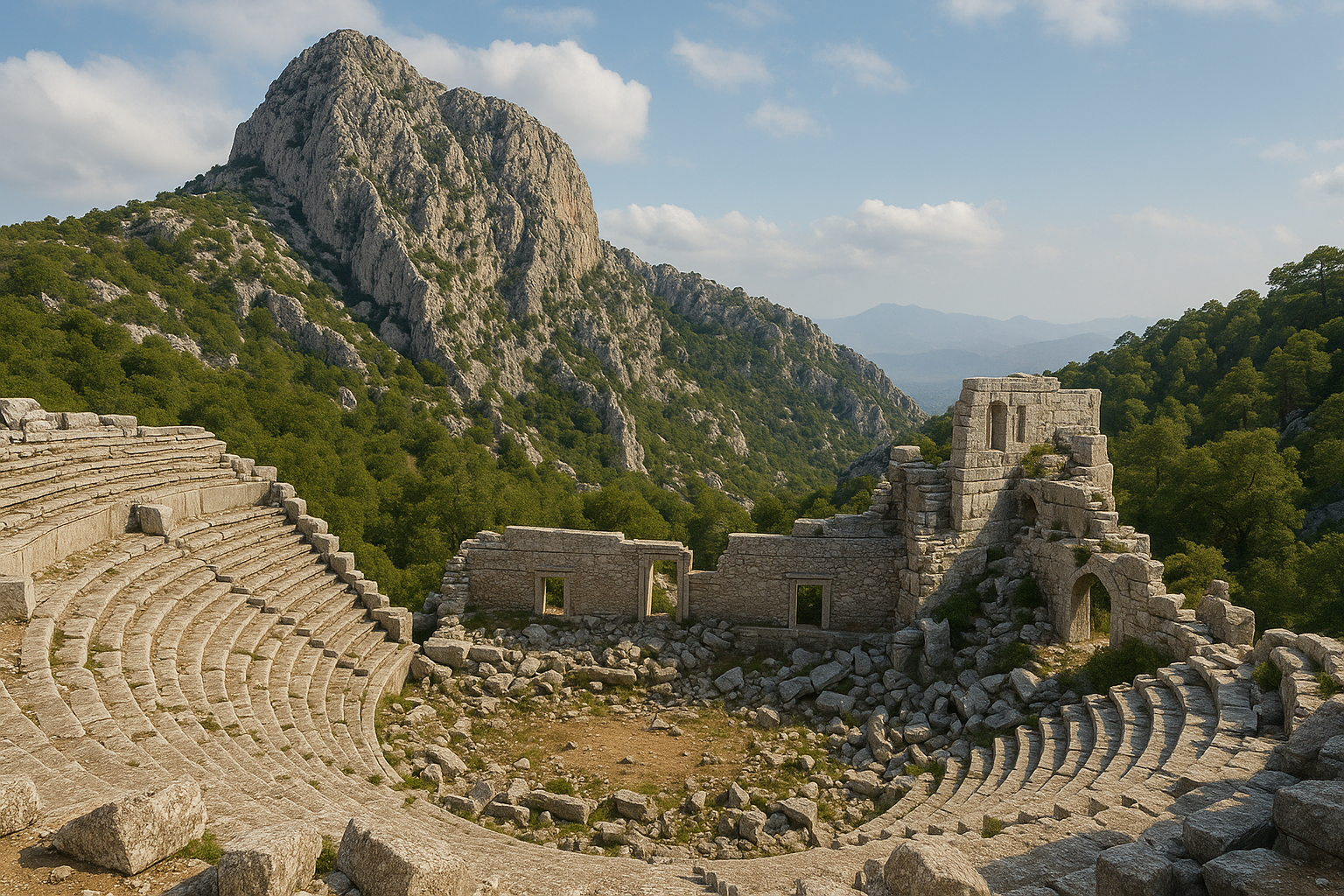
Adossé à la colline près de l'acropole, le théâtre pouvait accueillir environ 15 000 spectateurs, ce qui en faisait l'un des plus grands de Pamphylie (comparable à celui de Sidé). Son bâtiment de scène élaboré (scaenae frons) s'élevait sur trois étages et présentait des reliefs ornementaux dépeignant des scènes mythologiques -- la naissance de Dionysos, la vie de Kestros le dieu fleuve, et d'autres récits. Beaucoup de ces reliefs ont été récupérés et figurent désormais parmi les trésors du Musée d'Antalya. La cavea (zone des gradins) est divisée en deux sections principales (diazoma) comptant environ 42 rangs de sièges.
Thermes romains (Thermes du Sud)
Le complexe des Thermes du Sud est l'un des plus grands et des mieux conservés bâtiments de bains de Pamphylie, couvrant une surface d'environ 1 300 mètres carrés. Ses trois salles principales -- le frigidarium (salle froide), le tepidarium (salle tiède) et le caldarium (salle chaude) -- subsistent avec une hauteur de mur substantielle, dépassant par endroits 10 mètres. Les thermes étaient richement décorés de statues de marbre ; plusieurs découvertes sculpturales majeures proviennent de ce complexe, dont une célèbre statue d'Hermès et de multiples bustes-portraits.
Le système de chauffage (hypocauste) avec ses piles de briques (pilae) soutenant le plancher surélevé est clairement visible dans le caldarium, offrant un excellent exemple de la technologie de chauffage romaine.
Agora et macellum
La zone commerciale centrale combinait une grande cour à colonnades (agora) mesurant environ 75 sur 75 mètres avec un marché alimentaire dédié (macellum). L'agora comportait une structure ronde en son centre, probablement une fontaine ou un socle de monument (tholos). Les portiques environnants offraient un espace commercial ombragé, et des sols en mosaïque subsistent dans plusieurs des salles latérales.
Nymphée de Kestros
Une fontaine monumentale dédiée au dieu fleuve Kestros, richement ornée de sculptures et de décoration architecturale, se dressait à l'extrémité nord de la rue principale à colonnades près de l'acropole. C'était la source du canal d'eau qui s'écoulait à travers le cardo. Des travaux de restauration récents ont fait à nouveau couler de l'eau à travers la structure de la fontaine après environ 1 800 ans, recréant l'une des caractéristiques les plus distinctives de la cité.
Nymphée de Septime Sévère
Une seconde grande fontaine, construite sous le règne de Septime Sévère (193-211 apr. J.-C.), se dressait près des Thermes du Sud. Cette fontaine à façade élaborée à deux étages avec décoration colonnaire était typique des dispositifs hydrauliques monumentaux prisés par les cités romaines aux IIe-IIIe siècles.
Acropole
Les deux collines jumelles de l'acropole conservent les couches de peuplement les plus anciennes et offrent des vues panoramiques sur l'ensemble du plan de la cité. Des restes des premières fortifications, terrasses et structures religieuses peuvent être repérés sur les pentes. L'acropole était la source de l'eau de source qui alimentait le système de canal hydraulique de la cité, la rendant aussi centrale fonctionnellement que symboliquement à l'identité de Pergé.
Plancia Magna et le mécénat civique
Plancia Magna est l'une des figures les plus remarquables de la vie civique de l'Anatolie romaine. Membre de l'une des familles les plus en vue de Pergé -- son père, Marcus Plancius Varus, était sénateur romain et sa mère venait de la maison royale de Galatie --, elle occupa plusieurs charges publiques :
- Démiurge (premier magistrat de la cité)
- Grande prêtresse du culte impérial
- Prêtresse d'Artémis Pergaia, la déesse tutélaire de la cité
- Gymnasiarque (mécène du gymnase)
Sa contribution la plus visible fut la transformation de la porte hellénistique en une cour monumentale durant la période hadrianique (vers 120-130 apr. J.-C.). Elle finança la construction d'une façade décorative à deux étages remplie de statues de fondateurs mythologiques (Kalchas, Mopsos et autres héros légendaires), de héros de la cité et de membres de la famille impériale (Hadrien, Sabine, Trajan). Des inscriptions à travers le complexe de la porte honorent son nom et ses titres, et des dédicaces la décrivent comme une bienfaitrice de la cité.
Le programme de la porte de Plancia Magna est significatif parce qu'il révèle comment les élites provinciales fortunées utilisaient le mécénat architectural pour projeter simultanément loyauté civique et prestige personnel. En plaçant la famille impériale aux côtés des fondateurs légendaires de la cité, elle tissa le passé mythologique de Pergé dans le tissu de l'idéologie impériale romaine. Son histoire est fréquemment citée dans les études académiques sur le rôle des femmes dans la vie publique romaine.
Un héroon (tombeau monumental) attribué à Plancia Magna a été identifié à l'extérieur des murs de la cité, démontrant davantage son statut extraordinaire. La base de sa statue honorifique, retrouvée dans le complexe de la porte, porte l'une des inscriptions honorifiques les plus longues et les plus détaillées pour une femme dans l'Orient romain.
Apollonius de Pergé
Apollonius de Pergé (vers 262-190 av. J.-C.) fut l'un des trois plus grands mathématiciens de l'Antiquité, comptant aux côtés d'Euclide et d'Archimède. Né à Pergé, il étudia et travailla ensuite à Alexandrie au célèbre Mouseion sous les disciples d'Euclide.
Son chef-d'œuvre, les Coniques (Konika), composé en huit livres (dont sept survivent -- quatre en grec, trois en traduction arabe), est un traité systématique sur les sections coniques -- les courbes produites en tranchant un cône sous différents angles. Apollonius donna à l'ellipse, à la parabole et à l'hyperbole les noms par lesquels elles sont encore connues aujourd'hui.
L'importance de son œuvre s'étend bien au-delà de l'Antiquité :
- Son analyse des courbes elliptiques fut essentielle à la découverte par Kepler des orbites planétaires 1 800 ans plus tard
- Ses méthodes géométriques influencèrent Newton et le développement du calcul
- Les mathématiques des sections coniques restent fondamentales pour la physique, l'ingénierie, l'astronomie et le calcul des trajectoires satellitaires
- Son travail sur le problème des cercles tangents (le problème d'Apollonius) continue de susciter des recherches mathématiques
Apollonius était également connu dans l'Antiquité comme « Le Grand Géomètre ». Il représente la culture intellectuelle que Pergé entretint durant la période hellénistique -- une cité capable de produire et de cultiver des penseurs scientifiques de classe mondiale.
Sculpture et héritage artistique
La production sculpturale de Pergé est l'un de ses héritages les plus significatifs et la raison principale pour laquelle le Musée d'Antalya détient l'une des plus belles collections archéologiques de Turquie.
La tradition des ateliers
Pergé entretint des ateliers de sculpture actifs au moins du IIe siècle apr. J.-C. jusqu'au IIIe siècle. Ces ateliers produisaient :
- Des statues-portraits d'empereurs, de magistrats locaux et de bienfaiteurs
- Des figures mythologiques dont Hermès, Aphrodite, Artémis et Dionysos
- Des reliefs architecturaux pour les bâtiments de scène de théâtre et les façades publiques
- Des sarcophages à décoration figurée élaborée
Le marbre utilisé provenait à la fois de sources locales et d'importations (notamment le marbre proconnésien de la mer de Marmara), reflétant l'intégration de Pergé dans les réseaux commerciaux à l'échelle de l'empire.
Découvertes récentes (2024-2025)
Durant les fouilles menées dans le cadre du « Projet Patrimoine vers l'Avenir » (Mirasi Gelecege Tasima Projesi) de la Turquie, cinq nouvelles statues ont été mises au jour le long de la Rue Orientale en 2024-2025 :
- Une figure d'Aphrodite d'environ 2 mètres de haut, représentée assise sur un dauphin avec Éros, datant du IIe siècle apr. J.-C.
- Une statue féminine drapée liée à la période sévérienne (193-235 apr. J.-C.)
- Deux statues supplémentaires -- une femme drapée et un homme drapé -- trouvées côte à côte
- Un cinquième fragment sculptural en cours d'étude
Ces découvertes confirment que Pergé continue de livrer des découvertes majeures et que des portions significatives de la cité restent inexplorées.
La collection du Musée d'Antalya
Les galeries de Pergé au Musée d'Antalya contiennent :
- Le sarcophage des danseuses et d'autres monuments funéraires élaborément sculptés
- La statue d'Hermès provenant des Thermes du Sud
- De multiples portraits impériaux
- Les statues de la porte commandées par Plancia Magna
- Des reliefs architecturaux du théâtre
Cette collection est largement considérée comme l'une des plus belles présentations de sculpture provinciale romaine au monde.
Travaux archéologiques
Pergé a fait l'objet d'investigations archéologiques continues depuis le milieu du XXe siècle.
Le Pr Arif Mufid Mansel entreprit les premières fouilles systématiques en 1946 pour le compte de la Société d'histoire turque. Ses travaux établirent le plan d'ensemble du site et mirent au jour des monuments majeurs, dont la rue à colonnades, les thermes et l'agora. Mansel continua à diriger les travaux à Pergé pendant près de trois décennies.
Après le décès de Mansel en 1975, la Pr Jale Inan prit la direction des fouilles. Le travail d'Inan fut particulièrement important pour la récupération de l'extraordinaire collection de sculpture en marbre, pour l'étude détaillée des complexes thermaux et des zones de portes, et pour l'établissement de la séquence chronologique des phases monumentales de la cité.
Le Pr Haluk Abbasoglu dirigea les fouilles de la fin des années 1980 jusque dans les années 2000, en se concentrant sur le théâtre, le stade et les quartiers résidentiels. Son équipe apporta des contributions majeures à la compréhension de l'infrastructure hydraulique de Pergé et de la relation entre les phases hellénistique et romaine.
Les équipes archéologiques turques qui suivirent ont poursuivi et élargi le travail. Les fouilles actuelles, menées dans le cadre de l'initiative gouvernementale Patrimoine vers l'Avenir, se concentrent sur la zone de la Rue Orientale, les zones résidentielles et les secteurs auparavant inexplorés de la cité. Les découvertes de statues de 2024-2025 témoignent de la productivité continue de ces campagnes.
Le site fut placé sur la Liste indicative du patrimoine mondial de l'UNESCO de la Turquie en 2009 (référence 5411), reconnaissant sa valeur universelle exceptionnelle en tant que cité de Pamphylie globalement préservée.
Les trouvailles de Pergé forment la collection centrale du Musée d'Antalya, l'un des musées archéologiques les plus importants de Turquie. La galerie de sculpture de Pergé est considérée comme l'une des plus belles présentations de sculpture provinciale romaine au monde.
Informations pour le visiteur
S'y rendre
Pergé est située dans le district d'Aksu, à 17 km à l'est du centre-ville d'Antalya. Le site est facilement accessible en voiture ou en transports en commun depuis Antalya. Une sortie signalisée depuis l'autoroute D-400 mène directement à l'entrée. Le réseau de tramway d'Antalya s'étend jusqu'à la zone d'Aksu, et les bus locaux (dolmus) desservent également la route.
| Détail | Information |
|---|---|
| Distance du centre d'Antalya | 17 km à l'est |
| Distance de l'aéroport d'Antalya | 10 km au nord-est |
| Droit d'entrée | Museum Pass / Muze Kart acceptés ; vérifier les tarifs en vigueur |
| Heures d'ouverture | Généralement 08h00-19h00 en été, 08h00-17h30 en hiver |
| Parking | Disponible à l'entrée |
Temps nécessaire
- Vue d'ensemble rapide : 1h30
- Visite standard (monuments principaux) : 2 à 3 heures
- Visite complète incluant l'acropole et le stade : 3 à 4 heures
- Avec le Musée d'Antalya ensuite : ajouter 1h30 à 2h00
Meilleures saisons
- Printemps (mars-mai) : Températures idéales, fleurs sauvages à travers la plaine, excellente lumière pour la photographie
- Automne (septembre-novembre) : Météo agréable, moins de foule qu'en été, lumière dorée
- Été : Très chaud (souvent 35-40 °C) ; le site est largement sans ombre, les visites tôt le matin avant 09h00 sont donc essentielles
- Hiver : Doux en Pamphylie ; le site est calme et atmosphérique, pluie occasionnelle
Conseils pratiques
- Le site couvre une très grande surface (environ 1 km de l'entrée à l'acropole) ; portez des chaussures de marche confortables
- Apportez beaucoup d'eau et une protection solaire -- l'ombre est minimale en dehors des substructions voûtées du stade
- Le stade se trouve à 10 minutes de marche de l'entrée principale le long de la voie d'accès et est souvent négligé par les visiteurs qui ne se concentrent que sur la rue à colonnades ; il vaut absolument l'effort
- Le théâtre se trouve sur la colline au nord-ouest de la zone de la porte principale et nécessite une courte montée
- Après la visite des ruines, un détour par le Musée d'Antalya (Konyaalti, centre-ville d'Antalya) est vivement recommandé pour voir les découvertes sculpturales dans toute leur splendeur -- les ruines et le musée racontent ensemble l'histoire complète de Pergé
- Des visites guidées sont disponibles à l'entrée ; un guide compétent enrichit considérablement la visite
- La photographie est autorisée sur tout le site
Sites à proximité
Pergé se combine bien avec les visites de :
- Aspendos (45 km à l'est) -- le théâtre romain le mieux conservé au monde
- Sidé (65 km à l'est) -- cité côtière de Pamphylie aux ruines de temple impressionnantes
- Termessos (60 km au nord-ouest) -- cité de montagne spectaculaire dans la chaîne du Taurus
- Musée d'Antalya -- visite complémentaire essentielle pour la sculpture de Pergé
Foire aux questions
Qu'est-ce qui rend Pergé différente des autres cités de Pamphylie ?
Pergé se distingue par la sophistication de sa planification urbaine (en particulier le système de canal d'eau), son exceptionnelle production de sculpture en marbre et le rôle documenté de Plancia Magna comme grand mécène civique. Tandis qu'Aspendos a un théâtre mieux préservé et que Sidé bénéficie d'un cadre côtier plus spectaculaire, Pergé offre l'image la plus complète de la manière dont une cité provinciale romaine planifiée fonctionnait comme un système intégré de rues, d'eau, de commerce et de cérémonie.
Qui était Apollonius et pourquoi est-il important ?
Apollonius de Pergé (vers 262-190 av. J.-C.) fut l'un des plus grands mathématiciens de l'Antiquité. Son traité sur les sections coniques nomma l'ellipse, la parabole et l'hyperbole, et son œuvre influença Kepler, Newton et la physique moderne. Il est parfois appelé « Le Grand Géomètre ».
Quelle est la signification du canal d'eau dans la rue à colonnades ?
Le canal large de 2 mètres courant au centre de la rue principale acheminait l'eau des sources de l'acropole à travers la cité. Il servait des objectifs pratiques (approvisionnement en eau, rafraîchissement de l'air par chaudes journées d'été) et des objectifs esthétiques-cérémoniels (démonstration de la richesse civique et de la sophistication technique, création d'un agréable paysage sonore d'eau courante). Cette caractéristique est relativement inhabituelle parmi les cités antiques et constitue l'une des caractéristiques les plus distinctives de Pergé.
Pourquoi Pergé est-elle importante pour l'histoire chrétienne ?
L'apôtre Paul visita Pergé lors de son premier voyage missionnaire (vers 46 apr. J.-C.), comme décrit dans Actes 13:13-14 et 14:25. Jean Marc quitta de façon notoire le groupe à Pergé et retourna à Jérusalem, un événement qui provoqua plus tard une rupture entre Paul et Barnabé. Cela fait de Pergé l'un des premiers sites missionnaires documentés du christianisme primitif en Anatolie.
Où se trouvent les sculptures de Pergé ?
La grande majorité se trouve au Musée d'Antalya, qui possède une galerie entière dédiée à la sculpture de Pergé. Quelques pièces sont dans d'autres musées turcs, et un petit nombre dans des collections internationales. La collection d'Antalya est de loin la plus complète et comprend les découvertes les plus récentes de la saison de fouilles 2024-2025.
Combien de temps me faut-il ?
La plupart des visiteurs devraient prévoir 2 à 3 heures pour le site principal. Ajoutez 30-45 minutes pour le stade et 30 minutes supplémentaires pour la montée à l'acropole. Une visite ensuite au Musée d'Antalya ajoute 1h30 à 2h00 mais enrichit considérablement l'expérience de Pergé. Pour une expérience approfondie à la fois du site et du musée, prévoyez une journée entière.
Mesures architecturales : Inventaire complet
La documentation systématique des monuments de Pergé fournit des dimensions précises qui révèlent l'ambition de la cité :
| Monument | Dimensions | Date | Notes techniques |
|---|---|---|---|
| Tours de la porte hellénistique | Chaque tour ~13,5 m de diamètre, ~12 m de hauteur | IIIe s. av. J.-C. | Blocs d'appareil précisément taillés ; plan circulaire |
| Porte romaine | Trois ouvertures cintrées, tours jumelles flanquantes | IIe s. apr. J.-C. | Décoration en revêtement de marbre |
| Rue principale à colonnades (cardo) | ~300 m de long, 22 m de largeur totale, 9 m de chaussée | IIe s. apr. J.-C. | Canal d'eau central de 2 m de large |
| Canal d'eau | 2 m de large, s'étendant sur toute la longueur du cardo | IIe s. apr. J.-C. | Alimenté depuis les sources de l'acropole |
| Stade | 234 m de long x 34 m de large ; capacité de 12 000 | Fin IIe s. apr. J.-C. | 30 substructions voûtées utilisées comme boutiques |
| Théâtre | ~15 000 de capacité ; 42 rangs de sièges | IIe s. apr. J.-C. | Scaenae frons à trois étages |
| Thermes du Sud | ~1 300 m² de surface totale ; murs jusqu'à 10 m de haut | IIe s. apr. J.-C. | Hypocauste visible dans le caldarium |
| Agora | 76 x 76 m (plan carré) | Impériale romaine | Tholos central ; portiques environnants |
| Palestre | 76 m par côté (carrée) | Impériale romaine | Construction en travertin |
| Nymphée nord (hadrianique) | 21 m de large x 13 m de haut | 117-138 apr. J.-C. | Plan en U ; statue de Kestros allongé |
| Nymphée sud (sévérien) | 14,85 x 2,85 x 1,60 m (bassin) | 193-211 apr. J.-C. | Façade à deux étages avec colonnes corinthiennes |
L'agora de Pergé, mesurant 76 x 76 mètres, était la deuxième plus grande de Turquie en termes de surface close et serait, selon les hypothèses, une structure à deux étages. Son plan carré et ses colonnades environnantes sont caractéristiques de l'architecture commerciale régularisée prisée dans l'Orient romain au cours du IIe siècle apr. J.-C.
Chronologie et directeurs des fouilles
Pergé a bénéficié de près de huit décennies d'investigation archéologique continue par des chercheurs turcs :
| Période | Directeur | Institution | Contributions clés |
|---|---|---|---|
| 1946-1975 | Pr Arif Mufid Mansel | Société d'histoire turque | Établissement du plan du site ; mise au jour de la rue à colonnades, des thermes, de l'agora |
| 1975-1988 | Pr Jale Inan | Université d'Istanbul | Récupération de la collection de sculpture ; étude détaillée des thermes et portes |
| Fin des années 1980-2000 | Pr Haluk Abbasoglu | Université d'Istanbul | Théâtre, stade, quartiers résidentiels ; analyse de l'infrastructure hydraulique |
| Années 2010-présent | Diverses équipes turques | Ministère de la Culture / Universités | Fouille de la Rue Orientale ; programme « Patrimoine vers l'Avenir » |
| 2024-2025 | Équipe actuelle | Projet Patrimoine vers l'Avenir | Cinq nouvelles statues : Aphrodite de 2 m, figure féminine sévérienne, statues masculine-féminine appariées |
La saison 2015 produisit une découverte de mosaïque notable le long de la Rue à colonnades Ouest près des Thermes du Nord, dépeignant la scène mythologique du sacrifice d'Agamemnon -- preuve que les quartiers résidentiels et commerciaux de Pergé étaient ornés de décoration de sol figurée de haute qualité en plus de la sculpture publique monumentale pour laquelle la cité est célèbre.
Monnayage et Artémis Pergaia
Pergé frappa sa propre monnaie à partir du IIe siècle av. J.-C., l'image d'Artémis Pergaia apparaissant systématiquement sur les émissions municipales :
| Période | Dénomination | Avers | Revers | Signification |
|---|---|---|---|---|
| IIe s. av. J.-C. | Argent/Bronze | Tête d'Artémis | Temple d'Artémis Pergaia | Premières monnaies civiques |
| Ier s. av. J.-C. - Ier s. apr. J.-C. | Bronze | Artémis ou portrait impérial | Statue cultuelle d'Artémis Pergaia | Transition vers l'autorité romaine |
| IIe s. apr. J.-C. (Hadrien) | Bronze | Portrait impérial | Façade de temple avec image cultuelle | Apogée du prestige de Néocore |
| IIIe s. apr. J.-C. | Bronze | Portrait impérial | Légende ΠΕΡΓΑΙΩΝ ; divers types | Identité civique continue |
La statue cultuelle représentée sur les monnaies de Pergé montre Artémis Pergaia sous une forme aniconique distinctive -- une image conique ou en forme de pilier très différente de la déesse archère grecque classique. Cette forme archaïque, similaire aux représentations d'Éphèse, suggère que les origines du culte précédèrent la colonisation grecque et incorporèrent le culte d'une déesse anatolienne indigène.
Programme statuaire de la porte de Plancia Magna : Inventaire des statues
La cour en fer à cheval créée par la transformation par Plancia Magna de la porte hellénistique contenait environ une douzaine d'inscriptions liées à son mécénat, ainsi qu'un programme exhaustif de statues de marbre plus grandes que nature :
| Catégorie de statue | Exemples | Emplacement dans le complexe de la porte |
|---|---|---|
| Fondateurs mythologiques | Kalchas, Mopsos, Machaon (fils d'Asclépios) | Niches à l'étage supérieur du mur arrière central |
| Dieux olympiens | Artémis de type Versailles, Zeus héroïquement semi-nu | Niches inférieures et piédestaux indépendants |
| Famille impériale | Hadrien, Sabine, Trajan (divinisé) | Positions de premier plan flanquant l'entrée |
| Héros de la cité | Notables locaux nommés | Niches latérales de la cour |
La base de la propre statue honorifique de Plancia Magna, retrouvée dans le complexe de la porte, porte l'une des inscriptions honorifiques les plus longues et les plus détaillées pour une femme nulle part ailleurs dans l'Orient romain, énumérant tous ses titres : démiurge, grande prêtresse du culte impérial, prêtresse d'Artémis Pergaia et gymnasiarque.
Sources et lectures complémentaires
- Site archéologique de Pergé d'Antalya -- Turkish Museums
- Pergé -- Turkish Archaeological News
- Pergé -- Liste indicative du patrimoine mondial de l'UNESCO
- Pergé -- Wikipedia
- Apollonius de Pergé -- Wikipedia
- Fouilles récentes à Pergé -- Arkeonews
- Mansel, A.M. Fouilles et recherches à Pergé. Istanbul, 1949.
- Inan, J. La sculpture romaine à Sidé et à Pergé. Ankara, 1975.
- Ozgur, M.E. Pergé : histoire, ruines, musée. Antalya, 2008.
- Bryce, T. The Routledge Handbook of the Peoples and Places of Ancient Western Asia. Routledge, 2009.
- Abbasoglu, H. et Martini, W. (éds). Die Akropolis von Perge. Mainz, 2003.