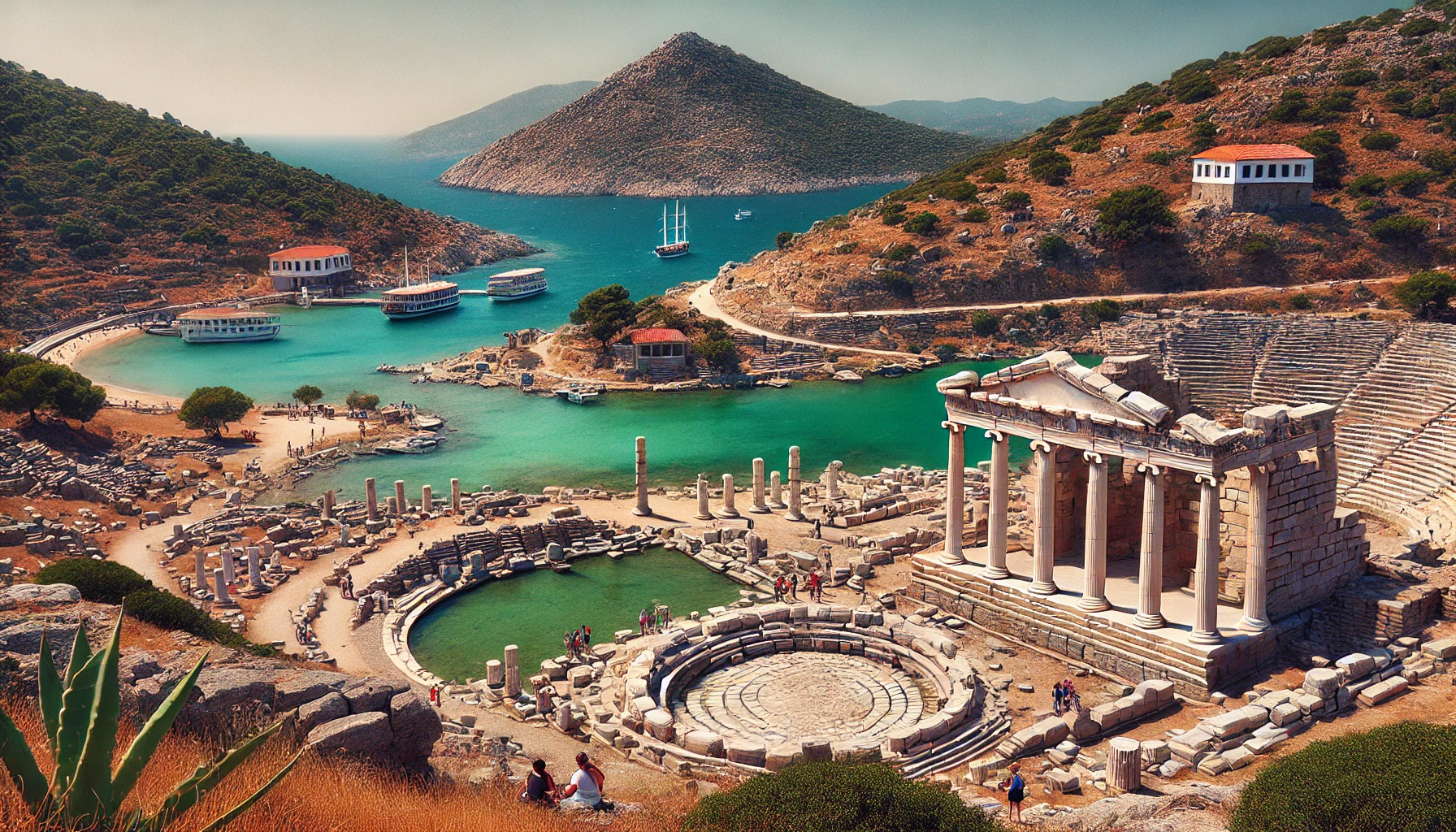
Kastabos es un antiguo santuario griego dedicado a la diosa sanadora Hemithea, situado en una cresta del Eren Dağı (monte Eren) aproximadamente a 300 metros sobre la llanura de Hisaronu en el distrito de Marmaris de la provincia de Mugla. Perteneciente a la antigua ciudad de Bybassos en el Quersoneso cario, este remoto santuario en la cumbre era un lugar de peregrinación donde los enfermos y heridos acudían en busca de curación divina mediante la práctica de la incubación --dormir en el recinto sagrado para recibir visiones curativas. Excavado por los arqueólogos británicos J.M. Cook y W.H. Plommer en 1959-1960, Kastabos produjo el primer templo griego de tamaño significativo descubierto en esta parte de Asia Menor.
Tabla de contenidos
- Por qué importa Kastabos
- Geografía y emplazamiento
- Cronología histórica
- El culto de Hemithea
- Principales monumentos
- Trabajos arqueológicos
- Información para el visitante
- Preguntas frecuentes
- Fuentes y lecturas complementarias
Por qué importa Kastabos
Kastabos no es una gran ciudad ni una ruina famosa. Es un santuario sanador especializado --un lugar donde la religión, la medicina y la arquitectura se unieron para servir a un único propósito: restaurar la salud. He aquí por qué esto importa:
-
Un raro yacimiento de culto sanador. Aunque los santuarios dedicados a Asclepio (el dios griego de la medicina) están bien documentados, Kastabos está dedicado a Hemithea, una semidiosa cuyo culto curativo era casi exclusivamente local. Esto convierte a Kastabos en uno de los pocos lugares donde podemos estudiar una tradición sanadora regional que existió junto al modelo asclepiano más famoso.
-
Convergencia literaria y arqueológica. La existencia de Kastabos era conocida por fuentes literarias antiguas, específicamente la historia universal de Diodoro Sículo (Libro V), que describía el santuario de Hemithea. La excavación de 1959-1960 confirmó el relato literario y proporcionó evidencia física para las prácticas cultuales descritas en los textos antiguos.
-
Significado arquitectónico. El Templo de Hemithea es un templo jónico que data aproximadamente del 300 a. C.. Aunque sigue el orden jónico utilizado en los grandes templos de Jonia (como el Templo de Artemisa en Éfeso), modifica el diseño estándar de maneras que recuerdan al Templo de Asclepio en Epidauro --el santuario sanador más famoso del mundo griego. Esta conexión arquitectónica refuerza la función sanadora del yacimiento.
-
El primer templo griego importante descubierto en esta región. Antes de la excavación de Cook y Plommer, ningún templo griego de tamaño significativo había sido excavado científicamente en el Quersoneso cario. Kastabos abrió, por tanto, un nuevo capítulo en la comprensión arqueológica de este rincón de Asia Menor.
-
Reubicación geográfica. El descubrimiento e identificación de Kastabos requirió la reubicación de varias ciudades antiguas en la región, corrigiendo errores de larga data en la geografía histórica del Quersoneso cario.
Geografía y emplazamiento
Kastabos ocupa una posición dramática en una cresta del Eren Dağı (monte Eren), con vistas a la llanura de Hisaronu y al mar más allá. El santuario está situado en la esquina suroccidental del continente anatolio, directamente frente a la isla de Rodas.
| Característica | Detalle |
|---|---|
| Región antigua | Quersoneso cario (Perea rodia) |
| Ubicación moderna | Hisaronu, distrito de Marmaris, provincia de Mugla |
| Altitud | Aproximadamente 300 m sobre la llanura de Hisaronu |
| Localidad moderna más cercana | Hisaronu (~5 km) |
| Ciudad importante más cercana | Marmaris (~20 km) |
| Ciudad antigua asociada | Bybassos |
| Terreno | Cresta montañosa rocosa con matorral mediterráneo |
En la Antigüedad, esta región era conocida como el Quersoneso cario (o la Perea rodia), una península que estaba política y culturalmente vinculada a la isla de Rodas. El paisaje es montañoso, con crestas escarpadas que descienden hasta una estrecha llanura costera. La posición elevada del santuario habría sido visible desde una distancia considerable, sirviendo como punto de referencia para los peregrinos que se aproximaban desde la costa o la llanura inferior.
La elección de una ubicación en la cumbre para un santuario sanador es significativa. En el Mediterráneo antiguo, se creía que los lugares sagrados elevados estaban más cerca del reino divino, y se pensaba que el aire limpio y las vistas panorámicas contribuían al proceso de curación. El aislamiento del lugar también reforzaba su carácter sagrado --los peregrinos tenían que hacer un viaje deliberado cuesta arriba para alcanzar el santuario, creando una separación física del mundo mundano.
Cronología histórica
Períodos arcaico y clásico (siglos VII-IV a. C.)
La región del Quersoneso cario era culturalmente mixta, combinando tradiciones carias, griegas dorias (desde Rodas) y locales anatolias. El culto de Hemithea probablemente tiene sus raíces en este período, aunque los restos físicos más antiguos en Kastabos datan de la era helenística. Según Diodoro Sículo, Hemithea era una mortal deificada --una joven mujer que obtuvo estatus divino tras su muerte y se asoció con poderes curativos.
Período helenístico (c. 300 a. C. -- Fase de construcción principal)
Los principales edificios del santuario se construyeron alrededor del 300 a. C., durante el período helenístico temprano. Esta fue una época de intensa actividad constructiva en todo el mundo griego, alimentada por la riqueza y la ambición de los reinos sucesores que siguieron a Alejandro Magno. El Templo de Hemithea y las estructuras asociadas (teatro, estoa, edificios residenciales) se construyeron durante esta fase.
El estilo arquitectónico del templo --orden jónico con modificaciones que recuerdan a Epidauro-- sugiere que los constructores evocaban deliberadamente el lenguaje de diseño de los santuarios sanadores establecidos para legitimar el culto de Hemithea en el mundo griego más amplio.
Período romano (siglo I a. C. -- siglo IV d. C.)
Bajo dominio romano, el Quersoneso cario pasó a formar parte de la provincia de Asia. El santuario probablemente continuó funcionando durante el período romano temprano, aunque la extensión de la actividad de época romana en el yacimiento no está bien documentada. Los cultos sanadores siguieron siendo populares en todo el Imperio romano, y la peregrinación a lugares sagrados era una práctica común.
Antigüedad tardía y abandono (siglos IV-VII d. C.)
La cristianización del Imperio romano en el siglo IV socavó gradualmente los cultos paganos tradicionales de curación. Los santuarios como Kastabos habrían perdido su apoyo oficial y, finalmente, sus fieles. El yacimiento fue probablemente abandonado en algún momento durante la Antigüedad tardía, y su remota ubicación en la cumbre aseguró que fuera en gran parte olvidado hasta el siglo XX.
El culto de Hemithea
Hemithea (que significa «medio diosa» o «semidiosa») fue una figura de la mitología griega cuyo culto se concentraba en el Quersoneso cario. Según el relato conservado por Diodoro Sículo (historiador del siglo I a. C.), Hemithea era originalmente una mujer mortal que fue deificada tras su muerte y se convirtió en una deidad sanadora.
Curación mediante incubación
La práctica de curación principal en Kastabos era probablemente la incubación (griego: enkoimesis) --un ritual en el que los suplicantes dormían dentro del recinto sagrado y esperaban recibir visiones curativas o apariciones de la diosa durante su sueño. Esta práctica estaba bien establecida en otros santuarios sanadores griegos, sobre todo en el Asclepieion de Epidauro.
En Kastabos, uno de los edificios más grandes adyacentes al templo pudo haber servido como sala de incubación --una estructura tipo dormitorio donde los peregrinos podían dormir cerca de la presencia divina. Sin embargo, los excavadores Cook y Plommer notaron que estas habitaciones también podrían haber albergado al personal del templo. La disposición exacta de la práctica de incubación en Kastabos sigue siendo objeto de discusión académica.
Peregrinación y ofrendas
Los peregrinos que viajaban a Kastabos habrían seguido senderos desde los asentamientos costeros hasta la cresta del Eren Dağı. El propio viaje formaba parte de la experiencia curativa --el esfuerzo físico de la subida, las vistas cambiantes y el creciente aislamiento contribuían todos a una transición psicológica del mundo cotidiano al reino sagrado.
A su llegada, los peregrinos habrían hecho ofrendas a Hemithea: sacrificios animales, libaciones y regalos votivos. Estas ofrendas eran tanto actos de piedad como pagos prácticos por los servicios curativos que el santuario proporcionaba.
Principales monumentos
Templo de Hemithea
El Templo de Hemithea es la estructura central del santuario y su edificio arquitectónicamente más significativo.
- Orden: Jónico
- Fecha: Aproximadamente 300 a. C.
- Planta: Cella rectangular (cámara interior) con un pronaos (pórtico de entrada)
- Dimensiones: Modestas comparadas con los grandes templos jónicos de Jonia, pero significativas para la región
- Conservación: La plataforma (estilóbato) se conserva, junto con fragmentos arquitectónicos incluidos tambores de columnas, capiteles y bloques de entablamento
- Paralelos: La planta y proporciones del templo recuerdan al Templo de Asclepio en Epidauro, sugiriendo una referencia arquitectónica deliberada al santuario sanador más famoso del mundo griego
El orden jónico era una elección natural para un templo en el Quersoneso cario, dadas las conexiones culturales de la región con Jonia y Rodas. Sin embargo, las modificaciones específicas a la planta jónica estándar --particularmente las proporciones del edificio-- indican que los arquitectos trabajaban dentro de una tradición de arquitectura de santuario sanador en lugar de simplemente copiar el templo importante más cercano.
La plataforma del templo y algunos elementos arquitectónicos dispersos son visibles en el yacimiento hoy. La calidad de la cantería, incluso en fragmentos, atestigua la habilidad de los constructores y la importancia atribuida al santuario por su comunidad.
Teatro
Un pequeño teatro (o área teatral) formaba parte del complejo del santuario, proporcionando un lugar para representaciones religiosas, ceremonias y festivales asociados con el culto de Hemithea.
- Tamaño: Pequeño, diseñado para la comunidad del santuario en lugar de una gran audiencia urbana
- Forma: Zona semicircular de asientos (cávea) excavada en la pendiente natural de la cresta
- Función: Representaciones de dramas sagrados, himnos y ceremonias relacionadas con el culto sanador
- Fecha: Contemporánea del templo (c. 300 a. C.)
La presencia de un teatro en un santuario sanador no es inusual. En Epidauro, el teatro era una de las estructuras más importantes del complejo. La representación era una parte integral de la práctica de curación griega antigua --la música, el drama y la poesía se consideraban todos con propiedades terapéuticas.
Estoa y edificios auxiliares
Varias estructuras auxiliares rodeaban el templo y el teatro:
- Estoa (pórtico cubierto): Una larga columnata cubierta que proporcionaba refugio a los peregrinos que esperaban entrar al templo o descansaban entre rituales. Las estoas eran características estándar de los santuarios griegos, cumpliendo funciones prácticas y sociales.
- Edificio de incubación o dormitorio: Una o más habitaciones grandes que pudieron haber albergado a los peregrinos durante su estancia nocturna en el santuario. La identificación de estas habitaciones como salas de incubación es debatida, pero su proximidad al templo apoya una función ritual.
- Salas de almacenamiento y servicio: Espacios prácticos para almacenar ofrendas, equipo del templo y provisiones para el personal del santuario.
Estructuras residenciales
La excavación también reveló edificios residenciales cerca del santuario, que probablemente albergaban a los sacerdotes, sacerdotisas y asistentes que mantenían el santuario y supervisaban los rituales curativos. Estas estructuras eran más simples que el templo pero sólidamente construidas, reflejando la naturaleza permanente de la comunidad del santuario.
Trabajos arqueológicos
La historia arqueológica de Kastabos está estrechamente asociada al trabajo de dos eruditos británicos:
J.M. Cook (John Manuel Cook, 1910-1994)
Cook fue un arqueólogo clásico e historiador especializado en la costa occidental de Asia Menor. Identificó el yacimiento de Kastabos durante una prospección regional del Quersoneso cario y organizó la excavación. Cook también fue profesor en la Universidad de Bristol y autor de varias obras importantes sobre arqueología griega.
W.H. Plommer (William Hugh Plommer)
Plommer fue un historiador de la arquitectura que analizó los restos del templo y produjo los detallados dibujos arquitectónicos que constituyen el núcleo de la publicación de la excavación.
Cronología de la excavación
- 1959-1960: Excavación del santuario por Cook y Plommer
- 1966: Publicación de los resultados de la excavación como The Sanctuary of Hemithea at Kastabos (Cambridge University Press)
La excavación reveló la plataforma del templo, fragmentos de la superestructura jónica, el teatro y varios edificios auxiliares. La publicación incluyó análisis arquitectónico detallado, estudios cerámicos y discusión histórica que situaba a Kastabos en el contexto más amplio de los santuarios sanadores griegos.
Significado para la geografía regional
Uno de los resultados más importantes del descubrimiento de Kastabos fue la corrección de la geografía antigua del Quersoneso cario. La identificación del yacimiento requirió la reubicación de varias ciudades antiguas que habían sido incorrectamente situadas en mapas anteriores. Esta revisión cartográfica afectó a la comprensión de los patrones de asentamiento de toda la región.
Información para el visitante
Cómo llegar
- Desde Marmaris: Conduzca al sur hacia Hisaronu (~20 km). El santuario está situado en el Eren Dağı sobre la llanura de Hisaronu. El acceso requiere una combinación de carretera y sendero; consulte localmente sobre las condiciones actuales del sendero.
- Desde el aeropuerto de Dalaman: Aproximadamente 120 km por la autopista D-400 hacia Marmaris, luego al sur a Hisaronu.
- Coordenadas GPS: Aproximadamente 36,73 N, 28,38 E (verifique con fuentes locales)
Qué esperar
- Sin entrada (yacimiento remoto, sin vallar)
- Sin instalaciones en el yacimiento (sin aseos, agua ni estructuras de sombra)
- Terreno: Cresta montañosa con suelo rocoso y matorral mediterráneo. La aproximación implica caminar cuesta arriba. Son esenciales zapatos de senderismo resistentes.
- Señalización: Limitada o ausente. Investigue el yacimiento antes de visitarlo.
Duración recomendada de la visita
- Visita rápida: 1-1,5 horas (más el tiempo de viaje al yacimiento)
- Exploración detallada: 2-3 horas
- Combinada con senderismo: Medio día o más
Mejor momento para visitar
- Primavera (marzo-mayo): Temperaturas ideales para la subida, flores silvestres en floración
- Otoño (septiembre-noviembre): Clima cómodo, vistas claras
- Verano: Muy caluroso, especialmente para la aproximación cuesta arriba. Visite solo a primera hora de la mañana.
- Invierno: Las temperaturas más frescas hacen la caminata agradable, pero la lluvia puede embarrar los senderos
Visitas combinadas
Kastabos se combina bien con:
- Bybassos --la antigua ciudad a la que pertenecía el santuario (ruinas cercanas)
- Hisaronu y Bozburun --pintorescos pueblos costeros del Egeo
- Marmaris --castillo y museo arqueológico
- Knidos --importante ciudad antigua en la punta de la península de Datça, con su famoso puerto y templo de Afrodita
- Loryma (Bozukkale) --antiguo puerto fortificado en la costa
Consejos
- Lleve abundante agua; no hay fuentes en la montaña
- Comience temprano por la mañana, especialmente en verano
- Lleve protección solar y calzado resistente
- Un conocimiento básico de la arquitectura griega de templos mejorará enormemente la visita
- Las vistas desde el Eren Dağı son espectaculares en sí mismas y valen la subida incluso aparte de la arqueología
Preguntas frecuentes
¿Quién era Hemithea?
Hemithea (literalmente «medio diosa») era una mortal deificada en la mitología griega. Según el relato conservado por el historiador Diodoro Sículo, era originalmente una joven mujer que obtuvo estatus divino tras su muerte. Su culto se centraba en la curación --se creía que curaba a los enfermos a través de visiones recibidas durante el sueño ritual (incubación) en su santuario.
¿Cómo se relaciona Kastabos con Bybassos?
Kastabos era el santuario sagrado perteneciente a la antigua ciudad de Bybassos, situada en las inmediaciones en el Quersoneso cario. La relación entre la ciudad y el santuario era típica de la práctica religiosa griega, donde los principales lugares de culto se situaban a menudo fuera de las murallas de la ciudad, a veces en cumbres o entornos rurales.
¿Qué se puede ver realmente sobre el terreno?
Los visitantes pueden ver la plataforma del templo (estilóbato), fragmentos arquitectónicos dispersos (tambores de columnas, capiteles), la zona de asientos de piedra tallada del pequeño teatro y los cimientos de varios edificios auxiliares. El yacimiento no está extensamente restaurado, por lo que una comprensión de la arquitectura griega de templos ayuda a interpretar lo que se ve.
¿Es el yacimiento adecuado para visitantes casuales?
El yacimiento requiere una caminata cuesta arriba y no ofrece instalaciones. Es más adecuado para visitantes con interés en arqueología o historia antigua que se sientan cómodos haciendo senderismo en terreno montañoso. No se recomienda para niños muy pequeños o personas con limitaciones de movilidad.
¿Cómo se compara Kastabos con Epidauro?
Epidauro en Grecia fue el santuario sanador más famoso del mundo antiguo, dedicado a Asclepio. Kastabos cumplía una función similar pero a una escala mucho menor y para una deidad local (Hemithea). Arquitectónicamente, el Templo de Hemithea en Kastabos muestra similitudes en planta y proporción con el Templo de Asclepio en Epidauro, sugiriendo que los constructores de Kastabos referenciaban deliberadamente el santuario sanador más prestigioso de su era.
¿Hay excavaciones en curso?
No se han realizado excavaciones desde la campaña original de 1959-1960 por Cook y Plommer. El yacimiento se ha dejado en gran parte sin perturbar desde entonces. Los futuros trabajos arqueológicos podrían revelar estructuras adicionales y refinar nuestra comprensión de la historia del santuario.
Templo de Hemithea: Mediciones arquitectónicas
La excavación de Cook y Plommer de 1959-1960 produjo dibujos arquitectónicos detallados y mediciones del Templo de Hemithea, publicadas en su monografía de 1966. La siguiente tabla resume las dimensiones clave.
| Elemento | Medida / Detalle |
|---|---|
| Planta general | 24 m x 11 m |
| Disposición de columnas | 12 columnas en los lados largos x 6 columnas en los lados cortos |
| Orden de columnas | Jónico |
| Fecha de construcción | c. 300 a. C. |
| Elementos supervivientes | Estilóbato (plataforma), tambores de columnas, capiteles, bloques de entablamento |
| Paralelos estilísticos | Templo de Asclepio en Epidauro (planta y proporciones) |
| Significado regional | Primer templo griego de tamaño significativo excavado en el Quersoneso cario |
La disposición de columnas 12 por 6 (una planta peripteral con columnas rodeando la cella en los cuatro lados) es relativamente generosa para un santuario de este tamaño y lejanía. El uso del orden jónico era apropiado para el contexto cultural: el Quersoneso cario tenía fuertes lazos con Jonia y con Rodas, donde el orden jónico era dominante. Sin embargo, las proporciones del templo se apartaron deliberadamente de las plantas alargadas de los principales templos jónicos (como el Templo de Artemisa en Éfeso) en favor de las proporciones más compactas asociadas con el Templo de Asclepio en Epidauro --el santuario sanador más famoso del mundo griego.
Esta cita arquitectónica era casi con certeza intencional: al hacer eco de Epidauro, los constructores de Kastabos señalaban que el santuario de Hemithea pertenecía a la misma categoría de yacimientos de culto sanador, otorgando a la diosa local el prestigio de asociación con la tradición curativa panhelénica.
Registro de excavación: Cook y Plommer (1959-1960)
La siguiente tabla detalla la cronología y resultados de la única campaña de excavación realizada en Kastabos.
| Aspecto | Detalle |
|---|---|
| Años de excavación | 1959-1960 (dos campañas) |
| Directores | J.M. Cook (Universidad de Bristol) y W.H. Plommer |
| Publicación | The Sanctuary of Hemithea at Kastabos, Cambridge University Press, 1966 |
| Estructuras descubiertas | Plataforma del templo, fragmentos de la superestructura jónica, teatro, estoa, edificios auxiliares/residenciales |
| Artefactos | Cerámica, fragmentos arquitectónicos, pequeños hallazgos |
| Resultado clave | Primer templo griego importante excavado en el Quersoneso cario |
| Impacto geográfico | El descubrimiento requirió la reubicación de varias ciudades antiguas en los mapas regionales |
| Post-excavación | Ninguna otra excavación desde 1960; yacimiento dejado en gran parte sin perturbar |
J.M. Cook (John Manuel Cook, 1910-1994) fue profesor en la Universidad de Bristol y una autoridad destacada en la arqueología del oeste de Asia Menor. Su identificación del yacimiento como Kastabos se basó en la correlación entre la descripción literaria de Diodoro Sículo (Bibliotheca Historica, Libro V) de un santuario de Hemithea en el Quersoneso cario y los restos físicos encontrados en el Eren Dağı. La contribución de Plommer fue principalmente arquitectónica: sus dibujos medidos de los restos del templo jónico forman el núcleo del análisis técnico de la publicación.
La reubicación de varias ciudades antiguas que resultó de este descubrimiento corrigió errores en la geografía histórica del Quersoneso cario que habían persistido desde la cartografía del siglo XIX. La identificación de Kastabos proporcionó un punto de referencia fijo desde el cual las ubicaciones de Bybassos, Phoinix y otros asentamientos podían recalcularse.
La Perea rodia: Contexto político y cultural
Kastabos existía dentro de la esfera política de la Perea rodia --el territorio continental controlado por la ciudad-estado insular de Rodas. La siguiente tabla resume los yacimientos clave y sus relaciones.
| Yacimiento | Tipo | Relación con Kastabos | Acceso actual |
|---|---|---|---|
| Bybassos | Ciudad madre | Kastabos era el santuario extramural de Bybassos | Ruinas cercanas |
| Loryma (Bozukkale) | Puerto fortificado | Puesto militar de Rodas en la península | Accesible por barco o sendero |
| Amos | Pequeña ciudad | Asentamiento compañero del Quersoneso | Ruinas de teatro y templo |
| Kedreai | Asentamiento isleño | En la costa; conocido por sus cedros | Requiere visita a la isla |
| Phoinix | Localidad portuaria | Punto de referencia para la navegación | Identificación moderna incierta |
| Rodas (isla) | Hegemón | Controlaba política y culturalmente la Perea | Importante destino turístico |
La Perea rodia quedó bajo control rodio no más tarde del 300 a. C. --aproximadamente la misma fecha que la construcción del Templo de Hemithea. Esta coincidencia cronológica sugiere que la principal campaña constructiva en Kastabos pudo haber sido patrocinada o fomentada por las autoridades rodias como parte de la integración cultural de su territorio continental.
Arquitectura de incubación: Identificando los espacios curativos
Cook y Plommer identificaron un gran edificio adyacente al lado exterior del muro de cerramiento del santuario que podría posiblemente haber servido para fines de incubación --la práctica del sueño ritual en espera de visiones curativas de la diosa. Sin embargo, señalaron que la identificación no era cierta, ya que las mismas habitaciones podían haber albergado al personal del templo.
Los requisitos arquitectónicos típicos para una instalación de incubación incluyen:
| Requisito | Propósito | Evidencia en Kastabos |
|---|---|---|
| Proximidad al templo | El suplicante duerme cerca de la presencia divina | El edificio adyacente está directamente junto al recinto del templo |
| Espacios cerrados de dormitorio | Protección durante la estancia nocturna | Múltiples habitaciones cerradas identificadas |
| Acceso al agua | Rituales de purificación antes de la incubación | Evidencia de manantial o cisterna en las inmediaciones |
| Separación del exterior | Frontera sagrada entre el espacio profano y el divino | El muro de cerramiento crea un recinto sagrado definido |
En el mejor documentado Asclepieion de Epidauro, la sala de incubación (abaton) era un edificio largo y estrecho con una columnata, situado cerca del templo de Asclepio. Los suplicantes se purificaban mediante baños y ayuno antes de dormir en el abaton, donde esperaban recibir un sueño curativo. El hecho de que Kastabos contenga estructuras que podrían haber cumplido la misma función apoya la identificación del yacimiento como santuario sanador, aunque la menor escala de Kastabos significa que cualquier actividad de incubación habría servido a una clientela regional en lugar de panhelénica.
Hemithea en las fuentes literarias antiguas
La fuente literaria antigua principal para Hemithea y su culto en Kastabos es Diodoro Sículo (siglo I a. C.), cuya historia universal (Bibliotheca Historica) conserva el relato más completo del mito y el culto. La siguiente tabla resume las referencias literarias clave.
| Fuente | Obra | Fecha | Contenido |
|---|---|---|---|
| Diodoro Sículo | Bibliotheca Historica, Libro V | Siglo I a. C. | Relato detallado del mito de Hemithea; descripción del santuario y culto sanador |
| Partenio de Nicea | Erotica Pathemata | Siglo I a. C. | Breve referencia a la historia de Hemithea dentro de una colección de mitos de amor |
| Pausanias | Descripción de Grecia | Siglo II d. C. | Posibles referencias indirectas a tradiciones cultuales del Quersoneso |
Según Diodoro, Hemithea (originalmente llamada Molpadia) era hija de Estáfilo (un hijo de Dioniso y Ariadna) y Crisótemis. Tras una crisis que implicó la muerte de su padre, llegó a Kastabos y recibió el nombre de Hemithea («Medio Diosa»). Era honrada por todos los que habitaban en el Quersoneso como una deidad sanadora, y su hermana Parteno era venerada en la vecina Bubasto (Bybassos).
La convergencia de evidencia literaria y arqueológica en Kastabos --la descripción textual de Diodoro confirmada por los hallazgos físicos de Cook y Plommer-- convierte a este yacimiento en uno de los casos más claros en arqueología clásica donde la literatura antigua y la excavación moderna se validan mutuamente.
Fuentes y lecturas complementarias
- Cook, J.M. y Plommer, W.H. The Sanctuary of Hemithea at Kastabos. Cambridge University Press, 1966.
- Diodoro Sículo. Bibliotheca Historica, Libro V (referencias a Hemithea y el Quersoneso cario).
- Castabus -- Wikipedia
- The Princeton Encyclopedia of Classical Sites: Kastabos
- Kastabos, Sanctuary of Hemithea -- Vici.org
- Cook, J.M. The Troad: An Archaeological and Topographical Study. Oxford University Press, 1973.
- Bean, G.E. Turkey Beyond the Maeander. Londres: Ernest Benn, 1971.
Comprender los santuarios sanadores en el mundo griego antiguo
Para apreciar plenamente lo que representa Kastabos, ayuda comprender el contexto más amplio de los santuarios sanadores en el mundo griego antiguo. Estos no eran hospitales en el sentido moderno. Eran instituciones religiosas donde se buscaba la curación física a través de la intervención divina, a menudo mediada por prácticas rituales.
El modelo de incubación
La práctica curativa más común era la incubación (griego: enkoimesis). El suplicante:
- Se purificaba --mediante baños, ayuno u otros rituales preparatorios
- Realizaba ofrendas --sacrificios animales, libaciones o regalos a la deidad
- Dormía en el recinto sagrado --típicamente en un edificio de dormitorio dedicado cerca del templo
- Recibía una visión curativa --la deidad (o un agente divino) aparecía en un sueño, ya sea realizando una curación milagrosa o prescribiendo un tratamiento
- Daba las gracias --los pacientes exitosos dejaban ofrendas votivas, inscripciones o donaciones
Este modelo se estandarizó en el Asclepieion de Epidauro en Grecia, que se convirtió en el santuario sanador más famoso del mundo antiguo. Otros centros sanadores importantes incluían los Asclepieia en Pérgamo, Cos y Atenas.
Cómo encaja Kastabos
Kastabos sigue el patrón general de los santuarios sanadores griegos, pero con diferencias importantes:
- La deidad es Hemithea, no Asclepio --indicando una tradición sanadora local independiente del modelo asclepiano dominante
- El santuario es mucho más pequeño que los grandes Asclepieia, sugiriendo una clientela regional en lugar de panhelénica
- El parecido arquitectónico del templo con Epidauro sugiere que los constructores referenciaron conscientemente el santuario sanador más prestigioso para realzar la credibilidad de su propio yacimiento
Curación y paisaje
La ubicación de los santuarios sanadores nunca era aleatoria. Los lugares se elegían por su percibida sacralidad --a menudo cumbres, arboledas o manantiales que ya se consideraban lugares de presencia divina. La posición en la cumbre de Kastabos en el Eren Dağı encaja perfectamente con este patrón. La ubicación elevada proporcionaba:
- Aire limpio --importante para la recuperación de enfermedades respiratorias y de otro tipo
- Aislamiento del bullicio de la vida urbana --creando una atmósfera contemplativa propicia para la curación
- Vistas espectaculares --la experiencia visual del paisaje panorámico se consideraba en sí misma terapéutica
- Proximidad a lo divino --la altura se asociaba con la cercanía a los dioses
El Quersoneso cario: Contexto regional
El Quersoneso cario (la moderna península de Bozburun y el área circundante) es una de las regiones más ricas arqueológicamente pero menos visitadas del oeste de Turquía. Comprender esta región ayuda a contextualizar Kastabos.
Geografía y cultura
La península es montañosa y profundamente entrante con bahías, puertos y calas rocosas. En la Antigüedad, albergaba una población mixta de carios (el pueblo anatolio indígena), griegos dorios (colonos de Rodas y otras islas griegas) y, más tarde, colonos romanos.
La región formaba parte de la Perea rodia --el territorio continental controlado por la poderosa ciudad-estado insular de Rodas. Esta relación política significaba que las tradiciones culturales y arquitectónicas de Rodas influían fuertemente en el Quersoneso, incluido el santuario de Kastabos.
Otros yacimientos antiguos en el Quersoneso
| Yacimiento | Relación con Kastabos |
|---|---|
| Bybassos | La ciudad madre del santuario de Kastabos |
| Loryma (Bozukkale) | Puerto fortificado con impresionantes murallas helenísticas |
| Amos | Ciudad antigua con ruinas de teatro y templo |
| Kedreai | Asentamiento insular con bosques de cedros |
| Phoinix | Localidad portuaria mencionada en textos antiguos de navegación |
Los visitantes que exploren el santuario de Kastabos encontrarán que el Quersoneso más amplio ofrece días de exploración adicional para aquellos interesados en yacimientos arqueológicos menos transitados.
Mitología de Hemithea: La historia completa
Según el relato en Diodoro Sículo, la historia de Hemithea está entrelazada con la mitología del Quersoneso cario:
Se decía que Hemithea era hija de Estáfilo (un hijo de Dioniso) y Crisótemis. Cuando su padre murió, ella y su hermana Reo quedaron vulnerables. En una versión del mito, Hemithea cayó (o se arrojó) desde un acantilado y fue atrapada por Apolo, quien la deificó y la estableció como diosa sanadora.
El mito contiene elementos clásicos de la transformación divina griega:
- Un mortal sufre dolor o crisis
- La intervención divina evita la muerte o la transforma
- El mortal obtiene estatus divino y una función divina específica (en este caso, curación)
- Se establece un culto para honrar a la nueva deidad en el lugar de la transformación
Este marco mitológico proporcionaba la justificación teológica del santuario en Kastabos y las prácticas curativas allí realizadas.
Análisis arquitectónico: El templo en perspectiva comparativa
El Templo de Hemithea en Kastabos es significativo no solo por lo que nos dice sobre el culto local, sino también por lo que revela sobre redes arquitectónicas en el período helenístico.
El orden jónico en el contexto cario
El uso del orden jónico en Kastabos era natural para una región tan estrechamente conectada con Jonia. Sin embargo, las proporciones específicas y los detalles del templo reflejan influencias de múltiples fuentes:
- Tradición jónica: El vocabulario básico de columnas, capiteles y entablamento jónicos
- Influencia de Epidauro: Las proporciones del edificio, sugiriendo conocimiento del santuario sanador en Epidauro
- Adaptación local: Modificaciones a las formas estándar que reflejan las prácticas constructivas locales y los materiales disponibles
Esta mezcla de influencias es característica de la arquitectura helenística, que era ecléctica y adaptativa en lugar de seguir rígidamente una única tradición.
Escala y ambición
Aunque modesto comparado con los grandes templos de Éfeso o Dídima, el Templo de Hemithea fue una empresa arquitectónica significativa para un santuario rural en una cresta montañosa. Su construcción requirió:
- Transportar materiales de construcción ladera arriba
- Artesanos cualificados capaces de trabajar en el orden jónico
- Recursos financieros suficientes para financiar un proyecto de construcción de varios años
- Organización comunitaria para coordinar la mano de obra y la logística
El hecho de que esto se lograra para un culto local relativamente menor subraya la importancia de la religión como fuerza motivadora en las comunidades antiguas --incluso pequeños grupos invertían enormes recursos en su arquitectura sagrada.