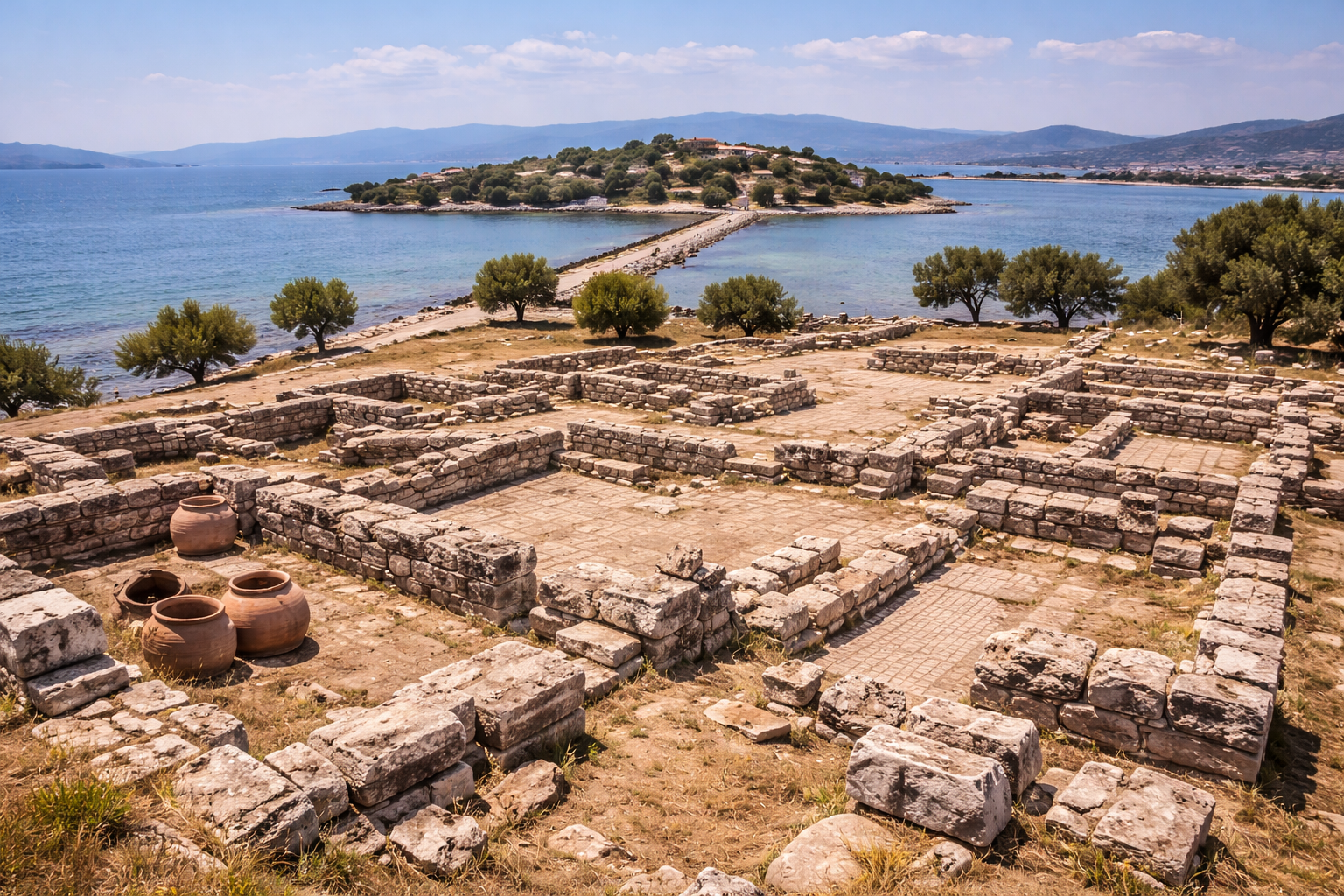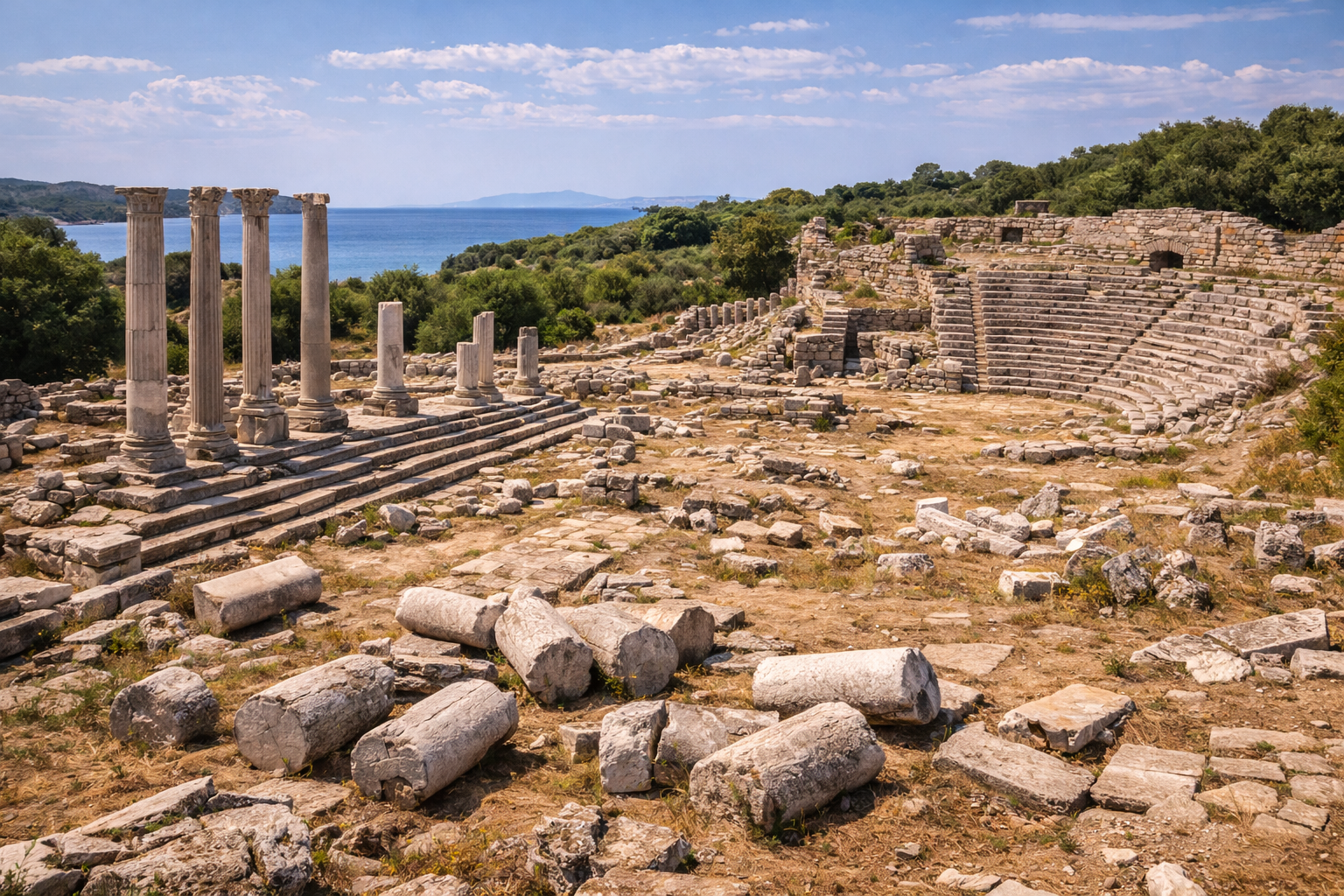
Quick Summary: The ancient city of Teos lies on a small peninsula about 1 km south of Sığacık and 5 km from Seferihisar, on the Aegean coast of western Türkiye. In Antiquity it was one of the maritime cities of Ionia, located on the southern shore of the Urla–Çeşme peninsula, with natural harbours opening towards the Aegean islands and the wider Mediterranean trade routes.
- Overview
- Historical Background
- Archaeology and Urban Layout
- Visitor Experience
- A Short Story from the Past
- Practical Travel Notes
- FAQ
- Sources
Overview
The ancient city of Teos lies on a small peninsula about 1 km south of Sığacık and 5 km from Seferihisar, on the Aegean coast of western Türkiye. In Antiquity it was one of the maritime cities of Ionia, located on the southern shore of the Urla–Çeşme peninsula, with natural harbours opening towards the Aegean islands and the wider Mediterranean trade routes.
This page is designed for real visitors: not only what this place is, but why it matters and how to experience it meaningfully.
Historical Background
The ancient city of Teos lies on a small peninsula about 1 km south of Sığacık and 5 km from Seferihisar, on the Aegean coast of western Türkiye. In Antiquity it was one of the maritime cities of Ionia, located on the southern shore of the Urla–Çeşme peninsula, with natural harbours opening towards the Aegean islands and the wider Mediterranean trade routes.
(Source: İzmir Provincial Directorate of Culture and Tourism – Teos (Seferihisar) – EN summary
Turkish Museums – İzmir Teos Archaeological Site)
Archaeological evidence shows that the first settlement at Teos dates back to the 11th–10th centuries BC (Protogeometric period). Ancient traditions present Athamas, son of Dionysos, as the founder of the city, which explains Teos’ long-standing association with the cult of Dionysos. According to Herodotus, Teos was one of the twelve cities of the Ionian League, and thanks to its two natural harbours it became an important centre of seaborne trade between the Anatolian mainland and the Aegean islands.
(Source: Wikipedia – Teos
İzmir Provincial Directorate of Culture and Tourism – Teos (Seferihisar))
Over the centuries Teos came under Lydian and then Persian rule. During the Ionian Revolt and the Greco-Persian Wars, groups of Teians migrated to new colonies such as Abdera in Thrace and Phanagoria on the Black Sea. In the Hellenistic and Roman periods, Teos prospered as a producer of wine, olive oil and ceramics, but also gained fame as a city of artists and poets, associated for example with the lyric poet Anacreon.
(Source: Wikipedia – Teos)
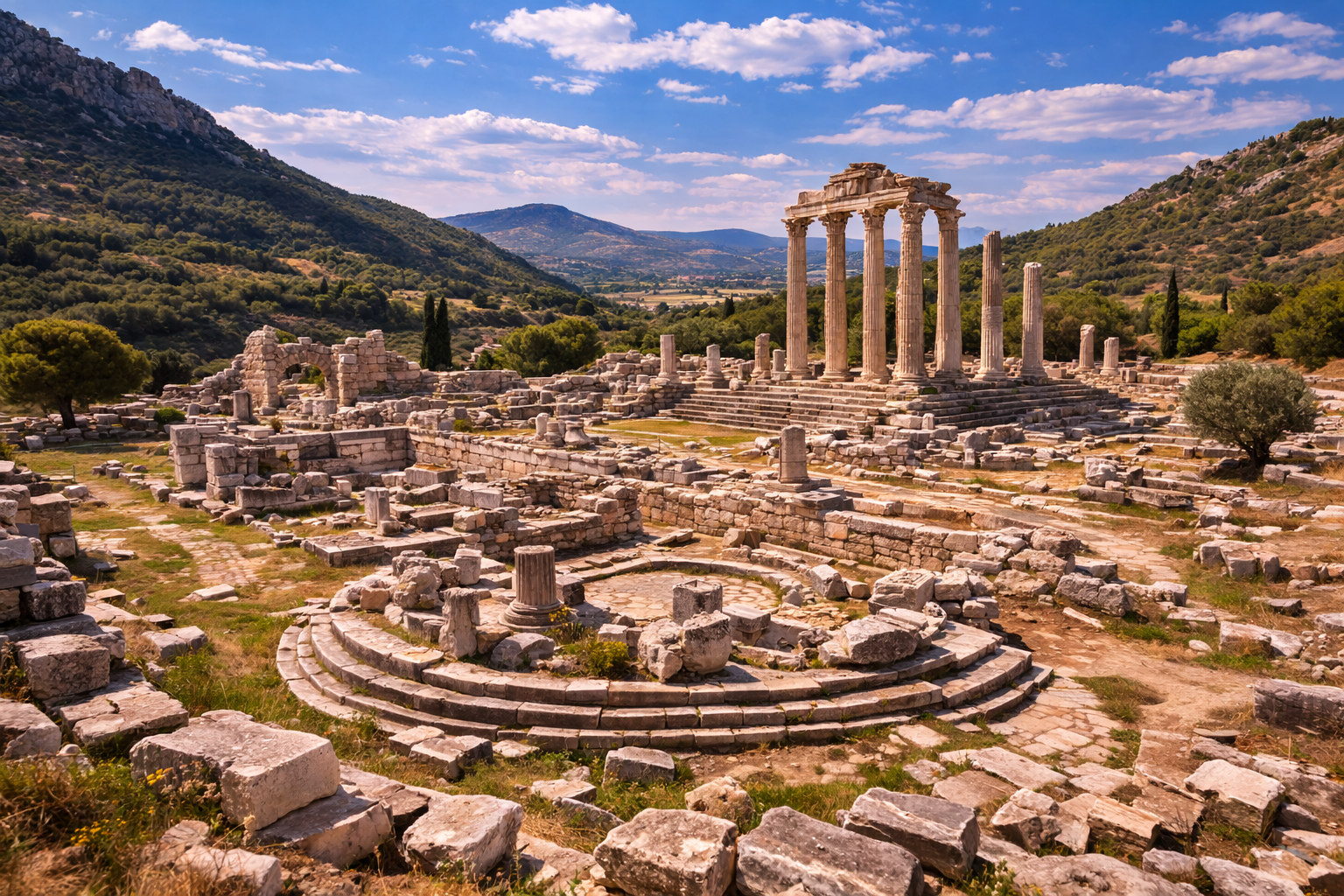
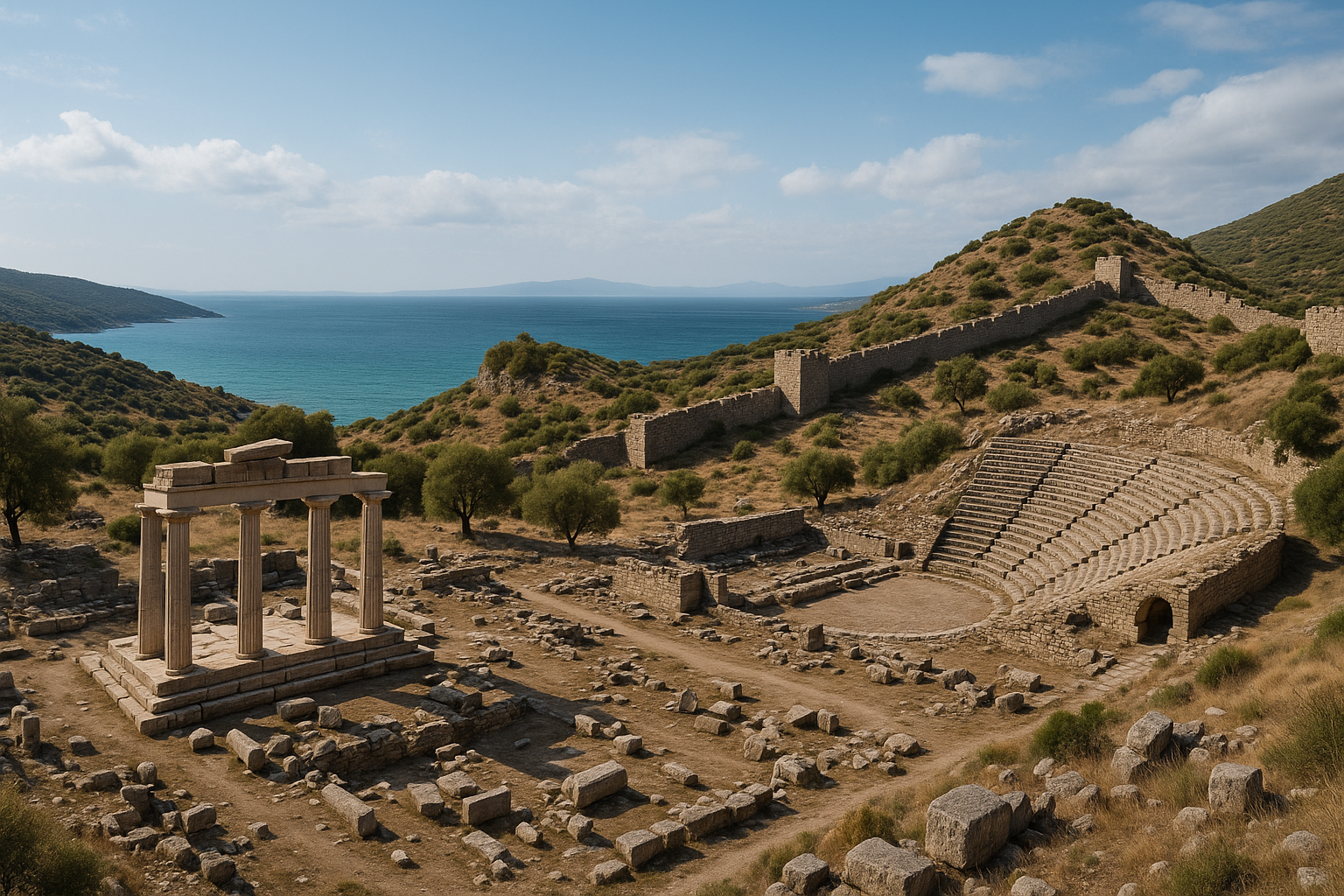
The most prominent monument of Teos is the Temple of Dionysos, designed in the early 2nd century BC by the famous Hellenistic architect Hermogenes of Priene. Built in the Ionic order, it is regarded as one of the largest temples dedicated to Dionysos in Asia Minor. Although heavily damaged by earthquakes, the plan and many architectural blocks are still visible. Around the temple lie the remains of the agora, theatre, odeion, bouleuterion (council house), gymnasion, cisterns, city walls and harbour installations.
(Source: Culture Portal – [Teos Ancient City – İzmir](https://www.kulturportali.gov.tr/turkiye/izmir/gezilecekyer/teos-antik-k...
Beyond the visible ruins, the historical value of this site comes from continuity: changing powers, changing urban functions, and changing ways people used public space over centuries.
Archaeology and Urban Layout
When reading this site on location, focus on three layers:
- Circulation layer: streets, gates, terraces, harbor or slope connections
- Public layer: theaters, agoras, baths, temples, administrative spaces
- Infrastructure layer: water systems, walls, storage zones, service architecture
This method helps visitors and researchers understand the city as a living system rather than isolated monuments.
Visitor Experience
A high-quality visit usually includes:
- A first orientation point (viewpoint, acropolis edge, or central axis)
- A pass through the site’s signature structure
- A slower walk through daily-life spaces
- A final stop connecting ruins with landscape
This sequence creates a stronger historical narrative than quick “photo-only” movement.
A Short Story from the Past
Imagine arriving here in antiquity at sunrise: workers preparing the day, travelers entering through roads or harbor routes, merchants opening storage spaces, and public architecture already shaping movement and ritual. The stones you see today are not silent objects; they are fragments of those repeated daily rhythms.
Practical Travel Notes
- Prefer spring and autumn for comfort.
- In summer, avoid midday peak heat when possible.
- Wear stable walking shoes for uneven terrain.
- Keep enough time (at least 1.5–3 hours) for a meaningful route.
- Check current access and ticket conditions before departure.
FAQ
Why is Teos Ancient City – Seferihisar, İzmir important?
Because it preserves multiple historical layers and helps explain regional cultural continuity in Türkiye.
How long should I spend here?
Most visitors spend 1.5–3 hours; in-depth visits may take half a day.
Is this suitable for first-time archaeology travelers?
Yes. With basic planning, this site is suitable for both first-time and experienced visitors.
Architectural Measurements: Temple of Dionysos
The Temple of Dionysos at Teos, designed by the architect Hermogenes of Priene, is the most significant surviving monument and one of the key buildings in the history of Hellenistic architecture.
| Parameter | Detail |
|---|---|
| Architect | Hermogenes of Priene |
| Architectural order | Ionic |
| Plan type | Peripteral (surrounded by columns on all sides) |
| Column arrangement | 6 x 11 columns |
| Stylobate dimensions | 18.50 x 35.00 m |
| Construction period | Begun c. 220 BC; completed c. 190 BC (approximately 30 years) |
| Design principle | Eustylos ("beautiful style") -- Hermogenes's innovation in intercolumniation |
| Intercolumniation ratio | 2.25 column-diameters between column centres |
| Column height ratio | 9.5 times the column's lower diameter |
| Status | Largest temple dedicated to Dionysos in Asia Minor |
| Current columns standing | 10 of the original 26 columns being reassembled in ongoing restoration |
Hermogenes's eustyle principle -- setting the spacing between columns at two-and-a-quarter column-thicknesses -- became the canonical standard for Ionic temple design. Vitruvius later codified this principle in De Architectura, citing Hermogenes's work at Teos specifically as the model.
Bouleuterion: Recent Excavations and Mosaic Discoveries (2022--2025)
The bouleuterion (council building) has been the focus of major excavation campaigns led jointly by the Teos Archaeological Project of Ankara University (directed by Prof. Musa Kadioglu) and the University of Pennsylvania (led by Prof. Mantha Zarmakoupi).
Bouleuterion Dimensions and Phases
| Parameter | Detail |
|---|---|
| Plan | Rectangular foundation with semicircular interior seating (cavea) |
| Seating rows | 16 tiers |
| Seating divisions | Cavea divided into 4 sections by 5 stairways |
| Original function | Civic assembly hall for the city council (late 3rd century BC, Hellenistic period) |
| Roman modification | Addition of a portico (triporticus) and stage structure, converting the space for theatrical performances |
| Location | Southeast of the theatre; east of the Dionysos Temple |
Mosaic of the Fighting Cupids (2024--2025)
Excavators uncovered two Early Hellenistic floor mosaics (3rd century BC) in two rooms associated with the bouleuterion complex:
| Mosaic | Subject | Date | Significance |
|---|---|---|---|
| Mosaic 1 | Two winged cupids (Erotes) engaged in combat | 3rd century BC | Associated with Eros, who in Greek mythology frequently appears alongside Dionysos -- Teos's patron deity |
| Mosaic 2 | Geometric and vegetal motifs | 3rd century BC | Complements the figural panel in the adjacent room |
A 30-cm-high monumental inscription was discovered on the bouleuterion wall, partially erased -- possibly for political or social reasons. Partial decipherment indicates the building was likely dedicated by a group of Dionysian artists (Technitai of Dionysos), the professional guild of actors, musicians, and performers that held a privileged position at Teos.
Excavation Chronology
| Year / Period | Director / Team | Focus |
|---|---|---|
| 1764--1765 | Richard Chandler, Nicholas Revett, William Pars (Society of Dilettanti) | First modern survey; architectural drawings of the Temple of Dionysos |
| 1862 | Richard Popplewell Pullan (architect) | First systematic excavation; focused on the Temple of Dionysos |
| 1962--1967 | Faculty of Language, History and Geography, Ankara University | Excavations in the Agora, Hellenistic Wall, Acropolis, area west of the Temple, and near the theatre and bouleuterion |
| 2010--present | Prof. Musa Kadioglu (Ankara University) / Teos Archaeological Project | Continuous excavation and restoration; temple column re-erection; bouleuterion excavation |
| 2022--present | Prof. Mantha Zarmakoupi (University of Pennsylvania) | Joint campaign on bouleuterion and triporticus; mosaic and inscription discoveries |
The collaboration between Ankara University and the University of Pennsylvania represents one of the most active international archaeological partnerships in western Turkey, combining Turkish institutional knowledge with American research resources.
Numismatic Evidence and the Artists of Dionysos
Teos minted coins from the 6th century BC onward. The most distinctive feature of Teos coinage is the griffin -- a mythological creature associated with Dionysos -- which served as the city's civic emblem across nearly all periods.
| Period | Coin Type | Obverse | Reverse |
|---|---|---|---|
| 6th--5th century BC | Silver stater | Griffin seated | Incuse square |
| 4th century BC | Silver drachm | Griffin seated | Lyre or kantharos (wine cup) |
| Hellenistic | Bronze | Griffin | Dionysos with thyrsos |
| Roman Imperial | Bronze provincial | Portrait of emperor | Griffin; or Dionysos enthroned |
The Technitai of Dionysos (Artists of Dionysos) was a powerful guild of performing artists that established its headquarters at Teos in the 2nd century BC. The guild's presence made Teos the de facto capital of theatrical and musical culture in the eastern Aegean. Members enjoyed diplomatic immunity and tax exemptions granted by Hellenistic kings, and they travelled throughout the Greek world to perform at major festivals. The bouleuterion inscription discovered in 2024--2025 may provide the first direct architectural evidence linking the guild to a specific civic building at Teos.
Sources
- https://izmir.ktb.gov.tr/TR-210599/teos-seferihisar.html
- https://www.turkishmuseums.com/museum/detail/2100-izmir-teos-orenyeri/2100/1
- https://en.wikipedia.org/wiki/Teos
- https://www.kulturportali.gov.tr/turkiye/izmir/gezilecekyer/teos-antik-kenti-
- https://teos.ankara.edu.tr/miras/tapinak-ve-kutsal-alanlar/dionysos-kutsal-alani/
- https://www.visitizmir.org/en/destination/10263
- https://commons.wikimedia.org/w/index.php?search=Teos+Ancient+City+–+Seferihisar,+İzmir&title=Special:MediaSearch&type=image
- https://en.wikipedia.org/wiki/Teos_Ancient_City_–_Seferihisar,_İzmir
Advanced Historical Analysis
Political Layering
Teos Ancient City – Seferihisar, İzmir should be interpreted through shifts in political authority, because each regime changed administrative priorities, urban investment, and symbolic architecture. This means visible remains are not neutral stones: they reflect historical decisions about control, legitimacy, and long-term territorial strategy.
Urban Adaptation
Cities evolved according to topography, resources, and mobility constraints. At sites like Teos Ancient City – Seferihisar, İzmir, adaptation can be traced in circulation routes, wall systems, water management, and the redistribution of public spaces over time.
Material Continuity and Reuse
A core archaeological reality is reuse: blocks, inscriptions, and architectural elements often migrated across periods. Reuse is not merely practical—it is also cultural messaging, where later communities selectively preserved, transformed, or reinterpreted earlier prestige.
Ritual and Public Memory
Sacred and civic spaces often overlap in long-lived cities. Ritual landscapes can persist even when political systems change, making them critical for studying continuity in collective memory.
Long-Form Visitor Interpretation Framework
Use this 8-step framework on site:
- Establish orientation with topography and route context.
- Identify the best-preserved structural system (walls, harbor, theatre, temple, etc.).
- Distinguish primary phase from later interventions.
- Compare monumental and everyday-life sectors.
- Read water and logistics infrastructure as survival systems.
- Evaluate symbolic/ritual axis and visibility politics.
- Track reuse and repair evidence.
- Conclude with city-landscape relationship at a final viewpoint.
This method improves interpretation quality for both general visitors and advanced readers.
Practical Planning for Researchers and Travelers
- Allocate at least one full interpretation cycle (2–4 hours).
- If available, pair site visit with local museum context.
- Record notes by phase, not by random observation order.
- Separate what is directly visible from what is inferred.
- Use maps and elevation to validate movement assumptions.
Expanded Visitor Q&A
Is this site only for archaeology specialists?
No. Structured route planning and basic historical framing make the site understandable to non-specialists.
Why do different periods overlap in one place?
Because cities are living systems. They are rebuilt, repurposed, and politically reframed rather than created once.
What is the most reliable way to avoid shallow interpretation?
Follow chronology, compare layers, and include infrastructure and landscape in your reading.
Should winter visits be avoided?
Not necessarily. Winter can offer lower crowd density and better interpretive pacing if weather conditions are manageable.
What makes this site distinct from other ancient cities?
Its specific combination of geography, political history, architecture, and continuity across multiple historical transitions.
Advanced Historical Analysis
Political Layering
Teos Ancient City – Seferihisar, İzmir should be interpreted through shifts in political authority, because each regime changed administrative priorities, urban investment, and symbolic architecture. This means visible remains are not neutral stones: they reflect historical decisions about control, legitimacy, and long-term territorial strategy.
Urban Adaptation
Cities evolved according to topography, resources, and mobility constraints. At sites like Teos Ancient City – Seferihisar, İzmir, adaptation can be traced in circulation routes, wall systems, water management, and the redistribution of public spaces over time.
Material Continuity and Reuse
A core archaeological reality is reuse: blocks, inscriptions, and architectural elements often migrated across periods. Reuse is not merely practical—it is also cultural messaging, where later communities selectively preserved, transformed, or reinterpreted earlier prestige.
Ritual and Public Memory
Sacred and civic spaces often overlap in long-lived cities. Ritual landscapes can persist even when political systems change, making them critical for studying continuity in collective memory.
Long-Form Visitor Interpretation Framework
Use this 8-step framework on site:
- Establish orientation with topography and route context.
- Identify the best-preserved structural system (walls, harbor, theatre, temple, etc.).
- Distinguish primary phase from later interventions.
- Compare monumental and everyday-life sectors.
- Read water and logistics infrastructure as survival systems.
- Evaluate symbolic/ritual axis and visibility politics.
- Track reuse and repair evidence.
- Conclude with city-landscape relationship at a final viewpoint.
This method improves interpretation quality for both general visitors and advanced readers.
Practical Planning for Researchers and Travelers
- Allocate at least one full interpretation cycle (2–4 hours).
- If available, pair site visit with local museum context.
- Record notes by phase, not by random observation order.
- Separate what is directly visible from what is inferred.
- Use maps and elevation to validate movement assumptions.
Expanded Visitor Q&A
Is this site only for archaeology specialists?
No. Structured route planning and basic historical framing make the site understandable to non-specialists.
Why do different periods overlap in one place?
Because cities are living systems. They are rebuilt, repurposed, and politically reframed rather than created once.
What is the most reliable way to avoid shallow interpretation?
Follow chronology, compare layers, and include infrastructure and landscape in your reading.
Should winter visits be avoided?
Not necessarily. Winter can offer lower crowd density and better interpretive pacing if weather conditions are manageable.
What makes this site distinct from other ancient cities?
Its specific combination of geography, political history, architecture, and continuity across multiple historical transitions.
Advanced Historical Analysis
Political Layering
Teos Ancient City – Seferihisar, İzmir should be interpreted through shifts in political authority, because each regime changed administrative priorities, urban investment, and symbolic architecture. This means visible remains are not neutral stones: they reflect historical decisions about control, legitimacy, and long-term territorial strategy.
Urban Adaptation
Cities evolved according to topography, resources, and mobility constraints. At sites like Teos Ancient City – Seferihisar, İzmir, adaptation can be traced in circulation routes, wall systems, water management, and the redistribution of public spaces over time.
Material Continuity and Reuse
A core archaeological reality is reuse: blocks, inscriptions, and architectural elements often migrated across periods. Reuse is not merely practical—it is also cultural messaging, where later communities selectively preserved, transformed, or reinterpreted earlier prestige.
Ritual and Public Memory
Sacred and civic spaces often overlap in long-lived cities. Ritual landscapes can persist even when political systems change, making them critical for studying continuity in collective memory.
Long-Form Visitor Interpretation Framework
Use this 8-step framework on site:
- Establish orientation with topography and route context.
- Identify the best-preserved structural system (walls, harbor, theatre, temple, etc.).
- Distinguish primary phase from later interventions.
- Compare monumental and everyday-life sectors.
- Read water and logistics infrastructure as survival systems.
- Evaluate symbolic/ritual axis and visibility politics.
- Track reuse and repair evidence.
- Conclude with city-landscape relationship at a final viewpoint.
This method improves interpretation quality for both general visitors and advanced readers.
Practical Planning for Researchers and Travelers
- Allocate at least one full interpretation cycle (2–4 hours).
- If available, pair site visit with local museum context.
- Record notes by phase, not by random observation order.
- Separate what is directly visible from what is inferred.
- Use maps and elevation to validate movement assumptions.
Expanded Visitor Q&A
Is this site only for archaeology specialists?
No. Structured route planning and basic historical framing make the site understandable to non-specialists.
Why do different periods overlap in one place?
Because cities are living systems. They are rebuilt, repurposed, and politically reframed rather than created once.
What is the most reliable way to avoid shallow interpretation?
Follow chronology, compare layers, and include infrastructure and landscape in your reading.
Should winter visits be avoided?
Not necessarily. Winter can offer lower crowd density and better interpretive pacing if weather conditions are manageable.
What makes this site distinct from other ancient cities?
Its specific combination of geography, political history, architecture, and continuity across multiple historical transitions.
Advanced Historical Analysis
Political Layering
Teos Ancient City – Seferihisar, İzmir should be interpreted through shifts in political authority, because each regime changed administrative priorities, urban investment, and symbolic architecture. This means visible remains are not neutral stones: they reflect historical decisions about control, legitimacy, and long-term territorial strategy.
Urban Adaptation
Cities evolved according to topography, resources, and mobility constraints. At sites like Teos Ancient City – Seferihisar, İzmir, adaptation can be traced in circulation routes, wall systems, water management, and the redistribution of public spaces over time.
Material Continuity and Reuse
A core archaeological reality is reuse: blocks, inscriptions, and architectural elements often migrated across periods. Reuse is not merely practical—it is also cultural messaging, where later communities selectively preserved, transformed, or reinterpreted earlier prestige.
Ritual and Public Memory
Sacred and civic spaces often overlap in long-lived cities. Ritual landscapes can persist even when political systems change, making them critical for studying continuity in collective memory.
Long-Form Visitor Interpretation Framework
Use this 8-step framework on site:
- Establish orientation with topography and route context.
- Identify the best-preserved structural system (walls, harbor, theatre, temple, etc.).
- Distinguish primary phase from later interventions.
- Compare monumental and everyday-life sectors.
- Read water and logistics infrastructure as survival systems.
- Evaluate symbolic/ritual axis and visibility politics.
- Track reuse and repair evidence.
- Conclude with city-landscape relationship at a final viewpoint.
This method improves interpretation quality for both general visitors and advanced readers.
Practical Planning for Researchers and Travelers
- Allocate at least one full interpretation cycle (2–4 hours).
- If available, pair site visit with local museum context.
- Record notes by phase, not by random observation order.
- Separate what is directly visible from what is inferred.
- Use maps and elevation to validate movement assumptions.
Expanded Visitor Q&A
Is this site only for archaeology specialists?
No. Structured route planning and basic historical framing make the site understandable to non-specialists.
Why do different periods overlap in one place?
Because cities are living systems. They are rebuilt, repurposed, and politically reframed rather than created once.
What is the most reliable way to avoid shallow interpretation?
Follow chronology, compare layers, and include infrastructure and landscape in your reading.
Should winter visits be avoided?
Not necessarily. Winter can offer lower crowd density and better interpretive pacing if weather conditions are manageable.
What makes this site distinct from other ancient cities?
Its specific combination of geography, political history, architecture, and continuity across multiple historical transitions.