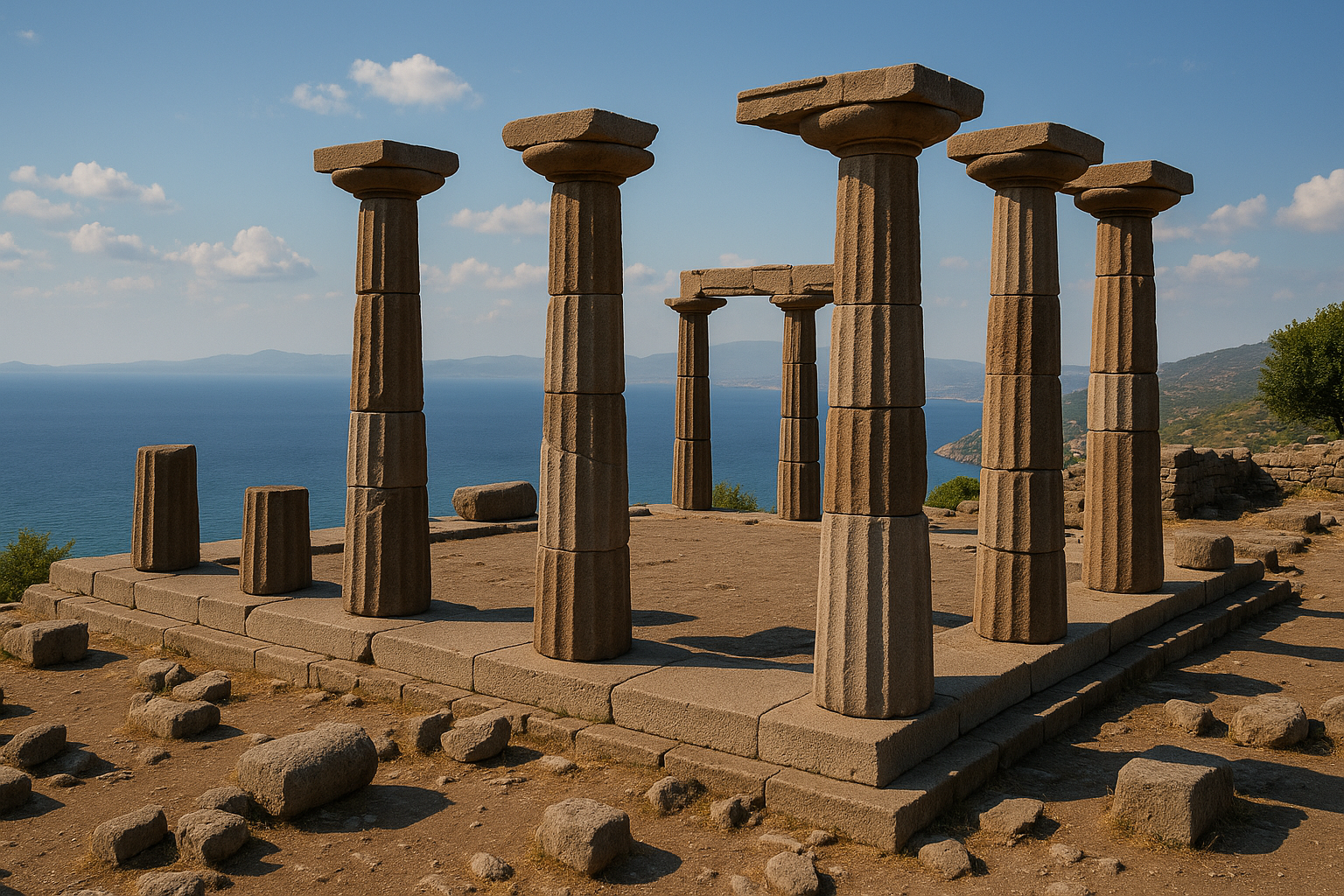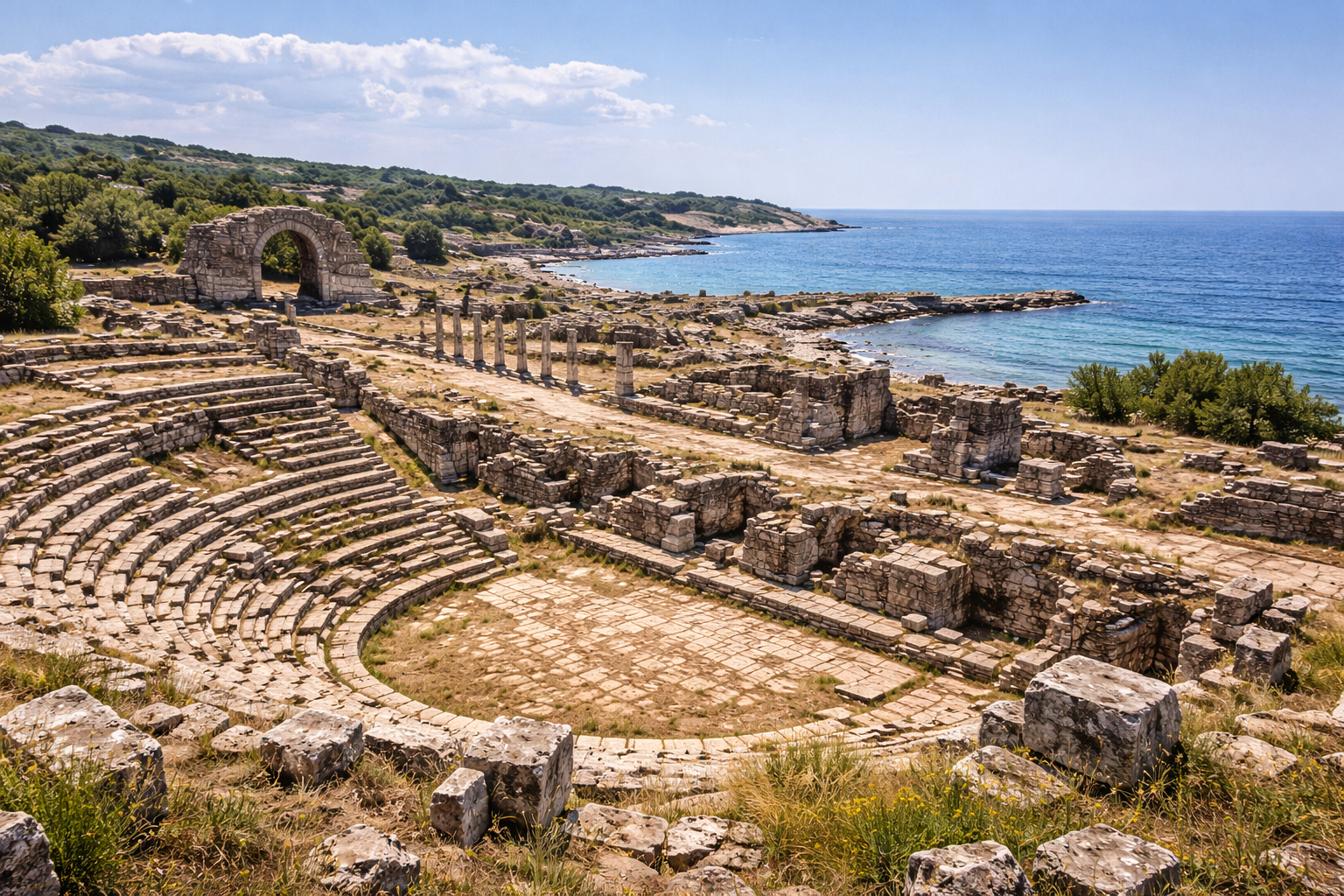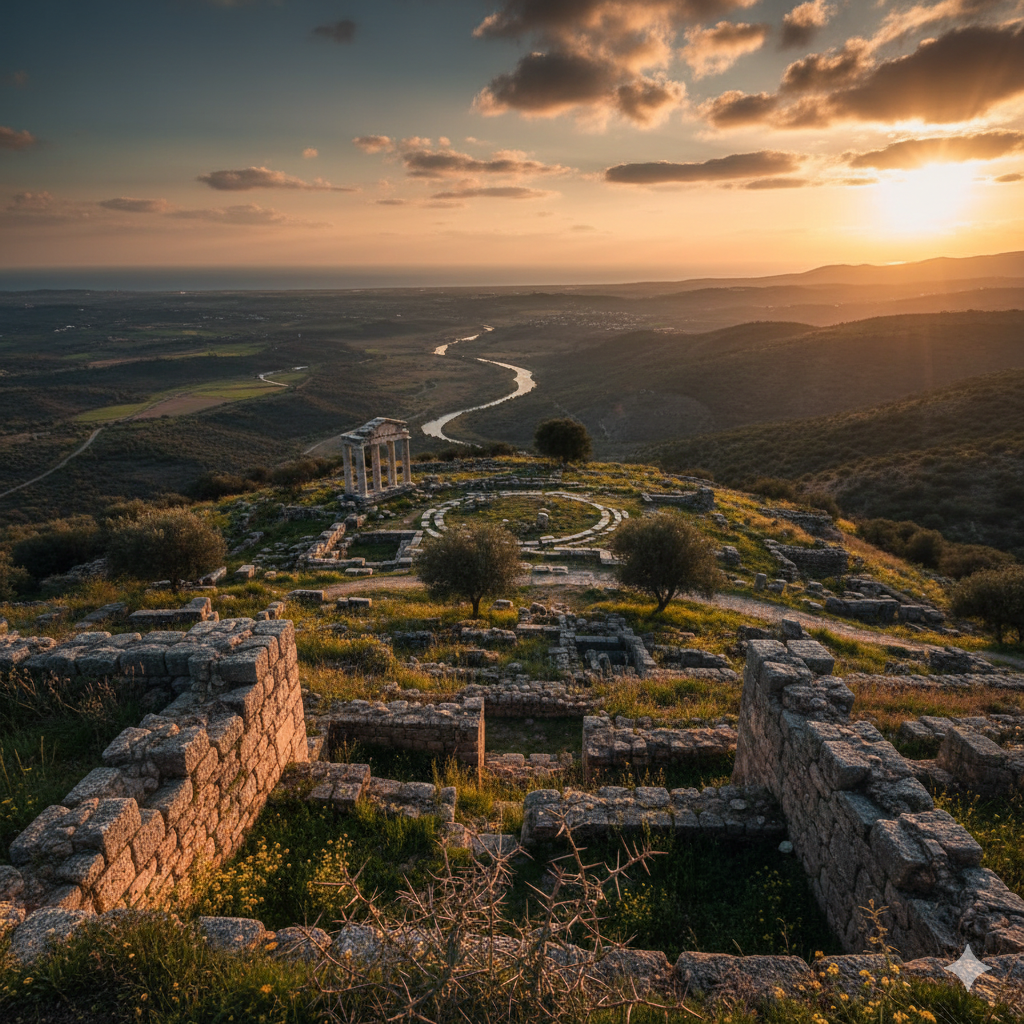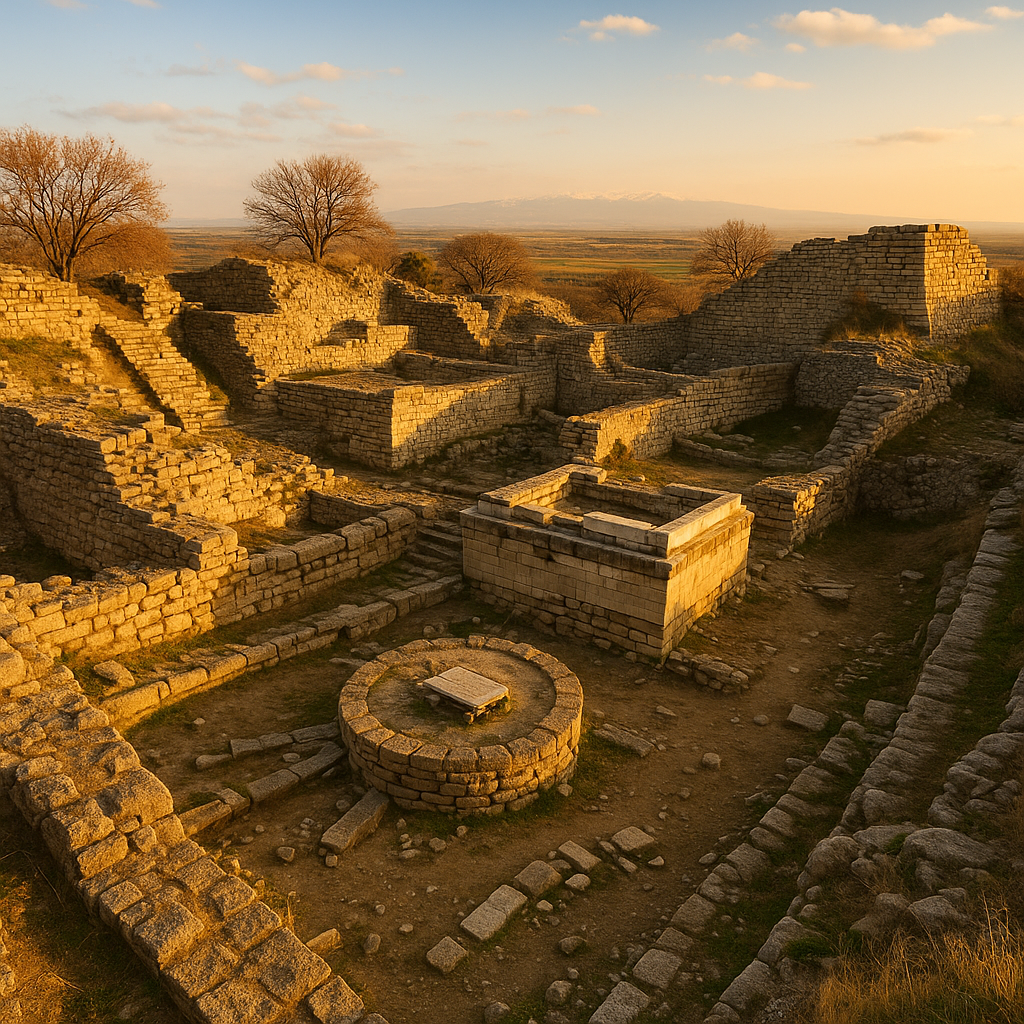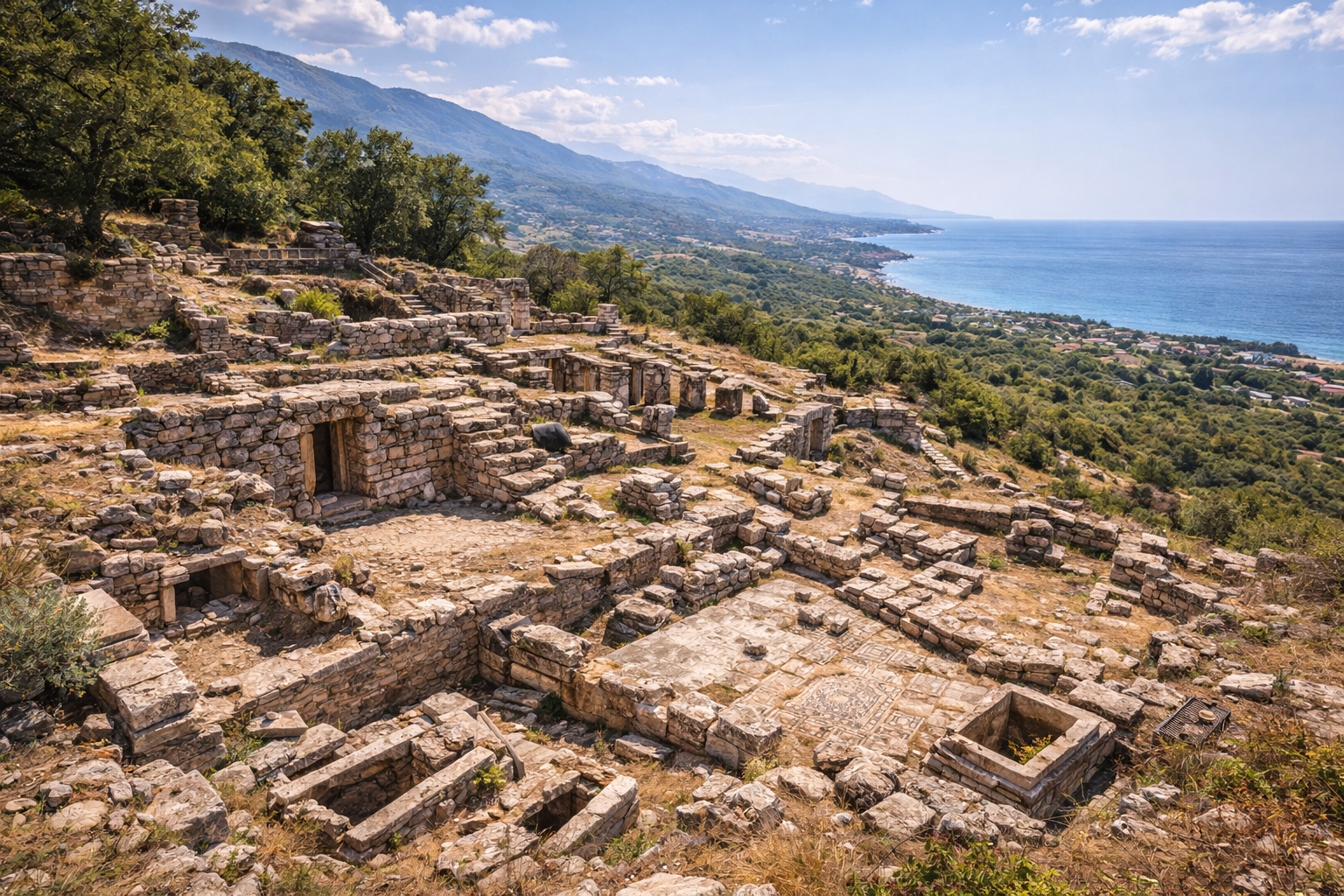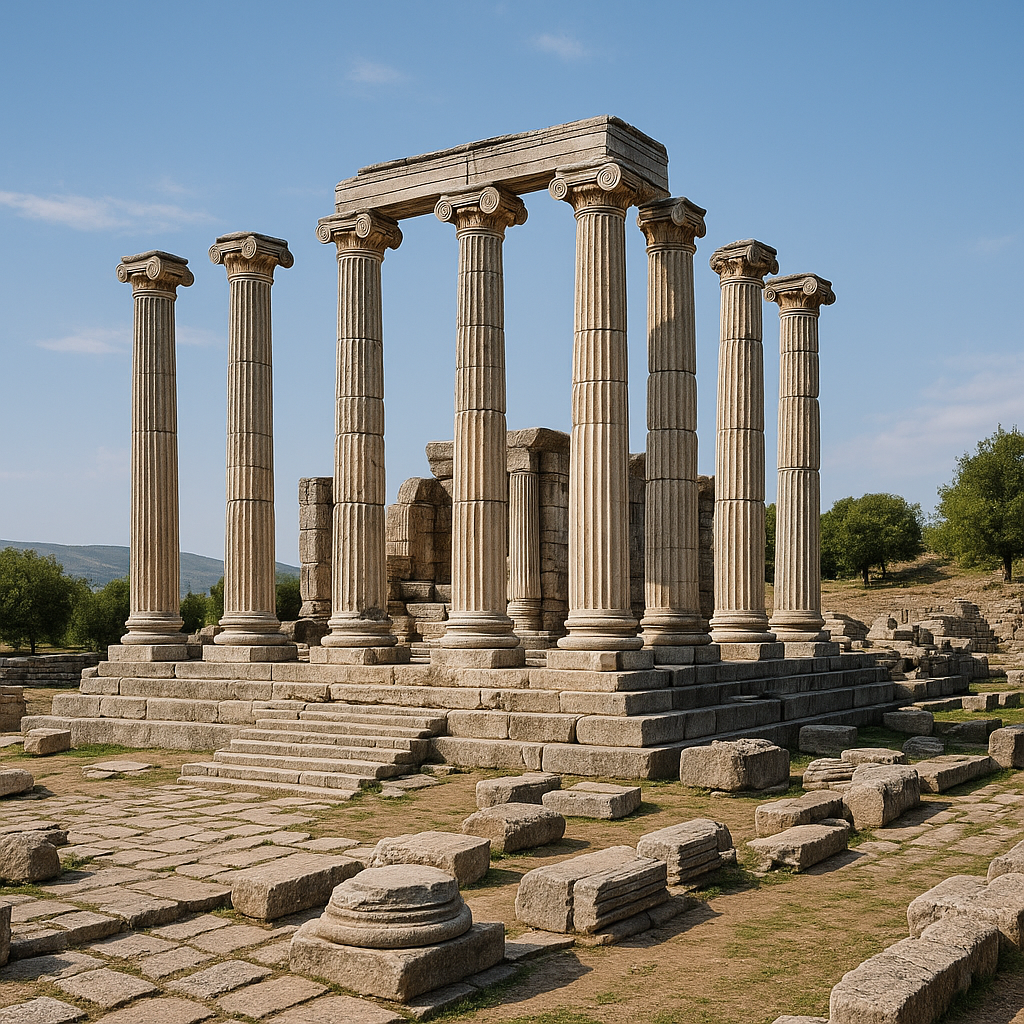
The Temple of Apollo Smintheus (the Smintheion) is located in Gulpinar village, Ayvacik district of Canakkale Province, on the northwestern Aegean coast of Turkey. It is one of the most important Hellenistic sanctuaries in the ancient Troad region. The epithet Smintheus -- meaning "Mouse Lord" -- refers to Apollo's role as a protector against plague-carrying rodents, a cult with roots stretching back to the 2nd millennium BC. The temple itself, built around 150 BC in the Ionic pseudodipteral style, is celebrated for its narrative frieze reliefs depicting scenes from Homer's Iliad, making it an extraordinary intersection of religion, architecture, and epic literature. The sanctuary has been on the UNESCO Tentative List since 2014, acknowledging its outstanding universal cultural value.
- Why Apollo Smintheus Matters
- Geography and Setting
- Historical Timeline
- Major Monuments
- The Cult of Apollo Smintheus
- The Iliad Frieze
- Archaeological Work
- Visitor Information
- Frequently Asked Questions
- Sources and Further Reading
Why Apollo Smintheus Matters
-
Opening scene of Western literature: The Smintheion is directly invoked in the very first book of Homer's Iliad (c. 8th century BC). The Trojan priest Chryses prays to "Apollo Smintheus" to punish the Greeks with plague for refusing to return his daughter Chryseis. This makes the sanctuary one of the few ancient sites explicitly named in the earliest surviving work of Western literature.
-
Unique cult title: Apollo Smintheus ("Lord of the Mice") is the only known example of a mouse-associated Apollo cult in Anatolia. The apotropaic (protective) nature of this cult -- invoking Apollo to ward off plague-carrying mice -- reflects ancient agricultural anxieties and is attested by votive mouse figurines found during excavations.
-
Masterpiece of Hellenistic architecture: The temple, dated to approximately 150 BC, follows the pseudodipteral plan attributed to the revolutionary architect Hermogenes of Priene. This plan creates the visual impression of a double colonnade while leaving extra space around the inner cella, producing an effect of lightness and spatial elegance that influenced Roman temple design for centuries.
-
Iliad frieze reliefs: The sculpted frieze running along the temple exterior depicted dramatic scenes from the Trojan War cycle. Only about 24 meters of the estimated 120-meter frieze have been recovered, but these fragments constitute some of the finest narrative sculpture from the Hellenistic period in Anatolia. The combination of epic literary themes with architectural sculpture is virtually unique among surviving Hellenistic temples.
-
Chalcolithic prehistory: Excavations beneath the sanctuary have revealed a Chalcolithic settlement dated between 5200 and 4800 BC, demonstrating that this location was a significant habitation site long before the Greek period, with over seven thousand years of human presence at the same spot.
-
UNESCO Tentative List: The Smintheion was added to Turkey's UNESCO World Heritage Tentative List in 2014 (reference 6242), recognizing its outstanding cultural value as a sanctuary connecting Homeric epic, unique religious practice, and Hellenistic architectural innovation.
Geography and Setting
The sanctuary lies in a fertile coastal zone near Gulpinar village, approximately 25 km southwest of Ayvacik and about 75 km south of Canakkale city center. The site occupies gently sloping terrain near the Aegean coast, with views toward the island of Lesbos (Midilli) on clear days.
Coastal and Agricultural Context
The ancient settlement of Hamaxitus (the city associated with the sanctuary) was a small harbor community. The sanctuary's location provided accessibility by both land and sea routes, making it a natural pilgrimage destination for communities across the Troad and the northeastern Aegean islands. The surrounding area is characterized by olive groves and Mediterranean scrubland, consistent with the agricultural cult of Apollo Smintheus as a protector of harvests against rodent infestation. Even today, the village of Gulpinar maintains its agricultural character, with olive oil production as its primary livelihood.
The Troad Archaeological Landscape
The Smintheion sits within the broader region of the Troad (the area around ancient Troy), making it part of a remarkably dense archaeological landscape. Within a two-hour drive from the temple, visitors can access:
- Troy (Truva): Approximately 60 km north, the legendary city of the Trojan War and a UNESCO World Heritage Site.
- Alexandria Troas: Approximately 20 km northeast, a major Hellenistic-Roman port city with monumental baths and city walls.
- Assos (Behramkale): Approximately 40 km southeast, an Archaic Greek city with a dramatic acropolis overlooking the Aegean.
- Neandria: An early Greek settlement in the hills east of Gulpinar.
This concentration of ancient sites makes the southwestern Troad one of the richest archaeological zones in the eastern Mediterranean.
Historical Timeline
Chalcolithic Period (c. 5200--4800 BC)
Excavations beneath the sanctuary have revealed a significant Chalcolithic settlement, including stone tools, pottery, habitation remains, post-holes, and storage pits. This discovery pushed the human history of the site back over seven millennia, demonstrating that the location attracted settlement long before the arrival of Greek colonists. The natural springs and fertile coastal soil likely drew these early farming communities.
Bronze Age and Early Cult Origins (c. 2000--1200 BC)
According to ancient literary tradition, the cult of Apollo Smintheus was brought to the Troad by migrants from Crete around 2000 BC. The priest Crinis is said to have founded the cult after mice gnawed through the leather straps of enemy warriors' shields, which was interpreted as divine intervention by Apollo. While direct archaeological evidence for Bronze Age cult activity at this specific site is limited, the antiquity of the Smintheus epithet is supported by Homeric references and regional tradition. The Troad was a major zone of interaction between Anatolian and Aegean civilizations during the Late Bronze Age.
Archaic and Classical Periods (c. 700--330 BC)
The Smintheion appears in Homer's Iliad (composed c. 8th century BC) as an established sanctuary. During the Classical period, Hamaxitus -- the associated settlement -- was part of the broader political landscape of the Troad, passing through periods of Persian control, membership in the Delian League (Athenian alliance), and local autonomy. The sanctuary maintained its religious function throughout these political changes, serving as a regional pilgrimage center. Coins minted at Hamaxitus during this period sometimes featured Apollo with a mouse at his feet, confirming the cult's visual iconography.
Hellenistic Period (c. 330--30 BC)
The major construction phase. Around 150 BC, the grand Ionic temple was built, following the pseudodipteral plan associated with Hermogenes of Priene, the most innovative architect of the Hellenistic age. The frieze reliefs depicting Iliad scenes were carved during this period, and the sanctuary was embellished with porticoes, an altar, and auxiliary buildings. The construction likely received patronage from one of the successor kingdoms, possibly the Attalids of Pergamon, who controlled much of the Troad during this period. The temple's ambitious sculptural program -- with its 120-meter narrative frieze -- was among the most elaborate decorative schemes of any Hellenistic temple in Anatolia.
Roman Period (30 BC -- c. 400 AD)
The sanctuary continued to function under Roman rule. The Troad held a special place in Roman cultural memory because of its association with the Trojan origins claimed by Rome (through Aeneas). This connection may have ensured continued imperial patronage of the sanctuary. A Roman tomb discovered in 2023 near the sanctuary complex confirms continued use of the site for ceremonial and burial purposes well into the Imperial period. The settlement of Hamaxitus evolved as a small Roman town with its own civic infrastructure.
Late Antiquity and Abandonment (c. 400--600 AD)
Like many pagan sanctuaries, the Smintheion fell into disuse during the Christianization of the Roman Empire in the 4th--5th centuries AD. The site was partially quarried for building materials in later centuries, and many of the temple's columns and architectural members were removed. However, the temple platform and significant portions of the structure survived due to the site's relatively remote location.
The Role of the Sanctuary in Troad Society
The Smintheion was far more than a place of worship. As the second most important sanctuary in the Troad region, it functioned as a social, economic, and cultural hub for the surrounding communities. During major festivals, pilgrims and traders from across the Troad, the northeastern Aegean islands, and possibly beyond would have gathered at the sanctuary, creating a temporary marketplace and social gathering. Animal sacrifices at the altar were followed by communal feasting, reinforcing bonds between communities. The sanctuary's role as a mediator between humans and the divine also gave its priesthood significant political influence in regional affairs. The investment in the monumental temple building around 150 BC can be understood as a statement of civic ambition by the communities who funded it.
Major Monuments
The Temple of Apollo Smintheus
The centerpiece of the sanctuary. Key architectural features:
- Style: Ionic order, pseudodipteral plan -- a design innovation that arranges a single row of freestanding columns around the cella but leaves the space of a second (inner) row empty, creating an unusually wide covered walkway
- Dimensions: Approximately 40 x 23 meters at the stylobate level
- Columns: 8 columns across the front (octastyle) and 14 along the sides, originally standing approximately 10 meters tall. The pseudodipteral arrangement creates an unusually wide ambulatory space around the cella
- Material: Local granite for the columns and andesite/marble for decorative elements
- Frieze: The Iliad frieze ran along the upper walls of the cella exterior, originally extending approximately 120 meters in total length
- Current state: Several columns have been re-erected during restoration. The temple platform (stylobate), column bases, and substantial wall sections are visible. A modern protective roof structure covers the main temple area, providing shade and weather protection for the surviving architectural elements. Frieze fragments are displayed both on-site and in the Canakkale Archaeological Museum
The Altar
Located east of the temple, as is standard in Greek sanctuary design. The altar served as the primary location for animal sacrifice -- the central ritual act of Greek religion. The altar's dimensions suggest it could accommodate major communal sacrifices during festival periods.
Porticoes and Stoa
Columned walkways flanking the temple precinct, providing sheltered space for visitors, pilgrims, and votive offerings. These structures helped define the sacred temenos (sanctuary boundary) and created a formal architectural frame for the temple within the landscape. The shaded corridors of the porticoes offered refuge during hot summer months and also served as display areas for votive gifts during festival periods.
Sacred Spring
A spring near the sanctuary has been known since antiquity. In the cult of Apollo, water held purifying power, and this spring may have played a central role in lustration (ritual purification) ceremonies. The spring water also served the daily water needs of the sanctuary and surrounding settlement. Similar sacred springs were integral to worship practice at other Apollo sanctuaries, including Didyma and Claros.
The Necropolis
A necropolis (cemetery) was situated northwest of the temple. Excavations in this area have uncovered tombs from different periods, including a 1,700-year-old burial and a 2,000-year-old monumental Roman tomb discovered in 2023 by archaeologists from Canakkale Onsekiz Mart University. These finds indicate that the sanctuary area served as a prestige burial zone for local elites across multiple centuries.
Chalcolithic Settlement Remains
Visible in excavated sections beneath the sanctuary level, including post-holes, storage pits, and fragments of early pottery and stone tools. These remains provide a rare stratigraphic window into over seven millennia of human activity at a single location. The Chalcolithic inhabitants likely sustained themselves through agriculture and fishing, taking advantage of the fertile coastal soil and natural water sources of the area.
The Cult of Apollo Smintheus
The epithet Smintheus derives from the word sminthos, meaning "mouse" in a dialect possibly related to Cretan or pre-Greek languages. The cult reflects an apotropaic (evil-averting) religious function:
- Agricultural protection: Mice and rats were devastating to grain stores in antiquity. By worshipping Apollo as the "Mouse Lord," farmers sought divine protection for their harvests. The Troad's grain-producing economy made rodent control an existential concern.
- Plague association: The opening of the Iliad describes Apollo Smintheus sending a plague upon the Greek army. This reflects the ancient understanding that rodents and disease were connected -- a remarkably prescient insight given modern epidemiology.
- Foundation myth: According to the ancient author Aelian, the cult was founded when mice gnawed through enemy warriors' leather bow-straps, leading to their defeat. The local priest Crinis interpreted this as Apollo's intervention and established the cult in gratitude.
- Votive evidence: Excavations at the Smintheion have uncovered small mouse figurines offered as votives, confirming the centrality of the mouse association in cult practice. These terracotta and bronze mice are among the most distinctive votive offerings from any Greek sanctuary.
- Iconography: Ancient coins and statues from the region sometimes depict Apollo with a mouse at his feet, reinforcing the visual identity of this unique cult. A famous Roman-era copy of the cult statue shows Apollo stepping on a mouse.
- Living tradition: Remarkably, mice still inhabit the site today and are considered a living connection to the ancient cult. Visitors frequently encounter them among the ruins, and the local community regards their presence as part of the sanctuary's heritage.
The Smintheion was considered the second most important sanctuary in the Troad, after the Temple of Athena at Troy itself.
The Iliad Frieze
The sculptured frieze is the temple's most celebrated artistic feature and one of the finest surviving examples of Hellenistic narrative sculpture in Anatolia.
Scale and Design
The frieze originally ran along the exterior upper walls of the cella for a total estimated length of approximately 120 meters. This made it one of the longest continuous narrative friezes of any Hellenistic temple. Only about 24 meters of relief panels have been recovered through excavation -- roughly 20% of the original.
Identified Scenes
The recovered fragments depict episodes from the Trojan War cycle, including:
- Battle scenes between Greek and Trojan warriors, with dynamic compositions showing combat, fallen warriors, and divine intervention
- Funeral processions and the mourning of heroes
- Scenes of divine council and interaction between gods and mortals
- Chariot combat scenes with detailed rendering of horses and equipment
Artistic Quality
The carving quality is exceptionally high, with dynamic compositions and detailed rendering of armor, drapery, and facial expressions. The sculptors demonstrated mastery of the "baroque" Hellenistic style, with dramatic poses, deep relief carving, and emotional expressiveness. Art historians compare the quality to the famous Pergamon Altar frieze (Great Altar of Zeus), suggesting that the Smintheion sculptors may have been trained in similar workshops.
Display and Conservation
Recovered frieze panels are displayed both on-site under the protective roof structure and in the Canakkale Archaeological Museum. The remaining 80% of the frieze likely lies buried beneath unexcavated portions of the site or was removed in antiquity and later periods for reuse. The possibility of discovering additional frieze fragments in future excavation seasons continues to make the Smintheion an archaeologically exciting prospect.
Archaeological Work
Frank Calvert (1866)
The British-American diplomat and pioneering archaeologist -- the same figure who first identified Troy at Hisarlik -- conducted initial investigations at the Smintheion site in 1866, recording surface finds and identifying the location of the temple. Calvert's work laid the groundwork for future systematic excavation.
Coskun Ozgunel and Ankara University (1980--2019)
Systematic excavations have been conducted since 1980 under the direction of Professor Coskun Ozgunel of Ankara University. This long-running project has:
- Uncovered the temple platform, columns, and substantial architectural elements
- Recovered and documented frieze fragments depicting Iliad scenes
- Excavated the Chalcolithic settlement beneath the sanctuary
- Restored several columns to their original positions
- Established an on-site display area with protective roofing over the main temple
- Mapped the broader sanctuary precinct including porticoes and altar
Davut Kaplan and Ondokuz Mayis University (2020--Present)
Since 2020, excavations have continued under the direction of Davut Kaplan of Ondokuz Mayis University (OMU), Samsun. The new excavation team has:
- Discovered a 2,000-year-old monumental Roman tomb near the sanctuary in 2023
- Continued work on the necropolis area northwest of the temple
- Expanded documentation of the site using modern digital recording methods
- Maintained conservation of previously exposed architectural elements
The Smintheion excavation is one of the longest-running continuous archaeological projects in Turkey, spanning over four decades and two institutional teams, and has transformed understanding of Hellenistic religious architecture in the Troad.
Visitor Information
Getting There
- From Ayvacik: Approximately 25 km west, about 30 minutes by car. Follow signs toward Gulpinar.
- From Canakkale: Approximately 75 km south, about 1.5 hours by car via the Ayvacik road.
- From Troy: Approximately 60 km south, about 1 hour by car. Makes an excellent combined day trip.
- From Assos: Approximately 40 km northwest, about 50 minutes.
The site is well signposted from both Ayvacik and the coastal road.
Hours and Admission
- Open daily. Hours typically 08:30--19:00 in summer (April--October), 08:30--17:00 in winter (November--March).
- Check the official Ministry of Culture and Tourism or Turkish Museums website for current hours.
- Museum Pass Turkiye is accepted, making it excellent value when combined with nearby sites.
- Individual admission ticket available for those without Museum Pass.
Time Required
- Minimum: 45 minutes to 1 hour (temple area only)
- Recommended: 1.5--2.5 hours (full sanctuary with interpretive reading and careful examination of the frieze fragments)
- Combined visit: Pair with Alexandria Troas (20 km) for a half-day itinerary, or add Assos for a full-day Troad tour
Best Seasons
- Spring (April--May): Mild weather, green landscape, wildflowers in the surrounding olive groves. Arguably the best time to visit.
- Autumn (September--October): Comfortable temperatures, excellent light for photography, olive harvest season
- Summer: Hot; visit early morning or late afternoon to avoid midday heat. The protective roof over the temple provides welcome shade.
- Winter: Quiet and atmospheric; verify hours before visiting. The site receives very few visitors in winter, offering a contemplative experience.
Practical Tips
- Wear comfortable walking shoes; the site is mostly flat but includes uneven stone surfaces around the temple platform.
- The on-site protective roof covers the main temple area, providing shade and rain protection.
- Bring water in summer. There is limited shade outside the covered area.
- Information panels on-site provide good context in Turkish and English, but a regional guidebook or pre-visit research enriches the experience significantly.
- This site is much less crowded than Troy, offering a more contemplative and intimate archaeological visit.
- Photography is permitted throughout the site. The covered area creates challenging lighting conditions; a camera with good low-light performance is helpful.
- Look for the resident mice among the ruins -- they are considered a living link to the ancient cult and are a charming feature of the visit.
- The nearby village of Gulpinar has basic cafes and shops. For more extensive facilities, return to Ayvacik.
Combining with Other Troad Sites
The Smintheion is ideally combined with other archaeological sites in the Troad for a comprehensive itinerary:
- Half-day option: Smintheion + Alexandria Troas (20 km apart)
- Full-day option: Troy + Smintheion + Alexandria Troas (covers the major sites of the Troad)
- Extended option: Add Assos (Behramkale) for a two-day Troad exploration
Frequently Asked Questions
What does "Smintheus" mean?
It means "Mouse Lord" or "Lord of the Mice." It refers to Apollo's role as protector against plague-bearing rodents. The cult likely originated in agricultural communities where mice threatened grain stores. The word sminthos may derive from a pre-Greek or Cretan dialect.
Is this site connected to the Iliad?
Yes, directly. The very first book of Homer's Iliad features the priest Chryses praying to "Apollo Smintheus" at this sanctuary. The priest begs Apollo to punish the Greeks with plague for refusing to return his captive daughter Chryseis. The temple frieze reliefs also depict scenes from the Trojan War narrative, creating a physical monument to the epic poem.
Who designed the temple?
The architect's name is not known with certainty. The pseudodipteral plan follows principles attributed to Hermogenes of Priene, the most influential Hellenistic architect, who is credited with developing this innovative temple layout. The temple's designer was likely a follower or student of Hermogenes working around 150 BC, possibly under the patronage of the Attalid kings of Pergamon.
How does this site relate to Troy?
The Smintheion is approximately 60 km south of Troy and belongs to the same ancient region (the Troad). It was the second most important sanctuary in the Troad after Troy's Temple of Athena. Visitors to Troy can easily combine both sites in a full-day Troad itinerary.
Is there a museum on site?
The site has an open-air display area with recovered architectural elements, frieze fragments, and informational panels under a modern protective roof structure. Significant finds are also displayed in the Canakkale Archaeological Museum in the provincial capital. The on-site display is well organized and provides excellent context for understanding the temple's original appearance.
Are there really mice at the site?
Yes. Mice have been observed living among the ruins and are considered by archaeologists and locals alike as a charming living connection to the ancient cult of Apollo Smintheus. The Hurriyet Daily News reported that mice regularly greet visitors at the site, adding an unexpected dimension to the archaeological experience.
Why is the site on the UNESCO Tentative List?
The Smintheion was added to Turkey's UNESCO Tentative List in 2014 (reference 6242) because of its combination of unique religious significance (the only mouse-cult Apollo temple), its connection to Homer's Iliad, its innovative Hellenistic architecture, the exceptional narrative frieze, and the deep archaeological stratigraphy extending back to the Chalcolithic period.
What was the pseudodipteral plan and why was it revolutionary?
The pseudodipteral plan was an architectural innovation attributed to the Hellenistic architect Hermogenes of Priene (active c. 200--150 BC). In a standard dipteral temple, two rows of columns surround the inner cella (the enclosed sacred room). In the pseudodipteral arrangement, the inner row of columns is omitted, but the outer row remains at the wider spacing of a dipteral temple. This creates an unusually broad covered walkway (ambulatory) around the cella -- roughly twice the width of a normal temple porch. The effect is a sense of spaciousness and lightness that was widely admired in antiquity. The Smintheion is one of the finest surviving examples of this plan type, alongside the Temple of Artemis Leukophryene at Magnesia ad Maeandrum (Hermogenes's own masterpiece) and the Temple of Dionysus at Teos. The pseudodipteral plan was later adopted by Roman architects and influenced temple design for centuries.
How does the Smintheion compare to other Troad sites like Troy and Assos?
The three sites complement each other beautifully. Troy (a UNESCO World Heritage Site) offers the layered archaeological tell with nine settlement levels spanning 3,000 years and the emotional weight of the Trojan War legend. Assos features a dramatic hilltop acropolis with a well-preserved Doric temple and sweeping Aegean views. The Smintheion offers the most complete surviving Hellenistic sanctuary complex in the Troad, with its innovative architecture, the Iliad frieze, and the unique mouse cult. While Troy draws the largest crowds, the Smintheion provides a more intimate, scholarly experience that rewards visitors who appreciate architectural and religious history.
What is the relationship between the Smintheion and Alexandria Troas?
Alexandria Troas, located approximately 20 km northeast of the Smintheion, was a major Hellenistic and Roman port city founded by Antigonus I around 310 BC and later renamed by Lysimachus in honor of Alexander the Great. While the Smintheion served primarily as a religious sanctuary, Alexandria Troas was a bustling urban port with baths, a gymnasium, an agora, and massive city walls. The two sites were connected by the ancient road network of the Troad, and it is likely that pilgrims visiting the Smintheion passed through Alexandria Troas. Together, the sites illustrate two very different aspects of ancient life in the Troad: sacred ritual at the Smintheion and urban commerce at Alexandria Troas.
What materials were used to build the temple?
The temple used a combination of materials reflecting regional resources. The columns were made from local granite, a durable igneous rock quarried from outcrops near the site. The decorative elements -- including capitals, architraves, and the Iliad frieze panels -- were carved from marble and andesite, finer-grained stones suitable for detailed sculptural work. This mix of utilitarian granite for structural elements and marble for decorative features is typical of Hellenistic temples in western Anatolia, where local granite was abundant but marble needed to be imported from quarries on the Proconnesian (Marmara) islands or from the major quarries of the Troad itself.
Were there other Apollo Smintheus temples in the ancient world?
While Smintheus as an epithet of Apollo appears in literary sources from several locations in the Greek world -- including the island of Rhodes and the town of Chryse in the Troad -- the Smintheion at Gulpinar is the only known monumental temple dedicated specifically to Apollo Smintheus that has been archaeologically identified and excavated. This makes it unique among surviving Greek sanctuaries. Minor shrines or cult sites invoking Apollo Smintheus may have existed elsewhere, but none achieved the architectural scale and sculptural elaboration of the Gulpinar sanctuary.
Architectural Measurements and Key Figures
| Feature | Measurement / Detail |
|---|---|
| Temple stylobate dimensions | 40.27 x 22.40 m |
| Column arrangement | 8 across front (octastyle), 14 along sides |
| Original column height | approximately 10 m |
| Frieze height above architrave | 0.80 m |
| Total frieze length (estimated) | approximately 120 m |
| Frieze recovered to date | approximately 24 m (~20% of total) |
| Cult statue height (Scopas) | approximately 5 m (over 16 feet) |
| Temple plan type | Ionic pseudodipteral |
| Construction date | c. 150 BC |
| Chalcolithic settlement date | c. 5200--4800 BC |
| Column material | local granite |
| Decorative element material | marble and andesite |
| UNESCO Tentative List reference | 6242 (inscribed 2014) |
The Cult Statue by Scopas of Paros
The temple housed one of the most celebrated cult statues of the Hellenistic world: a colossal figure of Apollo Smintheus sculpted by Scopas of Paros, one of the four greatest sculptors of the 4th century BC (alongside Praxiteles, Lysippos, and Leochares). The statue depicted Apollo standing with his right foot placed upon a mouse -- visually embodying his title as "Lord of the Mice."
The original statue stood approximately 5 metres (over 16 feet) tall. Fragments of the monumental work have been recovered during excavation, and the statue's appearance can be reconstructed from:
- Ancient coin types: Coins of Hamaxitus and later Alexandria Troas consistently depict Apollo standing with one foot on a mouse, wearing flowing robes and often holding a bow or lyre. These numismatic images provide the most reliable visual record of the cult statue's pose and attributes.
- Roman-era marble copy: A well-known Roman copy shows Apollo stepping on a small mouse beneath his right foot, wearing a long chiton with a quiver at his shoulder. This copy, reflecting the style of Scopas, confirms the literary descriptions.
- Frieze fragments: Some relief panels from the temple itself reference the cult statue's iconography.
Scopas of Paros was active in the mid-4th century BC, best known for his contributions to the sculptural programme of the Mausoleum of Halicarnassus (one of the Seven Wonders of the Ancient World). His commission for the Apollo Smintheus statue indicates that the Smintheion sanctuary commanded significant resources and prestige even before the construction of the present Hellenistic temple around 150 BC.
Numismatic Evidence
The coinage associated with the Smintheion provides a continuous numismatic record spanning over six centuries, documenting the cult's enduring importance.
| Period | Issuing Authority | Description |
|---|---|---|
| 4th century BC | Hamaxitus (civic mint) | Early silver and bronze types featuring Apollo with mouse at feet |
| 3rd century BC | Hamaxitus (elaborated series) | More detailed Apollo Smintheus types, promoting the sanctuary's prestige |
| c. 310 BC onward | Alexandria Troas (after synoikism) | Apollo Smintheus types continued after Hamaxitus was incorporated into Alexandria Troas |
| 1st--3rd century CE | Alexandria Troas (Roman provincial) | Imperial portrait obverses with Apollo Smintheus reverse types |
| Reign of Gallienus (260--268 CE) | Alexandria Troas (final issues) | Last known coins depicting Apollo Smintheus |
After the city of Hamaxitus was synoecized (merged) into the newly founded city of Alexandria Troas (c. 310 BC), the Apollo Smintheus image was transferred to the Alexandrian mint. This numismatic continuity demonstrates that the cult retained its regional importance under the new political arrangement. The coins served dual functions: as economic instruments and as portable advertisements for the sanctuary, encouraging pilgrimage and votive offerings from across the Troad and beyond.
The survival of Apollo Smintheus coin types through the Roman Imperial period, all the way to the reign of Gallienus (260--268 CE), represents over 600 years of continuous numismatic tradition for a single cult image -- an exceptionally long span for any provincial coin type.
Excavation Chronology: From Calvert to the Present
| Year(s) | Director / Institution | Key Activities |
|---|---|---|
| 1866 | Frank Calvert | Initial identification and recording of surface finds |
| 1971--1973 | Canakkale Archaeological Museum | First systematic excavation of the temple area |
| 1980--2019 | Prof. Coskun Ozgunel, Ankara University | Long-running excavation: temple platform, columns, frieze recovery, Chalcolithic layers, column restoration, protective roof installation |
| 2004 | Ankara University team | Discovery of Chalcolithic settlement beneath the sanctuary (first half of the 5th millennium BC) |
| 2020--present | Davut Kaplan, Ondokuz Mayis University (OMU) | Continuation of excavations: Roman tomb discovery (2023), necropolis work, digital documentation |
| 2023 | OMU team | Discovery of 2,000-year-old monumental Roman tomb with 10+ burials (adults and children) |
Frank Calvert (1828--1908), the British-American diplomat best remembered as the man who first identified Troy at Hisarlik before Heinrich Schliemann's famous excavations, was also responsible for the initial archaeological recognition of the Smintheion in 1866. Calvert's notebooks and correspondence document his survey of the temple area and his recognition of its significance within the broader Troad archaeological landscape.
The 2004 discovery of Chalcolithic remains beneath the sanctuary was a landmark finding, pushing the site's occupation history back to the first half of the 5th millennium BC -- over two millennia before the earliest literary references to Apollo Smintheus. This stratigraphic evidence demonstrates that the sanctuary location was chosen not by accident but because it had been a significant place of human habitation for thousands of years before the Greek period.
The 2023 Roman tomb discovery by the Ondokuz Mayis University team revealed a monumental burial containing more than 10 individual burials, including both adult and child skeletal remains. The tomb's proximity to the sanctuary suggests it was a prestige burial site for local elites who maintained connections to the cult throughout the Roman Imperial period.
Sources and Further Reading
- UNESCO Tentative List -- Sanctuary of Apollo Smintheion
- Turkish Museums -- Canakkale Apollon Smintheion
- Turkish Archaeological News -- Gulpinar (Apollon Smintheion)
- Cultural Inventory -- Temple of Apollon Smintheus
- Ondokuz Mayis University -- Apollon Smintheion Excavations
- Archaeology Magazine -- Roman Tomb at Apollon Smintheus Sanctuary
- Anatolian Archaeology -- 2,000-Year-Old Tomb at Apollo Smintheus
- Hurriyet Daily News -- Mice Welcome Visitors at Temple
- Turkiye Today -- Ancient Tomb at Apollo Smintheion Sanctuary
- Wikipedia -- Temple of Apollo Smintheus