Sardis sits at the foot of Mount Tmolus (Bozdağ) where the Pactolus stream tumbles out of the mountains into the broad Hermus (Gediz) valley, and few ancient places have shaped the modern world so decisively for so little present-day fame. This was the capital of the Kingdom of Lydia, the seat of the Mermnad dynasty, and the city of Croesus, the king whose proverbial wealth still survives in the English phrase "rich as Croesus." More importantly, this is the place where, sometime in the late seventh century BC, anonymous Lydian craftsmen began stamping small lumps of electrum — a natural alloy of gold and silver washed down from Tmolus by the Pactolus — with the image of a lion's head, and the coin was born. From Sardis the idea spread to Ionia, to mainland Greece, to Persia, and ultimately to every monetary economy on earth. After Cyrus the Great conquered the city in 547 BC, Sardis became the western terminus of the Royal Persian Road that ran roughly 2,700 kilometres to Susa, the artery along which Herodotus's narratives travelled. The city was burned in the Ionian Revolt of 499 BC, surrendered to Alexander in 334 BC, passed to the Seleucids and Pergamenes, became one of the great cities of the Roman Province of Asia, and was addressed by name in the Book of Revelation as one of the Seven Churches of Asia. Among its astonishing monuments are the colossal Ionic Temple of Artemis, the largest known synagogue of the ancient Roman world, and the Marble Court of the bath-gymnasium — painstakingly raised again by the Harvard–Cornell Sardis Expedition through one of archaeology's longest-running anastylosis projects. Today, Sardis stands at the edge of a sleepy village called Sart, and the visitor who walks the gravel paths between fallen capitals and standing columns is walking through one of the most consequential landscapes in the long history of money, religion, and empire.
- Why Sardis Matters
- Geography and Setting
- Historical Timeline
- Major Monuments
- Coinage Invented
- Croesus and Herodotean Tales
- Seven Churches of Asia
- Archaeological Work
- Numbers and Measurements
- Visitor Information
- FAQ
- Sources and Further Reading
Why Sardis Matters
Sardis is not a city one visits casually. Even in ruin it carries a weight out of all proportion to the scrubby pomegranate fields and the dusty roadside village of Sart that now occupy its valley floor. A handful of places in the ancient Mediterranean can claim to have permanently changed the way human beings live, and Sardis is one of them. The visitor who stands at the foot of the standing columns of the Temple of Artemis, or beside the long mosaic floor of the synagogue, is not looking at a regional curiosity but at one of the great hinges of world history.
-
The cradle of coinage. Around 630–600 BC, sometime under King Alyattes, the Lydian court began striking small lumps of electrum stamped with the image of a roaring lion. Within a century, every Greek polis worth the name was minting its own coins; within two centuries, the concept had reached India and the western Mediterranean. The Romans, the Carthaginians, the Sasanians, and ultimately every monetary culture on earth descends in an unbroken chain from this small metallurgical experiment at the Lydian palace. Modern money — paper, plastic, and digital alike — is a lineal descendant of what was done at Sardis in the seventh century BC.
-
The legendary wealth of Croesus. Lydian kings became, in the Greek imagination, the very definition of luxury and the moral risk it carries. The Pactolus actually carried real gold dust down from Tmolus; the royal treasury at Sardis was the marvel of the early Greek world; and Croesus's name passed into proverb in languages he never heard. He paid for the rebuilding of the Temple of Artemis at Ephesus, sent gifts to Delphi that astonished even the priests, and embodied the dangerous splendour that mainland Greeks both envied and distrusted.
-
The western terminus of the Royal Road. When Persia absorbed Lydia in 547 BC, Sardis became the Aegean end of an engineered imperial highway running roughly 2,700 kilometres east to Susa, the Persian winter capital. Herodotus says the Persian post-system covered the distance in about a week, riding day and night through a chain of 111 stations. The Royal Road glued the empire together administratively and militarily, and made Sardis the pivot between the Greek and Persian worlds for two centuries.
-
The Ionic Temple of Artemis. One of the largest temples ever planned in the Greek world — comparable in scale to the Artemision at Ephesus and the Didymaion at Miletus — Sardis's Artemis temple is unfinished, idiosyncratic, and unforgettable. Two of its colossal columns still stand to their full height of nearly eighteen metres in a sloping field below the acropolis cliff, with a small Byzantine chapel huddled against the southeast corner.
-
The largest ancient synagogue known. Embedded in the great Roman bath-gymnasium complex is a basilical hall, converted in the third or fourth century AD into a synagogue some sixty metres long, with mosaic floors, marble revetment, and donor inscriptions naming Jewish citizens who served on the city council. No other ancient synagogue comes close in size or in the social standing it documents.
-
One of the Seven Churches of Asia. The author of Revelation writes to Sardis with the sharpest reproach addressed to any of the seven communities: "you have a name of being alive, but you are dead." The second-century bishop Melito of Sardis is one of the foundational figures of early Christian rhetoric. For Christian pilgrims following the route through western Anatolia, Sardis is an unavoidable stop.
-
A laboratory of long-term excavation. Princeton in 1910–1914 and then Harvard–Cornell continuously from 1958 to the present have made Sardis one of the most thoroughly published ancient cities anywhere in Türkiye. The site is also one of the rare places where formal anastylosis — putting fallen blocks back exactly where they belong, with minimum modern intervention — has been carried through on a monumental scale.
-
A multicultural palimpsest. Lydian, Persian, Greek, Roman, Jewish, Christian, Sasanian, Byzantine, Seljuk, and Ottoman layers all overlie each other within a single archaeological landscape. Few sites in the world preserve so long and so legible a sequence of human occupation.
Geography and Setting
Sardis lies in the heart of western Anatolia, in the modern village of Sart, in Salihli district of Manisa province, about 90 km east of İzmir along the broad east–west corridor of the Hermus (Turkish: Gediz) River. The setting is one of the most theatrical in the country: the Hermus valley opens out as a plain six to ten kilometres wide, bounded on the south by the long limestone wall of Mount Tmolus — the modern Bozdağ — which rises sharply to 2,159 metres, and on the north by the lower, gentler ridges of Mount Sipylus and the foothills toward Manisa.
Mount Tmolus (Bozdağ)
The Greeks treated Tmolus as a god, the mountain that judged between Pan and Apollo in the musical contest of Ovid's Metamorphoses. For Sardis it was the rain-catcher, the timber supplier, and above all the source of the Pactolus. Snowmelt from Tmolus feeds the streams that thread the valley, and pine and oak forest still cover the upper slopes. In summer the air at Bozdağ village, on the mountain's saddle, is twenty degrees cooler than down at Sart, and the difference in vegetation is so striking that ancient writers treated the mountain as a kind of vertical wonderland — vineyards below, oak forest in the middle, fir and meadow above. The summit retains snow into May, and from the highest ridges in clear weather one can see south to the Aegean and east across half of inland Anatolia.
The Hermus valley and its fertility
The plain around Sardis is among the most agriculturally productive in Türkiye. Sultanas — the seedless raisins for which Manisa is world-famous — come from these vineyards; cotton, tobacco, olives, figs, and pomegranates fill the level land. Sardis itself sits where the southern tributaries from Tmolus break out of the foothills, on the alluvial fans where vine and grain can be watered by gravity. The combination of fertile valley, perennial water, defensible acropolis, and gold-bearing stream is geographically rare, and explains why so important a city should have arisen here rather than somewhere else.
The Pactolus stream and its gold
The Pactolus (Sart Çayı) is, in itself, a modest watercourse. It rises high on Tmolus and flows north past the foot of the Sardis acropolis to join the Hermus. What made it world-famous is that it carried gold — alluvial particles of electrum eroded out of the mountain's quartz veins. The Greeks explained the phenomenon mythically: King Midas of Phrygia, ashamed of his disastrous golden touch, was told by Dionysus to wash himself in the stream's headwaters, and the gold passed from his skin into the sand. The Lydians, more prosaically, panned the alluvium with fleeces and washtables; the gold deposits were essentially worked out by Strabo's day in the first century BC, but in the seventh century BC they were the raw material of an empire. Modern stream sediment surveys have confirmed the geological story: the Tmolus quartz veins do contain electrum at recoverable concentrations, and the alluvial reach below Sardis was the natural sluice.
Acropolis and lower city
The acropolis is a knife-blade ridge of soft conglomerate rising abruptly some 300 metres above the valley floor at the southern edge of the city. Its slopes are nearly vertical on the east and north, gentler on the south where the path to Tmolus rises. The lower city spread northward and northwestward from the foot of the acropolis along the Pactolus and out into the plain. This vertical separation between fortress and town — natural defence above, commerce below — is the basic geographic fact of Sardis and the reason it was so difficult to take. Both Cyrus in 547 BC and Antiochus III in 215 BC ultimately captured the citadel only through surprise night assaults on supposedly unclimbable cliffs.
Modern Sart
The village of Sart sits astride the four-lane İzmir–Ankara highway (E96 / D300). It is a small place: a few teahouses, a petrol station, mosques, the houses of farmers working the surrounding vineyards. The archaeological site is split by the highway. To the north, on a level platform, is the gymnasium–synagogue complex; to the south, reached by a quiet country lane that follows the Pactolus, are the Lydian workshops and, beyond them, the Temple of Artemis. The "thousand mounds" of the Lydian royal cemetery, Bin Tepe, rise across the Gediz some seven kilometres to the north. Salihli, the modern district centre with its train station, bus terminal, hotels, and restaurants, is twelve kilometres east on the highway; Manisa, the provincial capital, is fifty kilometres west.
Climate
Western Anatolian Mediterranean — hot dry summers, mild wet winters. July and August daytime highs of 35–38 °C are routine, and the temple site, with little shade, can be exhausting at midday in high summer. Winter is mild but rainy, with cold snaps when polar air briefly penetrates the valley. October to mid-November, when the vines turn red and the air sharpens, is the connoisseur's season; April and May are equally good and the wildflowers — anemones, irises, orchids on the lower slopes of the acropolis — are remarkable. Winter visits are perfectly feasible but expect mud underfoot on the temple track and short daylight hours.
Strategic position
The strategic logic of Sardis is the basic geographic logic of western Anatolia. The Hermus and Maeander valleys are the two great east-west corridors connecting the Aegean coast to the central Anatolian plateau; any movement between the two regions — armies, merchants, refugees, pilgrims — must pass through one or the other. Sardis stands at the natural pinch-point of the Hermus corridor, where the river bends north around Tmolus, where the southern mountains close in, and where the only practical roads down from the plateau converge before fanning out toward the coastal cities. For an empire wishing to control western Anatolia from the east — Persian, Hellenistic, or Roman — Sardis was the obvious capital; for a Lydian state wishing to project power from western Anatolia toward the interior, it was equally natural. The Royal Road from Susa, Alexander's march from the Granicus, the Roman provincial road network, and the Byzantine military Thema of Thrakesion all confirm the same geographic intuition.
Historical Timeline
The story of Sardis is essentially the story of western Anatolia: a long pre-Greek antiquity, a Lydian golden age, three centuries as a Persian satrapy and Greek royal capital, four centuries as a major city of the Roman East, a long Byzantine slide, and a near-eclipse under the Turkish beyliks and Ottomans before modern archaeology brought it back to the world.
Early Bronze Age — third millennium BC
The earliest material so far recovered from beneath the historical strata at Sardis dates to the Early Bronze Age. Surface sherds and the lowest sondages link the site loosely to the so-called Yortan culture of northwest Anatolia and to the broader EBA II–III ceramic koine of the Hermus basin. There is no evidence yet of an Early Bronze Age palace, but the position — defensible acropolis, fertile valley, perennial water — would have attracted settlement from the earliest farming era, and isolated EBA finds confirm an unbroken if low-intensity occupation through the third millennium.
Late Bronze Age and Early Iron Age — c. 1400–900 BC
In Late Bronze Age Hittite texts a kingdom called Arzawa, later Mira, dominated this part of Anatolia. Whether or not the place later called Sardis was already occupied by people identifiable as proto-Lydians is debated; recent excavation has produced unambiguous second-millennium Mycenaean and local pottery on the acropolis. After the Hittite collapse around 1200 BC, western Anatolia entered a poorly documented dark age. Greek tradition recorded the migration of a Lydian people into the region under semi-mythical kings, and Homer in the Iliad knows of "Maeonians" — an old name for the Lydians — fighting for Troy under leaders living "at the foot of Tmolus." Archaeology has so far given only thin glimpses of the Early Iron Age occupation, but enough material to confirm continuous habitation.
The Heraclid dynasty — legendary
Greek writers, drawing on Lydian palace tradition, listed an earlier ruling house called the Heraclids — twenty-two kings claiming descent from Heracles, said to have reigned for around 500 years before the historical dynasty. The list is legendary in the strict sense but the cultural memory it encoded — of a long Lydian sovereignty before the Mermnads — is consistent with what little the excavation has produced. The last Heraclid, Candaules, is traditionally killed by his bodyguard Gyges, who founds the new dynasty.
The Mermnad dynasty: Gyges, Ardys, Sadyattes, Alyattes — c. 680–560 BC
History at Sardis begins with Gyges (c. 680–644 BC), the first king of the Mermnad house. Herodotus tells the famous tale of how he murdered his predecessor Candaules at the queen's urging and married her; whatever the truth, Gyges left a strong impression on the wider Near East. Assyrian royal annals record an embassy from "Gugu of Luddi" — the Akkadian form of Gyges of Lydia — appealing to Ashurbanipal for help against the Cimmerians, the steppe raiders sweeping in from the Pontic steppe, who would eventually kill him in battle around 644 BC.
His son Ardys (c. 644–625 BC) and grandson Sadyattes (c. 625–610 BC) continued the family's eastward and Aegean wars against the Cimmerians and the Ionian cities of the coast, particularly Miletus. With Alyattes (c. 610–560 BC), Lydia reached the rank of a great power. He completed the expulsion of the Cimmerians, brought Smyrna to heel, and pushed Lydian frontiers east across the Halys into central Anatolia. The earliest electrum coinage is almost certainly his, and the great tumulus at Bin Tepe identified by Herodotus as his tomb is the largest burial mound in Anatolia.
The eclipse-treaty with the Medes — 28 May 585 BC
The famous war between Alyattes and the Medes is dated by the celebrated solar eclipse of 28 May 585 BC, which Herodotus says Thales of Miletus had predicted to within a year. When darkness fell over the battlefield on the Halys, both sides took it as divine displeasure, broke off the fight, and concluded a treaty sealed by the marriage of Alyattes's daughter Aryenis to the Median prince Astyages. The eclipse — astronomically datable to within minutes — is the earliest historical event in Greek tradition that can be fixed to an exact day, and gives us our first fixed chronological anchor for both Lydian and Median history.
Croesus — c. 561–547 BC
Croesus (c. 561–547 BC), Alyattes's son, inherited a kingdom that reached from the Aegean to the Halys and a treasury swollen by Pactolus gold, war indemnities, and the perfected technology of refined-metal coinage. He completed the conquest of the Ionian cities of the coast, who paid him tribute but were granted broad autonomy; he was a friend of Greek shrines, paying for the rebuilding of the Artemision at Ephesus and lavishing gold and silver on Delphi; and he was a patron of Greek intellectuals, hosting (according to tradition) Solon of Athens, Bias of Priene, and others at his court.
The Greek tradition that crystallises around him — his lavish dedications at Delphi, his patronage of Greek temples, his hospitality to Solon, the wisdom-tales of his fall — captures both the genuine reality of an unusually wealthy and Hellenophile court and the moral discomfort with which mainland Greeks viewed it. Croesus also introduced the world's first bimetallic monetary system: separate pure gold and pure silver coins (the so-called Croeseids), struck to a common weight standard so that a fixed exchange ratio could be guaranteed.
The Persian conquest — 547 BC
Convinced by ambiguous oracular advice that "if he crossed the Halys he would destroy a great empire," Croesus marched east against the rising power of Cyrus the Persian in 547 BC. After an indecisive battle at Pteria in Cappadocia, he retired to Sardis for the winter, dismissing his mercenaries on the assumption that the campaign would not resume until spring. Cyrus followed at unexpected speed, defeated the Lydian cavalry in the plain by feinting with camels (whose smell, Herodotus says, terrified the Lydian horses), and besieged the acropolis. According to Herodotus, a Persian climber spotted a careless Lydian defender retrieving a fallen helmet down an unguarded crack in the cliff and led a party up the same route under cover of darkness. Sardis fell after a fortnight's siege. Croesus was placed on a pyre and either pardoned at the last moment by Cyrus or rescued by Apollo in a sudden rainstorm — Herodotus offers both versions and seems uncertain which to prefer.
The Persian satrapy — 547–334 BC
For two centuries Sardis was the headquarters of a major Persian satrapy: the seat of the satrap of Lydia and Ionia, the western anchor of the Royal Road, and the staging point for every Persian campaign against the Greek world. Satraps who governed from Sardis include Oroetes, who tricked and crucified Polycrates of Samos; Artaphernes, who handled the negotiations preceding the Ionian Revolt; Tissaphernes, the architect of late-fifth-century Persian policy in the Aegean; the rebellious Tiribazos; and Cyrus the Younger, who marched from Sardis in 401 BC on the venture that gave Xenophon his Anabasis.
The Ionian Revolt and the burning of Sardis — 499 BC
Encouraged by Athens and Eretria, the Ionian cities of the Aegean coast rose against Persian rule in 499 BC under the leadership of Aristagoras of Miletus. An allied force marched inland from Ephesus along the road over Mount Tmolus, took the lower city of Sardis, and accidentally set it ablaze when fire spread from a burning reed-roofed house through the densely built quarter. The acropolis held out under the satrap Artaphernes; the Greeks withdrew and were defeated by the Persian cavalry near Ephesus on the return march. Darius the Great, on hearing of the burning of Sardis, is said by Herodotus to have ordered an attendant to remind him three times at every dinner to "remember the Athenians." The burning of Sardis became the official Persian casus belli for the great invasions of mainland Greece in 490 BC (Marathon) and 480 BC (Salamis).
Alexander and the Hellenistic kings — 334 BC onward
After his victory at the Granicus in 334 BC, Alexander marched south on Sardis. The Persian garrison commander Mithrenes surrendered the city without a fight. Alexander climbed the acropolis, was caught in a sudden thunderstorm at the ruined Lydian palace, and read it as a divine sign that he should build a temple of Zeus on the spot. He restored to the Sardians their ancestral laws and granted them democracy — a politic gesture much appreciated and recorded with gratitude in later inscriptions.
After Alexander's death Sardis passed into the Seleucid orbit and remained a major regional capital under Antiochus I, II, and III. The Ionic Temple of Artemis, planned at vast scale, belongs to this period. After the Roman victory over Antiochus III at the battle of Magnesia in 190 BC — fought a short distance west of Sardis — and the Treaty of Apamea in 188 BC, Sardis was handed to the kings of Pergamon. With the bequest of the last Attalid, Attalus III, in 133 BC, it passed under direct Roman administration as part of the new Province of Asia.
Roman Sardis — 133 BC to AD 395
Under Roman rule Sardis became one of the principal cities of the Province of Asia, the seat of an assize (a regional judicial district), a producer of textiles (purple-dyed wool especially), a centre of jewellery and goldsmithing, and a major node on the imperial road network. The city was wealthy enough by the late first century BC to compete vigorously with Pergamon, Ephesus, and Smyrna for the honour of building the first imperial cult temple — a competition Smyrna ultimately won in AD 26.
The AD 17 earthquake and Tiberius's restoration
In AD 17 an immense earthquake — one of the most destructive recorded in antiquity — flattened twelve cities of western Anatolia. Sardis was the worst affected. Tacitus (Annals 2.47) says the survivors were buried under their houses and the city was reduced "to a heap," and Pliny the Elder records that the entire central section of the city was destroyed in a single night. Tiberius responded with a remarkable programme of imperial aid: five years' remission of tribute, a gift of ten million sesterces from the imperial treasury, and the dispatch of a senatorial commissioner to supervise the rebuilding. The Sardians voted him divine honours, set up commemorative coinage, and joined twelve other restored cities in raising a monumental thanks-offering at Puteoli (the base of which survives at Naples). The great bath-gymnasium complex that dominates the lower city today belongs to the long Roman recovery — begun in the first century and completed under the Antonines and Severans in the second and third centuries.
Early Christianity and the Seven Churches
The Christian community at Sardis is attested from the late first century AD. The Book of Revelation (probably written in the 90s AD) addresses it as one of the seven churches of Asia, with words of mingled rebuke and consolation. In the second century Melito of Sardis, bishop and theologian, was among the most influential Asian Christian writers; his Peri Pascha is one of the earliest preserved Christian homilies and the inaugural text of a long rhetorical tradition. Eusebius preserves the titles of more than a dozen of Melito's works on apologetics, biblical interpretation, and the church calendar.
Byzantine Sardis — AD 395–1306
Sardis remained a metropolitan see and an important provincial capital through late antiquity, but a long decline set in. The Sasanian invasions of the early seventh century — culminating in the sack of AD 616 — destroyed the bath-gymnasium, ruined the synagogue, and left burn layers across the lower city. The Arab raids of the seventh and eighth centuries reduced the city further. By the middle Byzantine period the population had retreated largely to the acropolis and a small fortified lower town near the modern village. The bishopric, however, was still important enough to send representatives to the great ecumenical councils through the eleventh century, and the title of Metropolitan of Sardis continued to be conferred (in absentia) into the modern Greek Orthodox church.
Seljuk, Aydınoğlu, and Saruhanoğlu rule — 11th–14th century
After the battle of Manzikert in 1071, western Anatolia gradually passed out of Byzantine hands. Sardis fell briefly into the orbit of the Anatolian Seljuks, was recovered by the Byzantines under the Komnenian emperors, and after the fragmentation of Seljuk authority became disputed ground between the emirates (beyliks) of Aydın (centred at Birgi) and Saruhan (centred at Manisa). In 1306 the Saruhanoğlu emirate took definitive control. The acropolis fortifications were patched up, but the lower city was abandoned to vineyards.
Ottoman and modern — 14th–20th century
Under the Ottomans Sart was a tiny village in the kaza of Salihli. Western travellers in the seventeenth, eighteenth, and nineteenth centuries — Chishull, Chandler, Texier, Hamilton, Spiegelthal — passed through and described the two standing columns of the Artemis temple rising out of pasture. Modern Salihli grew up beside the new İzmir–Aydın railway line of the 1860s, and Sart itself remained the small farming village it is today. Excavation began in 1910 under Howard Crosby Butler of Princeton. The site is on the UNESCO Tentative List (added 2024) and is being prepared for full World Heritage nomination.
Sardis in literature and memory
Beyond formal history, Sardis has lived a long second life in literature. Aeschylus's Persians (472 BC) — the earliest surviving Greek tragedy and the only one to take a contemporary historical event as its subject — alludes to the burning of Sardis as a defining grievance of the Persian court. Xenophon's Cyropaedia, Plato's Republic, and Aristotle's Politics all draw morals from Croesus and the Lydian fall. In Roman literature, Ovid's Metamorphoses sets the contest of Pan and Apollo on Mount Tmolus above Sardis. Among English writers, Chaucer's Monk's Tale in the Canterbury Tales tells the story of Croesus's fall, drawing on Boethius; Shakespeare alludes to Lydian gold in Henry IV, Part 1; and W. B. Yeats names Sardis in "Sailing to Byzantium" as the type of an exhausted civilisation passing its torch. In the modern world, the proverbial phrase "rich as Croesus" survives in English, French, German, Spanish, Italian, Russian, Polish, Hungarian, Turkish, and Greek — a remarkable longevity for a king dead twenty-six centuries.
Major Monuments
Sardis is unusual in that its principal monuments are spread over a wide area — the temple, the gymnasium-synagogue complex, the acropolis, the Pactolus workshops, and the Bin Tepe cemetery are essentially separate visits. The site's curators have published an excellent set of online guides for each. What follows is an inventory of what to look for on the ground.
The Temple of Artemis (Ionic, 4th c BC onward)
The Temple of Artemis stands at the mouth of the Pactolus gorge, with the dramatic cliff of the acropolis behind it and a sloping field of pomegranates and wild figs in front. It is one of the largest Ionic temples ever planned — comparable in scale to the Artemision at Ephesus and the Didymaion at Miletus — and one of the most architecturally idiosyncratic.
The original sanctuary was a Lydian altar of Artemis, parts of which survive on the temple's west side as a low platform of conglomerate blocks. After Alexander's conquest, ambitions grew, and around the middle of the fourth century BC work began on a colossal peripteral temple, eight columns by twenty, on a stepped platform some 100 × 45 metres. The columns were planned at roughly 17.7 metres tall — half again the height of the Parthenon's — and 2.0 metres in diameter at the base. Work proceeded by fits and starts under the Seleucids and then under the Romans, and was never completed; some columns are still unfluted, others were never raised at all, and the architrave was never finished around the full perimeter.
Two columns survive to their full height at the east end, and the bases of several more stand at varying levels. The cella was divided in the Roman period into two chambers by a heavy cross-wall — one consecrated to Artemis and the other apparently to the imperial cult, a rare attested arrangement. In the fourth or fifth century AD a small Byzantine chapel (Church M) was built up against the southeast corner of the temple, reusing temple blocks for its own foundations and walls. It is one of the most photogenic juxtapositions in Anatolian archaeology: the squat brick chapel under the soaring Ionic shaft, the late antique world brushing the shoulder of the Hellenistic.
The Lydian royal palace (acropolis)
The acropolis preserves a complex stratigraphy: Lydian palace walls, Persian-period casemate fortifications, Hellenistic and Roman additions, and Byzantine cisterns and chapels. The Lydian palace — the residence of Croesus and his ancestors — sat near the summit. Erosion of the soft conglomerate rock has destroyed much of it, but enough survives, combined with the monumental terracing on the north slope, to give a sense of the scale on which the Mermnads built. The Persian assault route up the steep north face can still be picked out from the modern viewing point at the foot of the ridge.
Pactolus gold-washing installations (7th–6th c BC)
A short walk south from the highway, along the Pactolus, the Sardis Expedition uncovered in the 1960s and 1970s a remarkable group of seventh- and sixth-century BC industrial installations: a complex of small workshops with cementation furnaces, crucibles, hearth ash full of silver chloride residues, and waste slag. This is the place where, in the time of Alyattes and Croesus, Lydian metallurgists separated gold from silver in raw Pactolus electrum to produce the pure metal used in the Croeseid coinage. It is the oldest gold refinery known anywhere in the world, and arguably one of the most consequential technological sites ever excavated. The remains are partly back-filled for conservation, but the location, outlines, and reconstructed furnaces are visible from the access road, with bilingual interpretive panels.
Jeweller and metalwork workshops
Around the gold refinery a wider area of Lydian artisan housing has been excavated — small mud-brick rooms with hearths, the debris of jewellery making, dye vats, and bone-and-ivory carving. This quarter, occupied from the seventh century down to the Persian destruction of 547 BC, gives a rare glimpse of an Iron Age industrial neighbourhood: the cooks' kitchens beside the smiths' forges, children's toys among the crucibles, the spindle whorls of weaving women beside the templates of seal-cutters.
Roman Bath-Gymnasium and the Marble Court — anastylosis
The bath-gymnasium complex, on the north side of the modern highway, dominates the lower city. It is one of the largest such complexes known from Roman Asia Minor and one of very few anywhere to have been substantially re-erected.
The complex consists of three main elements:
- a great open palaestra to the east, surrounded by porticoes on all four sides for exercise and gymnastic training;
- a monumental two-storey screen of columns, niches, and entablature — the Marble Court — at the centre, opening from the palaestra into the bath block;
- and the vaulted bath block to the west, with the frigidarium, tepidarium, and caldarium arranged on the standard Roman pattern.
The Marble Court, completed in the early third century AD (the dedicatory inscription names Caracalla and Geta and dates to AD 211/212), is a sumptuous example of the so-called "marble style" of Severan Asia Minor — every visible surface sheathed in coloured marble, every column capital deeply undercut with acanthus, every aedicula crowned with elaborate pediments alternately triangular and curved.
From 1964 onward the Harvard–Cornell team, under George Hanfmann and the architect Andrew Seager, undertook the formal anastylosis of the Marble Court — sorting fallen blocks, identifying their original positions, and re-erecting them on the original podium with minimum modern intervention. The result, completed in 1973 and refined since, is one of the most spectacular sights in the Aegean: a fully re-raised Severan court, two storeys of columns and aediculae rising from the ancient pavement, the only such recompleted monument of its kind in Türkiye.
The Synagogue (3rd–4th c AD)
Set into the south flank of the bath-gymnasium, occupying space originally built as a civic basilica, is the largest known ancient synagogue in the Roman world. Discovered in 1962 and excavated through the 1960s, it measures approximately 60 × 18 metres internally and would have seated nearly a thousand worshippers.
The interior is laid out as a long apsidal hall with:
- a Torah shrine in two niches at the eastern (entrance) end, framing the doorway;
- a great central marble table flanked by Roman eagle supports, used for the public reading of the scriptures;
- a stepped bema in the western apse, from which the elder of the congregation presided;
- floors paved in elaborate geometric mosaic in red, white, blue, and green tesserae;
- walls sheathed in marble revetment with inscribed donor panels.
More than 80 Greek and 7 Hebrew donor inscriptions name members of the congregation. Several of the donors carry the titles polites (citizen) and bouleutes (city councillor) — proof that the Jewish community of late antique Sardis was integrated at the highest civic levels, owning property, paying for public works, and sitting in the city council alongside their pagan and Christian neighbours. The synagogue was destroyed in the Sasanian sack of AD 616 and never rebuilt.
The Bouleuterion
A small Roman council-chamber has been identified in the lower city, west of the bath-gymnasium. The structure preserves curved seating tiers and indicates the continued vitality of municipal self-government into the third century AD.
Roman houses and the Lydian section excavations
The "Lydian section" — a stratified area along the Pactolus south of the highway — has been the site of decades of careful excavation that have produced the city's clearest stratigraphic sequence: Lydian houses and workshops at the base; the destruction layer of 547 BC marked by burnt mud-brick and collapsed roofs; Persian, Hellenistic, and Roman rebuildings overlying. Above the Roman levels lie a row of small Late Roman shops along a colonnaded street, each preserving its threshold, its sales counter, and the everyday paraphernalia of small-scale retail.
Byzantine Basilica M and Church EA
Two principal Byzantine churches have been excavated. Basilica M (sometimes called Church M, after the Roman temenos grid letter), the small chapel attached to the southeast corner of the Temple of Artemis, is mentioned above. Church EA, near the gymnasium-synagogue, is a sixth-century three-aisled basilica with a baptistery, attesting the continued life of the Christian community after the Sasanian disaster.
Persian and Hellenistic tunnels
Beneath the acropolis and at points around the lower city, archaeologists have traced complex tunnel systems — water-supply conduits, sally ports, and what may be siege-mining works. The largest, near the gymnasium, runs underground for more than 100 metres and ventilates through small shafts to the surface. Their precise dating is disputed: some appear Lydian, others Hellenistic, and several seem to have been adapted across periods for different uses.
The acropolis walls
A monumental Lydian-Persian city wall some 20 metres thick at the base, constructed of mud-brick on a stone socle, has been traced for over 100 metres along the eastern approach to the lower city. It was destroyed in the Persian assault of 547 BC and the burn layer along its base is a key stratigraphic marker for the entire city. Higher up, the acropolis itself preserves successive fortification phases from Lydian through Byzantine, with a visibly different masonry style for each period.
"Bin Tepe": the Lydian royal cemetery and the Tumulus of Alyattes
Seven kilometres north of Sardis, across the Gediz on the low ridge between the river and Lake Marmara (Gygaea), lies Bin Tepe — literally "the thousand mounds" — the royal cemetery of the Lydian kings. Over a hundred tumuli are visible across some twelve square kilometres of low rolling country.
The largest is the Tumulus of Alyattes, which Herodotus said the Lydians regarded as their greatest monument after the works of the Egyptians and Babylonians. It is roughly 360 metres in diameter and 60–70 metres high — the largest tumulus in Anatolia and one of the largest in the ancient world, with an estimated fill volume of more than two million cubic metres. Herodotus describes the monument in detail (1.93): the burial mound was built by the prostitutes of Sardis, the merchants, and the artisans, each group of whom had inscribed boundary stones around the base recording their contribution; the prostitutes' share, he says, was the largest. The burial chamber inside, of cut limestone blocks with a corbelled ceiling and an entrance dromos, was robbed in antiquity and located again by Heinrich Spiegelthal in 1853; the entrance tunnel can sometimes be visited by special arrangement with the Manisa Museum. Two other immense tumuli, conventionally identified with Gyges and a third unidentified king, lie nearby, and dozens of smaller mounds across the field probably belong to Lydian nobility and Persian-era satrapal families. Recent geophysical and lidar survey by the Sardis Expedition has begun to map the cemetery as a coherent royal landscape, and a parallel project has documented the cluster of smaller tumuli that lie within the lower city itself.
The lower-city colonnaded street and shops
Running east-west through the lower city, just south of the bath-gymnasium, is a long Roman colonnaded street excavated in successive seasons since the 1960s. Along its south side stands a remarkable row of about thirty late Roman shops (4th–7th c AD), each opening onto the colonnade and each preserving the threshold, the back-room storage area, and traces of fitting. Inscriptions and small finds identify several of the shopkeepers — some Jewish (the synagogue lies a few metres to the north), some Christian, some pagan — and show that the trades practised included glassware, dyeing, paint mixing, ironmongery, and food retail. The shops were destroyed in the Sasanian sack of AD 616 and the burnt destruction layer preserves an unusually rich snapshot of late antique urban commerce.
The stadium and theatre
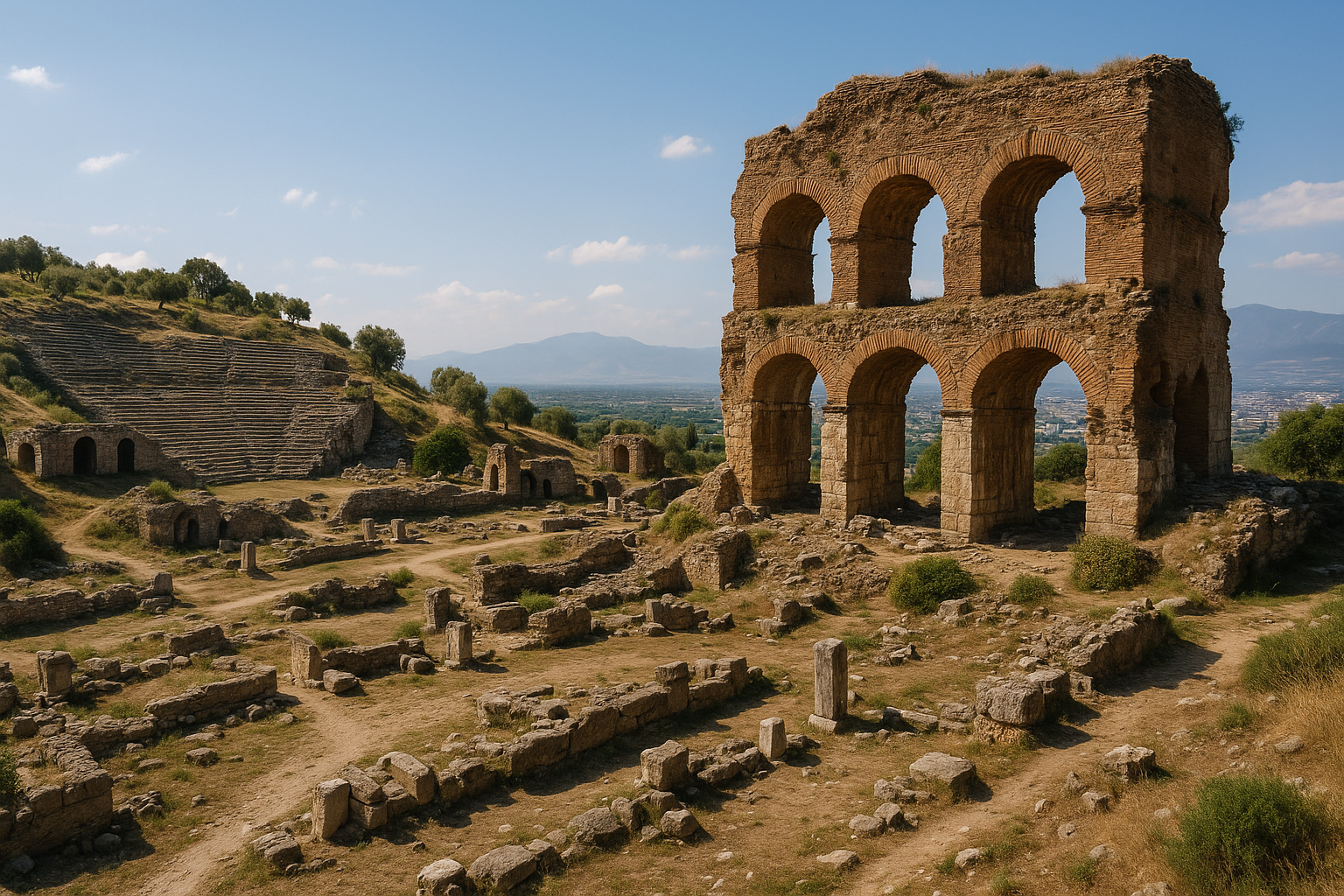
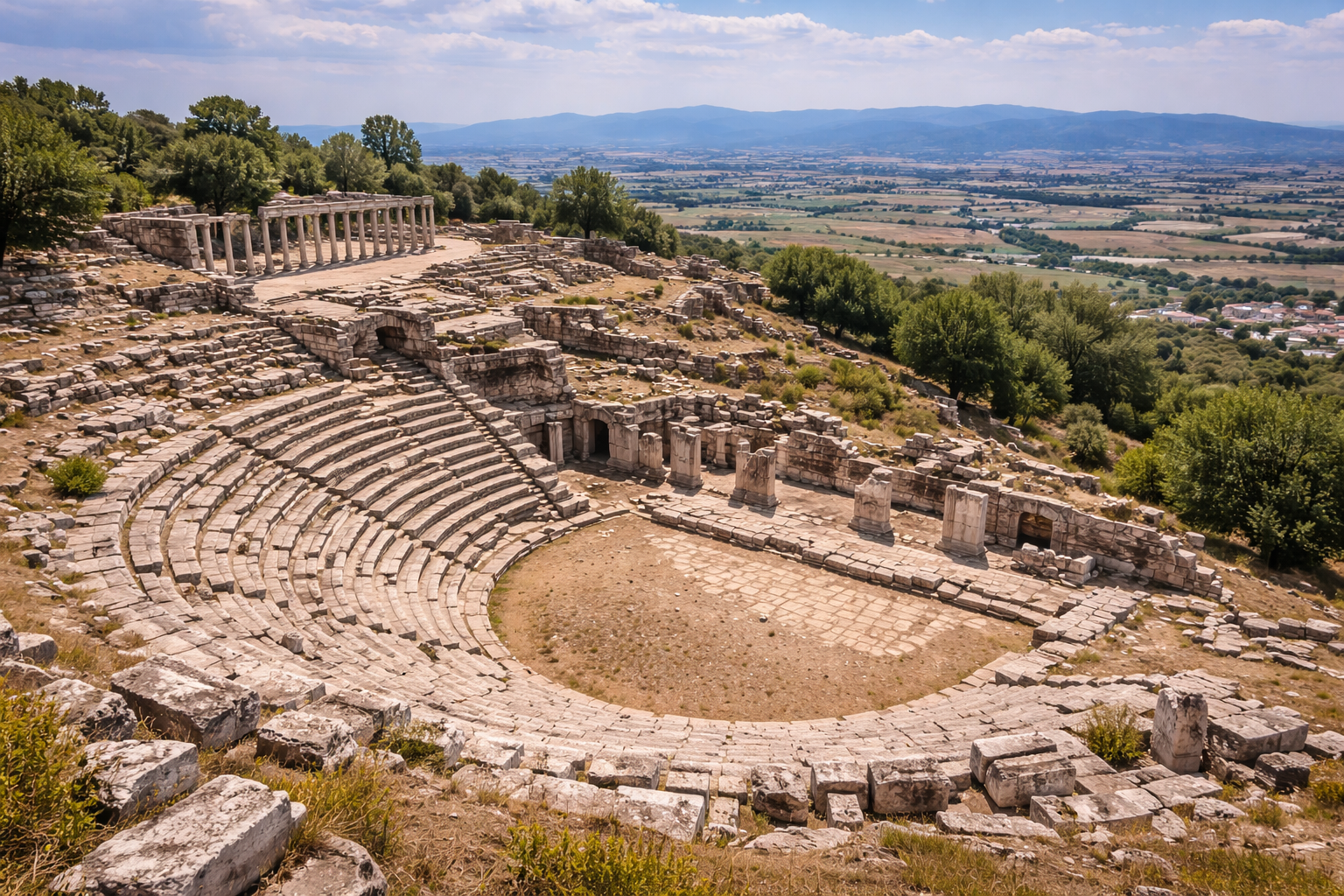
A Roman-period theatre and stadium are known on the lower north slopes of the acropolis, but neither has been fully excavated. The theatre's cavea is cut partly into the slope and partly built; the stadium lies in the saddle between the theatre and the bath-gymnasium and is traceable as a long depression in the modern fields. Both are visible from the highway but cannot at present be visited.
The Sardis "house of bronzes"
A particularly evocative excavation area, the "House of Bronzes," is a late Roman residence destroyed in a sudden fire and preserving a striking assemblage of bronze vessels (basins, lampstands, ewers) abandoned by their owners as they fled. Datable inscriptions and small finds place the destruction in the early seventh century AD — that is, in the Sasanian attack — and the assemblage is one of the most coherent groups of late antique domestic bronze yet excavated anywhere in Asia Minor.
Coinage Invented
The single most consequential thing that ever happened at Sardis happened sometime in the late seventh century BC, probably under Alyattes, when somebody at the Lydian court took a small lump of refined electrum, dropped it onto a die, struck it with a punch, and produced an object whose value was guaranteed by the issuer. It is hard to overstate how transformative this was, or how directly the modern world is built on it.
Why coins, why here?
Three preconditions came together at Sardis and almost nowhere else in the ancient world.
- Material. The Pactolus produced raw electrum in unusual quantities, immediately available to the royal workshops at the foot of the acropolis.
- Political authority. The Lydian state was centralised and rich enough to enforce a uniform standard, prosecute counterfeiters, and accept its own coins back in payment of taxes.
- Commercial demand. The agora — the densely commercial bazaar of which Herodotus says the Lydians were the pioneers — needed a medium of exchange more practical than weighed bullion. Anatolian and Greek merchants were trading at high enough volumes that the inconvenience of weighing out lumps of metal for each transaction had become real.
The earliest coins
The first issues, dated by stratigraphy beneath the foundations of the Temple of Artemis at Ephesus to around 630–600 BC, are small electrum lumps stamped on one face with the head of a roaring lion and on the other with the raw punch-marks of the die holder. They are anonymous — no king's name appears — but the lion is the well-attested royal emblem of the Mermnad house. Denominations descend from the full stater (about 14 g) through a hexte (one-sixth), an eighth, a twelfth, a twenty-fourth, and so on down to fractions of less than a tenth of a gram, smaller than a modern fingernail clipping. This wide range of denominations is itself important: it shows that the new system was meant for everyday retail commerce, not just for large state payments.
The "Lydian lion" iconography
The roaring lion of the Lydian coins is one of the most successful pieces of state branding ever devised. The same image had appeared for two generations on Lydian seals, ivories, and architectural ornaments, and was the well-recognised badge of the dynasty. Later issues add the head of a bull and (under Croesus) the confronted heads of a lion and a bull together — emblems of strength and fertility, of royal power and prosperity.
Standardised composition
Modern compositional analysis by the British Museum and the Sardis Expedition has shown that the electrum used was deliberately and consistently alloyed to roughly 55% gold, 45% silver, well away from the higher gold content of the natural Pactolus alluvium (which ranges from 70% to 83% gold). The Lydians, in other words, were not simply stamping found metal; they were refining it, adjusting the alloy, and then stamping it to a defined standard. This is the earliest documented case of state monetary control — the moment at which the value of a piece of metal began to derive from the authority of its issuer rather than solely from the weight and purity of its substance.
Croesus's bimetallic system: the Croeseids
Croesus's great innovation, around the middle of the sixth century BC, was to abandon electrum altogether in favour of separate pure gold and pure silver coins — the so-called Croeseids — struck to a common weight standard so that a fixed exchange ratio (typically 13⅓ to 1) could be guaranteed.
- The gold stater weighed approximately 10.7 g.
- The silver stater weighed approximately 10.7 g.
- Smaller denominations of each were struck in proportion.
This was the world's first bimetallic currency. To produce it required the cementation refinery on the Pactolus, since pure gold and pure silver could not simply be panned out of the stream. The two metals had to be chemically separated, which the Lydian metallurgists did by heating the electrum with salt in lidded earthenware pots at 600–800 °C — a process now known as cementation, in which chlorine released from the heated salt attacks the silver but leaves the gold untouched.
The global impact of coinage
The idea spread astonishingly fast. By the late sixth century BC every major Greek city — Aegina, Athens, Corinth, Chalcis, the Ionian cities, the Black Sea colonies — was minting its own silver coinage. By the late fifth century the Persians had standardised the Lydian system into the empire-wide daric (gold, c. 8.4 g) and siglos (silver, c. 5.6 g), both minted at Sardis as well as in the eastern provinces. The Carthaginians adopted Greek-style coinage during their wars in Sicily; the Romans began minting bronze in the fourth century BC and silver shortly thereafter. The Mauryan emperors in India adopted struck silver punch-marked coins. By the time of Augustus, the entire Mediterranean and Near Eastern world ran on coined money.
Modern currencies — the dollar, the euro, the lira, the yuan — are remote descendants in an unbroken chain of monetary practice that begins at Sardis under Alyattes and Croesus.
Coinage and the social transformation it brought
What was revolutionary about coinage was not the metal but the convention. A coin is a piece of metal whose value is guaranteed not by its purity (which is hard for an untrained eye to assess) but by the authority of its issuer. Accepting a coin therefore requires accepting the authority of the state that struck it; refusing to accept it amounts to political dissent. In this sense the Lydian invention was as much a political as an economic act. The fact that Lydian state authority was strong enough, in the late seventh century BC, to make such a convention stick — to make a privately weighed scrap of electrum less attractive than a slightly debased official coin of the same nominal weight — is itself a measure of the maturity of the Mermnad state.
Within a generation of the first issues, coined money began to permeate every level of Lydian and Ionian society. The smallest electrum fractions — pieces weighing as little as 0.16 g — must have been used for daily marketplace transactions, the equivalent of small change. Wages, market prices, slave sales, dowries, fines, taxes: all the categories of monetary transaction recorded in the inscriptions of fifth-century Athens are visible in embryo at sixth-century Sardis. A profound shift in how value itself was conceptualised — from substance to symbol, from weight to authority, from material to relationship — began here.
Where the first Lydian coins are found today
Modern collections of Lydian coinage are scattered, but the largest holdings are at:
- The British Museum, with major series acquired in the nineteenth century;
- The American Numismatic Society in New York;
- The Manisa Museum, with finds from the Sardis excavations themselves;
- The Bibliothèque nationale de France (Cabinet des Médailles) in Paris;
- The Berlin Münzkabinett;
- The Istanbul Archaeological Museum.
A handful of "trial pieces" — uniface electrum lumps stamped only with the lion's-head obverse and lacking a properly developed reverse punch — are believed to be among the very earliest issues and are particularly prized by numismatists.
Croesus and Herodotean Tales
No other Anatolian king has left so deep a mark on Greek literature as Croesus, and most of what we think we know about him comes from Herodotus, who devoted nearly half of Book One of the Histories to the rise and fall of the Lydian house. The tales are partly history, partly moral parable, partly Lydian palace tradition filtered through Ionian storytelling. They are read today as the founding texts of historical narrative — but they are also brilliant short fiction, and Herodotus knew it.
Solon at Sardis
Herodotus tells how the Athenian lawgiver Solon, on the ten-year travels he undertook after promulgating his constitution, came to the court of Croesus at Sardis. The king displayed his treasury and his city's prosperity and then, certain of the answer, asked Solon who was the happiest man in the world.
Solon named first the Athenian Tellus, who had lived in a prosperous polis, raised fine sons who in turn had raised fine grandchildren, and died honourably in battle defending his city. Pressed, Solon named in second place the brothers Cleobis and Biton, who had yoked themselves to a cart to pull their mother (a priestess of Hera) the five miles to her festival when the oxen failed to arrive on time, and afterwards lay down in the temple and never woke up — a death the goddess had granted as the perfect gift to honour their piety.
Croesus, expecting his own name, was offended. Solon replied with one of the most famous epigrams in Greek thought:
"Count no man happy until he is dead."
Wealth and power, Solon explained, are gifts of fortune, and fortune is fickle. A life can be called happy only when it is complete, beyond the reach of further change.
The dream of Atys
Croesus, foreseeing in a dream the violent death of his son Atys, locked the boy away from weapons and refused to let him hunt. When the men of Mysia begged for help against a monstrous boar ravaging their crops, Croesus relented and sent his son on the hunt with a bodyguard. A guest at court, the Phrygian Adrastus — himself a fugitive after killing a brother by accident, whom Croesus had purified and taken in — was given charge of him. In the chase, Adrastus's spear missed the boar and struck Atys, killing him instantly. Adrastus, on returning to Sardis, killed himself on the boy's grave. The tale's moral force lies in the impossibility of evading what is fated, and in the terrible irony by which the very precautions Croesus took proved the means of fulfilment.
The Delphic oracles
Croesus tested the Greek oracles by sending embassies who, on a precisely appointed day a hundred days after their departure, were to ask each shrine what the king was doing at that moment. Only Delphi answered correctly — that the king was boiling a tortoise and a lamb together in a bronze cauldron with a bronze lid (a deliberately bizarre menu chosen to defeat any guesswork).
Convinced, Croesus sent astonishing dedications to Delphi: a golden lion weighing ten talents, golden bowls and silver mixing-bowls, the gold and silver statue of a baker-woman, his own queen's jewellery. Some of these survived at Delphi for centuries — they are mentioned by Pausanias five hundred years later.
He then consulted the oracle on whether to attack Persia and was told:
"If you cross the Halys, you will destroy a great empire."
Encouraged, Croesus crossed the Halys. The empire he destroyed was his own.
Cybele's fire
A separate legend, recorded by Herodotus and other writers, attaches to the burning of Sardis in 499 BC. The Greeks set fire — accidentally — to a reed-roofed house in the densely built lower city; the fire spread to the temple of Cybele, the mother goddess of the Lydians and Phrygians, and burned it down. The Persians, Herodotus says, used this sacrilege as the official justification for the burning of Greek temples in revenge during the invasions of Xerxes, including the temples of the Athenian Acropolis in 480 BC.
The story is a small but revealing case of how a local accident at Sardis became, in Persian imperial memory, a defining grievance.
The pyre
When Cyrus took Sardis in 547 BC, Croesus was placed bound on a great pyre of wood — whether as a sacrifice, as a punishment, or as a test, Herodotus is uncertain. At the last moment, as the wood was lit, Croesus cried out the name of Solon three times. Cyrus, curious, had him taken down and questioned. On hearing about the conversation in the treasury at Sardis, Cyrus reflected on the reversal of fortunes and ordered the pyre extinguished.
But the wood was already alight; the flames had taken hold. Only a sudden rainstorm — sent by Apollo in answer to Croesus's prayer — put it out. Croesus passed the rest of his life as an honoured advisor at the Persian court, with Cyrus and then Cambyses, and appears in the Histories as a kind of philosophical chorus, commenting on the rise and fall of kings.
These stories are not history in the strict modern sense; they are the way the early Greeks reasoned, through narrative, about the dangers of wealth, the indifference of the gods to human happiness, and the slipperiness of oracular language. Sardis is the stage on which they are set, and Croesus the figure who stands in for the universal problem of how to live in a world where everything can be taken away.
Other Croesus stories preserved by Herodotus
Beyond the famous set-pieces, Herodotus preserves a handful of smaller stories that fill in the texture of life at the Lydian court.
-
The bridge over the Halys. When Croesus's army reached the Halys (modern Kızılırmak), there was no bridge, and the river was unfordable. The Greek engineer Thales of Miletus, said by Herodotus to have been in Croesus's retinue, dug a canal that diverted the river into two shallower channels behind the army's position, allowing both branches to be forded. Herodotus expresses scepticism but records the story.
-
The dumb son who spoke. Croesus had a second son who was mute from birth. In the chaos of the Persian assault on Sardis, an unrecognising soldier was about to kill the king when the mute son cried out, "Soldier, do not kill Croesus!" — finding his voice, the Histories says, in the extremity of his father's danger. Whatever its factual basis, the tale captures the Greek fascination with the irruption of voice and language at moments of crisis.
-
Croesus's advice to Cyrus. After his rescue from the pyre, Croesus became Cyrus's counsellor. When the Lydians revolted against Cyrus soon after the conquest, Cyrus considered destroying the city entirely; Croesus persuaded him instead to disarm the Lydians, forbid them weapons, and require them to send their sons to be taught the petty arts of music, dancing, and retail commerce. Within a generation, Croesus argued, the warrior people of Alyattes would become a nation of shopkeepers and present no military threat. The story is told with evident Greek disdain for what the Lydians were said to have become.
These vignettes circulate in Greek tradition with a moral force out of proportion to their factual weight: they are the way the Greeks taught themselves about empire, fate, and the fragility of greatness.
Seven Churches of Asia
The Book of Revelation (chapters 2 and 3) preserves seven letters dictated to John on Patmos and addressed to seven Christian communities in western Asia Minor: Ephesus, Smyrna, Pergamon, Thyatira, Sardis, Philadelphia, and Laodicea. Each letter follows the same rhetorical pattern — a salutation, a list of the community's strengths, a list of its failings, a warning, a promise — but their tone varies dramatically, from the cautious praise of Philadelphia to the scorching rebuke of Laodicea.
The letter to Sardis (Revelation 3:1–6) is among the harshest of the seven:
"I know your works; you have a name of being alive, but you are dead. Wake up, and strengthen what remains and is on the point of death, for I have not found your works perfect in the sight of my God. Remember then what you received and heard; obey it, and repent. If you do not wake up, I will come like a thief, and you will not know at what hour I will come to you. Yet you have still a few persons in Sardis who have not soiled their clothes; they will walk with me, dressed in white, for they are worthy."
The historical force of the rebuke depends on a play on Sardis's own civic reputation. The city had twice in its history been taken by surprise through inadequate watch on the acropolis — by Cyrus in 547 BC, when a Persian climber found an unguarded crack in the cliff while a sentry slept, and by Antiochus III in 215 BC, when Lagoras of Crete repeated the trick on a different face. Every Sardian of the late first century AD knew these stories. The summons to "wake up" and to remember "how you received and heard" lands with deliberate weight on a city that knew exactly what happened when its sentries dozed.
The "few persons who have not soiled their clothes" became, in later tradition, the faithful core of the Sardian church — those who in the second century carried it forward into the era of Melito.
Melito of Sardis
The second-century bishop Melito of Sardis is one of the most important Christian writers of his generation. His Peri Pascha — On the Passover — is the earliest surviving Christian Easter homily and one of the foundational texts of Christian rhetoric, with a long incantatory chant on the Lamb of God that has shaped Eastern liturgy ever since. Eusebius preserves fragments of his apologetic and theological works and lists more than a dozen lost treatises on prophecy, baptism, the church calendar, and biblical interpretation.
Melito attended the council that confirmed the canon of the Old Testament for the early Greek-speaking church; he travelled to Palestine to verify the Jewish biblical text against local Hebrew traditions; and he wrote an Apology addressed to the emperor Marcus Aurelius arguing for the toleration of Christianity. His presence at Sardis in the 160s and 170s AD means that the city was a major centre of Christian intellectual life in the period exactly when its Jewish synagogue was at its zenith. The two communities — Jewish and Christian, both prosperous and articulate — must have known each other well, and the polemical edge in Melito's Peri Pascha against Jewish interpretations of the Passover takes on a sharp local dimension in that light.
The pilgrimage route today
Sardis is a regular stop on the modern Seven Churches pilgrimage, which runs north from Ephesus through Smyrna (modern İzmir), Pergamon (Bergama), and Thyatira (Akhisar) and then south through Sardis (Sart), Philadelphia (Alaşehir), and Laodicea (near Denizli). The whole route can be driven in three or four days from İzmir; many tour companies offer it as a packaged itinerary. Visitors with a religious focus often combine Sardis with Philadelphia, which lies only 40 km further east up the same Hermus valley.
Archaeological Work
Modern archaeology at Sardis has been remarkably continuous. Two great campaigns — Princeton 1910–1914 and Harvard–Cornell 1958 to the present — have produced one of the deepest documentary records of any city in Türkiye.
Early travellers: Texier and Hamilton
The earliest serious topographical work at Sardis was done in the 1830s and 1840s by the French architect Charles Texier and the British geologist William Hamilton. Both made plans and sections of the surviving structures and identified the principal monuments. Texier's drawings of the standing Artemis columns, published in his great Description de l'Asie Mineure (1839–1849), remain the earliest accurate visual record of the temple. Hamilton's Researches in Asia Minor (1842) put Sardis on the maps of Victorian classical scholarship.
In 1853 Heinrich Spiegelthal, the Prussian consul at Smyrna, opened the burial chamber of the Alyattes tumulus at Bin Tepe — the first scientific excavation of a Lydian royal tomb.
Howard Crosby Butler (Princeton), 1910–1914
The first systematic excavation of the city was directed by Howard Crosby Butler of Princeton, who concentrated on the Temple of Artemis. In five seasons his team cleared the temple to its foundations, exposed the two columns standing to full height, traced the platform, and produced the magnificent two-volume publication Sardis I: The Excavations and Sardis II: The Temple of Artemis (1922–1925). Butler also opened more than 1,100 Lydian tombs in the necropoleis around the city and recovered the basis for the Lydian pottery sequence still in use today. Work ceased in 1914 with the outbreak of war and never resumed under Princeton's direction; Butler himself died in 1922, and his unpublished field notes were eventually inherited by the Harvard–Cornell team.
The interwar pause, 1914–1958
Through the First World War, the Greco-Turkish war and the Turkish War of Independence, the population exchanges of the 1920s, and the upheavals of the 1930s and the Second World War, no major excavation took place at Sardis. The site lay quiet under its vineyards. The two standing columns of the Artemis temple became, in this period, one of the iconic photographic motifs of "lost" classical antiquity.
George M. A. Hanfmann (Harvard–Cornell), 1958–1976
The modern era of work at Sardis began in 1958, when George Hanfmann of Harvard and Henry Detweiler of Cornell launched the Harvard–Cornell Archaeological Exploration of Sardis — the "Sardis Expedition." Hanfmann's vision was deliberately broad: the city in all its periods, the lower city as much as the acropolis, the everyday life of artisans and shopkeepers as much as the great monuments.
Under his direction the gymnasium-synagogue complex was discovered (1962), the gold refinery was identified (1968), the Marble Court was reconstructed by anastylosis (1964 onward), and the Lydian stratigraphic sequence on the Pactolus was firmly established for the first time. His Sardis from Prehistoric to Roman Times (Harvard, 1983) remains the standard one-volume account. Hanfmann's letters from the field, published as Letters from Sardis (1972), are also a classic of mid-twentieth-century field archaeology — funny, observant, generous about colleagues, and informative about every aspect of running a long-term dig in a small Turkish village.
Crawford H. Greenewalt Jr. (UC Berkeley), 1976–2007
On Hanfmann's retirement, direction passed to Crawford "Greenie" Greenewalt Jr. of the University of California, Berkeley. Over thirty-one annual seasons Greenewalt led the excavation of the great Lydian fortification wall, the workshops along the Pactolus, the Lydian destruction layer of 547 BC, and the residential terraces on the north slope of the acropolis. He was famous for his extraordinarily careful field method (every sherd recorded, every soil change drawn), his patient decades-long publication of the Lydian material, and his close, almost paternal mentorship of two generations of younger archaeologists. Greenewalt died in 2012, having seen the project safely through its second great generational transition.
Nicholas D. Cahill (University of Wisconsin–Madison), 2008–present
Since 2008 the project has been directed by Nicholas Cahill of the University of Wisconsin–Madison. Major recent work includes the long campaign to excavate the Sanctuary plaza in the lower city (a project that required fifteen years of cumulative seasons), the further investigation of the Lydian fortification wall, the publication of the Lydian houses and pottery in Sardis Report 4 (2010), and the long-term conservation of the synagogue's mosaics, which have suffered from frost damage and root incursion since their first exposure.
The project under Cahill has also placed unusual emphasis on public archaeology and open access: the project website, sardisexpedition.org, hosts the full series of Sardis Reports and Monographs, the field photographs, and the digital plans, all freely available. In 2024 the site was added to the UNESCO Tentative World Heritage List, with full nomination in preparation.
The Sardis Expedition's publications
The expedition publishes its results in two main series:
- The Sardis Reports — monographs on excavated areas and monuments, beginning with Sardis Report 1: The Lydian Treasure (1965) and now numbering more than a dozen volumes covering the synagogue, the bath-gymnasium, the Lydian houses, the prehistoric and protohistoric occupation, and individual monuments;
- The Sardis Monographs — treating particular categories of material across the whole site, including the coinage (Bates 1971), the lamps (Crawford 1990), the sculpture (Hanfmann and Ramage 1978), and the inscriptions (Buckler and Robinson 1932, updated since).
In addition to these formal series, the expedition publishes annual Reports in the Kazı Sonuçları Toplantısı and shorter scholarly articles in journals such as the American Journal of Archaeology and Anatolian Studies.
Conservation and presentation
A long-running theme of the project has been conservation as much as discovery. The anastylosis of the Marble Court remains the project's most visible achievement, but it is only one of many conservation efforts. The synagogue mosaics have been lifted, consolidated, and relaid; the standing temple columns have been monitored for movement; the Lydian artisan quarter has been sheltered under modern coverings; the colonnaded shops have been re-roofed. The project has trained generations of Turkish conservators alongside its American and European specialists, and the techniques developed at Sardis — particularly for mud-brick consolidation and for the lifting and re-laying of large mosaic surfaces — have been exported to other sites across western Anatolia.
The project as a model
Sardis is widely cited in the discipline as a model of how a long-term excavation project should be organised and published. The expedition has continuously published, has maintained close working relationships with Turkish authorities and local communities, has trained generations of students, and has progressively opened its archives. Few American projects abroad have run as long or as productively.
Numbers and Measurements
| Subject | Measurement | Period / Notes |
|---|---|---|
| Site elevation, lower city | c. 110 m above sea level | — |
| Acropolis summit | c. 410 m above sea level | c. 300 m above the valley floor |
| Mount Tmolus (Bozdağ) summit | 2,159 m | the highest peak in the immediate range |
| Distance from İzmir city centre | 90 km east | via E96/D300 highway |
| Distance from Salihli | 12 km west | the modern district centre |
| Distance from Manisa | 50 km east | the provincial capital |
| Distance to Bin Tepe (Alyattes tumulus) | c. 7 km north | across the Gediz |
| Royal Road, total length (Sardis–Susa) | c. 2,700 km | Herodotus 5.52–53 |
| Royal Road, posting stations | 111 | Herodotus |
| Temple of Artemis, platform | c. 100 × 45 m | Hellenistic / Roman |
| Temple of Artemis, planned column count | 78 (8 × 20) | Ionic peripteros pseudodipteros |
| Temple columns, external height | 17.73 m | Hellenistic |
| Temple columns, internal height | 17.13 m | Hellenistic |
| Temple columns, base diameter | c. 2.0 m | Hellenistic |
| Temple cella, east chamber length | 25.76 m | Hellenistic / Roman |
| Temple cella, west chamber length | 25.20 m | Hellenistic / Roman |
| Cella dividing wall thickness | 0.90 m | Roman partition |
| Cult image base | c. 3.60 × 3.60 × 0.50 m | Hellenistic |
| Byzantine Church M (against temple SE corner) | c. 11 × 7 m | 4th–5th c AD |
| Bath-gymnasium total footprint | c. 23,000 sq m | 2nd–3rd c AD |
| Bath-gymnasium walls, surviving height | up to 13 m | — |
| Marble Court date | dedicated AD 211/212 | under Caracalla and Geta |
| Marble Court anastylosis completed | 1973 | Hanfmann and Seager |
| Synagogue, internal length | c. 60 m | converted 3rd–4th c AD |
| Synagogue, internal width | c. 18 m | — |
| Synagogue, capacity | c. 1,000 worshippers | — |
| Synagogue mosaics, total area | c. 1,400 sq m | 4th–6th c AD |
| Synagogue, Greek inscriptions | 80+ | mostly donor inscriptions |
| Synagogue, Hebrew inscriptions | 7 | — |
| Lydian city wall, basal thickness | c. 20 m | mud-brick on stone socle |
| Pactolus refinery, date | c. 575–550 BC | cementation furnaces |
| First electrum coins, date | c. 630–600 BC | under Alyattes |
| Electrum coin composition (refined) | c. 55% Au / 45% Ag | natural Pactolus electrum: 70–83% Au |
| Croeseid gold stater weight | c. 10.7 g | pure refined gold |
| Croeseid silver stater weight | c. 10.7 g | pure refined silver |
| Gold-to-silver exchange ratio | c. 13⅓ : 1 | under Croesus |
| Persian daric (gold), weight | c. 8.4 g | minted at Sardis under Persia |
| Persian siglos (silver), weight | c. 5.6 g | minted at Sardis under Persia |
| Tumulus of Alyattes, height | c. 60–70 m | one of the largest in the ancient world |
| Tumulus of Alyattes, diameter | c. 360 m | — |
| Tumulus of Alyattes, fill volume (est.) | > 2,000,000 cu m | — |
| Bin Tepe, total mounds | c. 100+ visible | over 12 sq km |
| AD 17 earthquake, imperial aid | 10,000,000 sesterces; 5 years' tax remission | Tacitus, Annals 2.47 |
| Cyrus's siege of Sardis | 14 days | 547 BC |
| Princeton excavation seasons | 1910, 1911, 1912, 1913, 1914 | Howard Crosby Butler |
| Lydian tombs opened by Butler | 1,100+ | — |
| Harvard–Cornell project, founded | 1958 | Hanfmann and Detweiler |
| Synagogue discovered | 1962 | Hanfmann team |
| Gold refinery identified | 1968 | Hanfmann team |
| Marble Court re-erected | 1964–1973 | anastylosis under Seager |
| Sardis added to UNESCO WHL Tentative List | 2024 | — |
Visitor Information
Getting there
Sardis is 90 km east of İzmir along the E96 / D300 highway, the main east-west artery of the Hermus valley. The journey by car takes about 75–90 minutes from central İzmir, longer in afternoon traffic. Salihli, the district centre with its train station, bus terminal, hotels and restaurants, is 12 km further east. From İzmir Otogar (the intercity coach terminal in Bornova) several daily coaches run to Salihli; ask the driver to drop you at "Sart Antik Kenti," directly on the highway at the entrance to the village. From Salihli, frequent minibuses (dolmuş) run west to Sart for a few lira and a fifteen-minute ride. There is also a regional train (İZBAN / TCDD Basmane–Uşak line) with a station at Sart, but service is infrequent and timing requires planning.
Two main zones, one site
The archaeological site is split by the modern highway into two separately ticketed enclosures, about a kilometre apart on foot.
-
The Bath-Gymnasium and Synagogue. On the north side of the highway, signed from the road and reached by a short driveway. This is the main lower-city site: the re-erected Marble Court, the synagogue with its mosaic floors and donor inscriptions, the colonnaded Byzantine shops, the Bouleuterion, and Church EA. Allow 60–90 minutes.
-
The Temple of Artemis. On the south side of the highway, reached by a quiet country road that follows the Pactolus south for about 1 km. The setting alone is worth the walk: vineyards on the left, pomegranate trees and the Pactolus on the right, the cliff of the acropolis rising behind. Allow 60–90 minutes. The gold refinery and the Lydian artisan workshops are partly visible along the access road, with bilingual interpretive panels.
A short, steep, unmaintained track leads from the temple area up onto the acropolis — a strenuous walk of around an hour each way, on loose conglomerate footing, with no shade. It is rewarding for fit visitors with good shoes, a hat, and plenty of water; not advisable in midsummer heat or after rain. The path is not signed and locals will sometimes offer to guide you for a small fee.
Bin Tepe
The Lydian royal cemetery is a separate visit and requires a car. Cross the Gediz on the road north from Salihli or Sart; the great tumuli — Alyattes, Gyges, and the others — are visible across the flat agricultural land, with the largest dominating the horizon from kilometres away. The chamber of the Alyattes tumulus is occasionally accessible by special arrangement with the Manisa Museum, but there are no formal visitor facilities, the access track is rough, and the surrounding land is private farmland. Plan at least an hour, with your own vehicle. The view back south across the Gediz to the cliff of the Sardis acropolis is one of the great Lydian landscape moments.
Opening hours and tickets
Both ticketed enclosures are open daily, usually:
- Summer (April–October): 08:30–19:00
- Winter (November–March): 08:30–17:00
The last entry is typically half an hour before closing. Sardis is included in the Müzekart+ (the annual museum pass for residents of Türkiye); foreign visitors purchase tickets at each enclosure for a modest fee. Bring small change — card payment is sometimes available but not reliable.
Time to allow
A focused visit to the two main ticketed enclosures takes around 3–4 hours including the walk between them. Adding the acropolis brings it to a full day; adding Bin Tepe likewise. A serious visitor with an interest in any one period (Lydian, Roman, Jewish, Byzantine) could easily spend two days.
When to come
Late September through mid-November and mid-April through May are ideal — warm dry days, sharp light, autumn colour or spring wildflowers. July and August can be punishing for a site this exposed; plan for an early start and aim to finish by midday. December–February visits are quite feasible and the site is dramatically empty, but the temple field can be muddy, the acropolis trail unsafe, and daylight hours short. Rain in winter can be sudden and heavy.
Nearby sights
- Manisa Museum — the principal regional archaeological museum, with substantial Sardis material on display (coins, jewellery, sculpture, mosaics). An essential complement to the site itself, fifty kilometres west.
- Niobe Weeping Rock (Ağlayan Kaya) — the natural rock formation on the slopes of Mount Sipylus above Manisa, identified by Pausanias with the mythical Niobe whose children were killed by Apollo and Artemis. A short detour from the Manisa museum.
- Mount Sipylus (Spil) National Park — pine forest, hiking, and the Tantalid rock-cut tombs near Manisa.
- Philadelphia / Alaşehir — the next of the Seven Churches, 40 km east up the same valley.
- Bozdağ ski village — on Mount Tmolus, a cool summer retreat and a small winter ski centre, with magnificent views back down to the Hermus.
- Salihli thermal baths — the modern town's spa resorts, useful for combining Sardis with a relaxing stop.
Accessibility
The lower-city site (gymnasium and synagogue) is largely level on packed gravel paths and is reasonably accessible to wheelchair users with assistance, although there are some sections of uneven ancient paving in the synagogue itself. The temple site has a long approach on a rough track and a sloping field underfoot — manageable but not easy. The acropolis and Bin Tepe are not accessible to mobility-impaired visitors. There are toilets and a small kiosk selling water at the gymnasium enclosure; the temple enclosure has only basic facilities. Bring water in summer — there is none for sale at the temple.
Where to stay
- Salihli — the natural base, with a range of three- and four-star hotels.
- İzmir — a longer day trip but a much wider choice of accommodation, food, and evening life.
- Manisa — a closer alternative, useful if combining with the Niobe rock or Mount Sipylus.
- Bozdağ — a charming option in summer for those with a car who want cool mountain air; the village is just over an hour by mountain road from Sardis.
Eating and local specialities
The Hermus valley around Sardis is a serious food region. Salihli is famous for its kebab — the local "Salihli köfte" is a hand-rolled mince dish grilled over charcoal — and for the sultanas of the Sultaniye vineyards (the seedless raisins for which Manisa is internationally known). Manisa kebabı is another regional speciality, a flat lamb shish served with grilled tomato on a bed of yufka. Roadside stalls along the highway sell pomegranates, figs, olives, white cheese, and seasonal vegetables, all from the immediate plain. In autumn, grape molasses (pekmez) and walnuts in molasses (cevizli sucuk) appear in every village shop. A small picnic of these, eaten on the temple platform with a view of the standing columns, is one of the unmissable experiences of an Anatolian autumn.
Photography
The two standing columns of the temple are best photographed in the early morning (from the east, with the cliff of the acropolis lit behind) or in the late afternoon (from the west, with the columns silhouetted against Tmolus). The Marble Court at the bath-gymnasium photographs best in the morning, when the eastward-facing screen is fully lit. The synagogue's mosaics are protected by a modern roof; they photograph best in diffuse midday light. The acropolis is overwhelming at sunset but the descent in the dark is unsafe — plan accordingly.
Safety
Sardis is, in normal conditions, a safe and easy site to visit. The main risks are heat exhaustion in summer (carry water), uneven footing on ancient pavement, snakes and small mammals in the brush around the temple area, and slippery mud on the acropolis trail after rain. There is no medical facility at the site; the nearest hospital is in Salihli. Mobile phone coverage is good throughout.
FAQ
What is Sardis most famous for? Two things above all: it is where coinage was invented, in the late seventh century BC under the Lydian kings; and it is the city of Croesus, the proverbially wealthy last Lydian king. Beyond those, it is one of the great cities of the Roman Province of Asia, one of the Seven Churches of Revelation, and the site of the largest known ancient synagogue.
Where exactly is it? In the village of Sart, in Salihli district of Manisa province, in western Türkiye. The site straddles the modern E96 highway, 90 km east of İzmir and 12 km west of Salihli.
Were coins really invented at Sardis? Yes — and the evidence is unusually clean. The earliest stratified coins anywhere were found beneath the foundations of the Temple of Artemis at Ephesus, but they are Lydian electrum lumps with the lion's-head device. They are securely dated to around 630–600 BC and were almost certainly struck at Sardis under King Alyattes. King Croesus then introduced the world's first bimetallic system of pure gold and pure silver coins. The technology that made this possible — the cementation refinery — has been excavated on the Pactolus at Sardis itself.
Is Croesus a real historical figure? Yes. He is securely attested in Greek, Persian, and Babylonian sources; he ruled from c. 561 to 547 BC, paid for the rebuilding of the Artemision at Ephesus, lost a war to Cyrus the Great, and ended his days as an advisor at the Persian court. The picturesque tales told about him by Herodotus — the conversation with Solon, the oracle of the mule, the rescue from the pyre — are largely legendary, but his historical reality is not in doubt.
How does the Temple of Artemis at Sardis compare to the one at Ephesus? They are in roughly the same league of ambition. The Ephesian Artemision was longer (about 137 m to Sardis's 100 m) and is one of the Seven Wonders of the Ancient World; but the Sardis temple's columns are nearly as tall, two of them still stand to their full height (whereas Ephesus has only one reconstructed column), and the setting under the acropolis cliff is incomparably more atmospheric.
Why is the synagogue so important? For two reasons. First, sheer size: at sixty metres long it is by far the largest known ancient synagogue, in a class of its own. Second, its inscriptions name Jewish residents of Sardis who held titles like polites (citizen) and bouleutes (city councillor). Before this discovery, scholars generally assumed Jews in the Roman East were on the margins of civic life; Sardis showed otherwise, and the conclusion has reshaped the study of Diaspora Judaism.
Can I see the standing temple columns up close? Yes — the temple is freely walkable inside the enclosure, and the two surviving columns can be approached on all sides. They are an unforgettable sight, especially in the low light of early morning or late afternoon.
Is the gold refinery visible? The cementation furnaces are partly back-filled for conservation; the location, outlines, and reconstructed features are visible from the access road that runs south along the Pactolus, with information panels in Turkish and English. The finds themselves — crucibles, slag, gold beads, jewellery — are in the Manisa Museum.
Is Sardis really one of the Seven Churches of Revelation? Yes. Revelation 3:1–6 contains the letter addressed by name to the church at Sardis, the most sharply worded of the seven. Sardis is a regular stop on the modern Seven Churches pilgrimage route through western Türkiye.
Can I climb the acropolis? Yes, but only with care. There is no maintained path; the route is steep, unshaded, and on loose conglomerate. Plan an hour each way, take plenty of water, do not attempt it in summer midday heat or after rain, and turn back if uncertain. The view from the top is one of the great panoramas of western Anatolia.
How long should I plan for a visit? Three to four hours for the two main ticketed enclosures (bath-gymnasium-synagogue and temple). A full day if you want to add the acropolis or Bin Tepe. Two days if you also want to take in Manisa Museum and the surroundings.
Is Sardis on the UNESCO World Heritage List? It was added to the Tentative List in 2024 and is being prepared for full nomination as "Sardis and the Lydian Tumuli of Bin Tepe." The site has been a leading candidate for many years and is widely expected to be inscribed in the coming decade.
Can I combine Sardis with Ephesus and Pamukkale? Easily. Sardis sits along the natural inland route between Ephesus (180 km west) and Pamukkale / Hierapolis (200 km southeast), and can be inserted as a full-day stop on a western Türkiye loop. A common itinerary is İzmir → Pergamon → İzmir → Ephesus → Sardis → Pamukkale → Aphrodisias → coast.
What language do I need? Signage at both ticketed enclosures is in Turkish and English; the Sardis Expedition's published guidebooks are in English; museum labels in Manisa are bilingual. Guides offering tours in English, German, French, and (sometimes) Russian wait at the bath-gymnasium entrance in season. A few words of Turkish are appreciated at the village teahouses but not necessary.
Are there guided tours? Yes — local guides licensed by the Ministry of Culture offer day tours from İzmir, Salihli, and Manisa. Multi-day Seven Churches tours typically include Sardis. The Sardis Expedition itself does not offer public tours but its excellent online publications can serve as a substitute.
Is photography permitted? Yes, for personal use, throughout both ticketed enclosures. Tripods and drones require permission from the site directorate; commercial filming requires advance application to the Ministry of Culture.
Can I bring a picnic? Yes — picnicking is informally tolerated in shaded corners of the temple enclosure and along the access track. There are no benches. Carry out all waste; the site is not staffed for cleaning beyond the main paths.
Is the site suitable for children? Yes, with the usual cautions about heat, footing, and snakes. The standing temple columns, the synagogue mosaics, and the Marble Court all appeal to children who like dramatic visual contrasts. The Lydian workshop area is less immediately exciting but can be made interesting with a little preparation (the gold-refining story, the Pactolus gold-panning legend). The acropolis climb is suitable only for older, fit children.
What about toilets and food on site? Basic toilets and a small kiosk selling bottled water and a few snacks are available at the gymnasium-synagogue enclosure. The temple enclosure has only basic toilets and no food or drink for sale. Bring what you need, especially in summer.
Sources and Further Reading
- Harvard–Cornell Archaeological Exploration of Sardis — the official project website, sardisexpedition.org, with preliminary reports, plans, photographs, and the full series of Sardis Reports and Sardis Monographs in open access. The single most important resource for any serious study of the site.
- Sardis Final Reports and Monographs — the formal publication series of the Harvard–Cornell expedition, beginning with George M. A. Hanfmann's Sardis from Prehistoric to Roman Times (Harvard University Press, 1983). Volumes treat the temple, the synagogue, the bath-gymnasium, the Lydian houses, the coinage, the inscriptions, and the sculpture.
- Wikipedia: Sardis — a useful general-interest overview with bibliography and links, regularly updated; a sound starting point for non-specialist readers.
- Republic of Türkiye Ministry of Culture and Tourism, Sardis page (kulturvarliklari.gov.tr) — the official site description, current opening hours, and access information.
- Manisa Archaeological Museum — the principal regional museum, displaying Lydian, Persian, Hellenistic, Roman, and Byzantine finds from Sardis; an essential introduction before or after the site visit.
- Turkish Archaeological News (turkisharchaeonews.net), "Sardis" — accessible summaries of recent fieldwork and discoveries, with photographs.
- Herodotus, Histories, Book I — the classical source for the Mermnad dynasty, Croesus, and the Persian conquest. The Oxford World's Classics translation by Robin Waterfield (2008) and the Landmark Herodotus edited by Robert Strassler (2007) are both excellent and well annotated for the general reader.
- Tacitus, Annals II.47 — the contemporary Roman account of the earthquake of AD 17 and Tiberius's relief programme.
- Melito of Sardis, Peri Pascha (On the Passover) — translated and edited by Stuart George Hall (Oxford, 1979). The principal Christian source from second-century Sardis.
- George M. A. Hanfmann, Letters from Sardis (Harvard, 1972) — a readable behind-the-scenes account of the first decade of the modern excavation, indispensable for anyone interested in field archaeology.
- Crawford H. Greenewalt Jr., numerous articles in the American Journal of Archaeology and the Sardis Reports on the Lydian destruction layer, the fortification wall, and the Pactolus workshops.
- Nicholas D. Cahill (ed.), Lydian Houses and Architectural Terracottas (Sardis Report 4, 2010) and subsequent monographs on the recent campaigns.
- Andrew Ramage and Paul Craddock, King Croesus's Gold: Excavations at Sardis and the History of Gold Refining (Harvard / British Museum Press, 2000) — the definitive technical account of the cementation refinery and Lydian metallurgy, essential reading for the coinage story.
- Encyclopaedia Britannica, "Sardis" — a concise, reliable overview for non-specialists.
- The Metropolitan Museum of Art, Heilbrunn Timeline of Art History, "Sardis" essay — short scholarly introduction with high-quality images.
- UNESCO World Heritage Centre, Tentative List — the nomination dossier for "Sardis and the Lydian Tumuli of Bin Tepe" (2024).
- John Pedley, Sardis in the Age of Croesus (University of Oklahoma Press, 1968) — older, but still a useful narrative introduction to Lydian Sardis.
- A. Ramage, Lydian Houses and Architectural Terracottas (Cambridge, MA, 1978) — an earlier monograph on the Lydian residential evidence.
- Jane Hickman, Aaron Levin, and Jennifer Houser Wegner (eds.), The Lydians and their World, exhibition catalogue, Penn Museum (2010) — a richly illustrated catalogue produced for a touring exhibition of Lydian material.
- Andrew Seager, The Sardis Synagogue — the formal architectural publication of the building, with full plans, sections, and reconstruction drawings.
- A. T. Kraabel, "The Synagogue at Sardis: Jews and Christians" in Diaspora Jews and Judaism, Brown Judaic Studies (1992) — the classic essay on the social standing of the Sardian Jewish community.
- Marcus N. Tod, A Selection of Greek Historical Inscriptions — for the Persian-period and Hellenistic inscriptions of Sardis.
- Anatolian Studies and the American Journal of Archaeology — for the project's continuing series of interim reports and specialist articles.
Online resources
- sardisexpedition.org — the project's official site (definitive).
- kulturvarliklari.gov.tr — the Turkish Ministry of Culture and Tourism site.
- manisa.ktb.gov.tr — the Manisa provincial tourism office, with practical information.
- whc.unesco.org/en/tentativelists/ — the UNESCO Tentative List entry for Sardis (2024).
- britannica.com/place/Sardis — Britannica's concise overview.
- metmuseum.org/essays/sardis — the Metropolitan Museum of Art's Heilbrunn Timeline essay.
A note on transliteration
Sardis (Greek Σάρδεις, Sardeis; Lydian Sfard; Persian Sparda; Hebrew Sĕp̄āraḏ; Turkish Sart or Sardes) is referred to in many languages and many spellings. The English convention used here — "Sardis" for the ancient city, "Sart" for the modern village — follows the practice of the Sardis Expedition and most English-language scholarship. "Sardes" remains common in French, German, and Turkish academic writing. The Hebrew form Sepharad, originally a transliteration of the Persian Sparda, came in the medieval period to refer to Spain — Sephardic Jews are, etymologically, "Sardian" Jews, in a curious geographic drift that ultimately traces back to this Anatolian city.
Final note
A visit to Sardis rewards both the casual traveller and the long-term student. The standing columns of the temple, the re-erected screen of the Marble Court, the long mosaic floor of the synagogue, and the silent rolling fields of Bin Tepe each offer something different: respectively, a monumental, an architectural, a social, and a funerary encounter with the Lydian and Roman past. Above all, however, Sardis is the place where the abstract idea of money was given material form for the first time. Every coin in every modern pocket, every digital token in every electronic ledger, is a remote descendant of a small lump of refined electrum, stamped with a lion's head, that left a Lydian workshop on the banks of the Pactolus some twenty-six centuries ago. That fact alone makes the journey worth making.