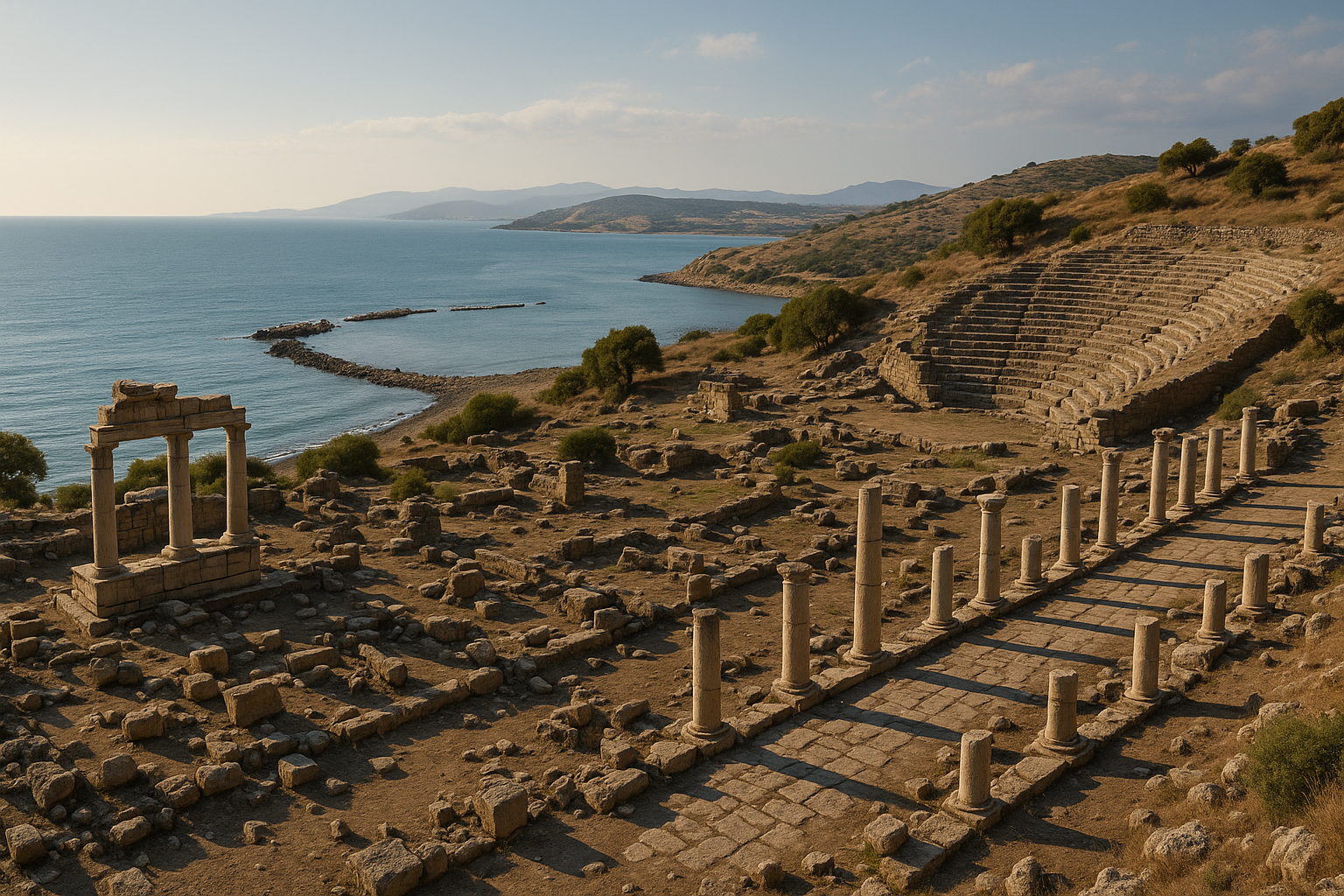
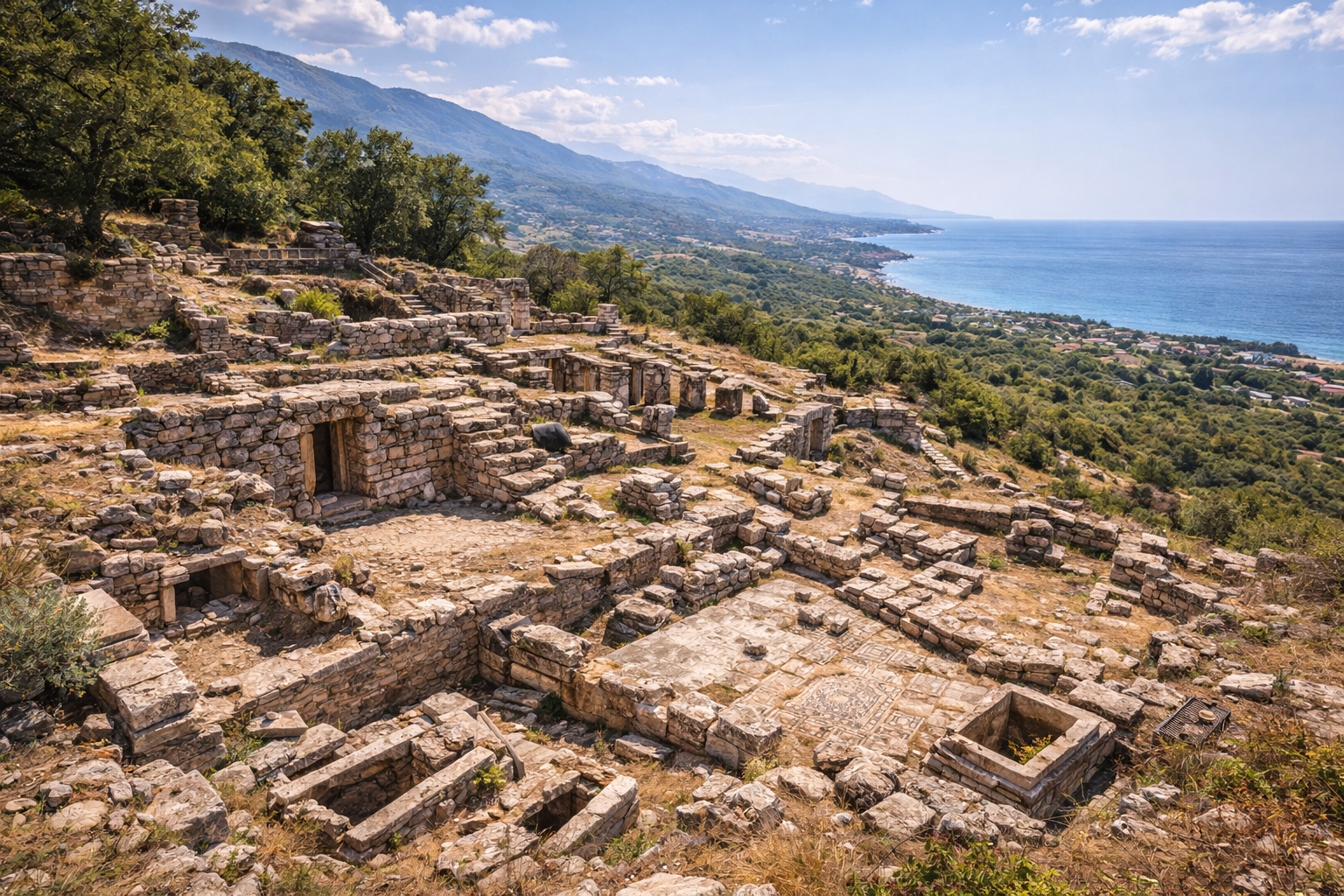
Pergamon rises from the plain of the Bakırçay — the ancient Caicus — like a stone crown set on a single sharp hill. For about a century and a half between 282 and 133 BC it served as the capital of the Attalid dynasty, a line of kings who began as treasurers of one of Alexander's successors and ended as rulers of a state wealthy enough to challenge Alexandria in scholarship and Rome in diplomacy. Their citadel, terraced into a 335-metre rock above the modern town of Bergama, still preserves one of the most theatrical urban silhouettes in the Mediterranean: a stack of marble platforms, palace blocks, the foundation of the Great Altar of Zeus, the Temple of Trajan re-erected against the sky, and the famous theatre clinging to a 36-degree slope. To its name antiquity attached three of the most powerful ideas in Western culture — the library of two hundred thousand volumes that pushed Alexandria into a papyrus embargo and forced Pergamon to perfect charta pergamena, the parchment that would carry the literature of Greece, Rome and Christendom for a thousand years; Galen, the physician of Marcus Aurelius, trained in the courtyards of Pergamon's Asklepion; and the Great Altar, whose Gigantomachy frieze, lifted block by block in the 1870s by Carl Humann and reassembled in Berlin, became one of the most disputed objects of modern archaeology. Pergamon is best understood as a city in three layers — the Acropolis on the rock, the Asklepion healing sanctuary on the plain below, and the Lower City of the Red Basilica, the agoras and the Roman quarter — woven together by aqueducts, terraced streets and twenty-two centuries of continuous memory.
- Why Pergamon Matters
- Geography and Setting
- Historical Timeline
- Major Monuments
- Archaeological Work
- Pergamon as a Centre of Science and Culture
- The Roman Transition
- Numbers and Measurements
- Visitor Information
- FAQ
- Sources and Further Reading
Why Pergamon Matters
Pergamon is one of those rare ancient cities whose importance is not the inheritance of geography or trade alone, but of deliberate, sustained cultural policy. The Attalid kings used wealth, marble and learning the way other Hellenistic dynasts used cavalry and elephants — and the result reshaped the look and the intellectual horizon of the post-Alexandrian world.
-
It was a Hellenistic capital built from nothing into a peer of Alexandria. When Philetairos pocketed Lysimachos' war chest in 282 BC, Pergamon was a fortified hilltop with no great pedigree. Within four generations it stood beside the Ptolemaic and Seleucid capitals as one of the three great cultural courts of the age.
-
It produced parchment. When the Ptolemies cut the papyrus supply to throttle a rival library, the scribes of Pergamon refined the treatment of animal skins to such a degree that the new material took the city's name: charta pergamena, parchment, the medium of every Western book down to the Renaissance.
-
It gave Western medicine its longest-lived authority. Galen of Pergamon, trained as a wound-doctor for the gladiators of his home city before becoming physician to Marcus Aurelius and Commodus, wrote a corpus so vast and so coherent that Greek, Latin, Syriac, Arabic and Latin-again medicine all sat in his shadow until Vesalius and Harvey.
-
It was the first capital of the Roman Province of Asia. Attalos III's will of 133 BC handed an entire kingdom — territory, treasury, libraries and quarries — to the Roman Republic, creating the wealthiest province Rome had yet possessed.
-
It invented a sculptural language. The Pergamene "Baroque" — twisting bodies, contorted faces, drapery whipped into motion — was the artistic answer to Classical restraint, and it set the template for late Hellenistic and much Roman public sculpture.
-
It is the textbook example of terraced Hellenistic urbanism. No flat grid, no Hippodamian rationality: Pergamon worked with the rock, stacking sanctuary, library, palace and theatre into a single sloping composition designed to be read from the valley below.
-
It is a UNESCO multi-layered cultural landscape (2014). The inscription explicitly recognises that the Hellenistic Acropolis, the Roman healing sanctuary, the Byzantine churches and the living Ottoman-Turkish town of Bergama are a single, continuous monument.
Geography and Setting
The ancient city sits at the southern edge of the Bakırçay plain, the broad alluvial valley known to Greeks and Romans as the Caicus. The river runs west to the Aegean, reaching the sea between the modern bay of Çandarlı and the Kane peninsula — a coastline that gave the Attalid state direct maritime access without exposing its capital to coastal raids.
The acropolis itself is a single, isolated, conical-to-pyramidal mass of andesite, Kale Tepesi, rising to 335 m above sea level and a clear 250 m above the surrounding plain. Its three accessible flanks (north, west and south) drop steeply; its eastern side falls almost vertically, forming a natural fortress wall. The summit ridge is so narrow that the Attalid architects had to engineer it: nearly every major Hellenistic structure on the upper city sits on artificial terracing supported by massive retaining walls and vaulted substructures.
Three quite distinct archaeological zones make up the World Heritage site:
- The Acropolis (the rock) — royal palaces, the Great Altar precinct, the Temple of Athena and the library, the theatre carved into the western slope, the gymnasia on the middle terraces, the Temple of Trajan crowning the summit, and the Sanctuary of Demeter on the southern flank.
- The Asklepion — the great healing sanctuary on a low terrace about 2 km south-west of the acropolis, on the western edge of the modern town, reached in antiquity by a colonnaded Sacred Way.
- The Lower City — the Roman-era town that spread out on the plain, with the Red Basilica, the Lower Agora, Roman baths, a stadium, an amphitheatre and the residential quarters now overlaid by the streets of Bergama.
Linking all three are the remains of the Pergamene water system: long-distance pressure pipelines that brought water from the springs of Madra Dağı to the north, including the famous Madradağ pipeline whose siphons crossed valleys at hydrostatic pressures matched nowhere else in the ancient world.
The Caicus Valley
The Bakırçay/Caicus plain is one of the larger fluvial basins of western Anatolia, opening to a coast that in antiquity formed a deep gulf — the Elaitic Gulf, now silted and contracted by the river's sediments. The plain is naturally fertile: in antiquity it supported intensive grain agriculture, vineyards, olive groves and stock-raising, and large herds of sheep were a regional specialty. The Attalid economy rested on this productive hinterland as much as on the silver in the citadel. The royal estates (basilikē chōra) covered substantial parts of the valley and the surrounding hills.
The Wider Setting
To the north rises the volcanic massif of Madra Dağı (ancient Pindasos), whose springs fed the city's aqueducts. To the south lies the ridge of Yunt Dağı, separating the Caicus basin from the Hermos (Gediz) valley. To the east the country rises into the highlands of Mysia; to the west the plain opens to the Aegean. The position was ideally suited to a state that wished to dominate the western Aegean coastline without itself being exposed to it.
Climate and Vegetation
The climate is Mediterranean: hot dry summers, mild wet winters. The natural vegetation is mixed evergreen — pine, holm oak, kermes oak, myrtle, terebinth, mastic — interspersed with cultivated fields. Pollen cores from the Caicus marshes confirm a long history of human deforestation and replanting, with major expansion of olive and grape cultivation in the Hellenistic and Roman periods.
Historical Timeline
Aiolian Beginnings (before c. 400 BC)
The rock is mentioned by Xenophon in the Anabasis: in 399 BC the Ten Thousand pass through "Pergamon," a stronghold held by descendants of the Eretrian exile Gongylos. This Aiolian phase left only modest archaeological traces — wall fragments, sherds — but it confirms the site as a defensive position long before the Attalids.
Persian and Early Hellenistic Phases (c. 5th–4th centuries BC)
Throughout the late Archaic and Classical periods the hill belonged loosely to the Achaemenid satrapy of Hellespontine Phrygia, held by local dynasts under the Persian umbrella. Alexander's passage in 334 BC ended Persian rule. After his death the city fell into the orbit of Lysimachos, the Thracian king who chose Pergamon as a treasury — its natural defences made it an ideal vault for the staggering sum of 9,000 talents of silver.
Philetairos and the Founding of the Dynasty (281 BC)
Lysimachos appointed a eunuch officer named Philetairos as commander of the citadel and keeper of the treasure. When Lysimachos died at the Battle of Corupedium in 281 BC, Philetairos kept the silver, switched allegiance briefly to Seleukos I, and then carved out a quasi-independent principality. Although he never took the title of king, he used the treasury to build temples, fund a court and adopt his nephew Eumenes — and so founded the Attalid line.
Attalos I and the Galatian Victories (241–197 BC)
Under Eumenes I (263–241 BC) Pergamon broke openly with the Seleucids. His successor Attalos I Soter ("the Saviour") inflicted a decisive defeat on the marauding Galatian Celts around 230 BC and, on the strength of that victory, was the first of the line to claim the diadem and the royal title. The Galatian theme — the heroic, doomed Celtic warrior — became the signature subject of Pergamene sculpture: the Dying Gaul and the Ludovisi Gaul are Roman copies of Attalid victory monuments commissioned to broadcast this triumph across the Greek world.
Eumenes II's Golden Age (197–159 BC)
Eumenes II is the architect-king of Pergamon. Allied with Rome against Antiochos III, he came out of the Treaty of Apameia (188 BC) with a vastly enlarged kingdom — most of Anatolia west of the Taurus passed under Attalid control. He used the windfall to rebuild the capital: the terraced city plan, the Great Altar of Zeus, the Library, the expanded Sanctuary of Athena, the gymnasium complex, and the great theatre with its 80 rows date in their developed form from his reign. Under Eumenes II Pergamon was, by general assent of the ancient sources, the most beautiful new city in the Greek world.
Eumenes II also pursued a sophisticated foreign policy. He intervened diplomatically in the affairs of the Greek cities of mainland Greece, gave benefactions on a princely scale to Athens (the Stoa of Eumenes south of the Acropolis) and Delphi, and managed the Galatian frontier through a mixture of force, alliance and selective settlement. His coinage — large issues of cistophoric tetradrachms — became the basis of the western Anatolian monetary system for over a century. His death is dated to 159 BC; his brother Attalos II Philadelphos succeeded him after acting as regent during Eumenes' final years of incapacity.
Attalos II and the Cultural Court (159–138 BC)
Attalos II Philadelphos consolidated his brother's work. He founded Attaleia (modern Antalya) on the southern coast, financed the Stoa of Attalos in Athens (today rebuilt as the museum of the Athenian Agora), and continued the patronage of philosophers, grammarians and physicians.
Attalos III's Will and the Roman Takeover (133 BC)
Attalos III Philometor, last of the line, was a strange and bookish king — a botanist and pharmacologist who reportedly grew poisonous plants in the palace gardens. He died without an heir in 133 BC, and his will — its authenticity debated even in antiquity — bequeathed the kingdom to the Roman People. Rome accepted, but only after suppressing the revolt of Aristonikos (133–129 BC), an illegitimate Attalid claimant who raised a coalition of citizens and slaves under the slogan of a utopian "City of the Sun" (Heliopolis).
Mithridatic Wars (88–63 BC)
In 88 BC, during the Asiatic Vespers, Pergamon joined the general massacre of Italians ordered by Mithridates VI of Pontus. Roman reprisals under Sulla were severe — heavy indemnities, the loss of free-city status, a long economic depression — but the city was eventually rehabilitated and slowly recovered through the late Republic.
Roman Imperial Period: Trajan and Hadrian (1st–2nd centuries AD)
The 2nd century AD is Pergamon's second golden age. Trajan authorised an imperial-cult temple on the very summit of the acropolis; Hadrian completed it and granted the city the rare honour of a second neokoria (status as warden of an imperial temple). The Asklepion was rebuilt on a monumental scale with porticoes, a domed Temple of Asklepios-Zeus Soter modelled on the Pantheon, and a small theatre. The Red Basilica rose in the lower city as a sanctuary of Egyptian deities. Galen was born here in 129 AD.
Byzantine Period (4th–11th centuries)
Pergamon became a bishopric early — it is one of the Seven Churches of Asia in the Book of Revelation. The Red Basilica was converted into a Christian basilica dedicated to St John; the acropolis circuit was contracted into a smaller fortified enceinte; Arab raids in the 8th century left their mark in burn layers and hasty fortification. By the 11th century it was a minor Byzantine garrison town.
Coin finds, ceramic chronology and the surviving architecture suggest that Byzantine Pergamon was a much-reduced settlement compared to its Roman maximum, concentrated on the acropolis and on a small enclave around the Red Basilica. The Asklepion was abandoned. Several smaller Byzantine churches have been excavated, including a basilica built into the gymnasium terrace. The site was sacked by Arab raiders under Maslamah in 717 AD during the siege of Constantinople; the hasty repairs to the acropolis wall, reusing earlier blocks (including sculpted fragments), are still visible.
Seljuk–Ottoman: The Bergama Beylik (13th–15th centuries)
After Manzikert (1071) the region passed in and out of Seljuk control. In the early 14th century a local Turkish beylik established itself at Bergama, and the town was finally absorbed into the Ottoman state under Murad I in the later 14th century. Ottoman Bergama preserved a complex urban fabric of medreses, mosques (including a small mosque inside a corner tower of the Red Basilica), bathhouses and caravanserais — most of which still stand, woven through the modern town.
Modern Era
Carl Humann's excavations from 1878 opened the modern archaeological history of the site. 1930: Pergamonmuseum Berlin opens. 1957: DAI campaigns resume after the war. 2014: UNESCO World Heritage inscription as Pergamon and its Multi-Layered Cultural Landscape.
A Continuous Timeline of Pergamene Power
| Period | Date Range | Key Events |
|---|---|---|
| Aiolian settlement | before c. 400 BC | Fortified hilltop of Gongylids; Xenophon's "Pergamon" |
| Persian/Lysimachean | c. 400–281 BC | Achaemenid satrapy; Lysimachos' treasury (9,000 talents) |
| Philetairos | 282–263 BC | Foundation of the dynasty; treasury seized |
| Eumenes I | 263–241 BC | First open break with Seleucids |
| Attalos I Soter | 241–197 BC | Galatian victories; first to take the royal title |
| Eumenes II Soter | 197–159 BC | Golden age: Altar, Library, theatre, terraced city |
| Attalos II Philadelphos | 159–138 BC | Stoa of Attalos (Athens); foundation of Attaleia |
| Attalos III Philometor | 138–133 BC | Will bequeathing kingdom to Rome |
| Aristonikos revolt | 133–129 BC | Heliopolis movement; suppressed by Rome |
| Province of Asia | 129 BC | Pergamon as first administrative seat |
| Mithridatic crisis | 88–63 BC | Asiatic Vespers; Sullan reprisals |
| Roman High Empire | 14–284 AD | Trajaneum; second neokoria; Galen; Red Basilica |
| Late Roman / Early Byzantine | 284–c. 700 | Bishopric; Red Basilica converted to church |
| Middle Byzantine | c. 700–1071 | Arab raids; contracted hilltop fortress |
| Seljuk / Beylik | 1071–c. 1390 | Bergama Beylik; town below the ruins |
| Ottoman | c. 1390–1922 | Provincial town; bazaar, mosques, bathhouses |
| Modern Republic | 1923– | Bergama district of İzmir Province; archaeological park |
Major Monuments
The Acropolis Theatre
Cut into the western flank of the rock, the Hellenistic theatre is the most dramatic surviving piece of Pergamene engineering. Its 80 rows of seats were divided by two narrow walkways (diazomata) into three horizontal blocks, holding approximately 10,000 spectators. The slope of the cavea is about 36 degrees — steeper than virtually any other surviving ancient theatre — giving the highest row a vertiginous drop of more than 35 m to the orchestra. The architects refused to build a permanent stone skene, because a fixed stage would have walled off the long theatre terrace (247 m) and the Temple of Dionysos at its northern end. Instead, holes drilled into the orchestra paving show that a wooden stage building was erected only when performances were given and removed afterwards — a solution unique in the ancient world.
The theatre's acoustic performance is exceptional even today: a coin dropped on the orchestra stones is audible in the highest row. The cavea is supported by massive substructures of cut andesite that fan outward into the slope and are visible from the lower terrace. The radial staircases (klimakes) are extremely steep — a steady descent is required even for the modern visitor — and the topmost row offers a sweeping view westward across the Bakırçay plain to the Aegean. Modern conservation has stabilised the lowest rows and the orchestra zone; the upper cavea is partly closed for safety in the high summer months.
The Great Altar of Zeus
The most famous monument of Pergamon stood on a horseshoe-shaped marble podium roughly 36 × 34 m on a terrace beneath the Temple of Athena. Built under Eumenes II around 180–160 BC, it consisted of a high stepped base wrapped in the Gigantomachy frieze — a continuous relief, 2.30 m high and about 113 m long, depicting the cosmic battle between the Olympian gods and the Giants. Inside the colonnade ran a second, smaller frieze, the Telephos frieze, narrating the story of the mythical Heraklid founder of Pergamon. The Gigantomachy is the masterpiece of the Pergamene Baroque: bodies twist out of the marble plane, snakes coil through composition, gods stride over fallen Giants, drapery curls like water. Carl Humann's excavations between 1878 and 1886 lifted the panels and shipped them to Berlin, where they became the centrepiece of the Pergamonmuseum. Only the empty terrace, the foundation outline and a single tree remain on site — and the question of restitution remains open.
The Gigantomachy programme included over a hundred figures, organised by divine family: on the eastern side, the principal Olympians (Zeus, Athena, Heracles, Apollo, Artemis); on the northern side, Aphrodite and her circle; on the southern side, Apollo and the sun and stellar deities; on the western side (the staircase wing), the marine deities. The figures are accompanied by carved labels — divine names on the upper moulding, the names of the artists on the lower — making the Altar an unusually well-documented Hellenistic sculptural ensemble. Stylistic analysis identifies several distinct workshops collaborating under a single overall design: some hands favour the heroic and statuesque, others a more nervous, agitated treatment of muscle and hair.
The Telephos frieze, much smaller (about 1.58 m high), tells in continuous narrative the story of the mythical founder: from the seduction of Auge by Heracles, through Telephos' exposure and rescue, his arrival at Mysian Pergamon, his wounding by Achilles, his cure, and his recognition as the city's eponymous hero. The frieze is sometimes credited as the first sustained continuous narrative cycle in Greek art, prefiguring Trajan's Column three centuries later.
Sanctuary of Athena and the Library
Athena Polias Nikephoros — Athena Guardian-of-the-City, Bringer-of-Victory — was the patron deity of the dynasty. Her temple, a small Doric peripteros of the 4th–3rd centuries BC, sat on a terrace above the theatre, surrounded by a two-storey stoa added by Eumenes II. Behind the northern stoa lay the Library: a large main reading hall (about 13 × 16 m, with a podium for a colossal Athena now in Berlin) and three smaller rooms. Ancient sources (Strabo, Plutarch via the apocryphal Mark Antony story) credit it with around 200,000 volumes. The cavity walls were designed to keep papyrus and parchment rolls cool and dry — a technical solution that anticipates modern archive design.
Temple of Trajan (Trajaneum)
The Trajaneum crowns the very summit of the acropolis. Begun under Trajan, completed under Hadrian, it is a Corinthian peripteros in white marble standing on a monumental podium supported by deep barrel-vaulted substructures that artificially extended the narrow ridge. The temple housed the colossal cult statues of both deified emperors and was framed on three sides by colonnaded porticoes. The German-led anastylosis of the 1970s–1990s re-erected several of the columns and a section of the entablature; together with the cliff edge and the view down the Caicus valley, it is the most photographed image of Pergamon today.
Royal Palaces
North of the Trajaneum lie the foundations of five Attalid palace complexes — Palaces I through V, generally identified with successive rulers. They are surprisingly modest in plan compared to Ptolemaic palaces: peristyle courts, modest reception rooms, mosaic floors (the famous parrot mosaic now in Berlin came from Palace V). Adjacent are the arsenals — long rectangular storerooms that yielded thousands of stone projectiles for catapults, a reminder that the cultural capital was also a fortress.
The modesty of the Attalid palaces is striking and deliberate. Where Ptolemaic and Seleucid kings built halls of audience designed to overwhelm, the Attalids — whose royal title was hard-won and whose authority depended on cooperation with city institutions — preferred a less assertive idiom. The palace mosaics, however, are technically among the finest of the Hellenistic world: the parrot mosaic of Palace V uses opus vermiculatum tesserae as small as one or two millimetres, and a fragment of a Sosos-style "unswept floor" mosaic, with naturalistic depictions of scattered food remains, was found in the same complex.
The Asklepion
About 2 km south-west of the acropolis, on a low terrace at the western edge of modern Bergama, stands the great healing sanctuary of Asklepios-Soter. From the Roman gateway in the Lower City a colonnaded Sacred Way (Via Tecta) led west to the Propylon, a four-columned monumental gate built by the consul L. Cuspius Pactumeius Rufinus in the early 2nd century AD. Beyond it opens a vast rectangular courtyard (about 110 × 130 m) framed by stoas on three sides — the long galleries where patients walked, slept and listened to lectures.
Around the courtyard cluster the principal structures:
- The Temple of Asklepios-Zeus Soter — a circular domed building about 23.85 m in diameter, modelled directly on the Pantheon in Rome and dedicated around AD 142.
- The Treatment Building — a two-storey round structure about 26.50 m in diameter, with six niches around a central space, connected to the Sacred Spring by an underground cryptoporticus about 70 m long. Patients were led through this dim, vaulted tunnel as part of the dream-incubation cure.
- The Temple of Telesphoros — a small shrine to the dwarf-god of convalescence, son or companion of Asklepios.
- The Theatre — a small but elegant Roman theatre of about 3,500 seats, used for therapeutic music and recitations.
- Sacred springs and pools — radioactive thermal water still flows on the site; mud baths and bathing were central to therapy.
- The Library — because Aelius Aristides (a famous 2nd-century AD patient who wrote the Sacred Tales about his cures here) insisted that reading was itself a treatment.
Galen himself, born in Pergamon in 129 AD, served his early career here as the physician of the gladiators of the city.
The Red Basilica (Kızıl Avlu / Serapeum)
On the plain in the centre of modern Bergama looms the Red Basilica, a colossal red-brick temple built under Hadrian. The main hall is 60 m long, 26 m wide and about 19 m high, flanked by two round towers and set in a courtyard 200 m long. It was dedicated to Egyptian deities — Serapis, Isis and Harpokrates — whose colossal cult statue stood at the rear of the cella on a podium with a hollow staircase, so that priests could appear to speak from inside the god. The Selinus river (Bergama Çayı) was channeled through two parallel vaulted tunnels beneath the courtyard so that the temple could be built directly on top of the watercourse — these tunnels still carry the river today. In Byzantine times the building was converted into a basilica dedicated to St John, one of the Seven Churches of Asia. A small Ottoman mosque still occupies one of the corner towers.
Upper and Lower Agorae
The Upper Agora, on the high terrace just below the Altar precinct, was the political and ceremonial market of the Hellenistic city — a square colonnaded plaza opening onto the main north-south street. The Lower Agora, further down the slope, was the commercial market: a two-storey colonnaded square, with shops on both levels, surrounded by warehouses, workshops and the houses of the merchant class.
Between them ran the main street of the Hellenistic city, a paved climbing road with stepped sections in the steepest stretches. The street was lined with shops, inscriptions and honorific monuments; it passed through the Eumenes Gate and continued up to the Athena precinct, defining the spatial spine of the upper city. The intermediate terraces — gymnasium, Sanctuary of Demeter, House of Attalos — opened onto this artery, so that a visitor could read the social hierarchy of the city by ascending it.
Sanctuary of Demeter
On the southern slope of the acropolis lies a long, narrow precinct dedicated to Demeter and Kore, one of the oldest cult sites in the city, with origins in the 4th century BC and major expansion under Philetairos and Apollonis (the mother of Eumenes II and Attalos II). It contained a small Ionic temple, a long stepped seating area for spectators of the Eleusinian-style mysteries celebrated here, and altars. It is among the most evocative spaces on the acropolis because it preserves its original intimacy.
Ancient Pressure-Pipe Aqueducts
Perhaps the most extraordinary engineering achievement of ancient Pergamon is invisible. The Madradağ pipeline brought water from springs on Mount Madra, about 45 km to the north, to the acropolis. Where the line crossed valleys it became an inverted siphon, using closed lead and stone pipes to carry water under pressure across the depression and up the other side. The hydrostatic pressures involved — estimated at up to 20 atmospheres at the lowest point — are not matched in any other surviving ancient system. Two later Roman aqueducts (the Kaikos and Aksu lines) added capacity to serve the expanded Roman city.
The Madradağ line was built under Eumenes II around 200 BC. Its course, traced by topographic survey, runs roughly 45 km across very broken country, crossing at least three deep valleys. The pipe consisted of stone-encased ceramic and lead segments, with stress joints designed to absorb pressure surges. The terminal reservoir on the acropolis distributed water through smaller secondary lines to fountains, palaces and the gymnasium. The Roman lines, much longer and lower, were arched aqueducts in the conventional Western fashion and supplied the lower city and the Asklepion.
City Walls and Gates
The Hellenistic fortification system enclosed the upper city in a circuit nearly 4 km long, anchored at the south by the Eumenes Gate (a tower-flanked entrance from the gymnasium terrace) and at the north by a postern gate behind the palaces. The walls, built in fine isodomic ashlar, follow the cliff edge wherever possible and stand to a preserved height of several courses across most of the circuit. The Roman lower-city wall, much longer, enclosed an enlarged urban area on the plain; sections of it survive between the modern town and the Asklepion.
Roman Theatre, Amphitheatre and Stadium
In addition to the famous Hellenistic theatre on the acropolis, the Roman lower city possessed a complete entertainment complex on the plain: a second theatre (separate from the acropolis cavea), a small amphitheatre — one of the very few in western Anatolia — built in part over a watercourse so that the arena could be flooded for aquatic spectacles, and a long stadium, of which the foundations survive west of the modern town. Together these structures attest the Roman-period scale of the lower city, which is still only partly excavated.
Archaeological Work
Carl Humann (1878 — the Discovery of the Great Altar)
The modern archaeology of Pergamon begins with a German road engineer. Carl Humann (1839–1896) had been working in western Anatolia on Ottoman road-survey contracts since the 1860s. In Bergama he noticed villagers burning ancient marble for lime — including, he suspected, sculpted blocks. A first visit in 1865 brought him pieces of what he would later recognise as the Gigantomachy frieze. After years of lobbying the Berlin museums, he obtained an Ottoman firman and opened the first official excavations in September 1878. Over the next eight years Humann's team excavated the Altar terrace, identified the foundation, and shipped the surviving frieze panels to Berlin under the terms of the firman as it was then interpreted.
Alexander Conze and the 1880s Programme
The classical archaeologist Alexander Conze (1831–1914), then director of the Antikensammlung in Berlin, was the scientific partner of Humann's enterprise. He published the first systematic reports (Die Ergebnisse der Ausgrabungen zu Pergamon), established the canonical numbering of the Gigantomachy slabs, and set the standard for Hellenistic frieze publication.
Theodor Wiegand (1900s)
Theodor Wiegand (1864–1936), one of the dominant figures of German Mediterranean archaeology, took over the Pergamon excavations in 1900. Under his direction the team systematically exposed the gymnasium complex, the Sanctuary of Demeter, the Lower Agora, the House of Attalos, the Sanctuary of Hera Basileia and large sections of the city wall. His architectural draughtsmen — Pontremoli, Schrammen, Schazmann — produced reconstruction drawings that still define our visual sense of the Hellenistic city.
DAI Continuity
The German Archaeological Institute (DAI) has held the Pergamon concession, with interruptions for the two world wars, since the early 20th century, making it one of the longest continuous foreign archaeological projects in Türkiye. Successive directors — Erich Boehringer, Wolfgang Radt, Felix Pirson — have shifted the emphasis from monument-by-monument excavation toward an integrated study of the micro-region: surface survey of the surrounding plain, geophysics, environmental archaeology, study of the rural hinterland and the necropoleis.
Felix Pirson as Current Head
Since 2006 the project has been directed by Felix Pirson, who has reorganised the campaign around the concept of a "Transformation of the Pergamon Micro-Region" — placing the city in its wider settlement, agricultural and ecological landscape. New survey work has identified previously unknown rural sanctuaries, kilns, terraces and Roman-period villas on the slopes above the Bakırçay plain.
Removal to Berlin and Modern Restitution Debates
The Great Altar reached Berlin between 1879 and 1886. From 1901 it stood in a purpose-built first Pergamonmuseum, replaced in 1930 by the current museum building. Turkey has, since the 1930s, raised the question of restitution; the issue intensified after 1990 and is again under active discussion as the Pergamonmuseum closes for a multi-year reconstruction (begun 2014 and ongoing). The legal situation is contested — Ottoman antiquities law was reformed in 1884 to prohibit export, which the Pergamon shipments preceded — but ethically and politically the debate remains live, and is one of the highest-profile cases in the broader restitution conversation.
Modern Restoration: Trajaneum Anastylosis
The most spectacular conservation project on site is the anastylosis of the Temple of Trajan, carried out by the DAI between 1976 and 1994 under Klaus Nohlen. Fallen blocks were catalogued, joined with stainless-steel pins, and re-erected to a partial elevation — re-creating, with scientific honesty about what is original and what is replacement, the columns and entablature of the imperial-cult temple. The Red Basilica has also been the subject of long-term restoration since the early 2000s, including the 2022 discovery of an 1,800-year-old geometric mosaic in the temenos.
Excavation Chronology at a Glance
| Phase | Director / Team | Period | Headline Discoveries |
|---|---|---|---|
| Initial campaign | Carl Humann | 1878–1886 | Great Altar of Zeus; Gigantomachy frieze shipped to Berlin |
| Systematic exploration | Alexander Conze; Wilhelm Dörpfeld | 1900–1913 | Lower Agora, Gymnasium, House of Attalos, Sanctuary of Demeter |
| Interwar campaign | Theodor Wiegand | 1927–1938 | Acropolis architecture; cult buildings; numismatic study |
| Post-war re-opening | Erich Boehringer | 1957–1972 | Trajaneum study; Asklepion publication |
| Long DAI continuity | Wolfgang Radt | 1972–2004 | Trajaneum anastylosis (1976–1994); Red Basilica conservation |
| Micro-region phase | Felix Pirson | 2006–present | Hinterland survey; environmental archaeology; Kane harbour identification |
| Recent finds | Turkish–German team | 2022 | 1,800-year-old geometric mosaic at the Red Basilica |
The Question of Restitution
The legal status of the Berlin altar is complicated. The Ottoman antiquities law of 1874 (Asar-ı Atika Nizamnamesi) and its 1884 revision changed the rules of foreign excavation: the 1874 version permitted the foreign partner to take a share of finds; the 1884 version, drafted in part as a direct response to Pergamon, ended that practice. Humann's first campaign fell under the older, more permissive regime. The Berlin claim therefore rests on Ottoman legal authorisation in force at the time of removal; the Turkish claim emphasises that the political and ethical frame has shifted decisively and that an integrated cultural landscape demands that its central monument be restored to its terrace. As of the mid-2020s the question is still subject to active intergovernmental discussion.
Pergamon as a Centre of Science and Culture
The Library
The Library of Pergamon is one of the great institutions of ancient learning, even though we know it largely through ancient testimonia rather than its own remains. The main reading hall, behind the northern stoa of the Athena sanctuary, was a rectangular room about 13 × 16 m, with a podium for a colossal statue of Athena now in Berlin. The walls were doubled — an outer wall of fine masonry and an inner shelving wall separated by a narrow gap — to keep books cool and dry. Three smaller rooms served as study rooms or specialised stacks.
Ancient sources credit Pergamon with around 200,000 volumes by the late Attalid period — second in the world only to Alexandria. The library attracted leading scholars: Krates of Mallos, the Stoic grammarian, was its director and developed a Pergamene school of allegorical literary criticism in conscious opposition to the Alexandrian school's grammatical and editorial methods. Apollodoros of Athens, the author of a famous Chronika, worked there. Strabo describes the library as one of the wonders of Asia. Plutarch's account that Mark Antony gave the entire collection to Cleopatra as a gift is now generally treated as a polemical anecdote rather than literal history.
Parchment Exports
The most concrete legacy of the library is material. Pliny the Elder (Natural History XIII.70) records that when the Ptolemies prohibited the export of papyrus to prevent Pergamon from outstripping Alexandria, the Pergamene scribes perfected the treatment of split, scraped and stretched animal skins. The product, charta pergamena — parchment — was more expensive than papyrus but far more durable, foldable into codices and writable on both sides. From the late Hellenistic period onward Pergamon became a major centre of parchment manufacture and export; the word, and the medium, carry the city's name into the modern era.
Galen and Medicine
Galen (Aelius Galenus, c. 129–c. 216 AD) was born in Pergamon to a wealthy architect-mathematician father, Nikon. He studied at the Asklepion as a teenager, travelled to Smyrna, Corinth and Alexandria for further medical education, and returned home around 157 AD to take up the post of physician to the gladiators of the high priest of Asia at Pergamon — an unrivalled opportunity to observe living anatomy through wounds. He moved to Rome in 162 AD, became physician to Marcus Aurelius, Lucius Verus, Commodus and Septimius Severus, and produced a corpus of more than 300 treatises (of which around 120 survive). His synthesis of Hippocratic humoral theory, Aristotelian biology, and his own dissections of Barbary apes, pigs and goats became the unchallenged foundation of Western and Islamic medicine for fifteen centuries.
The Pergamene Sculptural School
The Attalid court created and sustained one of the most distinctive sculptural traditions of antiquity. From the dedicatory groups of Attalos I — the long lost bronze Gauls — through the Gigantomachy frieze of the Great Altar to the smaller-scale narrative reliefs of the Telephos frieze, Pergamene sculptors developed a vocabulary of muscular violence, twisting bodies, deep cutting and theatrical drapery. The Dying Gaul and the Ludovisi Gaul (the Gaul killing himself and his wife) are Roman marble copies of bronze originals from the Athena sanctuary. The style is sometimes called the Pergamene Baroque, and its influence on Roman sarcophagus reliefs, Mannerist and Baroque sculpture, and even on modern monumental art is impossible to overstate.
Stoicism
Pergamon was also a centre of philosophical activity, particularly Stoic. Krates of Mallos, head of the library, was a Stoic; the Attalid court patronised philosophers from a range of schools but had a special affinity for the Stoa, and the city's gymnasia included lecture halls and a small auditorium (often called a Musaeum) for philosophical discourse. Galen himself was trained in Stoic logic as a young man and his medical philosophy is recognisably indebted to Stoic physics.
The Three Great Hellenistic Libraries Compared
| Library | Estimated Holdings | Foundation | Specialisation |
|---|---|---|---|
| Alexandria | 400,000–700,000 volumes | early 3rd c. BC, Ptolemy I/II | Grammatical edition of Homer; sciences; universal collection |
| Pergamon | ~200,000 volumes | early 2nd c. BC, Eumenes II | Allegorical literary criticism; Stoic philosophy; medicine |
| Antioch | substantial but unknown | 3rd c. BC, Seleucid | Royal historical archives |
The two leading libraries differed in method as well as scale. Alexandrian scholars edited texts by collation and emendation, applying grammatical criteria; the Pergamene school read literature allegorically, seeking philosophical and cosmological meaning beneath the surface narrative. The two methodologies competed for centuries and shaped the subsequent history of literary interpretation in both the pagan and the Christian traditions.
The Pergamene School of Sculpture: A Closer Look
The signature sculptural commissions of the Attalids fall into several distinct phases.
- Phase I — The Small Gauls. The first victory dedications of Attalos I, around 230–220 BC, included the famous "Small Gauls" group (Pliny's parva monumenta), dedicated on the Athens Acropolis. They survive in Roman copies.
- Phase II — The Large Gauls. A second, larger dedication at Pergamon itself, commemorating later Galatian victories, included the bronze originals of the Dying Gaul (Capitoline Museums, Rome) and the Ludovisi Gaul (Palazzo Altemps, Rome). These belong to the heroic-pathos vein of Pergamene work — defeated barbarians depicted with dignity and emotional weight.
- Phase III — The Gigantomachy. The masterpiece — the Altar frieze under Eumenes II — pushes Pergamene Baroque to its furthest reach: deep undercutting, twisting bodies that break the frame, drapery rendered as if blown by an interior wind, faces in spasms of effort, pain or ecstasy.
- Phase IV — Telephos Frieze. The inner frieze of the Altar marks a different direction: continuous narrative, smaller scale, more intimate compositions, often called the first "continuous narrative frieze" in Greek art.
Pergamene sculptors are also credited with the Laocoön group (Hagesandros, Polydoros and Athenodoros of Rhodes — the Rhodian school is a direct heir of Pergamon) and many late-Hellenistic and Roman-imperial masterpieces of muscular contortion.
Music, Theatre and Festivals
Pergamon hosted at least two great civic festivals: the Nikephoria, founded by Eumenes II after the defeat of the Galatians, with musical and athletic competitions; and the Asklepieia, attached to the healing sanctuary, which by the 2nd century AD had become one of the most prestigious festivals of Asia, attracting performers from across the Mediterranean.
The Roman Transition
The Will of Attalos III (133 BC)
Attalos III Philometor Euergetes ruled for only five years (138–133 BC). Ancient sources paint a strange portrait: a botanist and pharmacologist who allegedly grew aconite and hellebore in the palace garden, a sculptor and bronze-caster, a king who avoided the public face of monarchy. He died suddenly in 133 BC, leaving a will — preserved for us only in summary form, principally in the historian Strabo and inscriptions from Pergamon — that bequeathed the kingdom to the Roman People.
The will distinguished, in line with Hellenistic legal practice, between royal property (which passed to Rome) and the free cities of the kingdom (which were declared autonomous). The historicity of the will was challenged at the time and has been challenged since — but the inscriptional evidence, including a Pergamene decree confirming the new dispensation, makes the basic act secure.
The Aristonikos Revolt (133–129 BC)
Almost immediately a man calling himself Aristonikos, claiming to be an illegitimate son of Eumenes II, raised a revolt against Roman takeover. He rallied disaffected free citizens and, when the cities resisted, raised the rural population and slaves under the utopian slogan of a City of the Sun (Heliopolis) — a programme combining Stoic egalitarian theory (perhaps developed with the philosopher Blossius of Cumae, formerly a teacher of the Gracchi) with Hellenistic kingship rhetoric. The revolt was eventually crushed by the Roman consul Manius Aquillius in 129 BC, after the death in battle of his predecessor Publius Licinius Crassus.
The Founding of the Province of Asia
With the revolt suppressed, Rome formally organised the bequeathed territories into the Provincia Asia in 129 BC. Pergamon served as the original administrative seat of the province, although the governor's residence later moved to Ephesus. The province quickly became one of the richest in the Roman empire — its tax revenues, farmed out to publicani under the Gracchan reforms, were central to the politics of the late Republic and a recurring object of provincial complaint, most spectacularly in the Asiatic Vespers of 88 BC. The will of Attalos III is therefore not only the end of the Attalid dynasty but the founding act of one of the most important institutional structures of Roman imperial history.
Pergamon as Imperial-Cult Centre
In 29 BC, Augustus permitted the koinon (provincial assembly) of Asia to dedicate a temple to the deified Caesar and to Roma — at Pergamon. This was the first imperial cult temple in the eastern empire and made Pergamon the original neokoros (temple warden) city of Asia. A century and a half later, under Trajan and Hadrian, Pergamon received its second neokoria — an honour shared by only a handful of cities and reflected on civic coinage as a badge of status. The Trajaneum on the acropolis is the architectural expression of that role.
The Asiatic Vespers (88 BC) and the Sullan Settlement
When Mithridates VI of Pontus invaded Roman Asia in 88 BC, he ordered the simultaneous massacre of all Italians in the province on a single day: ancient sources speak of 80,000 dead. Pergamon participated. Sulla's reprisal after Mithridates was driven back was severe: a five-year retroactive tax levy, loss of free-city status, the requirement to billet Roman troops, and the cancellation of many civic privileges. The economic depression that followed lasted into the early Augustan period, when imperial patronage gradually rehabilitated the city's status.
Numbers and Measurements
| Item | Value | Notes |
|---|---|---|
| Acropolis elevation | 335 m a.s.l. | About 250 m above the surrounding plain |
| Acropolis area (Hellenistic enceinte) | ~90 ha | Including the lower terraces |
| Theatre — rows | ~80 | Three horizontal blocks divided by 2 diazomata |
| Theatre — capacity | ~10,000 | Hellenistic-Roman estimate |
| Theatre — slope | ~36° | Steepest surviving ancient theatre |
| Theatre terrace | 247 m × up to 17.4 m | Bounded by stoa and Temple of Dionysos |
| Great Altar — podium | 36.44 × 34.20 m | Marble foundation only on site |
| Great Altar — Gigantomachy frieze | ~113 m × 2.30 m | In Berlin's Pergamonmuseum |
| Great Altar — Telephos frieze | ~80 m × 1.58 m | Inner colonnade |
| Library — main reading hall | ~13 × 16 m | Behind the northern stoa of Athena |
| Library — estimated holdings | ~200,000 volumes | Late Attalid period |
| Trajaneum — platform | ~68 × 58 m | Corinthian peripteros on vaulted substructure |
| Gymnasium complex | >36,000 m² | Three terraces (Paides / Neoi / Epheboi) |
| Asklepion — central court | ~110 × 130 m | Stoas on three sides |
| Asklepion — Temple of Zeus-Asklepios | 23.85 m diameter | Dedicated AD 142, Pantheon-derived |
| Asklepion — treatment rotunda | 26.50 m diameter | Two-storey |
| Asklepion — cryptoporticus | ~70 m | Underground vaulted passage |
| Asklepion — theatre | ~3,500 seats | Roman period |
| Red Basilica — main hall | 60 × 26 m × ~19 m high | Hadrianic; Serapis cult |
| Red Basilica — temenos | ~270 × 100 m | River Selinus tunnelled below |
| Madra Dağı aqueduct | ~45 km | Inverted siphon up to ~20 atm pressure |
| Foundation of dynasty | 282/281 BC | Philetairos and the treasury |
| Bequeathal to Rome | 133 BC | Will of Attalos III |
| Province of Asia founded | 129 BC | After Aristonikos revolt |
| Carl Humann first excavation | 1878 | Great Altar campaign |
| Pergamonmuseum Berlin opened | 1930 | Current building |
| UNESCO inscription | 2014 | "Multi-Layered Cultural Landscape" |
The Attalid Royal Sequence
| Ruler | Reign | Title | Headline Achievements |
|---|---|---|---|
| Philetairos | 282–263 BC | Dynast | Seized Lysimachos' treasury; founded the line |
| Eumenes I | 263–241 BC | Dynast | Independence from Seleucids; defeated Antiochos I at Sardis |
| Attalos I Soter | 241–197 BC | King (first) | Defeated Galatians; "Dying Gaul" monuments |
| Eumenes II Soter | 197–159 BC | King | Treaty of Apameia; Altar; Library; theatre; terraced city |
| Attalos II Philadelphos | 159–138 BC | King | Stoa of Attalos in Athens; foundation of Attaleia |
| Attalos III Philometor | 138–133 BC | King | Botanical studies; will bequeathing kingdom to Rome |
Coinage and Economy
| Coin Type | Period | Notes |
|---|---|---|
| Philetairic tetradrachm | 282–c. 200 BC | Philetairos portrait obverse; Athena reverse |
| Cistophoric tetradrachm | c. 190 BC onwards | Sacred basket with snake; standard silver of Asia for over a century |
| Roman provincial bronze | 133 BC – 3rd c. AD | Athena, Asklepios serpent, imperial portraits |
| Neokoros issues | 1st–3rd c. AD | Twin or triple temple types celebrating imperial cult honours |
The cistophorus, introduced at Pergamon around 190 BC, became the dominant large silver coin of western Anatolia for more than a century. Its distinctive iconography — a serpent emerging from a sacred basket (cista mystica) bound with wreaths — links Dionysian cult to civic identity. After 133 BC the Roman state continued striking cistophori in Pergamon and other Asian mints, making the type a transitional currency between Hellenistic and Roman monetary systems.
Visitor Information
Getting There
Bergama lies about 110 km north of İzmir along the E87/D550 highway. From İzmir's central bus terminal (İZOTAŞ) there are frequent direct coaches; the journey takes about two hours. Drivers from İzmir Adnan Menderes Airport (ADB) should allow 2 to 2.5 hours; from Çanakkale in the north the run is about 3 hours. The town centre is signposted in Turkish and English for the three main archaeological zones: Akropol, Asklepion and Kızıl Avlu.
Acropolis Cable Car
A modern cable car (Bergama Akropol Teleferik) climbs from a lower station on the northern flank of the rock directly to the entrance of the upper city. The ride takes about 4 minutes and is the recommended way up: the alternative is a steep, winding 4 km road by car or taxi, or a strenuous 30–40 minute walk on the ancient road. The cable car runs on a return ticket, and operating hours follow the site itself.
Three Separately Ticketed Areas
The site is administered as three separate ticketed enclosures:
- The Acropolis (upper city — theatre, Altar terrace, Athena sanctuary, Trajaneum, palaces, gymnasium upper terrace).
- The Asklepion (about 2 km south-west of the centre; separate entrance, separate ticket).
- The Red Basilica / Kızıl Avlu (in the heart of the modern town; separate entrance, separate ticket).
The Türkiye Müzekart (Museum Pass) and the Müzekart+ for international visitors cover all three sites, as well as the Bergama Archaeological Museum, and is by far the cheapest option if you plan to visit more than one.
Hours
Summer (April–October): generally 08:30–19:00, last entry around 18:00. Winter (November–March): generally 08:30–17:00, last entry around 16:00. The Asklepion and Red Basilica follow the same pattern. Hours are subject to change — check the Ministry of Culture and Tourism's müze.gov.tr portal before travelling.
Time Budget
- Fast visit (half day): cable car up, acropolis only (theatre, Altar terrace, Athena, library terrace, Trajaneum) — about 2.5–3 hours.
- Comfortable visit (full day): acropolis in the morning; lunch in town; Red Basilica and Bergama Museum in the early afternoon; Asklepion in the late afternoon when the light is best — about 7–8 hours including travel.
- Two-day visit: add Allianoi (now submerged but documented in the museum), Aigai and the Kane peninsula.
Nearby Sites
- Allianoi — a Roman thermal sanctuary about 18 km north-east of Bergama, of the 2nd century AD, with extraordinarily preserved baths. The site was largely submerged by the Yortanlı Dam in 2010–2011 despite international protest; finds are displayed in Bergama Museum.
- Aigai (Nemrutkale) — a Hellenistic Aiolian city on a rocky hilltop about 50 km south-east of Bergama, with a remarkable three-storey market building.
- The Kane Peninsula (Kane / Kanai) — the ancient harbour and naval base of Pergamon, on the coast near modern Bademli, identified in recent surveys as one of the lost "Arginusae" islands.
- Çandarlı (Pitane) — Genoese castle on the coast, with the remains of the ancient Aeolian city of Pitane below.
Bergama Museum
The Bergama Archaeological Museum, on Cumhuriyet Caddesi in the town centre, opened in 1936 and has been recently re-displayed. It holds the major finds from the site that remained in Türkiye: Hellenistic statuary from the gymnasium and the theatre, an exceptional collection of inscriptions, Roman portraits, mosaics from the lower city, terracottas, coins (including a strong Attalid series and cistophoroi), and material from Allianoi. The ethnographic section preserves the textiles, carpets and silverwork of Ottoman Bergama. The museum is small but exceptional in quality and should not be missed.
Practical Notes
- Footwear: sturdy shoes for the acropolis; the ancient paving is uneven and slippery in places.
- Water: there is a kiosk at the upper cable-car station, but bring water in any case, especially in summer.
- Sun: shade is scarce on the acropolis — hat and sunscreen are essential from May through September.
- Photography: the best light on the Trajaneum is late afternoon; the best light on the Asklepion theatre is morning.
- Crafts: the bazaar district of Bergama is one of the last surviving traditional craft quarters in Aegean Türkiye, known for hand-knotted Bergama carpets, leatherwork and silver.
A Suggested Walking Order on the Acropolis
- Cable car to the upper station.
- South gate and Heroon of the Attalid rulers.
- Upper Agora — the political square of the Hellenistic city.
- Altar terrace (foundation only; closes the visual axis from below).
- Temple of Athena and the Library behind it.
- Theatre terrace and the long theatre street with the Temple of Dionysos at its northern end.
- Royal Palaces and Arsenals on the upper ridge.
- Temple of Trajan at the summit (Trajaneum) — the best viewpoint over the valley.
- Walk down via the Sanctuary of Demeter and the Gymnasium terraces to the lower car park or back to the cable car.
A Suggested Walking Order at the Asklepion
- Roman gate at the entry to the Sacred Way.
- Via Tecta (Sacred Way) — colonnaded approach.
- Propylon — Rufinus' monumental gate.
- Cross the central court to the library (north).
- The theatre (north-west corner).
- The Sacred Spring (north-east).
- The cryptoporticus (underground tunnel) — south-east.
- The Treatment Building (round, two storeys).
- The Temple of Asklepios-Zeus Soter (round, domed).
- The small Temple of Telesphoros.
Bergama Town: What to See Beyond the Ancient Sites
The Ottoman quarter wraps around the Red Basilica and runs up the lower slopes of the acropolis. Highlights include:
- The bazaar (Bergama Çarşısı) — silver, leather, carpets.
- Ulu Cami — the 14th-century Great Mosque, one of the earliest Beylik mosques of the region.
- Çukurhan and Taşhan — Ottoman caravanserais.
- Hacı Hekim Hamamı — a fine Ottoman bath, still functioning.
- Bergama Cumhuriyet Meydanı — the central square, with cafés where carpet weavers and townspeople meet.
Carpets, Leather and Crafts
Bergama is one of the named centres of Anatolian carpet weaving. The classic Bergama carpet is a small to medium-sized rug with bold geometric medallions, a deep madder-red ground, and indigo borders. Traditional weaving continues in workshops in the town and in surrounding villages; the most authentic examples are sold by named co-operatives that label provenance. Leather working — boots, jackets, traditional saddlery — is a second specialty, with several historic tanneries still in operation on the edge of the Bakırçay.
Religion, Cult, and the Sacred Landscape
Pergamon was an exceptionally religious city — not because its people were unusual but because cult was used by the Attalid kings, and after them by Roman emperors, as a deliberate instrument of legitimacy.
The Athena Polias Nikephoros Cult
Athena was the city's patron and the dynasty's protector — Polias (Guardian of the City) and Nikephoros (Bringer of Victory). The cult was state-sponsored, with a major festival (the Nikephoria) and a high priestess drawn from the royal family. The temple on the acropolis was the focal point of civic identity.
The Zeus Cult and the Great Altar
The Great Altar's dedication was probably to Zeus, possibly to Zeus and Athena jointly. Its Gigantomachy frieze was theologically charged: the Olympian victory over the Giants stood for the triumph of cosmic order, and by allegory for the Attalid victory over the Galatian "barbarians." The altar was therefore as much a political monument as a religious one.
Dionysos Kathegemon
Dionysos Kathegemon — "the Leader" — was claimed by the Attalids as their dynastic ancestor through Telephos, the mythical son of Herakles and founder of Pergamon. The cult was elaborate, with a state-supported guild of Dionysiac artists (technitai) who performed at festivals across the Mediterranean.
Asklepios Soter
The healing cult was already established at Pergamon in the 4th century BC, by tradition imported from Epidauros by an Archias who had been cured there. Under the Attalids it remained modest; under the Roman empire — especially under Hadrian and the Antonines — it grew into one of the great healing centres of the Mediterranean.
The Sanctuary of Demeter
The Demeter cult, with its links to the Eleusinian mysteries, was patronised by the queens — particularly Apollonis, mother of Eumenes II — as the women's counterpart to the male-coded Athena cult. Its long, narrow precinct on the southern slope retained an archaic intimacy through the Roman period.
Egyptian Cults at the Red Basilica
The Egyptian gods — Serapis, Isis, Harpokrates — were already established in Hellenistic Pergamon and acquired a monumental setting under Hadrian. The Red Basilica is one of the most ambitious Serapeum complexes anywhere in the Roman world, comparable to (and architecturally different from) those of Alexandria, Ostia and Rome itself.
The Imperial Cult
From 29 BC Pergamon was a centre of the imperial cult in Asia. The Trajaneum on the acropolis crowned the system; provincial assemblies (koina) met here for festivals and the election of provincial high priests; coins celebrating the city's neokoria status proliferated through the 2nd and 3rd centuries AD.
Pergamon in the Book of Revelation
In the Book of Revelation (2:12–17), addressed to the angel of the Church in Pergamon, the city is described as the place "where Satan's throne is." The reference is debated: some commentators read it as the Great Altar; some as the imperial cult; some as the Asklepieion's serpent. Whatever the original referent, the passage gave the city an enduring profile in Christian apocalyptic literature and a particular status as one of the Seven Churches of Asia.
Pergamon in Literature and Memory
Pergamon entered Western imagination through several distinct channels.
Greek and Roman Authors
- Strabo (Geography XIII.4) gives the most extensive ancient description, including the library and the city's appearance.
- Pliny the Elder (Natural History XIII.70; XXXIV) discusses parchment and the Pergamene bronzes.
- Pausanias (1.4; 5.13) refers to Attalid dedications and to the Telephos myth.
- Plutarch records the Mark Antony / Cleopatra anecdote about the library.
- Aelius Aristides (Sacred Tales) is our most vivid first-person account of life at the Asklepion in the mid-2nd century AD.
- Galen himself describes his upbringing and training in On My Own Books and On the Order of My Own Books.
Byzantine and Medieval Reception
Through Galen, the Sacred Tales, and the Book of Revelation, Pergamon remained a known name across the medieval Greek, Latin and Arabic worlds — although the physical city was reduced to a small Byzantine fortress and the Attalid monuments fell into ruin or were quarried.
Modern Rediscovery
Pergamon was visible to early modern travellers — Cyriacus of Ancona in the 15th century, Pococke in the 18th — but only as a romantic ruin. Humann's 1878 campaign and Conze's publications turned it into a major archaeological project, and the 1901 opening of the (first) Berlin Pergamonmuseum made the Great Altar one of the most famous ancient monuments in the world. In the 20th century, Pergamon featured in literature (notably in Peter Weiss's three-volume novel Die Ästhetik des Widerstands (The Aesthetics of Resistance), which opens with the narrator and his friends contemplating the Gigantomachy frieze in 1937 Berlin), in cinema, and in countless tourist guides.
Conservation Challenges
Pergamon is a large, exposed, multi-period site, and its management raises questions that recur across the heritage sector.
- Stone weathering. Andesite and marble both suffer from rainwater dissolution and biological colonisation. Monitoring programmes track surface change on the Trajaneum columns and the Altar foundation.
- Earthquake risk. Western Anatolia is one of the world's most seismically active regions. Many of Pergamon's structures have already been brought down by historical earthquakes; modern anastylosis projects incorporate flexible joints designed to absorb seismic energy.
- Visitor pressure. Although Pergamon does not yet receive Ephesus-level numbers, the acropolis paths and the Asklepion cryptoporticus show wear; circulation has been redesigned several times to spread the load.
- Urban encroachment. The Lower City lies under the modern town. Each new building in Bergama is a potential threat to undocumented archaeology and a potential opportunity for rescue excavation.
- Looting and illicit trade. Like most Anatolian sites, Pergamon has suffered from clandestine digging in the past; control has improved sharply over recent decades.
- The repatriation question. The continued absence of the Great Altar from the site is itself a conservation issue, in the sense that the cultural meaning of the place is fragmented across two continents.
Pergamon and Its Region: Connected Sites
Pergamon was the centre of a network. The principal nodes of that network, several of them visitable today, include:
- Elaia — the Hellenistic harbour of Pergamon, on the Aegean coast about 25 km west; remains of the city wall, harbour moles, necropolis. Under active survey by the DAI.
- Atarneus — an earlier Aiolian city north-west of Pergamon, briefly the residence of Aristotle's father-in-law Hermias and visited by Aristotle himself.
- Pitane (Çandarlı) — another Aiolian coastal city, with a well-preserved Genoese castle.
- Aigai (Nemrutkale) — Hellenistic hilltop city south-east of Pergamon, with a remarkable three-storey bouleuterion / market building.
- Allianoi — Roman thermal sanctuary, largely submerged by the Yortanlı Dam in 2010–11.
- Kane Peninsula — naval base of Pergamon and the historical island of the Battle of Arginusae, recently identified by Pirson's team through coring of the silted-up channel.
- Myrina and Gryneion — Aiolian coastal sites with Hellenistic and Roman remains.
Visiting any two or three of these in a Bergama-based itinerary gives a much richer sense of the Attalid state than the acropolis alone.
A Day in Pergamon, c. 150 AD: An Imagined Walk
To bring the stones to life, imagine the city under Antoninus Pius. A merchant from Smyrna arrives by the Aegean road, enters the city through the Roman gate on the Caicus plain, and turns north up the colonnaded Sacred Way to the Asklepion: physicians and patients are walking in the stoas, Aelius Aristides is dictating his dream of last night to a slave, a chorus rehearses for the Asklepieia festival in the small theatre. He leaves, returns to the centre, eats at a tavern near the Lower Agora, and in the afternoon climbs the road to the acropolis — through the gymnasium terraces, past the Sanctuary of Demeter, into the Athena precinct. The Great Altar, two and a half centuries old, glows in the late sun; the Trajaneum at the summit, brand new in his lifetime, blazes white above. He pays his respects to the imperial cult, takes the air on the long theatre terrace, descends as the lamps are being lit in the lower city, and sleeps in an inn behind the Red Basilica, where the priests of Serapis are conducting an evening procession. Most of the structures he encounters that day still stand, in some form, on the same hill.
FAQ
Q: Where exactly is Pergamon? A: In the town of Bergama, in İzmir Province on Türkiye's northern Aegean coast, about 110 km north of İzmir city and 26 km inland from the Aegean Sea.
Q: Why is the Great Altar of Zeus in Berlin and not in Pergamon? A: It was excavated by Carl Humann between 1878 and 1886 under a German concession from the Ottoman state; the frieze panels were shipped to Berlin under the terms of the firman of the day. They have been the centrepiece of the Pergamonmuseum since 1901 (and 1930 in the current building). Turkey has repeatedly raised the question of restitution; the legal and political debate continues.
Q: Can I climb up to the acropolis without the cable car? A: Yes — there is a road for cars and taxis and an old footpath. The path is steep and takes about 30–40 minutes; in summer the cable car is far more pleasant.
Q: How many separate tickets do I need? A: Three — Acropolis, Asklepion and Red Basilica are separately ticketed enclosures. The Türkiye Müzekart (or Müzekart+ for foreign visitors) covers all three and the Bergama Museum.
Q: What is parchment's connection to Pergamon? A: The Latin name for parchment, charta pergamena, comes from Pergamon. According to Pliny the Elder, the Pergamene scribes perfected the treatment of animal skins as a writing material after the Ptolemies banned papyrus exports to undercut the city's library.
Q: Who was Galen? A: Galen of Pergamon (c. 129 – c. 216 AD) was the most influential physician of antiquity. He was born in Pergamon, trained at the Asklepion, served as doctor to the gladiators, and went on to become physician to Marcus Aurelius and several successor emperors. His writings dominated Western and Islamic medicine for some 1,500 years.
Q: Why is the theatre so steep? A: The architects exploited the natural western slope of the rock to seat 10,000 spectators on a 36-degree gradient — the steepest of any surviving ancient theatre. The slope had the added bonus of preserving the long terrace below the cavea, where the Temple of Dionysos and a stoa stood.
Q: What is the "Red Basilica"? A: A vast Hadrianic-era red-brick temple in the lower city, originally dedicated to the Egyptian deities Serapis, Isis and Harpokrates. It was converted into a Christian basilica of St John in late antiquity (one of the Seven Churches of Asia in Revelation), and a small Ottoman mosque still occupies one of its corner towers.
Q: Is the Asklepion worth visiting? A: Absolutely — it is among the best-preserved healing sanctuaries of the ancient Mediterranean. Allow at least an hour and a half. The Sacred Way, the Propylon, the cryptoporticus, the round Temple of Telesphoros and the small theatre are all in remarkably good condition.
Q: What was the "City of the Sun"? A: The utopian slogan of the rebel Aristonikos in 133–129 BC, after the bequeathal of the Attalid kingdom to Rome. Drawing on Stoic egalitarian theory, Aristonikos rallied free citizens, rural populations and slaves; the revolt was crushed by Rome in 129 BC and the Province of Asia was formally organised.
Q: When is the best time of year to visit? A: Late April–early June and September–October are ideal: long days, mild temperatures, manageable crowds. July and August are very hot — start early. Winter visits are quieter and atmospheric but rainy.
Q: How long has the German Archaeological Institute been working there? A: Continuously since 1878 (with interruptions for the two world wars) — one of the longest-running foreign archaeological projects in Türkiye. The current director, Felix Pirson, has led the campaign since 2006.
Q: Did Galen actually train at the Asklepion? A: Yes. He tells us himself, in On My Own Books and other autobiographical works, that he was educated at Pergamon and Smyrna; after further study in Alexandria he returned home to serve as physician to the gladiators of the high priest of Asia, headquartered in Pergamon.
Q: What is the meaning of neokoros? A: Literally "temple-sweeper" or "temple-warden". In the Greek east of the Roman empire it was a title given to a city that hosted a provincial temple of the imperial cult. Holding it was a major mark of distinction. Pergamon was the first neokoros of Asia under Augustus and received a second neokoria under Trajan/Hadrian.
Q: Are there guided tours available? A: Yes — licensed guides operate at all three sites and through the Bergama tourism office. Many tour operators in İzmir and Ayvalık also run organised day trips. Audio guides are available at the acropolis.
Hellenistic Capitals Compared
| City | Population (est.) | Founding Dynasty | Most Famous Surviving Monument | Library |
|---|---|---|---|---|
| Alexandria | 300,000–500,000 | Ptolemy I (305 BC) | Catacombs / Pompey's Pillar | 400,000–700,000 vols (lost) |
| Antioch | 200,000+ | Seleukos I (300 BC) | Daphne suburb / mosaics | substantial (lost) |
| Pergamon | 100,000–200,000 | Philetairos (282 BC) | Acropolis terrace and Trajaneum | ~200,000 vols |
| Pella | 30,000–50,000 | Argead (5th c. BC) | Mosaic floors | none recorded |
| Seleukeia-on-Tigris | up to 600,000 | Seleukos I (305 BC) | mud-brick walls | unknown |
Pergamon's achievement, given its much smaller territorial base than the Ptolemaic or Seleucid empires, was to compete in cultural soft-power on a scale wholly disproportionate to its political reach. This was a deliberate strategy of the Attalid kings, who substituted patronage, building and scholarship for the manpower they did not have.
Pergamon Compared to Other Anatolian Ancient Cities
| Site | Province | Period of Peak | Distinctive Feature |
|---|---|---|---|
| Pergamon | İzmir | Hellenistic–Roman | Terraced acropolis; Altar; library |
| Ephesos | İzmir | Roman | Library of Celsus; Artemision; provincial capital |
| Aphrodisias | Aydın | Roman | Sculptural school; stadium; Sebasteion |
| Hierapolis | Denizli | Roman | Necropolis; travertines; Apollo sanctuary |
| Sardis | Manisa | Lydian–Roman | Temple of Artemis; gymnasium-synagogue complex |
| Miletos | Aydın | Archaic–Roman | Hippodamian grid plan; theatre |
| Priene | Aydın | Hellenistic | Best-preserved Hippodamian grid |
Pergamon is unusual in this list for the steepness of its setting and the vertical organisation of its monuments — the deliberate refusal of Hippodamian flat-plan rationality in favour of a terraced, visual urbanism designed to be read from below.
Pergamon and the Seven Churches of Asia
| City | Modern Location | Surviving Monument | Status in Revelation |
|---|---|---|---|
| Ephesos | Selçuk, İzmir | Library of Celsus, Artemision | Praised for endurance |
| Smyrna | İzmir | Agora, citadel | Praised |
| Pergamon | Bergama, İzmir | Acropolis, Red Basilica, Asklepion | Rebuked: "where Satan's throne is" |
| Thyateira | Akhisar, Manisa | Limited remains | Mixed |
| Sardis | Sart, Manisa | Temple, gymnasium | Rebuked |
| Philadelphia | Alaşehir, Manisa | Byzantine basilica | Praised |
| Laodicea | Denizli | Stadium, theatres | Rebuked |
Pergamon's prominence in the Apocalypse — the strongest negative judgement of any of the seven churches — reflects, in early Christian eyes, the city's saturation with imperial cult and pagan grandeur. The Red Basilica's conversion into the Christian basilica of St John was a deliberate occupation of that landscape.
Major Festivals at Pergamon
| Festival | Period | Held in Honour Of | Notes |
|---|---|---|---|
| Nikephoria | from c. 182 BC | Athena Nikephoros | Musical and athletic contests; established by Eumenes II |
| Soteria | from late 3rd c. BC | Zeus Soter | Civic festival; commemorating victory over Galatians |
| Asklepieia | from 2nd c. BC, expanded under empire | Asklepios | Healing-sanctuary festival; major panhellenic status by 2nd c. AD |
| Eumeneia | Hellenistic | Eumenes II | Dynastic festival |
| Augustalia | from 29 BC | Augustus and Roma | First imperial cult festival in Asia |
| Hadrianeia | from 2nd c. AD | Hadrian | Festival linked to the second neokoria |
Many of these festivals included musical, theatrical and athletic events, drawing competitors from across the eastern Mediterranean. The Pergamene festival circuit was tightly integrated with those of Smyrna, Ephesos and Sardis, producing a regional calendar of cult, performance and civic display.
Pergamon Today: Modern Bergama
The modern town of Bergama (population around 100,000) sits at the foot of the acropolis. It is the seat of an İzmir provincial district, an agricultural market town and a regional industrial centre. Its economy still rests on the products of the Caicus plain — cotton, tobacco, grain, olives, livestock — supplemented by tourism, traditional crafts (carpets, leather), and a small light-industrial sector.
Townscape
The town wraps around three sides of the rock. Its centre is the Cumhuriyet Meydanı (Republic Square), south of the Red Basilica. From the square, narrow streets climb north toward the acropolis through the Ottoman bazaar district, with stone houses, small mosques, fountains and hans (caravanserais) preserved in dense fabric. East of the centre lie the modern residential districts and the school and administrative quarter; west of the centre, beyond the Bergama Çayı, the road leads to the Asklepion.
Bergama Archaeological Museum
The Bergama Museum on Cumhuriyet Avenue was opened in 1936 and is one of the most rewarding small archaeological museums in Türkiye. Highlights include: a Hellenistic statue of Asklepios from the Asklepion; an Attalid-era statue of Hadrian; the Eros Trapezophoros (a marble table support carved as a winged cupid); inscriptions documenting Attalid administration; an outstanding numismatic display covering the cistophoric coinage; the Allianoi finds, removed before submersion; and an ethnographic wing presenting Bergama carpets, kilims, costumes and silver.
Living Heritage
UNESCO's 2014 inscription explicitly recognised Bergama as a multi-layered cultural landscape: the Hellenistic city, the Roman lower city, the Byzantine churches, the Ottoman quarter and the living modern town are treated as a single integrated heritage object. Conservation policy in Bergama is therefore not only archaeological but urbanistic — controlling the height, materials and uses of buildings in the historic centre, restoring Ottoman houses, supporting craft economies.
Festivals and Events
The modern town hosts an annual Bergama Kermesi (Bergama Festival) in summer, a tradition going back to 1937; events include carpet exhibitions, folkloric performances, oil-wrestling and music. The festival weeks are a good time to combine archaeological visits with experience of contemporary Bergama life.
A Closer Look at the Asklepion
Because the Asklepion is often less familiar to visitors than the Berlin-famous acropolis, a closer description is in order.
History
The cult of Asklepios was established at Pergamon, by tradition, in the early 4th century BC, when one Archias of Pergamon was cured at Epidauros and brought a sacred snake home with him. The earliest sanctuary, modest in scale, lay where the Roman complex was later built. Under the Attalids it remained a local cult site. The transformation into a panhellenic healing destination came in the early 2nd century AD, when major Roman-period building — much of it financed by the consul L. Cuspius Pactumeius Rufinus — gave the site its present form.
The Sacred Way (Via Tecta)
The colonnaded approach from the Lower City to the sanctuary was about 820 m long, paved in stone, lined with shops in places. Most of it now lies under modern Bergama, but the final stretch, immediately east of the Propylon, has been excavated and is visitable. Inscriptions along the way recorded dedications by grateful patients.
The Propylon
The monumental gate is a four-column Corinthian porch in marble, set into the precinct wall. Its frieze, partly preserved, depicts cult symbols. The columns are still partially in situ and have been re-erected as part of the modern conservation.
The Central Court
The rectangular plaza, about 110 × 130 m, was framed by stoas (covered colonnades) on three sides — north, east and south. The stoas provided shaded walking and reading space, and incubation rooms where patients slept. The court contained altars and basins.
The Temple of Asklepios-Zeus Soter
Dedicated around 142 AD, this is a round, domed temple about 23.85 m in diameter, modelled directly on the Pantheon at Rome (which had been completed by Hadrian only about two decades earlier). The dome was concrete; the interior had niches with statues; a circular oculus pierced the apex. The walls survive in part to substantial height.
The Treatment Building
A two-storey circular structure of about 26.50 m in diameter, with six radiating niches around a central rotunda. Its function is debated: most scholars regard it as a treatment building, with the niches used for patient incubation, music, hydrotherapy or massage. It was connected to the Sacred Spring by the cryptoporticus.
The Cryptoporticus
The underground vaulted passage, about 70 m long, is one of the most evocative spaces in the entire sanctuary. Patients passed through it from the central court to the treatment rotunda; the experience of moving through a dim, echoing tunnel was part of the ritual. Light enters through small openings in the vault, and the play of shadow on the andesite walls gives the visitor today an immediate sense of the original atmosphere.
The Theatre
A small Roman theatre at the north-west of the sanctuary, with about 3,500 seats, was used for therapeutic music and recitation. It is unusually well preserved: the stage building survives in part, the cavea is complete, and the radial staircases are intact.
Sacred Spring
A spring of slightly radioactive thermal water still rises in the sanctuary. Ancient patients drank, bathed and mud-bathed; modern hydrogeological analysis confirms its chemical character.
Library
A library was attached to the sanctuary — because reading and intellectual stimulation were considered part of the healing regimen. Galen lectured here; Aelius Aristides composed his Sacred Tales in the surrounding stoas.
The Patient Experience
Aelius Aristides' Sacred Tales (mid-2nd c. AD) give a unique window into the Asklepion experience: long stays at the sanctuary, complex dream-incubations, regulated baths, prescribed runnings barefoot in cold weather, vomiting, fasting, hot mud, theatrical performances, lectures and personal interviews with the priests. The treatment was simultaneously religious, medical and psychological — and, by Aristides' own account, remarkably effective.
A Closer Look at the Acropolis
The acropolis rewards slow looking. Beyond the headline monuments, several smaller features repay attention.
Heroon
At the south-east of the upper terrace stand the foundations of a Heroon — the shrine of the dynastic cult of the Attalid rulers. The plan included a square cult chamber and an antechamber; statues of Philetairos and Eumenes I almost certainly stood here. After the bequeathal to Rome the cult continued, transferred to the imperial line.
House of Attalos
Mid-way down the slope, just below the Trajaneum, lies a large peristyle residence excavated by Wiegand and named the House of Attalos. Its mosaic floors, fresco fragments and finely carved doorways suggest the residence of a high-ranking court official. The plan — a peristyle court surrounded by reception, dining and storage rooms — is a fine example of late Hellenistic elite domestic architecture.
Sanctuary of Hera Basileia
A small Doric temple to Hera Basileia ("Hera the Queen") stood on a terrace near the gymnasium, built by Attalos II in honour of his mother Apollonis. It is one of several monuments at Pergamon attesting the cultic role of royal women — alongside the Demeter sanctuary, said to have been refounded by Apollonis.
Eumenes Gate
At the southern end of the city, where the road from the gymnasium enters the upper enceinte, stands the Eumenes Gate: a robust tower-flanked entrance of fine ashlar masonry. It is one of the best-preserved Hellenistic fortification gates anywhere in Anatolia.
Building K (the "Hall of the Cult of the Caesars")
An unexcavated rectangular building south of the Trajaneum is now identified, on inscriptional grounds, as a hall associated with the provincial imperial cult of the Caesars — possibly the meeting place of the koinon of Asia.
Inscriptions and Royal Documents
Pergamon has yielded a substantial body of Hellenistic inscriptions — most published in the Inschriften von Pergamon series. Major categories include:
- Royal letters from the Attalid kings to cities and federations, often dealing with sanctuary privileges, festival recognition or land grants.
- Civic decrees of the demos of Pergamon, honouring benefactors, regulating cults, settling disputes.
- The Diodoros Pasparos decree — a long honorific inscription for the orator and benefactor Diodoros Pasparos, who negotiated post-Sullan privileges for the city and reorganised the local civic festivals.
- Asklepion dedications — hundreds of small votive inscriptions left by grateful patients.
- Coin legends and weights — short but informative texts.
Together these texts reconstruct the institutions of the Attalid state and the early imperial city in unusual detail. The combination of full archaeological excavation and rich epigraphy makes Pergamon one of the best-documented Hellenistic capitals.
The Civic Constitution
After the Roman takeover, Pergamon retained an extensive civic apparatus: a boule (council), an ekklesia (assembly), elected magistrates including the strategoi (board of generals serving as chief executives), the prytaneis, the agoranomoi (market officials), the gymnasiarchs (heads of the gymnasium) and the high priests of the various cults. Under the empire the high priesthood of Asia — based at Pergamon — became one of the most prestigious offices in the entire province.
The Hellenistic Sculptural Programme: A Catalogue Sketch
A partial catalogue of major surviving Pergamene sculptural works helps situate the school.
- The Dying Gaul (Capitoline Museums, Rome). Roman marble copy of a bronze original from the Attalid victory monument.
- The Ludovisi Gaul (Palazzo Altemps, Rome). Companion piece — a Gaul killing himself and his wife to avoid capture.
- The Gigantomachy Frieze (Pergamonmuseum, Berlin). The masterpiece of the Great Altar.
- The Telephos Frieze (Pergamonmuseum, Berlin). Inner narrative frieze of the Altar.
- The Attalid Athena (Pergamonmuseum, Berlin). Colossal statue, modelled on Pheidias' Athena Parthenos, from the Library.
- The Drunken Old Woman (Munich, Glyptothek). Late Hellenistic genre sculpture in the Pergamene manner.
- The Sleeping Hermaphrodite. Late Hellenistic, often attributed stylistically to Pergamene workshops.
- The Boy with the Goose and several similar genre groups.
- Architectural sculpture from the Asklepion, the Trajaneum and the Sanctuary of Hera.
- Numerous portraits of the Attalid kings, both on coins and in marble.
The school's geographical reach was wide: Pergamene sculptors trained successors who worked at Rhodes (the Laocoön group), at Aphrodisias and across the Roman empire.
Coinage in Detail
Attalid Royal Coinage
The first major royal coin of Pergamon was the Philetairic tetradrachm, struck in fine silver from c. 280 BC, featuring a portrait of Philetairos on the obverse and a seated Athena on the reverse. The portrait — a stocky middle-aged man with a strong jaw — became the iconic image of the dynasty and was retained on coins long after Philetairos' death, much as Alexander's portrait was retained on later Hellenistic coinage.
The Cistophorus
Introduced around 190 BC under Eumenes II, the cistophoric tetradrachm weighed approximately 12.6 g (lower than the Attic standard but on a distinct provincial weight). Its obverse showed a serpent emerging from a cista mystica surrounded by an ivy wreath; its reverse showed two coiled snakes flanking a bow case (a gorytos) and a cult symbol or magistrate's name. The cistophorus spread across western Anatolia as the standard silver of the region, with mints at Pergamon, Ephesos, Sardis, Tralles, Apameia and other cities. It survived the Roman takeover, becoming a Roman provincial issue, and continued in production into the early imperial period.
Civic and Roman Provincial Bronze
A long series of bronze coins from Pergamon, struck under both the Attalids and Rome, give a sustained picture of civic identity: Athena, Asklepios with his serpent, the Telephos myth, neokoros temples, imperial portraits. Roman provincial issues run from the 1st century BC through the mid-3rd century AD, when, as elsewhere in the empire, civic minting ceased.
Pergamon in the Christian Tradition
Pergamon's place in Christian history is dominated by the Apocalypse, but it extends further.
- Bishopric. Pergamon was an episcopal see from at least the 2nd century AD, ranking among the more important sees of Asia.
- Martyrdom of Antipas. The Book of Revelation refers to "Antipas, my faithful witness, who was killed among you" — taken by later tradition as the first martyr of Pergamon, possibly under Domitian (some sources say Nero). His relics were venerated in the Byzantine city.
- Conversion of the Red Basilica. In late antiquity the great Hadrianic Serapeum was reconsecrated as the basilica of St John, with a Christian apse inserted into the eastern end and a baptistery added in one of the round corner towers.
- Late Byzantine continuity. Several small churches, mostly converted earlier structures, served the reduced Byzantine population through to the 11th century.
Ottoman and Modern Bergama
The Beylik Phase
After the collapse of Byzantine control in western Anatolia, Bergama became the seat of a minor Turkish beylik in the 14th century, before passing to the Ottoman state under Murad I in the later 14th century. Most of the surviving Ottoman monuments — the Ulu Cami, the Şadırvanlı Cami, the Hacı Hekim Hamamı, several caravanserais and the bazaar district — date from the 14th to the 17th centuries.
Travellers' Accounts
European travellers began to visit Bergama in numbers from the 17th century onwards. Their accounts trace the slow recognition that the modest market town stood on the ruins of one of the great cities of antiquity. By the early 19th century the acropolis was a fixture of the classical travel itinerary; by the time Humann arrived in the 1860s, it was a known but unexcavated site.
19th-Century Town
The mid-19th-century town was a regional centre of about 15,000 people, with mixed Muslim, Greek and Armenian populations. Carpet weaving, leather working and silver smithing were the principal handcrafts. The road to İzmir was poor; the railway came later in the century.
Republican Period
After the proclamation of the Republic in 1923, Bergama was reorganised as a district (ilçe) of İzmir Province. The Bergama Archaeological Museum was founded in 1936, and the town became a steady tourist destination — particularly after the 1970s, when the cable car was built and the Trajaneum anastylosis programme drew international attention to the acropolis.
Today
Modern Bergama is a working town with a population of around 100,000 in the urban centre. It is connected to İzmir by a 110 km highway, with frequent bus service. The town's identity is shaped by the daily presence of antiquity: the Red Basilica rises out of the bazaar, the acropolis dominates the skyline, and the Asklepion lies a short walk from the western edge of the modern centre.
Galen of Pergamon: A Closer Profile
Because Galen is one of the figures who carries Pergamon's name into the longest stretch of subsequent history, his career and his work deserve a fuller treatment.
Life
Born in 129 AD at Pergamon to Nikon, a prosperous architect and mathematician, Galen was given an unusually broad early education in mathematics, geometry and philosophy before being directed toward medicine — reportedly because Nikon had a dream that his son should pursue this art. After studies at Pergamon, Smyrna and Corinth, he travelled to Alexandria, then the leading centre of anatomical instruction, where he had access to skeletons and to the surviving tradition of human dissection going back to Herophilos and Erasistratos.
He returned to Pergamon around 157 AD and took up the post of physician to the gladiators of the high priest of Asia — a post he held for several years and which, by his own account, transformed his understanding of trauma, wounds, muscles and tendons. In 162 AD he moved to Rome, where he became physician to the imperial court under Marcus Aurelius, Lucius Verus, Commodus and (later) Septimius Severus. He died around 216 AD.
Output
Galen's literary output is staggering — over 300 treatises, of which about 120 survive in Greek (and many more in Arabic, Latin or Syriac translation). Major works include:
- On the Natural Faculties — biological theory.
- On the Usefulness of the Parts of the Body — comparative anatomy.
- Method of Medicine — systematic medicine in 14 books.
- On the Doctrines of Hippocrates and Plato — physiological psychology.
- On My Own Books; On the Order of My Own Books — bibliographic autobiography.
- The Therapeutic Method to Glaucon — clinical handbook.
- Hygiene — preventive medicine.
- On the Affected Parts — diagnosis.
Method
Galen's method combined Hippocratic clinical observation, Aristotelian biology, Stoic logic and his own anatomical research. He performed systematic dissections on Barbary apes, pigs, goats and dogs, and used the results — sometimes with errors that would haunt anatomy for fifteen centuries — to build a coherent theory of physiology around the four humours, the three souls (vegetative, animal, rational) and the three principal organs (liver, heart, brain).
Influence
Through Greek, Syriac, Arabic, Hebrew, Latin and vernacular European translations, Galen dominated Western and Islamic medicine until the work of Vesalius (anatomy) and Harvey (circulation) in the 16th and 17th centuries. Even after his anatomical errors were corrected, his clinical method, his pharmacology and many of his therapeutic principles continued to inform medicine into the 19th century.
His connection to Pergamon was lifelong: although based in Rome for most of his career, he returned to his native city repeatedly, kept up correspondence with friends there, and identified himself in inscriptions as "Galen of Pergamon."
The Library in Detail
A more detailed account of the Library is warranted, both because it is one of Pergamon's most famous institutions and because the visible remains are modest.
Architecture
The library complex consisted of a main reading hall (approx. 13 × 16 m) opening off the northern stoa of the Athena precinct, plus three smaller rooms (each about 13 × 6–7 m) along the same wall. The main hall had a podium for a colossal statue of Athena (a Hellenistic version of Pheidias' Athena Parthenos, now in Berlin). The walls were doubled — an inner wall holding the shelves, an outer wall of fine masonry — separated by an air gap designed to control humidity. Windows were small and high, to limit direct sunlight and dust.
Collection
Ancient sources speak of around 200,000 volumes. Modern scholars regard this as an order-of-magnitude figure rather than an exact count; the holdings were certainly large enough to be considered a serious rival to Alexandria. The collection included Greek literature (Homer, the tragedians, lyric poets), philosophy (especially Stoic), medicine (Hippocratic corpus), history, science and technical handbooks. There may also have been Persian, Phoenician and Egyptian works in translation.
Librarians and Scholars
- Krates of Mallos, a Stoic philosopher and grammarian, was head librarian under Eumenes II. He developed an allegorical method of literary interpretation in conscious opposition to the grammatical-editorial school of Alexandria.
- Apollodoros of Athens, the chronographer, worked at Pergamon for a time.
- Polemon of Ilion, the perigetic writer, was associated with the library.
- Many anonymous scribes and copyists produced the manuscripts that gave the collection its bulk.
The Mark Antony Anecdote
Plutarch (Life of Antony 58) reports that Mark Antony gave the entire Pergamon library — 200,000 volumes — to Cleopatra as a gift, partly to replenish the Alexandrian collection after the fire of 48 BC. Modern scholars are sceptical: the story has a polemical edge (Antony portrayed as squandering Roman cultural property on a foreign queen), and there is no other evidence that the Pergamon library was physically transferred. The library remained at Pergamon at least into the Roman imperial period.
Fate
The library's fate is unclear. It is not mentioned in late antique sources, and its physical remains show no clear sign of catastrophic destruction. The most likely scenario is gradual decline through the late 3rd and 4th centuries, as imperial patronage shifted elsewhere and Greek paideia changed shape. By the Byzantine period the building was probably reused for other purposes.
Parchment: A Technical Note
The story of parchment's invention at Pergamon is told most fully by Pliny the Elder (Natural History XIII.70), who reports that the Ptolemaic prohibition on papyrus export forced King Eumenes to develop the use of treated animal skins. The story is part legend (parchment-like skins had been used as writing material long before), but Pergamon was probably the first centre to perfect and industrialise the production of high-quality parchment.
Technique
Parchment is made by:
- Soaking the hide of a sheep, goat or calf in lime for several days.
- Scraping it on both sides to remove hair and flesh.
- Stretching it on a frame and scraping again, this time with a curved knife (the lunellum), while alternately wetting and drying it.
- Polishing the dried surface with pumice or chalk.
The result is a thin, flexible, durable sheet that can be written on both sides and folded — three properties that papyrus does not share. Parchment is also far more resistant to humidity, mould and physical damage, which is why so much medieval European literature has survived.
The Codex Revolution
The crucial technical advantage of parchment — that it can be folded without breaking — made possible the codex, the bound book of folded sheets, which gradually replaced the scroll as the standard format of literature between the 1st and 5th centuries AD. The codex is much easier to consult (you can jump to a passage), much more durable, and much more efficient to store; its triumph is intimately bound up with the spread of Christianity, which adopted it early.
Pergamon was therefore not just the inventor of a writing material but, indirectly, an enabler of the shift from scroll to book — one of the most important media revolutions in Western history.
The Pergamene Water System: An Engineering Marvel
The Pergamene water system deserves a dedicated description, both because it is one of the most ambitious of antiquity and because so little of it is visible to the casual visitor.
The Madra Dağı Pipeline
The most famous of the city's three principal aqueducts brought water from the springs of Madra Dağı (the ancient Pindasos), 45 km to the north of Pergamon, to a high reservoir on the acropolis. The system was built under Eumenes II in the early 2nd century BC. It consisted of three parallel ceramic pipelines laid in a stone trench, with intermediate settling tanks and pressure-relief towers.
The Inverted Siphon
Over its 45 km length, the line had to cross several deep valleys, the deepest of which dropped about 200 m below the elevation of the reservoir. Rather than build a colossal aqueduct bridge in the Roman manner — which would have been technically beyond the resources of the city — the Pergamene engineers used an inverted siphon: a closed lead-encased pipe that descended one side of the valley, crossed the bottom, and ascended the other side, propelled by the hydrostatic pressure of the head of water in the reservoir on Madra Dağı.
At the lowest point of the deepest siphon the pressure inside the pipe is estimated at around 18–20 atmospheres (about 2 megapascals). This is the highest hydrostatic pressure documented in any ancient water system; the Roman aqueducts, even at their most ambitious (Lyon, Aspendos), did not exceed about 12 atmospheres. The lead casing was required to withstand this pressure; the joints had to be water-tight to a degree that pushed the technology of the time to its limits.
The Madra Dağı pipeline is the most extraordinary surviving piece of Pergamene engineering. Stretches of its trench can still be traced on the ground, and a number of the heavy stone pipe segments are preserved in the Bergama Museum.
Roman Aqueducts
Under the empire two additional aqueducts were added — the Kaikos and the Aksu lines — both shorter and lower than the Madra Dağı pipeline, supplying the expanded lower city and the Asklepion. These were conventional Roman-style aqueducts, with arched bridges across the valleys (sections of which still stand to the east of Bergama).
Distribution Network
On the acropolis, water was distributed from the main reservoir through smaller pipes to fountains, public buildings and the palaces. The gymnasium had its own bathing complex; the Asklepion had its own water from the sacred springs and from a dedicated branch of the Roman aqueducts.
Sewage and Drainage
Pergamon also possessed an extensive drainage system. The Selinus river, channelled through the two tunnels under the Red Basilica, served as the main sewer of the Roman lower city. Smaller drains ran beneath the streets of the acropolis and the agorae.
Pergamon and the Hellenistic World
Pergamon must be understood as one node in a connected Hellenistic world, in which kings, scholars and artists moved between courts and capitals.
Diplomatic Network
The Attalid kings maintained an active diplomatic network. Surviving letters and inscriptions document correspondence with Athens (the gift of the Stoa of Attalos, the gift of the Stoa of Eumenes south of the Acropolis, regular benefactions to the city's festivals); with Delphi (dedications, restoration of buildings damaged by the Gauls); with Delos (royal dedications); with Rhodes (alliances against Macedon and the Seleucids); with Rome (the crucial Roman alliance after 200 BC, sealed at Apameia in 188); with Egypt (intermittent diplomatic contact, despite the cultural rivalry); and with Syria (mostly hostile).
The Roman Alliance
The decisive geopolitical move of the dynasty was the alliance with Rome, brokered by Attalos I in the 200s BC and consolidated by Eumenes II. At the Battle of Magnesia in 190 BC, Pergamene cavalry under Eumenes II were instrumental in the Roman victory over Antiochos III. The Treaty of Apameia in 188 BC handed most of the Seleucid territories north of the Taurus to Pergamon, transforming the Attalid kingdom from a minor power into a major Anatolian state. The Roman alliance was therefore not, as later moralising historians sometimes claimed, a one-sided act of imperial domination: it was the strategic choice of a wealthy, sophisticated middle power that lacked the military mass to confront the Seleucid army alone.
Cultural Soft Power
Pergamene cultural soft power was projected across the Greek world in deliberate, expensive ways. The Stoa of Attalos in Athens (now rebuilt as the museum of the Athenian Agora) is the most spectacular example: a vast colonnaded shopping arcade given as a benefaction to the city of Athena. Similar benefactions were made to Delphi, Delos, Olympia, Ephesos and other centres. Attalid victory monuments — the Dying Gaul and his companions — were dedicated on the Athenian Acropolis as well as at Pergamon. The point was to be present, with marble and bronze, in every major Greek sanctuary.
The Galatian Wars
The wars against the Galatian Celts — the principal military theme of the dynasty's first century — were also a cultural theme. The Attalids cast themselves, on the analogy of Athens' fifth-century propaganda against the Persians, as defenders of Greek civilisation against barbarian invasion. The Galatians had crossed into Anatolia in the 270s BC and settled in central Anatolia, raiding the western coast for tribute. Attalos I's victories around 230 BC ended the raids and were celebrated in a sustained sculptural and architectural programme.
Daily Life in Roman Pergamon
The Roman imperial period — broadly the 1st to 3rd centuries AD — was Pergamon's second great age. By this time the population may have approached 200,000; the city was a provincial metropolis, with all the institutions of a sophisticated urban centre.
Demography
Estimated population: perhaps 150,000–200,000 in the city itself, with a further population of similar size in the rural hinterland of the Caicus valley. The population was overwhelmingly Greek-speaking, with a Latin-speaking Roman administrative elite, a substantial Jewish community (attested in inscriptions), and a smaller community of Egyptians associated with the Serapis cult at the Red Basilica.
Economy
The Roman economy of Pergamon rested on:
- Agriculture of the Caicus plain (grain, olives, vines, livestock).
- Textile production — Pergamon was known for fine wool fabrics.
- Parchment — by Roman times a major export.
- Pottery — the famous Pergamene red-slip wares were exported across the eastern Mediterranean.
- Tourism and pilgrimage — the Asklepion drew patients and pilgrims from across the Mediterranean.
- Imperial administration — as a leading city of the province, Pergamon hosted Roman officials, soldiers, tax-farmers and provincial-cult priests.
Civic Life
Civic life was organised around the gymnasium, the agora, the theatres, the baths and the cults. The gymnasium continued as the principal educational institution; the agora as the political and commercial centre; the theatres as venues for performance and assembly; the baths as social hubs; the cults as the framework of public time and identity.
Houses
Roman-era houses excavated in the lower city show a mix of Greek peristyle and Roman atrium plans, with painted walls, mosaic floors and elaborate water installations. The wealthier houses included private baths, gardens and reception rooms decorated with figural mosaics.
Public Health and Welfare
Pergamon's water system, drainage, public baths and hospitals (the Asklepion functioned in part as a public clinic) gave it one of the highest standards of public health in the Mediterranean world. Inscriptions document grain distributions, oil distributions and other forms of civic euergetism by wealthy citizens.
Recent Discoveries (2010s–2020s)
The Pergamon excavation continues to produce major finds. Among the more important discoveries of recent years:
- 2014: UNESCO inscription as a multi-layered cultural landscape; new visitor centre and conservation plan.
- 2015: Discovery of a substantial Roman bath complex in the lower city.
- 2017: Identification of the harbour of Kane, on the peninsula south of Bergama, as one of the islands of the Battle of Arginusae (406 BC).
- 2019: New geomagnetic survey of the unexcavated portions of the lower city revealing the street grid and the locations of public buildings.
- 2020: Discovery of additional structures associated with the Asklepion under modern Bergama.
- 2022: Discovery of an 1,800-year-old geometric mosaic during conservation work at the Red Basilica.
- 2023–2024: New work on the Roman aqueduct lines and their reservoirs; identification of additional rural sanctuaries in the Caicus hinterland.
The DAI's current programme emphasises the integration of fieldwork, environmental archaeology, geomagnetic survey and digital reconstruction. A continuously updated 3D model of the city is one of the project's flagship outputs.
Visiting Pergamon: Special Considerations
Accessibility
The acropolis is steep and uneven; many of the principal monuments are accessed by paths that are not wheelchair-friendly. The cable car itself is accessible. The Asklepion and the Red Basilica are largely flat and far more accessible.
Children
Children generally enjoy the cable car, the theatre and the cryptoporticus. The Asklepion's underground tunnel is a particular favourite.
Seasons
Spring (mid-April to early June) is ideal — wildflowers on the slopes, mild temperatures, long days. Autumn (mid-September to October) is also excellent. Summer (July–August) is very hot — start early, carry water, and take a long midday break. Winter (November to early March) is quiet and atmospheric but often wet; some upper paths can be slippery.
Photography
The acropolis is most photogenic in the late afternoon, when the western light rakes across the Trajaneum and the theatre. The Asklepion's cryptoporticus is most atmospheric mid-morning, when shafts of light come through the vent openings.
Eating and Drinking
Bergama has a strong local food culture. Look for tirit (a stew of boiled meat, broth and stale flatbread), bergama köftesi (the local meatball), local olive oils and a sharp village goat-cheese. The bazaar district contains numerous small restaurants and tea-gardens; the area around Cumhuriyet Square has more options for evening dining.
Where to Stay
Bergama has a moderate range of accommodation, from small boutique hotels in restored Ottoman houses in the old town to standard mid-range hotels near the centre. Many visitors prefer to base themselves in Ayvalık, an hour to the north along the coast, or in İzmir; but spending at least one night in Bergama itself allows visits at the best times of day.
Driving in Bergama
The old town has narrow, steep streets that are challenging for unfamiliar drivers; parking is most reliable at the main municipal car park near the museum, or at the cable car base station. Driving to the upper city is possible by a winding road, but the cable car is far easier.
Connecting Itineraries
Pergamon fits well into several broader itineraries:
- The Seven Churches of Asia route — combining Pergamon with Ephesos, Smyrna (İzmir), Sardis, Philadelphia (Alaşehir), Thyateira (Akhisar) and Laodicea.
- The Aiolian coast — combining Pergamon with Pitane (Çandarlı), Myrina, Kane, Aigai and Larisa Aiolida.
- The Hellenistic capitals tour — combining Pergamon with Sardis, Ephesos and (further afield) Antioch and Alexandria.
- The Anatolian carpet route — combining Bergama with Uşak, Milas and Konya as classic centres of Anatolian carpet weaving.
Combining Pergamon with the North Aegean Coast
A particularly rewarding itinerary combines a day at Pergamon with a stay on the north Aegean coast at Ayvalık (about 55 km north): a former Greek town with a remarkably preserved late-Ottoman/Greek architectural fabric, the Cunda Island opposite it, the Roman site of Assos further north on the Troad peninsula, and the coastal route through Behramkale.
A Final Word
Few ancient cities reward attentive visitors as richly as Pergamon. The acropolis is a single architectural composition stretched across two centuries of royal patronage; the Asklepion is one of the only ancient healing sanctuaries that still feels like a working sanctuary; the Red Basilica is one of the most extraordinary brick buildings of the Roman world; the modern town of Bergama preserves a continuous urban life from antiquity through the Ottoman period into the present. Add the Berlin Altar, with all its political and ethical weight, and the figure of Galen, whose intellectual shadow stretches to the early modern world — and Pergamon becomes a place that one understands only by visiting more than once, and in more than one mood.
The Attalids built deliberately for posterity. Twenty-two centuries later, on a sharp hill above the Bakırçay plain, their work still does its job.
Quick Reference Tables
Site Comparison: How Long Does Each Zone Take?
| Zone | Minimum | Comfortable | In-depth |
|---|---|---|---|
| Acropolis | 2 h | 3 h | 4–5 h |
| Asklepion | 1 h | 1.5 h | 2.5 h |
| Red Basilica | 30 min | 45 min | 1 h |
| Bergama Museum | 45 min | 1.5 h | 2.5 h |
| Bergama Old Town | 1 h | 2 h | half day |
A "minimum" visit to all three archaeological zones plus the museum totals about 4.5 hours of actual visiting time; with travel between zones and a lunch break, that becomes a full but manageable day. A "comfortable" version, more rewarding, is a full day with a moderately early start; an "in-depth" version is best spread over two days.
What to See If You Have Only One Hour
- Cable car up the acropolis.
- The theatre terrace and the upper steps of the cavea.
- The Great Altar foundation.
- The Trajaneum.
- Cable car down.
What to See If You Have a Full Day
- Acropolis (3 hours).
- Lunch in the old town.
- Red Basilica (45 minutes).
- Bergama Museum (1 hour).
- Asklepion in late afternoon (1.5 hours).
What to See If You Have Two Days
- Day 1: Acropolis (morning), lunch in town, Red Basilica and Bergama Museum (afternoon), evening walk in the bazaar.
- Day 2: Asklepion (morning), Allianoi or Aigai (afternoon), or a slow second look at the acropolis with the light coming from the opposite direction.
Sources and Further Reading
- UNESCO World Heritage Centre. Pergamon and its Multi-Layered Cultural Landscape (Inscription 1457, 2014). whc.unesco.org/en/list/1457
- Wikipedia. "Pergamon." en.wikipedia.org/wiki/Pergamon
- T.C. Kültür ve Turizm Bakanlığı (Republic of Türkiye Ministry of Culture and Tourism). Bergama Acropolis, Asklepion and Kızıl Avlu site pages. muze.gov.tr and kulturportali.gov.tr
- Deutsches Archäologisches Institut — Pergamon Excavation Project. dainst.org/projekt/pergamon
- Pergamonmuseum, Staatliche Museen zu Berlin. Permanent display of the Great Altar, the Telephos frieze and other Pergamene material. smb.museum/en/museums-institutions/pergamonmuseum
- Turkish Archaeological News. Pergamon and Bergama field reports and museum updates. turkisharchaeonews.net
- Bergama Belediyesi (Bergama Municipality). Cultural heritage portal and visitor information. bergama.bel.tr
- Radt, Wolfgang. Pergamon. Geschichte und Bauten einer antiken Metropole. Darmstadt: Primus, 2011.
- Hansen, Esther V. The Attalids of Pergamon. 2nd ed. Ithaca: Cornell University Press, 1971.
- Pirson, Felix (ed.). Pergamon-Bericht and the annual Archäologischer Anzeiger Pergamon reports, DAI.
- Pliny the Elder. Natural History, Book XIII (on parchment) and Book XXXIV (on the Pergamene bronzes).
- Strabo. Geography, Book XIII, 4 (on the Attalid kingdom and the library).
- Galen. On My Own Books; On the Order of My Own Books; Method of Medicine (autobiographical and theoretical works).
- Nohlen, Klaus. Der Tempel des Trajan (Altertümer von Pergamon XV.2). Berlin: De Gruyter, 1985.
- Aelius Aristides. Sacred Tales (the patient's-eye view of the Pergamon Asklepion in the 2nd century AD).