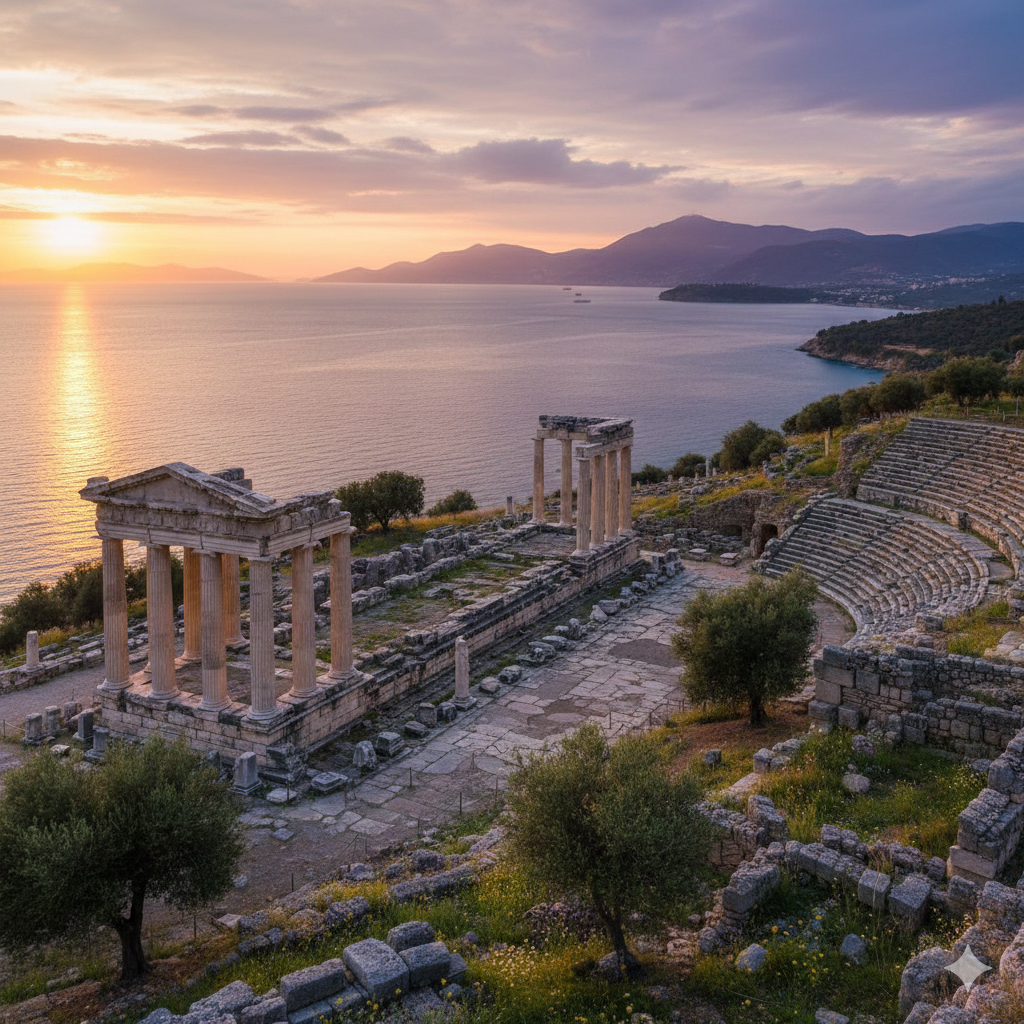
Parion (Parium) Ancient City – Biga, Çanakkale
Quick Summary: The ancient city of Parion (Parium) lies near Kemer village in the Biga district of Çanakkale, on the Marmara Sea coast of northwestern Anatolia. The settlement occupies both sides of a small river where it meets the sea, forming a natural harbour, and covers an area about 4 km in diameter, making it one of the largest archaeological sites in the region.
Table of Contents
- Overview
- Historical Background
- Archaeology and Urban Layout
- Visitor Experience
- A Short Story from the Past
- Practical Travel Notes
- FAQ
- Sources
Overview
The ancient city of Parion (Parium) lies near Kemer village in the Biga district of Çanakkale, on the Marmara Sea coast of northwestern Anatolia. The settlement occupies both sides of a small river where it meets the sea, forming a natural harbour, and covers an area about 4 km in diameter, making it one of the largest archaeological sites in the region.
This page is designed for real visitors: not only what this place is, but why it matters and how to experience it meaningfully.
Historical Background
The ancient city of Parion (Parium) lies near Kemer village in the Biga district of Çanakkale, on the Marmara Sea coast of northwestern Anatolia. The settlement occupies both sides of a small river where it meets the sea, forming a natural harbour, and covers an area about 4 km in diameter, making it one of the largest archaeological sites in the region.
(Source: Ondokuz Mayıs University – Parion Excavations
Canakkale.com.tr – Parion Ancient City (EN))
Parion was a Greek colonial foundation on the border between the historical regions of Troad and Mysia, probably established in the 7th–6th centuries BC. In antiquity it functioned as a major port city on the Hellespont / Propontis, serving as a commercial gateway for inland settlements. Ancient authors describe it as a coastal town west of Priapos in the district of Adrasteia.
(Source: ArticHaeology – “Parium Ancient City”
Greek Travel Pages – Information on the area Parion)
Over time Parion came under the rule of Persian, Hellenistic, Pergamene and Roman powers. In the Roman Imperial period it became an important harbour and bishopric; from the 5th century AD onward, sources refer to it as a Christian center, and by the 10th century it held the rank of archbishopric.
(Source: Wow Cappadocia – Parion (Parium) Ancient City)
Intensive excavations since 2005 have brought to light a large Roman bath complex, the cavea of a Roman theatre, a colonnaded street or agora, city walls, extensive necropolis areas, and harbour installations. Underwater research conducted in 2024–2025 revealed the remains of a second ancient port, confirming the city’s role as a key maritime hub of the Marmara region.
(Source: Turkish Archaeological News – Parion (Kemer)
Daily Sabah – “2700-year-old Roman harbor unearthed in Parion, Türkiye”
Greek Reporter – “Second Ancient Port Discovered at Parion, Turkey”)
Numismatic and epigraphic evidence shows that Parion minted its own coins from the...
Beyond the visible ruins, the historical value of this site comes from continuity: changing powers, changing urban functions, and changing ways people used public space over centuries.
Archaeology and Urban Layout
When reading this site on location, focus on three layers:
- Circulation layer: streets, gates, terraces, harbor or slope connections
- Public layer: theaters, agoras, baths, temples, administrative spaces
- Infrastructure layer: water systems, walls, storage zones, service architecture
This method helps visitors and researchers understand the city as a living system rather than isolated monuments.
Visitor Experience
A high-quality visit usually includes:
- A first orientation point (viewpoint, acropolis edge, or central axis)
- A pass through the site’s signature structure
- A slower walk through daily-life spaces
- A final stop connecting ruins with landscape
This sequence creates a stronger historical narrative than quick “photo-only” movement.
A Short Story from the Past
Imagine arriving here in antiquity at sunrise: workers preparing the day, travelers entering through roads or harbor routes, merchants opening storage spaces, and public architecture already shaping movement and ritual. The stones you see today are not silent objects; they are fragments of those repeated daily rhythms.
Practical Travel Notes
- Prefer spring and autumn for comfort.
- In summer, avoid midday peak heat when possible.
- Wear stable walking shoes for uneven terrain.
- Keep enough time (at least 1.5–3 hours) for a meaningful route.
- Check current access and ticket conditions before departure.
FAQ
Why is Parion (Parium) Ancient City – Biga, Çanakkale important?
Because it preserves multiple historical layers and helps explain regional cultural continuity in Türkiye.
How long should I spend here?
Most visitors spend 1.5–3 hours; in-depth visits may take half a day.
Is this suitable for first-time archaeology travelers?
Yes. With basic planning, this site is suitable for both first-time and experienced visitors.
Sources
- https://ark-itbf.omu.edu.tr/en/ara%C5%9Ftirmalar/kazilar/parion-kazilari
- https://canakkale.com.tr/en/ne-yapmali1/tarihi-ve-kulturel-degerler/parion-ancient-city
- https://www.artichaeology.com/parium-ancient-city
- https://www.gtp.gr/LocpageInform.asp?id=60668
- https://wowcappadocia.com/parion-parium-ancient-city.html
- https://turkisharchaeonews.net/site/parion-kemer
- https://www.dailysabah.com/arts/2700-year-old-roman-harbor-unearthed-in-parion-turkiye/news
- https://greekreporter.com/2024/07/19/second-ancient-port-discovered-at-parion-turkey/