Neandria (Neandreia) Ancient City – Ezine, Çanakkale
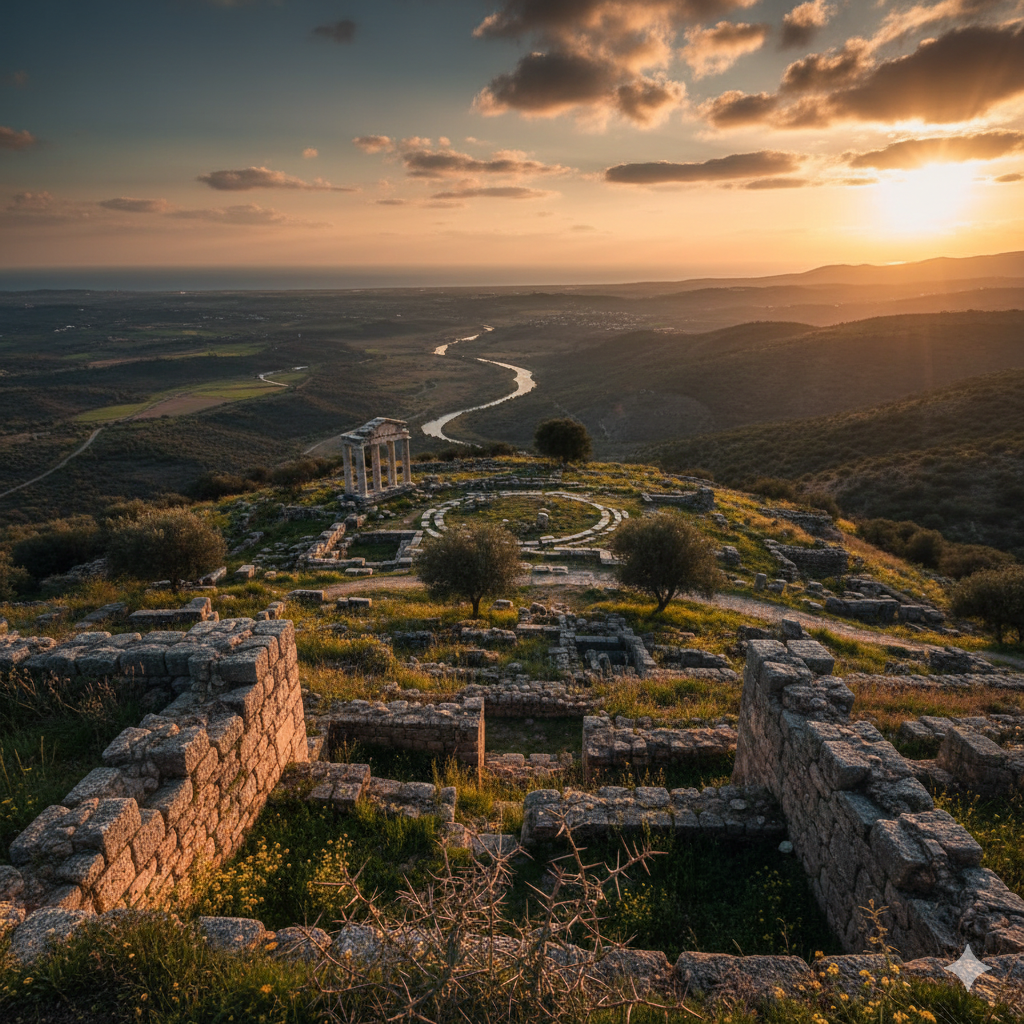
Quick Summary: Neandria (Neandreia) was an ancient Greek polis in the south-western Troad, located on Çığrı Dağ (Mount Çığrı), about 9 km east of Alexandria Troas in the modern district of Ezine, Çanakkale. The city occupied the summit and upper slopes of a granite hill with steep sides and wide views over the western Troad and the middle Skamander valley, making it an ideal defensive stronghold and lookout point.
Table of Contents
- Overview
- Historical Background
- Archaeology and Urban Layout
- Visitor Experience
- A Short Story from the Past
- Practical Travel Notes
- FAQ
- Sources
Overview
Neandria (Neandreia) was an ancient Greek polis in the south-western Troad, located on Çığrı Dağ (Mount Çığrı), about 9 km east of Alexandria Troas in the modern district of Ezine, Çanakkale. The city occupied the summit and upper slopes of a granite hill with steep sides and wide views over the western Troad and the middle Skamander valley, making it an ideal defensive stronghold and lookout point.
This page is designed for real visitors: not only what this place is, but why it matters and how to experience it meaningfully.
Historical Background
Neandria (Neandreia) was an ancient Greek polis in the south-western Troad, located on Çığrı Dağ (Mount Çığrı), about 9 km east of Alexandria Troas in the modern district of Ezine, Çanakkale. The city occupied the summit and upper slopes of a granite hill with steep sides and wide views over the western Troad and the middle Skamander valley, making it an ideal defensive stronghold and lookout point.
(Source: Neandreia – Wikipedia)
The site’s origins lie in the Archaic period. Although we do not know the exact circumstances of its foundation, archaeological remains on Çığrı Dağ date back to the 6th century BC, including a temple (probably of Apollo), an agora, a stoa, and early fortifications. In the Periplus of Pseudo-Scylax, Neandria is described as an Aeolian city, a fact supported by inscriptions in the Aeolic dialect from the 6th century BC.
(Source: Neandreia – Wikipedia)
In the 5th century BC, Neandria belonged to the Delian League and appears in the Athenian tribute lists as part of the Hellespontine district, paying a tribute of 2,000 drachmas. Later, during the late 5th and early 4th centuries BC, the city came under the control of Zenis and Mania of Dardanus, acting on behalf of the Persian satrap Pharnabazos, and was then freed by the Spartan commander Dercylidas.
(Source: Neandreia – Wikipedia)
Archaeological surveys show that in this period a new circuit of fortification walls was built from granite ashlar blocks, about 3.2 km long, nearly 3 m thick and enclosing an area of roughly 40 hectares. Within this walled space, houses were laid out on a rectangular grid, with an internal drainage system and possibly a small theatre or stepped structure; the total population at that time is estimated at around 2,500 inhabitants.
(Source: Neandreia – Wikipedia
Neandria – Culture Inventory (EN))
Around 310 BC, Antigonus I Monophthalmus founded Antigonia Troas, later renamed Alexandria Troas, by synoecizing several surrounding communities, including Neandria. The inhabitants of Neandria were relocated to this new coastal city, and from then on Neandria ceased to exist as an independent polis. The earliest coins of Alexandria Troas adopted Neandria’s grazing horse type, preserving the older city’s emblem in the coinage...
Beyond the visible ruins, the historical value of this site comes from continuity: changing powers, changing urban functions, and changing ways people used public space over centuries.
Archaeology and Urban Layout
When reading this site on location, focus on three layers:
- Circulation layer: streets, gates, terraces, harbor or slope connections
- Public layer: theaters, agoras, baths, temples, administrative spaces
- Infrastructure layer: water systems, walls, storage zones, service architecture
This method helps visitors and researchers understand the city as a living system rather than isolated monuments.
Visitor Experience
A high-quality visit usually includes:
- A first orientation point (viewpoint, acropolis edge, or central axis)
- A pass through the site’s signature structure
- A slower walk through daily-life spaces
- A final stop connecting ruins with landscape
This sequence creates a stronger historical narrative than quick “photo-only” movement.
A Short Story from the Past
Imagine arriving here in antiquity at sunrise: workers preparing the day, travelers entering through roads or harbor routes, merchants opening storage spaces, and public architecture already shaping movement and ritual. The stones you see today are not silent objects; they are fragments of those repeated daily rhythms.
Practical Travel Notes
- Prefer spring and autumn for comfort.
- In summer, avoid midday peak heat when possible.
- Wear stable walking shoes for uneven terrain.
- Keep enough time (at least 1.5–3 hours) for a meaningful route.
- Check current access and ticket conditions before departure.
FAQ
Why is Neandria (Neandreia) Ancient City – Ezine, Çanakkale important?
Because it preserves multiple historical layers and helps explain regional cultural continuity in Türkiye.
How long should I spend here?
Most visitors spend 1.5–3 hours; in-depth visits may take half a day.
Is this suitable for first-time archaeology travelers?
Yes. With basic planning, this site is suitable for both first-time and experienced visitors.
Sources
- https://en.wikipedia.org/wiki/Neandreia
- https://kulturenvanteri.com/en/yer/neandria/
- https://ancientcitiesturkey.com/en/neandria
- https://turkisharchaeonews.net/site/neandria
- https://commons.wikimedia.org/w/index.php?search=Neandria+Ancient+City+–+Ezine,+Çanakkale&title=Special:MediaSearch&type=image
- https://en.wikipedia.org/wiki/Neandria_Ancient_City_–_Ezine,_Çanakkale