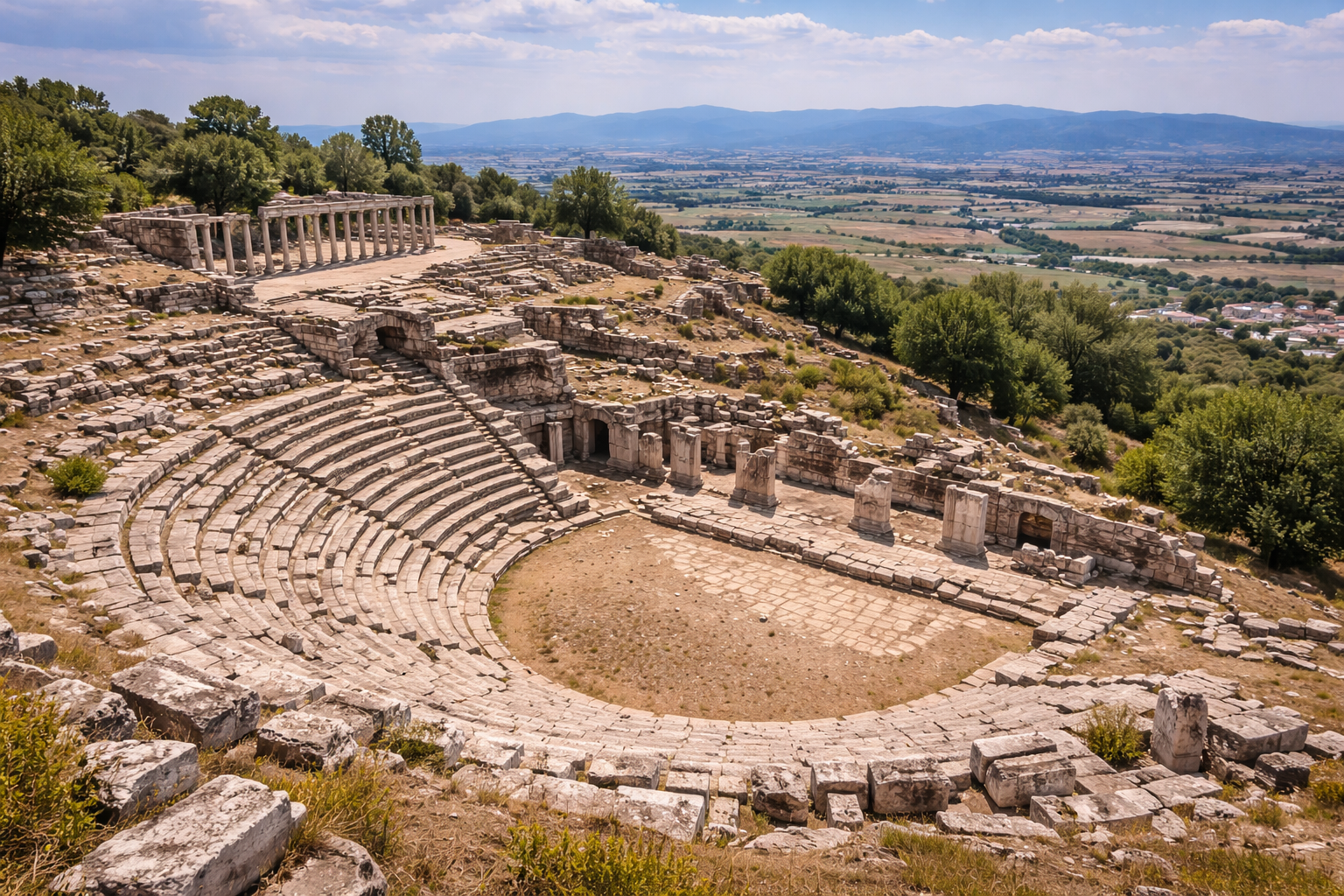
Metropolis Ancient City – Torbalı, İzmir
Quick Summary: The ancient city of Metropolis lies on the slopes of a hill between the villages of Yeniköy and Özbey in the district of Torbalı, about 40–45 km southeast of İzmir and roughly 30 km from Ephesus. Overlooking the Kaystros (Küçük Menderes) River plain, the site controlled the routes linking the Aegean coast with the inland valleys, making it a strategic node between the Ionian coastal cities and the interior of western Anatolia.
Table of Contents
- Overview
- Historical Background
- Archaeology and Urban Layout
- Visitor Experience
- A Short Story from the Past
- Practical Travel Notes
- FAQ
- Sources
Overview
The ancient city of Metropolis lies on the slopes of a hill between the villages of Yeniköy and Özbey in the district of Torbalı, about 40–45 km southeast of İzmir and roughly 30 km from Ephesus. Overlooking the Kaystros (Küçük Menderes) River plain, the site controlled the routes linking the Aegean coast with the inland valleys, making it a strategic node between the Ionian coastal cities and the interior of western Anatolia.
This page is designed for real visitors: not only what this place is, but why it matters and how to experience it meaningfully.
Historical Background
The ancient city of Metropolis lies on the slopes of a hill between the villages of Yeniköy and Özbey in the district of Torbalı, about 40–45 km southeast of İzmir and roughly 30 km from Ephesus. Overlooking the Kaystros (Küçük Menderes) River plain, the site controlled the routes linking the Aegean coast with the inland valleys, making it a strategic node between the Ionian coastal cities and the interior of western Anatolia.
(Source: Culture Portal of Türkiye – Metropolis Archaeological Site – İzmir
Izmir Provincial Directorate of Culture and Tourism – Metropolis (Torbalı))
The name Metropolis means “City of the Mother Goddess” and is linked to the local cult of Meter Gallesia (Metagallezya) on nearby Mount Gallesion. A cult cave and rock sanctuary at Uyuzdere have yielded numerous figurines and votive offerings dedicated to the Mother Goddess. While the earliest architectural and ceramic remains on the acropolis belong to the Late Geometric period, the city as a planned Hellenistic settlement with terraces, streets and monumental public buildings took shape in the 3rd century BC. Prehistoric settlement at the nearby site of Bademgediği Tepe goes back to the Neolithic and Bronze Ages; the area is thought to have been known as Puranda in Hittite sources.
(Source: Metropolis Excavations – History of the City
Izmir Metropolis Archaeological Site – Turkish Museums
Wikipedia – Metropolis (Anatolia))
Systematic archaeological work at Metropolis began in 1989 under Prof. Recep Meriç, initially focusing on the Mother-Goddess cave sanctuary at Uyuzdere in cooperation with the Ephesus Museum, and later expanding over the whole city. Since 2006, the project has been directed by Prof. Serdar Aybek. The excavations, supported by the Ministry of Culture and Tourism, the General Directorate of Cultural Heritage and Museums and the Sabancı Foundation, have continued without interruption, and in 2014 Metropolis was officially opened to visitors as an archaeological site.
(Source: Izmir Provincial Directorate of Culture and Tourism – [Metropolis Excavation / Torbalı](https://izmir.ktb.gov.tr/EN-24033...
Beyond the visible ruins, the historical value of this site comes from continuity: changing powers, changing urban functions, and changing ways people used public space over centuries.
Archaeology and Urban Layout
When reading this site on location, focus on three layers:
- Circulation layer: streets, gates, terraces, harbor or slope connections
- Public layer: theaters, agoras, baths, temples, administrative spaces
- Infrastructure layer: water systems, walls, storage zones, service architecture
This method helps visitors and researchers understand the city as a living system rather than isolated monuments.
Visitor Experience
A high-quality visit usually includes:
- A first orientation point (viewpoint, acropolis edge, or central axis)
- A pass through the site’s signature structure
- A slower walk through daily-life spaces
- A final stop connecting ruins with landscape
This sequence creates a stronger historical narrative than quick “photo-only” movement.
A Short Story from the Past
Imagine arriving here in antiquity at sunrise: workers preparing the day, travelers entering through roads or harbor routes, merchants opening storage spaces, and public architecture already shaping movement and ritual. The stones you see today are not silent objects; they are fragments of those repeated daily rhythms.
Practical Travel Notes
- Prefer spring and autumn for comfort.
- In summer, avoid midday peak heat when possible.
- Wear stable walking shoes for uneven terrain.
- Keep enough time (at least 1.5–3 hours) for a meaningful route.
- Check current access and ticket conditions before departure.
FAQ
Why is Metropolis Ancient City – Torbalı, İzmir important?
Because it preserves multiple historical layers and helps explain regional cultural continuity in Türkiye.
How long should I spend here?
Most visitors spend 1.5–3 hours; in-depth visits may take half a day.
Is this suitable for first-time archaeology travelers?
Yes. With basic planning, this site is suitable for both first-time and experienced visitors.
Sources
- https://www.kulturportali.gov.tr/turkiye/izmir/gezilecekyer/metropolis-orenyeri
- https://izmir.ktb.gov.tr/EN-240338/metropolis-torbali.html
- https://metropolistr.org/metropolis-Tarihce.aspx
- https://www.turkishmuseums.com/museum/detail/2098-izmir-metropolis-archaeological-site/2098/4
- https://en.wikipedia.org/wiki/Metropolis_%28Anatolia%29
- https://www.dailysabah.com/history/2018/07/19/ancient-city-of-metropolis-in-turkeys-izmir-ready-for-further-excavation
- https://www.dailysabah.com/life/history/archaeologists-unearth-cisterns-at-izmirs-ancient-metropolis
- https://www.anatolianarchaeology.net/1800-year-old-roman-agora-unearthed-in-the-ancient-city-of-metropolis/