Daskyleion (Dascylium) Ancient City – Bandırma, Balıkesir
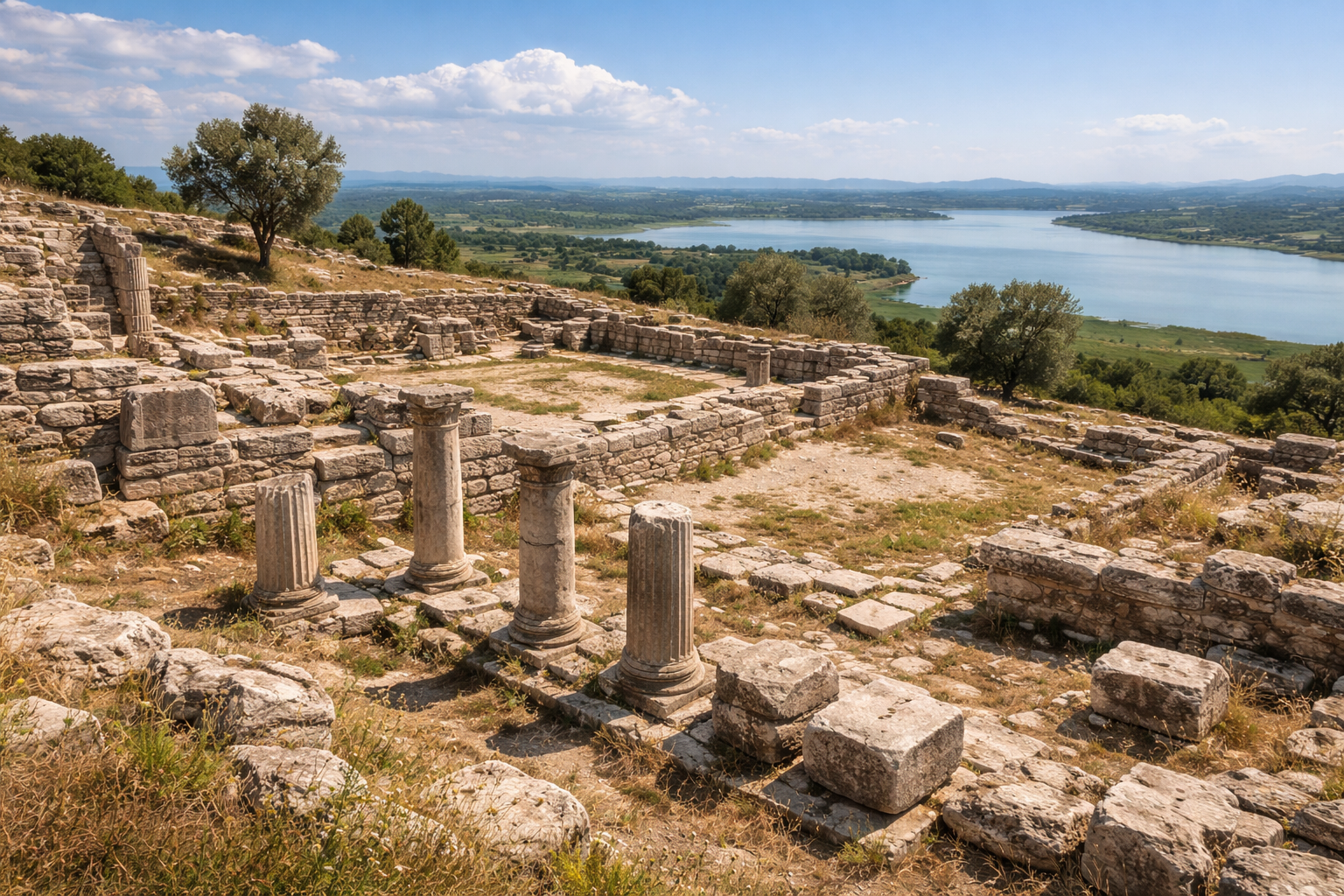
Quick Summary: Daskyleion (Dascylium) is located on Hisartepe hill near Ergili village, on the southeastern shore of Lake Manyas (ancient Dascylitis Limne) in the district of Bandırma, Balıkesir, northwestern Turkey. The site overlooks the wetlands of Lake Manyas National Park, today known as Bird Paradise.
Table of Contents
- Overview
- Historical Background
- Archaeology and Urban Layout
- Visitor Experience
- A Short Story from the Past
- Practical Travel Notes
- FAQ
- Sources
Overview
Daskyleion (Dascylium) is located on Hisartepe hill near Ergili village, on the southeastern shore of Lake Manyas (ancient Dascylitis Limne) in the district of Bandırma, Balıkesir, northwestern Turkey. The site overlooks the wetlands of Lake Manyas National Park, today known as Bird Paradise.
This page is designed for real visitors: not only what this place is, but why it matters and how to experience it meaningfully.
Historical Background
Daskyleion (Dascylium) is located on Hisartepe hill near Ergili village, on the southeastern shore of Lake Manyas (ancient Dascylitis Limne) in the district of Bandırma, Balıkesir, northwestern Turkey. The site overlooks the wetlands of Lake Manyas National Park, today known as Bird Paradise.
(Source: Turkish Archaeological News – Daskyleion
Livius.org – Dascylium (Ergili))
Archaeological evidence shows that the site was inhabited since the Early Bronze Age, confirming the accounts of ancient writers such as Strabo and Dionysius of Halicarnassus. Around the 7th century BC, it became part of the Lydian Kingdom and was named Daskyleion after Dascylus, father of King Gyges. The lake nearby thus became known as Lake Dascylitis.
(Source: Turkish Archaeological News – Daskyleion)
After the Persian conquest of Lydia, Daskyleion became the capital of Hellespontine Phrygia, one of the Achaemenid satrapies. It served as the administrative and military headquarters of the Pharnacid dynasty, controlling routes between Anatolia and Europe.
(Source: Turkish Archaeological News – Daskyleion
Livius.org – Dascylium (Ergili))
Excavations have revealed architecture from multiple periods: Phrygian walls and a Cybele temple; Lydian fortifications and terraces; Persian palace remains and ritual areas; Hellenistic towers and streets; and a Byzantine citadel gate. Numerous artefacts such as sealings, coins, ceramics, reliefs, and inscriptions are displayed in the Bandırma and Istanbul Archaeological Museums.
(Source: Turkish Archaeological News – Daskyleion)
Recent work led by Prof. Kaan İren uncovered an 8th-century BC Phrygian wall and 5th-century BC Greco-Persian reliefs depicting the Greco-Persian Wars, likely serving as political propaganda. Excavations also revealed a 137-meter-long Lydian fortification wall, made of andesite and limestone, similar to the citadel walls of Gordion.
(Source: TRT World – Reliefs found in Daskyleion in northwest Turkey depict Greco-Persian Wars
Arkeoloji ve Sanat – [137 meter-long Lydian wall uncovered in Daskyleion](https://www.arkeolojisanat.com/shop/blog/das...
Beyond the visible ruins, the historical value of this site comes from continuity: changing powers, changing urban functions, and changing ways people used public space over centuries.
Archaeology and Urban Layout
When reading this site on location, focus on three layers:
- Circulation layer: streets, gates, terraces, harbor or slope connections
- Public layer: theaters, agoras, baths, temples, administrative spaces
- Infrastructure layer: water systems, walls, storage zones, service architecture
This method helps visitors and researchers understand the city as a living system rather than isolated monuments.
Visitor Experience
A high-quality visit usually includes:
- A first orientation point (viewpoint, acropolis edge, or central axis)
- A pass through the site’s signature structure
- A slower walk through daily-life spaces
- A final stop connecting ruins with landscape
This sequence creates a stronger historical narrative than quick “photo-only” movement.
A Short Story from the Past
Imagine arriving here in antiquity at sunrise: workers preparing the day, travelers entering through roads or harbor routes, merchants opening storage spaces, and public architecture already shaping movement and ritual. The stones you see today are not silent objects; they are fragments of those repeated daily rhythms.
Practical Travel Notes
- Prefer spring and autumn for comfort.
- In summer, avoid midday peak heat when possible.
- Wear stable walking shoes for uneven terrain.
- Keep enough time (at least 1.5–3 hours) for a meaningful route.
- Check current access and ticket conditions before departure.
FAQ
Why is Daskyleion (Dascylium) Ancient City – Bandırma, Balıkesir important?
Because it preserves multiple historical layers and helps explain regional cultural continuity in Türkiye.
How long should I spend here?
Most visitors spend 1.5–3 hours; in-depth visits may take half a day.
Is this suitable for first-time archaeology travelers?
Yes. With basic planning, this site is suitable for both first-time and experienced visitors.
Sources
- https://turkisharchaeonews.net/site/daskyleion
- https://www.livius.org/articles/place/dascylium-ergili/
- https://www.trtworld.com/article/12869724
- https://www.arkeolojisanat.com/shop/blog/daskyleion-antik-kentinde-lidyalilarca-insa-edilmis-137-metrelik-sur-ortaya-cikarildi_3_1410590.html
- https://commons.wikimedia.org/w/index.php?search=Daskyleion+Ancient+City+–+Bandırma,+Balıkesir&title=Special:MediaSearch&type=image
- https://en.wikipedia.org/wiki/Daskyleion_Ancient_City_–_Bandırma,_Balıkesir