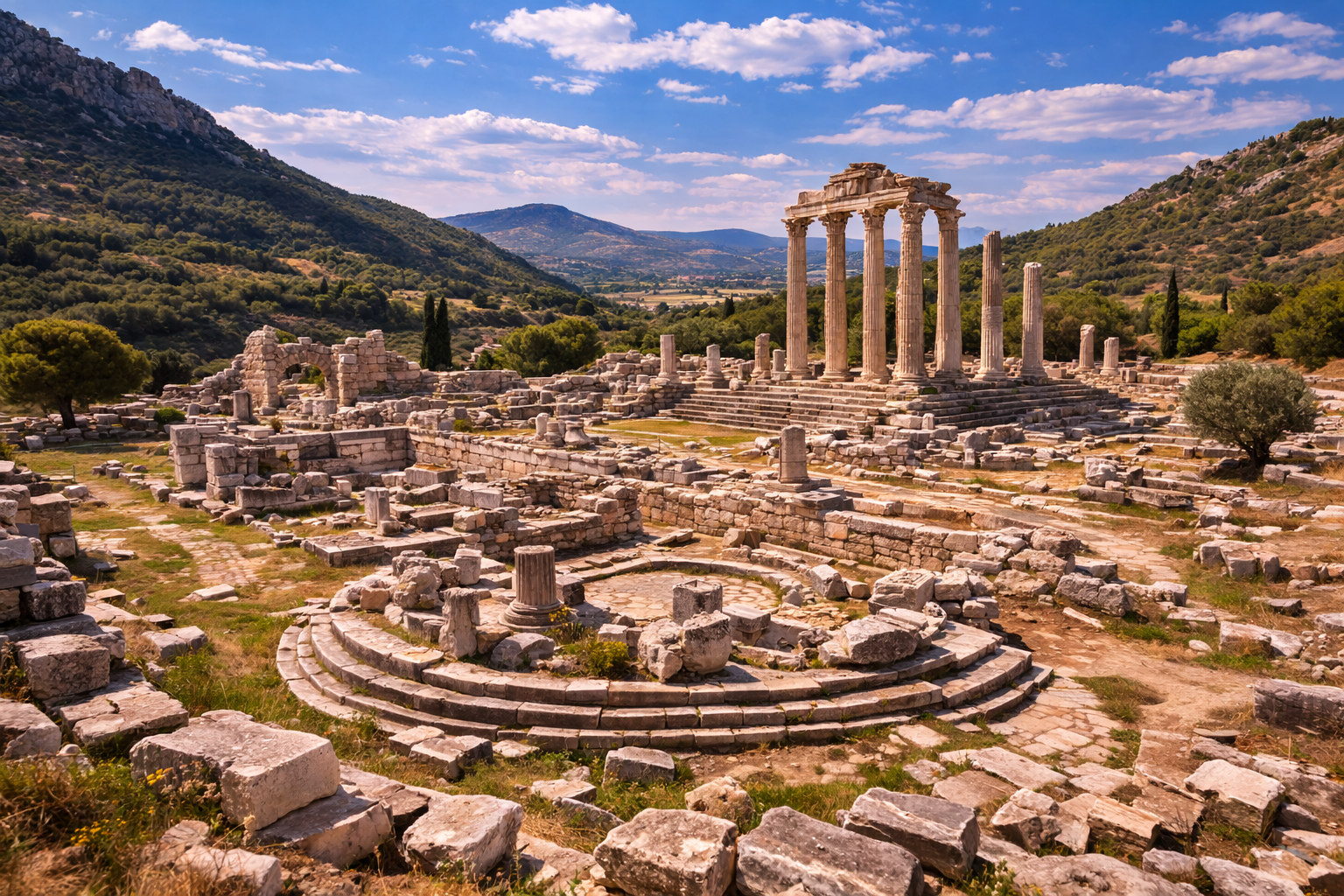
Claros Oracle Sanctuary – Menderes, İzmir
Quick Summary: Claros (Clarus) is an ancient sanctuary and oracle of Apollo in western Anatolia, located in the Ahmetbeyli valley of the Menderes district (İzmir Province). The sacred area lies on the flat floor of the valley that connects the Menderes plain to the Gulf of Kuşadası, about 13 km south of Colophon (Değirmendere) and around 2 km north of the coastal town of Notion.
Table of Contents
- Overview
- Historical Background
- Archaeology and Urban Layout
- Visitor Experience
- A Short Story from the Past
- Practical Travel Notes
- FAQ
- Sources
Overview
Claros (Clarus) is an ancient sanctuary and oracle of Apollo in western Anatolia, located in the Ahmetbeyli valley of the Menderes district (İzmir Province). The sacred area lies on the flat floor of the valley that connects the Menderes plain to the Gulf of Kuşadası, about 13 km south of Colophon (Değirmendere) and around 2 km north of the coastal town of Notion.
This page is designed for real visitors: not only what this place is, but why it matters and how to experience it meaningfully.
Historical Background
Claros (Clarus) is an ancient sanctuary and oracle of Apollo in western Anatolia, located in the Ahmetbeyli valley of the Menderes district (İzmir Province). The sacred area lies on the flat floor of the valley that connects the Menderes plain to the Gulf of Kuşadası, about 13 km south of Colophon (Değirmendere) and around 2 km north of the coastal town of Notion. Claros was never an independent polis; it functioned throughout antiquity as the sacred oracle center of Colophon, one of the twelve cities of the Ionian League.
(Source: İzmir Provincial Directorate of Culture and Tourism – Claros (Menderes)
Visitİzmir – Claros Archaeological Site
Wikipedia – Claros)
In the ancient Greek world, the oracle of Apollo at Claros ranked among the major prophetic centers, alongside Delphi in mainland Greece and Didyma near Miletus. Archaeology shows that the sanctuary was in use from at least the late 13th century BC and continued to attract pilgrims until the 4th century AD, when the spread of Christianity led to its abandonment – meaning over a thousand years of continuous religious activity.
(Source: Turkish Archaeological News – Claros
ANAMED – “Klaros: An Oracular Center of Apollo in Western Anatolia”)
Mythological traditions link the foundation of Claros to Manto, daughter of the Theban seer Tiresias, and to Apollo himself. An earlier sacred cave near the later temple suggests that the site may first have been a cult-place of the Anatolian mother goddess Cybele, later reinterpreted as an oracle of Apollo Clarius when Greek settlers arrived. Protogeometric pottery and early altars show that the area was a sacred landscape long before the monumental temple was built.
(Source: Turkish Archaeological News – Claros
Wikipedia – Claros)
The sanctuary of Claros preserves an unusually complete picture of how an ancient oracle worked, thanks to its architectural layout:
- A large Temple of Apollo in Doric order, with a subterranean adyton and underground corridors where the inspired prophet delivered responses.
- A monumental altar in front of the temple for large-scale sacrifices.
- A **propylon (mon...
Beyond the visible ruins, the historical value of this site comes from continuity: changing powers, changing urban functions, and changing ways people used public space over centuries.
Archaeology and Urban Layout
When reading this site on location, focus on three layers:
- Circulation layer: streets, gates, terraces, harbor or slope connections
- Public layer: theaters, agoras, baths, temples, administrative spaces
- Infrastructure layer: water systems, walls, storage zones, service architecture
This method helps visitors and researchers understand the city as a living system rather than isolated monuments.
Visitor Experience
A high-quality visit usually includes:
- A first orientation point (viewpoint, acropolis edge, or central axis)
- A pass through the site’s signature structure
- A slower walk through daily-life spaces
- A final stop connecting ruins with landscape
This sequence creates a stronger historical narrative than quick “photo-only” movement.
A Short Story from the Past
Imagine arriving here in antiquity at sunrise: workers preparing the day, travelers entering through roads or harbor routes, merchants opening storage spaces, and public architecture already shaping movement and ritual. The stones you see today are not silent objects; they are fragments of those repeated daily rhythms.
Practical Travel Notes
- Prefer spring and autumn for comfort.
- In summer, avoid midday peak heat when possible.
- Wear stable walking shoes for uneven terrain.
- Keep enough time (at least 1.5–3 hours) for a meaningful route.
- Check current access and ticket conditions before departure.
FAQ
Why is Claros Oracle Sanctuary – Menderes, İzmir important?
Because it preserves multiple historical layers and helps explain regional cultural continuity in Türkiye.
How long should I spend here?
Most visitors spend 1.5–3 hours; in-depth visits may take half a day.
Is this suitable for first-time archaeology travelers?
Yes. With basic planning, this site is suitable for both first-time and experienced visitors.
Sources
- https://izmir.ktb.gov.tr/EN-240332/klaros-menderes.html
- https://www.visitizmir.org/en/Destination/11678
- https://en.wikipedia.org/wiki/Claros
- https://turkisharchaeonews.net/site/claros
- https://anamed.ku.edu.tr/klaros-an-oracular-center-of-apollo-in-western-anatolia/
- https://de.wikipedia.org/wiki/Nuran_%C5%9Eahin
- https://commons.wikimedia.org/w/index.php?search=Claros+Oracle+Sanctuary+–+Menderes,+İzmir&title=Special:MediaSearch&type=image
- https://en.wikipedia.org/wiki/Claros_Oracle_Sanctuary_–_Menderes,_İzmir