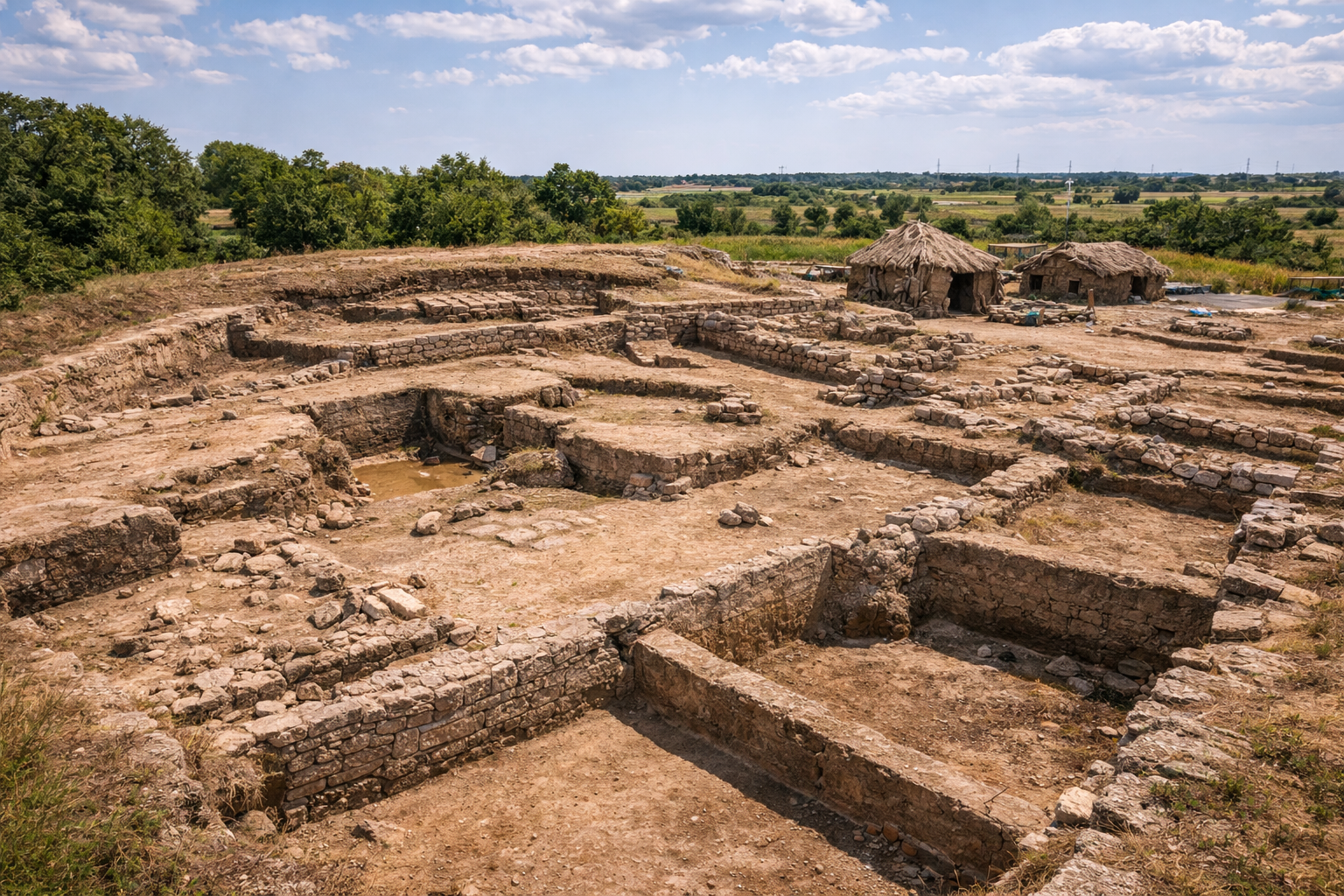
Aşağı Pınar Mound (Kırklareli)
Quick Summary: Aşağı Pınar Mound is a prehistoric settlement mound located about 3 km south of Kırklareli city center, on the road to Asilbeyli village, in a transitional zone between the Istranca (Strandzha) Mountains and the Ergene Basin. The site lies close to fresh-water sources and the Haydardere stream, on a low, flat mound that blends into the surrounding topography.
Table of Contents
- Overview
- Historical Background
- Archaeology and Urban Layout
- Visitor Experience
- A Short Story from the Past
- Practical Travel Notes
- FAQ
- Sources
Overview
Aşağı Pınar Mound is a prehistoric settlement mound located about 3 km south of Kırklareli city center, on the road to Asilbeyli village, in a transitional zone between the Istranca (Strandzha) Mountains and the Ergene Basin. The site lies close to fresh-water sources and the Haydardere stream, on a low, flat mound that blends into the surrounding topography.
This page is designed for real visitors: not only what this place is, but why it matters and how to experience it meaningfully.
Historical Background
Aşağı Pınar Mound is a prehistoric settlement mound located about 3 km south of Kırklareli city center, on the road to Asilbeyli village, in a transitional zone between the Istranca (Strandzha) Mountains and the Ergene Basin. The site lies close to fresh-water sources and the Haydardere stream, on a low, flat mound that blends into the surrounding topography.
(Source: Kırklareli Project – Aşağı Pınar
https://kirklareliprojesi.org/asagipinar/
TAY Project – Aşağı Pınar
https://www.tayproject.org/TAYmaster.fm%24Retrieve?YerlesmeNo=218&html=masterdetail.html&layout=web)
First identified by Mehmet Özdoğan in 1980, Aşağı Pınar has been excavated systematically since the early 1990s. Excavations have revealed nine cultural layers, spanning roughly from 6200 to 4400/4300 BC, covering the Late Neolithic to Early Chalcolithic. This sequence makes Aşağı Pınar one of the earliest and most completely excavated farming settlements in Eastern Thrace.
(Source: Vici.org – Asagi Pinar – Kirklareli Höyük
https://vici.org/vici/46172/?lang=en
JADER article on Aşağı Pınar prehistoric settlement
https://dergipark.org.tr/tr/pub/jader/issue/73495/1207499)
Aşağı Pınar is considered a key site for understanding the spread of the Neolithic “way of life” from Anatolia into Europe. The arrival of the first farming communities in Thrace and their adaptation to the local environment can be traced here, so the mound plays a central role in discussions of the Neolithic Revolution in the Balkans.
(Source: Green Corridors – “The excavation area of Aşağı Pınar”
https://greencorridors.burgas.bg/en/objects/view/80
“Continuity and Discontinuity in Eastern Thrace during the Neolithic Period”
https://www.cambridge.org/core/books/6000-bc/continuity-and-discontinuity-in-eastern-thrace-during-the-neolithic-period/7DA1C1BD3EF3E27EE25EFFFDABA0D641)
Archaeological work has uncovered wattle-and-daub houses with rectangular or multi-room plans, ovens and hearths, storage pits, ditches and various ritual features. Together, these remains show how Neolithic households at Aşağı Pınar organized domestic space, food production and storage, and ritual practices through time.
(Source: Eylem Özdoğan – “Contextualising the Neolithic House: A View from Aşağı Pınar in Eastern Thrace”
https://www.academia.edu/44594897/
“Settlement Organization and Architecture in Aşağı Pınar”
https://www.researchgate.net/publication/332100865_Settlement_Organization_and_Architecture_in_Asagi_Pinar_2011)
Today, part of the site is arranged as an **open-a...
Beyond the visible ruins, the historical value of this site comes from continuity: changing powers, changing urban functions, and changing ways people used public space over centuries.
Archaeology and Urban Layout
When reading this site on location, focus on three layers:
- Circulation layer: streets, gates, terraces, harbor or slope connections
- Public layer: theaters, agoras, baths, temples, administrative spaces
- Infrastructure layer: water systems, walls, storage zones, service architecture
This method helps visitors and researchers understand the city as a living system rather than isolated monuments.
Visitor Experience
A high-quality visit usually includes:
- A first orientation point (viewpoint, acropolis edge, or central axis)
- A pass through the site’s signature structure
- A slower walk through daily-life spaces
- A final stop connecting ruins with landscape
This sequence creates a stronger historical narrative than quick “photo-only” movement.
A Short Story from the Past
Imagine arriving here in antiquity at sunrise: workers preparing the day, travelers entering through roads or harbor routes, merchants opening storage spaces, and public architecture already shaping movement and ritual. The stones you see today are not silent objects; they are fragments of those repeated daily rhythms.
Practical Travel Notes
- Prefer spring and autumn for comfort.
- In summer, avoid midday peak heat when possible.
- Wear stable walking shoes for uneven terrain.
- Keep enough time (at least 1.5–3 hours) for a meaningful route.
- Check current access and ticket conditions before departure.
FAQ
Why is Aşağı Pınar Mound (Kırklareli) important?
Because it preserves multiple historical layers and helps explain regional cultural continuity in Türkiye.
How long should I spend here?
Most visitors spend 1.5–3 hours; in-depth visits may take half a day.
Is this suitable for first-time archaeology travelers?
Yes. With basic planning, this site is suitable for both first-time and experienced visitors.
Sources
- https://kirklareliprojesi.org/asagipinar/
- https://www.tayproject.org/TAYmaster.fm%24Retrieve?YerlesmeNo=218&html=masterdetail.html&layout=web
- https://vici.org/vici/46172/?lang=en
- https://dergipark.org.tr/tr/pub/jader/issue/73495/1207499
- https://greencorridors.burgas.bg/en/objects/view/80
- https://www.cambridge.org/core/books/6000-bc/continuity-and-discontinuity-in-eastern-thrace-during-the-neolithic-period/7DA1C1BD3EF3E27EE25EFFFDABA0D641
- https://www.academia.edu/44594897/
- https://www.researchgate.net/publication/332100865_Settlement_Organization_and_Architecture_in_Asagi_Pinar_2011