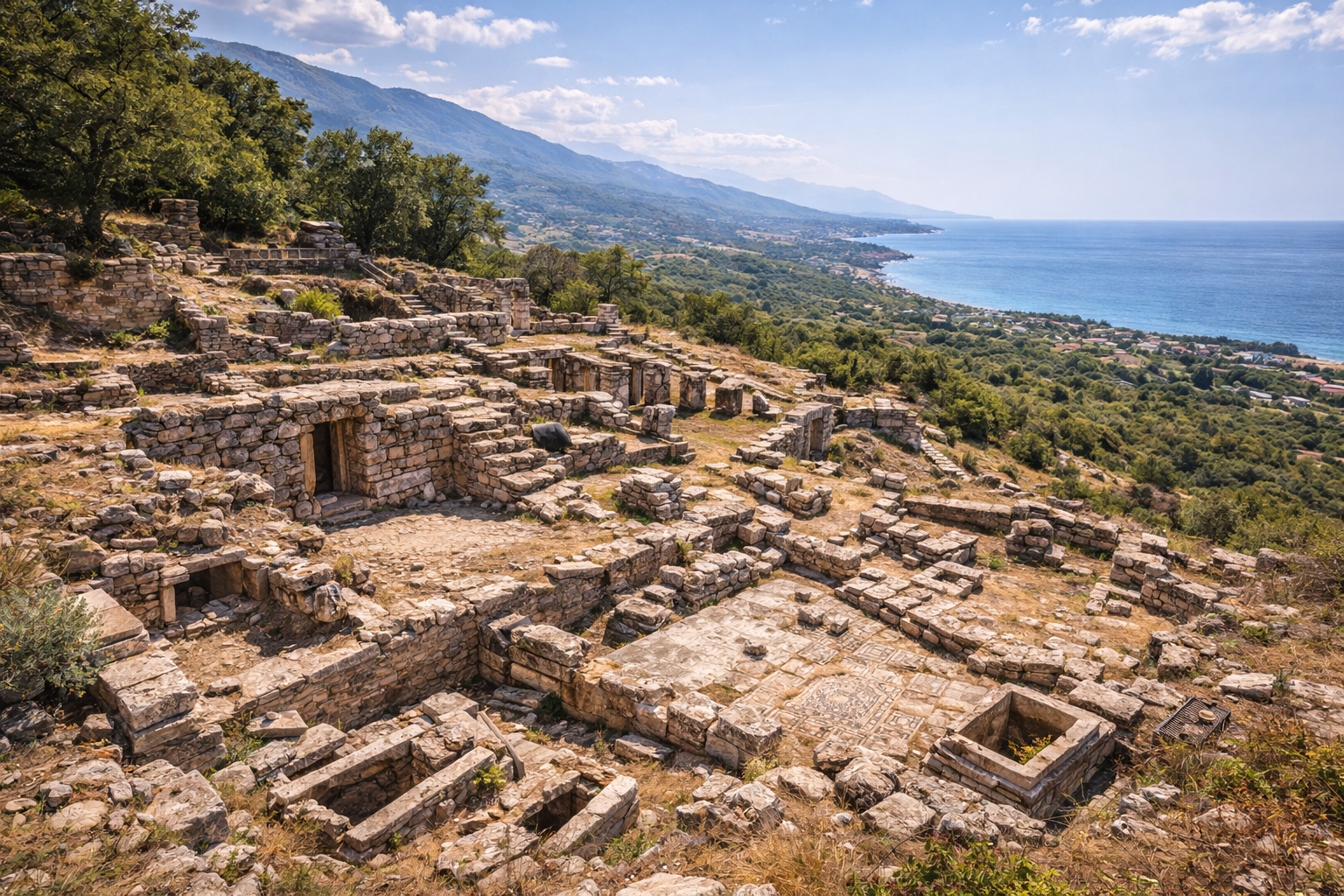
Antandros Ancient City – Edremit, Balıkesir
Quick Summary: The ancient city of Antandros lies near Altınoluk in the Edremit district of Balıkesir, on the north shore of the Gulf of Edremit, on the southern slopes of Mount Ida (Kaz Dağı). The site occupies the summit and western slopes of Kaletaşı Hill, about 2–2.5 km east of modern Altınoluk, directly above the old coastal road between Çanakkale and Edremit.
Table of Contents
- Overview
- Historical Background
- Archaeology and Urban Layout
- Visitor Experience
- A Short Story from the Past
- Practical Travel Notes
- FAQ
- Sources
Overview
The ancient city of Antandros lies near Altınoluk in the Edremit district of Balıkesir, on the north shore of the Gulf of Edremit, on the southern slopes of Mount Ida (Kaz Dağı). The site occupies the summit and western slopes of Kaletaşı Hill, about 2–2.5 km east of modern Altınoluk, directly above the old coastal road between Çanakkale and Edremit.
This page is designed for real visitors: not only what this place is, but why it matters and how to experience it meaningfully.
Historical Background
The ancient city of Antandros lies near Altınoluk in the Edremit district of Balıkesir, on the north shore of the Gulf of Edremit, on the southern slopes of Mount Ida (Kaz Dağı). The site occupies the summit and western slopes of Kaletaşı Hill, about 2–2.5 km east of modern Altınoluk, directly above the old coastal road between Çanakkale and Edremit. Its elevated terraces command both overland routes between Mysia and the Troad and important North Aegean maritime routes, which made Antandros a strategically significant harbor city in antiquity.
(Source: Republic of Türkiye Ministry of Culture and Tourism – Antandros Ancient City
Antandros Association – Ancient City of Antandros
Turkish Archaeological News – Antandros)
Ancient authors give conflicting traditions for the foundation of Antandros. The poet Alcaeus attributes the city to the Leleges, Herodotus describes it as a Pelasgian foundation, while Thucydides and later writers call it an Aeolian colony. Archaeological finds – especially pottery and grave goods – indicate continuous occupation from at least the 8th–7th centuries BC, with the city flourishing thanks to the timber and pitch supplied by the forests of Mount Ida, ideal for shipbuilding and naval activities.
(Source: Wikipedia – Antandrus
Antandros Association – History
Ancient City of Antandros – GoTürkiye Cultural Journeys)
The necropolis of Antandros, discovered during modern construction in the late 20th century, has yielded hundreds of graves, including stone sarcophagi, amphora burials, cist graves and cremation burials. Excavations show that the cemetery was used from the 8th century BC to the 1st century AD, after which parts of the area were reused in Late Antiquity as industrial installations such as wine presses and glass workshops. The rich grave offerings – pottery, jewelry, weapons and everyday objects – provide detailed evidence for the city’s social structure and funerary customs over nearly a millennium.
(Source: Antandros Association – Necropolis
Anadolu Agency – [Roman Villa and Necropolis Unearthed in Antandros](https://www.aa.com....
Beyond the visible ruins, the historical value of this site comes from continuity: changing powers, changing urban functions, and changing ways people used public space over centuries.
Archaeology and Urban Layout
When reading this site on location, focus on three layers:
- Circulation layer: streets, gates, terraces, harbor or slope connections
- Public layer: theaters, agoras, baths, temples, administrative spaces
- Infrastructure layer: water systems, walls, storage zones, service architecture
This method helps visitors and researchers understand the city as a living system rather than isolated monuments.
Visitor Experience
A high-quality visit usually includes:
- A first orientation point (viewpoint, acropolis edge, or central axis)
- A pass through the site’s signature structure
- A slower walk through daily-life spaces
- A final stop connecting ruins with landscape
This sequence creates a stronger historical narrative than quick “photo-only” movement.
A Short Story from the Past
Imagine arriving here in antiquity at sunrise: workers preparing the day, travelers entering through roads or harbor routes, merchants opening storage spaces, and public architecture already shaping movement and ritual. The stones you see today are not silent objects; they are fragments of those repeated daily rhythms.
Practical Travel Notes
- Prefer spring and autumn for comfort.
- In summer, avoid midday peak heat when possible.
- Wear stable walking shoes for uneven terrain.
- Keep enough time (at least 1.5–3 hours) for a meaningful route.
- Check current access and ticket conditions before departure.
FAQ
Why is Antandros Ancient City – Edremit, Balıkesir important?
Because it preserves multiple historical layers and helps explain regional cultural continuity in Türkiye.
How long should I spend here?
Most visitors spend 1.5–3 hours; in-depth visits may take half a day.
Is this suitable for first-time archaeology travelers?
Yes. With basic planning, this site is suitable for both first-time and experienced visitors.
Sources
- https://www.kulturportali.gov.tr/turkiye/balikesir/gezilecekyer/antandros-edremit-altinoluk-antik-kenti
- https://antandros.org/en/antandros/
- https://turkisharchaeonews.net/site/antandros
- https://en.wikipedia.org/wiki/Antandrus
- https://culturaljourneys.goturkiye.com/ancient-city-of-antandros
- https://antandros.org/nekropolis/
- https://www.aa.com.tr/en/culture/antandros-roman-villa-excavations-shed-light-on-ancient-life/2322750
- https://antandros.org/en/excavations/