Quick Summary: The ancient city of Erythrae (Greek: Ἐρυθραί, “the Red City”) lies near the modern village of Ildırı, on the northeastern coast of the Çeşme Peninsula, İzmir Province. It was one of the twelve Ionian cities, situated opposite the island of Chios (Sakız Adası), and served as an important port and trading centre throughout the Archaic and Classical periods.
- Overview
- Historical Background
- Archaeology and Urban Layout
- Visitor Experience
- A Short Story from the Past
- Practical Travel Notes
- FAQ
- Sources
Overview
The ancient city of Erythrae (Greek: Ἐρυθραί, “the Red City”) lies near the modern village of Ildırı, on the northeastern coast of the Çeşme Peninsula, İzmir Province. It was one of the twelve Ionian cities, situated opposite the island of Chios (Sakız Adası), and served as an important port and trading centre throughout the Archaic and Classical periods.
This page is designed for real visitors: not only what this place is, but why it matters and how to experience it meaningfully.
Historical Background
The ancient city of Erythrae (Greek: Ἐρυθραί, “the Red City”) lies near the modern village of Ildırı, on the northeastern coast of the Çeşme Peninsula, İzmir Province. It was one of the twelve Ionian cities, situated opposite the island of Chios (Sakız Adası), and served as an important port and trading centre throughout the Archaic and Classical periods.
(Source: Izmir Directorate of Culture and Tourism – “Erythrai (Ildırı)”;
Turkish Museums – “Erythrai Archaeological Site”;
Wikipedia – “Erythrae”)
Erythrae was founded around the 8th century BC and became famous for its wine, figs, and prophecy cults. Ancient writers such as Strabo and Pausanias mention the presence of a Sibyl (prophetess) at Erythrae, whose oracles were known across the ancient Mediterranean. Alongside Delphi and Didyma, the sanctuary of Erythrae was one of the three most respected centres of prophecy in the Greek world.
(Source: Wikipedia – “Erythrae”;
Oxford Classical Dictionary – “Erythrae” entry)
The city prospered as a member of the Ionian League, controlling fertile lands and an excellent natural harbour. Like many Ionian cities, it was destroyed during the Persian conquest (mid-6th century BC) but regained autonomy under Alexander the Great in the 4th century BC. In the Hellenistic period, Erythrae was rebuilt with a grid plan, monumental agora, theatre, temples, and city walls. It continued to thrive under the Romans, maintaining its status as a regional port until the 3rd century AD.
(Source: Turkish Museums – “Erythrai Archaeological Site”;
Ancient Cities of Turkey – “Erythrai”;
Wikipedia – “Erythrae”)
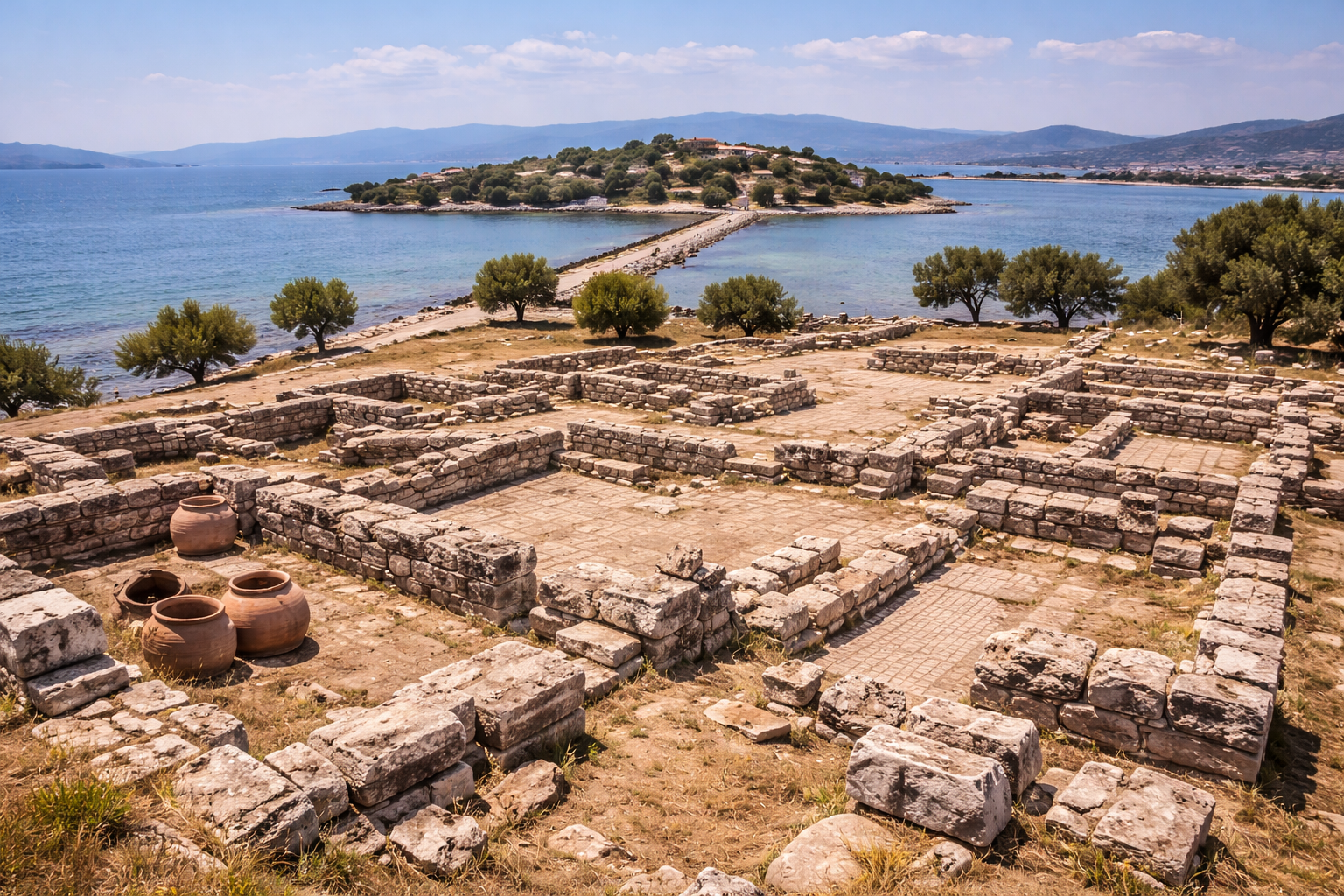
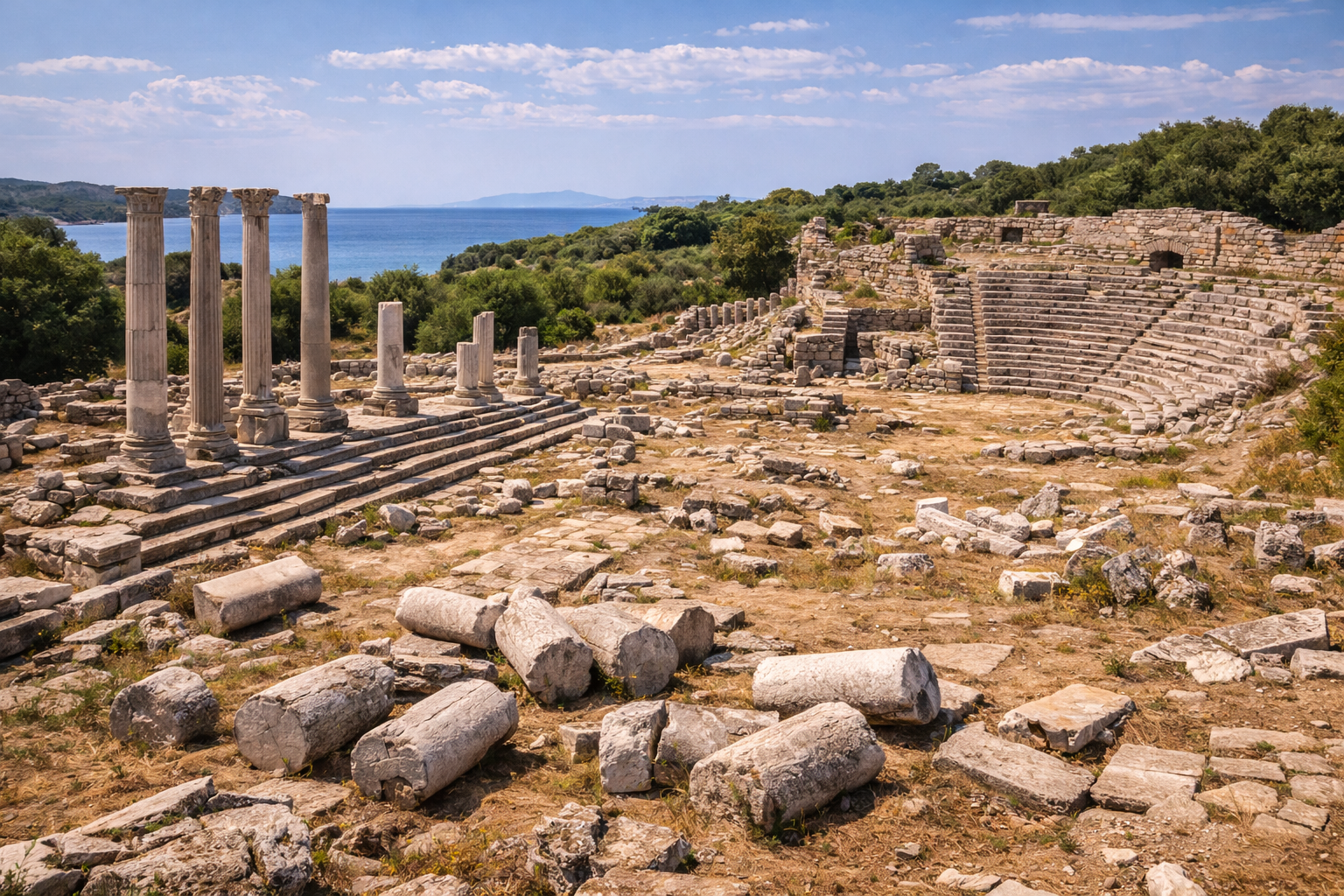
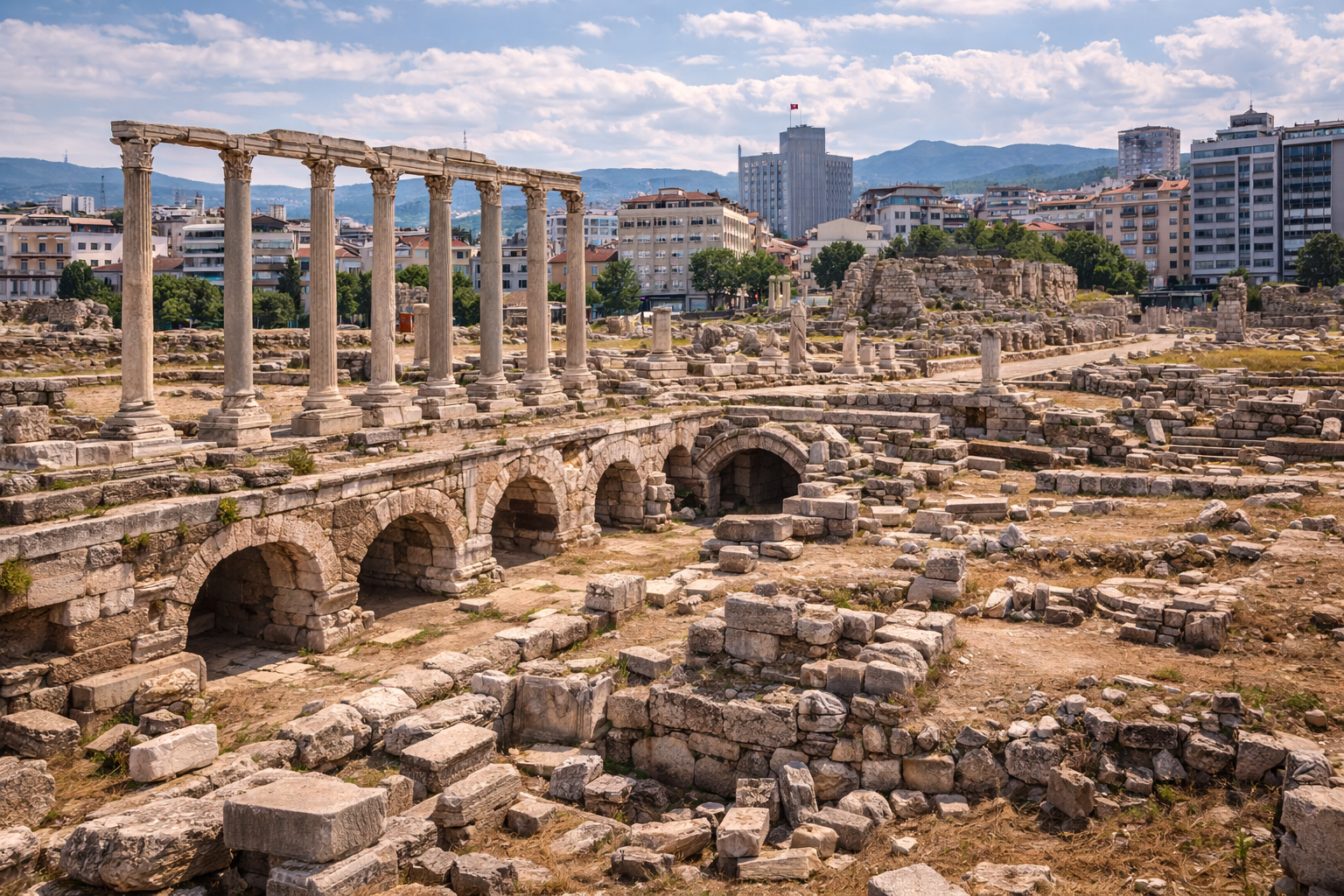
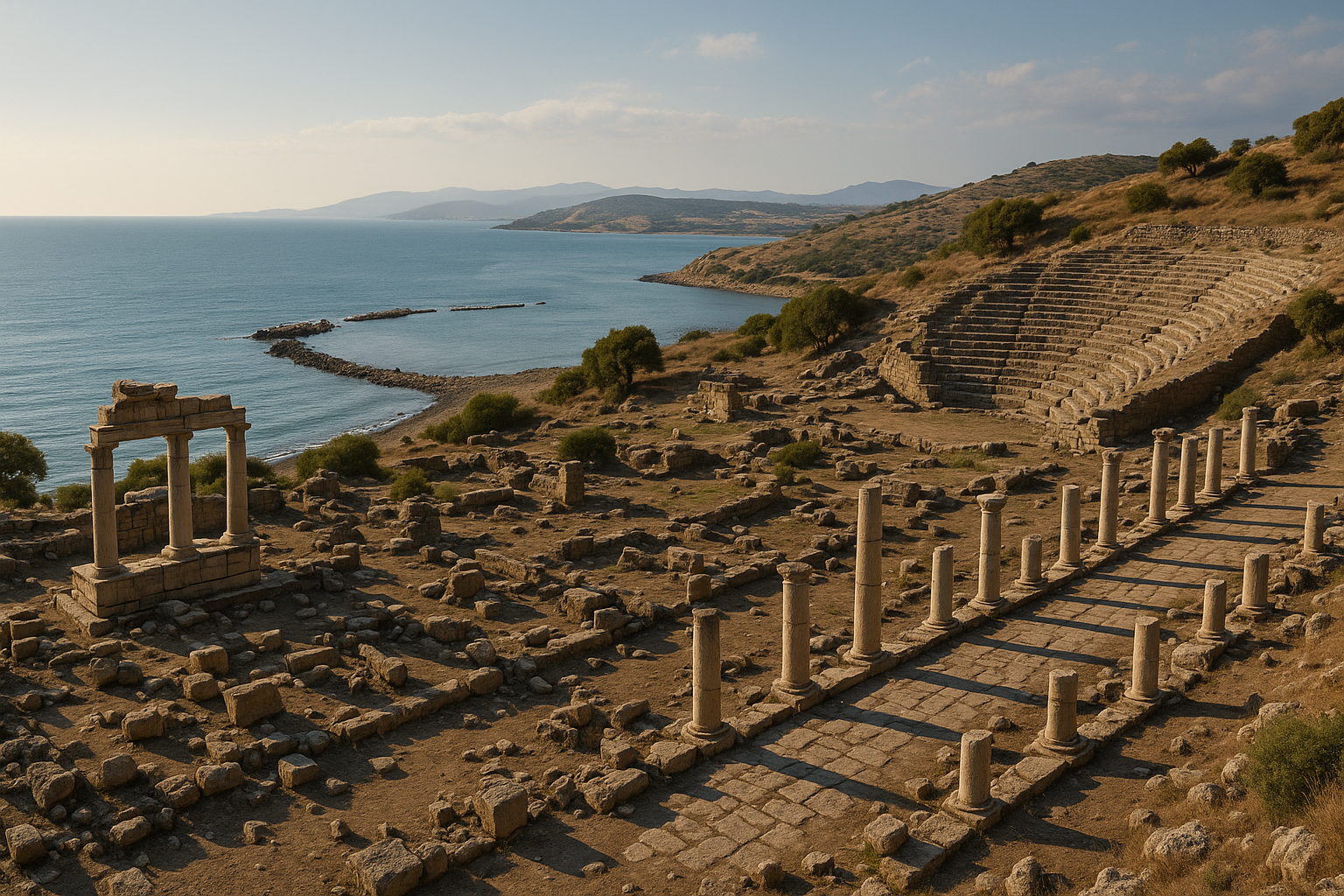
The main monuments visible today include the theatre, cut into the hillside with views of the Aegean; the temple terrace with remains of shrines to Athena Polias, Apollo, and Heracles; the agora, necropolis, and stretches of fortification walls built in polygonal masonry. Excavations by the University of Ankara since...
Beyond the visible ruins, the historical value of this site comes from continuity: changing powers, changing urban functions, and changing ways people used public space over centuries.
Archaeology and Urban Layout
When reading this site on location, focus on three layers:
- Circulation layer: streets, gates, terraces, harbor or slope connections
- Public layer: theaters, agoras, baths, temples, administrative spaces
- Infrastructure layer: water systems, walls, storage zones, service architecture
This method helps visitors and researchers understand the city as a living system rather than isolated monuments.
Visitor Experience
A high-quality visit usually includes:
- A first orientation point (viewpoint, acropolis edge, or central axis)
- A pass through the site’s signature structure
- A slower walk through daily-life spaces
- A final stop connecting ruins with landscape
This sequence creates a stronger historical narrative than quick “photo-only” movement.
A Short Story from the Past
Imagine arriving here in antiquity at sunrise: workers preparing the day, travelers entering through roads or harbor routes, merchants opening storage spaces, and public architecture already shaping movement and ritual. The stones you see today are not silent objects; they are fragments of those repeated daily rhythms.
Practical Travel Notes
- Prefer spring and autumn for comfort.
- In summer, avoid midday peak heat when possible.
- Wear stable walking shoes for uneven terrain.
- Keep enough time (at least 1.5–3 hours) for a meaningful route.
- Check current access and ticket conditions before departure.
FAQ
Why is Ancient City of Erythrae (Ildırı, Izmir) important?
Because it preserves multiple historical layers and helps explain regional cultural continuity in Türkiye.
How long should I spend here?
Most visitors spend 1.5–3 hours; in-depth visits may take half a day.
Is this suitable for first-time archaeology travelers?
Yes. With basic planning, this site is suitable for both first-time and experienced visitors.
Excavation Chronology
| Year / Period | Activity | Director / Institution |
|---|---|---|
| 1891 | First surface survey and topographic sketch | British naval surveyors |
| 1964--1982 | First systematic excavation campaign | Prof. Dr. Ekrem Akurgal & Hakkı Gültekin (Ankara University / Izmir Museum) |
| 1964--1982 | Uncovering of theatre, Temple of Athena Polias podium, fortification walls, necropolis | Cevdet Bayburtluoglu (site planning) |
| 2006/2007--present | Second excavation campaign | Assoc. Prof. Dr. Ayse Gul Akalin Orbay (Ankara University) |
| 2010s | Discovery and registration of the Rock Sanctuary of Kybele as a first-degree archaeological site | Ankara University team |
The first-generation excavations (1964--1982) established the fundamental site plan and revealed the major monumental structures. The second-generation excavations from 2006/2007 onward have focused on sacred areas, ceramic sequences, and the relationship between the harbour quarter and the upper city.
Architectural Measurements of Key Structures
| Structure | Dimensions / Key Details |
|---|---|
| Temple of Athena Polias | 6th c. BC podium; earliest phase dates to second half of 8th c. BCE; Ionic order; podium walls of cut limestone |
| Theatre | Hellenistic, first half of 3rd c. BCE; cavea cut into hillside facing the Aegean; double diazoma; analemma walls rebuilt in Roman period |
| Fortification walls | Polygonal masonry technique; circuit enclosing the acropolis and lower city; total estimated perimeter ~3.5 km |
| Agora | Rectangular plan on the lower terrace; stoa foundations along at least two sides |
| Harbour mole | Submerged rubble-core construction visible in shallow water opposite Chios |
Numismatic Evidence: The Coinage of Erythrae
Erythrae minted coins from the Archaic through the Roman Imperial period, providing a continuous numismatic record of over 800 years.
| Period | Metal | Typical Obverse | Typical Reverse | Notable Features |
|---|---|---|---|---|
| Archaic (6th c. BC) | Electrum / Silver | Pegasus | Incuse square | Among the earliest Ionian coinages |
| Classical (5th--4th c. BC) | Silver / Bronze | Head of Heracles | Club, bow, and quiver | Heraclean iconography dominant |
| Hellenistic (3rd--2nd c. BC) | Bronze | Head of Heracles | Club with magistrate names | Greek legends: ERYTH or ERY |
| Roman Imperial | Bronze | Emperor portrait | Erythraean Sibyl seated | Sibyl depicted with elaborate jewelled hair, enclosed in a sling |
The Erythraean Sibyl appeared on Roman-period civic coinage, making Erythrae one of very few cities to feature a prophetess as a primary reverse type. This reflects the enduring fame of the oracle into the Imperial era.
The Erythraean Sibyl and Prophecy Cult
The Sibyl of Erythrae (Sibylla Erythraea) was one of the most celebrated prophetesses of the ancient Mediterranean world. Ancient sources including Strabo, Pausanias, and Varro mention her prominence:
- Pausanias (10.12.1--8) lists the Erythraean Sibyl among the earliest and most authoritative, alongside the Sibyl of Delphi
- The Sibyl reportedly prophesied the fall of Troy and the coming of Alexander
- In the Christian tradition, the Erythraean Sibyl was adopted as a pagan witness to monotheism; she appears in Michelangelo's Sistine Chapel ceiling (1508--1512)
- The sanctuary area near the Temple of Apollo Delphinion on the acropolis has been identified as the probable locus of the oracular cult
The Kore Sculpture and Key Finds
The excavations around the Temple of Athena Polias yielded one of the most important Archaic sculptures found in Ionia:
- The Erythrae Kore -- a draped female figure (young woman in long dress), dated to the 6th century BC, representing one of the rare surviving examples of Archaic Ionian marble sculpture
- The figure follows the canonical Kore type: frontal stance, elaborately dressed with chiton and himation, with traces of original polychrome paint
- Currently displayed at the Izmir Archaeological Museum
- Additional finds from the temple precinct include Archaic terracotta votives, bronze fibulae, and fragments of painted architectural terracottas
Sources
- https://izmir.ktb.gov.tr/EN-240247/erythrai-ildiri.html
- https://www.turkishmuseums.com/museum/detail/2089-izmir-erythrai-archaeological-site/2089/1
- https://en.wikipedia.org/wiki/Erythrae
- https://oxfordre.com/classics/view/10.1093/acrefore/9780199381135.001.0001/acrefore-9780199381135-e-2847
- https://ancientcitiesturkey.com/en/erythrai
- https://arkeoloji.ankara.edu.tr/erythrai-kazisi/
- https://www.visitizmir.org/en/Destination/10303
- https://commons.wikimedia.org/w/index.php?search=Ancient+City+of+Erythrae&title=Special:MediaSearch&type=image
Advanced Historical Analysis
Political Layering
Ancient City of Erythrae (Ildırı, Izmir) should be interpreted through shifts in political authority, because each regime changed administrative priorities, urban investment, and symbolic architecture. This means visible remains are not neutral stones: they reflect historical decisions about control, legitimacy, and long-term territorial strategy.
Urban Adaptation
Cities evolved according to topography, resources, and mobility constraints. At sites like Ancient City of Erythrae (Ildırı, Izmir), adaptation can be traced in circulation routes, wall systems, water management, and the redistribution of public spaces over time.
Material Continuity and Reuse
A core archaeological reality is reuse: blocks, inscriptions, and architectural elements often migrated across periods. Reuse is not merely practical—it is also cultural messaging, where later communities selectively preserved, transformed, or reinterpreted earlier prestige.
Ritual and Public Memory
Sacred and civic spaces often overlap in long-lived cities. Ritual landscapes can persist even when political systems change, making them critical for studying continuity in collective memory.
Long-Form Visitor Interpretation Framework
Use this 8-step framework on site:
- Establish orientation with topography and route context.
- Identify the best-preserved structural system (walls, harbor, theatre, temple, etc.).
- Distinguish primary phase from later interventions.
- Compare monumental and everyday-life sectors.
- Read water and logistics infrastructure as survival systems.
- Evaluate symbolic/ritual axis and visibility politics.
- Track reuse and repair evidence.
- Conclude with city-landscape relationship at a final viewpoint.
This method improves interpretation quality for both general visitors and advanced readers.
Practical Planning for Researchers and Travelers
- Allocate at least one full interpretation cycle (2–4 hours).
- If available, pair site visit with local museum context.
- Record notes by phase, not by random observation order.
- Separate what is directly visible from what is inferred.
- Use maps and elevation to validate movement assumptions.
Expanded Visitor Q&A
Is this site only for archaeology specialists?
No. Structured route planning and basic historical framing make the site understandable to non-specialists.
Why do different periods overlap in one place?
Because cities are living systems. They are rebuilt, repurposed, and politically reframed rather than created once.
What is the most reliable way to avoid shallow interpretation?
Follow chronology, compare layers, and include infrastructure and landscape in your reading.
Should winter visits be avoided?
Not necessarily. Winter can offer lower crowd density and better interpretive pacing if weather conditions are manageable.
What makes this site distinct from other ancient cities?
Its specific combination of geography, political history, architecture, and continuity across multiple historical transitions.
Advanced Historical Analysis
Political Layering
Ancient City of Erythrae (Ildırı, Izmir) should be interpreted through shifts in political authority, because each regime changed administrative priorities, urban investment, and symbolic architecture. This means visible remains are not neutral stones: they reflect historical decisions about control, legitimacy, and long-term territorial strategy.
Urban Adaptation
Cities evolved according to topography, resources, and mobility constraints. At sites like Ancient City of Erythrae (Ildırı, Izmir), adaptation can be traced in circulation routes, wall systems, water management, and the redistribution of public spaces over time.
Material Continuity and Reuse
A core archaeological reality is reuse: blocks, inscriptions, and architectural elements often migrated across periods. Reuse is not merely practical—it is also cultural messaging, where later communities selectively preserved, transformed, or reinterpreted earlier prestige.
Ritual and Public Memory
Sacred and civic spaces often overlap in long-lived cities. Ritual landscapes can persist even when political systems change, making them critical for studying continuity in collective memory.
Long-Form Visitor Interpretation Framework
Use this 8-step framework on site:
- Establish orientation with topography and route context.
- Identify the best-preserved structural system (walls, harbor, theatre, temple, etc.).
- Distinguish primary phase from later interventions.
- Compare monumental and everyday-life sectors.
- Read water and logistics infrastructure as survival systems.
- Evaluate symbolic/ritual axis and visibility politics.
- Track reuse and repair evidence.
- Conclude with city-landscape relationship at a final viewpoint.
This method improves interpretation quality for both general visitors and advanced readers.
Practical Planning for Researchers and Travelers
- Allocate at least one full interpretation cycle (2–4 hours).
- If available, pair site visit with local museum context.
- Record notes by phase, not by random observation order.
- Separate what is directly visible from what is inferred.
- Use maps and elevation to validate movement assumptions.
Expanded Visitor Q&A
Is this site only for archaeology specialists?
No. Structured route planning and basic historical framing make the site understandable to non-specialists.
Why do different periods overlap in one place?
Because cities are living systems. They are rebuilt, repurposed, and politically reframed rather than created once.
What is the most reliable way to avoid shallow interpretation?
Follow chronology, compare layers, and include infrastructure and landscape in your reading.
Should winter visits be avoided?
Not necessarily. Winter can offer lower crowd density and better interpretive pacing if weather conditions are manageable.
What makes this site distinct from other ancient cities?
Its specific combination of geography, political history, architecture, and continuity across multiple historical transitions.
Advanced Historical Analysis
Political Layering
Ancient City of Erythrae (Ildırı, Izmir) should be interpreted through shifts in political authority, because each regime changed administrative priorities, urban investment, and symbolic architecture. This means visible remains are not neutral stones: they reflect historical decisions about control, legitimacy, and long-term territorial strategy.
Urban Adaptation
Cities evolved according to topography, resources, and mobility constraints. At sites like Ancient City of Erythrae (Ildırı, Izmir), adaptation can be traced in circulation routes, wall systems, water management, and the redistribution of public spaces over time.
Material Continuity and Reuse
A core archaeological reality is reuse: blocks, inscriptions, and architectural elements often migrated across periods. Reuse is not merely practical—it is also cultural messaging, where later communities selectively preserved, transformed, or reinterpreted earlier prestige.
Ritual and Public Memory
Sacred and civic spaces often overlap in long-lived cities. Ritual landscapes can persist even when political systems change, making them critical for studying continuity in collective memory.
Long-Form Visitor Interpretation Framework
Use this 8-step framework on site:
- Establish orientation with topography and route context.
- Identify the best-preserved structural system (walls, harbor, theatre, temple, etc.).
- Distinguish primary phase from later interventions.
- Compare monumental and everyday-life sectors.
- Read water and logistics infrastructure as survival systems.
- Evaluate symbolic/ritual axis and visibility politics.
- Track reuse and repair evidence.
- Conclude with city-landscape relationship at a final viewpoint.
This method improves interpretation quality for both general visitors and advanced readers.
Practical Planning for Researchers and Travelers
- Allocate at least one full interpretation cycle (2–4 hours).
- If available, pair site visit with local museum context.
- Record notes by phase, not by random observation order.
- Separate what is directly visible from what is inferred.
- Use maps and elevation to validate movement assumptions.
Expanded Visitor Q&A
Is this site only for archaeology specialists?
No. Structured route planning and basic historical framing make the site understandable to non-specialists.
Why do different periods overlap in one place?
Because cities are living systems. They are rebuilt, repurposed, and politically reframed rather than created once.
What is the most reliable way to avoid shallow interpretation?
Follow chronology, compare layers, and include infrastructure and landscape in your reading.
Should winter visits be avoided?
Not necessarily. Winter can offer lower crowd density and better interpretive pacing if weather conditions are manageable.
What makes this site distinct from other ancient cities?
Its specific combination of geography, political history, architecture, and continuity across multiple historical transitions.
Advanced Historical Analysis
Political Layering
Ancient City of Erythrae (Ildırı, Izmir) should be interpreted through shifts in political authority, because each regime changed administrative priorities, urban investment, and symbolic architecture. This means visible remains are not neutral stones: they reflect historical decisions about control, legitimacy, and long-term territorial strategy.
Urban Adaptation
Cities evolved according to topography, resources, and mobility constraints. At sites like Ancient City of Erythrae (Ildırı, Izmir), adaptation can be traced in circulation routes, wall systems, water management, and the redistribution of public spaces over time.
Material Continuity and Reuse
A core archaeological reality is reuse: blocks, inscriptions, and architectural elements often migrated across periods. Reuse is not merely practical—it is also cultural messaging, where later communities selectively preserved, transformed, or reinterpreted earlier prestige.
Ritual and Public Memory
Sacred and civic spaces often overlap in long-lived cities. Ritual landscapes can persist even when political systems change, making them critical for studying continuity in collective memory.
Long-Form Visitor Interpretation Framework
Use this 8-step framework on site:
- Establish orientation with topography and route context.
- Identify the best-preserved structural system (walls, harbor, theatre, temple, etc.).
- Distinguish primary phase from later interventions.
- Compare monumental and everyday-life sectors.
- Read water and logistics infrastructure as survival systems.
- Evaluate symbolic/ritual axis and visibility politics.
- Track reuse and repair evidence.
- Conclude with city-landscape relationship at a final viewpoint.
This method improves interpretation quality for both general visitors and advanced readers.
Practical Planning for Researchers and Travelers
- Allocate at least one full interpretation cycle (2–4 hours).
- If available, pair site visit with local museum context.
- Record notes by phase, not by random observation order.
- Separate what is directly visible from what is inferred.
- Use maps and elevation to validate movement assumptions.
Expanded Visitor Q&A
Is this site only for archaeology specialists?
No. Structured route planning and basic historical framing make the site understandable to non-specialists.
Why do different periods overlap in one place?
Because cities are living systems. They are rebuilt, repurposed, and politically reframed rather than created once.
What is the most reliable way to avoid shallow interpretation?
Follow chronology, compare layers, and include infrastructure and landscape in your reading.
Should winter visits be avoided?
Not necessarily. Winter can offer lower crowd density and better interpretive pacing if weather conditions are manageable.
What makes this site distinct from other ancient cities?
Its specific combination of geography, political history, architecture, and continuity across multiple historical transitions.