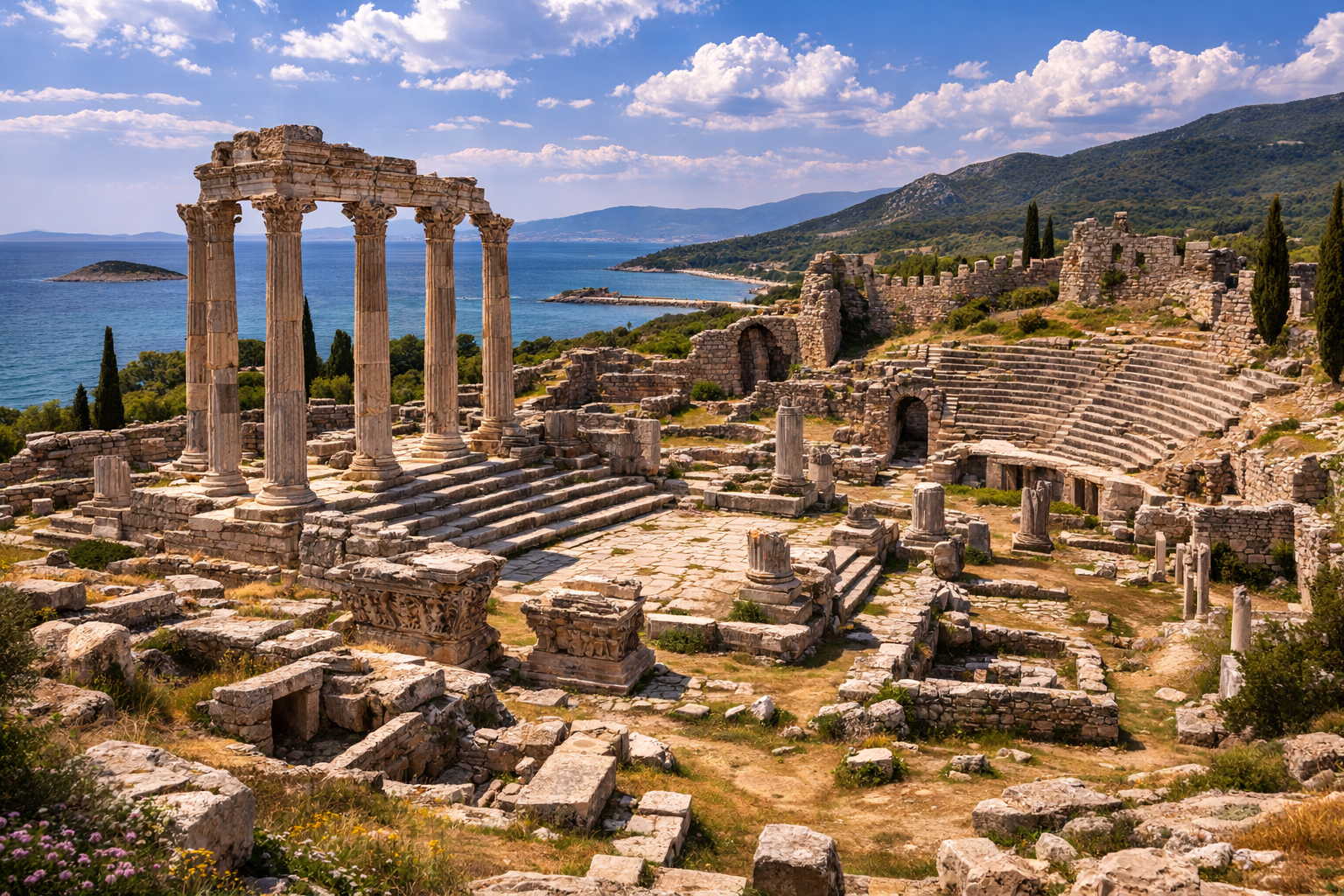
Ancient City of Cyzicus (Erdek, Balıkesir – Propontis)
Quick Summary: The ancient city of Cyzicus (Greek: Κύζικος) stood on the southern shore of the Propontis (Sea of Marmara), near the modern town of Erdek in northwestern Turkey. Founded in the 8th century BC as an Aeolian–Milesian colony, it soon became one of the most powerful maritime cities of the region thanks to its position on the narrow isthmus connecting the Kapıdağ Peninsula to the mainland.
Table of Contents
- Overview
- Historical Background
- Archaeology and Urban Layout
- Visitor Experience
- A Short Story from the Past
- Practical Travel Notes
- FAQ
- Sources
Overview
The ancient city of Cyzicus (Greek: Κύζικος) stood on the southern shore of the Propontis (Sea of Marmara), near the modern town of Erdek in northwestern Turkey. Founded in the 8th century BC as an Aeolian–Milesian colony, it soon became one of the most powerful maritime cities of the region thanks to its position on the narrow isthmus connecting the Kapıdağ Peninsula to the mainland.
This page is designed for real visitors: not only what this place is, but why it matters and how to experience it meaningfully.
Historical Background
The ancient city of Cyzicus (Greek: Κύζικος) stood on the southern shore of the Propontis (Sea of Marmara), near the modern town of Erdek in northwestern Turkey. Founded in the 8th century BC as an Aeolian–Milesian colony, it soon became one of the most powerful maritime cities of the region thanks to its position on the narrow isthmus connecting the Kapıdağ Peninsula to the mainland.
(Source: Wikipedia – Cyzicus; Livius.org – Cyzicus)
Ancient authors such as Herodotus, Xenophon, and Strabo describe Cyzicus as a rich trading hub situated on two natural harbours. Its prosperity stemmed from fishing, agriculture, and especially coinage. From the 6th century BC, Cyzicus issued electrum staters, known in antiquity as “Kyzikenes,” which became an international trade currency throughout the Aegean and Black Sea.
(Source: Wikipedia – Cyzicus / Economy; NumisWiki – Cyzicus Electrum Coinage)
During the Hellenistic and Roman periods, Cyzicus was granted the status of a free city and served as the provincial capital of Mysia within the Roman province of Asia. The city flourished under the emperors Hadrian and Antoninus Pius, who sponsored large-scale building projects including a massive marble temple dedicated to Emperor Hadrian—the so-called Hadrianeion—described by ancient sources as one of the largest temples ever constructed in the Roman world.
(Source: Livius.org – Cyzicus; Ancient Ports & Harbours – Cyzicus entry)
Archaeological remains include parts of the Hadrianic Temple, city walls, a theatre, stadium, agora, and extensive aqueducts supplying water from the mountains of Kapıdağ. Excavations led by Bandırma Onyedi Eylül University have uncovered new evidence of monumental marble architecture and sculptural fragments, suggesting that Cyzicus rivalled Pergamon and Ephesus in urban splendour.
(Source: Turkish Archaeological News – Cyzicus; Anadolu Agency – Cyzicus excavations)
The city’s importance declined after severe **earthqu...
Beyond the visible ruins, the historical value of this site comes from continuity: changing powers, changing urban functions, and changing ways people used public space over centuries.
Archaeology and Urban Layout
When reading this site on location, focus on three layers:
- Circulation layer: streets, gates, terraces, harbor or slope connections
- Public layer: theaters, agoras, baths, temples, administrative spaces
- Infrastructure layer: water systems, walls, storage zones, service architecture
This method helps visitors and researchers understand the city as a living system rather than isolated monuments.
Visitor Experience
A high-quality visit usually includes:
- A first orientation point (viewpoint, acropolis edge, or central axis)
- A pass through the site’s signature structure
- A slower walk through daily-life spaces
- A final stop connecting ruins with landscape
This sequence creates a stronger historical narrative than quick “photo-only” movement.
A Short Story from the Past
Imagine arriving here in antiquity at sunrise: workers preparing the day, travelers entering through roads or harbor routes, merchants opening storage spaces, and public architecture already shaping movement and ritual. The stones you see today are not silent objects; they are fragments of those repeated daily rhythms.
Practical Travel Notes
- Prefer spring and autumn for comfort.
- In summer, avoid midday peak heat when possible.
- Wear stable walking shoes for uneven terrain.
- Keep enough time (at least 1.5–3 hours) for a meaningful route.
- Check current access and ticket conditions before departure.
FAQ
Why is Ancient City of Cyzicus (Erdek, Balıkesir – Propontis) important?
Because it preserves multiple historical layers and helps explain regional cultural continuity in Türkiye.
How long should I spend here?
Most visitors spend 1.5–3 hours; in-depth visits may take half a day.
Is this suitable for first-time archaeology travelers?
Yes. With basic planning, this site is suitable for both first-time and experienced visitors.
Sources
- https://en.wikipedia.org/wiki/Cyzicus
- https://www.livius.org/articles/place/cyzicus/
- https://en.wikipedia.org/wiki/Cyzicus#Economy
- https://www.forumancientcoins.com/numiswiki/view.asp?key=cyzicus
- https://www.ancientportsantiques.com/wp-content/uploads/Documents/PLACES/Marmara/Cyzicus.pdf
- https://turkisharchaeonews.net/site/cyzicus
- https://www.aa.com.tr/en/culture/mythical-argos-ship-saga-city-cyzicus-being-excavated-in-turkey/3254097
- https://en.wikipedia.org/wiki/Cyzicus#Later_history